Anaes · Regional / perioperative medicine
Perioperative VTE prophylaxis and neuraxial anaesthesia timing
Also known as perioperative vte prophylaxis neuraxial
Exam-exhaustive VTE prophylaxis versus neuraxial haematoma risk: Caprini/Padua-type risk, mechanical and pharmacological methods, ASRA principles for drug-specific timing, catheter removal rules, combination therapy, and emergency haematoma pathway for ANZCA Final.
On this page & tools
Your progress
Saved locally on this device.
8 MCQs with explanations
Target exams
Red flags
Why this is examined / the one-line answer
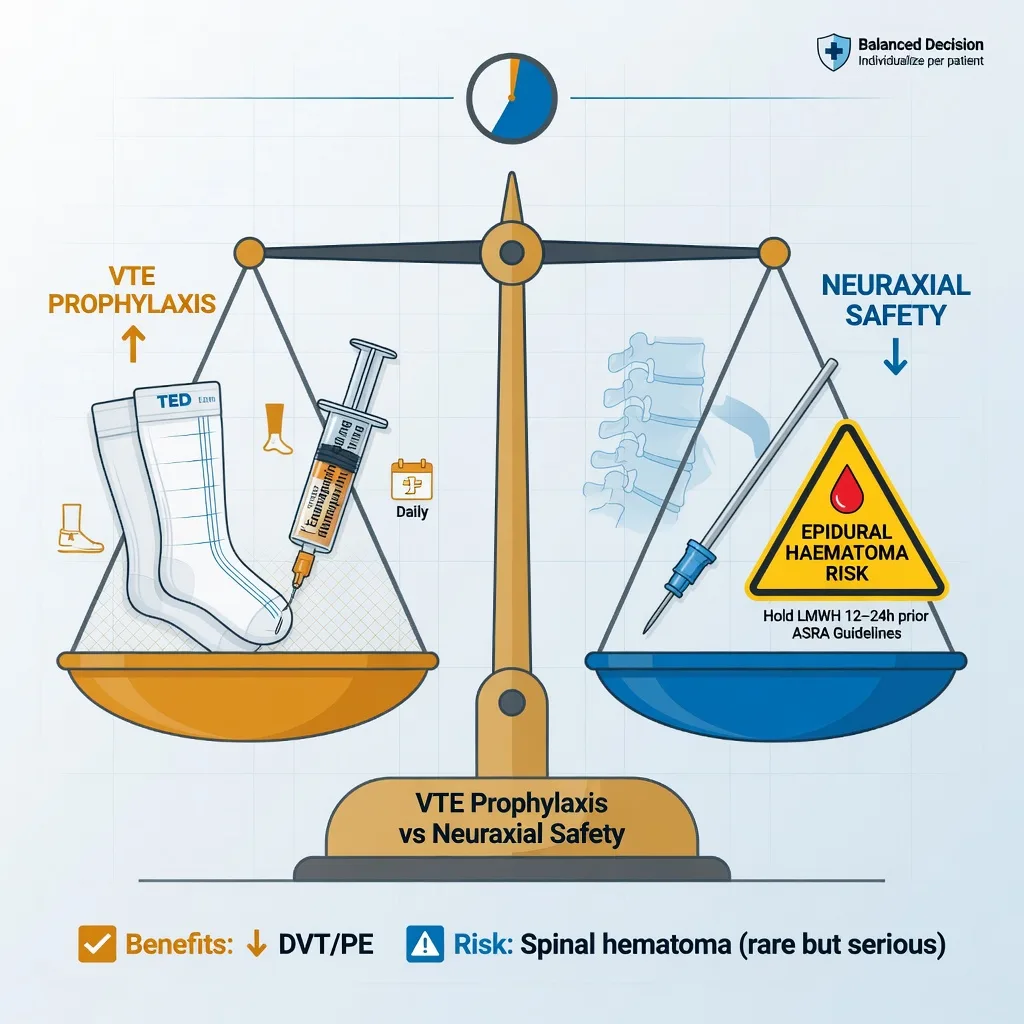
Major orthopaedic and general surgery patients need venous thromboembolism (VTE) prophylaxis, while neuraxial anaesthesia demands drug-specific timing to avoid spinal or epidural haematoma. Fellowship examiners test whether you can hold both truths at once: omit prophylaxis and patients clot; ignore ASRA-type intervals and patients may be permanently paraplegic. The discriminating skill is principles and table use, not reckless recitation of every hour for every drug from imperfect memory. [1]
The one-line answer: I stratify VTE risk, use mechanical methods early, and time pharmacological prophylaxis around neuraxial needle placement and catheter removal using current ASRA (or national equivalent) drug-specific tables that account for dose, renal function, and combination therapy — I will not invent intervals, and progressive motor block after anticoagulation restart is a haematoma emergency until proven otherwise.[1]
Preoperative assessment and risk stratification
VTE risk
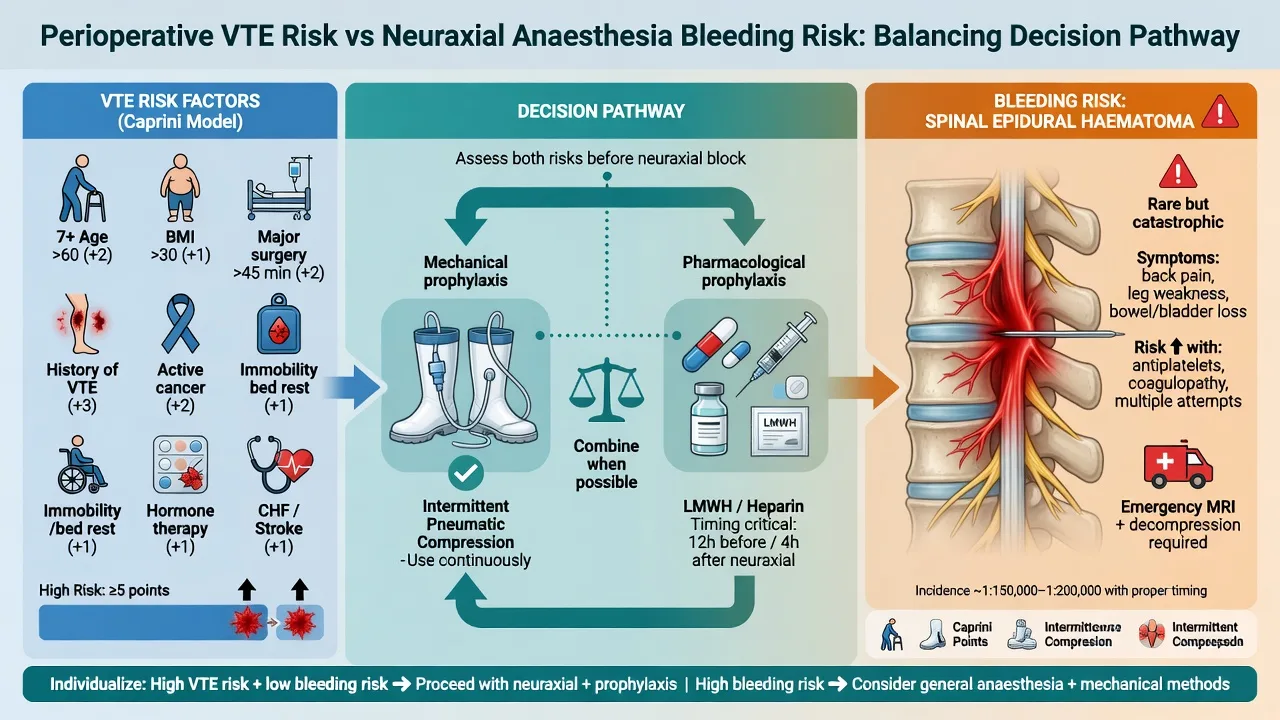
Use structured tools in the spirit of Caprini (surgical) or Padua (medical) scores: age, prior VTE, thrombophilia, malignancy, hip or knee arthroplasty, hip fracture, immobility, obesity, oestrogen therapy, stroke with paralysis, and acute inflammatory states. Orthopaedic arthroplasty and major lower-limb surgery sit in high intrinsic risk bands even without additional factors. [1]
Bleeding risk
Active bleeding, inherited coagulopathy, severe thrombocytopenia, uncontrolled hypertension, recent neuraxial or intracranial haemorrhage, and planned neuraxial or deep plexus block all modify the pharmacological plan. HAS-BLED-type thinking (hypertension, renal/liver disease, stroke history, bleeding history, labile INR, elderly, drugs/alcohol) helps communicate bleeding risk on anticoagulants even though it is an AF score originally. [1]
Exact drug history — the non-negotiable details
Document: drug name, dose (prophylactic versus therapeutic), indication (VTE treatment vs AF stroke prevention vs ACS dual therapy), last dose date and time, renal function (creatinine clearance for DOACs and LMWH accumulation), hepatic function, body weight, and combination therapy (for example LMWH plus aspirin, or DOAC plus antiplatelet). Dual or triple therapy multiplies neuraxial haematoma risk. [1]
Planned technique
Single-shot spinal, epidural catheter, CSE, and deep peripheral plexus blocks have different risk profiles; ASRA addresses neuraxial and some deep blocks specifically — apply the same caution mindset to deep approaches.[1] Superficial blocks still require LAST preparedness when large volumes are used.[3]
Applied pathophysiology
Virchow triad in the surgical patient
Stasis (immobility, tourniquet, heart failure), endothelial injury (surgery, trauma), and hypercoagulability (acute phase response, cancer, oestrogen) drive DVT and PE. Neuraxial anaesthesia may improve flow via sympathectomy and better analgesia facilitating mobilisation, but it does not replace pharmacological prophylaxis in high-risk arthroplasty pathways. [1]
Neuraxial haematoma physics
Bleeding into the fixed volume of the spinal canal compresses the cord or cauda equina. Risk rises with coagulopathy, traumatic puncture, larger needle trauma, indwelling catheters, advanced age, spinal abnormalities, and combination antithrombotics. Presentation: severe back pain, progressive motor or sensory block, bowel or bladder dysfunction — time to decompression determines outcome. [1]
Anaesthetic goals
- Deliver effective anaesthesia and analgesia.
- Do not create an unmonitored window for catastrophic neuraxial bleeding.
- Do not omit indicated VTE prevention.
- Document exact times of needle, catheter removal, and anticoagulant doses.
- Ensure ward teams know neurological observation triggers.
- Coordinate TXA for blood conservation with — not instead of — VTE plans.[2]
ASRA principles (use current tables)
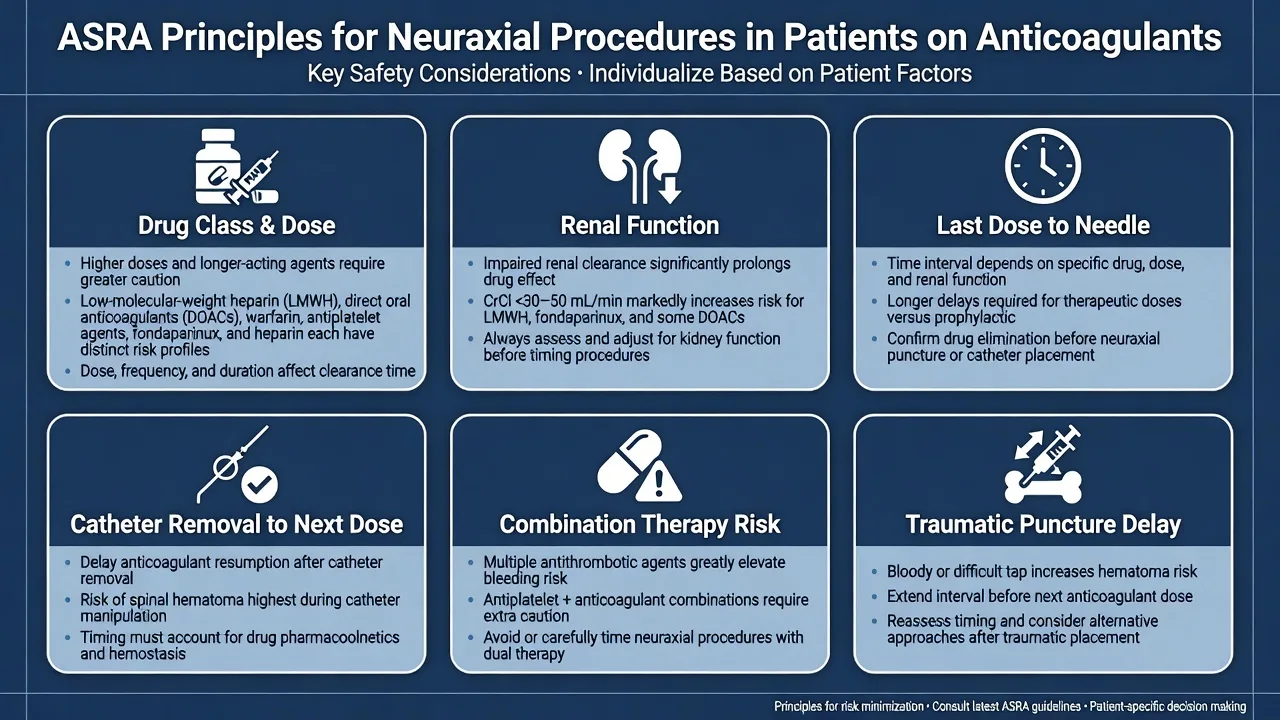
ASRA evidence-based guidelines structure decisions around:[1]
- Drug class and dose — prophylactic LMWH intervals differ from therapeutic LMWH; DOACs differ from warfarin; thrombolytics are usually prohibitive.
- Pharmacokinetics and renal clearance — accumulation lengthens the safe wait (especially enoxaparin and DOACs in CKD).
- Interval from last dose to needle or catheter placement.
- Interval from catheter removal to next anticoagulant dose.
- Combination therapy multiplies risk (LMWH + antiplatelet; multiple agents).
- Traumatic (bloody) puncture may warrant delaying restart and senior discussion.
- NSAID monotherapy is generally lower risk than anticoagulants, but combinations matter.
- HIT surveillance if heparin exposure for several days before catheter manipulation.
- Warfarin decisions incorporate INR targets before neuraxial procedures.
- Uraemia and antiplatelet loading for ACS require cardiology–anaesthesia joint plans. [1]
Technique options when timing cannot be met
If the ASRA interval for a needed drug cannot be satisfied and surgery cannot wait: use general anaesthesia plus peripheral nerve blocks where superficial enough and still ASRA-cautious for deep blocks, mechanical prophylaxis (intermittent pneumatic compression, graduated compression stockings when appropriate), and optimised pharmacological VTE plan as soon as safe postoperatively. Do not perform neuraxial “because the patient prefers it” against an unsafe coagulation window. [1]
For single-shot spinal versus epidural catheter: catheters prolong the risk window because removal is a second haemostatic challenge — plan catheter duration consciously. [1]
Monitoring and equipment
Neurological observation protocol after neuraxial techniques in patients receiving anticoagulants: hourly then regular motor and sensory checks per local pathway. Progressive weakness after a block should be wearing off is a red flag. Immediate access to emergency MRI and spine surgical decompression pathways — do not wait for “review tomorrow.” [1]
Intraoperative management
Document atraumatic versus traumatic (bloody) insertion. Record exact time of block. Communicate anticoagulant plan on the theatre whiteboard and in the notes. Avoid unnecessary dual antiplatelet loading perioperatively without indication. If massive haemorrhage requires reversal of anticoagulation, document what was given and when neuraxial might next be safe. [1]
Crisis pivots — suspected epidural haematoma
Haematoma red flags
Do not attribute new dense motor block solely to “epidural still working” after a long interval or after anticoagulant restart. Stop epidural infusions if needed to clarify neurology, but imaging must not be delayed by false reassurance. [1]
Pulmonary embolism crisis: support oxygenation and circulation, anticoagulation when neuraxial risk allows or after catheter removal timing, thrombolysis only with extreme caution if a neuraxial catheter is in situ or recent — this is a true competing-risk disaster needing senior multidisciplinary decisions. [1]
Postoperative VTE plan
Mechanical methods early and consistently. Pharmacological agents per orthopaedic or institutional protocol (often LMWH or a DOAC after arthroplasty once haemostasis allows). Match catheter removal to the ASRA table before the next dose.[1] Mobilise as ERAS allows — mobilisation is part of prophylaxis. TXA for blood conservation does not replace VTE prophylaxis.[2] Extended prophylaxis duration after hip/knee arthroplasty follows orthopaedic guidelines (often weeks — quote local protocol).
Special populations
Renal impairment: prolonged DOAC and LMWH effect — longer waits, dose adjustment, consider anti-Xa or drug levels where available. Pregnancy and labour epidurals: obstetric ASRA/SOAP-type guidance — same haematoma physics, different clinical culture and urgency. Cancer: high VTE risk, often therapeutic dosing issues. Trauma with bleeding then delayed prophylaxis: document the intentional gap and restart plan. Epidural for labour versus orthopaedic catheter: do not import casual timing habits across settings. [1]
Worked examples (principle-based, table-dependent)
Example A — prophylactic enoxaparin 40 mg subcutaneous daily, normal renal function, elective spinal for TKA.
Stop at a table-compliant interval before needle placement; perform atraumatic spinal if possible; restart LMWH at a table-compliant interval after the block, coordinated with surgical haemostasis. Mechanical IPC from recovery. Do not give the evening dose early for nursing convenience if the interval after spinal is insufficient. [1]
Example B — therapeutic enoxaparin 1 mg/kg twice daily for acute DVT, needs laparotomy, wants epidural.
Therapeutic dosing usually makes neuraxial high risk or contraindicated until held for the longer therapeutic interval and haemostasis is assured; prefer GA plus multimodal analgesia, or delay epidural until coagulation safe. Treat the VTE — do not leave it untreated without an alternative plan (IVC filter only in highly selected circumstances with vascular input). [1]
Example C — rivaroxaban 20 mg daily for AF, eGFR 35, last dose 24 hours ago, patient wants spinal.
Renal impairment prolongs DOAC effect. Use the ASRA DOAC row for that drug and renal band; if residual effect likely, delay neuraxial, consider calibrated anti-Xa if available and expert interpretation exists, or choose GA. Stroke risk from holding anticoagulation must be balanced with haematoma risk — shared decision with cardiology for complex AF cases. [1]
Example D — epidural catheter day 2, next dalteparin due, bloody insertion documented.
Traumatic insertion may warrant delaying the next dose and senior discussion; remove catheter only when the table says removal is safe relative to the last dose; observe neurology intensively. [1]
Mechanical prophylaxis done properly
Intermittent pneumatic compression must be fitted correctly and running nearly continuously when in bed — devices left in the cupboard do not prevent PE. Graduated compression stockings have mixed evidence and contraindication lists (peripheral vascular disease, neuropathy, ill-fitting). Early mobilisation is a drug. Hydration and avoiding unnecessary central lines that immobilise patients help. [1]
Warfarin, INR, and bridging
For patients on warfarin, ASRA-type guidance uses INR thresholds before neuraxial procedures (commonly INR ≤1.4 is cited in many protocols for elective neuraxial — confirm current table). Bridging with LMWH creates its own timing complexity and is not automatically indicated for all AF patients — follow thrombosis risk stratification. Vitamin K or prothrombin complex concentrate reversal is for bleeding or emergency surgery, not casual neuraxial convenience. [1]
Antiplatelets and dual therapy
Aspirin monotherapy is often continued for cardiac stents perioperatively when bleeding risk allows, and is relatively lower risk for neuraxial than anticoagulants in ASRA framing. P2Y12 inhibitors (clopidogrel, ticagrelor, prasugrel) have longer holds before neuraxial in the tables. Dual antiplatelet therapy after recent coronary stents is a cardiology emergency discussion if surgery cannot wait — stopping both agents risks stent thrombosis; neuraxial may be inappropriate. [1]
Ward communication package (write this in the notes)
- Time of neuraxial needle / catheter insertion.
- Traumatic or atraumatic.
- Last anticoagulant dose time and next eligible time from table.
- Catheter removal planned time and post-removal dose time.
- Neurological observation frequency and red flags.
- Named person to call for progressive weakness.
- VTE mechanical devices in place. [1]
Competing disasters: PE with an epidural in situ
Massive PE may need anticoagulation or thrombolysis while an epidural catheter is present — haematoma risk skyrockets with thrombolysis. Senior multidisciplinary decision: remove catheter only if timing allows before lysis (often it does not in true arrest), accept haematoma risk to save life, or use mechanical/ECMO strategies in extreme centres. Document the conflict explicitly. [1]
European and local guideline harmony
ASRA fourth edition (Horlocker et al., 2018) is the citation most Australian and New Zealand examiners recognise; ESA and national societies publish parallel tables that differ in detail. The exam skill is to name the framework and use the institutional table hanging in theatre, not to fight about a one-hour discrepancy between societies under viva stress. When tables conflict, choose the more conservative interval for haematoma prevention and document. [1]
Thrombophilia and high lifetime VTE risk
Patients with antiphospholipid syndrome, active cancer, or prior PE on suboptimal anticoagulation need haematology input. Neuraxial may still be possible if drug timing is perfect, but the cost of missing doses is higher — plan bridging and mechanical methods obsessively. Inferior vena cava filters are not routine VTE prophylaxis for surgery; they are specialised interventions with their own complications. [1]
Neuraxial after thrombolysis or in DIC
Recent thrombolysis is generally a hard stop for neuraxial. DIC and trauma coagulopathy likewise. Normalise coagulation (platelets, fibrinogen, PT/APTT as context requires) before elective neuraxial; in emergencies, choose GA. [1]
LAST remains relevant when you pivot to peripheral blocks
If you abandon neuraxial because of anticoagulation timing and place large-volume peripheral blocks instead, you inherit LAST risk — lipid 1.5 mL/kg readiness still applies. Deep plexus blocks may still have haematoma risk under anticoagulation; ASRA discusses deep blocks cautiously. [1]
Documentation that wins coroners and exams
Write times to the minute, drug names and doses, table used, traumatic stick yes/no, and the neurological observation plan. Vague notes (“LMWH later”) are how haematoma cases become indefensible. [1]
Hip fracture pathway special case
Elderly hip fracture patients need early surgery, often spinal anaesthesia, and have high VTE risk. Admission LMWH timing frequently conflicts with morning spinal lists. Solutions: schedule surgery before the next LMWH dose when possible, use unfractionated heparin with shorter hold times when tables allow, or choose GA when anticoagulation cannot be timed safely. Do not cancel life-improving early hip fracture surgery indefinitely for a perfect epidural window — pick a safe single-shot spinal moment or GA and still protect against VTE postoperatively. [1]
Patient education lines
We will prevent blood clots with stockings or pumps and injections when safe. Because you are having a spinal/epidural, the timing of those injections is carefully controlled to avoid rare bleeding around the spinal cord. Tell nurses immediately if your legs become weaker after the block should have worn off or if you develop severe back pain. [1]
Caprini-type factors worth reciting
Age bands, surgery type and duration, obesity, prior VTE, family history/thrombophilia, malignancy, mobility, central lines, oestrogen/SERMs, COPD/acute MI/sepsis inflammatory states, and hip/leg fractures all push scores up. You need not reproduce every Caprini point value from memory, but you must show structured risk thinking and then match prophylaxis intensity to risk while protecting the neuraxial window. [1]
Unfractionated heparin nuances
Subcutaneous UFH prophylactic dosing has shorter hold times than LMWH in many tables; IV heparin infusions are stopped for a defined number of hours and sometimes checked with aPTT before neuraxial. Heparin is useful when surgery timing is unpredictable (hip fracture lists) because offset is faster than LMWH — still use the table, not guesswork. [1]
One-line viva closers
I time the needle and the next dose from the current ASRA table for this drug, dose, and creatinine clearance. Combination therapy is a haematoma multiplier. Progressive motor block after restart is a scanner-and-surgeon emergency, not a wait-and-see ward problem. [1]
When unsure, choose the safer interval, use mechanical prophylaxis without pause, and escalate to a senior or haematologist rather than guessing a number that could paraplegise a patient or leave a high-risk arthroplasty unprotected against PE. [1]
SAQ answer scaffold
Stem: Patient on rivaroxaban for AF for elective TKA requesting spinal anaesthesia; eGFR 40. [1]
- VTE vs stroke vs haematoma balance (3 marks).
- Information needed (3 marks): last dose time, exact dose, renal function, other antiplatelets, surgical bleed risk.
- ASRA principles without inventing hours (4 marks).[1]
- If spinal unsafe (2 marks): GA + peripheral motor-sparing blocks + mechanical and timed pharmacological VTE plan.
- Haematoma recognition (3 marks).
Viva stem bank and model phrases
Stem 1: “When can I site the spinal after enoxaparin?”
Model: “I use the current ASRA table for prophylactic versus therapeutic dose and renal function — I will not invent a number under pressure.”[1]
Stem 2: “Epidural still in, next LMWH due.”
Model: “I time the dose after catheter removal according to the table, not by ward convenience.” [1]
Stem 3: “New dense motor block 12 hours after restart of LMWH.”
Model: “Epidural haematoma until proven otherwise — emergency imaging and spine surgical review now.” [1]
Stem 4: “Is aspirin alone a contraindication to spinal?”
Model: “NSAID or aspirin monotherapy is generally lower risk than anticoagulants in ASRA framing, but combination therapy and clinical context matter.” [1]
Stem 5: “Caprini high — mechanical only?”
Model: “Mechanical methods alone are insufficient for many high-risk orthopaedic patients — they are adjuncts, not full substitutes for indicated drugs when bleeding risk allows.” [1]
Stem 6: “TXA given — can I skip LMWH?”
Model: “No. TXA reduces bleeding; it does not replace VTE prophylaxis.”[2]
Common traps
- Using prophylactic LMWH intervals for treatment doses
- Removing an epidural then immediately giving therapeutic anticoagulation
- Ignoring combination aspirin plus LMWH
- Delaying imaging when motor block deepens
- Inventing hour numbers confidently and wrongly
- Omitting mechanical prophylaxis while waiting for drug windows
- Forgetting renal adjustment for DOACs [1]
ANZCA candidates may be asked to apply local hospital protocols that track ASRA or European society tables — the exam skill is the framework and safety culture, not bluffing precise hours for every DOAC without the table.
References
- [1]Horlocker TT et al. Regional Anesthesia in the Patient Receiving Antithrombotic or Thrombolytic Therapy: American Society of Regional Anesthesia and Pain Medicine Evidence-Based Guidelines (Fourth Edition) Reg Anesth Pain Med, 2018.PMID 29561531
- [2]CRASH-2 trial collaborators Effects of tranexamic acid on death, vascular occlusive events, and blood transfusion in trauma patients with significant haemorrhage (CRASH-2): a randomised, placebo-controlled trial Lancet, 2010.PMID 20554319
- [3]Neal JM et al. The Third American Society of Regional Anesthesia and Pain Medicine Practice Advisory on Local Anesthetic Systemic Toxicity: Executive Summary 2017 Reg Anesth Pain Med, 2018.PMID 29356773