Anaes · Neuroanaesthesia
Transsphenoidal pituitary surgery: hormones, airway, and DI
Also known as TSS pituitary · Acromegaly anaesthesia · Postop diabetes insipidus
Exam-exhaustive anaesthesia for endoscopic and microscopic transsphenoidal pituitary surgery: hormone phenotype map (acromegaly airway, Cushing comorbidity, hypopituitarism), steroid cover, still bloodless field, smooth emergence for early vision check, CSF leak precautions, and structured diabetes insipidus recognition with desmopressin for ANZCA Final and equivalents.
On this page & tools
Your progress
Saved locally on this device.
10 MCQs with explanations
Target exams
Red flags
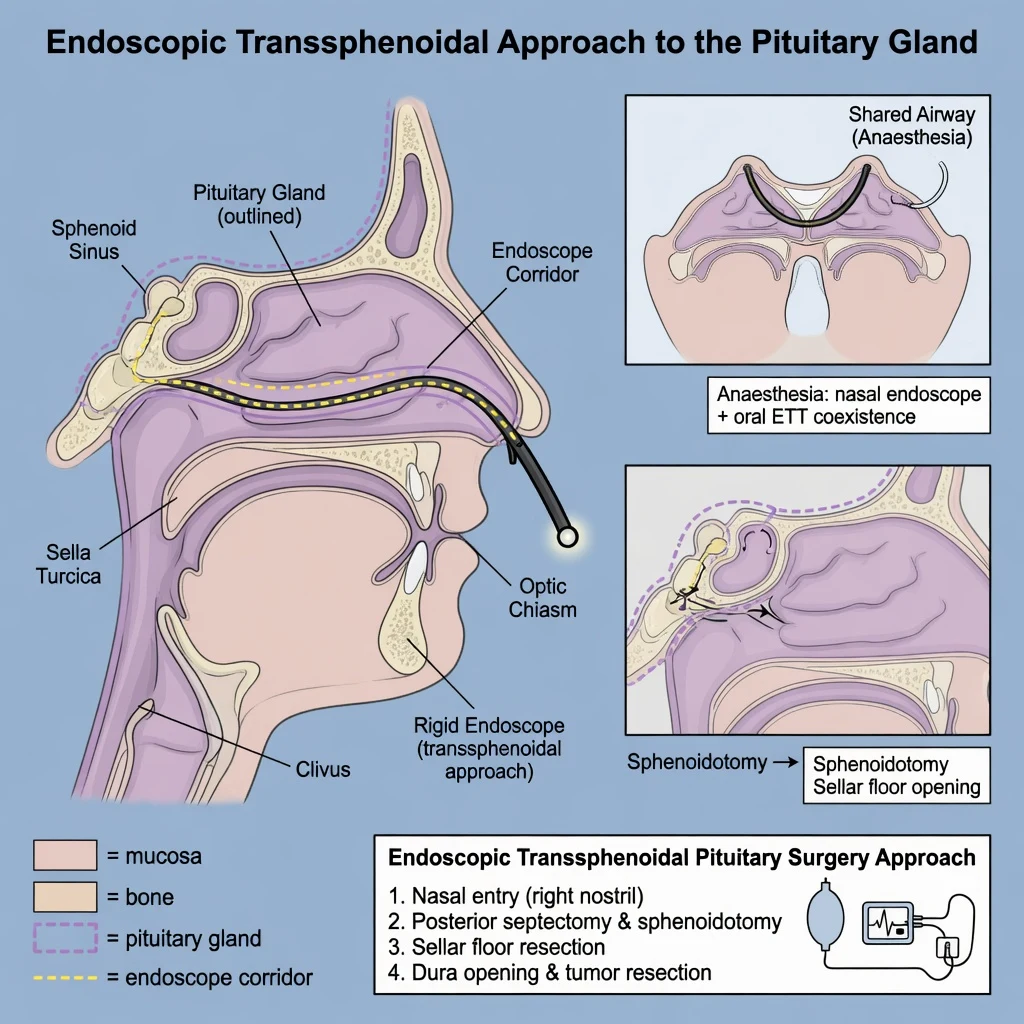
Why this is examined / the one-line answer
Transsphenoidal pituitary surgery is a high-yield neuroanaesthesia and endocrine intersection topic on the ANZCA Final Examination (and FRCA Final, EDAIC Part II, ABA APPLIED, and FCAI). Examiners are not testing whether you can name a nasal endoscope; they are testing whether you can map the hormone phenotype to specific anaesthetic risks, secure a potentially difficult acromegalic airway, cover the cortisol axis when it is unreliable, keep a still and relatively bloodless endoscopic field, emerge smoothly for early vision assessment, and recognise postoperative diabetes insipidus before sodium climbs dangerously.[1]
The one-line viva opener is: I prepare for the endocrine phenotype — especially acromegaly airway and steroid cover — provide a still bloodless field with controlled blood pressure for the endoscopic corridor, plan smooth emergence for immediate visual assessment, and run structured DI and CSF-leak surveillance postoperatively. Everything else in this topic is the anatomy, hormone physiology, pharmacology, crisis algorithms, and decision tables that justify that sentence.
[3]Pituitary adenomas are common neurosurgical workloads: non-functioning macroadenomas present with mass effect and hypopituitarism; functioning tumours produce acromegaly, Cushing disease, hyperprolactinaemia, or rare TSH excess. Approaches are predominantly endoscopic endonasal; microscopic sublabial routes remain examinable historically. Shared-airway proximity to ENT and neurosurgery, venous bleeding from cavernous sinus neighbours, and the sellar floor repair all shape anaesthetic technique.[1]
Preoperative assessment and risk stratification
Hormone phenotype map
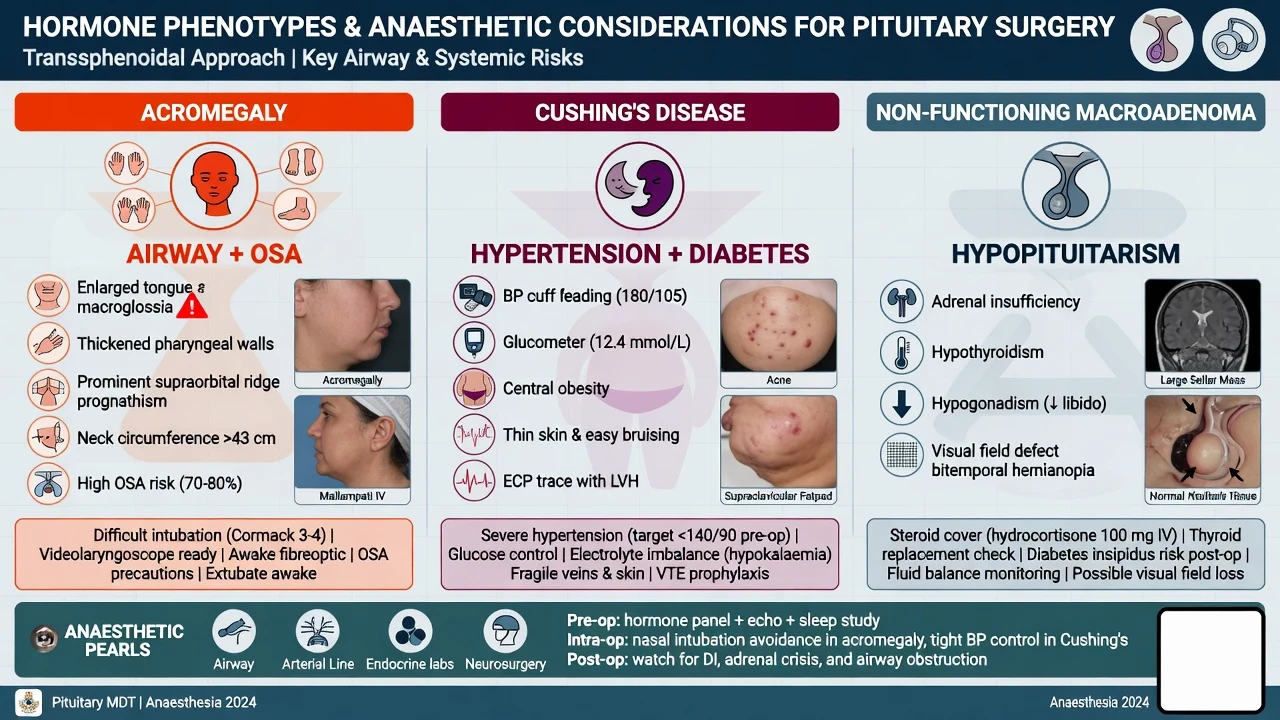
Every patient needs a written hormone map before induction. The operation is one corridor; the physiology is five different diseases.
[3]History and examination that change the plan
Mass effect: progressive visual field loss (bitemporal hemianopia classically), headache, cranial nerve palsies if cavernous sinus invasion, pituitary apoplexy (sudden headache, acute visual loss, haemodynamic instability) as an emergency pathway. Hypopituitarism symptoms: fatigue, orthostatic intolerance, cold intolerance, amenorrhoea, loss of libido, polyuria/polydipsia already present. Acromegaly: ring/shoe size change, prognathism, macroglossia, spaced teeth, thick soft tissues, carpal tunnel, OSA symptoms (snoring, daytime somnolence), hypertension, cardiomyopathy history, diabetes. Cushing: central obesity, moon face, buffalo hump, easy bruising, proximal weakness, hypertension, diabetes, psychiatric features, high VTE risk.
[1]Airway-focused exam in acromegaly: Mallampati, mouth opening, tongue size relative to oral cavity, thyromental distance, neck mobility, ability to protrude the mandible, beard and soft-tissue bulk, resting SpO2 and STOP-BANG or equivalent OSA screen. Do not rely on a normal-looking neck to exclude difficult bag-mask ventilation. Document a provisional Plan A/B/C airway strategy before induction and escalate early to video laryngoscopy, second-generation SGA readiness, and DAS-style failed intubation thinking when predicted difficulty is high.[3]
Investigations and endocrine optimisation
Review MRI (tumour size, suprasellar extension, cavernous invasion, hydrocephalus if any), formal visual fields, morning cortisol and ACTH axis testing, free T4/TSH, prolactin, IGF-1/GH axis results as relevant, electrolytes (especially sodium), glucose/HbA1c, ECG, and echocardiography if acromegaly with cardiomyopathy or severe hypertension. Correct severe hyponatraemia carefully before elective surgery. Optimise blood pressure and glucose. Discuss with endocrinology whether perioperative glucocorticoid cover is required: stress-dose hydrocortisone when the ACTH axis is unreliable, after significant gland handling, or when preoperative cortisol is low — classic exam ranges include hydrocortisone 50–100 mg IV at induction then taper per local endocrine pathway (for example 50 mg 8-hourly stepping down over 24–48 hours). Do not invent cover for every microadenoma without indication, but never omit cover when secondary adrenal insufficiency is plausible.[1]
Consent and team briefing: nasal packing, possible CSF leak repair with fat graft or nasoseptal flap, temporary visual change, DI risk, and rare carotid injury or major venous bleeding. Agree throat pack policy, arterial line threshold, and postoperative destination (ward versus HDU/ICU).
[3]Applied anatomy, physiology, and pharmacology
Surgical corridor and anaesthetic implications
The endoscopic endonasal approach traverses the nasal cavity and sphenoid sinus to the sella turcica. The operative field is small, deep, and easily flooded by venous ooze. The internal carotid arteries and cavernous sinuses flank the sella; the optic chiasm sits above. Anaesthesia must deliver: a secure shared airway that does not obstruct the endoscope, relative hypotension only within safe cerebral and optic perfusion limits, absolute stillness (coughing mid-dissection is dangerous), and a smooth wake for immediate vision check.
[3]Acromegaly pathophysiology for the anaesthetist
Excess growth hormone and IGF-1 drive soft-tissue hypertrophy (tongue, pharynx, larynx), prognathism, and sometimes subglottic narrowing. OSA is highly prevalent and worsens postoperative hypoventilation risk. Cardiovascular effects include hypertension, left ventricular hypertrophy, diastolic dysfunction, and arrhythmias. Insulin resistance produces hyperglycaemia. Peripheral neuropathy and arthropathy affect positioning. Airway difficulty may affect both mask ventilation and intubation; DAS 2015 principles apply if the unanticipated difficult airway appears after induction.[1][3]
Cushing disease pathophysiology for the anaesthetist
Hypercortisolism produces central obesity (difficult airway and ventilation), hypertension, hyperglycaemia, fragile skin and vessels (cannulation and pressure injury), proximal myopathy (positioning and residual weakness), immunosuppression (infection), and a markedly elevated VTE risk. Electrolyte issues (hypokalaemia) and psychiatric comorbidity complicate consent and recovery.
[3]Fluid, sodium, and posterior pituitary physiology
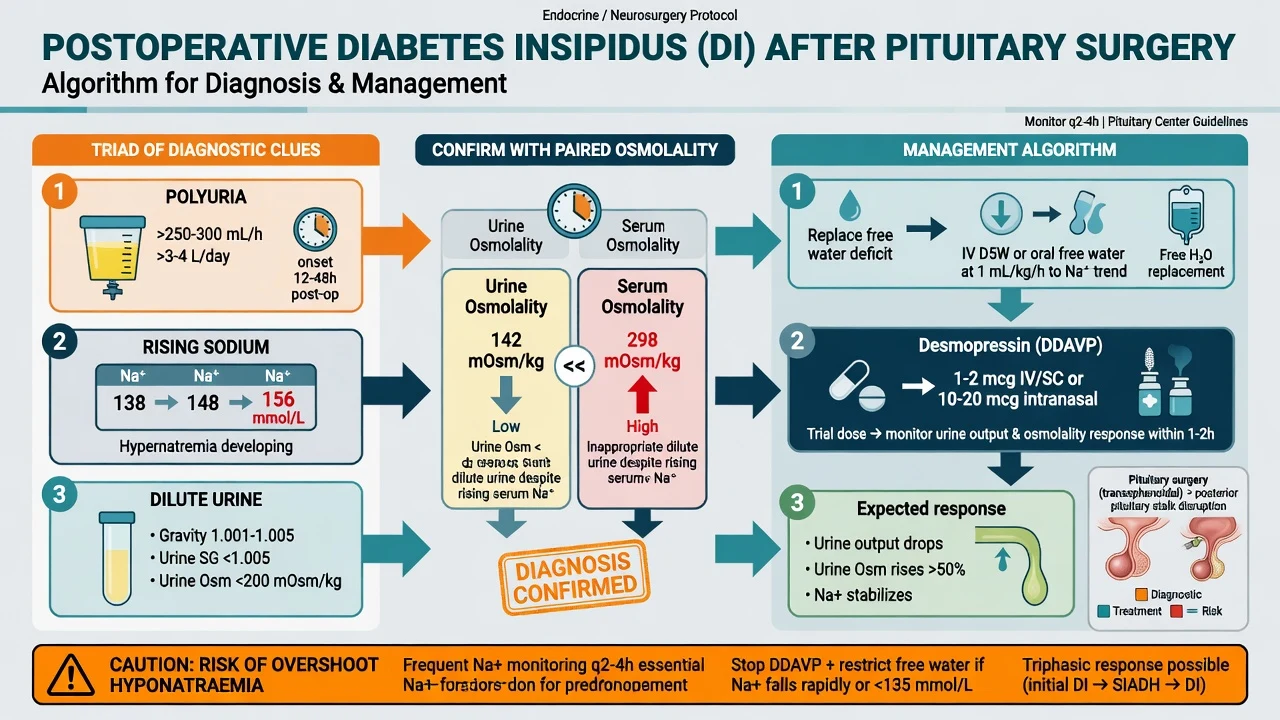
The posterior pituitary stores ADH (vasopressin). Surgical manipulation, stalk stretch, or excision can reduce ADH release and produce central diabetes insipidus: high-volume dilute urine, rising plasma sodium and osmolality, thirst if conscious. After stalk injury a triphasic pattern may occur: early DI (axon shock), then a SIADH-like phase (unregulated ADH release from dying neurons), then permanent DI if axons do not recover. Over-treatment of DI with desmopressin during the SIADH-like window produces dangerous hyponatraemia. SIADH from other causes and cerebral salt wasting are differential diagnoses for postoperative sodium disorders — distinguish by volume status and urine sodium patterns with endocrine help.[1]
Pharmacology choices
Induction: propofol remains standard; titrate carefully in Cushing cardiomyopathy or severe OSA. Maintenance: TIVA (propofol–remifentanil) offers smooth titration and potentially smoother emergence for rapid neurological assessment; volatile anaesthesia is also acceptable if emergence is controlled. Remifentanil provides profound suppression of coughing and blood pressure responses useful for the endoscopic field. Dexmedetomidine appears in neuroanaesthesia and awake-craniotomy literature as a sedative adjunct with opioid-sparing and haemodynamic properties; it is not mandatory for routine TSS but is examinable as a comparative option in related contexts.[2] Muscle relaxation: facilitate intubation and absolute stillness; reverse fully before extubation. Vasopressors and antihypertensives: short-acting agents (metaraminol/phenylephrine boluses, noradrenaline infusion if needed; esmolol, labetalol, clevidipine, or GTN for hypertensive spikes) beat long-acting agents when the field needs moment-to-moment control. Antiemetics: multimodal PONV prophylaxis — vomiting raises ICP/venous pressure and stresses sellar repairs. Steroids: hydrocortisone as protocolised above. Desmopressin (DDAVP): for confirmed central DI — typical starting ranges include 0.5–1 microg SC/IV (or protocolised intranasal/oral when appropriate) plus free-water replacement, titrated to urine output and sodium, avoiding overshoot hyponatraemia.[1]
Anaesthetic goals
- Hormone-safe preparation — cortisol cover when indicated; thyroid and glucose control; electrolyte optimisation.
- Airway security matched to phenotype — especially acromegaly and OSA; DAS rescue ready.[3]
- Still, relatively bloodless endoscopic field — adequate depth, controlled blood pressure, relaxation.
- Protect optic and cerebral perfusion — avoid profound hypotension for cosmetic surgical dryness.
- Prepare for venous bleeding and rare arterial catastrophe — large-bore access, blood availability for complex cases.
- Smooth emergence — early vision assessment without coughing that disrupts repair.
- Structured DI and CSF-leak surveillance postoperatively.
- Communicate continuously with neurosurgery and ENT about packing, Valsalva testing, and repair.
Technique options and decision matrix
Standard general anaesthesia for endoscopic TSS
IV access (consider second line for large/redo tumours), standard monitoring plus arterial line for acromegaly with cardiovascular disease, large tumours, expected bleeding, or labile blood pressure. Consider central access only when vasoactive infusions or difficult peripheral access demand it. Induce carefully; intubate with reinforced or standard ETT secured away from the surgical field (usually left or right per local convention, tape clear of nasal corridor). Throat pack if used — explicit checklist in and out. Eyes protected; head in slight extension as requested; pressure points padded (Cushing skin). Maintain normocapnia or mild hypocapnia only if requested for specific intracranial concerns — most pure sellar work does not need deep hypocapnia. Avoid nitrous oxide if intracranial air or long cases with expanding closed spaces are a concern.
[3]Airway strategy spectrum in acromegaly
Controlled hypotension versus perfusion
Surgeons often request a drier field. Moderate reduction of blood pressure (for example keeping mean arterial pressure in a range agreed with the surgeon while remaining above the patient's autoregulatory comfort zone) may help venous ooze. Profound hypotension risks optic chiasm and cerebral hypoperfusion and is not justified for elective dryness. Communicate MAP targets aloud. Brief Valsalva or jugular compression is performed only when the surgeon requests to test venous haemostasis or reveal a CSF leak — not as routine anaesthetic habit.[1]
Maintenance and emergence
Prefer remifentanil-based techniques or deep volatile with opioid to blunt coughing. Transition to longer-acting analgesia (paracetamol, judicious opioid, multimodal) before remifentanil stops. Extubate awake when airway protective reflexes return, especially in OSA/acromegaly, or deep extubation only in carefully selected non-difficult airways without fresh CSF repair concerns — many units prefer controlled awake extubation after sellar packing. Remove throat pack with dual checklist. Immediate vision check: ask the patient to count fingers or report fields as protocol allows; escalate acute visual loss to urgent surgical review.
[2]Monitoring and equipment
Minimum: continuous ECG, SpO2, NIBP (1-minute cycles at induction/emergence), waveform capnography, inspired oxygen analyser, temperature, neuromuscular monitoring.
[3]Add for many TSS cases: invasive arterial pressure; urinary catheter for longer cases and DI surveillance; large-bore IV access; blood products available for cavernous/carotid risk cases; difficult airway trolley for acromegaly; throat pack documentation system; emergency drugs for hypertension, hypotension, and bradycardia.
[3]Not routinely required but examinable: central venous catheter, processed EEG depth monitoring for TIVA, arterial blood gas sampling for sodium trends in long cases.
[3]Intraoperative management
- Shared airway with ENT/neurosurgery endoscopic corridor; keep gas sampling lines and circuit routed clear of the face.
- Maintain relaxation until the critical dissection and packing are complete.
- Treat hypertensive responses to nasal packing and local adrenaline-containing solutions — know what the surgeon injects.
- Be ready for sudden bleeding: head-up slightly if safe, restore volume, communicate whether packing or conversion is needed; catastrophic carotid injury is rare but demands massive transfusion activation and endovascular/surgical rescue pathways.
- Avoid aggressive positive-pressure recruitment manoeuvres after sellar repair if a CSF leak pathway exists.
- Document steroid doses, urine output hourly, and any desmopressin given.
Crisis pivots — what changes the plan
Pituitary apoplexy presenting for emergency decompression
Acute haemorrhage or infarction into a pituitary tumour: sudden headache, visual loss, ophthalmoplegia, acute adrenal insufficiency, and haemodynamic instability. Resuscitate, give stress-dose hydrocortisone early, correct electrolytes, secure airway if GCS falls, and proceed for urgent decompression with full endocrine support — do not delay steroid cover for laboratory perfection.
[1]Venous bleeding and cavernous sinus ooze
Communicate; provide quiet field; modest MAP reduction if safe; packing; avoid coughing. Massive venous bleeding may require temporary packing and staged return.
[3]Suspected carotid injury
Immediate surgical control steps, blood pressure support without hypertension that worsens extravasation, activate major haemorrhage pathway, prepare for angiography. Maintain oxygenation and anaesthesia; this is a shared crisis.
[3]Difficult airway after induction
Declare difficulty early; limit attempts; second-generation SGA; DAS 2015 CICO pathway if needed; do not sacrifice oxygenation for surgical schedule pressure.[3]
Emergence stridor or visual emergency
Stridor: residual oedema, pack migration, or rare haematoma — inspect, support airway, reintubate early if needed. Acute postoperative blindness or severe field cut: urgent neurosurgical review and imaging pathway; blood pressure optimisation to support optic perfusion.
[3]Postoperative / ICU / PACU plan
Destination: HDU/ICU for large resections, significant intraoperative DI, CSF leak repair, acromegaly with severe OSA, or haemodynamic instability; otherwise monitored ward with clear DI protocols.
[3]DI surveillance: hourly urine output; paired plasma and urine osmolality and sodium when polyuria appears. Suspect central DI if urine output is persistently high (commonly cited thresholds around greater than 250–300 mL/h for consecutive hours) with rising plasma sodium and inappropriately dilute urine — confirm with paired osmolalities. Treat with desmopressin plus free water, carefully avoiding iatrogenic hyponatraemia from overtreatment. Continue sodium checks for 48–72 hours or longer if the triphasic pattern is possible.[1]
CSF leak: clear rhinorrhoea, salty taste, headache — escalate; avoid continuous positive airway pressure if possible until cleared by the surgical team; meningitis precautions and antibiotic policy per neurosurgery.
[3]Analgesia and OSA: multimodal; minimise heavy opioids that mask neurological status and worsen OSA. Nurse head-up; consider CPAP only after surgical clearance of CSF-leak risk. VTE prophylaxis once bleeding risk allows — especially Cushing.
[3]Steroid wean plan: written endocrine instructions before discharge from PACU/HDU.
[3]Special populations and comorbidities
Acromegaly with cardiomyopathy or severe OSA: arterial line, careful induction, HDU, postoperative non-invasive ventilation plan with surgical agreement. Cushing with morbid obesity and VTE history: thromboprophylaxis priority, glucose management, careful positioning. Paediatric Cushing or craniopharyngioma pathways: different DI rates and perioperative steroid protocols — follow paediatric endocrine guidance. Redo TSS: scarred corridor, higher CSF leak and bleeding risk. Pregnancy: rare; multidisciplinary obstetric–endocrine–neurosurgery planning. Concurrent significant cardiac disease: balance controlled hypotension requests against coronary perfusion pressure.
[3]SAQ answer scaffold
A 15-mark SAQ: A 48-year-old man with acromegaly and a macroadenoma is listed for endoscopic transsphenoidal resection. He snores heavily and has a large tongue. Morning cortisol is borderline low.
[1]- Preoperative priorities (4 marks): airway assessment and OSA risk; acromegaly cardiovascular/glucose issues; cortisol cover discussion; MRI/vision baseline; consent for DI/CSF leak.[1]
- Airway plan (3 marks): predicted difficult bag-mask and intubation; video laryngoscopy; DAS rescue; consider awake intubation if exam highly unfavourable.[3]
- Intraoperative goals (4 marks): still field, controlled BP without optic hypoperfusion, throat pack checklist, arterial monitoring, smooth emergence for vision.
- Postoperative DI (4 marks): definition with polyuria + rising Na + dilute urine; desmopressin dosing concept; free water; triphasic warning; monitoring duration.
Viva stem bank and model phrases
Stem 1: “How does acromegaly change your anaesthetic?” Model: “Soft-tissue airway hypertrophy and OSA raise difficult mask and intubation risk; I plan advanced airway strategy early, assess cardiovascular and glucose effects of GH excess, and prepare for opioid-sensitive postoperative respiration.”
[3]Stem 2: “Urine output is 400 mL/h for three hours and sodium is rising.” Model: “I suspect central DI: confirm with paired plasma and urine osmolality, replace free water, give desmopressin per protocol, and avoid overtreatment that will cause hyponatraemia.”
[3]Stem 3: “Does every pituitary patient need stress-dose steroids?” Model: “No. Cover when the ACTH axis is unreliable, cortisol is low, or extensive gland handling is expected; follow endocrine protocol rather than blanket treatment of every microadenoma.”
[1]Stem 4: “The surgeon wants a Valsalva.” Model: “I perform a brief controlled Valsalva only on request to test haemostasis or CSF leak, not as routine, and I avoid aggressive positive pressure after an unrepaired defect.”
[3]Stem 5: “Compare TIVA and volatile for this case.” Model: “Both are acceptable; TIVA with remifentanil often gives smooth haemodynamic control and rapid clear-headed emergence for vision testing; volatile works if coughing is prevented and depth is adequate.”[1][2]
Common traps
- Ignoring the cortisol axis and precipitating adrenal crisis
- Treating polyuria as “fluids too high” without sodium and osmolality
- No difficult airway plan in acromegaly because the “neck looks fine”
- Coughing on emergence after sellar repair
- Over-treatment of DI leading to severe hyponatraemia
- Profound hypotension for a dry field at the expense of optic perfusion
- Forgotten throat pack
- Sending severe OSA acromegaly to an unmonitored ward without a respiratory plan
- Missing the triphasic DI–SIADH–DI sequence
- Delaying vision assessment until the next morning
Pituitary case priorities
In Australia and New Zealand, ANZCA Final candidates should integrate this topic with neuroanaesthesia outcomes and DAS 2015 difficult airway behaviour. Local endocrine unit protocols govern steroid cover and desmopressin dosing — cite the principles and show you will follow institutional pathways rather than improvising microgram doses from memory under stress.
References
- [1]Dunn LK, Nemergut EC Anesthesia for transsphenoidal pituitary surgery Curr Opin Anaesthesiol, 2013.PMID 23963232
- [2]Goettel N et al. Dexmedetomidine vs propofol-remifentanil conscious sedation for awake craniotomy: a prospective randomized controlled trial Br J Anaesth, 2016.PMID 27099154
- [3]Frerk C et al. Difficult Airway Society 2015 guidelines for management of unanticipated difficult intubation in adults Br J Anaesth, 2015.PMID 26556848