Anaes · Cardiac anaesthesia
Heparin, protamine, and coagulopathy on CPB
Also known as Heparin, protamine, and coagulopathy on CPB · Protamine reaction · Post-CPB bleeding
Exact heparin dosing and ACT targets, protamine dosing and reaction phenotypes, HIT alternatives, and viscoelastic-guided post-CPB bleeding management.
On this page & tools
Your progress
Saved locally on this device.
10 MCQs with explanations
Target exams
Red flags
Why this is examined / the one-line answer
Exact heparin / ACT / protamine numbers are pure pass filters. Protamine reaction is a classic crisis. Post-CPB bleeding differentials separate safe candidates from guessers who only say “give more products.” Viscoelastic testing (TEG/ROTEM), residual heparin, excess protamine, platelets, fibrinogen, and fibrinolysis must be spoken as a structured list.
[3]One-line opener: Three hundred to four hundred IU per kilogram, ACT at least four hundred seconds, protamine about one milligram per hundred units slowly — and if they bleed, I do not reverse by guesswork.
[3]Preoperative assessment relevant to coagulation
- Bleeding history, bruising, menorrhagia, prior cardiac surgery bleeding
- Antiplatelet agents (aspirin, P2Y12 inhibitors), anticoagulants (warfarin, DOACs), and timing of cessation
- Heparin exposure history and prior HIT (absolute planning issue)
- Liver disease, renal failure, anaemia, thrombocytopenia
- Baseline ACT if used, coagulation screen, fibrinogen, platelet count
- Plan for cell salvage, antifibrinolytics (tranexamic acid), and point-of-care testing availability
Applied pharmacology and monitoring
Unfractionated heparin for CPB
Heparin potentiates antithrombin III, accelerating inhibition of thrombin and factor Xa. For full CPB:
[1]- Loading dose unfractionated heparin 300–400 IU/kg IV (institutional range)
- Confirm ACT ≥400 s before full CPB; many units target ≥480 s
- Obtain baseline ACT before heparin when institutional practice uses it for comparison
- Recheck ACT after heparin before initiating full bypass — this is a hard stop
- On CPB, redose heparin as ACT falls, or use heparin concentration / heparin management systems where available
ACT caveats. Celite and kaolin activators differ; aprotinin historically affected celite ACT (historical viva fact); hypothermia, haemodilution, and thrombocytopenia alter ACT interpretation. Know your device’s target.
[2]Heparin resistance
Inadequate ACT rise after standard heparin. Causes: antithrombin III deficiency (common after heparin infusions, liver disease, nephrotic states, congenital AT deficiency), high factor VIII/fibrinogen (acute phase), technical issues. Management pathway:
[1]- Additional heparin per protocol (total dose ceilings unit-dependent)
- Antithrombin III concentrate if available, or FFP as AT source
- Do not initiate full CPB on a subtherapeutic ACT
- Escalate to specialist haematology/perfusion early in complex resistance
Protamine
Protamine is a polycationic peptide that neutralises anionic heparin. Approximate dose 1 mg protamine per 100 IU of heparin administered (or titrate to residual heparin/ACT/heparin concentration). Give slowly, preferably via a peripheral venous line, with surgical awareness and vasopressors ready.[3]
Excess protamine can impair platelet function and exert anticoagulant effects — “more protamine” is not always the answer for microvascular bleeding.
[3]Exact numbers (rote pass filter)
Technique: sequence from heparin to reverse
- Baseline labs and optional baseline ACT
- Heparin 300–400 IU/kg after surgical readiness for cannulation
- Confirm ACT ≥400–480 s
- Full CPB; maintain anticoagulation throughout
- Wean using RRRAC/TOE; remain heparinised until stable decision to reverse
- Surgical request for protamine; slow administration; watch PA pressures, RV, SVR
- Post-protamine ACT and clinical bleeding assessment
- Targeted therapy for residual coagulopathy
TOE remains essential for distinguishing surgical bleeding sources, tamponade physiology, and ventricular failure that mimic “coagulopathy.”[2]
Protamine reaction phenotypes
Literature frames a spectrum from mild vasodilatory responses to catastrophic pulmonary hypertension; risk narratives include prior protamine exposure, some NPH insulin histories, and rapid administration, with mechanistic nuance around fish allergy claims.[3]
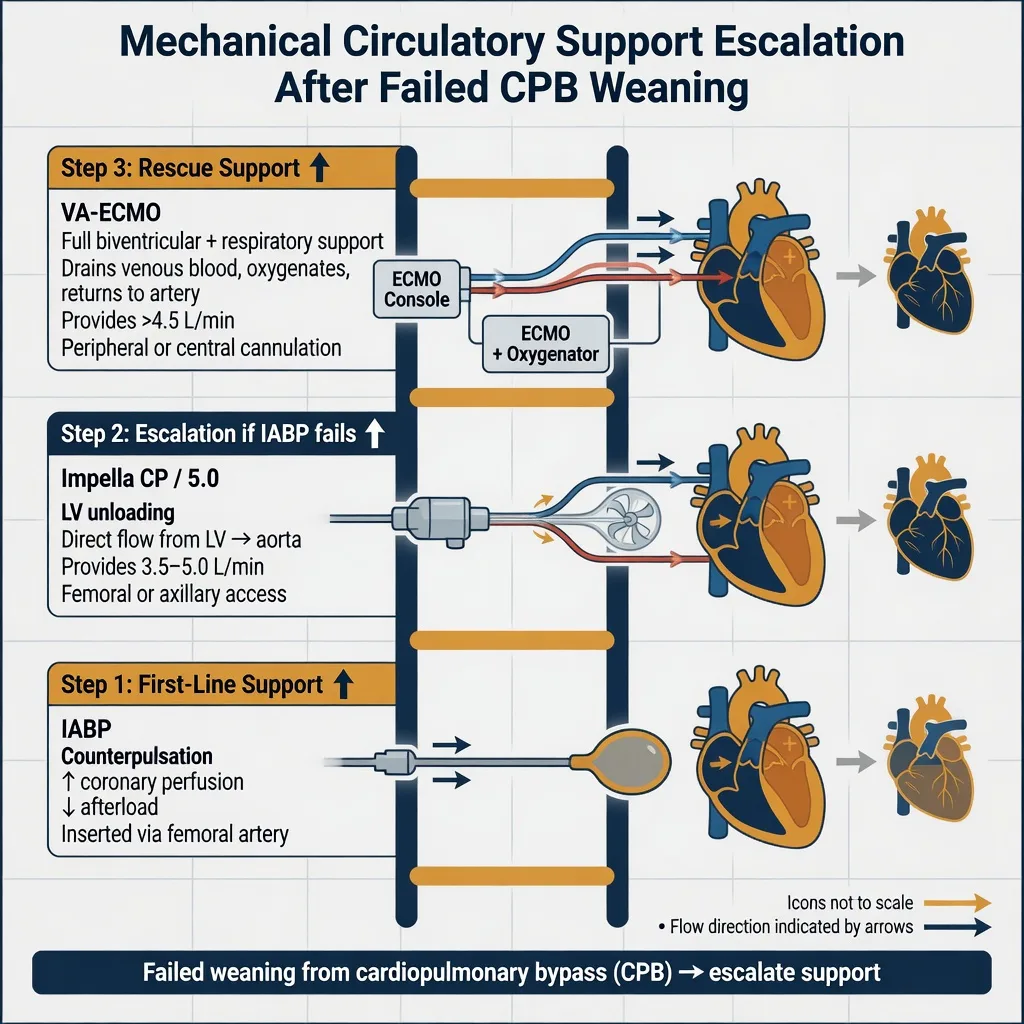
Model crisis script for catastrophic reaction
- Stop protamine immediately; announce the diagnosis out loud.
- FiO2 1.0; support airway and ventilation.
- Support SVR (noradrenaline/adrenaline) and RV (inotropes; inhaled pulmonary vasodilators if available).
- If cardiovascular collapse persists and chest still open or reopenable: discuss re-heparinisation and return to CPB.
- Treat as anaphylaxis if features fit (adrenaline boluses/infusion per ALS).
- After stabilisation: delayed cautious re-challenge only with extreme care or alternative strategies per team judgment.
Heparin-induced thrombocytopenia (HIT)
Immune-mediated HIT (typically IgG against PF4–heparin complexes) causes thrombocytopenia and paradoxical thrombosis. If HIT is suspected or confirmed and cardiac surgery with CPB is required:
[1]- Multidisciplinary plan with haematology and perfusion
- Common alternative: bivalirudin protocols for CPB (direct thrombin inhibitor)
- ACT targets and monitoring differ; ecarin clotting time or specific protocols may be used
- Avoid all heparin including flushes and coated circuits as per protocol
- Platelet transfusions are nuanced in HIT (generally avoid unless bleeding/procedures require) — follow haematology advice
This is never a “give standard heparin and hope” viva answer.
[2]Post-CPB coagulopathy — structured differential
Microvascular bleeding after CPB is multifactorial. Work it like a list:
[2]- Surgical bleeding — look in the field; drains; TOE for collections
- Residual heparin — incomplete neutralisation; heparin rebound later in ICU
- Excess protamine — anticoagulant effect of over-neutralisation
- Thrombocytopenia / platelet dysfunction — CPB circuit, hypothermia, antiplatelets
- Hypofibrinogenaemia / factor dilution-consumption — haemodilution, long CPB, bleeding
- Hyperfibrinolysis — if antifibrinolytic omitted or inadequate; clot breakdown
- Hypothermia, hypocalcaemia, acidaemia — fix the milieu
- Unrecognised surgical technical issues (anastomotic, cannulation sites)
Targeted therapy tools
- ACT after protamine for residual heparin signal
- Laboratory PT/aPTT, fibrinogen, platelet count, haemoglobin
- TEG/ROTEM algorithms (unit-specific): heparinase channels for residual heparin; FIBTEM/fibrinogen assays; platelet maps where available
- Protamine top-up only when residual heparin is likely (small increments)
- Platelets for thrombocytopenia/dysfunction with bleeding
- Cryoprecipitate or fibrinogen concentrate for low fibrinogen
- Plasma for multifactorial factor deficiency (less specific than targeted therapy)
- Tranexamic acid for fibrinolysis (perioperative dosing per cardiac protocol; do not invent a single universal dose without unit context)
- Cell salvage to reduce allogeneic red-cell exposure
- Red cells guided by oxygen delivery and bleeding; TRICS III supports restrictive red-cell strategies in appropriate cardiac surgical adults when not actively exsanguinating.[1]
Intraoperative and ICU bleeding algorithm (exam scaffold)
- Communicate: is bleeding surgical or microvascular?
- Warm the patient; correct Ca2+, pH, and severe anaemia as indicated.
- Check ACT ± heparinase viscoelastic channel.
- If residual heparin: small protamine increments.
- If low fibrinogen: cryoprecipitate/fibrinogen concentrate.
- If low platelets or antiplatelet effect with ooze: platelet transfusion.
- If fibrinolysis: antifibrinolytic strategy.
- If factors depleted: plasma or PCCs per protocol (know local cardiac surgery product rules).
- Re-explore early if drains torrential or tamponade physiology develops.
- Avoid endless product cycles without surgical re-look when indicated.
Crisis pivots — what changes the plan
- ACT 280 s after “full” heparin: more heparin / AT pathway; do not go on full CPB
- Collapse 2 minutes into protamine: reaction algorithm, not more protamine
- High ACT after calculated full reverse: residual heparin vs technical ACT issues vs other inhibitors
- Normal ACT with microvascular bleeding: platelets/fibrinogen/fibrinolysis pathway
- HIT diagnosis preoperatively: cancel routine heparin plan; activate bivalirudin pathway
Postoperative / ICU plan
- Monitor drains, haemoglobin, lactate, urine, filling pressures for tamponade
- Heparin rebound: delayed bleeding hours after protamine — recheck ACT/coags
- Mechanical valve anticoagulation timing once bleeding controlled
- Restrictive red-cell transfusion when clinically appropriate (TRICS III)[1]
- Handover: total heparin, protamine given, last ACT, products, open issues
Special populations
- Deep hypothermic circulatory arrest / long CPB: worse coagulopathy expected
- Endocarditis / sepsis: consumptive coagulopathy plus surgical bleeding
- Jehovah’s Witness / blood conservation: meticulous antifibrinolytics, cell salvage, tolerance thresholds planned preoperatively
- Pregnancy on CPB (rare): dual patient considerations with haematology
SAQ answer scaffold
- Heparin dose, ACT threshold, when to refuse full CPB.
- Protamine ratio, administration technique, excess-protamine harm.[3]
- Three reaction phenotypes with first moves.
- HIT alternative anticoagulation outline.
- Post-CPB bleeding differential and TEG/ROTEM-guided therapy.
- TRICS III restrictive transfusion one-liner.[1]
Viva stem bank and model phrases
- “ACT is 320 seconds after 400 IU/kg — what now?”
- “Blood pressure collapses during protamine.”
- “Microvascular bleeding continues after a full calculated protamine dose.”
- “This patient has HIT and needs emergency CABG.”
Model phrases:
[2]- “I will not initiate full bypass without a therapeutic ACT.”
- “Stopping protamine — treating as reaction and supporting the right ventricle.”
- “I will not treat surgical arterial spurting with platelets alone.”
Common traps
- Starting bypass at ACT 280 s
- Confusing 1 mg protamine per 1 mg heparin without unit clarity (use IU framing)
- Rapid central protamine boluses
- Blind additional protamine for all bleeding
- Missing residual heparin on heparinase channel
- Ignoring hypothermia and hypocalcaemia
- Transfusing red cells liberally without thinking (TRICS III context)
Heparin pharmacology beyond the headline dose
Unfractionated heparin binds antithrombin, accelerating inhibition of thrombin (IIa) and Xa. It is heterogeneous in chain length; only about one-third of chains contain the critical pentasaccharide for AT binding. This heterogeneity plus variable AT levels explains inter-patient ACT responses. Heparin does not dissolve clot; it prevents propagation in the circuit and patient. Subcutaneous prophylactic heparin doses are irrelevant arithmetic for CPB loading — always use the IV CPB protocol dose.
[3]ACT versus anti-Xa versus heparin concentration
ACT is a whole-blood clotting time used because it is fast in theatre. Anti-Xa assays are more specific but slower. Heparin–protamine titration systems estimate residual heparin and can reduce empirical protamine overdosing. Know which system your unit uses and that targets are device-specific.
[3]Protamine administration technique detail
- Calculate dose from total heparin given (including redoses) approximately 1 mg per 100 IU
- Some units give 0.8–1.0 mg per 100 IU then titrate — state the principle of avoiding massive excess
- Peripheral IV preferred; if central, still slow
- Typical administration over 10–15 minutes rather than push
- Watch PA catheter numbers if present: rising PA pressures warn of pulmonary hypertensive reaction
- Surgeon should not be creating major vascular anastomoses at the exact moment of highest reaction risk without readiness to go back on bypass
Differentiating reaction from bleeding and from failure to wean
| Picture | Clues | Action |
|---|---|---|
| Protamine reaction | Timing with infusion; PHT; RV fail; rash/bronchospasm | Stop protamine; resuscitate |
| Surgical bleed | Focal field bleeding; normal ACT | Surgical haemostasis |
| Residual heparin | High ACT; heparinase corrects viscoelastic trace | Small protamine top-up |
| Platelet problem | Low count; ADP pathway drugs; CPB time long | Platelets |
| Low fibrinogen | FIBTEM/Clauss low; dilute | Cryoprecipitate/fibrinogen |
| Hyperfibrinolysis | LY30 high; clot breakdown | Antifibrinolytic |
Antifibrinolytics in cardiac surgery
Tranexamic acid is widely used to reduce bleeding and transfusion. Dosing regimens vary (bolus plus infusion vs weight-based institutional cardiac protocols). High-dose historical regimens raised seizure concerns in some cardiac populations — follow contemporary unit protocols rather than inventing megadoses. Aprotinin history may appear in vivas (efficacy vs safety withdrawal/return narratives) — know it as historical context unless your region actively uses it under regulated pathways.
[1]Cell salvage and transfusion thresholds
Cell salvage returns washed red cells and reduces allogeneic exposure. TRICS III supports a restrictive red-cell transfusion strategy as non-inferior to liberal transfusion for a composite outcome in moderate-to-high-risk adults having cardiac surgery with CPB. Exam phrasing: restrictive thresholds are reasonable when the patient is not actively exsanguinating or ischaemic; individualise.
[1]HIT laboratory and clinical vignette
Falling platelets by more than 50 percent from baseline between days 5–10 of heparin (earlier if re-exposure), thrombosis, skin necrosis at injection sites — calculate 4Ts score conceptually and involve haematology. For emergency CPB with confirmed HIT, bivalirudin protocols require perfusion expertise: no heparin-coated equipment as specified, different monitoring, and careful transition off bypass because bivalirudin has a short half-life but no simple protamine equivalent.
[3]ICU heparin rebound
Hours after protamine, heparin can reappear from tissue stores leading to delayed bleeding and rising ACT. Management: confirm with ACT/viscoelastic heparinase channel; small additional protamine if indicated; exclude surgical causes.
[3]Circuit thrombosis nightmare stem
ACT not checked, full flow started, rising line pressures, dark blood, circuit clotting — catastrophic. Prevention is the only acceptable strategy: verbalise ACT before “going on.” If partial clotting suspected early, emergency protocols with surgeon and perfusion (may include stopping, replacing circuit components, supporting the patient) — this is a never-event style viva about prevention. [1]
Protamine reaction pharmacology notes
Protamine can cause histamine release, especially with rapid injection, and immune-mediated reactions in sensitised patients. Catastrophic pulmonary vasoconstriction may involve thromboxane-related pathways and acute RV failure. Treatment priorities mirror acute RV failure plus stopping the trigger. Literature reviews (including Levy and colleagues) summarise clinical use, adverse reactions, and the limited landscape of alternatives.[3]
Viscoelastic tracing patterns (speak the language)
- Prolonged R/CT that corrects with heparinase: residual heparin
- Low MA/MCF: platelet contribution or fibrinogen — use FIBTEM/functional fibrinogen to separate
- Low fibrinogen trace: replace fibrinogen
- High lysis parameters: hyperfibrinolysis — antifibrinolytic
- Normal traces with bleeding: surgical bleeding until proven otherwise [1]
Exact cartridge names differ between TEG and ROTEM; examiners care that you target mechanism. [1]
Product dosing order-of-magnitude literacy
- Platelets: typically one adult therapeutic dose and reassess
- Cryoprecipitate: institutional pooled unit dosing to raise fibrinogen
- Fibrinogen concentrate: grams dosed to target fibrinogen level per protocol
- FFP: 10–15 mL/kg bands when factors broadly depleted
- PCC: selected factor deficiency/warfarin contexts per protocol — not indiscriminate [1]
Always reassess clinically and with labs after each round rather than shotgun all products. [1]
Massive bleeding with open chest
Keep the patient warm, calcium replete, pH controlled, surgical team exploring, cell salvage running, activate major haemorrhage protocol if needed, consider leaving chest open with temporary closure if packing and coagulopathy dominate. TOE for tamponade physiology even with partially open chest scenarios in ICU. [1]
Drug interactions and antiplatelets
Recent P2Y12 inhibitors predict platelet transfusion need even when counts are numerically adequate. Aspirin is often continued in coronary patients — balance bleeding vs graft thrombosis narratives with surgical team. DDAVP sometimes discussed for platelet dysfunction (desmopressin 0.3 microg/kg IV carefully) — evidence and use vary; know it as an option not a mandate. [1]
Point-of-care haemoglobin and ACT traps
Haemodilution on CPB lowers Hb without “bleeding.” ACT prolongation has multiple causes beyond heparin. Never reverse based on a single unexplained number without clinical correlation and, when available, heparinase comparison. [1]
Full heparin–protamine arithmetic example
Patient receives heparin 350 IU/kg × 80 kg = 28,000 IU loading, plus 10,000 IU redose on CPB → total 38,000 IU. Protamine estimate 380 mg at 1 mg per 100 IU, given slowly over 10–15 minutes, titrated to ACT and bleeding. If ACT remains high with heparinase-correctable viscoelastic abnormality, add small increments (e.g. 25–50 mg) rather than another full calculated dose blindly. [1]
ACT device practicalities
Baseline ACT might be 100–140 s classically; after heparin expect several-fold prolongation. Hypothermia prolongs ACT; haemodilution affects it; lupus anticoagulant and other inhibitors confuse interpretation rarely. If ACT fails to rise: check heparin actually given IV (not into disconnected line), then heparin resistance pathway. [1]
Bleeding after cardiac surgery — first 30 minutes algorithm
- Look at the field with the surgeon — is it surgical?
- Warm patient; ionised calcium; pH
- ACT ± viscoelastic panel
- Targeted products
- Control systolic hypertension that worsens suture line bleeding
- Reverse residual heparin only if indicated
- Early re-explore thresholds for drain losses per unit (know local numbers) [1]
TRICS III exam sentence
TRICS III demonstrated that a restrictive red-cell transfusion strategy was non-inferior to a liberal strategy with respect to a composite outcome including death and major morbidity among moderate-to-high-risk adults undergoing cardiac surgery with CPB.[1] Quote the principle; do not invent a single universal haemoglobin trigger without context.
Protamine alternatives landscape
No perfect universal alternative widely replaces protamine in all CPB systems. Hexadimethrine historical, heparinase experimental/limited, and other approaches appear in reviews; clinically, prevention of excess heparin, titration systems, and careful protamine remain standard.[3]
Teaching table: do / do not
| Do | Do not |
|---|---|
| Confirm ACT before full CPB | Start bypass on ACT 280 s |
| Give protamine slowly | Push full dose centrally fast |
| Use heparinase channels | Blind double protamine |
| Fix temperature and calcium | Ignore milieu |
| Re-explore surgical bleeding | Transfuse endlessly without looking |
Final viva closer
“My safe cardiac anticoagulation practice is heparin 300 to 400 IU per kilogram, ACT at least 400 seconds before full bypass, protamine about one milligram per hundred units slowly after a stable wean, and mechanism-based treatment of bleeding with ACT and viscoelastic guidance.” [1]
[2] [3] [3]References
- [1]Mazer CD, Whitlock RP, Fergusson DA, et al. Restrictive or Liberal Red-Cell Transfusion for Cardiac Surgery N Engl J Med, 2017.PMID 29130845
- [2]Hahn RT, Abraham T, Adams MS, et al. Guidelines for performing a comprehensive transesophageal echocardiographic examination: recommendations from the American Society of Echocardiography and the Society of Cardiovascular Anesthesiologists J Am Soc Echocardiogr, 2013.PMID 23998692
- [3]Levy JH, et al. What's fishy about protamine? Clinical use, adverse reactions, and potential alternatives J Thromb Haemost, 2023.PMID 37062523