Anaes · Orthopaedic anaesthesia
Tourniquet physiology, bone cement implantation syndrome, and fat embolism
Also known as tourniquet bcis fes
Exam-exhaustive orthopaedic triple crisis: tourniquet inflation/deflation physiology and ~2 h limit; Donaldson BCIS grades 1–3 at cementation; fat embolism syndrome triad (respiratory, neuro, petechiae) — prevention, recognition, and supportive care for ANZCA Final.
On this page & tools
Your progress
Saved locally on this device.
8 MCQs with explanations
Target exams
Red flags
Why this is examined / the one-line answer
Orthopaedic lists produce three physiology crises that fellowship examiners treat as core: tourniquet inflation and deflation effects, bone cement implantation syndrome (BCIS) with Donaldson grading, and fat embolism syndrome (FES). The discriminating candidate recites exact grades, anticipates the cement moment, and does not confuse FES (hours later, triad including petechiae) with BCIS (at cementation). [1]
The one-line answer: I manage tourniquets with appropriate pressure and a practical maximum near two hours before staged reperfusion; I grade BCIS with Donaldson 1–3 at cementation and treat hypoxia and hypotension aggressively while considering uncemented technique in high-risk patients; and I recognise FES by respiratory failure, neurological change, and petechial rash, managing supportively while early fixation strategies reduce ongoing risk.[1]
Preoperative assessment and risk stratification
Cemented versus uncemented plan
Ask the surgeon explicitly. Elderly neck-of-femur fracture for cemented hemiarthroplasty is the classic BCIS teaching case. Pulmonary hypertension, right ventricular dysfunction, severe aortic stenosis, critical left main disease, and profound hypovolaemia raise BCIS consequence severity. [1]
Tourniquet necessity
Not every case needs a tourniquet. Sickle cell disease, severe peripheral vascular disease, and some grafts change risk–benefit. Expected duration and site (upper versus lower limb) guide pressure settings and padding. [1]
FES risk
Long-bone and pelvic fractures, intramedullary nailing, multiple trauma — counsel and plan ICU-capable postoperative care if high risk. Early definitive fixation strategies aim to reduce ongoing embolisation compared with prolonged traction in many protocols (damage-control nuance in the unstable polytrauma patient). [1]
Blood conservation
TXA (for example 1 g IV or 10–15 mg/kg as institutional arthroplasty protocols dictate) reduces bleeding and transfusion in many orthopaedic pathways; trauma evidence from CRASH-2 supports TXA in bleeding trauma — it does not treat BCIS or FES directly.[2]
Applied physiology — tourniquet
Inflation
Arterial inflow stops distal to the cuff when pressure exceeds systolic pressure by a sufficient margin. Distal tissues become ischaemic and anaerobic: lactate, potassium, and CO2 accumulate; temperature falls. Awake patients feel tourniquet pain after a period (C-fibre mediated), often requiring supplementation or general anaesthesia. Systemic blood pressure may rise from pain and catecholamines and from an acute increase in systemic vascular resistance with the volume of blood in the excluded limb. [1]
Pressure and time (exam numbers)
Practical teaching anchors (institutional protocols vary; quote as typical values): [1]
- Upper limb: often about 250 mmHg or approximately 100 mmHg above systolic blood pressure
- Lower limb: often about 300 mmHg or approximately 100–150 mmHg above systolic
- Maximum continuous inflation: about 2 hours, then deflate for 10–15 minutes of reperfusion before reinflation if surgery continues
- Padding and correct cuff width reduce nerve injury; never inflate on bare skin or over malignancy/infection when avoidable [1]
Deflation
Return of acidotic, hyperkalaemic, cold, vasodilated blood produces: transient fall in SVR and blood pressure, rise in EtCO2, possible arrhythmias from potassium load, fall in core temperature, and occasionally embolic phenomena if debris was trapped. Anticipate and treat — fluids, vasopressors, hyperventilation briefly for CO2, and readiness for arrhythmia management. Rarely, severe collapse at deflation overlaps with embolisation physiology. [1]
Complications beyond physiology
Nerve injury (especially radial and sciatic neuropathies), compartment syndrome after prolonged ischaemia, skin injury, chemical burns from spirit under cuffs, and thromboembolism after release. [1]
Bone cement implantation syndrome — definition and grades
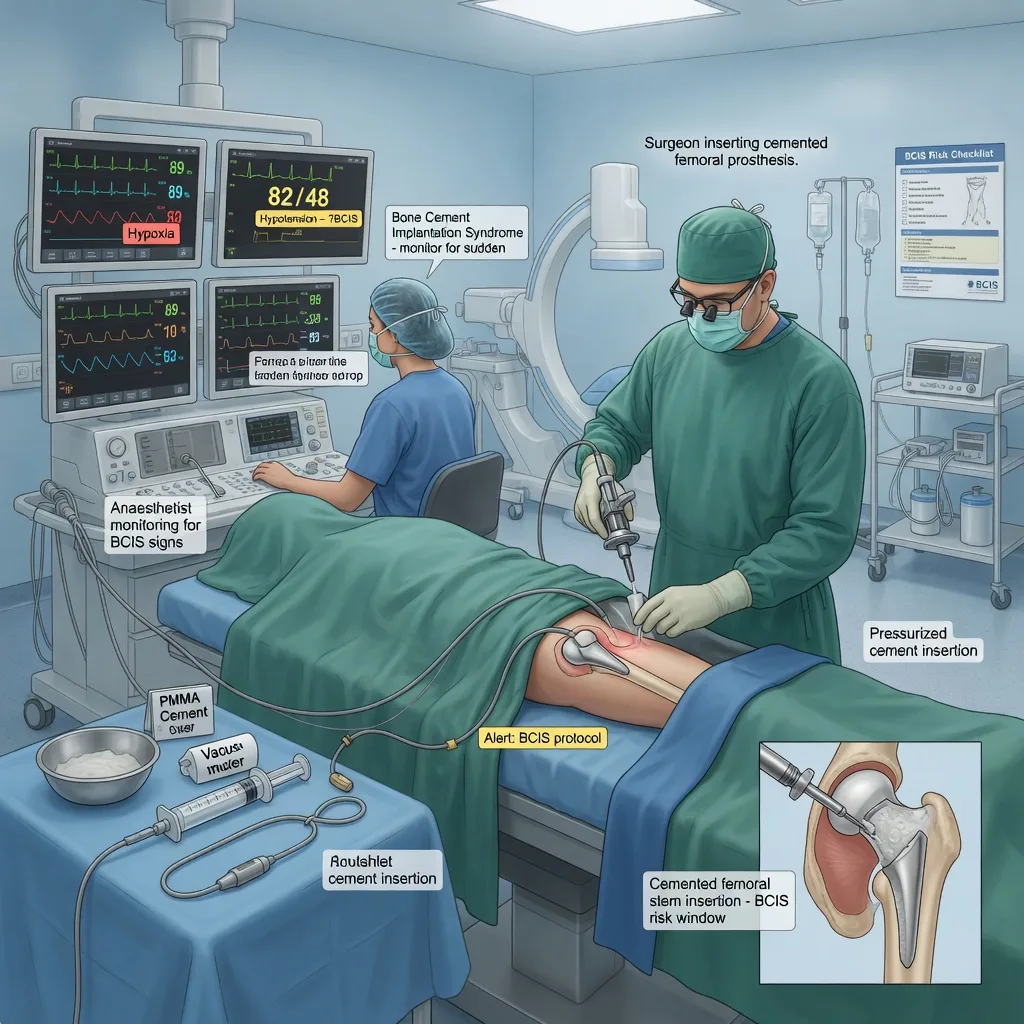
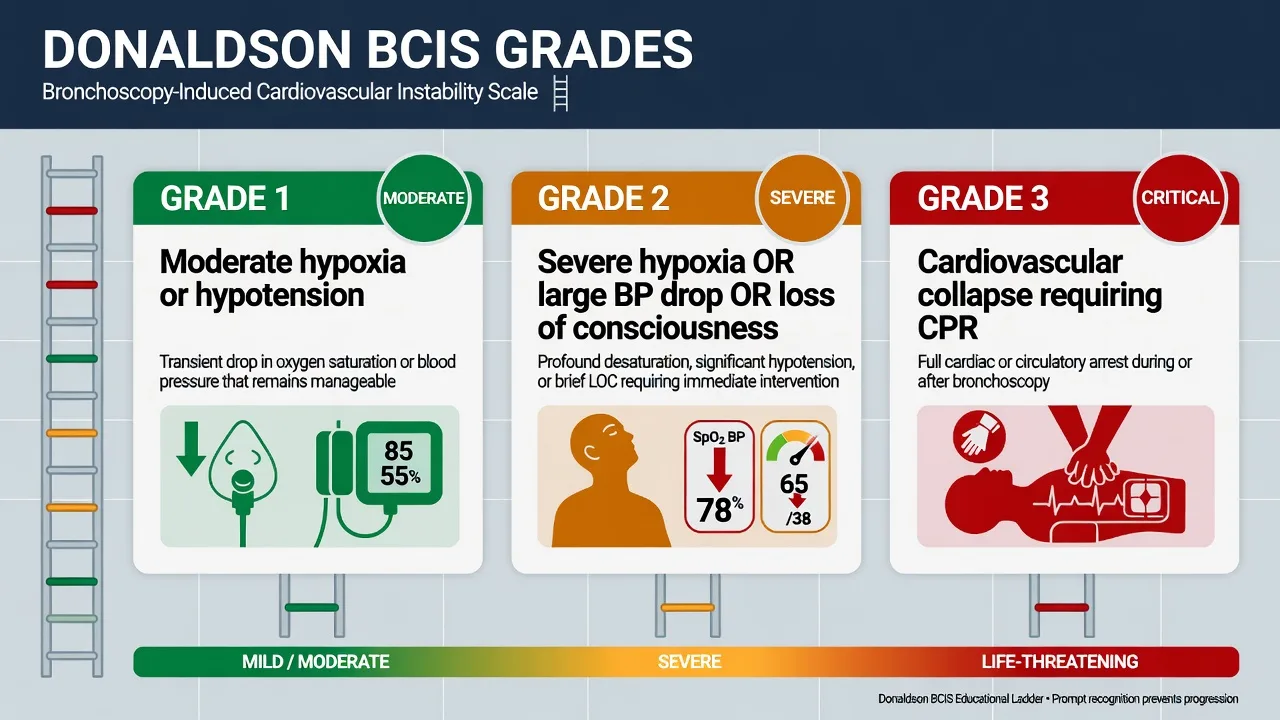
Donaldson and colleagues describe BCIS as hypoxia, hypotension or both, and/or unexpected loss of consciousness occurring around cementation of the prosthesis, prosthesis insertion, reduction of the joint, or occasionally at tourniquet deflation in cemented bone surgery.[1] Pathophysiology is multifactorial: embolisation of marrow fat, air, and cement particles into the pulmonary circulation; pulmonary hypertension and acute right ventricular failure; histamine and mediator release; and hypovolaemia amplifying collapse.
Donaldson grades (verbatim structure)
Prevention and high-risk strategy
Surgical: thorough medullary lavage, good cement technique, venting, avoid excessive pressurisation when possible, consider uncemented prosthesis in very high-risk patients after shared discussion. Anaesthetic: restore circulating volume before cementing, 100 percent oxygen for the cement moment in high-risk cases, invasive arterial monitoring in frail cemented hip fracture, have vasopressors including adrenaline prepared, announce “cementing now,” and avoid distraction. [1]
Fat embolism syndrome
Clinical picture
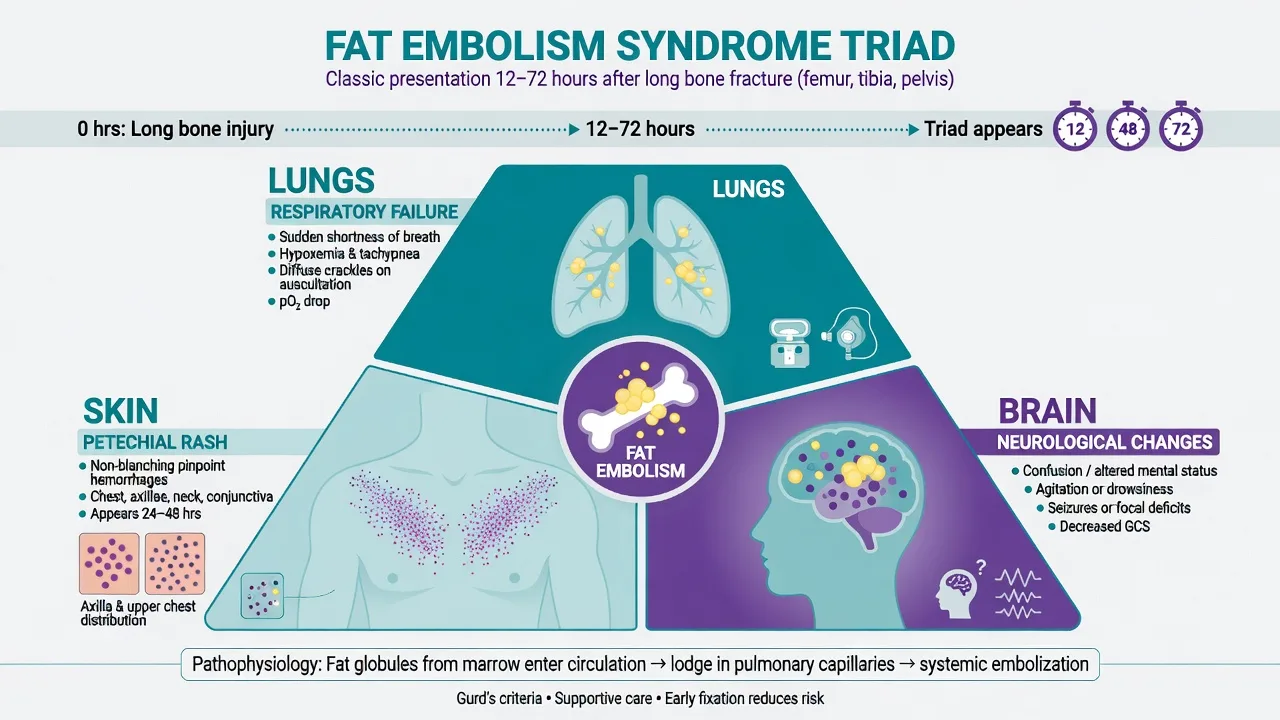
Classic triad: respiratory insufficiency, neurological dysfunction (confusion to coma), and petechial rash (often upper body, axillae, conjunctivae). Onset commonly 12–72 hours after long-bone or pelvic injury or instrumentation — not usually the exact second of cementing (that is BCIS territory). Fever, tachycardia, thrombocytopenia, and fat macroglobulinaemia historically described; diagnosis is clinical. [1]
Management
Supportive: oxygen, ventilatory support with lung-protective strategies if ARDS-like, haemodynamic support, ICU care. No specific “dissolving” drug is standard. Early appropriate fracture fixation reduces ongoing embolic load in many pathways; in unstable polytrauma, damage-control orthopaedics may stage definitive nailing. Corticosteroids are not routine proven therapy for established FES in modern practice discussions — emphasise support and prevention. [1]
Anaesthetic goals
- Safe tourniquet use with time discipline and deflation anticipation.
- Euvolaemia and communication for cementation; minimise BCIS severity.
- Immediate recognition and graded response to BCIS.
- High index of suspicion for delayed FES after long-bone work.
- Blood conservation without ignoring embolisation risk.
- Airway security if collapse requires CPR and airway rescue.[3]
Technique options and decision matrix
Regional anaesthesia for hip fracture (fascia iliaca, spinal) coexists with BCIS risk — the block does not prevent embolisation. General anaesthesia with controlled airway may be preferred in patients with zero reserve. For trauma nailing under GA: lung-protective ventilation, careful fluid strategy, ICU destination if bilateral nailing or already hypoxic. [1]
Monitoring and equipment
High-risk cemented arthroplasty: invasive arterial line, ready vasopressors (metaraminol/phenylephrine and adrenaline), defibrillator, EtCO2 and SpO2 continuous focus at cementation, and optional TOE if available for unexplained collapse. Tourniquet machine with calibrated pressure display and audible alarms. Major haemorrhage equipment when trauma coincides. [1]
Intraoperative management
At cementation: watch SpO2, EtCO2, and blood pressure continuously. Treat hypotension aggressively — adrenaline is appropriate for severe BCIS with suspected RV failure rather than pure high-dose pure alpha strategies alone in every case; use clinical judgement and local cardiac arrest algorithms. If arrest: high-quality CPR, 100 percent oxygen, treat reversible causes, consider TOE for right heart strain, notify surgeon to stop further pressurisation, prepare ICU. At tourniquet deflation: warn the team, lighten only when safe, support blood pressure, watch ECG for hyperkalaemic changes. [1]
Crisis pivots
Cement crisis
Differential of hypoxia at cementation: BCIS, anaphylaxis (cement or antibiotic cement), PE, mucus plug, endobronchial intubation, pneumothorax, residual opioid apnoea if spontaneous ventilation — use EtCO2, airway pressures, and timing. [1]
Differential of delayed hypoxia after nailing: FES, PE, pneumonia, transfusion related lung injury, fluid overload — petechiae help FES but are not always present. [1]
Postoperative / PACU plan
Watch for delayed hypoxia and confusion after long-bone nailing (FES window), fluid balance, cardiac biomarkers if profound intraoperative instability, and wound/tourniquet site complications. Escalate early to ICU for grade 2–3 BCIS survivors. [1]
Special populations
Hip fracture elderly: highest BCIS teaching density; invasive monitoring threshold low. Multiple trauma: FES plus ARDS differential; TXA for bleeding.[2] Sickle cell: tourniquet risk discussion with haematology. Pulmonary hypertension: strongly consider uncemented techniques. Paediatric: tourniquet pressures and times need age-appropriate limits; FES can occur after long-bone injury.
Tourniquet pain and anaesthetic technique choice
Under regional anaesthesia alone, tourniquet pain typically appears after 30–60 minutes despite a dense distal block, because C-fibre ischaemic pain is only partly covered by peripheral nerve blocks. Supplementation options: systemic opioids or ketamine, sedation, conversion to general anaesthesia, or additional field coverage (for upper limb, intercostobrachial). Under general anaesthesia, tourniquet inflation still produces a catecholamine pressor response; deflation still dumps metabolites. For bilateral tourniquets (rare staged cases), stagger inflation and never maximise both limbs’ ischaemic time casually. [1]
Nerve injury mechanisms under the cuff
Compression and shear at the cuff edge, especially with insufficient padding, excessive pressure, or prolonged time, injure myelin and axons. The radial nerve in the upper arm and the sciatic nerve in the thigh are classic sites. Postoperative neuropraxia is usually temporary but requires documentation, orthopaedic and neurology follow-up, and honest consent that tourniquet is not risk-free. Avoid placing cuffs over vascular grafts, malignancies, or infected tissue when alternatives exist. [1]
BCIS pathophysiology in examiner depth
Embolisation of fat, marrow debris, air, and polymethylmethacrylate monomer into pulmonary capillaries raises pulmonary vascular resistance. The right ventricle dilates and fails acutely; left ventricular filling falls; coronary perfusion to the strained RV drops if systemic pressure collapses — a vicious cycle. Histamine and complement activation may contribute in some models. Hypovolaemia and pre-existing pulmonary hypertension amplify the hit. This is why adrenaline (inotropic and vasopressor support of coronary perfusion) is often preferred over pure high-dose pure vasoconstrictors alone in grade 2–3 syndromes, and why TOE shows a dilated hypokinetic RV with small left heart when available. [1]
Cemented hip fracture — a full crisis drill
Before cement: arterial line in high-risk elderly, restore volume, draw adrenaline 1:10,000 or diluted infusion ready, increase FiO2 toward 1.0, reduce volatile if using to preserve blood pressure reserve, tell the room “cementing now — quiet.” During cement: eyes on the monitor. Grade 1: oxygen, fluids, small vasopressor. Grade 2: escalate adrenaline, consider central access and ICU, stop further pressurisation. Grade 3: CPR on a fractured hip table is awkward — call for help, board/CPR plan, ALS algorithms, treat as PEA with embolic RV failure physiology, prepare for post-ROSC ICU and possible echocardiography. [1]
FES versus thromboembolic PE versus BCIS — comparison table thinking
- BCIS: seconds to minutes around cement/prosthesis/reduction; hypoxia + hypotension ± LOC; no petechiae required.
- Thromboembolic PE: can occur any time; risk with DVT; may need anticoagulation/thrombolysis decisions.
- FES: typically 12–72 h after long-bone/pelvic injury or nailing; triad respiratory + neuro + petechiae; supportive care. [1]
Gurd and Wilson criteria and similar scoring systems exist historically for FES diagnosis; examiners usually prefer the clinical triad and supportive management narrative over obscure point systems unless asked. [1]
Prevention bundle you can recite
Tourniquet: correct size and padding, lowest effective pressure, shortest time, planned reperfusion break at two hours, anticipate deflation. BCIS: lavage, venting, good cement technique, euvolaemia, oxygen, vasopressors ready, uncemented option in extreme risk. FES: early appropriate fixation, gentle instrumentation, supportive ICU readiness, avoid missed hypoxia after nailing. [1]
Sickle cell and vascular disease footnotes
Tourniquets in sickle cell disease are controversial — ischaemia and stasis may promote sickling; many centres avoid or use with extreme caution, full oxygenation, warmth, and haematology input. Severe PVD and grafts: tourniquet may be contraindicated. Always ask before inflating on a vascular patient’s only good limb. [1]
Laboratory and monitoring adjuncts after collapse
After grade 2–3 BCIS: arterial blood gas (hypoxaemia, acidosis, hypercarbia), electrolytes (potassium), haemoglobin, troponin later if coronary ischaemia secondary to hypotension, ECG, chest radiograph, and echocardiography (RV strain). For suspected FES: ABG, CXR (may show diffuse infiltrates), CT brain if focal neurology (often normal early), fundoscopy historically for retinal changes — management remains supportive. Do not delay resuscitation for a perfect set of tests. [1]
Interaction with regional anaesthesia for hip fracture
Spinal anaesthesia for cemented hemiarthroplasty is common. BCIS still occurs under spinal — patients may lose consciousness from hypotension and hypoxia (grade 2 definition includes unexpected LOC under GA context historically; under spinal, sudden unresponsiveness and collapse still demand the same oxygen and vasopressor response). Maintain conversation with the patient as a monitor when awake; convert to GA if collapse requires airway control. [1]
Cement chemistry pearl
Polymethylmethacrylate polymerisation is exothermic and releases monomer; pressurisation forces debris into circulation. Modern vacuum mixing and careful technique reduce but do not eliminate BCIS. Antibiotic-loaded cement adds allergy considerations to the differential of hypotension. [1]
Fat embolism without full triad
Not every patient shows petechiae. Hypoxia and delirium after nailing still warrant FES in the differential alongside PE and stroke. Treat supportively and investigate broadly. Petechiae, when present, are highly suggestive. [1]
Teaching drill for juniors on orthopaedic lists
Before every cemented case: say the grade definitions aloud, point to adrenaline, confirm volume status, assign who watches the monitor at cement, and agree the uncemented bailout phrase with the surgeon for extreme risk patients. Before every long tourniquet: set a visible timer, plan the two-hour break, and brief the deflation haemodynamics. [1]
EtCO2 and SpO2 pattern recognition at cement
A sudden fall in EtCO2 with hypoxia and rising airway pressures suggests increased dead space and pulmonary vascular obstruction — classic embolic physiology. Pure hypoventilation from light anaesthesia shows rising EtCO2. Anaphylaxis may show high airway pressures with bronchospasm and rash. Use the whole picture: timing at cement, EtCO2 direction, skin, and blood pressure trajectory. [1]
Post-BCIS disposition
Grade 1 may recover quickly and go to a monitored ward bed if stable. Grade 2–3 survivors need HDU/ICU, serial gases, echocardiography when available, troponin if coronary hypoperfusion likely, and delayed definitive further cementing or revision only when stable. Family communication should name the syndrome, not only “a reaction to anaesthetic.” [1]
Compare table: three crises at a glance for revision
- Tourniquet deflation: predictable metabolite wash-in; hypotension, ↑EtCO2, K+ load; treat supportively; prevent with time limits.
- BCIS: at cement/prosthesis/reduction; Donaldson 1–3; oxygen, vasopressors/CPR, surgical pause; prevent with technique and patient selection.
- FES: delayed 12–72 h; respiratory + neuro + petechiae; ICU supportive care; prevent with timely appropriate fixation. [1]
Memorise the time domains — examiners use timing as the first branching question. [1]
Adrenaline practical concentrations
Have a clear plan: adrenaline 1:10,000 (100 microg/mL) for boluses in arrest or severe collapse, or a dilute infusion (for example 0.01–0.1 microg/kg/min institutional) for ongoing RV support after ROSC. Label syringes. Confusion between 1:1000 and 1:10,000 is a never-event risk — double-check. [1]
One-line viva closers
Grade 3 BCIS is CPR at cementation; I pre-oxygenate, fill the tank, and have adrenaline ready. Tourniquets: about 250 upper, 300 lower, two hours then rest. FES: lungs, brain, petechiae — support, do not chase a magic antidote. [1]
These three crises share one consultant habit: announce the dangerous moment (inflate, cement, nail), watch the monitor without distraction, and escalate oxygen and cardiovascular support before secondary surveys. [1]
SAQ answer scaffold
- Tourniquet physiology inflation/deflation with pressure and 2-hour rule (4 marks).
- Donaldson BCIS grades verbatim (4 marks).[1]
- Prevention of BCIS (3 marks).
- FES triad and timing (3 marks).
- Management differences BCIS vs FES (3 marks).
Viva stem bank and model phrases
Stem 1: “What is grade 3 BCIS?”
Model: “Cardiovascular collapse requiring CPR at or around cementation.”[1]
Stem 2: “Pressures and time for tourniquet?”
Model: “Upper limb about 250 mmHg, lower limb about 300 mmHg as typical anchors, about two hours maximum then 10 to 15 minutes reperfusion.” [1]
Stem 3: “Hypoxia and hypotension as cement goes in.”
Model: “I call for help, give 100 percent oxygen, support blood pressure including adrenaline if severe, ask the surgeon to stop pressurisation, and treat as BCIS while excluding anaphylaxis and other causes.” [1]
Stem 4: “Triad of fat embolism?”
Model: “Respiratory failure, neurological dysfunction, and petechial rash — often 12 to 72 hours after injury or nailing.” [1]
Stem 5: “Does TXA prevent BCIS?”
Model: “No — TXA reduces bleeding; BCIS prevention is surgical technique, euvolaemia, and patient selection for cement.”[2]
Stem 6: “Why not blame the propofol bolus at cement time?”
Model: “Timing at cementation with hypoxia and raised airway pressures points to BCIS until proven otherwise — do not miss the syndrome.” [1]
Common traps
- Blaming induction agent for hypoxia exactly at cement
- Forgetting tourniquet deflation haemodynamics
- Missing petechiae in FES (or requiring them always)
- No adrenaline drawn for cemented hemiarthroplasty in ASA 4 patients
- Confusing BCIS (peri-cement) with FES (delayed triad)
- Inflating tourniquet beyond two hours without reperfusion
- Quoting impossible exact pressures as universal law without “protocol varies” humility [1]
References
- [1]Donaldson AJ et al. Bone cement implantation syndrome Br J Anaesth, 2009.PMID 19059919
- [2]CRASH-2 trial collaborators Effects of tranexamic acid on death, vascular occlusive events, and blood transfusion in trauma patients with significant haemorrhage (CRASH-2): a randomised, placebo-controlled trial Lancet, 2010.PMID 20554319
- [3]Frerk C et al. Difficult Airway Society 2015 guidelines for management of unanticipated difficult intubation in adults Br J Anaesth, 2015.PMID 26556848