Anaes · Cardiac anaesthesia
Weaning from bypass and low cardiac output
Also known as Weaning from bypass and low cardiac output · Unable to wean CPB · Low cardiac output syndrome
RRRAC weaning framework, TOE-guided optimisation, vasoplegia, RV failure, and escalation to IABP/ECMO when unable to wean from CPB.
On this page & tools
Your progress
Saved locally on this device.
10 MCQs with explanations
Target exams
Red flags
Why this is examined / the one-line answer
Unable to wean from CPB is the single most classic cardiac crisis in the ANZCA Final map. Examiners score structured thinking: preparation checklist, RRRAC, TOE phenotype diagnosis, and logical escalation to IABP / temporary VAD / VA-ECMO. Random adrenaline boluses without a diagnosis fail.
[1]One-line opener: Full flow, TOE on, RRRAC out loud — if it still fails, rest the heart, find the reversible cause, then escalate mechanical support.
[2]Preoperative and pre-wean preparation
Weaning starts before the cross-clamp comes off.
[2]Metabolic and thermal readiness
- Core temperature rewarmed toward normothermia without overshoot hyperthermia
- Potassium corrected after cardioplegia (often high then falling)
- Ionised calcium available; correct if low
- Glucose controlled; treat severe hyperglycaemia
- Acid–base near normal; ongoing metabolic acidosis suggests inadequate delivery or gut/limb ischaemia and predicts hard wean
- Haematocrit/haemoglobin adequate for oxygen delivery; transfusion strategy individualised with TRICS III restrictive non-inferiority context when appropriate[1]
Mechanical and team readiness
- Lungs re-expanded; secretions suctioned; FiO2 and ventilation set before reducing flows
- Pacing wires tested (atrial, ventricular, DDD capability)
- Inotropes and vasopressors primed and connected (adrenaline, noradrenaline, vasopressin, milrinone/dobutamine as indicated)
- TOE optimised views for LV, RV, valves, air, SAM risk[2]
- Surgical haemostasis plan and readiness to return to full flow
- ACT still therapeutic until off bypass and stable — do not reverse heparin early during unstable low-output trials
RRRAC framework (must be spoken fluently)
[2]Rate
Target often 80–100 beats/min early after CPB (unit-dependent). Too slow reduces output; too fast shortens filling and coronary perfusion. Use epicardial pacing: AAI if AV conduction intact, DDD if AV block, VVI if no atrial capture.
[2]Rhythm
Sinus or sequential AV pacing preferred. Treat AF, flutter, VT promptly (amiodarone, cardioversion with internal/external paddles as available, correct K+/Mg2+). New ischaemic VT needs graft/coronary review.
[2]Preload (reload)
Volume from the venous reservoir guided by TOE cavity size, not CVP alone. Empty hyperdynamic ventricles need volume; dilated failing ventricles may need less volume and more support. Over-distension worsens AV valve regurgitation and wall tension.
[2]Afterload
- Vasoplegia (low SVR, good contractility): noradrenaline first-line; add vasopressin (commonly 0.01–0.06 units/min range per protocol); consider methylene blue for refractory vasodilatory shock (unit protocol; typically 1–2 mg/kg IV over 20–60 min where used). Avoid extreme hypertension on fresh suture lines.
- High afterload crushing a weak LV: careful afterload reduction once coronary perfusion is safe; IABP reduces LV afterload and augments diastolic coronary pressure.
Contractility
Correct ischaemia, electrolytes, and temperature first. Pharmacologic options:
[2]- Adrenaline infusion (e.g. start around 0.02–0.1 microg/kg/min and titrate — unit protocol)
- Dobutamine for inodilation when SVR allows
- Milrinone (loading often avoided post-CPB if hypotensive; infusion e.g. 0.25–0.75 microg/kg/min) especially helpful for RV failure and pulmonary hypertension
- Calcium chloride boluses if ionised calcium low (e.g. 250–500 mg IV carefully)
- Levosimendan where available/indicated (unit protocol)
TOE phenotypes of failure
TOE is the diagnostic spine of weaning failure; ASE/SCA comprehensive examination principles apply to focused peri-CPB rescue views.[2]

Practical wean sequence
- Confirm readiness checklist (temperature, labs, ventilation, drugs, TOE, pacing).
- Resume ventilation; de-air under TOE; head-down strategies as agreed for residual air.
- Reduce venous drainage / increase preload progressively while watching MAP, PA pressures if present, and ventricular filling.
- Reduce pump flow stepwise; keep ACT therapeutic until stable off pump.
- If MAP or cardiac output falls: pause, full support, diagnose with RRRAC + TOE — do not thrash.
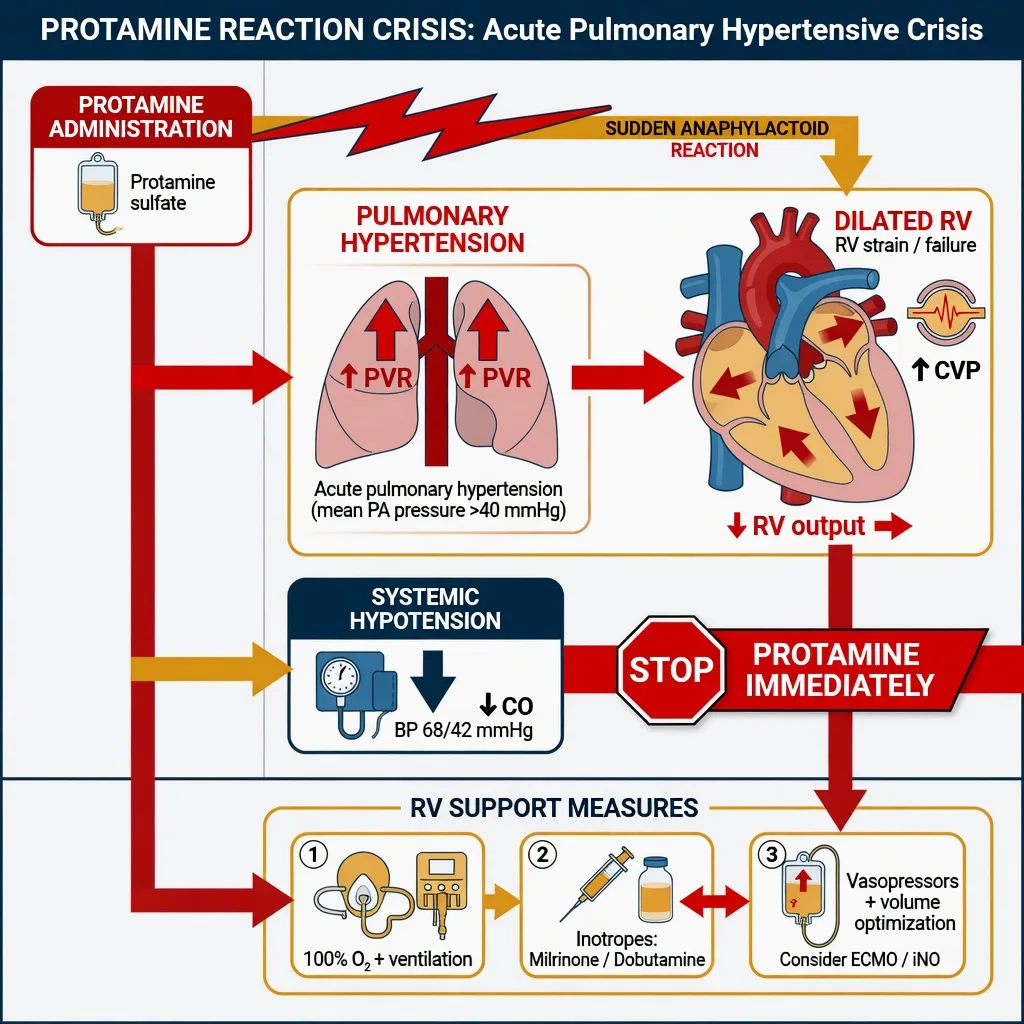
- When stable off CPB: surgical haemostasis, then protamine plan (~1 mg per 100 IU heparin slowly) only if haemodynamics secure.[3]
Specific low-output syndromes
Left ventricular failure / low cardiac output syndrome
Causes: inadequate myocardial protection, incomplete revascularisation, stunning, residual valve lesions, air in coronaries, metabolic derangement. Support contractility and coronary perfusion pressure; consider IABP early rather than after multiple failed weans.
[1]Right ventricular failure
Clues: high CVP, low left-sided filling, dilated hypokinetic RV on TOE, systemic hypotension. Management pillars:
[2]- Optimise RV coronary perfusion (maintain aortic pressure).
- Reduce PVR: avoid hypoxia, hypercarbia, acidosis, excessive PEEP/high airway pressures; consider inhaled pulmonary vasodilators (nitric oxide, inhaled epoprostenol) where available.
- Inodilators (milrinone, dobutamine) carefully balanced against systemic vasodilation.
- Mechanical support: RVAD or VA-ECMO if refractory.
Vasoplegia
Common after long CPB, ACE inhibitor exposure narratives, inflammatory states. Good contractility with low SVR. Prioritise noradrenaline and vasopressin; methylene blue for refractory cases per protocol. Do not keep adding pure inotropes alone.
[2]Dynamic LVOTO / SAM
See valve surgery topic. Opposite physiology to pump failure: volume, vasoconstriction, less inotropy.
[1]Escalation to mechanical circulatory support
If unable to wean after optimisation:
[2]- Return to full CPB flow; rest the myocardium; correct reversible causes.
- Team huddle: surgeon, perfusion, anaesthetist, intensivist.
- Escalate the MCS ladder thoughtfully:
Communicate early — delayed MCS after endless high-dose catecholamines worsens end-organ injury and arrhythmia risk.
[2]Monitoring numbers examiners expect
After successful wean
- Protamine approximately 1 mg per 100 IU heparin, slow peripheral administration preferred, reaction readiness.[3]
- Reassess TOE after protamine and again as chest closes (tamponade, graft kinking, dynamic obstruction).
- Bleeding algorithm: surgical vs coagulopathy (ACT, lab tests, TEG/ROTEM).
- ICU handover: vasoactive infusions, pacing mode, RV/LV concerns, open-chest plan if used, transfusion thresholds (TRICS III restrictive strategy when clinically appropriate).[1]
Crisis pivots — what changes the plan
- Sudden EtCO2 fall / air on TOE: de-air, support, surgical protocol for air embolism
- New RWMA after CABG: graft revision conversation
- Equalising low output as sternum approximates: consider tamponade / graft compression
- Collapse during protamine: stop drug; treat reaction; support RV; consider return to CPB[3]
- Refractory VF/VT: internal defibrillation, correct electrolytes, exclude ischaemia, rest on bypass
Postoperative / ICU plan
- Low cardiac output surveillance: lactate trend, urine output, mixed/central venous saturation where used, TOE/TTE
- Inotrope/vasopressor wean plans
- Mechanical support weaning criteria if IABP/ECMO placed
- Renal protection, glucose control, early recognition of tamponade (equalisation, oliguria, rising filling pressures, PEA)
- Restrictive transfusion strategy when safe; product therapy for true coagulopathy rather than anaemia alone
Special populations
- Long cross-clamp / redo / emergency cases: higher stunning and bleeding risk — lower threshold for MCS discussion
- Severe PHT / mitral disease: RV-centric wean plan from the start
- Heart transplant / VAD explant-implant: specialised protocols, denervated heart pacing dependence in transplant
- Paediatric/congenital: different flows, temperatures, residual lesion physiology — not adult RRRAC alone
SAQ answer scaffold
- Pre-wean checklist (temp, K+, Ca2+, ventilation, pacing, drugs, TOE, ACT).
- Define RRRAC with concrete interventions in each domain.
- TOE phenotype table and matching therapy.
- Unable-to-wean algorithm: full flow → diagnose → drugs → MCS.
- Protamine only when stable; reaction spectrum.[3]
- TRICS III one-liner for restrictive transfusion context.[1]
Viva stem bank and model phrases
- “The patient will not come off bypass — your systematic approach?”
- “TOE shows a dilated RV and empty LV — what now?”
- “Blood pressure is 60 mmHg with a hyperdynamic empty LV after mitral repair.”
- “When do you call for ECMO rather than more adrenaline?”
Model phrases:
[2]- “I am returning to full flow to rest the heart while I diagnose the phenotype on TOE.”
- “This is vasoplegia — I need vasoconstrictors, not only inotropes.”
- “I will not reverse heparin during an unstable failed wean.”
Common traps
- Only giving adrenaline without RRRAC
- Ignoring rhythm and pacing
- Missing SAM / dynamic obstruction
- Treating RV failure with pure systemic vasoconstriction and high ventilating pressures
- Delayed MCS after repeated failed weans
- Protamine during unstable low-output
- Using CVP alone for preload decisions
Extended RRRAC pharmacology (exact exam framing)
Pacing detail
After aortic valve surgery and many multi-valve cases, AV block is common. Test atrial and ventricular thresholds. DDD pacing restores AV synchrony and atrial kick (important in hypertrophied ventricles). Rates of 80–90/min often optimise output early after CPB; individualise for diastolic filling in MS-like physiology or dynamic obstruction where slower rates help.
[1]Inotrope and vasopressor ranges (unit-titrated, know the order of magnitude)
- Adrenaline: commonly 0.02–0.2 microg/kg/min — inotropy and some vasoconstriction at higher doses
- Noradrenaline: commonly 0.02–0.5 microg/kg/min — first-line for low SVR
- Vasopressin: commonly 0.01–0.06 units/min — catecholamine-sparing in vasoplegia; watch digital ischaemia narratives at high dose
- Milrinone: 0.25–0.75 microg/kg/min — inodilation, RV and PHT utility; expect SVR fall
- Dobutamine: 2.5–10 microg/kg/min typical starting bands — inodilation, tachycardia risk
- Methylene blue: often 1–2 mg/kg IV over 20–60 min for refractory vasoplegia where used; may interfere with oximetry readings
- Calcium chloride: 250–1000 mg IV carefully for low ionised calcium — transient inotropy
State clearly that infusions follow local cardiac ICU protocols and are titrated to TOE and numbers, not fixed recipes alone.
[1]Stepwise failed-wean algorithm (hot case spine)
- Declare failure early — return to full flow, rest 10 minutes while diagnosing.
- TOE survey: LV, RV, valves, SAM, air, tamponade, new RWMA.
- Labs: ABG, K+, ionised Ca2+, Hb, glucose, ACT.
- Surgical look: grafts, anastomoses, prosthesis, bleeding, dynamic obstruction anatomy.
- Phenotype-directed drugs (table above).
- Second wean attempt with optimised RRRAC.
- If still failing: IABP for LV failure without severe AR; pulmonary vasodilators for RV; VA-ECMO for refractory biventricular or combined failure.
- Only when stable: protamine plan.
IABP essentials for the viva
- Inflates in diastole (coronary perfusion), deflates in systole (afterload reduction)
- Improves LV myocardial supply–demand if some residual output exists
- Timing on ECG or arterial waveform; 1:1 support initially when unstable
- Contraindications include significant AR and severe peripheral vascular disease for femoral access
- Complications: limb ischaemia, balloon rupture, thrombocytopenia, incorrect timing worsening output
VA-ECMO essentials
- Drains venous blood, returns to arterial system — supports systemic flow and gas exchange
- Peripheral (femoral) vs central configurations
- LV may distend without ejection — needs venting strategy, IABP adjunct, or inotropes to open aortic valve
- Not a substitute for fixing a technical surgical problem that is immediately correctable
Metabolic drivers of failed wean
- Hyperkalaemia: arrhythmias, failure to capture pacing — treat with calcium, insulin–dextrose, washout on CPB
- Hypocalcaemia: poor contractility
- Acidaemia: reduced catecholamine responsiveness
- Hypothermia: coagulopathy and poor contractility — finish rewarming
- Residual air and coronary ischaemia
Communication language that scores
- “Full flow please — TOE shows a failing RV with underfilled LV.”
- “This is vasoplegia with good biventricular function — escalating vasopressin.”
- “I am concerned about SAM — reducing adrenaline, giving volume, raising SVR.”
- “We need mechanical support before a third high-dose wean attempt.”
ICU low cardiac output syndrome after arrival
Lactate rising, oliguria, cool peripheries, high inotrope scores, low ScvO2 — reassess with echo for tamponade, hypovolaemia, RV failure, or graft occlusion. Early return to theatre thresholds should be explicit in handover.
[1]Pre-wean checklist (read aloud in viva)
- Nasopharyngeal or bladder temperature near target (avoid hyperthermia overshoot)
- K+ in safe band after cardioplegia (often treat hyperkalaemia on CPB before wean)
- Ionised calcium checked
- Hb/Hct adequate for oxygen delivery strategy
- Base deficit and lactate noted (worsening lactate predicts hard wean)
- Lungs up, bilateral air entry, no mainstem tube
- FiO2 and PEEP set deliberately (high PEEP can impede RV)
- Pacing wires tested
- Inotropes connected and running if anticipated need
- TOE views optimised; surgeon ready to resume full flow
- ACT still therapeutic
- Suction ready; defibrillator ready [1]
RV failure deep dive
The RV is sensitive to acute PVR rises and to loss of coronary perfusion when aortic pressure falls. TOE: dilated hypokinetic RV, septal D-sign in pressure overload, underfilled LV, severe TR. Ventilator strategy: modest tidal volumes, avoid high mean airway pressure, treat hypoxia/hypercarbia aggressively, consider inhaled pulmonary vasodilators. Inotropes with pulmonary vasodilation (milrinone, dobutamine) help, but noradrenaline may still be needed for aortic root pressure. Opening the chest if closed and tamponade or tight mediastinum suspected can be life-saving in ICU returns. [1]
Vasoplegia deep dive
Mechanisms include inflammatory mediator release, relative vasopressin deficiency, and endothelial dysregulation after CPB. Clinical: low SVR, high or normal cardiac output, warm extremities, low MAP despite volume. Treatment ladder: noradrenaline → add vasopressin → methylene blue if refractory and protocol allows → rarely angiotensin II in specialised centres. Exclude anaphylaxis, residual anaesthetic overdose, and technical measurement error. [1]
Technical causes you must name
- Kinked graft or anastomotic problem
- Coronary air
- Native coronary occlusion/embolism
- Prosthetic valve dysfunction
- Dynamic LVOTO/SAM
- Shunt or residual lesion in congenital cases
- Iatrogenic aortic dissection from cannulation
- Severe AI from IABP misplaced or contraindicated use
- Tension pneumothorax after central lines [1]
Blood gas and electrolyte “wean killers”
Hyperkalaemia after cardioplegia: protect heart with calcium, shift with insulin–dextrose (e.g. 10 units insulin with 25 g dextrose adult starting regimens — titrate glucose), continue ultrafiltration/washout on CPB if needed. Hypokalaemia: arrhythmias. Severe acidaemia: reduce responsiveness to catecholamines — correct while supporting. Hypoglycaemia and hyperglycaemia both undesirable; follow cardiac anaesthetic glucose protocols. [1]
Second and third wean attempts — decision discipline
Each failed wean without a new diagnosis costs myocardial energy and raises lactate. After two optimised attempts, mechanical support conversation should already be active. Document MAP, flows, TOE findings, and drugs used at each attempt. [1]
Handover template to ICU
Procedure; cross-clamp and CPB times; difficulties weaning; final TOE summary; pacing mode; vasoactive infusions with rates; IABP/ECMO details; bleeding and products; ACT/protamine total; open chest yes/no; planned MAP and SpO2 targets; contingencies for tamponade. [1]
Rate and rhythm problems that look like pump failure
AF with rapid ventricular response after CPB reduces filling and output — cardiovert if unstable, load amiodarone if stable enough (e.g. 150–300 mg IV carefully over minutes with monitoring), correct K+ and Mg2+. Complete heart block after AVR: DDD pacing immediately. VT/VF: internal defibrillation, amiodarone, rest on bypass if recurrent ischaemic VT until grafts revised. Do not keep raising adrenaline for pure bradycardia — pace. [1]
Left ventricular failure sequencing
- Exclude reversible technical causes on TOE and surgical inspection
- Optimise rate/rhythm and coronary perfusion pressure
- Inotrope support (adrenaline/dobutamine) with afterload management
- IABP early if still marginal
- Temporary LVAD/Impella or VA-ECMO if refractory [1]
Delayed IABP after extreme catecholamines worsens arrhythmia and end-organ injury. [1]
Open chest management
If haemostasis and swelling prevent safe closure, the chest may be left open with a sterile temporary closure and ICU plan for delayed sternal closure. Handover must be explicit about dressing integrity, emergency reopen plan, and infection precautions. [1]
Numbers revision card
| Item | Value |
|---|---|
| Heparin | 300–400 IU/kg |
| ACT | ≥400–480 s |
| CPB flow | 2.2–2.5 L/min/m² |
| MAP on CPB | 50–80 mmHg typical |
| Protamine | ~1 mg/100 IU heparin |
| Vasopressin | ~0.01–0.06 U/min |
| Methylene blue | ~1–2 mg/kg where used |
SAQ paragraph bank
Definition: Low cardiac output syndrome after CPB is inadequate systemic oxygen delivery despite optimised preload, usually requiring inotropes ± mechanical support.
Assessment: RRRAC + TOE phenotypes + labs.
Escalation: drugs → IABP → ECMO/VAD.
Evidence: TRICS III restrictive transfusion non-inferiority in appropriate adults.[1]
Pitfall catalogue (final)
Ignoring TOE; protamine too early; pure inotropes for vasoplegia; pure vasoconstrictors for RV failure; missing SAM; third failed wean without MCS talk; no pacing wires tested; rewarming incomplete; K+ 6.8 ignored; treating CVP as gospel. [1]
[1] [1]References
- [1]Mazer CD, Whitlock RP, Fergusson DA, et al. Restrictive or Liberal Red-Cell Transfusion for Cardiac Surgery N Engl J Med, 2017.PMID 29130845
- [2]Hahn RT, Abraham T, Adams MS, et al. Guidelines for performing a comprehensive transesophageal echocardiographic examination: recommendations from the American Society of Echocardiography and the Society of Cardiovascular Anesthesiologists J Am Soc Echocardiogr, 2013.PMID 23998692
- [3]Levy JH, et al. What's fishy about protamine? Clinical use, adverse reactions, and potential alternatives J Thromb Haemost, 2023.PMID 37062523