EM · Resuscitation team leadership & CRM
Resuscitation team leadership and crisis resource management
The non-technical skills of the resuscitation: crisis resource management, the allocated team roles, the standing-back team leader, the closed-loop communication and the structured handover, the fixation error and the cognitive biases, the checklist and the cognitive aids, the simulation training, the debrief, and the human factors of fatigue and hierarchy.
On this page & tools
Your progress
Saved locally on this device.
Target exams
Red flags
The resuscitation is not a series of clinical decisions made by a single clinician; it is a team operation in which the non-technical skills — the leadership, the communication, the resource management, and the situational awareness — are as important to the outcome as the clinical knowledge. The formal study of these skills, the crisis resource management, began in the aviation industry after the recognition that most aeroplane crashes were caused not by mechanical failure but by failures of the crew's communication, the leadership, and the decision-making under stress. The translation of these principles to medicine, and to the resuscitation in particular, is the subject of the ILCOR Education, Implementation and Teams consensus, and it is now an explicit domain of the Fellowship examination.[1][1]

Team roles in resuscitation
The resuscitation team has allocated roles, each with a defined responsibility, and the allocation is made at the start of the resuscitation, before the need for it arises. The team leader stands back and directs the team, the airway operator manages the airway and the ventilation, the compressor performs the chest compressions (rotated every two minutes in the arrest), the defibrillator operator manages the rhythm analysis and the shocks, the drugs operator prepares and gives the drugs, the timekeeper and scribe records the interventions and the cycle times, and the runner fetches the equipment and the blood products.[1][1]
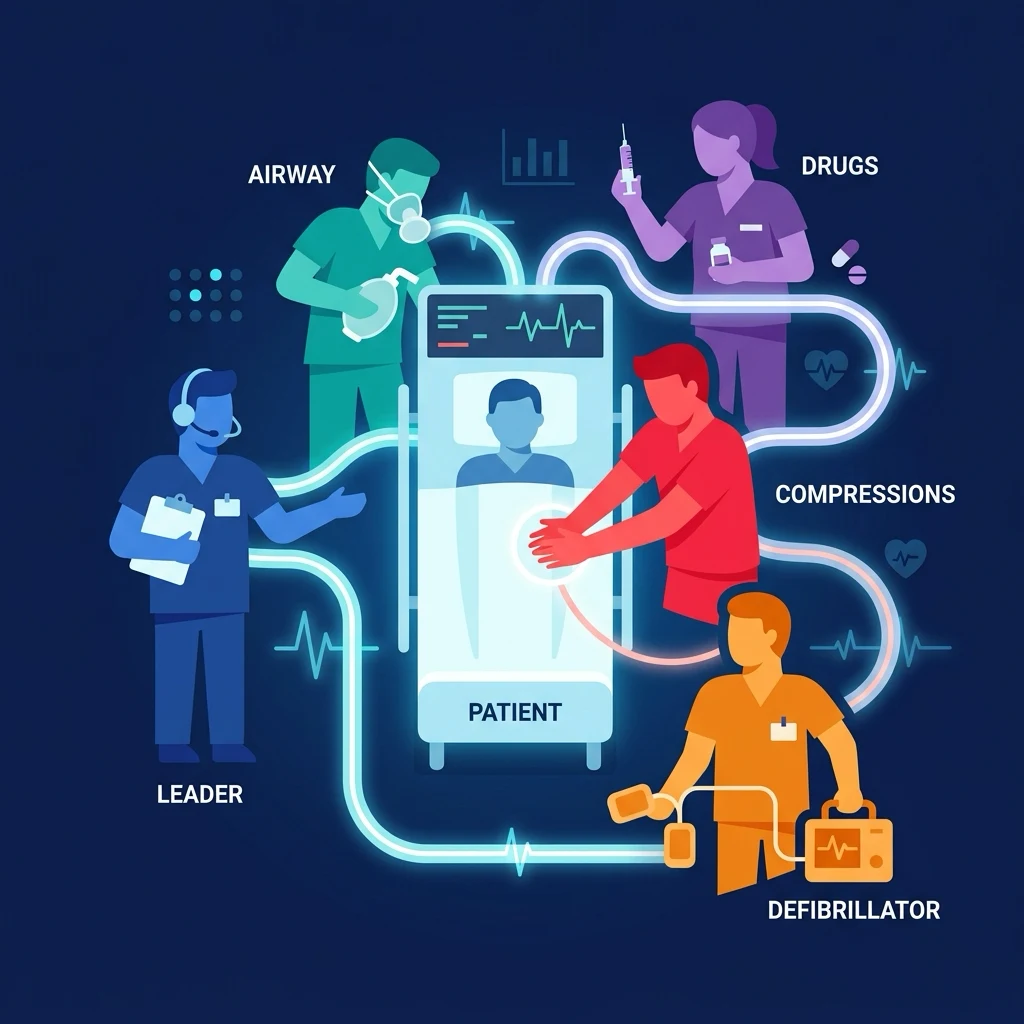
The team leader
The team leader's role is to stand back and maintain the situational awareness, not to perform the procedures. The leader who intubates or who compresses loses the overview of the patient, the team, and the environment, and this loss is the proximate cause of the missed deterioration, the overlooked reversible cause, and the failure to escalate. The leader calls the decisions, names the next step, ensures that every instruction is acknowledged, and periodically summarises the situation aloud so that the whole team shares the mental model. The leader also recognises the fatigue and rotates the team, calls for the senior or the specialty help early, and makes the decision to terminate or to continue.[1]
Closed-loop communication and the structured handover
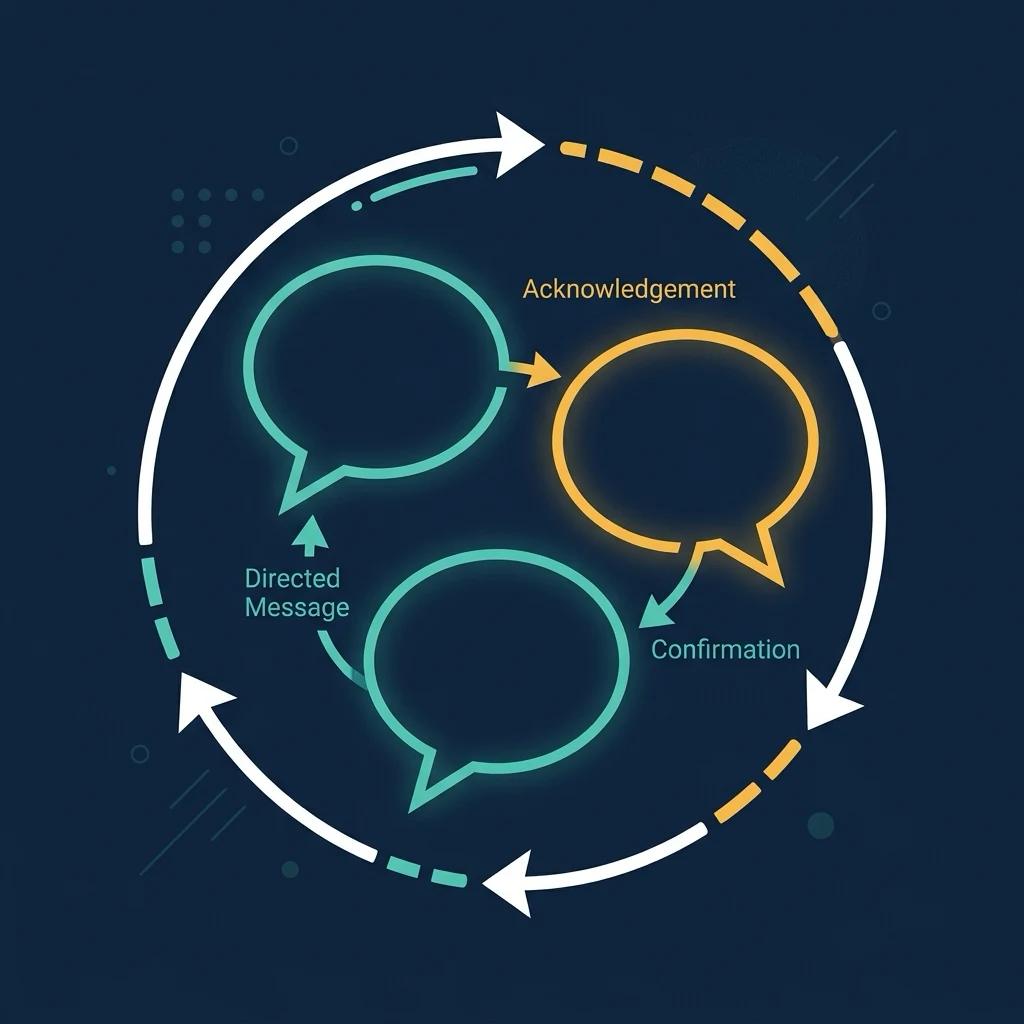
The communication in the resuscitation is closed-loop: the leader gives a specific, directed instruction (by name: "Sarah, give 1 milligram of adrenaline"), the receiver acknowledges it ("1 milligram of adrenaline, drawn up"), and the receiver confirms its administration ("adrenaline 1 milligram given"). The loop is closed by the confirmation, which prevents the silent assumption that an instruction was followed when it was not. The communication is brief, loud enough to be heard, and free of the ambiguous phrasing that leads to the error.[1]
The structured handover, at the arrival of the patient or at the transfer of the care, uses the SBAR (the Situation, the Background, the Assessment, the Recommendation) or the ISBAR, and it ensures that the receiving team inherits an accurate picture of the patient, the interventions, and the plan without having to reconstruct it.[1]
Fixation error and cognitive bias
The fixation error — the failure to revise a working diagnosis in the face of the contradictory information — is a leading cause of the failed resuscitation, and it is the non-technical-skill failure that the team leader must actively counter. The clinician who anchors on the first diagnosis (the "gastroenteritis" that is actually the septic shock, the "panic attack" that is the pulmonary embolism) pursues the wrong treatment while the patient deteriorates, and the structured ABCDE reassessment is the defence against it. The cognitive biases — the anchoring, the availability, the confirmation, and the framing — are universal, they are amplified by the stress and the fatigue, and they are mitigated by the explicit naming of the alternative diagnoses, the asking for the dissenting opinion, and the structured reassessment at every cycle.[1]
The checklist and the cognitive aids
The checklist (the WHO-style surgical checklist, the pre-intubation checklist, the arrest algorithm displayed on the wall) is a cognitive aid that offloads the memory and the vigilance in the high-stress environment, and the ILCOR consensus supports its use in the resuscitation.[1] The checklist ensures that the equipment is ready, the drugs are drawn up, the team is briefed, and the steps are not omitted under the pressure. It is run before the procedure, not during it, and it is brief and focused.
Simulation training
The team competencies of the resuscitation are taught and maintained through the simulation training, which allows the team to rehearse the rare and the high-stakes scenarios in a safe environment, and the systematic review of the resuscitation training confirms that the simulation improves the team performance.[2] The in-situ simulation (the simulation run in the actual resuscitation bay with the actual team) further identifies the latent system errors that the simulation centre cannot. The regular, the multidisciplinary, and the realistic simulation is the foundation of the competent resuscitation team.[1][2]
The debrief
The debrief after the resuscitation — whether the patient survived or not — is the mechanism by which the team learns from the event, the individual processes the emotional impact, and the system identifies the improvement points. The debrief is brief, structured, non-judgemental, and focused on the team performance and the system factors rather than the individual blame. It is the essential complement to the resuscitation, and its omission is the omission of the learning opportunity.[1]
Human factors: fatigue, hierarchy, and the authority gradient
The fatigue, the hunger, the stress, and the sleep deprivation degrade the cognitive performance and the decision-making, and the recognition of these factors — and the mitigation by the rest, the rotation, and the caffeine — is part of the professional practice. The hierarchy and the authority gradient — the steep one where the junior does not question the senior — suppress the subordinate who sees the error, and the flat, the inclusive, and the psychologically safe team culture is the countermeasure. The team leader who explicitly invites the dissent and the question ("tell me if I am missing something") is the team leader who hears the critical observation.[1][1]
Management — the team leader's emergency drug reference
The team leader must know the core emergency drug doses by heart, because the drugs operator looks to the leader for the dose and the route: adrenaline 1 mg IV/IO in the arrest (or 500 mcg IM for the anaphylaxis), amiodarone 300 mg IV after the third shock (150 mg after the fifth), noradrenaline 0.05 to 0.5 mcg/kg/min for the vasodilatory shock, calcium chloride 1 g IV (10 mL of 10 per cent) for the hyperkalaemia or the calcium-channel-blocker toxicity, and tranexamic acid 1 g IV bolus for the traumatic haemorrhage. The drugs are spoken aloud by name and dose, confirmed by the closed-loop communication, and documented by the scribe. [1]
Differential diagnosis — the causes of the non-technical-skill failure
- Fixation error — the anchoring on the first diagnosis; the defence is the structured ABCDE reassessment and the explicit naming of the alternatives.
- Authority gradient — the steep hierarchy that suppresses the junior; the defence is the flat, the inclusive team and the explicit invitation of dissent.
- Communication failure — the ambiguous, the unacknowledged or the not-heard instruction; the defence is the closed-loop communication and the directed instruction by name.
- Resource failure — the missing equipment, the delayed blood product, the unavailable senior; the defence is the pre-procedure checklist and the early escalation.
- Fatigue and stress — the degraded cognition; the defence is the rotation, the caffeine, and the awareness of the limitation. [1]
The structured approach — ABCDE, SAMPLE, and the treat–reassess–treat cycle
The non-technical skills are the scaffolding on which the clinical assessment hangs, and the structured approach is the scaffold itself. The team that improvises the assessment under the stress omits the step, misses the finding, and pursues the wrong treatment; the team that follows the canonical sequence does none of these. The ABCDE — the Airway, the Breathing, the Circulation, the Disability, the Exposure — is the shared, the universal, and the rehearsed order of the resuscitation, and it is performed in that order because each level is the precondition of the next: the breathing cannot be treated before the airway is secured, the circulation is not corrected before the breathing is, and the disability is not interpretable before the perfusion is restored. The leader who treats the C before the A is the leader who loses the patient to the unrecognised airway obstruction.[1]
The structured history — the SAMPLE (the Symptoms, the Allergies, the Medications, the Past history, the Last meal, the Events leading to the presentation) — is taken in parallel by a second team member while the leader runs the ABCDE, and it is fed back to the leader at the first pause. The two streams run simultaneously, and they converge in the working diagnosis that the leader names aloud and shares with the team. The cycle is the treat–reassess–treat loop: the leader treats the immediately life-threatening abnormality, reassesses the response, and treats again — the bronchodilator is given and the wheeze is reassessed, the fluid is given and the perfusion is reassessed, the glucose is given and the consciousness is reassessed — and the cycle is repeated at every change and at every cycle until the patient is stable. The resuscitation is not a single intervention; it is this iterative loop run until the patient is corrected.[1]
The team leader's structured approach — the treat–reassess–treat cycle
Recognise the deterioration and call for help early — activate the team and the resources before they are needed.
A — Airway: assess and secure; protect the cervical spine in the trauma; the bedside airway adjunct ready.
B — Breathing: the rate, the effort, the symmetry, the oxygen saturation; give the high-flow oxygen and the ventilatory support to the target; the chest for the tension pneumothorax, the haemothorax.
C — Circulation: the pulse, the perfusion, the capillary refill, the blood pressure; the IV/IO access; the fluid or the blood to the target; the control of the catastrophic haemorrhage first.
D — Disability: the AVPU/GCS, the pupils, the glucose (do NOT miss the hypoglycaemia), the temperature; the targeted intervention.
E — Exposure: the full examination, the vital signs, the capillary glucose, the ECG; the simultaneous SAMPLE history from the paramedic or the family.
Synthesise: name the working diagnosis aloud, state the immediate plan, allocate the next actions by name.
Treat–reassess–treat: treat the abnormality, reassess the response at the next cycle, treat again — repeat until the patient is stable or the decision to escalate is made.
Reassess the whole ABCDE at every cycle: the fixation error is held at bay by the structured re-examination, not by the impression of stability.
The team leader's mental model — the global picture and the periodic summary
The team leader's single most valuable activity is the maintenance of the global picture — the integrated awareness of the patient, the team, the environment, the time, and the trajectory. The leader who is absorbed in the single task — the intubation, the central line, the ultrasound probe — loses the global picture, and the loss of the global picture is the proximate cause of the missed deterioration, the overlooked reversible cause, the failure to rotate the compressor, and the failure to call the senior early. The leader stands back, the hands off the patient, and the eyes on the whole.[1][3]
The mechanism by which the leader holds the global picture is the periodic verbal summary — the leader's aloud review, every two minutes or every cycle, of the situation: "We are now eight minutes into the arrest, the rhythm is the VF, we have given three shocks and two of adrenaline, the airway is secured, the IV access is in, the reversible causes searched are the hyperkalaemia and the PE, the blood gas is back, the potassium is six. The plan is the calcium, the insulin-dextrose, the fourth shock, and the call for the ECMO." The summary does three things: it refreshes the leader's own situational awareness, it broadcasts the shared mental model to the team, and it invites the correction from the member who has noticed the thing the leader has missed. The leader who does not summarise aloud is the leader who drifts.[6]
The team leader — what to do
- Stand back, hands off the patient, eyes on the whole — the patient, the team, the monitor, the clock
- Allocate and name the roles at the start, before the need
- Direct every instruction by name and confirm the closed loop
- Run the periodic verbal summary every cycle — the situation, the time, the plan
- Call for the senior, the specialty, and the blood products EARLY, before the need is critical
- Rotate the compressor and the airway operator against the fatigue
- Make and own the decisions — the drugs, the escalation, the termination, the disposition
The team leader — what NOT to do
- Do NOT perform the procedures — the intubation, the compressions, the line; the leader who does loses the overview
- Do NOT anchor on the first diagnosis — the periodic reassessment is the defence
- Do NOT allow the open-loop instruction — the unconfirmed order is the source of the silent omission
- Do NOT hold the dissent — the steep authority gradient suppresses the junior who sees the error
- Do NOT omit the debrief — the resuscitation without the debrief is the resuscitation whose lessons are lost
- Do NOT delay the senior or the specialty call for want of certainty — the call is the help
CRM in cardiac arrest — the designated roles and the two-minute rhythm
The cardiac arrest is the archetypal CRM event, and it is managed by a team of designated roles assembled and briefed before the arrest is run. The roles are the team leader (the standing-back director), the compressor (the chest compressions, rotated every two minutes), the airway operator (the airway, the ventilation, the waveform capnography), the IV/drugs operator (the access, the drawn-up and the administration), the defibrillator operator (the rhythm analysis and the shocks), the timekeeper and recorder (the cycle times, the drugs, the rhythm, the interventions), and the runner (the equipment, the blood products, the family). Each role is named at the start, each is acknowledged, and each knows the responsibility. The team that assembles without the named roles is the team that fumbles the drug, misses the shock timing, and forgets the reversible-cause search.[1][6]
The resuscitation is run to the metronome of the two-minute cycle — the cycle of the chest compressions punctuated by the rhythm check and the drug at the cycle's end, and the compressor is rotated at every rhythm check against the fatigue that silently degrades the compression depth and the rate. The leader calls the rhythm, names the next action, allocates the drug, and restarts the compressions within the five-second pause. The recorder writes the rhythm, the shock, the drug, the dose, and the time at each cycle, and the running record is the team's shared memory and the medicolegal document. The cycle continues until the return of the spontaneous circulation, the termination, or the decision to escalate to the extracorporeal CPR.[1]
The cardiac-arrest team — the designated roles and their responsibility
The compressor
- Delivers the compressions at 100-120/min, 5-6 cm depth, with the full chest recoil and the minimal interruption
- Rotated every two minutes (at the rhythm check) — the fatigue silently degrades the depth and the rate from the first minute
- Swaps in under five seconds; the hands overlap on the chest during the rotation to minimise the no-flow time
- Counts aloud or follows the metronome; the leader watches the depth and the rate
The airway operator
- Manages the airway and the ventilation — the basic airway, the supraglottic, the intubation, the surgical airway
- Watches the waveform capnography — the ETCO2 confirms the tube placement and trends the CPR quality
- Ventilates at 10 breaths/min once the airway is secured; avoids the excessive ventilation that raises the intrathoracic pressure
- Calls the ETCO2 trend to the leader (the rising ETCO2 may signal the ROSC)
The defibrillator operator
- Places the pads in the anterolateral (and anteroposterior) position, shaves the chest hair, dries the skin
- Analyses the rhythm at the cycle end, calls it aloud ("VF — shockable"), delivers the shock with the safety check
- Resumes the CPR immediately after the shock — no rhythm or pulse check in the post-shock window
- Charges the defibrillator during the final compressions of the cycle to minimise the pre-shock pause
The IV / drugs operator
- Secures the IV or the IO access early; the IO is the default if the IV is delayed beyond one minute
- Draws up and administers the drugs on the leader instruction; confirms the closed loop for every drug
- Knows the arrest card — the adrenaline 1 mg, the amiodarone 300 mg, the bicarbonate, the calcium, the fluid
- Labels the syringes; never administers an unidentified drug
The timekeeper / recorder
- Calls the cycle end ("two minutes — pause for the rhythm check"); keeps the CPR metronome
- Records the rhythm, the shock, the drug, the dose, and the time at every cycle — the running record
- Acts as the team memory — the leader asks "how long, how many adrenaline, what was the rhythm three cycles ago"
- Documents the ROSC time, the reversible-cause search, the family contact
The runner
- Fetches the equipment, the blood gas cartridge, the warmer, the ultrasound, the difficult-airway trolley
- Runs the massive transfusion protocol; fetches and checks the blood products
- Manages the family at the bedside; the dedicated family liaison preserves the team focus
- Removes the clutter and the bottleneck; the unblocked team is the efficient team
Closed-loop communication — the three-part verbal structure
The closed-loop communication is the three-part verbal structure that guarantees the instruction is heard, understood, and executed. The call-out is the leader's directed instruction, given by name, naming the drug, the dose, and the route ("Sarah, give one milligram of adrenaline intravenously"). The check-back is the receiver's repeat-back of the instruction as the action is begun ("one milligram of adrenaline intravenously, drawn up"). The closed loop is the receiver's confirmation that the action is complete ("adrenaline one milligram given"). The loop is closed only by the final confirmation, and the absence of the confirmation is the open loop that allows the instruction to be assumed done when it was not.[1][10]
The closed loop is not optional, and it is not the redundancy — it is the explicit, the deliberate safeguard against the silent omission that kills the patient. The leader who calls "someone give the adrenaline" without the name, the dose, or the route, and who receives no check-back, has issued an open-loop instruction that may or may not be executed, and the arrest that fails for the want of the given adrenaline is the open-loop failure. The systematic review of the teamwork and the communication training in the emergency departments confirms that the structured communication interventions improve the safety culture and the patient outcomes.[10]
Effective closed-loop communication
- The leader directs BY NAME — "Sarah, give one milligram of adrenaline IV"
- The receiver CHECKS BACK — "One milligram of adrenaline IV, drawn up"
- The receiver CLOSES THE LOOP — "Adrenaline one milligram IV given at oh-nine-twelve"
- The leader acknowledges the closure — "Thank you, noted"
- Every drug, every dose, every route spoken aloud; the ambiguity is eliminated
Failed open-loop communication
- The leader calls to no one — "Can someone give the adrenaline?"
- No name, no check-back, no confirmation; the instruction assumed but not verified
- The drug is drawn up twice or not at all; the dose and the route uncertain
- The leader moves on without the closure — the silent omission is undetected
- The open loop is the proximate cause of the missed drug, the wrong dose, and the duplicate administration
Human factors — the fixation error taxonomy
The fixation error — the failure to revise the working diagnosis or the course of action in the face of the contradictory evidence — is the best-studied and the most dangerous of the non-technical-skill failures, and the human-factors literature describes it in three canonical forms that the Fellowship candidate must name and recognise. The first is "This and only this" — the fixation on a single diagnosis or a single task to the exclusion of the others; the clinician is certain it is the sepsis and pursues the sepsis while the tamponade is untreated. The second is "This and such" — the recognition of one problem but the failure to recognise the other coexisting problem; the clinician treats the obvious tension pneumothorax but misses the concurrent massive haemorrhage. The third is "Everything is OK" — the persistent failure to recognise any abnormality at all despite the clear evidence; the clinician reads the normal-looking trace and ignores the falling capnography, the rising lactate, and the dropping consciousness.[3]
The three forms share the mechanism: the attentional and the cognitive resources are captured by the single interpretation, and the disconfirming evidence is filtered out. The defence against all three is the same — the structured, the periodic ABCDE reassessment, the explicit naming of the alternative diagnoses, and the active invitation of the dissenting observation. The leader who says, at every cycle, "what else could this be?" is the leader who holds the fixation error at bay.[1]
"This and only this" — the tunnel vision
- The fixation on a single diagnosis or a single task to the exclusion of all others
- The "gastroenteritis" that is the septic shock; the "panic attack" that is the pulmonary embolism; the "COPD" that is the high-output heart failure
- The defence: the structured ABCDE reassessment every cycle; the explicit naming of the alternatives
- The leader asks: "If this is NOT what we think it is, what else could it be?"
"This and such" — the single-cause trap
- The recognition of one problem but the failure to recognise the other, coexisting problem
- The tension pneumothorax treated but the concurrent internal haemorrhage missed; the sepsis treated but the concurrent tamponade overlooked
- The defence: the complete ABCDE at every cycle, not the focus on the treated abnormality alone
- The leader asks: "What ELSE is going on? Is there a second problem?"
"Everything is OK" — the normalcy bias
- The persistent belief that nothing is wrong despite the clear evidence of the deterioration
- The flat capnography ignored; the falling saturations attributed to the probe; the rising lactate dismissed as the "baseline"
- The defence: the objective vital-sign trend, the blood gas, the capnography — trust the numbers over the impression
- The leader asks: "Does the patient look better, the same, or worse than ten minutes ago? What do the numbers say?"
Cognitive overload, the tunnel vision, and the cognitive biases
The resuscitation imposes the cognitive load that exceeds the unaided human capacity, and the failure modes that result are the cognitive overload (the exceeding of the working-memory capacity with the resultant omission and the error), the tunnel vision (the attentional narrowing onto the single salient feature at the expense of the periphery), and the cognitive biases (the systematic distortions of the judgement). The four biases the Fellowship candidate must name are the anchoring (the over-weighting of the first impression), the availability (the over-weighting of the recently or the vividly recalled case), the confirmation (the selective search for the evidence that supports and the disregard of the evidence that refutes), and the framing (the undue influence of the way the problem is presented — the "known septic" patient who is actually the diabetic ketoacidosis). The biases are universal, they are amplified by the stress and the fatigue, and they are mitigated only by the structured, the explicit countermeasures.[3]
Anchoring bias
- The over-weighting of the first impression or the early datum; the first diagnosis "sticks"
- The paramedic handover of the "known asthmatic" anchors the team on the asthma and misses the pneumothorax
- Defence: the structured ABCDE; the explicit "what else could this be?"; the willingness to abandon the first diagnosis
Availability bias
- The over-weighting of the recently seen, the memorable, or the feared case
- The recent aortic-dissection case makes the clinician over-call the dissection in the next ten chest pains
- Defence: the baseline prevalence and the likelihood ratio, not the vivid memory; the disciplined differential
Confirmation bias
- The selective search for the supporting evidence and the disregard of the refuting evidence
- The "sepsis" patient — the rising lactate is weighted, the normal white count is dismissed
- Defence: the active search for the disconfirming datum; the named devil's advocate on the team
Framing / diagnostic momentum
- The undue influence of the way the problem is presented; the label handed on acquires the momentum
- The "known alcoholic, withdrawal" frame obscures the intracranial bleed; the "frequent flyer" frame obscures the genuine pathology
- Defence: the de-framing — assess the patient fresh, ignore the label; "what would I think if this were the first presentation?"
Premature closure
- The acceptance of a diagnosis before it is fully verified; "the case is closed"
- The chest pain labelled "musculoskeletal" before the ECG is done; the abdomen labelled "gastroenteritis" before the lactate returns
- Defence: the rule-out of the life-threat first; the ECG before the disposition; the lactate before the discharge
The post-arrest debrief — plus–delta, PEARLS, and the structured format
The debrief is the structured conversation held in the minutes to the hours after the resuscitation, in which the team reviews the event, identifies what went well and what to improve, processes the emotional impact, and converts the single event into the durable learning. The debrief is not the optional nicety — it is the mechanism by which the team learns, by which the individual recovers, and by which the system improves, and the omission of the debrief is the omission of the learning. The landmark study of the performance debriefing after the in-hospital cardiac arrest demonstrated that the structured debrief improved the CPR process and the patient outcomes, and the contemporary guidelines make the debrief an explicit best practice.[4][6]
The debrief is brief (ten to twenty minutes), structured (it follows a framework, not a free-for-all), non-judgemental (it focuses on the team and the system, not the individual blame), safe (the psychological safety is the precondition — the team member will not speak honestly if the honesty is punished), and action-oriented (it identifies the one or two specific improvements the team will enact). The timing is soon — within the minutes to the hours, while the memory is fresh and before the cognitive bias of the hindsight reshapes it. The debrief is led by the team leader or the trained facilitator, and every member of the team is invited to speak.[4][11]
The post-arrest debrief — the structured format (plus–delta)
Set the frame: state the purpose (the learning, not the blame), the confidentiality ("what is said here stays here"), and the time (the ten to twenty minutes).
Reconstruct the facts: walk the timeline aloud — the call, the arrival, the rhythm, the interventions, the ROSC or the termination. Use the recorder's notes.
Plus — what went well: each member names one thing the team did well (the early defibrillation, the closed-loop communication, the rotation of the compressor).
Delta — what to improve: each member names one thing the team could do better (the delayed senior call, the over-long pause, the missed reversible-cause check).
Analyse the why: for each delta, ask the "five whys" to reach the system factor, not the individual fault (the drug was late because the access was delayed, because the IO was not the default).
Commit to the action: agree the one or two specific, the measurable improvements the team will enact (the IO as the default after one minute; the senior call at the five-minute mark).
Close with the support: acknowledge the emotional impact, offer the follow-up, and thank the team. The debrief ends on the note of the shared learning and the mutual support.
Plus–delta debrief
- The simplest and the most widely used format — the "plus" (what went well) and the "delta" (what to change)
- Quick (10-20 min), inclusive, low-facilitation-skill — ideal for the time-pressured ED
- Centred on the informed learner self-assessment — each member reflects, then the group adds
- The output is the one or two concrete actions the team commits to enact
PEARLS framework
- Promoting Excellence And Reflective Learning in Simulation — the blended debriefing framework of Eppich and Cheng
- Blends the learner self-assessment, the facilitated critique, and the directive feedback in the proportions the situation warrants
- Structured around the reactions, the description, the analysis, and the summary — the GAS
- The richer framework for the complex, the high-stakes, or the emotionally charged event
Gather–Analyze–Summarize (GAS)
- The three-phase structure that underlies the PEARLS — the Gather (the facts and the reactions), the Analyze (the why), the Summarize (the actions)
- The scaffold the facilitator holds in the head while the conversation flows
- Useful for the debrief of any complexity; the "analyze" phase is where the learning is made
- The summary is the bridge to the next event — the team carries the action into the next resuscitation
Improving in-hospital cardiac arrest outcomes with performance debriefing
Archives of Internal Medicine
PMID 18504334
Key finding
The before-and-after study of the structured performance debriefing (the CPR-quality data reviewed with the team after the arrest) in the in-hospital cardiac arrests; the debriefing improved the CPR process (the compression depth and the pre-shock pause) and was associated with the improved survival to discharge.
Practice change
The structured debrief after the arrest improves both the CPR process and the patient outcomes — it is the mechanism by which the team converts the single event into the durable improvement, and its omission is the omission of the learning.
The PEARLS Healthcare Debriefing Tool
Academic Medicine
PMID 29381495
Key finding
The PEARLS Healthcare Debriefing Tool — a published, the portable framework that operationalises the PEARLS blended debriefing (the learner self-assessment plus the facilitated critique plus the directive feedback) into the structured worksheet the team can use at the bedside.
Practice change
The PEARLS tool gives the team the ready framework for the debrief of any complexity — the structured, the time-efficient, the action-oriented conversation that converts the event into the learning.
The non-technical skills — the assessment of the team
The non-technical skills of the resuscitation — the leadership, the communication, the teamwork, the situational awareness — are observable, they are teachable, and they are assessable, and the validated tools exist for the rating of the team performance. The Team Emergency Assessment Measure (TEAM) is the tool developed and validated for the rating of the emergency team's non-technical skills across the eleven items of the leadership, the teamwork, the task management, and the situational awareness, and the mapping review confirms its widespread and the valid use in the emergency, the obstetric, and the trauma teams. The Anaesthetists' Non-Technical Skills (ANTS) and the NOTCHS-family tools do the equivalent for the anaesthesia and the operating theatre. The Fellowship candidate should know that the non-technical skills are assessed as rigorously as the clinical skills, and that the assessment drives the training.[7][8][3]
The hierarchy, the authority gradient, and the graded assertiveness
The authority gradient — the steepness of the hierarchy between the senior and the junior — is the cultural factor that most reliably suppresses the critical observation. The steep gradient is the one in which the junior sees the error (the wrong dose, the missed rhythm, the overlooked cause) and does not speak, because the cost of the correction by the junior of the senior is felt to exceed the cost of the error. The flat gradient — the psychologically safe team in which the dissent is invited and the correction is welcomed — is the one in which the critical observation is made and the error is averted. The team leader creates the flat gradient by the explicit invitation ("tell me if I am wrong; I want the dissent; the question is not the challenge"), by the welcoming of the correction, and by the graded assertiveness the junior is taught to use.[1][1]
The graded assertiveness is the structured escalation the junior uses when the concern is not heard: the probe (the question — "are you sure that is the adrenaline dose?"), the alert (the statement of the concern — "I think that is the ten-fold dose"), the challenge (the direct stop — "stop, that is the wrong dose"), and the emergency (the action — the physical interruption, the call to the third party). The graded assertiveness gives the junior the script and the permission to escalate, and the team leader who has taught it to the team is the team leader who hears the correction before the harm.[1]
The steep authority gradient
- The senior is unquestionable; the junior who corrects is rebuked or the worse
- The critical observation is suppressed; the error proceeds undetected
- The "Swiss-cheese" defence fails because the last layer — the junior who sees it — is silenced
- The defence: the explicit flattening by the leader — the invitation of the dissent, the CUS word
The flat authority gradient
- The senior is the leader AND the learner; the junior is empowered to correct
- The critical observation is made and heard; the error is averted
- The CUS — "I am Concerned, I am Uncomfortable, this is a Safety issue" — is the agreed stop signal
- The defence: the two-challenge rule and the graded assertiveness the junior is taught to use
The cognitive aids — the algorithm on the wall and the read-aloud checklist
The cognitive aid — the algorithm displayed on the wall, the reversible-causes card, the pre-intubation checklist, the dose card — is the prosthetic that extends the working memory in the high-stress environment, and the ILCOR consensus supports its use in the resuscitation. The cognitive aid is run before the procedure (the pre-intubation checklist confirms the equipment, the drugs, the back-up plan), it is followed during the procedure (the algorithm on the wall is the reference, not the recollection), and it is read aloud by the scribe in the arrest (the leader calls the step, the scribe reads it back, the team executes it). The cognitive aid does not replace the knowledge — it scaffolds the application of the knowledge under the load.[1]
[1]Simulation, the in-situ rehearsal, and the team training
The team competencies of the resuscitation are the perishable skills, and they are taught and maintained through the simulation training. The systematic reviews confirm that the CRM simulation-based training improves the non-technical skills of the interprofessional teams, that the teamwork and the communication interventions improve the safety culture in the emergency departments, and that the high-fidelity simulation improves the advanced life support performance.[2][9][10] The in-situ simulation — the simulation run in the actual resuscitation bay with the actual team — further identifies the latent system errors (the missing equipment, the blocked access, the unclear protocol) that the simulation centre cannot, and the in-situ programme is the highest-yield form of the team training. The regular, the multidisciplinary, and the realistic simulation is the foundation of the competent resuscitation team.[1]
The structured handover — SBAR and ISBAR
The structured handover at the arrival of the patient, the transfer of the care, or the escalation to the senior uses the SBAR or the ISBAR — the Situation (the patient, the problem, the presenting state), the Background (the history, the comorbidity, the medications), the Assessment (the vital signs, the examination, the investigations, the working diagnosis), and the Recommendation (the plan, the action requested, the timeframe). The structured handover ensures the receiving team inherits the accurate and the complete picture without the reconstruction, it standardises the communication so that no critical datum is omitted, and it is the closed-loop at the level of the whole patient. The ISBAR adds the Identify (the sender and the receiver named) to the front, and it is the format the ANZ and the UK systems use.[1]
[1]Management — the team leader's cognitive and behavioural repertoire
Beyond the drug doses, the team leader's repertoire in the resuscitation is the set of the cognitive and the behavioural habits that the examiner assesses in the viva: the structured ABCDE, the directed closed-loop communication, the periodic verbal summary, the rotation of the compressor, the early senior call, the structured reversible-cause search, the read-aloud algorithm, the named devil's advocate, the invited dissent, and the post-event debrief. These are the observable behaviours, they are teachable, and they are the substance of the non-technical-skill assessment. The candidate who names them, demonstrates them in the simulation, and applies them in the practice is the candidate who passes the CRM viva.[1][1][1]
High-yield viva answers — the CRM pearls
SAQ — Leading the ventricular-fibrillation arrest and the two-minute cycle
10 minutes · 10 marks
You are the team leader for a cardiac arrest call in the resuscitation bay. A 58-year-old man has collapsed in the waiting room; the initial rhythm on the monitor is ventricular fibrillation. Six staff respond to the call: a senior nurse, two junior doctors, a registrar, an emergency nurse and a porter.
SAQ — The fixation error, the cognitive bias and the authority gradient
10 minutes · 10 marks
You are leading the resuscitation of a 45-year-old woman brought in with breathlessness and presyncope. The paramedic handover describes her as a known asthmatic. On arrival she is distressed and wheezy, with a respiratory rate of 32, a saturation of 90 per cent on 15 litres of oxygen, a blood pressure of 100 over 70 and a heart rate of 128. The team has begun the salbutamol nebs and the intravenous hydrocortisone. After 20 minutes there is no improvement and the blood pressure has fallen to 84 over 60.
Red flags
The following features identify the team or the leadership that is at risk of a non-technical-skill failure, in which the structured CRM principles are applied: [1]
[1]References
- [1]Greif R, Bhanji F, Bigham BL, et al. Education, Implementation, and Teams: 2020 International Consensus on Cardiopulmonary Resuscitation and Emergency Cardiovascular Care Science With Treatment Recommendations Resuscitation, 2020.PMID 33098918
- [2]Farquharson B, Caesar D, McKee S, et al. Teaching team competencies within resuscitation training: A systematic review Resusc Plus, 2024.PMID 39006135
- [3]Gaba DM. Crisis resource management and teamwork training in anaesthesia Br J Anaesth, 2010.PMID 20551023
- [4]Edelson DP, Litzinger B, Arora V, et al. Improving in-hospital cardiac arrest process and outcomes with performance debriefing Arch Intern Med, 2008.PMID 18504334
- [5]Bajaj K, Meguerdichian M, Thoma B, et al. The PEARLS Healthcare Debriefing Tool Acad Med, 2018.PMID 29381495
- [6]Anderson TM, Secrest K, Krein SL, et al. Best Practices for Education and Training of Resuscitation Teams for In-Hospital Cardiac Arrest Circ Cardiovasc Qual Outcomes, 2021.PMID 34779653
- [7]Cooper S, Cant R, Porter J, et al. Rating medical emergency teamwork performance: development of the Team Emergency Assessment Measure (TEAM) Resuscitation, 2010.PMID 20117874
- [8]Cooper S, Connell C, Cant R. Review article: Use of the Team Emergency Assessment Measure in the rating of emergency teams' non-technical skills: A mapping review Emerg Med Australas, 2023.PMID 36849717
- [9]Fung L, Boet S, Bould MD, et al. Impact of crisis resource management simulation-based training for interprofessional and interdisciplinary teams: A systematic review J Interprof Care, 2015.PMID 25973615
- [10]Alsabri M, Boudi Z, Lauque D, et al. Impact of Teamwork and Communication Training Interventions on Safety Culture and Patient Safety in Emergency Departments: A Systematic Review J Patient Saf, 2022.PMID 33890752
- [11]Cheng A, Eppich W, Epps C, et al. Embracing informed learner self-assessment during debriefing: the art of plus-delta Adv Simul (Lond), 2021.PMID 34090514
- [12]Kainth R. Dynamic Plus-Delta: an agile debriefing approach centred around variable participant, faculty and contextual factors Adv Simul (Lond), 2021.PMID 34620251