EM · Vasoactive drugs in resuscitation
Vasoactive drugs in resuscitation
The vasoactive drugs of resuscitation: the vasopressors (noradrenaline, adrenaline, vasopressin, phenylephrine, metaraminol) and the inotropes (dobutamine, milrinone, the declining dopamine), their receptor pharmacology, their doses, the matching of the drug to the type of shock, the route and the monitoring, and the adjunctive corticosteroids.
On this page & tools
Your progress
Saved locally on this device.
Target exams
Red flags
The vasoactive drugs restore the blood pressure and the cardiac output when the fluid alone is insufficient, and the Fellowship candidate must know them by their receptor pharmacology, their doses, and their place in the specific type of shock. The modern approach is driven by the cause: the vasodilated patient (the distributive shock) needs a vasopressor to restore the vascular tone, the patient with a failing pump (the cardiogenic shock) needs an inotrope, and the two classes are combined when the shock is mixed. The ESICM guidelines and the Surviving Sepsis Campaign provide the evidence-based framework for their selection and their titration.[1][2]
Classification
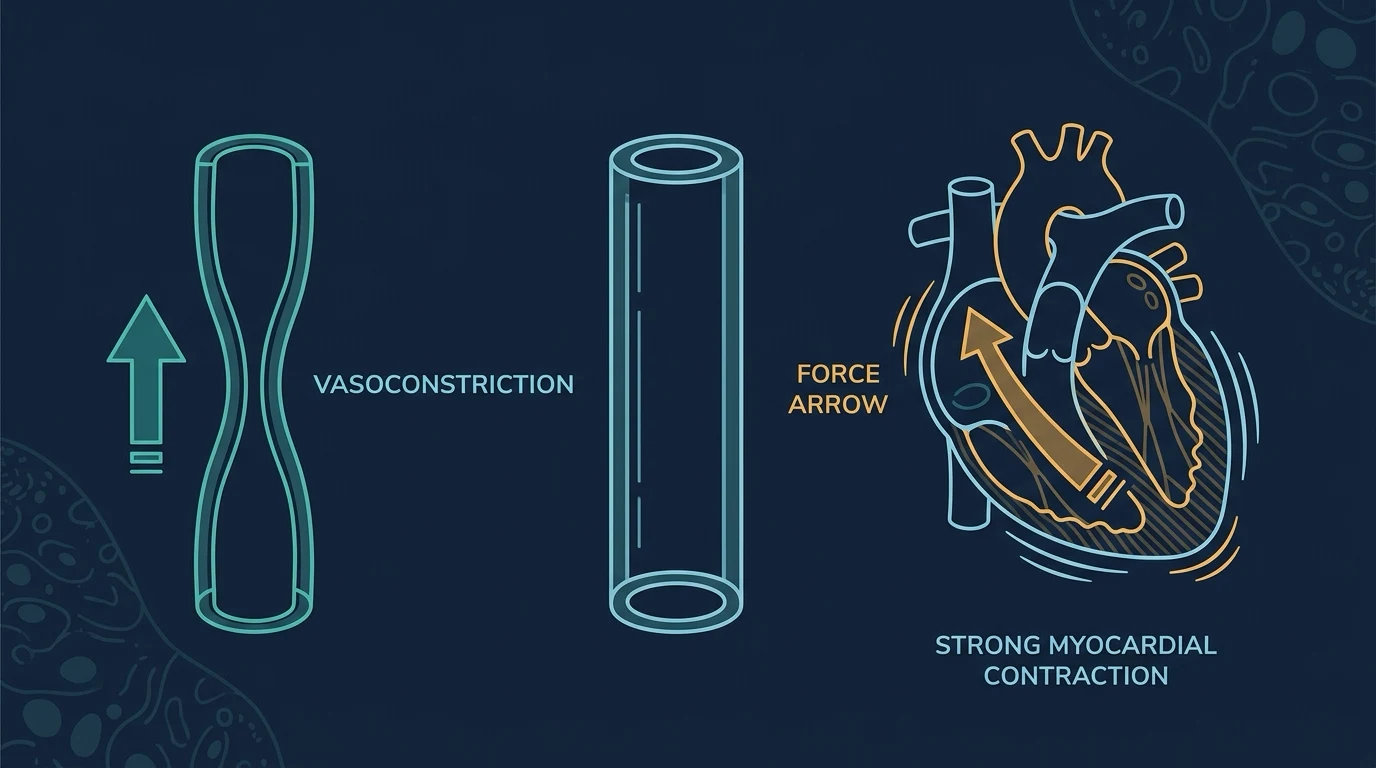
The vasoactive drugs are classified by their primary receptor effect and their purpose. The vasopressors raise the systemic vascular resistance and the blood pressure: noradrenaline (the alpha-1 agonist with a mild beta-1 effect), adrenaline (the mixed alpha and beta agonist), phenylephrine (the pure alpha-1 agonist), metaraminol (the mixed alpha agonist with some beta), and vasopressin (the V1-receptor agonist that is independent of the adrenergic system). The inotropes raise the cardiac contractility and the cardiac output: dobutamine (the beta-1 agonist), milrinone (the phosphodiesterase inhibitor that raises the intracellular cAMP by a different mechanism), and adrenaline (which is both a vasopressor and an inotrope at the higher doses). Dopamine, the dose-dependent agent, is historically both but is no longer first-line. The drug is chosen to correct the specific physiological failure that produced the shock.[1]
Noradrenaline — the first-line vasopressor
Noradrenaline (norepinephrine) is the first-line vasopressor for the vasodilatory shock of sepsis and the other distributive causes, and the Surviving Sepsis Campaign recommends it over dopamine for this indication because it produces fewer arrhythmias.[2] It acts primarily at the alpha-1 receptor (vasoconstriction) with a modest beta-1 effect (a slight increase in the contractility), and it is infused at 0.05 to 0.5 micrograms per kilogram per minute, titrated to the mean arterial pressure (65 mmHg or more) and the markers of perfusion. It is preferably given through a central line, but in the emergency it may be given peripherally for a short period, with the early conversion to the central access; the risk of the extravasation and the tissue necrosis is real but lower than was historically taught.[1]
Adrenaline
Adrenaline (epinephrine) is the mixed alpha and beta agonist that is used in anaphylaxis (the intramuscular 500 micrograms), in the cardiac arrest (the 1 milligram intravenous), and as the second-line agent or the alternative in the septic shock that does not respond to noradrenaline. As an infusion, it is given at 0.05 to 0.5 micrograms per kilogram per minute, titrated to the blood pressure and the perfusion. Its beta-2 effect raises the lactate (by the stimulation of the glycolysis), which can confuse the lactate-guided resuscitation, and its beta-1 effect produces more arrhythmia than noradrenaline. It is a potent and a versatile drug, but it is not the first choice for the ordinary distributive shock.[1]
Vasopressin
Vasopressin is the V1-receptor agonist that constricts the vasculature by a mechanism independent of the adrenergic system, and it is used as a catecholamine-sparing adjunct in the septic shock, at a fixed dose of 0.03 units per minute, to reduce the noradrenaline requirement. It does not replace the noradrenaline, and it is not given as the first-line agent; its role is to allow a lower dose of the catecholamine, with their associated arrhythmias and ischaemia. The Surviving Sepsis Campaign recommends the vasopressin as an adjunct to the noradrenaline rather than its replacement.[2]
Phenylephrine, metaraminol and the push-dose pressors
Phenylephrine (the pure alpha-1 agonist) is the vasopressor for the patient in whom the beta-1 stimulation is unwanted (the tachyarrhythmia-prone patient, the peri-induction hypotension of anaesthesia). Metaraminol (the mixed alpha agonist) is a useful push-dose bolus agent in the emergency department, given as a 0.5 to 1 milligram intravenous bolus for the transient hypotension that bridges to the infusion. The push-dose pressors (the diluted boluses of adrenaline or noradrenaline, drawn up at the bedside) are an increasingly used technique for the immediate support of the crashing patient while the infusion and the central line are prepared.[1]
Dobutamine and milrinone — the inotropes
For the failing pump, the inotrope is added. Dobutamine (the beta-1 agonist) increases the contractility and the cardiac output at a dose of 2.5 to 20 micrograms per kilogram per minute; it may lower the blood pressure (through the beta-2 vasodilation), so it is combined with a vasopressor in the hypotensive cardiogenic shock. Milrinone (the phosphodiesterase-3 inhibitor) is the inodilator that raises the cAMP by preventing its breakdown, producing the inotropy and the vasodilation, and it is used where the afterload reduction is wanted (the pulmonary hypertension, the right-heart failure). It is renally excreted, so it accumulates in the renal failure. The choice between the two follows the clinical context and the haemodynamic monitoring.[1]
Dopamine — the declining role
Dopamine, the dose-dependent agent (the low dose for the dopaminergic effect, the mid dose for the beta, the high dose for the alpha), was once the first-line agent for the shock, but it has been displaced. The SOAP II trial and the subsequent evidence showed that dopamine produces significantly more arrhythmia than noradrenaline in the shock, without a survival advantage, and it is no longer the first-line agent. It retains a role in the select patient — the bradycardic shock where its chronotropic effect is wanted — but its routine use has been abandoned.[2]
Matching the drug to the shock type
The vasoactive drug is chosen to correct the physiological failure that produced the shock, and the matching is the core of the Fellowship-level understanding.[1][2] The distributive shock (sepsis, anaphylaxis, neurogenic) needs a vasopressor for the vasodilation: noradrenaline first-line, vasopressin as the adjunct, adrenaline for the refractory or the anaphylactic. The cardiogenic shock needs an inotrope for the failing pump: dobutamine or milrinone, with the addition of a vasopressor if the blood pressure is low. The obstructive shock is not primarily treated with the vasoactive drugs but with the relief of the obstruction, though the noradrenaline may bridge the patient to the definitive treatment. The hypovolaemic shock is treated with the fluid or the blood, not with the vasoactive drugs, though the push-dose pressor may bridge the extreme hypotension while the fluid is running.

Differential diagnosis — the shock pattern and the drug choice
- Distributive shock — the sepsis, the anaphylaxis, the neurogenic; the noradrenaline 0.05 to 0.5 mcg/kg/min first-line, the vasopressin 0.03 units/min adjunct.
- Cardiogenic shock — the MI, the myocarditis; the dobutamine 2.5 to 20 mcg/kg/min for the pump failure, with the noradrenaline for the low SVR.
- Hypovolaemic shock — the haemorrhage, the dehydration; the fluid first, not the pressor (the pressor masks the hypovolaemia).
- Obstructive shock — the tamponade, the tension PTX; the treat-the-cause first, the pressor as the bridge.
- Mixed shock — the septic cardiomyopathy; the noradrenaline for the SVR plus the dobutamine for the contractility. [1]
Route, monitoring and complications
The vasoactive drugs are ideally given through the central access, but the peripheral administration is acceptable in the emergency for a short period, with the early conversion. The monitoring is to the mean arterial pressure of 65 mmHg or more (higher in the chronically hypertensive), the lactate clearance, the perfusion (the capillary refill, the mottling, the urine output, the conscious level), and the cardiac output (with the focused echocardiography or the advanced monitoring) when an inotrope is used. The complications are the arrhythmia (commonest with the adrenaline and the dopamine), the peripheral ischaemia from the extravasation (treated with the infiltration of the phentolamine), the hyperglycaemia (from the catecholamine effect on the glucose), and the tachyphylaxis (the increasing dose requirement over time). The static markers of the volume status do not predict the fluid responsiveness, and the fluid and the vasoactive drug are titrated together, not in isolation.[4]
Corticosteroids in refractory shock
The adjunctive hydrocortisone is given for the septic shock that is refractory to the adequate fluid and the vasopressor. The ADRENAL trial found that hydrocortisone did not reduce the 90-day mortality overall, though it hastened the shock reversal and allowed the earlier vasopressor cessation, and the Surviving Sepsis Campaign suggests a low-dose infusion (200 milligrams per day) for the vasopressor-refractory septic shock.[2][3] It is an adjunct to the vasopressor, not a replacement.
Receptor pharmacology — the basis of the choice
The vasoactive drugs act through a small number of receptor systems, and a Fellowship candidate must be able to draw the receptor profile of each drug from memory, because the profile predicts the haemodynamic effect, the adverse effect, and the clinical fit. The adrenergic receptors are the dominant system: the alpha-1 receptor (the vascular smooth muscle, the vasoconstriction), the beta-1 receptor (the heart, the inotropy and the chronotropy), the beta-2 receptor (the vascular and the bronchial smooth muscle, the vasodilation and the bronchodilation), and the dopamine receptors (D1 in the renal and the mesenteric vasculature, D2 in the central nervous system). The two non-adrenergic systems are the V1 vasopressin receptor (the vascular smooth muscle, the vasoconstriction, independent of the adrenergic pathway and the catecholamine stores) and the phosphodiesterase-3 enzyme (the breakdown of the intracellular cAMP, the inhibition of which produces the inodilator effect).[1]
The receptor profile determines the net effect, and the dose determines which receptor dominates. Noradrenaline is alpha-1 predominant with a mild beta-1 effect, so it constricts with little chronotropy — the clean vasopressor. Adrenaline is dose-dependent: at the low dose the beta-2 effect predominates (the vasodilation, the bronchodilation, the anaphylaxis dose), at the mid dose the beta-1 effect emerges (the inotropy and the chronotropy), and at the high dose the alpha-1 effect dominates (the vasoconstriction, the cardiac-arrest dose). Dopamine is the most dose-dependent of all: 1 to 3 mcg/kg/min for the dopaminergic effect (the renal and mesenteric vasodilation, historically but falsely used to "protect the kidney"), 3 to 10 for the beta-1 effect (the inotropy and the chronotropy), and above 10 for the alpha-1 effect (the vasoconstriction). Phenylephrine is the pure alpha-1 agonist (the vasoconstriction with no chronotropy, in fact a reflex bradycardia that may lower the cardiac output). Vasopressin is the V1 agonist, independent of the catecholamine system — the property that makes it a true adjunct rather than a substitute, and that preserves its effect when the catecholamine receptors are down-regulated in the late septic shock. [1]
A second pharmacological principle is the mechanism of the inotropy. All the inotropes raise the cAMP in the cardiac myocyte, but by two distinct routes: the beta-1 agonists (dobutamine, adrenaline) stimulate the production of the cAMP through the receptor and the G-protein, while the phosphodiesterase-3 inhibitors (milrinone) prevent the breakdown of the cAMP by inhibiting the enzyme. The two routes matter clinically because in the patient on a beta-blocker the receptor-dependent dobutamine is blunted, while the PDE-inhibitor milrinone is unaffected — it bypasses the receptor entirely. Levosimendan, the calcium sensitiser, is a third class: it binds the troponin C and sensitises the myofilament to the calcium that is already there, so it increases the contractility without raising the intracellular calcium and without the oxygen demand of the other inotropes. [1]
Noradrenaline
- Alpha-1 predominant (potent vasoconstriction) with a mild beta-1 effect (modest inotropy); the first-line vasopressor for vasodilatory shock
- 0.05 to 0.5 (up to 1) mcg/kg/min titrated to a MAP of 65 mmHg; the SOAP II trial confirmed fewer arrhythmias than dopamine
- Less lactate elevation than adrenaline, so lactate-guided monitoring remains interpretable
- The clean vasopressor: restores the tone with minimal chronotropy
Adrenaline
- Mixed alpha and beta agonist, dose-dependent: beta-2 at low dose (anaphylaxis 500 mcg IM), alpha at high dose (1 mg IV in cardiac arrest)
- 0.05 to 0.5 mcg/kg/min infusion as second-line in septic shock or where the inotropy is wanted
- Beta-2-driven aerobic glycolysis raises the lactate, confounding the lactate-based monitoring; more tachyarrhythmia than noradrenaline
- First-line for anaphylaxis and cardiac arrest; not first-line for the ordinary distributive shock
Vasopressin (VASST/VANISH)
- V1-receptor agonist; vasoconstriction independent of the adrenergic system; a fixed 0.03 units/min, not titrated
- VASST (2008): no overall mortality benefit, a possible benefit in the less-severe subgroup; VANISH (2016): no kidney-protective benefit from the early use
- Catecholamine-sparing adjunct added to noradrenaline, not a replacement; less tachyarrhythmia; preserves effect in the receptor-down-regulated late shock
- Can cause the digital and the mesenteric ischaemia at the higher doses; do not titrate above 0.04 units/min routinely
Dopamine (SOAP II harm)
- Dose-dependent: dopaminergic at 1 to 3, beta at 3 to 10, alpha above 10 mcg/kg/min; the once first-line agent now displaced
- SOAP II (2010): no mortality benefit over noradrenaline and a significantly higher arrhythmia rate, even at the low "renal" dose
- The renal-protective myth of the low-dose dopamine was refuted; the subgroup analysis showed harm in the cardiogenic shock
- Retained only for the bradycardic shock where its chronotropy is wanted; abandoned for the routine use
Phenylephrine
- Pure alpha-1 agonist (vasoconstriction with no beta effect); a reflex bradycardia may lower the cardiac output
- 50 to 250 mcg/min infusion, or 50 to 200 mcg boluses; the pressor for the tachyarrhythmia-prone patient where the beta-1 is unwanted
- The agent for the anaesthetic-induced vasodilation and the peri-induction hypotension
- Avoid in the failing heart — the increased afterload without the inotropy drops the stroke volume
Metaraminol
- Mixed alpha agonist with some beta; an indirect sympathomimetic that releases noradrenaline, plus a direct alpha effect
- 0.5 to 1 mg IV bolus (push-dose), or 2 to 10 mg in 500 mL as an infusion; the Australasian workhorse bridge
- Onset in 1 to 2 minutes, duration 10 to 20 minutes; useful to bridge the transient hypotension while the infusion is prepared
- The tachyphylaxis from the noradrenaline depletion limits the sustained use; convert to an infusion early
The vasopressors in detail — the trial evidence
The modern hierarchy of the vasopressors rests on a handful of randomised trials, and the Fellowship candidate must be able to summarise each in a sentence. The defining arc runs from the SOAP II trial that displaced the dopamine, through the VASST and VANISH trials that defined the place of the vasopressin, to the Annane trial that confirmed the noradrenaline over the adrenaline.[1]/>[1]/>
SOAP II — dopamine versus norepinephrine
New England Journal of Medicine, 2010
A multicentre randomised trial of dopamine versus norepinephrine in 1,679 patients with shock of any type; the primary outcome was the 28-day mortality.
Key finding
No difference in the mortality overall, but significantly more arrhythmia with dopamine (24.1 per cent versus 12.4 per cent), and most were ventricular. A pre-specified subgroup suggested a worse outcome with dopamine in the cardiogenic shock.
Practice change
Displaced dopamine as the first-line vasopressor; noradrenaline became the default in the septic and the other distributive shock.
VASST — vasopressin versus norepinephrine in septic shock
New England Journal of Medicine, 2008
A multicentre randomised trial of the low-dose vasopressin (0.03 units/min) versus the norepinephrine in 778 patients with the septic shock on the vasopressors; the primary outcome was the 28-day mortality.
Key finding
No difference in the mortality overall. A pre-specified subgroup with the less severe septic shock (on one but not two vasopressors) appeared to benefit from the vasopressin.
Practice change
Vasopressin is not a first-line agent; it is a catecholamine-sparing adjunct added to the noradrenaline, at a fixed dose, in the noradrenaline-refractory patient.
VANISH — early vasopressin in septic shock
JAMA, 2016
A 2×2 factorial multicentre randomised trial in 409 patients of the early vasopressin (titrated to 0.06 units/min) versus the norepinephrine, with and without the hydrocortisone, in the septic shock; the primary outcome was the kidney-failure-free days.
Key finding
No difference in the kidney-failure-free days overall. The early vasopressin did not reduce the need for the renal replacement therapy and carried no survival advantage.
Practice change
Confirmed vasopressin as a catecholamine-sparing adjunct rather than an upfront strategy; the fixed 0.03 unit/min adjunctive dose remained the standard.
Annane et al — adrenaline versus noradrenaline plus dobutamine
The Lancet, 2007
A multicentre randomised trial of the adrenaline versus the noradrenaline plus the dobutamine in 330 patients with the septic shock; the primary outcome was the 28-day mortality.
Key finding
No difference in the mortality, but a transiently higher lactate and more tachycardia with the adrenaline, attributed to the beta-2-driven glycolysis.
Practice change
Noradrenaline (with the dobutamine where needed) preferred over the adrenaline as the first-line in the septic shock; the lactate-raising effect of the adrenaline is a reason to avoid it first.
Inotropes — dobutamine, milrinone and levosimendan
For the failing pump, the inotrope is the agent, and the choice depends on the afterload, the right-heart involvement and the renal function. Dobutamine (the synthetic beta-1 agonist with a mild beta-2 effect) increases the contractility and the cardiac output at 2.5 to 20 mcg/kg/min; it is the first-line inotrope for the acute cardiogenic shock where the blood pressure is acceptable or supported by a vasopressor. Its beta-2 effect produces the vasodilation, which lowers the blood pressure in the vasodilated patient, so the routine practice is to combine it with a vasopressor (noradrenaline) when the MAP is low. The onset is rapid (1 to 2 minutes) and the half-life is short (about 2 minutes), so it is titrated to the cardiac output and the perfusion. Its key limitation is the beta-blockade: in the patient on a beta-blocker, the receptor-dependent dobutamine is blunted, and the milrinone is the alternative. [1]
Milrinone (the PDE-3 inhibitor) is the inodilator that produces the inotropy plus the pulmonary and the systemic vasodilation. Its place is the right-heart failure and the pulmonary hypertension (where the pulmonary vasodilation is wanted), the patient on a beta-blocker (where the dobutamine is blunted), and the chronic heart failure. Its key pharmacokinetic caveat is the renal excretion: the half-life is about 2.5 hours in the normal kidney but markedly prolonged in the renal failure, so the dose is reduced and the drug accumulates — a fact the Fellowship candidate must know. The longer half-life, compared with the dobutamine, makes it harder to titrate rapidly, and an adverse effect (the hypotension, the arrhythmia) persists for hours after the infusion is stopped. [1]
Levosimendan (the calcium sensitiser) is the third class of inotrope. The SURVIVE trial found no mortality benefit of the levosimendan over the dobutamine in the acute decompensated heart failure, and the LeoPARDS trial found no benefit (and a signal of harm) when the levosimendan was added to the standard therapy in the septic shock with the cardiac dysfunction. The contemporary place is narrow: it is considered in the refractory cardiogenic shock where the conventional inotropes have failed, and it has a particular rationale in the patient on a beta-blocker and in the takotsubo cardiomyopathy, where the calcium sensitisation is mechanistically attractive.[1]/>[1]/>
Dobutamine
- Synthetic beta-1 agonist with a mild beta-2 effect; raises the contractility and the cardiac output
- 2.5 to 20 mcg/kg/min titrated to the cardiac output and the perfusion; rapid onset, short half-life (2 min)
- First-line inotrope for the acute cardiogenic shock; combined with a vasopressor in the hypotensive patient
- Blunted by the beta-blockade; the beta-2 vasodilation may lower the blood pressure and require the noradrenaline
Milrinone
- Phosphodiesterase-3 inhibitor; raises the cAMP by preventing its breakdown, independent of the beta receptor
- 0.125 to 0.75 mcg/kg/min (after a loading dose); the inodilator with the inotropy plus the pulmonary and the systemic vasodilation
- The agent for the right-heart failure and the pulmonary hypertension; works in the beta-blocked patient
- Renally excreted, long half-life (2.5 h, much longer in the renal failure); accumulates and is hard to titrate rapidly
Levosimendan
- Calcium sensitiser; binds the troponin C and enhances the contractility without raising the intracellular calcium or the oxygen demand
- 0.05 to 0.2 mcg/kg/min infusion; opens the ATP-sensitive potassium channel, producing the vasodilation
- SURVIVE (2007): no mortality benefit over the dobutamine in the acute decompensated heart failure
- LeoPARDS (2016): no benefit and a signal of harm in the septic cardiomyopathy; reserved for the refractory cardiogenic shock
The dosing table
The Fellowship candidate is expected to know the dose, the receptor and the place of each drug. The table below collects the standard adult doses; the paediatric doses are weight-based and consult the local protocol. [1]
| Drug | Class | Dose | Receptor | Indication |
|---|---|---|---|---|
| Noradrenaline | Vasopressor | 0.05 to 0.5 (up to 1) mcg/kg/min | Alpha-1, mild beta-1 | First-line vasodilatory shock; septic, neurogenic, post-CPB vasoplegia |
| Adrenaline | Vasopressor and inotrope | 0.05 to 0.5 mcg/kg/min infusion; 500 mcg IM (anaphylaxis); 1 mg IV (arrest) | Alpha-1/2, beta-1/2 | Anaphylaxis, cardiac arrest, refractory septic shock |
| Vasopressin | Vasopressor adjunct | 0.03 units/min (fixed) | V1 | Catecholamine-sparing adjunct in the noradrenaline-refractory septic shock |
| Phenylephrine | Vasopressor | 50 to 250 mcg/min; 50 to 200 mcg bolus | Pure alpha-1 | Tachyarrhythmia-prone hypotension; peri-induction |
| Metaraminol | Vasopressor | 0.5 to 1 mg IV bolus; 2 to 10 mg/500 mL | Alpha-1 (direct and indirect) | Push-dose bridge; the Australasian workhorse |
| Dopamine | Vasopressor and inotrope | 2 to 20 mcg/kg/min | Dopaminergic, beta-1, alpha-1 | Bradycardic shock only; abandoned for the routine use |
| Dobutamine | Inotrope | 2.5 to 20 mcg/kg/min | Beta-1, mild beta-2 | First-line inotrope for the cardiogenic shock |
| Milrinone | Inodilator | 0.125 to 0.75 mcg/kg/min | PDE-3 inhibitor | Right-heart failure, pulmonary hypertension, the beta-blocked patient |
| Levosimendan | Calcium sensitiser | 0.05 to 0.2 mcg/kg/min | Troponin C sensitiser | Refractory cardiogenic shock; the beta-blocked patient |
Clinical scenarios — the drug matched to the patient
The Fellowship viva commonly presents a clinical scenario and asks for the vasoactive agent and the dose. The four scenarios below are the high-yield archetypes, and the candidate must be able to defend each choice from the receptor pharmacology and the trial evidence. [1]
Septic shock — noradrenaline first-line
The septic patient who remains hypotensive after the initial fluid has a vasodilatory shock with the loss of the vascular tone, and the agent is the noradrenaline, started at 0.05 mcg/kg/min and titrated to a MAP of 65 mmHg. The noradrenaline is preferred over the dopamine (more arrhythmia in the SOAP II) and over the adrenaline (raises the lactate, more tachycardia, in the Annane trial). The vasopressin is added as a catecholamine-sparing adjunct at 0.03 units/min when the noradrenaline requirement rises (typically above 0.25 to 0.5 mcg/kg/min), and the hydrocortisone 200 mg/day is considered for the refractory shock. The dobutamine is added if there is a persistent low cardiac output (the septic cardiomyopathy, suggested by a focused echocardiogram), but only after the MAP is secured with the noradrenaline — adding the dobutamine to the unresuscitated vasodilated patient drops the blood pressure further.[2]
Cardiogenic shock — noradrenaline plus an inotrope
The cardiogenic shock has a low cardiac output and a high SVR (the compensatory vasoconstriction), but in the advanced or the post-arrest cardiogenic shock the SVR may also be low (the inflammatory response, the post-cardiac-arrest vasoplegia). The modern approach is the noradrenaline to secure the MAP (preferred over the adrenaline for the arrhythmia profile) plus an inotrope (the dobutamine or the milrinone) to support the contractility. The adrenaline was historically the agent but has been displaced by the noradrenaline-plus-inotrope combination because the adrenaline carries more arrhythmia. The choice between the dobutamine and the milrinone follows the right-heart involvement (the milrinone for the right-heart failure and the pulmonary hypertension) and the beta-blockade (the milrinone for the beta-blocked patient). The levosimendan is reserved for the refractory case.[1]/>
Anaphylaxis — intramuscular adrenaline
The anaphylactic shock is a combined vasodilatory and distributive shock with the bronchospasm and the angioedema, and the time-critical agent is the adrenaline, given intramuscularly at 500 micrograms (0.5 mg of the 1:1000) into the anterolateral thigh, repeated every 5 minutes as needed. The intramuscular route is preferred over the subcutaneous (faster and more reliable absorption) and over the intravenous (safer in the non-arrested patient — the IV adrenaline is reserved for the peri-arrest or the arrested patient, given as a 50 microgram bolus or an infusion). The patient on a beta-blocker may be refractory to the adrenaline, and the glucagon (1 to 5 mg IV over 5 minutes, then an infusion) bypasses the beta receptor and is the antidote. The fluid resuscitation, the oxygen and the second-line agents (the antihistamine, the corticosteroid) follow the adrenaline, never precede it — the adrenaline is the resuscitative drug, the rest is adjunctive.[1]/>
Vasoplegic post-cardiopulmonary-bypass shock — vasopressin
The patient who is vasoplegic after the cardiopulmonary bypass has a distributive shock (the systemic inflammatory response to the circuit, the complement activation, the nitric-oxide release) that is often resistant to the noradrenaline. The vasopressin has a defined role here: the post-CPB vasoplegia is characterised by a relative vasopressin deficiency, and the vasopressin restores the tone through the V1 receptor that is independent of the down-regulated adrenergic system. The methylene blue (1 to 2 mg/kg IV over 20 to 60 minutes, then an infusion) is an emerging adjunct that inhibits the nitric-oxide–cGMP pathway and reverses the refractory vasoplegia, and the hydrocortisone 200 mg/day is given for the refractory case. The approach is the noradrenaline first, the vasopressin added early, and the methylene blue and the hydrocortisone for the refractory. [1]
Matching the drug to the shock — the decision sequence
Identify the shock type
Use the focused echocardiogram, the lactate, the SVR (the warm mottled peripheries of the distributive, the cold shut-down of the cardiogenic), and the venous and the arterial gases. The shock type determines the class of the agent — a vasopressor for the vasodilated, an inotrope for the failing pump.
Secure the MAP with the noradrenaline
Noradrenaline is the default first-line vasopressor across the distributive and the cardiogenic shock, titrated from 0.05 mcg/kg/min to a MAP of 65. Begin peripherally in extremis and convert to the central access early.
Add the inotrope if the pump is failing
In the cardiogenic or the mixed shock, add the dobutamine (or the milrinone for the right-heart failure or the beta-blocked patient) after the MAP is secured. The focused echocardiogram confirms the low cardiac output.
Spare the catecholamine with the vasopressin
When the noradrenaline requirement rises above 0.25 to 0.5 mcg/kg/min in the septic or the post-CPB vasoplegia, add the vasopressin at the fixed 0.03 units/min to spare the catecholamine and reduce the arrhythmia.
Escalate to the hydrocortisone and the refractory agents
For the shock that is refractory to the adequate fluid, the noradrenaline, the vasopressin and the inotrope, add the hydrocortisone 200 mg/day; consider the methylene blue for the post-CPB vasoplegia and the second-line agents (the adrenaline, the levosimendan) on the critical-care advice.
Push-dose pressors — the bedside bridge
The push-dose (the bolus-dose) pressors are the diluted boluses drawn up at the bedside for the immediate support of the crashing patient while the infusion and the central line are prepared. The two common preparations are the push-dose adrenaline (10 mcg/mL — 1 mL of the 1:1000 adrenaline in 9 mL of the saline, given as 1 to 2 mL boluses every 1 to 2 minutes) and the push-dose phenylephrine (100 mcg/mL — diluted to give 50 to 200 mcg boluses). The metaraminol 0.5 to 1 mg IV bolus is the Australasian equivalent and does not require the dilution. The push-dose pressors buy minutes — the time to establish the definitive infusion, the central line and the reassessment — and they are not a substitute for the infusion. The principle is that the crashing hypotensive patient is resuscitated immediately, not after the pump is primed; the push-dose is the bridge.[1]/>
The push-dose adrenaline preparation
Draw up
Take 1 mL of the 1:1000 adrenaline (1 mg/mL) and add it to 9 mL of the normal saline in a 10 mL syringe. The final concentration is 10 mcg/mL (a 1:100,000 dilution). Label the syringe clearly — the misidentification of the adrenaline concentration is a recognised cause of the dosing error.
Administer
Give 1 to 2 mL (10 to 20 mcg) intravenously every 1 to 2 minutes, titrated to the blood pressure. The onset is within 30 to 60 seconds and the duration is 5 to 10 minutes. Watch for the tachycardia, the arrhythmia and the overshoot.
Transition to the infusion
The push-dose is a bridge to the infusion. Start the noradrenaline infusion in parallel — through the peripheral cannula if that is all that is available — and taper the push-dose as the infusion takes effect. The central line is sited as a controlled parallel step once the pressure is back.
Extravasation and peripheral access
The traditional teaching that the vasopressors require the central access delayed their initiation and cost the patients, and the evidence has moved. A large prospective study of the peripheral administration of the vasoactive medication found a low rate of the serious extravasation (under 2 per cent), and the modern practice is to begin the noradrenaline through a large-bore cannula in a proximal arm vein, with the close observation of the site and the early conversion to the central line.[1]/> The principle is that the failure to perfuse is the emergency, not the absence of the central line — start the noradrenaline peripherally, then obtain the central access as the controlled parallel task.
The extravasation of the vasopressor is the recognised complication: the alpha-1 agonist constricts the local vessels, the tissue becomes ischaemic, and the necrosis may follow. The management is the immediate cessation of the infusion, the aspiration of the residual drug from the cannula if possible, and the infiltration of the phentolamine — the non-selective alpha-blocker (5 to 10 mg in 10 mL of the saline, infiltrated subcutaneously around the extravasation site with the fine 25- or 27-gauge needle) — which reverses the alpha-1 vasoconstriction and restores the perfusion. The topical nitroglycerin paste is an alternative where the phentolamine is unavailable. The early recognition (the blanching, the induration, the patient complaint of the pain at the site) is the key, because the phentolamine is most effective when given early, ideally within 12 hours of the extravasation. [1]
High-yield clinical pearls
[1] [1] [1] [1] [1] [1] [1] [1] [1] [1] [1] [1] [1] [1] [1] [1]Additional red flags — the failing vasoactive therapy
[1]SAQ — First-line vasopressor in septic shock and the escalation
10 minutes · 10 marks
A 70-year-old man in the septic shock from a biliary source has received 30 mL per kilogram of balanced crystalloid and the piperacillin-tazobactam. His mean arterial pressure is 58 mmHg despite the fluid, the lactate is 5.4 mmol per litre, and a central line is being prepared. The nursing staff ask which vasopressor to prepare.
SAQ — The inotrope in the beta-blocked cardiogenic shock and the extravasation
10 minutes · 10 marks
A 68-year-old woman who takes the metoprolol 100 mg daily for the heart failure presents with the anterior STEMI and the cardiogenic shock. Her blood pressure is 84 over 60, the heart rate is 92, the lactate is 4.2, and the bedside echocardiogram shows a poorly contracting dilated left ventricle with an ejection fraction of approximately 25 per cent. The noradrenaline infusion is running to hold the mean arterial pressure at 65.
Red flags
The following features identify the vasoactive therapy that is failing or harmful, in which the approach is reconsidered: [1]
[1]References
- [1]Monnet X, Messina A, Greco M, et al. ESICM guidelines on circulatory shock and hemodynamic monitoring 2025 Intensive Care Med, 2025.PMID 41236566
- [2]Evans L, Rhodes A, Alhazzani W, et al. Surviving sepsis campaign: international guidelines for management of sepsis and septic shock 2021 Intensive Care Med, 2021.PMID 34599691
- [3]Venkatesh B, Finfer S, Cohen J, et al. Adjunctive Glucocorticoid Therapy in Patients with Septic Shock N Engl J Med, 2018.PMID 29347874
- [4]Marik PE, Baram M, Vahid B. Does central venous pressure predict fluid responsiveness? A systematic review of the literature and the tale of seven mares Chest, 2008.PMID 18628220