EM · The anticoagulated trauma patient
The anticoagulated trauma patient
The anticoagulated trauma patient: the reversal of the warfarin (the PCC and the vitamin K), the DOACs (the dabigatran with the idarucizumab, the apixaban and the rivaroxaban with the andexanet alfa or the PCC), the antiplatelet agents, the timing of the reversal in parallel with the resuscitation, and the diagnostic limitations of the standard coagulation tests.
On this page & tools
Your progress
Saved locally on this device.
Target exams
Red flags
The anticoagulated trauma patient is the patient whose bleeding is amplified by the medication that was prescribed to prevent the thrombosis — the warfarin, the direct oral anticoagulants (the dabigatran, the apixaban, the rivaroxaban), and the antiplatelet agents (the aspirin, the clopidogrel). The emergency physician must know which agent the patient is on, how to reverse each one rapidly, and how to integrate the reversal with the trauma resuscitation. The key principle is the early reversal in parallel with the resuscitation — the haematoma expands and the bleeding continues while the confirmatory testing is awaited.[1][1]
The reversal agents — management and dosing
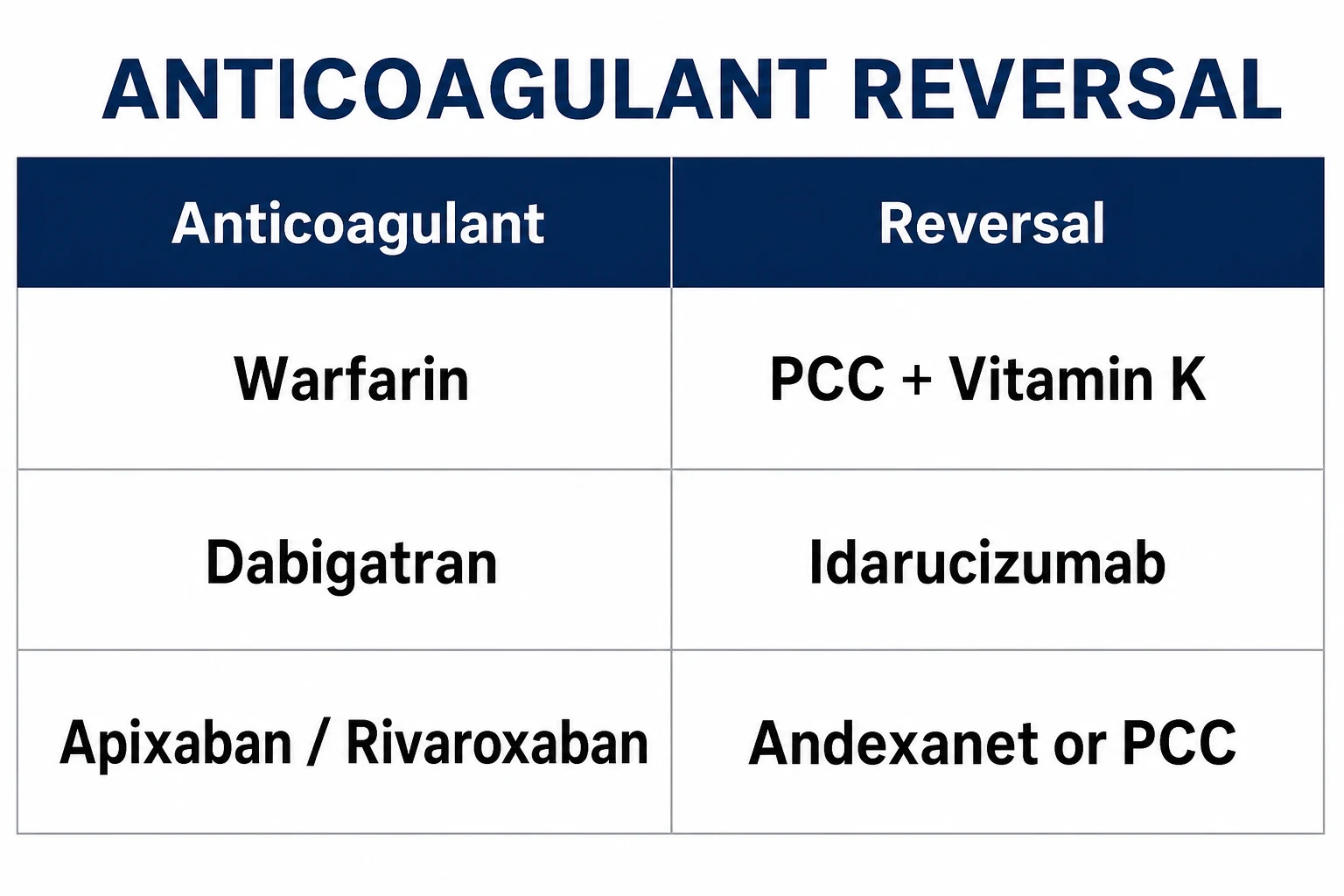
Warfarin. The reversal is the prothrombin complex concentrate (the PCC) at 25 to 50 units per kilogram intravenously (the dose by the INR and the weight), which restores the factors rapidly (within minutes), together with the intravenous vitamin K (10 milligrams), which restores the endogenous production over 6 to 12 hours (so the PCC buys the time for the vitamin K to work). The fresh frozen plasma is the alternative if the PCC is unavailable, but it is slower, requires the larger volume, and carries the infection and the TRALI risk.[1][1]
Dabigatran (the direct thrombin inhibitor). The specific antidote is the idarucizumab (5 grams intravenously, in two 2.5-gram doses), which binds the dabigatran directly and reverses the anticoagulant effect within minutes. The RE-VERSE AD study and its subgroups, including the urgent-surgery subgroup, confirmed the efficacy and the safety.[2][1]
Apixaban and rivaroxaban (the factor Xa inhibitors). The specific antidote is the andexanet alfa (the low or the high dose by the drug, the dose and the timing), which binds and sequesters the factor Xa inhibitor. The andexanet is effective but expensive, associated with the thrombotic events, and not universally available. The PCC (or the activated PCC, the factor VIII inhibitor bypassing activity) is the widely available alternative that reverses the bleeding by replenishing the factors, though without the direct measurement of the anti-Xa effect.[1][1]
Antiplatelet agents (the aspirin, the clopidogrel). The reversal is the platelet transfusion in the actively bleeding patient (the intracranial haemorrhage, the life-threatening bleeding), though the evidence for the benefit is limited and the transfusion is not given routinely for the non-life-threatening bleeding. The desmopressin (the DDAVP) is sometimes used for the aspirin effect on the platelet function.[1]
The timing of the reversal
The reversal is given early and in parallel with the resuscitation, not deferred for the confirmatory testing. The clinical decision to reverse is based on the known anticoagulant and the active bleeding (the intracranial haemorrhage, the massive haemorrhage, the need for the emergency surgery), not on the laboratory confirmation — because the standard tests (the INR, the APTT) do not reliably measure the DOAC effect, and the specific assays (the anti-Xa, the thrombin time) are not available rapidly in the emergency department. The pragmatic approach: the known warfarin with the ICH gets the PCC and the vitamin K while the INR is pending; the known dabigatran with the ICH gets the idarucizumab; the known apixaban or rivaroxaban with the ICH gets the andexanet or the PCC. The reversal is integrated into the MTP.[1][1]
The diagnostic limitations
The INR measures the warfarin effect (and is the guide to the PCC dosing), but it does not reliably measure the DOAC effect — the apixaban may produce the minimal INR elevation despite the therapeutic anticoagulation, and the rivaroxaban produces the variable INR elevation. The APTT may be prolonged with the dabigatran but is insensitive at the lower levels. The anti-Xa assay (the specific measurement of the factor Xa inhibitor activity) is the definitive test but is rarely available rapidly. The thrombin time is sensitive for the dabigatran. The pragmatic approach is to reverse on the clinical grounds of the known DOAC and the active bleeding, rather than awaiting the confirmatory assay.[1]
Common pitfalls
The recurring errors are: awaiting the INR or the anti-Xa before reversing the bleeding; using the fresh frozen plasma instead of the PCC for the warfarin reversal (slower, larger volume); forgetting the vitamin K with the PCC (the PCC wears off, the warfarin does not); not giving the andexanet or the PCC for the apixaban or the rivaroxaban because the INR is normal; and the delayed reversal of the intracranial haemorrhage (the haematoma expands while the testing is awaited). [1]
Differential diagnosis
In the anticoagulated trauma patient the "differential" is the identification of the responsible agent, because the reversal is agent-specific and the history (supplemented by the limited bedside testing) is the guide while the confirmatory assay is awaited. The four agent classes differ in their antidote, their monitoring, and the urgency of the reversal. [1]
- Warfarin (the vitamin K antagonist) — reversed with the prothrombin complex concentrate (the PCC) at 25 to 50 IU/kg together with the vitamin K 10 mg; the INR is the reliable guide to the dosing, and the vitamin K sustains the reversal once the PCC has worn off.
- Dabigatran (the direct thrombin inhibitor) — reversed with the idarucizumab 5 g (given as two 2.5-g doses), which binds the dabigatran directly; the thrombin time is sensitive and the APTT may be prolonged at the higher levels.
- Apixaban or rivaroxaban (the factor Xa inhibitors) — reversed with the andexanet alfa, or with the PCC where the andexanet is unavailable; the INR is unreliable (the apixaban may barely elevate it), so the anti-Xa assay is the definitive test and the reversal is often given on the clinical grounds.
- Aspirin or clopidogrel (the antiplatelet agents) — managed with the platelet transfusion in the actively bleeding patient (the intracranial haemorrhage, the life-threatening bleeding), with the desmopressin (the DDAVP) sometimes added for the aspirin effect; the evidence is limited and the transfusion is withheld for the non-life-threatening bleeding. [1]
The pragmatic distinction is between the anticoagulants (the warfarin and the DOACs, reversed with the specific antidotes or the factor replacement) and the antiplatelet agents (managed with the platelet transfusion). Within the anticoagulants the further distinction is between the warfarin (the INR-guided PCC and the vitamin K), the dabigatran (the idarucizumab) and the apixaban or the rivaroxaban (the andexanet or the PCC) — because the wrong agent gets the wrong reversal. [1]
SAQ — Warfarin and the traumatic intracranial haemorrhage
10 minutes · 10 marks
A 78-year-old woman on warfarin for atrial fibrillation (INR target 2 to 3) sustains a ground-level fall and is brought to the emergency department with a GCS of 13. The CT head shows an acute subdural haematoma with midline shift. The INR is 4.6, the blood pressure is 165 over 92, and the time since the fall is 45 minutes.
SAQ — The apixaban patient with a life-threatening gastrointestinal bleed
10 minutes · 10 marks
A 68-year-old man taking apixaban 5 mg twice daily for atrial fibrillation presents with haematemesis and melaena, a heart rate of 118, a blood pressure of 88 over 55, and a haemoglobin of 62 grams per litre. The INR is 1.1 and the APTT is normal.
Red flags
[1]The anticoagulant classes — the systematic comparison
The reversal is agent-specific, so the first step at the bedside is the identification of the agent the patient is taking. The five classes differ in the mechanism, the laboratory signature, the available antidote and the urgency of the reversal. The history (the patient, the medication list, the general-practitioner or the pharmacy record, the time of the last dose) is the primary instrument — the confirmatory assay lags behind the decision to reverse.[1][8]
The anticoagulant and the antiplatelet classes — the mechanism, the monitoring, the antidote
| Class | The agent | The mechanism | The reliable monitoring | The antidote (the life-threatening bleed) |
|---|---|---|---|---|
| Vitamin K antagonist | The warfarin | Inhibits the vitamin K epoxide reductase → the depleted factors II, VII, IX, X, protein C and S | The INR (reliable, dose-guiding) | The PCC (the 4-factor) + the vitamin K 5–10 mg IV |
| Direct thrombin inhibitor (the DOAC) | The dabigatran | The direct inhibition of the thrombin (the factor IIa) | The thrombin time (sensitive); the APTT is qualitative | The idarucizumab 5 g IV |
| Factor Xa inhibitors (the DOACs) | The apixaban, the rivaroxaban, the edoxaban | The direct inhibition of the factor Xa | The anti-Xa assay (the specific calibrator); the INR is unreliable | The andexanet alfa (or the PCC if the andexanet is unavailable) |
| Unfractionated heparin | The UFH (the IV infusion) | The antithrombin-mediated inhibition of the thrombin and the factor Xa | The APTT (or the anti-Xa for the supratherapeutic) | The protamine sulfate 1 mg per 100 units of the heparin (the full reversal) |
| Low-molecular-weight heparin | The enoxaparin, the dalteparin | The antithrombin-mediated inhibition of the factor Xa (predominantly) | The anti-Xa (the routine monitoring is uncommon) | The protamine sulfate (the PARTIAL reversal — ~60% of the anti-Xa effect) |
| Antiplatelet agents | The aspirin, the clopidogrel, the ticagrelor, the prasugrel | The inhibition of the platelet aggregation (the COX-1 or the P2Y12) | None is reliable at the bedside; the platelet-function assays where available | The platelet transfusion for the life-threatening bleed (the ICH); the DDAVP 0.3 µg/kg for the aspirin |
The fondaparinux (the selective factor Xa inhibitor given subcutaneously) has no approved specific antidote; the off-label use of the recombinant factor VIIa or the activated PCC is described for the life-threatening bleed. The parenteral direct thrombin inhibitors (the argatroban, the bivalirudin) are short-acting and the supportive care with the cessation is usually sufficient; there is no specific antidote. [1]
The unfractionated heparin and the LMWH — the protamine reversal
The unfractionated heparin is reversed with the protamine sulfate, which binds the heparin directly and neutralises the anticoagulant effect. The dose is 1 mg of the protamine per 100 units of the heparin still in the circulation (the dosing is based on the total heparin given in the preceding 2 to 3 hours, because the half-life of the IV heparin is 60 to 90 minutes). The maximum dose is 50 mg in any single bolus, given the slow IV injection over 1 to 3 minutes to avoid the hypotension, the bradycardia and the anaphylaxis. The protamine fully reverses the unfractionated heparin.[1]
The low-molecular-weight heparin (the enoxaparin, the dalteparin) is only partially reversed by the protamine — the protamine neutralises the larger heparin fragments but not the smaller ones, so only about 60% of the anti-Xa activity is reversed. The pragmatic dosing is the 1 mg of the protamine per 1 mg of the enoxaparin (given within the 8 hours of the last dose), with a further 0.5 mg per 1 mg if the bleeding continues, up to the 50 mg bolus limit. Beyond 8 to 12 hours the role of the protamine is limited because the LMWH has largely cleared. [1]
The protamine itself is anticoagulant in excess — the over-administration paradoxically causes the bleeding (the protamine inhibits the platelet function and the thrombin). Do NOT give the protamine "to be safe"; dose it against the estimated residual heparin. The protamine can precipitate the hypotension, the bradycardia and the anaphylaxis (especially the patient with the fish allergy or the prior NPH-insulin or the prior protamine exposure) — give it the slow IV push with the monitoring and the resuscitation ready. [1]
The prothrombin complex concentrate — the pharmacology and the dosing
The 4-factor prothrombin complex concentrate (the PCC) — the Beriplex, the Octaplex, the Kcentra — contains the factors II, VII, IX and X (together with the proteins C and S). It reverses the warfarin within minutes (the factor VII has the shortest half-life, so the INR corrects rapidly, then begins to drift up again at 6 to 8 hours if the vitamin K is not given). The dose is 25 to 50 IU/kg (the weight-based and the INR-based dosing, capped usually at the 3000 to 5000 IU), given the slow IV push over 5 to 20 minutes. The PCC is the preferred agent for the warfarin reversal because it is faster, given in the small volume (the ~20 mL versus the 4 units of the FFP at the ~800 mL), does not require the crossmatching, does not require the thawing, and carries the very low (but not zero) risk of the thromboembolism.[1][8]
The activated PCC (the FEIBA, the factor VIII inhibitor bypassing activity) contains the activated factor VII and is used off-label for the DOAC-related bleed where the andexanet is unavailable — the dose is the 50 IU/kg (the lower, 25 IU/kg, for the dabigatran where it is less effective). The activated PCC carries the higher thrombotic risk than the 4-factor PCC. [1]
The vitamin K (the phytomenadione) is given with the PCC to sustain the reversal — the PCC restores the factors immediately, but the warfarin is still present and still blocking the new factor synthesis, so the PCC wears off (the INR begins to rise again at 6 to 8 hours) unless the liver is enabled to make the new factors. The vitamin K restores the endogenous production over 6 to 12 hours (the IV route) and the 6 to 24 hours (the oral route). The dose is the 5 to 10 mg IV given the SLOW injection over 10 to 20 minutes (or the infusion) — the rapid IV push causes the hypotension, the flushing and the anaphylactoid reaction. The vitamin K alone is too slow for the active bleeding (the INR does not correct for the 6 to 24 hours), so it is ALWAYS given WITH the PCC, never as the sole agent in the emergency. [1]
The PCC versus the fresh frozen plasma — the head-to-head for the warfarin reversal
| Feature | The 4-factor PCC | The fresh frozen plasma |
|---|---|---|
| The onset | The minutes (the factor VII restores the INR rapidly) | The 30+ minutes (the thawing, the crossmatch) |
| The volume | The ~20 mL (the small reconstituted vial) | The ~800 mL (the 4 units) — the volume overload and the transfusion-related circulatory overload |
| The efficacy | The reliable, the predictable, the rapid correction of the INR | The variable and the incomplete (often does not reach the INR target) |
| The infection and the TRALI | The very low (the viral-inactivated, the pathogen-reduced) | The residual (the TRALI, the transfusion-transmitted infection) |
| The thrombosis | The small but the real (the disseminated intravascular coagulation is rare) | The low |
| The cost and the availability | The expensive, the stock-limited, but the stocked in the trauma centre | The cheaper, the widely available, but the slower to the bedside |
The bottom line: the PCC is the preferred agent for the warfarin reversal in the life-threatening bleed; the FFP is the alternative where the PCC is unavailable.[1]
The andexanet alfa — the low-dose and the high-dose
The andexanet alfa is the recombinant modified factor Xa that acts as the decoy — it binds and sequesters the factor Xa inhibitor (the apixaban or the rivaroxaban), thereby freeing the endogenous factor Xa to restore the thrombin generation. It is dosed by the specific drug, the dose and the timing of the last ingestion because the andexanet must exceed the residual circulating inhibitor.[6][8]
The andexanet alfa — the low-dose versus the high-dose regimen
| Feature | The low-dose regimen | The high-dose regimen |
|---|---|---|
| The loading dose | The 400 mg IV at the 30 mg/min | The 800 mg IV at the 80 mg/min |
| The maintenance infusion | The 4 mg/min for up to 120 min | The 8 mg/min for up to 120 min |
| The indication | The apixaban OR the rivaroxaban at the lower dose (<10 mg apixaban / <10 mg rivaroxaban), OR the last dose taken >8 hours ago (the unknown time) | The rivaroxaban at the higher dose (>10 mg), OR ANY dose within the last 8 hours (the higher residual) |
| The anti-Xa reduction | The rapid and the near-complete within the minutes | The rapid and the near-complete within the minutes |
| The thrombotic risk | The ~10% at the 30 days (the ANNEXA-4) | The ~10% at the 30 days (the ANNEXA-4) |
The andexanet is effective but expensive, associated with the thrombotic events (the ~10% at the 30 days — the ischaemic stroke, the myocardial infarction, the venous thromboembolism), and not universally available. The 4-factor PCC at the 25 to 50 IU/kg is the widely available alternative that does not measure or neutralise the inhibitor but restores the depleted factors — it is the pragmatic choice where the andexanet is unavailable or the cost is prohibitive, and some guidelines prefer the PCC on the grounds of the lower cost and the comparable clinical effectiveness.[1][8]
The anticoagulated patient with the traumatic brain injury
The anticoagulated patient who sustains the head strike is the highest-risk scenario in this topic — the intracranial haemorrhage is the feared complication, the haematoma expands while the INR or the anti-Xa is awaited, and the mortality and the functional dependency are markedly increased. The risk of the intracranial haemorrhage after the head injury is increased 3- to 10-fold in the anticoagulated patient compared with the non-anticoagulated control. The warfarin doubles the mortality of the traumatic intracranial haemorrhage; the DOACs appear to carry the lower risk than the warfarin but are still substantially elevated versus the no-anticoagulant baseline.[4][8]
The principles specific to the anticoagulated head injury: [1]
- The immediate CT head — for ANY head strike in the anticoagulated patient, regardless of the GCS and the absence of the loss of consciousness. The Canadian CT Head Rule and the New Orleans Criteria were NOT derived in the anticoagulated population, and the guidelines do NOT allow the clinical clearance of the anticoagulated patient. The drip is on the way to the scanner.
- The IMMEDIATE reversal — do NOT wait for the INR, the anti-Xa, or the CT result. If the patient is on the warfarin or the DOAC and there is the clinical suspicion of the intracranial haemorrhage (the head strike, the headache, the focal deficit, the altered GCS, the vomiting, the on-anticoagulant history alone with the significant mechanism), the reversal is started in parallel with the CT. The haematoma expansion is the time-critical event — the majority of the expansion occurs within the first 3 to 6 hours.
- The repeat CT after the reversal — to confirm the haemorrhage is controlled and to detect the delayed expansion.
- The neurosurgical referral in parallel — the operating theatre and the reversal run in the same timeline.
- The avoidance of the hypotension and the hypoxia — the anticoagulated brain is the injured brain, and the secondary injury from the SBP <90 or the SpO2 <90% compounds the haemorrhagic damage. Maintain the SBP >110. [1]
The anticoagulated head injury — the agent and the immediate action
| The agent | The IMMEDIATE reversal (do not wait for the labs) | The confirmatory test (taken but not awaited) |
|---|---|---|
| The warfarin | The PCC 25–50 IU/kg IV + the vitamin K 10 mg IV (the slow push) | The INR (to confirm and to guide the further dose) |
| The dabigatran | The idarucizumab 5 g IV (the two 2.5 g vials) | The thrombin time or the dilute thrombin time |
| The apixaban or the rivaroxaban | The andexanet alfa (the low or the high dose) OR the PCC 25–50 IU/kg | The anti-Xa assay (the specific calibrator) |
| The aspirin or the clopidogrel | The platelet transfusion (one adult dose) ± the DDAVP 0.3 µg/kg | None is reliable |
| The unfractionated heparin | The protamine 1 mg per 100 units of the residual heparin | The APTT |
The tranexamic acid and the CRASH evidence
The tranexamic acid (the TXA) is the antifibrinolytic that inhibits the plasminogen activation and reduces the clot breakdown. It is given in the trauma resuscitation for the significant haemorrhage and the traumatic brain injury. The window is the first 3 hours — the TXA given early reduces the death from the bleeding; the TXA given AFTER 3 hours appears to increase the mortality (the late fibrinolysis and the harm).[3]
CRASH-2 (2010) — the tranexamic acid in the traumatic haemorrhage
Design
Multicentre randomised placebo-controlled trial — 40 countries, 20,211 adult trauma patients with the significant bleeding or the risk of the bleeding, within 8 hours of the injury
Intervention
The tranexamic acid 1 g IV over 10 min, then 1 g over 8 hours, vs the placebo
Primary outcome
All-cause mortality at 28 days — REDUCED (14.5% vs 16.0%; the relative risk 0.91)
The bleeding death
REDUCED (4.9% vs 5.7%; the relative risk 0.85)
The vascular occlusive events
NO increase (the stroke, the myocardial infarction, the pulmonary embolism were NOT increased)
The timing
The benefit the greatest within 3 hours; the harm suggested when given after 3 hours
The bottom line
The TXA 1 g + 1 g within 3 hours of the injury reduces the death from the bleeding — give it early.
CRASH-3 (2019) — the tranexamic acid in the traumatic brain injury
Design
Multicentre randomised placebo-controlled trial — 29 countries, 12,737 adults with the traumatic brain injury (the GCS ≤12, or any intracranial bleed on the CT), within 3 hours of the injury
Intervention
The tranexamic acid 1 g IV over 10 min, then 1 g over 8 hours, vs the placebo
Primary outcome
The head-injury death at 28 days — the small reduction overall; the clear benefit in the mild-to-moderate TBI (the GCS 9–15) and when given within 3 hours
The harm
NO increase in the stroke, the thromboembolism, or the complications
The caveat
The benefit concentrated in the patients with the mild-to-moderate injury and the early administration; the severe TBI (GCS 3–8) the less clear
The bottom line
The TXA within 3 hours of the TBI reduces the head-injury death without the thrombotic harm — give it early to the mild-to-moderate and the anticoagulated head injury.
The pragmatic dosing in the trauma resuscitation: the TXA 1 g IV over 10 minutes, then the 1 g over 8 hours, given within 3 hours of the injury (some protocols give the 1 g bolus only). The TXA is cheap, safe within the window, and additive to the specific reversal — it does NOT replace the idarucizumab or the PCC, it complements them by stabilising the clot that the reversal agents enable to form. [1]
The massive transfusion protocol and the anticoagulated patient
The anticoagulated patient in the shock from the haemorrhage is managed with the massive transfusion protocol (the MTP) running in parallel with the specific reversal. The MTP delivers the blood products in the fixed ratio while the reversal agent is drawn up and given. The two interventions are not in conflict — the MTP restores the circulating volume and the oxygen carriage, while the reversal agent removes the pharmacological cause of the bleeding.[1][7]
PROPPR (2015) — the 1:1:1 versus the 1:1:2 ratio in the massive transfusion
Design
Multicentre randomised controlled trial — 12 US trauma centres, 680 patients with the severe trauma and the massive transfusion
Intervention
The plasma : platelet : red cell ratio of 1:1:1 vs 1:1:2 (the red-cell-heavy)
Primary outcome
The 24-hour and the 30-day mortality — NO significant difference (the 1:1:1 trended toward the lower 24-hour mortality)
The secondary
The 1:1:1 achieved the haemostasis more often and had the fewer deaths from the exsanguination at 24 hours
The bottom line
The 1:1:1 ratio is the reasonable default — the more plasma and the platelets early, the better the haemostasis, with no survival downside.
The considerations specific to the anticoagulated patient on the MTP: [1]
- The factor depletion from the massive transfusion compounds the anticoagulant effect — the dilutional coagulopathy, the consumption and the acidosis-hypothermia-hypocalcaemia triad worsen the bleeding on top of the warfarin or the DOAC. The PCC (the small-volume, the concentrated factors) is the rational complement to the MTP, replacing the factors far more efficiently than the FFP.
- The calcium — the citrate in the transfused products chelates the calcium; the hypocalcaemia impairs the coagulation and the cardiac function. Give the calcium chloride or the calcium gluconate to keep the ionised calcium in the normal range during the massive transfusion.
- The tranexamic acid is given early (within 3 hours) alongside the MTP — the CRASH-2 evidence.
- The specific reversal agent is given in parallel, not deferred — the warfarin patient gets the PCC + the vitamin K with the first pack of the MTP; the dabigatran patient gets the idarucizumab; the apixaban or the rivaroxaban patient gets the andexanet or the PCC.
- The repeat INR, the fibrinogen, the platelets and the ionised calcium at intervals — the viscoelastic testing (the TEG or the ROTEM), where available, guides the targeted product administration. [1]
The timing of the reversal — the parallel-with-resuscitation protocol
The reversal is started immediately on the recognition of the life-threatening bleed in the known-anticoagulated patient — the decision is clinical, based on the agent and the bleed, NOT on the laboratory confirmation. The confirmatory test is sent but NOT awaited. The principle is the parallel processing: the intravenous access, the bloods, the crossmatch, the CT and the reversal agent all proceed in the same timeline.[1][8]
The anticoagulated patient with the life-threatening bleed — the structured first hour
1. The identification of the agent — take the history in parallel with the ABCDE
The medication list, the general-practitioner or the pharmacy record, the time of the last dose, the indication, the renal function (the dabigatran and the Xa inhibitors are renally cleared — the renal impairment prolongs the half-life and the reversal need). The patient or the family at the bedside. Do NOT delay the resuscitation for the complete history.
2. The ABCDE and the activation of the team
The airway with the cervical spine control (the anticoagulated head injury may deteriorate); the breathing with the oxygen; the circulation — the two large-bore cannulae, the bloods (the FBE, the coagulation, the group-and-hold or the crossmatch, the electrolytes, the troponin if the chest trauma), the tranexamic acid within 3 hours, the activation of the massive transfusion protocol if the shock. The trauma team leader, the haematology and the neurosurgery (if the ICH) are called early.
3. The immediate reversal — do NOT wait for the labs
The known warfarin → the PCC 25–50 IU/kg + the vitamin K 10 mg IV slow. The known dabigatran → the idarucizumab 5 g IV. The known apixaban/rivaroxaban → the andexanet alfa (the low or the high dose) OR the PCC 25–50 IU/kg. The known aspirin/clopidogrel with the ICH → the platelet transfusion ± the DDAVP. The known UFH → the protamine. Send the INR, the APTT, the anti-Xa, the thrombin time — but DO NOT await them.
4. The imaging — the CT head and the CT body
The immediate CT head for ANY head strike in the anticoagulated patient (the clinical rules do not apply). The CT chest/abdomen/pelvis for the significant mechanism. The reversal has already been given before the scan — the scan confirms the bleed, it does not trigger the reversal.
5. The control of the source and the definitive care
The neurosurgical evacuation for the surgical haematoma; the angioembolisation or the surgery for the solid-organ or the pelvic bleed; the endoscopic control for the gastrointestinal bleed. The reversal buys the time for the source control — they run together.
6. The reassessment and the repeat reversal
The repeat INR at 30 minutes and at 6 hours (the INR drifts up as the PCC wears off — the vitamin K must be on board). The repeat CT head at 4 to 6 hours or for any deterioration. The thrombosis prophylaxis deferred until the bleed is controlled (see the resumption section).
7. The disposition — the ICU or the theatre
The anticoagulated patient with the major bleed is the high-acuity patient — the ICU for the monitoring and the ongoing correction, the theatre for the surgical source control. The reversal is documented and the agent and the dose are handed over explicitly.
The resumption of the anticoagulation after the bleeding
The resumption of the anticoagulation after the major bleed is the balance of the risks — the thrombotic risk the anticoagulant was prescribed to prevent (the atrial fibrillation stroke, the mechanical valve thrombosis, the venous thromboembolism) versus the re-bleeding risk at the site of the recent haemorrhage. The decision is the multidisciplinary one (the haematology, the cardiology, the neurosurgery) and is individualised to the indication, the bleed and the patient.[9][8]
The general principles: [1]
- The timing — the anticoagulation is typically resumed at the 7 to 14 days after the major bleeding event, once the haemostasis is achieved and the source is controlled. The earlier resumption (<7 days) increases the re-bleeding; the delayed resumption (>14 days, or not at all) increases the thromboembolism. The mechanical mitral valve and the recent venous thromboembolism are the highest-thrombotic-risk groups and tilt toward the earlier (7-day) resumption; the spontaneous intracerebral haemorrhage with the uncontrolled hypertension tilts toward the later.
- The agent — the DOAC is often preferred over the warfarin on the resumption, on the lower intracranial-haemorrhage risk and the predictable pharmacokinetics (the evidence is the observational). The warfarin is unavoidable for the mechanical valve (the DOACs are contraindicated). The aspirin is resumed after the gastrointestinal bleed once the source is treated and the secondary prevention is needed.
- The bridging — the warfarin requires the overlap (the heparin or the LMWH) until the INR is therapeutic, which re-exposes the patient to the bleeding risk; the DOACs need no bridging, which is the further advantage on the resumption.
- The the restart should be deliberate and documented — the indication, the agent, the dose, the date, and the discussion of the risk-benefit. The default is to resume unless there is a compelling reason not to. [1]
The resumption of the anticoagulation — the bleed type and the typical timing
| The bleed type | The typical resumption | The modifier |
|---|---|---|
| The intracerebral haemorrhage (the spontaneous, on the anticoagulant for the AF) | The 7–14 days (the observational data favours the resumption over the permanent cessation for the net benefit) | The earlier if the AF is high-risk (the high CHA2DS2-VASc); the later if the haemorrhage is uncontrolled |
| The gastrointestinal bleed | The 7–14 days (the earlier if the source is treated endoscopically) | The resumption reduces the thrombosis and the mortality without the excess re-bleeding in the observational data |
| The traumatic bleed (the anticoagulated trauma) | The 7–14 days once the haemostasis is secure | The trauma itself raises the thrombotic risk (the immobility, the surgery), tilting toward the earlier resumption |
| The mechanical mitral valve | The earliest safe (the 7 days, the bridging with the heparin) | The highest thrombotic risk — the cessation is rarely justified beyond the acute window |
The recurring errors — the expanded list
The anticoagulated-trauma errors — the error, the harm, the correction
| The error | The harm it causes | The correction |
|---|---|---|
| Awaiting the INR or the anti-Xa before the reversal | The haematoma expands while the test is run; the window for the reversal closes | The reversal on the clinical grounds (the agent + the life-threatening bleed); the test is sent but not awaited |
| The FFP instead of the PCC for the warfarin | The slower, the incomplete reversal; the larger volume; the TRALI | The PCC as the first-line; the FFP only if the PCC is unavailable |
| Forgetting the vitamin K with the PCC | The PCC wears off at 6–8 h; the INR climbs back; the re-bleed | The vitamin K 10 mg IV slow WITH every PCC dose for the warfarin |
| Withholding the andexanet or the PCC for the apixaban because the INR is "normal" | The Xa inhibitor is not measured by the INR; the bleed continues | The andexanet or the PCC on the clinical grounds for the known Xa inhibitor |
| The delayed CT head in the anticoagulated patient | The intracranial bleed is missed or the evacuation is delayed | The CT for ANY head strike in the anticoagulated patient; the clinical rules do not apply |
| The TXA given after 3 hours | The late TXA may increase the mortality | The TXA within 3 hours; if >3 hours, weigh the harm |
| The over-administration of the protamine | The protamine is anticoagulant in excess; the hypotension; the anaphylaxis | The protamine dosed against the residual heparin; the slow IV push |
| The platelet transfusion for the minor bleed on the aspirin | The transfusion risk without the benefit; the TTP worsening for the clopidogrel | The platelets only for the life-threatening bleed (the ICH); not the minor bleed |
| Not resuming the anticoagulation after the bleed | The thrombotic stroke, the valve thrombosis, the venous thromboembolism | The deliberate resumption at 7–14 days with the documented risk-benefit |
| The rapid IV push of the vitamin K | The hypotension, the flushing, the anaphylactoid reaction | The slow IV injection over 10–20 min or the infusion |
Clinical pearls
Red flags (the additional)
[1]References
- [1]Rossaint R, Bouillon B, Cerny V, et al. The European guideline on management of major bleeding and coagulopathy following trauma: sixth edition Crit Care, 2023.PMID 36859355
- [2]Levy JH, van de Water N, Matthieu D, et al. Dabigatran Reversal With Idarucizumab in Patients Requiring Urgent Surgery: A Subanalysis of the RE-VERSE AD Study Ann Surg, 2021.PMID 31599808
- [3]CRASH-2 trial collaborators, Shakur H, Roberts I, et al. Effects of tranexamic acid on death, vascular occlusive events, and blood transfusion in trauma patients with significant haemorrhage (CRASH-2): a randomised, placebo-controlled trial Lancet, 2010.PMID 20554319
- [4]CRASH-3 trial collaborators (Dewan Y, et al.). Effects of tranexamic acid on death, disability, vascular occlusive events and other morbidities in patients with acute traumatic brain injury (CRASH-3): a randomised, placebo-controlled trial Lancet, 2019.PMID 31623894
- [5]Pollack CV Jr, Reilly PA, Eikelboom J, et al. Idarucizumab for Dabigatran Reversal N Engl J Med, 2015.PMID 26095746
- [6]Connolly SJ, Crowther M, Eikelboom JW, et al. Full Study Report of Andexanet Alfa for Bleeding Associated with Factor Xa Inhibitors N Engl J Med, 2019.PMID 30730782
- [7]Holcomb JB, Tilley BC, Baraniuk S, et al. (PROPPR Study Group). Transfusion of plasma, platelets, and red blood cells in a 1:1:1 vs a 1:1:2 ratio and mortality in patients with severe trauma: the PROPPR randomized clinical trial JAMA, 2015.PMID 25647203
- [8]Christensen H, Cordonnier C, Kõrv J, et al. European Stroke Organisation Guideline on Reversal of Oral Anticoagulants in Acute Intracerebral Haemorrhage Eur Stroke J, 2019.PMID 31903428
- [9]El Naamani K, Abbas R, Ghanem M, et al. Resuming Anticoagulants in Patients With Intracranial Hemorrhage: A Meta-Analysis and Literature Review Neurosurgery, 2024.PMID 37459580