MedVellum
MCQsExamsAtlas
DashboardPricing
MBBS / Core medicine✳Dermatology✳ICU Fellowship (CICM)✳Anaesthesia✳Emergency Medicine✳Psychiatry Fellowship✳Paediatrics Fellowship✳Physician Medicine✳MCQs✳SAQs✳Vivas✳OSCE✳Evidence-first✳MBBS / Core medicine✳Dermatology✳ICU Fellowship (CICM)✳Anaesthesia✳Emergency Medicine✳Psychiatry Fellowship✳Paediatrics Fellowship✳Physician Medicine✳MCQs✳SAQs✳Vivas✳OSCE✳Evidence-first✳

MedVellum.

The folio

Exam-exhaustive medical education across every specialty — evidence-graded topics, engraved plates, and practice in every written and oral format. Educational content only — not medical advice.

llms.txt · psychiatry LLM catalog · sitemap

Atlas

  • Specialty atlas
  • MBBS / Core medicine
  • Dermatology
  • ICU Fellowship (CICM)
  • Anaesthesia
  • Emergency Medicine
  • Psychiatry Fellowship
  • Paediatrics Fellowship
  • Physician Medicine

Study & account

  • MCQ practice
  • Practice alias
  • Exam tools
  • Dashboard
  • Pricing
  • Sign in

© 2026 MedVellum. For education only — not a substitute for clinical judgement.

Folio edition · Set in Instrument Serif & Archivo

ICU TopicsAntimicrobial Stewardship

ICU · Antimicrobial Stewardship

Antimicrobial resistance in the ICU: mechanisms, organisms, and management

Also known as MDR organisms in ICU · VRE, ESBL, CRE, CPE · Antibiotic resistance · ESBL pneumonia · Carbapenem-resistant Enterobacterales · MRSA, VRE, CRPA, CRAB · Beta-lactamases — KPC, NDM, OXA-48 · Novel antibiotics for MDR Gram-negatives

Multidrug-resistant (MDR) organisms are endemic in the ICU and independently increase mortality, length of stay, and cost. Resistance arises from beta-lactamases (ESBL — CTX-M; AmpC; carbapenemases — KPC class A, NDM/VIM/IMP class B metallo-beta-lactamases, OXA-48 class D), altered targets (PBP2a in MRSA via mecA; D-Ala-D-Lac in VRE via vanA/B; QRDR mutations in fluoroquinolone resistance), efflux pumps, porin loss (OprD in Pseudomonas), and enzymatic modification. The ICU core threats are MRSA, VRE, ESBL-Enterobacterales, CRE/CPE, carbapenem-resistant Pseudomonas aeruginosa (CRPA) and carbapenem-resistant Acinetobacter baumannii (CRAB). Management demands rapid molecular diagnostics (carbapenemase typing), empiric broad therapy within one hour of sepsis, then aggressive de-escalation using novel beta-lactam/beta-lactamase inhibitor combinations (ceftazidime-avibactam for KPC/OXA-48; meropenem-vaborbactam and imipenem-relebactam for KPC; ceftolozane-tazobactam and cefiderocol for MDR Pseudomonas; aztreonam-avibactam for NDM/MBL), supported by infection-control bundles (contact precautions, cohorting, surveillance screening, decolonisation) and antimicrobial stewardship (PK/PD-optimised dosing, extended infusions, therapeutic drug monitoring, shortest effective duration).

high19 referencesUpdated 2 July 2026
On this page & tools

Your progress

Saved locally on this device.

Target exams

CICMFFICMEDIC

Red flags

CRE/CPE = nightmare bacteria — carbapenem-resistant Enterobacterales. Limited treatment options. Mortality 40-50%ESBL: resistant to all penicillins and cephalosporins (except cephamycins) — must use carbapenemsVRE: resistant to vancomycin — use linezolid or daptomycin (NOT daptomycin for pneumonia — inactivated by surfactant)Contact isolation + cohorting for ALL MDR organismsNDM is a metallo-beta-lactamase — avibactam and vaborbactam do NOT inhibit it; use aztreonam-avibactam or colistin + aztreonamMBLs (NDM/VIM/IMP) cannot hydrolyse aztreonam — the rational regimen is aztreonam-avibactamDaptomycin is inactivated by pulmonary surfactant — NEVER for pneumoniaVancomycin MIC creep (>1.5 mg/L) in MRSA predicts failure — switch to daptomycin or linezolidPDR (pandrug-resistant) = no licensed susceptible agent — ID + public health emergencyColistin is a prodrug (colistimethate sodium, CMS) — nephrotoxicity 30-50%, dose by ideal body weight and CrCl

Your progress

Saved locally on this device.

Target exams

CICMFFICMEDIC

Red flags

CRE/CPE = nightmare bacteria — carbapenem-resistant Enterobacterales. Limited treatment options. Mortality 40-50%ESBL: resistant to all penicillins and cephalosporins (except cephamycins) — must use carbapenemsVRE: resistant to vancomycin — use linezolid or daptomycin (NOT daptomycin for pneumonia — inactivated by surfactant)Contact isolation + cohorting for ALL MDR organismsNDM is a metallo-beta-lactamase — avibactam and vaborbactam do NOT inhibit it; use aztreonam-avibactam or colistin + aztreonamMBLs (NDM/VIM/IMP) cannot hydrolyse aztreonam — the rational regimen is aztreonam-avibactamDaptomycin is inactivated by pulmonary surfactant — NEVER for pneumoniaVancomycin MIC creep (>1.5 mg/L) in MRSA predicts failure — switch to daptomycin or linezolidPDR (pandrug-resistant) = no licensed susceptible agent — ID + public health emergencyColistin is a prodrug (colistimethate sodium, CMS) — nephrotoxicity 30-50%, dose by ideal body weight and CrCl
Cinematic ICU scene of an antibiogram resistance-pattern chart and a beta-lactamase enzyme molecular model on a clinical screen above a contact-precaution isolation door, infusion pumps running ceftazidime-avibactam and colistin, clinical-blue lighting, medical educational, no text, no people
FigureThe MDR organisms — MRSA, VRE, ESBL, CRE, the carbapenem-resistant Pseudomonas and Acinetobacter. The mechanisms (the beta-lactamases, the altered targets, the porin loss), the rapid molecular diagnostics, the novel beta-lactam/inhibitor combinations, and the contact-isolation bundle.

In one line

MDR organisms: MRSA (vancomycin/linezolid), VRE (linezolid/daptomycin — NOT daptomycin for pneumonia), ESBL (carbapenems), CRE/CPE (colistin, ceftazidime-avibactam, meropenem-vaborbactam), MDR Pseudomonas (colistin, ceftolozane-tazobactam). Risk: hospitalisation, antibiotics, ICU. Prevention: stewardship + infection control + surveillance. Contact isolation for ALL MDR.

[7]

SAQ — Carbapenem-resistant Klebsiella pneumoniae bacteraemia in a repatriated patient (NDM metallo-beta-lactamase)

10 minutes · 10 marks

A 62-year-old man is admitted to ICU in septic shock 10 days after repatriation from a three-week hospitalisation in New Delhi for polytrauma (splenectomy, temporary colostomy, broad-spectrum antibiotics). On examination: T 39.1 degrees C, HR 132, BP 78/45 on noradrenaline 0.4 mcg/kg/min (MAP 58 after 30 mL/kg crystalloid), RR 30, SpO2 94 percent on FiO2 0.5, GCS 13, urine output 15 mL/h. Lactate 5.2 mmol/L, creatinine 220 micromol/L (baseline 85), platelets 92, INR 1.7. Two of two peripheral blood cultures grow Klebsiella pneumoniae resistant to meropenem, ertapenem, all cephalosporins, fluoroquinolones and aminoglycosides; carbapenemase PCR has been sent and is pending.

[7]

SAQ — Vancomycin-resistant Enterococcus faecium (vanA VRE) bacteraemia complicated by VRE ventilator-associated pneumonia

10 minutes · 10 marks

A 67-year-old man is day 14 of an ICU admission for necrotising pancreatitis. He has a triple-lumen central venous catheter, an arterial line, and is intubated for abdominal sepsis and ARDS. He now develops fever (38.9 degrees C), HR 118, BP 96/58, rising lactate to 3.1 mmol/L, and purulent endotracheal secretions. Two of two peripheral blood cultures grow Enterococcus faecium resistant to vancomycin and ampicillin (vanA VRE), susceptible to linezolid and daptomycin (daptomycin MIC 1 mg/L). Platelets 140 x 10^9/L, creatinine 160 micromol/L. Transthoracic echo shows no vegetations.

[7]

Clinical pearls

High-yield MDR points for the CICM/FFICM exam

  1. CRE/CPE: 'nightmare bacteria' — carbapenem-resistant Enterobacterales. Mortality 40-50%. Limited options: colistin, ceftazidime-avibactam, meropenem-vaborbactam, fosfomycin.[3]
  2. ESBL: resistant to all penicillins + cephalosporins (except cephamycins). Treat with carbapenems (meropenem, imipenem, ertapenem).[1]
  3. VRE: resistant to vancomycin. Treat with linezolid (bacteriostatic) or daptomycin (bactericidal — but NOT for pneumonia — inactivated by surfactant).[1]
  4. Daptomycin: INEFFECTIVE for pneumonia (surfactant inactivates it). Use linezolid for VRE pneumonia.[1]
  5. MDR Pseudomonas: colistin (nephrotoxic), ceftolozane-tazobactam, ceftazidime-avibactam, imipenem-relebactam.[1]
  6. Colistin: polymyxin — last-line. Nephrotoxicity (30-50%), neurotoxicity. Monitor renal function. CMS (colistimethate sodium) is the prodrug — converted to colistin in vivo.[1]
  7. Newer agents: ceftazidime-avibactam (KPC, OXA-48 — NOT MBL), meropenem-vaborbactam (KPC), imipenem-relebactam (KPC), ceftolozane-tazobactam (MDR Pseudomonas), cefiderocol (siderophore cephalosporin — broad Gram-negative including carbapenem-resistant).[3]
  8. MBL (metallo-beta-lactamase): NDM, VIM, IMP. NOT inhibited by avibactam or vaborbactam. Treat with colistin ± aztreonam (MBLs don't hydrolyse aztreonam).[3]
  9. Risk factors: hospitalisation <90 days, IV antibiotics <90 days, nursing home, dialysis, central line, known colonisation, mechanical ventilation >7 days.[1]
  10. Contact isolation: single room or cohorting with same organism. Gown + gloves for ALL contact. Dedicated equipment (stethoscope, BP cuff).[1]
  11. Surveillance cultures: nasal swab (MRSA), rectal swab (VRE, ESBL, CPE/CRE, MDR Pseudomonas) on admission + weekly. Guides empiric therapy.[1]
  12. Antibiotic stewardship: minimise duration (5-7 days), de-escalate based on cultures, procalcitonin-guided, avoid unnecessary broad-spectrum. Each unnecessary antibiotic day selects for resistance.[1]
  13. Antibiotic cycling: controversial — rotating antibiotic classes may reduce resistance selection. Not proven effective.[1]
  14. Novel diagnostics: rapid molecular tests (GeneXpert, BioFire, Verigene) identify resistance genes within 1-2 hours → guide empiric therapy faster.[3]

Red flags

Critical MDR points

  • CRE/CPE = nightmare bacteria — mortality 40-50%. Limited treatment options.[3]
  • Daptomycin INEFFECTIVE for pneumonia — surfactant inactivates it. Use linezolid.[1]
  • ESBL: resistant to ALL penicillins and cephalosporins — must use carbapenems.[1]
  • MBL (NDM): NOT inhibited by avibactam/vaborbactam — treat with colistin + aztreonam.[3]
  • Contact isolation for ALL MDR organisms — gown + gloves, single room/cohorting.[1]

Overview — why antimicrobial resistance dominates ICU practice

Antimicrobial resistance (AMR) is one of the top ten global public health threats and is magnified in the ICU, where antibiotic pressure is intense, patients are vulnerable, and the consequences of ineffective empiric therapy are measured in hours of added mortality. The WHO publishes a priority pathogens list ranking carbapenem-resistant Gram-negatives as the highest-priority ("critical") targets for new drug development.[3] In a critically ill patient, the single biggest decision the intensivist makes is whether to broaden empiric cover to capture likely MDR organisms — because inappropriate empiric therapy independently raises mortality, yet every unnecessary antibiotic day drives further resistance, C. difficile, and toxicity.

AMR is not one problem but many. Resistance is encoded by genes on chromosomes, plasmids, transposons and integrons, spreads horizontally between bacteria (plasmid transfer, conjugation), and is selected by antibiotic exposure (the ICU itself is a resistance factory). The intensivist must know (1) the mechanism of each resistance phenotype, because it predicts which drug classes fail and which novel agents work; (2) the organism and its risk factors, to calibrate empiric therapy; and (3) the stewardship and infection-control bundle that contains spread. This topic maps the resistance mechanisms, the six core ICU MDR organisms, the novel antibiotics that have transformed therapy since 2015, and the bundles that prevent and de-escalate.[3]

Definitions — MDR, XDR, PDR (Magiorakos 2012)

The internationally agreed (ECDC/CDC consensus) definitions are built around antimicrobial categories (drug classes), not individual agents, and apply to acquired resistance.[4] Every fellowship candidate must be able to quote them.

[4]

Applying the definitions correctly: (1) count categories, not drugs — an organism resistant to three cephalosporins counts as resistant to one category and is not yet MDR; (2) only acquired resistance counts (intrinsic Pseudomonas ampicillin resistance does not); (3) the isolate must have been tested against nearly all agents — you cannot call an organism "PDR" if half the panel was never tested; (4) breakpoints are revised (CLSI M100, EUCAST) — apply the current breakpoint.[4]

Mechanisms of resistance — the molecular basis
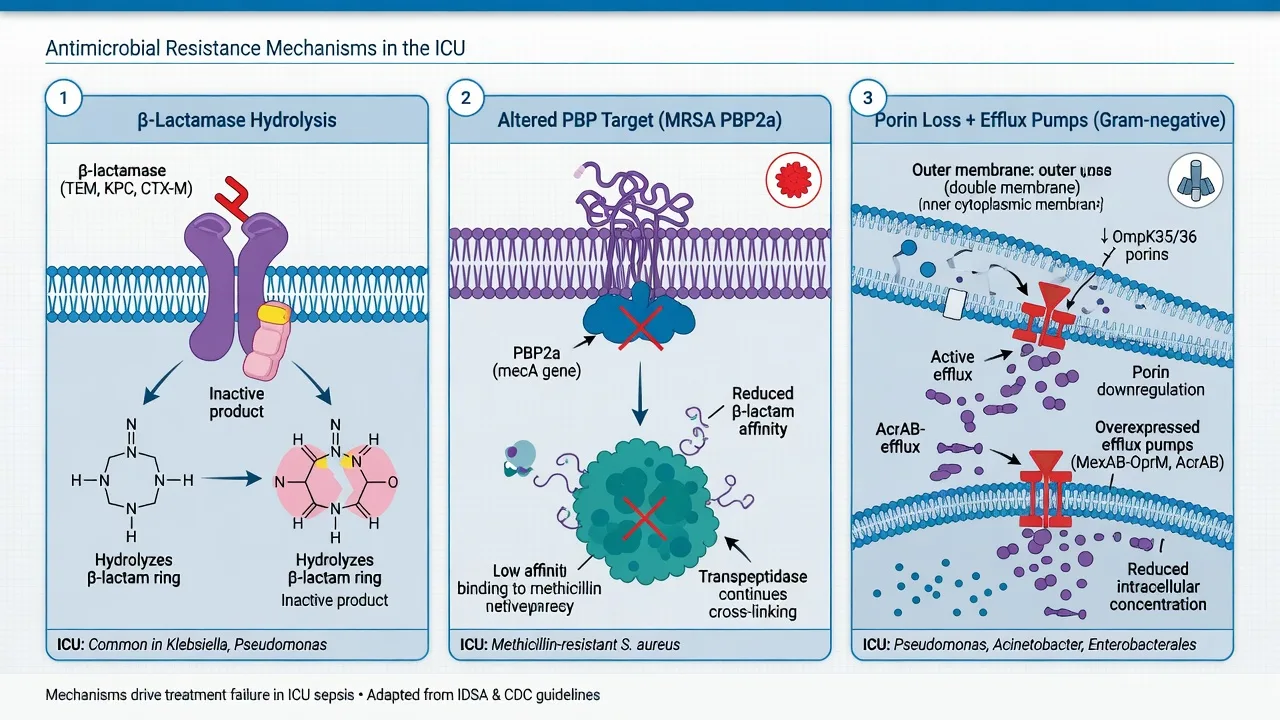
Three-panel educational diagram of antimicrobial resistance mechanisms: beta-lactamase hydrolysis, altered PBP2a in MRSA, and porin loss with efflux pumps in Gram-negative bacilli
FigureThree core resistance strategies in the ICU — enzymatic drug destruction, target alteration (e.g. mecA/PBP2a), and reduced intracellular drug levels via porin loss and efflux.

Resistance mechanisms fall into a small number of strategies: (1) enzymatic inactivation of the drug (beta-lactamases, aminoglycoside-modifying enzymes, chloramphenicol acetyltransferases); (2) target alteration (PBP2a, D-Ala-D-Lac, QRDR mutations, D-Ala-D-Ala to D-Ala-D-Ser); (3) reduced intracellular accumulation via decreased influx (porin loss, e.g., OprD in Pseudomonas) or increased efflux (AcrAB-TolC, Mex pumps); (4) bypass of the inhibited pathway (alternative PBP); and (5) protection of the target (tetracycline-resistance ribosomal protection proteins). The ICU intensivist needs fluency with the beta-lactamase family tree in particular, because it dictates which novel beta-lactamase inhibitor to deploy.[3][17]

Beta-lactamases — Ambler classification

Beta-lactamases are classified by Ambler molecular class (A-D), which reflects the active-site chemistry. This is not pedantry: class A, C and D are serine beta-lactamases (inhibited by classical inhibitors like clavulanate, tazobactam, and the novel diazabicyclooctanes avibactam/relebactam and boronic acids vaborbactam); class B are metallo-beta-lactamases requiring zinc at the active site, inhibited by EDTA chelation but NOT by any licensed beta-lactamase inhibitor, and intrinsically unable to hydrolyse aztreonam.[17]

[7]

ESBL — Extended-Spectrum Beta-Lactamases

ESBLs are Ambler class A serine beta-lactamases that hydrolyse the oxyimino-beta-lactams — penicillins and 3rd-generation cephalosporins (ceftriaxone, ceftazidime) and (for many) the 4th-generation cefepime — but not carbapenems or cephamycins. They are typically plasmid-encoded, which means they spread horizontally and frequently carry co-resistance genes (fluoroquinolones, aminoglycosides, co-trimoxazole) on the same plasmid — explaining why ESBL isolates are so often multiply resistant. CTX-M has overtaken TEM and SHV as the dominant ESBL family worldwide, with bla(CTX-M-15) the single most common allele.[5][17]

Inoculum effect: cephalosporins can look susceptible at low inoculum but fail at the high bacterial loads seen in bacteraemia, pneumonia, or undrained abscess. This is why cephalosporins are not reliable for ESBL even when reported susceptible, and why MERINO established the carbapenem as the standard of care.[5]

AmpC beta-lactamases

AmpC are class C enzymes that are either chromosomally encoded and inducible (the "SPICE/SPACE" organisms — Serratia, Pseudomonas, Indole-positive Proteae [Morganella, Providencia], Citrobacter, Enterobacter; some add Acinetobacter) or plasmid-acquired (in E. coli, Klebsiella). Induction occurs on exposure to beta-lactams (especially clavulanate, which paradoxically induces AmpC), so therapy can select for a derepressed mutant during treatment — the clinical scenario of an Enterobacter bacteraemia that develops cephalosporin resistance mid-therapy. Cefepime is relatively stable to AmpC (a key reason it is preferred over 3rd-gen cephalosporins for known AmpC producers); carbapenems are the reliable backstop for serious AmpC infections.[17]

Carbapenemases — the highest-yield distinction

Carbapenemases hydrolyse carbapenems (and virtually all other beta-lactams). Identifying the type of carbapenemase — by PCR (KPC/NDM/OXA-48/VIM/IMP), CarbaNP, modified carbapenem inactivation method (mCIM), or MALDI-TOF hydrolysis assay — drives the drug choice.[3][17]

[7]

The pearl that saves lives: NDM is a metallo-beta-lactamase — avibactam and vaborbactam do NOT inhibit it, so ceftazidime-avibactam or meropenem-vaborbactam monotherapy for an NDM producer fails. But aztreonam is structurally stable to metallo-enzymes, so the combination aztreonam-avibactam works: avibactam shields aztreonam from any co-produced ESBL/AmpC/KPC, while the MBL cannot touch aztreonam. NDM producers also frequently co-carry 16S rRNA methylases (conferring aminoglycoside resistance) and plasmid-borne colistin resistance (mcr), narrowing salvage options.[17]

Non-beta-lactam resistance mechanisms

[5]

Mechanisms — fellowship-viva ammunition

  1. Ambler class B (NDM, VIM, IMP) = metallo-beta-lactamase, zinc-dependent, EDTA-inhibited, NOT inhibited by any licensed beta-lactamase inhibitor, but cannot hydrolyse aztreonam.[17]
  2. mecA → PBP2a explains why no beta-lactam (including carbapenems) works against MRSA — except ceftaroline, whose side chain gives PBP2a affinity.[15]
  3. vanA replaces D-Ala-D-Ala with D-Ala-D-Lac, eliminating the critical hydrogen bond that anchors vancomycin to the cell-wall precursor.[15]
  4. AmpC is inducible in the "SPICE" organisms (Serratia, Pseudomonas, Indole-positive Proteae — Morganella/Providencia, Citrobacter, Enterobacter) — avoid 3rd-gen cephalosporins for serious infections with these; prefer cefepime or a carbapenem.[17]
  5. Porin OprD loss is the canonical non-enzymatic route to carbapenem-resistant Pseudomonas — imipenem is most affected, meropenem variably spared.[17]
  6. Fluoroquinolone resistance arises in the QRDR of gyrA/parC (target) and is augmented by plasmid Qnr proteins and efflux — explaining the rapid stepwise rise in FQ MIC and its frequent co-selection with ESBL on the same plasmid.[17]
  7. Colistin resistance via mgrB / pmrAB / phoPQ modifies lipid A; plasmid mcr-1 is the terrifying exception because it is horizontally transferable and can move through a population independent of antibiotic pressure.[3]
  8. Efflux pumps (AcrAB-TolC, Mex, AdeABC) confer multi-class resistance in one move — a reason MDR Gram-negatives so often lose beta-lactams, fluoroquinolones and tetracyclines simultaneously.[17]

The six core ICU MDR organisms

[7]

MRSA — methicillin-resistant Staphylococcus aureus

VRE — vancomycin-resistant Enterococcus

ESBL — Extended-Spectrum Beta-Lactamase Enterobacterales

CRE — Carbapenem-Resistant Enterobacterales

CRPA — Carbapenem-Resistant Pseudomonas aeruginosa

Pseudomonas aeruginosa is intrinsically difficult (low outer-membrane permeability, AmpC, broad efflux) and acquires resistance readily. Difficult-to-treat resistance (DTR) denotes non-susceptibility to all first-line anti-pseudomonals (piperacillin-tazobactam, ceftazidime, cefepime, aztreonam, meropenem, imipenem, ciprofloxacin, levofloxacin). The IDSA 2024 guidance prefers novel BL/BLI over polymyxins when susceptible.[17]

CRAB — Carbapenem-Resistant Acinetobacter baumannii

CRAB is a WHO "critical priority" pathogen, endemic in many ICUs, and one of the most therapy-limited organisms in practice. Resistance is driven by OXA-type carbapenemases (OXA-23, OXA-24/40, OXA-58), AdeABC efflux, and often polymyxin co-resistance.[11]

Novel antibiotics for MDR Gram-negatives — the post-2015 armamentarium

Five novel agents — ceftazidime-avibactam, meropenem-vaborbactam, imipenem-relebactam, ceftolozane-tazobactam, cefiderocol — plus plazomicin and eravacycline have transformed the treatment of MDR Gram-negative infections, displacing colistin as first-line for many susceptible isolates and reducing nephrotoxicity.[3][17]

[17]

Novel agents — when to use which

  1. Ceftazidime-avibactam = the workhorse for KPC and OXA-48 CRE, and some ESBL/AmpC. Ineffective for NDM/MBL — the classic exam trap.[17]
  2. Meropenem-vaborbactam = KPC CRE (TANGO-II showed superiority over best-available therapy). No activity against Pseudomonas or MBL.[8]
  3. Imipenem-relebactam = KPC CRE and DTR-Pseudomonas (RESTORE-IMI 1 — better outcomes and less nephrotoxicity than colistin + imipenem).[9]
  4. Ceftolozane-tazobactam = the anti-Pseudomonas specialist — preferred for MDR/XDR P. aeruginosa pneumonia (ASPECT-NP), including strains resistant to ceftazidime. Not active against carbapenemases.[10]
  5. Cefiderocol = the broadest novel Gram-negative — active against MBL, KPC, OXA-48, CRPA, CRAB via the iron-transport "Trojan horse" mechanism. Watch the CREDIBLE-CR mortality signal in Acinetobacter.[11]
  6. Plazomicin = aminoglycoside for CRE UTI / bacteraemia (EPIC-cUTI — superior to levofloxacin); evades classical modifying enzymes but NOT 16S rRNA methylases (common in NDM). Nephro/ototoxicity.[13]
  7. Eravacycline = tetracycline-class for cIAI due to CRE/Acinetobacter (IGNITE — non-inferior to ertapenem and meropenem). Poor urine levels → not for UTI; no activity vs Pseudomonas.[12][20]
  8. Aztreonam + avibactam (given together) = the logical answer to NDM/MBL CRE — aztreonam is MBL-stable, avibactam protects it from co-produced ESBL/AmpC/KPC. Now a preferred MBL-CRE regimen in IDSA 2024.[17]
  9. Colistin is no longer first-line for CRE/CPE when a susceptible novel agent exists — the novel BL/BLIs are less nephrotoxic and at least as effective. Reserve colistin/polymyxin B for pan-resistant isolates or when novel agents are unavailable.[17]

Infection control — containing MDR in the ICU
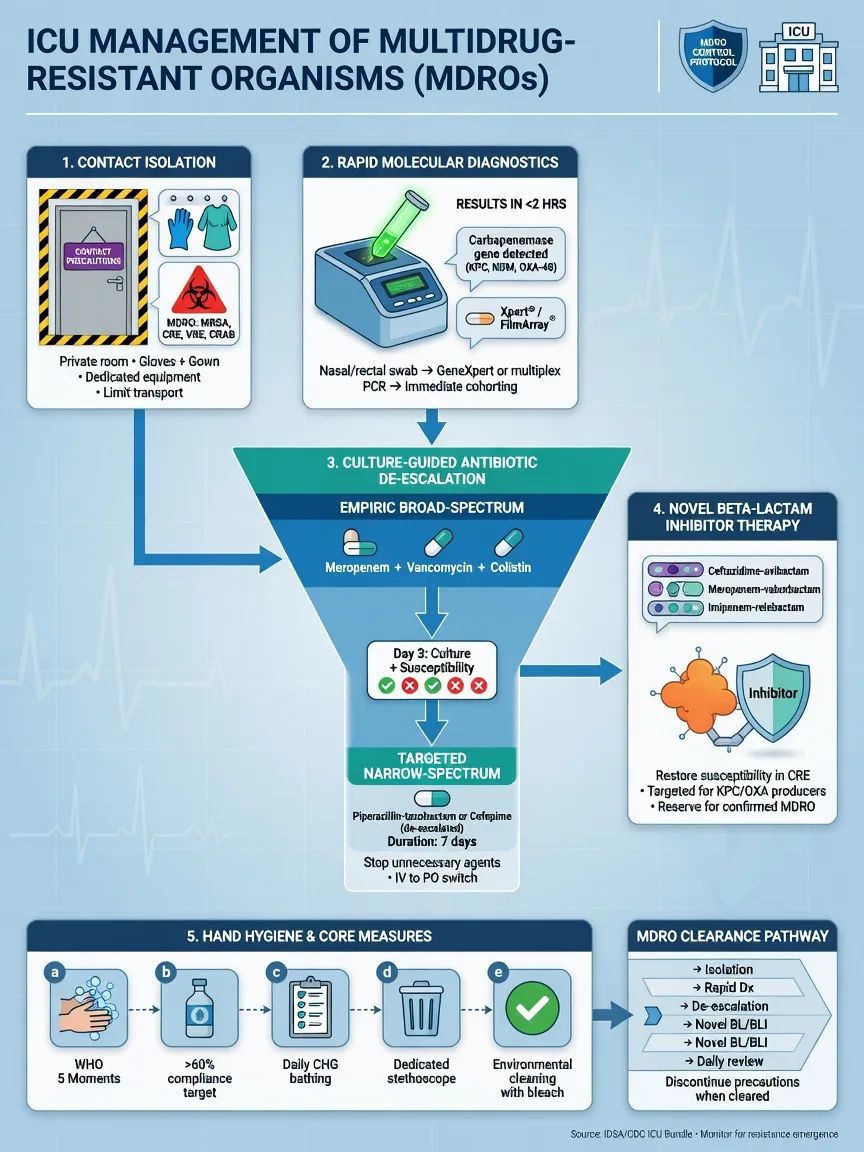
ICU MDRO management pathway: contact isolation, rapid molecular diagnostics, culture-guided de-escalation, novel beta-lactam inhibitor therapy, and hand hygiene bundle
FigureContaining MDR in ICU — isolate, diagnose fast, de-escalate on culture/AST, reserve novel BL/BLI agents for confirmed resistant pathogens, and enforce hand hygiene plus contact precautions.

Infection control is the only intervention that prevents MDR spread; treatment of individual patients does not. The bundle (CDC, ESCMID) rests on standard precautions applied rigorously, contact precautions for MDR, surveillance, cohorting, decolonisation, and environmental hygiene.[14]

[14]

Antimicrobial stewardship — the intensivist's daily discipline

Stewardship protects the patient (right drug, right dose, right duration), protects the unit (less resistance, less C. difficile), and protects the population (preserves agents for the future). The ICU is where stewardship pays the largest dividend because antibiotic exposure per patient-day is highest.[1][18]

PK/PD in the critically ill — high-yield

  1. Augmented renal clearance (ARC) — CrCl >120 mL/min in young, septic, trauma, burn patients — sub-therapeutises beta-lactams and vancomycin. Recognise it (measure CrCl on timed urine or by Cockcroft), and increase dose or use continuous infusion; consider beta-lactam TDM.[6]
  2. Beta-lactam PD index = fT>MIC (time above MIC). Achieve by extended (over ~3-4 h) or continuous (24 h) infusion after a loading dose — standard of care for severe Gram-negative infection in the ICU.
  3. Vancomycin PD index = AUC/MIC 400-600 (2020 consensus — trough-only monitoring is obsolete). Bayesian dosing software helps; load 25-30 mg/kg, then individualise.
  4. Aminoglycoside PD index = Cmax/MIC — extend the dosing interval (once-daily) to achieve high peaks; nephro/ototoxicity limits duration to <=5-7 days as monotherapy.
  5. Colistin is a prodrug (CMS); start with a loading dose (9 MU) and target Css,av ~2 mg/L — mortality is higher if under-dosed in the first 48 h. Nephrotoxicity 30-50%.
  6. Fluoroquinolone / daptomycin / linezolid / metronidazole PD index = AUC/MIC — these have excellent bioavailability; oral therapy equals IV for susceptible pathogens where gut absorption is intact.
  7. Procalcitonin algorithms safely shorten antibiotic duration in suspected sepsis and LRTI — stop when PCT <0.5 ng/mL or falls >=80% from peak. Do not use to start antibiotics in clear infection, and do not over-rule clinical judgement in deteriorating patients.

Prognosis — why MDR doubles mortality

[7]

Why MDR doubles mortality: the excess is driven by (1) inappropriate empiric therapy — the initial antibiotic misses the organism because of resistance, and each hour of delay in septic shock raises mortality ~8%; (2) greater virulence and comorbidity in the affected population (sicker patients get MDR); (3) use of toxic salvage agents (colistin) with their own failure modes. The corollary: a current antibiogram, rapid molecular diagnostics, getting the first antibiotic right, and aggressive source control close most of the mortality gap.[1][3]

Key trials and evidence

MERINO (Harris PNA 2018, JAMA) — meropenem vs piperacillin-tazobactam for ceftriaxone-resistant E. coli/Klebsiella bacteraemia

[1]

TANGO II (Wunderink 2018, Infect Dis Ther) — meropenem-vaborbactam vs best-available therapy for CRE

[1]

RESTORE-IMI 1 (Motsch 2020, Clin Infect Dis) — imipenem-relebactam vs colistin + imipenem for imipenem-nonsusceptible infection

[1]

ASPECT-NP (Martin-Loeches 2023, Ann Intensive Care) — ceftolozane-tazobactam for ventilated nosocomial pneumonia

[1]

CREDIBLE-CR (Bassetti 2021, Lancet Infect Dis) — cefiderocol vs best-available therapy for carbapenem-resistant Gram-negative infection

[1]

EPIC-cUTI (Wagenlehner 2019, NEJM) — plazomicin vs levofloxacin for complicated UTI

[1]

IDSA 2024 Guidance on Treatment of AMR Gram-Negative Infections (Tamma PD 2024, Clin Infect Dis)

[1]

Lange 2019 (Lancet) — Management of drug-resistant tuberculosis

[1]

Exam pitfalls and high-yield summary

The 14 highest-yield facts for the CICM/FFICM viva

  1. CRE bacteraemia kills 40-50% — get the carbapenemase type early; KPC → ceftazidime-avibactam; NDM/MBL → aztreonam-avibactam (avibactam does NOT inhibit MBL).[17]
  2. ESBL bacteraemia = meropenem, not pip-tazo (MERINO) — the inoculum effect makes cephalosporins and pip-tazo fail even when reported susceptible.[5]
  3. Daptomycin is inactivated by surfactant — NEVER for pneumonia (use linezolid or vancomycin).[15]
  4. Vancomycin monitoring is now AUC-based (400-600), not trough — load 25-30 mg/kg, individualise with Bayesian software; avoid vancomycin + pip-tazo (AKI).[6]
  5. NDM co-carries 16S rRNA methylases and often mcr → aminoglycoside and colistin resistance; the regimen is aztreonam-avibactam.[17]
  6. AmpC is inducible in the "SPICE" organisms — avoid 3rd-gen cephalosporins; prefer cefepime or carbapenem for serious infection.[17]
  7. Ceftolozane-tazobactam is the anti-Pseudomonas specialist (3 g q8h for HAP/VAP); cefiderocol is the broadest (MBL + CRAB).[10][11]
  8. Contact isolation for ALL MDR; cohort by organism; rectal swab for VRE/ESBL/CRE, nasal for MRSA on ICU admission + weekly.[14]
  9. MDR-TB is airborne — negative-pressure room + N95/P2, not surgical mask; BPaL regimen is the modern standard.[16]
  10. Augmented renal clearance (CrCl >120) sub-therapeutises beta-lactams and vancomycin — increase dose / use continuous infusion / TDM.[6]
  11. Colistin is a prodrug (CMS) — load 9 MU, target Css ~2 mg/L, nephrotoxicity 30-50%; polymyxin B is preferred for bacteraemia (more predictable exposure).[17]
  12. Procalcitonin safely shortens antibiotic duration (stop when PCT <0.5 or falls >=80%); never use it to withhold antibiotics in clear severe infection.[1]
  13. Inappropriate empiric therapy kills — each hour of delay in septic shock raises mortality; calibrate empiric breadth by risk factors + local antibiogram, then de-escalate at 48-72 h.[1]
  14. Stewardship + infection control together (right drug/dose/duration + isolation + surveillance + decolonisation + environmental hygiene) are the only interventions that contain MDR spread at the population level.[14][18]

CRE bacteraemia with shock — identify the carbapenemase BEFORE you commit

  • KPC: ceftazidime-avibactam (or meropenem-vaborbactam, imipenem-relebactam) — novel BL/BLI preferred over colistin.[17]
  • NDM/VIM/IMP (MBL): aztreonam-avibactam (ceftazidime-avibactam + aztreonam, or cefiderocol) — avibactam/vaborbactam/relebactam do NOT inhibit MBL.[17]
  • OXA-48: ceftazidime-avibactam (often co-produces ESBL).[17]
  • Send carbapenemase PCR / mCIM at first suspicion; start empirically on the most likely mechanism, then refine.

ESBL treated with a cephalosporin will fail — use a carbapenem

Cephalosporins (and pip-tazo) fail in ESBL bacteraemia despite reported susceptibility because of the inoculum effect (MERINO). Meropenem is the standard of care. The same logic applies to AmpC-producing "SPICE" organisms and 3rd-gen cephalosporins — derepression during therapy selects resistant mutants.[5][17]

Daptomycin for MRSA/VRE pneumonia = guaranteed failure

Daptomycin is inactivated by pulmonary surfactant — never use for pneumonia. Use linezolid (superior lung penetration, the preferred agent for MRSA/VRE pneumonia) or vancomycin (MRSA only). Reserve daptomycin for MRSA/VRE bacteraemia, endocarditis, and deep-seated soft-tissue/bone infection.[15]

TB is AIRBORNE — negative pressure and N95, not a surgical mask

Drug-resistant TB (MDR/pre-XDR/XDR) requires airborne precautions: negative-pressure isolation room (>=12 air changes/h), N95/P2 respirator for all staff, and continued isolation until three consecutive negative AFB smears on effective therapy. This is distinct from the contact precautions used for MRSA/VRE/CRE/CRAB/CRPA.[16]

Cefiderocol mortality signal in Acinetobacter — use judiciously

CREDIBLE-CR showed a non-significant numerical increase in all-cause mortality with cefiderocol versus best-available therapy, driven largely by the Acinetobacter subgroup and non-susceptible isolates. Cefiderocol remains a valuable broad agent for MBL-CRE and CRPA, but interpret the Acinetobacter signal cautiously and confirm susceptibility.[11]

Mnemonic

SPICESPICE organisms — the inducible AmpC family

[11]
Mnemonic

KNIFECarbapenemase classes — "KNIFE" for the ICU

[9]
Exam pitfall

Common viva traps in MDR

  1. "Ceftazidime-avibactam covers NDM" — FALSE. Avibactam inhibits KPC, ESBL, AmpC, OXA-48 — NOT class B metallo-beta-lactamases (NDM, VIM, IMP). The fix is aztreonam-avibactam.
  2. "Treat ESBL bacteraemia with piperacillin-tazobactam if susceptible" — FALSE (MERINO). Use a carbapenem; pip-tazo fails because of the inoculum effect.
  3. "Daptomycin for MRSA pneumonia" — FALSE (surfactant inactivates it). Use linezolid or vancomycin.
  4. "Vancomycin trough 15-20 is the target" — OUTDATED. Target AUC/MIC 400-600 (2020 consensus).
  5. "Use 3rd-gen cephalosporin for Enterobacter bacteraemia" — FALSE (inducible AmpC; risk of derepression). Use cefepime or a carbapenem.
  6. "CRAB → colistin monotherapy" — INSUFFICIENT. Prefer high-dose sulbactam + polymyxin; cefiderocol has a mortality caveat.
  7. "MDR-TB isolation = contact precautions" — FALSE. TB is airborne — negative pressure + N95.
  8. "Colistin = polymyxin B" — NOT quite. CMS (colistimethate sodium) is a prodrug with slow, variable conversion; polymyxin B gives more predictable exposure and is preferred for bacteraemia.
  9. "Beta-lactam TDM is unnecessary" — FALSE in the critically ill. Augmented renal clearance, RRT, oedema, and difficult organisms (high MIC) all justify beta-lactam TDM targeting 100% fT>4-5x MIC.
  10. "Stop antibiotics when fever resolves" — INSUFFICIENT. Use clinical + microbiological + biomarker (procalcitonin) resolution, and the shortest evidence-based duration (usually 7 days for most ICU infections).
[7]

References

  1. [1]Niederman MS, Torres A. Severe community-acquired pneumonia. European Respiratory Review, 2022.PMID 36517046
  2. [3]Tacconelli E, Carrara E, Savoldi A, et al. Discovery, research, and development of new antibiotics: the WHO priority list of antibiotic-resistant bacteria and tuberculosis. Lancet Infectious Diseases, 2018.PMID 29276051
  3. [4]Magiorakos AP, Srinivasan A, Carey RB, et al. Multidrug-resistant, extensively drug-resistant and pandrug-resistant bacteria: an international expert proposal for interim standard definitions for acquired resistance. Clinical Microbiology and Infection, 2012.PMID 21793988
  4. [5]Harris PNA, Tambyah PA, Lye DC, et al. Effect of Piperacillin-Tazobactam vs Meropenem on 30-Day Mortality for Patients With E coli or Klebsiella pneumoniae Bloodstream Infection and Ceftriaxone Resistance: A Randomized Clinical Trial. JAMA, 2018.PMID 30208454
  5. [6]Rybak MJ, Le J, Lodise TP, et al. Therapeutic Monitoring of Vancomycin for Serious Methicillin-resistant Staphylococcus aureus Infections: A Revised Consensus Guideline. Clinical Infectious Diseases, 2020.PMID 32658968
  6. [7]Shields RK, Nguyen MH, Chen L, et al. Pneumonia and Renal Replacement Therapy Are Risk Factors for Ceftazidime-Avibactam Treatment Failures and Resistance among Patients with Carbapenem-resistant Enterobacteriaceae Infections. Antimicrobial Agents and Chemotherapy, 2018.PMID 29507064
  7. [8]Wunderink RG, Giamarellos-Bourboulis EJ, Rahav G, et al. Effect and Safety of Meropenem-Vaborbactam versus Best-Available Therapy in Patients with Carbapenem-Resistant Enterobacteriaceae Infections in the TANGO II Randomized Trial. Infectious Diseases and Therapy, 2018.PMID 30270406
  8. [9]Motsch J, Murta de Oliveira C, Stus V, et al. RESTORE-IMI 1: A Multicenter, Randomized, Double-blind Trial Comparing Efficacy and Safety of Imipenem/Relebactam versus Colistin plus Imipenem in Patients with Imipenem-nonsusceptible Infections. Clinical Infectious Diseases, 2020.PMID 31400759
  9. [10]Martin-Loeches I, Shorr AF, Wunderink RG, et al. Outcomes in participants with ventilated nosocomial pneumonia and organ failure treated with ceftolozane/tazobactam in the ASPECT-NP trial. Annals of Intensive Care, 2023.PMID 36773112
  10. [11]Bassetti M, Echols R, Matsunaga Y, et al. Efficacy and safety of cefiderocol or best available therapy for the treatment of serious infections caused by carbapenem-resistant Gram-negative bacteria (CREDIBLE-CR): a randomised, open-label, blinded-endpoint, pathogen-focused, descriptive study. Lancet Infectious Diseases, 2021.PMID 33058795
  11. [12]Zhanel GG, Cheung D, Adam H, et al. Review of Eravacycline, a Novel Fluorocycline Antibacterial Agent. Drugs, 2016.PMID 26863149
  12. [13]Wagenlehner FME, Cloutier DJ, Komirenko AS, et al. Once-Daily Plazomicin for Complicated Urinary Tract Infections. New England Journal of Medicine, 2019.PMID 30786187
  13. [14]Tacconelli E, Cataldo MA, Dancer SJ, et al. ESCMID guidelines for the management of the infection control measures to reduce transmission of multidrug-resistant Gram-negative bacteria in hospitalized patients. Clinical Microbiology and Infection, 2014.PMID 24329732
  14. [15]Liu C, Bayer A, Cosgrove SE, et al. Clinical practice guidelines by the Infectious Diseases Society of America for the treatment of methicillin-resistant Staphylococcus aureus infections in adults and children. Clinical Infectious Diseases, 2011.PMID 21208910
  15. [16]Lange C, Dheda K, Chesov D, et al. Management of drug-resistant tuberculosis. Lancet, 2019.PMID 31526739
  16. [17]Tamma PD, Heil EL, Justo JA, et al. Infectious Diseases Society of America 2024 Guidance on the Treatment of Antimicrobial-Resistant Gram-Negative Infections. Clinical Infectious Diseases, 2024.PMID 39108079
  17. [18]Lawandi A, Yek C, Kadri SS, et al. IDSA guidance and ESCMID guidelines: complementary approaches toward a care standard for MDR Gram-negative infections. Clinical Microbiology and Infection, 2022.PMID 35150882
  18. [19]Huang SS, Septimus E, Hayden MK, et al. Effect of body surface decolonisation on bacteriuria and candiduria in intensive care units: an analysis of a cluster-randomised trial. Lancet Infectious Diseases, 2016.PMID 26631833
  19. [20]Heaney M, Mahoney MV, Gallagher JC. Eravacycline: The Tetracyclines Strike Back. Annals of Pharmacotherapy, 2019.PMID 31081341