ICU · Infection / pharmacology
Beta-Lactam Antibiotics — Penicillins, Cephalosporins, Carbapenems, Monobactams
Also known as Beta-lactam · Penicillin · Cephalosporin · Carbapenem · Meropenem · Piperacillin-tazobactam · Flucloxacillin · Ceftriaxone · Ceftazidime · Cefepime · Ceftaroline · Aztreonam · Beta-lactamase inhibitor · Prolonged infusion
The beta-lactam antibiotics share the beta-lactam ring and the mechanism — the bind the PBPs, the inhibit the cell-wall (the peptidoglycan) synthesis, the bactericidal, the time-dependent (the T over the MIC drives the prolonged or the continuous infusion in the severe sepsis). The four subclasses: the penicillins (the piperacillin-tazobactam the broad and the pseudomonal, the flucloxacillin the staph MSSA not MRSA, the amoxiclav), the cephalosporins (the ceftriaxone or the cefotaxime the 3rd no pseudomonal, the ceftazidime the 3rd pseudomonal, the cefepime the 4th pseudomonal, the ceftaroline the 5th MRSA), the carbapenems (the meropenem the broadest — the ESBL — the reserve for the MDR, the imipenem the seizures), and the monobactams (the aztreonam the Gram-negative only, the safe in the penicillin allergy). The resistance: the beta-lactamases (the solved by the clavulanate or the tazobactam or the avibactam), the altered PBPs (the MRSA PBP2a — needs the vancomycin). The adverse: the allergy (the low cross-reactivity), the C. difficile, the interstitial nephritis, the seizures (the high-dose or the imipenem).
On this page & tools
Your progress
Saved locally on this device.
8 MCQs with explanations
Target exams
Overview & definition
The beta-lactam antibiotics share the beta-lactam ring and the mechanism of the action. They are the bactericidal, the time-dependent — the duration that the free-drug concentration exceeds the MIC (the T over the MIC) drives the efficacy, hence the prolonged or the continuous infusion in the severe sepsis. The four subclasses: the penicillins, the cephalosporins, the carbapenems, and the monobactams. The ICU workhorses (the piperacillin-tazobactam, the meropenem, the ceftriaxone, the cefepime).[1]
The mechanism and the pharmacodynamics
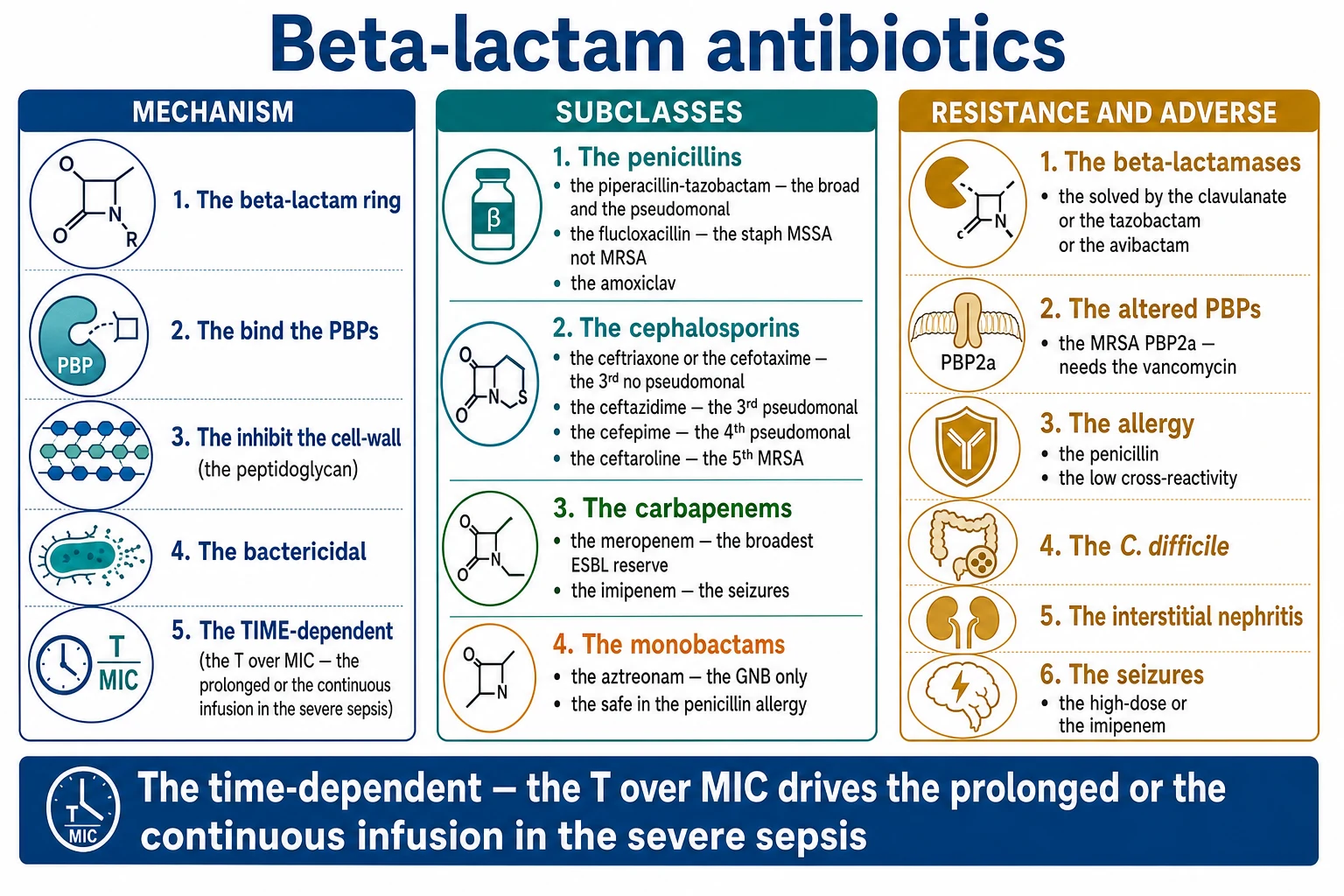
- The beta-lactam ring — the core structure (the 4-membered lactam ring).
- The mechanism — the bind the PBPs (the penicillin-binding proteins) → the inhibit the transpeptidase → the fail the peptidoglycan cross-linking → the cell-wall lysis (the bactericidal).[1]
- The time-dependent killing — the efficacy depends on the T over the MIC (the duration the concentration exceeds the MIC), NOT the peak. Hence the prolonged (over 3 to 4 hours) or the continuous infusion in the severe sepsis, the critical illness, the MDR — to maximise the T over the MIC.[1]
- The beta-lactamases — the bacterial enzymes that hydrolyse the beta-lactam ring → the inactivation. The solved by the beta-lactamase inhibitors (the clavulanate, the tazobactam, the avibactam, the relebactam).[1]
The subclasses
The penicillins
- The benzylpenicillin — the narrow (the streptococcus, the enterococcus, the syphilis, the listeria, the meningococcus).[1]
- The amoxicillin or the ampicillin — the broader (the Gram-positive plus the some Gram-negative; the Listeria, the enterococcus).[1]
- The amoxicillin-clavulanate — the + the beta-lactamase cover (the clavulanate inhibits the beta-lactamase).[1]
- The flucloxacillin — the staph (the MSSA, the beta-lactamase-stable). NOT the MRSA (the MRSA has the altered PBP2a).[1]
- The piperacillin-tazobactam — the broad (the pseudomonal, the Gram-negative, the anaerobes, the some ESBL). The ICU workhorse. The tazobactam (the beta-lactamase inhibitor) extends the cover.[1]
The cephalosporins (the generations)
- The 1st (the cefalexin, the cefazolin) — the Gram-positive (the strep, the MSSA, the some E. coli). The cefazolin for the surgical prophylaxis.[1]
- The 2nd (the cefuroxime, the cefoxitin) — the + the some Gram-negative, the anaerobes (the cefoxitin).[1]
- The 3rd:[1]
- The 4th (the cefepime) — the broad, the pseudomonal, the Gram-positive. The ICU workhorse for the febrile neutropenia, the nosocomial.[1]
- The 5th (the ceftaroline) — the + the MRSA (the binds the PBP2a). The only beta-lactam for the MRSA.[1]
The carbapenems (the reserve for the MDR)
- The meropenem — the broadest (the Gram-positive, the Gram-negative including the ESBL, the anaerobes). The reserve for the MDR, the ESBL, the severe. Crosses the CSF.[1]
- The imipenem — the similar; the seizures (the high dose, the renal failure — the dehydropeptidase-I inhibitor, the cilastatin, the required).[1]
- The ertapenem — the once-daily; the NO the pseudomonal and the NO the atypicals (the enterococcus). The for the ESBL, the community intra-abdominal.[1]
The monobactams
- The aztreonam — the Gram-negative only (the no Gram-positive, the no anaerobes, the no atypicals). The safe in the penicillin allergy (the no cross-reactivity, except the ceftazidime — the shared side-chain). The for the GNB in the beta-lactam-allergic.[1]
The resistance and the adverse effects
- The beta-lactamases — the enzymes that hydrolyse the ring. The solved by the inhibitors (the clavulanate, the tazobactam, the avibactam, the relebactam).[1]
- The altered PBPs — the MRSA (the PBP2a — the low affinity for the beta-lactams). The needs the vancomycin (or the ceftaroline).[1]
- The reduced permeability, the efflux, the altered targets.[1]
- The allergy — the penicillin (the rash, the anaphylaxis). The cross-reactivity with the cephalosporins is the LOW (1 to 2 per cent), the higher with the similar side-chains (the amoxicillin-cefalexin, the ceftazidime-aztreonam).[1]
- The C. difficile, the interstitial nephritis, the neutropenia, the seizures (the high-dose penicillin, the imipenem).[1]
Red flags
The penicillins — the deep dive
The penicillins are the 6-aminopenicillanic-acid nucleus fused to the beta-lactam ring. The acyl side-chain at the 6-position determines the spectrum. The penicillins are the narrowest (the benzylpenicillin) → the aminopenicillins (the amoxicillin, the ampicillin) → the anti-staphylococcal (the flucloxacillin, the dicloxacillin) → the anti-pseudomonal (the piperacillin, the ticarcillin).[1]
The benzylpenicillin (the penicillin G) — the narrow, the IV
- The spectrum — the streptococci (the Groups A, B, C, G, the viridans, the S. pneumoniae in the penicillin-susceptible), the enterococci (the susceptible — the ampicillin preferred), the Neisseria meningitidis, the Listeria monocytogenes (the ampicillin-gentamicin), the Treponema pallidum (the syphilis), the anaerobes (the Clostridium, the Peptostreptococcus — the Bacteroides the resistant), the Actinomyces, the Leptospira.[1]
- The dosing — the 1.2 to 2.4 g IV every 4 to 6 hours (the high-dose 18 to 24 million units per day for the meningitis, the endocarditis). The oral route the NOT absorbed (the gastric acid destroys it). The benzathine and the procaine penicillin the IM-depot.[1]
- The CSF penetration — the poor in the uninflamed meninges, the adequate only in the high-dose with the inflamed meninges (the synergistic with the gentamicin for the Listeria meningitis).[1]
The amoxicillin and the ampicillin — the aminopenicillins
- The amoxicillin — the oral (the absorbed), the IV. The ampicillin the IV (the poor oral). Both the Gram-positive (the enterococcus, the Listeria — the drug of choice) plus the some Gram-negative (the E. coli, the H. influenzae in the susceptible, the Proteus mirabilis, the Salmonella).[1]
- The amoxicillin-clavulanate — the + the beta-lactamase cover (the clavulanate the suicide inhibitor of the beta-lactamase). The for the bites (the Pasteurella), the aspiration, the sinusitis, the otitis, the diabetic-foot (the mild).[1]
- The ampicillin — the first-line for the Listeria monocytogenes meningitis and bacteraemia (the with the gentamicin for synergy), the enterococcus (the susceptible), the neonatal sepsis.[1]
- The ampicillin-sulbactam — the + the anaerobes (the sulbactam the beta-lactamase inhibitor). The community intra-abdominal, the aspiration. NOT the pseudomonal.[1]
The flucloxacillin — the anti-staphylococcal penicillin
- The spectrum — the MSSA only (the S. aureus without the altered PBP2a), the coagulase-negative staphylococci (the susceptible), the streptococci. The beta-lactamase-stable (the isoxazolyl side-chain resists the staphylococcal penicillinase).[1]
- The NOT the MRSA — the MRSA has the PBP2a (the altered penicillin-binding protein with the low affinity for the beta-lactams) → the resistant to the flucloxacillin, the cephalosporins (the 1st to 4th), the carbapenems. The MRSA the needs the vancomycin or the ceftaroline.[1]
- The dosing — the 1 to 2 g IV every 6 hours (the high-dose for the endocarditis). The oral the absorbed. The for the MSSA bacteraemia (the preferred — the bactericidal, the lower mortality than the vancomycin for the MSSA), the endocarditis, the cellulitis, the osteomyelitis, the septic arthritis.[1]
- The cholecystitis caveat — the flucloxacillin (and the dicloxacillin, the nafcillin, the oxacillin) the biliary-excreted → the rare cholestatic hepatitis (the can persist for months after cessation — the consider in the patient with the post-flucloxacillin jaundice).[1]
The piperacillin-tazobactam — the ICU workhorse
- The spectrum — the broadest of the penicillins: the Gram-positive (the streptococci, the enterococcus the susceptible, the MSSA), the Gram-negative including the Pseudomonas aeruginosa (the anti-pseudomonal), the anaerobes (the Bacteroides), the some ESBL (the if the MIC the low). The tazobactam (the beta-lactamase inhibitor) extends the cover to the many beta-lactamase producers.[1]
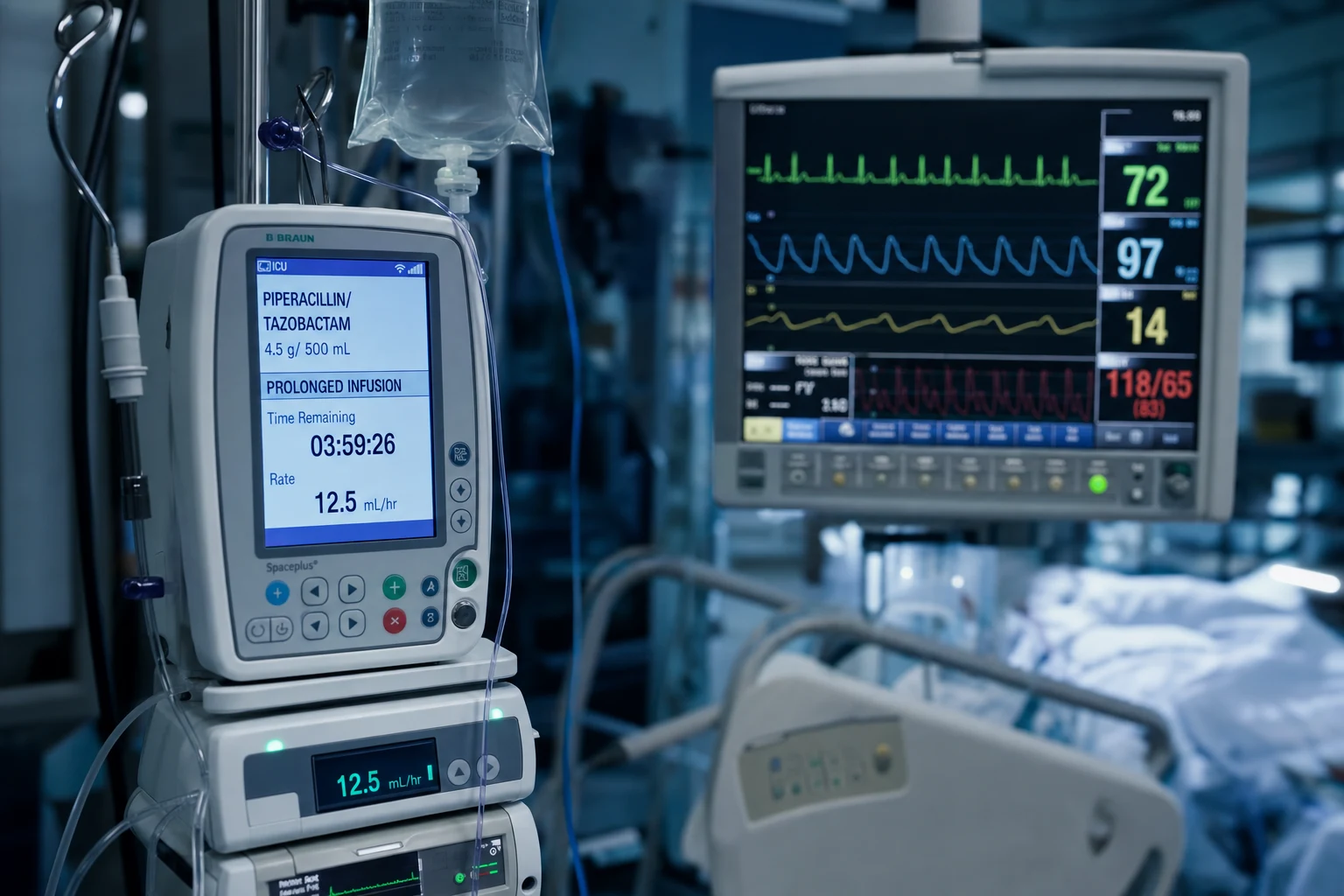
- The dosing — the 4 g/0.5 g IV every 6 to 8 hours (the 4.5 g); the prolonged infusion (the over 4 hours) or the continuous (the 18 g per day) for the severe sepsis, the MDR, the augmented renal clearance. The renal-adjust for the AKI and the dialysis.[1]
- The the MERINO trial — the piperacillin-tazobactam the INFERIOR to the meropenem for the ESBL-E. coli and Klebsiella bloodstream infection (the 30-day mortality the 12 per cent vs the 4 per cent). The do NOT use the piperacillin-tazobactam for the confirmed ESBL bacteraemia (the meropenem the preferred).[4]
- The the VANCO-ZOSYN AKI — the vancomycin-plus-the-piperacillin-tazobactam the significantly increases the AKI risk (the ~3-fold) compared with the vancomycin-plus-the-cefepime. The prefer the cefepime for the empirical Gram-negative cover when the vancomycin is the concurrently administered.[10]
- The the hypernatraemia — the piperacillin-tazobactam the high-sodium-content (the ~2 g of sodium per 4.5 g vial) → the monitor the sodium in the prolonged therapy and the heart failure.[1]
The four penicillin groups — by spectrum
| Group | Examples | Spectrum highlight | ICU role |
|---|---|---|---|
| Natural (narrow) | Benzylpenicillin (penicillin G), benzathine, procaine | Strep, enterococcus (susceptible), N. meningitidis, Listeria, syphilis, anaerobes (not Bacteroides) | Meningococcal, streptococcal, listerial infection |
| Aminopenicillins | Amoxicillin, ampicillin; +clavulanate; +sulbactam | Above + some enteric GNB; +inhibitor covers beta-lactamase | Listeria, enterococcus, paediatric, community |
| Anti-staphylococcal | Flucloxacillin, dicloxacillin, nafcillin, oxacillin | MSSA only (beta-lactamase-stable); NOT MRSA | MSSA bacteraemia, endocarditis, cellulitis |
| Anti-pseudomonal | Piperacillin (+tazobactam), ticarcillin (+clavulanate) | Broadest: includes Pseudomonas, anaerobes, some ESBL | Empiric sepsis, nosocomial, neutropenia |
The cephalosporins — the generations
The cephalosporins are the 7-aminocephalosporanic acid nucleus with the beta-lactam ring. The 3-position side-chain at the cephem core determines the Gram-negative cover and the pharmacokinetics. The generations the progressively gain the Gram-negative (and the Pseudomonas) cover while the losing the Gram-positive (the first to the fourth). The ceftaroline the 5th-generation regains the MRSA.[1]
The 1st-generation (the cefazolin, the cefalexin)
- The cefazolin — the IV. The Gram-positive (the strep, the MSSA, the S. epidermidis the susceptible) and the some E. coli, the Klebsiella, the Proteus mirabilis. The surgical prophylaxis (the standard before the surgery). The for the MSSA bacteraemia and endocarditis (the alternative to the flucloxacillin in the penicillin-allergic, the low cross-reactivity).[1]
- The cefalexin — the oral. The for the uncomplicated cellulitis, the UTI. The NOT the serious (the poor tissue penetration).[1]
The 2nd-generation (the cefuroxime, the cefoxitin)
- The cefuroxime — the + the some Gram-negative (the H. influenzae, the Enterobacter, the Neisseria), the MSSA. The CSF penetration the moderate.[1]
- The cefoxitin — the + the anaerobes (the Bacteroides) — the for the pelvic and the intra-abdominal. The cefotetan the similar.[1]
The 3rd-generation (the ceftriaxone, the cefotaxime, the ceftazidime)
- The ceftriaxone and the cefotaxime — the broad Gram-negative (the Enterobacterales, the Neisseria, the H. influenzae), the streptococci, the MSSA (the cefotaxime the better staph). The cross the CSF (the for the community-acquired bacterial meningitis — the ceftriaxone or the cefotaxime + the vancomycin + the ampicillin for the Listeria). The biliary (the ceftriaxone) and the urinary (the ceftriaxone). The once-daily (the ceftriaxone — the long half-life). The NO the Pseudomonas.[1]
- The ceftazidime — the + the Pseudomonas (the only 3rd-generation with the pseudomonal cover). The lose the some Gram-positive. The for the nosocomial, the febrile neutropenia, the pseudomonal. The inactivated by the ESBL and the AmpC.[1]
The 4th-generation (the cefepime)
- The cefepime — the broad: the Gram-positive (the strep, the MSSA), the Gram-negative (the Enterobacterales, the Pseudomonas), the stable against the AmpC (the zwitterionic structure). The ICU workhorse for the febrile neutropenia, the nosocomial pneumonia, the empirical Gram-negative cover. The q8 to 12 hours; the renal-adjust for the AKI and the dialysis.[1]
- The cefepime neurotoxicity (the encephalopathy, the myoclonus, the non-convulsive status) — the high-dose, the renal failure, the accumulation → the myoclonus, the encephalopathy, the seizures, the non-convulsive status epilepticus. The monitor the renal function (the dose-adjust early), the consider the EEG in the unexplained altered-consciousness. The reversible on the dose-reduction and the dialysis.[1]
The 5th-generation (the ceftaroline, the ceftobiprole)
- The ceftaroline — the + the MRSA (the binds the PBP2a) plus the broad Gram-negative (the NOT the Pseudomonas, the ESBL, the AmpC). The for the MRSA skin and the soft-tissue (the CAP, the community-acquired pneumonia). The NOT yet the standard for the MRSA bacteraemia (the vancomycin or the daptomycin the preferred; the ceftaroline the in the trials — the ceftaroline the OK for the pneumonia). The the only beta-lactam for the MRSA.[1]
- The ceftobiprole — the similar; the licensed (the some regions) for the HAP/VAP including the MRSA. The active against the PBP2a and the some Gram-negative.[1]
The five cephalosporin generations — by spectrum
| Generation | Examples | Gram-positive | Gram-negative | Pseudomonas | MRSA | Notable ICU role |
|---|---|---|---|---|---|---|
| 1st | Cefazolin, cefalexin | +++ (strep, MSSA) | + (some E. coli, Klebsiella) | — | — | Surgical prophylaxis, MSSA |
| 2nd | Cefuroxime, cefoxitin | ++ | ++ (H. flu, Neisseria); cefoxitin + anaerobes | — | — | Community, mixed |
| 3rd (anti-GNB) | Ceftriaxone, cefotaxime | ++ | +++ (cross CSF) | — | — | CAP, meningitis, biliary, UTI |
| 3rd (anti-PSA) | Ceftazidime | + | +++ | +++ | — | Neutropenia, pseudomonal |
| 4th | Cefepime | ++ | +++ | +++ (AmpC-stable) | — | Febrile neutropenia, nosocomial |
| 5th | Ceftaroline, ceftobiprole | +++ | +++ | — | +++ (PBP2a) | MRSA pneumonia/SSTI |
The carbapenems — the reserve
The carbapenems are the broadest of the beta-lactams — the Gram-positive, the Gram-negative (including the ESBL, the AmpC), the anaerobes. The reserve for the MDR (the ESBL, the severe, the healthcare-associated) to preserve the efficacy and to limit the carbapenem-resistance (the CRE — the carbapenem-resistant Enterobacterales).[5]
The meropenem — the broadest
- The spectrum — the broadest: the Gram-positive (the strep, the MSSA, the some enterococcus), the Gram-negative (the Enterobacterales including the ESBL, the AmpC, the some carbapenemase — the NOT the KPC, the NDM, the OXA-48), the Pseudomonas aeruginosa, the anaerobes (the Bacteroides). The crosses the CSF (the for the meningitis — the cefepime the alternative).[1]
- The dosing — the 1 g IV every 8 hours (the 2 g IV every 8 hours for the meningitis, the pseudomonal, the severe); the prolonged infusion (the over 3 hours) or the continuous (the 3 to 6 g per day) for the severe sepsis, the MDR, the augmented renal clearance. The renal-adjust for the AKI and the dialysis.[1]
- The seizure threshold — the lower than the imipenem but the rare; the dose-related (the high-dose in the renal failure).[1]
- The the MERINO trial — the meropenem the SUPERIOR to the piperacillin-tazobactam for the ESBL-E. coli and Klebsiella bacteraemia (the 30-day mortality the 4 per cent vs the 12 per cent). The meropenem the preferred for the confirmed ESBL bacteraemia.[4]
The imipenem-cilastatin — the seizure-prone
- The spectrum — the similar to the meropenem (the broad). The inactivated by the renal dehydropeptidase-I (the DHP-I) → the cilastatin (the DHP-I inhibitor) the co-formulated to prevent the renal degradation and the nephrotoxicity.[1]
- The seizures — the highest of the carbapenems (the high-dose, the renal failure, the CNS disease, the elderly, the concomitant the ganciclovir). The meropenem the lower-seizure threshold; the ertapenem the lowest. The avoid the imipenem in the seizure-prone and the CNS disease.[1]
- The dosing — the 500 mg to 1 g IV every 6 to 8 hours (the renal-adjust).[1]
The ertapenem — the once-daily, the no pseudomonal
- The spectrum — the broad (the Gram-positive, the Gram-negative including the ESBL, the AmpC, the anaerobes); the NO the Pseudomonas, the NO the Acinetobacter, the NO the atypicals (the enterococcus the variable). The long half-life (the once-daily). The for the ESBL (the community-acquired), the intra-abdominal (the with the adequate source control), the complicated UTI.[1]
- The dosing — the 1 g IV once daily (the renal-adjust).[1]
- The the stewardship advantage — the ertapenem the does NOT select for the pseudomonal resistance (the no pseudomonal cover) → the preferred carbapenem-sparing for the ESBL (the does not drive the Pseudomonas-the-carbapenem-resistance).[5]
The four carbapenems — at a glance
| Drug | Pseudomonas | ESBL | Carbapenemase | CSF | Seizure risk | Dosing |
|---|---|---|---|---|---|---|
| Meropenem | +++ | +++ | Some (if low MIC) | ++ | Low-moderate | 1–2 g q8h (prolonged) |
| Imipenem-cilastatin | +++ | +++ | Some | ++ | Highest | 500 mg–1 g q6–8h |
| Ertapenem | — | +++ | — | + | Lowest | 1 g q24h |
| Doripenem | +++ | +++ | Some | ++ | Low | 500 mg q8h (prolonged) |
The monobactams — the aztreonam
- The aztreonam — the monocyclic beta-lactam (the no fused second ring). The Gram-negative only (the Enterobacterales, the Pseudomonas, the H. influenzae, the Neisseria); the NO the Gram-positive, the NO the anaerobes, the NO the atypicals.[1]
- The the safe in the penicillin allergy — the NO the cross-reactivity with the penicillins or the carbapenems (the structurally distinct — the no side-chain similarity). The option for the Gram-negative cover in the beta-lactam-allergic.[10]
- The the ceftazidime caveat — the cross-reactivity with the ceftazidime (the shared side-chain) → the avoid the aztreonam if the ceftazidime allergy. The (the new ceftazidime-avibactam-plus-aztreonam combination the for the metallo-beta-lactamase — the avibactam the protects the aztreonam from the serine-beta-lactamase, the aztreonam the stable against the NDM).[5]
- The dosing — the 1 to 2 g IV every 8 to 12 hours (the renal-adjust). The CSF penetration the moderate.[1]
- The the for the pseudomonal GNB in the beta-lactam-allergic — the aztreonam (the Gram-negative, the pseudomonal) + the metronidazole (the anaerobes) + the vancomycin (the Gram-positive, the MRSA) = the complete empirical cover for the beta-lactam-allergic.[1]
The mechanism — the PBP binding and the cell wall
The covalent acyl-enzyme
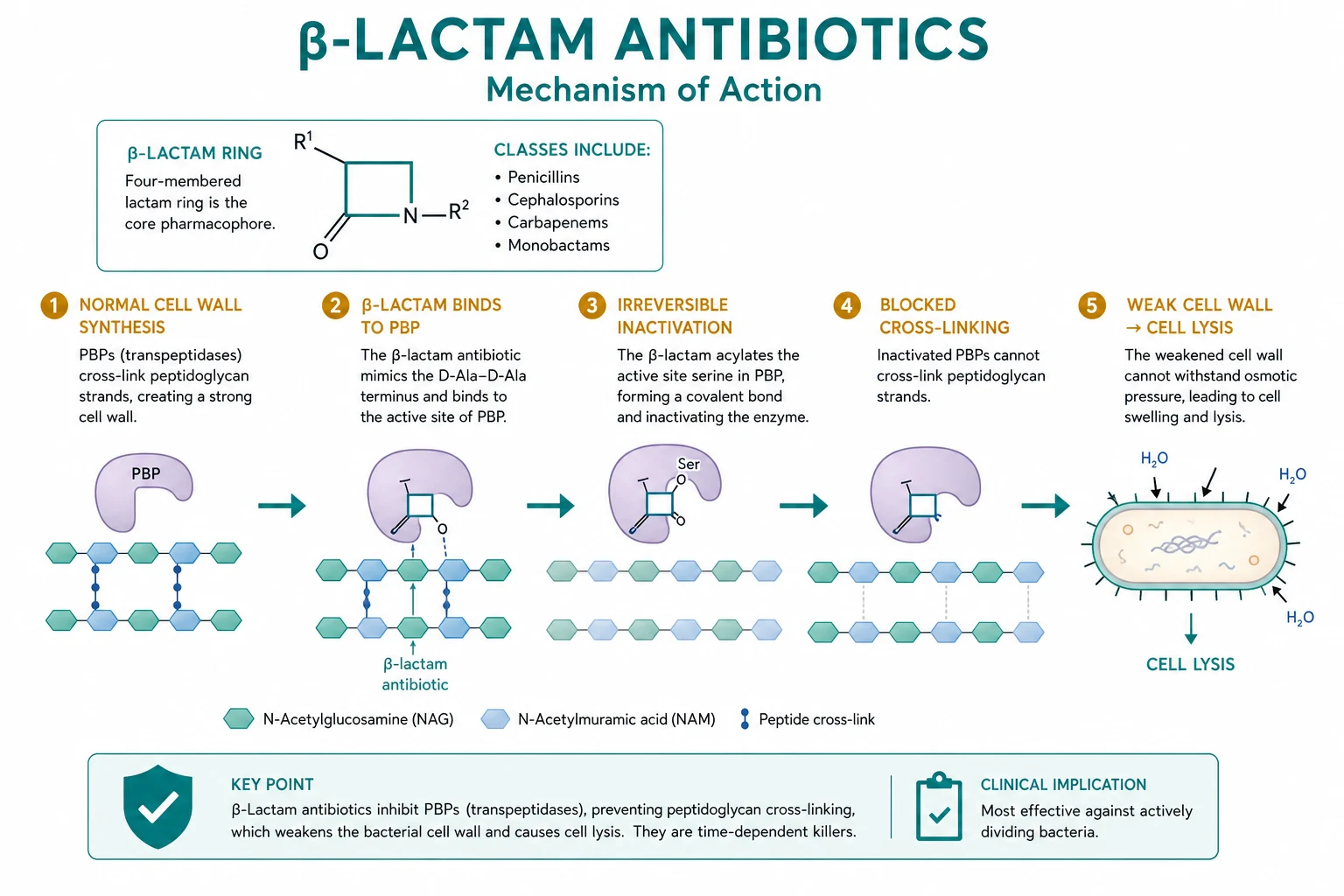
- The beta-lactam ring is the structural analogue of the D-alanyl-D-alanine (the D-Ala-D-Ala) terminus of the peptidoglycan precursor. The four-membered lactam ring the sterically resembles the terminal D-Ala-D-Ala dipeptide → the recognised by the PBPs (the penicillin-binding proteins — the transpeptidases, the carboxypeptidases, the endopeptidases).[1]
- The covalent acylation — the active-site serine of the PBP the attacks the carbonyl of the beta-lactam ring → the stable covalent acyl-enzyme intermediate → the PBP the permanently inactivated (the suicide substrate).[1]
- The un-cross-linked peptidoglycan → the cell wall the weakened → the autolysins (the murein hydrolases) the unopposed → the cell lysis in the hypotonic environment (the bactericidal).[1]
The PBP targets and the morphology
- The PBP1a and PBP1b (the transpeptidases for the cell-wall elongation) → the rapid lysis (the cell rupture).
- The PBP2 (the transpeptidase for the cell-shape maintenance) → the round osmotic-fragile spheroplasts.
- The PBP3 (the septal transpeptidase for the cell division) → the long filamentous filaments (the failed septation).[1]
The pharmacodynamics — the time-dependent
- The T over the MIC — the efficacy depends on the duration the free-drug concentration exceeds the MIC (the percentage of the dosing interval — the 40 to 70 per cent of T over the MIC for the bacteriostasis, the 100 per cent for the bactericidal).[12]
- The post-antibiotic effect — the modest (the shorter than the aminoglycosides, the vancomycin) — except for the staphylococci (the 1 to 3 hours). The NO the meaningful post-antibiotic effect for the Gram-negative bacilli → the need for the sustained T over the MIC.[12]
- The inoculum effect — the high-inoculum sites (the endocarditis, the abscess) → the elevated MIC (the beta-lactamases hydrolyse the drug at the high bacillary load) → the under-dosing risk. The for the endocarditis the high-dose + the prolonged infusion.[1]
- The the pharmacokinetic targets — the piperacillin-tazobactam (the 100 per cent T over the MIC, the trough 15 to 30 mg/L for the seriously-ill), the meropenem (the 100 per cent T over the MIC, the trough 4 to 8 mg/L), the cefepime (the 100 per cent T over the MIC, the trough 4 to 8 mg/L).[12]
The resistance — the beta-lactamases, the ESBL, the AmpC, the carbapenemase

The beta-lactamases (the Ambler classes A, B, C, D)
- The Ambler molecular classification — the four classes based on the structure: the A (the serine beta-lactamases — the TEM, the SHV, the CTX-M, the KPC), the B (the metallo-beta-lactamases — the NDM, the VIM, the IMP — the zinc-dependent), the C (the AmpC — the chromosomal or the plasmid), the D (the OXA — the OXA-48 the carbapenemase). The A, the C, the D the serine-enzymes (the inhibited by the avibactam, the relebactam); the B the metallo-enzymes (the NOT inhibited by the avibactam, the aztreonam the stable).[5]
The ESBL (the extended-spectrum beta-lactamase)
- The spectrum — the hydrolyse the penicillins and the cephalosporins (the 1st to the 4th) but the NOT the carbapenems. The inhibited by the clavulanate, the tazobactam, the sulbactam, the avibactam. The CTX-M (the E. coli, the Klebsiella) the dominant worldwide.[5]
- The clinical — the ESBL-E. coli and Klebsiella UTI, biliary, intra-abdominal, bacteraemia. The the MERINO trial the piperacillin-tazobactam the INFERIOR to the meropenem for the ESBL bacteraemia (the meropenem the preferred for the bloodstream infection; the piperacillin-tazobactam the may-be-acceptable for the lower-risk UTI with the source control).[4]
- The treatment — the meropenem (or the ertapenem for the no-pseudomonal) the first-line for the serious ESBL. The aminoglycosides, the fluoroquinolones, the TMP-SMX, the fosfomycin (the UTI) the alternatives (the based on the susceptibility). The piperacillin-tazobactam the NOT for the bacteraemia.[5]
The AmpC (the inducible cephalosporinase)
- The spectrum — the chromosomal in the Enterobacter, the Citrobacter, the Serratia, the Morganella, the Providencia (the 'SPICE/ICE' organisms — the SPACE). The inducible by the third-generation cephalosporins → the selection of the stable derepressed mutants during the therapy → the treatment failure on the ceftriaxone.[5]
- The NOT inhibited by the clavulanate or the tazobactam → the piperacillin-tazobactam the unreliable for the Enterobacter bacteraemia. The cefepime (the stable against the AmpC — the zwitterionic) or the carbapenem the preferred.[5]
- The clinical — the Enterobacter cloacae, the Citrobacter freundii, the Serratia marcescens bacteraemia → the cefepime or the carbapenem; the AVOID the ceftriaxone and the piperacillin-tazobactam (the derepression risk).[5]
The carbapenemases (the KPC, the NDM, the OXA-48, the VIM/IMP)
- The KPC (the Klebsiella pneumoniae carbapenemase — the class A) — the serine-carbapenemase; the global (the USA, the southern Europe, the Latin America). The inhibited by the avibactam and the relebactam → the ceftazidime-avibactam, the meropenem-vaborbactam, the imipenem-relebactam.[5]
- The NDM (the New Delhi metallo-beta-lactamase — the class B) — the metallo-enzyme (the zinc-dependent); the global (the Indian-subcontinent, the Balkans, the spreading worldwide). The NOT inhibited by the avibactam or the relebactam; the aztreonam the stable (the aztreonam-avibactam the combination). The for the NDM-CRE: the ceftazidime-avibactam + the aztreonam (the avibactam the protects the aztreonam from the co-produced serine-enzymes).[5]
- The OXA-48 (the class D) — the serine-carbapenemase; the Mediterranean and the spreading. The inhibited by the avibactam → the ceftazidime-avibactam.[5]
- The VIM and the IMP (the class B) — the metallo-carbapenemases; the aztreonam + the avibactam.[5]
- The treatment of the CRE — the the IDSA 2024 guidance: the ceftazidime-avibactam (the KPC, the OXA-48), the meropenem-vaborbactam (the KPC), the imipenem-relebactam (the KPC — the RESTORE-IMI 1 trial the superior to the colistin-plus-imipenem, the lower nephrotoxicity), the aztreonam + the ceftazidime-avibactam (the NDM, the metallo). The colistin, the tigecycline, the aminoglycosides the alternatives (the high-toxicity). The infectious-diseases the consult.[5]
The altered PBPs (the MRSA, the pneumococcus)
- The MRSA (the PBP2a) — the acquired mecA gene → the PBP2a (the low affinity for the beta-lactams) → the resistant to the flucloxacillin, the cephalosporins (the 1st to 4th), the carbapenems. The only beta-lactam active against the MRSA the ceftaroline (the binds the PBP2a).[1]
- The penicillin-resistant pneumococcus (the altered PBPs 1a, 2b, 2x) — the mosaic PBPs (the recombinant) → the reduced affinity; the high-dose the ceftriaxone or the meropenem for the meningitis (the vancomycin + the ceftriaxone for the empirical CAP meningitis).[1]
- The enterococcus (the intrinsic low-affinity PBP5) — the ampicillin-resistant (the E. faecium the PBP5 — the ampicillin-R, the vancomycin-R the VRE); the E. faecalis the ampicillin-susceptible. The ampicillin the for the susceptible enterococcus (the with the aminoglycoside for the synergy in the endocarditis).[1]
The reduced permeability, the efflux, the altered targets
- The reduced permeability — the loss or the alteration of the porins (the OprD in the Pseudomonas → the carbapenem-resistance to the imipenem).[1]
- The efflux pumps — the MexAB-OprM in the Pseudomonas (the multi-drug).[1]
- The altered targets — the altered PBPs (above).[1]
The four beta-lactamase families — and the matching inhibitor
| Class | Enzyme | Hydrolyses | Inhibited by | NOT inhibited by | Drug of choice for the producer |
|---|---|---|---|---|---|
| A (serine) | TEM, SHV, CTX-M (ESBL); KPC | Penicillins, cephalosporins (1st–4th); KPC also carbapenems | Clavulanate, tazobactam, sulbactam (ESBL); avibactam, relebactam, vaborbactam (KPC) | — | Carbapenem (ESBL); ceftazidime-avibactam (KPC) |
| B (metallo) | NDM, VIM, IMP | Carbapenems + most beta-lactams | — (no clinical inhibitor) | Avibactam, relebactam, chelators | Ceftazidime-avibactam + aztreonam |
| C (serine) | AmpC | Penicillins, cephalosporins (incl. 3rd) | Avibactam, relebactam | Clavulanate, tazobactam (poorly) | Cefepime (stable) or carbapenem |
| D (serine) | OXA (incl. OXA-48) | Penicillins; OXA-48 weakly carbapenems | Avibactam | Clavulanate, tazobactam | Ceftazidime-avibactam |
The adverse effects — the allergy, the cross-reactivity, the C. difficile, the neurotoxicity
The hypersensitivity
- The the IgE-mediated (the immediate, the type I) — the anaphylaxis, the urticaria, the angio-oedema, the bronchospasm (the within minutes to an hour). The penicillin the most common (the rash the 1 to 10 per cent, the anaphylaxis the 0.01 to 0.05 per cent, the fatal-anaphylaxis the 0.001 to 0.002 per cent).[10]
- The the non-IgE (the delayed, the type IV) — the morbilliform rash (the common, the amoxicillin), the serum-sickness-like, the DRESS (the drug-reaction-with-eosinophilia-and-systemic-symptoms), the SJS/TEN (the rare).[10]
- The the interstitial nephritis (the type II, the humoral) — the methicillin, the nafcillin, the oxacillin, the flucloxacillin; the acute kidney injury with the eosinophiluria, the fever, the rash, the sterile pyuria. The treat the stop the drug, the supportive.[1]
- The the haemolytic anaemia (the type II) — the high-dose the IV penicillin (the Coombs-positive); the rare.[1]
The cross-reactivity between the classes
- The cross-reactivity is the side-chain-determined (the NOT the ring-determined). The shared R1 side-chain between the penicillins and the cephalosporins → the cross-reactivity. The different side-chains → the NO cross-reactivity.[10]
- The penicillin-to-cephalosporin — the LOW overall (~1 to 2 per cent; the meta-analysis the relative-risk ~1.0 to the cephalosporins with the dissimilar side-chains, the elevated to the aminopenicillins-cefalexin-cefazolin and the amoxicillin-cefuroxime).[10]
- The penicillin-to-carbapenem — the very LOW (the <1 per cent — the meta-analysis the ~1 per cent). The carbapenems the safe in the penicillin-allergic (the no need for the test-dose in the non-IgE-allergy).[10]
- The penicillin-to-monobactam — the essentially ZERO (the aztreonam); except the ceftazidime (the shared side-chain).[10]
- The the practical rule — the non-severe penicillin-allergy (the rash) the cephalosporins and the carbapenems the safe. The severe (the anaphylaxis, the SJS/TEN) the avoid the cross-reactive (the test-dose or the alternative). The the side-chain matching (the aminopenicillin-cefalexin, the amoxicillin-cefuroxime-cefotaxime-ceftriaxone-ceftazidime-aztreonam) the higher risk.[10]
The Clostridioides difficile infection
- The beta-lactams (the broad — the clindamycin, the fluoroquinolones, the cephalosporins, the carbapenems) the highest-risk for the C. difficile. The cephalosporins (the 2nd, the 3rd, the 4th) and the clindamycin the most-implicated; the piperacillin-tazobactam the variable (the older-data the protective, the newer the risk).[6]
- The the IDSA/SHEA 2017-2018 guideline — the oral vancomycin (the 125 mg QID × 10 days, the 500 mg QID for the fulminant), or the fidaxomicin (the preferred for the non-severe — the lower recurrence), or the metronidazole (the non-severe if the others unavailable). The fulminant (the ileus, the toxic-megacolon, the shock) the oral vancomycin + the IV metronidazole ± the surgical-consult.[6]
- The the stewardship principle — the narrow the spectrum, the shorten the duration, the avoid the unnecessary — the reduce the C. difficile risk.[1]
The neurotoxicity (the seizures, the encephalopathy)
- The the penicillins (the benzylpenicillin, the high-dose) — the seizures (the CSF accumulation in the renal failure — the beta-lactam the GABA-A antagonist).[1]
- The the imipenem — the highest of the carbapenems (the high-dose, the renal failure, the CNS disease, the elderly, the ganciclovir).[1]
- The the cefepime — the encephalopathy, the myoclonus, the non-convulsive status epilepticus (the high-dose, the renal failure, the accumulation). The reversible on the dose-reduction and the dialysis; the EEG for the unexplained altered-consciousness.[1]
- The the mechanism — the beta-lactam the antagonises the GABA-A receptor (the structural similarity to the GABA) → the neuro-excitation. The structurally-penetrant (the CSF), the high-dose, the renal failure → the accumulation.[1]
The haematologic and the electrolyte
- The the neutropenia (the high-dose, the prolonged — the >7 to 10 days) — the common (the 5 to 15 per cent); the reversible; the monitor the FBC. The piperacillin-tazobactam, the cefepime, the meropenem.[1]
- The the thrombocytopenia and the platelet dysfunction — the moxalactam (the withdrawn), the cefotetan (the disulfiram-like + the bleeding), the high-dose the carbenicillin, the ticarcillin. The aPTT-prolongation with the ceftriaxone (the false-elevation of the PTT — the interference with the lecithin-based assays).[1]
- The the hypokalaemia (the high-sodium the penicillins → the distal-tubule potassium-wasting); the the hypernatraemia (the piperacillin-tazobactam the high-sodium-content).[1]
- The the disulfiram-like reaction (the cefotetan, the cefamandole — the historical — with the alcohol).[1]
The cephalosporin-to-penicillin cross-reactivity by side-chain
| Cephalosporin | Shared side-chain with | Cross-reactivity with penicillin |
|---|---|---|
| Cefalexin, cefazolin, cefradine | Aminopenicillins (amoxicillin, ampicillin) | Elevated (~similar amino-benzyl) |
| Cefuroxime, cefotaxime, ceftriaxone | Amoxicillin (methoxyimino) | Moderate |
| Ceftazidime | Aztreonam (shared oxyimino) | Avoid aztreonam if ceftazidime allergy |
| Cefepime, cefpirome | Amoxicillin (methoxyimino) | Low-moderate |
| Ceftaroline, ceftobiprole | Distinct | Very low |
The dosing in the ICU — the renal adjustment, the continuous infusion, the TDM

The augmented renal clearance and the increased volume of distribution
- The augmented renal clearance (ARC) — the young, the septic, the traumatised, the burned, the post-neurosurgical, the post-major-surgery, the febrile, the pregnant → the creatinine clearance >130 mL/min → the beta-lactam the cleared faster than the predicted → the sub-therapeutic the T over the MIC → the treatment failure. The suspect the ARC in the hyperdynamic ICU patient (the cardiac-output the high, the creatinine the low-normal); the check the levels early; the up-titrate the dose and the choose the prolonged or the continuous infusion.[12]
- The the increased volume of distribution (Vd) — the severe sepsis, the cirrhosis, the burns, the oedema, the pregnancy → the Vd the expanded (the 0.3 to 0.5 L/kg → the 0.5 to 1.0 L/kg) → the lower the peak → the sub-therapeutic. The load the high-dose (the loading dose the same regardless of the renal function — the Vd-driven).[12]
- The the hypoalbuminaemia — the critical illness → the albumin <25 g/L → the increased the free-fraction (the only the free-drug the active) → the increased the Vd and the clearance (the free-drug the filtered and the secreted) → the unpredictable. The TDM the more important.[12]
The renal adjustment
- The the dose-reduce (the frequency-extend, not the dose-cut) for the AKI and the dialysis — the beta-lactams the renally-excreted; the accumulation → the neurotoxicity (the seizures, the encephalopathy) and the interstitial-nephritis-the-worsening. The monitor the creatinine; the adjust early; the extend the dosing-interval.[1]
- The the dialysis — the haemodialysis the removes the most beta-lactams (the water-soluble, the low-protein-bound) → the dose AFTER the dialysis; the CRRT (the CVVHDF) the variable-clearance → the near-normal or the higher-dose (the CRRT the augmented-clearance).[1]
- The the ECMO and the VAD — the sequestration in the circuit (the increased Vd) → the higher-dose and the TDM.[1]
The prolonged and the continuous infusion (the BLING II, the BLING III)
- The the rationale — the time-dependent the T over the MIC → the prolonged (the over 3 to 4 hours) or the continuous (the over 24 hours) the maximise the T over the MIC for the severe sepsis, the MDR, the augmented-clearance. The loading dose the first (the achieve the steady-state-fast).[12]
- The the BLING II trial (Dulhunty 2015, AJRCCM) — the negative for the primary (the 14-day alive-and-free-of-organ-support: the 66 per cent vs the 65 per cent), but the signal for the severely-ill (the APACHE II >25) and the low-MIC. The piperacillin-tazobactam, the meropenem, the ticarcillin-clavulanate.[1]
- The the BLING III trial (Dulhunty 2024, JAMA) — the negative (the all-cause 90-day mortality: the 26.0 per cent continuous vs the 26.9 per cent intermittent; the OR 0.95, the 95 per cent CI 0.83–1.10). The largest test (the ~7000 patients). The continuous infusion the safe but the NOT the routine-mortality-benefit. The selective-use (the high-MIC, the augmented-clearance, the deep-source) the reasonable.[2]
- The the 2024 meta-analysis (Abdul-Aziz 2024, JAMA) — the prolonged the infusion the small-the-mortality-benefit in the subgroup (the critically-ill with the severe sepsis); the BLING III the dominant-weight. The overall the NO-the-routine-mortality-benefit; the individualised.[3]
- The the bottom line — the continuous infusion the NOT the routine; the selective for the difficult (the augmented-clearance, the high-MIC, the deep-source-the-endocarditis, the MDR). The TDM the more-important than the infusion-strategy.[2]
The therapeutic drug monitoring (the TDM)
- The the targets — the piperacillin-tazobactam (the trough 15 to 30 mg/L for the seriously-ill), the meropenem (the trough 4 to 8 mg/L), the cefepime (the trough 4 to 8 mg/L). The measure the pre-dose the trough (the steady-state — the after the 4th to 5th dose).[11]
- The the Hagel 2022 trial (ICM) — the TDM-based the piperacillin-tazobactam the dose-optimisation the NO-the-improvement-in-the-sepsis-related-organ-dysfunction (the primary); the pharmacokinetic-target the more-frequently-achieved. The routine-the-TDM the still-the-investigational.[11]
- The the when the TDM the useful — the augmented-clearance, the dialysis, the ECMO, the morbid-obesity, the deep-source (the endocarditis, the meningitis, the osteomyelitis), the MDR, the failure-the-response.[11]
The beta-lactam dosing in the ICU — the practical algorithm
- The assess the patient and the syndrome. The syndrome (the community vs the nosocomial, the bacteraemia vs the localised), the host (the immunocompromised, the dialysis, the burns, the pregnancy), the local-resistance-the-patterns (the ESBL, the MRSA). The choose the empirical the broad-enough-for-the-likely-the-pathogen.[1]
- The load the high-dose. The piperacillin-tazobactam 4.5 g, the meropenem 2 g, the cefepime 2 g — the loading dose the same regardless of the renal function (the Vd-driven). The in the severe sepsis the first-hour.[12]
- The choose the infusion strategy. The intermittent (the standard), the prolonged (the over 3 to 4 hours — the for the MDR, the augmented-clearance), the continuous (the for the difficult — the high-MIC, the deep-source). The BLING III the continuous the NOT-the-routine.[2]
- The renal-adjust the maintenance. The AKI and the dialysis the dose-after-the-dialysis, the extend-the-interval. The CRRT the near-normal-or-higher. The monitor the creatinine the daily.[1]
- The de-escalate on the day 2 to 3. The cultures the return → the narrow to the narrowest-effective (the flucloxacillin for the MSSA, the ceftriaxone for the susceptible-GNB, the stop-the-anti-MRSA, the stop-the-anaerobic-the-cover-if-not-indicated). The stop the antibiotic-the-day-the-source-controlled-and-the-clinically-improved.[1]
- The TDM the in-the-indicated. The augmented-clearance, the dialysis, the ECMO, the morbid-obesity, the deep-source, the MDR, the failure-the-response. The target-the-trough the piperacillin 15 to 30, the meropenem 4 to 8, the cefepime 4 to 8 mg/L.[11]
- The reassess the daily. The antibiotic-the-day — the still-the-needed? The narrow-the-still? The stop-the-day-the-not-the-needed.[1]
The new beta-lactam–beta-lactamase-inhibitor combinations
- The ceftolozane-tazobactam — the ceftolozane (the anti-pseudomonal cephalosporin) + the tazobactam. The the MDR-Pseudomonas (the some-the-carbapenem-non-susceptible-the-still-the-susceptible). The the ASPECT-NP trial (Kollef 2019, Lancet ID) — the non-inferior to the meropenem for the nosocomial pneumonia. The for the MDR-Pseudomonas-the VAP, the complicated UTI, the intra-abdominal.[7]
- The ceftazidime-avibactam — the ceftazidime + the avibactam (the non-beta-lactam the beta-lactamase-inhibitor). The the KPC, the OXA-48, the ESBL, the AmpC (the NOT the metallo-NDM/VIM/IMP). The the REPROVE trial (Torres 2018, Lancet ID) — the non-inferior to the meropenem for the HAP/VAP. The + the aztreonam for the NDM (the above).[8]
- The meropenem-vaborbactam — the meropenem + the vaborbactam (the boronic-acid the inhibitor). The the KPC (the NOT the NDM, the OXA-48). The for the CRE-the-KPC.[5]
- The imipenem-relebactam — the imipenem-cilastatin + the relebactam (the diazabicyclooctane the inhibitor). The the KPC and the some-AmpC (the NOT the NDM, the OXA-48). The the RESTORE-IMI 1 trial (Kaye 2020, AAC) — the superior to the colistin-plus-imipenem for the imipenem-non-susceptible (the lower the nephrotoxicity).[9]
- The aztreonam + the ceftazidime-avibactam — the aztreonam (the stable against the metallo-NDM) + the avibactam (the protects the aztreonam from the co-produced serine-enzymes). The for the NDM-CRE.[5]
The new beta-lactam–beta-lactamase-inhibitor combinations
| Combination | Covers | Does NOT cover | Trial evidence |
|---|---|---|---|
| Ceftolozane-tazobactam | MDR-Pseudomonas (incl. some carbapenem-R) | KPC, NDM, OXA-48, MRSA | ASPECT-NP (Kollef 2019, Lancet ID) — non-inferior to meropenem for HAP/VAP8 |
| Ceftazidime-avibactam | KPC, OXA-48, ESBL, AmpC | NDM, VIM, IMP (metallo); MRSA | REPROVE (Torres 2018, Lancet ID) — non-inferior to meropenem for HAP/VAP9 |
| Meropenem-vaborbactam | KPC, some AmpC | NDM, OXA-48; MRSA | TANGO II — vs best-available for CRE |
| Imipenem-cilastatin-relebactam | KPC, some AmpC | NDM, OXA-48; MRSA | RESTORE-IMI 1 (Kaye 2020, AAC) — superior to colistin+imipenem, less nephrotoxicity10 |
| Ceftazidime-avibactam + aztreonam | NDM (metallo-CRE) + co-produced serine-enzymes | MRSA | Observational + RCT (RESCUE) |
The key trials
Harris 2018 (JAMA) — MERINO — piperacillin-tazobactam vs meropenem for ESBL E. coli/Klebsiella bacteraemia
Design
Multinational, randomised, open-label, non-inferiority trial; 391 adults with E. coli or K. pneumoniae bloodstream infection and ceftriaxone non-susceptibility (ESBL-producers)
Intervention
Piperacillin-tazobactam 4.5 g IV q6h vs meropenem 1 g IV q8h for 7–14 days
Primary outcome
30-day all-cause mortality: piperacillin-tazobactam 12% (23/194) vs meropenem 4% (7/193) — absolute risk difference +7.8 percentage points (95% CI +1.5 to +14.4); **non-inferiority NOT met** (margin 5%)
Clinical bottom line
Piperacillin-tazobactam is INFERIOR to meropenem for ESBL E. coli/Klebsiella bloodstream infection. Do NOT use pip-tazo for confirmed ESBL bacteraemia — use a carbapenem. Pip-tazo may still be acceptable for lower-risk ESBL UTI with good source control. Practice-changing — narrowed empiric use of pip-tazo in ESBL-suspected sepsis.
Dulhunty 2024 (JAMA) — BLING III — continuous vs intermittent β-lactam infusion in severe sepsis
Design
Multinational, multicentre, randomised, double-blind, placebo-controlled trial; 7024 critically ill adults with sepsis (Australia, NZ, UK, Malaysia, Hong Kong)
Intervention
Continuous infusion of piperacillin-tazobactam, meropenem, or ticarcillin-clavulanate (loading dose + 24-h continuous infusion) vs intermittent infusion (same total daily dose, q6–q8h) for the treating clinician's chosen drug
Primary outcome
All-cause 90-day mortality: continuous 26.0% (825/8308) vs intermittent 26.9% (893/8301); OR 0.95 (95% CI 0.83–1.10) — **no significant difference**
Clinical bottom line
The largest trial of continuous β-lactam infusion found NO mortality benefit. Continuous infusion is safe but NOT a routine ICU intervention. Reserve selective use for high-MIC organisms, augmented renal clearance, or deep-seated infection. Refocused ICU practice away from universal continuous infusion.
Dulhunty 2015 (AJRCCM) — BLING II — continuous vs intermittent β-lactam infusion in severe sepsis
Design
Multicentre, randomised, double-blind, placebo-controlled trial; 432 critically ill adults with severe sepsis (Australia, NZ, Hong Kong)
Intervention
Continuous infusion of piperacillin-tazobactam, meropenem, or ticarcillin-clavulanate vs intermittent infusion (same total daily dose)
Primary outcome
Alive 14 days after the start of study drug and free of organ support: continuous 56.6% vs intermittent 55.0% — **no significant difference** (adjusted OR 1.08, 95% CI 0.77–1.50)
Clinical bottom line
The earlier BLING II was also negative for the primary outcome, with a signal toward benefit in the more severely ill (APACHE II >25) and low-MIC subgroups. Together with BLING III, established that routine continuous infusion is not the standard of care; selective use remains defensible.
Kollef 2019 (Lancet ID) — ASPECT-NP — ceftolozane-tazobactam vs meropenem for nosocomial pneumonia
Design
Multinational, randomised, double-blind, phase 3, non-inferiority trial; 726 adults with ventilated or non-ventilated hospital-acquired pneumonia / VAP
Intervention
Ceftolozane-tazobactam 3 g IV q8h (prolonged) vs meropenem 1 g IV q8h for 7–14 days (with linezolid as MRSA overlay in both arms)
Primary outcome
28-day all-cause mortality in the modified intention-to-treat: ceftolozane-tazobactam 24.0% vs meropenem 24.4% — **non-inferiority met** (margin 7.5%)
Clinical bottom line
Ceftolozane-tazobactam is non-inferior to meropenem for nosocomial pneumonia including VAP, and is the workhorse for MDR-Pseudomonas VAP. Renal adjustment is mandatory; high sodium load. Established ceftolozane-tazobactam as the go-to antipseudomonal beta-lactam when MDR-Pseudomonas is suspected.
Torres 2018 (Lancet ID) — REPROVE — ceftazidime-avibactam vs meropenem for HAP/VAP
Design
Multinational, randomised, double-blind, phase 3, non-inferiority trial; 879 adults with nosocomial pneumonia including VAP
Intervention
Ceftazidime-avibactam 2 g/0.5 g IV q8h (prolonged) vs meropenem 1 g IV q8h for 7–14 days (with linezolid as MRSA overlay in both arms)
Primary outcome
Clinical cure at day 21 (mITT): ceftazidime-avibactam 68.8% vs meropenem 73.2% — **non-inferiority met** (margin −12.5%)
Clinical bottom line
Ceftazidime-avibactam is non-inferior to meropenem for HAP/VAP, and covers KPC and OXA-48 (not NDM). The agent of choice for KPC-producing Enterobacterales and KPC/OXA-48 nosocomial pneumonia. Combined with aztreonam for NDM-producing CRE.
Kaye 2020 (AAC) — RESTORE-IMI 1 — imipenem-cilastatin-relebactam vs colistin + imipenem for imipenem-non-susceptible infection
Design
Multinational, randomised, phase 3 trial; 47 adults with imipenem-non-susceptible (carbapenem-resistant) Enterobacterales or Pseudomonas infection (limited HAP/VAP/cUTI/cIAI/BSI); small sample reflects the difficulty of recruiting CRE infection
Intervention
Imipenem-cilastatin-relebactam (1.25 g IV q6h) vs colistin-plus-imipenem-cilastatin (the best-available standard)
Primary outcome
Favourable overall response (clinical + microbiological) at day 28: relebactam 71.4% vs colistin 70.0%; **non-inferiority met**. Nephrotoxicity (AKI) markedly lower with relebactam (10% vs 56% with colistin)
Clinical bottom line
Imipenem-relebactam is non-inferior to colistin for KPC-CRE with substantially less nephrotoxicity. Covers KPC and AmpC (NOT NDM/OXA-48). Part of the new anti-CRE armamentarium alongside ceftazidime-avibactam and meropenem-vaborbactam; ID consultation essential.
The empirical beta-lactam choice in the ICU — by syndrome
- The community-acquired sepsis (no healthcare exposure, no MDR risk). Ceftriaxone 2 g IV (the strep, the MSSA-the-flucloxacillin-add, the Enterobacterales, the atypicals-the-macrolide-or-the-fluoroquinolone-add for the CAP). The source-control-the-considered.[1]
- The nosocomial / the healthcare-associated sepsis. Piperacillin-tazobactam 4.5 g IV or cefepime 2 g IV (the Pseudomonas, the Enterobacterales, the anaerobes-the-pip-tazo) + the vancomycin (the MRSA, the line-the-associated). The if the VANCO-ZOSYN-the-AKI-the-concern the cefepime-the-instead.[1]
- The suspected-ESBL (the healthcare-associated, the prior-ESBL, the cephalosporin-exposure). Meropenem 1–2 g IV (the prolonged-infusion) the first-line. The MERINO-the-pip-tazo-the-INFERIOR.[4]
- The neutropenic fever. Piperacillin-tazobactam or cefepime (the Pseudomonas, the broad) ± the vancomycin (the catheter, the mucositis, the S. viridans, the soft-tissue). The de-escalate-the-cultures-the-return.[1]
- The penicillin-allergic. The non-severe-the-rash: the cefepime or the meropenem (the low-cross-reactivity). The severe-the-anaphylaxis: the aztreonam (the Gram-negative) + the metronidazole (the anaerobes) + the vancomycin (the Gram-positive, the MRSA).[10]
- The MRSA-the-confirmed. The vancomycin (the AUC-guided) the first-line. The ceftaroline the pneumonia-or-the-soft-tissue. The linezolid the pneumonia (the VAP-the-MRSA, the lung-penetration). The daptomycin the bacteraemia-the-endocarditis (the NOT the pneumonia — the surfactant-inactivation).[1]
- The CRE-the-confirmed. The ID-the-consult. The ceftazidime-avibactam (the KPC, the OXA-48), the meropenem-vaborbactam (the KPC), the imipenem-relebactam (the KPC), the aztreonam + the ceftazidime-avibactam (the NDM). The colistin-the-fallback.[5]
The beta-lactam allergy desensitisation — when no alternative exists
- Confirm the allergy is real and IgE-mediated (history + skin testing if available). For a non-severe rash, cross-reactivity is low and a standard cephalosporin/carbapenem may be given directly.[10]
- Weigh the alternatives. If an effective non-beta-lactam exists (e.g. vancomycin for MRSA, aztreonam for GNB), use it. Reserve desensitisation for when the beta-lactam is clearly the best agent (e.g. meropenem for ESBL meningitis in a penicillin-anaphylaxis patient).[10]
- Prepare the patient. Monitored ICU/HDU bed, IV access, resuscitation drugs at the bedside, antihistamines and adrenaline ready. Desensitisation is a graded re-exposure that temporarily tolerises mast cells.[10]
- Administer incremental doses (typically 1:10 000 → 1:1000 → 1:10 → 1:1 → full dose) at 15–30 min intervals, observing for any reaction. Most protocols reach the full dose in ~4–6 hours.[10]
- If a reaction occurs (mild: rash/itch), pause, treat, resume at the previous tolerated dose and proceed more slowly. If severe (anaphylaxis), STOP and abandon — the alternative agent must be used.[10]
- Once the full dose is tolerated, continue uninterrupted therapy. Desensitisation is lost if the drug is stopped for >1–2 half-lives — the whole protocol must be repeated on re-exposure.[10]
SAQ — Empiric antibiotic therapy in septic shock of unknown source
10 minutes · 10 marks
A 68-year-old man is admitted to ICU with a 12-hour history of rigors, dyspnoea and confusion. He has a 5-day history of an indwelling urinary catheter for obstructive uropathy and was discharged from hospital 8 days ago after a partial colectomy. On examination: T 38.9°C, HR 132, BP 78/46 (MAP 57), RR 30, SpO2 92% on room air, GCS 13. Lactate 4.6 mmol/L, creatinine 215 (baseline 95), WCC 28.4, platelets 88, INR 1.8, bilirubin 48. He has received 30 mL/kg crystalloid and is now on noradrenaline 0.35 mcg/kg/min. Two sets of blood cultures have been drawn and a chest X-ray shows a right lower lobe infiltrate. He has no known drug allergies.
SAQ — Anaphylaxis to piperacillin-tazobactam and selection of an alternative antibiotic regimen
10 minutes · 10 marks
A 56-year-old woman with known penicillin allergy (documented anaphylaxis at age 20 with cardiovascular collapse and bronchospasm following oral amoxicillin) is admitted to ICU with nosocomial pneumonia and early septic shock following a 10-day ICU stay for trauma. Sputum grows Pseudomonas aeruginosa sensitive to piperacillin-tazobactam, ceftazidime, cefepime, meropenem and aztreonam. BP 92/58, HR 110, lactate 2.4. She requires definitive antipseudomonal therapy.
Clinical pearls — high-yield CICM/FFICM/EDIC points
Additional red flags
The stewardship — the de-escalation, the dose-optimisation, the source-control

The empirical — the broad, the early, the adequate
- The the first-hour — the severe sepsis and the septic-shock the mortality-the-sensitive-to-the-early-antibiotics (the each-hour-the-delay-the-mortality-the-increases). The broad-enough-for-the-likely-the-pathogen (the local-the-resistance-the-patterns). The empirical-the-cover-the-within-the-first-hour-the-recognised.[1]
- The the adequate-the-dose — the high-dose-the-loading, the appropriate-the-route (the IV), the appropriate-the-source-the-concentration (the CSF, the biliary, the urine, the lung).[1]
The de-escalation — the day 2 to 3
- The the cultures-the-return → the narrow to the narrowest-effective. The flucloxacillin for the MSSA (the LOWER-the-mortality than the vancomycin). The ceftriaxone for the susceptible-GNB. The stop-the-anti-MRSA if the MRSA-the-not-the-isolated. The stop-the-anaerobic-the-cover-if-the-not-the-indicated (the CAP-the-anaerobic-the-rare; the intra-abdominal-the-required).[1]
- The the ESBL-the-confirmed → the meropenem-the-the-confirmed-ESBL-bacteraemia (the MERINO-the-pip-tazo-the-INFERIOR).[4]
The stop-the-day
- The the source-controlled-and-the-clinically-improved → the stop-the-antibiotic. The CAP-the-5-to-7-days; the intra-abdominal-the-4-to-7-days-with-the-source-control; the VAP-the-7-days; the bacteraemia-the-7-to-14-days-the-uncomplicated; the endocarditis-the-4-to-6-weeks. The longer-the-not-the-better (the C. difficile, the resistance, the toxicity).[1]
The source-control
- The the drainage-the-debridement-the-removal-of-the-infected-the-device — the antibiotic-the-NO-the-substitute-the-for-the-source-control. The source-control-the-within-the-6-to-12-hours-the-recognised-the-sepsis-the-source. The infected-the-line-the-removed; the abscess-the-drained; the perforation-the-repaired; the necrotic-the-tissue-the-debrided.[1]
The complete exam answer
References
- [1]Dulhunty JM, Roberts JA, Davis JS, Webb SA, Bellomo R, Gomersall C, Shirwadkar C, Paterson DL A Multicenter Randomized Trial of Continuous versus Intermittent β-Lactam Infusion in Severe Sepsis Am J Respir Crit Care Med, 2015.PMID 26200166
- [2]Dulhunty JM, Brett SJ, De Waele JJ, Lipman J, Lange D, Rajbhandari D, Lovern D, Abramo T, Jones P, Lorenz C, Bhimma Z, Mouncey PR, Broomhead R, Toft P, Hammond NE, Trinder TJ, Thomas-Robert S, Murray L, Fraser JF, Baguley D, Paterson DL, Roberts JA, Myburgh J Continuous vs Intermittent β-Lactam Antibiotic Infusions in Critically Ill Patients With Sepsis: The BLING III Randomized Clinical Trial JAMA, 2024.PMID 38864155
- [3]Abdul-Aziz MH, Hammond NE, Brett SJ, Cotta MO, Jiang L, Lingaratnam S, Liang J, Lovern D, McArthur CJ, Page DM, Rajbhandari D, Rhodes NJ, Richards B, Rood C, Smith JR, Stewart BA, Tan CS, Tiong IT, Wael JJD, Wong A, Lipman J, Roberts JA Prolonged vs Intermittent Infusions of β-Lactam Antibiotics in Adults With Sepsis or Septic Shock: A Systematic Review and Meta-Analysis JAMA, 2024.PMID 38864162
- [4]Harris PNA, Tambyah PA, Lye DC, Moi Y, Lee W, Lum J, Yeo TW, Wijaya L, Archuleta S, Avdic E, Iredell J, Mendoza TP, Len NP, Pham HV, Rasheed R, Gadomski AM, Zinyama R, Hii K, Seng CP, Barantino E, Zhu Y, Borgia S, Lye D, Monkman L, Bergh H, Cheng VC, Lai R, Teng CB, Pada SK, Hsueh PR, Sulaiman S, Fisher DA, Ratanaratin J, Chan M, Cheng J, Paterson DL, MERINO Investigators Effect of Piperacillin-Tazobactam vs Meropenem on 30-Day Mortality for Patients With E coli or Klebsiella pneumoniae Bloodstream Infection and Ceftriaxone Resistance: A Randomized Clinical Trial JAMA, 2018.PMID 30208454
- [5]Tamma PD, Heil EL, Justo JA, Mathers AJ, Satlin MJ, Bonomo RA Infectious Diseases Society of America 2024 Guidance on the Treatment of Antimicrobial-Resistant Gram-Negative Infections Clin Infect Dis, 2024.PMID 39108079
- [6]McDonald LC, Gerding DN, Johnson S, Bakken JS, Carroll KC, Coffin SE, Dubberke ER, Garey KW, Gould CV, Kelly C, Loo V, Shaklee Sammons J, Sandora TJ, Wilcox MH Clinical Practice Guidelines for Clostridium difficile Infection in Adults and Children: 2017 Update by the Infectious Diseases Society of America (IDSA) and Society for Healthcare Epidemiology of America (SHEA) Clin Infect Dis, 2018.PMID 29462280
- [7]Kollef MH, Nováček M, Kivistik Ü, Réa-Neto Á, Shime N, Martin-Loeches I, Timsit JF, Wunderink RG, Bruno CJ, Huntington JA, Krishnan L, Lin G, Yu B, Ketter N, Siew L, Matsunaga Y, Rhee EG, ASPECT-NP Trial Team Ceftolozane-tazobactam versus meropenem for treatment of nosocomial pneumonia (ASPECT-NP): a randomised, controlled, double-blind, phase 3, non-inferiority trial Lancet Infect Dis, 2019.PMID 31563344
- [8]Torres A, Zhong N, Pachl J, Timsit JF, Köhler M, Chastre J, Luyt CE, Sánchez R, Carlet J, Giunta G, Mouton JW, Larsen IA, Hamilton M, Huang X, Ostermann H Ceftazidime-avibactam versus meropenem in nosocomial pneumonia, including ventilator-associated pneumonia (REPROVE): a randomised, double-blind, phase 3 non-inferiority trial Lancet Infect Dis, 2018.PMID 29254862
- [9]Kaye KS, Boucher HW, Brown ML, Khan u, Fraenkel C, Gattuso JM, Lee M, Loutit JS, Mould-Quevedo JF, Ortega R, Rizk ML, Santevecchi B, Wende R, Zelasky A, Basu A, Castanheira M, Krause KM, McClure T, Gordon M, Huntington JA, Kessler AT, Rhee EG, Sims M, Wagenlehner FM, Connolly LE, Motta VT, Vazquez J, Yoshida-Ueno A, Lopez J, RESTORE-IMI 1 Investigators Comparison of Treatment Outcomes between Analysis Populations in the RESTORE-IMI 1 Phase 3 Trial of Imipenem-Cilastatin-Relebactam versus Colistin plus Imipenem-Cilastatin in Patients with Imipenem-Nonsusceptible Bacterial Infections Antimicrob Agents Chemother, 2020.PMID 32094127
- [10]Picard M, Robitaille G, Karam F, Kaufman M, De Létourneau JF, Frenette L, Moreau-Mathieu M, Paradis L, Bégin P Cross-Reactivity to Cephalosporins and Carbapenems in Penicillin-Allergic Patients: Two Systematic Reviews and Meta-Analyses J Allergy Clin Immunol Pract, 2019.PMID 31170539
- [11]Hagel S, Bach F, Brenner T, Bohn A, Bracht H, Brinkmann A, Bühren V, Dierdorf M, Frey OR, Goerller M, Hähnel E, Hecker A, Hügel K, Kirchner C, Klammer M, Mager A, Mathew P, Pham M, Schmid S, Schwarzkopf D, Seybold S, Stephan M, Steinbach D, Weinberger M, Werritzsch P, Wöbse M, Wulf M, Yoann P, Kreske P, Leichel M, Tan N, Roberts JA, Lichtenstern C, Allgaeuer K, Forster MH, Knothe C, Schmoor C, Kratzer A, Kees MG, Kees F, Marx G, Weigand MA Effect of therapeutic drug monitoring-based dose optimization of piperacillin/tazobactam on sepsis-related organ dysfunction in patients with sepsis: a randomized controlled trial Intensive Care Med, 2022.PMID 35106617
- [12]Abdul-Aziz MH, Portunato F, Roberts JA Prolonged infusion of beta-lactam antibiotics for Gram-negative infections: rationale and evidence base Curr Opin Infect Dis, 2020.PMID 33009140