ICU · Infection / general
Fever in the ICU — Infectious or Not? The Workup & the Procalcitonin
Also known as Fever in the ICU · Pyrexia · ICU fever · Nosocomial infection · VAP · CRBSI · CAUTI · Drug fever · Central fever · Procalcitonin · Antipyresis
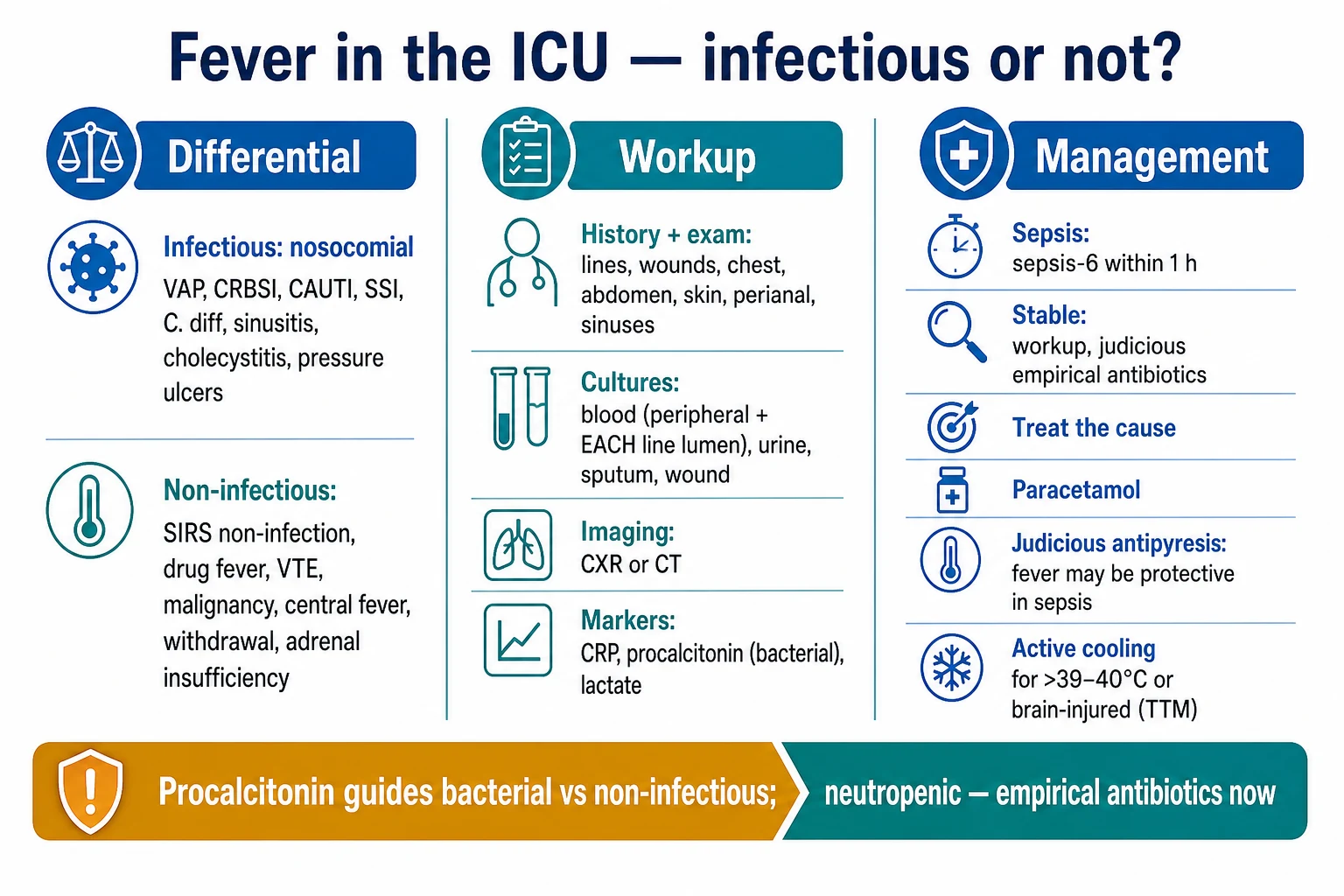
The fever in the ICU (the temp over 38.3) is the symptom, the not the diagnosis. The first question: the infectious or the non-infectious. The infectious (the nosocomial): the VAP, the CRBSI, the CAUTI, the SSI, the C. difficile, the sinusitis, the cholecystitis, the pressure ulcers, the primary. The non-infectious: the SIRS non-infection (the pancreatitis, the trauma, the burns, the post-op, the transfusion), the drug fever, the VTE, the malignancy, the central fever (the brain injury), the alcohol withdrawal, the adrenal insufficiency, the thyroid storm. The workup: the history and the exam (the lines, the wounds, the chest, the abdomen, the skin, the perianal, the sinuses); the cultures (the blood — the peripheral plus the EACH line lumen — the urine, the sputum, the wound); the imaging (the CXR, the CT); the markers (the CRP, the procalcitonin — the bacterial; the lactate). The management: the sepsis — the sepsis-6 within the 1 hour; the stable — the workup and the judicious the empirical antibiotics; the treat the cause; the paracetamol; the judicious the antipyresis (the fever protective in the sepsis); the active the cooling for the over 39 to 40 or the brain-injured (the TTM). The neutropenic — the empirical antibiotics the now.
On this page & tools
Your progress
Saved locally on this device.
8 MCQs with explanations
Target exams
Overview & definition
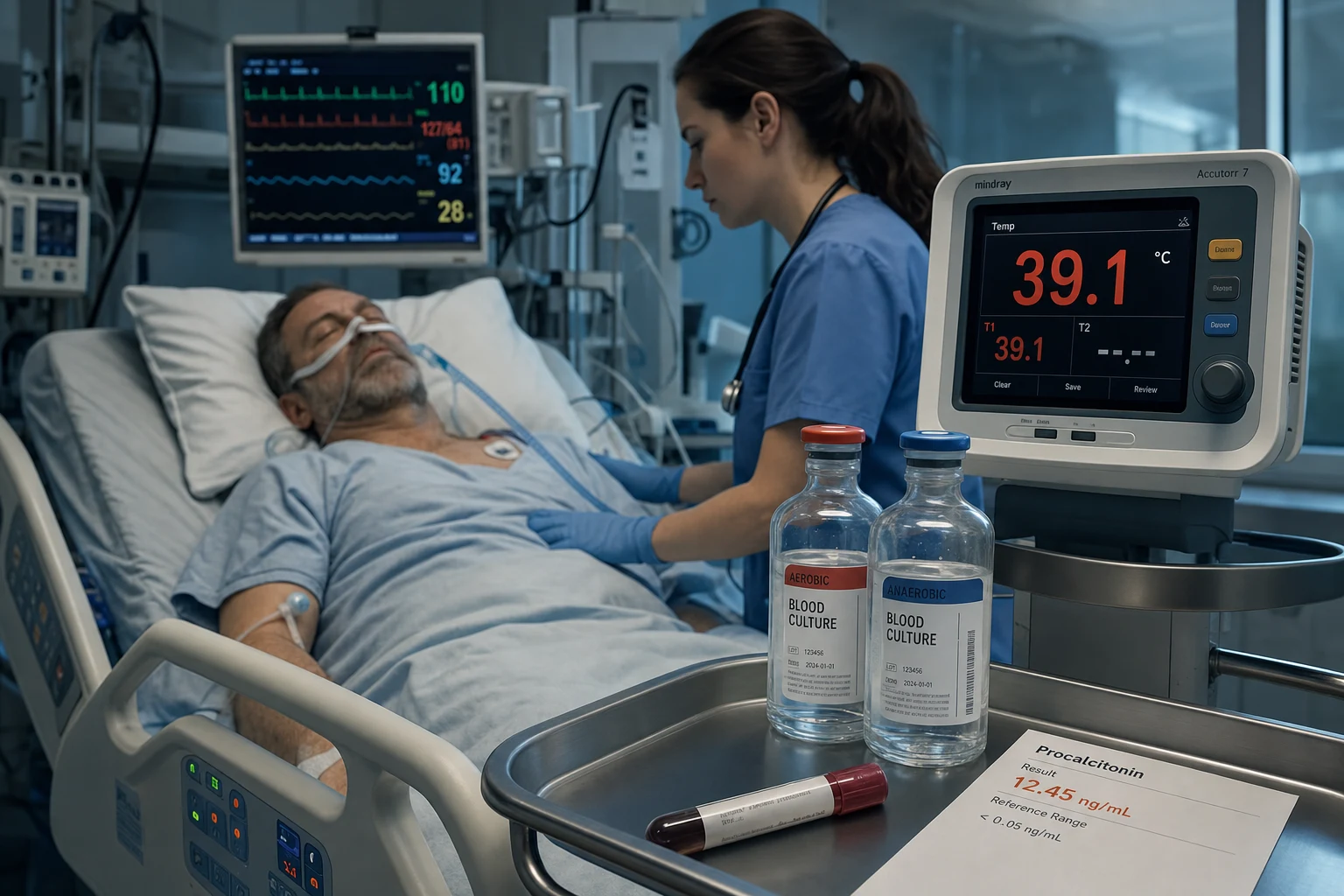
[1]The fever in the ICU (the core temp over 38.3°C) is the common and the symptom, the NOT the diagnosis. The first question the every time: the infectious or the non-infectious? The 50 to 70 per cent of the ICU fevers the infectious; the rest the non-infectious (the SIRS, the drug, the VTE, the malignancy, the central). The systematic the workup and the judicious the antibiotic the use (the procalcitonin the guide) the prevent the over-investigation and the over-treatment.[1]
The mechanisms (the pathophysiology)
The fever is the regulated the upward the shift of the hypothalamic the set-point — the body actively the generates and the conserves the heat (the vasoconstriction, the shivering, the behavioural) the until the core the temp the reaches the new the set-point. This is the FUNDAMENTAL the distinction from the hyperthermia (the unregulated the heat the overload — the set-point the normal; the heat the gain the exceeds the dissipation) and the hypothermia (the set-point the overridden; the sepsis-3 the sign of the poor the prognosis).[3]
The cascade (the PGE2 — the final the common the pathway)
- The exogenous the pyrogens (the lipopolysaccharide the LPS, the viral the particles, the toxins) the stimulate the monocytes and the macrophages and the endothelium.[1]
- The endogenous the pyrogens (the cytokines): the interleukin-1β (IL-1β), the interleukin-6 (IL-6), the tumour-necrosis-factor-α (TNF-α), the interferon-α/γ. These the travel the humoral the route to the brain.[1]
- At the organum vasculosum of the lamina terminalis (the OVLT) — the circumventricular the organ the outside the blood-brain the barrier — the cytokines the activate the cyclo-oxygenase-2 (the COX-2) and the membrane the prostaglandin-endoperoxide the synthase-2 (the mPGES-1).[1]
- The prostaglandin-E2 (the PGE2) is the synthesised — the binds the EP3 the receptors on the preoptic the anterior the hypothalamus — the raises the thermoregulatory the set-point — the FEVER.[1]
- The effector the response: the peripheral the vasoconstriction (the cold, the pale; the shivering) the generates and the conserves the heat the until the new the set-point the reached, then the vasodilation and the sweating the maintain the plateau.[1]
The clinical the implications
- The PGE2 the pathway is the WHY the NSAIDs (the COX the inhibition) and the paracetamol (the central the COX/POX the inhibition) the WORK — they the reset the set-point the downward (so the vasodilation and the sweating the follow; the rigor the sometimes).[1]
- The fever the is the regulated (the responds to the antipyretics); the hyperthermia the is the unregulated (the antipyretics the useless — the physical the cooling the needed).[3]
- The fever the pattern (the continuous, the intermittent, the hectic, the relapsing) the rarely the diagnostic the alone — the misleading the with the empirical the antibiotics and the antipyretics.[1]
The differential
The infectious (the commonest concern)
- The nosocomial (the ICU-acquired):[1]
- The VAP (the ventilator-associated pneumonia).[1]
- The CRBSI (the catheter-related bloodstream).[1]
- The CAUTI (the catheter-associated urinary).[1]
- The SSI (the surgical site).[1]
- The C. difficile, the sinusitis (the nasogastric or the nasotracheal), the cholecystitis (the acalculous), the decubitus (the pressure ulcer), the perianal.[1]
- The primary or the community infections.[1]
The non-infectious
- The SIRS non-infection — the pancreatitis, the trauma, the burns, the ARDS, the post-operative, the transfusion reaction.[1]
- The drug fever (the antibiotics, the anticonvulsants, the heparin).[1]
- The VTE (the DVT, the PE).[1]
- The malignancy (the tumour fever, the haematological).[1]
- The central fever (the brain injury — the hypothalamic; the refractory to the antipyretics).[1]
- The alcohol withdrawal, the adrenal insufficiency, the thyroid storm.[1]
The non-infectious — the deep the dive (the each the cause)
The non-infectious the causes the account for the 30 to 50 per cent of the ICU fevers; the missing the one the leads the unnecessary the antibiotics and the delay the definitive the treatment.[2]
The DVT and the PE
- The fever the sometimes the ONLY the sign of the DVT/PE in the immobile the ICU the patient; the low-grade (the usually the under 38.5°C); the pulmonary the infarction the infarcts the tissue — the inflammatory the response.[1]
- The look the for: the asymmetric the leg, the unexplained the tachycardia, the desaturation, the new the right-heart the strain, the raised the D-dimer, the unexplained the fever the after the prolonged the immobility.[1]
- The diagnostic: the Doppler the duplex (the legs, the arms — esp. the IVC the filter, the femoral the line); the CTPA; the bedside the echo (the RV the strain, the McConnell the sign).[1]
The drug fever
- The classic the triad: the relative the bradycardia (the temp the high but the HR the inappropriately the low — the fails the rise the 10 bpm the per 1°C), the eosinophilia, the rash — but the triad the present in the MINORITY (the often the just the fever the after the 7 to 10 the days of the new the drug).[2]
- The common the culprits: the β-lactams, the vancomycin (the red-man the syndrome — the histamine), the sulphonamides, the phenytoin, the carbamazepine, the heparin, the amphotericin the B, the atropine/the anticholinergics, the NMS the antipsychotics, the serotonergic, the chemotherapy.[1]
- The pattern: the new the fever the 7 to 10 the days the after the START of the drug; the defervescence the within the 48 to 72 the hours of the STOP.[2]
The malignancy (the tumour the fever)
- The lymphoma (the Pel-Ebstein the periodic the fever), the leukaemia, the renal-cell the carcinoma, the hepatic the metastases, the hepatocellular — the cytokine the (the IL-6, the TNF) the driven.[1]
- The clue: the fever the refractory to the antibiotics; the responds to the NSAIDs (the naproxen the test — the rapid the defervescence; the tumour the fever the characteristic).[2]
- The exclude the infection the FIRST (the neutropenic the patient the febrile — the ALWAYS the infection the until the proven the otherwise).[1]
The adrenal the insufficiency (the relative — the critical-illness-related the corticosteroid the insufficiency the CIRCI)
- The septic the shock (the vasopressor-dependent), the the prior the long-term the steroids (the suppressed the axis), the the etomidate (the 11β-hydroxylase the inhibition), the the tuberculosis/the adrenal the metastases/the autoimmune.[1]
- The features: the fever OR the hypothermia, the hypotension the refractory, the hyponatraemia with the hyperkalaemia, the hypoglycaemia, the eosinophilia, the fatigue.[1]
- The test: the random the cortisol the under the 276 nmol per L (the 10 µg per dL) — the suggestive; the cosyntropin the (the 250 µg the ACTH) the stimulation — the cortisol the rise the under the 250 nmol per L — the CIRCI. The treat empirically — the hydrocortisone the 200 mg per day (the do NOT the wait for the results in the shock).[1]
The heat the stroke (the environmental)
- The exertional (the young the fit the athlete, the military) vs the classic (the elderly, the chronic the disease, the heat the wave).[1]
- The triad: the core the temp the over 40°C, the CNS the dysfunction (the coma, the seizure, the delirium), the hot the dry the skin (the classic; the exertional the may the sweat).[1]
- The antipyretics the USELESS (the set-point the normal); the aggressive the physical the cooling the FAST (the cold-water the immersion the gold the standard for the exertional; the evaporative the spray-and-fan for the classic); the target the 39°C; the STOP the cooling at the 38.5°C (the afterdrop). The rhabdomyolysis, the DIC, the hepatic, the AKI — the multi-organ the failure.[1]
The transfusion the reaction
- The febrile the non-haemolytic (the commonest; the cytokines the from the donor the leukocytes; the pre-storage the leukodepletion the reduces) — the fever the within the 0 to 4 the hours of the transfusion.[1]
- The acute the haemolytic (the ABO the mismatch — the fever, the hypotension, the flank the pain, the haemoglobinuria, the DIC; the emergency). The TRALI (the transfusion-related the acute the lung the injury — the new the bilateral the infiltrates the within the 6 the hours; the non-cardiogenic). The TACO (the transfusion-associated the circulatory the overload).[1]
- The STOP the transfusion the immediately; the check the clerical; the return the unit and the sample to the blood the bank; the supportive the (the fluids, the vasopressors, the diuretic for the TACO).[1]
The pancreatitis, the MI, the SAH (the non-infectious the SIRS)
- The pancreatitis (the SIRS the from the inflamed the retroperitoneum; the fever the common; the differentiate the sterile the from the infected the necrosis — the gas, the cultures, the CT the fine-needle the aspiration).[1]
- The MI (the myocardial the infarction — the fever the within the 24 to 72 the hours; the pericarditis the post-MI the Dressler the at the 2 to 10 the weeks).[1]
- The SAH and the brain the injury — the central the fever (the hypothalamic the injury; the within the 72 the hours; the refractory to the antipyretics; the worsens the ICP and the neurological the outcome — the aggressive the cooling and the maintain the normothermia).[8]
The workup
- The history and the exam — the onset, the pattern, the recent the procedures, the drugs; the EXAM the every the potential source: the lines, the wounds, the chest, the abdomen, the skin, the perianal, the sinuses (the NGT).[1]
- The cultures — the blood (the peripheral PLUS the EACH the central-line lumen — the paired), the urine, the sputum, the wound, the stool (the C. difficile). The send the BEFORE the antibiotic (but the never the delay the empirical antibiotic if the septic).[1]
- The imaging — the CXR (the pneumonia), the CT (the chest, the abdomen, the pelvis) if the source the not clear, the Doppler (the DVT), the sinus CT (the sinusitis).[1]
- The markers — the CRP, the procalcitonin (the bacterial — the rises with the bacterial infection, the low in the viral and the non-infectious; the guides the antibiotic the start and the stop), the lactate (the sepsis).[1]
The diagnostic the approach (the stepwise — the SSCM/IDSA the 1998 the guidelines the framework)[1]
The history and the exam — the COMPLETE the head-to-toe (the lines, the wounds, the chest, the abdomen, the skin the including the pressure the areas and the perianal, the sinuses if the nasal the tubes, the joints, the surgical the sites, the oral the cavity). The rectal in the neutropenic — the NEVER the digital the exam (the bacteraemia the risk; the perianal the visualise only).[1]
The cultures (the cornerstone — the BEFORE the antibiotic)
- The blood the cultures × 2 to 3 the sets — the peripheral PLUS the EACH the central-line the lumen (the paired) — the differential the time-to-positivity (the DTP) the greater than the 2 hours (the line the positive the FIRST) the identifies the CRBSI.[1]
- The adequate the volume the 20 to 30 mL per the adult the set (the 2 the bottles the aerobic and the anaerobic) — the YIELD the volume-dependent (the 20 mL the optimal; the under the 10 mL the poor). The timing — the BEFORE the antibiotic; the 2 the sets the spaced the 30 to 60 the minutes (the febrile the spike the NOT the necessary — the continuous the bacteraemia).[1]
- The urine the culture (the catheter the sample; the CAUTI — the over the 10³ the CFU the symptomatic) — the asymptomatic the bacteriuria the common in the catheterised — the do NOT the treat.[1]
- The sputum the / the BAL the / the ETA (the quantitative — the VAP the threshold the 10⁴ the BAL, the 10⁶ the ETA).[1]
- The stool for the C. difficile (the toxin the assay — the NAAT the PCR the sensitive; the GDH the screening).[1]
- The CSF, the joint, the pleural, the ascitic — the if the source the suspected.[1]
The imaging (the source the localise)
- The CXR — the pneumonia, the effusion, the line the position, the aspiration.[1]
- The CT (the chest, the abdomen, the pelvis) — the if the source the NOT the clear after the exam and the cultures; the sinus the CT if the NGT the or the prolonged the intubation; the CTPA if the PE the suspected.[1]
- The bedside the ultrasound (the POCUS) — the FAST, the echo (the vegetation the endocarditis, the RV the strain), the biliary (the cholecystitis), the lungs (the B-lines, the consolidation).[1]
The markers (the supportive — the NEVER the diagnostic the alone)
- The procalcitonin — the bacterial the infection the marker — the rises the 2 to 6 the hours; the peak the 24 the hours; the half-life the 24 to 30 the hours — the KINETICS the useful (the rising the = the active; the falling the = the resolving). The false-negative the early (the first the 6 the hours); the false-positive the major the trauma, the surgery, the cardiogenic the shock, the large the burns, the malaria, the pancreatitis.[4]
- The CRP — the slower (the 24 to 48 the hours); the less the specific; the useful the trend.[1]
- The lactate — the sepsis the tissue the hypoperfusion; the serial the to the guide the resuscitation.[1]
- The 1,3-β-D-glucan the / the galactomannan — the invasive the fungal (the aspergillus the in the immunosuppressed).[1]
The when the CT and the WHEN the antibiotics
- The stable the patient without the source — the CT the chest/abdomen/pelvis the BEFORE the empirical the antibiotic; the procalcitonin the guide.[1]
- The unstable the / the septic — the empirical the antibiotic the NOW (the sepsis-6 within the 1 the hour); the imaging the AFTER the stabilisation.[1]
- The neutropenic — the empirical the broad-spectrum the NOW (the anti-pseudomonal the β-lactam the ± the vancomycin); the NEVER the wait.[1]
The new ICU fever — the stepwise the workup
The 1: the sepsis the SCREEN (the lactate, the MAP, the GCS, the urine the output — the organ the dysfunction?)
The 2: the septic the / the neutropenic → the sepsis-6 the within the 1 the hour (the cultures ×2–3 the before the antibiotic; the empirical the broad-spectrum; the fluids; the vasopressors; the source the control)
The 3: the stable → the COMPLETE the exam (the lines, the wounds, the chest, the abdomen, the skin, the perianal, the sinuses)
The 4: the cultures (the peripheral + the EACH the line the lumen; the urine; the sputum; the stool the C. diff); the markers (the CRP, the procalcitonin, the lactate)
The 5: the imaging (the CXR; the CT the chest/abdomen/pelvis if the source the unclear; the Doppler/CTPA; the sinus the CT)
The 6: the EMPIRICAL the antibiotic the ONLY if the source the suspected or the high-risk; the de-escalate the once the cultures the identify the organism
The 7: the procalcitonin the KINETICS the guide the stop (the fall the over the 80 per cent from the peak or the under the 0.5 µg per L)
The 8: the treat the CAUSE (the drain, the debridement, the device the removal, the anticoagulate the VTE, the stop the drug)
The 9: the antipyresis the JUDICIOUS (the paracetamol; the active the cooling the for the over the 39 to 40°C or the brain-injured)
The management
1. The sepsis question
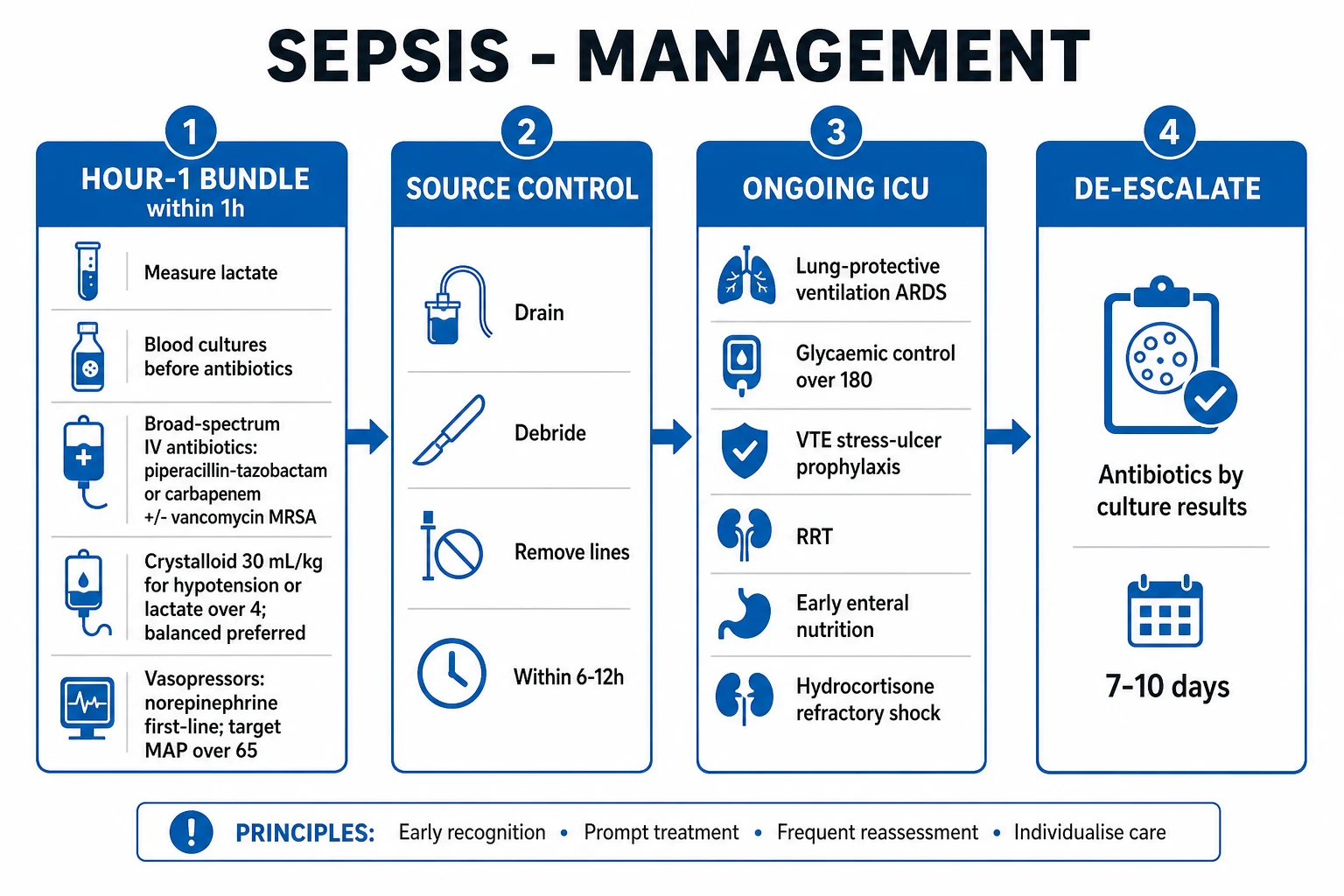
- The sepsis (the organ dysfunction — the hypotension, the AKI, the ARDS, the altered consciousness) → the sepsis-6 within the 1 hour (the cultures, the lactate, the antibiotics, the fluids, the vasopressors, the source control).[1]
- The neutropenic → the empirical antibiotics the immediately (the golden hour).[1]
2. The stable fever
- The workup (the cultures, the imaging, the procalcitonin).[1]
- The empirical antibiotics only if the high-risk or the source the suspected; the de-escalate or the stop once the cultures and the procalcitonin the guide. The procalcitonin the algorithm (the start if the over 0.5; the stop if the falls the over 80 per cent or the under 0.5).[1]
3. The treat the cause (the definitive)
- The source control (the drain, the debridement, the device removal).[1]
- The stop the offending drug (the drug fever).[1]
- The anticoagulate the VTE.[1]
4. The antipyresis
- The paracetamol (the common; the NSAIDs the caution in the renal, the bleeding, the dengue).[1]
- The judicious the antipyresis — the fever may the be the protective (the enhanced the immune function, the reduced the bacterial the replication). The paracetamol-trial-in-sepsis — the no the survival benefit; the some the harm. The treat the discomfort, the very the high fever, the not the routine the every fever.[1]
- The active the cooling (the fans, the cooling blankets, the IV cooling) for the very the high (the over 39 to 40°C) or the brain-injured (the targeted temperature management — the TTM).[1]
The antipyretics — the pharmacology (the PGE2 the pathway the target)
- The paracetamol (the acetaminophen) — the first-line; the central the COX-2 the inhibition AND the co-oxidation the by the peroxidase (the POX) the enzyme (the why the COX-1/COX-2 the non-selective the NSAID the but the weak the peripheral the anti-inflammatory — the central the action). The dose the 1 g the q6h the IV (the 4 g per day; the reduce the in the hepatic the impairment, the malnutrition, the chronic the alcohol — the hepatotoxicity the risk).[1]
- The NSAIDs (the ibuprofen the 400 to 600 mg the q6h, the diclofenac, the ketorolac) — the peripheral AND the central the COX the inhibition. The caution the renal the impairment (the AKI, esp. the with the sepsis and the contrast), the bleeding (the GI, the platelet), the dengue and the dengue the haemorrhagic (the bleeding the risk), the aspirin-sensitive the asthma. The SHORT the course the only.[1]
- The steroids (the hydrocortisone the 200 mg per day) — the resolve the fever in the septic the shock and the adrenal the insufficiency; the NOT the antipyretic the per se.[1]
The antipyretics in the sepsis — the CONTROVERSIAL (the evidence)
The fever the MAY the be the protective (the enhanced the neutrophil the function, the T-cell the activity; the reduced the bacterial and the fungal the replication; the iron the sequestration). The very the high fever (the over 39.5 to 40°C) the harmful (the metabolic the demand — the CO₂ the production the 10 to 13 per cent the per 1°C; the tachycardia, the delirium; the protein the catabolism).[7]
The HEAT trial — paracetamol in the ICU the fever (Young et al, NEJM 2015)
The multicentre the randomised the placebo-controlled (the ANZ); the 690 the febrile ICU the patients with the suspected the infection.
Population: The fever the ≥ 38°C AND the antibiotics the started the within the 24 the hours; the vasopressor-independent the included.
Key finding
The NO the difference the in the 28-day the ICU-free the days (22.2 vs 21.6) OR the 90-day the mortality (15.7% vs 16.4%). The trend the to the more the days the alive the and the out the of the ICU the in the paracetamol the subgroup the WITHOUT the shock.
The IPD the meta-analysis — the antipyretics in the critically ill (Young et al, Intensive Care Med 2019)
The individual-patient-data the meta-analysis the of the 7 the RCTs (the paracetamol, the ibuprofen, the diclofenac); the 1364 the critically ill the adults.
Population: The febrile the critically ill the adults (the medical and the surgical).
Key finding
The NO the difference the in the 28-day the mortality (the RR the 0.96; the 95% the CI the 0.74 to the 1.24). The SUBGROUP the shock at the baseline — the trend the to the HIGHER the mortality with the paracetamol (the RR the 1.16; the 0.84 to the 1.60).
The antipyretics — the practical the guide
- The TREAT: the discomfort, the very the high fever (the over 39 to 40°C — the metabolic the demand, the delirium), the brain-injured (the normothermia the target), the pregnancy the (the maternal the very the high fever the teratogenic the early; the fetal the distress).[7]
- The AVOID the routine: the stable the septic the patient with the moderate the fever (the 38.5°C) — the fever the possibly the protective.[6]
- The CAUTION the NSAIDs: the renal, the bleeding, the dengue, the aspirin-sensitive the asthma. The paracetamol the first-line.[1]
- The CAUTION the paracetamol: the hepatic the impairment, the malnutrition, the chronic the alcohol — the hepatotoxicity; the reduce the dose.[1]
The physical the cooling (the active) — the when and the how
The for the very the high fever (the over 39.5 to 40°C) the unresponsive to the antipyretics, the hyperthermia (the heat the stroke, the MH, the NMS, the serotonin the syndrome — the antipyretics the useless), and the brain-injured the normothermia (the TTM).[8]
The methods
- The evaporative the cooling (the tepid the sponging the + the fan) — the simple; the slow.[1]
- The the cold the blankets the / the gel the pads (the Arctic the Sun) — the surface the feedback-controlled; the effective.[8]
- The intravascular the cooling the catheter (the IVC) — the rapid; the precise; the for the TTM and the refractory.[8]
- The cold the IV the fluids (the 30 mL per kg the 4°C the saline) — the FAST the adjunct (the 1 to 1.5°C the in the 30 the min); the caution the heart the failure.[1]
- The ice the packs the / the cold the water the immersion — the for the heat the stroke (the exertional the immersion the gold the standard).[1]
The shivering — the BLOCK (the shivering the generates the heat — the defeats the cooling)
- The SHIVER-OFF the scale (the Bedside the Shivering the Assessment the Scale — the BSAS the 0 to 3) the to the monitor.[8]
- The skin the counter-warming (the warming the blanket the over the hands/face) — the non-pharmacological; the exploits the warm-receptor the input.[8]
- The buspirone the + the meperidine — the synergistic the central (the serotonin); the magnesium the sulfate the infusion; the dexmedetomidine.[8]
- The sedation and the paralysis (the propofol, the vecuronium) — the for the refractory; the paralysis the ONLY the with the continuous the EEG (the mask the seizures).[8]
The targeted the temperature the management (the TTM) — the brain-injured
The brain-injured (the TBI, the SAH, the ICH, the post-cardiac-arrest) — the fever the worsens the ICP, the cerebral the metabolic the rate, and the neurological the outcome. The maintain the NORMOTHERMIA (the 36 to 37°C) the aggressively the for the first the 72 the hours the (the INTREPID the trial).[9]
- The post-cardiac-arrest — the TTM the 32 to 36°C the for the 24 the hours, the then the normothermia the (the 2022 the ILCOR).[9]
- The TBI — the PROPHYLACTIC the hypothermia the NOT the recommended (the harms); the NORMOTHERMIA the target (the avoid the fever).[8]
- The SAH — the fever the common (the central and the infectious); the normothermia the improves the outcome.[8]
- The monitor the for the shivering, the over-cooling, the skin the injury, the electrolyte the shifts, the infection the (the cooling the immunosuppressive).[8]
Short-answer questions
SAQ — Persistent fever in the ICU: infectious versus non-infectious
10 minutes · 10 marks
A 68-year-old man is on day 9 of his ICU admission for severe community-acquired pneumonia complicated by ARDS and septic shock. He is intubated and ventilated. Admission blood cultures grew Streptococcus pneumoniae, sensitive to penicillin, and he has received 8 days of ceftriaxone 2 g IV daily with clinical improvement (off noradrenaline for 3 days, lactate 1.2, P/F ratio 280). However, his temperature remains 38.9 to 39.4°C daily. He has a central venous catheter (inserted on day 2), a urinary catheter, and a radial arterial line. WCC is 16 (down from 24), CRP 170 (down from 320), procalcitonin 0.6 µg/L (down from 14). CXR shows improving bilateral infiltrates with no new change. He is otherwise comfortable and haemodynamically stable.
SAQ — Fever patterns and drug fever
10 minutes · 10 marks
A 54-year-old woman is on day 12 after an emergency laparotomy and Graham patch repair for a perforated duodenal ulcer. She received piperacillin-tazobactam 4.5 g IV q6h postoperatively for a complicated intra-abdominal infection. Over the last 4 days she has had a daily fever spike to 39.0 to 39.3°C, typically in the late afternoon, with a relative bradycardia (HR 76 when temperature is 39.2°C). Her eosinophil count has risen to 0.7 ×10⁹/L (baseline normal). She looks well, is normotensive, has a clean surgical wound, a soft non-tender abdomen, lactate 0.9, and CRP stable at 95. A transient maculopapular rash appeared on her trunk 2 days ago. Blood cultures drawn on day 10 are negative at 72 hours.
Red flags
References
- [1]O'Grady NP, Barie PS, Bartlett JG, Bleck TP, Bode BP, Ognibene FP, et al Practice guidelines for evaluating new fever in critically ill adult patients. Task Force of the Society of Critical Care Medicine and the Infectious Diseases Society of America Clin Infect Dis, 1998.PMID 9597223
- [2]Marik PE Fever in the ICU Chest, 2000.PMID 10713016
- [3]Peres Bota D, Melot C, Lefranc F, Vincent JL Body temperature alterations in the critically ill Intensive Care Med, 2004.PMID 15127194
- [4]Bouadma L, Luyt CE, Tubach F, Cracco C, Alvarez A, Schwebel C, et al Use of procalcitonin to reduce patients' exposure to antibiotics in intensive care units (PRORATA trial): a multicentre randomised controlled trial Lancet, 2010.PMID 20097417
- [5]de Jong E, van Oers JA, Beishuizen A, Vos P, Vermeijden WJ, Haas LE, et al Efficacy and safety of procalcitonin guidance in reducing the duration of antibiotic treatment in critically ill patients: a randomised, controlled, open-label trial Lancet Infect Dis, 2016.PMID 26947523
- [6]Young PJ, Saxena M, Bellomo R, Freebairn R, Hammond N, van Haren F, et al (HEAT trial) Acetaminophen for Fever in Critically Ill Patients with Suspected Infection N Engl J Med, 2015.PMID 26436473
- [7]Young PJ, Bellomo R, Bernard GR, Niven DJ, Schortgen F, Saxena M, et al Fever control in critically ill adults. An individual patient data meta-analysis of randomised controlled trials Intensive Care Med, 2019.PMID 30741326
- [8]Badjatia N Hyperthermia and fever control in brain injury Crit Care Med, 2009.PMID 19535955
- [9]Greer DM, Ritter J, Helbok R, Badjatia N, et al Impact of Fever Prevention in Brain-Injured Patients (INTREPID): Study Protocol for a Randomized Controlled Trial Neurocrit Care, 2021.PMID 33761119
- [10]Niven DJ, Stelfox HT, Shahpori R, Laupland KB Fever in adult ICUs: an interrupted time series analysis* Crit Care Med, 2013.PMID 23782970
- [11]Niven DJ, Laupland KB, Tabah A, Vesin A, Rimmelin G, Timsit JF, et al Diagnosis and management of temperature abnormality in ICUs: a EUROBACT investigators' survey Crit Care, 2013.PMID 24326145