ICU · Infection / pharmacology
Macrolides, Tetracyclines & Oxazolidinones — Atypicals, MRSA & VRE
Also known as Macrolide · Azithromycin · Clarithromycin · Erythromycin · Tetracycline · Doxycycline · Tigecycline · Oxazolidinone · Linezolid · Tedizolid · VRE · Serotonin syndrome · QT prolongation
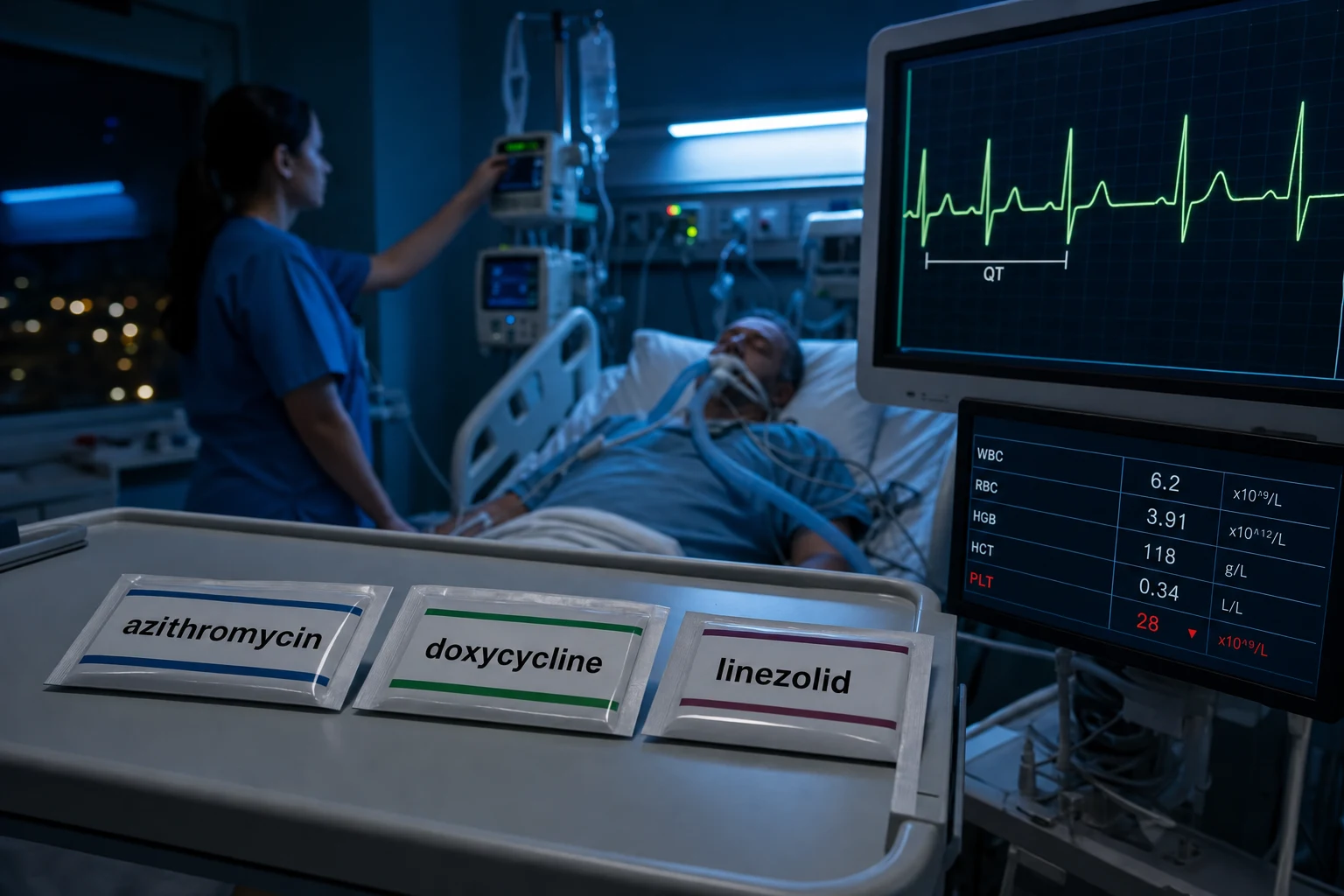
The macrolides (the azithromycin, the clarithromycin, the erythromycin) bind the 50S ribosome, the bacteriostatic, the cover the atypicals (the Legionella, the Mycoplasma, the Chlamydia) and the community respiratory; the QT prolongation (the clarithro), the CYP inhibition (the drug interactions), and the erythromycin the prokinetic. The tetracyclines (the doxycycline, the tigecycline) bind the 30S ribosome; the atypicals (the chlamydia, the rickettsia, the Lyme), the doxycycline for the MRSA skin, the tigecycline the broad (the MRSA, the VRE, the ESBL, the anaerobes — the NO pseudomonas, the mortality warning); the avoid the pregnancy and the under-8 (the teeth and the bone). The oxazolidinones (the linezolid, the tedizolid) bind the 50S; the Gram-positive incl the MRSA and the VRE (the key VRE cover); the thrombocytopenia (the over 2 weeks), the SEROTONIN SYNDROME (the MAO inhibitor — the avoid the SSRIs), the neuropathy, the lactic acidosis; the no renal adjustment.
On this page & tools
Your progress
Saved locally on this device.
8 MCQs with explanations
Target exams
Overview & definition
The macrolides, the tetracyclines, and the oxazolidinones are the protein-synthesis inhibitors (the ribosomal binders) with the distinct spectra and the distinct toxicities. The macrolides (the 50S) cover the atypicals and the community respiratory; the tetracyclines (the 30S) cover the atypicals, the zoonotic, and the MRSA skin (the doxycycline), with the tigecycline the broad reserve; the oxazolidinones (the 50S) cover the MRSA and the VRE with the unique serotonin-syndrome risk (the MAO inhibitor).[1]
The macrolides (azithromycin, clarithromycin, erythromycin)
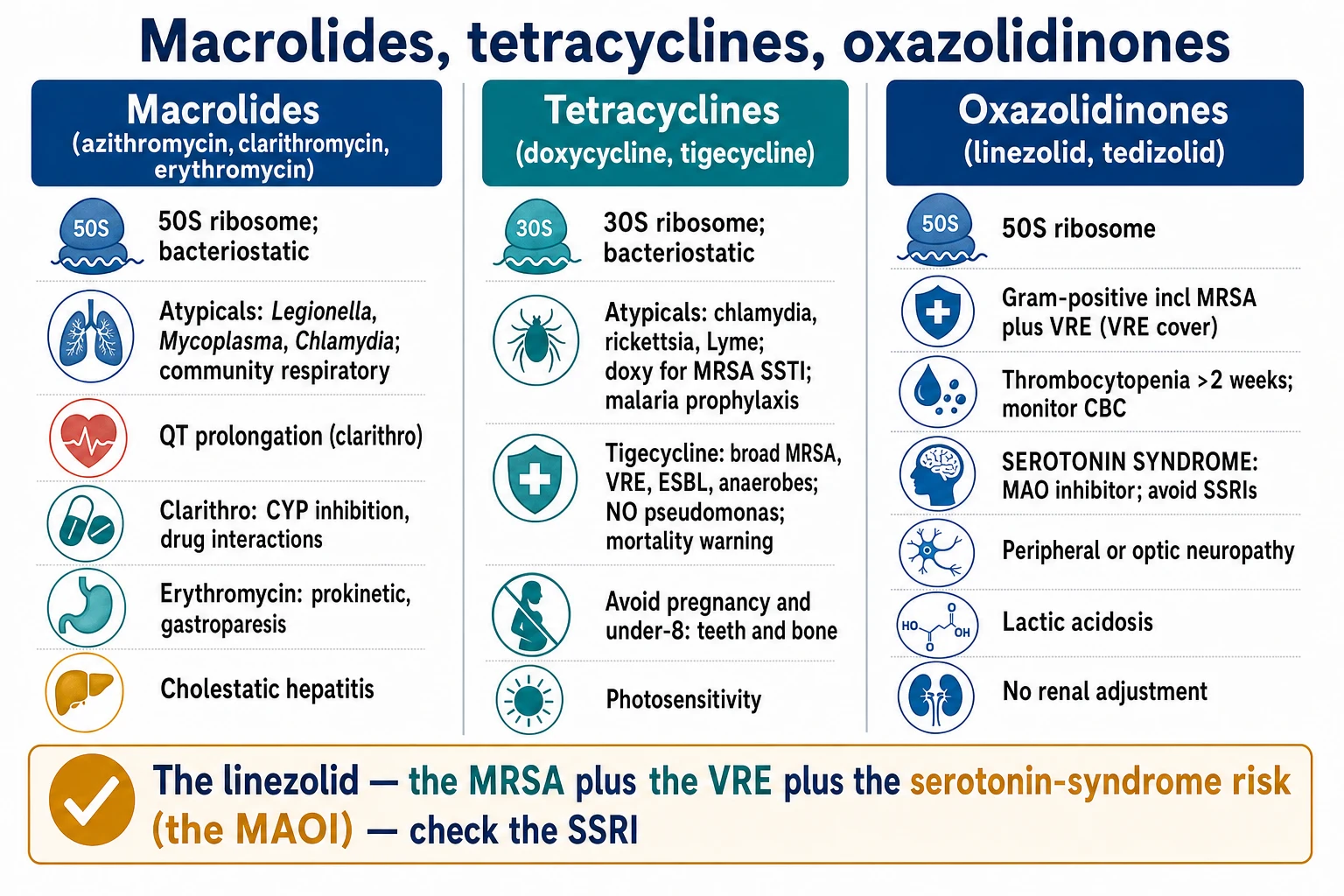
- The mechanism — the bind the 50S ribosomal subunit → the inhibit the protein synthesis (the bacteriostatic).[1]
- The spectrum — the atypicals (the Legionella, the Mycoplasma, the Chlamydia, the Bordetella pertussis), the community respiratory (the strep pneumo, the H. flu, the Moraxella), the chlamydia, the Mycobacterium avium (the azithromycin, the clarithromycin).[1]
- The adverse:[1]
- The QT prolongation (the clarithromycin the more than the azithromycin) — the torsades risk, the caution with the other QT drugs.[1]
- The cholestatic hepatitis (the erythromycin, the estolate).[1]
- The GI (the nausea, the cramping) — the erythromycin is the prokinetic (the motilin agonist, the for the gastroparesis).[1]
- The CYP3A4 inhibition (the clarithromycin, the erythromycin — the strong; the azithromycin the minimal) → the drug interactions (the statins, the warfarin, the tacrolimus, the digoxin, the clopidogrel).[1]
- The ototoxicity (the high dose).[1]
The tetracyclines (doxycycline, tigecycline, minocycline)
- The mechanism — the bind the 30S ribosomal subunit → the inhibit the protein synthesis (the bacteriostatic).[1]
- The spectrum — the atypicals (the Chlamydia, the Mycoplasma, the Rickettsia, the Q fever, the Lyme — the borrelia), the Vibrio cholerae, the MRSA (the doxycycline for the skin and the soft-tissue), the malaria prophylaxis (the doxycycline), the acne.[1]
- The tigecycline — the broad (the MRSA, the VRE, the ESBL, the anaerobes) — the reserve; the NO pseudomonas and the NO proteus (the in vitro gap); the increased-mortality warning (the for the severe, the use the alternative).[1]
- The adverse — the photosensitivity, the teeth discoloration and the bone (the avoid the pregnancy and the under-8), the oesophagitis (the take with the water, the upright), the hepatotoxicity, the benign intracranial hypertension (the minocycline), the drug-induced lupus (the minocycline).[1]
The oxazolidinones (linezolid, tedizolid)
- The mechanism — the bind the 50S ribosomal subunit (the 23S rRNA) → the inhibit the protein synthesis (the bacteriostatic, the bactericidal for the some).[1]
- The spectrum — the Gram-positive incl the MRSA, the VRE (the key — the VRE cover), the penicillin-resistant strep; the NO Gram-negative.[1]
- The adverse:[1]
- The myelosuppression (the thrombocytopenia, the pancytopenia) — the monitor the CBC, the especially the over the 2 weeks.[1]
- The serotonin syndrome — the linezolid is the reversible MAO inhibitor → the avoid the SSRIs, the SNRIs, the tramadol, the pethidine, the serotonergic drugs (the tyramine). The ICU-relevant — the patient on the SSRI + the linezolid for the VRE → the serotonin syndrome.[1]
- The peripheral and the optic neuropathy (the long-term, the over the 28 days) — the monitor the vision.[1]
- The lactic acidosis (the mitochondrial toxicity).[1]
- The no renal adjustment (the linezolid). The oral bioavailability the 100 per cent (the IV = the oral).[1]
Red flags
The macrolides — the deeper ICU dive (the mechanism, the PK/PD, the dosing)
The macrolides are the large lactone ring antibiotics (the 14-membered the erythromycin and the clarithromycin; the 15-membered the azithromycin — hence the 'az-alide'; the 16-membered the spiramycin). The bind the 50S ribosomal subunit at the 23S rRNA of the peptidyl-transferase centre, the tunnel the nascent peptide exits through → the block the translocation → the inhibit the protein synthesis (the bacteriOSTATIC; the bacteriCIDAL only at the high concentrations for the some).[1]
- The PK/PD driver — the concentration-time / the fAUC/MIC (the concentration-dependent AND the time-dependent — the azithromycin the AUC/MIC; the clarithromycin the AUC/MIC; the erythromycin the T>MIC). The long half-lives (the azithromycin the 68 h tissue; the clarithromycin the 5–7 h; the erythromycin the 1.5 h) — the azithromycin the once-daily, the erythromycin the q6h (the impractical — the why the rarely used the ICU).
- The tissue concentrations the exceed the serum (the azithromycin the 100-fold the in the macrophages and the neutrophils, the in the epithelial lining fluid) — the why the macrolide the excellent for the intracellular (the Legionella, the Chlamydia, the Mycoplasma) and the lung.[1]
- The azithromycin dosing — the 500 mg day 1 then 250 mg days 2–5 (the community respiratory) OR the 500 mg daily × 3 days (the z-pack); the IV the 500 mg daily. The half-life the 68 h → the persistent effect after the short course. The NO renal adjustment until the CrCl <10 (the azithromycin the biliary the excretion, NOT the renal — the why the preferred in the renal failure).
- The clarithromycin dosing — the 500 mg PO q12h (the 250 mg q12h for the mild); the renal adjustment the CrCl <30 (the half the dose OR the double the interval). The CYP3A4 the strong — the review the medication list. The NOT the preferred in the ICU (the interactions and the QT).
- The erythromycin dosing — the 500 mg PO q6h (or the 0.5–1 g IV q6h, the painful — the thrombophlebitis). The PROKINETIC dose the 125–250 mg PO/NG q6h or the 100 mg IV q8h (the motilin-agonist for the gastroparesis). The estolate the cholestatic hepatitis (the avoid).
Azithromycin vs clarithromycin vs erythromycin — the three macrolides at a glance
| Feature | Azithromycin (the 15-mem 'az-alide') | Clarithromycin (the 14-mem) | Erythromycin (the 14-mem, the original) |
|---|---|---|---|
| CYP3A4 inhibition | Minimal (the preferred) | Strong (the drug-interaction minefield) | Strong |
| QT prolongation | Low–moderate (the Ray 2012 signal the high-dose 5d)[5] | Highest (the torsades, the CLARICOR)[6] | Moderate |
| Half-life | ~68 h (the tissue) | ~5–7 h | ~1.5 h (the q6h) |
| Renal handling | Biliary (the no renal adjustment) | Renal (the adjust CrCl <30) | Renal (the adjust) |
| Atypicals | Excellent (the Legionella, the MAC) | Excellent (the MAC, the Mycoplasma) | Good (the less the Legionella) |
| GI intolerance | Low | Low–moderate | High (the nausea, the cramping) |
| Prokinetic | No | No | Yes (the motilin agonist, the gastroparesis) |
| ICU role | The preferred macrolide (the CAP, the atypicals) | The limited (the interactions, the QT) | The prokinetic for the gastroparesis (the rarely the antibiotic) |
The macrolide spectrum and the 'atypical' cover — the ICU-centre
The macrolides earn the ICU place for the atypical cover (the Legionella, the Mycoplasma pneumoniae, the Chlamydia pneumoniae, the Chlamydophila psittaci, the Coxiella burnetii — the Q fever, the Bordetella pertussis) and the community respiratory (the Streptococcus pneumoniae — though the resistance the rising, the Mycoplasma the macrolide-resistance in the Asia >70 per cent, the Chlamydia). The Legionella the macrolide the CLASSIC — the azithromycin the preferred for the severe Legionella pneumonia, the fluoroquinolone the alternative.[1]
- The severe community-acquired pneumonia (the CAP) — the ATS/IDSA the β-lactam (the amoxicillin-clavulanate OR the ceftriaxone) PLUS the macrolide (the azithromycin) OR the respiratory fluoroquinolone (the moxifloxacin) for the monotherapy. The ICU severe CAP — the β-lactam PLUS the macrolide (the azithromycin) OR the β-lactam PLUS the respiratory fluoroquinolone. The macrolide is the atypical cover; the do NOT omit it for the severe CAP.[1]
- The Legionella — the azithromycin the (the 500 mg IV daily) OR the fluoroquinolone (the levofloxacin, the moxifloxacin). The rifampicin the add-on for the severe (the severe pneumonia, the immunocompromised). The urinary antigen the detects only the L. pneumophila serogroup 1 (the most the community).
- The Mycobacterium avium complex (the MAC) — the azithromycin + the ethambutol ± the rifampicin (the prophylaxis the CD4 <50; the treatment the 3-drug). The clarithromycin the alternative.
- The pertussis — the azithromycin the (the 5-day; the prophylaxis the household). The NOT the fluoroquinolone for the pertussis.
- The chlamydia (the trachomatis) — the azithromycin the 1 g single dose. The doxycycline the 7-day the alternative.
The macrolide QT prolongation and the cardiovascular mortality signal
The macrolides block the HERG-channel / the rapid delayed-rectifier potassium current (the IKr) → the QT prolongation → the torsades-de-pointes risk. The clarithromycin the strongest, the erythromycin the next, the azithromycin the weakest — but the azithromycin NOT the zero.[5]
- The Ray 2012 NEJM study (the Tennessee Medicaid cohort, the 347795 azithromycin prescriptions) — the 5-day azithromycin course associated with the small but the significant increased cardiovascular death (the HR 2.88, 95% CI 1.79–4.63 vs the no antibiotic; the HR 1.85 vs the amoxicillin) — the risk the highest in the decile the highest baseline cardiovascular risk (the absolute the additional 245 deaths per 1 million 5-day courses in the highest-risk decile). The mechanism the torsades. The clinical — the azithromycin still the safe for the most, but the caution in the QT-long, the electrolyte-low, the high-cardiovascular-risk, the on the other QT-drug.[5]
- The CLARICOR trial (the Jespersen 2006 BMJ, the 4372 patients the stable coronary disease the randomised the clarithromycin vs placebo for the 2 weeks) — the clarithromycin associated with the increased all-cause mortality (the HR 1.72, 95% CI 1.15–2.55) — the 15% vs 9.8% — the significant and the unexpected; the mechanism the uncertain (the QT the torsades, the cytochrome the drug-interaction). The clinical — the AVOID the clarithromycin in the stable coronary disease; the caution in the elderly and the high-cardiovascular-risk.[6]
- The QT-drug interactions — the amiodarone, the sotalol, the class IA and the class III antiarrhythmics, the haloperidol, the droperidol, the methadone, the fluoroquinolones (the moxifloxacin, the ciprofloxacin), the ondansetron, the antipsychotics (the chlorpromazine, the clozapine, the olanzapine), the azole antifungals. The check the ECG and the electrolytes (the K+, the Mg2+, the Ca2+) before the macrolide in the ICU.
The macrolide in the suspected atypical / the severe CAP — the empiric ICU pathway
- The recognise the atypical clue — the Legionella (the hyponatraemia, the diarrhoea, the confusion, the high fever, the hepatitis, the patchy infiltrate), the Mycoplasma (the young, the dry cough, the extrapulmonary the erythema multiforme), the psittacosis (the bird exposure), the Q fever (the farming, the parturient animals, the hepatitis + the atypical pneumonia). The urinary Legionella antigen (the L. pneumophila the sg1 only).[1]
- The empiric regimen for the severe ICU CAP — the β-lactam (the ceftriaxone 2 g IV daily OR the amoxicillin-clavulanate 1.2 g IV q8h) PLUS the macrolide the azithromycin 500 mg IV daily; the alternative the respiratory fluoroquinolone (the moxifloxacin 400 mg IV daily) for the monotherapy if the penicillin-allergic.[1]
- The check the QT before the macrolide — the ECG; if the QTc >500 ms OR the on the amiodarone/methadone/fluoroquinolone, the consider the doxycycline (the atypical cover, the NO QT) instead of the macrolide.
- The review the medication list for the CYP3A4 interaction — if the patient the on the statin (the simvastatin, the atorvastatin), the tacrolimus, the warfarin, the digoxin, the clopidogrel, the hold or the dose-reduce the interacting drug for the macrolide course (the clarithromycin > the erythromycin > the azithromycin).
- The de-escalate at the 48–72 h — the stop the macrolide if the atypical NOT confirmed (the Legionella antigen the negative, the PCR the negative) and the patient the improving on the β-lactam alone for the typical pneumonia. The continue the 5–7 day (the Legionella the longer, the 7–14 day; the azithromycin the 5–10; the fluoroquinolone the 7–14).
- The monitor for the diarrhoea and the QT — if the new diarrhoea, the C. difficile (the macrolide the risk); if the palpitations or the syncope, the ECG for the torsades.
The tetracyclines — the deeper ICU dive (the mechanism, the PK/PD, the doxycycline vs the tigecycline)
The tetracyclines are the four-ring polyketide antibiotics. The bind the 30S ribosomal subunit at the A-site, the block the amino-acyl tRNA the entry → the inhibit the protein synthesis (the bacteriOSTATIC). The reversibly bind — hence the bacteriostatic, the NOT the combination with the cell-wall agent (the antagonism the theoretical, the in vivo the modest).[1]
- The doxycycline and the minocycline — the longer half-life (the 18–22 h) → the once- OR the twice-daily. The doxycycline the excellent the oral bioavailability (the 95 per cent) — the IV = the oral. The biliary the excretion → the NO renal adjustment (the doxycycline the preferred in the renal failure — the NOT the tetracycline the original, the uremic the worsening).
- The spectrum — the atypicals (the Chlamydia trachomatis, the Mycoplasma, the Rickettsia — the Rocky-Mountain-spotted-fever, the typhus; the Coxiella the Q-fever; the Borrelia the Lyme; the Leptospira; the Ehrlichia, the Anaplasma), the Vibrio cholerae and the Vibrio vulnificus, the MRSA (the community the skin-and-soft-tissue — the doxycycline for the SSTI the oral step-down), the malaria prophylaxis (the mefloquine the alternative), the acne, the rosacea, the spirochaetes (the syphilis the alternative in the penicillin-allergic), the leptospirosis.
- The doxycycline for the MRSA SSTI — the community-MRSA (the USA300) the susceptible; the 100 mg PO q12h × 7–14 days. The cheaper than the linezolid; the NOT the bacteraemia or the pneumonia (the tissue the adequate; the serum the lower; the bacteriostatic).
- The tigecycline — the glycylcycline (the minocycline the derivative, the bulky the glycyl side-chain) → the bypasses the ribosomal-protection (the tetM/tetO) and the efflux (the tetA–tetK) resistance → the broad spectrum: the MRSA, the MRSE, the VRE (the Enterococcus faecium and the faecalis), the ESBL-producing Enterobacteriaceae, the anaerobes (the Bacteroides, the Clostridium), the atypicals, the Acinetobacter. The NO Pseudomonas aeruginosa, the NO Proteus, the NO Morganella, the NO Providencia (the intrinsic the efflux) — the critical the exam point and the clinical the gap. The high tissue the penetration (the low the serum) → the poor for the bacteraemia.[3][4]
- The tigecycline dosing — the 100 mg loading then the 50 mg IV q12h (the 30-min infusion). The NO renal adjustment. The hepatic the adjust (the Child-Pugh C the 25 mg q12h). The NOT the oral.
Doxycycline vs tigecycline — the two ICU tetracyclines
| Feature | Doxycycline (the workhorse) | Tigecycline (the broad reserve) |
|---|---|---|
| Spectrum | Atypicals, MRSA SSTI, Lyme, Rickettsia, Vibrio, malaria prophylaxis | MRSA, VRE, ESBL, anaerobes, Acinetobacter — the broad |
| Pseudomonas / Proteus | No | No (the in vitro gap — the add the cover) |
| Route | PO (95% bioavailability) or IV | IV only |
| Renal adjustment | None (the biliary) | None |
| Mortality warning | No | Yes — the FDA (the 2010/2013 black-box-equivalent)[3][4] |
| ICU niche | MRSA SSTI step-down, atypical pneumonia (the Q-fever, the rickettsia, the Lyme), malaria prophylaxis | The MDR intra-abdominal, the MDR SSTI, the reserve where the no alternative |
| Bacteraemia | Not the first-line | Avoid (the low serum, the high tissue, the mortality signal) |
| Pregnancy / under-8 | Avoid (the teeth, the bone) | Avoid (same class) |
The tigecycline FDA increased-mortality warning — the data the ICU must know
In the 2010 the FDA the issued the boxed warning (the strengthened the 2013) for the tigecycline — the pooled analysis of the 13 phase-3/4 trials found the increased all-cause mortality (the 4.0% the tigecycline vs the 3.0% the comparator; the adjusted OR 1.54, 95% CI 1.06–2.23). The risk the highest in the nosocomial pneumonia (the HAP/VAP — the 16.6% the tigecycline vs the 13.3% the comparator; NOT licensed for the HAP/VAP) and the ventilator-associated pneumonia, the diabetic-foot-infection (the failed), and the severe the complicated SSTI.[3][4]
- The 2011 Tasina meta-analysis (the Lancet Infect Dis, the 15 trials, the 7654 patients) confirmed — the all-cause mortality the significantly higher (the OR 1.46, 95% CI 1.09–1.95; the RD 0.6%, the NNH ~167). The mortality signal the consistent across the indications; the no the single cause (the not the sepsis, the not the failure — the uncertain the mechanism).[3]
- The 2012 Cai/Prasad meta-analysis (the Clin Infect Dis, the post-approval) — the excess deaths the tigecycline (the OR 1.47, 95% CI 1.12–1.93), the reinforcing the FDA warning; the signal the in the non-inferiority-trial the approved-on.[4]
- The Yahav 2011 systematic review (the J Antimicrob Chemother) — the same the signal (the OR 1.39, 95% CI 1.02–1.88).[9]
- The clinical the bottom-line — the tigecycline the reserve for the MDR where the NO alternative; the NOT the empiric; the NOT the monotherapy for the bacteraemia, the HAP/VAP, the severe sepsis; the add the anti-pseudomonal if the Pseudomonas the risk; the the mortality signal the worth the explicit the documented the justification.[3][4]
Tasina 2011 (Lancet Infect Dis) — meta-analysis of all-cause mortality with tigecycline
Design
Systematic review and meta-analysis of 15 randomised controlled trials, 7654 patients
Comparison
Tigecycline vs comparator antibiotics (imipenem-cilastatin, vancomycin + aztreonam, linezolid, etc.)
Primary result
All-cause mortality significantly higher with tigecycline: OR 1.46 (95% CI 1.09–1.95); risk difference +0.6%
Cure rate
Lower cure with tigecycline: OR 0.84 (95% CI 0.70–0.99) for the modified-clinical cure
Cause of excess deaths
Unclear — no single cause; not clearly treatment failure or sepsis
Clinical bottom line
Consistent mortality signal across indications. Reserve tigecycline for MDR infection where no alternative; never first-line empiric, never monotherapy for bacteraemia/HAP-VAP/severe sepsis.
The oxazolidinones — the deeper ICU dive (the mechanism, the PK/PD, the linezolid)
The oxazolidinones are the synthetic class (the NOT the natural product). The bind the 50S ribosomal subunit at the 23S rRNA (the P-site, the domain V) → the inhibit the formation of the 70S initiation complex → the inhibit the protein synthesis (the EARLY stage — the unique; the NOT the same as the macrolide the 50S). The bacteriOSTATIC (the bacteriCIDAL for the some — the Bacteroides fragilis, the Clostridium perfringens). The no the cross-resistance with the other the protein-synthesis the inhibitors.[1][2]
- The linezolid PK/PD — the 100 per cent the oral bioavailability (the IV = the oral — the step-down the seamless), the volume the distribution the 40–50 L (the total the body water — the excellent the tissue the penetration: the lung, the skin, the CSF ~30–70% the serum, the bone), the half-life the 5 h, the non-renal the metabolism (~50% — the inactive the metabolites), the renal the excretion (~35% the unchanged). The NO the renal the adjustment (the even the dialysis). The PK/PD the driver — the fAUC/MIC 80–120 (the concentration- AND the time-dependent).[2]
- The linezolid dosing — the 600 mg IV/PO q12h (the NO the renal adjustment; the NO the hepatic). The paediatric the 10 mg/kg q8h.
- The spectrum — the Gram-positive: the MRSA, the MRSE, the VRE (the Enterococcus faecium — the E. faecalis the variable), the penicillin-resistant Streptococcus pneumoniae, the viridans strep, the group A and B strep, the Corynebacterium jeikeium, the Nocardia (the alternative), the Mycobacterium abscessus (the oral the adjunct). The NO the Gram-negative (the not the atypicals, the not the Pseudomonas). The excellent the CSF (the meningitis the VRE/MRSA).[2]
- The tedizolid — the second-generation (the 200 mg IV/PO daily × 6 days for the SSTI; the once-daily; the fewer the mitochondrial the off-target — the in theory the less the myelosuppression and the neuropathy; the ESTABLISH-1/2 the non-inferior for the SSTI). The narrower the FDA license (the SSTI only); the less the real-world the ICU the experience than the linezolid.[7][8]
Linezolid vs vancomycin for the MRSA pneumonia — why the ZEPHyR shifted the practice
| Feature | Linezolid | Vancomycin |
|---|---|---|
| Mechanism | 50S protein synthesis (bacteriostatic) | D-Ala-D-Ala cell-wall (bactericidal for Staph) |
| Lung penetration | Excellent (epithelial lining fluid ~10× serum) | Modest (ELF ~5× serum but variable) |
| CSF penetration | Excellent (~30–70% — for CNS) | Poor (~1–5%) |
| Route | IV = oral (100% bioavailability) | IV only (oral for CDI) |
| Nephrotoxicity | None | Yes (AKI, esp + piperacillin-tazobactam) |
| Thrombocytopenia | Yes (>14 days) | Rare |
| Serotonin syndrome | Yes (MAO-A) | No |
| ZEPHyR result | Higher clinical cure (57.6% vs 46.6%); trend to lower mortality[1] | Lower cure |
| Guideline position | Preferred or first-line option for MRSA HAP/VAP[2] | Alternative; AUC-guided if used |
Wunderink 2012 ZEPHyR (Clin Infect Dis) — Linezolid vs vancomycin for MRSA nosocomial pneumonia
Design
Randomised, double-blind, controlled trial (ZEPHyR); 1225 patients randomised, 448 with confirmed MRSA pneumonia (the primary analysis)
Population
Adults with suspected MRSA nosocomial pneumonia (HAP/VAP)
Comparison
Linezolid 600 mg q12h IV vs vancomycin 15 mg/kg q12h IV (with adjustment), for 7–14 days
Primary result
In the confirmed-MRSA cohort: linezolid **significantly higher clinical cure** at end-of-study (57.6% vs 46.6%; odds ratio 1.58, 95% CI 1.02–2.45; p=0.042)
Mortality
Numerically lower 28-day all-cause mortality with linezolid (15.2% vs 18.6%); not statistically powered for mortality
Renal safety
Significantly lower incidence of treatment-emergent renal dysfunction with linezolid (5.4% vs 11.9%; p=0.009)
Limitations
Open-label antibiotic pre-treatment common; vancomycin dosing fixed (not AUC-guided); underpowered for mortality
Clinical bottom line
Linezolid superior to vancomycin for clinical cure in confirmed MRSA nosocomial pneumonia, with less nephrotoxicity. Together with IDSA guidance, linezolid is a preferred agent for MRSA HAP/VAP.
The linezolid duration — the 14-day limit, the thrombocytopenia, the neuropathy
The linezolid the the duration-dependent toxicities — the longer the course, the higher the risk. The IDSA the recommend the shortest the effective course; the monitor the CBC the weekly the (the more the often the if the prolonged or the baseline-low).[2]
- The thrombocytopenia (the 14-day inflection) — the incidence the rises the sharply the after the 14 days (the ~10–20% the over the 2 weeks; the ~30–50% the over the 4 weeks). The mechanism the bone-marrow suppression (the megakaryocyte the maturation the arrest). The risk the higher in the baseline-low the platelet, the renal-failure, the concomitant the immunosuppressant. The monitor the CBC the weekly; the check the platelets every the 3–4 days the if the >14 days. The switch to the daptomycin (the VRE) or the vancomycin (the MRSA) if the platelets the <50 OR the falling the trend.
- The peripheral and the optic neuropathy (the 28-day inflection) — the axonal the peripheral neuropathy (the numbness, the paraesthesia the distal) and the optic neuropathy (the visual the loss, the colour the vision, the disc the swelling — the papillopathy) — the rare the over the 28 days, the higher the over the 6 weeks. The mechanism the mitochondrial the toxicity (the linezolid the inhibits the mitochondrial the 16S rRNA the protein synthesis — the off-target). The often the reversible on the cessation (the NOT the always; the optic the may the persist). The monitor the vision; the refer the ophthalmology the if the >28 days.
- The lactic acidosis — the acute the (the first the days) OR the late the (the after the weeks); the mechanism the mitochondrial. The suspect the unexplained the lactate the rising on the linezolid → the stop; the switch. The ICU the high-index the suspicion (the sepsis the confounds).
- The serotonin syndrome — see the dedicated the section the below. [1]
The linezolid duration and monitoring algorithm in ICU
- The start the 600 mg IV/PO q12h. Confirm the organism (the MRSA or the VRE); the plan the shortest the effective the duration (the SSTI the 7–14 d; the pneumonia the 7–14 d; the VRE bacteraemia the individualise — the linezolid is the bacteriostatic, the NOT the preferred for the bacteraemia if the daptomycin the option).[2]
- The baseline the CBC — the platelets, the haemoglobin, the WCC. The baseline the ECG. The baseline the lactate. The screen the medication list for the SSRIs, the SNRIs, the tramadol, the pethidine (the serotonin), the MAOIs (the linezolid the MAO-A).
- The weekly the CBC (the every 3–4 days the if the >14 days OR the baseline-low OR the renal-failure). If the platelets the <100 OR the falling >25 per cent the trend → the plan the switch. If the platelets the <50 OR the bleeding → the stop the linezolid; the switch the daptomycin (the VRE) or the vancomycin (the MRSA).
- The 14-day the review. If the >14 days the required (the deep-seated — the osteomyelitis, the endocarditis the VRE), the document the explicit the reason; the intensify the CBC the monitoring; the consider the switch the daptomycin (the VRE) or the ceftaroline (the MRSA — the bactericidal) if the prolonged the course the anticipated.
- The 28-day the review. If the >28 days the (the rare the ICU the — the osteomyelitis the VRE), the screen for the peripheral the neuropathy (the symptom) and the optic the neuropathy (the visual the acuity, the colour, the fields); the refer the ophthalmology; the weigh the switch to the tedizolid (the less the mitochondrial the off-target — the theoretical) or the alternative.
- The lactate the check. If the unexplained the rising the lactate on the linezolid → the stop; the switch; the supportive (the fluids, the bicarbonate the if the severe).
The linezolid serotonin syndrome — the MAO-A inhibition (the ICU the SSRI patient)
The linezolid is the reversible, the non-selective the monoamine oxidase inhibitor (the MAO-A the strong, the MAO-B the weaker). The MAO-A the metabolises the serotonin and the noradrenaline → the linezolid the raises the synaptic the serotonin → the serotonin syndrome with the serotonergic the drugs.[2]
- The high-risk the drugs — the SSRIs (the sertraline, the fluoxetine, the citalopram, the escitalopram, the paroxetine, the fluvoxamine), the SNRIs (the venlafaxine, the duloxetine, the desvenlafaxine), the tricyclics (the clomipramine, the imipramine), the tramadol, the pethidine (the meperidine), the methadone, the MAOIs (the phenelzine, the tranylcypromine, the moclobemide, the selegiline, the rasagiline, the methylene blue), the 5-HT3 the antagonists (the ondansetron), the triptans, the cough the linctus (the dextromethorphan), the tyramine-rich the foods (the aged the cheese, the cured the meat, the fermented the soy, the red wine).[2]
- The risk the magnitude — the linezolid + the SSRI the serotonin syndrome the incidence the ~0.05–1.3 per cent (the retrospective); the higher the if the multiple the serotonergic. The fluoxetine the longer the half-life (the active the metabolite the norfluoxetine the 1–2 weeks) — the washout the impractical.
- The clinical the picture — the classic the triad: the neuromuscular (the hyperreflexia, the clonus — the lower-limb the worse, the rigidity — the lead-pipe; the babinski), the autonomic (the hyperthermia, the tachycardia, the hypertension, the diaphoresis, the mydriasis, the diarrhoea), the mental-status (the agitation, the confusion, the delirium, the coma). The onset the hours the after (the rapid). The clonus the (the inducible OR the spontaneous) the pathognomonic. The differentiate from the NMS (the slower, the lead-pipe the rigidity, the lower the creatine the kinase, the NOT the clonus) and the malignant the hyperthermia (the post-the-succinylcholine OR the volatile).
- The management — (1) the stop the linezolid AND the serotonergic the drug. (2) the supportive — the benzodiazepine (the diazepam, the lorazepam) for the agitation and the rigidity; the cooling; the fluids; the beta-block the (the esmolol) for the tachycardia/hypertension. (3) the cyproheptadine (the 5-HT2A the antagonist — the 12 mg PO/NG, the then the 2 mg q2h the up the 32 mg/day) for the moderate–severe. (4) the avoid the antipyretics (the not the infective) and the dopamine the antagonists (the metoclopramide — the worsen). (5) the switch the antibiotic — the daptomycin (the VRE), the vancomycin (the MRSA). The not the restart the SSRI until the 2 weeks the after the linezolid the cessation.
Linezolid vs tedizolid — the two oxazolidinones
| Feature | Linezolid | Tedizolid phosphate |
|---|---|---|
| Generation | First | Second |
| Dose | 600 mg IV/PO q12h | 200 mg IV/PO once daily |
| Course (SSTI) | 10 days | 6 days (shorter) |
| Bioavailability | ~100% | ~90–95% |
| Spectrum | MRSA, VRE, Gram-positive | MRSA, VRE (the E. faecium — the E. faecalis the variable) |
| FDA license | SSTI, pneumonia (HAP/VAP), VRE | SSTI only (the ABSSSI) |
| MAO-A inhibition | Yes (the serotonin syndrome) | Weaker (the in vitro — the fewer the clinical the SS reports; the NOT the risk-free) |
| Myelosuppression | Yes (>14 d) | Theoretically less (the shorter the course, the lower the mitochondrial the off-target) |
| Trial | ZEPHyR (the HAP/VAP)[1] | ESTABLISH-1/2 (the SSTI)[7][8] |
| ICU role | The first-line the MRSA HAP/VAP; the VRE | The step-down the SSTI; the limited the ICU the experience |
ESTABLISH-1 (Prokocimer 2013, JAMA) and ESTABLISH-2 (Moran 2014, Lancet Infect Dis) — Tedizolid vs linezolid for ABSSSI
Design (ESTABLISH-1)
Randomised double-blind phase 3 non-inferiority trial; 667 adults with acute bacterial skin and skin-structure infection (ABSSSI)
Design (ESTABLISH-2)
Randomised double-blind phase 3 non-inferiority trial; 666 adults with ABSSSI; 6-day tedizolid vs 10-day linezolid
Comparison
Tedizolid phosphate 200 mg IV/PO once daily × 6 days vs linezolid 600 mg IV/PO q12h × 10 days
Primary result (ESTABLISH-1)
Early clinical response at 48–72 h: tedizolid 79.5% non-inferior to linezolid 79.4% (treatment difference 0.6%, 95% CI -5.1 to 6.3)
Primary result (ESTABLISH-2)
Early clinical response: tedizolid 83.0% vs linezolid 80.5% (treatment difference 2.6%, 95% CI -2.0 to 7.5; non-inferior)
Safety
Similar GI adverse events; tedizolid trend to less haematologic toxicity and fewer drug-related adverse events (shorter course)
Clinical bottom line
Tedizolid (6 days, once daily) non-inferior to linezolid (10 days, twice daily) for ABSSSI. Shorter, simpler; SSTI license only — not approved for pneumonia/VRE bacteraemia.
SAQs — exam-style scenarios
SAQ — Linezolid for VRE bacteraemia in a patient on an SSRI (serotonin-syndrome risk)
10 minutes · 10 marks
A 67-year-old man (80 kg), day 12 of an ICU admission for necrotising pancreatitis, develops a new fever (38.9 °C) with tachycardia (HR 110) and a rising lactate (2.8 mmol/L). Two of two peripheral blood cultures grow Enterococcus faecium resistant to vancomycin and ampicillin (vanA VRE), susceptible to linezolid and daptomycin (DAP MIC 2 mg/L). His home medications include sertraline 100 mg daily for depression and he has been receiving tramadol 50–100 mg PRN for breakthrough pain. Platelets 145 × 10⁹/L (baseline 220), Hb 95 g/L, CrCl 45 mL/min. He is alert, oriented, BP 100/65. A transthoracic echo shows no vegetations.
SAQ — Macrolide QT prolongation and CYP3A4 drug interactions in severe CAP
10 minutes · 10 marks
A 72-year-old woman (60 kg) is admitted to the ICU with severe community-acquired pneumonia (CURB-65 = 4; RR 34, SpO₂ 90% on 15 L NRBM, BP 88/52, confusion, urea 11 mmol/L). Chest X-ray shows right upper- and middle-lobe consolidation. She is empirically started on ceftriaxone 2 g IV daily PLUS azithromycin 500 mg IV daily for atypical cover. Her home medications are simvastatin 40 mg nocte, amiodarone 200 mg OD (paroxysmal AF), escitalopram 10 mg OD, and amlodipine 5 mg OD. Baseline ECG: sinus rhythm, QTc 478 ms. Bloods: K⁺ 3.2 mmol/L, Mg²⁺ 0.65 mmol/L, creatinine 130 µmol/L. Legionella urinary antigen is pending.
Clinical pearls — the high-yield the CICM/FFICM/EDIC points
Additional red flags
[1]References
- [1]Wunderink RG, Niederman MS, Kollef MH, Shorr AF, Kunkel MJ, Baruch A, McGee WT, Reisman A, Chastre J Linezolid in methicillin-resistant Staphylococcus aureus nosocomial pneumonia: a randomized, controlled study Clin Infect Dis, 2012.PMID 22247123
- [2]Liu C, Bayer A, Cosgrove SE, Daum RS, Fridkin SK, Gorwitz RJ, Kaplan SL, Karchmer AW, Levine DP, Murray BE, Rybak MJ, Talan DA, Chambers HF, Infectious Diseases Society of America Clinical practice guidelines by the infectious diseases society of america for the treatment of methicillin-resistant Staphylococcus aureus infections in adults and children Clin Infect Dis, 2011.PMID 21208910
- [3]Tasina E, Haidich AB, Kokkali S, Arvanitidou M Efficacy and safety of tigecycline for the treatment of infectious diseases: a meta-analysis Lancet Infect Dis, 2011.PMID 21784708
- [4]Cai Y, Wang R, Liang B, Bai N, Liu Y Excess deaths associated with tigecycline after approval based on noninferiority trials Clin Infect Dis, 2012.PMID 22467668
- [5]Ray WA, Murray KT, Hall K, Arbogast PG, Stein CM Azithromycin and the risk of cardiovascular death N Engl J Med, 2012.PMID 22591294
- [6]Jespersen CM, Als-Nielsen B, Damgaard M, Hansen JF, Hansen S, Helo OH, Hildebrandt P, Hildebrandt PR, Iversen K, Kjoller E, Kober L, Lind I, Nielsen HL, Sanne M, Skou F, Steffensen R, Tuxen C, Gluud C, CLARICOR Trial Group Randomised placebo controlled multicentre trial to assess short term clarithromycin for patients with stable coronary heart disease: CLARICOR trial BMJ, 2006.PMID 16339220
- [7]Prokocimer P, De Anda C, Fang E, Mehra P, Das A Tedizolid phosphate vs linezolid for treatment of acute bacterial skin and skin structure infections: the ESTABLISH-1 randomized trial JAMA, 2013.PMID 23403680
- [8]Moran GJ, Fang E, Corey GR, Das AF, De Anda C, Prokocimer P Tedizolid for 6 days versus linezolid for 10 days for acute bacterial skin and skin-structure infections (ESTABLISH-2): a randomised, double-blind, phase 3, non-inferiority trial Lancet Infect Dis, 2014.PMID 24909499
- [9]Yahav D, Lador A, Paul M, Leibovici L Efficacy and safety of tigecycline: a systematic review and meta-analysis J Antimicrob Chemother, 2011.PMID 21685488