ICU · Infection / pharmacology
MDR Organisms — MRSA, VRE, ESBL, CRE & C. difficile
Also known as Multidrug-resistant organism · MDRO · MRSA · VRE · Vancomycin-resistant enterococcus · ESBL · Extended-spectrum beta-lactamase · CRE · Carbapenem-resistant Enterobacteriaceae · Carbapenemase · KPC · NDM · Colistin · C. difficile
The multidrug-resistant organisms (the MDRO) comprise the MRSA (the altered PBP2a — the mecA; the resistant to the beta-lactams; the vancomycin, the linezolid, the daptomycin; the ceftaroline the only active beta-lactam), the VRE (the vancomycin-resistant enterococcus — the altered D-ala-D-ala; the linezolid, the daptomycin), the ESBL (the extended-spectrum beta-lactamase — the E. coli, the Klebsiella; the carbapenems), and the CRE (the carbapenem-resistant Enterobacteriaceae — the carbapenemases the KPC, the NDM; the colistin, the ceftazidime-avibactam, the meropenem-vaborbactam), plus the C. difficile (the spore, the toxin, the post-antibiotic). The infection control: the contact precautions, the isolation, the hand hygiene, and the antibiotic stewardship.
On this page & tools
Your progress
Saved locally on this device.
8 MCQs with explanations
Target exams
Overview & definition
The multidrug-resistant organisms (MDRO) are the bacteria resistant to the multiple antibiotic classes — the MRSA, the VRE, the ESBL, the CRE, and the C. difficile. The driver is the antibiotic selection pressure (the overuse, the broad-spectrum). The two pillars of the management: (1) the targeted antibiotic (the reserve agents — the vancomycin, the linezolid, the daptomycin, the colistin, the ceftazidime-avibactam) and (2) the infection control (the contact precautions, the isolation, the hand hygiene, the stewardship).[1]
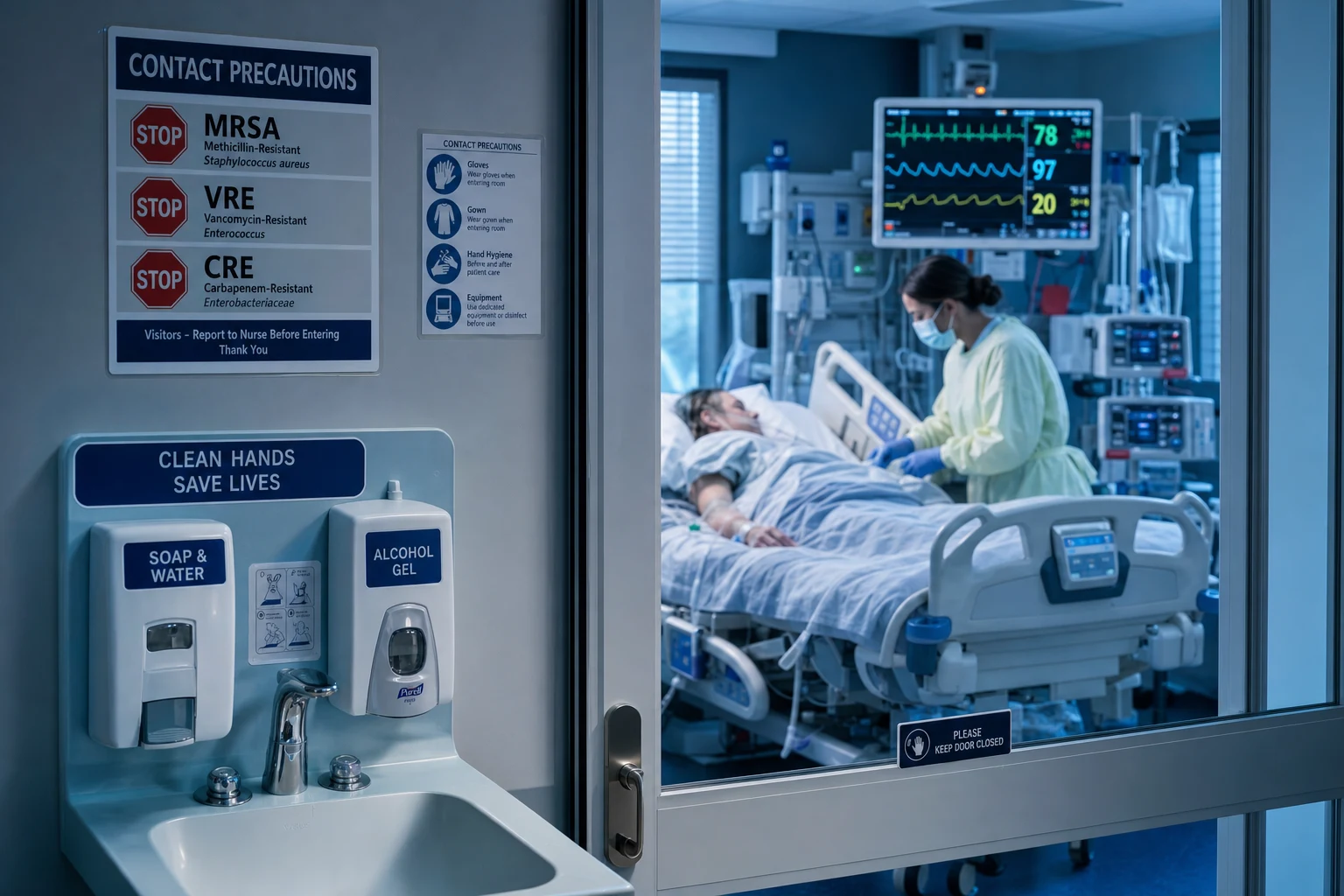
MRSA (methicillin-resistant Staphylococcus aureus)

- The mechanism — the altered PBP2a (the mecA gene) → the low affinity for the beta-lactams → the resistant to the ALL the beta-lactams except the ceftaroline.[1]
- The treatment — the vancomycin (the workhorse), the linezolid (the MRSA + the VRE), the daptomycin (the NOT for the pneumonia — the surfactant), the clindamycin / the doxycycline (the SSTI only, the not the bacteraemia), the ceftaroline (the only beta-lactam active against the MRSA).[1]
- The sites — the SSTI, the bacteraemia, the endocarditis, the pneumonia (the HAP/VAP), the osteomyelitis.[1]
VRE (vancomycin-resistant enterococcus)
- The mechanism — the altered D-alanyl-D-alanine (the D-ala-D-lac, the VanA or the VanB gene) → the vancomycin can't bind → the resistant to the vancomycin (and the teicoplanin for the VanB). The E. faecium the commonest.[1]
- The treatment — the linezolid (the MRSA + the VRE), the daptomycin (the workhorse for the VRE bacteraemia — the NOT for the pneumonia), the tigecycline.[1]
ESBL (extended-spectrum beta-lactamases)
- The mechanism — the Gram-negatives (the E. coli, the Klebsiella, the Proteus) produce the enzymes that the hydrolyze the penicillins, the cephalosporins (the 1st to the 3rd generation), and the aztreonam.[1]
- The treatment — the carbapenems (the meropenem, the imipenem, the ertapenem) — the mainstay. The often resistant to the fluoroquinolones too. The newer the beta-lactamase-inhibitor combinations (the ceftazidime-avibactam) the for the some.[1]
CRE (carbapenem-resistant Enterobacteriaceae)
- The mechanism — the produce the carbapenemases (the KPC, the NDM, the OXA-48, the VIM, the IMP) → the hydrolyze the carbapenems (the meropenem, the imipenem, the ertapenem).[1]
- The treatment — the colistin (the polymyxin E), the polymyxin B, the tigecycline, the ceftazidime-avibactam (the for the KPC), the meropenem-vaborbactam, the aztreonam plus the avibactam (the for the metallo-beta-lactamases — the NDM). The often the last-resort.[1]
- The colistin nephrotoxicity and the neurotoxicity — the monitor the renal function. The newer the combinations (the ceftazidime-avibactam, the meropenem-vaborbactam) the less toxic and the more effective than the colistin for the some.[1]
C. difficile (the spore, the toxin)
- The mechanism — the spore-forming, the toxin A and the toxin B producer. The antibiotic-associated (the disrupted gut flora).[1]
- The treatment — the oral vancomycin or the fidaxomicin (the see the separate topic).[1]
The infection control
(the prevent the spread) [1]
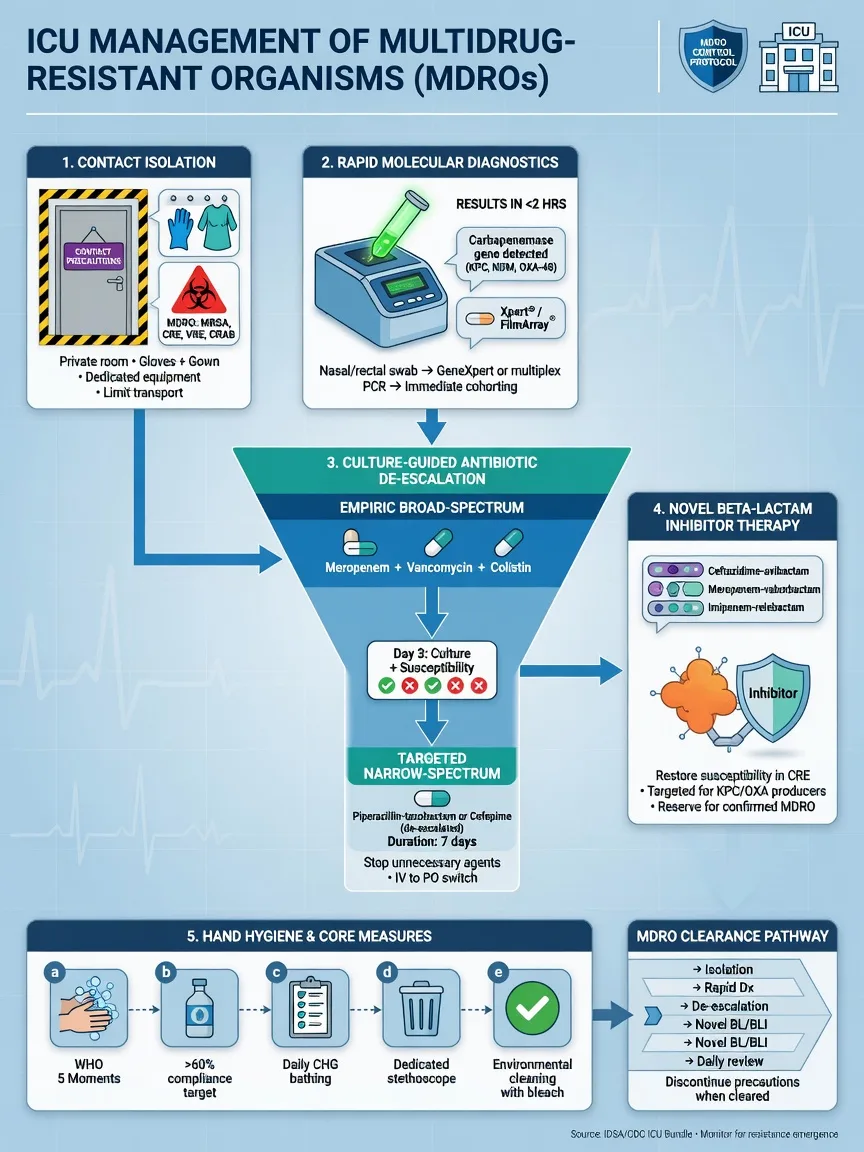
- The contact precautions and the isolation (the single room).[1]
- The hand hygiene — the soap-and-water for the C. difficile (the spores); the alcohol gel the inadequate for the spores but the fine for the others.[1]
- The decolonization (the MRSA — the chlorhexidine wash, the intranasal mupirocin).[1]
- The antibiotic stewardship (the reduce the selection pressure — the narrow, the de-escalate, the stop the unnecessary).[1]
- The surveillance and the screening (the high-risk admissions).[1]
Red flags
The ESKAPE pathogens — the mnemonic
The ESKAPE mnemonic captures the six genera that escape the action of the common antibiotics and dominate the ICU's resistant-infection burden: Enterococcus faecium (the VRE), Staphylococcus aureus (the MRSA), Klebsiella pneumoniae (the ESBL and the KPC-CRE), Acinetobacter baumannii (the CRAB), Pseudomonas aeruginosa (the CRPA), and the Enterobacter spp (the inducible AmpC). They share three features — the intrinsic hardiness, the acquisition of the mobile resistance elements (the plasmids, the transposons, the integrons), and the biofilm formation on the indwelling devices — and they spread clonally within the unit unless the contact precautions, the surveillance, and the stewardship are enforced.[6][8]
The ESKAPE pathogens — the resistance and the targeted agent
| Pathogen | Key resistance | Genes / mechanism | First-line targeted agent |
|---|---|---|---|
| Enterococcus faecium | Vancomycin-resistant (VRE) | vanA (high-level, vanco + teicoplanin), vanB (vanco only) | Daptomycin (BSI), linezolid (low-inoculum); combination for high-inoculum |
| Staphylococcus aureus | Methicillin-resistant (MRSA) | mecA → PBP2a (the SCCmec cassette) | Vancomycin (AUC-guided), linezolid, daptomycin; ceftaroline the only active beta-lactam |
| Klebsiella pneumoniae | ESBL; carbapenemase (CRE) | blaCTX-M (ESBL); blaKPC (class A), blaNDM (class B MBL), blaOXA-48 (class D) | ESBL → carbapenem; KPC → ceftazidime-avibactam; NDM → aztreonam + CZA; colistin reserve |
| Acinetobacter baumannii | Carbapenem-resistant (CRAB) | blaOXA-23/24/58, the over-expressed intrinsic AmpC | Sulbactam-durlobactam; high-dose sulbactam + polymyxin; cefiderocol |
| Pseudomonas aeruginosa | Carbapenem-resistant (CRPA), DTR | AmpC (Pdc), OprD loss (imipenem), efflux, VIM/IMP/NDM/GES | Ceftolozane-tazobactam; cefiderocol; colistin reserve |
| Enterobacter spp (E. cloacae, E. aerogenes) | Inducible AmpC | chromosomal ampC derepressed by the beta-lactam exposure | Cefepime (stable to AmpC), carbapenem; AVOID the 3rd-gen cephalosporin |
Resistance mechanisms in depth — the molecular basis
The Ambler beta-lactamase classification (the four classes)
The beta-lactamases are classified by the Ambler scheme into four molecular classes by the active-site mechanism. The classes A, C and D are the serine beta-lactamases (the active-site serine hydrolyses the beta-lactam ring); the class B are the metallo-beta-lactamases (MBL) — they require the zinc at the active site, which is why they are NOT inhibited by avibactam, vaborbactam, or relebactam (the novel inhibitors target the serine only) and why they hydrolyse nearly every beta-lactam EXCEPT aztreonam (the monobactam).[8]
The Ambler beta-lactamase classes — the ICU-relevant members
| Class | Type | Key examples | Hydrolyses | Active inhibitor combinations |
|---|---|---|---|---|
| A (serine) | ESBL (TEM, SHV, CTX-M); KPC; PER, VEB | blaCTX-M-15, blaKPC | Penicillins, cephalosporins, aztreonam (ESBL); KPC also the carbapenems | Ceftazidime-avibactam, meropenem-vaborbactam, imipenem-relebactam |
| B (metallo-β-lactamase, MBL) | NDM, VIM, IMP | blaNDM-1, blaVIM, blaIMP | ALL beta-lactams EXCEPT aztreonam; the carbapenems | Aztreonam + ceftazidime-avibactam (the avibactam protects the aztreonam); cefiderocol |
| C (serine) | AmpC | chromosomal ampC (Enterobacter, Serratia, Citrobacter, Morganella — the SPICE/M); plasmid AmpC (CMY, DHA) | Penicillins, 1st–3rd-gen cephalosporins; NOT inhibited by clavulanate | Cefepime, cefpirome, the carbapenems (stable to AmpC) |
| D (serine) | OXA | OXA-48 (Enterobacteriaceae), OXA-23/24/58 (Acinetobacter) | The carbapenems (weakly), the penicillins | Ceftazidime-avibactam (OXA-48); sulbactam-durlobactam (Acinetobacter) |
The ESBLs — the CTX-M era
The extended-spectrum beta-lactamases hydrolyse the penicillins, the 1st-to-3rd-generation cephalosporins, and the monobactam (aztreonam) — but NOT the cephamycins or the carbapenems. They are inhibited (in vitro) by the clavulanate. The dominant family worldwide is the CTX-M (the cefotaximase-Munich) — and CTX-M-15 in particular — which has displaced the older TEM/SHV types and moved from the hospital into the community (the community-acquired ESBL UTI is now routine). The MERINO trial settled the empiric-therapy question for the ESBL bloodstream infection: a carbapenem, NOT piperacillin-tazobactam.[1]
The AmpC — the inducible chromosomal beta-lactamase
The Enterobacter cloacae complex, the Klebsiella (Enterobacter) aerogenes, the Serratia marcescens, the Citrobacter freundii, and the Morganella morganii carry a chromosomal, inducible AmpC. The exposure to a beta-lactam (especially the 3rd-generation cephalosporin — ceftriaxone, ceftazidime) induces the derepression of the AmpC promoter → the stably-derepressed mutant emerges within days → the cephalosporin now fails. Therefore: never treat a serious Enterobacter/Serratia/Citrobacter/Morganella infection with a 3rd-generation cephalosporin, even when the initial susceptibility panel shows susceptible (the inoculum and the induction will outgrow it). The stable drugs against the derepressed AmpC are the cefepime (the 4th-gen, stable to the AmpC), the cefpirome, and the carbapenem.[8]
The carbapenemases — KPC, NDM, OXA-48, VIM, IMP
The carbapenemases hydrolyse the carbapenems (meropenem, imipenem, ertapenem). The geography matters: [1]
- KPC (Klebsiella pneumoniae carbapenemase) — the class A enzyme; the dominant CRE mechanism in the Americas, southern Europe, Israel, China. Clonal spread on the ST258 K. pneumoniae. Treatable with the ceftazidime-avibactam, the meropenem-vaborbactam, the imipenem-relebactam.[8]
- NDM (New Delhi metallo-beta-lactamase) — the class B MBL; the dominant mechanism in the Indian subcontinent, the Balkans, the Middle East, now globally disseminated. Resistant to ALL the novel inhibitors EXCEPT that the aztreonam survives (the MBLs cannot hydrolyse the monobactam) — so aztreonam + ceftazidime-avibactam (the avibactam covers any co-carried ESBL/AmpC/KPC that would otherwise destroy the aztreonam).[6]
- OXA-48 — the class D enzyme; the dominant CRE mechanism in Turkey, North Africa, the Mediterranean, now spreading across Europe. Often the low-level carbapenem resistance (easy to miss on the routine MIC) but the ceftazidime-avibactam is active.[8]
- VIM, IMP — the other class B MBLs; less common than the NDM but the same treatment implications (aztreonam + CZA; cefiderocol).[8]
The MRSA — mecA, PBP2a, and the SCCmec cassette
The methicillin resistance in Staphylococcus aureus arises from the mecA (or the rarer mecC) gene carried on a mobile genetic cassette — the SCCmec (staphylococcal cassette chromosome mec). The mecA encodes the PBP2a (penicillin-binding protein 2a) — a transpeptidase with a low affinity for ALL beta-lactam antibiotics → the cell-wall synthesis continues in the presence of the methicillin, the flucloxacillin, and every cephalosporin. The single exception is ceftaroline — the 5th-generation cephalosporin whose bulky R-group side chain allows it to bind and inhibit the PBP2a. Some MRSA strains also carry the Panton-Valentine leukocidin (PVL) — a cytotoxin associated with the necrotising pneumonia and the recurrent skin/soft-tissue infection.[7]
The VRE — vanA and vanB and the altered target
The vancomycin resistance in the enterococci arises from the replacement of the terminal D-alanine-D-alanine (the vancomycin-binding target) with the D-alanine-D-lactate ester bond — which has a 1000-fold lower affinity for the vancomycin. The vanA operon confers the high-level vancomycin resistance (MIC ≥64) AND the teicoplanin resistance; the vanB confers the variable vancomycin resistance and the teicoplanin remains active. Enterococcus faecium (NOT faecalis) is the dominant VRE — driven by the hospital-adapted ST17 / CC17 clonal complex.[8]
Carbapenemase detection — phenotypic vs molecular
The detection of a carbapenemase determines whether a CRE will respond to the ceftazidime-avibactam (the KPC, the OXA-48) or need the aztreonam + CZA (the NDM). The two arms of the testing: [1]
Carbapenemase detection methods in the ICU microbiology lab
| Method | What it detects | Turnaround | Limitation |
|---|---|---|---|
| Carba NP / modified carbapenem inactivation (mCIM) | Any carbapenemase activity (phenotypic) | Hours (Carba NP) / overnight (mCIM) | Does NOT specify the enzyme class |
| Immunochromatographic lateral-flow (RESIST, NG-Test) | The KPC / NDM / OXA-48 / VIM / IMP antigens directly | 15–30 min | Only the targeted antigens; misses the novel variants |
| EDTA synergy (cloxacillin + EDTA disk) | Distinguishes the class B MBL (inhibited by EDTA chelation of zinc) from the KPC | Overnight | Indirect; needs the expertise to interpret |
| Boronic acid synergy | Confirms the KPC (class A, inhibited by the boronic acid) | Overnight | Indirect |
| Multiplex PCR (Xpert Carba-R) | blaKPC, blaNDM, blaOXA-48, blaVIM, blaIMP | ~1 hour | Molecular — does NOT confirm expression/phenotype, only the gene presence |
| Whole-genome sequencing | All known + novel resistance determinants | Days | Research / reference lab |
The pragmatic message: know the local carbapenemase epidemiology AND send the molecular test early — the empiric ceftazidime-avibactam will cover the KPC and the OXA-48 but NOT the NDM, and the wrong choice in a CRE bacteraemia carries a measurable mortality penalty.[6]
Acinetobacter baumannii (CRAB) — the environmental survivor
The Acinetobacter baumannii is the environmental survivor — desiccation-tolerant, surviving on the dry surfaces for weeks, contaminating the ventilator circuits, the water taps, the bedside equipment. The carbapenem resistance (the CRAB) is driven by the OXA-23, OXA-24/40, OXA-58 carbapenemases (the class D), frequently compounded by the over-expressed intrinsic AmpC (ADC), the efflux pumps, and the porin loss. The clinical scenarios: the late-onset VAP in the long-stay ventilated patient, the CRBSI in the patient with multiple lines, the wound infection in the trauma/burn/military casualty, and the post-neurosurgical meningitis (the external ventricular drain).[8]
The treatment has historically been colistin- or polymyxin-B-based combination with the high-dose ampicillin-sulbactam (the sulbactam component has the intrinsic anti-Acinetobacter activity — up to 6–8 g/day of sulbactam) plus a carbapenem or a tigecycline. The sulbactam-durlobactam (durlobactam is a diazabicyclooctane beta-lactamase inhibitor that protects the sulbactam from the OXA carbapenemases) is now the targeted agent of choice for the CRAB. The cefiderocol retains the activity against many CRAB but the CREDIBLE-CR signalled a possible mortality excess in the CRAB subgroup — reserve it for the CRAB where the sulbactam-durlobactam is unavailable or the organism is susceptible only to cefiderocol. The source control (the line removal, the wound debridement, the device removal) is mandatory — the antibiotics alone rarely clear a device-associated CRAB.[6][3]
Pseudomonas aeruginosa (CRPA / DTR) — the opportunist
The Pseudomonas aeruginosa is the opportunist of the structurally-damaged lung (the bronchiectasis, the CF, the severe COPD on frequent antibiotics) and the burn/immunocompromised host. The resistance is multifactorial and often cumulative: the over-expressed intrinsic AmpC (Pdc), the OprD porin loss (the imipenem-specific resistance), the upregulated efflux pumps (MexAB-OprM, MexXY) (conferring the meropenem, the fluoroquinolone, the aminoglycoside resistance), the acquired VIM/IMP/NDM/GES carbapenemases, and the target modification (the DNA gyrase for the fluoroquinolones). When the isolate is non-susceptible to ALL the first-line agents (piperacillin-tazobactam, ceftazidime, cefepime, the carbapenems, the fluoroquinolones, the aminoglycosides) it is labelled the difficult-to-treat resistance (DTR-P. aeruginosa).[6]
The targeted agents for the CRPA: [1]
- Ceftolozane-tazobactam — the ceftolozane is a cephalosporin with the greatest intrinsic anti-pseudomonal potency and the stability against the AmpC; the tazobactam adds the ESBL cover. The first-line for the CRPA WITHOUT a carbapenemase. The ASPECT-NP established it for the HAP/VAP.[6]
- Cefiderocol — the siderophore cephalosporin (uses the iron-transport active uptake to cross the outer membrane); active against many CRPA including some MBL-producers. The CREDIBLE-CR is the evidence.[3]
- Colistin / polymyxin B — the reserve; the nephrotoxicity the dose-limiting toxicity.
- Ceftazidime-avibactam — only if the resistance is KPC/ESBL-driven; the avibactam has NO useful activity against the AmpC of Pseudomonas (and none against the MBL).[8]
Enterobacter spp & the inducible AmpC — the derepression trap
The Enterobacter cloacae complex, the Klebsiella aerogenes (formerly Enterobacter aerogenes), the Citrobacter freundii, the Serratia marcescens, and the Morganella morganii share a chromosomal inducible AmpC — the "SPICE/M" organisms (Serratia, Pseudomonas/Proteus-indole-positive, Indole-positive Providencia, Citrobacter, Enterobacter, Morganella). The trap: the 3rd-generation cephalosporin (ceftriaxone, ceftazidime) initially appears susceptible on the panel, but the treatment selects the stably-derepressed mutant within 3–4 days → the cephalosporin fails with a breakthrough bacteraemia. The safe empiric options for a serious SPICE/M infection are the cefepime (4th-gen, stable to the derepressed AmpC), the cefpirome, or the carbapenem; the fluoroquinolone and the cotrimoxazole susceptibility must be confirmed. The piperacillin-tazobactam is borderline (acceptable for some, avoided for the high-inoculum BSI/endocarditis).[8]
The newer Gram-negative agents — when to use what
The post-2015 antibacterial armamentarium is the most-tested "new drugs" topic in the CICM/FFICM exam. The choice rests on the carbapenemase class and the pathogen.[6]
The newer Gram-negative agents — the spectrum and the niche
| Agent | Class | Active against | NOT active against | Niche |
|---|---|---|---|---|
| Ceftazidime-avibactam (CZA) | Cephalosporin + diazabicyclooctane inhibitor | KPC, ESBL, AmpC, OXA-48, Pseudomonas | MBL (NDM, VIM, IMP), Acinetobacter | KPC-CRE; OXA-48 CRE; some CRPA |
| Meropenem-vaborbactam (MVB) | Carbapenem + boronic-acid inhibitor | KPC, ESBL, AmpC | OXA-48, MBL, Pseudomonas (no advantage), Acinetobacter | KPC-CRE (TANGO II) |
| Imipenem-cilastatin-relebactam | Carbapenem + diazabicyclooctane inhibitor | KPC, some CRPA, AmpC | OXA-48, MBL, Acinetobacter | KPC-CRE; CRPA with KPC |
| Ceftolozane-tazobactam (C/T) | Anti-pseudomonal cephalosporin + tazobactam | CRPA (AmpC, efflux, OprD loss), ESBL (some) | Carbapenemase-producers, Acinetobacter | DTR-Pseudomonas (first-line if no carbapenemase) |
| Cefiderocol | Siderophore cephalosporin (iron-transport uptake) | CRPA incl. some MBL, CRAB (variable), KPC/OXA-CRE | Some KPC variants | CRPA/CRAB; MBL-CRE when aztreonam unavailable |
| Aztreonam + CZA | Monobactam + CZA (the avibactam shields the aztreonam) | MBL (NDM, VIM, IMP)-CRE | Acinetobacter, Pseudomonas (often) | NDM-CRE — the regimen of choice |
| Plazomicin | Aminoglycoside (synthetic, modified) | CRE (incl. some KPC/NDM), ESBL | Pseudomonas, Acinetobacter (poor) | CRE cUTI; CRE BSI as part of combination (renal toxicity) |
| Eravacycline | Fluorocycline (tetracycline class) | CRE (incl. KPC, NDM, OXA-48), Acinetobacter, anaerobes | Pseudomonas, Proteus (intrinsic resistance) | cIAI due to CRE; poor urine levels (NOT for cUTI) |
| Colistin / polymyxin B | Cationic peptide (membrane disruptor) | CRE, CRPA, CRAB (universal) | Serratia, Proteus, Morganella (intrinsic) | Last-resort; nephro/neuro-toxicity; replaced by CZA/MVB for KPC |
| Sulbactam-durlobactam | Beta-lactamase inhibitor + sulbactam | CRAB (OXA-23/24/58) | Enterobacteriaceae (no), Pseudomonas | CRAB — the targeted agent of choice |
| Ceftaroline | 5th-gen cephalosporin (binds PBP2a) | MRSA (only active beta-lactam), S. pneumoniae | Pseudomonas, Enterobacteriaceae (limited) | MRSA SSTI, community-acquired pneumonia |
CRE treatment by carbapenemase type — the bedside decision
Step 1 — Confirm it is a carbapenemase-producer
A CRE (carbapenem-non-susceptible Enterobacteriaceae) may be resistant by porin loss + AmpC/ESBL overexpression (NON-enzymatic) OR by a true carbapenemase (enzymatic). The non-enzymatic CRE responds to a higher-dose carbapenem; the enzymatic CRE does not. Send the molecular test (Xpert Carba-R / lateral-flow / PCR) BEFORE committing to CZA.
Step 2 — KPC producer: ceftazidime-avibactam monotherapy
For a blaKPC-positive CRE with a susceptible MIC, ceftazidime-avibactam monotherapy (2.5 g IV q8h, extended infusion over 2 h) is the regimen of choice — it outperformed colistin-based therapy in TANGO II and the observational cohorts, with markedly less nephrotoxicity. Meropenem-vaborbactam and imipenem-relebactam are equivalent alternatives. Add an aminoglycoside or tigecycline for the high-inoculum (BSI, endocarditis, undrained abscess).
Step 3 — OXA-48 producer: ceftazidime-avibactam
OXA-48 (common in patients transferred from Turkey/North Africa/the Mediterranean) is hydrolysed by NOTHING except ceftazidime-avibactam. Use CZA — colistin and cefiderocol have variable activity. If it co-carries an ESBL (common), the avibactam covers that too.
Step 4 — NDM (metallo-beta-lactamase) producer: aztreonam + ceftazidime-avibactam
NDM (and VIM, IMP) are MBLs — they hydrolyse every beta-lactam EXCEPT aztreonam. BUT NDM-producers usually co-carry an ESBL/AmpC/KPC that destroys the aztreonam. The fix: give aztreonam (which the MBL spares) PLUS ceftazidime-avibactam (whose avibactam inhibits the co-carried ESBL/AmpC/KPC). This is the regimen of choice for the NDM-CRE. Cefiderocol is the alternative. NEVER use CZA alone for NDM — the avibactam has no MBL activity.
Step 5 — Carbapenemase unknown / awaiting PCR
Empirically in a severe CRE infection with unknown mechanism, cover BOTH possibilities: ceftazidime-avibactam (covers KPC + OXA-48) PLUS aztreonam (covers MBL) PLUS an aminoglycoside (plazomicin/amikacin) or polymyxin for synergy. Narrow as soon as the molecular result returns. The ID consult is mandatory.
Step 6 — Combination vs monotherapy (the INCREMENT score)
For the high-risk CRE bacteraemia (INCREMENT score ≥7 — severe sepsis, Pitt bacteraemia score high, rapidly fatal underlying disease, source not controllable), combination therapy (the active beta-lactam + aminoglycoside, or + tigecycline, or + colistin) reduces mortality vs monotherapy. For the low-risk (score <7), monotherapy with a novel active beta-lactam (CZA, MVB) is equivalent and less toxic. The era of universal colistin-combination for CRE is over.
The MERINO evidence — piperacillin-tazobactam is NOT adequate for the ESBL BSI
MERINO (Harris PNA 2018, JAMA) — piperacillin-tazobactam vs meropenem for the ESBL E. coli / K. pneumoniae bloodstream infection
Design
Multicentre, randomised, open-label, non-inferiority trial; 378 adults with E. coli or K. pneumoniae bloodstream infection non-susceptible to ceftriaxone, across 9 countries (ANZ well-represented)
Intervention
Piperacillin-tazobactam 4.5 g q6h vs meropenem 1 g q8h (extended infusion)
Primary outcome
All-cause mortality at day 30
Key result
Trial STOPPED early for harm: 30-day mortality 12% piperacillin-tazobactam vs 4% meropenem (risk difference +8 percentage points, 95% CI +3 to +14 — exceeded the pre-specified non-inferiority margin). Most infections were E. coli with CTX-M-type ESBL
Clinical bottom line
Piperacillin-tazobactam is NOT acceptable empiric or definitive therapy for the ESBL-producing E. coli/Klebsiella bloodstream infection — the inoculum effect and the chromosomal ESBL overwhelm it. Use a carbapenem. The trial that retired piperacillin-tazobactam for the serious ESBL infection
INCREMENT-CPE — the combination therapy and the mortality-predictor score
INCREMENT-CPE (Gutiérrez-Gutiérrez 2017, Lancet Infect Dis) — combination therapy for the carbapenemase-producing Enterobacteriaceae bacteraemia
Design
Multinational, prospective, preregistered cohort; 437 patients with CPE bloodstream infection across 10 countries; observational (no RCT feasible for the rare outcome)
Intervention
Combination therapy (≥2 active agents — usually colistin + carbapenem, or + tigecycline, or + aminoglycoside, or + CZA) vs monotherapy
Primary outcome
All-cause 30-day mortality
Key result
Combination therapy reduced mortality ONLY in the high-risk group (INCREMENT mortality score ≥7): adjusted OR ~0.40 favouring combination. In the low-risk (score <7) there was no survival benefit from combination and more toxicity. The INCREMENT score (variables: severe sepsis/septic shock, Pitt bacteraemia score, source of BSI, Charlson, transplant/haematological malignancy) stratifies who benefits
Clinical bottom line
For the severe / high-inoculum CPE bacteraemia, combination therapy (an active novel beta-lactam + a second active agent) reduces mortality. For the stable patient, monotherapy with a novel active agent (CZA, MVB) is acceptable. The end of universal combination for every CRE
CREDIBLE-CR — cefiderocol for the carbapenem-resistant Gram-negatives
CREDIBLE-CR (Bassetti 2021, Lancet Infect Dis) — cefiderocol vs best-available therapy for the CR Gram-negatives
Design
Multicentre, randomised, open-label, pathogen-focused descriptive trial (no formal non-inferiority margin — the rare-disease design); 152 adults with CR Acinetobacter, CR Pseudomonas, or CR Enterobacteriaceae infections (cUTI/cIAI/HAP/VAP/BSI)
Intervention
Cefiderocol 2 g q8h (extended 3-h infusion) vs best-available therapy (colistin-based, often with carbapenem/aminoglycoside/tigecycline)
Primary outcome
Clinical cure at test-of-cure in the microbiological intention-to-treat population
Key result
Clinical cure numerically FAVOURED cefiderocol across the CR-pathogen groups (50% vs 39% best-available therapy overall). For CRAB, mortality numerically HIGHER with cefiderocol (34% vs 19%) — a signal, not statistically conclusive but flagged by the FDA. Cefiderocol retained activity against many MBL-producing strains
Clinical bottom line
Cefiderocol is a valuable targeted agent for the CR Gram-negative — especially the CRPA with MBL — but the CRAB mortality signal means it is NOT first-line for documented CRAB (use sulbactam-durlobactam). Reserve for the MBL-CRE/CRPA where the aztreonam+CZA is unsuitable
TANGO II — meropenem-vaborbactam for the CRE
TANGO II (Wunderink 2018, Lancet Infect Dis) — meropenem-vaborbactam vs best-available therapy for the CRE infection
Design
Multicentre, randomised, open-label trial; 72 adults with confirmed CRE infection (cUTI, cIAI, HAP/VAP, BSI, including KPC producers). Small but pivotal — the rare-disease design
Intervention
Meropenem-vaborbactam (4 g meropenem-equivalent q8h, extended 3-h infusion) vs best-available therapy (carbapenem-based or colistin-based, often combination)
Primary outcome
Clinical cure; all-cause mortality; nephrotoxicity (descriptive due to the size)
Key result
In the CRE-infection cohort: clinical cure HIGHER with meropenem-vaborbactam (66% vs 33%), mortality LOWER (16% vs 33% for the colistin arm), and nephrotoxicity MUCH LOWER (4% vs 36% with colistin). Limited to KPC-CRE — vaborbactam does NOT inhibit OXA-48 or MBL
Clinical bottom line
For the KPC-CRE infection, meropenem-vaborbactam is more effective and far less nephrotoxic than the old colistin-based regimens. Confirmed KPC → MVB or CZA are now preferred over colistin. Pointless for OXA-48 / NDM (vaborbactam has no activity there)
IGNITE4 — eravacycline for the complicated intra-abdominal infection
IGNITE4 (Solomkin 2017, Clin Infect Dis) — eravacycline vs ertapenem for the complicated intra-abdominal infection
Design
Multicentre, randomised, double-blind, double-dummy, non-inferiority trial; 500 adults with the complicated intra-abdominal infection requiring surgery + antibiotics
Intervention
Eravacycline 1 mg/kg IV q12h vs ertapenem 1 g IV q24h
Primary outcome
Clinical response at test-of-cure (day 4-6)
Key result
Eravacycline NON-INFERIOR to ertapenem for clinical cure (~87% vs ~89%). Eravacycline retains the in-vitro activity against the ESBL-CRE, KPC, NDM and OXA-48 producers, and against the Acinetobacter and the anaerobes — but has NO useful Pseudomonas or Proteus activity and poor urine levels
Clinical bottom line
Eravacycline is a carbapenem-sparing option for the cIAI caused by the resistant Gram-negatives (ESBL, CRE, Acinetobacter). Do NOT use for cUTI (poor urinary concentrations) or for Pseudomonas/Proteus. AVOID in pregnancy (tetracycline class — tooth/bone effects)
Infection control deep-dive — cohorting, screening, decolonisation, environment
The two pillars of the MDRO management are the targeted antibiotic and the infection control. The infection-control arm is what stops the MDRO reaching the next patient — every gap here is measured in the additional colonised/infected patients downstream.[8]
Contact precautions and the single room
- Single-room isolation with a dedicated toilet and dedicated equipment (stethoscope, BP cuff, thermometer) for every patient colonised or infected with an MDRO.
- Gown and gloves on entry to the room (the donning BEFORE contact, the doffing BEFORE exit). The gown protects the uniform — the uniform is the vector to the next bed.
- Duration: until discharge for the VRE and the CRE (the decolonisation is ineffective and the recrudescence common); for the MRSA the precautions may be discontinued after the documented decolonisation AND repeat negative screens. [1]
Hand hygiene — the alcohol vs the soap-and-water
- Alcohol-based hand rub is the mainstay for the MRSA, the VRE, the ESBL, the CRE — fast, well-tolerated, evidence-based.
- SOAP-AND-WATER is mandatory for C. difficile and Norovirus — the alcohol does NOT kill the spores. Wash hands with soap and water after every contact with a C. difficile patient; the alcohol rub is acceptable IN ADDITION but NOT as a substitute.
- The five moments of hand hygiene (WHO): before patient contact, before aseptic task, after body-fluid exposure, after patient contact, after contact with the surroundings. [1]
Screening and the admission surveillance
- Targeted admission screening for the high-risk admissions: the patient transferred from an overseas hospital (especially India, SE Asia, the Middle East, southern Europe), the patient with a prior MDRO history, the long-term-care-facility resident, the patient with a recent hospitalisation or recent broad-spectrum antibiotics in the last 3–12 months.
- Sites: rectal/perianal swab (the carriage site for VRE, CRE, ESBL); nares + groin/perianal (MRSA); sputum/respiratory (MRSA, CRPA, CRAB if colonised); wound/drain sites.
- Active surveillance cultures repeated weekly during the ICU stay for the high-prevalence units (catches the ICU-acquired acquisition). [1]
Cohorting
When the single rooms run out, cohort — place the patients with the SAME MDRO in the same bay/room, with dedicated staff (the cohort nursing: one team for the MDRO-positive bay, a different team for the negative). NEVER cohort the patients with different MDROs together (the co-colonisation and the plasmid transfer accelerate the resistance). The dedicated equipment and the terminal cleaning between patients are still required. [1]
Environmental cleaning and the terminal disinfection
The MDRO survive on the inanimate surfaces: the Acinetobacter for weeks, the VRE and the MRSA for days, the C. difficile spores for months. The daily cleaning with a hospital-grade disinfectant and the terminal cleaning (after discharge/transfer) are non-negotiable. For C. difficile the disinfectant must be sporicidal (bleach / hypochlorite 1000 ppm, or the hydrogen peroxide vapour). The ultraviolet-C and the hydrogen-peroxide vapour are adjuncts for the terminal clean. The hand-touch surfaces (bed rails, call buttons, IV pumps, keyboards) are the highest-yield targets. [1]
Decolonisation — MRSA yes, VRE and CRE no
- MRSA decolonisation: 2% chlorhexidine (CHG) body wash daily for 5 days + 2% mupirocin nasal ointment twice daily for 5 days, repeated for 2-3 cycles. Use for the pre-operative MRSA carrier (reduces the surgical-site infection) and the recurrent MRSA SSTI. Effect on the ICU-acquired MRSA transmission is modest but real in the high-prevalence settings.
- VRE and CRE decolonisation: NOT effective and NOT recommended — the gut colonisation persists, the recurrence after apparent clearance is the rule, and the antibiotics used risk selecting further resistance. Focus on the contact precautions, the cohorting, and the stewardship. [1]
Antimicrobial stewardship — the upstream prevention
The antibiotic selection pressure is the engine of the MDRO. The stewardship interventions that reduce the MDRO burden: the narrowing at 48-72 h (de-escalation by culture), the shortest effective duration (procalcitonin-guided stopping, oral switch), the formulary restriction of the broadest agents, the prior-authorization for the reserve agents, and the daily antibiotic review ("stop, change, or continue?" at every ward round). The reduction in the total antibiotic DOT (days-of-therapy) per 1000 patient-days is the most reliable single correlate of the falling MDRO rate.[8]
Vancomycin AUC-guided monitoring — the new standard for the MRSA
The 2020 ASHP/IDSA/PIDS/SIDP consensus moved the vancomycin dosing from trough-based to AUC-guided (area-under-curve / MIC). The target for the serious MRSA infection is an AUC₀₋₂₄ / MIC of 400-600 (assuming MIC ≤1 mg/L). The old trough 15-20 mg/L target was a poor surrogate — it underdosed some and overdosed others, and the vancomycin + piperacillin-tazobactam combination roughly TRIPLED the AKI rate (the vancomycin-related AKI is concentration-dependent and the piptazo potentiated it).[12][9]
Trough vs AUC-guided vancomycin monitoring — the CICM exam answer
| Parameter | Trough-based (old) | AUC-based (current standard) |
|---|---|---|
| Target | Trough 15-20 mg/L | AUC₀₋₂₄ / MIC 400-600 (MIC ≤1) |
| Sampling | Trough immediately pre-4th dose | Two levels (peak + trough, or Bayesian) in first 24-48 h |
| AKI | Higher (especially with piptazo) | Lower — meta-analyses show ~20-30% AKI reduction vs trough-15-20 |
| Efficacy | Acceptable but suboptimal | Improved target attainment for the serious MRSA |
| When the trough is still OK | Lower-risk, short course, MIC <1 | All serious MRSA, all renal impairment, all piptazo co-therapy |
| Vancomycin + piptazo AKI | Tripled AKI (Hammond meta-analysis) | Prefer vancomycin + cefepime where cover allows; AUC monitoring attenuates but does not abolish the AKI |
VRE treatment — linezolid vs daptomycin
The VRE (almost always the Enterococcus faecium) bacteraemia carries the mortality of the untreated Gram-positive sepsis. The two workhorses: [1]
Linezolid vs daptomycin for the VRE (Enterococcus faecium) infection
| Feature | Linezolid | Daptomycin |
|---|---|---|
| Class | Oxazolidinone (protein synthesis, 50S) | Cyclic lipopeptide (membrane depolarisation) |
| Site — BSI | Acceptable (bacteraemia) — but thrombocytopenia, lactic acidosis | Workhorse for the VRE BSI (high-dose 8-10 mg/kg q24h) |
| Site — pneumonia | Active (good lung penetration) | INACTIVE — surfactant inactivates it |
| Site — endocarditis / deep-seated | Bacteriostatic — suboptimal for the endocarditis | Bactericidal — preferred for the endocarditis (combine with ampicillin or ceftaroline for synergy if the MIC high) |
| Duration toxicity | Thrombocytopenia (>14 days), peripheral/optic neuropathy, serotonin syndrome (MAO-inhibition — avoid SSRIs, tyramine) | Creatine kinase elevation, eosinophilic pneumonia — monitor CK weekly |
| Emergence of resistance | Low | High-dose daptomycin to avoid the daptomycin-non-susceptible mutant; some VRE have the constitutive resistance |
| PO formulation | 100% bioavailability — IV-to-PO switch same dose | IV only |
The pragmatic choice: daptomycin for the VRE BSI / endocarditis (bactericidal, the workhorse); linezolid for the VRE pneumonia or the patient intolerant of daptomycin. AVOID the linezolid in the severe thrombocytopenia, the concurrent SSRI/MAOI, and the long (>14-day) course. AVOID the daptomycin in the pneumonia and the statin coadministration (CK/myopathy). [1]
Exam practice
SAQ — Carbapenem-resistant Klebsiella pneumoniae bacteraemia in a returned traveller
10 minutes · 10 marks
A 62-year-old man is admitted to the ICU with septic shock from a catheter-related bloodstream infection. He was repatriated 10 days ago from a three-week hospitalisation in New Delhi for motorcycle trauma (splenectomy, temporary colostomy, ICU stay with broad-spectrum antibiotics). On examination: T 39.1°C, HR 132, BP 78/45 on noradrenaline 0.4 mcg/kg/min (MAP 58 after 30 mL/kg crystalloid), lactate 5.2 mmol/L, urine output 15 mL/hr, creatinine 220 µmol/L (baseline 85). Blood cultures grow Klebsiella pneumoniae resistant to meropenem (MIC 16), imipenem, ertapenem, ceftriaxone, ceftazidime and cefepime, susceptible only to colistin and tigecycline. A rectal surveillance swab from admission is positive. He has a tunnelled haemodialysis catheter in situ.
SAQ — MRSA ventilator-associated pneumonia and vancomycin AUC monitoring
10 minutes · 10 marks
A 68-year-old man is intubated and ventilated on day 8 of an ICU admission for a severe traumatic brain injury. He develops a fever (38.9°C), purulent endotracheal secretions, a rising FiO2 requirement (0.5 to 0.8), and a new infiltrate on the chest X-ray. WCC 18.4, CRP 220, procalcitonin 8.6. Bronchoalveolar lavage grows MRSA with vancomycin MIC 1.0 mg/L. He is started on vancomycin 1.5 g IV q12h plus piperacillin-tazobactam 4.5 g q6h for dual Gram-negative cover. On day 3 of therapy the creatinine has risen from 95 to 168 µmol/L and the urine output has fallen to 0.4 mL/kg/hr. Vancomycin trough is 22 mg/L.
Additional clinical pearls — the CICM/FFICM/EDIC high-yield
Extended red flags — the errors that kill in the MDR infection
Region alert — the carbapenemase epidemiology by geography
The empiric choice for a CRE depends on the local carbapenemase — and the geography predicts it. Know the patient's travel and transfer history before choosing the empiric novel beta-lactam.[8]
Carbapenemase epidemiology by region — the empiric-therapy implications
| Region / risk factor | Dominant carbapenemase | Empiric CRE regimen of choice |
|---|---|---|
| USA (east coast), Israel, southern Europe, China | KPC | Ceftazidime-avibactam OR meropenem-vaborbactam |
| Indian subcontinent, Pakistan | NDM (often co-carries ESBL) | Aztreonam + ceftazidime-avibactam; cefiderocol |
| Turkey, North Africa, Middle East, Mediterranean | OXA-48 (often with ESBL) | Ceftazidime-avibactam |
| Balkans, Greece | KPC + NDM (mixed) | Aztreonam + CZA (covers both); + cefiderocol if polymicrobial |
| ANZ | KPC and NDM rising (imported from overseas transfers); local OXA-48 rare | Send the molecular test early; empiric aztreonam + CZA while awaiting for the high-risk admission |
| ANZ — indigenous / remote | Low MDR-GN; high MRSA (community-acquired) | Empiric MRSA cover (vancomycin + beta-lactam) for the severe SSTI/pneumonia/bacteraemia |
The expanded one-paragraph viva answer
[1]References
- [1]Harris PNA, Tambyah PA, Lye DC, et al Effect of Piperacillin-Tazobactam vs Meropenem on 30-Day Mortality for Patients With E coli or Klebsiella pneumoniae Bloodstream Infection and Ceftriaxone Resistance: A Randomized Clinical Trial JAMA, 2018.PMID 30208454
- [2]Gutiérrez-Gutiérrez B, Salamanca E, de Cueto M, et al Effect of appropriate combination therapy on mortality of patients with bloodstream infections due to carbapenemase-producing Enterobacteriaceae (INCREMENT): a retrospective cohort study Lancet Infect Dis, 2017.PMID 28442293
- [3]Bassetti M, Echols R, Matsunaga Y, et al Efficacy and safety of cefiderocol or best available therapy for the treatment of serious infections caused by carbapenem-resistant Gram-negative bacteria (CREDIBLE-CR): a randomised, open-label, multicentre, pathogen-focused, descriptive, phase 3 trial Lancet Infect Dis, 2021.PMID 33058795
- [4]Wunderink RG, Giamarellos-Bourboulis EJ, Rahav G, et al Effect and Safety of Meropenem-Vaborbactam versus Best-Available Therapy in Patients with Carbapenem-Resistant Enterobacteriaceae Infections: The TANGO II Randomized Clinical Trial Infect Dis Ther, 2018.PMID 30270406
- [5]Solomkin JS, Ramesh MK, Cesnauskas G, et al Assessing the Efficacy and Safety of Eravacycline vs Ertapenem in Complicated Intra-abdominal Infections in the Investigating Gram-Negative Infections Treated With Eravacycline (IGNITE 1) Trial: A Randomized Clinical Trial JAMA Surg, 2017.PMID 27851857
- [6]Tamma PD, Aitken SL, Bonomo RA, et al Infectious Diseases Society of America 2024 Guidance on the Treatment of Antimicrobial-Resistant Gram-Negative Infections Clin Infect Dis, 2024.PMID 39108079
- [7]Liu C, Bayer A, Cosgrove SE, et al Clinical practice guidelines by the infectious diseases society of america for the treatment of methicillin-resistant Staphylococcus aureus infections in adults and children Clin Infect Dis, 2011.PMID 21208910
- [8]Paul M, Carrara E, Retamar P, Tängdén T, Bitterman R, Bonomo RA, et al European Society of Clinical Microbiology and Infectious Diseases (ESCMID) guidelines for the treatment of infections caused by multidrug-resistant Gram-negative bacilli (endorsed by European society of intensive care medicine) Clin Microbiol Infect, 2022.PMID 34923128
- [9]Lim AS, Ho E, Tacey M, et al Area-Under-Curve-Guided Versus Trough-Guided Monitoring of Vancomycin and Its Impact on Nephrotoxicity: A Systematic Review and Meta-Analysis Ther Drug Monit, 2023.PMID 36728329
- [10]Almangour TA, Alhammad AM, Alenzi F, et al Ceftazidime-Avibactam versus Colistin for the Treatment of Infections Due to Carbapenem-Resistant Enterobacterales: A Multicenter Cohort Study Infect Drug Resist, 2022.PMID 35125877
- [11]Schmid A, Wolfensberger A, Nemeth J, et al Monotherapy versus combination therapy for multidrug-resistant Gram-negative infections: Systematic Review and Meta-Analysis Sci Rep, 2019.PMID 31664064
- [12]Hammond DA, Smith MN, Li C, et al Systematic Review and Meta-Analysis of Acute Kidney Injury Associated with Concomitant Vancomycin and Piperacillin/tazobactam Clin Infect Dis, 2017.PMID 27940946
- [13]Connolly LE, Riddle V, Cebrik D, et al A Multicenter, Randomized, Double-Blind, Phase 2 Study of the Efficacy and Safety of Plazomicin Compared with Levofloxacin in the Treatment of Complicated Urinary Tract Infection and Acute Pyelonephritis Antimicrob Agents Chemother, 2018.PMID 29378708