ICU · antimicrobial-stewardship
MDR Organisms in ICU — Comprehensive (ESBL, CRE, MRSA, VRE, MDR-XDR TB)
Also known as MDR · XDR · PDR · Multidrug-resistant · Extensively drug-resistant · Pandrug-resistant · ESBL · CRE · MRSA · VRE · Carbapenemase · KPC · NDM · OXA-48 · Ceftazidime-avibactam · Antimicrobial stewardship · MDR-TB · XDR-TB
Multidrug-resistant (MDR) organisms in the ICU — the single greatest infectious threat to critically ill patients. DEFINITIONS (Magiorakos 2012, ECDC/CDC international expert consensus): MDR = acquired non-susceptibility to at least one agent in three or more antimicrobial categories; XDR (extensively drug-resistant) = non-susceptible to all but one or two categories (only 1-2 agents left); PDR (pandrug-resistant) = non-susceptible to ALL agents in ALL categories (no treatment options). KEY ORGANISMS & MECHANISMS: (1) ESBL (Extended-Spectrum Beta-Lactamase) — plasmid-encoded beta-lactamase (TEM, SHV, CTX-M) hydrolyses penicillins AND 3rd-gen cephalosporins (ceftriaxone, ceftazidime) — treat with CARBAPENEM (meropenem) — cephalosporins fail even if susceptible in vitro (inoculum effect). (2) CRE (Carbapenem-Resistant Enterobacteriaceae) — produce carbapenemases that destroy ALL beta-lactams: KPC (class A serine — treat ceftazidime-avibactam), NDM (class B metallo-beta-lactamase — avibactam does NOT inhibit — treat colistin ± meropenem ± aztreonam), OXA-48 (treat ceftazidime-avibactam). CRE mortality 40-50%. (3) MRSA — acquired mecA/mecC gene encoding PBP2a (altered penicillin-binding protein with low beta-lactam affinity) — treat vancomycin (TDM trough 15-20 mg/L), linezolid (pneumonia), daptomycin (NOT pneumonia — inactivated by surfactant). (4) VRE — vanA/vanB operon (altered D-Ala-D-Ala target to D-Ala-D-Lac) — E. faecium — treat linezolid or daptomycin. (5) MDR/XDR-TB — resistant to rifampicin + isoniazid (MDR), + fluoroquinolone + injectable (XDR) — treat bedaquiline + pretomanid-based regimens. INFECTION CONTROL: contact precautions, single-room isolation, cohorting, WHO '5 moments' hand hygiene, chlorine-based environmental cleaning, dedicated equipment, antimicrobial stewardship, active surveillance screening. OUTCOMES: MDR infections roughly DOUBLE mortality versus susceptible organisms (attributable mortality, longer ICU stay, higher cost).
On this page & tools
Your progress
Saved locally on this device.
Target exams
Red flags
Overview
Definitions — MDR, XDR, PDR (Magiorakos 2012)
These are the international expert consensus definitions, jointly developed by ECDC and CDC, that you MUST be able to quote in a vivait. They are built around antimicrobial categories (drug classes), not individual agents.[1]
MDR vs XDR vs PDR — the tiered definitions
| Term | Abbreviation | Definition (Magiorakos 2012) | Clinical meaning |
|---|---|---|---|
| Multidrug-resistant | MDR | Acquired non-susceptibility to >=1 agent in >=3 antimicrobial categories | Several options still exist; can usually de-escalate |
| Extensively drug-resistant | XDR | Non-susceptible to >=1 agent in ALL but <=2 categories | Only 1-2 drug classes remain — last-line territory |
| Pandrug-resistant | PDR | Non-susceptible to ALL agents in ALL categories | No licensed susceptible agent — ID + public health emergency |
How to apply the definitions correctly:
- They describe acquired resistance (not intrinsic). Pseudomonas being intrinsically resistant to ampicillin does NOT count.
- The isolate must be tested against all (or nearly all) agents in the relevant categories — an organism cannot be called "PDR" if half the panel was never tested.[1]
- "Non-susceptible" pools together resistant, intermediate, and non-susceptible results per CLSI/EUCAST breakpoints. Breakpoints are revised periodically (e.g., lowered cephalosporin breakpoints for Enterobacterales) — always apply the current CLSI M100 / EUCAST breakpoint.
- Each organism genus has its own predefined list of categories (e.g., S. aureus lists aminoglycosides, ansamycins, anti-MRSA cephalosporins, etc.) — you do not count TB drugs for Staph.[1]
Standardised categories in practice — illustrative organism panels
| Organism | Example antimicrobial categories counted | Common MDR phenotype | Common XDR phenotype |
|---|---|---|---|
| Enterobacterales (E. coli, Klebsiella) | Aminoglycosides, anti-pseudomonal penicillins, 1st-2nd gen cephalosporins, 3rd-4th gen cephalosporins, carbapenems, fluoroquinolones, folate-pathway, polymyxins, tetracyclines | ESBL E. coli (3GC + FQ + SMX-TMP) | CRE resistant to everything but colistin/tigecycline |
| Pseudomonas aeruginosa | Aminoglycosides, anti-pseudomonal penicillins, anti-pseud cephalosporins, carbapenems, fluoroquinolones, monobactams, polymyxins | Resistant to >=3 classes (e.g., DTR Pseudomonas) | DTR — only colistin left |
| Acinetobacter baumannii | Aminoglycosides, anti-pseud penicillins, carbapenems, fluoroquinolines, polymyxins, tetracyclines, sulbactam | Carbapenem-resistant Acinetobacter (CRAB) | Only colistin ± sulbactam left |
| Staphylococcus aureus | Aminoglycosides, beta-lactam anti-staph, fluoroquinolones, folate-pathway, glycopeptides, lincosamides, macrolides, oxazolidinones, tetracyclines | MRSA (beta-lactam class + 1-2 others) | VRSA / vancomycin-intermediate (VISA) |
| Enterococcus | Aminoglycosides (high-level), beta-lactams, glycopeptides, lipopeptides, oxazolidinones, streptogramins, tetracyclines | VRE (vanA E. faecium) | Linezolid-resistant VRE |
Exam trap: the definitions count categories (drug classes), not individual drugs. An organism resistant to three different cephalosporins is resistant to one category — that alone does NOT make it MDR. [1]
Mechanisms of resistance — the molecular basis
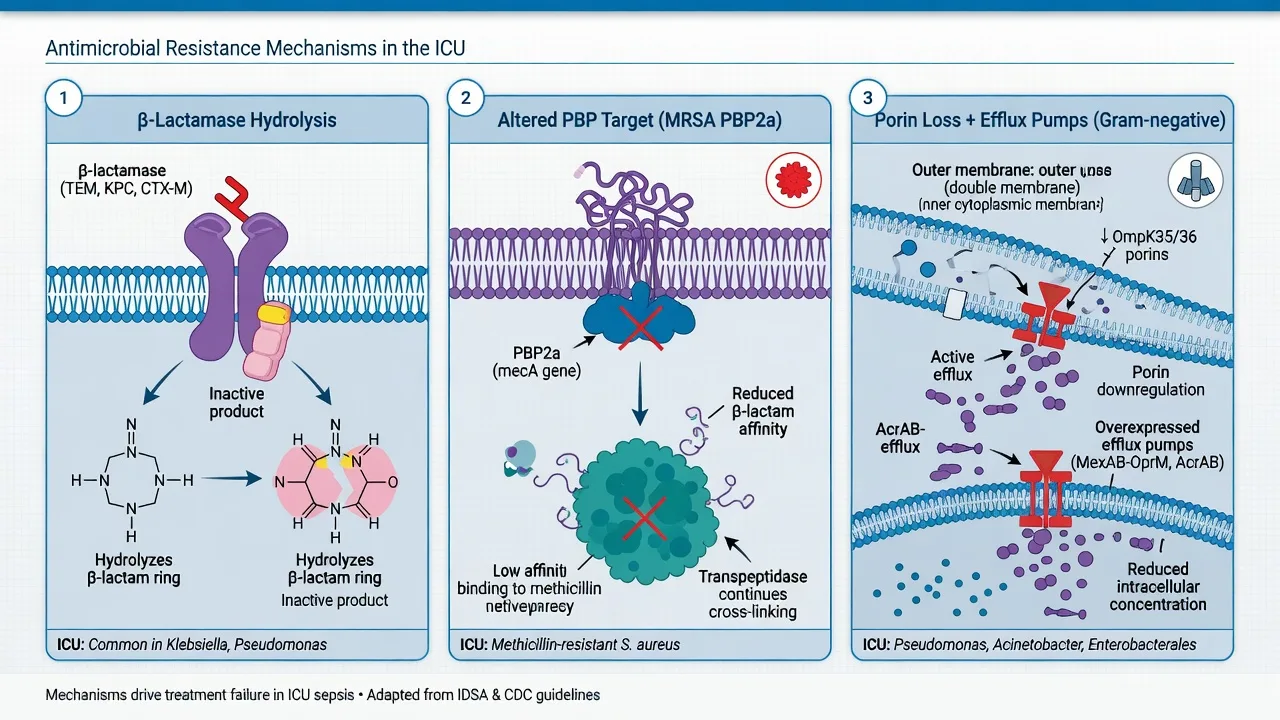
The four core ICU organisms — mechanism at a glance
| Organism | Resistance mechanism | Gene(s) | Drug classes affected | Key diagnostic clue |
|---|---|---|---|---|
| ESBL (E. coli, Klebsiella, Proteus) | Plasmid-encoded beta-lactamase that hydrolyses the oxyimino-beta-lactams = penicillins + 3rd-gen cephalosporins (ceftriaxone, ceftazidime) ± 4th-gen | bla(CTX-M), bla(TEM), bla(SHV) | Penicillins, 1st-4th gen cephalosporins; NOT carbapenems | Positive ESBL screen / ceftazidime-clavulanate synergy; co-resistant to fluoroquinolones |
| CRE (Klebsiella, E. coli, Enterobacter) | Carbapenemase enzyme destroys the carbapenem ring AND all other beta-lactams | bla(KPC), bla(NDM), bla(OXA-48), bla(VIM), bla(IMP) | ALL beta-lactams; often co-resistant to FQ, aminoglycosides | Meropenem/ertapenem non-susceptible; carbapenemase PCR/CarbaNP |
| MRSA | Altered penicillin-binding protein PBP2a with very low affinity for all beta-lactams | mecA (occasionally mecC) | ALL beta-lactams (penicillins, cephalosporins, carbapenems) | Cefoxitin screen / PBP2a latex / mecA PCR |
| VRE (usually E. faecium) | Operon replaces target terminal D-Ala-D-Ala with D-Ala-D-Lac → vancomycin cannot bind | vanA, vanB (occasionally vanD) | Glycopeptides (vancomycin, teicoplanin variable) | Vancomycin MIC >=32 mg/L; vanA/vanB PCR |
Mechanistic detail worth knowing:
- ESBLs are Ambler class A serine beta-lactamases, usually plasmid-borne — which means they spread horizontally between bacteria and frequently carry co-resistance genes (fluoroquinolones, aminoglycosides, co-trimoxazole) on the same plasmid. This is why ESBL isolates are so often multiply resistant. CTX-M has overtaken TEM/SHV as the dominant family worldwide.[3]
- Carbapenemases are classified by Ambler category: class A (KPC), class B = metallo-beta-lactamases requiring zinc at the active site (NDM, VIM, IMP — EDTA/chelators inhibit them, aztreonam is intrinsically stable), and class D (OXA-48-like). This molecular split is not academic — it dictates which novel beta-lactamase inhibitor will work.[3][4]
- MRSA: PBP2a is encoded by mecA on the SCCmec cassette. Because the transpeptidase still cross-links peptidoglycan but beta-lactams cannot inhibit it, no beta-lactam (including carbapenems) is reliable against MRSA — except the anti-MRSA cephalosporin ceftaroline, which has increased PBP2a affinity.[5]
- VRE: vanA gives inducible high-level resistance (vancomycin MIC >=32) to vancomycin and teicoplanin; vanB gives vancomycin resistance with variable teicoplanin susceptibility. E. faecium (not E. faecalis) is the usual MDR culprit.[2]
CRE carbapenemases — the single highest-yield distinction
The type of carbapenemase drives the drug choice. Get the molecular result early (PCR, CarbaNP, or matrix-assisted laser desorption for hydrolysis).[3][4]
KPC vs NDM vs OXA-48 vs MBL (VIM/IMP)
| Feature | KPC | NDM | OXA-48-like | VIM / IMP |
|---|---|---|---|---|
| Ambler class | A (serine) | B (metallo, Zn-dependent) | D (serine) | B (metallo) |
| Epidemiology | US, S. Europe, China, Americas | S. Asia (origin) → global (UK, Middle East, Balkans) | N. Africa, Turkey, Middle East, Europe | S. Europe, Greece, Asia |
| Inhibited by avibactam? | YES | NO | YES | NO |
| Inhibited by vaborbactam/relebactam? | YES | NO | NO | NO |
| Aztreonam stable? | Hydrolysed | YES — stable (MBL cannot hydrolyse) | Hydrolysed | YES — stable |
| First-line therapy | Ceftazidime-avibactam | Colistin ± meropenem ± aztreonam (or aztreonam-avibactam) | Ceftazidime-avibactam | Colistin ± meropenem ± aztreonam |
| Often co-resistant to colistin? | Variable | Frequently YES | Variable | Variable |
The exam pearl that saves lives: NDM is a metallo-beta-lactamase — avibactam does NOT inhibit it. Giving ceftazidime-avibactam monotherapy for an NDM producer is ineffective. BUT aztreonam is structurally stable to metallo-enzymes, so the combination aztreonam-avibactam works (avibactam protects aztreonam from any co-produced ESBL/AmpC, while the MBL cannot hydrolyse aztreonam).[4]
Key organisms side-by-side — what to reach for
The five ICU threats — treatment and outcomes
| Organism | Resistant to | First-line ICU therapy | Alternative / salvage | Mortality (bacteraemic) |
|---|---|---|---|---|
| ESBL Enterobacterales | Penicillins, cephalosporins | Meropenem (carbapenem) | Piptazo only if mild; ertapenem (non-critically ill) | 15-30% |
| CRE — KPC | All beta-lactams incl carbapenems | Ceftazidime-avibactam | Meropenem-vaborbactam, imipenem-relebactam, tigecycline | 40-50% |
| CRE — NDM (MBL) | All beta-lactams incl carbapenems | Colistin ± meropenem ± aztreonam (or ceftazidime-avibactam + aztreonam) | Polymyxin B, tigecycline, fosfomycin | 40-50% |
| MRSA | All beta-lactams | Vancomycin (AUC/MIC 400-600) or linezolid (pneumonia) | Daptomycin (bacteraemia/endocarditis), ceftaroline, TMP-SMX | 15-25% |
| VRE (E. faecium) | Vancomycin (vanA/B) | Linezolid or daptomycin 8-10 mg/kg | Ampicillin (if susceptible, high-dose +/- aminoglycoside), tigecycline | 20-30% |
| MDR/XDR Pseudomonas / DTR | >=3 classes / nearly all | Colistin or ceftolozane-tazobactam / ceftazidime-avibactam | Polymyxin B, cefiderocol, combination therapy | 20-40% |
| CRAB (Acinetobacter) | Carbapenems + most | Sulbactam combinations + colistin/polymyxin B | High-dose ampicillin-sulbactam + tigecycline, cefiderocol | 30-50% |
| MDR-TB | Rifampicin + isoniazid | Bedaquiline + pretomanid + linezolid (BPaL) ± moxifloxacin | Longer individualised regimens | 15-30% |
| XDR/pre-XDR-TB | MDR + (FQ or injectable) | BPaL / BPaLM; close the regimen | Clofazimine, cycloserine, para-aminosalicylate | 20-40% |
Approach to a suspected MDR infection
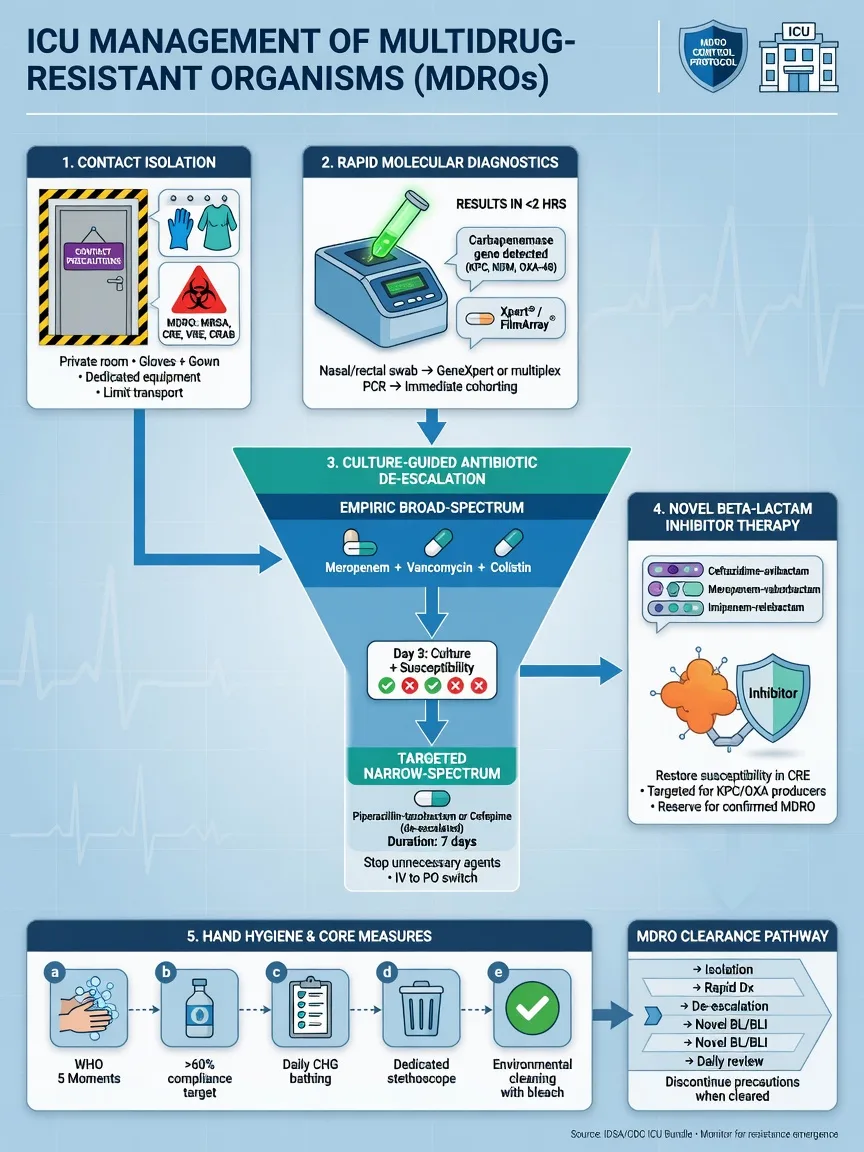
The ICU MDR pathway — empiric to targeted
- Assess RISK for resistance at the bedside, before cultures return. Independent risk factors: antibiotics in the prior 90 days, hospitalisation >=5 days (or transfer from another facility / overseas hospital), residence in a nursing home / long-term acute care, haemodialysis, home wound care or infusion, indwelling hardware/lines, immunocompromise, known prior colonisation (MRSA, ESBL, CRE, VRE). The more boxes ticked, the broader the empiric cover.[3]
- Know your LOCAL ANTIIBOGRAM. Resistance varies by ICU, unit, and country. Empiric therapy must reflect local susceptibility data (e.g., if your unit's Klebsiella is 30% ESBL, your empiric gram-negative cover for septic shock is a carbapenem).[3]
- Start EMPIRIC broad-spectrum therapy within 1 hour of sepsis recognition. For high-risk septic shock: meropenem + vancomycin (cover ESBL/CRE backbone + MRSA) ± aminoglycoside or colistin if extreme risk (known CRE, overseas transfer). Inappropriate empiric therapy independently increases mortality — get the first drug right.[3][4]
- Obtain cultures and source samples BEFORE antibiotics whenever possible (blood x2 sets, urine, sputum, wound, line tips, CSF). Add molecular resistance testing (carbapenemase PCR, MRSA nasal screen, ESBL screen). Send rectal surveillance swab if CRE suspected.
- REVIEW at 48-72 hours. When the organism, susceptibility, and carbapenemase type are known, de-escalate aggressively: narrow to the narrowest effective agent, STOP redundant cover (e.g., stop vancomycin if no MRSA), STOP if the syndrome turns out not to be infection. The single most powerful stewardship move.[3]
- Use the SHORTEST effective duration. Most ICU infections: 7 days. PCT-guided stopping (stop when procalcitonin <0.5 ng/mL or falls >=80% from peak). Longer courses drive resistance and C. difficile.Exceptions: endocarditis, undrained abscess, S. aureus bacteraemia (>=14 days).
- Optimise PK/PD for the critically ill. Increased volume of distribution (oedema, sepsis) and augmented renal clearance lower beta-lactam levels; RRT changes everything. Use extended/continuous infusions of beta-lactams (meropenem, piperacillin-tazobactam), check vancomycin AUC (not just trough), and consider TDM for beta-lactams in difficult organisms.
- Apply source control as for any infection — drain collections, remove infected lines, debride necrotic tissue. No antibiotic overcomes an undrained focus.
- Engage infection control the moment MDR is suspected (see bundle below) — do not wait for confirmation.
ESBL — Extended-Spectrum Beta-Lactamase Enterobacterales
ESBL — recognition and treatment
- Recognise the phenotype: E. coli or Klebsiella (also Proteus) non-susceptible to 3rd-generation cephalosporins (ceftriaxone, ceftazidime) — the lab will flag a suspected ESBL. Confirm with the double-disc synergy / ceftazidime-clavulanate test, or CTX-M PCR.
- First-line therapy: a CARBAPENEM (meropenem, imipenem, ertapenem). MERINO (2018) showed meropenem is preferred over piperacillin-tazobactam for ESBL E. coli/Klebsiella bacteraemia. 3rd-gen cephalosporins are unreliable even if the lab reports susceptibility — the inoculum effect (high bacterial load overwhelms the enzyme threshold) causes clinical failure.
- Where piperacillin-tazobactam MAY be acceptable: low-inoculum, non-critical infections (mild pyelonephritis, some wound infections) with documented susceptibility — but NOT for bacteraemia, severe sepsis, or high-inoculum foci (abscess, pneumonia).[3][4]
- Nitrofurantoin / oral options for simple cystitis if susceptible. TMP-SMX and fluoroquinolones often co-resistant (same plasmid) — only if susceptible.
- Duration: 7 days for most; bacteraemia with source control 7 days. PCT-guided stopping.
CRE — Carbapenem-Resistant Enterobacterales
CRE — identify the carbapenemase, then treat
- Recognise: Enterobacterales non-susceptible to a carbapenem (meropenem, imipenem, ertapenem). Ertapenem is the most sensitive screen (often first to go). Send carbapenemase identification (PCR for KPC/NDM/OXA-48/VIM/IMP, or phenotypic CarbaNP / modified carbapenem inactivation method).[3]
- If KPC (class A): first-line ceftazidime-avibactam 2.5 g IV q8h (extended infusion). Superior to colistin-based therapy (lower mortality, less nephrotoxicity). Alternatives: meropenem-vaborbactam, imipenem-cilastatin-relebactam.[4]
- If NDM / VIM / IMP (metallo-beta-lactamase, class B): avibactam and vaborbactam do NOT inhibit MBLs. Use colistin (or polymyxin B) ± meropenem ± aztreonam. The rational modern combination is aztreonam + avibactam (avibactam shields aztreonam from co-produced ESBL/AmpC; the MBL cannot hydrolyse aztreonam). Cefiderocol is an alternative.[4]
- If OXA-48-like (class D): ceftazidime-avibactam is active. Often co-produces ESBL.
- Combination therapy is often used for severe infection (bacteraemia, pneumonia, neutropenia): colistin + meropenem + a third active agent (tigecycline for intra-abdominal, fosfomycin for UTI). Evidence for routine combination over monotherapy of an active novel agent is debated — use combination for high-inoculum/low-clearance foci.
- Source control is critical — CRE endocarditis, abscess, infected lines need drainage/removal.
- Toxicity monitoring: colistin — nephrotoxicity (30-50%), adjust to CrCl; tigecycline — avoid in pancreatitis and as monotherapy for bacteraemia (poor serum levels); fosfomycin — sodium load, monitor for resistance.
- Duration: 7-14 days depending on focus and response; bacteraemia with source control 7-10 days.
MRSA — methicillin-resistant Staphylococcus aureus
MRSA — choose the right drug for the syndrome
- Empiric MRSA cover is added when risk factors present (prior MRSA, healthcare-associated, post-influenza, necrotising pneumonia, IV drug use, indwelling hardware, chronic skin ulcers) or per local antibiogram. Standard: vancomycin 25-30 mg/kg loading then AUC-guided.[5]
- Vancomycin — optimise exposure. Target AUC/MIC 400-600 (practical surrogate: trough 15-20 mg/L in serious infection). MIC creep (MIC >1.5 mg/L) predicts failure — switch to daptomycin (bacteraemia/endocarditis) or linezolid (pneumonia). Vancomycin is nephrotoxic with concurrent piperacillin-tazobactam — avoid that combination.[5]
- MRSA PNEUMONIA: prefer LINEZOLID (600 mg IV q12h) — superior lung penetration, no nephrotoxicity; landmark trial showed linezolid superior to vancomycin in nosocomial MRSA pneumonia. NEVER use daptomycin for pneumonia — it is inactivated by pulmonary surfactant.[5]
- MRSA BACTERAEMIA / ENDOCARDITIS: prefer DAPTOMYCIN 8-10 mg/kg IV q24h (or vancomycin). Add an adjunct (e.g., beta-lactam for synergy, or TMP-SMX) for refractory/high-inoculum endovascular infection. Transoesophageal echo, search for and remove/remove source. Echocardiogram mandatory. Minimum 14 days from first negative culture (uncomplicated); 6 weeks for endocarditis / metastatic foci.[5]
- Skin/soft-tissue, bone/joint: vancomycin, daptomycin, linezolid, or ceftaroline (anti-MRSA cephalosporin). Linezolid has excellent bone penetration but thrombocytopenia and serotonine syndrome risk >14 days and irreversible neuropathy with very prolonged use.
- Duration: pneumonia 7 days; bacteraemia >=14 days; endocarditis/osteomyelitis 6 weeks.
VRE — vancomycin-resistant Enterococcus
VRE — management
- Almost always E. faecium with vanA/vanB. Differentiate colonisation (urine, wound without inflammation) from true infection — most VRE isolated in ICU is colonisation and does NOT need treatment.
- Bacteraemia: daptomycin 8-10 mg/kg IV q24h (Enterococcus needs a HIGHER dose than Staph) — or linezolid 600 mg IV/PO q12h if susceptible. Ampicillin high-dose (2 g q4h) if the isolate is susceptible (many E. faecium are AmpC/AmpR-resistant via PBP5). Add an aminoglycoside (gentamicin/streptomycin high-level screen permitting) for synergy in endocarditis.[5]
- Linezolid — excellent oral bioavailability; monitor for thrombocytopenia (>14 days), serotonin syndrome (with SSRIs/MAOIs), peripheral/optic neuropathy, lactic acidosis.
- Daptomycin — monitor CK (myopathy); no pulmonary use.
- Newer agents for resistant VRE: oritavancin, dalbavancin (long-acting glycopeptides), tedizolid (oxazolidinone with better safety). Not first-line for ICU bacteraemia.
- Source control — remove infected lines. Duration: bacteraemia 7-14 days; endocarditis >=6 weeks.
MDR-TB and XDR-TB
MDR/XDR-TB in the ICU — principles
- DEFINITIONS (WHO): Rifampicin-resistant TB (RR-TB) — resistant to rifampicin with/without other drugs. MDR-TB — resistant to at least rifampicin AND isoniazid. pre-XDR-TB — MDR + resistant to any fluoroquinolone. XDR-TB — MDR + fluoroquinolone resistance + resistance to at least one additional Group A drug (bedaquiline OR linezolid).[6]
- The ICU rarely 'manages' the TB drugs themselves — these patients are managed jointly with TB/infectious-disease services. ICU relevance: respiratory failure (ARF requiring ventilation), massive haemoptysis, severe miliary/CNS TB, adverse drug events (QT prolongation with bedaquiline/delamanid/moxifloxacin; myelosuppression and neuropathy with linezolid; hepatotoxicity).
- Modern shorter regimens (WHO-endorsed): all-oral BPaL/BPaLM — bedaquiline + pretomanid + linezolid (± moxifloxacin), 6-9 months — far better tolerated and more effective than the old 18-24 month injectable regimens. Linezolid dose is often reduced (e.g., 600 mg daily or 300 mg) after 8-16 weeks to limit neuropathy/myelosuppression.[6]
- INFECTION CONTROL in ICU is critical — TB is AIRBORNE (acid-fast bacilli in sputum = infectious). Negative-pressure single room, N95/P2 respirator (NOT surgical mask) for staff, keep door closed. This is DROPLET/CONTACT precautions territory for the bacterial MDRs above, but AIRBORNE for TB. Notify TB/public health.
- Diagnosis: GeneXpert MTB/RIF (rifampicin resistance in ~2 h), line-probe assay (MDR + XDR probe sets), whole-genome sequencing for full resistance profile. Sputum AFB smear remains the infectivity marker.
- Prognosis: MDR-TB mortality ~15-30% globally (lower with BPaL); XDR-TB historically 20-50% but improving with newer agents. ICU mortality in MDR-TB respiratory failure is high.[6]
Infection control — the bundle that works
The MDR infection-control bundle (ESCMID/CDC)
- HAND HYGIENE — WHO '5 Moments': before patient contact, before aseptic task, after body-fluid exposure, after patient contact, after contact with patient surroundings. Alcohol-based rub is the workhorse; soap-and-water for C. difficile (spores) and visibly soiled hands. The single highest-impact, lowest-cost intervention.[2]
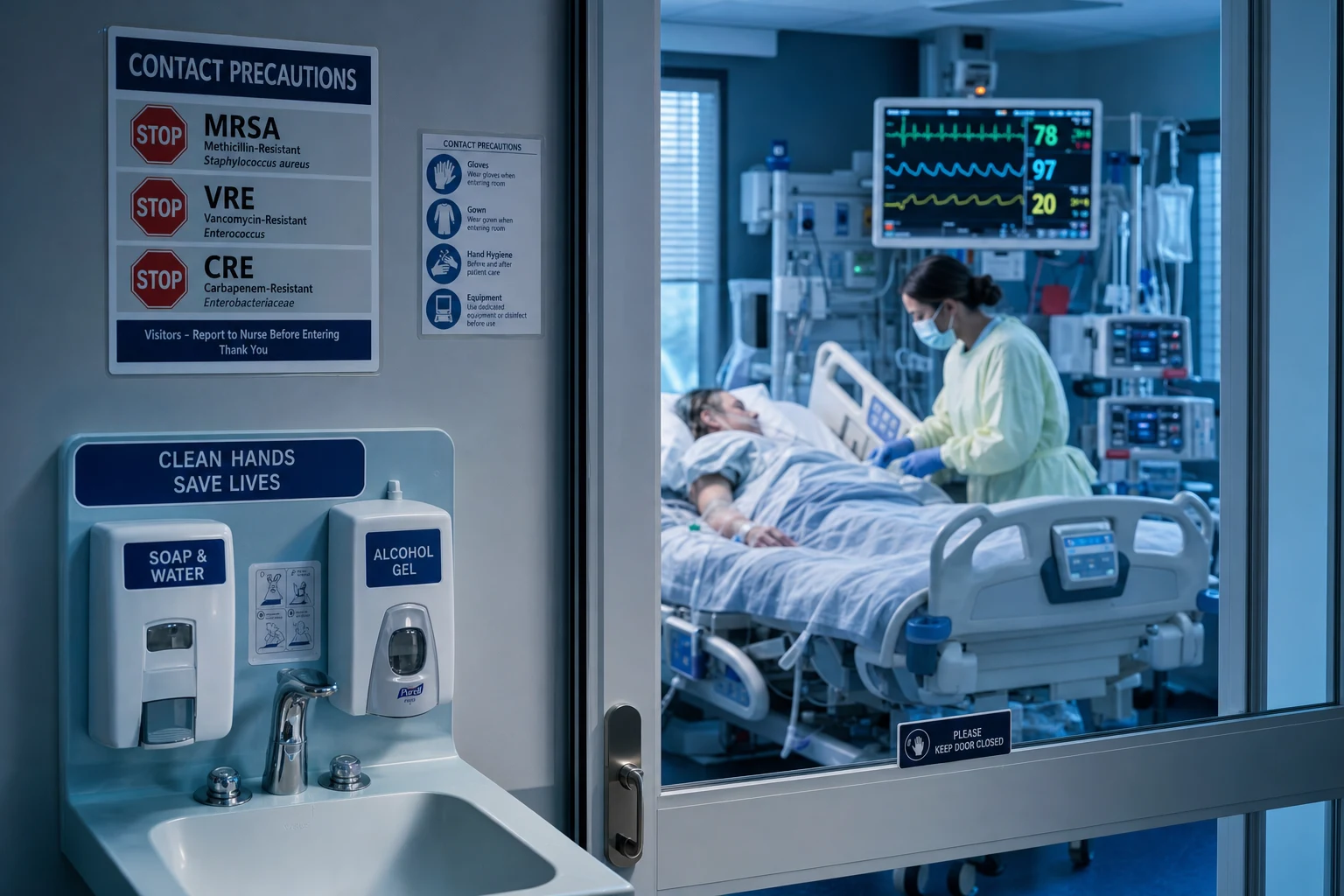
- CONTACT PRECAUTIONS for ALL MDR organisms (MRSA, VRE, ESBL, CRE, CRAB, MDR Pseudomonas, C. auris): gown + gloves on entry; dedicate non-shared equipment (stethoscope, BP cuff, thermometer).[2]
- SINGLE-ROOM ISOLATION (or cohorting): ideally a dedicated en-suite single room; if rooms are scarce, cohort patients with the same organism and same resistance profile together, with dedicated staff.[2]
- ENHANCED ENVIRONMENTAL CLEANING: chlorine-based (1000 ppm chlorine) or sporicidal disinfectant; focus on high-touch surfaces. C. auris and CRAB persist on surfaces for days-weeks — terminal cleaning (UV/hydrogen peroxide vapour) after discharge. Verify with ATP/fluorescent markers.
- ACTIVE SURVEILLANCE CULTURING of high-risk admissions (overseas transfer, known history, long-term care): MRSA nasal PCR, rectal CRE/VRE swabs, C. auris axilla/groin swab. Lets you isolate before transmission.
- ANTIMICROBIAL STEWARDSHIP — the long-game prevention: restrict broad-spectrum agents, pre-authorisation, pharmacist-led daily review, automatic stop-orders, audit-and-feedback, shortest effective duration. Reduces the selection pressure that creates MDR in the first place.
- DECOLONISATION where applicable (MRSA: chlorhexidine wash + intranasal mupirocin) before elective procedures.
- NOTIFY & COMMUNICATE on transfer — flag the record; alert the receiving facility/ward; CRE and C. auris are often reportable to public health.
- Audit and feedback — hand-hygiene compliance, isolation compliance, environmental cleaning scores. What isn't measured isn't done.
Antimicrobial stewardship — the core principles
Stewardship 'Start Smart, Then Focus' in ICU
- START SMART: right drug, right dose, right route, within 1 hour of septic shock — empiric cover must include the LIKELY organism AND its likely resistance profile (from the antibiogram).[3]
- REVIEW at 48-72 h ('Focus'): when microbiology returns — narrow (de-escalate), stop redundant agents, or stop altogether if not infection.
- SHORTEST effective duration — PCT-guided, syndrome-specific; most 7 days.
- Avoid redundant/anaerobic double-cover, avoid prolonged piptazo + vancomycin (nephrotoxicity), reserve carbapenems for true ESBL/CRE.
- Intravenous-to-oral switch when clinically improving and an oral agent with bioavailability is available (linezolid, fluoroquinolones, co-trimoxazole, metronidazole).
- Pharmacist-led daily review + infectious-disease round — embedded in the ICU multidisciplinary team. Demonstrated to reduce broad-spectrum use, resistance, and C. difficile without increasing mortality.
- Monitor the ANTIIBOGRAM annually; feed local resistance data back into empiric guidelines.
Clinical pearls
Red flags
Prognosis
Outcomes of MDR infection in ICU
| Organism / syndrome | Attributable/excess mortality vs susceptible | ICU length of stay | Key determinants of outcome |
|---|---|---|---|
| ESBL bacteraemia | ~2x mortality if inappropriate empiric therapy | Increased | Appropriate empiric therapy (carbapenem), source control |
| CRE bacteraemia | 40-50% all-cause mortality | Significantly increased | Carbapenemase type, appropriateness of therapy, source control, severity of illness |
| MRSA bacteraemia | 15-25% (with appropriate therapy) | Increased | Vancomycin MIC, endocarditis, metastatic foci, source control |
| VRE bacteraemia | 20-30% | Increased | Underlying illness (often immunocompromised/host), source removal |
| MDR Pseudomonas / DTR | 20-40% | Increased | Appropriate therapy, source control, neutropenia |
| CRAB | 30-50% | Increased | Severity, appropriateness of therapy |
| MDR-TB | 15-30% (improving with BPaL) | N/A (chronic) | Regimen adequacy, resistance pattern, HIV co-infection |
| XDR-TB | 20-50% (historically) | N/A | Availability of newer agents (bedaquiline, pretomanid), HIV |
Why MDR doubles mortality: the excess is driven by (1) inappropriate empiric therapy — the initial antibiotic misses the organism because of resistance, and each hour of delay in septic shock raises mortality; (2) more virulence/comorbidity in the affected population; (3) use of toxic salvage agents (colistin) with their own failure modes. The corollary: a good antibiogram, rapid diagnostics, and getting the first antibiotic right close most of the mortality gap.[3]
Key trials and evidence
MERINO trial (Harris PNA 2018, JAMA) — meropenem vs piperacillin-tazobactam for ESBL E. coli/Klebsiella bacteraemia
Design
Multicentre randomised non-inferiority trial; 378 patients with ESBL-producing E. coli or Klebsiella bacteraemia
Intervention
Meropenem vs piperacillin-tazobactam
Primary outcome
30-day all-cause mortality: meropenem 4% vs piperacillin-tazobactam 12% — trial STOPPED EARLY for safety (piptazo had more clinical/microbiological failure)
Clinical bottom line
Meropenem is PREFERRED for ESBL E. coli/Klebsiella bacteraemia. Piperacillin-tazobactam fails despite in-vitro susceptibility (inoculum effect). Establishes the carbapenem as standard of care for ESBL bacteraemia.
IDSA 2024 Guidance on Treatment of AMR Gram-Negative Infections (Tamma PD 2024, Clin Infect Dis)
Type
Expert guidance (living document); consolidates and updates the 2021 and 2022 guidance
Scope
ESBL-E, AmpC-E, CRE (KPC, NDM, OXA-48), DTR-Pseudomonas, CRAB, Stenotrophomonas
Key recommendations
ESBL-E: carbapenem for infection outside urinary tract. CRE-KPC: ceftazidime-avibactam, meropenem-vaborbactam, or imipenem-relebactam. CRE-MBL (NDM/VIM/IMP): ceftazidime-avibactam + aztreonam, or cefiderocol. DTR-Pseudomonas: ceftolozane-tazobactam, ceftazidime-avibactam, imipenem-cilastatin-relebactam, or cefiderocol per susceptibility.
Clinical bottom line
Defines contemporary organism-specific therapy — drives the carbapenemase-typing-first approach. Monotherapy with a novel BL/BLI is now preferred over colistin combinations for most KPC and MBL CRE when susceptible.
Lange 2019 — Management of drug-resistant tuberculosis (Lancet)
Type
Authoritative narrative review
Key points
MDR-TB = rifampicin + isoniazid resistance; XDR-TB adds fluoroquinolone + bedaquiline/linezolid resistance. Modern all-oral shorter regimens (BPaL: bedaquiline + pretomanid + linezolid) transform outcomes and tolerability vs old injectable 18-24-month regimens.
Clinical bottom line
ICU role is supportive (respiratory failure, haemoptysis, CNS TB, drug toxicity); TB therapy is specialist-led. Bedaquiline and moxifloxacin prolong QT — monitor ECG; linezolid causes neuropathy and myelosuppression with prolonged use.
Exam practice — SAQ
SAQ — CRE pneumonia and stewardship
10 minutes · 10 marks
A ventilated patient day 10 develops VAP. Prior cultures grew ESBL E. coli. New tracheal aspirate grows carbapenem-resistant Klebsiella. The unit has active CRE transmission precautions.
References
- [1]Magiorakos AP, et al. Multidrug-resistant, extensively drug-resistant and pandrug-resistant bacteria: an international expert proposal for interim standard definitions for acquired resistance Clin Microbiol Infect, 2012.PMID 21793988
- [2]Tacconelli E, et al. ESCMID guidelines for the management of the infection control measures to reduce transmission of multidrug-resistant Gram-negative bacteria in hospitalized patients Clin Microbiol Infect, 2014.PMID 24329732
- [3]Bassetti M, et al. Treatment of Infections Due to MDR Gram-Negative Bacteria Front Med (Lausanne), 2019.PMID 31041313
- [4]Tamma PD, et al. Infectious Diseases Society of America 2024 Guidance on the Treatment of Antimicrobial-Resistant Gram-Negative Infections Clin Infect Dis, 2024.PMID 39108079
- [5]Liu C, et al. Clinical practice guidelines by the infectious diseases society of america for the treatment of methicillin-resistant Staphylococcus aureus infections in adults and children Clin Infect Dis, 2011.PMID 21208910
- [6]Lange C, et al. Management of drug-resistant tuberculosis Lancet, 2019.PMID 31526739