ICU · Infection / oncology
Neutropenic Sepsis — The Golden Hour & the Antipseudomonal Beta-Lactam
Also known as Neutropenic sepsis · Febrile neutropenia · Neutropenic fever · Chemotherapy sepsis · Golden hour · Mucositis translocation · MASCC risk index · CISNE index · Piperacillin-tazobactam · Ceftazidime · Cefepime · Meropenem · G-CSF · Echinocandin · Liposomal amphotericin B · Viridans streptococcal shock syndrome · Invasive pulmonary aspergillosis · Typhlitis · Differential time to positivity
The neutropenic sepsis is the sepsis in the neutropenic patient (the neutrophils under 0.5, or the under 1.0 and the falling) — the medical emergency, the mortality up to the 20 per cent the untreated. The febrile neutropenia: the single oral temp over 38.3, or the over 38.0 sustained the 1 hour, in the neutropenic patient. The GOLDEN HOUR — the empirical broad-spectrum antipseudomonal beta-lactam (the piperacillin-tazobactam, the ceftazidime, the cefepime, the meropenem) WITHIN the 1 hour, the never wait for the cultures. The cultures from the EACH the central-line lumen PLUS the peripheral. The plus the vancomycin if the line sepsis or the MRSA colonisation or the severe. The sources: the GI mucositis translocation (the commonest), the line sites, the pneumonia, the perianal. The organisms: the Gram-positive (the coag-neg staph, the strep viridans) the commonest, the Gram-negative (the E. coli, the Pseudomonas), the fungal (the Candida, the Aspergillus) the prolonged. The persistent fever (the 3 to 5 days) — the add the antifungal (the echinocandin or the liposomal amphotericin). The G-CSF the high-risk. The line removal if the infected.
On this page & tools
Your progress
Saved locally on this device.
Target exams
Red flags
Overview & definition
The neutropenic sepsis is the sepsis in the neutropenic patient — the medical emergency. The mortality is the up to the 20 per cent the untreated. The two principles: (1) the empirical broad-spectrum antibiotic WITHIN the 1 hour (the never wait for the cultures) and (2) the cultures from the EACH the line lumen plus the peripheral (the guide the de-escalation). The "golden hour" — the time to the antibiotic is the survival-critical.[1]
The definition and the golden hour
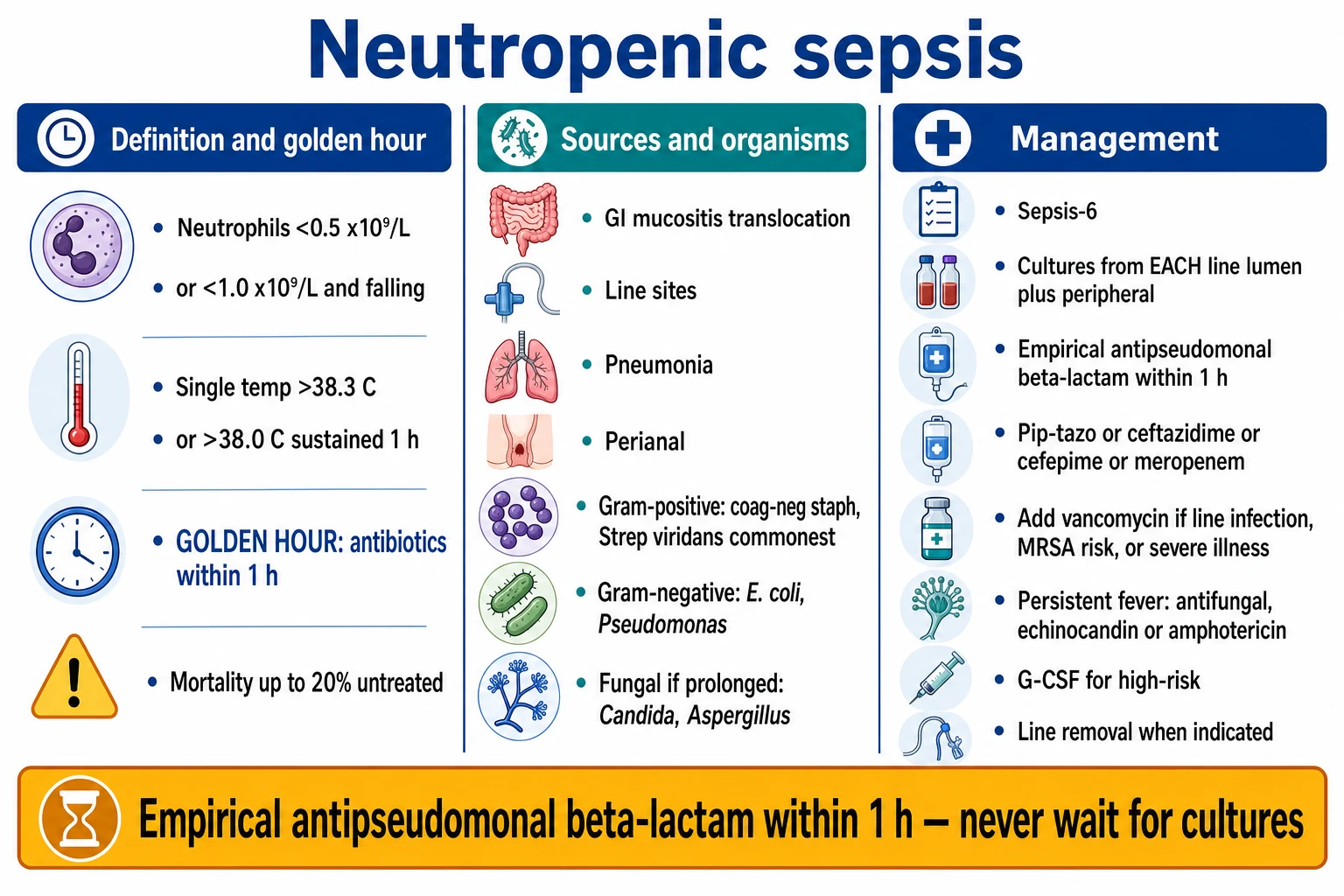
- The neutropenia — the neutrophils under 0.5 × 10⁹ per L (or the under 1.0 and the falling). The nadir typically the 7 to 14 days the post-chemotherapy.[1]
- The febrile neutropenia — the single oral temp over 38.3°C, or the over 38.0°C sustained the 1 hour, in the neutropenic patient.[1]
- The golden hour — the empirical broad-spectrum antibiotic within the 1 hour of the presentation. The never wait for the cultures (the cultures guide the de-escalation, not the empiric). The time to the antibiotic is the survival-critical (the each the hour the delay the worse the outcome).[1]
The sources and the organisms
- The sources — the GI mucositis (the chemotherapy-induced — the translocation, the commonest), the line sites, the pneumonia, the perianal, the urinary, the skin.[1]
- The Gram-positive (the commonest now) — the coagulase-negative staph (the line-related), the Staphylococcus aureus, the streptococcus viridans (the mucositis), the enterococcus.[1]
- The Gram-negative (the historical priority, the higher the mortality) — the E. coli, the Klebsiella, the Pseudomonas aeruginosa (the antipseudomonal cover the essential).[1]
- The fungal (the prolonged neutropenia, the over the 7 to 10 days) — the Candida, the Aspergillus, the Mucorales. The persistent fever despite the antibiotics → the fungal.[1]
The management
1. The sepsis-6 bundle + the cultures
- The sepsis-6 within the 1 hour — the cultures, the lactate, the IV fluids, the antibiotics, the vasopressors, the source control.[1]
- The cultures — the blood cultures from the EACH the central-line lumen PLUS the peripheral (the paired — the differential the time-to-positivity identifies the line source); the urine, the swabs (the line, the perianal, the mucositis), the sputum, the stool (the C. difficile).[1]
2. The empirical antibiotic within 1 hour
- The first-line — the antipseudomonal beta-lactam monotherapy: the piperacillin-tazobactam OR the ceftazidime OR the cefepime OR the meropenem.[1]
- The add the vancomycin (or the teicoplanin) if:[1]
- The central-line sepsis suspected (the line-site infection, the tunnel-tract).[1]
- The known the MRSA colonisation.[1]
- The severe sepsis / the septic shock.[1]
- The severe mucositis (the strep viridans risk — the ceftazidime alone the unreliable).[1]
- The recent fluoroquinolone prophylaxis (the resistant the Gram-negative).[1]
- The gentamicin sometimes the added for the severe (the Gram-negative synergy).[1]
3. The escalation / the antifungal
- The persistent fever (the over the 3 to 5 days) → the add the antifungal (the echinocandin, or the liposomal amphotericin; the voriconazole if the aspergillus suspected — the CT chest, the galactomannan).[1]
- The haemodynamically unstable → the escalate to the meropenem plus the vancomycin plus the aminoglycoside.[1]
4. The source control
- The line removal if the central-line sepsis confirmed (the tunnel infection, the septic thrombophlebitis).[1]
- The drainage of the collections, the surgical source control.[1]
5. The G-CSF
- The G-CSF (the filgrastim) — the high-risk (the prolonged neutropenia expected, the AML, the HSCT); the NOT routine. The shortens the neutropenia.[1]
Red flags
The MASCC risk index — the high-risk vs the low-risk
Not the all the febrile neutropenia the requires the ICU. The MASCC (the Multinational Association of the Supportive Care in Cancer) risk index — the validated bedside score the predicts the low-risk the febrile neutropenia (the resolution the without the serious the medical complication). The seven the weighted variables; the maximum the 26 points. The score the ≥21 → the low-risk (the sensitivity the 91 per cent, the specificity the 68 per cent).[3][2]
The MASCC risk index — the components and the weights
| The characteristic | The points |
|---|---|
| The burden of the illness — the no the symptoms or the mild the symptoms | 5 |
| The burden of the illness — the moderate the symptoms | 3 |
| The no the hypotension (the systolic the >90 mmHg) | 5 |
| The no the chronic the obstructive the pulmonary disease | 4 |
| The solid the tumour / the no the previous the fungal the infection | 4 |
| The no the dehydration | 3 |
| The outpatient the onset of the fever | 3 |
| The age the <60 the years | 2 |
- The low-risk (the MASCC the ≥21, the anticipated the neutropenia the <7 days, the clinically the stable) — the outpatient the management the may the be the appropriate (the oral the ciprofloxacin the PLUS the amoxicillin-clavulanate; the close the 24-hour the follow-up, the rescue the plan).[2]
- The high-risk (the MASCC the <21, the anticipated the profound the neutropenia the <0.5 × 10⁹ the for the >7 days, the haemodynamic the instability, the end-organ the dysfunction, the comorbidities, the inpatient the onset) — the inpatient the IV the antipseudomonal the beta-lactam.[2][4]
- The CISNE (the Clinical Index of the Stable Febrile Neutropenia) — the ECOG the ≥2, the COPD, the chronic the liver disease, the previous the fungal infection, the CRP the ≥90 mg/L — the predicts the serious the complications in the seemingly the stable; the score the ≥1 → the NOT the suitable the for the outpatient.[12]
- The pearl — the MASCC the overestimates the low-risk in the modern the cohort (the ICU the admission the rate the higher the than the predicted); the combine the MASCC with the CISNE the for the safer the triage.[12]
The pathogen map — the type of the immune defect the dictates the expected the pathogen
The single the most the useful framework: the the type of the immune defect the dictates the expected the pathogen. In the chemotherapy-induced the neutropenia the dominant the defects the are (1) the loss of the neutrophil the function (the bacteria + the Candida/Aspergillus), (2) the mucosal the barrier the breach the mucositis (the enteric the Gram-negatives, the viridans the strep, the Candida), (3) the indwelling the central the venous the catheter (the coag-neg the staph, the S. aureus, the Candida), (4) the steroid/the calcineurin-inhibitor the T-cell the defect (the Pneumocystis, the Listeria, the reactivation the HSV/VZV/CMV).[1][4]
The common the organisms — by the Gram the stain and the source
| The class | The organisms | The source / the comment |
|---|---|---|
| The Gram-positive (the commonest the now) | The coagulase-negative the staph | The line-related; the indolent; the low the mortality |
| The Staphylococcus aureus | The line / the skin; the remove the line; the high the mortality | |
| The streptococcus the viridans | The oral the mucositis; the fulminant the shock the syndrome; the ARDS | |
| The enterococcus (the VRE) | The GI; the prior the vancomycin / the cephalosporin | |
| The Gram-negative (the higher the mortality) | The Escherichia coli | The GI the translocation; the commonest the Gram-negative |
| The Klebsiella the pneumoniae | The GI; the ESBL the common | |
| The Pseudomonas the aeruginosa | The HIGHEST the mortality; the antipseudomonal the cover the mandatory | |
| The fungal (the prolonged) | The Candida | The line / the GI; the >7 days the neutropenia |
| The Aspergillus | The airway; the halo the sign; the galactomannan | |
| The Mucorales (the mucormycosis) | The sinus; the galactomannan the NEGATIVE |
The protocol — the first the six hours
The neutropenic sepsis the protocol — the first the six hours
1. The RECOGNISE — the antibiotics the within the 1 HOUR
ANY the cancer the patient the on the chemotherapy (or the within the 3 to 4 weeks) with the fever (the >38.3°C the single OR the >38.0°C ×2 the one the hour the apart) PLUS the neutrophils the <0.5 (or the <1.0 and the falling) = the NEUTROPENIC the SEPSIS. Do the NOT the attribute the fever to the tumour / the drug / the blood-product the fever the until the infection the excluded. The 1-hour the door-to-needle the target the absolute — the analogous to the STEMI. Do the NOT the wait the for the cultures, the WCC the printout, or the consultant the review.
2. The RESUSCITATE (if the septic) — the Surviving the Sepsis the Hour-1 the bundle
The oxygen the for the hypoxia; the crystalloid the 30 mL/kg the bolus the for the hypotension or the lactate the ≥2 mmol/L; the noradrenaline the first-line the vasopressor the to the MAP the ≥65 (the central the access the early); the lactate the normalisation. The standard the SSC the bundle — but the with the modified the empiric the antibiotic (the MUST the cover the Pseudomonas). The consider the intubation the early the for the fatiguing the septic the patient.
3. The CULTURES — the before the antibiotics IF the possible, the never the >1 hour the delay
The blood the cultures: the TWO the peripheral the sets PLUS the one the set the from the EACH the lumen of the any the central the venous the catheter. The paired the peripheral/line the cultures the allow the DIFFERENTIAL the TIME-TO-POSITIVITY the to the localise the line the source (the line-positive the ≥2 h the before the peripheral the suggests the CRBSI). The add: the urine the culture, the sputum the culture, the stool the + the C. difficile the toxin (if the diarrhoea), the throat/the viral the swabs, the respiratory the viral the PCR. The draw the cultures the BEFORE the antibiotics the if the does the NOT the delay the 1-hour the target.
4. The EMPIRIC the ANTIBIOTIC — the antipseudomonal the beta-lactam
The piperacillin-tazobactam the 4.5 g IV the q6h (the first-line); the OR the cefepime the 2 g the q8h; the OR the ceftazidime the 2 g the q8h; the OR the meropenem the 1 g the q8h (if the prior the resistance, the ESBL, the severe the sepsis). The ADD the vancomycin the 15-20 mg/kg the q12h the if the line the sepsis, the mucositis, the shock, the MRSA, the severe the pneumonia, the prior the fluoroquinolone the prophylaxis. The gentamicin the for the synergistic the Gram-negative the cover in the shock.
5. The EXAMINE the + the imaging
The full the examination the INCLUDING the oral the cavity (the mucositis), the perianal the region (the cellulitis / the abscess — the gentle, the NO the digital the rectal the exam in the neutropenia), the line the sites, the skin. The chest the X-ray; the high-resolution the CT the chest the if the respiratory the signs (the halo the sign — the aspergillus). The bedside the ultrasound the for the source the control.
6. The REASSESS the + the DE-ESCALATE
The daily the review. The narrow the once the organism + the susceptibility the known (the typically the 48-72 h). The STOP the vancomycin the at the 48 h the if the no the Gram-positive the isolated. The continue the broad the cover the if the febrile + the neutropenic. The add the antifungal the if the fever the persists the >4-7 days (the see the below). The G-CSF the for the high-risk the only.
The empiric the antibiotic the choice — the antipseudomonal the agents the compared
The empiric the antipseudomonal the beta-lactams — the choose and the defend
| The agent | The dose | The coverage | The when the to the choose | The caveats |
|---|---|---|---|---|
| The piperacillin-tazobactam | 4.5 g IV the q6h | The Gram-positive + the Gram-negative + the Pseudomonas + the anaerobes | The first-line the default | The sodium the load; the VRE the risk; the cholestatic the hepatitis |
| The cefepime | 2 g IV the q8h | The Gram-positive + the Gram-negative + the Pseudomonas | The allergy / the VRE the concern | The NO the anaerobic the cover; the neurotoxicity (the encephalopathy) |
| The ceftazidime | 2 g IV the q8h | The Gram-negative + the Pseudomonas | The alternative | The weak the Gram-positive; the unreliable the for the viridans the strep |
| The meropenem | 1 g IV the q8h | The broadest; the ESBL; the anaerobes | The ESBL / the prior the resistance / the severe the sepsis | The seizure the threshold; the selection the pressure; the VRE |
| The NEVER the ceftriaxone | — | The NO the Pseudomonas | The NEVER the in the neutropenic the sepsis | The untreated the Pseudomonas → the death |
- The the monotherapy the adequate in the most — the meta-analyses the no the advantage the of the dual the Gram-negative the cover.[1]
- The the add the vancomycin (or the teicoplanin) the only the for the specific the indications (the line, the mucositis, the shock, the MRSA, the severe the pneumonia) — the NOT the routine; the STOP the at the 48 h the if the not the indicated.[1]
- The the aminoglycoside (the gentamicin / the amikacin) the for the synergistic the Gram-negative the cover in the septic the shock — the once-daily; the monitor the levels + the renal the function; the nephrotoxicity.[1]
- The the fluoroquinolone the prophylaxis (the ciprofloxacin / the levofloxacin) the in the high-risk → the resist the Gram-negatives → the choose the meropenem.[4]
The empiric the antifungal the strategy — the persistent the fever (the day the 4 to 7)
If the fever the persists the beyond the 72 to 96 hours of the appropriate the broad-spectrum the antibacterials in the high-risk the neutropenic the patient, the working the diagnosis the shifts to the the invasive the fungal the infection (the IFI). The probability the rises the steeply the with the neutropenia the duration: the by the day the 14 of the profound the neutropenia, the over the 50 per cent of the persistently the febrile the patients the have the mould or the yeast the disease.[5][8]
The persistent-fever the antifungal the decision the pathway (the days the 3 to 7+)
The DAY the 3-4 — the re-investigate
The re-examine; the repeat the blood, the urine and the line the cultures. The send the serum the galactomannan (the Aspergillus) and the (1→3)-β-D-glucan (the pan-fungal). The perform the high-resolution the CT the chest (+ the CT the sinuses/abdomen the guided the by the symptoms). The look the for: the halo the sign, the nodules, the reversed-halo (the mould); the hepatosplenic the lesions (the chronic the disseminated the candidiasis); the sinus the opacification (the mucormycosis/the Aspergillus).
The DAY the 4-7 — the add the empiric the antifungal (the two the valid the strategies)
The ECHINOCANDIN (the caspofungin the 70 mg the day the 1 → the 50 mg/day; the micafungin the 100 mg/day; the anidulafungin the 200 mg → the 100 mg/day) — the first-line the if the concern the is the primarily the Candida, the renal the impairment, or the as the diagnostic-driven the holding; the excellent the Candida the cover, the low the toxicity, the weak the mould the activity. The LIPID the AMPHOTERICIN the B (the 3 mg/kg/day) — the default the if the already the on the mould-active the azole and the breakthrough the suspected, or the mucormycosis the in the differential; the broader (the Aspergillus, the Mucorales).
The if the Aspergillus the documented — the switch the to the mould-active the azole
The voriconazole the 6 mg/kg the BD ×2 the then the 4 mg/kg the BD (the first-line the since the Herbrecht the 2002 NEJM — the survival the benefit the vs the amphotericin); the OR the isavuconazole the 200 mg the q8h ×6 the then the 200 mg/day. The requires the therapeutic the drug the monitoring (the voriconazole the trough the 1-5 mg/L) and the CYP2C19 the polymorphism/the interaction the checks. The treat the for the ≥6-12 the weeks.
The if the mucormycosis — the liposomal the amphotericin the B + the surgical the debridement
The liposomal the amphotericin the B the 5-10 mg/kg/day; the early the aggressive the surgical the debridement; the reverse the immunosuppression the if the possible. The galactomannan AND the β-D-glucan the BOTH the NEGATIVE. The mortality the 50-80 per cent the if the debridement the delayed.
The empiric the antifungal the agents — the choose and the defend
| The agent | The dose | The spectrum | The when | The caveats |
|---|---|---|---|---|
| The caspofungin | 70 mg → 50 mg/day | The Candida (the weak the mould) | The first-line the empiric; the renal the impairment | TheNOT the mucor |
| The micafungin | 100 mg/day | The Candida | The alternative the echinocandin | The same the class |
| The liposomal the amphotericin the B | 3 mg/kg/day | The Candida + the Aspergillus + the Mucorales | The broad; the mucormycosis | The nephrotoxicity; the infusion the reaction |
| The voriconazole | 6→4 mg/kg the BD | The Aspergillus (the NOT the mucor) | The documented the aspergillosis | The TDM; the CYP2C19; the hepatotoxicity |
| The isavuconazole | 200 mg the daily | The Aspergillus + the Mucorales | The mould + the mucor | The QT the shortening; the less the hepatotoxic |
The G-CSF — the controversy
The G-CSF (the filgrastim the 5 mcg/kg/day the SC; the pegfilgrastim the 6 mg the SC the once the per the cycle; the lenograstim) the stimulates the myeloid the progenitor the proliferation, the shortening the neutropenic the nadir. The ASCO the position:[9][11]
- The the primary the prophylaxis the when the expected the febrile-neutropenia the risk the ≥20 per cent (the regimen, the age the >65, the extensive the disease, the prior the chemo/radiation, the poor the performance the status, the pre-existing the neutropenia, the renal/the liver the dysfunction, the HIV). The reduces the febrile the neutropenia the by the ~46 per cent and the infection-related the mortality the by the ~40 per cent.[11]
- The the secondary the prophylaxis the to the maintain the dose-intensity the in the curative the therapy.
- The the therapeutic the G-CSF the NOT the routine the for the established the febrile the neutropenia — the no the consistent the mortality the benefit; the reserved the for the high-risk (the profound the prolonged the neutropenia, the pneumonia, the invasive the fungal, the septic the shock).[9]
- The the caveats — the NOT the in the concurrent the chemoradiation (the pneumonitis); the NOT the in the AML the induction the (the no the benefit, the possible the harm); the splenic the rupture (the rare); the respiratory the distress.[9]
The duration of the therapy
- The the documented the infection — the complete the standard the course (the 7-14 the days the for the bacteraemia; the longer the for the endocarditis, the osteomyelitis, the fungal).
- The the unexplained the fever (the culture-negative) — the continue the until (a) the afebrile the ≥48 h, (b) the cultures the negative, (c) the ANC the >500 the cells/μL the AND the clinically the stable.[1]
- The the persistent the fever the despite the ANC the recovery — the stop the at the day the 5-7 the if the recovering; the NOT the treat the fever the alone the indefinitely.
- The the oral the step-down (the ciprofloxacin + the amoxicillin-clavulanate) the for the low-risk, the culture-negative, the afebrile, the ANC the rising.[2]
- The the switch the to the mould-active the azole the for the documented the mould; the 6-12 the weeks the minimum.[5]
The special the clinical the scenarios
The HSCT (the stem-cell the transplant) — the infectious the threats the by the phase
The HSCT the infectious the timeline
| The phase | The defect | The threats |
|---|---|---|
| The pre-engraftment (the 0-30 the days) | The profound the neutropenia + the mucositis | The Gram-negative, the strep the viridans, the Candida, the HSV |
| The post-engraftment (the 30-100 the days) | The cellular + the humoral the defect | The CMV, the Pneumocystis, the Aspergillus |
| The late (the >100 the days) | The chronic the GVHD | The encapsulated the bacteria, the VZV, the CMV |
The neutropenic the enterocolitis (the typhlitis)
The the typhlitis — the neutropenic the enterocolitis the of the caecum (the right the iliac the fossa the pain, the fever, the bloody the diarrhoea, the distension). The imaging: the CT — the bowel-wall the thickening, the pneumatosis. The management: the bowel the rest, the NG the decompression, the broad-spectrum the antipseudomonal + the anaerobic the cover (the piperacillin-tazobactam the ideal), the G-CSF, the NO the surgery the unless the perforation.[1]
The CAR-T the recipient — the CRS the vs the infection
The CAR-T the recipient the with the fever the may the have the CRS the Grade the 1, but the CRS and the infection the coexist. The run the full the 1-hour the neutropenic-sepsis the pathway (the cultures + the empiric the antipseudomonal the antibiotics) the BEFORE the attributing the fever the to the CRS. The tocilizumab the for the CRS the can the be the given the alongside the antibiotics; the steroids the MUST the NOT the be the given the without the concurrent the antibiotics.[1]
The antimicrobial the prophylaxis
The prophylaxis the dictated the by the the expected the depth and the duration of the neutropenia and the specific the immune the defect.[4]
- The the bacterial — the fluoroquinolone (the ciprofloxacin / the levofloxacin) the for the high-risk the prolonged the neutropenia (the AML, the MDS, the HSCT); the reduces the Gram-negative the bacteraemia.[4]
- The the antifungal — the posaconazole (the mould-active) the for the AML/the HSCT the GVHD; the fluconazole the for the standard-risk; the reduces the invasive the candidiasis.[5]
- The the antiviral — the aciclovir / the valaciclovir the for the HSV/VZV the seropositive; the hepatitis the B the reactivation the prophylaxis.
- The the Pneumocystis (the PCP) — the co-trimoxazole (the TMP-SMX) the for the HSCT, the steroid the ≥20 mg the for the >4 the weeks; the dapsone / the atovaquone the if the sulfa-the-allergic.
- The the caveat — the fluoroquinolone the prophylaxis the drives the resistance → the choose the meropenem the empirically.[4]
Short-answer questions
SAQ — Febrile neutropenia with septic shock and ARDS (viridans streptococcal shock syndrome)
10 minutes · 10 marks
A 47-year-old man with newly diagnosed AML is day 10 of 7+3 induction (cytarabine + daunorubicin) with grade 3 oral mucositis. He presents with rigors, fever 39.5 degrees C, confusion and dyspnoea. Neutrophils 0.08 x10^9/L, platelets 19, lactate 5.2 mmol/L, MAP 49 mmHg, HR 138, RR 34, SpO2 88% on room air with bilateral infiltrates on chest X-ray. He has a tunnelled central line and is on levofloxacin prophylaxis. Blood cultures are being drawn.
SAQ — Persistent fever despite broad-spectrum antibiotics: invasive pulmonary aspergillosis
10 minutes · 10 marks
A 61-year-old woman with relapsed AML is day 18 of re-induction chemotherapy. Her ANC has been below 0.1 x10^9/L for 12 days. She has received meropenem 1 g q8h plus vancomycin for 5 days for a febrile-neutropenia episode (blood cultures negative). Fever persists at 38.9 degrees C. She now develops pleuritic chest pain and a dry cough; SpO2 93% on room air. She is on fluconazole 400 mg daily prophylaxis. HRCT chest shows multiple nodules with halo signs. Serum galactomannan index 5.8 (positive).
Clinical pearls
Red flags
The key the trials and the evidence
The IDSA the 2011 — the antimicrobial the agents the in the neutropenic the cancer the patient (PMID the 21258094)
The source
Freifeld AG, Bow EJ, Sepkowitz KA, et al. Clinical Infectious Diseases 2011;52(2):e56-93 — the IDSA the clinical the practice the guideline
The key the principle 1
The empiric the antipseudomonal the beta-lactam the WITHIN the 1 hour — the piperacillin-tazobactam, the cefepime, the ceftazidime, the meropenem the all the acceptable
The key the principle 2
The add the vancomycin the ONLY the for the specific the indications (the line, the mucositis, the shock, the MRSA, the severe the pneumonia) — the NOT the routine
The key the principle 3
The persistent the fever → the empiric the antifungal (the caspofungin / the liposomal the amphotericin the B); the daily the review; the de-escalate the at the 48-72 h
The ASCO/IDSA the 2018 — the outpatient the management (PMID the 29461916)
The source
Taplitz RA, Kennedy EB, Bow EJ, et al. Journal of Clinical Oncology 2018;36(14):1443-1453 — the joint the ASCO/IDSA the update
The key the principle
The clinical the evaluation (the MASCC/the CISNE) the identifies the low-risk the for the outpatient the oral the therapy
The risk the stratification
The MASCC the ≥21 or the CISNE the 0 the with the close the follow-up → the oral the ciprofloxacin + the amoxicillin-clavulanate; the high-risk → the inpatient the IV
The Klastersky the 2013 — the MASCC the risk the index the 10-year the validation (PMID the 23443617)
The source
Klastersky J, Paesmans M. Supportive Care in Cancer 2013;21(5):1483-1491
The key the result
The MASCC the ≥21 the identified the low-risk the with the sensitivity the ~91 per cent and the specificity the ~68 per cent; the validated the in the 1000+ the episodes
The clinical the bottom the line
The bedside the score the to the triage the low-risk the for the outpatient; the combine the with the CISNE the for the safer the selection
The Herbrecht the 2002 NEJM — the voriconazole the vs the amphotericin the B (PMID the 12167683)
The source
New England Journal of Medicine 2002;347:408-415 — the definitive the randomised the trial the in the primary the invasive the aspergillosis
The design
The randomised the open-label: the voriconazole the vs the amphotericin the B the deoxycholate
The population
277 the patients the with the definite/probable the invasive the aspergillosis (the largely the haematological the malignancy, the neutropenia, the HSCT)
The key the result
The voriconazole the superior: the better the survival (the 71 per cent the vs the 58 per cent), the fewer the severe the reactions — the standard the first-line the for the aspergillosis
The Walsh the 2004 NEJM — the caspofungin the vs the liposomal the amphotericin the B (PMID the 15459300)
The source
Walsh TJ, Teppler H, Donowitz GR, et al. New England Journal of Medicine 2004;351:1391-1402
The design
The randomised the double-blind the non-inferiority: the caspofungin the vs the liposomal the amphotericin the B the in the persistent the febrile the neutropenia
The population
1,095 the patients the with the febrile the neutropenia the persisting the >96 h the on the broad-spectrum the antibiotics
The key the result
The caspofungin the non-inferior, the LESS the toxicity (the nephrotoxicity), the less the infusion-related — the echinocandin the as the empiric the antifungal the standard
The Kuderer the 2007 JCO — the G-CSF the primary the prophylaxis (PMID the 17634496)
The source
Kuderer NM, Dale DC, Crawford J, Lyman GH. Journal of Clinical Oncology 2007;25(21):3158-3167
The design
The systematic the review the of the 17 the randomised the trials (the n > the 3,000) the of the primary the prophylactic the G-CSF the in the chemotherapy
The key the result
The G-CSF the prophylaxis the reduced the febrile the neutropenia the by the ~46 per cent and the early (the infection-related) the mortality the by the ~40 per cent the in the overall the cohort
The Carmona-Bayonas the 2015 JCO — the CISNE the validation (PMID the 25559804)
The source
Carmona-Bayonas A, et al. Journal of Clinical Oncology 2015;33(5):466-472
The key the result
The CISNE the (the ECOG the ≥2, the COPD, the chronic the liver, the prior the fungal, the CRP the ≥90) the predicted the serious the complications the in the seemingly the stable; the score the ≥1 → the NOT the suitable the for the outpatient
The clinical the bottom the line
The MASCC the overestimates the low-risk the in the modern the cohort; the CISNE the the safer the complement
The prognosis
The neutropenic the sepsis the outcomes
| The factor | The mortality | The notes |
|---|---|---|
| The overall the febrile the neutropenia | the 5-10 per cent | The modern the era, the early the antibiotics |
| The septic the shock | the 30-50 per cent | The Pseudomonas, the viridans the shock |
| The invasive the aspergillosis | the 30-60 per cent | The higher the if the delayed the diagnosis |
| The mucormycosis | the 50-80 per cent | The debridement-dependent |
| The MASCC the low-risk | the <5 per cent | The outpatient the eligible |
The summary — the exam the one-liners
- The neutrophils the <0.5 the plus the fever the >38.3 = the neutropenic the sepsis → the empiric the antipseudomonal the beta-lactam the WITHIN the 1 hour (the piperacillin-tazobactam the first-line; the meropenem the if the prophylaxis/the resistance). The NEVER the ceftriaxone.[1]
- The Pseudomonas the is the #1 the killer — the antipseudomonal the cover the mandatory and the non-negotiable.[1]
- The cultures the from the EACH the central-line the lumen the PLUS the peripheral — the differential the time-to-positivity the for the CRBSI.[1]
- The add the vancomycin the if the line / the mucositis / the shock / the MRSA — the NOT the routine; the stop the at the 48 h.[1]
- The persistent the fever the >4-7 the days = the invasive the fungal → the caspofungin or the liposomal the amphotericin the B; the CT the chest + the galactomannan.[8]
- The MASCC the ≥21 = the low-risk (the oral the ciprofloxacin + the amoxicillin-clavulanate); the <21 = the high-risk (the inpatient the IV).[3]
- The G-CSF the primary the prophylaxis the if the regimen the risk the ≥20 per cent; the therapeutic the NOT the routine.[11]
- The remove the line the for the S. aureus / the Pseudomonas / the Candida / the persistent the bacteraemia / the tunnel the infection.[1]
References
- [1]Freifeld AG, Bow EJ, Sepkowitz KA, Boeckh MJ, et al. Clinical practice guideline for the use of antimicrobial agents in neutropenic patients with cancer: 2010 update by the infectious diseases society of america Clin Infect Dis, 2011.PMID 21258094
- [2]Taplitz RA, Kennedy EB, Bow EJ, et al. Outpatient Management of Fever and Neutropenia in Adults Treated for Malignancy: American Society of Clinical Oncology and Infectious Diseases Society of America Clinical Practice Guideline Update J Clin Oncol, 2018.PMID 29461916
- [3]Klastersky J, Paesmans M. The Multinational Association for Supportive Care in Cancer (MASCC) risk index score: 10 years of use for identifying low-risk febrile neutropenic cancer patients Support Care Cancer, 2013.PMID 23443617
- [4]Flowers CR, Seidenfeld J, Bow EJ, et al. Antimicrobial prophylaxis and outpatient management of fever and neutropenia in adults treated for malignancy: American Society of Clinical Oncology clinical practice guideline J Clin Oncol, 2013.PMID 23319691
- [5]Patterson TF, Thompson GR 3rd, Denning DW, et al. Practice Guidelines for the Diagnosis and Management of Aspergillosis: 2016 Update by the Infectious Diseases Society of America Clin Infect Dis, 2016.PMID 27365388
- [6]Pappas PG, Kauffman CA, Andes DR, et al. Clinical Practice Guideline for the Management of Candidiasis: 2016 Update by the Infectious Diseases Society of America Clin Infect Dis, 2016.PMID 26679628
- [7]Herbrecht R, Denning DW, Patterson TF, et al. Voriconazole versus amphotericin B for primary therapy of invasive aspergillosis N Engl J Med, 2002.PMID 12167683
- [8]Walsh TJ, Teppler H, Donowitz GR, et al. Caspofungin versus liposomal amphotericin B for empirical antifungal therapy in patients with persistent fever and neutropenia N Engl J Med, 2004.PMID 15459300
- [9]Smith TJ, Bohlke K, Lyman GH, et al. Recommendations for the Use of WBC Growth Factors: American Society of Clinical Oncology Clinical Practice Guideline Update J Clin Oncol, 2015.PMID 26169616
- [10]Bohlius J, Herbst C, Reiser M, et al. Granulopoiesis-stimulating factors to prevent adverse effects in the treatment of malignant lymphoma Cochrane Database Syst Rev, 2008.PMID 18843642
- [11]Kuderer NM, Dale DC, Crawford J, Lyman GH. Impact of primary prophylaxis with granulocyte colony-stimulating factor on febrile neutropenia and mortality in adult cancer patients receiving chemotherapy: a systematic review J Clin Oncol, 2007.PMID 17634496
- [12]Carmona-Bayonas A, Jimenez-Fonseca P, Virizuela Echaburu J, et al. Prediction of serious complications in patients with seemingly stable febrile neutropenia: validation of the Clinical Index of Stable Febrile Neutropenia in a prospective cohort of patients from the FINITE study J Clin Oncol, 2015.PMID 25559804