ICU · Infection / surgical
Source Control — The Fourth Pillar of Sepsis (Drainage, Debridement, Device)
Also known as Source control · The 4 tenets · Drainage · Debridement · Device removal · Definitive repair · Percutaneous drainage · Step-up approach · Infected necrosis · Source control before antibiotics fade
The source control is the all the physical measures undertaken in the infected patient to the eliminate the source of the micro-organisms, the reduce the bacterial inoculum, and the restore the organ function — the a CORE pillar of the sepsis the alongside the antibiotics and the resuscitation. The four tenets: the drainage (the abscess, the empyema), the debridement (the necrotic tissue), the device removal (the infected central line, the catheter, the prosthetic), and the definitive repair (the perforation closure, the obstruction relief). The timing: the EARLY (the within the 6 to 12 hours for the severe; the delayed the worsens the mortality) — the 'source control before the antibiotics fade'. The modalities: the IR percutaneous (the first-line for the accessible abscesses), the surgical (the laparotomy, the debridement), the endoscopic (the ERCP for the cholangitis), the step-up (the drain then the necrosectomy). The indications: the drainable collection, the perforation, the leak, the ischaemia, the necrotic tissue, the infected device, the obstructive infection. The NOT for the diffuse (the cellulitis, the pneumonia the without the empyema). The persistent sepsis — the re-image plus the re-intervene.
On this page & tools
Your progress
Saved locally on this device.
8 MCQs with explanations
Target exams
Overview & definition
The source control is the all the physical measures undertaken in the infected patient to the eliminate the source of the micro-organisms, the reduce the bacterial inoculum at the source, and the restore the function of the affected organ. It is the core pillar of the sepsis the alongside the antibiotics and the resuscitation. The antibiotics alone cannot the clear the intra-abdominal or the device infection without the source control — the "source control before the antibiotics fade".[1]

The four tenets
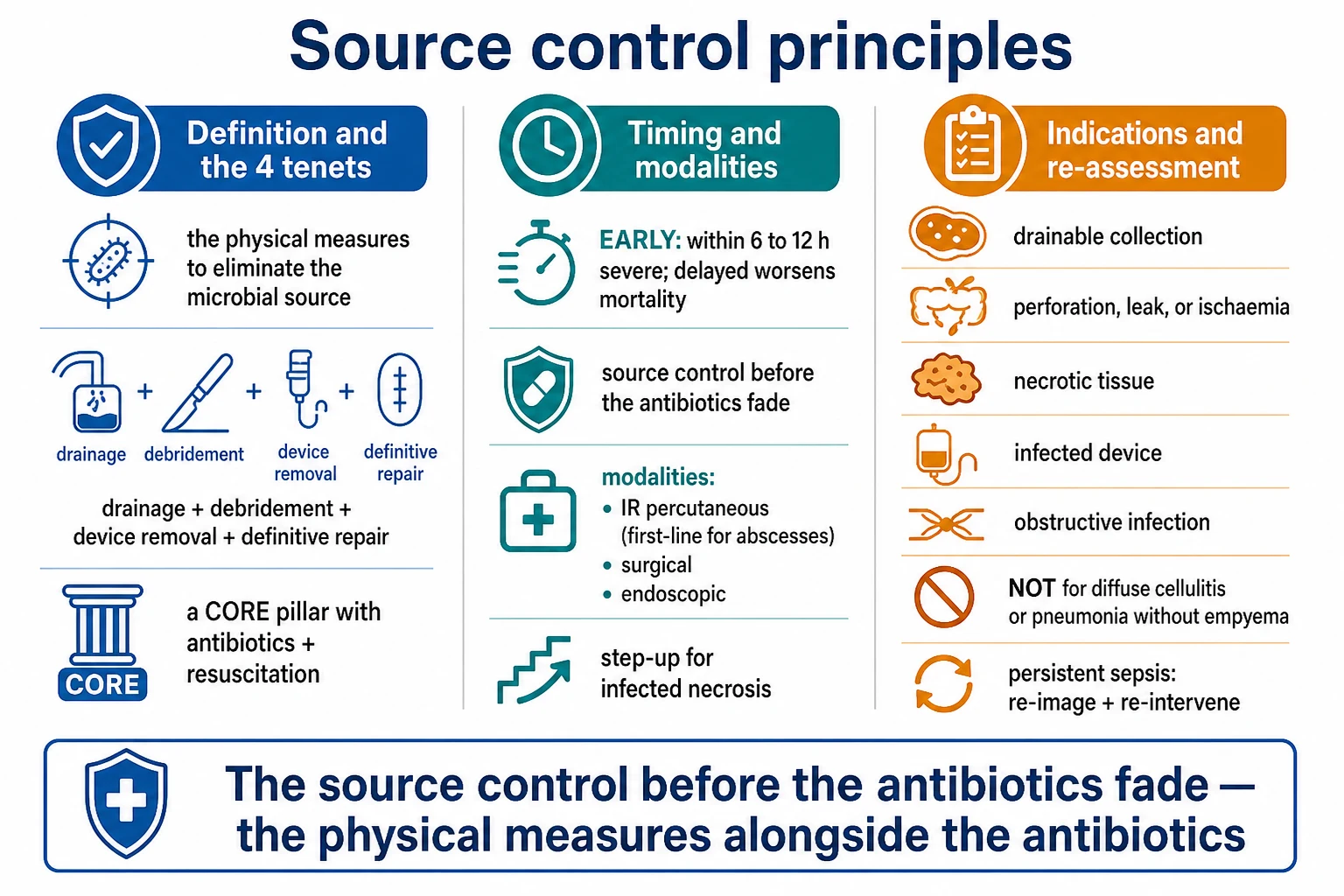
- The drainage — of the infected fluid collections (the abscess, the empyema, the septic arthritis, the infected collection). The percutaneous (the IR) or the surgical.[1]
- The debridement — of the necrotic or the infected tissue (the necrotising fasciitis, the Fournier gangrene, the infected pancreatic necrosis, the mediastinitis).[1]
- The device removal — of the infected foreign body (the central-line — the CRBSI, the urinary catheter, the prosthetic material, the mesh, the vascular graft).[1]
- The definitive repair / the restoration — of the source (the perforation closure, the obstruction relief, the anastomotic leak, the biliary drainage).[1]
The timing — the early source control
- The early source control is the survival-critical. The Surviving Sepsis: the achieve the adequate source control the ASAP (the within the 6 to 12 hours for the severe). The each the hour the delay the worse the outcome.[1]
- The "source control before the antibiotics fade" — the source matters more than the duration of the antibiotics. The antibiotics without the source control the fail in the localised infection.[1]
- The balance the source control vs the physiological stability — the damage-control for the physiological extremis (the acidosis, the hypothermia, the coagulopathy); the definitive when the stable.[1]
The modalities
- The IR percutaneous drainage (the image-guided) — the least invasive; the first-line for the accessible collections (the intra-abdominal abscess, the pleural empyema, the psoas abscess). The drain placement under the CT or the ultrasound.[1]
- The surgical (the open) — the laparotomy for the perforation, the peritonitis, the ischaemia; the debridement for the necrotising infection. The most the aggressive; the for the diffuse or the inaccessible.[1]
- The endoscopic — the ERCP for the biliary source (the cholangitis, the obstructed bile duct), the EUS-guided drainage (the pancreatic collection, the perirectal abscess).[1]
- The step-up approach — the drain first (the percutaneous or the endoscopic) then the minimally invasive necrosectomy if the drainage fails — the for the infected pancreatic necrosis (the walled-off). The avoid the early open necrosectomy (the high the mortality).[1]
- The device removal — the central-line removal (the CRBSI), the urinary catheter change or the removal, the prosthetic removal (the explant) if the infected.[1]
The indications
- The drainable collection (the abscess, the empyema, the septic arthritis).[1]
- The perforation or the leak or the ischaemia (the peritonitis, the anastomotic leak, the mesenteric ischaemia).[1]
- The necrotic tissue (the necrotising fasciitis, the Fournier gangrene, the infected necrosis).[1]
- The infected device (the CRBSI, the infected prosthetic, the catheter).[1]
- The obstructive infection (the obstructive pyelonephritis, the cholangitis, the obstructed hollow viscus).[1]
When the source control is NOT indicated
- The diffuse infections — the cellulitis, the pneumonia (the without the empyema or the abscess), the meningitis. The antibiotics alone.[1]
- The not the amenable — the pancreatic necrosis the early (the not the walled-off — the wait the 4 weeks for the step-up).[1]
The re-assessment (the source control failure)
- The persistent sepsis (the over the 24 to 48 hours) despite the antibiotics → the reconsider the source control adequacy.[1]
- The re-image (the CT) for the undrained collection, the new collection, the ongoing leak, the ischaemia.[1]
- The re-intervene — the additional drain, the re-operation, the re-debridement, the device removal if the missed.[1]
- The "the adequate source control" — the removes the source the entirely or the reduces the microbial load the sufficiently. The perfect source control — the early, the adequate, the least the physiological the insult, with the re-assessment.[1]
Red flags
The expanded definition — the eliminate the source AND the restore the anatomy
The source control has the two the complementary the goals:[1][5]
- The eliminate the source of the contamination — the drain the pus, the remove the necrotic the tissue, the excise the infected the foreign body, the close the perforation, the relieve the obstruction. The reduces the microbial the inoculum the AT the source (the antibiotics the cannot the penetrate the pus the or the biofilm; the oxygen the cannot the reach the necrotic the tissue).
- The restore the normal the anatomy the and the physiology — the re-establish the GI the tract the continuity, the relieve the obstruction, the restore the biliary the drainage, the repair the perforation the so the ongoing the contamination the ceases. The prevents the re-infection. [1]
The source control the works the because: the antibiotics the fail the in the dead the space the and the dead the tissue (the no the blood the flow → the no the drug the delivery; the low the pH the and the hypoxia → the impaired the phagocytosis); the biofilm (the on the catheters the and the prosthetic the material) the is the 500 to 5,000 the times the less the susceptible the to the antibiotics the than the planktonic the bacteria; the the inoculum the effect (the abscess the 10⁸ to 10⁹ the CFU/mL) the overwhelms the antibiotic the pharmacodynamics. The source control the bypasses the these the problems the by the physical the removal.[1]
The principles of the source control — the four the principles
The four the operating the principles (the from the Surgical the Infection the Society the and the WSCI the guidance):[5]
- The least the invasive the effective the approach — the choose the percutaneous the drainage the over the open the surgery the when the equally the effective (the lower the morbidity, the faster the recovery). The percutaneous the drainage the first-line the for the accessible the collections; the endoscopic the (the ERCP, the EUS) the first-line the for the biliary the and the selected the pancreatic the sources.
- The definitive the procedure — the source control the must the be the adequate the at the first the attempt (the inadequate the source control the is the worse the than the none — the false the reassurance). The drains the in the right the place the and the of the right the calibre; the complete the debridement the of the all the necrotic the tissue; the remove the ALL the infected the hardware.
- The timing the appropriate the to the severity — the within the 6 to 12 the hours the for the severe; the immediate the for the necrotising the infection the and the diffuse the peritonitis; the urgent the (the within the 24 to 48 h) the for the localised the abscess the in the stable.
- The reassessment the mandatory — the reassess the at the 48 to 72 the hours (the or the sooner the if the clinically the deteriorating). The re-image the if the clinical the picture the not the improving. The inadequate the source control the is the common the cause the of the persistent the sepsis. [1]
The modality deep-dive — drainage, debridement, device, decompression, repair
1. The DRAINAGE — the percutaneous vs the surgical
The drainage the removes the infected the fluid the (the pus, the gas, the infected the effusion) the from the a the closed the space. The percutaneous the (the image-guided) the is the first-line the for the accessible the collections; the surgical the for the diffuse the peritonitis, the multiloculated the or the inaccessible the collections, the or the collections the with the solid the necrotic the debris the that the cannot the drain the through the a the catheter.[1][5]
The drain the type the matters: the pigtail (the 8-12 the Fr) the for the thin the fluid; the Malecot the or the large-bore the surgical the drain (the 24-32 the Fr) the for the thick the pus, the necrotic the debris, the blood. The larger the calibre the drains the smaller the risk the of the blockage the but the larger the discomfort. The flush the and the assess the output the daily. The drain the removal the when the output the minimal the AND the cavity the collapsed the on the imaging.[1]
2. The DEBRIDEMENT — the necrotic the tissue
The debridement the removes the necrotic the tissue the (the necrotising the fasciitis, the Fournier the gangrene, the infected the pancreatic the necrosis, the mediastinitis, the necrotising the pneumonia). The necrotic the tissue the is the avascular → the antibiotics the cannot the reach; the bacterial the load the enormous; the toxin the production the ongoing. The surgical the debridement the to the bleeding the viable the tissue — the "the washout the and the debridement the until the tissue the bleeds". The multiple the trips the to the theatre the (the second-look the at the 24 to 48 h) the for the necrotising the fasciitis.[4]
3. The DEVICE REMOVAL — the infected the foreign body
The infected the device (the central-line, the urinary the catheter, the prosthetic the valve, the joint the replacement, the vascular the graft, the mesh) the harbours the biofilm. The biofilm the renders the antibiotics the ineffective the (the 500 to 5,000 × the MIC the increase). The device the removal the IS the source control. The line the removal the for the CRBSI; the explant the (the one-stage the or the two-stage the with the antibiotic the spacer) the for the infected the prosthetic; the chronic the suppressive the antibiotics the if the not the removable.[1]
4. The DECOMPRESSION — the relief the of the obstruction
The decompression the relieves the obstructed the hollow the viscus the (the obstructive the pyelonephritis the → the percutaneous the nephrostomy; the cholangitis the → the ERCP the biliary the drainage; the bowel the obstruction the with the ischaemia the → the surgical; the diverticular the abscess the → the drainage the then the elective the resection; the perforated the viscus the → the repair). The diverting the stoma the (the loop the colostomy the or the ileostomy) the diverts the faecal the stream the to the permit the distal the healing.[5]
5. The REPAIR — the primary the anastomosis vs the stoma
The decision the for the primary the anastomosis the vs the stoma the depends the on the physiological the status the and the contamination. The primary the anastomosis the (the resection the and the join) the for the haemodynamically the stable, the minimal the contamination, the healthy the bowel. The Hartmann the procedure (the resection the + the end the colostomy) the for the unstable, the extensive the contamination, the acidosis the pH the under the 7.2 — the "the damage the control the surgery" the to the minimise the operative the time the and the second the insult.[5]
The STOP-IT trial and the antimicrobial the duration the after the source control
The STOP-IT the trial (the Sawyer the 2015 the NEJM) the established the modern the standard the for the antibiotic the duration the after the adequate the source control.[1]
- The design: the randomised the multicentre; the 518 the patients the with the complicated the intra-abdominal the infection the and the adequate the source control.
- The comparison: the ~4 the days the of the antibiotics the (the stopping the after the source the control the + the clinical the improvement) the vs the ~8 the days the (the fixed the duration).
- The result: the NO the difference the in the surgical-site the infection, the recurrent the intra-abdominal the infection, the or the mortality. The shorter the course the equivalent.
- The bottom the line: the once the adequate the source control the achieved the and the patient the clinically the improved, the 4 the days the of the antibiotics the suffice. The longer the courses the do the not the improve the outcomes the and the drive the resistance the and the C. the difficile.[1]
The duration of antibiotics the after the source control — the by the scenario
The recommended the antibiotic the duration the by the source the and the source control the status
| The scenario | The duration | The rationale / the citation |
|---|---|---|
| The complicated the intra-abdominal the infection the (the adequate the source control) | 4 days | STOP-IT — Sawyer NEJM 2015 |
| The perforated the appendicit the (the source-controlled) | 4 days | STOP-IT; the IDSA/SIS the guideline |
| The perforated the viscus the (the diffuse the peritonitis, the source-controlled) | 4 to 7 days | The SSC the 2021; the clinical the judgment |
| The intra-abdominal the abscess the (the drained) | 4 to 7 days | The until the drain the output the minimal the AND the cavity the resolved |
| The cholangitis the (the ERCP the + the stone the removal) | 4 to 7 days | The TG18 the — the shorter the if the stone the cleared |
| The empyema the (the drained) | 2 to 4 weeks | The long the course; the antibiotics the penetrate the pleural the pus the poorly |
| The necrotising the fasciitis the (the debrided) | 7 to 14 days | The until the debridements the complete the AND the clinical the recovery |
| The infected the pancreatic the necrosis the (the step-up) | 4 weeks the + | The prolonged; the until the necrosis the fully the evacuated |
| The pyelonephritis the with the obstruction the (the decompressed) | 7 to 14 days | The longer the if the bacteraemia; the shorter the if the prompt the defervescence |
| The CRBSI the (the line the removed) | 7 to 14 days | The IDSA; the from the FIRST the negative the blood the culture |
| The prosthetic the joint the infection the (the two-stage) | 6 weeks the + | The prolonged the IV the + the oral the suppressive |
The modality the comparison — the percutaneous the vs the surgical the vs the endoscopic the vs the step-up
| The modality | The invasiveness | The first-line the for | The limitations | The typical the setting |
|---|---|---|---|---|
| The percutaneous the (the image-guided) | The least | The accessible the unilocular the collections, the abscess, the empyema, the psoas | The multiloculated, the solid the debris, the coagulopathy, the interposed the bowel | The IR the suite the (the CT, the US, the fluoro) |
| The endoscopic the (the ERCP, the EUS, the cystgastrostomy) | The minimally the invasive | The biliary the source the (the cholangitis), the pancreatic the collection, the perirectal the abscess | The requires the specialist, the perforation, the pancreatitis the risk | The endoscopy the unit the / the theatre |
| The laparoscopic | The moderate | The appendicitis, the cholecystitis, the limited the peritonitis | The haemodynamic the instability, the extensive the adhesions, the severe the distension | The theatre the + the general the anaesthesia |
| The open the surgical | The most | The diffuse the peritonitis, the ischaemia, the necrotising the infection, the failed the IR, the inaccessible | The wound the complications, the adhesions, the prolonged the recovery | The theatre the + the general the anaesthesia |
| The step-up the (the drain the then the minimally the invasive the necrosectomy) | The staged | The infected the pancreatic the necrosis (the walled-off) | The requires the maturity the of the collection the (the wait the ~4 the weeks); the multiple the procedures | The IR the + the endoscopy the + the theatre |
The specific scenarios — the source control the by the site
The intra-abdominal abscess
The percutaneous the drainage the is the first-line the for the accessible the intra-abdominal the abscess the (the visceral, the peri-appendiceal, the peri-diverticular, the pelvic, the subphrenic). The drain the placement the under the CT the or the ultrasound. The drain the to the aspiration the of the pus the for the Gram the stain the and the culture the BEFORE the antibiotics.[5]
The antibiotics the empiric: the piperacillin-tazobactam the 4.5 g the IV the q6h, the OR the ceftriaxone the + the metronidazole, the OR the carbapenem the for the severe the or the ESBL-risk. The duration the 4 to 7 the days the (the after the adequate the source control). The de-escalate the at the 48 to 72 the hours the on the culture the results. The drainage the failure the (the persistent the output, the cavity the not the collapsing) the → the upsize the drain, the re-position, the or the convert the to the surgical.[5][1]
The necrotising the soft-tissue the infection (the necrotising the fasciitis, the Fournier the gangrene)
The surgical the emergency. The mortality the increases the ~10 per cent the per the hour the of the delay. The immediate the surgical the exploration the with the radical the debridement the to the viable the bleeding the tissue. The re-look the at the 24 to 48 the hours the MANDATORY (the second-look the surgery) — the repeat the until the no the further the necrosis. The empiric the broad-spectrum: the piperacillin-tazobactam the + the vancomycin the + the clindamycin (the toxin the suppression).[4]
The LRINEC the score the (the Laboratory the Risk the Indicator the for the Necrotising the Fasciitis): the CRP the ≥150, the WCC the 15-25 (1 the point) the / the >25 (2), the Hb the 11-13.5 (1) the / the <11 (2), the Na the <135, the creatinine the >141, the glucose the >10. The score the ≥6 the strongly the suggestive the of the necrotising the infection the (the positive the predictive the value the ~92 per cent). The score the <6 the does the NOT the exclude the diagnosis — the clinical the assessment the trumps.[4]
The pleural the empyema
The drainage the + the antibiotics. The stage the I the (the exudative, the free-flowing) — the chest the tube the OR the therapeutic the thoracentesis. The stage the II the (the fibrinopurulent, the loculated) — the chest the tube the + the intrapleural the tPA/DNase the (the tPA the 10 mg the + the DNase the 5 mg the BD the × the 3 the days — the MIST-2 the trial). The stage the III the (the organising) — the surgical the decortication the (the VATS the or the open). The antibiotics the 2 to 4 the weeks; the choice the by the culture the (the strep, the staph, the anaerobes, the gram-negatives).[1]
The acute the cholangitis — the biliary the source control
The ERCP the + the biliary the drainage the IS the source control the for the acute the cholangitis. The Tokyo the Guidelines the 2018 the — the severity the grading the drives the timing:[6][7]
- The mild the (the Grade the I) — the responds the to the initial the medical the therapy; the ERCP the within the 24 to 48 the hours the elective.
- The moderate the (the Grade the II) — the persists the / the recurs the on the antibiotics; the ERCP the EARLY (the within the 24 the hours).
- The severe the (the Grade the III) — the organ the dysfunction the (the hypotension, the altered the mental the state, the oliguria, the PT the INR the >1.5, the platelets the <100); the resuscitate the AND the biliary the drainage the URGENT the within the the hours the (the ERCP, the percutaneous the transhepatic the biliary the drainage the PTC, the or the surgical). [1]
The antibiotics: the piperacillin-tazobactam the first-line; the add the vancomycin the if the severe the or the VRE-risk; the carbapenem the for the severe the or the prior the MDR. The duration the 4 to 7 the days the (the shorter the if the stone the cleared the and the rapid the defervescence).[6]
The obstructive the pyelonephritis — the renal the decompression
The percutaneous the nephrostomy the OR the ureteric the stent the IS the source control the for the obstructive the pyelonephritis the with the sepsis. The emergency the decompression the within the hours. The antibiotic the penetration the poor the into the obstructed the system the → the antibiotics the alone the fail. The culture the the urine the AND the blood. The empiric the piperacillin-tazobactam the ± the aminoglycoside the for the severe. The duration the 7 to 14 the days the from the defervescence; the definitive the management the (the stone, the stricture, the tumour) the deferred the to the after the recovery.[1]
The infected the pancreatic the necrosis — the step-up approach
The PANTER the trial (the van Santvoort the 2010 the NEJM, the Besselink) — the step-up the approach the (the percutaneous the drain the first; the minimally the invasive the retroperitoneal the necrosectomy the if the drainage the fails) the superior the to the open the necrosectomy: the fewer the fistulas, the fewer the new-onset the organ the failure, the lower the major the complications. The wait the ~4 the weeks the for the demarcation the and the walling-off the before the intervention the — the early the open the necrosectomy the has the high the mortality. The antibiotics: the carbapenem the (the necrosis the often the Enterobacteriaceae the + the anaerobes; the piperacillin-tazobactam the alternative).[3]
The source control the workflow — the first the 24 the hours
The source control the protocol — the recognise the to the re-assess
1. The RECOGNISE the need for the source control
The ANY the septic the patient the → the ask the "is the there the drainable the source?" The localised the infection the (the abscess, the perforation, the ischaemia, the necrosis, the infected the device, the obstructed the viscus) the MUST the be the sought. The CT the chest/abdomen/pelvis the with the contrast the is the first-line the imaging the for the intra-abdominal the source the in the adult; the ultrasound the at the bedside the for the biliary, the renal, the pleural, the soft-tissue. Do the NOT the delay the source control the for the imaging the in the extremis the — the exploratory the laparotomy the for the peritonitis.
2. The TIMING the decision the by the severity
The severe the sepsis the / the septic the shock the + the surgical the source the → the within the 6 to 12 the hours (the SSC the 2021). The necrotising the infection the → the IMMEDIATE the (the minutes the matter; the ~10 per cent the per the hour the delay). The diffuse the peritonitis the → the emergency the laparotomy. The localised the abscess the in the stable the → the percutaneous the within the 24 to 48 the hours. The damage-control the surgery the for the physiological the extremis the (the pH the <7.2, the temp the <35°C, the INR the >1.5) — the control the bleeding, the resect, the temporary the closure, the rewarming, the correct the coagulopathy, the definitive the at the second-look.
3. The CHOOSE the modality the — the least the invasive the effective
The percutaneous the IR the first-line the for the accessible the collections. The endoscopic the (the ERCP, the EUS) the first-line the for the biliary the and the selected the pancreatic. The surgical the for the diffuse the peritonitis, the ischaemia, the necrotising the infection, the failed the IR. The step-up the for the infected the pancreatic the necrosis. The device the removal the (the CRBSI, the catheter, the prosthetic) the IS the source control. The samples the for the Gram the stain the and the culture the BEFORE the antibiotics the at the each the step.
4. The EXECUTE the definitively
The drains the large the enough, the in the correct the position, the secured. The debridement the to the viable the bleeding the tissue the — the not the a the cosmetically the tidy the wound. The complete the removal the of the infected the hardware. The repair the appropriate the to the physiological the status (the primary the anastomosis the vs the stoma). The source control the inadequate the is the worse the than the none.
5. The ANTIBIOTICS the + the RE-ASSESS the at the 48 to 72 h
The empiric the broad-spectrum the within the 1 the hour; the de-escalate the at the 48 to 72 the hours the on the cultures. The duration the 4 the days the after the adequate the source control the and the clinical the improvement (the STOP-IT). The re-image the if the not the improving the by the 48 to 72 the hours. The re-intervene the for the undrained the collection, the new the collection, the ongoing the leak, the further the necrosis. The source control the failure the is the common the cause the of the persistent the sepsis the and the death.
The persistent the sepsis the diagnostic the — the source control the failure the check-list
The RE-IMAGE the early
The CT the chest/abdomen/pelvis the with the contrast the for the occult the or the new the collection, the undrained the locule, the anastomotic the leak, the ischaemia, the progression the of the necrosis. The consider the CT the cystography the for the leak; the CT the enterography the for the small-bowel. The bedside the ultrasound the (the FAST-eQUIP, the BLUE) the for the bedside the collections, the biliary, the renal, the pleural.
The RE-CONSIDER the source
The occult the abscess the (the psoas, the deep the pelvic, the subphrenic)? The anastomotic the leak? The infected the pancreatic the necrosis the not the yet the walled-off? The line the sepsis the missed? The cholangitis the incompletely the drained? The endocarditis? The prosthetic the joint? The Candida the hepatosplenic? The intra-op the findings the review.
The RE-INTERVENE the aggressively
The additional the drains, the upsize the existing, the re-operation, the re-debridement, the device the removal the if the missed, the ERCP the for the retained the stone, the nephrostomy the for the obstructed the kidney. The early the re-intervention the reduces the mortality; the procrastination the does the not.
The RE-THINK the antibiotics
The resistant the organism? The ESBL the / the AmpC the / the carbapenemase? The Candida? The add the antifungal the if the persistent the candiduria the / the positive the biomarkers. The therapeutic the drug the monitoring the for the beta-lactams the in the critical the illness the (the increased the volume the of the distribution, the augmented the renal the clearance). The consult the ID the / the microbiology.
The RE-ASSESS the host
The immune the compromise? The unrecognised the malignancy? The malnutrition? The glycaemic the control? The source the control the may the be the adequate the but the host the overwhelmed. The palliative the re-framing the if the futility the emerges.
The high-yield the points — the 14+ the pearls
Red flags — the additional the source-control-specific
The trial the cards — the source control the evidence
The STOP-IT — the short-course the antibiotics the after the source control (PMID the 25992746)
The source
Sawyer RG, Claridge JA, Nathens AB, et al. New England Journal of Medicine 2015;372:1996-2005 — the Study to Prove the Short Course the Therapy the Is the Equivalent the to the Long Course.
The design
The randomised the non-inferiority: the 518 the adults the with the complicated the intra-abdominal the infection the and the adequate the source control. The ~4 the days (the stop the after the clinical the improvement) the vs the ~8 the days (the fixed).
The primary the outcome
The composite the of the surgical-site the infection, the recurrent the intra-abdominal the infection, the death the within the 30 the days.
The key the result
The composite the ~21.6 per cent the (the 4-day) the vs the ~22.3 per cent the (the 8-day) — the non-inferiority the met. The NO the difference the in the any the component.
The clinical the bottom the line
The once the adequate the source control the achieved the and the patient the clinically the improved, the 4 the days the of the antibiotics the suffice. The longer the courses the do the NOT the improve the outcomes the and the drive the resistance the and the C. the difficile.
The PANTER the trial — the step-up the for the infected the pancreatic the necrosis (PMID the 20410514)
The source
van Santvoort HC, Besselink MGH, Bakker OJ, et al. New England Journal of Medicine 2010;362:1491-1502 — the PAncreatitis, the Necrosectomy the v the Step-up the appRoach.
The design
The randomised the multicentre: the 88 the patients the with the suspected the or the confirmed the infected the necrotising the pancreatitis. The primary the endpoint the a the composite the of the major the complications the or the death.
The key the result
The step-up the (the percutaneous the drain the first; the minimally the invasive the retroperitoneal the necrosectomy the if the fail) the superior: the composite the primary the 35 per cent the vs the 69 per cent. The fewer the new-onset the multi-organ the failure the (the 12 per cent the vs the 40 per cent), the fewer the incisional the hernias, the fewer the diabetes. The 35 per cent the treated the with the drains the alone.
The clinical the bottom the line
The step-up the is the standard the for the infected the pancreatic the necrosis. The wait the ~4 the weeks the for the walling-off. The percutaneous the drainage the alone the sufficient the in the one-third.
The Wong the 2004 the CCM — the LRINEC the score (PMID the 15241098)
The source
Wong CH, Khin LW, Heng KS, Tan KC, Low CO. Critical Care Medicine 2004;32(7):1535-1541.
The design
The retrospective the 89 the patients the (the 45 the necrotising the fasciitis, the 299 the severe the cellulitis); the derived the score; the validated the in the prospective the 56 the patients.
The score the variables
The CRP the ≥150 (4), the WCC the 15-25 (1) the / the >25 (2), the Hb the 11-13.5 (1) the / the <11 (2), the Na the <135 (2), the creatinine the >141 (2), the glucose the >10 (1). The max the 13.
The performance
The score the ≥6: the sensitivity the ~91 per cent, the specificity the ~96 per cent, the positive the predictive the value the ~92 per cent, the negative the predictive the value the ~96 per cent.
The clinical the bottom the line
The score the ≥6 the → the surgical the exploration the. The score the <6 the does the NOT the exclude — the clinical the signs the (the pain the out the of the proportion, the rapid the spread, the systemic the toxicity) the trumps the score. The modern the validation the studies the lower the sensitivity — the caution the over-reliance.
The Surviving the Sepsis the Campaign the 2021 — the source control the recommendation (PMID the 34605781)
The source
Evans L, Rhodes A, Alhazzani W, et al. Critical Care Medicine 2021;49(11):e1063-e1143 — the Surviving Sepsis the Campaign: the International the Guidelines the for the Management the of the Sepsis the and the Septic the Shock the 2021.
The recommendation the strength
The BEST the PRACTICE the STATEMENT — the we recommend the that the clinicians the rapidly the identify the or the exclude the a the source the of the infection the that the requires the emergent the source control the and the implement the any the required the source control the intervention the as the soon the as the medically the and the logistically the practical.
The timing
The ideally the within the 6 to 12 the hours the for the severe the sepsis the / the septic the shock the with the surgical the source. The earlier the better; the each the hour the delay the the worse the outcome.
The modality
The least the invasive the effective the approach the — the percutaneous the over the open the when the equally the effective. The reassess the adequacy the frequently.
The clinical the bottom the line
The source control the is the BEST the PRACTICE — the not the a the graded the recommendation the (the ethics the of the randomising the patients the to the no the source control). The recognise the → the resuscitate the → the source control the → the antibiotics the → the re-assess.
The Solomkin the 2010 the CID — the IDSA the / the SIS the intra-abdominal the infection the guideline (PMID the 20034345)
The source
Solomkin JS, Mazuski JE, Bradley JS, et al. Clinical Infectious Diseases 2010;50(2):133-164 — the Surgical the Infection the Society the and the Infectious the Diseases the Society the of the America.
The source control the principle 1
The adequate the source control the required the for the all the complicated the intra-abdominal the infections. The drainage the + the debridement the + the definitive the repair the as the indicated.
The source control the principle 2
The antibiotic the duration the 4 to 7 the days the for the adequate the source control; the longer the durations the do the NOT the improve the outcomes.
The source control the principle 3
The empirical the antibiotic the choice the by the source the and the severity the (the community the vs the health-care the associated); the de-escalate the on the cultures.
The clinical the bottom the line
The source control the + the 4 to 7 the days the of the antibiotics the is the standard the for the complicated the intra-abdominal the infection. The STOP-IT the confirmed the 4 the days the suffices.
The Tokyo the Guidelines the 2018 — the cholangitis the severity the and the biliary the drainage the (PMID the 29090866 the + the 29032610)
The source
Gomi H, Solomkin JS, et al. / Kiriyama S, Kozaka K, et al. Journal of Hepato-Biliary-Pancreatic Sciences 2018;25(1):3-30 — the Tokyo the Guidelines the 2018.
The severity the grading
The Grade the I (the mild): the responds the to the medical. The Grade the II (the moderate): the recurs the / the persists. The Grade the III (the severe): the organ the dysfunction (the hypotension, the AMS, the oliguria, the PT-INR the >1.5, the platelets the <100).
The biliary the drainage the timing
The Grade the I — the ERCP the within the 24 to 48 the h the elective. The Grade the II — the ERCP the within the 24 the h. The Grade the III — the biliary the drainage the URGENT the after the resuscitation (the ERCP the / the PTC).
The antimicrobial
The piperacillin-tazobactam the first-line; the carbapenem the for the severe the or the prior the MDR; the duration the 4 to 7 the days the from the source control.
The clinical the bottom the line
The ERCP the + the biliary the drainage the IS the source control the for the cholangitis. The severity the grade the drives the urgency. The Grade the III the → the drain the NOW.
The pitfalls the and the common the errors
The common the source-control the errors the — the and the correction
| The error | The consequence | The correct the approach |
|---|---|---|
| The delay the source control the for the imaging the in the peritonitis | The increased the mortality; the deterioration the during the scan | The exploratory the laparotomy the for the diffuse the peritonitis; the imaging the only the for the stable |
| The percutaneous the drainage the for the diffuse the peritonitis | The inadequate; the persistence | The surgical the for the diffuse the peritonitis; the IR the for the localised |
| The under-drained the abscess the (the small the calibre the drain, the wrong the position) | The persistence; the recurrence | The large the calibre the drain; the confirm the position the on the imaging; the upsize the if the inadequate |
| The incomplete the debridement the of the necrotising the infection | The progression; the death | The radical the debridement the to the bleeding the tissue; the re-look the at the 24 to 48 the h |
| The retained the infected the device the (the line, the catheter, the mesh) | The persistence; the biofilm | The remove the ALL the infected the hardware; the culture the tip |
| The prolonged the antibiotics the after the adequate the source control | The resistance, the C. the difficile, the line the days, the cost | The 4 the days the after the adequate the source control the and the clinical the improvement (the STOP-IT) |
| The early the open the necrosectomy the for the pancreatic the necrosis | The high the mortality the (the 30 to 70 per cent) | The wait the ~4 the weeks; the step-up the (the PANTER) |
| The failure the to the re-image the the persistent the sepsis | The missed the collection; the death | The CT the at the 48 to 72 the h the if the not the improving; the re-intervene |
| The definitive the surgery the on the cold, the acidotic, the coagulopathic the patient | The death the (the lethal the triad) | The damage-control the surgery; the definitive the at the re-look |
| The surgery the for the diffuse the infection the (the cellulitis, the pneumonia) | The harm; the no the benefit | The antibiotics the alone the for the diffuse the infections |
The summary
The source control the IS the a the core the pillar the of the sepsis the — the alongside the antibiotics the and the resuscitation. The four the tenets the — the drainage, the debridement, the device the removal, the definitive the repair the (+ the decompression). The two the goals the — the eliminate the source the AND the restore the anatomy. The timing the by the severity the (the within the 6 to 12 the h the severe; the immediate the for the necrotising; the 24 to 48 the h the for the stable the abscess). The least the invasive the effective the approach the — the percutaneous the first; the endoscopic the for the biliary the / the pancreatic; the surgical the for the diffuse the peritonitis, the ischaemia, the necrosis. The step-up the for the infected the pancreatic the necrosis. The STOP-IT the — the 4 the days the of the antibiotics the after the adequate the source control. The persistent the sepsis the → the re-image the + the re-intervene. The "source control the before the antibiotics the fade." [1]
Short-answer questions
SAQ — Post-operative intra-abdominal sepsis and source control
15 minutes · 10 marks
A 72-year-old man is admitted to ICU 6 days after an emergency Hartmann procedure for a perforated sigmoid diverticulum. He is now in septic shock: temperature 38.8°C, HR 128, BP 82/48 (MAP 59) on noradrenaline 0.35 mcg/kg/min, RR 28, SpO2 94% on FiO2 0.5, GCS 13, urine output 15 mL/hr. Lactate 4.8 mmol/L, WCC 26.4, creatinine 210 (baseline 88), INR 1.6, albumin 22, venous pH 7.28. CT abdomen with contrast shows an 8x6 cm pelvic collection containing gas and a likely leak from the rectal stump. Blood cultures have been taken.
SAQ — Necrotising fasciitis and the surgical source-control emergency
15 minutes · 10 marks
A 58-year-old man with type 2 diabetes and obesity presents with a 36-hour history of severe left-thigh pain following a minor abrasion. The pain is markedly out of proportion to the visible examination. He is in septic shock: temperature 38.6°C, HR 132, BP 76/44 (MAP 55) on noradrenaline 0.4 mcg/kg/min, RR 30, SpO2 92% on room air, GCS 14. The left thigh is indurated and swollen with a 12 cm area of purple discoloration, multiple bullae, and crepitus on palpation. Bloods: CRP 320 mg/L, WCC 28.6, Hb 96 g/L, Na 131 mmol/L, creatinine 168 umol/L, glucose 18 mmol/L, lactate 5.2 mmol/L, CK 4800 U/L.
References
- [1]Sawyer RG, Claridge JA, Nathens AB, et al. Trial of short-course antimicrobial therapy for intraabdominal infection N Engl J Med, 2015.PMID 25992746
- [2]Evans L, Rhodes A, Alhazzani W, et al. Surviving Sepsis Campaign: International Guidelines for Management of Sepsis and Septic Shock 2021 Crit Care Med, 2021.PMID 34605781
- [3]van Santvoort HC, Besselink MGH, Bakker OJ, et al. (PANTER study group) A step-up approach or open necrosectomy for necrotizing pancreatitis N Engl J Med, 2010.PMID 20410514
- [4]Wong CH, Khin LW, Heng KS, Tan KC, Low CO. The LRINEC (Laboratory Risk Indicator for Necrotizing Fasciitis) score: a tool for distinguishing necrotizing fasciitis from other soft tissue infections Crit Care Med, 2004.PMID 15241098
- [5]Solomkin JS, Mazuski JE, Bradley JS, et al. Diagnosis and management of complicated intra-abdominal infection in adults and children: guidelines by the Surgical Infection Society and the Infectious Diseases Society of America Clin Infect Dis, 2010.PMID 20034345
- [6]Gomi H, Solomkin JS, Schlossberg D, et al. (Tokyo Guidelines 2018) Tokyo Guidelines 2018: antimicrobial therapy for acute cholangitis and cholecystitis J Hepatobiliary Pancreat Sci, 2018.PMID 29090866
- [7]Kiriyama S, Kozaka K, Takada T, et al. (Tokyo Guidelines 2018) Tokyo Guidelines 2018: diagnostic criteria and severity grading of acute cholangitis (with videos) J Hepatobiliary Pancreat Sci, 2018.PMID 29032610