ICU · Cardiovascular
Acute coronary syndromes (STEMI, NSTEMI, unstable angina)
Also known as ST-elevation myocardial infarction (STEMI) · Non-ST elevation MI (NSTEMI) · Unstable angina (UA) · Primary PCI · Door-to-balloon time · GRACE risk score
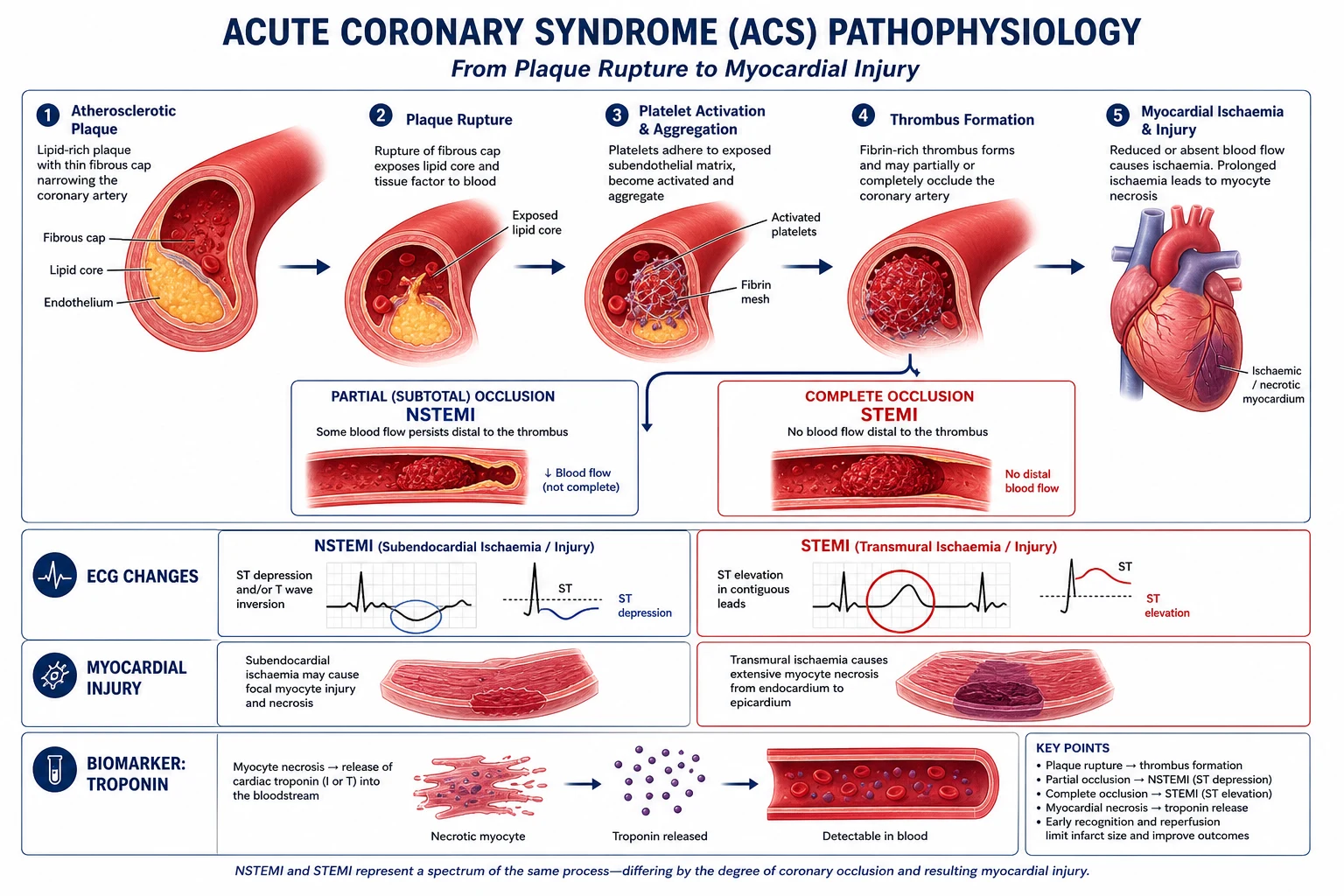
Acute coronary syndrome (ACS) encompasses STEMI, NSTEMI, and unstable angina — all caused by acute myocardial ischaemia from coronary plaque rupture/erosion. Classification: STEMI (ST elevation 1mm in limb leads, 2mm in chest leads) requires IMMEDIATE reperfusion (primary PCI within 90 min door-to-balloon, or thrombolysis if PCI unavailable within 120 min). NSTEMI (troponin rise without ST elevation) requires risk stratification (GRACE/TIMI score) and early invasive strategy within 24-72h for high-risk. Universal management: dual antiplatelet therapy (aspirin + P2Y12 inhibitor — ticagrelor or prasugel preferred over clopidogrel), anticoagulation (heparin or bivalirudin), high-dose statin, beta-blocker (if no contraindication), ACE inhibitor. Cardiogenic shock complicating MI requires urgent revascularisation (multi-vessel PCI in shock), mechanical circulatory support.
On this page & tools
Your progress
Saved locally on this device.
Target exams
Red flags

Classification
ACS classification (click each)
Unstable angina
Ischaemic symptoms + ECG changes (ST depression, T inversion) but NO troponin rise. Plaque instability without necrosis. Manage as NSTEMI. Early invasive if high-risk.
Diagnosis
ECG criteria
[1]Troponin
High-sensitivity troponin
Preferred — 0/1h or 0/2h algorithms
- Detects myocardial injury earlier (within 1-3h)
- 0/1h algorithm: measure at presentation + 1 hour
- Rise AND fall = acute injury (MI)
- Static elevation = chronic injury (CKD, heart failure, sepsis)
- Values above 99th centile of normal population = abnormal
Causes of troponin elevation BEYOND ACS
Important DDx
- Type 2 MI (demand ischaemia — tachyarrhythmia, hypotension, sepsis)
- Myocarditis, pericarditis
- Pulmonary embolism (right ventricular strain)
- Sepsis / critical illness
- CKD (chronic low-grade elevation)
- Heart failure, tachyarrhythmia, stroke
STEMI management
STEMI immediate management — MONA-B + reperfusion
Oxygen — only if hypoxic
Give O2 if SpO2 <90%. Do NOT routinely give oxygen to non-hypoxic patients (AVOID trial — excess mortality with routine O2 in STEMI). Monitor SpO2 continuously.
Aspirin 300 mg orally (chewed)
Loading dose immediately. Then 75-100 mg daily maintenance. Irreversible COX-1 inhibition → reduced thromboxane A2 → antiplatelet. First-line for ALL ACS.
P2Y12 inhibitor loading
Ticagrelor 180 mg loading (preferred — PLATO: reduced mortality vs clopidogrel) OR prasugrel 60 mg loading (preferred for primary PCI — TRITON-TIMI 38: reduced ischaemic events vs clopidogrel). Clopidogrel 600 mg if ticagrelor/prasugrel contraindicated or high bleeding risk. Do NOT give prasugrel if prior stroke/TIA.
Anticoagulation
Heparin: unfractionated heparin 70-100 U/kg IV bolus (target aPTT 1.5-2x normal) for primary PCI. OR bivalirudin 0.75 mg/kg IV bolus then 1.75 mg/kg/h infusion (lower bleeding risk). OR enoxaparin 1 mg/kg SC BD (for fibrinolysis pathway).
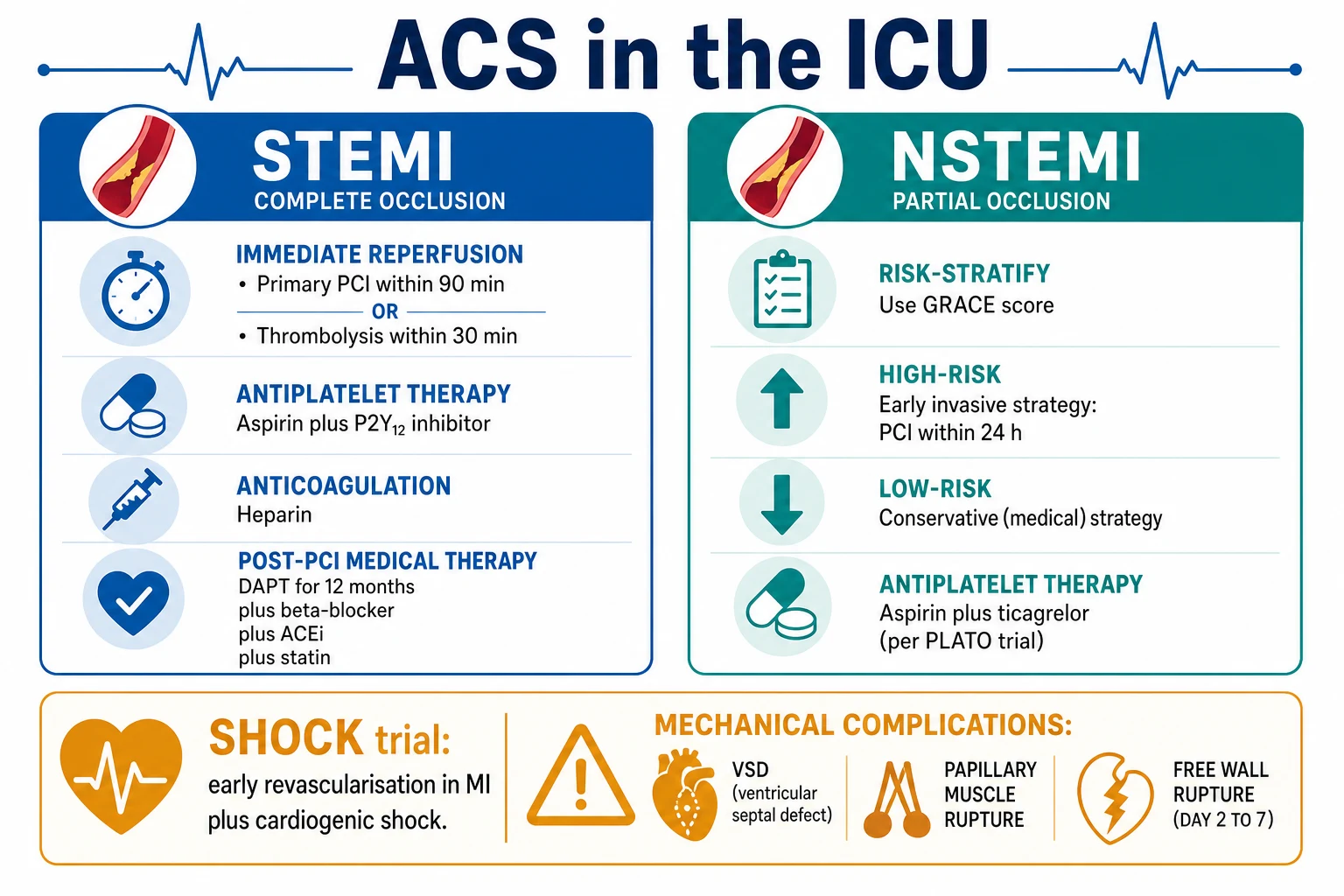
Reperfusion: Primary PCI within 90 min door-to-balloon
GOLD STANDARD. Transfer to PCI-capable hospital. Door-to-balloon time <90 min = quality target. Delay >90 min associated with increased mortality. If PCI unavailable within 120 min: give thrombolysis (tenecteplase — single bolus, weight-based).
High-dose statin
Atorvastatin 80 mg daily (or rosuvastatin 40 mg). Given regardless of baseline cholesterol. Pleiotropic effects: plaque stabilisation, anti-inflammatory. Continue indefinitely.
Beta-blocker — if no contraindication
Metoprolol 25-50 mg BD or bisoprolol 5 mg daily. Start within 24h if no heart failure, hypotension (SBP <90), bradycardia (HR <60), severe asthma/COPD, or advanced AV block. Reduces mortality, arrhythmia, reinfarction.
ACE inhibitor
Start within 24h (ramipril 2.5 mg BD, lisinopril 5 mg daily). Especially beneficial if LV dysfunction, anterior MI, diabetes, heart failure. Reduces ventricular remodelling and mortality.
STEMI reperfusion pathway — PCI versus fibrinolysis
Primary PCI (preferred)
Door-to-balloon <90 min
- GOLD STANDARD if achievable within 120 min of first medical contact
- Door-to-balloon time <90 min — ACC/AHA Class I quality target
- Superior to fibrinolysis: lower 30-day mortality, less reinfarction, less intracranial haemorrhage, less heart failure
- Stent restores TIMI 3 flow in >90% vs ~50-60% with lysis
- Transfer should not delay reperfusion — first-door-to-device target <120 min
Fibrinolysis (if PCI >120 min)
Door-to-needle <10 min
- Indicated when primary PCI cannot be delivered within 120 min of first medical contact
- Door-to-needle time <10 min (ESC/NICE target)
- Tenecteplase (TNK-tPA): single weight-based IV bolus (max 50 mg) — preferred
- Alteplase: 15 mg bolus then 0.75 mg/kg over 30 min then 0.5 mg/kg over 60 min (max 100 mg)
- Absolute contraindications: prior intracranial haemorrhage, ischaemic stroke <6 months, known cerebral vascular lesion, intracranial neoplasm, active bleeding, aortic dissection, severe uncontrolled hypertension
- ST resolution <50% at 60-90 min = failed lysis → rescue PCI
Pharmaco-invasive strategy
After successful lysis
- After successful lysis, transfer for routine angiography within 3-24h (not immediate unless failed)
- Rescue PCI if failed lysis (ST resolution <50% or ongoing chest pain)
- Aspirin + clopidogrel (300 mg load if <75 yr; 75 mg if >75 yr) plus anticoagulation (enoxaparin) until PCI
- Outcomes equivalent to primary PCI when applied systematically (STREAM-2)
NSTEMI/UA management
NSTEMI risk stratification and invasive strategy
Risk stratify using GRACE score
GRACE score (age, heart rate, systolic BP, creatinine, Killip class, cardiac arrest at admission, ST deviation, troponin). Low risk (<109): conservative strategy acceptable. Intermediate (109-140): invasive within 72h. High risk (>140): invasive within 24h. Very high risk: immediate invasive (<2h).
Very high risk features — immediate invasive (<2h)
Haemodynamic instability/cardiogenic shock. Recurrent/persistent chest pain refractory to medical therapy. Life-threatening arrhythmia/cardiac arrest. Mechanical complication (acute MR, VSD). Acute heart failure. Recurrent dynamic ST/T changes (especially transient ST elevation).
High risk — invasive within 24h
GRACE >140. Dynamic ST/T changes. Troponin rise/fall. Confirmed NSTEMI diagnosis.
Low/intermediate risk — invasive within 72h
GRACE <140. No recurrent symptoms. No dynamic ECG changes. Diabetic, eGFR <60, LVEF <40%, early post-MI angina, prior PCI, prior CABG.
TIMI risk score (NSTE-ACS)
[1]GRACE score
Preferred — registry-derived
- Continuous variables: age, heart rate, systolic BP, creatinine, Killip class, cardiac arrest at admission, ST deviation, troponin
- More accurate than TIMI for mortality prediction
- High risk (>140): invasive within 24h
- Very high risk features (shock, refractory pain, life-threatening arrhythmia, mechanical complication): immediate invasive (<2h)
TIMI score
Simpler bedside tool
- 7 dichotomous variables — easy to calculate at bedside
- Predicts composite endpoint (death/MI/urgent revascularisation)
- Useful for rapid triage but less discriminating than GRACE
- High risk (≥3): early invasive strategy
Low-risk NSTE-ACS — conservative strategy
[1]Pharmacotherapy comparison
PLATO (Wallentin, NEJM 2009)
Multicentre RCT: 18,624 patients with ACS
Population: STEMI, NSTEMI, unstable angina
Key finding
Ticagrelor reduced primary endpoint (9.8% vs 11.7%, p<0.001). Reduced all-cause mortality (4.5% vs 5.9%, p<0.001). No increase in major bleeding.
Practice change
Ticagrelor is preferred over clopidogrel for ACS unless contraindicated.
TRITON-TIMI 38 (Wiviott, NEJM 2007)
Multicentre RCT: 13,608 patients with ACS undergoing PCI
Population: STEMI and NSTEMI planned for PCI
Key finding
Prasugrel reduced primary endpoint (9.9% vs 12.1%, p<0.001). BUT increased major bleeding (2.4% vs 1.8%, p=0.03) and fatal bleeding. Harm in prior stroke/TIA and age >75.
Practice change
Prasugrel preferred for primary PCI. Avoid in prior stroke/TIA, age >75, or low body weight (<60 kg — reduce to 5 mg).
Dual antiplatelet therapy — agent comparison
Aspirin
Backbone — all ACS
- 300 mg loading (chewed) then 75-100 mg daily
- Irreversible COX-1 inhibition → blocks thromboxane A2 for platelet lifespan (~7-10 days)
- Continue indefinitely — never omit
Ticagrelor
Preferred P2Y12 (PLATO)
- 180 mg load then 90 mg twice daily
- Reversible P2Y12 inhibition — faster onset, more potent than clopidogrel
- PLATO: 16% relative reduction in CV death/MI/stroke; 22% reduction in all-cause mortality vs clopidogrel
- Side effects: dyspnoea (~10-15%), bradyarrhythmia, higher minor bleeding
- Contraindicated in prior intracranial haemorrhage; caution in gout (raises uric acid)
- Offset ~3-5 days — stop 3 days pre-elective surgery
Prasugrel
Preferred for primary PCI (TRITON)
- 60 mg load then 10 mg daily (5 mg if <60 kg or ≥75 yr)
- Prodrug — single hepatic step (faster/more consistent than clopidogrel)
- TRITON: 19% relative reduction in CV death/MI/stroke vs clopidogrel — but increased major and fatal bleeding
- AVOID in prior stroke/TIA, active bleeding, age >75 yr, urgent CABG
- Give only AFTER coronary anatomy defined (PCI pathway) — NOT for NSTEMI pre-treatment
Clopidogrel
Fallback P2Y12
- 300-600 mg load then 75 mg daily
- Two-step prodrug with variable CYP2C19 metabolism — ~30% poor responders
- Use when ticagrelor/prasugrel contraindicated, high bleeding risk, oral anticoagulation needed, or cost constraints
- Offset ~5 days — stop 5 days pre-elective surgery
ISAR-REACT-5 (Schüpke, NEJM 2019)
Multicentre randomised open-label trial: 4018 patients with ACS
Population: STEMI and NSTE-ACS intended for invasive strategy
Key finding
Prasugrel had LOWER primary endpoint than ticagrelor (6.9% vs 9.3%, p=0.006). No difference in major bleeding. Counterintuitively favours prasugrel when used correctly (post-angiography).
Practice change
Prasugrel (used after anatomy defined) may be superior to ticagrelor in ACS undergoing invasive management — challenges the ticagrelor-first default.
Anticoagulation
Unfractionated heparin (UFH)
Default for primary PCI
- 70-100 U/kg IV bolus (no GPIIb/IIIa) or 50-70 U/kg (with GPIIb/IIIa)
- Rapid onset, short half-life, fully reversible with protamine
- Monitor ACT 250-300s during PCI
- Preferred in renal failure (not renally cleared) and when rapid reversibility needed
Enoxaparin
LMWH — fibrinolysis pathway
- 1 mg/kg SC twice daily (once daily if eGFR <30)
- More predictable than UFH; lower HIT risk
- Used in pharmaco-invasive/fibrinolysis pathway; IV enoxaparin 0.5 mg/kg during PCI if already on SC
- Partially reversible with protamine
Bivalirudin
Direct thrombin inhibitor
- 0.75 mg/kg IV bolus then 1.75 mg/kg/h infusion
- ACUITY/HORIZONS-AMI: lower bleeding than heparin + GPIIb/IIIa
- Safe in heparin-induced thrombocytopenia (no antigenicity)
- Renally cleared — reduce infusion in renal impairment; not fully reversible
Fondaparinux
Factor Xa inhibitor
- 2.5 mg SC daily — effective in fibrinolysis pathway (OASIS-6)
- Catheter thrombosis risk if used alone during PCI — add UFH for the procedure
- Preferred in OASIS-5 for NSTE-ACS (less bleeding than enoxaparin)
ACUITY (Stone, NEJM 2006)
Multicentre RCT: 13,819 patients with NSTE-ACS undergoing early invasive strategy
Population: Moderate-to-high risk NSTE-ACS
Key finding
Bivalirudin alone was NON-INFERIOR for ischaemia and REDUCED major bleeding (3.0% vs 5.7%, p<0.001). Net clinical outcomes favoured bivalirudin.
Practice change
Bivalirudin is a reasonable alternative to heparin + GPIIb/IIIa, with lower bleeding — but modern practice often omits routine GPIIb/IIIa regardless.
Complications
Mechanical complications (first week)
Acute MR (papillary muscle rupture)
Day 3-5
- Inferior MI (posteromedial papillary muscle — single blood supply from PDA)
- Sudden pulmonary oedema, new murmur (may be soft)
- Echo: flail leaflet, severe MR
- Treatment: urgent surgery (MVR), IABP support
Ventricular septal rupture (VSR)
Day 3-5
- More common in anterior MI, large infarcts, elderly, female
- New loud pansystolic murmur at left sternal edge ± thrill
- Echo: defect in interventricular septum with left-to-right shunt
- Treatment: urgent surgical or percutaneous closure, IABP
Free wall rupture
Day 1-5
- Sudden cardiac tamponade — usually fatal
- Presents with electromechanical dissociation / sudden collapse
- Risk: large transmural infarct, elderly, female, hypertension
- Treatment: emergency surgery (rarely survive)
Left ventricular aneurysm
Weeks to months
- Persistent ST elevation after MI (Q waves)
- Risk: mural thrombus (anticoagulate), heart failure, ventricular arrhythmia
- Treatment: anticoagulation, ACE inhibitor, consider surgery
Cardiogenic shock
See dedicated topic: cardiogenic-shock-mechanical-support. Key points:
- SHOCK trial: early revascularisation (PCI/CABG) improves 6-year survival
- CULPRIT-SHOCK: culprit-only PCI is preferred over immediate multi-vessel PCI in shock
- Mechanical support: IABP (no mortality benefit in IABP-SHOCK II), Impella, ECMO [1]
Mechanical circulatory support (MCS)
IABP-SHOCK II (Thiele, NEJM 2012)
Multicentre RCT: 600 patients with AMI and cardiogenic shock planned for early revascularisation
Population: STEMI/NSTEMI with cardiogenic shock (SBP <90, end-organ hypoperfusion)
Key finding
NO difference in 30-day mortality (39.7% IABP vs 41.3% control, p=0.69). No benefit in secondary endpoints or 12-month mortality.
Practice change
Routine IABP in AMI-shock has no mortality benefit (Class III, ESC/AHA). Reserve IABP for mechanical complications (acute MR, VSD) or as a bridge to definitive therapy.
DanGer-SHOCK (Møller, NEJM 2024)
Multicentre RCT: 360 patients with STEMI and cardiogenic shock
Population: STEMI with cardiogenic shock (SBP <100 for >30 min, end-organ hypoperfusion)
Key finding
Impella REDUCED 180-day mortality (66.9% vs 80.0% control; relative risk 0.83, p=0.04). Higher rates of moderate/severe bleeding, limb ischaemia, and need for renal replacement therapy with Impella.
Practice change
First RCT to show a mortality benefit of Impella in STEMI-shock. Selective use in infarct-related shock may be justified — but bleeding and device complications are significant.
IABP
Intra-aortic balloon pump
- Augments coronary perfusion during diastole, reduces afterload
- No mortality benefit in unselected AMI-shock (IABP-SHOCK II)
- Still useful: bridge to recovery/MCS/decision, mechanical complications (MR/VSD), refractory ischaemia, weaning from cardiopulmonary bypass
- Contraindications: aortic regurgitation, aortic dissection, severe peripheral arterial disease
Impella (microaxial flow pump)
Active LV unloading
- Axial flow pump across aortic valve — directly unloads LV (2.5-5.0 L/min)
- DanGer-SHOCK: mortality benefit in STEMI-shock; increased bleeding/limb ischaemia
- Useful for severe LV failure, refractory ventricular arrhythmia, bridge to decision
- Contraindications: LV thrombus, mechanical aortic valve, severe AR, severe PAD
VA-ECMO
Venous-arterial ECMO
- Provides both cardiac and respiratory support (up to 4-6 L/min)
- No RCT mortality benefit to date (ECLS-SHOCK neutral) — but commonly used in refractory shock
- Risk: increases LV afterload (may worsen LV failure — consider concomitant Impella venting), limb ischaemia, bleeding, haemolysis
- Used as bridge to recovery, LVAD, or transplant
Arrhythmias complicating MI
Ventricular fibrillation / pulseless VT
Immediate — first 48h
- Most common cause of pre-hospital sudden cardiac death in MI
- Treatment: immediate defibrillation (biphasic 150-200 J) + CPR per ALS algorithm
- Amiodarone 300 mg IV if recurrent/refractory
- Check and correct K⁺ (>4.0), Mg²⁺ (>0.8), ischaemia — revascularise
- Primary VF in first 48h does NOT necessarily indicate long-term ICD need
Atrial fibrillation
Common — 10-20% of MI
- Often from atrial ischaemia, LV failure, pericarditis, sympathetic surge
- Rate control: beta-blocker (if no HF/hypotension) or digoxin (if HF); amiodarone if haemodynamically unstable
- Anticoagulate (CHA₂DS₂-VASc high) — heparin/NOAC, weigh bleeding
- New AF predicts worse outcome — look for and treat LV failure
Bradycardia & AV block
Inferior > anterior MI
- Inferior MI: vagally mediated sinus bradycardia, 1st-degree AV block, Mobitz I — usually transient. Atropine 0.5 mg IV if symptomatic
- Inferior MI with complete heart block: often junctional escape (narrow QRS, stable) — atropine/temporary pacing if unstable
- Anterior MI with AV block: septal/His-Purkinje damage (wide QRS) — ominous, needs transvenous pacing; often becomes permanent
- Temporary pacing: transvenous (preferred) or transcutaneous (bridge). Indications: symptomatic bradycardia, Mobitz II, complete heart block, slow idioventricular rhythm
Late ventricular arrhythmia (>48h)
Scar-related — ICD territory
- Sustained VT/VF >48h after MI = scar re-entry — high recurrence risk
- Secondary prevention ICD indication (MADIT-II, MUSTT: LVEF ≤30-35%)
- LifeVest or planned ICD after 40-day reassessment if LVEF ≤35% post-revascularisation
- Amiodarone for suppression; correct electrolytes
Right ventricular infarct
[1]Post-MI secondary prevention (the four pillars + aldosterone antagonist)
Secondary prevention after MI — disease-modifying therapy
1. Dual antiplatelet therapy (DAPT) — 12 months
Aspirin 75-100 mg lifelong + P2Y12 inhibitor (ticagrelor preferred) for 12 months. Extend with ticagrelor 60 mg BD beyond 12 months if high ischaemic / low bleeding risk (PEGASUS-TIMI 54). Dual-pathway inhibition for AF + stent: NOAC + clopidogrel.
2. Beta-blocker — indefinite if LV dysfunction
Metoprolol, bisoprolol, carvedilol. Indefinite if LVEF ≤40%; otherwise continue at least 12 months (ESC 2023). Contraindications: acute heart failure, SBP <90, severe asthma, advanced AV block. Reduces mortality, reinfarction, arrhythmia.
3. ACE inhibitor / ARB — indefinite
Ramipril, lisinopril, perindopril (ARB if intolerant — valsartan). Start within 24h. Mandatory if LV dysfunction, anterior MI, diabetes, hypertension, CKD. Reduces remodelling, heart failure, mortality. ACE + ARB + MRA combination risks hyperkalaemia and AKI — monitor.
4. High-intensity statin — indefinite
Atorvastatin 80 mg or rosuvastatin 20-40 mg. Target LDL ≤1.4 mmol/L (55 mg/dL) and ≥50% reduction (ESC). Add ezetimibe and PCSK9 inhibitor (alirocumab/evolocumab) if not at target. Pleiotropic effects: plaque stabilisation, anti-inflammatory.
5. Aldosterone antagonist — if LV dysfunction + HF/DM
Eplerenone (EPHESUS) or spironolactone. Indicated if LVEF ≤40% AND heart failure OR diabetes, started within 3-14 days, K⁺ <5.0 and eGFR >30. Reduces mortality and HF hospitalisation. Monitor K⁺ and renal function at 1, 4, 8 weeks.
6. Lifestyle & risk factor modification
Smoking cessation (single most effective secondary prevention), cardiac rehabilitation, Mediterranean diet, BP <130/80, individualised HbA1c target, weight management, influenza and pneumococcal vaccination. Cardiac rehabilitation reduces mortality ~20-25%.
EPHESUS (Pitt, NEJM 2003)
Multicentre RCT: 6642 patients with acute MI complicated by LV dysfunction (LVEF ≤40%) and heart failure
Population: Post-MI, LVEF ≤40%, clinical HF
Key finding
Eplerenone REDUCED all-cause mortality (14.4% vs 16.7%, p=0.008) and sudden cardiac death. Benefit independent of ACE-I. Hyperkalaemia risk — monitor K⁺ and renal function.
Practice change
Eplerenone indicated in post-MI patients with LVEF ≤40% and HF/diabetes — adds mortality benefit on top of ACE-I and beta-blocker.
Prognosis
ACS outcomes
Exam practice
SAQ — Acute coronary syndrome
10 minutes · 10 marks
A 62-year-old man presents with 2 hours of central chest pain, diaphoresis, and dyspnoea. ECG shows ST elevation in II, III, aVF with reciprocal ST depression in I, aVL. BP 100/60, HR 52, SpO2 96% on room air. Troponin pending. He is 45 minutes from the nearest PCI centre.
Clinical pearls
Red flags
References
- [1]Byrne RA, Rossello X, Coughlan JJ, et al. 2023 ESC Guidelines for the management of acute coronary syndromes Eur Heart J, 2023.PMID 37622654
- [2]Kite TA, Kurshid A, Cafferkey A, et al. Door-to-Balloon Time and Mortality Among Patients Undergoing Primary PCI, Challenges and Experience from Somalia's Largest PCI Center Int J Gen Med, 2024.PMID 38283076
- [3]Garg P, Morris P, Fawcett L, et al. Contemporary NSTEMI management: the role of the hospitalist Hosp Pract (1995), 2020.PMID 31815570
- [4]Vranckx P, Valgimigli M, Windecker S, et al. Ticagrelor or prasugrel vs. clopidogrel in combination with anticoagulation for treatment of acute coronary syndrome in patients with atrial fibrillation Ann Transl Med, 2019.PMID 31660305
- [5]Various authors. BMI differences on anticoagulation with bivalirudin vs. heparin during primary PCI: a BRIGHT-4 subanalysis BMC Med, 2025.PMID 41029353
- [6]Wallentin L, Becker RC, Budaj A, et al. Ticagrelor versus clopidogrel in patients with acute coronary syndromes N Engl J Med, 2009.PMID 19717846
- [7]Schüpke S, Neumann FJ, Menichelli M, et al. Ticagrelor or Prasugrel in Patients with Acute Coronary Syndromes N Engl J Med, 2019.PMID 31475799
- [8]Wiviott SD, Braunwald E, McCabe CH, et al. Prasugrel versus clopidogrel in patients with acute coronary syndromes N Engl J Med, 2007.PMID 17982182
- [9]Stone GW, McLaurin BT, Cox DA, et al. Bivalirudin for patients with acute coronary syndromes N Engl J Med, 2006.PMID 17124018
- [10]Thiele H, Zeymer U, Neumann FJ, et al. Intraaortic balloon support for myocardial infarction with cardiogenic shock N Engl J Med, 2012.PMID 22920912
- [11]Møller JE, Terkelsen CJ, Engstrøm T, et al. Microaxial Flow Pump or Standard Care in Infarct-Related Cardiogenic Shock N Engl J Med, 2024.PMID 38587239
- [12]Thiele H, Akin I, Sandri M, et al. PCI Strategies in Patients with Acute Myocardial Infarction and Cardiogenic Shock N Engl J Med, 2017.PMID 29083953
- [13]Pitt B, Remme W, Zannad F, et al. Eplerenone, a selective aldosterone blocker, in patients with left ventricular dysfunction after myocardial infarction N Engl J Med, 2003.PMID 12668699
- [14]Hochman JS, Sleeper LA, Webb JG, et al. Early revascularization in acute myocardial infarction complicated by cardiogenic shock. SHOCK Investigators. Should We Emergently Revascularize Occluded Coronaries for Cardiogenic Shock N Engl J Med, 1999.PMID 10460813
- [15]Stone GW, Witzenbichler B, Guagliumi G, et al. Bivalirudin during primary PCI in acute myocardial infarction N Engl J Med, 2008.PMID 18499566
- [16]Stub D, Smith K, Bernard S, et al. Air Versus Oxygen in ST-Segment-Elevation Myocardial Infarction Circulation, 2015.PMID 26002889