ICU · Cardiovascular
Acute decompensated pulmonary hypertension in ICU
Also known as Pulmonary hypertension crisis · Pulmonary hypertensive crisis · Acute decompensated PH · Right ventricular failure · Pulmonary vascular crisis · WHO Group 1-5 PH
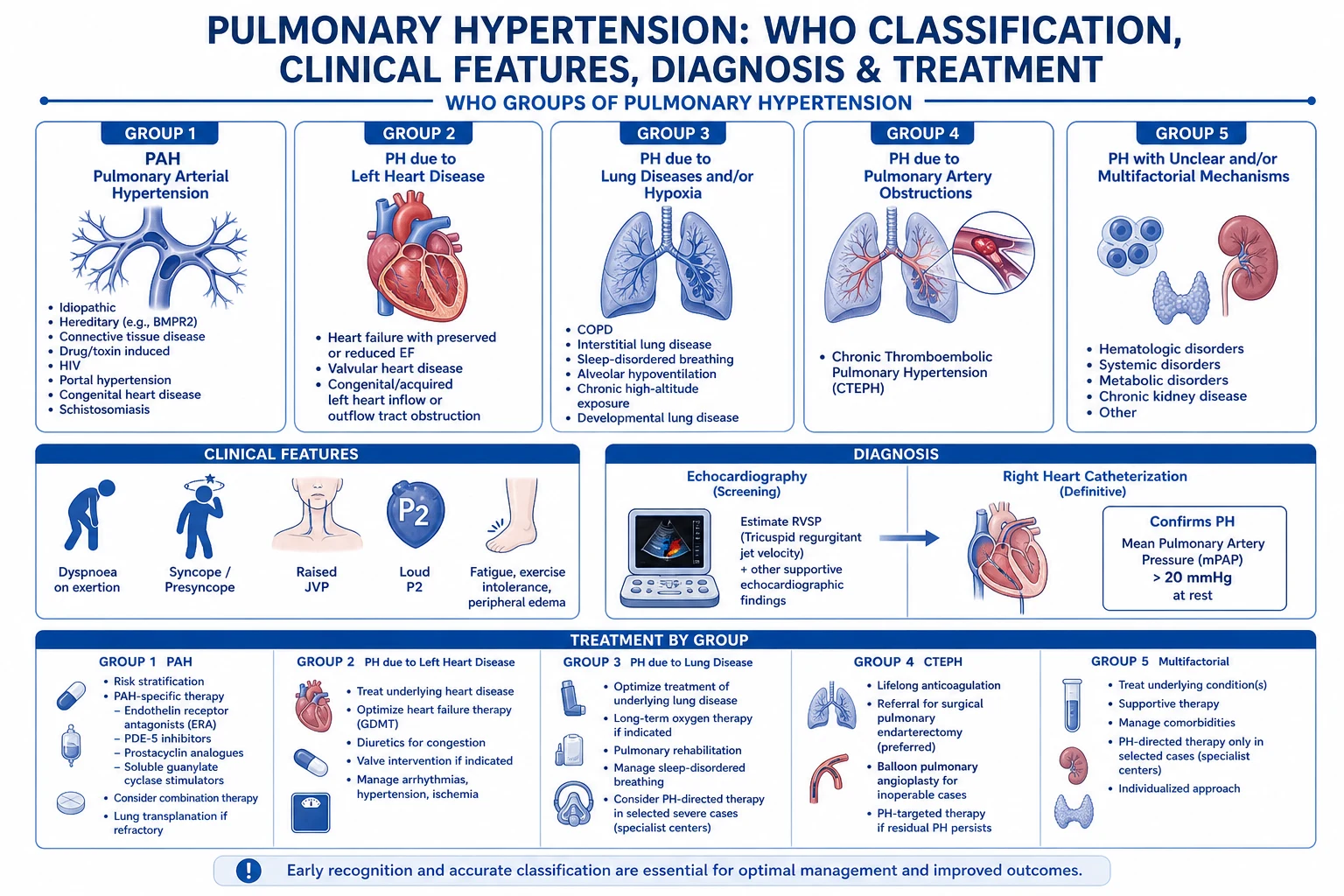
Acute decompensated pulmonary hypertension (PH): acute worsening of PH → right ventricular (RV) failure → cardiogenic shock. PH classification (WHO): Group 1 (PAH — idiopathic, heritable, connective tissue), Group 2 (left heart disease), Group 3 (lung disease/hypoxia), Group 4 (CTEPH), Group 5 (multifactorial). CRISIS: RV cannot pump against high pulmonary vascular resistance (PVR) → RV dilatation → septal shift → LV compression → low cardiac output → cardiogenic shock → death. Management: (1) Maintain systemic BP (noradrenaline — alpha vasoconstriction). (2) Reduce PVR (inhaled NO, prostacyclins, PDE5 inhibitors). (3) Support RV (inotropes — milrinone, dobutamine). (4) Correct triggers (hypoxia, acidosis, arrhythmia, volume overload). (5) Mechanical support (VA-ECMO — bridge to recovery/transplant).
On this page & tools
Your progress
Saved locally on this device.
Target exams
Red flags

WHO PH classification
| Group | Cause | Examples | Key features |
|---|---|---|---|
| 1 (PAH) | Pulmonary arterial disease | Idiopathic, heritable (BMPR2), CTD (scleroderma), portal HTN, congenital heart disease, drugs | Pre-capillary, elevated PVR, responsive to PAH-specific therapy |
| 2 (Left heart) | Post-capillary | HFrEF, HFpEF, valvular (mitral), congenital | Elevated PCWP (>15), treat underlying heart disease |
| 3 (Lung disease) | Hypoxia-driven | COPD, ILD, OSA, chronic high altitude | Treat underlying lung disease, oxygen |
| 4 (CTEPH) | Chronic thromboembolic | Organised thrombi in pulmonary arteries | Potentially curable: pulmonary endarterectomy |
| 5 (Multifactorial) | Various | Sarcoidosis, haematological, metabolic, renal | Treat underlying cause |
Management of acute pulmonary hypertensive crisis
- RECOGNISE — known PH patient with: hypotension (SBP <90), rising lactate, RV dysfunction on echo (dilated RV, septal shift, reduced TAPSE), rising CVP, falling cardiac output
- IDENTIFY AND CORRECT PRECIPITANTS — (a) Hypoxia (SpO2 <90 → pulmonary vasoconstriction). (b) Acidosis (pH <7.3 → pulmonary vasoconstriction). (c) Hypercapnia (PaCO2 >45 → pulmonary vasoconstriction). (d) Arrhythmia (AF — common in PH, worsens RV filling). (e) Volume overload (excess fluids → RV dilatation). (f) Sepsis/infection. (g) Pulmonary embolism. (h) Non-adherence to PH medications (sildenafil, bosentan)
- MAINTAIN SYSTEMIC BP — noradrenaline (alpha vasoconstriction → systemic BP ↑ → coronary perfusion to RV). Target: MAP ≥65. Avoid: pure alpha agonists (phenylephrine — may worsen PVR). Vasopressin: variable effect (may reduce PVR — some evidence)
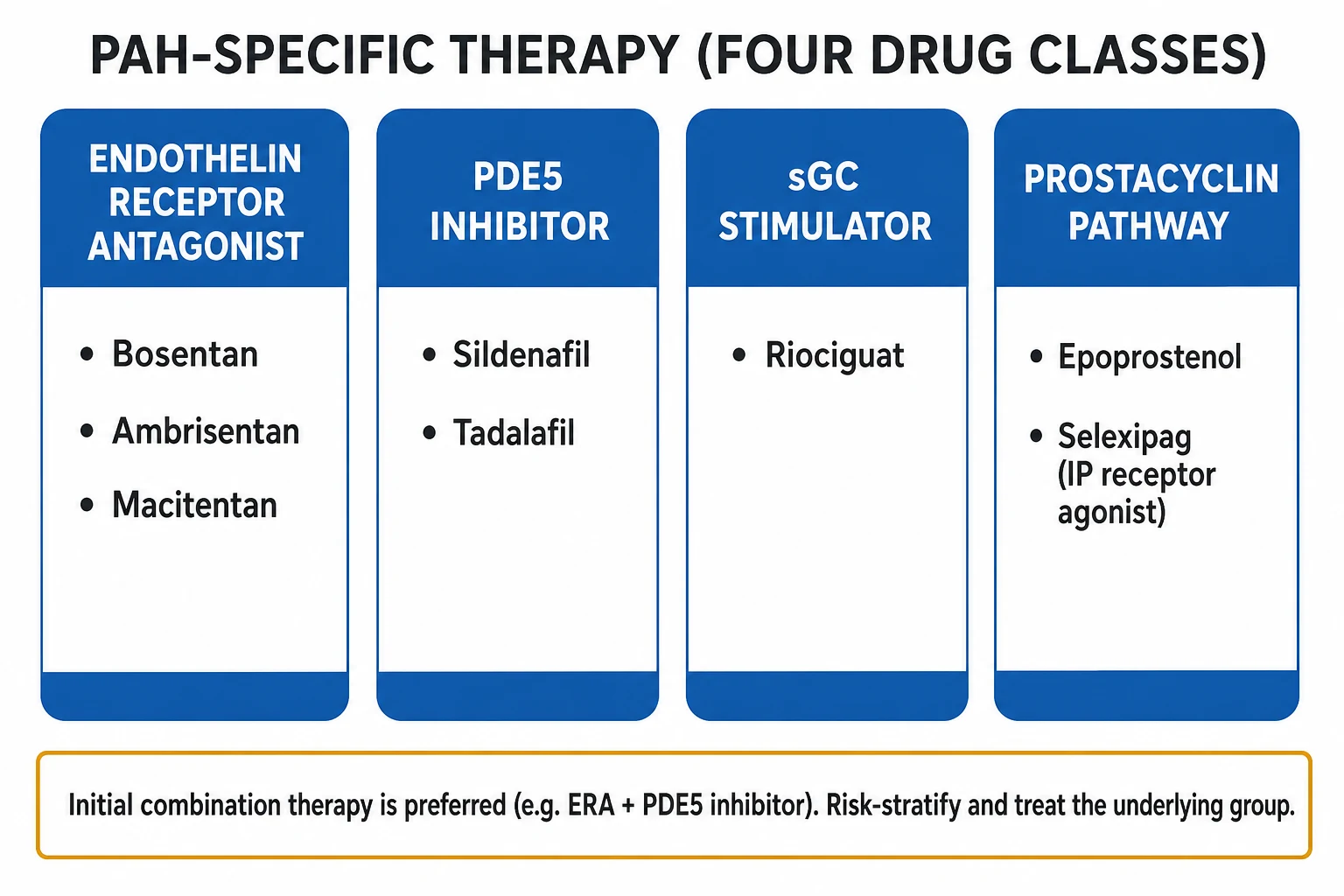
- REDUCE PVR — (a) Inhaled NO (5-20 ppm — selective pulmonary vasodilation, no systemic hypotension). (b) Inhaled epoprostenol (10-50 ng/kg/min — alternative to NO). (c) IV sildenafil (10-20 mg TDS — PDE5 inhibitor — reduces PVR). (d) IV riociguat (soluble guanylate cyclase stimulator). (e) Correct hypoxia/acidosis/hypercapnia (reduces hypoxic pulmonary vasoconstriction)
- SUPPORT RV — (a) Milrinone (PDE3 inhibitor — inotropy + pulmonary vasodilation — PREFERRED). (b) Dobutamine (beta-1 — inotropy — may cause hypotension). (c) Levosimendan (calcium sensitiser — inotropy — less arrhythmia). (d) Target: cardiac index >2.0 L/min/m², mixed venous saturation >60%
- AVOID EXCESS FLUIDS — volume loading >500 mL → RV dilatation → septal shift → LV compression → worse output. If hypovolaemic: cautious 250 mL bolus (assess response). If overloaded: diurese (frusemide)
- MECHANICAL SUPPORT (refractory) — VA-ECMO (bridge to recovery, transplant, or decision). Reduces RV load (bypasses pulmonary circulation), supports systemic perfusion
- TREAT UNDERLYING PH — restart/optimize PAH-specific therapy (sildenafil, bosentan, macitentan, riociguat, prostacyclins). Consider: lung transplant evaluation (if end-stage)
Exam practice
SAQ — Pulmonary hypertensive crisis with right ventricular failure
10 minutes · 10 marks
A 48-year-old woman with idiopathic PAH on sildenafil 20 mg TDS, macitentan 10 mg daily, and nebulised iloprost presents with 6 hours of worsening dyspnoea and presyncope after missing her iloprost doses yesterday. She is hypotensive (BP 78/45), in new atrial fibrillation at 132/min, SpO2 86% on room air, JVP to the angle of the jaw, cool peripheries, lactate 5.2 mmol/L. Bedside echo shows a dilated RV (RV/LV ratio 1.4), D-shaped septum, TAPSE 11 mm, moderate tricuspid regurgitation.
SAQ — Escalation of therapy in refractory pulmonary hypertension
10 minutes · 10 marks
A 55-year-old man with idiopathic PAH (WHO Group 1), chronically on tadalafil 40 mg daily, macitentan 10 mg daily, and nebulised iloprost, is admitted with syncope and NYHA IV dyspnoea despite his background therapy. PA catheter: RA pressure 18 mmHg, PCWP 12 mmHg, cardiac index 1.6 L/min/m², PVR 9 Wood units, mixed venous saturation 48%. He is on noradrenaline 0.4 mcg/kg/min, milrinone 0.5 mcg/kg/min, and inhaled NO 20 ppm, with lactate 4.8 mmol/L and MAP 58.
Clinical pearls [1]
Red flags
Prognosis
PH crisis outcomes (Price 2019)
Mortality from PH crisis in ICU: 40-60% (without prompt, targeted treatment). With early recognition + aggressive management: may improve to 20-30%. Key predictors of poor outcome: (1) Cardiac index <2.0 L/min/m². (2) RA pressure >20 mmHg. (3) Mixed venous saturation <50%. (4) Lactate >4 mmol/L. (5) Need for VA-ECMO. (6) Acute kidney injury (from low cardiac output). PAH-specific therapy (chronic): has dramatically improved survival (idiopathic PAH: median survival 2.8 years without therapy → 7+ years with sildenafil + prostacyclin). Lung transplant: 1-year survival 80-90%, 5-year 50-60%. [1]
Pregnancy with PH: maternal mortality 30-50% (contraindicated).
Triggers and precipitants
Common precipitants of acute PH decompensation
| Trigger | Mechanism of decompensation | Key management point |
|---|---|---|
| Hypoxia / hypercapnia / acidosis | Hypoxic pulmonary vasoconstriction + acidosis directly constrict pulmonary arterioles → PVR rises sharply | Correct immediately: 100% FiO2, ventilate to normocapnia, bicarbonate if pH <7.2[2] } |
| Arrhythmia (new AF/flutter) | Loss of atrial kick → loss of ~25-30% RV preload → RV output collapses; atrial stretch from dilated RA is the substrate | Urgent rhythm/rate control — synchronised cardioversion if unstable; amiodarone; AVOID CCB/beta-blocker monotherapy[9] } |
| Sepsis / systemic infection | Sepsis-induced myocardial depression + vasodilation (low systemic BP → RV ischaemia) + pulmonary neutrophil activation ↑ PVR + iNOS downregulation | Early antibiotics, source control, careful vasopressor support (noradrenaline); restrictive fluids[14] } |
| Acute pulmonary embolism | Acute obstruction of pulmonary vasculature → sudden PVR spike on already-compromised RV | Empiric anticoagulation if unstable; CTPA if stable; thrombolysis for massive PE with shock (weigh bleeding)[11] } |
| Withdrawal of PH-specific therapy | Sudden cessation of PDE5i/ERA/prostacyclin → rebound pulmonary vasoconstriction; missed doses are a leading avoidable cause of crisis | NEVER interrupt background PAH therapy — confirm and restart sildenafil, bosentan, prostacyclin immediately on admission; NG/IV route if NPO[3] } |
| Pregnancy | 50% increase in blood volume + ↑ cardiac output + hypercoagulability + labour-related surges → RV cannot adapt → crisis; maternal mortality 30-50% | Contraception mandatory; if pregnant: multidisciplinary PH-OB-anaesthesia clinic, planned caesarean, epidural (avoid GA), continue PAH therapy[1] } |
| Volume overload / aggressive fluid resuscitation | RV on flat Starling curve → dilates further → septal shift → LV compression → output falls | Cautious 250 mL boluses with reassessment; diurese if overloaded; target RA pressure 5-10 mmHg[9] } |
| Perioperative / procedural | Anaesthetic vasodilation + positive-pressure ventilation + withdrawal of PAH drugs intra-op | Highest-risk period: continue PAH therapy peri-op, avoid hypotension, plan post-op ICU admission[10] } |
| Anaemia / blood loss | Reduced oxygen-carrying capacity → worsens RV ischaemia; tachycardia ↑ RV demand | Transuse to keep Hb ≥90-100 g/L in decompensated PH (RV oxygen supply/demand is critical)[12] } |
| High-altitude exposure / air travel | Hypobaric hypoxia → hypoxic pulmonary vasoconstriction | Supplemental oxygen for all flights; avoid altitude in uncontrolled PH |
Identifying the trigger — a systematic approach
- BEDSIDE — exclude immediate killers: Airway/breathing (hypoxia? SpO2, ABG — acidosis/hypercapnia?), Circulation (arrhythmia? 12-lead + rhythm strip — new AF/VT?), Disability (sepsis? temperature, lactate, cultures)
- DRUG HISTORY — the single most common avoidable trigger: Confirm the patient has received their usual sildenafil/tadalafil, bosentan/macitentan, riociguat, and prostacyclin (inhaled iloprost, SC/IV treprostinil). A missed dose or stopped infusion can precipitate crisis within hours. Check adherence, supply, and whether any were withheld (e.g., for procedures)
- INFECTION SCREEN — pneumonia (most common infection trigger), line infection, UTI, bacteraemia. Send cultures, CXR, procalcitonin, lactate. Treat early and broadly
- EXCLUDE PE — D-dimer (low utility in PH), CTPA if haemodynamically stable; bedside echo (acute RV dilatation with McConnell sign suggests PE). Empiric LMWH if suspicion high
- ECHO — compare to prior: worsening RV dilatation, new septal shift, change in TAPSE, new pericardial effusion, new TR jet velocity
- VOLUME STATUS — clinical (JVP, oedema, hepatomegaly), echo (IVC, RA size), and if available PA catheter (RA pressure, PCWP, cardiac index, PVR). A common error is over-resuscitating the failing RV
Right ventricular failure pathophysiology — the vicious spiral
The decompensation spiral: how RV failure becomes irreversible
- TRIGGER raises PVR (hypoxia, acidosis, PE, sepsis, arrhythmia) → pulmonary artery pressure rises acutely
- RV cannot eject against high afterload → RV end-systolic and end-diastolic volume INCREASE → RV dilates. The normal RV is a thin-walled, low-pressure, volume-tolerant chamber that CANNOT acutely generate high pressures (unlike the LV)
- RV wall stress rises (Laplace: T = P × r / 2h) → RV oxygen demand rises sharply at the same time that coronary perfusion is falling. RV myocardium becomes ischaemic — RV infarction patterns (ST elevation in V4R) can develop[12] }
- RV ISCHAEMIA — uniquely vulnerable: the RV receives coronary perfusion in BOTH systole and diastole (low-pressure chamber normally), but as RV pressure rises, systolic perfusion is lost; falling systemic BP (from low output) reduces diastolic perfusion. Supply-demand mismatch → RV dysfunction worsens → lower output → worse perfusion — a true vicious cycle[12] }
- SEPTAL SHIFT — RV dilatation pushes the interventricular septum LEFTWARD into the LV cavity (paradoxical/D-shaped septum on echo). This is the central mechanical lesion of PH crisis
- LV COMPRESSION — the septum compresses the LV during diastole → LV cannot fill adequately → LV preload falls → LV stroke volume falls (despite a normal LV). LV end-diastolic volume may be tiny
- LOW CARDIAC OUTPUT → systemic hypotension → coronary hypoperfusion (both LV and RV) → worsening biventricular ischaemia → further RV failure. The patient is now in cardiogenic shock
- TRICUSPID REGURGITITATION WORSENS — RV annular dilatation from RV enlargement → functional TR → further reduction in forward RV output → worsening venous congestion
- VENOUS CONGESTION & ENDO-ORGAN FAILURE — high RA pressure → congested liver (ischemic hepatitis), kidneys (pre-renal + congestive nephropathy → AKI), gut (ileus, malabsorption). This is the clinical face of irreversible RV failure
- DEATH if the spiral is not broken by reducing PVR + restoring RV perfusion + mechanical support (VA-ECMO)
ICU management — drug-by-drug
Vasopressors in PH crisis — effect on systemic vs pulmonary vasculature
| Agent | Systemic effect | Pulmonary effect | Role in PH crisis |
|---|---|---|---|
| Noradrenaline (FIRST-LINE) | α1 vasoconstriction → ↑ SVR, ↑ MAP | Mild α1 on pulmonary vessels → slight ↑ PVR, but NET beneficial (systemic effect dominates) | FIRST-LINE: restores systemic BP → restores RV coronary perfusion. Titrate to MAP ≥65[3] } |
| Adrenaline | α + β → ↑ SVR + inotropy + chronotropy | Modest ↑ PVR, ↑ RV O2 demand (tachycardia, arrhythmia) | Second-line if noradrenaline inadequate; adds inotropy. Caution: lactate rise, arrhythmia |
| Vasopressin | V1 → ↑ SVR (peripheral) | Pulmonary vasculature relatively INSPARIED; may REDUCE PVR:PVR ratio (favourable) | USEFUL ADD-ON: can reduce PVR relative to SVR. Consider in refractory shock with rising PVR[8] } |
| Phenylephrine (AVOID) | Pure α1 → ↑ SVR | Significant ↑ PVR (no β2 offset) → WORSENS RV afterload | AVOID — pure afterload rise on RV can precipitate or worsen crisis[7] } |
| Metaraminol | α1 (some β1) → ↑ SVR | Variable ↑ PVR | CAUTION — common peri-induction agent but can spike PVR; use only short-term, transition to noradrenaline |
Inotropes in PH crisis — supporting the failing RV
| Agent | Mechanism | RV effect | PVR effect | Cautions |
|---|---|---|---|---|
| Milrinone (PREFERRED) | PDE3 inhibitor → ↑ cAMP | ↑ RV contractility | ↓ PVR (pulmonary vasodilation) | Systemic hypotension (often need noradrenaline concurrently); long half-life (2-3 h); thrombocytopenia; cannot rapidly titrate off[3] } |
| Dobutamine | β1 agonist → ↑ cAMP | ↑ RV (and LV) contractility | Mild ↓ PVR (β2) at low doses | Tachycardia, arrhythmia, hypotension at higher doses; ↑ myocardial O2 demand; less pulmonary-selective than milrinone |
| Levosimendan | Cardiac myofilament Ca²⁺ sensitizer (no cAMP) | ↑ contractility without ↑ O2 demand | ↓ PVR | Cost, limited availability; QT prolongation; less tachyarrhythmia than dobutamine — consider if tachyarrhythmia limits catecholamines |
| Digoxin | Na-K ATPase inhibition → ↑ intracellular Ca²⁺ | Modest inotropy | None | Mainly for RATE CONTROL of AF, not primary inotrope in crisis; narrow therapeutic window |
Pulmonary vasodilators — selective vs non-selective
| Agent | Route | Selectivity | Onset/dose | Key advantages | Key cautions |
|---|---|---|---|---|---|
| Inhaled nitric oxide (iNO) | Inhaled gas | HIGHLY SELECTIVE pulmonary (inhaled → ventilated alveoli only; bound by Hb systemically → no systemic vasodilation) | 5-20 ppm; onset seconds | Gold standard for selective pulmonary vasodilation; rapid; no systemic hypotension | Methaemoglobinaemia; rebound PH on withdrawal (taper slowly); cost ($150-300/h); NO2 toxicity at high dose; V/Q matching improved (only ventilated units vasodilate) |
| Inhaled epoprostenol (PGI2) | Nebulised | SELECTIVE pulmonary | 10-50 ng/kg/min; nebulised continuously | Cheaper than iNO; equipotent; avoids methaemoglobinaemia | Requires continuous nebuliser; abrupt interruption causes rebound; systemic leak possible at high doses |
| Inhaled iloprost (PGI2 analogue) | Nebulised 6-9×/day | SELECTIVE pulmonary | 2.5-5 mcg/inhaled dose | Oral/inhaled chronic formulation available; useful for step-down from iNO | Frequent dosing; cough; reversible with cessation |
| IV epoprostenol / treprostinil | Continuous IV | NON-SELECTIVE (pulmonary AND systemic) | Eoprostenol 1-12 ng/kg/min; titrate slowly | Potent background therapy for Group 1 PAH | Systemic hypotension (dangerous in crisis); central line sepsis risk; cannot abruptly stop; prostacyclin withdrawal can precipitate crisis |
| Sildenafil (PDE5i) | IV or oral | Pulmonary-selective (lung PDE5-rich) | 10-20 mg IV TDS; 20 mg PO TDS | Oral available; smooth step-down from iNO; well-tolerated | Systemic hypotension (mild); NEVER with nitrates (profound hypotension); onset slower than inhaled |
| Riociguat (sGC stimulator) | Oral | Pulmonary | 1-2.5 mg TDS | Alternative cGMP pathway | Hypotension; not combined with PDE5i (both ↑ cGMP — additive hypotension) |
| SYSTEMIC vasodilators — GTN, SNP, hydralazine | IV | NON-SELECTIVE (systemic > pulmonary) | — | None in crisis | DANGEROUS — systemic hypotension → RV ischaemia → worsening crisis. CONTRAINDICATED in acute decompensated PH |
Mechanical ventilation in PH crisis
Ventilation strategy to protect the RV (lung-protective AND RV-protective)
- AVOID INTUBATION if possible. Non-invasive ventilation may avoid the haemodynamic collapse that accompanies intubation in PH (anaesthetic vasodilation + loss of sympathetic tone + positive pressure → RV failure). Use NIV/HHF if the patient can protect their airway and oxygenation/ventilation failure is reversible
- IF INTUBATING — anticipate cardiovascular collapse. Have noradrenaline, milrinone, and inhaled NO RUNNING BEFORE induction. Use a haemodynamically neutral induction: ketamine (maintains SVR, sympathetic preservation) or etomidate. AVOID propofol (profound vasodilation). AVOID high-dose opiates as sole agent. Full-stomach precautions; RSI with minimal apnoea
- LUNG-PROTECTIVE + RV-PROTECTIVE settings: (a) Low tidal volumes 4-6 mL/kg PBW. (b) Lowest PEEP that maintains oxygenation (≤5-8 cmH2O — high PEEP raises intrathoracic pressure → compresses pulmonary vessels → raises transpulmonary pressure → raises RV afterload). (c) Plateau pressure <30 cmH2O. (d) Allow permissive hypercapnia if pH >7.2 (avoid hypercapnia that causes pulmonary vasoconstriction, but do not chase normocapnia at the cost of high pressures). (e) Lowest mean airway pressure possible
- MINIMISE INTRATHORACIC PRESSURE — this is the cardinal rule. High intrathoracic pressure: (i) reduces venous return (preload falls), (ii) raises PVR (compresses alveolar vessels), (iii) reduces RV coronary perfusion. Use short inspiratory time, long expiratory time, low rate if possible
- CORRECT THE GAS EXCHANGE FIRST — 100% FiO2 (pulmonary vasodilator), normalise pH, target SpO2 >92% and PaCO2 35-40 (or permissive up to 55 if pH >7.2)
- AVOID DYNAMIC HYPERINFLATION / AUTO-PEEP — in COPD-Group 3 PH especially, trapped gas raises intrathoracic pressure catastrophically. Slow rate, long expiratory time
- EXTUBATE EARLY — once the trigger is corrected and PVR-controlled, wean to spontaneous breathing/NIV as soon as possible. Positive-pressure ventilation is haemodynamically hostile to the PH RV
Mechanical circulatory support (MCS)
Mechanical support options for refractory PH crisis
| Modality | Mechanism | Indication | Limitations |
|---|---|---|---|
| VA-ECMO (preferred MCS) | Drains RA → oxygenates → returns to femoral artery; bypasses RV AND lung → unloads RV, supports systemic perfusion, restores coronary perfusion | Refractory cardiogenic shock from RV failure despite maximal medical therapy; bridge to transplant / recovery / decision | Bleeding, stroke, infection, limb ischaemia (femoral), LV distension (afterload from retrograde flow) — may need LV vent; can worsen pulmonary congestion if LV failing |
| Pulmonary artery pulsatility / RV assist device (RVAD) | Surgically or percutaneously (TandemHeart, ProtekDuo) unloads RA/RV directly → drains RA, returns to PA | RV failure without severe lung disease (need native lung gas exchange); bridge in selected centres | Requires functional lungs; not suitable if hypoxia is the driver; cannulation expertise needed |
| V-AV ECMO | Adds venous return to support both RV (VA) and oxygenation (VV) | Combined RV failure + severe hypoxaemia | Complexity, more cannulae, higher anticoagulation burden |
| IABP (intra-aortic balloon pump) | ↓ LV afterload, ↑ coronary perfusion | Largely UNHELPFUL for primary RV failure — no direct RV support. Only if concomitant LV failure | Not first-line for PH crisis |
VA-ECMO in PH crisis — when and how
- INDICATION — PH crisis with refractory cardiogenic shock (rising lactate despite inotropes/vasopressors, MAP <65 on two pressors, cardiac index <1.8) despite: (a) maximal vasoactive therapy (noradrenaline + milrinone ± vasopressin), (b) inhaled pulmonary vasodilator (iNO or epoprostenol), (c) corrected triggers, (d) lung-protective ventilation
- GOAL — unload the RV (rest), restore systemic perfusion and coronary perfusion, break the ischaemia spiral, allow time for reversibility or bridge to lung transplant
- CANNULATION — femoro-femoral VA-ECMO is fastest; central cannulation if post-cardiotomy or for transplant bridge. Consider LV venting if LV distension (septal shift means LV is small — assess by echo; some need IABP or pigtail vent)
- ANTICOAGULATION — unfractionated heparin to ACT 1.5× baseline (balance bleeding vs clotting; PH patients often on background anticoagulation)
- MANAGE THE LUNG — on VA-ECMO, continue lung-protective ventilation (rest settings), keep iNO/pulmonary vasodilators running (to lower PVR for when ECMO is weaned), avoid high PEEP
- DE-ESCALATION — as the trigger reverses (infection treated, PE anticoagulated, PAH therapy restarted), taper vasoactives, then trial off VA-ECMO by reducing flows while monitoring RV function (echo) and lactate. Wean iNO last (after ECMO decannulation)
- DESTINATION — recovery (rare in fixed PAH), lung transplant (bridge to transplant in decompensated end-stage PAH — awake VA-ECMO preferred), or palliation / withdrawal if not a transplant candidate[6] }
Cardiac tamponade in PH
Pericardial effusion and tamponade in pulmonary hypertension
- RECOGNISE THE SETTING — pericardial effusions are COMMON in severe PAH (up to 50% in advanced disease), arising from elevated RA pressure and pericardial lymphatic obstruction. SMALL effusions are usually haemodynamically insignificant; LARGE or rapidly accumulating effusions can cause tamponade
- TAMPONADE PHYSIOLOGY IS ATYPICAL IN PH — the high RV pressure partially 'protects' against classical tamponade (equalisation of diastolic pressures still occurs, but the RV is already stiff). Clinical signs: rising RA pressure, falling cardiac output, tachycardia, muffled heart sounds may be absent. Echo: RA collapse (early), RV free-wall collapse (later), plethoric IVC, >1 cm effusion with swing
- PERICARDIOCENTESIS — INDICATED for tamponade physiology (echo-confirmed chamber collapse, haemodynamic compromise). PERFORMED under echocardiographic guidance, subxiphoid or apical approach, by experienced operator. Drain slowly — rapid decompression can precipitate acute RV dilatation (the RV, freed from external constraint, suddenly dilates against high PVR)
- CAUTION — pericardiocentesis in PH carries higher risk than usual (RV puncture in a dilated RV; bleeding; arrhythmia). Ensure crossmatched blood, continuous monitoring, surgical backup. Leave a drain if effusion is likely to re-accumulate (malignant, uraemic, or ongoing PAH)
- AFTER PERICARDIOCENTESIS — reassess RV (echo), continue PH-specific therapy, and address the underlying trigger. Tamponade can be the presenting feature or a complication of PH crisis
Expanded clinical pearls
Expanded red flags
Key trials and evidence
SUPER-1 — Sildenafil for PAH (Galie 2005)
Design: RCT, 278 patients with PAH, 12 weeks. Sildenafil 20/40/80 mg TDS vs placebo. Result: Improved 6-minute walk distance (+45-50 m), improved haemodynamics (lower mPAP, PVR), improved functional class. Effect maintained at 1 year. Significance: Established sildenafil (PDE5i) as first-line oral therapy for PAH. Basis for IV sildenafil use in PH crisis (pulmonary-selective vasodilation, oral step-down).[4] }
EARLY — Bosentan in mildly symptomatic PAH (Galie 2008)
Design: RCT, 185 patients with WHO Class II PAH. Bosentan (ERA) vs placebo, 6 months. Result: Reduced PVR by 22.6%, improved exercise capacity, delayed clinical worsening. Significance: Established EARLY initiation of endothelin receptor antagonists in mild PAH — underscored that PAH is a progressive disease and earlier therapy reduces events.[13] }
Hoeper 2019 — Intensive care, RV support and lung transplantation in PH
Scope: Authoritative review defining the ICU management of decompensated PH, RV support strategies, and the role of mechanical support / lung transplantation. Key messages: (1) PH crisis mortality remains 20-50% in ICU. (2) Standardised bundle — fix triggers, maintain SVR (noradrenaline), lower PVR (inhaled vasodilators), support RV (milrinone), avoid volume overload. (3) VA-ECMO (preferably awake) as bridge to transplant in refractory cases. (4) Lung transplant remains the definitive therapy for end-stage PAH. Significance: The reference framework cited in ESC/ERS and contemporary ICU guidelines for PH crisis.[3] }
CRASH report — Price 2017
Design: National UK survey of acute physicians managing PH crisis. Identified the commonest dilemmas: fluid resuscitation, choice of vasopressor, inhaled vasodilator availability, and inter-hospital transfer. Findings: Wide practice variation; only a minority of hospitals had iNO available; fluid over-resuscitation was common; missed background PAH therapy was a recurrent precipitant. Significance: Catalysed standardised pathways and the message 'do no harm — give noradrenaline, give inhaled vasodilator, withhold fluids, restart PAH drugs, ask the PH team'.[2] }
Hussain 2017 — Vasoconstrictor effects on human pulmonary arteries
Design: Ex-vivo human pulmonary artery ring tension study comparing noradrenaline, phenylephrine, vasopressin, metaraminol. Findings: Noradrenaline and metaraminol produced less pulmonary vasoconstriction than phenylephrine at equi-effective systemic doses; vasopressin had minimal effect on pulmonary arterial tone. Significance: Provides the mechanistic rationale for preferring noradrenaline (and vasopressin) over phenylephrine in PH crisis — minimise the pulmonary vasoconstrictive 'cost' of restoring SVR.[7] }
Sarkar 2015 — Vasopressin in severe PH (animal model)
Design: Porcine model of severe pulmonary hypertension. Compared vasopressin vs noradrenaline on PVR:SVR ratio. Findings: Vasopressin lowered the PVR:SVR ratio (relatively more systemic than pulmonary vasoconstriction) — favourable for RV. Noradrenaline raised both, vasopressin preferentially raised SVR. Significance: Mechanistic support for vasopressin as a useful adjunct in PH crisis shock — particularly when PVR is rising or noradrenaline dose is escalating.[8] }
Arrigo 2024 — RV failure from acutely increased RV afterload (ESC position)
Scope: European Society of Cardiology position paper on acute RV failure from sudden afterload rise (PE, ARDS, PH crisis, post-cardiotomy). Key messages: (1) Acute RV failure is under-recognised and carries >50% mortality. (2) The RV is 'afterload-intolerant'. (3) Management bundle: reverse the trigger, optimise preload (cautious — usually already overloaded), reduce RV afterload (inhaled vasodilators, correct hypoxia/acidosis), support contractility (milrinone, dobutamine, levosimendan), maintain SVR (noradrenaline), and MCS (VA-ECMO) for refractory cases. Significance: Contemporary authoritative framework directly applicable to PH crisis.[9] }
References
- [1]Humbert M, et al. 2022 ESC/ERS Guidelines for the diagnosis and treatment of pulmonary hypertension Eur Heart J, 2022.PMID 36017548
- [2]Price LC, et al. The CRASH report: emergency management dilemmas facing acute physicians in patients with pulmonary arterial hypertension Thorax, 2017.PMID 28904006
- [3]Hoeper MM, et al. Intensive care, right ventricular support and lung transplantation in patients with pulmonary hypertension Eur Respir J, 2019.PMID 30545979
- [4]Galie N, et al. Sildenafil citrate therapy for pulmonary arterial hypertension N Engl J Med, 2005.PMID 16291984
- [5]Hoeper MM, et al. Long-term effects of intravenous iloprost in patients with idiopathic pulmonary arterial hypertension deteriorating on non-parenteral therapy BMC Pulm Med, 2011.PMID 22133492
- [6]Hoeper MM, et al. Extracorporeal Life Support in Pulmonary Hypertension: Practical Aspects Semin Respir Crit Care Med, 2023.PMID 37709284
- [7]Hussain A, et al. The differential effects of systemic vasoconstrictors on human pulmonary artery tension Eur J Cardiothorac Surg, 2017.PMID 28164217
- [8]Sarkar J, et al. Vasopressin decreases pulmonary-to-systemic vascular resistance ratio in a porcine model of severe hemorrhagic shock Shock, 2015.PMID 25565637
- [9]Arrigo M, et al. Diagnosis and treatment of right ventricular failure secondary to acutely increased right ventricular afterload (acute cor pulmonale): a clinical consensus statement of the Association for Acute CardioVascular Care of the European Society of Cardiology Eur Heart J Acute Cardiovasc Care, 2024.PMID 38135288
- [10]Price LC, et al. Perioperative management of patients with pulmonary hypertension undergoing non-cardiothoracic, non-obstetric surgery: a systematic review and expert consensus statement Br J Anaesth, 2021.PMID 33612249
- [11]Aubry A, Vieillard-Baron A. [Cor pulmonale] Rev Mal Respir, 2020.PMID 32088063
- [12]Pavsic N, et al. The association between myocardial ischemia and myocardial dysfunction in adult patients with systemic right ventricle - A single centre multimodality study Int J Cardiol, 2023.PMID 37087053
- [13]Galie N, et al. Treatment of patients with mildly symptomatic pulmonary arterial hypertension with bosentan (EARLY study): a double-blind, randomised controlled trial Lancet, 2008.PMID 18572079
- [14]Bernier ML, et al. Spectrum of Current Management of Pediatric Pulmonary Hypertensive Crisis Crit Care Explor, 2019.PMID 32166278