MedVellum
MCQsExamsAtlas
DashboardPricing
MBBS / Core medicine✳Dermatology✳ICU Fellowship (CICM)✳Anaesthesia✳Emergency Medicine✳Psychiatry Fellowship✳Paediatrics Fellowship✳Physician Medicine✳MCQs✳SAQs✳Vivas✳OSCE✳Evidence-first✳MBBS / Core medicine✳Dermatology✳ICU Fellowship (CICM)✳Anaesthesia✳Emergency Medicine✳Psychiatry Fellowship✳Paediatrics Fellowship✳Physician Medicine✳MCQs✳SAQs✳Vivas✳OSCE✳Evidence-first✳

MedVellum.

The folio

Exam-exhaustive medical education across every specialty — evidence-graded topics, engraved plates, and practice in every written and oral format. Educational content only — not medical advice.

llms.txt · psychiatry LLM catalog · sitemap

Atlas

  • Specialty atlas
  • MBBS / Core medicine
  • Dermatology
  • ICU Fellowship (CICM)
  • Anaesthesia
  • Emergency Medicine
  • Psychiatry Fellowship
  • Paediatrics Fellowship
  • Physician Medicine

Study & account

  • MCQ practice
  • Practice alias
  • Exam tools
  • Dashboard
  • Pricing
  • Sign in

© 2026 MedVellum. For education only — not a substitute for clinical judgement.

Folio edition · Set in Instrument Serif & Archivo

ICU TopicsCardiovascular

ICU · Cardiovascular

Heart failure guideline-directed medical therapy update: SGLT2, ARNI, and the four pillars

Also known as Heart failure GDMT · Guideline-directed medical therapy · SGLT2 inhibitors · ARNI · Four pillars of heart failure · Dapagliflozin · Empagliflozin

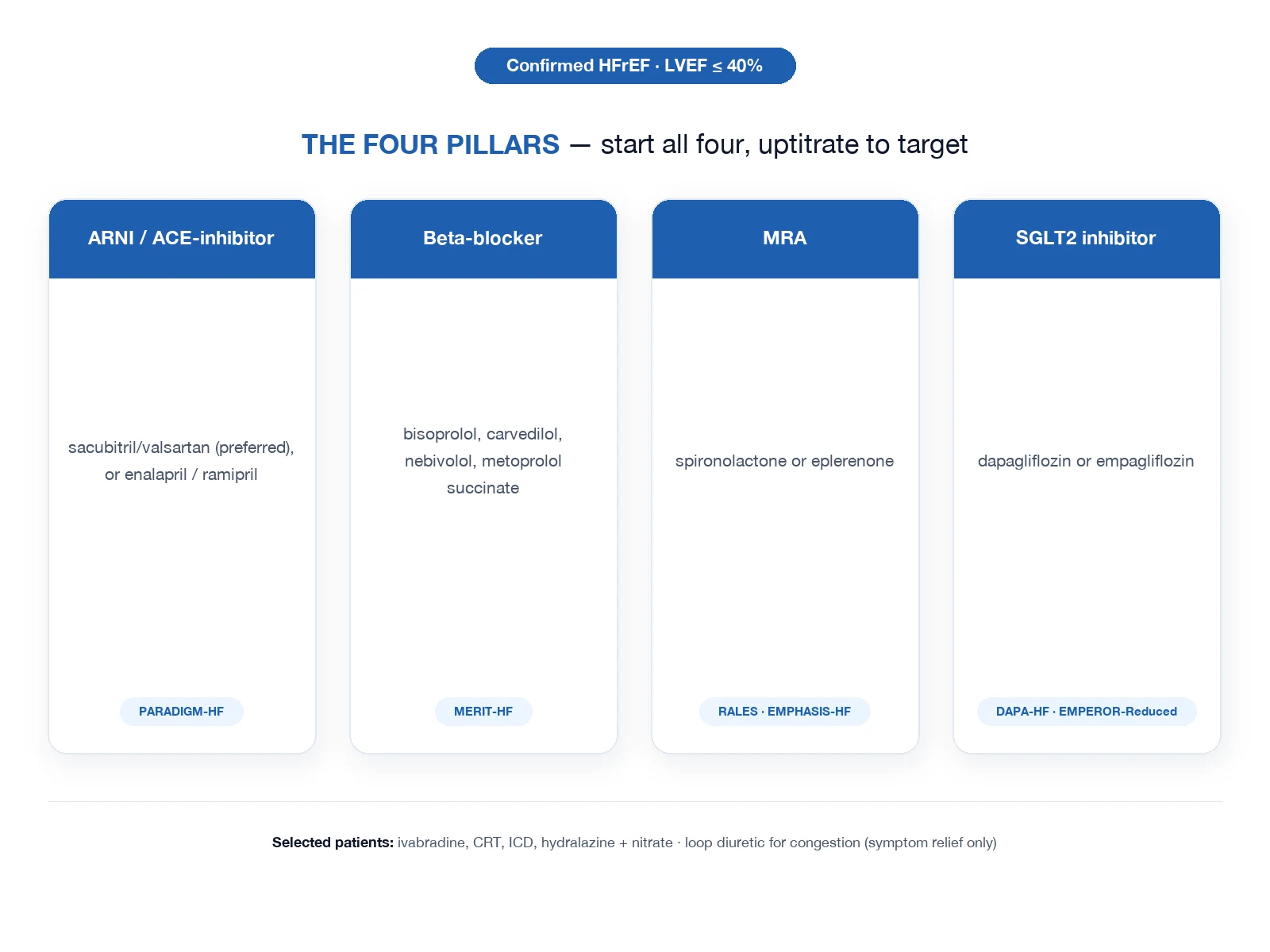
Heart failure with reduced EF (HFrEF): FOUR PILLARS of guideline-directed medical therapy (GDMT). (1) ARNI (sacubitril/valsartan) or ACEi/ARB. (2) Beta-blocker (bisoprolol, carvedilol, metoprolol succinate). (3) Mineralocorticoid receptor antagonist (MRA — spironolactone, eplerenone). (4) SGLT2 inhibitor (dapagliflozin, empagliflozin) — NEWEST, benefits HF regardless of diabetes. Each reduces mortality ~15-20%. Target: all four (if tolerated). New paradigm: start EARLY, all FOUR, then uptitrate. SGLT2 inhibitors are REVOLUTIONARY — first drug class to benefit HFrEF AND HFpEF. In ICU: don't start new GDMT during acute decompensation — stabilise first, start after recovery.

high25 referencesUpdated 1 July 2026
On this page & tools

Your progress

Saved locally on this device.

Target exams

CICMFFICMEDIC

Red flags

SGLT2 inhibitors (dapagliflozin, empagliflozin) benefit BOTH HFrEF AND HFpEF — first drug class to do soFour pillars — start all early (within days-weeks), not sequentially over monthsDon't start new GDMT during acute decompensation in ICU — stabilise firstSGLT2 inhibitors: risk of euglycaemic DKA, volume depletion, genital infections

Your progress

Saved locally on this device.

Target exams

CICMFFICMEDIC

Red flags

SGLT2 inhibitors (dapagliflozin, empagliflozin) benefit BOTH HFrEF AND HFpEF — first drug class to do soFour pillars — start all early (within days-weeks), not sequentially over monthsDon't start new GDMT during acute decompensation in ICU — stabilise firstSGLT2 inhibitors: risk of euglycaemic DKA, volume depletion, genital infections

In one line

HFrEF GDMT — four pillars: (1) ARNI (sacubitril/valsartan) or ACEi. (2) Beta-blocker (bisoprolol/carvedilol). (3) MRA (spironolactone). (4) SGLT2 inhibitor (dapagliflozin/empagliflozin — benefits HFrEF AND HFpEF). Each reduces mortality ~15-20%. New paradigm: start all four EARLY, uptitrate. In ICU: don't start during acute decompensation — stabilise first.

[1]
Cinematic ICU scene of the four pillars of heart-failure GDMT on the trolley — a beta-blocker, an ARNI, a mineralocorticoid receptor antagonist, and an SGLT2 inhibitor — beside a cardiac monitor, clinical-blue lighting, no faces, no text
FigureThe four pillars of the HFrEF GDMT — the beta-blocker, the ARNI, the MRA, the SGLT2 inhibitor. Each reduces the mortality; the start all four early, the uptitrate, the stabilise first in the acute decompensation.

Four pillars of HFrEF therapy

PillarDrugMortality reductionKey trialCautions
ARNISacubitril/valsartan~20% vs ACEiPARADIGM-HFHypotension, hyperkalaemia, angioedema. Don't use with ACEi (washout 36h)
Beta-blockerBisoprolol, carvedilol, metoprolol succinate~35%MERIT-HF, COPERNICUS, CIBIS-IIBradycardia, hypotension, worsening HF (start low)
MRASpironolactone, eplerenone~30%RALES, EMPHASIS-HFHyperkalaemia, renal impairment, gynaecomastia (spironolactone)
SGLT2 inhibitorDapagliflozin, empagliflozin~17-25%DAPA-HF, EMPEROR-ReducedVolume depletion, euglycaemic DKA, genital infections
[1]

Starting GDMT in HFrEF — new rapid initiation paradigm

  1. Diagnose HFrEF — echocardiography (EF <40%), clinical assessment
  2. Stabilise acute decompensation (if present) — diuretics, oxygen, vasodilators. DON'T start new GDMT during acute crisis (except continue existing)
  3. Start FOUR PILLARS early (within days-weeks) — NOT sequentially over months (old paradigm). Rapid initiation:
    • ARNI (sacubitril/valsartan 24/26 mg BD) OR ACEi (enalapril 2.5 mg BD)
    • Beta-blocker (bisoprolol 1.25 mg OD or carvedilol 3.125 mg BD — start LOW)
    • MRA (spironolactone 12.5-25 mg OD)
    • SGLT2 inhibitor (dapagliflozin 10 mg OD or empagliflozin 10 mg OD)
  4. Uptitrate — every 2-4 weeks, to target doses (as tolerated)
  5. Monitor — BP, heart rate, renal function, potassium, symptoms
  6. Consider additional — loop diuretic (for congestion), ivabradine (HR >70 on beta-blocker), vericiguat (worsening HF), hydralazine/nitrate (African descent, ACEi intolerance)
[1]

Clinical pearls

High-yield heart failure GDMT points for CICM/FFICM exam

  1. SGLT2 inhibitors are REVOLUTIONARY — benefit HFrEF AND HFpEF. First drug class to improve outcomes in BOTH HF types. DAPA-HF (HFrEF): reduced mortality + HF hospitalisation. EMPEROR-Preserved (HFpEF): reduced HF hospitalisation. Works REGARDLESS of diabetes (originally diabetes drugs — discovered HF benefit). Mechanism: not fully understood (osmotic diuresis, improved cardiac metabolism, reduced inflammation, reduced preload/afterload).[1] }
  2. Four pillars — start ALL early, not sequentially. OLD paradigm: start ACEi, wait months, add beta-blocker, wait, add MRA. NEW paradigm: start all FOUR within days-weeks (each independent benefit). Rationale: additive effects (each reduces mortality ~15-20%), patients die while waiting for sequential initiation. PIONEERED-HF, TRANSITION trials: safe to start early post-hospitalisation.[5] }
  3. ARNI (sacubitril/valsartan) superior to ACEi. PARADIGM-HF (2014): ARNI vs enalapril. ARNI reduced mortality 20%, reduced HF hospitalisation 21%. ARNI is FIRST-LINE (replacing ACEi as first choice) for HFrEF. CAUTION: 36-hour washout from ACEi before starting ARNI (risk of angioedema). Don't combine ARNI + ACEi.[4] }
  4. Beta-blockers — only THREE proven for HFrEF. Bisoprolol (MERIT-HF, CIBIS-II), carvedilol (COPERNICUS, COMET), metoprolol succinate (not tartrate — MERIT-HF). Other beta-blockers (atenolol, metoprolol tartrate, propranolol) NOT proven for HF. Start LOW (bisoprolol 1.25 mg, carvedilol 3.125 mg), uptitrate slowly. AVOID in acute decompensation (hold if worsening).[5] }
  5. MRA (spironolactone, eplerenone) — for symptomatic HFrEF. RALES trial: reduced mortality 30% in severe HF. EMPHASIS-HF: benefit in mild-moderate HF. MONITOR potassium (hyperkalaemia common — especially with ACEi/ARNI). Spironolactone: gynaecomastia (anti-androgenic) — switch to eplerenone if occurs. NOT for HFpEF (TOPCAT — overall negative, possible benefit in Americas subgroup).[5] }
  6. Don't start NEW GDMT during acute decompensation in ICU. During ADHF: (1) Continue EXISTING GDMT (don't stop, unless hypotensive/AKI). (2) TEMPORARILY HOLD ACEi/ARNI/MRA if hypotensive or AKI worsening. (3) DON'T start NEW beta-blocker (may worsen acute HF). (4) START GDMT after stabilisation (decongestion, euvolaemic, stable BP/renal function). (5) SGLT2 inhibitors: hold during acute illness (DKA risk — especially if insulin-dependent diabetic).[6] }
  7. SGLT2 inhibitors — adverse effects to know. (1) EUGLYCAEMIC DKA (rare but serious — especially type 1 diabetes, insulin-dependent type 2, starvation, surgery). (2) Volume depletion (osmotic diuresis — hypotension, AKI). (3) Genital infections (candidiasis — mycotic). (4) Rare: Fournier's gangrene (necrotising fasciitis of perineum). (5) Hold during acute illness, surgery, starvation (DKA risk). MONITOR: glucose, ketones, volume status.[1] }
  8. Hydralazine + nitrate — for specific groups. A-HeFT trial: added benefit in AFRICAN DESCENT patients (on standard GDMT). Also: ACEi/ARNI intolerance (renal, cough, angioedema). Not first-line (less effective than ACEi/ARNI) but valuable for selected patients. Dose: hydralazine 37.5-75 mg TDS + isosorbide dinitrate 20-40 mg TDS.[5] }
  9. Ivabradine — for elevated heart rate on beta-blocker. SHIFT trial: ivabradine (If channel inhibitor — slows sinus node) reduced HF hospitalisation in patients with HR >70 despite beta-blocker. Add to GDMT (NOT replacement for beta-blocker). Dose: 5 mg BD (titrate to HR 55-60). Side effects: bradycardia, visual phenomena (phosphenes).[5] }
  10. Vericiguat — newest, for worsening HF. VICTORIA trial (2021): soluble guanylate cyclase stimulator. Reduced composite CV death + HF hospitalisation in worsening HF (recent hospitalisation or IV diuretics). Modest benefit (NNT 25). For high-risk patients with recent worsening. Dose: 10 mg OD.[6] }
  11. SGLT2 for HFpEF — breakthrough. EMPEROR-Preserved (2021): empagliflozin reduced HF hospitalisation in HFpEF (EF >40%). FIRST drug to show benefit in HFpEF (all previous trials negative — TOPCAT marginal). Also: PRESERVED-HF, DELIVER — confirming benefit. Mechanism unclear (HFpEF has different pathophysiology — diastolic dysfunction, stiffness). SGLT2 now recommended for HFpEF.[3] }
  12. Device therapy — ICD and CRT for selected patients. ICD (primary prevention): EF <35% despite ≥3 months optimal GDMT. Reduces sudden cardiac death. CRT (cardiac resynchronisation): EF <35% + LBBB + QRS >150 ms. Improves symptoms, survival. Assess AFTER 3 months GDMT (EF may improve — avoid unnecessary devices).[5] }
  13. Loop diuretics — for symptom relief, NOT mortality. Frusemide, bumetanide, torsemide: relieve congestion (dyspnoea, oedema). Do NOT improve mortality (no outcome trials). Use for SYMPTOMS (congestion). Taper to lowest effective dose once euvolaemic. NOT one of the 'four pillars' (which reduce mortality).[6] }
  14. Combining all four — additive mortality benefit. If all four pillars used: estimated mortality reduction 70-80% (vs no therapy). This is comparable to ACEi after MI. TRANSFORMS HFrEF from progressive fatal disease to manageable chronic condition. GOAL: get patients on all four (if tolerated). Barriers: hypotension (can't tolerate all), renal impairment (MRA/SGLT2), cost, side effects.[5] }

Red flags

Critical heart failure GDMT red flags

  • SGLT2 benefit BOTH HFrEF and HFpEF — first drug class to do so.[1] }
  • Start four pillars EARLY (not sequentially) — each independent mortality benefit.[5] }
  • Don't start NEW GDMT during acute decompensation — stabilise first.[6] }
  • ARNI: 36-hour washout from ACEi (angioedema risk).[4] }
  • SGLT2: euglycaemic DKA risk — hold during acute illness, surgery, starvation.[1] }
  • MRA: hyperkalaemia — monitor, especially with ACEi/ARNI.[5] }

Prognosis

Key heart failure GDMT trials

PARADIGM-HF (2014): ARNI vs ACEi. ARNI reduced mortality 20% (CV death/HF hospitalisation). ARNI now first-line for HFrEF. DAPA-HF (2019): dapagliflozin vs placebo (HFrEF). Reduced primary outcome 26% (HF worsening or CV death). Reduced mortality 17%. EMPEROR-Reduced (2020): empagliflozin vs placebo (HFrEF). Reduced primary outcome 25%. EMPEROR-Preserved (2021): empagliflozin in HFpEF. Reduced HF hospitalisation 29% (FIRST positive HFpEF trial). RALES (1999): spironolactone in severe HFrEF. Reduced mortality 30%. MERIT-HF (1999): bisoprolol in HFrEF. Reduced mortality 34%. [1]

FOUR PILLARS combined: estimated 70-80% mortality reduction (vs no therapy). HFrEF now a MANAGEABLE chronic condition.

[1]

The one-paragraph fellowship answer — why four pillars, why early, why devices last

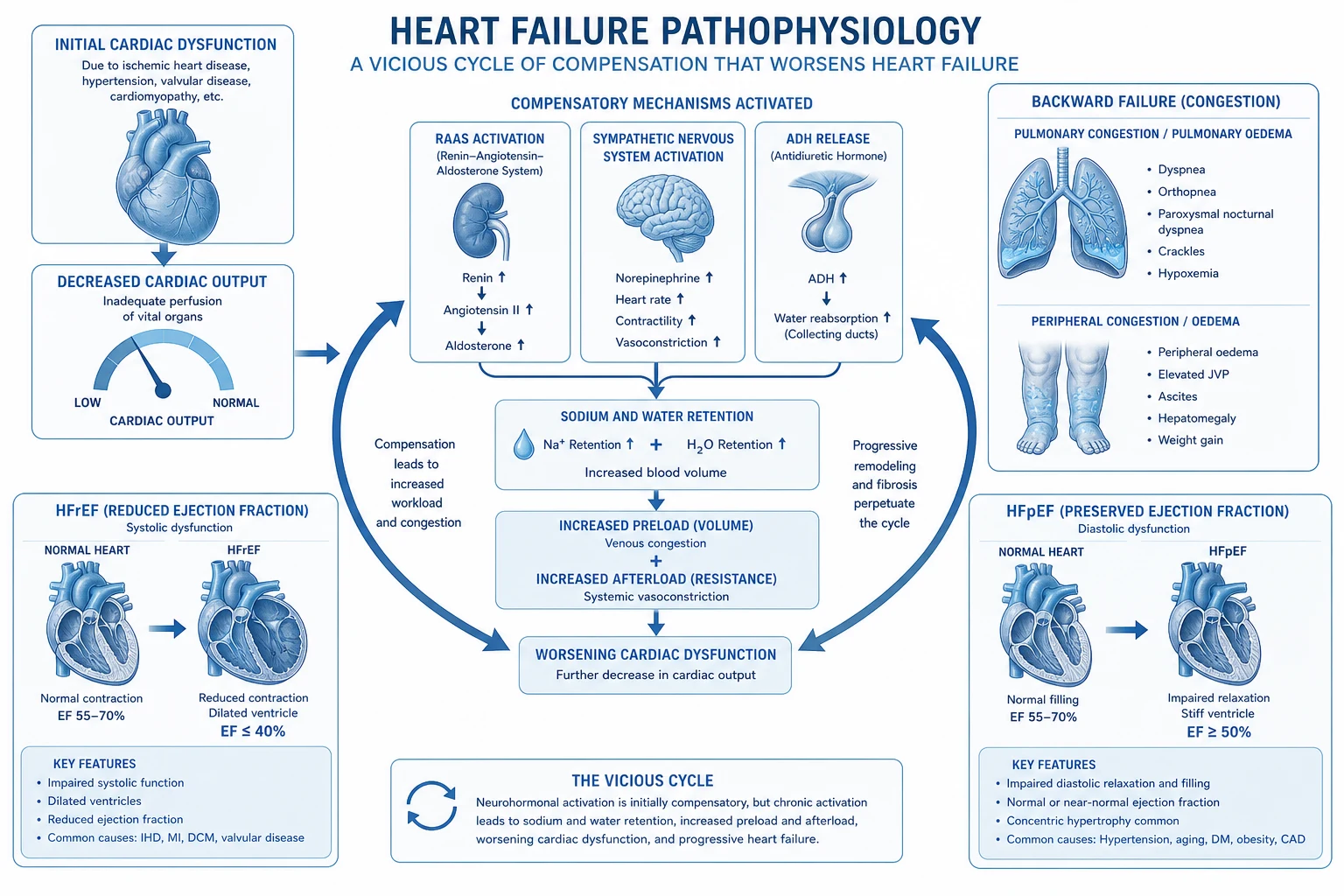
HFrEF is driven by a self-perpetuating cycle of neurohormonal activation (sympathetic nervous system, renin-angiotensin-aldosterone system, and — in decompensation — arginine-vasopressin and endothelin). Each of the four pillars targets one limb of this maladaptive remodelling loop and has shown an independent mortality reduction in a randomised trial: beta-blockade (MERIT-HF, CIBIS-II, COPERNICUS), RAAS blockade with the superior neprilysin-inhibiting ARNI (PARADIGM-HF), aldosterone antagonism (RALES, EMPHASIS-HF), and the pleiotropic SGLT2 inhibitors (DAPA-HF, EMPEROR-Reduced).[8][9][10][4][5][11][1][2] Because the benefits are largely additive, contemporary guidelines (2022 AHA/ACC/HFSA, 2021 ESC) recommend starting all four at low dose within days of diagnosis — the "quadruple therapy, then titrate" paradigm — rather than the historical sequential stepwise addition that left patients under-protected while they waited months between agents.[6][7] Device therapy (ICD, CRT) is not first-line: reassess EF after at least 3 months of maximally-tolerated GDMT, because a third of non-ischaemic patients will recover EF above the device threshold and avoid an unnecessary generator.[18][20]

Pillar one — Beta-blockade

Educational schematic of HFrEF neurohormonal activation and the four GDMT pillars targeting sympathetic, RAAS, aldosterone and SGLT2 pathways
FigureHFrEF is a neurohormonal disease — GDMT attacks sympathetic drive (beta-blocker), RAAS (ARNI/ACEi/ARB), aldosterone (MRA) and metabolic/volume pathways (SGLT2i).

The three beta-blockers proven for HFrEF — and why only these three

DrugInitial doseTarget doseLandmark trial(s)Mechanism nuance
Bisoprolol1.25 mg OD10 mg ODCIBIS-II, MERIT-HF (β1-selective)[8][9]Highest β1 selectivity; once-daily; well tolerated
Carvedilol3.125 mg BD25 mg BD (50 mg BD if >85 kg)COPERNICUS, COMET[10]Non-selective β + α1-blockade; antioxidant; preferred in diabetics (no weight gain)
Metoprolol succinate (CR/XL)12.5-25 mg OD200 mg ODMERIT-HF[8]MUST be succinate (long-acting). Tartrate NOT proven for mortality

Beta-blocker pearls the examiner will probe

  1. Only THREE beta-blockers are evidence-based for HFrEF: bisoprolol, carvedilol, and metoprolol succinate. Metoprolol tartrate, atenolol, nebivolol (except elderly HFpEF — SENIORS), propranolol and sotalol have NOT demonstrated mortality benefit in HFrEF and are not interchangeable substitutes.[9][8][10]
  2. Start LOW, go SLOW — initial dose is ~1/8 of target; double every 2 weeks (or longer if symptomatic) to the maximally-tolerated dose. The dose–response is flat for mortality benefit, but UP-titration reduces hospitalisation. Never uptitrate during acute decompensation.[6]
  3. COPERNICUS extended beta-blockade to severe HFrEF: previously contraindicated in NYHA IV, carvedilol reduced mortality 35% in decompensated-severe patients once clinically euvolaemic — the qualifier matters.[10]
  4. Carvedilol vs metoprolol — COMET showed carvedilol superior to metoprolol tartrate for mortality, but the comparison is confounded by the wrong (short-acting) metoprolol formulation. Do NOT conclude carvedilol > metoprolol succinate from COMET.
  5. Do not abandon beta-blockade because of mild decompensation — temporary dose reduction is preferred over abrupt cessation, which precipitates rebound tachycardia, ischaemia and arrhythmia. Hold only for cardiogenic shock, severe bronchospasm, symptomatic bradycardia not responsive to pacing, or advanced heart block.
  6. Beta-blockade is the single most powerful individual therapy for HFrEF mortality — relative risk reduction ~35%, greater than any other single drug class. Exam favourite: "which GDMT class has the largest individual mortality reduction?" Answer: beta-blocker.[8][9][10]

Pillar two — RAAS blockade: ARNI, ACEi, ARB

Renin-angiotensin axis options — picking the right agent

AgentMechanismStarting doseTarget doseKey trialPreferred when
Sacubitril/valsartan (ARNI)Blocks AT1 receptor + inhibits neprilysin (↑ natriuretic peptides, bradykinin)24/26 mg BD (low)97/103 mg BDPARADIGM-HF[4]First-line for all HFrEF (Class I, LOE B-R)
Enalapril (ACEi)Blocks ACE → ↓ angiotensin II2.5 mg BD10-20 mg BDSOLVD-TreatmentARNI not available/intolerated, cost, hypotension risk
Ramipril (ACEi)ACE inhibitor2.5 mg OD10 mg ODHOPEPost-MI HFrEF, vascular protection
Candesartan (ARB)Blocks AT1 receptor (ACE-independent)4 mg OD32 mg ODCHARM-Alternative[22]ACEi intolerance (cough — NOT angioedema)

Switching from ACEi to ARNI — the 36-hour washout protocol

  1. Confirm no contraindication — SBP >100 mmHg, eGFR >30, K+ <5.2, no history of angioedema or hereditary angioedema
  2. STOP the ACEi — record exact time (enalapril/lisinopril/ramipril)
  3. Wait 36 hours (washout) — sacubitril inhibits neprilysin, which degrades bradykinin; ACE also degrades bradykinin; combined ACEi + ARNI exponentially raises angioedema risk. The 36-hour washout is non-negotiable.[4]
  4. Initiate ARNI low-dose — sacubitril/valsartan 24/26 mg BD (lower if SBP 100-110, eGFR <30, or moderate hepatic impairment)
  5. Reassess in 2-4 weeks — BP, renal function, potassium, symptoms
  6. Uptitrate to 49/51 mg BD then 97/103 mg BD every 2-4 weeks as tolerated
  7. If switching from ARB → ARNI — no washout needed (valsartan component overlaps directly); just stop the ARB and start ARNI next dose

ARNI and ACEi/ARB pearls — washout, angioedema, equivalence

  1. PARADIGM-HF was stopped early by the DSMB because ARNI was overwhelmingly superior to enalapril: 20% reduction in CV death/HF hospitalisation, 16% reduction in all-cause mortality.[4] ARNI is now Class I, LOE B-R first-line for symptomatic HFrEF.
  2. The 36-hour ACEi washout before ARNI is the single highest-yield safety fact: combined ACEi + ARNI causes a 6-14× higher rate of angioedema. Black patients and those with prior ACEi-related angioedema are at greatest risk and may be better managed with ARB + evidence-based beta-blocker + MRA + SGLT2i rather than ARNI.[4]
  3. PARAGON-HF (2019) was a near-miss in HFpEF: ARNI narrowly missed the primary endpoint overall (HR 0.87, p=0.06) but showed significant benefit in the pre-specified EF <=57% subgroup and in women, leading to a labelled indication for HFmrEF/HFpEF in some jurisdictions. The 2022 AHA/ACC guideline gives ARNI a Class IIa for HFpEF.[23]
  4. CHARM-Alternative established ARBs as the answer to ACEi-intolerant patients — candesartan reduced CV death/HF hospitalisation 23% in patients who could not tolerate ACEi (mostly cough).[22] ARB is the second-line RAAS agent (not first-line if ARNI available).
  5. Do NOT combine ACEi + ARB + ARNI — triple RAAS blockade is dangerous and offers no benefit, while escalating hyperkalaemia, hypotension, and renal injury. Pick ONE RAAS agent.
  6. Hold RAAS blockade temporarily in ADHF if: SBP <90, AKI with creatinine rising >2× baseline, or K+ >5.5 despite correction. Resume at half-dose once stabilised — do NOT discontinue permanently for a transient AKI.

Pillar three — Mineralocorticoid receptor antagonists (MRA)

Spironolactone vs eplerenone — choosing the MRA

FeatureSpironolactoneEplerenone
Source trialRALES (severe HFrEF)[5]EPHESUS (post-MI HF), EMPHASIS-HF (mild-moderate)[11]
Starting dose12.5-25 mg OD25 mg OD
Target dose25-50 mg OD50 mg OD
Anti-androgenic effectsYES — gynaecomastia (10%), impotence, menstrual irregularityMinimal (selective MRA)
Half-life~20 hours (long)~4-6 hours
Hyperkalaemia riskHighHigh (similar)
CostInexpensive (generic)More expensive
Preferred inGeneral HFrEF, ascites, cirrhosisYoung men (gynaecomastia-intolerant), post-MI LV dysfunction

MRA pearls — potassium, TOPCAT, and the Americas paradox

  1. RALES (1999) was a landmark — spironolactone 25-50 mg OD on top of ACEi + loop diuretic reduced all-cause mortality 30% in NYHA III-IV HFrEF. This was the first proof that aldosterone breakthrough matters even when patients are on ACEi.[5]
  2. EMPHASIS-HF (2011) extended MRA benefit to mild HF — eplerenone reduced CV death/HF hospitalisation 37% in NYHA II patients. MRAs are now indicated for ALL symptomatic HFrEF, not just severe.[11]
  3. TOPCAT was overall NEGATIVE in HFpEF — but a striking geographic heterogeneity emerged: patients recruited in the Americas (Russia/Georgia) had negligible event rates suggesting enrolment of non-HF patients, while the Americas-subgroup actually showed benefit. MRA is therefore Class IIb for HFpEF — reasonable to reduce hospitalisation.[12]
  4. Hyperkalaemia is the dose-limiting toxicity — check K+ and creatinine at 1 week, 1 month, 3 months, then every 3 months. Hold MRA if K+ >5.5, halve dose after recheck. Persistent K+ >6.0 = stop. Modern potassium binders (patiromer, SZC) can enable continuation in selected patients.
  5. Gynaecomastia is not benign — 10% of men on spironolactone develop painful gynaecomastia; switch to eplerenone rather than discontinuing the class.
  6. MRA reduces sudden cardiac death independent of K+ — there is a direct anti-fibrotic effect on the myocardium, separate from any electrolyte change. This is why MRAs are 'pillar three' even in well-diuresed patients.
  7. Avoid in K+ >5.0, eGFR <30, or concurrent potassium-sparing diuretics/trimet­hrim — triple potassium-loading combinations are the commonest cause of iatrogenic hyperkalaemia admissions.

Pillar four — SGLT2 inhibitors

SGLT2 inhibitors in heart failure — dapagliflozin vs empagliflozin

FeatureDapagliflozinEmpagliflozin
HFrEF trialDAPA-HF (2019)[1]EMPEROR-Reduced (2020)[2]
HFpEF trialDELIVER (2022)[25]EMPEROR-Preserved (2021)[3]
HFrEF primary outcome reduction26% (CV death/HF hospitalisation)25% (CV death/HF hospitalisation)
HFrEF mortality reduction17% (HR 0.83)Non-significant trend
HFpEF hospitalisation reduction21% (DELIVER)29% (EMPEROR-Preserved)
Renal effectSlows eGFR declineSlows eGFR decline
Dose10 mg OD10 mg OD
Diabetes dose10 mg OD10-25 mg OD
Euglycaemic DKA riskRare but realRare but real

Starting an SGLT2 inhibitor in a stable HFrEF patient

  1. Confirm HFrEF diagnosis (EF <=40%, symptomatic NYHA II-IV) and clinical stability — SBP >100, euvolaemic, no acute illness
  2. Check baseline — eGFR (dapagliflozin/empagliflozin licensed from eGFR 20), glucose, ketones, BMI, genital examination
  3. Counsel the patient on — genital hygiene (candidiasis risk), volume depletion symptoms, euglycaemic DKA warning signs (nausea, abdominal pain, ketotic breath even at normal glucose), and the importance of holding during illness/surgery/fasting
  4. Start dapagliflozin 10 mg OD or empagliflozin 10 mg OD — no dose escalation needed; full-dose from initiation
  5. Recheck at 2-4 weeks — BP (may allow diuretic reduction), renal function, glucose, ketones if diabetic
  6. Reduce loop diuretic by 25-50% if signs of over-diuresis — SGLT2 adds ~25 g/day of glucose-mediated osmotic diuresis
  7. Sick-day rules — hold during acute illness, surgery, prolonged fasting, or insulin withdrawal in T1DM (NEVER use in T1DM — DKA risk prohibitive)
[1]

SGLT2 pearls — mechanism, indications, the impossible-to-recall adverse effects

  1. SGLT2 inhibitors are the first drug class to benefit BOTH HFrEF and HFpEF — DAPA-HF and EMPEROR-Reduced in HFrEF[1][2]; EMPEROR-Preserved and DELIVER in HFpEF/HFmrEF.[3][25] This is revolutionary because every prior HFpEF trial (I-PRESERVE, TOPCAT, PARAGON-HF narrowly) was negative.
  2. Benefit is INDEPENDENT of diabetes — DAPA-HF excluded unstable diabetics and the hazard ratio was identical in diabetics and non-diabetics. SGLT2i is now a heart-failure drug that happens to lower glucose, not the reverse.[1]
  3. Onset of benefit is FAST — separation of Kaplan-Meier curves begins within 2-4 weeks, much earlier than beta-blockers or ARNI (months). This supports starting in hospital once stabilised (PIONEERED-HF, TRANSITION).[16][17]
  4. Mechanism is genuinely uncertain — proposed mechanisms include: (a) osmotic diuresis and mild volume depletion reducing preload; (b) improved myocardial energetics (ketone body and free fatty acid utilisation); (c) reduction of inflammation and oxidative stress; (d) improved myocardial Na+/Ca2+ handling; (e) lowered afterload via BP reduction; (f) renal protection reducing cardiorenal spirals. The mechanism exam answer is "multifactorial — not fully elucidated."[6]
  5. Euglycaemic DKA is the exam-favourite rare complication — glucose typically <14 mmol/L (differentiates from classic DKA). Risk factors: insulin-dependent T2DM, recent surgery, prolonged fasting, sepsis, alcohol, ketogenic diet. Present with nausea/vomiting/abdominal pain and metabolic acidosis with a high anion gap. Treat with IV dextrose + insulin (NOT just insulin — glucose is normal), hold SGLT2 indefinitely.
  6. Fournier's gangrene (necrotising fasciitis of the perineum) — extremely rare (FDA warning 2018) but life-threatening. Counsel patients to seek emergency care for perineal/groin pain, swelling, or fever.
  7. Volume depletion and AKI — the osmotic diuresis can drop preload; reduce loop diuretics on initiation by ~25-50% in volume-sensitive patients (elderly, low SBP, on multiple diuretics).[6]
  8. SGLT2 + MRA combination is SAFE and recommended — DAPA-HF and EMPEROR-Reduced both included patients on MRAs without signal of hyperkalaemia or AKI synergy. This is a key difference from the historical ACEi + MRA + ARB "triple" combination that was nephrotoxic.

Initiation timing — the rapid-quadruple paradigm

OLD (sequential) vs NEW (rapid quadruple) initiation paradigm

FeatureOLD paradigm (pre-2020)NEW paradigm (current guidelines)[6][7]
SequenceACEi → wait months → β-blocker → wait → MRA → lastly SGLT2iStart ALL FOUR within days-weeks of diagnosis
LogicAdd one drug, titrate, reassessEach drug independently reduces mortality; additive effects
Risk of under-treatmentHIGH — patients died waitingLOW
Hospital-initiatedOften deferred to outpatientOften in-hospital at first encounter
Trial basisEmpiric, traditionPIONEERED-HF, TRANSITION, STRONG-HF[16][17]

Managing GDMT during an ADHF admission — the inpatient GDMT algorithm

  1. ADMIT — IV loop diuretic (1-2.5× oral dose), oxygen if hypoxic, consider NIV if respiratory distress, treat precipitant (AF, ischaemia, non-adherence, infection)
  2. CONTINUE existing GDMT unless haemodynamically contraindicated — never stop beta-blocker abruptly (rebound ischaemia/arrhythmia); reduce dose rather than cease
  3. HOLD temporarily if: SBP <90 (RAAS, SGLT2i), symptomatic bradycardia (β-blocker), AKI with K+ rising or eGFR dropping >30% (RAAS, MRA, SGLT2i), severe hypoperfusion/cardogenic shock (all four)
  4. DO NOT initiate NEW beta-blocker during acute crisis — wait until euvolaemic and off IV inotropes for 24 h
  5. CONSIDER initiating in hospital: SGLT2i (PIONEERED-HF, TRANSITION support in-hospital initiation once stabilised, even before discharge)[16][17]; switch ACEi to ARNI in stabilised patients (PIONEERED-HF showed greater NT-proBNP reduction without excess adverse events)
  6. TARGET on discharge: patient on at least one agent of each pillar class (or a documented contraindication for each missing agent)
  7. SCHEDULE close follow-up within 1-2 weeks for BP, renal function, K+, uptitration plan — gaps in care post-discharge are the commonest cause of re-admission

ICU initiation timing pearls — what to start, what to hold, what to switch

  1. During acute decompensation, the rule is: continue, do not initiate — the only exception is the SGLT2i (PIONEERED-HF demonstrated safe initiation of ARNI vs enalapril in stabilised ADHF with significant NT-proBNP reduction, no excess hypotension/renal dysfunction/AKI).[16]
  2. TRANSITION supported pre-discharge initiation of ARNI — patients randomised to sacubitril/valsartan started in-hospital or within 14 days post-discharge had comparable safety and tolerability, supporting the "initiate before they leave" strategy.[17]
  3. Beta-blocker in acute decompensated HFrEF is harmful — initial worsening of contractility can precipitate cardiogenic shock. The exception is the patient already on beta-blocker who decompensates due to non-cardiac cause (e.g., pneumonia): continue the home dose.
  4. "Cardiorenal dose" of RAAS — in patients with rising creatinine during decongestion, halve rather than stop the ACEi/ARNI; creatinine rise up to 30% from baseline during decongestion is expected and BENIGN (haemoconcentration effect) and is NOT a reason to permanently discontinue.
  5. Iron deficiency is common and treatable — ~50% of HFrEF patients have absolute (ferritin <100 µg/L or 100-299 with TSAT <20%) iron deficiency; IV ferric carboxymaltose (AFFIRM-AHF, CONFIRM-HF) improves symptoms and exercise capacity independent of anaemia. Check ferritin and TSAT in every HFrEF admission.[6]
  6. Hyponatraemia in ADHF is a marker of high AVP, not sodium deficiency — fluid-restrict, intensify diuretics, consider tolvaptan only if severe (Na+ <125) and symptomatic. Hypertonic saline is wrong unless seizures/imminent herniation.

Device therapy — ICD and CRT

Heart failure GDMT management pathway: stabilise acute decompensation, initiate all four pillars early at low dose, uptitrate, monitor electrolytes and blood pressure, plan devices after optimisation
FigureModern paradigm — stabilise first, then start all four pillars early at low dose and uptitrate; restart GDMT before discharge after acute decompensation.

Device therapy in HFrEF — ICD vs CRT-P vs CRT-D

DeviceIndicationKey trial(s)BenefitCautions
ICD (primary prevention)EF <=35% after ≥3 months optimal GDMT, NYHA II-III, survival expectation >1 yearMADIT-II, SCD-HeFT[19][18]↓ sudden cardiac death 50-60%Inappropriate shocks (15-20%), infection, lead failure, end-of-life deactivation
CRT-P (paces only)EF <=35%, LBBB, QRS >150 ms, NYHA III-IV despite GDMTCARE-HF, COMPANION[20][21]↓ mortality, ↑ EF, ↑ symptomsNon-responder rate 30%; lead complexity
CRT-D (paces + defibrillates)Same as CRT-P but adds sudden-death protectionMADIT-CRT, RAFT[24]↓ mortality + ↓ sudden deathHigher complication rate than CRT-P; choice individualised

ICD/CRT evaluation — the 3-month GDMT reassessment

  1. Confirm ≥3 months of maximally-tolerated GDMT at target or highest-tolerated doses of all four pillars
  2. Repeat echocardiography — measure LVEF and assess mechanical dyssynchrony
  3. If EF recovered to >35% — re-stratify; one third of non-ischaemic patients will recover above threshold with optimal quadruple therapy (especially in tachycardia-mediated, peri-partum, alcoholic, or mineralocorticoid-excess cardiomyopathies). NO device.
  4. If EF remains <=35% and NYHA II-III — ICD for primary prevention (Class I), expected survival >1 year, no unrecoverable comorbidity. SCD-HeFT basis.[18]
  5. If LBBB + QRS >150 ms — add CRT. CARE-HF (CRT-P) and COMPANION (CRT-D) showed 36% and 24% mortality reduction respectively.[20][21]
  6. If QRS <120 ms without LBBB — no CRT (EchoCRT, RAFT narrow-QRS subgroups negative)
  7. Document shared decision-making — benefits, risks, shock burden, end-of-life deactivation preferences
  8. If NYHA IV refractory — consider left ventricular assist device (LVAD) or transplant referral rather than CRT in isolation

Device therapy pearls for the exam

  1. SCD-HeFT (2005) is the cornerstone primary-prevention ICD trial — ICD vs amiodarone vs placebo in NYHA II-III HFrEF; ICD reduced all-cause mortality 23%, amiodarone was NO different from placebo (and may have harmed NYHA III).[18]
  2. MADIT-II (2002) expanded ICD indications — prophylactic ICD in post-MI patients with EF <=30% reduced mortality 31% irrespective of symptoms.[19]
  3. CARE-HF (2005) defined CRT-P benefit — biventricular pacing in LBBB/QRS >120 ms HFrEF reduced mortality 36%. CRT-P alone is a mortality-reducing therapy, not just symptom relief.[20]
  4. COMPANION (2004) showed CRT-D ≥ CRT-P > optimal medical therapy — both CRT modalities reduced the composite of death/HF hospitalisation; CRT-D trended toward superior mortality reduction.[21]
  5. MADIT-CRT (2009) extended CRT to mild HFrEF — CRT-D in NYHA I-II, EF <=30%, QRS >130 ms reduced HF events by 41%, especially in LBBB and women.[24]
  6. The 3-month reassessment matters — too many devices implanted in patients who would have recovered on quadruple therapy. "EF recovery" is now a recognised phenomenon in dilated cardiomyopathy of reversible cause; the goal of GDMT is to AVOID unnecessary device placement, not to qualify for it.
  7. ICD is for primary prevention of arrhythmic death, NOT contractile improvement — ICD does not improve EF or symptoms; it converts sudden death into non-sudden death. Patients with end-stage HFrEF and frequent appropriate shocks have poor quality of life; deactivation discussions should occur early.
  8. Contraindications to ICD: life expectancy <1 year (NYHA IV refractory, advanced dementia, terminal malignancy), incessant VT/VF without treatable trigger, significant psychiatric illness that would render shocks intolerable, and patients who decline. CRT-P remains an option in end-stage HFrEF for symptom palliation even when ICD is declined.
  9. Subcutaneous ICD (S-ICD) — avoids transvenous leads; suitable for young patients (long lead lifetime need), vascular access difficulties, or prior endocarditis; NOT suitable for patients needing pacing (bradycardia, CRT) or with monomorphic VT requiring ATP.
  10. Cardiac contractility modulation (CCM) — investigational non-defibrillating device delivering signals to RV septum during absolute refractory period; may benefit HFrEF patients with narrow QRS who do not qualify for CRT.

Adjunctive and targeted therapies

Targeted add-on therapies — when the four pillars are not enough

DrugIndicationTrialDoseCautions
IvabradineSinus rhythm HR >70 on maximally-tolerated β-blocker, HFrEF EF <=35%SHIFT[13]5 mg BD, titrate to HR 55-60Bradycardia, phosphenes (visual phenomena), atrial fibrillation (do not use in AF — only slows sinus node)
Hydralazine + isosorbide dinitrateAfrican-descent patients with HFrEF on optimal GDMT; or ACEi/ARNI intolerance (renal/angioedema)A-HeFT, V-HeFT[15]Hydralazine 37.5-75 mg TDS + ISDN 20-40 mg TDSHeadache, hypotension, drug-induced lupus, tachyphylaxis
VericiguatWorsening HFrEF (recent HF hospitalisation or IV diuretics) despite GDMTVICTORIA[14]10 mg ODHypotension, anaemia (modest); well-tolerated overall
DigoxinSymptomatic HFrEF despite GDMT with persistent symptoms; rate control of AF with HFDIG0.125-0.25 mg OD (reduce in renal impairment, elderly)Toxicity (anorexia, visual disturbance, arrhythmia), narrow therapeutic window; check level if deteriorating
Loop diuretics (furosemide, bumetanide, torsemide)Symptomatic congestion(no mortality trials)Titrate to euvolaemiaHypokalaemia, hyponatraemia, AKI, ototoxicity (high-dose furosemide)

Adjunctive therapy pearls — ivabradine, hydralazine-nitrate, vericiguat

  1. Ivabradine is NOT a beta-blocker substitute — it selectively inhibits the If channel in the sinoatrial node and ONLY works in sinus rhythm. Adding it to a beta-blocker when HR >70 reduces HF hospitalisation (SHIFT) but does NOT reduce mortality.[13] It is contraindicated in atrial fibrillation (only slows sinus node — AF will escape unaffected).
  2. A-HeFT (2004) is the basis for hydralazine + nitrate in self-identified African-descent patients — added on top of standard therapy, it reduced mortality 43% in this specific population.[15] The mechanism is NO donation + afterload reduction; biological rationale relates to lower bioavailable NO in this group.
  3. Hydralazine + nitrate is also the answer for ACEi/ARNI intolerance — particularly angioedema (where ARB is also unsafe) or severe bilateral renal artery stenosis. It is the only RAAS-independent vasodilator combination proven for HFrEF.
  4. Vericiguat (VICTORIA, 2020) — the newest add-on — soluble guanylate cyclase stimulator; reduced the composite of CV death/HF hospitalisation by 10% (NNT 25 over 10 months) in patients with worsening HFrEF. Modest benefit but well-tolerated and indicated for high-risk recent worsening phenotype.[14]
  5. Digoxin (DIG trial, 1997) — reduces HF hospitalisation but does NOT reduce mortality. Narrow therapeutic window (target 0.5-0.9 ng/mL, lower than historically used). Use sparingly, primarily for rate control of AF in HFrEF when beta-blockers not tolerated.
  6. Loop diuretics reduce symptoms, not mortality — they are essential for decongestion but are NOT one of the four pillars (which are mortality-reducing). The goal is to taper to the lowest dose that maintains euvolaemia once GDMT is established — chronic over-diuresis worsens renal function and activates RAAS.
  7. Diuretic resistance — strategies: switch furosemide to torsemide/bumetanide (better oral bioavailability), combine loop + thiazide (sequential nephron blockade, short course), IV bolus or continuous infusion, add acetazolamide or SGLT2i. Albumin + furosemide only for severe hypoalbuminaemia.

Contraindications and the "do-not" list

Absolute and relative contraindications to GDMT initiation

  • ARNI — history of angioedema (ANY cause), concomitant ACEi within 36 h, concomitant ARB (use one RAAS agent only), pregnancy, severe hepatic impairment (Child-Pugh C), SBP <100 mmHg (relative — start at low dose)
  • Beta-blocker (for HFrEF) — acute decompensation with pulmonary oedema or shock, symptomatic bradycardia (<50), advanced AV block without pacemaker, severe bronchospasm (carvedilol worse than bisoprolol), decompensated asthma, SBP <85 mmHg
  • MRA — K+ >5.0 mmol/L at baseline, eGFR <30, concomitant potassium-sparing diuretics (amiloride, triamterene), trimethoprim (life-threatening hyperkalaemia),Addison's disease
  • SGLT2i — T1DM (DKA risk prohibitive), eGFR <20 (limited evidence below this), active urinary tract or genital infection, volume-depleted/hypotensive, insulin-dependent T2DM with recent DKA, perioperative period (hold on day of major surgery)
  • Ivabradine — atrial fibrillation (only slows SA node), HR <70 already, sick sinus syndrome without pacemaker, concomitant strong CYP3A4 inhibitors (clarithromycin, ketoconazole)
  • ICD (primary prevention) — life expectancy <12 months, NYHA IV refractory (DANISH trial showed no benefit in non-ischaemic), incessant VT/VF without treatable trigger, significant psychiatric illness, patient decline
[1]

Monitoring schedule and lab safety pearls

  1. Standard monitoring on quadruple therapy — BP (every visit), heart rate, renal function and K+ at 1-2 weeks after EACH dose change or new agent, then every 3-6 months when stable. ECG annually (especially with ivabradine/amiodarone for QTc).
  2. Creatinine rise after RAAS initiation is EXPECTED — up to 30% from baseline within 2 weeks is acceptable and benign (reflects efferent arteriolar vasodilation). Sustained rise >30% requires dose reduction; persistent rise >50% or AKI requires temporary hold and investigation for renal artery stenosis.
  3. Hyperkalaemia management ladder — K+ 5.5-5.9: dietary counselling, recheck, consider potassium binder; K+ 6.0-6.4: hold MRA, consider patiromer/SZC, recheck in 24 h; K+ >=6.5 or ECG changes: IV calcium gluconate, insulin/dextrose, salbutamol, consider dialysis if refractory.
  4. Symptomatic hypotension on quadruple therapy — sequence of dose reduction: (1) reduce/stop non-essential vasodilators (nitrates, calcium-channel blockers except amlodipine); (2) reduce ARNI/ACEi dose; (3) reduce beta-blocker (last resort); (4) NEVER stop MRA or SGLT2i first — they have minimal BP effect and disproportionate mortality benefit.
  5. Iron deficiency is the most under-diagnosed comorbidity — check ferritin and TSAT in every HFrEF patient at diagnosis, after each HF hospitalisation, and annually. IV iron (ferric carboxymaltose) improves symptoms even without anaemia. Do NOT use oral iron (poor absorption, GI side effects, ineffective in HF).
[1]

Special populations

GDMT in special populations — what changes

PopulationBeta-blockerARNI/ACEiMRASGLT2iSpecial notes
Elderly (>80)Same — start lowerSame — start lowerSame — start lowerSameAggressive uptitration less critical; emphasise symptom control
CKD (eGFR 20-60)SameCaution if eGFR <30Avoid if eGFR <30; low dose otherwiseLicensed from eGFR 20Closer K+ monitoring
AF with HFrEFSame (also rate control)SameSameSameConsider anticoagulation (CHA2DS2-VASc); ablation in selected (CASTLE-AF)
Post-MI HFrEFSame (early within 24 h)Same (early within 24 h)Eplerenone preferred (EPHESUS)SameEplerenone reduces mortality post-MI HF
PregnancyMetoprolol (safest β)STOP ACEi/ARNI/MRASTOP MRALimited dataHydralazine + nitrate + beta-blocker only
African descentSameLower BP effect of ARNISameSameAdd hydralazine + nitrate (A-HeFT)
HFpEFFor rate/SxARNI Class IIa (PARAGON-HF)Class IIb (TOPCAT)Class I — first proven mortality/hospitalisation benefit (EMPEROR-Preserved, DELIVER)SGLT2i is the standout therapy
[1]

Special population and recovery pearls

  1. HFpEF (EF ≥50%) — SGLT2 inhibitors are now first-line — EMPEROR-Preserved (2021) reduced HF hospitalisation 29%; DELIVER (2022) extended benefit to HFmrEF (EF 41-49%).[3][25] ARNI is Class IIa, MRA Class IIb. Diuretics for congestion. Treat comorbidities (HTN, AF, obesity, sleep apnoea, iron deficiency).
  2. DANISH trial (2019) — in non-ischaemic HFrEF, prophylactic ICD did NOT reduce all-cause mortality. Reflects the modern era of effective GDMT and the high rate of EF recovery in non-ischaemic cardiomyopathies. Rethink automatic ICD in this population; reassess EF after 3 months quadruple therapy first.
  3. Peripartum cardiomyopathy — has the highest rate of EF recovery on GDMT (up to 70-80% recover within 6-12 months). Bromocriptine may aid recovery (lactation suppression). Avoid ACEi/ARNI/MRA during pregnancy and breastfeeding; bromocriptine allows cessation of lactation and use of full quadruple therapy postpartum.
  4. Iron deficiency regardless of anaemia — IV ferric carboxymaltose improves symptoms, exercise capacity, and quality of life in HFrEF patients with ferritin <100 µg/L (or 100-299 with TSAT <20%). Check at every HF admission.[6]
  5. Tachycardia-mediated cardiomyopathy — sustained AF, frequent PVCs, or inappropriate sinus tachycardia can cause a reversible HFrEF. Always check a Holter/loop in unexplained HFrEF; treat the arrhythmia and EF usually recovers, avoiding lifelong device therapy.
  6. Alcoholic cardiomyopathy — abstinence + GDMT leads to EF recovery in ~70%. The most common recoverable cardiomyopathy after tachycardia-mediated.

High-yield exam questions and answers

Exam-style rapid-fire answers — CICM/FFICM/EDIC

Q: Which four drug classes form the pillars of HFrEF GDMT? A: ARNI (or ACEi/ARB), beta-blocker (bisoprolol/carvedilol/metoprolol succinate), MRA (spironolactone/eplerenone), SGLT2 inhibitor (dapagliflozin/empagliflozin).[6][7]

Q: Why is ARNI preferred over ACEi? A: PARADIGM-HF showed 20% reduction in the composite of CV death + HF hospitalisation vs enalapril.[4]

Q: Which beta-blockers are evidence-based for HFrEF? A: ONLY bisoprolol (CIBIS-II), carvedilol (COPERNICUS), and metoprolol succinate (MERIT-HF). Not tartrate.[8][9][10]

Q: What is the 36-hour washout rule? A: ACEi must be stopped 36 hours before starting ARNI due to bradykinin accumulation causing angioedema.[4]

Q: First drug to benefit HFpEF? A: SGLT2 inhibitors (EMPEROR-Preserved, DELIVER).[3][25]

Q: When to reassess for ICD/CRT? A: After at least 3 months of maximally-tolerated quadruple therapy — many patients recover EF above the 35% threshold.[18]

Q: Why combine MRA with ACEi when both raise K+? A: Aldosterone breakthrough occurs despite chronic ACEi; direct myocardial anti-fibrotic effect of MRA reduces sudden death independent of K+.[5]

Q: What is the only add-on therapy that reduces mortality in HFrEF? A: Hydralazine + isosorbide dinitrate (A-HeFT) in self-identified African-descent patients; CRT-P/CRT-D in LBBB HFrEF. (Ivabradine, digoxin, vericiguat do NOT reduce mortality — only hospitalisation.)[15][20]

Q: Hold SGLT2 inhibitor perioperatively for how long? A: At least 3-4 days before major surgery or prolonged fasting; resume once eating and stable (euglycaemic DKA risk). [1]

Q: Which GDMT class has the largest individual mortality reduction? A: Beta-blockers (~35%); SGLT2i and ARNI each ~17-25%; MRA ~30% in severe HF.[8][9][10]

Mnemonic and framework

Mnemonic — 'B-MAS' for the four pillars, in order of largest mortality reduction

  1. Beta-blocker (~35% mortality reduction — bisoprolol/carvedilol/metoprolol succinate). The single most powerful individual therapy. Start LOW (1/8 target), go SLOW (double every 2 weeks), but never in acute decompensation.[8][9][10]
  2. Mineralocorticoid receptor antagonist (~30% — spironolactone/eplerenone). The "aldosterone breakthrough" blocker; monitor K+.[5][11]
  3. Angiotensin receptor-neprilysin inhibitor (ARNI, ~20% over ACEi — sacubitril/valsartan). The "four-pillar" upgrade from ACEi; 36-hour washout.[4]
  4. SGLT2 inhibitor (~25% — dapagliflozin/empagliflozin). The newest pillar; works in HFrEF AND HFpEF; diabetes-independent.[1][2]
  5. Plus targeted add-ons: ivabradine (HR >70 in sinus rhythm), hydralazine + nitrate (African-descent), vericiguat (worsening HF).
  6. Plus device therapy AFTER 3 months quadruple GDMT if EF still <=35%: ICD for primary prevention, CRT-P/CRT-D if LBBB + QRS >150 ms.[18][20]

Critical red flags revisited

The most frequently missed or mismanaged red flags

  • The 36-hour ACEi-to-ARNI washout is non-negotiable — combined therapy causes a 6-14× higher rate of angioedema and is the single most preventable catastrophic complication of HFrEF pharmacotherapy.[4]
  • Never start a NEW beta-blocker in acute decompensation — wait until euvolaemic and off IV inotropes for 24 h.[6]
  • Do NOT permanently stop RAAS for a transient AKI — hold, dose-reduce, but resume; chronic under-treatment of HFrEF is the leading driver of recurrent hospitalisation.
  • SGLT2 inhibitors in T1DM are contraindicated — insulin withdrawal + SGLT2 = euglycaemic DKA. T2DM on insulin: hold during illness/surgery/fasting.
  • Always reassess EF after 3 months of quadruple therapy before ICD/CRT — a third of non-ischaemic HFrEF patients will recover above threshold and avoid an unnecessary generator.[18]
  • ICD is for primary prevention of arrhythmic death, not contractile improvement — do not implant in patients with life expectancy <1 year (NYHA IV refractory, terminal illness); have the deactivation discussion early.[6]
  • Hyperkalaemia on MRA + RAAS is the commonest reason for dose reduction — start the patient on patiromer/SZC early rather than compromising the MRA dose, which has disproportionate mortality benefit.
  • Check ferritin and TSAT at every HF admission — iron deficiency affects 50% of HFrEF patients and is treatable; IV iron improves symptoms independently of haemoglobin.
  • DANISH changed ICD practice in non-ischaemic HFrEF — reassess EF after quadruple therapy before assuming a device is needed.[6]
  • Digoxin does NOT reduce mortality — only HF hospitalisation; the four pillars do. Do not position digoxin as a "fifth pillar."[6]

Pitfalls

Common errors in HFrEF GDMT management

  1. Sequential initiation instead of rapid quadruple — the historical stepwise approach leaves patients under-protected; modern evidence supports starting all four within days-weeks of diagnosis.[6][7]
  2. Wrong beta-blocker — metoprolol tartrate, atenolol, nebivolol, sotalol, propranolol are NOT evidence-based for HFrEF. Use only bisoprolol, carvedilol, or metoprolol succinate.[8][9][10]
  3. Wrong SGLT2 — only dapagliflozin and empagliflozin have HFrEF outcome trials — canagliflozin, ertugliflozin do not (yet). Do not assume class effect; prescribe by indication.
  4. Stopping MRA at first sign of mild hyperkalaemia — manage with dietary counselling and potassium binders rather than discontinuing the class; the MRA mortality benefit is disproportionate to its BP or symptom effect.
  5. Failing to uptitrate to target doses — beta-blocker and ARNI have flat mortality dose-response but steeper hospitalisation dose-response; many patients remain at sub-therapeutic doses indefinitely.
  6. Not reassessing EF before ICD — DANISH and modern GDMT-era data show substantial EF recovery; many devices are implanted that would have been avoided with patience.[18]
  7. Adding ivabradine in atrial fibrillation — ivabradine only slows the SA node; AF escapes it. Check rhythm first; in AF, use beta-blocker + digoxin for rate control.
  8. Permanently stopping RAAS for an acute decompensation — temporary hold during shock/AKI is appropriate, but resume once stable. Permanent discontinuation accelerates HFrEF progression.
  9. Concurrent ACEi + ARB + ARNI — never combine; pick ONE RAAS agent. Triple therapy is dangerous and offers no benefit.
  10. Forgetting iron deficiency — ferritin/TSAT are not part of the standard "GDMT" check but iron deficiency affects 50% of HFrEF and is treatable; include in the work-up.[6]
  11. Treating the EF instead of the patient — symptoms (NYHA, congestion, exercise tolerance) and QoL matter; an optimal EF on maximal GDMT with crippling symptoms needs escalation (advanced HF referral, transplant, palliative care), not "GDMT optimisation."
  12. Using furosemide as a "fifth pillar" — diuretics are essential for symptom control but do NOT reduce mortality; the four pillars are the mortality-reducing agents.

Prognosis — expanded landmark trials

2014

PARADIGM-HF (2014)

N Engl J Med 2014; 371:993

RCT, 8442 symptomatic HFrEF (EF ≤40%, NYHA II-IV) — sacubitril/valsartan 97/103 mg BD vs enalapril 10 mg BD, mean follow-up 27 months

Key finding

Composite of CV death or HF hospitalisation: 21.8% ARNI vs 26.5% enalapril (HR 0.80, p<0.001). All-cause mortality 17.0% vs 19.8% (HR 0.84). Trial stopped early by DSMB for overwhelming ARNI benefit

Practice change

ARNI replaced ACEi as first-line RAAS agent for HFrEF

[1]
2019

DAPA-HF (2019)

N Engl J Med 2019; 381:1995

RCT, 4744 symptomatic HFrEF (EF ≤40%, NYHA II-IV) — dapagliflozin 10 mg OD vs placebo, on top of standard GDMT including ACEi/ARNI, beta-blocker, MRA. Diabetics AND non-diabetics

Key finding

Primary composite (worsening HF or CV death): 16.3% vs 21.2% (HR 0.74, p<0.001). CV death HR 0.82. HF hospitalisation HR 0.70. All-cause mortality 11.6% vs 13.9% (HR 0.83). Symptom benefit seen within 2-4 weeks

Practice change

SGLT2 inhibitors became the fourth pillar of HFrEF GDMT, independent of diabetes

[1]
2020

EMPEROR-Reduced (2020)

N Engl J Med 2020; 383:1413

RCT, 3730 HFrEF (EF ≤40%, eGFR ≥20) — empagliflozin 10 mg OD vs placebo

Key finding

Primary composite (CV death or HF hospitalisation): 19.4% vs 24.7% (HR 0.75, p<0.001). HF hospitalisation HR 0.69 (31% relative reduction). Renal benefit on secondary outcomes. Confirms DAPA-HF class effect

Practice change

Confirmed SGLT2i as a class effect in HFrEF; both dapagliflozin and empagliflozin approved

[1]
2021

EMPEROR-Preserved (2021)

N Engl J Med 2021; 385:1451

RCT, 5988 HFpEF/HFmrEF (EF >40%, NYHA II-IV) — empagliflozin 10 mg OD vs placebo

Key finding

Primary composite (CV death or HF hospitalisation): 13.8% vs 17.1% (HR 0.79, p<0.001). Driven by HF hospitalisation reduction (HR 0.71). No significant CV mortality reduction. FIRST positive HFpEF outcome trial

Practice change

SGLT2 inhibitors became first drug class to benefit HFpEF — Class I recommendation

[1]
2022

DELIVER (2022)

N Engl J Med 2022; 387:1089

RCT, 6263 HFmrEF/HFpEF (EF >40%, recent worsening) — dapagliflozin 10 mg OD vs placebo

Key finding

Primary composite (worsening HF or CV death): 16.4% vs 19.5% (HR 0.82, p<0.001). Confirms EMPEROR-Preserved; extends benefit to acutely decompensated HFpEF. Pooled with EMPEROR-Preserved: consistent class effect

Practice change

SGLT2 inhibitors established as standard of care across the full HF EF spectrum (HFrEF, HFmrEF, HFpEF)

[1]
1999

RALES (1999)

N Engl J Med 1999; 341:709

RCT, 1663 severe HFrEF (EF ≤35%, NYHA III-IV on ACEi + loop) — spironolactone 25-50 mg OD vs placebo

Key finding

All-cause mortality 24% vs 46% (RR 0.70, p<0.001). 30% reduction. HF hospitalisation 35% reduction. Hyperkalaemia manageable

Practice change

MRA became the third pillar of HFrEF GDMT — first proof that aldosterone breakthrough matters despite ACEi

[1]
2011

EMPHASIS-HF (2011)

N Engl J Med 2011; 364:11

RCT, 2737 NYHA II HFrEF (EF ≤30%, or ≤35% if QRS >130) — eplerenone 25-50 mg OD vs placebo

Key finding

Composite CV death or HF hospitalisation: 7.5% vs 12.8% (HR 0.63, p<0.001). 37% reduction. Extended MRA benefit from severe to mild-moderate HF

Practice change

MRA indication expanded from NYHA III-IV to ALL symptomatic HFrEF

[1]
1999

MERIT-HF (1999)

Lancet 1999; 353:2001

RCT, 3991 symptomatic HFrEF (EF ≤40%, NYHA II-IV) — metoprolol succinate CR/XL target 200 mg OD vs placebo

Key finding

All-cause mortality 7.2% vs 11.0% (RR 0.66, p=0.00009). 34% reduction. Sudden death reduced 41%. Trial stopped early for mortality benefit

Practice change

Metoprolol succinate (NOT tartrate) became one of three evidence-based beta-blockers for HFrEF

[1]
1999

CIBIS-II (1999)

Lancet 1999; 353:9

RCT, 2647 symptomatic HFrEF (EF ≤35%, NYHA III-IV) — bisoprolol target 10 mg OD vs placebo

Key finding

All-cause mortality 11.8% vs 17.3% (HR 0.66, p<0.0001). 34% reduction. Sudden death reduced 44%. Trial stopped early

Practice change

Bisoprolol became one of three evidence-based beta-blockers for HFrEF

[1]
2001

COPERNICUS (2001)

N Engl J Med 2001; 344:1651

RCT, 2289 severe HFrEF (EF ≤25%, symptoms of decompensation at rest on diuretic + ACEi) — carvedilol target 25 mg BD (50 mg BD if >85 kg) vs placebo

Key finding

All-cause mortality 11.4% vs 18.5% (HR 0.65, p=0.0014). 35% reduction. Trial stopped early. Extended beta-blockade to previously contraindicated severe decompensated HFrEF (once euvolaemic)

Practice change

Beta-blocker contraindication in NYHA IV removed — carvedilol safe and beneficial once clinically euvolaemic

[1]
2010

SHIFT (2010)

Lancet 2010; 376:875

RCT, 6558 HFrEF (EF ≤35%, sinus rhythm HR ≥70 on stable beta-blocker) — ivabradine target 7.5 mg BD vs placebo

Key finding

Composite CV death or HF hospitalisation: 24% vs 29% (HR 0.82, p<0.0001). 18% reduction. No effect on CV or all-cause mortality alone

Practice change

Ivabradine became add-on therapy for HFrEF with persistently elevated HR on beta-blocker (NOT a substitute)

[1]
2020

VICTORIA (2020)

N Engl J Med 2020; 382:1883

RCT, 5050 worsening HFrEF (EF ≤45%, recent HF hospitalisation or IV diuretics) — vericiguat target 10 mg OD vs placebo

Key finding

Primary composite (CV death or first HF hospitalisation): 27.5% vs 30.7% (HR 0.90, p=0.02). 10% relative reduction (NNT 25 over 10 months). Modest benefit

Practice change

Vericiguat approved as add-on for worsening HFrEF — modest benefit but well-tolerated

[1]
2004

A-HeFT (2004)

N Engl J Med 2004; 351:2049

RCT, 1050 self-identified African-descent NYHA III-IV HFrEF — fixed-dose isosorbide dinitrate + hydralazine vs placebo, on top of standard therapy

Key finding

Primary composite (death, first HF hospitalisation, QoL change): significantly favoured hydralazine + nitrate. All-cause mortality 6.2% vs 10.2% (p=0.02). 43% mortality reduction. Trial stopped early

Practice change

Hydralazine + isosorbide dinitrate became a Class I add-on for self-identified African-descent HFrEF patients

2014

TOPCAT (2014)

N Engl J Med 2014; 370:1383

RCT, 3445 HFpEF (EF ≥45%) — spironolactone 15-45 mg OD vs placebo

Key finding

Primary composite (CV death, aborted cardiac arrest, HF hospitalisation): 18.6% vs 20.4% (HR 0.89, p=0.14). OVERALL NEGATIVE. Striking geographic heterogeneity: Russia/Georgia had negligible events (suggested enrolment of non-HF patients); Americas subgroup showed benefit

Practice change

MRA Class IIb for HFpEF; the regional heterogeneity triggered re-examination of trial conduct in Eastern Europe

[1]
2019

PARAGON-HF (2019)

N Engl J Med 2019; 381:1609

RCT, 4822 HFpEF (EF ≥45%) — sacubitril/valsartan vs valsartan

Key finding

Primary composite (CV death and total HF hospitalisations): 890 vs 944 events (rate ratio 0.87, p=0.06). NARROWLY MISSED PRIMARY ENDPOINT. Pre-specified EF ≤57% subgroup and women showed significant benefit

Practice change

ARNI Class IIa for HFpEF, particularly in women and EF ≤57% (HFmrEF). SGLT2 inhibitors remain first-line for HFpEF

2019

PIONEERED-HF (2019)

N Engl J Med 2019; 380:539

RCT, 881 stabilised ADHF (EF ≤40%, inpatient) — sacubitril/valsartan vs enalapril, started in-hospital

Key finding

Time-averaged NT-proBNP reduction 29% greater with ARNI (p<0.001). No excess hypotension, renal dysfunction, hyperkalaemia, or angioedema

Practice change

Supported in-hospital initiation of ARNI in stabilised ADHF before discharge

2019

TRANSITION (2019)

Eur J Heart Fail 2019; 21:998

Open-label RCT, 1002 ADHF (EF ≤40%) — pre-discharge vs post-discharge (within 14 days) initiation of sacubitril/valsartan

Key finding

Comparable safety and tolerability: 45% vs 50.2% reached target dose at 10 weeks. No excess hypotension, renal dysfunction, hyperkalaemia

Practice change

Supported "initiate before they leave" strategy for ARNI in stabilised ADHF

2005

SCD-HeFT (2005)

N Engl J Med 2005; 352:225

RCT, 2521 NYHA II-III HFrEF (EF ≤35%) — ICD vs amiodarone vs placebo

Key finding

All-cause mortality over 5 years: 28.9% ICD vs 35.8% placebo vs 28.9% amiodarone (HR 0.77 for ICD, p=0.007). Amiodarone NO different from placebo (possible harm in NYHA III)

Practice change

ICD established for primary prevention of sudden death in NYHA II-III HFrEF; amiodarone NOT for primary prevention

2002

MADIT-II (2002)

N Engl J Med 2002; 346:877

RCT, 1232 post-MI patients EF ≤30% — prophylactic ICD vs conventional therapy

Key finding

All-cause mortality 14.2% ICD vs 19.8% control (HR 0.69, p=0.016). 31% reduction. Mean follow-up 20 months

Practice change

ICD indication broadened to all post-MI patients with EF ≤30%, irrespective of symptoms or arrhythmia history

2005

CARE-HF (2005)

N Engl J Med 2005; 352:1539

RCT, 813 HFrEF (EF ≤35%, QRS ≥120 ms with mechanical dyssynchrony, NYHA III-IV despite GDMT) — CRT-P vs medical therapy alone

Key finding

All-cause mortality 20% vs 30% (HR 0.64, p<0.002). 36% reduction. Significant symptom and QoL improvement. Reduced interventricular mechanical delay

Practice change

CRT-P established as a mortality-reducing therapy (not just symptom relief) in LBBB HFrEF

2004

COMPANION (2004)

N Engl J Med 2004; 350:2140

RCT, 1520 NYHA III-IV HFrEF (EF ≤35%, QRS ≥120 ms, prior HF hospitalisation) — CRT-P vs CRT-D vs optimal medical therapy

Key finding

Primary composite (death or any-cause hospitalisation): reduced by both CRT-P (HR 0.81) and CRT-D (HR 0.80) vs OMT. CRT-D showed stronger mortality trend (HR 0.64, p=0.06)

Practice change

Both CRT-P and CRT-D superior to OMT; CRT-D preferred when sudden-death protection also needed

2009

MADIT-CRT (2009)

N Engl J Med 2009; 361:1329

RCT, 1820 NYHA I-II HFrEF (EF ≤30%, QRS ≥130 ms) — CRT-D vs ICD alone

Key finding

Primary composite (death or non-fatal HF event): 17.2% CRT-D vs 25.3% ICD (HR 0.66, p=0.001). 34% reduction. Benefit greatest in LBBB and women

Practice change

CRT-D extended to NYHA I-II HFrEF with wide QRS (especially LBBB and women)

2003

CHARM-Alternative (2003)

Lancet 2003; 362:772

RCT, 2028 symptomatic HFrEF (EF ≤40%) intolerant to ACEi — candesartan target 32 mg OD vs placebo

Key finding

Composite CV death or HF hospitalisation: 33% vs 42% (HR 0.77, p=0.0004). 23% reduction. Confirmed ARB as the answer for ACEi-intolerant HFrEF

Practice change

Candesartan established as second-line RAAS agent for ACEi-intolerant HFrEF

[1]
2022

2022 AHA/ACC/HFSA HF Guideline

J Am Coll Cardiol 2022; 79:e263

Multidisciplinary task force consensus — evidence-based recommendations across HFrEF, HFmrEF, HFpEF, and ADHF

Key finding

ARNI Class I first-line over ACEi for HFrEF; SGLT2 inhibitors Class I for HFrEF AND HFpEF; "quadruple therapy" paradigm codified; reassess EF after 3 months GDMT before ICD/CRT

Practice change

Codified four-pillar GDMT as the standard; consolidated evidence from PARADIGM-HF, DAPA-HF, EMPEROR trials

2021

2021 ESC HF Guidelines

Eur Heart J 2021; 42:3599

European Society of Cardiology task force — comprehensive HF guideline across the EF spectrum

Key finding

Aligned with AHA/ACC: ARNI preferred first-line RAAS, SGLT2 inhibitors Class I for HFrEF and Class I for HFpEF, quadruple therapy initiation recommended

Practice change

European harmonisation with four-pillar GDMT; emphasis on rapid initiation and CRP completion

Exam practice

SAQ — GDMT four pillars for newly-diagnosed HFrEF after anterior STEMI

10 minutes · 10 marks

A 64-year-old man is reviewed in ICU two days after an uncomplicated anterior STEMI treated with primary PCI and a drug-eluting stent to the proximal LAD. He has been stabilised on IV furosemide and is now euvolaemic. Echocardiography shows a left ventricular ejection fraction of 25 per cent with apical akinesis, LV end-diastolic diameter 62 mm, and moderate functional mitral regurgitation. He is in sinus rhythm at 76 per minute, BP 112/68 mmHg, eGFR 65 mL/min, serum potassium 4.2 mmol/L. Current medications: aspirin, ticagrelor, atorvastatin 80 mg, and ramipril 2.5 mg daily.

[1]

Closing summary

What the ICU clinician must take home

HFrEF is now a manageable chronic disease with an estimated 70-80% mortality reduction when all four GDMT pillars are used at target doses, plus targeted device therapy in selected patients. The contemporary paradigm is rapid initiation of all four pillars (ARNI, beta-blocker, MRA, SGLT2 inhibitor) at low dose within days of diagnosis, followed by sequential uptitration to maximally-tolerated doses over weeks-months.[6][7] During acute decompensation in the ICU: continue existing GDMT (do not stop beta-blocker abruptly), temporarily hold RAAS/MRA/SGLT2i if hypotensive or AKI, do not initiate new beta-blocker until euvolaemic, but consider initiating SGLT2i and switching to ARNI once stabilised (PIONEERED-HF, TRANSITION).[16][17] Reassess EF after 3 months of maximally-tolerated quadruple therapy before ICD/CRT — many non-ischaemic HFrEF patients recover above the device threshold.[18][20] For HFpEF, SGLT2 inhibitors are now first-line (the only drug class proven to benefit HFpEF),[3][25] with diuretics for congestion and aggressive comorbidity management. The ICU clinician's role is to bridge acute decompensation safely and ensure every patient leaves the ICU on at least one agent of each pillar class, with a clear plan for uptitration and device reassessment in the outpatient setting.

References

  1. [1]McMurray JJV, Solomon SD, Inzucchi SE, et al. Dapagliflozin in Patients with Heart Failure and Reduced Ejection Fraction N Engl J Med, 2019.PMID 31535829
  2. [2]Packer M, Anker SD, Butler J, et al. Cardiovascular and Renal Outcomes with Empagliflozin in Heart Failure N Engl J Med, 2020.PMID 32865377
  3. [3]Anker SD, Butler J, Filippatos G, et al. Empagliflozin in Heart Failure with a Preserved Ejection Fraction N Engl J Med, 2021.PMID 34449189
  4. [4]McMurray JJV, Packer M, Desai AS, et al. Angiotensin-neprilysin inhibition versus enalapril in heart failure N Engl J Med, 2014.PMID 25176015
  5. [5]Pitt B, Zannad F, Remme WJ, et al. The effect of spironolactone on morbidity and mortality in patients with severe heart failure. Randomized Aldactone Evaluation Study Investigators N Engl J Med, 1999.PMID 10471456
  6. [6]Heidenreich PA, Bozkurt B, Aguilar D, et al. 2022 AHA/ACC/HFSA Guideline for the Management of Heart Failure: A Report of the American College of Cardiology/American Heart Association Joint Committee on Clinical Practice Guidelines J Am Coll Cardiol, 2022.PMID 35379503
  7. [7]McDonagh TA, Metra M, Adamo M, et al. 2021 ESC Guidelines for the diagnosis and treatment of acute and chronic heart failure Eur Heart J, 2021.PMID 34447992
  8. [8]MERIT-HF Study Group. Effect of metoprolol CR/XL in chronic heart failure: Metoprolol CR/XL Randomised Intervention Trial in Congestive Heart Failure (MERIT-HF) Lancet, 1999.PMID 10376614
  9. [9]CIBIS-II Investigators. The Cardiac Insufficiency Bisoprolol Study II (CIBIS-II): a randomised trial Lancet, 1999.PMID 10023943
  10. [10]Packer M, Coats AJS, Fowler MB, et al. Effect of carvedilol on survival in severe chronic heart failure N Engl J Med, 2001.PMID 11386263
  11. [11]Zannad F, McMurray JJV, Krum H, et al. Eplerenone in patients with systolic heart failure and mild symptoms N Engl J Med, 2011.PMID 21073363
  12. [12]Pitt B, Pfeffer MA, Assmann SF, et al. Spironolactone for heart failure with preserved ejection fraction N Engl J Med, 2014.PMID 24716680
  13. [13]Swedberg K, Komajda M, Bohm M, et al. Ivabradine and outcomes in chronic heart failure (SHIFT): a randomised placebo-controlled study Lancet, 2010.PMID 20801500
  14. [14]Armstrong PW, Pieske B, Anstrom KJ, et al. Vericiguat in Patients with Heart Failure and Reduced Ejection Fraction N Engl J Med, 2020.PMID 32222134
  15. [15]Taylor AL, Ziesche S, Yancy C, et al. Combination of isosorbide dinitrate and hydralazine in blacks with heart failure N Engl J Med, 2004.PMID 15533851
  16. [16]Velazquez EJ, Morrow DA, DeVore AD, et al. Angiotensin-Neprilysin Inhibition in Acute Decompensated Heart Failure N Engl J Med, 2019.PMID 30415601
  17. [17]Wachter R, Senni M, Belohlavek J, et al. Initiation of sacubitril/valsartan in haemodynamically stabilised heart failure patients in hospital or early after discharge: primary results of the randomised TRANSITION study Eur J Heart Fail, 2019.PMID 31134724
  18. [18]Bardy GH, Lee KL, Mark DB, et al. Amiodarone or an implantable cardioverter-defibrillator for congestive heart failure N Engl J Med, 2005.PMID 15659722
  19. [19]Moss AJ, Zareba W, Hall WJ, et al. Prophylactic implantation of a defibrillator in patients with myocardial infarction and reduced ejection fraction N Engl J Med, 2002.PMID 11907286
  20. [20]Cleland JGF, Daubert J-C, Erdmann E, et al. The effect of cardiac resynchronization on morbidity and mortality in heart failure N Engl J Med, 2005.PMID 15753115
  21. [21]Bristow MR, Saxon LA, Boehmer J, et al. Cardiac-resynchronization therapy with or without an implantable defibrillator in advanced chronic heart failure N Engl J Med, 2004.PMID 15152059
  22. [22]Granger CB, McMurray JJV, Yusuf S, et al. Effects of candesartan in patients with chronic heart failure and reduced left-ventricular systolic function intolerant to angiotensin-converting-enzyme inhibitors: the CHARM-Alternative trial Lancet, 2003.PMID 13678870
  23. [23]Solomon SD, McMurray JJV, Anand IS, et al. Angiotensin-Neprilysin Inhibition in Heart Failure with Preserved Ejection Fraction N Engl J Med, 2019.PMID 31475794
  24. [24]Moss AJ, Hall WJ, Cannom DS, et al. Cardiac-resynchronization therapy for the prevention of heart-failure events N Engl J Med, 2009.PMID 19723701
  25. [25]Solomon SD, McMurray JJV, Claggett B, et al. Dapagliflozin in Heart Failure with Mildly Reduced or Preserved Ejection Fraction N Engl J Med, 2022.PMID 36027570