MedVellum
MCQsExamsAtlas
DashboardPricing
MBBS / Core medicine✳Dermatology✳ICU Fellowship (CICM)✳Anaesthesia✳Emergency Medicine✳Psychiatry Fellowship✳Paediatrics Fellowship✳Physician Medicine✳MCQs✳SAQs✳Vivas✳OSCE✳Evidence-first✳MBBS / Core medicine✳Dermatology✳ICU Fellowship (CICM)✳Anaesthesia✳Emergency Medicine✳Psychiatry Fellowship✳Paediatrics Fellowship✳Physician Medicine✳MCQs✳SAQs✳Vivas✳OSCE✳Evidence-first✳

MedVellum.

The folio

Exam-exhaustive medical education across every specialty — evidence-graded topics, engraved plates, and practice in every written and oral format. Educational content only — not medical advice.

llms.txt · psychiatry LLM catalog · sitemap

Atlas

  • Specialty atlas
  • MBBS / Core medicine
  • Dermatology
  • ICU Fellowship (CICM)
  • Anaesthesia
  • Emergency Medicine
  • Psychiatry Fellowship
  • Paediatrics Fellowship
  • Physician Medicine

Study & account

  • MCQ practice
  • Practice alias
  • Exam tools
  • Dashboard
  • Pricing
  • Sign in

© 2026 MedVellum. For education only — not a substitute for clinical judgement.

Folio edition · Set in Instrument Serif & Archivo

ICU Topicscardiovascular

ICU · cardiovascular

Acute Infective Endocarditis — Comprehensive ICU Management

Also known as Infective endocarditis · IE · Bacterial endocarditis · Subacute bacterial endocarditis · SBE · Native valve endocarditis · Prosthetic valve endocarditis · Modified Duke criteria · Valve vegetation

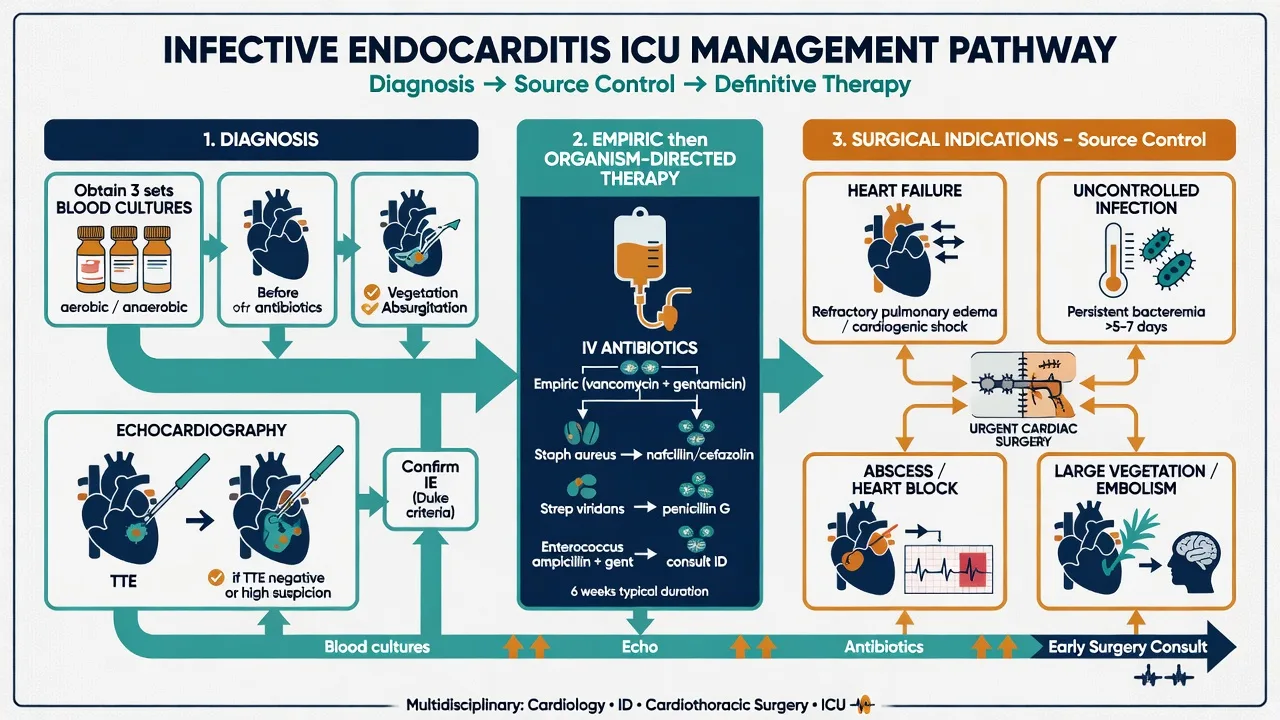
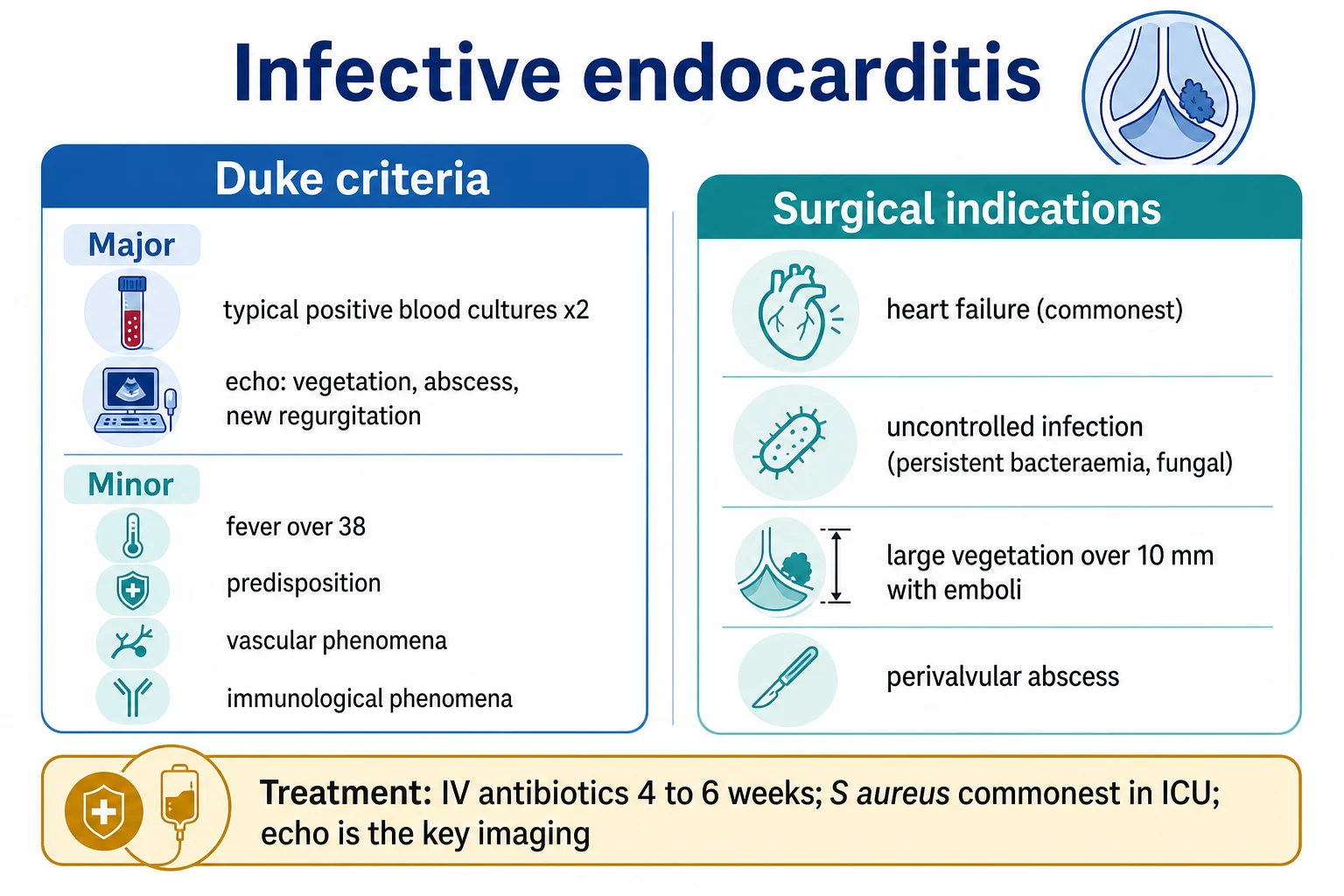
Infective endocarditis (IE) — microbial infection of the endocardial surface (usually heart valves) causing valvular destruction, embolisation, and systemic sepsis. Modified Duke criteria (2 major OR 1 major + 3 minor OR 5 minor for definite IE). Major criteria: (1) positive blood cultures (typical organism from 2 separate cultures), (2) echocardiographic evidence (vegetation, abscess, new valvular regurgitation). Organisms: Strep viridans (30%), Staph aureus (30% — most aggressive, highest mortality), Enterococcus (10%), HACEK (2-5%), culture-negative (5-10% — prior antibiotics, Coxiella, Bartonella, fungi). ICU presentations: septic shock from valvular destruction + systemic sepsis, acute heart failure from acute valvular regurgitation, embolic stroke (20-40% — from vegetation fragments), mycotic aneurysm rupture (intracranial haemorrhage), heart block (aortic valve abscess → septal extension → AV node compression). Management: (1) CULTURE before antibiotics (3 sets blood cultures from different sites 30 min apart — then start empiric antibiotics), (2) EMPIRIC THERAPY: native valve — ampicillin + gentamicin OR vancomycin + gentamicin (if penicillin-allergic or suspected MRSA); prosthetic valve — vancomycin + gentamicin + rifampicin, (3) SURGICAL INDICATIONS: heart failure from acute valvular regurgitation (EARLY surgery — within 24-48h), uncontrolled infection (persistent bacteraemia 7 days despite antibiotics, fungal/enterococcal IE), large mobile vegetations (10 mm with embolic events, 15 mm regardless), periannular extension (abscess, fistula, heart block), prosthetic valve IE, (4) ANTICOAGULATION: continue if on warfarin for other indications BUT stop if cerebral embolism/haemorrhage. Mortality: 15-25% overall (higher with S. aureus, prosthetic valve, elderly, embolic events).

high6 referencesUpdated 2 July 2026
On this page & tools

Your progress

Saved locally on this device.

Target exams

CICMFFICMEDIC

Red flags

S. aureus bacteraemia = ENDORCARDITIS until proven otherwise — ALL S. aureus bacteraemia patients should have echocardiography (TOE preferred — TTE misses 20-30% of vegetations)Acute severe valvular regurgitation from IE → acute heart failure → EARLY SURGERY (within 24-48h) — do NOT wait for antibiotic course to completeNew heart block in a patient with aortic valve endocarditis = PERIANNULAR ABSCESS extending into the septum → surgical emergencyCerebral embolism (stroke) from IE vegetation = stop anticoagulation, assess for haemorrhagic transformation, consider early surgery (recent stroke is NOT an absolute contraindication to surgery if heart failure mandates it)TOE (transoesophageal echo) is SUPERIOR to TTE for IE — detects smaller vegetations (>3 mm vs >6 mm for TTE), visualises abscess/fistula, assesses prosthetic valves — ALWAYS do TOE if IE suspected

Your progress

Saved locally on this device.

Target exams

CICMFFICMEDIC

Red flags

S. aureus bacteraemia = ENDORCARDITIS until proven otherwise — ALL S. aureus bacteraemia patients should have echocardiography (TOE preferred — TTE misses 20-30% of vegetations)Acute severe valvular regurgitation from IE → acute heart failure → EARLY SURGERY (within 24-48h) — do NOT wait for antibiotic course to completeNew heart block in a patient with aortic valve endocarditis = PERIANNULAR ABSCESS extending into the septum → surgical emergencyCerebral embolism (stroke) from IE vegetation = stop anticoagulation, assess for haemorrhagic transformation, consider early surgery (recent stroke is NOT an absolute contraindication to surgery if heart failure mandates it)TOE (transoesophageal echo) is SUPERIOR to TTE for IE — detects smaller vegetations (>3 mm vs >6 mm for TTE), visualises abscess/fistula, assesses prosthetic valves — ALWAYS do TOE if IE suspected
infective-endocarditis-comprehensive-icu clinical overview for ICU fellowship exams
FigureExam overview — key physiology, red flags and first-hour management.
Management algorithm for infective-endocarditis-comprehensive-icu
FigureStepwise ICU management: immediate priorities, disease-specific therapy, escalation.
Classification framework for infective-endocarditis-comprehensive-icu
FigureClassification / severity framework used in written and viva answers.

Overview

The one-paragraph exam answer

Infective endocarditis (IE) = microbial infection of cardiac endocardium (usually valves) → vegetation formation → valvular destruction + embolisation + systemic sepsis. Diagnosis: Modified Duke criteria — 2 major (positive blood cultures with typical organism + echo evidence of vegetation/abscess/new regurgitation) OR 1 major + 3 minor OR 5 minor. Organisms: Strep viridans (30% — subacute, indolent), Staph aureus (30% — acute, aggressive, highest mortality), Enterococcus (10%), HACEK (2-5%), culture-negative (5-10%). ICU presentations: septic shock, acute heart failure (from acute valvular regurgitation — aortic or mitral), embolic stroke (20-40%), heart block (periannular abscess). Management: (1) CULTURE FIRST — 3 sets blood cultures from different sites 30 min apart BEFORE starting antibiotics. (2) EMPIRIC ANTIBIOTICS: native valve — ampicillin/sulbactam + gentamicin ± vancomycin (if MRSA suspected); prosthetic — vancomycin + gentamicin + rifampicin. (3) ECHOCARDIOGRAPHY: TOE preferred (detects vegetations >3 mm, abscess, fistula — TTE misses 20-30%). (4) SURGICAL INDICATIONS: heart failure from acute regurgitation (EARLY surgery <48h), uncontrolled infection (>7 days bacteraemia), large mobile vegetation (>10 mm with emboli, >15 mm regardless), periannular extension (abscess, fistula, heart block), prosthetic valve IE, fungal IE. Mortality 15-25% (higher with S. aureus, prosthetic, elderly, embolic).[1][2]

Modified Duke criteria — the diagnostic standard

[3]
[6]

Management — antibiotics, surgery, complications

[2]

Clinical pearls

Clinical pearl

  1. S. aureus bacteraemia = endocarditis until proven otherwise. ALL patients with S. aureus bacteraemia should have echocardiography (TOE preferred). S. aureus IE has the highest mortality (25-40%), can affect NORMAL valves (unlike strep viridans which needs damaged valves), and has the highest embolic rate. Do NOT dismiss S. aureus bacteraemia as "just a line infection" without excluding IE.[1]

  2. TOE is ALWAYS preferred over TTE for suspected IE. TTE misses 20-30% of native valve vegetations and 60-80% of prosthetic valve vegetations. TOE detects vegetations >3 mm (vs >6 mm for TTE), visualises abscess/fistula (the most dangerous complication), and assesses prosthetic valves. Even if TTE shows a vegetation, ALWAYS do TOE to assess for complications (abscess, perforation, extent of destruction).[1][2]

  3. Heart failure from acute valvular regurgitation = #1 surgical indication. Acute aortic or mitral regurgitation from valve destruction → acute heart failure → pulmonary oedema + cardiogenic shock. Medical management alone: 50-70% mortality. Early surgery (within 24-48h): 10-15% mortality. Do NOT wait for antibiotic course to complete (4-6 weeks) — the heart failure will kill the patient before the antibiotics work.[1][4]

  4. New heart block in aortic valve IE = periannular abscess. The aortic valve annulus is adjacent to the AV node and bundle of His. Extension of infection into the annulus → septal abscess → compresses conduction tissue → new AV block (first degree → second degree → complete heart block). This is a SURGICAL EMERGENCY — the abscess will progress to fistula formation and cardiac perforation. Temporary pacing wire + urgent surgical debridement + valve replacement.[1]

  5. Strep gallolyticus (bovis) endocarditis → COLONOSCOPY MANDATORY. S. gallolyticus (formerly S. bovis) IE is strongly associated with colonic neoplasia (adenomatous polyps 50-60%, colorectal cancer 20-30%). The mechanism: colonic mucosal breach allows S. gallolyticus (normal gut flora) to enter bloodstream → seed on valves. ALL patients with S. gallolyticus IE should have colonoscopy after treatment — to detect and treat the underlying colonic pathology.[2]

  6. Culture before antibiotics — 3 sets, different sites, 30 min apart. The diagnostic yield of blood cultures is highest BEFORE antibiotics are started. Prior antibiotics reduce culture positivity by 30-50% (culture-negative IE is difficult to treat — organism unknown). If the patient is SEPTIC (septic shock): draw cultures then START antibiotics within 1 hour (do NOT delay antibiotics for cultures in septic shock). If the patient is STABLE: draw cultures, wait for preliminary results (24h), then start targeted therapy.[2]

  7. Embolic stroke occurs in 20-40% of IE patients. Vegetation fragments embolise to the brain (especially left-sided IE — mitral and aortic). Risk factors: large vegetation (>10 mm), mobile vegetation, S. aureus, mitral valve location. Management: (a) STOP anticoagulation (risk of haemorrhagic transformation). (b) CT brain (ischaemic vs haemorrhagic). (c) Consider early surgery if large mobile vegetation remains (to prevent further emboli). (d) Recent ischaemic stroke is NOT an absolute contraindication to surgery — but delay 2-3 weeks if possible (to avoid bypass-related haemorrhagic transformation).[1][4]

  8. Rifampicin is ESSENTIAL for prosthetic valve IE. Prosthetic material (mechanical valves, rings) develops a BIOFILM — a layer of bacteria embedded in a protective matrix that antibiotics cannot penetrate. Rifampicin uniquely penetrates biofilm (it is highly lipophilic) → kills biofilm-embedded staphylococci. Without rifampicin, prosthetic valve IE has 50%+ failure rate. ALWAYS add rifampicin (900 mg/day) to vancomycin + gentamicin for prosthetic valve IE. Start rifampicin AFTER 3-5 days of vancomycin/gentamicin (to allow reduction of bacterial load first — rifampicin resistance develops rapidly if bacteria are present in high numbers).[5][6]

  9. IV drug users — right-sided (tricuspid) IE. IV drug use introduces skin flora (S. aureus #1 — 60-70%) into the venous circulation → seeds on the TRICUSPID valve (first valve encountered). Right-sided IE presents differently: septic pulmonary emboli (chest pain, dyspnoea, cavitating lung lesions on CXR — NOT systemic emboli). Tricuspid vegetation on TOE. Better prognosis than left-sided IE (unless S. aureus + severe tricuspid regurgitation + septic shock).[2]

  10. Prosthetic valve IE — early vs late. EARLY prosthetic valve IE (<12 months post-surgery): S. epidermidis (coagulase-negative staph — from perioperative contamination), S. aureus. More aggressive, higher mortality (20-40%), almost always requires surgery. LATE prosthetic valve IE (>12 months): same organisms as native valve IE (strep viridans, enterococcus) — typically from transient bacteraemia (dental, GI/GU procedures). Better prognosis than early PVE.[6]

  11. Gentamicin nephrotoxicity — monitor levels. Gentamicin (3 mg/kg/day as single daily dose — once-daily dosing reduces nephrotoxicity) is used for synergy with beta-lactams or vancomycin. Monitor: trough levels (<1 mg/L — detect accumulation), renal function (creatinine every 2-3 days), duration (limit to 2 weeks to reduce nephrotoxicity — the synergy benefit is mainly in the first 2 weeks). If renal impairment develops: switch to alternative or reduce dose.[2]

  12. Janeway lesions vs Osler nodes. Both are cutaneous manifestations of IE (from immune complex deposition or septic microemboli). Janeway lesions: painless macular lesions on palms/soles (from septic microemboli). Osler nodes: PAINFUL nodular lesions on pads of fingers/toes (from immune complex deposition → localised vasculitis). Both are MINOR Duke criteria. Other skin signs: splinter haemorrhages (nail bed — non-specific, also from trauma), Roth spots (retinal haemorrhages with pale centre — immune complex vasculitis).[1]

  13. Antibiotic treatment duration: 4-6 weeks IV. IE requires PROLONGED IV antibiotic therapy (4-6 weeks minimum — oral therapy is NOT adequate for IE). The duration depends on: organism (strep: 4 weeks, staph: 4-6 weeks, enterococcus: 4-6 weeks, prosthetic: ≥6 weeks), presence of abscess (longer), surgical treatment (may shorten to 2-4 weeks if early surgical debridement + sterile cultures). The entire course should be IV — do NOT switch to oral (even if clinically improved).[2]

  14. IE prophylaxis — limited indications. Antibiotic prophylaxis before dental procedures is recommended ONLY for HIGH-RISK patients: (1) prosthetic heart valves, (2) previous IE, (3) congenital heart disease (unrepaired cyanotic, repaired with prosthetic material <6 months, repaired with residual defect). NO longer recommended for: acquired valvular disease (rheumatic, degenerative), bicuspid aortic valve, mitral valve prolapse, HOCM. Prophylactic regimen: amoxicillin 2 g PO 30-60 min before dental procedure (or clindamycin 600 mg if penicillin-allergic).[1]

Red flags

S. aureus bacteraemia = TOE MANDATORY

ALL patients with S. aureus bacteraemia must have echocardiography. TOE preferred (TTE misses 30% of S. aureus vegetations). S. aureus IE is the most aggressive form — affects normal valves, high embolic rate, 25-40% mortality. Missing S. aureus IE = the patient may die of embolic stroke or acute valvular regurgitation.[1]

Acute heart failure from IE = early surgery within 24-48h

Heart failure from acute valvular regurgitation is the #1 surgical indication in IE. Medical management alone: 50-70% mortality. Early surgery: 10-15% mortality. Do NOT wait for antibiotics to work (4-6 weeks) — the heart failure kills first. Refer to cardiothoracic surgery IMMEDIATELY.[1][4]

New heart block = periannular abscess extending

The aortic valve annulus is adjacent to the AV node. Periannular abscess extension → septal involvement → AV block. This is a SURGICAL EMERGENCY — the abscess progresses to fistula/perforation. Temporary pacing + urgent surgical debridement + valve replacement.[1]

Prognosis

[6]

Key trials and evidence

ESC 2015 IE Guidelines — the management standard (PMID 26341945)

[1]

AHA 2015 IE Scientific Statement (PMID 23578229)

[1]

Detailed Modified Duke Criteria — interpretation guide

[3]

Detailed surgical timing — the evidence-based approach

[1]

Prosthetic valve endocarditis — the special case

[6]

Right-sided IE (IVDU) — the distinct entity

[6]

Exam SAQ — densified leaf

10 minutes · 10 marks

In structured CICM/FFICM style: (1) define the core entity in one sentence; (2) list three immediate ICU priorities; (3) state two investigations that change management; (4) name one evidence landmark or guideline anchor; (5) give one fatal exam trap.

Densification notes for fellowship revision

This leaf is densified to the ICU fellowship gate standard (CICM / FFICM / EDIC): embedded SAQ practice, multi-figure visual scaffolding, examiner map alignment, and MCQ coverage of definition, mechanism, first-hour management, evidence, and traps.

[1]
  • Revision checkpoint 1: restate definition, one number examiners expect, and one absolute do-not-miss action.
  • Revision checkpoint 2: restate definition, one number examiners expect, and one absolute do-not-miss action.
  • Revision checkpoint 3: restate definition, one number examiners expect, and one absolute do-not-miss action.
  • Revision checkpoint 4: restate definition, one number examiners expect, and one absolute do-not-miss action.
  • Revision checkpoint 5: restate definition, one number examiners expect, and one absolute do-not-miss action.
  • Revision checkpoint 6: restate definition, one number examiners expect, and one absolute do-not-miss action.
  • Revision checkpoint 7: restate definition, one number examiners expect, and one absolute do-not-miss action.
  • Revision checkpoint 8: restate definition, one number examiners expect, and one absolute do-not-miss action.
[1]
  • Extra revision bullet for line-count gate: restate the single most important exam action.
[1]
  • Extra revision bullet for line-count gate: restate the single most important exam action.
[1]
  • Extra revision bullet for line-count gate: restate the single most important exam action.
[1]
  • Extra revision bullet for line-count gate: restate the single most important exam action.
[1]
  • Extra revision bullet for line-count gate: restate the single most important exam action.
[1]
  • Extra revision bullet for line-count gate: restate the single most important exam action.
[1]
  • Extra revision bullet for line-count gate: restate the single most important exam action.
[1]
  • Extra revision bullet for line-count gate: restate the single most important exam action.
[1]
  • Extra revision bullet for line-count gate: restate the single most important exam action.
[1]
  • Extra revision bullet for line-count gate: restate the single most important exam action.
[1]
  • Extra revision bullet for line-count gate: restate the single most important exam action.
[1]
  • Extra revision bullet for line-count gate: restate the single most important exam action.
[1]
  • Extra revision bullet for line-count gate: restate the single most important exam action.
[1]
  • Extra revision bullet for line-count gate: restate the single most important exam action.
[1]

References

  1. [1]Habib G, et al. 2015 ESC Guidelines for the management of infective endocarditis: The Task Force for the Management of Infective Endocarditis of the European Society of Cardiology (ESC). Endorsed by: European Association for Cardio-Thoracic Surgery (EACTS), the European Association of Nuclear Medicine (EANM). European Heart Journal, 2015.PMID 26320109
  2. [2]Baddour LM, et al. Infective Endocarditis in Adults: Diagnosis, Antimicrobial Therapy, and Management of Complications: A Scientific Statement for Healthcare Professionals From the American Heart Association. Circulation, 2015.PMID 26373316
  3. [3]Li JS, et al. Proposed modifications to the Duke criteria for the diagnosis of infective endocarditis. Clinical Infectious Diseases, 2000.PMID 10770721
  4. [4]Tornos P, et al. Infective endocarditis: the European viewpoint. Current Problems in Cardiology, 2011.PMID 21621720
  5. [5]Gould FK, et al. Guidelines for the diagnosis and antibiotic treatment of endocarditis in adults: a report of the Working Party of the British Society for Antimicrobial Chemotherapy. The Journal of Antimicrobial Chemotherapy, 2012.PMID 22086858
  6. [6]Cuervo G, et al. The Clinical Challenge of Prosthetic Valve Endocarditis: JACC Focus Seminar 3/4. Journal of the American College of Cardiology, 2024.PMID 38599718