ICU · Cardiovascular
Mechanical circulatory support: IABP, Impella, and ECMO for cardiogenic shock
Also known as IABP · Intra-aortic balloon pump · Impella · VA-ECMO · TandemHeart · Mechanical circulatory support · MCS
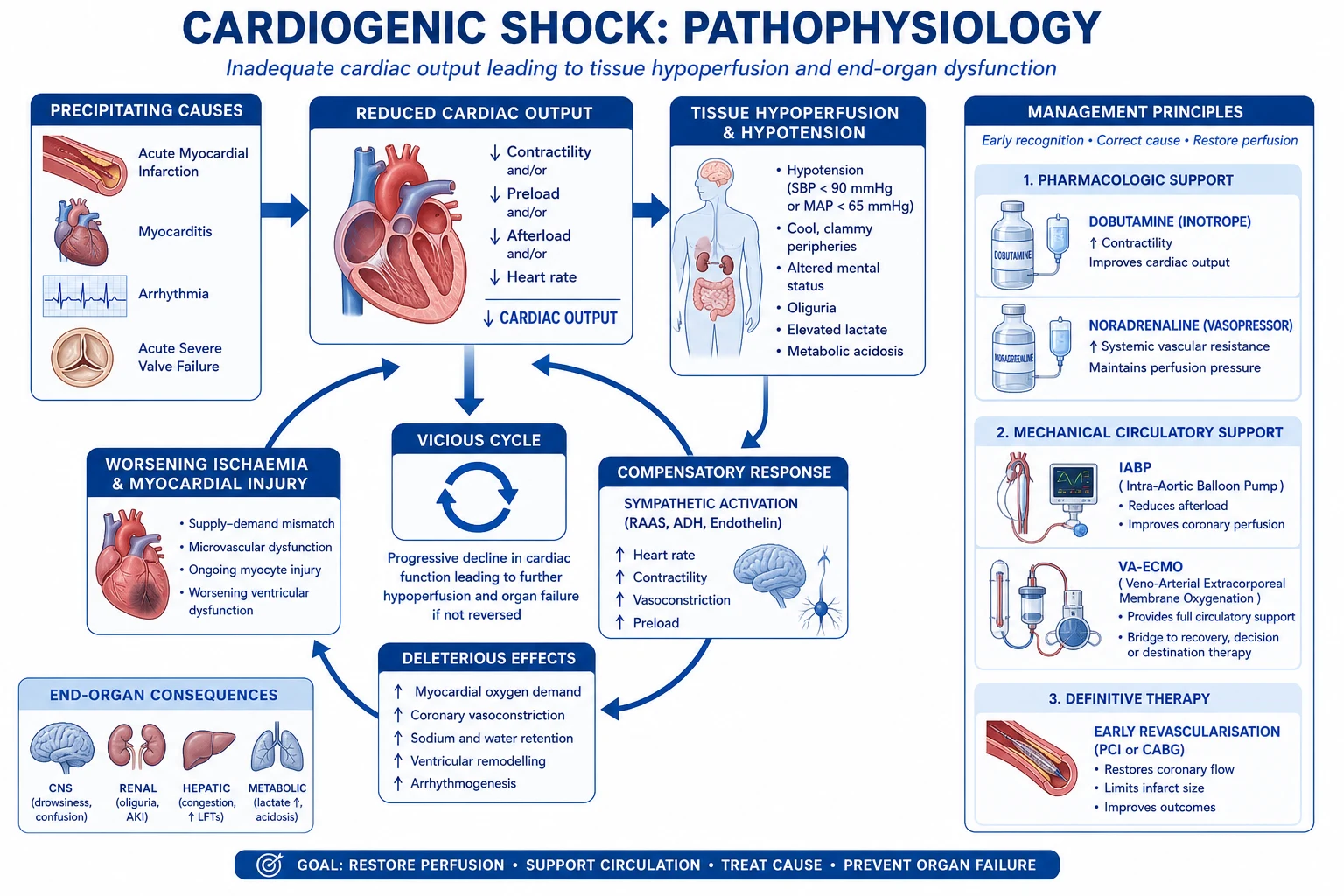
Mechanical circulatory support (MCS) for refractory cardiogenic shock spans a spectrum from modest afterload reduction to full cardiopulmonary replacement. (1) IABP (intra-aortic balloon pump): counterpulsation in the descending thoracic aorta — inflates in diastole (augmenting coronary perfusion), deflates at systole (reducing afterload); modest support (~0.5-1.0 L/min augmentation). IABP-SHOCK II (Thiele 2012, NEJM): NO mortality benefit in AMI-CS — routine use not recommended. (2) Impella: transaortic axial-flow micro-pump actively unloading the LV (Impella CP 2.5-4.0 L/min; Impella 5.0/5.5 up to 5.5 L/min). DanGer-SHOCK (Moller 2024, NEJM): IMPROVED 180-day survival in AMI-CS (45.8% vs 58.5% deaths). IMPRESS (Ouweneel 2017): no benefit in severe shock. (3) VA-ECMO (venoarterial ECMO): full cardiopulmonary bypass, 4-6 L/min + oxygenation; peripheral (femoro-femoral) vs central (ascending aorta); requires distal perfusion cannula and often LV venting. ECLS-SHOCK (Thiele 2023, NEJM): no mortality benefit at 30 days. (4) TandemHeart (LA-to-femoral arterial centrifugal pump, ~4 L/min) and ProtekDuo (dual-lumen RA-to-PA cannula for RV support). SCAI shock stages A-E guide escalation. Complications: bleeding (anticoagulation), thrombosis, limb ischaemia, haemolysis, infection, stroke, LV distension (VA-ECMO), Harlequin syndrome.
On this page & tools
Your progress
Saved locally on this device.
Target exams
Red flags
SCAI shock stages: when to escalate [1]
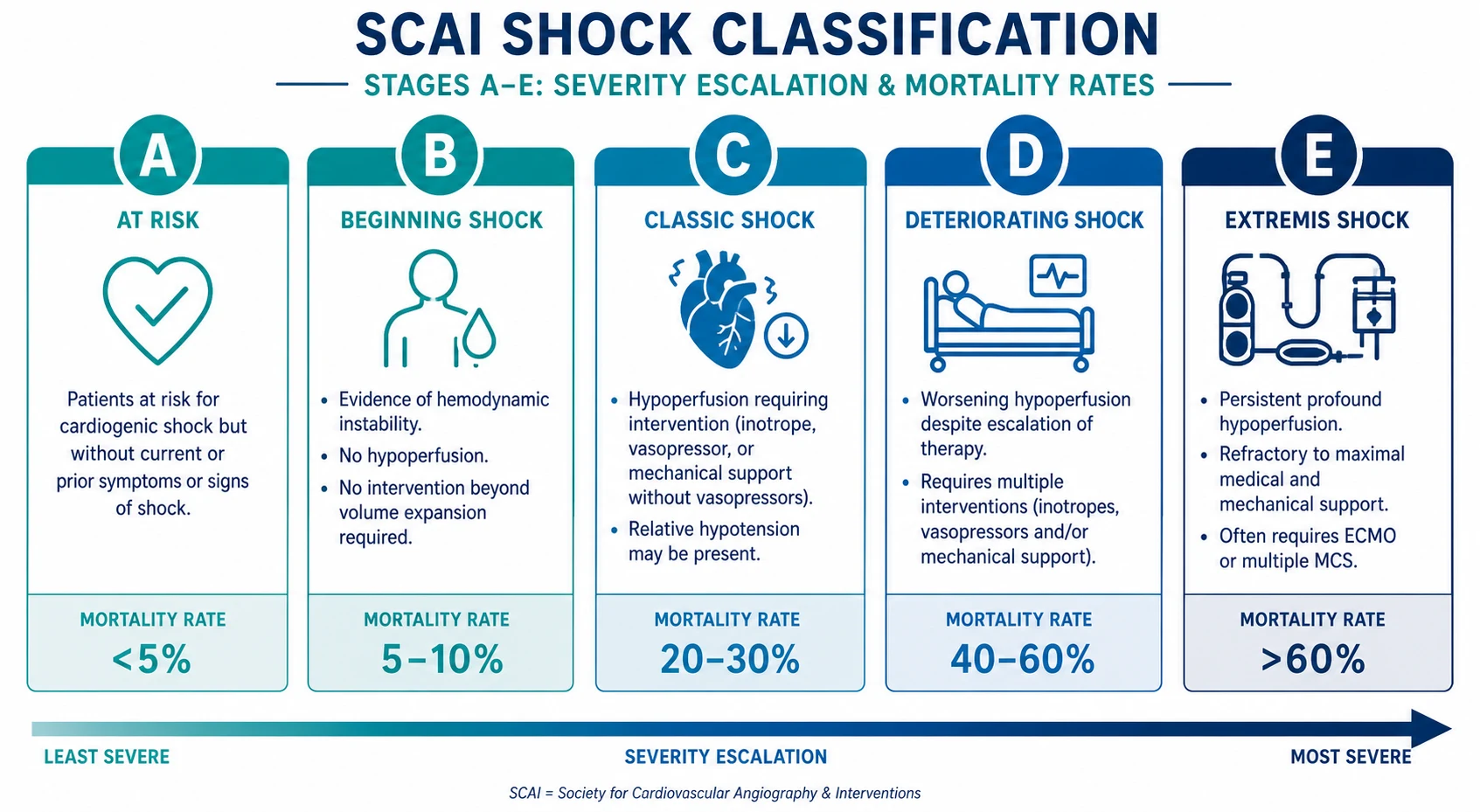
The Society for Cardiovascular Angiography and Interventions (SCAI) classification stratifies shock severity from a pre-shock "at risk" state through extremis, and is the framework used to time MCS initiation.[6]
SCAI shock stages (A–E) and the role of MCS
| Stage | Definition | Haemodynamics | Typical MCS role |
|---|---|---|---|
| A — At risk | Risk factors for shock (large MI, ADHF); not yet shocked | Normal, warm, well perfused | None — optimise guideline therapy |
| B — Beginning shock | Early/presumed shock; clinical concern | Warm, mildly hypoperfused; lactate rising | None — inotropes/vasopressors, close monitoring |
| C — Classic shock | Hypoperfusion + hypotension requiring inotropes/vasopressors | Cold, hypoperfused; SBP <90 / MAP <60 despite drugs | Consider IABP/Impella — bridge to decision/recovery |
| D — Deteriorating | Rapidly worsening despite escalating pharmacological support | Falling MAP, rising lactate, organ dysfunction | Definite MCS — Impella or VA-ECMO (early, before organ failure) |
| E — Extremis | Collapse, refractory arrest, near-circulatory standstill | Cardiac arrest / PEA / profound bradyasystole | ECPR (VA-ECMO during CPR); consider futility screen |
Key principle: MCS should be contemplated at Stage C and instituted by Stage D, before irreversible end-organ injury. Waiting for Stage E carries the highest mortality; the goal is "bridge to decision" — stabilise haemodynamics, unload the ventricle, and define a definitive plan (recovery, durable LVAD, transplant, or palliation).[7]
Escalation algorithm for refractory cardiogenic shock
- Confirm shock + aetiology: lactate >2 mmol/L with hypoperfusion (cold extremities, oliguria, altered mentation); echocardiography to define LV vs RV vs biventricular failure; exclude/treat reversible triggers (ischaemia → PCI, arrhythmia, tamponade, mechanical complication of MI)
- Stage A/B (pharmacological): achieve euvolaemia (careful, lung US for B-lines), start inotrope (dobutamine 2.5–10 µg/kg/min OR milrinone 0.125–0.5 µg/kg/min) and/or vasopressor (noradrenaline first-line) targeting MAP >65 mmHg; serial lactate, urine output, mixed venous saturation
- Stage C (refractory on single agent): add second inotrope/vasopressor; insert arterial line + consider PA catheter for cardiac index (CI) and pulmonary capillary wedge pressure (PCWP). If CI <2.2 L/min/m² despite drugs → plan MCS
- Device selection by failure mode:
- Isolated LV failure (AMI-CS, myocarditis, decompensated HFrEF): Impella CP (preferred where AMI-CS, per DanGer-SHOCK) or IABP (selective — bridge to surgery)
- Biventricular or cardiopulmonary failure (concomitant hypoxaemia, massive PE, ARDS + shock): VA-ECMO
- RV failure (acute PE, RV infarct, post-LVAD): ProtekDuo + inotrope, or Impella RP
- Refractory arrest (Stage E): ECPR (VA-ECMO during ongoing CPR)
- Vascular access: ultrasound-guided, percutaneous femoral for IABP/Impella/peripheral VA-ECMO; surgical cut-down or central sternotomy for central VA-ECMO. Mandatory distal perfusion cannula at index cannulation for femoro-femoral VA-ECMO to prevent limb ischaemia
- Anticoagulation: unfractionated heparin infusion titrated to ACT 150–180 (IABP), 160–180 s (Impella), 180–220 s (VA-ECMO); monitor aPTT, anti-Xa, haemoglobin, platelets (watch for HIT)
- Monitor while on support: arterial waveform, CI/PCWP (PA catheter), lactate trend, organ function (urine, liver), hourly limb perfusion, LDH/plasma-free haemoglobin (haemolysis), renal Dopplers, daily echocardiography for LV distension (VA-ECMO) and aortic regurgitation
- Define endpoint: bridge to recovery (wean), bridge to decision (stabilise then plan), bridge to durable LVAD/transplant, or transition to comfort care if futile
IABP — intra-aortic balloon pump
Mechanism (counterpulsation)
The IABP is a 30–50 mL helium-filled polyurethane balloon percutaneously placed in the descending thoracic aorta (tip distal to left subclavian artery, proximal to renal arteries). It operates on counterpulsation: the balloon inflates in early diastole (immediately after aortic valve closure), timed to the dicrotic notch — this augments diastolic coronary and cerebral perfusion pressure; it deflates rapidly at end-diastole (just before systole), causing an abrupt fall in afterload → reduced LV stroke work, reduced myocardial oxygen demand (MVO₂), and a modest rise in cardiac output (~0.5–1.0 L/min). Triggering is from the ECG R-wave (preferred) or arterial pressure waveform; with intrinsic heart rates <40 bpm or >150 bpm, triggering becomes unreliable.[1]
Indications
- Bridge to definitive therapy in cardiogenic shock: mechanical complications of MI (acute MR, VSR) awaiting surgery; high-risk PCI support; refractory ischaemia/arrhythmia
- Cardiogenic shock complicating acute MI (selective use — NOT routine, per IABP-SHOCK II)
- Weaning from cardiopulmonary bypass, intractable ventricular failure post-cardiotomy
- Intractable angina as a bridge to revascularisation
Contraindications
| Absolute | Relative |
|---|---|
| Moderate–severe aortic regurgitation (balloon augments regurgitant volume → worsens LV distension) | Severe peripheral vascular disease (cannot pass sheath) |
| Aortic dissection or thoracic aortic aneurysm | Active bleeding / coagulopathy |
| Sepsis (uncontrolled — relative contraindication) | Uncontrolled tachyarrhythmia (poor triggering) |
| Sheathless/severe iliofemoral disease |
The IABP-SHOCK II trial
Thiele et al. (NEJM 2012) randomised 600 patients with AMI-CS planned for early revascularisation to IABP vs no IABP. No difference in 30-day mortality (39.7% vs 41.3%, RR 0.96, p=0.69), 12-month mortality, or 6-year all-cause mortality (Thiele, Circulation 2019). Routine IABP in AMI-CS is not recommended (ESC Class III, AHA Class IIb). Selective use remains reasonable for mechanical complications of MI, bridge to surgery, and refractory ischaemia.[1][2]
Impella — trans-aortic axial-flow micro-pump
Mechanism (active LV unloading)
Impella is a catheter-mounted axial-flow (Archimedes screw) pump advanced retrogradely across the aortic valve so the inlet sits in the left ventricle and the outlet in the ascending aorta. It continuously aspirates blood from the LV and ejects it into the aorta, actively unloading the LV — reducing LV end-diastolic pressure, wall stress, and MVO₂ — while delivering forward systemic flow independent of the cardiac cycle. Unlike IABP, it does not require intrinsic systole or ECG triggering.[9]
Device variants and flow
| Device | Max flow | Insertion | Typical use |
|---|---|---|---|
| Impella 2.5 | 2.5 L/min | 12 Fr femoral | High-risk PCI support, moderate shock |
| Impella CP | 3.5–4.0 L/min | 14 Fr femoral | AMI-CS (used in DanGer-SHOCK, IMPRESS) |
| Impella 5.0 / 5.5 | 5.0–5.5 L/min | 21–25 Fr (surgical/axillary) | Deep shock, bridge to durable LVAD |
| Impella RP / RP Flex | 4.0+ L/min (RV) | 23 Fr femoral/ij — across PV | Acute RV failure (PE, RV infarct, post-LVAD) |
Indications
- Acute MI cardiogenic shock (AMI-CS) — DanGer-SHOCK supports use in STEMI-CS with reduced LVEF (≤40%) and early (<6 h) intubation/high-dose inotrope
- High-risk PCI haemodynamic support
- Decompensated chronic heart failure as bridge to decision/LVAD
- Myocarditis, peri-partum cardiomyopathy with refractory LV failure
Contraindications
| Absolute | Relative |
|---|---|
| Moderate–severe aortic regurgitation (pump output regurgitates back into LV) | Severe aortic stenosis (cannot cross valve) — relative; can be used post-AVR |
| Mechanical aortic valve (cannot cross) | Severe peripheral arterial disease |
| Left ventricular thrombus (risk of systemic embolisation) | Active bleeding requiring anticoagulation |
| Ventricular septal rupture (VSR) with significant L→R shunt | Hepatic failure/coagulopathy |
| Severe aortic stenosis (pre-cross) | Pregnancy (relative) |
DanGer-SHOCK (Møller 2024, NEJM) — the practice-changing positive trial
Randomised 360 patients with STEMI-CS (LVEF ≤40%, early after PCI) to Impella CP + standard care vs standard care alone. Primary endpoint (all-cause death at 180 days): 45.8% (Impella) vs 58.5% (control), HR 0.74 (95% CI 0.55–0.99), p=0.04 — significant mortality reduction. Trade-off: higher device-related complications (composite safety endpoint 24.0% vs 6.2% — severe bleeding, limb ischaemia, haemolysis, need for renal replacement therapy). This is the first RCT to show survival benefit of a micro-axial pump in AMI-CS and has shifted practice toward earlier Impella in STEMI-CS with reduced EF.[3]
Contrast with IMPRESS in severe shock (Ouweneel 2017, JACC): 48 patients with severe AMI-CS (lactate >8, often post-arrest) randomised to Impella CP vs IABP — no mortality difference (66% vs 47%, p=0.27) at 30 days, with higher complications in the Impella arm. Likely reflect that in extremis (Stage E), unloading alone is too late — supporting earlier (Stage C–D) deployment.[4]
VA-ECMO — venoarterial extracorporeal membrane oxygenation
Mechanism (full cardiopulmonary bypass)
VA-ECMO drains deoxygenated venous blood via a large cannula, passes it through an external centrifugal pump + membrane oxygenator (gas exchange + decarboxylation), and returns oxygenated blood under pressure to the arterial tree — providing both circulatory support (4–6 L/min) and oxygenation independent of heart and lung. This is the strongest temporary MCS available.[8]
Peripheral vs central VA-ECMO
Peripheral vs central VA-ECMO cannulation
| Feature | Peripheral (femoro-femoral) | Central (ascending aorta / RA) |
|---|---|---|
| Access | Percutaneous, bedside possible | Surgical — sternotomy, theatre/ICU |
| Cannulation | Femoral vein (drainage) + femoral artery (return) | RA appendage (drainage) + ascending aorta (return) |
| Speed | Rapid (minutes) — preferred for arrest/ECPR | Slower — planned, post-cardiotomy |
| Oxygenation distribution | Lower body only (see Harlequin) | Whole body (aortic root first) — better coronary/cerebral oxygenation |
| LV afterload | ↑↑ (closed arterial system, retrograde flow) — risk LV distension | Less afterload increase |
| Bleeding | Cannulation-site, groin | Larger surgical wound — higher bleeding |
| Mobility / tracheostomy | Limited (groin cannulae) | Easier mobilisation |
| Typical use | ECPR, acute shock, bridge to decision | Post-cardiotomy failure, post-VAD, chronic support |
Distal perfusion cannula (DPC) — mandatory limb protection
Femoral arterial return (15–25 Fr) occludes ipsilateral limb perfusion → critical limb ischaemia in up to 10–30% without protection. A distal perfusion cannula (6–8 Fr antegrade sheath in the superficial femoral artery, or retrograde posterior tibial) back-perfuses the limb from the ECMO circuit. Current best practice: place the DPC at index cannulation (prophylactic) rather than reactively. Monitor hourly: colour, temperature, dorsalis pedis/posterior tibial Doppler, capillary refill, and consider near-infrared spectroscopy (NIRS) on both calves.[8]
LV venting — preventing LV distension
VA-ECMO increases LV afterload (retrograde arterial flow against a failing LV) → LV distension, raised LVEDP, pulmonary oedema, subendocardial ischaemia, and stasis thrombus. Signs on echo: dilated, under-contractile LV with closed aortic valve (no ejection). LV venting strategies:
- Impella as an LV vent in combination with VA-ECMO ("ECPELLA") — unloads LV while ECMO supports systemic flow
- Intra-aortic balloon pump (IABP) — modest afterload reduction
- Pulmonary artery vent (percutaneous, via PV) — drains LV output into circuit
- Atrial septostomy (TANRP / left atrial vent)
- Direct LV apical vent (surgical) Signs that venting is needed: rising PCWP, pulmonary oedema, LV stasis, subendocardial ischaemia on ECG, aortic root stasis thrombus on echo.[7]
ECLS-SHOCK (Thiele 2023, NEJM)
Randomised 420 patients with AMI-CS to early VA-ECMO + standard care vs standard care alone. Primary endpoint (30-day all-cause mortality): 47.8% (ECMO) vs 49.0% (control), RR 0.98 (95% CI 0.75–1.13), p=0.70 — NO significant difference. Higher rates of bleeding (ventilator/sedation and transfusion), vascular complications, and renal replacement therapy in ECMO arm. Importantly, ECLS-SHOCK enrolled a heterogeneous AMI-CS population (not restricted to reduced EF, many milder shock) and did not require protocolised LV venting — both may have diluted any benefit. Practice has not abandoned VA-ECMO, but the trial underscores that ECMO is not a reflex in all AMI-CS: it is reserved for biventricular failure, hypoxaemia, ECPR, and refractory (Stage D–E) shock where its full cardiopulmonary support is required.[5]
TandemHeart and ProtekDuo
TandemHeart (percutaneous LA-to-femoral arterial support)
A centrifugal pump (TandemLife) drains oxygenated blood from the left atrium via a trans-septal 21 Fr cannula (femoral vein → RA → across interatrial septum → LA) and returns it to a femoral artery (15–17 Fr), bypassing the LV. Provides ~3–5 L/min of systemic flow with effective LV unloading (drains LA → lowers LV preload). Advantages over Impella: does not cross the aortic valve (useful in severe AS or mechanical AVR). Disadvantages: requires trans-septal puncture expertise; higher bleeding; no RV support.[8]
- Indications: refractory LV shock when Impella is contraindicated (severe AS, mechanical AVR); bridge to recovery/decision
- Contraindications: severe PAD, unable to anticoagulate, LA thrombus, VSR
ProtekDuo (dual-lumen RA-to-PA cannula for RV support)
A single 29–31 Fr dual-lumen cannula inserted via the right internal jugular vein drains deoxygenated blood from the RA and reinfuses it into the main pulmonary artery after passing through the TandemLife pump and oxygenator — providing RV support (up to 4–5 L/min) and, when an oxygenator is inline, oxygenation (useful for RV failure + ARDS or massive PE). Advantages: single-site (RIJ) access, no femoral cannulation, patient can mobilise; oxygenator can be added/removed.
- Indications: acute RV failure (massive/submassive PE, RV infarct, post-LVAD RV failure, post-cardiotomy, decompensated pulmonary hypertension); ARDS with RV failure
- Contraindications: severe tricuspid regurgitation (relative), IJ thrombosis, unable to anticoagulate, PFO with right-to-left shunt
Indications and contraindications across MCS devices
| Device | Strong indications | Key contraindications |
|---|---|---|
| IABP | Mechanical complication of MI (bridge to surgery), refractory ischaemia, weaning from CPB, high-risk PCI | Moderate-severe AR, aortic dissection, severe PAD |
| Impella | AMI-CS with reduced EF (DanGer-SHOCK), high-risk PCI, myocarditis, decompensated HFrEF | Moderate-severe AR, mechanical AVR, LV thrombus, VSR, severe AS |
| VA-ECMO | Biventricular failure, AMI-CS with hypoxaemia/ARDS, massive PE, ECPR, refractory arrest | Moderate-severe AR (unvented), irreversible brain injury, futility, severe PAD (consider central) |
| TandemHeart | LV shock when Impella contraindicated (severe AS, mechanical AVR) | Severe PAD, LA thrombus, VSR, unable to anticoagulate |
| ProtekDuo | RV failure (PE, RV infarct, post-LVAD), RV failure + ARDS | TR (relative), IJ thrombosis, unable to anticoagulate |
| Impella RP | RV failure (PE, RV infarct) — alternative to ProtekDuo | Mechanical PV, severe TR, RV thrombus, severe PAD |
Comparison of temporary MCS devices — haemodynamics and logistics
| Feature | IABP | Impella (CP/5.0) | VA-ECMO | TandemHeart | ProtekDuo |
|---|---|---|---|---|---|
| Mechanism | Counterpulsation (diastolic inflation) | Axial pump across AV | External pump + oxygenator | LA→artery centrifugal pump | RA→PA centrifugal pump |
| Max flow | 0.5–1.0 L/min (augment) | 2.5–5.5 L/min | 4–6 L/min | 3–5 L/min | 4–5 L/min |
| Ventricle supported | LV (afterload) | LV (active unloading) | Both (biventricular) + lung | LV (bypasses LV) | RV (bypasses RV) |
| Oxygenation | No | No | Yes | No | Optional (add oxygenator) |
| Insertion | 7–8 Fr femoral art | 12–25 Fr femoral art | 19–25 Fr art + 21–25 Fr vein | Trans-septal + femoral art | 29–31 Fr RIJ |
| Anticoagulation (ACT) | 150–180 s | 160–180 s | 180–220 s | Moderate-high | Moderate-high |
| Pulsatility / afterload | Preserves pulsatility; ↓ afterload | Non-pulsatile; ↓ LV afterload | Non-pulsatile; ↑↑ afterload (LV distension) | Non-pulsatile | Non-pulsatile |
| Key complications | Limb ischaemia, infection, gas embolus | Haemolysis, limb ischaemia, AR | Limb ischaemia, bleeding, Harlequin, LV distension | Bleeding (trans-septal), limb | Bleeding, RIJ thrombosis |
| Evidence (RCT) | IABP-SHOCK II: NO benefit | DanGer-SHOCK: POSITIVE (AMI-CS); IMPRESS: negative (severe) | ECLS-SHOCK: NO benefit at 30 d | Observational only | Observational only |
| When to use | Bridge to surgery, selective | AMI-CS, high-risk PCI | Biventricular/lung failure, ECPR | LV shock + contraindicated Impella | RV failure ± ARDS |
Approach to mechanical circulatory support in cardiogenic shock
- Optimise conventional therapy FIRST: inotropes (dobutamine, milrinone), vasopressors (noradrenaline), correct volume status, treat arrhythmia, revascularise (if ischaemic). Define SCAI stage and shock phenotype (LV vs RV vs biventricular ± lung)
- If refractory (rising lactate, worsening organ failure, high inotrope/vasopressor doses, Stage C–D) → escalate to MCS before irreversible organ damage
- Assess suitability: reversible cause? (bridge to recovery/transplant). Contraindications? (severe AR for IABP, severe AS/mechanical AVR/LV thrombus for Impella, severe PAD, active bleeding, multi-organ failure, futility)
- Device selection: (a) IABP — selective (mechanical complications of MI, bridge to surgery). (b) Impella — AMI-CS with reduced EF (DanGer-SHOCK positive), bridge to decision. (c) VA-ECMO — biventricular failure, hypoxaemia, ECPR, bridge to transplant/VAD. (d) TandemHeart/ProtekDuo for niche LV/RV indications
- Insertion: percutaneous (femoral access) where possible. Ultrasound-guided. Arterial line monitoring. Distal perfusion cannula at index cannulation for VA-ECMO (prevent limb ischaemia)
- Anticoagulation: heparin (unfractionated) — titrate to device-specific ACT. Monitor for bleeding; watch for HIT (falling platelets after day 5)
- Monitor: haemodynamics (arterial line, cardiac output, PA catheter CI/PCWP), hourly limb perfusion, haemolysis (LDH, plasma-free haemoglobin), renal/hepatic function, daily echo (LV distension for VA-ECMO), signs of infection, organ recovery
- Prevent and recognise device-specific complications: LV distension/Harlequin (VA-ECMO), haemolysis/thrombosis (Impella), limb ischaemia (all femoral), bleeding (all)
- Wean: as native heart function recovers (rising native cardiac output, falling lactate, reducing inotropes, stable echo). Trial of lower support. Decannulate when stable — achieve haemostasis, repair vessel
Exam practice — SAQs
SAQ — IABP in post-infarction cardiogenic shock with a mechanical complication
10 minutes · 10 marks
A 68-year-old man is admitted 6 hours after an anterior STEMI complicated by out-of-hospital cardiac arrest (ROSC after 12 minutes). Primary PCI to the proximal LAD was technically successful. On ICU arrival he is intubated and sedated: MAP 58 on noradrenaline 0.4 mcg/kg/min, HR 118 (sinus), SpO2 94% on FiO2 0.6. A new loud pansystolic murmur is audible at the apex. Lactate 5.8 mmol/L, urine output 0.2 mL/kg/h. Bedside PA catheter: CI 1.7 L/min/m2, PCWP 28 mmHg with a large V-wave. Focused echo: flail anterior mitral leaflet with severe MR, LVEF ~35%, no aortic regurgitation. The cardiology team propose inserting an intra-aortic balloon pump (IABP).
SAQ — Impella vs VA-ECMO selection in refractory AMI cardiogenic shock
10 minutes · 10 marks
A 55-year-old woman presents 4 hours after an infero-lateral STEMI. Primary PCI to a dominant RCA was complicated by repetitive VT and pulmonary oedema. On arrival in ICU she is intubated, MAP 55 on noradrenaline 0.6 mcg/kg/min and adrenaline 0.2 mcg/kg/min, HR 130 (sinus), SpO2 88% on FiO2 1.0 and PEEP 12. Lactate 7.4 mmol/L, urine 0.1 mL/kg/h. Echo: LVEF ~25%, no aortic regurgitation, RV mildly impaired. The team must choose between an Impella CP and peripheral VA-ECMO.
Clinical pearls
Red flags
Prognosis and key trials
IABP-SHOCK II (Thiele 2012, NEJM) + 6-year follow-up (Circulation 2019)
RCT: 600 patients with acute MI + cardiogenic shock (planned early revascularisation). IABP vs no IABP.
- 30-day mortality: IABP 39.7% vs no IABP 41.3% (RR 0.96, p=0.69 — NO significant difference)
- 12-month mortality: IABP 52% vs no IABP 51% (no difference)
- 6-year all-cause mortality: ~57% both arms (no late emergence of benefit)
- Secondary outcomes: no difference in complications, ICU stay, quality of life
- CONCLUSION: Routine IABP does NOT improve outcomes in AMI cardiogenic shock (ESC Class III). Use selectively — mechanical complications of MI, bridge to surgery, refractory ischaemia.[1][2]
DanGer-SHOCK (Møller 2024, NEJM) — FIRST positive RCT for Impella
RCT: 360 patients with STEMI complicated by cardiogenic shock (LVEF ≤40%), randomised to Impella CP + standard care vs standard care alone.
- Primary endpoint — all-cause mortality at 180 days: 45.8% (Impella) vs 58.5% (control), HR 0.74 (95% CI 0.55–0.99), p=0.04 — significant
- Composite safety endpoint (severe bleeding, limb ischaemia, haemolysis, device failure, worsening AR, need for RRT): 24.0% (Impella) vs 6.2% (control) — more complications
- CONCLUSION: Routine early Impella CP in STEMI-CS with reduced EF improved 180-day survival. The benefit must be weighed against higher device-related complication rates. Practice-changing for STEMI-CS with low EF; less applicable to non-ischaemic or very severe (Stage E) shock.[3]
ECLS-SHOCK (Thiele 2023, NEJM) — VA-ECMO negative in AMI-CS
RCT: 420 patients with AMI-CS, randomised to early VA-ECMO + standard care vs standard care alone.
- Primary endpoint — 30-day all-cause mortality: 47.8% (ECMO) vs 49.0% (control), RR 0.98 (95% CI 0.75–1.13), p=0.70 — NO significant difference
- Complications: more moderate/severe bleeding (23.4% vs 9.6%), more vascular complications requiring surgery (11.0% vs 3.6%), more RRT (29.7% vs 21.4%) in ECMO arm
- CONCLUSION: Routine early VA-ECMO did not improve 30-day mortality in AMI-CS. Caveats: heterogeneous shock severity (many milder), no protocolised LV venting, crossover 4%. ECMO remains indicated for biventricular failure, hypoxaemia, ECPR, and refractory Stage D–E shock — not a reflex for all AMI-CS.[5]
IMPRESS in severe shock (Ouweneel 2017, JACC)
RCT: 48 patients with severe AMI-CS (lactate >8 mmol/L, often post-arrest), Impella CP vs IABP.
- 30-day mortality: 66% (Impella) vs 47% (IABP), p=0.27 — no significant difference
- CONCLUSION: No benefit (and non-significant harm signal) of Impella in very severe AMI-CS. Likely reflects that unloading alone is insufficient in extremis — supports earlier (Stage C–D) deployment rather than waiting for Stage E. Small sample limits conclusions.[4]
Overall outcomes by device (observational + trial data):
- IABP: no mortality benefit in AMI-CS (IABP-SHOCK II); useful selectively.
- Impella: DanGer-SHOCK shows survival benefit in STEMI-CS with reduced EF when used early; IMPRESS negative in severe shock — timing matters.
- VA-ECMO: ECLS-SHOCK negative in broad AMI-CS; observational survival to discharge 30–50% in refractory cardiogenic shock (higher if early, reversible cause, single-organ failure).
- ECPR: 20–30% survival to discharge in refractory cardiac arrest (Cochrane 2023 — low-certainty evidence; selection bias concerns); best if witnessed, early cannulation, reversible cause.
- Bridge to durable therapy: up to 30–50% of refractory shock patients survive to discharge with timely MCS; durable LVAD/transplant candidacy must be assessed early.[7][10][11]
References
- [1]Thiele H, Zeymer U, Neumann FJ, et al. Intraaortic balloon support for myocardial infarction with cardiogenic shock N Engl J Med, 2012.PMID 22920912
- [2]Thiele H, Akin I, Sandri M, et al. Intraaortic Balloon Pump in Cardiogenic Shock Complicating Acute Myocardial Infarction: Long-Term 6-Year Outcome of the Randomized IABP-SHOCK II Trial Circulation, 2019.PMID 30586721
- [3]Møller JE, Engstrøm T, Jensen LO, et al. Microaxial Flow Pump or Standard Care in Infarct-Related Cardiogenic Shock N Engl J Med, 2024.PMID 38587239
- [4]Ouweneel DM, Eriksen E, Sjauw KD, et al. Percutaneous Mechanical Circulatory Support Versus Intra-Aortic Balloon Pump in Cardiogenic Shock After Acute Myocardial Infarction J Am Coll Cardiol, 2017.PMID 27810347
- [5]Thiele H, Zeymer U, Akin I, et al. Extracorporeal Life Support in Infarct-Related Cardiogenic Shock N Engl J Med, 2023.PMID 37634145
- [6]Baran DA, Grines CL, Bailey S, et al. SCAI clinical expert consensus statement on the classification of cardiogenic shock: This document was endorsed by the American College of Cardiology (ACC), the American Heart Association (AHA), the Society of Critical Care Medicine (SCCM), and the Society of Thoracic Surgeons (STS) in April 2019 Catheter Cardiovasc Interv, 2019.PMID 31104355
- [7]Lüsebrink E, Binzenhöfer L, Adamo M, et al. Cardiogenic shock Lancet, 2024.PMID 39550175
- [8]Nakata J, Yamamoto T, Saku K, et al. Mechanical circulatory support in cardiogenic shock J Intensive Care, 2023.PMID 38115065
- [9]Masiero G, Arturi F, Panza A, et al. Mechanical Circulatory Support with Impella: Principles, Evidence, and Daily Practice J Clin Med, 2024.PMID 39200728
- [10]Sarma D, Jentzer JC. Cardiogenic Shock: Pathogenesis, Classification, and Management Crit Care Clin, 2024.PMID 37973356
- [11]Burrell A, Kim J, Alliegro P, et al. Extracorporeal membrane oxygenation for critically ill adults Cochrane Database Syst Rev, 2023.PMID 37750499