ICU · Endocrine & metabolic emergencies
Adrenal Crisis & Corticosteroid Replacement
Also known as Adrenal crisis · Addisonian crisis · Adrenal insufficiency · HPA suppression · Stress-dose steroids · Corticosteroid withdrawal · Waterhouse-Friderichsen
The adrenal crisis — the acute the life-threatening the glucocorticoid the deficiency. The causes (the primary — the Addison's, the adrenal the haemorrhage; the secondary — the pituitary; the iatrogenic — the abrupt the withdrawal of the chronic the exogenous the steroids [the HPA the suppression] — the commonest the ICU the cause). The refractory the hypotension, the abdominal the pain, the hyponatraemia, the hyperkalaemia, the hypoglycaemia. The hydrocortisone the IV the immediately (the before the tests), the fluid, the treat the trigger. The stress-dose the steroids for the chronic the users (the illness / the surgery).
On this page & tools
Your progress
Saved locally on this device.
Target exams
Overview & definition
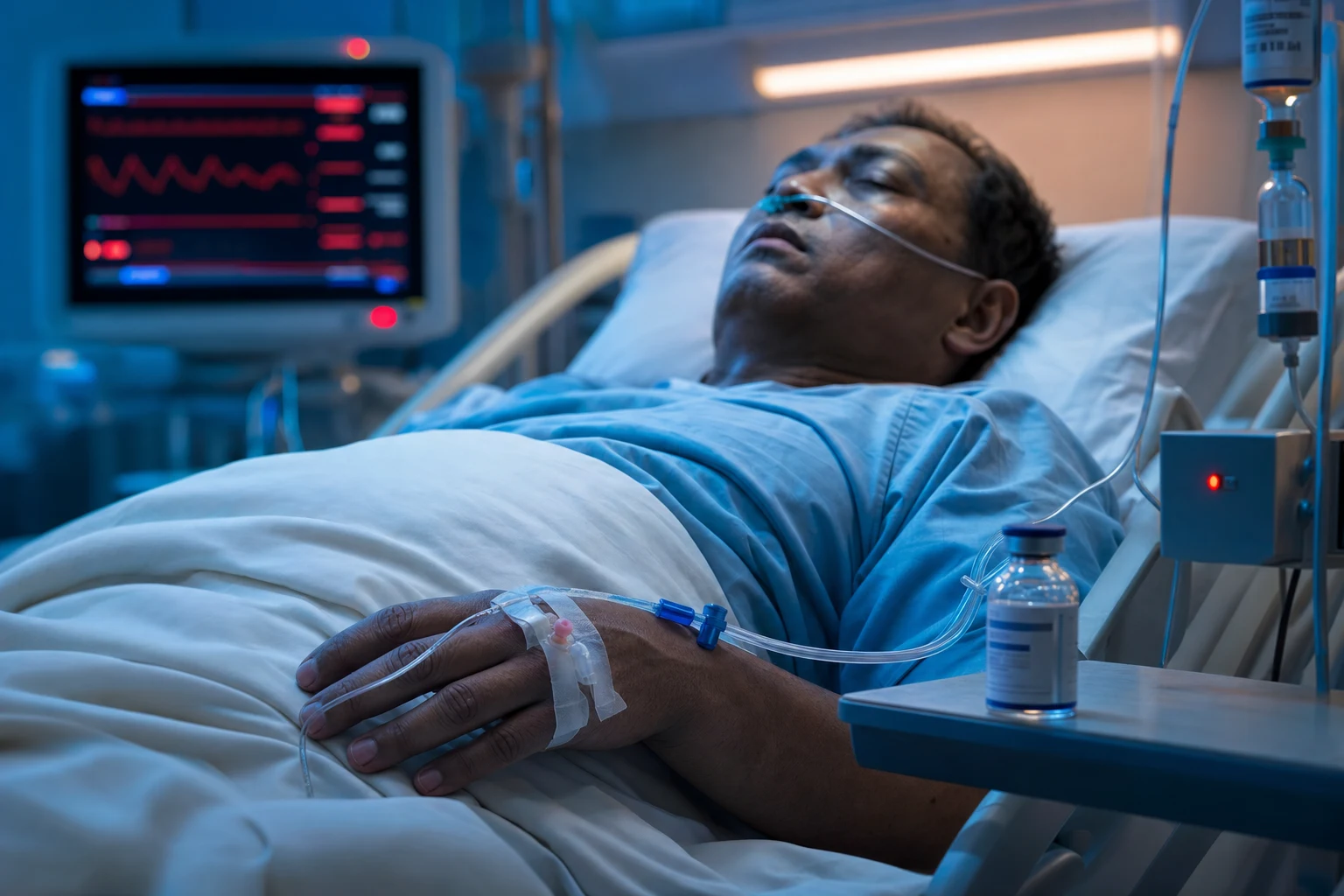
The adrenal the crisis — the acute the life-threatening the glucocorticoid the deficiency. The refractory the vasodilatory the shock, the abdominal the symptoms, the electrolyte the disturbance (the hyponatraemia, the hyperkalaemia), the hypoglycaemia. The mortality the high if the unrecognised. The hydrocortisone the IV the immediately (the before the diagnostic the tests). The commonest the ICU the cause the iatrogenic (the abrupt the withdrawal of the chronic the exogenous the steroids — the HPA the suppression).[1][2][1]
The pathophysiology
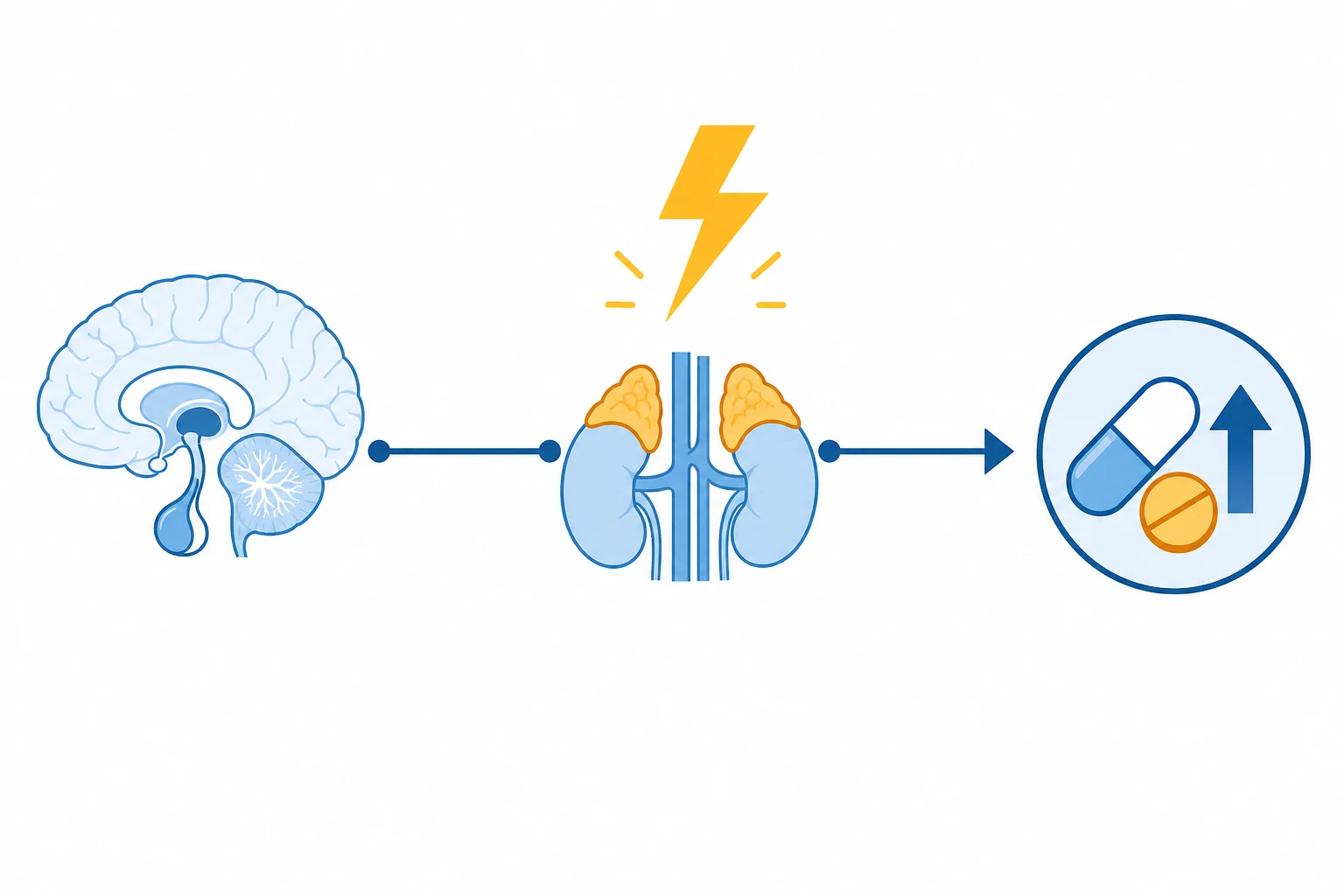
The HPA the axis — the hypothalamus (the CRH) → the anterior the pituitary (the ACTH) → the adrenal the cortex (the cortisol the zona the fasciculata, the aldosterone the zona the glomerulosa). The cortisol the released the in the pulsatile + the circadian the rhythm (the peak the dawn; the nadir the midnight). The stress (the critical the illness, the surgery, the sepsis, the trauma) → the cortisol the production the up the 6-fold the (the basal the 10 to 20 mg/day; the stress the 100 to 200 mg/day).[1][1]
The cortisol the actions — the vascular the tone (the permissive the catecholamine — the upregulate the α1 + the β2 the adrenergic the receptors; the inhibit the inducible the NOS + the prostacyclin the vasodilators; the maintain the capillary the integrity), the gluconeogenesis (the ↑ the hepatic; the anti-the-insulin), the anti-the-inflammatory (the inhibit the NF-κB; the ↓ the TNF / the IL-1 / the IL-6), the mild the Na the retention, the free the water the clearance (the ADH the antagonism).[1][1]
The cortisol the deficiency → the loss of the vascular the tone (the refractory the vasodilatory the shock — the vasopressor the resistant; the cortisol the restores the sensitivity), the gluconeogenesis the impaired (the hypoglycaemia), the Na the wasting (the hyponatraemia — the mineralocorticoid + the ADH the uninhibited), the K the retention (the hyperkalaemia — the primary the only; the mineralocorticoid the loss), the free the water the impaired (the dilutional the hyponatraemia).[1]
The mineralocorticoid (the aldosterone) — the RAAS-driven (the angiotensin the II / the K / the ACTH the minor). The independent the of the ACTH (the secondary the AI — the aldosterone the intact → the no the hyperkalaemia). The lost in the primary (the zona the glomerulosa the destroyed) → the hyperkalaemia + the salt the wasting.[1][7]
The causes
- The primary the adrenal the insufficiency (the Addison's) — the autoimmune (the commonest in the developed the world), the TB (the commonest the worldwide), the adrenal the haemorrhage (the Waterhouse-Friderichsen — the meningococcal; the anticoagulant / the heparin-induced), the metastases (the lung, the breast, the melanoma), the congenital (the CAH).[1][1]
- The secondary the adrenal the insufficiency (the pituitary) — the Sheehan (the postpartum), the apoplexy, the infiltrative, the tumour.[1]
- The iatrogenic (the commonest the ICU the cause) — the abrupt the withdrawal / the cessation of the chronic the exogenous the steroids (the oral, the inhaled, the parenteral) → the HPA the suppression (the hypothalamic-pituitary-adrenal the axis the suppressed — the months to the recover). The the stress (the infection, the surgery, the trauma) the unmasks the suppressed the axis.[2][3][1]
The primary the adrenal the insufficiency — the causes the detailed
| The category | The mechanism | The examples |
|---|---|---|
| The autoimmune | The autoimmune the adrenalitis (the isolated / the type 1 + 2 the autoimmune the polyglandular) | 21-hydroxylase the antibodies; the commonest in the developed the world (70 to 90 per cent) |
| The infectious — the TB | The caseating the granuloma (the bilateral the enlargement → the atrophy + the calcification) | The commonest the worldwide; the HIV the coexistent |
| The infectious — the other | The fungal / the viral / the bacterial the destruction | The histoplasma; the cryptococcus; the CMV (the AIDS the defining) |
| The vascular — the haemorrhage | The bilateral the adrenal the haemorrhage | The Waterhouse-Friderichsen (the meningococcal); the anticoagulant; the post-the-surgery; the trauma |
| The vascular — the infarct | The thrombosis / the embolic | The antiphospholipid the syndrome |
| The infiltrative / the metastatic | The metastases (the lung, the breast, the melanoma, the kidney) — the bilateral | The > 90 per cent the cortex the replacement the needed the for the insufficiency |
| The infiltrative — the other | The sarcoid, the amyloid, the haemochromatosis | The rare |
| The genetic / the congenital | The congenital the adrenal the hyperplasia (the 21-OH), the adrenoleukodystrophy | The rare in the adults |
| The drug-induced | The steroidogenesis the inhibitor | The etomidate, the ketoconazole, the metyrapone, the mitotane, the mifepristone |
| The drug | The mechanism | The duration | The clinical the note |
|---|---|---|---|
| The etomidate | The 11β-hydroxylase + the cholesterol the side-chain the cleavage the inhibition | The single the dose → 24 to 48 h the (reversible); the infusion → the prolonged | The induction the agent; the even the single the dose → the transient the AI (the controversial the mortality).[9][10] |
| The ketoconazole | The 11β-hydroxylase + the 17,20-lyase the inhibition | The days | The antifungal; the medical the Cushing the treatment |
| The metyrapone | The 11β-hydroxylase the inhibition | The days | The Cushing the medical |
| The mitotane | The mitochondrial the toxicity (the adrenolytic) | The months | The adrenocortical the carcinoma |
| The mifepristone (the RU-486) | The glucocorticoid the receptor the antagonist | The days | The medical the abortion; the Cushing the hyperglycaemia |
| The megestrol | The glucocorticoid the activity (the HPA the suppression) | The weeks | The appetite the stimulant |
| The exogenous the steroids | The HPA the suppression (the chronic — the oral / the inhaled / the parenteral) | The weeks to the months | The commonest the ICU the cause; the iatrogenic |
The bilateral the adrenal the haemorrhage
The bilateral the adrenal the haemorrhage — the rare but the catastrophic. The presentation: the abdominal / the flank / the back the pain (the sudden, the severe), the fever, the hypotension, the falling the haematocrit (the retroperitoneal the bleed), the mimics the surgical the abdomen. The precipitants: the anticoagulation (the heparin — the over-the-anticoagulation; the warfarin; the LMWH; the heparin-induced the thrombocytopenia the classic), the post-the-major-the-surgery (the cardiovascular; the aortic), the trauma (the seat-belt; the blunt), the sepsis (the meningococcaemia — the Waterhouse-Friderichsen), the antiphospholipid the syndrome, the severe the stress (the burns, the severe the illness), the neonatal (the asphyxia), the idiopathic. The CT — the bilateral the adrenal the masses (the high the density the acutely — 50 to 70 the HU; the resolution the over the weeks; the calcification the late). The MRI — the high the T1 the signal (the methaemoglobin).[1][1]
The Waterhouse-Friderichsen the syndrome — the bilateral the adrenal the haemorrhage in the meningococcal the septicaemia (Neisseria the meningitidis; the Pseudomonas, the Streptococcus pneumoniae, the Haemophilus influenzae, the Staphylococcus aureus the also the reported). The purpuric the rash, the DIC, the rapid the refractory the shock, the multi-the-organ the failure. The high the mortality. The empirical the stress-dose the steroids the warranted in the meningococcal the septic the shock (the debated but the widely the practised).[1]
The metastatic the involvement
The adrenal the metastases — the common (the adrenal the gland the a the common the site) BUT the clinical the insufficiency the uncommon (> 90 per cent the cortex the destruction the needed — the bilateral). The primaries: the lung, the breast, the melanoma, the kidney (the renal the cell), the lymphoma. The CT — the bilateral the adrenal the masses (the heterogeneous the enhancement). The biopsy the to the confirm. The screen the cortisol / the ACTH the in the bilateral the adrenal the masses the + the malignancy.[1]
The clinical
- The refractory the vasodilatory the shock — the hypotension the unresponsive to the fluid; the vasopressor-resistant (the cortisol the required for the vascular the tone and the catecholamine the sensitivity). The cardinal the ICU the feature.[1][1]
- The gastrointestinal — the abdominal the pain (the classic — the mimics the acute the abdomen), the nausea, the vomiting, the anorexia.[1]
- The electrolyte — the hyponatraemia (the mineralocorticoid the loss — the Na the wasting; the secondary the no — the RAAS the intact), the hyperkalaemia (the mineralocorticoid the loss — the primary the only), the hypoglycaemia (the gluconeogenesis the impaired).[1][1]
- The constitutional — the lethargy, the fatigue, the weight the loss, the fever, the confusion.[1]
- The primary the signs — the hyperpigmentation (the ACTH the excess — the skin the creases, the palmar the creases, the buccal, the scars, the gums), the salt the craving. The secondary the NO the hyperpigmentation (the low the ACTH), the NO the hyperkalaemia.[1]
The clinical — the primary the vs the secondary
| The feature | The primary (the Addison's) | The secondary (the pituitary) |
|---|---|---|
| The ACTH | The HIGH (the > 200 ng/L) | The LOW / the inappropriately the normal |
| The hyperpigmentation | The YES (the skin the creases, the palmar, the buccal, the scars, the gums, the areolae) | The NO (the pale the skin) |
| The hyperkalaemia | The YES (the mineralocorticoid the loss) | The NO (the RAAS the intact) |
| The hyponatraemia | The YES (the Na the wasting + the ADH) | The YES (the cortisol the → the ADH the uninhibited) |
| The hypoglycaemia | The YES (the common) | The YES (the GH the deficiency; the cortisol the low) |
| The hypotension | The marked (the mineralocorticoid + the cortisol) | The mild (the cortisol the only) |
| The salt the craving | The YES | The NO |
| The weight the loss | The YES (the marked) | The YES (the mild) |
| The other the pituitary the deficits | The NO | The YES (the secondary the hypothyroid, the hypogonadism, the GH) |
| The abdominal the pain | The YES (the marked) | The mild |
| The menstruation / the libido | The impaired (the androgen the loss) | The impaired (the gonadotropin) |
| The vitiligo | The YES (the autoimmune) | The NO |
| The system | The features |
|---|---|
| The cardiovascular | The refractory the vasodilatory the shock (the vasopressor the resistant), the orthostatic the hypotension, the reduced the contractility |
| The gastrointestinal | The abdominal the pain (the mimics the acute the abdomen), the nausea, the vomiting, the anorexia, the weight the loss, the diarrhoea, the salt the craving |
| The metabolic / the electrolyte | The hypoglycaemia (the gluconeogenesis the impaired), the hyponatraemia (the Na the wasting + the ADH), the hyperkalaemia (the primary the only), the hypercalcaemia (the rare), the metabolic the acidosis |
| The neurological | The lethargy, the fatigue, the apathy, the confusion, the depression, the psychosis (the rare), the coma |
| The musculoskeletal | The myalgia, the arthralgia, the muscle the weakness (the secondary — the bone the loss / the osteoporosis) |
| The skin (the primary) | The hyperpigmentation (the sun-exposed + the skin the creases + the palmar + the buccal + the scars + the gums), the vitiligo (the autoimmune), the alopecia |
| The reproductive | The amenorrhoea, the reduced the libido (the primary — the androgen the loss; the secondary — the gonadotropin) |
The precipitants the of the crisis
The adrenal the crisis the precipitated by the stress in the patient the with the established (the overt / the occult) the adrenal the insufficiency. The common the precipitants: the infection (the GI / the respiratory / the urinary — the commonest), the GI the upset (the vomiting / the diarrhoea → the missed the dose + the dehydration), the surgery / the trauma / the dental, the myocardial the infarction, the withdrawal (the abrupt the steroid the cessation), the emotional the stress, the pregnancy / the labour, the drugs (the phenytoin / the rifampicin / the barbiturates → the cortisol the metabolism the ↑), the sepsis, the etomidate the induction.[1][2]
The treatment
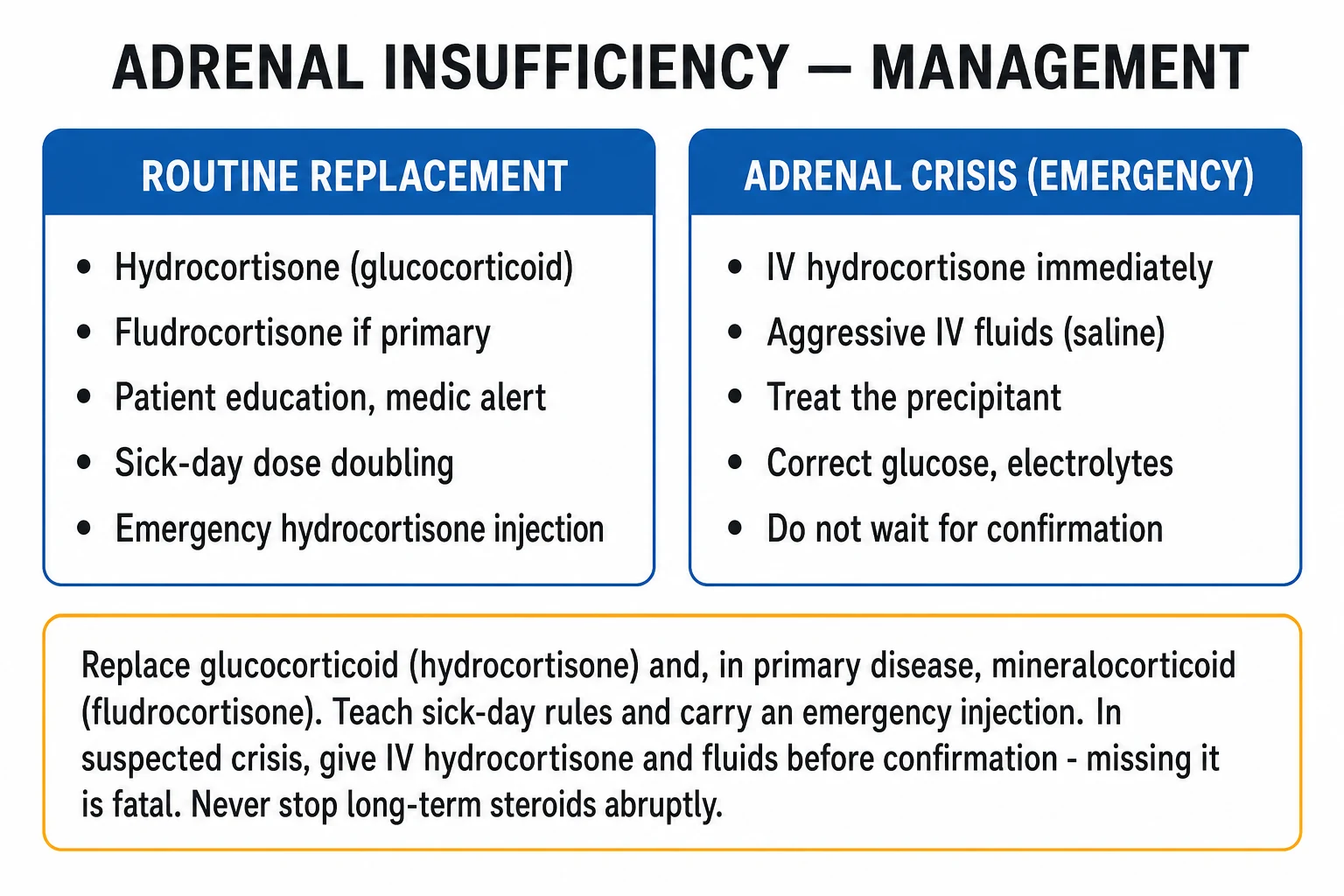
1. The hydrocortisone the IV — the immediate (the before the tests).[1][1][1]
- The 100 mg the IV the stat then the 200 mg the over the 24 h (the infusion or the 50 mg the every the 6 h). The immediate — the NOT the await the cortisol / the ACTH (the delay the dangerous).[1]
- The the hydrocortisone the has the mineralocorticoid the activity the at the high the doses — the no the fludrocortisone the needed the acutely (the add the once the wean to the maintenance the below the 50 mg/day).[1]
- The the dexamethasone the alternative the IF the diagnostic the testing the needed the before the steroid (the no the mineralocorticoid the activity, the no the cross-react the cortisol the assay) — BUT the hydrocortisone the preferred the for the crisis.[1]
2. The fluid the resuscitation.[1]
- The isotonic the saline (the 1 to 2 L the rapidly, then the titrate) — the hypovolaemia (the mineralocorticoid the loss).
- The add the dextrose (the 5 per cent / the 10 per cent) — the hypoglycaemia the common.
- The correct the electrolyte (the hyponatraemia the gradual — the avoid the rapid; the hyperkalaemia the resolves with the steroid).[1][1]
3. The treat the trigger. The search the infection (the cultures, the antibiotics — the broad the early), the DKA, the surgery, the trauma. The crisis the precipitated by the stress.[1]
4. The vasopressors — the norepinephrine (the cortisol the deficiency → the vasopressor-resistant; the steroid the restores the sensitivity).[1]
5. The investigate (the once the stable). The cortisol + the ACTH (the taken the BEFORE the hydrocortisone — the if the possible; the if the already the given, the dexamethasone the if the further the testing). The the short the synacthen the test (the 250 mcg — the cortisol the rise the 30 + the 60 min). The electrolyte, the glucose, the TFTs (the coexistent). The primary the vs the secondary the (the ACTH the high the primary; the low the secondary).[1]
The diagnosis
The diagnosis the NEVER the delays the treatment. The clinical the suspicion (the refractory the vasodilatory the shock, the abdominal the pain, the electrolyte, the chronic-the-steroid the history) → the hydrocortisone the IV the IMMEDIATELY. The tests the confirmatory the later.[1][7]
The acute the bloods (the drawn the BEFORE the hydrocortisone the if the possible)
- The cortisol (the serum the total) + the ACTH — the paired. The cortisol the > 400 to 500 nmol/L (the 14 to 18 mcg/dL) in the unwell the patient → the AI the excluded (the stress the response the adequate). The cortisol the < 300 nmol/L (the 11 mcg/dL) in the unwell → the AI the likely; the further the test. The ACTH the high (the > 200 ng/L) + the cortisol the low → the primary. The ACTH the low / the inappropriately the normal → the secondary.[7][8]
- The renin / the aldosterone — the high the renin + the low the aldosterone (the primary). The supplementary the not the acute.
- The electrolyte — the hyponatraemia (the common), the hyperkalaemia (the primary), the hypoglycaemia, the hypercalcaemia (the rare), the metabolic the acidosis.
- The FBC, the CRP, the lactate, the cultures — the precipitant the search (the infection / the sepsis).
- The TFTs, the FSH / the LH, the oestradiol, the IGF-1, the prolactin — the coexistent the pituitary the deficits (the secondary).
- The cortisol-binding the globulin (the CBG) — the low in the critical the illness → the falsely the low the total the cortisol (the free the cortisol the preferred but the not the routine the assay).
The dynamic the tests (the once the stable)
- The short the Synacthen the test (the SST — the 250 mcg the IM / the IV the cosyntropin) — the cortisol the baseline + the 30 + the 60 min. The rise the > 500 to 550 nmol/L (the 18 to 20 mcg/dL) AND the increment the > 250 nmol/L (the 9 mcg/dL) → the normal the response (the AI the excluded). The 250 mcg the dose the supramaximal — the SST the detects the primary the AI the reliably (the atrophic the gland the unresponsive) BUT the the recent / the partial the secondary the may the pass (the gland the still the responsive the short the term). The SST the NOT the for the critical-illness the CIRCI.[7][8]
- The low-dose the (1 mcg) the SST — the more the sensitive the for the secondary / the CIRCI; the not the standardised; the not the widely the available.
- The insulin the tolerance the test (the ITT) — the gold the standard the for the secondary / the HPA the reserve; the dangerous the in the ICU (the seizure / the arrhythmia / the hypoglycaemia); the once the well.
- The metyrapone the test — the central the secondary; the rare; the risky (the crisis the precipitated).
- The CRH the stimulation the test — the distinguishes the hypothalamic the from the pituitary; the research.
The imaging
- The CT the adrenal — the bilateral the enlargement (the TB / the haemorrhage / the infiltrative / the metastatic); the small the atrophic (the autoimmune / the secondary). The calcification (the old the TB / the old the haemorrhage). The high the density the acute the haemorrhage (the 50 to 70 the HU). The heterogeneous the enhancement (the metastatic).[1]
- The MRI the pituitary — the secondary (the apoplexy, the tumour, the empty the sella, the infiltrative; the Sheehan).
The antibodies
- The 21-hydroxylase the antibodies — the autoimmune the Addison's (the positive → the lifelong; the no the further the imaging the needed). The 17-OH / the side-chain the cleavage the also the screen.[7]
- The other the autoimmune — the thyroid (the TPO), the coeliac (the TTG), the type 1 the diabetes (the GAD), the B12 (the parietal the cell), the vitiligo. The screen the for the autoimmune the polyglandular the syndrome (the type 1: the mucocutaneous the candidiasis + the hypoparathyroidism + the Addison's; the type 2: the Addison's + the autoimmune the thyroid + the type 1 the diabetes / the pernicious the anaemia).[7]
The corticosteroid replacement / the prevention
- The maintenance — the hydrocortisone the divided (the 15 to 25 mg/day) + the fludrocortisone (the 50 to 200 mcg/day — the primary the only). The patient the education (the sick-day the rules — the double / the triple the dose the for the illness; the emergency the IM the hydrocortisone the kit).[2][1]
- The stress the dosing — the illness / the surgery → the double / the triple the maintenance (the or the IV the hydrocortisone the 50 to 100 mg the q6-8h for the major the surgery / the severe the illness).[2]
- The withdrawal — the gradual the taper (the never the abrupt) of the chronic the steroids; the HPA the recovery the months.[3]
Prognosis
The adrenal the crisis the mortality the high if the unrecognised (the refractory the shock, the arrhythmia from the hyperkalaemia, the hypoglycaemia). The prompt the hydrocortisone + the fluid → the rapid the improvement. The chronic the patient the education + the sick-day the rules the prevents the recurrence.[1][2][1]
The critical-illness-related the corticosteroid the insufficiency (the CIRCI)
The CIRCI — the relative the cortisol the deficiency in the critical the illness (the sepsis, the ARDS, the trauma, the severe the burns). The NOT the absolute (the cortisol the may the be the normal / the high — but the inadequate the for the stress). The mechanism the complex (the CBG the low → the free the cortisol the measured the more the accurately; the glucocorticoid the receptor the resistance; the tissue the conversion the 11β-HSD2 the impaired; the pro-inflammatory the cytokines). The diagnosis the controversial — the SST the poor the (the 250 mcg the supraphysiological the masks the partial); the delta the cortisol the < 250 nmol/L the after the 250 mcg the ACTH the historical the criterion (the no the longer the recommended the 2017 the consensus — the diagnosis the clinical the in the vasopressor-dependent the shock).[8]
The septic the shock the steroids — the landmark the trials
The steroids the in the septic the shock — the one of the ICU the most the debated the questions. The indications the current (the Surviving the Sepsis the 2021 + the 2017 the CIRCI the consensus): the hydrocortisone the 200 mg/day the continuous the OR the 50 mg the q6h the IV the if the vasopressor-dependent the shock (the norepinephrine the not the weaned / the escalating the despite the adequate the fluid). The NOT the routine (the CORTICUS the harm); the the for the refractory the shock.[4][5][6][8]
ADRENAL trial (2018)
The largest the septic the shock the steroid the trial the to the date (3,658 the patients, the ANZ). The hydrocortisone the 200 mg/day the continuous the infusion × 7 days (the or the until the ICU the discharge) the vs the placebo. The primary the outcome the 90-day the mortality — NO the difference (the 27.9 per cent the hydrocortisone the vs the 28.8 per cent the placebo). The faster the shock the reversal (the median the 3 days the shorter); the no the difference the in the infection / the superinfection; the more the insulin the for the hyperglycaemia; the more the new the infection (the trend). The take-home — the hydrocortisone the speeds the shock the reversal the but the does the not the improve the survival the in the broad the septic the shock the population.[4]
APROCCHSS trial (2018)
The hydrocortisone + the fludrocortisone (the 200 mg/day the hydrocortisone × 7 days the + the 50 mcg/day the fludrocortisone × 7 days) the vs the placebo in the severe the septic the shock (1,241 the patients, the French). The primary the outcome the 90-day the mortality — REDUCED (the 43.0 per cent the treatment the vs the 49.1 per cent the placebo; the p = 0.03). The faster the shock the reversal; the more the superinfection (the trend; the not the significant). The take-home — the hydrocortisone + the fludrocortisone the improves the survival the in the severe the septic the shock; the questioned the (the larger the ADRENAL the negative); the fludrocortisone the contribution the unclear.[5]
CORTICUS trial (2008)
The hydrocortisone the 200 mg/day × 5 days (the tapered × 6 days) the vs the placebo in the pressor-responsive OR the non-responsive the septic the shock (499 the patients). The 28-day the mortality the no the difference (the 34.9 per cent the hydrocortisone the vs the 31.5 per cent the placebo; the NS). The rate the of the superinfection + the new the sepsis the INCREASED (the 21 the vs the 16 per cent). The take-home — the hydrocortisone the NOT the routine in the septic the shock; the for the refractory the pressor-dependent the only. The CORTICUS the closed the question the until the APROCCHSS the re-opened the it.[6]
| The trial | The year | The n | The intervention | The population | The 90 / 28-day the mortality | The shock the reversal | The harm |
|---|---|---|---|---|---|---|---|
| Annane 2002 (the JAMA) | 2002 | 300 | The hydro + the flu × 7 d | The pressor-dependent (the non-responsive the SST) | ↓ 28-day (the 53 → 29 per cent in the non-responders) | The faster | — |
| CORTICUS | 2008 | 499 | The hydro × 11 d (the taper) | The pressor-responsive / non | The no the difference | The faster | The ↑ superinfection |
| ADRENAL | 2018 | 3,658 | The hydro the 200 the continuous × 7 d | The broad the septic the shock | The no the difference (the 90-day) | The faster (the 3 days) | The ↑ hyperglycaemia |
| APROCCHSS | 2018 | 1,241 | The hydro + the flu × 7 d | The severe the septic the shock | ↓ (the 49 → 43 per cent) | The faster | The trend ↑ superinfection |
The current the recommendations (the Surviving the Sepsis 2021 + the CIRCI the consensus 2017)
- The hydrocortisone the 200 mg/day the IV (the 50 mg the q6h the OR the continuous the infusion) the for the vasopressor-dependent the septic the shock (the norepinephrine the dose the high / the escalating the despite the adequate the fluid). The weak the recommendation, the low-the-quality the evidence.[8]
- The NOT the routine the in the septic the shock the without the pressor the dependence (the CORTICUS the harm).[6]
- The fludrocortisone the OPTIONAL (the 50 mcg/day × 7 days; the APROCCHSS) — the hydrocortisone the has the mineralocorticoid the activity the at the high the doses; the fludrocortisone the additional the in the severe.[5]
- The methylprednisolone the NOT the preferred (the no the mineralocorticoid the activity; the more the immunosuppression); the hydrocortisone the first.
- The NO the SST the to the guide the treatment (the 2017 the consensus the no the longer the recommends; the test the poor).[8]
- The wean the slowly (the taper the over the days the once the pressors the off; the abrupt the cessation → the rebound the inflammation / the shock the recurrence).[1]
The CIRCI the beyond the septic the shock
- The severe the community-the-acquired the pneumonia (the SCAP) — the hydrocortisone the ↓ the ARDS / the late the shock the (the Confalonieri / the Torres the evidence; the debated).[8]
- The early the severe the ARDS (the PaO2/FiO2 the < 200) — the methylprednisolone the early the (the Meduri the evidence) the ↓ the mortality the + the ventilator the days the (the debated; the LAEDRS the trial the negative).[8]
- The severe the burns (the > 30 per cent the TBSA) — the hydrocortisone / the methylprednisolone the ↓ the shock the days; the debated.
- The cardiac the surgery the post-the-cardiopulmonary-the-bypass the vasoplegia — the hydrocortisone the ↓ the vasopressor the duration.
- The severe the trauma — the relative the AI the common; the empirical the hydrocortisone the in the refractory the shock.
Red flags
The clinical the pearls
The flow the steps
The adrenal the crisis — the immediate the management the algorithm
- The recognise — the refractory the vasodilatory the shock (the vasopressor the resistant), the abdominal the pain, the electrolyte (the Na ↓ / the K ↑ / the glucose ↓), the chronic-the-steroid the history, the autoimmune the patient, the anticoagulated. The clinical the diagnosis.[1]
- The bloods the BEFORE the steroid (the if the possible — the NOT the delay the > the minutes) — the cortisol + the ACTH (the paired), the U&E, the glucose, the FBC, the CRP, the lactate, the cultures. The store the serum.[7]
- The hydrocortisone the 100 mg the IV the stat (the immediate — the before the cortisol / the ACTH the results).[1]
- The hydrocortisone the 200 mg/24h (the 50 mg the q6h the OR the continuous the infusion).[7]
- The fluid — the isotonic the saline the 1 to 2 L the rapidly → the titrate (the MAP the 65; the lactate the ↓). The add the 5 per cent / the 10 per cent the dextrose (the hypoglycaemia).[1]
- The vasopressors — the norepinephrine (the steroid the restores the sensitivity — the wean the once the steroid the on board).[1]
- The treat the precipitant — the cultures + the broad the antibiotics (the sepsis — the within the hour); the DKA the protocol the if the overlap; the surgery; the cardiac.[1]
- The monitor — the MAP, the lactate, the urine the output, the Na / the K / the glucose the q the 2 to 6 h.[1]
- The taper the once the stable (the off the pressor) — the 100 mg/day → the 50 mg the q6h → the 25 mg the q6h → the oral the 20 mg the AM + the 10 mg the PM. The add the fludrocortisone the once the hydrocortisone the < 50 mg/day.[7]
- The investigate the once the stable — the SST (the 250 mcg) the if the diagnosis the unclear; the 21-hydroxylase the antibodies; the CT the adrenal / the MRI the pituitary; the TFTs / the gonadotropins / the IGF-1 (the secondary).[7]
- The education the BEFORE the discharge — the sick-day the rules (the double / the triple the maintenance the for the illness); the emergency the IM the hydrocortisone the kit (the 100 mg the IM the — the patient / the family the trained); the Medic-Alert the bracelet; the endocrine the follow-up.[1][2]
The diagnostic the workup — the once the stable
- The confirm the cortisol the deficiency — the 8 am the cortisol (the low / the inappropriately the normal the for the stress); the ACTH (the high the primary / the low the secondary).[7]
- The dynamic the test — the short the Synacthen the test (the 250 mcg the IM / the IV — the cortisol the 0 / the 30 / the 60 min). The blunted the response → the primary / the severe the secondary.[7][8]
- The renin / the aldosterone — the high the renin + the low the aldosterone (the primary); the supplementary.[7]
- The antibodies — the 21-hydroxylase (the autoimmune the primary); the other the autoimmune the screen.[7]
- The imaging — the CT the adrenal (the TB / the haemorrhage / the metastatic / the atrophic); the MRI the pituitary (the secondary).[1]
- The other the pituitary — the TFTs, the FSH / the LH, the oestradiol / the testosterone, the IGF-1, the prolactin (the secondary the → the hypopituitarism the screen).[1]
- The DEXA — the bone the density (the chronic the steroid / the hypogonadism).[7]
The exam the practice — the SAQs
SAQ — Adrenal crisis in vasopressor-dependent septic shock
10 minutes · 10 marks
A 64-year-old woman is admitted to ICU with community-acquired pneumonia and septic shock. Despite 30 mL/kg of balanced crystalloid she remains hypotensive: BP 78/46 (MAP 57), HR 128 sinus, lactate 4.8 mmol/L, urine output 15 mL/hr, SpO2 92 per cent on FiO2 0.6. She requires noradrenaline 0.45 mcg/kg/min. Bloods: Na 128 mmol/L, K 5.6 mmol/L, glucose 2.9 mmol/L, cortisol 220 nmol/L (drawn before any steroid). Past history: rheumatoid arthritis on oral prednisolone 10 mg daily for 8 years, stopped on admission 2 days ago. She has faint hyperpigmentation of the palmar creases.
SAQ — Etomidate-induced adrenal suppression after RSI in septic shock
10 minutes · 10 marks
A 72-year-old man is intubated in the emergency department for severe septic shock from a urinary source. Rapid sequence induction uses etomidate 0.3 mg/kg and suxamethonium 1.5 mg/kg. Twelve hours later in ICU he remains profoundly hypotensive: BP 76/45 (MAP 55) on noradrenaline 0.5 mcg/kg/min and vasopressin 0.03 U/min, despite 30 mL/kg crystalloid. Na 130, K 5.4, glucose 3.1, lactate 4.6. The registrar attributes the vasopressor resistance to the etomidate. You are asked to assess and manage suspected etomidate-induced adrenal suppression.
References
- [1]Hahner S, et al. Adrenal crisis: prevention and management in adult patients Ther Adv Endocrinol Metab, 2019.PMID 31223468
- [2]Burman P, et al. Iatrogenic adrenal insufficiency in adults Nat Rev Endocrinol, 2024.PMID 38272995
- [3]Kokot M, et al. Glucocorticoid withdrawal and glucocorticoid-induced adrenal insufficiency: Study protocol of the randomized controlled «TOASST (Taper Or Abrupt Steroid STop) multicenter trial PLoS One, 2023.PMID 37018188
- [4]Venkatesh B, Finfer S, Cohen J, et al. Adjunctive Glucocorticoid Therapy in Patients with Septic Shock N Engl J Med, 2018.PMID 29347874
- [5]Annane D, Renault A, Brun-Buisson C, et al. Hydrocortisone plus Fludrocortisone for Adults with Septic Shock N Engl J Med, 2018.PMID 29490185
- [6]Sprung CL, Annane D, Keh D, et al. Hydrocortisone therapy for patients with septic shock N Engl J Med, 2008.PMID 18184957
- [7]Bornstein SR, Allolio B, Arlt W, et al. Diagnosis and Treatment of Primary Adrenal Insufficiency: An Endocrine Society Clinical Practice Guideline J Clin Endocrinol Metab, 2016.PMID 26760044
- [8]Annane D, Pastores SM, Rochwerg B, et al. Guidelines for the diagnosis and management of critical illness-related corticosteroid insufficiency (CIRCI) in critically ill patients (Part I): Society of Critical Care Medicine (SCCM) and European Society of Intensive Care Medicine (ESICM) 2017 Intensive Care Med, 2017.PMID 28940011
- [9]Chan CM, Mitchell AL, Shorr AF Etomidate is associated with mortality and adrenal insufficiency in sepsis: a meta-analysis* Crit Care Med, 2012.PMID 22971586
- [10]Bruder EA, Ball IM, Ridi S, et al. Single induction dose of etomidate versus other induction agents for endotracheal intubation in critically ill patients Cochrane Database Syst Rev, 2015.PMID 25568981