ICU · Endocrine & metabolic emergencies
Hypoglycaemia
Also known as Hypoglycaemia · Low blood glucose · Whipple triad · Sulfonylurea overdose · Octreotide · Insulinoma · Neuroglycopenia
The hypoglycaemia — the Whipple the triad (the symptoms, the low the glucose, the relief with the glucose); the severe (the altered the consciousness, the needing the assistance). The causes (the insulin, the sulfonylurea — the prolonged, the recurrent; the insulinoma; the adrenal the insufficiency; the liver the failure; the alcohol; the sepsis). The IV the dextrose, the glucagon (the if the no the IV), the octreotide for the sulfonylurea (the inhibits the insulin the release — the not the dextrose the alone, which the fuels the further the insulin).
On this page & tools
Your progress
Saved locally on this device.
Target exams
Overview & definition
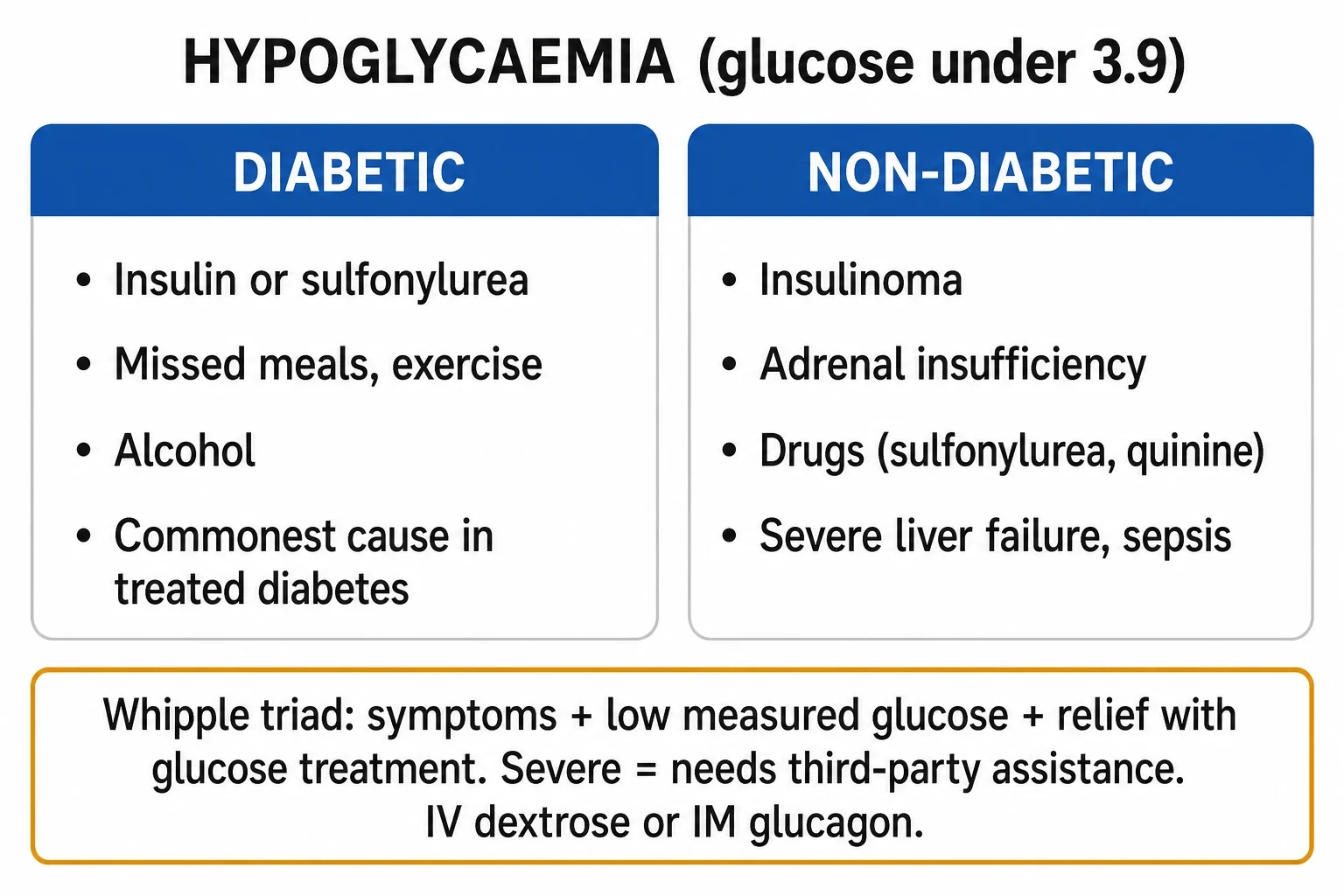
The hypoglycaemia — the Whipple the triad (the symptoms the consistent with the low the glucose, the documented the low the glucose, the relief with the glucose). The severe (the altered the consciousness, the seizure, the coma, the needing the assistance). The brain the dependent on the glucose (the no the storage); the severe the prolonged → the irreversible the neurology. The every the altered / the fitting / the comatose the patient → the check the glucose.[1][1]
The clinical
The two the symptom the groups:[1][1]
- The autonomic (the adrenergic) — the sweating, the tremor, the palpitations, the hunger, the anxiety, the pallor. The early the warning (the fall the below the 3.5).
- The neuroglycopenic (the brain) — the confusion, the drowsiness, the dysarthria, the visual the disturbance, the seizures, the coma, the focal the neurological the deficit (the stroke-mimic). The brain the cannot the use the anything but the glucose. The fall the below the 2.5 to 3.0.
The diabetic the patient the impaired the awareness (the recurrent the hypoglycaemia → the blunted the autonomic the response → the no the warning → the straight to the neuroglycopenic).[1]
The causes
- The drugs — the insulin (the exogenous — the deliberate the overdose, the error), the sulfonylurea (the glibenclamide, the gliclazide, the glipizide — the stimulates the endogenous the insulin → the prolonged, the recurrent; the dangerous), the quinine, the quinolones, the pentamidine, the beta-blockers (the mask the autonomic the signs).[2][1]
- The insulinoma (the rare; the fasted; the Whipple the triad; the inappropriately the high the insulin + the C-peptide during the hypo).[1]
- The endocrine — the adrenal the insufficiency (the cortisol the needed for the gluconeogenesis), the hypopituitarism, the hypothyroid.
- The organ the failure — the liver (the gluconeogenesis), the renal (the clearance of the insulin), the cardiac.[1]
- The alcohol (the inhibits the gluconeogenesis — the depleted the glycogen; the often the co-the thiamine the deficiency).[1]
- The sepsis, the malaria (the severe), the post-bariatric (the postprandial / the dumping).[1]
The treatment
1. The IV the dextrose — the immediate.[1][1]
- The 50 mL the 50 per cent the dextrose (the 25 g) IV (the central the line the preferred — the 50 per cent the vesicant; the peripheral the with the flush; the 10 per cent the infusion the alternative). The response the rapid.[1]
- The the continue the infusion (the 10 per cent the dextrose) if the recurrent (the sulfonylurea, the long-acting the insulin, the liver). The target the glucose the 6 to 10.[1]
2. The glucagon — the if the no the IV.[1][1]
- The 1 mg the IM (the SC). The stimulates the hepatic the glycogenolysis → the glucose the rise the 5 to 20 the min. The ineffective the in the depleted the glycogen (the alcohol, the starvation, the liver the disease, the chronic). The no the role the in the sulfonylurea (the stimulates the further the insulin).[1]
3. The octreotide — the sulfonylurea.[2][3]
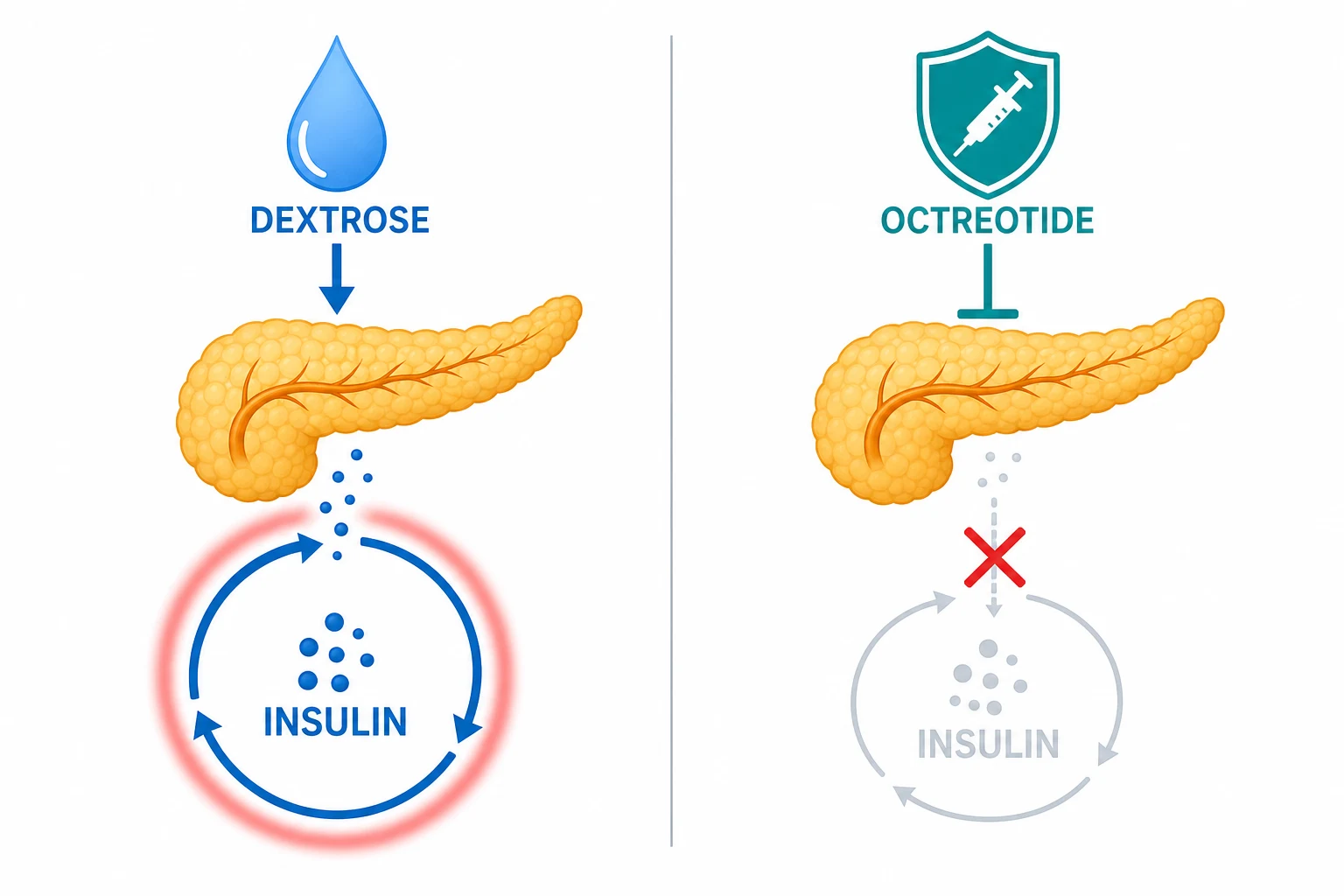
- The sulfonylurea the stimulates the pancreatic the insulin the release — the dextrose the alone the fuels the further the insulin (the rebound the worse). The octreotide (the somatostatin the analogue — the 50 to 100 mcg the SC / the IV the 8-hourly) the inhibits the insulin the release. The give the WITH the dextrose (the dextrose the for the immediate; the octreotide the for the sustained). The diazoxide the alternative.[2][3]
- The monitor the prolonged (the glibenclamide the long the half-life — the 12 to 24 h the observation).[2]
4. The thiamine BEFORE the glucose (the alcoholic / the malnourished). The prevent the Wernicke (the thiamine the glycolysis the cofactor — the glucose the depletes the further). The empirical.[1]
5. The identify / the treat the cause + the monitoring. The cause the search (the sulfonylurea the level, the insulin + the C-peptide the during the hypo, the cortisol, the lactate). The monitor the recurrent (the sulfonylurea, the long-acting the insulin — the 12 to 24 h).[1]
Prognosis
The hypoglycaemia the rapid the reversible if the treated the promptly. The severe the prolonged → the irreversible the neurology (the neuronal the death — the brain the no the glucose). The diabetic the patient the impaired the awareness the higher the risk. The sulfonylurea the recurrent the (the 12 to 24 h the monitoring).[1][2][1]
Red flags
Detailed ICU management protocol
Hypoglycaemia management — the ICU protocol
- RECOGNISE: Blood glucose <3.9 mmol/L (70 mg/dL) = hypoglycaemia. <2.2 mmol/L (40 mg/dL) = SEVERE (seizure/coma risk). Symptoms: adrenergic (sweating, tremor, palpitations, hunger) + neuroglycopaenic (confusion, drowsiness, seizures, coma). NOTE: ICU patients on beta-blockers may NOT show adrenergic symptoms — the neuroglycopaenic symptoms may be the FIRST sign
- IMMEDIATE TREATMENT:
- Conscious + can swallow: 15-20g rapid-acting carbohydrate (200 mL fruit juice, 4 glucose tablets, 1 tube glucose gel). Recheck glucose at 15 min. If still <3.9 → repeat
- Impaired consciousness OR unable to swallow: IV 50 mL of 50% dextrose (25g glucose) over 2-3 min via LARGE PERIPHERAL vein or CENTRAL line (50% dextrose is IRRITANT to small peripheral veins — phlebitis risk). Alternative: 200 mL of 10% dextrose over 10-15 min (less irritant but slower)
- No IV access: IM glucagon 1 mg (NOT effective in: liver failure — no glycogen stores; sulfonylurea overdose — insulin still high; chronic alcoholism — depleted glycogen)
- MAINTENANCE: After initial correction → START continuous dextrose infusion (10% dextrose at 50-100 mL/hr OR 5% dextrose at 100-200 mL/hr). Monitor glucose q1h initially → q2h when stable. Target: glucose 6-10 mmol/L
- IDENTIFY AND TREAT CAUSE:
- Insulin/sulfonylurea overdose: STOP the offending agent. Sulfonylurea: give OCTREOTIDE 50-100 mcg SC q8h (inhibits insulin secretion). Monitor for 24-72h (long-acting sulfonylureas: glibenclamide up to 72h)
- Sepsis: increased glucose utilisation + impaired gluconeogenesis. Treat sepsis + maintain nutrition (enteral/parenteral)
- Liver failure: impaired gluconeogenesis + depleted glycogen. Give 10% dextrose infusion. Monitor closely
- Adrenal insufficiency: cortisol deficiency → impaired gluconeogenesis. Give hydrocortisone 100mg IV
- Insulinoma: C-peptide level (high = endogenous insulin. Low = exogenous insulin). CT/MRI for localisation
- Alcohol: impairs gluconeogenesis. Give dextrose + thiamine (100mg IV BEFORE dextrose to prevent Wernicke)
- Quinine/quinolone/pentamidine: drug-induced insulin release. Stop offending drug
- CRITICAL ILLNESS HYPOGLYCAEMIA: ICU patients are at HIGH risk due to: renal failure (reduced insulin clearance), liver failure (reduced gluconeogenesis), sepsis (increased utilisation), medications (insulin, sulfonylureas, beta-blockers masking symptoms). TARGET glucose 6-10 mmol/L in ICU (NICE-SUGAR: tight control 4-6 INCREASED hypoglycaemia AND mortality)
Causes of hypoglycaemia in ICU — the comprehensive differential
Causes of hypoglycaemia — by mechanism
| Mechanism | Specific causes | Diagnostic clue |
|---|---|---|
| Excess insulin | Exogenous insulin overdose, sulfonylurea (gliclazide, glibenclamide, glipizide), quinine, pentamidine | LOW C-peptide (exogenous insulin) or HIGH C-peptide (sulfonylurea → endogenous insulin stimulated). Sulfonylurea screen in urine/plasma |
| Excess endogenous insulin | Insulinoma, autoimmune hypoglycaemia (anti-insulin antibodies), non-islet cell tumour (IGF-2 — large retroperitoneal tumours) | HIGH C-peptide + HIGH proinsulin + HIGH insulin. Autoimmune: anti-insulin antibody positive |
| Impaired gluconeogenesis | Liver failure (acute + chronic), alcohol (inhibits gluconeogenesis), sepsis (impaired hepatic glucose output), adrenal insufficiency (cortisol stimulates gluconeogenesis), growth hormone deficiency | Abnormal LFTs. Alcohol history. Septic signs. Morning cortisol <200 nmol/L |
| Increased glucose utilisation | Sepsis (cytokine-mediated increased utilisation), severe burns, severe exercise, large tumour burden, refeeding syndrome (insulin surge) | Septic source. Burn assessment. Refeeding context (phosphate, magnesium low) |
| Drugs | Beta-blockers (mask adrenergic symptoms + impair gluconeogenesis), ACEi (increase insulin sensitivity), quinine, quinolones, pentamidine, trimethoprim-sulfamethoxazole | Medication review. Beta-blocker history |
| Post-bariatric surgery | Dumping syndrome (rapid gastric emptying → exaggerated GLP-1 + insulin response). Nesidioblastosis (islet cell hyperplasia) | Gastric bypass history. Postprandial timing (hypoglycaemia 1-3h after meals) |
C-peptide, insulin and proinsulin — differentiating endogenous from exogenous insulin
The single most informative blood sample in the ICU is the one drawn DURING the hypoglycaemic episode. Once glucose is corrected the diagnostic window closes — insulin, C-peptide and proinsulin fall in parallel with glucose, so a "random" sample in a normoglycaemic patient is meaningless. Draw the critical 4-tube panel (glucose, insulin, C-peptide, proinsulin) plus β-hydroxybutyrate and a sulfonylurea screen BEFORE giving dextrose whenever the cause is not obvious.[1][5]
Interpretation rules
- Insulin HIGH, C-peptide HIGH, proinsulin HIGH → endogenous hyperinsulinaemia: sulfonylurea, insulinoma, autoimmune insulin syndrome (Hirata), or post-bariatric nesidioblastosis.
- Insulin HIGH, C-peptide LOW/SUPPRESSED, proinsulin LOW → exogenous insulin (the injected insulin carries no C-peptide — the pancreas is NOT making it). This is the injectable-overdose / factitious / iatrogenic signature.
- Insulin LOW, C-peptide LOW, proinsulin LOW → NON-insulin-mediated: liver failure, alcohol, sepsis, adrenal insufficiency, starvation, non-islet cell tumour (IGF-2), renal failure.
- β-hydroxybutyrate LOW (<2.7 mmol/L) during hypoglycaemia = insulin is present (insulin is the only hormone that suppresses ketogenesis). A normal/high β-hydroxybutyrate during a true hypo points AWAY from hyperinsulinism and toward a fuel-substrate or hormonal-deficiency cause.[1][5]
Why C-peptide tells you the source
Insulin is secreted from the β-cell as a single-chain polypeptide proinsulin, which is enzymatically cleaved into insulin and C-peptide in equimolar amounts. Both leave the β-cell together, but: (a) exogenous pharmaceutical insulin contains no C-peptide; (b) the liver clears ~50% of insulin on first pass but clears little C-peptide, which is excreted unchanged by the kidney. C-peptide is therefore a faithful marker of endogenous β-cell secretion — a high insulin with a low C-peptide means the insulin came from a syringe.[1][5]
Sulfonylurea screen
A plasma/urine sulfonylurea screen is mandatory whenever C-peptide is high — it distinguishes a drug-induced (sulfonylurea) from a structural (insulinoma) cause, completely changing management (octreotide + observe vs surgical workup).[2][6]
Diagnostic interpretation of the hypoglycaemia panel
| Glucose | Insulin | C-peptide | Proinsulin | β-OHB | Sulfonylurea screen | Diagnosis |
|---|---|---|---|---|---|---|
| LOW | HIGH | HIGH | HIGH | LOW | Positive | Sulfonylurea |
| LOW | HIGH | HIGH | HIGH | LOW | Negative | Insulinoma / nesidioblastosis |
| LOW | HIGH | HIGH | HIGH | LOW | Negative | Autoimmune insulin syndrome (anti-insulin Ab +) |
| LOW | HIGH | LOW | LOW | LOW | Negative | Exogenous insulin (iatrogenic / factitious) |
| LOW | LOW | LOW | LOW | HIGH | Negative | Non-islet cell: liver, alcohol, adrenal, sepsis, starvation |
| LOW | LOW/normal | LOW | LOW | HIGH/normal | Negative | Non-islet cell tumour (IGF-2) — low IGF-1, high "big IGF-2" |
Diagnostic sampling DURING the hypoglycaemic spell — the ICU 4-tube panel
- RECOGNISE the window: every minute after glucose is corrected, the diagnostic information decays. When glucose <3.0 mmol/L and the cause is not obviously iatrogenic insulin, TAKE THE SAMPLE FIRST
- DRAW 4 tubes BEFORE dextrose: (a) glucose (laboratory, not just finger-prick), (b) insulin, (c) C-peptide, (d) proinsulin. Add β-hydroxybutyrate, lactate, cortisol and a sulfonylurea screen
- THEN treat: 25 g of 50% dextrose IV (or glucagon 1 mg IM if no access). Do NOT delay treatment for more than 5 minutes for sampling in a comatose patient
- INTERPRET against the threshold rules: during a true hypo (glucose <2.5-3.0), inappropriately high insulin (>3 µU/mL), C-peptide (>0.2 nmol/L), or proinsulin (>5 pmol/L) = endogenous hyperinsulinaemia. Suppressed β-OHB (<2.7 mmol/L) confirms insulin action
- IDENTIFY the mechanism: high C-peptide + positive sulfonylurea screen = drug; high C-peptide + negative screen = insulinoma / autoimmune / nesidioblastosis → CT/MRI + endoscopic ultrasound for localisation; low C-peptide + high insulin = exogenous; low insulin + low C-peptide + high β-OHB = substrate or hormonal deficiency → cortisol (adrenal), LFTs (liver), septic workup, IGF-2 if a large tumour
- STORE surplus serum frozen for later (anti-insulin antibodies, IGF-2, drug levels) — the spell may not recur for hours
Sulfonylurea pharmacology — why each agent behaves differently in overdose
| Agent | Onset | Half-life | Duration of hypoglycaemia | ICU implication |
|---|---|---|---|---|
| Glibenclamide (glyburide) | 30-60 min | 10-30 h (active metabolites) | up to 24-72 h | Longest — observe ≥24 h; the classic recurrent-hypo culprit |
| Glimepiride | 1 h | 5-8 h (active metabolites) | up to 24 h | Observe 24 h |
| Gliclazide (modified release) | 1-2 h | 12-20 h | up to 24 h | MR form prolongs the effect |
| Glipizide | 30 min | 2-4 h | up to 12-24 h | Shorter but still observe overnight |
| Chlorpropamide | 1 h | ~36 h | up to 60-72 h | Longest half-life; also an ADH-like effect |
| Tolbutamide | 1 h | 4-5 h | 6-12 h | Shortest — rarely causes prolonged hypo |
Additional clinical pearls
[1]Sulfonylurea overdose — the dedicated ICU pathway
Sulfonylureas close the ATP-sensitive K-ATP channel on the β-cell → membrane depolarisation → calcium influx → insulin exocytosis independent of glucose. Dextrose corrects the number on the monitor but simultaneously stimulates further insulin release through the still-blocked K-ATP channel → rebound hypoglycaemia, often deeper than the first. This is the central trap. Octreotide (a somatostatin analogue) bypasses the K-ATP channel and directly inhibits insulin secretion via Gi-coupled somatostatin receptors on the β-cell.[2][6][7]
Sulfonylurea overdose — stepwise ICU management
- CONFIRM: hypoglycaemia + drug history (own or family member's medication) + positive sulfonylurea screen + HIGH C-peptide (endogenous insulin driven). A single tablet can be lethal in a child or a renally-impaired adult
- DEXTROSE STRATEGY: titrate a 10% dextrose infusion to keep glucose 6-10 mmol/L. AVOID boluses of 50% dextrose unless the patient is comatose or seizing — every bolus provokes an insulin surge. Give the MINIMUM dextrose needed to stay above 6 mmol/L
- OCTREOTIDE 50-100 mcg SC q6-8h (or 25-50 mcg IV q8h) — start AT THE SAME TIME as the first dextrose, not after the first rebound. Continue for 24 h past the last hypoglycaemic episode
- ACTIVATED CHARCOAL 50 g within 1-2 h of ingestion (if airway protected) — sulfonylureas adsorb well. Consider whole-bowel irrigation for sustained-release formulations
- RENAL CHECK: glibenclamide metabolites accumulate in renal failure and prolong the duration; treat the dialysis-dependent patient as effectively having a 72 h drug exposure
- OBSERVATION: minimum 12 h after the last episode for short-acting agents (glipizide, tolbutamide); 24 h for gliclazide/glimepiride; 24-72 h for glibenclamide and chlorpropamide. Discharge only after tolerating a full fast (≥6 h off all dextrose) without hypo
- PSYCHOSOCIAL: deliberate self-harm using a relative's diabetic medication is common — safeguarding and psychiatric review before discharge
NICE-SUGAR (2009)
PMID 19318384
Multicentre RCT, 6104 critically ill adults (mixed medical-surgical ICU) across 41 hospitals in Australia, New Zealand, Canada and the USA. Intensive glucose control (target 4.5-6.0 mmol/L, insulin infusion) vs conventional control (glucose kept ≤10 mmol/L, insulin started only if glucose >10)
Population: Adult ICU patients expected to stay ≥3 days
Comparator: Conventional target ≤180 mg/dL (10 mmol/L)
Key finding
Intensive control INCREASED mortality (27.5% vs 24.9%, OR 1.14, P=0.02) AND severe hypoglycaemia (blood glucose ≤2.2 mmol/L: 6.8% vs 0.5%, P<0.001). Severe hypoglycaemia was independently associated with death
Pharmacological antidotes — mechanism, dose and pitfalls
| Drug | Mechanism | Dose | Onset | Pitfalls / contraindications |
|---|---|---|---|---|
| 50% dextrose | Direct glucose replacement | 25-50 mL (=12.5-25 g) IV bolus | 1-5 min | Vesicant — large vein or central line; phlebitis and extravasation necrosis risk. Rebound in sulfonylurea |
| 10% dextrose | Direct glucose replacement (lower concentration) | 100-200 mL bolus, then infusion 50-100 mL/h | 5-10 min | Volume load; central or large peripheral vein |
| Glucagon | Hepatic glycogenolysis → glucose release | 1 mg IM/SC (repeat once after 15 min) | 5-15 min | Ineffective if glycogen depleted (alcohol, starvation, liver disease, chronic illness). Stimulates further insulin release — avoid in sulfonylurea. Causes vomiting |
| Octreotide | Somatostatin analogue → inhibits β-cell insulin secretion | 50-100 mcg SC q8h, or 25-50 mcg IV q8h | 30-60 min | For SULFONYLUREA and nesidioblastosis. May cause hyperglycaemia, bradycardia, GI upset. Give WITH dextrose |
| Diazoxide | Opens K-ATP channel → hyperpolarises β-cell → stops insulin release | 200-300 mg PO q6-8h (1 mg/kg in children) | hours | Slow onset → second-line to octreotide. Causes fluid retention, hypotension, hypertrichosis |
| Hydrocortisone | Glucocorticoid → restores gluconeogenesis + permissive | 100 mg IV stat, then 200 mg/24 h | hours | ONLY if adrenal insufficiency confirmed or suspected — empiric in shock with unexplained hypo |
| Thiamine | Cofactor for pyruvate dehydrogenase, transketolase | 100-300 mg IV BEFORE or with dextrose | — | Prevents precipitation of Wernicke by the glucose load in deficient patients |
Red flags — additional
More clinical pearls
Prognostic pearls
- Severe hypoglycaemia in ICU independently predicts mortality. A single glucose ≤2.2 mmol/L is associated with a roughly 2- to 6-fold increase in ICU and hospital mortality — the relationship is dose-dependent (deeper and more prolonged = worse) and persists after adjustment for illness severity.[4]
- The brain dies fastest where it has no fuel. Hypoglycaemic neuronal death is a real, histologically distinct entity (cortical necrosis) — prolonged severe hypo over hours leaves permanent cognitive impairment, seizures, or a persistent vegetative state even after the glucose is corrected.[1][1]
- Sulfonylurea and long-acting insulin overdose need prolonged observation. Glibenclamide, chlorpropamide and long-acting insulin analogues (glargine, detemir, degludec) can cause recurrent hypoglycaemia for 24-72 h. Premature discharge after the first correction is a common and avoidable cause of collapse or death.[2][6]
SAQ — Severe hypoglycaemia with seizure in a postoperative ICU patient on an insulin infusion
10 minutes · 10 marks
A 68-year-old man, ICU day 2 after an emergency laparotomy for a perforated diverticulum, is on an Actrapid insulin sliding scale (1 to 3 units per hour) targeting glucose 6 to 10 mmol/L. Overnight the team held his nasogastric feed for a planned re-look laparotomy but did not reduce the insulin rate. The nurse calls you urgently: the patient has just had a 90-second generalised tonic-clonic seizure and remains post-ictal, GCS 10 (E2V3M5), HR 96, BP 118/72. Fingerprick glucose reads LOW (below 1.1 mmol/L); the laboratory value returns 1.2 mmol/L.
SAQ — Sulfonylurea overdose with recurrent hypoglycaemia managed with octreotide
10 minutes · 10 marks
A 52-year-old woman with type 2 diabetes and a recent relationship breakdown is brought in 4 hours after a deliberate overdose of her mother's gliclazide modified-release tablets — she estimates 30 tablets of 60 mg (1800 mg total). She is sweaty, tremulous and confused (GCS 13); fingerprick glucose is 1.4 mmol/L. The emergency team gives 25 g of 50 percent dextrose IV; the glucose rises to 8.8 mmol/L but 75 minutes later has fallen to 1.7 mmol/L with recurrent confusion. You are asked to take over her management.
References
- [1]Kitabchi AE, Umpierrez GE, Miles JM, Fisher JN. Diabetic emergencies - ketoacidosis, hyperglycaemic hyperosmolar state and hypoglycaemia Nat Rev Endocrinol, 2016.PMID 26893262
- [2]Fasano CJ, O'Malley G, Dominici P, Aguilera E, Latta DR. Bench-to-bedside review: Antidotal treatment of sulfonylurea-induced hypoglycaemia with octreotide Crit Care, 2005.PMID 16356235
- [3]Bergenstal RM, et al. Octreotide for the treatment of sulfonylurea poisoning Clin Toxicol (Phila), 2012.PMID 23046209
- [4]The NICE-SUGAR Study Investigators, Finfer S, Chittock DR, Su SY, et al. Intensive versus conventional glucose control in critically ill patients N Engl J Med, 2009.PMID 19318384
- [5]Cryer PE. Hypoglycemia: still the limiting factor in the glycemic management of diabetes Endocr Pract, 2008.PMID 18996798
- [6]Dougherty PP, Klein-Schwartz W. Octreotide's role in the management of sulfonylurea-induced hypoglycemia J Med Toxicol, 2010.PMID 20352540
- [7]Dougherty PP, Lee SC, Cervellione KL, et al. Evaluation of the use and safety of octreotide as antidotal therapy for sulfonylurea overdose in children Pediatr Emerg Care, 2013.PMID 23426239