ICU · Endocrine & metabolic emergencies
Thyroid Storm & Myxoedema Coma
Also known as Thyroid storm · Thyrotoxic crisis · Myxoedema coma · Decompensated hyperthyroidism · Burch-Wartofsky · PTU · Wolff-Chaikoff
The two decompensated thyroid emergencies at the opposite ends of the spectrum — the thyroid storm (the decompensated hyperthyroidism: the hyperthermia, the tachyarrhythmia, the heart failure, the CNS agitation, the multi-organ) and the myxoedema coma (the decompensated hypothyroidism: the hypothermia, the bradycardia, the hypoventilation, the hyponatraemia, the coma). The thyroid storm: the beta-blocker, the thionamide (the PTU), the iodine (the AFTER the thionamide), the glucocorticoid, the cooling. The myxoedema coma: the IV levothyroxine, the hydrocortisone, the slow warming.
On this page & tools
Your progress
Saved locally on this device.
Target exams
Overview & definition
The thyroid emergencies are the two decompensated states at the opposite ends — the thyroid storm (the decompensated hyperthyroidism) and the myxoedema coma (the decompensated hypothyroidism). Both the ICU emergencies; the mortality the high if the untreated. The recognition (the clinical — the thyroid the tests the take the days) and the empiric the treatment are the core.[1][1]
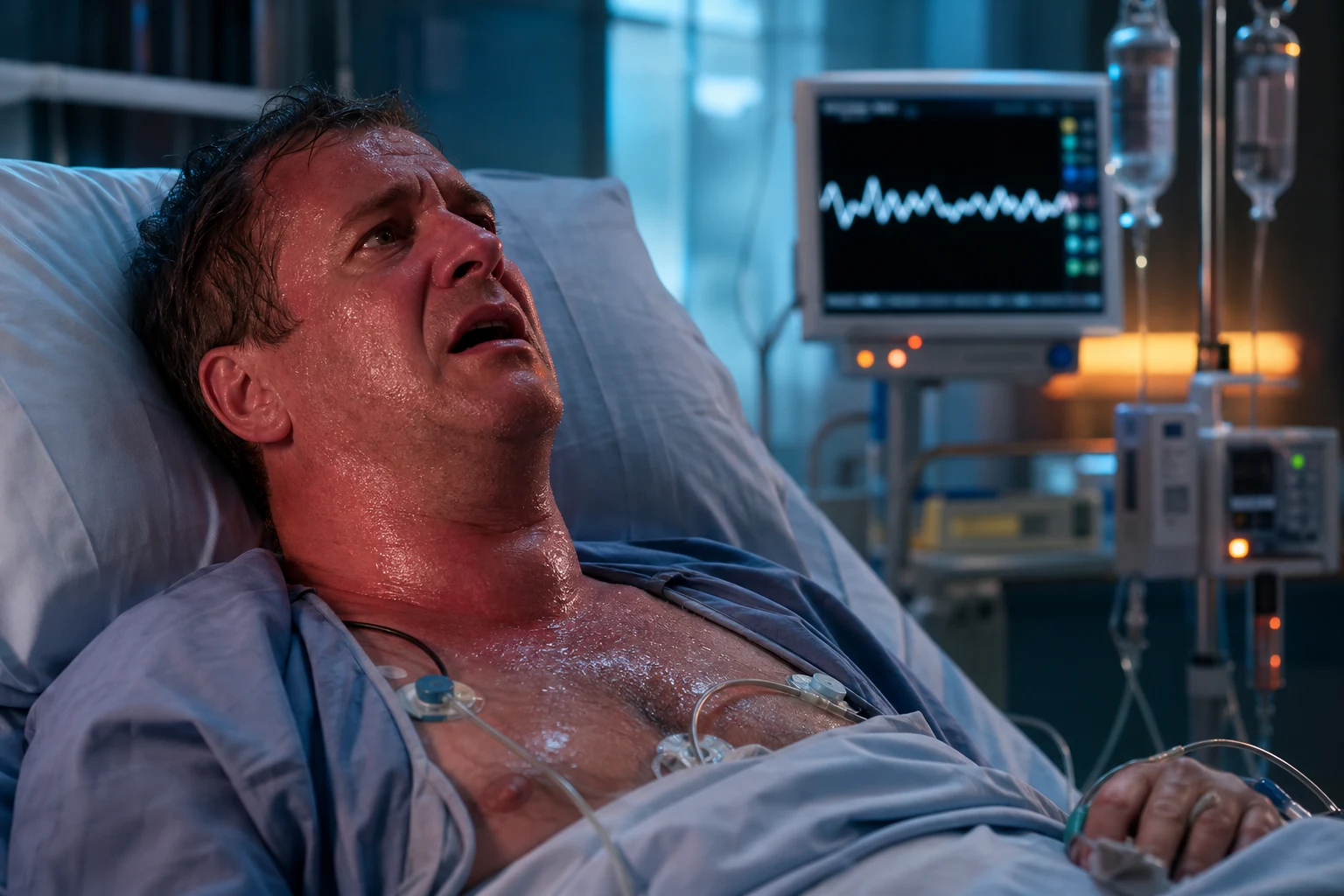
Pathophysiology — the HPT axis in the storm and the coma
The thyroid the gland the synthesises the T4 (the thyroxine — the 93 per cent of the output) and the T3 (the triiodothyronine — the 7 per cent; the active). The peripheral the tissues the convert the T4 → the T3 (the deiodinase the type 2) OR the T4 → the reverse-T3 (the inactive — the deiodinase the type 3, the up in the illness the critical). The TSH the from the pituitary the responds to the T4/T3 (the negative the feedback); the TRH the from the hypothalamus the drives the TSH. The T4 the bound the mostly (the TBG — the thyroxine-binding the globulin); the free the fraction (the fT4, the fT3) the active.[1][1]
The thyroid storm. The precipitant the stress → the surge the catecholamine the sensitivity (the thyroid the hormones the upregulate the beta-adrenergic the receptors) → the hyperthermia, the tachyarrhythmia, the heart failure. The mass the efflux of the preformed the hormone (the iodine the load, the surgery on the gland, the withdrawal of the antithyroid) AND the increased the peripheral the conversion the T4 → T3 → the free-hormone the flood. The cortisol the clearance the increased → the relative the adrenal the insufficiency (the contributes to the shock). The high-output the heart failure → the cardiogenic the shock (the late).[1][4]
The myxoedema coma. The severe the chronic the hypothyroidism → the metabolic the slowdown (the basal the metabolic the rate the 50 per cent the reduced) → the hypoventilation (the blunted the hypercapnic + the hypoxic the drive), the bradycardia, the hypothermia. The impaired the hepatic the gluconeogenesis → the hypoglycaemia. The increased the ADH (the non-osmotic) + the impaired the free-water the clearance → the dilutional the hyponatraemia. The ileus, the pericardial the effusion, the pleural the effusion (the capillary the leak the low-grade). The coma (the cerebral the oedema the low-grade, the slow the conduction).[3][1]
The thyroid storm
The thyroid storm (the thyrotoxic crisis) — the decompensated hyperthyroidism, the severe hypermetabolic. The triggered by the stress (the surgery, the infection, the iodine the load, the amiodarone, the withdrawal of the antithyroid, the DKA, the trauma, the parturition).[1][2]
The clinical.[1]
- The hyperthermia (the often the above 40 — the disproportionate to the infection).
- The tachyarrhythmia (the atrial fibrillation the common; the heart failure; the high-output).
- The CNS — the agitation, the delirium, the seizures, the coma (the one of the diagnostic the criteria).
- The GI — the nausea, the vomiting, the abdominal pain, the jaundice (the hepatic dysfunction).
- The signs of the hyperthyroidism — the goitre, the eye signs (the Graves).
The diagnosis — the clinical (the Burch-Wartofsky the score — the thermoregulation, the CNS, the GI-hepatic, the cardiovascular, the precipitant). The TFTs the confirmatory but the take the days — the treat the empirically.[1]
- The supportive — the ABCDE, the ICU, the treat the precipitant (the infection, the DKA), the cooling (the active — the NOT the salicylates: the displace the T4 from the binding proteins → the free T4 the rises → the worsen).
- The beta-blocker — the propranolol (the non-selective; the blocks the adrenergic AND the peripheral the T4 → the T3 the conversion; the oral the 60 to 120 mg the 4-hourly, or the IV the esmolol the cautious if the heart failure). The esmolol the preferred if the heart failure (the short-acting, the titratable).
- The thionamide (the antithyroid) — the PTU (the propylthiouracil) the preferred for the storm (the blocks the synthesis AND the peripheral T4 → T3; the 500 to 1000 mg the loading then the 250 mg the 4-hourly). The carbimazole the alternative (the blocks the synthesis the only).
- The iodine (the Lugol's, the potassium iodide) — the AFTER the thionamide (the 1 h) — the Wolff-Chaikoff (the blocks the hormone the release); if the given the BEFORE the thionamide, the substrate the fuels the synthesis → the worsen. The radiographic the contrast (the iopanoic) the alternative.
- The glucocorticoid — the hydrocortisone (the 100 mg the 8-hourly) — the blocks the peripheral the T4 → T3 AND the treats the relative the adrenal insufficiency (the high the turnover the coexists).[1][2]
- The treat the precipitant, the cooling, the NOT the salicylates, the consider the plasmapheresis / the dialysis for the refractory.[1]
The Burch-Wartofsky the point score (BWPS) — the diagnostic the anchor
The Burch-Wartofsky the point score (the 1993) — the clinical the score; the ≥ 45 the highly the suggestive of the storm; the 25 to 44 the impending; the < 25 the unlikely. The never the confirmatory (the sensitivity the high, the specificity the modest — the over-diagnosis the acceptable: the storm the missed the fatal).[1][4]
The Burch-Wartofsky score — the components and the points
Thermoregulatory dysfunction
Temperature °C
- 37.2–37.7 = 5; 37.8–38.2 = 10; 38.3–38.8 = 15; 38.9–39.2 = 20; 39.3–39.9 = 25
- ≥ 40.0 = 30 (the disproportionate the fever is the cardinal the sign)
CNS dysfunction
Agitation → coma
- Absent = 0; Agitation = 10; Delirium/psychosis = 20; Lethargy/seizure = 30; Coma = 30
GI-hepatic dysfunction
Nausea → jaundice
- Absent = 0; Nausea/vomiting/abdominal pain/diarrhoea = 10; Jaundice (unexplained) = 20
Cardiovascular dysfunction
Tachycardia + AF + failure
- Tachycardia: 99–109 = 5; 110–119 = 10; 120–129 = 15; 130–139 = 20; ≥ 140 = 25
- Atrial fibrillation: absent = 0; present = 10
- CHF: absent = 0; mild (pedal oedema) = 5; moderate (bibasal crackles) = 10; severe (pulmonary oedema) = 15
Precipitant
Recent event
- Absent = 0; present = 10 (the recent the surgery, the infection, the iodine load, the withdrawal)
The total the interpreted in the context: the ≥ 45 the storm; the 25–44 the impending; the < 25 the unlikely. The treat the empirically the if the clinical the suspicion the high — the score the supportive, the NOT the gating.[1][6]
The precipitants — the six the categories
The precipitants of the thyroid storm — the six categories
1. Infection
The #1 precipitant
- Pneumonia, UTI, bacteraemia, COVID-19 — the most the common
- Search the aggressively (the blood, the urine, the sputum, the CXR); the empiric the antibiotics
2. Iodine load
Substrate flood
- Contrast the load (the CT the angiography, the coronary), the amiodarone (the iodine-rich + the direct the toxicity)
- The Jod-Basedow the phenomenon (the iodine-induced the hyperthyroidism)
3. Withdrawal / non-adherence
Antithyroid stopped
- The missed the carbimazole / the PTU — the rebound the surge
4. Surgery / trauma / parturition
Physical stress
- The thyroid the surgery (the manipulation the releases the hormone), the non-thyroid the surgery, the trauma, the labour / the post-partum
5. Metabolic / endocrine
DKA, hypoglycaemia
- DKA, the hypoglycaemia, the traumatic the brain the injury, the stroke, the pulmonary the embolism
6. Drugs
Sympathomimetics
- The pseudoephedrine, the amphetamines, the excessive the thyroid the hormone the ingestion (the factitious)
The drug comparisons — the thionamides, the beta-blockers, the iodine
PTU vs carbimazole (thionamides) in the storm
Propylthiouracil (PTU)
Preferred for the storm
- Blocks the hormone the SYNTHESIS AND the peripheral the T4 → T3 conversion (the dual the action — the faster the control)
- Loading 500–1000 mg PO/NG, then 250 mg every 4 hours (1500–3000 mg/day)
- Onset within 1 hour; peak effect ~6 weeks for the gland the stores the depletion
- Hepatotoxicity (the black-box the warning) — the transaminitis the monitor; the LFTs the baseline + the serial
- Preferred in the FIRST the trimester of the pregnancy (the carbimazole the teratogenic)
- Preferred in the STORM (the T4→T3 the block the matters the acutely)
Carbimazole / methimazole
Alternative; preferred for the maintenance
- Blocks the hormone the synthesis the ONLY (the no the peripheral the T4→T3 the block) — the slower
- Loading 60–80 mg PO/NG, then 20 mg every 4 hours
- Less the hepatotoxic (the agranulocytosis the rare the idiosyncratic — the warn the patient the fever the sore-throat)
- Once-daily the dosing (the better the adherence for the maintenance)
- Preferred in the SECOND/third the trimester and the lactation
- The TRANSITION to the carbimazole once the storm the controlled (the lower the hepatotoxicity)
The beta-blockers in the storm — propranolol vs esmolol vs landiolol
Propranolol
First-line if NO heart failure
- Non-selective — blocks the beta-adrenergic AND the peripheral the T4 → T3 the conversion (the mild the intrinsic the anti-thyroid the effect)
- Oral 60–120 mg every 4–6 hours; IV 1–2 mg the slow (the cautious)
- The first the drug in the storm (the controls the adrenergic the symptoms the fastest)
- AVOID if the decompensated the heart failure, the severe the asthma, the severe the COPD
Esmolol
If the heart failure / the unstable
- Ultra-short-acting (the beta-1 the selective, the half-life 9 min) — the titratable, the reversible
- Loading 250–500 mcg/kg/min over 1 min, then 50–100 mcg/kg/min the infusion
- Preferred if the heart failure the suspected (the can the stop the instantly if the decompensates)
- NO the T4→T3 the block (the add the propranolol / the PTU for the conversion the block)
Landiolol
The ultra-short the alternative
- Ultra-short-acting, the beta-1 the selective (the half-life 4 min) — the Japan the preferred
- Useful if the tachyarrhythmia the difficult (the AF the rate the control)
- Limited the availability outside the Japan
Diltiazem
If the beta-blocker the contraindicated
- The rate the control the alternative (the non-dihydropyridine the CCB)
- Useful in the asthma — but the additive the hypotension
The iodine the options — to block the hormone release (AFTER the thionamide)
Lugol solution
5% iodine + 10% KI
- 8 drops (≈ 300 mg iodine) every 6 hours PO/NG
- Give ≥ 1 hour AFTER the PTU (the Wolff-Chaikoff the block the only if the synthesis the first the blocked)
- Continue for the 7–10 days then the taper (the escape the phenomenon the after)
Saturated KI (SSKI)
Alternative
- 5 drops (≈ 500 mg iodine) every 6 hours PO/NG
Iopanoic acid / iopodate
Radiographic contrast
- The oral the contrast — the iodine the load AND the direct the T4→T3 the block (the dual the action)
- 1 g every 8 hours — the useful if the iodine the unavailable / the oral
Cholestyramine
Enterohepatic the blockade
- 4 g every 6–8 hours PO/NG — the binds the thyroid the hormones in the gut (the enterohepatic the circulation)
- The adjunctive for the refractory the storm
FlowSteps — the storm the sequence (the beta-blocker FIRST, the PTU, the iodine 1 h after the PTU)
Thyroid storm — the time-critical sequence (the hour-by-hour)
0–30 min: ABCDE, the cooling, the beta-blocker FIRST
ABCDE + the ICU + the IV access. Active cooling (cooling blankets, ice to groin/axilla/neck; paracetamol — NOT the salicylates). Give the BETA-BLOCKER FIRST (propranolol 60–80 mg PO/NG, or esmolol infusion if heart failure/asthma) — it is the FASTEST-acting limb and controls the adrenergic surge that is killing the patient. Draw blood for TSH, fT4, fT3, cortisol, FBC, LFTs, glucose, cultures — but do NOT await results.
30–60 min: the thionamide (PTU)
PTU 500–1000 mg loading PO/NG, then 250 mg every 4 hours. PTU preferred over carbimazole in the storm because it blocks BOTH hormone synthesis AND peripheral T4→T3 conversion (carbimazole blocks synthesis only). This MUST be given BEFORE the iodine — iodine given before a thionamide becomes substrate for new hormone synthesis and worsens the storm.
≥ 1 h after the PTU: the iodine (Wolff-Chaikoff)
Lugol solution 8 drops every 6 hours PO/NG, given AT LEAST 1 hour after the PTU (the synthesis pathway is now blocked, so the iodine can exert the Wolff-Chaikoff effect — blocking hormone release from the gland). If the iodine is given before the PTU, the iodine fuels new synthesis and worsens the storm.
Concurrent: hydrocortisone 100 mg IV every 8 hours
Hydrocortisone does double duty: blocks the peripheral T4→T3 conversion AND treats the relative adrenal insufficiency (high cortisol turnover in the storm). Equivalent to dexamethasone 2 mg every 6 hours (but dexamethasone has no mineralocorticoid effect). Continue until the storm resolves, then taper.
Throughout: treat the precipitant
Identify and treat the precipitant (infection #1 — cultures + empiric antibiotics; DKA — insulin; iodine load — stop the amiodarone; withdrawal — restart antithyroid). The storm will not resolve if the precipitant persists.
If refractory: escalation
Plasmapheresis / TPE (removes the circulating T4/T3 — every other day), haemodialysis (limited — T4 is protein-bound), cholestyramine (binds enterohepatic thyroid hormones), L-carnitine (inhibits thyroid hormone entry into cells). Definitive: radioiodine or thyroidectomy once stable.
The mnemonic — the sequence: B-T-I-G-C — Beta-blocker, Thionamide, Iodine (after), Glucocorticoid, Cooling + the precipitant. The order the matters; the beta-blocker the first (the fastest), the iodine the never the before the thionamide.[1]
The myxoedema coma
The myxoedema coma — the decompensated the severe hypothyroidism. The triggered by the cold, the infection, the sedatives (the opiates, the anaesthetics), the missed the levothyroxine, the AMI, the GI bleed, the stroke.[2][3]
- The hypothermia (the often the below 35; the severe the below 30 — the "the myxoedema the strip").
- The bradycardia, the hypotension, the pericardial effusion.
- The hypoventilation (the hypercapnia, the hypoxia).
- The hyponatraemia (the dilutional — the impaired the free-water the clearance).
- The hypoglycaemia (the hypocortisolism the coexists).
- The coma, the seizures.
- The ileus, the urinary retention. The signs of the hypothyroidism — the dry the skin, the delayed the reflexes, the coarse the hair, the macroglossia.
- The IV levothyroxine (the T4) — the 200 to 500 mcg the loading then the 50 to 100 mcg the daily. The IV (the impaired the absorption the oral in the ileus). The ± the T3 (the liothyronine) the cautious (the more the rapid; the arrhythmia / the angina the risk — the esp. the elderly, the cardiac).
- The hydrocortisone (the 100 mg the 8-hourly) — the the adrenal insufficiency the coexists until the proven the otherwise (the autoimmune the polyglandular; the secondary). The before the levothyroxine (the levothyroxine the increases the cortisol the clearance → the precipitate the adrenal the crisis).[3][1]
- The supportive — the warm the SLOWLY (the rapid the warming → the vasodilation → the shock); the ventilation (the hypoventilation, the hypercapnia); the correct the sodium (the hypertonic the saline the only the if the severe the seizures; the fluid the restriction the often), the glucose; the treat the precipitant.[1]
The myxoedema coma the diagnostic the score (the Wiersinga / the Poppe)
The myxoedema the coma the score — the clinical the score (the abnormal the mental the status, the hypothermia, the bradycardia, the precipitant, the GI the symptoms, the hypoxaemia / the hypercapnia) — the supports the empiric the diagnosis (the TFTs the take the days; the mortality the high if the delayed).[3][7]
The myxoedema score (Wiersinga) — the components
Abnormal mental status
The cardinal
- Disorientation / lethargy / coma — the requirement for the diagnosis (the absent → not the coma)
Hypothermia
The degree the matters
- 35–35.9 = mild; 34–34.9 = moderate; < 34 = severe (the prognosis the worse)
Bradycardia
< 60 bpm
- The metabolic the slowdown the hallmark
Precipitant
The recent the event
- The cold the exposure, the infection, the sedative, the missed the levothyroxine, the AMI
The T4 vs the T3 — the loading the debate
The IV levothyroxine (T4) alone vs the T4 + the liothyronine (T3) — the loading the debate
IV levothyroxine (T4) alone
The simpler; the standard
- Loading 200–500 mcg IV (the weight-based the 4 mcg/kg, the lean the body), then 50–100 mcg IV daily
- The T4 → the T3 the conversion (the deiodinase) — the delayed the onset (the 24–48 h)
- The safer (the lower the arrhythmia the risk); the preferred if the cardiac the history
- The IV (the impaired the absorption the oral — the ileus, the oedematous the gut)
IV T4 + oral/IV T3 (liothyronine)
The faster; the higher the risk
- The T3 the 5–20 mcg loading, then 2.5–10 mcg every 8 hours (the cautious)
- The faster the onset (the bypasses the conversion) — the useful if the conversion the impaired (the critical the illness, the deiodinase the dysfunction)
- The HIGHER the arrhythmia / the angina the risk — the esp. the elderly, the cardiac the history
- The add the T3 if the no the improvement in the 24–48 h on the T4 the alone
Oral levothyroxine
The unreliable the acutely
- The ileus / the oedematous the gut → the unpredictable the absorption
- The reserve for the transition once the ileus the resolves
FlowSteps — the myxoedema coma the sequence (the hydrocortisone BEFORE the thyroid)
Myxoedema coma — the time-critical sequence
0–30 min: ABCDE, the ventilation, the hydrocortisone FIRST
ABCDE + the ICU + the IV access. Hypoventilation + the hypercapnia is common — intubate early if the respiratory failure (BiPAP as a bridge if cooperative). Draw blood for TSH, fT4, cortisol, ACTH, FBC, electrolytes, glucose, CK, cultures. Give HYDROCORTISONE 100 mg IV STAT (then 50 mg every 6 hours) BEFORE any thyroid hormone — adrenal insufficiency coexists in up to 20% and levothyroxine without steroid cover precipitates adrenal crisis. Treat the hypoglycaemia (D50).
30–60 min: the IV levothyroxine (the hydrocortisone already given)
IV levothyroxine 200–500 mcg loading (4 mcg/kg lean body weight), then 50–100 mcg IV daily. The IV route — oral absorption is unreliable (ileus). Consider adding liothyronine (T3) 5–10 mcg every 8 hours if severe coma or no improvement at 24–48 h — but T3 carries higher arrhythmia risk in the elderly/cardiac.
Supportive: the PASSIVE rewarming, the electrolytes
Warm SLOWLY (passive — blankets, warm room; NOT active external warming, which causes peripheral vasodilation → "rewarming shock"). Correct the sodium: fluid restriction often suffices (dilutional hyponatraemia); hypertonic saline ONLY if severe (seizures) — the rapid correction risks osmotic demyelination. Correct hypoglycaemia. Treat the precipitant.
Throughout: the ventilation, the monitoring
Monitor the ventilation (the hypercapnia the resolution), the ECG (the QT the prolongation — the hypothermia), the temperature (the rewarming the slow), the sodium, the glucose, the cortisol. The clinical improvement in 24–48 h (the temperature the rising, the heart the rate the rising, the mental the status the clearing). The transition to the oral the levothyroxine once the ileus the resolves.
Investigate the precipitant
Search for and treat the precipitant (infection, AMI, sedative, the missed the dose). The myxoedema the coma the resolves the slowly (the days); the mortality the 20–60 per cent (the elderly, the comorbid, the delayed). The lifelong the levothyroxine the replacement.
The mnemonic — the sequence: H-T-W-V-P — Hydrocortisone (FIRST), Thyroid (T4 IV), Warm (slow/passive), Ventilation, Precipitant + the sodium + the glucose. The hydrocortisone the BEFORE the levothyroxine (the adrenal the crisis the otherwise).[3]
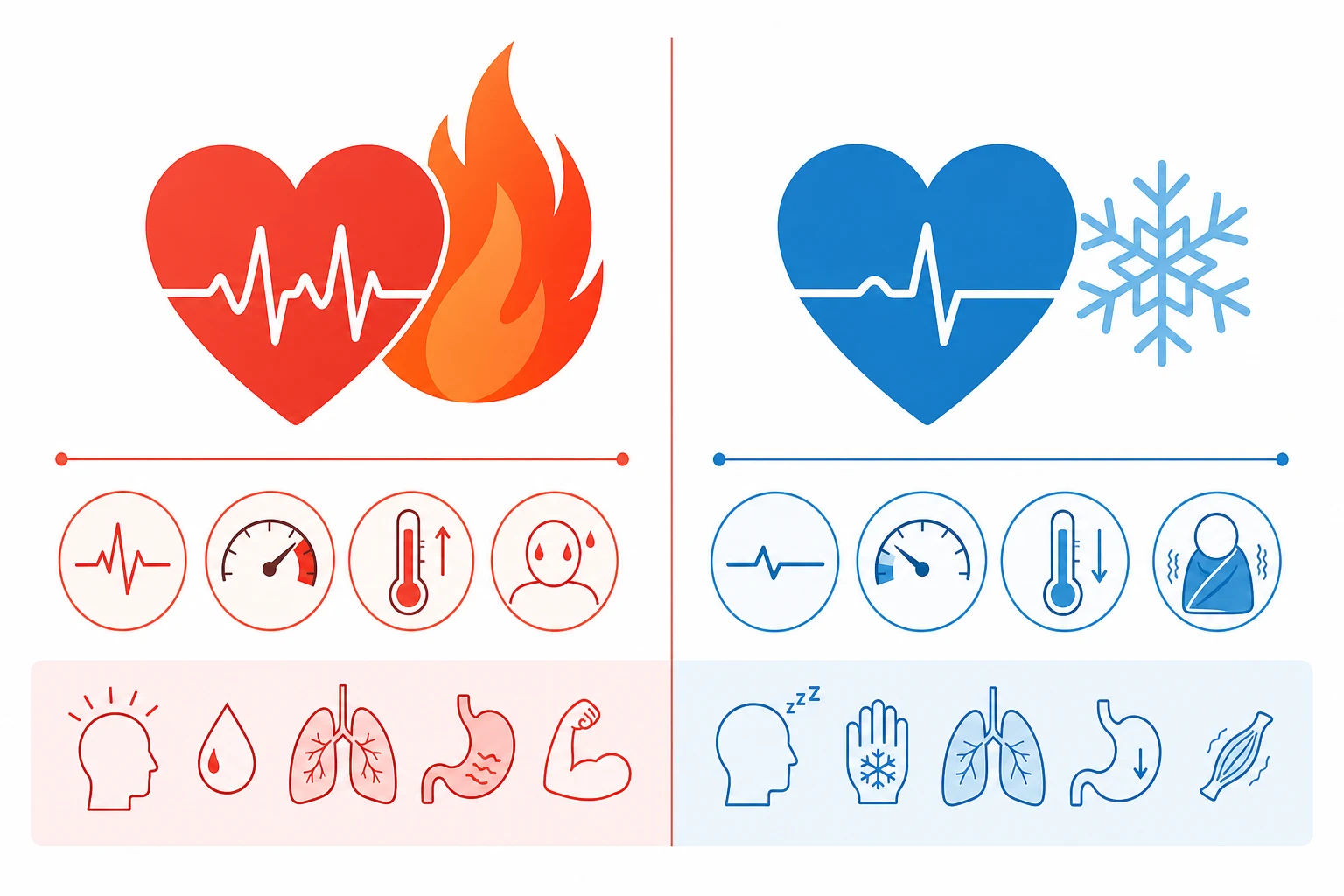
Differential diagnosis — the storm vs the mimics
The storm the mimicked by the other the hyperthermia + the tachycardia + the altered the mental the states. The distinguishing the features:[1][6]
The storm vs the mimics — the hyperthermia + the tachycardia + the AMS
Thyroid storm
Goitre + the eye signs
- Goitre (the Graves the diffuse, the toxic the multinodular), the eye signs (the ophthalmopathy), the recent the weight the loss
- TFTs the markedly the deranged (the suppressed the TSH, the high the fT4 / the fT3)
- The history the of the hyperthyroidism (the known / the untreated)
Sepsis / septic shock
Infection the source
- The fever the infection-related, the vasoplegic the shock, the leukocytosis
- The normal the TFTs (the sick the euthyroid the syndrome — the low the T3, the high the rT3, the normal the TSH)
- The infection the source the identifiable
Malignant hyperthermia
Triggered by the anaesthetic
- The volatile / the suxamethonium the trigger, the rapid the rise the CO2, the rigidity (the masseter), the hyperkalaemia
- The intra-the-operative / the immediately the post — the dantrolene
Serotonin syndrome
The serotonergic the drug
- The serotonergic the agent (the SSRI, the MAOI, the tramadol, the linezolid), the clonus (the lower > the upper), the hyperreflexia, the mydriasis
- The GI the hypermotility, the diaphoresis
Neuroleptic malignant syndrome
The dopamine the antagonist
- The antipsychotic (the recent the initiation / the withdrawal the of the dopaminergic), the LEADEN the rigidity (the brady-reflexia), the slower the onset (the days)
- The CK the markedly the elevated
Heat stroke
The environmental the exposure
- The exertional / the environmental the exposure, the core the > 40, the CNS the dysfunction, the ANHIDROSIS (the classic the heat the stroke)
- The normal the TFTs
Drug / withdrawal
Sympathomimetics / alcohol
- The cocaine / the amphetamines / the MDMA, the alcohol the withdrawal (the DTs), the caffeine the overdose
The key the discriminators — the storm: the goitre + the eye signs + the suppressed the TSH + the history of the hyperthyroidism; the malignant the hyperthermia: the anaesthetic the trigger + the rigidity + the rapid the CO2 the rise; the serotonin: the clonus + the mydriasis; the NMS: the rigidity + the brady-reflexia + the slower; the sepsis: the infection the source + the normal the TFTs.[6]
The refractory the storm — the rescue the therapies
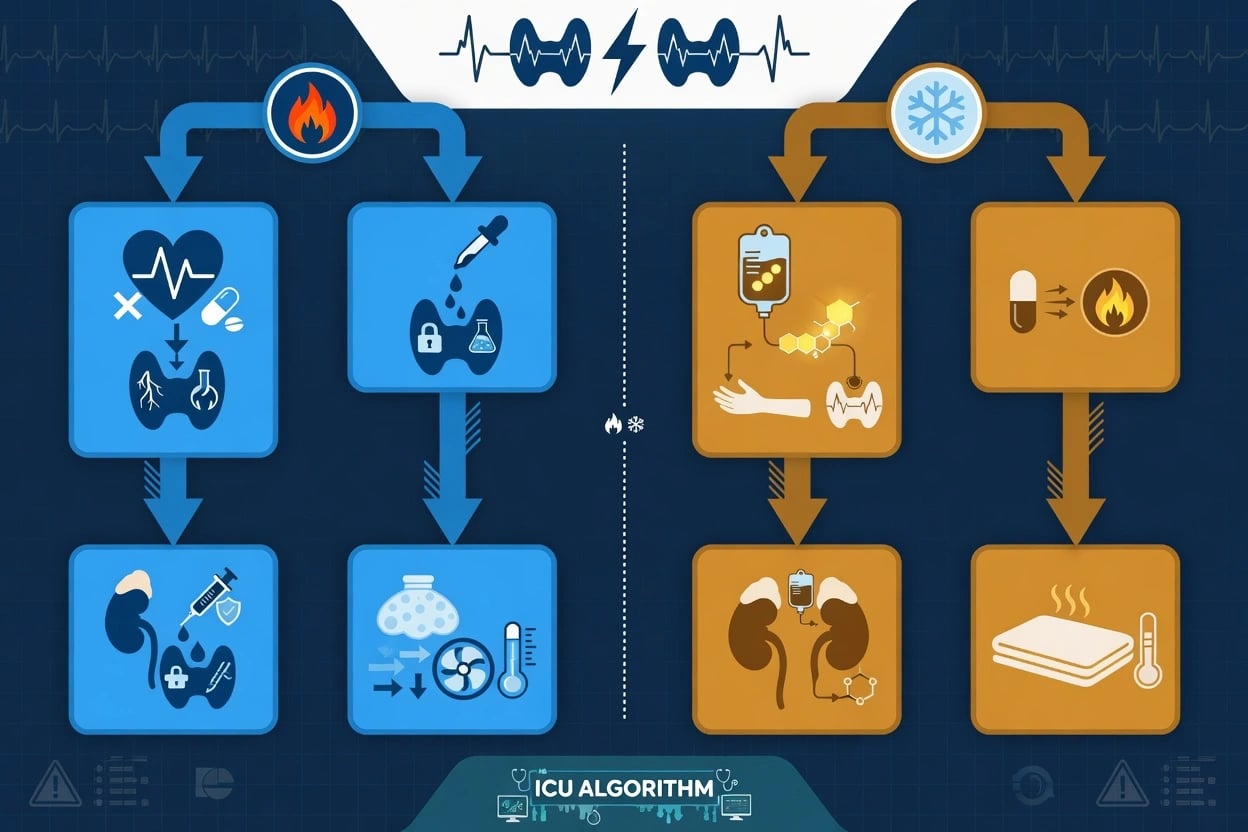
The storm the refractory (the 24–48 h on the standard the therapy the without the improvement) — the rescue the therapies the considered:[1][1]
The refractory the storm — the rescue the therapies
Plasmapheresis (TPE)
The most the effective the rescue
- Removes the circulating the T4 / the T3 (the protein-bound — the TPE the effective)
- Every the other the day; the 3–5 the sessions
- The rapid the improvement (the 24–48 h); the transient (the resume the standard the therapy)
- The useful in the pregnancy (the avoids the teratogenic the drugs), the hepatic the failure, the refractory
Cholestyramine
The enterohepatic the blockade
- 4 g every 6–8 hours PO/NG — the binds the thyroid the hormones in the gut (the enterohepatic the circulation)
- The adjunctive; the safe; the 24–48 h to the effect
L-carnitine
The cellular the entry the blockade
- Inhibits the thyroid the hormone the entry the into the cells (the mitochondrial the uptake)
- The adjunctive; the oral 1–2 g every 8 hours
Dialysis / the haemoperfusion
The limited
- The T4 the protein-bound → the limited the clearance; the less the effective than the TPE
- The useful if the TPE the unavailable / the renal the failure the coexists
Emergency thyroidectomy
The last the resort
- The last the resort — the surgery on the unstable the patient the high the risk
- The reserve for the truly the refractory; the stabilise the first (the TPE the bridge)
Special situations
The thyroid the emergencies in the special the situations
Pregnancy
The PTU in the first trimester
- The storm the rare but the fetal the loss the high; the treat the aggressively (the maternal the stability the first)
- The PTU the first trimester (the carbimazole the teratogenic — the aplasia the cutis, the choanal the atresia); the carbimazole the second/third
- The beta-blocker the propranolol (the short the course); the hydrocortisone; the iodine the brief (the fetal the goitre the risk — the 4–6 weeks the max)
- The TPE the safe (the avoids the teratogenic the drugs); the surgery the second trimester
Amiodarone-induced
Type 1 vs the Type 2
- The amiodarone the iodine-rich + the direct the toxicity
- Type 1: the iodine-induced (the Jod-Basedow) — the underlying the multinodular the goitre; the thionamide (the high the dose) + the perchlorate
- Type 2: the destructive the thyroiditis — the normal the gland; the glucocorticoid (the prednisolone 40–60 mg); the self-limiting
- The mixed the picture the common — the treat the empirically (the thionamide + the steroid)
Subacute / silent thyroiditis
The transient the hyperthyroid
- The destructive the release (the self-limiting); the HIGH the fT4, the LOW the uptake (the radioactive the iodine)
- The beta-blocker the symptomatic; the thionamide the INEFFECTIVE (the no the synthesis); the steroid (the subacute — the painful)
- The transition the through the hypothyroid (the 4–8 weeks); the lifelong the levothyroxine the uncommon
Heart failure / the AF
The esmolol; the rate the control
- The esmolol (the short-acting, the titratable) the preferred if the decompensated the heart failure
- The rate the control the first (the AF the common); the digoxin the less the effective (the increased the clearance)
- The anticoagulate the AF (the high the embolic the risk in the hyperthyroid)
Adrenal insufficiency the coexisting
The autoimmune the polyglandular
- The autoimmune the polyglandular the syndrome (the type 2: the Addison + the autoimmune the thyroid the disease + the type 1 the DM)
- The empiric the hydrocortisone in the every the storm AND the every the coma (until the proven the otherwise)
Monitoring & the ICU the targets
The ICU monitoring — the targets and the frequency
The continuous
ECG (the rate, the rhythm — the AF, the ischaemia), the BP (the arterial the line), the SpO2, the temperature (the core), the urine the output (the catheter).
The 1–2 hourly
The GCS / the sedation the score (the agitation, the delirium, the coma), the ABG (the hypercapnia in the myxoedema, the acidosis in the storm), the glucose (the hypoglycaemia in the myxoedema, the hyperglycaemia in the storm), the electrolytes (the sodium, the potassium, the magnesium, the phosphate).
The 6–12 hourly
The LFTs (the hepatic the dysfunction in the storm), the CK (the rhabdomyolysis in the myxoedema), the cortisol (the adrenal the insufficiency), the TFTs (the fT4, the fT3, the TSH — the trend the NOT the absolute; the 24–48 h to the change).
The daily
The CXR (the pulmonary the oedema, the effusion, the ARDS), the echocardiography (the high-output vs the low-output, the pericardial the effusion, the biventricular the function), the cultures (the precipitant).
The targets
The storm: the heart the rate the < 100, the temperature the < 38, the agitation the controlled, the AF the rate-controlled, the fT4 the trending the down. The myxoedema: the temperature the rising (the 0.5–1 °C per the hour the NOT the faster), the heart the rate the rising, the GCS the improving, the sodium the normalising, the weaning the ventilation.
Prognosis
The thyroid storm the mortality the 10 to 30 per cent (the prompt the treatment the reduces). The myxoedema coma the mortality the 20 to 60 per cent (the high — the elderly, the comorbid, the delayed).[1][3][1]
Red flags
Trial cards — the evidence the base
Burch & Wartofsky 1993 — the diagnostic point score for thyroid storm (Endocrinol Metab Clin North Am, PMID 8325286)
Source
Endocrinol Metab Clin North Am 1993;22(2):263-277 — the seminal review that codified the Burch-Wartofsky Point Scale (BWPS), still the bedside diagnostic anchor for thyroid storm.
What it established
A clinical scoring system (thermoregulation, CNS, GI-hepatic, cardiovascular, precipitant) that operationalises a diagnosis no single test can confirm. Score ≥45 = highly suggestive of storm; 25-44 = impending; <25 = unlikely. The score is intentionally sensitive — over-diagnosis is acceptable because missed storm is fatal.
Limitations
No biochemical confirmation is possible acutely (TFTs take days). The score was never validated against a gold standard (there is none). Subsequent studies show it over-scores in the elderly and in those with multi-system illness, but it remains the most widely taught bedside tool.
Clinical bottom line
Use the BWPS to support — never to gate — treatment. If clinical suspicion is high, treat empirically regardless of the score. This paper is the origin of every exam answer on thyroid-storm recognition.
Angell et al. 2015 — Clinical features and hospital outcomes in thyroid storm (JCEM, PMID 25343237)
Source
J Clin Endocrinol Metab 2015;100(2):451-458 — the largest US retrospective cohort of thyroid storm (n=135 hospitalisations across the National Inpatient Sample), the modern epidemiology reference.
Design
Retrospective analysis using ICD-9-CM coding for thyroid storm; described demographics, clinical features, precipitants, treatments, and in-hospital mortality.
What it established
In-hospital mortality ~11% (lower than older estimates of 20-30%, attributed to earlier recognition and protocolised care). Atrial fibrillation present in ~40%, heart failure ~30%. Precipitants: infection the most common, followed by non-adherence and iodine load. Mechanical ventilation in ~30%.
Clinical bottom line
Confirms thyroid storm remains a high-mortality disease (~1 in 9 in-hospital deaths) whose precipitants are modifiable (infection, adherence, iodine load). Drives the search-for-precipitant and the protocolised four-blocker therapy.
Chiha et al. 2015 — Thyroid storm: an updated review (J Intensive Care Med, PMID 23920160)
Source
J Intensive Care Med 2015;30(3):131-140 — a widely cited ICU-focused narrative review of pathophysiology, recognition, and the time-critical blockade sequence.
What it established
Codified the four-blockade sequence (beta-blocker, thionamide, iodine after thionamide, glucocorticoid) and emphasised the order dependency: iodine before a thionamide worsens the storm (substrate for new synthesis). Highlighted plasmapheresis, cholestyramine, and L-carnitine for refractory disease.
Clinical bottom line
The modern ICU reference for the time-critical sequence. The order matters — beta-blocker first (fastest), thionamide, iodine ≥1 h after the thionamide (Wolff-Chaikoff), hydrocortisone concurrent (blocks T4→T3 and treats relative adrenal insufficiency).
Chaudhary et al. 2023 — Utility of myxedema score as a predictor of mortality in myxedema coma (J Endocrinol Invest, PMID 35945394)
Source
J Endocrinol Invest 2023;46(1):195-201 — a retrospective study correlating a composite myxedema score with in-hospital mortality.
What it established
A higher clinical myxedema score (hypothermia depth, bradycardia, altered mental status, precipitant, hyponatraemia, hypoxaemia/hypercapnia) correlated with mortality, supporting its use as a bedside prognostic and diagnostic aid. Confirmed mortality remains high (20-60%), driven by age, comorbidity, and delay to treatment.
Clinical bottom line
The score supports empiric diagnosis when TFTs are pending (they take days) and quantifies risk — use it to justify early empiric IV levothyroxine + hydrocortisone without awaiting biochemistry.
Exam practice — SAQs
SAQ — Thyroid storm with atrial fibrillation and decompensated heart failure
10 minutes · 10 marks
A 48-year-old woman with known Graves disease (on carbimazole, non-adherent for three weeks) presents with 24 hours of agitation, vomiting, diarrhoea and worsening dyspnoea. Temp 39.8°C, HR 158 (atrial fibrillation), BP 96/58, RR 32, SpO2 90 percent on room air, GCS 14 (agitated). Bilateral crackles to mid-zones, raised JVP, mild lid lag and a diffuse goitre. fT4 sent but pending. Burch-Wartofsky score 55. Lactate 3.4 mmol/L.
SAQ — Myxoedema coma with hypoventilation, hyponatraemia and hypoglycaemia
10 minutes · 10 marks
A 78-year-old woman is brought to the emergency department confused and hypothermic after being found at home with the heating off. Temp 32.4°C, HR 44 (sinus), BP 88/54, RR 8, SpO2 86 percent on room air, GCS 8 (E2V2M4). Dry skin, slow-relaxing reflexes, macroglossia. Arterial blood gas: pH 7.24, PaCO2 78 mmHg, PaO2 56 mmHg, HCO3 24 mmol/L. Sodium 118 mmol/L, glucose 1.9 mmol/L, creatinine 130 micromol/L. Known hypothyroid — stopped levothyroxine two months ago. TSH pending.
Clinical pearls — the high-yield the points
MnemonicThe two sequences — B-T-I-G-C and H-T-W-V-P
References
- [1]Gullo D, et al. Clinical Review and Update on the Management of Thyroid Storm Mo Med, 2022.PMID 36118802
- [2]Satin-Smith M, et al. Thyroid Emergencies: A Narrative Review Endocr Pract, 2025.PMID 40553957
- [3]Chiong YV, et al. Myxedema Coma 2026.PMID 31424777
- [4]Burch HB, Wartofsky L Life-threatening thyrotoxicosis. Thyroid storm Endocrinol Metab Clin North Am, 1993.PMID 8325286
- [5]Angell TE, et al. Clinical features and hospital outcomes in thyroid storm: a retrospective cohort study J Clin Endocrinol Metab, 2015.PMID 25343237
- [6]Chiha M, Samarasinghe S, Kabaker AS Thyroid storm: an updated review J Intensive Care Med, 2015.PMID 23920160
- [7]Chaudhary S, et al. Utility of myxedema score as a predictor of mortality in myxedema coma J Endocrinol Invest, 2023.PMID 35945394