ICU · Environmental emergencies
High-Altitude Illness
Also known as Acute mountain sickness · AMS · High-altitude cerebral edema · HACE · High-altitude pulmonary edema · HAPE · Acetazolamide
The high-altitude illness — the hypobaric hypoxia from the ascent. The spectrum: the AMS (the headache + the nausea / the fatigue / the dizziness), the HACE (the ataxia + the altered mental state — the brain oedema), the HAPE (the non-cardiogenic the pulmonary oedema). The DESCENT (the primary), the acetazolamide, the dexamethasone (the HACE), the nifedipine + the oxygen (the HAPE), the Gamow bag.
On this page & tools
Your progress
Saved locally on this device.
Target exams
Overview & definition
The high-altitude illness — the hypobaric hypoxia from the ascent to altitude (the low atmospheric pressure → the low PaO2). The spectrum: the AMS (the acute mountain sickness — the commonest), the HACE (the high-altitude cerebral oedema — the severe brain), the HAPE (the high-altitude pulmonary oedema — the severe lungs). The key principle: the DESCENT is the definitive treatment.[1][1]
The AMS — the acute mountain sickness
The AMS — the commonest (the 25 per cent at the 2500 m; the 50 per cent + at the 4500 m).[1][2][1]
The clinical — the headache (the hallmark) + at least one of: the nausea / the vomiting, the fatigue / the weakness, the dizziness / the lightheadedness, the sleep disturbance. The Lake Louise score.[1][2]
The management — the rest (the stop the ascent; the descend if the not the improved), the analgesia (the paracetamol / the NSAID), the antiemetic, the acetazolamide (the 125 to 250 mg the BD), the oxygen.[1]
The HACE — the high-altitude cerebral oedema
The HACE — the severe (the life-threatening). The brain oedema (the vasogenic — the hypoxia → the cerebral the vasodilation → the blood-brain-barrier the leak).[1][1]
The clinical — the AMS + the ataxia (the hallmark — the wide-based the gait) + the altered the mental state (the confusion, the lethargy, the coma).[1]
- The IMMEDIATE DESCENT (the definitive — the by at least 500-1000 m).[1]
- The dexamethasone (the 8 mg the loading then the 4 mg the 6-hourly — the reduces the brain oedema).[1]
- The oxygen (the supplemental — the target the SpO2 above 90).[1]
- The Gamow bag (the portable the hyperbaric the chamber — the simulates the descent; the if the descent the not the possible).[1]
The HAPE — the high-altitude pulmonary oedema
The HAPE — the severe (the life-threatening). The non-cardiogenic pulmonary oedema (the uneven the pulmonary the vasoconstriction → the overperfusion of the dilated vessels → the capillary the leak → the oedema).[1][1]
The clinical — the dyspnoea (the exertional → the rest), the cough (the dry → the pink / the frothy), the cyanosis, the crackles, the tachycardia, the tachypnoea. The CXR (the patchy the infiltrates).[1][2]
- The IMMEDIATE DESCENT (the definitive).[1]
- The oxygen (the supplemental — the target the SpO2 above 90).[1]
- The nifedipine (the 30 mg the SR the 12-hourly — the pulmonary the vasodilator; the reduces the pulmonary the pressure).[1]
- The CPAP / the PEEP (the alveolar the recruitment).[1]
- The Gamow bag (the if the descent the not the possible).[1]
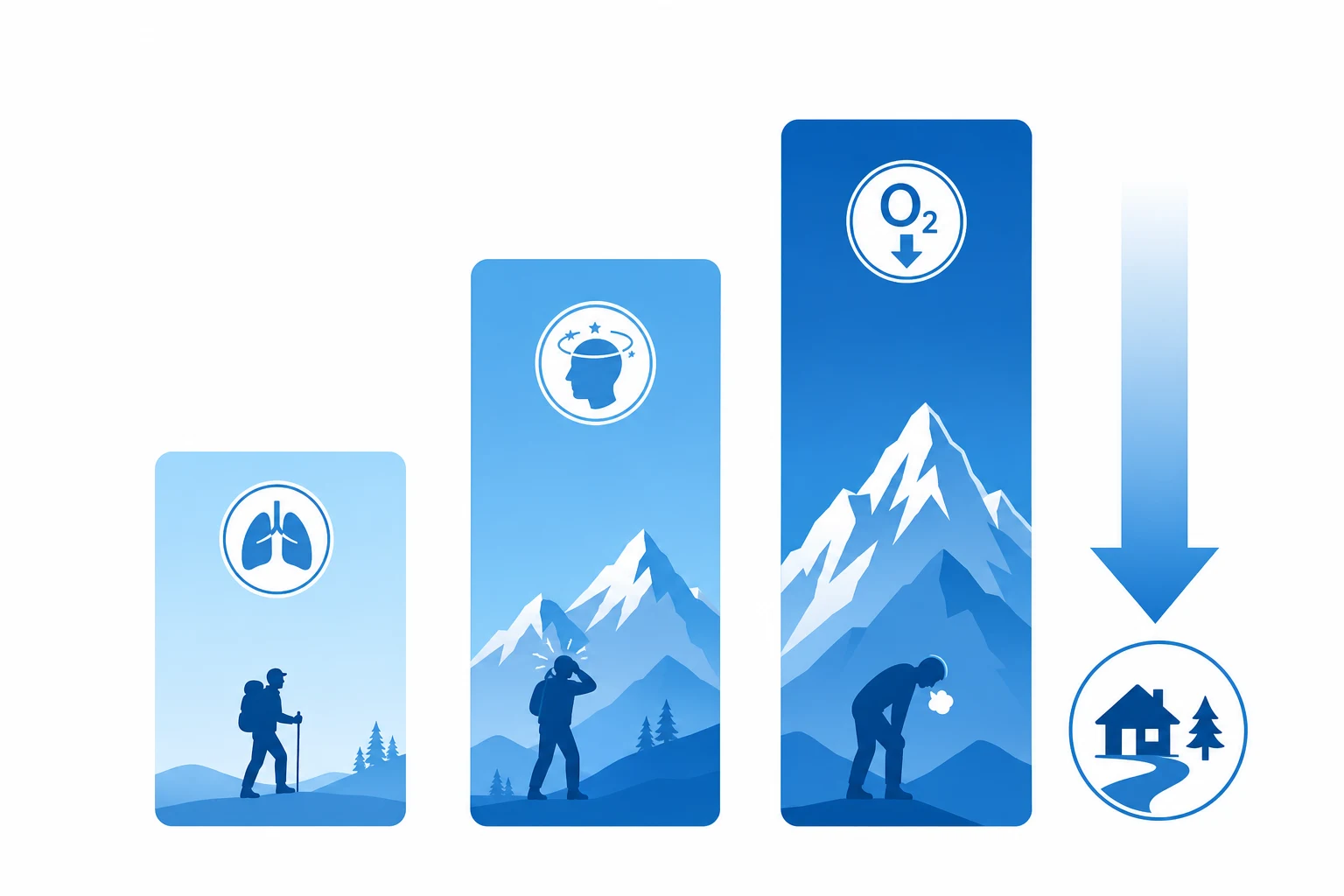
The prevention
- The gradual the ascent (the 300 to 500 m/day above the 3000 m; the rest day every the 1000 m).[1]
- The acetazolamide (the prophylactic — the 125 to 250 mg the BD; the start the day before the ascent; the continue the 2 to 4 days at the altitude). The carbonic the anhydrase the inhibitor → the metabolic the acidosis → the compensatory the hyperventilation → the acclimatisation the accelerated.[1][2]
- The avoid the alcohol, the sedatives, the high-the-altitude the sleep the medications.[1]
Prognosis
The AMS the resolves with the rest / the descent. The HACE and the HAPE the life-threatening if the not the descended. The descent the definitive. The mortality the low if the prompt; the high if the delayed.[1][2][1]
Red flags
Altitude physiology — the barometric pressure and the alveolar gas equation
High-altitude illness is driven entirely by hypobaric hypoxia: ascent → fall in barometric pressure → fall in inspired PO2 → fall in alveolar PO2 (PAO2) → fall in arterial PO2 (PaO2). The alveolar gas equation is the foundational principle for the whole topic and the single most examined concept in the Fellowship altitude question.[1][3][4]
Barometric pressure falls exponentially with altitude (not linearly — the atmosphere is compressible, so most of the air mass sits below). Sea level 760 mmHg; 5500 m (Everest base camp) ~380 mmHg; 8848 m (Everest summit) ~253 mmHg.[3][4]
Inspired PO2 = FiO2 × (PB − PH2O). Sea level: 0.21 × (760 − 47) = 149 mmHg. At 8848 m: 0.21 × (253 − 47) = 43 mmHg. Water vapour pressure (47 mmHg) is a CONSTANT at body temperature — it does NOT fall with altitude, so it consumes a proportionally larger fraction of the low barometric pressure at altitude.[3]
The alveolar gas equation: PAO2 = PiO2 − (PaCO2 / R). R = respiratory quotient (~0.8 mixed diet). Sea level: PAO2 = 149 − (40/0.8) = 149 − 50 = ~99 mmHg. The key insight: at altitude PAO2 depends HEAVILY on PaCO2 — the LOWER the PaCO2 (the more hyperventilation), the HIGHER the PAO2. This is precisely why acclimatisation (hyperventilation) saves the climber.[3][4]
Barometric pressure and alveolar PO2 across altitudes (alveolar gas equation worked)
| Altitude | Barometric (mmHg) | Inspired PO2 (mmHg) | PaCO2 acclimatised (mmHg) | PAO2 = PiO2 − PaCO2/0.8 (mmHg) | Clinical state |
|---|---|---|---|---|---|
| Sea level | 760 | 150 | 40 | ~100 | Normal |
| 1500 m | ~630 | 122 | 35 | ~78 | Threshold below which altitude effects begin |
| 2500 m | ~560 | 108 | 34 | ~65 | AMS threshold (~25% affected) |
| 3500 m | ~490 | 93 | 30 | ~56 | HACE + HAPE threshold |
| 4500 m | ~430 | 80 | 27 | ~46 | >50% with AMS |
| 5500 m (Everest base) | 380 | 70 | 24 | ~40 | HAPE common |
| 8848 m (Everest summit) | 253 | 43 | 7–8 (maximal hyperventilation) | ~35 | Limit of unaided human survival |
The crucial insight. At the summit of Everest the only reason a human survives is extreme hyperventilation (PaCO2 7–8 mmHg — the lowest ever recorded in a living person), which pushes PAO2 back up to ~35 mmHg, just enough to sustain consciousness. Without hyperventilation the alveolar PO2 would fall to ~30 mmHg → loss of consciousness. Acclimatisation saves the climber by lowering PaCO2.[3][4]
Acclimatisation — the cascade of physiological adaptations
Acclimatisation is the series of adaptations over days to weeks at altitude that restore tissue oxygen delivery. TIME is the essence — gradual ascent allows acclimatisation; rapid ascent (flight, car, ski-lift) bypasses it and causes illness. The ventilatory component takes 4–7 days; the haematological takes weeks; tissue adaptation takes months.[1][2][4]
The four systems of acclimatisation — time-course and mechanism
| System | Adaptation | Time-course | Mechanism | Clinical effect |
|---|---|---|---|---|
| 1. Ventilation | Hyperventilation (↑minute ventilation) | Minutes–hours (begins immediately); peaks 4–7 days | Hypoxia → peripheral chemoreceptors (carotid body) → ↑ventilatory drive. Catch: hyperventilation blows off CO2 → respiratory alkalosis → central chemoreceptor brakes ventilation. Kidney then excretes bicarbonate (1–3 days) → CSF bicarbonate falls → central brake removed → ventilation rises further. | ↑PAO2 via the alveolar gas equation — the MOST important adaptation. Acetazolamide accelerates this by forcing bicarbonate diuresis. |
| 2. Haematological | ↑Haemoglobin (↑O2 carrying capacity) | EPO rises within hours; reticulocytes 4–5 days; Hb peaks weeks | Hypoxia → HIF-2α → ↑erythropoietin (renal) → ↑red cell production | ↑CaO2 compensates for low SaO2. Downside: hyperviscosity (Hct 55–60%) → thrombosis risk, reduced cerebral flow. |
| 3. Pulmonary vascular | ↑Pulmonary vascular resistance (PVR) | Immediate, sustained | Hypoxia → hypoxic pulmonary vasoconstriction (HPV — unique to pulmonary circulation; systemic vasodilates). Uniform HPV benign; UNEVEN → HAPE. | ↑Pulmonary artery pressure → right heart strain. Benign if uniform; pathological if uneven (HAPE-susceptible). |
| 4. Tissue | ↑Capillary density, ↑mitochondria, ↑2,3-DPG, ↑myoglobin, ↑glycolytic enzymes | Weeks–months | HIF-1α → ↑VEGF (capillary growth), ↑glycolytic enzymes. 2,3-DPG shifts the Hb-dissociation curve RIGHT → easier tissue offload. | ↑Tissue O2 extraction. Most relevant for long-term residents. |
Sleep and periodic breathing (Cheyne-Stokes). At altitude hypoxia drives hyperventilation → ↓PaCO2 → central apnoea → ↑PaCO2 + ↓PaO2 → hyperventilation resumes. The cycle is 12–20 seconds, near-universal above 3000 m, causing poor sleep and daytime fatigue. Acetazolamide abolishes periodic breathing (smoothes the CO2 response) and improves sleep. Do NOT use sedatives — they depress ventilation.[1][4]
The AMS — the Lake Louise score
The Lake Louise score (2018 revision — self-reported + clinical). The diagnosis requires headache + total score ≥ 3 with at least one symptom.[1][6]
The 2018 Lake Louise AMS score — self-reported symptom severity
| Symptom | 0 | 1 | 2 | 3 |
|---|---|---|---|---|
| Headache (cardinal — REQUIRED) | None | Mild | Moderate | Severe |
| GI (nausea / vomiting) | None | Poor appetite / nausea | Moderate nausea / vomiting | Severe, incapacitating |
| Fatigue / weakness | None | Mild | Moderate | Severe, incapacitating |
| Dizziness / lightheadedness | None | Mild | Moderate | Severe, incapacitating |
| Sleep | Slept as well as usual | Did not sleep as well | Woke many times, poor sleep | Could not sleep |
The functional score (clinician-assessed): 0 = no symptoms; 1 = symptoms but activity unchanged; 2 = activity reduced; 3 = bedbound / severe. Mild AMS = headache + 1–3 points; moderate = 4–5; severe = 6+. HACE = AMS + ataxia OR altered mental state (a separate diagnosis, NOT a high score).[1][6]
AMS vs HACE vs HAPE — the comprehensive comparison
AMS vs HACE vs HAPE — the altitude-illness spectrum at a glance
| Feature | AMS | HACE | HAPE |
|---|---|---|---|
| Hallmark | Headache (cardinal) | Ataxia (wide-based gait) | Dyspnoea at rest + cough |
| Incidence | 25% at 2500 m; 50%+ at 4500 m | 1–2% (progression from untreated AMS) | 1–2% at 4500 m; higher in HAPE-susceptible |
| Onset | 6–12 h after arrival (up to 24 h) | 1–3 days (usually progression from AMS) | 2–4 days (typically the 2nd night) |
| Mechanism | Mild cerebral vasodilation (benign) | Vasogenic + cytotoxic brain oedema → ↑ICP | Uneven pulmonary vasoconstriction → overperfusion → capillary stress failure |
| Symptoms | Headache + nausea / fatigue / dizziness / insomnia | AMS + ataxia + altered mental state (confusion → coma) | Dyspnoea (exertional → rest), cough (dry → pink-frothy), cyanosis |
| Signs | Normal exam | Wide-based gait, confusion, lethargy, late coma | Crackles, tachypnoea, tachycardia, cyanosis; CXR patchy infiltrates |
| Severity | Benign (self-limiting) | Life-threatening | Life-threatening |
| Definitive treatment | Rest / stop ascent; descend if not improved | IMMEDIATE descent + dexamethasone | IMMEDIATE descent + oxygen + nifedipine |
| Mortality | ~zero (with rest) | High (up to 60% if descent delayed) | High (up to 50% untreated; <5% with prompt treatment) |
HACE — the pathophysiology deep dive
HACE is severe brain oedema. Two synergistic mechanisms:[1][3]
-
Vasogenic oedema (EARLY). Hypoxia → cerebral vasodilation (hypoxia is a potent vasodilator) → ↑cerebral blood flow → ↑capillary hydrostatic pressure → blood-brain-barrier leak → fluid into the extracellular space (white matter). Dexamethasone reverses this (↓BBB permeability).[1][3]
-
Cytotoxic oedema (LATE). Severe hypoxia → failure of the Na/K ATPase → intracellular Na+ and water → cellular swelling (grey matter). Late and irreversible. Dexamethasone is less effective for cytotoxic oedema.[3]
-
Raised intracranial pressure (consequence). Oedema → ↑ICP → headache, vomiting, altered mental state, late herniation (Cushing triad — bradycardia + hypertension + irregular respiration).[3]
Ataxia is the earliest and most reliable sign. The cerebellum is exquisitely sensitive to hypoxia (high metabolic demand) → ataxia PRECEDES confusion. ANY ataxia at altitude = HACE → IMMEDIATE descent. A simple tandem-gait test (heel-to-toe walking) is the best screening tool. Do NOT wait for coma.[1][3]
HAPE — the pathophysiology deep dive
HAPE is non-cardiogenic pulmonary oedema. Pulmonary artery pressure is the driver.[1][1][4]
-
Hypoxic pulmonary vasoconstriction (HPV) — unique to the pulmonary circulation (systemic vasodilates; pulmonary constricts). Uniform HPV is benign. UNEVEN (patchy/heterogeneous) HPV → some vessels constrict tightly (low flow) while others dilate (high flow) → overperfusion of the dilated vessels.[1][4]
-
Capillary stress failure (West 1991 — rabbit model). High pressure → capillary wall stress → mechanical disruption of the alveolar-capillary membrane → leak of red cells, protein and fluid into the alveoli. HAPE fluid is BLOODY (red cells) and high-protein (an exudate) — NOT a transudate.[4]
-
The HAPE-susceptible (HAPE-S) phenotype. ~5–10% of climbers have exaggerated (uneven) HPV → ↑pulmonary artery pressure at moderate altitudes where others tolerate. Single-nucleotide polymorphisms in NO synthase and amiloride-sensitive channels contribute. A PRIOR HAPE is the strongest risk factor.[4]
Clinical progression. Reduced exercise tolerance (earliest) → dyspnoea at rest → dry cough → pink-frothy sputum → cyanosis → coma (hypoxia) → death (~50% untreated). The 2nd-night rule: HAPE is typically worst on the 2nd night (sleep exacerbates it — nocturnal hypoxia).[1][4]
Pharmacology — the altitude drugs compared
Pharmacology of altitude drugs — mechanism, dose, role, cautions
| Drug | Mechanism | Dose | Role | Cautions |
|---|---|---|---|---|
| Acetazolamide | Carbonic anhydrase inhibitor → ↓bicarbonate reabsorption (proximal tubule) → bicarbonate diuresis → metabolic acidosis → COMPENSATORY hyperventilation → ↑PAO2 + accelerated acclimatisation. Also ↓CSF production and smooths periodic breathing. | Prophylaxis: 125 mg BD (the most studied dose; higher is no better — Low 2012 meta-analysis). Treatment: 250 mg BD. Start day before; continue 2–4 days at altitude. | AMS prophylaxis (#1); AMS treatment; periodic breathing abolition. | Paresthesia (fingers/toes/perioral — nearly universal, benign), taste disturbance (carbonated drinks flat), diuresis, photosensitivity. AVOID: sulfa allergy (rare cross-reactivity, Stevens-Johnson), severe renal/hepatic failure, hypokalaemia/hyponatraemia (monitor). |
| Dexamethasone | Glucocorticoid → ↓BBB permeability (vasogenic oedema) + anti-inflammatory. Does NOT aid acclimatisation. | HACE treatment: 8 mg loading then 4 mg 6-hourly (IM/IV/PO). Taper after descent. Prophylaxis (alternative for sulfa-allergic): 2 mg 6-hourly or 4 mg 12-hourly. | HACE (definitive drug); HACE prophylaxis (alternative). NOT for routine AMS (rebound on cessation). | Gastric irritation, hyperglycaemia, insomnia, mood changes, immunosuppression, rebound on abrupt cessation (taper after descent). Avoid for routine prophylaxis (side effects outweigh benefit). |
| Nifedipine | Dihydropyridine calcium-channel blocker → systemic + pulmonary vasodilation. ↓Pulmonary artery pressure (the HAPE driver). | HAPE treatment + prophylaxis: 30 mg SR 12-hourly (slow-release — AVOID sublingual immediate — precipitous hypotension). | HAPE (#1 drug). NOT for AMS / HACE. | Hypotension (titrate), reflex tachycardia, headache, peripheral oedema. AVOID immediate-release (dangerous hypotension). |
| Tadalafil / sildenafil (PDE-5 inhibitors) | ↑cGMP → pulmonary vasodilation (selective — PDE-5 abundant in pulmonary vasculature) → ↓pulmonary artery pressure. | Tadalafil 10 mg BD (prophylaxis in HAPE-S). | HAPE prophylaxis (alternative in HAPE-S; not first-line for treatment). | Headache, hypotension (NOT with nitrates), priapism. NOT with nifedipine (additive hypotension). |
| Salmeterol (inhaled LABA) | ↑Alveolar sodium-channel clearance → reabsorption of alveolar fluid (oedema clearance). | Inhaled 125 mcg BD (adjunct in HAPE-S). | HAPE prophylaxis (adjunct; not monotherapy). | Tachycardia, tremor, hypokalaemia. |
The descent adjuncts — Gamow bag, oxygen, CPAP
Adjuncts to descent — what each does and when to use
| Adjunct | Mechanism | Effect | When to use |
|---|---|---|---|
| Actual descent | ↑Barometric pressure → ↑PAO2 (alveolar gas equation). The ONLY definitive treatment. | Resolution of hypoxia (immediate — every ~300 m descended raises PAO2 meaningfully). | EVERY case of HACE + HAPE; any AMS not improving. Never delay descent for drugs. |
| Supplemental oxygen | ↑FiO2 → ↑PAO2 (even at the same altitude). | SpO2 rises; buys time while descent is arranged. | All HACE/HAPE; severe AMS. Target SpO2 >90%. Adjunct, NOT a substitute for descent. |
| Gamow bag (portable hyperbaric chamber) | Foot-pump inflates a fabric bag to ~2 psi above ambient → simulates descent of ~1500–2000 m. | Raises PAO2 while the patient stays at altitude. | When descent is impossible (weather, terrain, log-jam). Patient lies inside; pumped continuously; ~1–2 h sessions. Temporary — MUST still descend afterwards. |
| CPAP / PEEP | Splints alveoli open in HAPE; ↑mean airway pressure → fluid back into capillaries; improves V/Q matching. | Improved oxygenation in HAPE. | HAPE with severe hypoxaemia where descent is delayed. ICU adjunct once intubated. |
The Gamow bag — the practical detail
| Feature | Detail |
|---|---|
| What it is | A portable, inflatable fabric hyperbaric chamber (~7 kg, packs into a backpack). |
| How it works | Foot or hand pump inflates the bag to ~2 psi (105 mmHg) above ambient pressure → simulates a descent of ~1500–2000 m. The patient breathes ambient air at higher pressure (effectively higher PAO2). |
| Use | Patient lies inside; a companion pumps continuously (valve maintains pressure); 1–2 h sessions produce dramatic improvement. A small CO2 scrubber + clear window allow monitoring. |
| Limitation | TEMPORARY — the patient still must descend. Cannot be moved while inflated. Requires a second person to pump continuously. Cannot treat the unconscious/fitting patient well. |
The management — the field protocol
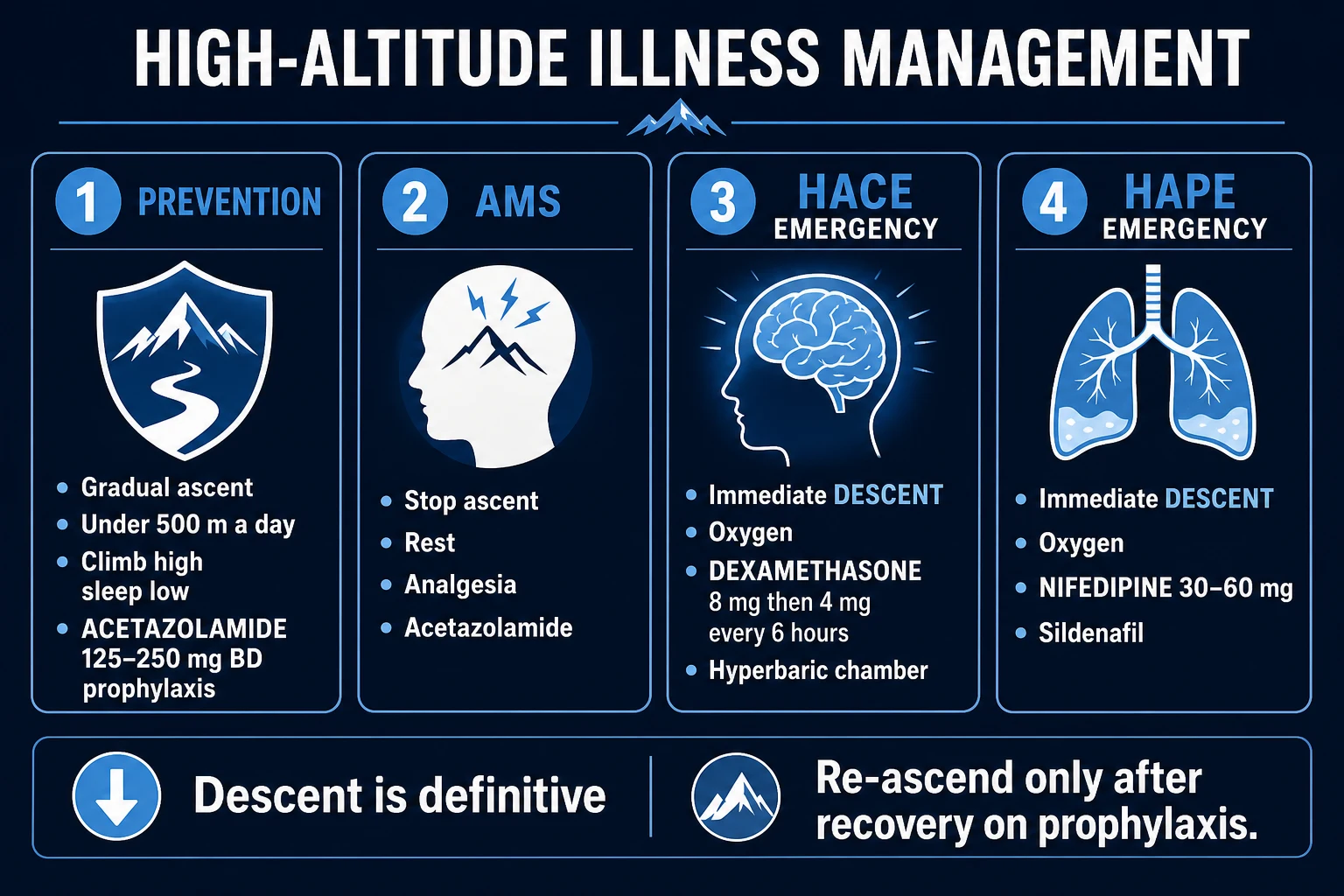
Field management of high-altitude illness (the wilderness + retrieval protocol)
-
RECOGNISE — altitude + symptoms = altitude illness until proven otherwise — (a) HISTORY: recent ascent (>2500 m), rapid gain (flight/car/lift), prior altitude illness, missed acclimatisation. (b) AMS: headache + nausea/fatigue/dizziness (Lake Louise ≥3). (c) HACE: AMS + ATAXIA or altered consciousness — the ataxia is the discriminator; do a heel-to-toe tandem gait. (d) HAPE: dyspnoea at rest + cough + crackles + cyanosis + SpO2 low. (e) The question to ask yourself: "Is this AMS only, or has it become HACE/HAPE?" — because HACE/HAPE change the urgency from 'stop and rest' to 'descend now'.[1][6]
-
STOP ASCENT for any AMS; DESCEND for HACE/HAPE — (a) MILD AMS: stop ascent, rest, hydrate, simple analgesia (paracetamol/NSAID), antiemetic, consider acetazolamide 250 mg BD. Symptomatic improvement in 12–24 h. Do NOT ascend again until symptom-free. (b) ANY ataxia, altered mental state, or signs of HACE → IMMEDIATE descent. (c) ANY dyspnoea at rest, cough with crackles, or SpO2 <85–90 → IMMEDIATE descent. The threshold to descend is LOWER than trainees think.[1]
-
DESCEND — the definitive treatment — (a) HOW MUCH: at least 500–1000 m, or until symptoms resolve (whichever is more). (b) HOW FAST: as quickly as safely possible; the patient cannot self-rescue if deteriorating — send a companion. (c) NEVER delay descent for drugs or oxygen to "work" — they are adjuncts to buy time, used WHILE descending. (d) Helicopter retrieval if available and the terrain is severe — but weather/altitude often preclude it; do not wait for a machine that cannot come.[1][3]
-
OXYGEN — if available — supplemental oxygen via mask, target SpO2 >90%. Use while descending, in the Gamow bag, and during retrieval. Oxygen alone can resolve HAPE if descent is impossible, but it does NOT negate the need to descend.[1]
-
DRUGS — matched to the syndrome — (a) AMS: acetazolamide 250 mg BD (speeds acclimatisation). (b) HACE: dexamethasone 8 mg loading then 4 mg 6-hourly (IM/IV/PO) — reduces vasogenic oedema, may improve ataxia enough to allow the patient to walk down. (c) HAPE: nifedipine 30 mg SR 12-hourly (↓pulmonary artery pressure). Consider tadalafil 10 mg BD, inhaled salmeterol. DO NOT give diuretics (HAPE patients are volume-depleted) or preload-reducers.[1][4]
-
GAMOW BAG — if descent is impossible — inflate the portable hyperbaric chamber; 1–2 h sessions simulate ~1500–2000 m descent. Use for HACE/HAPE trapped by weather or terrain. Continue oxygen and drugs while inside. STILL descend afterwards — the bag is a bridge, not a cure.[1]
-
TRANSPORT TO DEFINITIVE CARE — evacuate to the nearest facility with oxygen and intensive-care capability. For refractory or comatose HACE, or HAPE with profound hypoxaemia, retrieve to an ICU. Do not abandon resuscitation in cold hypoxia — altitude hypoxia is reversible with descent and oxygen.[1][1]
ICU management of severe HACE and HAPE
For the patient who reaches the ICU comatose (HACE) or in refractory hypoxaemic respiratory failure (HAPE), the principles are oxygenation, lung-protective ventilation, control of intracranial pressure, and reversal of the pulmonary hypertension — combined with the ongoing imperative that the patient must remain at low altitude.[1]
HACE in ICU. (1) Airway protection — intubate for GCS ≤8 or loss of airway reflexes. (2) Normocapnia / mild hyperventilation only if signs of impending herniation (avoid prolonged hyperventilation — cerebral ischaemia). (3) Continue dexamethasone 4 mg 6-hourly. (4) Head of bed 30°, normoglycaemia, normothermia, avoid hypotension (CPP >60). (5) Hyperosmolar therapy (mannitol / hypertonic saline) for cerebral oedema with herniation signs. (6) Seizure control (benzodiazepines; levetiracetam). (7) CT brain to exclude alternative causes (infarct, haemorrhage) once stable — MRI shows characteristic corpus callosum splenium signal change.[1][3]
HAPE in ICU. (1) Oxygen — target SpO2 >90% (PAO2 >60). (2) Non-invasive ventilation (CPAP/BiPAP) if distress/hypoxaemia persists on high-flow oxygen — splints alveoli and drives oedema back. (3) Intubate + lung-protective ventilation if NIV fails or the patient tires — VT 6 mL/kg PBW, plateau <30 cmH2O, PEEP titrated to SpO2 (typically 10–14 cmH2O). (4) Continue nifedipine SR 30 mg 12-hourly. (5) Position upright to aid venous return. (6) AVOID diuretics, nitrates, and preload-reducers — the HAPE patient is intravascularly volume-depleted; these worsen output and perfusion. (7) Treat secondary infection if present; otherwise no role for routine antibiotics. Resolution over 24–48 h with oxygen + descent is the rule.[1][4]
ICU drugs — what to give and what to avoid in HACE / HAPE
| Drug | HACE | HAPE | Comment |
|---|---|---|---|
| Oxygen | Give (target SpO2 >90) | Give (target SpO2 >90) | Universally indicated; the hypoxia is the root cause. |
| Dexamethasone 8 mg then 4 mg 6h | Give (definitive) | Not specific | Reverses vasogenic oedema; may let patient walk down. |
| Nifedipine SR 30 mg 12h | Not specific | Give (definitive) | ↓Pulmonary artery pressure; the HAPE driver. |
| CPAP / PEEP | Not specific | Give (if hypoxaemic) | Splints alveoli; drives oedema back into capillaries. |
| Furosemide / diuretics | AVOID (cautiously, if proven fluid overload only) | AVOID (volume-depleted) | HAPE patients are dry; diuresis worsens cardiac output and perfusion. |
| Nitrates / preload reducers | Avoid | AVOID | Worsen hypotension and perfusion in HAPE. |
| Acetazolamide | Adjunct (speeds acclimatisation; ↓CSF) | Adjunct | Useful for ongoing acclimatisation and periodic breathing; not the acute lifesaver. |
Special populations at altitude
Pre-existing conditions and altitude — who is at risk
| Condition | Risk at altitude | Recommendation |
|---|---|---|
| COPD | Hypoxaemia worsens; ↑work of breathing; pulmonary hypertension | Below 2500 m usually tolerated if sea-level SpO2 >92%. Above 3000 m, supplemental oxygen + slow ascent. PaO2 <55 at sea level → avoid high altitude. |
| Coronary artery disease (stable) | Modest risk; altitude increases HR and myocardial O2 demand | Stable, exercised patients usually tolerate 2500–3500 m. Avoid sudden exertion; carry nitrate (NOT if also on PDE-5 inhibitor for HAPE prophylaxis). |
| Heart failure (stable, NYHA I–II) | Moderate risk; hypoxic pulmonary vasoconstriction ↑RV afterload | Usually tolerated if stable; monitor for decompensation. Avoid if decompensated. |
| Pulmonary hypertension | HIGH risk — ↑PVR + already elevated PAP → severe HAPE-like picture | Avoid altitude >2500 m. If travel unavoidable: supplemental oxygen, nifedipine prophylaxis, slow ascent, abort criteria. |
| Pregnancy | Low risk to fetus below 3000 m (normal pregnancy is mildly hyperventilatory) | Avoid sustained exercise >3000 m; avoid high altitude with complications (pre-eclampsia, anaemia). Commercial flights are safe (cabin ~2000 m). |
| Sickle cell trait/disease | High risk — splenic and vaso-occlusive crisis triggered by hypoxia | Avoid altitude; trait carriers can crisis at moderate altitude. |
| Cyanotic congenital heart disease (Eisenmenger) | Very high risk — fixed right-to-left shunt cannot compensate | Contraindicated at altitude. |
| Prior HACE/HAPE | High risk of recurrence | Prophylactic acetazolamide (+ nifedipine if prior HAPE); very gradual ascent. |
Clinical pearls
Additional red flags
Landmark trials and guidelines
Luks 2024 — Wilderness Medical Society Clinical Practice Guidelines (PMID 37833187)
Source
Wilderness & Environmental Medicine — the current international guideline
Authors
Luks AM, et al.
Scope
Evidence-based prevention and treatment of acute altitude illness (AMS, HACE, HAPE)
Key recommendations
Gradual ascent; acetazolamide 125 mg BD prophylaxis; dexamethasone 8 mg loading for HACE; nifedipine 30 mg SR for HAPE; descent as definitive treatment; Gamow bag as adjunct
Clinical bottom line
The authoritative modern reference — descent is definitive; acetazolamide prophylaxis at the lowest effective dose; matched drug therapy by syndrome
Hackett & Roach 2001 — High-altitude illness (NEJM) (PMID 11450659)
Source
New England Journal of Medicine — Current Concepts review
Authors
Hackett PH, Roach RC
Scope
The definitive review of pathophysiology and management of the altitude syndromes
Key teaching
Hypobaric hypoxia → the alveolar gas equation → acclimatisation; the spectrum AMS–HACE–HAPE; descent the definitive treatment; the alveolar gas equation worked at altitude
Clinical bottom line
The foundational modern reference — the pathophysiology, the descent imperative, and the role of each drug
Bärtsch & Swenson 2013 — Acute high-altitude illnesses (NEJM) (PMID 23734077)
Source
New England Journal of Medicine — Current Concepts review
Authors
Bärtsch P, Swenson ER
Scope
Updated pathophysiology and management — especially HAPE capillary stress failure and HACE vasogenic oedema
Key teaching
HAPE = uneven hypoxic pulmonary vasoconstriction → overperfusion → capillary stress failure (exudative, bloody); HACE = vasogenic (early, steroid-responsive) + cytotoxic (late, irreversible) oedema
Clinical bottom line
The mechanistic companion to Hackett & Roach — explains why nifedipine works in HAPE and why early dexamethasone works in HACE
Low 2012 — Acetazolamide dose meta-analysis (BMJ) (PMID 23077406)
Source
BMJ — systematic review and meta-analysis
Authors
Low EV, Avery AJ, Gupta V, Schedlbauer A, Grocott MP
Question
What is the lowest effective dose of acetazolamide for AMS prophylaxis?
Finding
125 mg BD is as effective as higher doses; doses above 250 mg BD add side effects (paresthesia, polyuria, taste disturbance) without additional benefit
Clinical bottom line
125 mg BD is the prophylactic dose of choice — the answer the exam wants
Imray 2011 — Acute altitude illnesses (BMJ) (PMID 21903669)
Source
BMJ — practical clinical review
Authors
Imray C, Booth A, Wright A, Bradwell A
Scope
Recognition and management of AMS, HACE and HAPE for the non-specialist
Key teaching
The three syndromes and their discriminators (headache vs ataxia vs dyspnoea); the descent imperative; matched drug therapy; the Gamow bag
Clinical bottom line
The accessible companion to the NEJM reviews — the triage framework for the field
Luks 2022 — Medical conditions and high-altitude travel (NEJM) (PMID 35081281)
Source
New England Journal of Medicine — Clinical Practice
Authors
Luks AM, et al.
Scope
Risk assessment and advice for patients with pre-existing medical conditions travelling to altitude
Key teaching
COPD, CAD, heart failure, pulmonary hypertension, pregnancy, sickle cell disease — stratified risk and recommendations; chronic mountain sickness (Monge disease)
Clinical bottom line
The reference for the pre-travel consultation — who can go, who needs oxygen, who should stay at low altitude
Prognosis — summary
The AMS resolves with rest or descent within 12–24 h. The HACE and HAPE are life-threatening if descent is delayed — untreated HACE mortality approaches 60% and untreated HAPE approaches 50%. With prompt descent, oxygen and matched drug therapy, HACE/HAPE mortality falls below 5%. Resolution of HAPE over 24–48 h with oxygen and descent is the rule; residual neurological deficit after HACE is uncommon with early treatment but can follow delayed or severe cases. The single most important determinant of outcome is the SPEED of descent.[1][2][1][3]
SaqBlocks — fellowship exam practice
SAQ — High-altitude pulmonary oedema (HAPE) at 4500 m: descent as the definitive treatment
10 minutes · 10 marks
A 34-year-old fit male climber is at a trekking lodge at 4500 m, day 3 of a rapid ascent (he flew to 2800 m two days earlier). Over 12 hours he has developed dyspnoea at rest, a dry cough progressing to pink frothy sputum, and orthopnoea. On examination he is cyanosed, RR 36, SpO2 72 per cent on room air, bilateral inspiratory crackles to mid-zones, HR 128, BP 116/74. He is alert but very distressed. A pulse oximeter and a limited supply of oxygen, nifedipine SR, and a Gamow bag are available; descent is possible but requires organising porters and will take 4–6 hours to reach 3500 m.
SAQ — High-altitude cerebral oedema (HACE): dexamethasone, descent and the ataxia sign
10 minutes · 10 marks
A 41-year-old woman on day 5 of a trek at 4800 m is found in her tent confused, unable to walk a straight line, and vomiting. She had a headache and insomnia the previous evening but no respiratory symptoms. On examination she is drowsy (GCS 13, E3V4M6), has a wide-based ataxic gait when she attempts to stand, and her SpO2 is 88 per cent on room air with a clear chest. HR 96, BP 120/76. Her trekking partners have dexamethasone tablets, oxygen, a Gamow bag, and acetazolamide; a helicopter rescue has been requested but weather will delay it for at least 6 hours. The nearest descent by foot to 3800 m takes 4 hours.
References
- [1]Luks AM, et al. Wilderness Medical Society Clinical Practice Guidelines for the Prevention, Diagnosis, and Treatment of Acute Altitude Illness: 2024 Update Wilderness Environ Med, 2024.PMID 37833187
- [2]Luks AM, et al. Medical Conditions and High-Altitude Travel N Engl J Med, 2022.PMID 35081281
- [3]Hackett PH, Roach RC High-altitude illness N Engl J Med, 2001.PMID 11450659
- [4]Bärtsch P, Swenson ER Longitudinal fluorescent observation of retinal degeneration and regeneration in zebrafish using fundus lens imaging Mol Vis, 2013.PMID 23734077
- [5]Low EV, Avery AJ, Gupta V, Schedlbauer A, Grocott MP Gene therapy in animal models of autosomal dominant retinitis pigmentosa Mol Vis, 2012.PMID 23077406
- [6]Imray C, Booth A, Wright A, Bradwell A Normal mammalian cells negatively regulate telomere length by telomere trimming Hum Mol Genet, 2011.PMID 21903669