ICU · Environmental emergencies
Toxic Gas & Smoke Inhalation
Also known as Smoke inhalation · Toxic gas inhalation · Chemical pneumonitis · Chlorine gas · Ammonia gas · Phosgene · Nitrogen oxides
The toxic gas and smoke inhalation — the combustion products (the CO, the cyanide, the hydrogen chloride, the acrolein, the phosgene, the nitrogen oxides), the industrial gases (the chlorine, the ammonia), the particulate. The chemical pneumonitis → the ARDS. The management — the 100 per cent the oxygen, the lung-the-protective the ventilation, the PEEP, the bronchodilators, the NOT the steroids (the ineffective). The CO / the cyanide — the see the Toxicology the topics.
On this page & tools
Your progress
Saved locally on this device.
Target exams
Overview & definition
The toxic gas and smoke inhalation — the chemical injury to the respiratory tract from the inhaled toxins. The combustion products (the house fire, the industrial fire) and the industrial gases (the accidental, the occupational). The chemical pneumonitis → the ARDS. The management — the oxygen, the ventilation, the PEEP, the supportive. The CO and the cyanide — the see the Toxicology topics.[1][1]
The sources
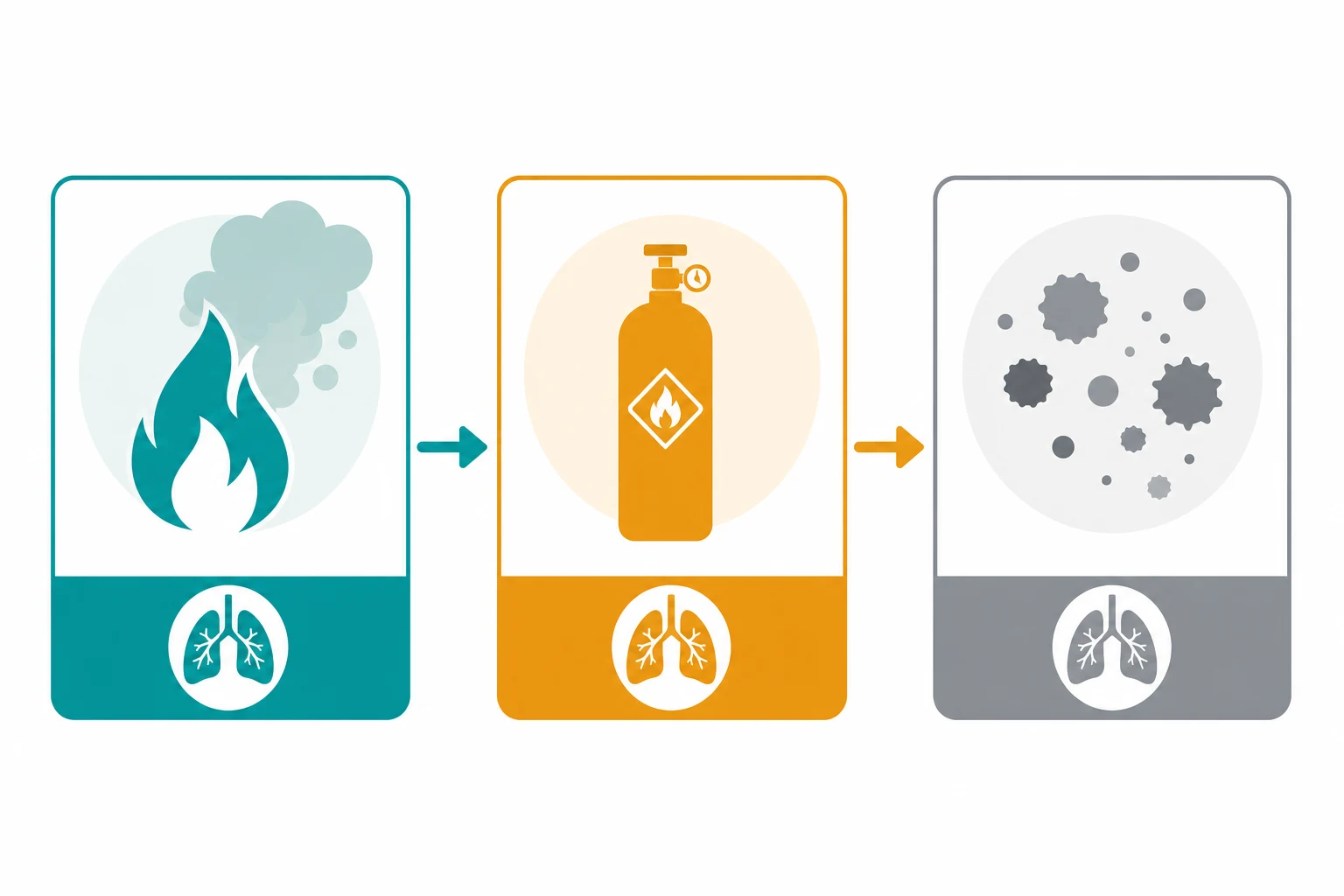
The combustion products.[2][1]
- The CO (the tissue hypoxia — the see the Toxicology #10).[1]
- The cyanide (the cellular hypoxia — the see the Toxicology #10).[1]
- The hydrogen chloride (the water-soluble — the dissolves in the upper airway → the upper airway the injury).[2]
- The acrolein, the aldehydes (the low-the-water-solubility — the reaches the lower airway → the alveolar the injury → the ARDS).[2]
- The phosgene (the delayed — the 24 to 72 h → the pulmonary the oedema).[2]
- The chlorine (the swimming the pool, the industrial; the water-soluble → the upper + the lower airway; the bronchospasm, the chemical the pneumonitis).[1]
- The ammonia (the refrigeration, the fertiliser; the highly the water-the-soluble → the upper the airway the caustic).[1]
- The nitrogen the oxides (the silo the filler's the disease; the delayed the pulmonary the oedema).[1]
The clinical
- The upper the airway — the stridor, the hoarse, the drooling (the upper airway the oedema / the thermal the injury).[2]
- The lower the airway — the bronchospasm (the wheeze), the cough, the dyspnoea, the hypoxaemia.[1]
- The ARDS (the 24 to 72 h — the delayed; the non-cardiogenic the pulmonary the oedema).[1][1]
- The systemic — the CO (the tissue the hypoxia), the cyanide (the cellular the hypoxia), the methaemoglobinaemia (the nitrogen the oxides).[1]
The management
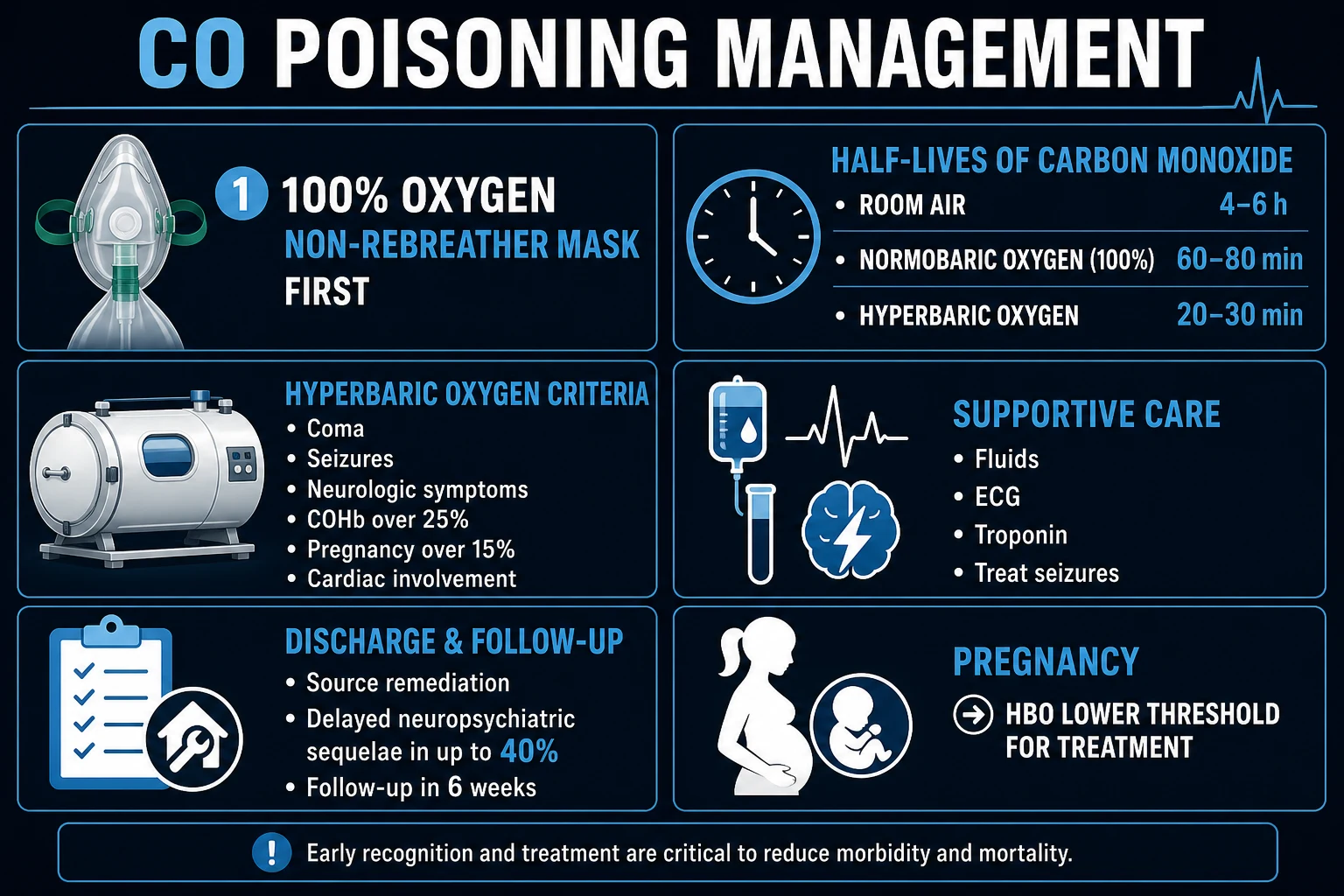
1. The remove from the exposure.[1]
2. The 100 per cent the oxygen.[1][1]
- The CO the elimination (the t1/2 the 320 the 80 the 20 the min).[1]
3. The lung-the-protective the ventilation (if the ARDS — the low the TV 6 mL/kg, the plateau below 30).[1][1]
- The PEEP (the alveolar the recruitment).[1]
4. The bronchodilators (the beta-2 — the bronchospasm).[1]
5. The NOT the steroids.[1][1]
- The corticosteroids the INEFFECTIVE for the chemical the pneumonitis (the no the benefit; the increased the infection).[1]
6. The CO / the cyanide — the see the Toxicology #10.[1]
Prognosis
The severity the depends on the concentration + the duration + the water-the-solubility. The ARDS the mortality the 30 to 40 per cent. The chronic (the bronchiectasis, the obstructive).[1][2][1]
Exam practice — SAQs
SAQ — Enclosed-space house fire: combined carbon monoxide and cyanide poisoning
10 minutes · 10 marks
A 34-year-old woman is brought to the emergency department after being pulled unconscious from a house fire in an enclosed bedsit. There is soot around her nares and in her oropharynx, singed nasal hairs, and carbonaceous sputum. On arrival: GCS 8 (E2V3M3), HR 124, BP 88/54, RR 28 and shallow, SpO2 99 percent on a 15 L non-rebreather mask. Arterial blood gas on 100 percent oxygen: pH 7.18, PaO2 92 mmHg, PaCO2 32 mmHg, bicarbonate 14, lactate 11.4 mmol/L, base excess -14. CO-oximetry: carboxyhaemoglobin 34 percent. The venous blood drawn for the gas is bright red. No burns to the airway on initial inspection but the voice is hoarse.
SAQ — Carbon monoxide poisoning from an enclosed-space heater
10 minutes · 10 marks
A 52-year-old man is brought to the emergency department after being found unconscious overnight in a small closed garage beside a faulty portable LPG heater. He is GCS 10 (E2V4M5), confused and nauseated with a severe throbbing headache. HR 110, BP 100/60, RR 22, SpO2 99 percent on room air. The skin is unusually pink. Arterial blood gas on room air: pH 7.32, PaO2 95 mmHg, PaCO2 34, bicarbonate 18, lactate 4.2 mmol/L. CO-oximetry: carboxyhaemoglobin 38 percent. The ECG shows anterior T-wave inversions.
SAQ — Cyanide toxicity from a polyurethane-foam factory fire
10 minutes · 10 marks
A 41-year-old worker is brought to the emergency department after being trapped in a plastics and polyurethane-foam factory fire. He was alert at the scene but collapsed in the ambulance. On arrival he is GCS 6, RR 30, HR 52, BP 76/40. The venous blood gas sample is strikingly bright red. Arterial blood gas: pH 7.10, PaO2 90 mmHg, PaCO2 28, bicarbonate 10, lactate 16 mmol/L, base excess -20. CO-oximetry: carboxyhaemoglobin 12 percent (mild). There is soot in the oropharynx and an expiratory wheeze.
Red flags
The common the toxic the gases — in the detail
The common the toxic the gases — the each the gas the unique the chemistry (the water-the-solubility the determines the depth of the penetration), the unique the source, the unique the injury the site. The CO + the cyanide the systemic (the tissue / the cellular the hypoxia — the see the Toxicology the topics). The HCl + the ammonia the upper the airway (the water-the-soluble — the dissolves the high). The chlorine the intermediate (the both the upper + the lower). The acrolein + the phosgene + the nitrogen the oxides the lower the airway / the alveoli (the low the water-the-solubility — the deep the penetration → the chemical the pneumonitis → the ARDS).[1][2][3]
The CO — the #1 the cause of the inhalation the death in the fires
The CO — the colourless, the odourless, the tasteless the gas, the product of the incomplete the combustion (the any the carbon-the-containing the fuel: the wood, the petrol, the gas, the oil, the coal, the charcoal). The #1 the cause of the inhalation-the-related the death in the structural the fires (the 50 to 80 per cent of the fire-the-related the deaths; the leading the cause of the poisoning the death the worldwide). The mechanism: (a) the binds the haemoglobin (the 200 to 250 the times the affinity of the O2) → the carboxyhaemoglobin (COHb) → the functional the anaemia + the left-the-shift of the dissociation the curve → the impaired the tissue the O2 the delivery; (b) the binds the cytochrome the aa3 (the mitochondrial) → the impaired the cellular the respiration. The clinical: the 'flu-like' (the headache — the most the common, the 90 per cent; the nausea, the dizziness, the malaise), the confusion, the syncope, the seizure, the coma, the cherry-the-red the skin (the rare, the late, the poor the sign — the severe the COHb). The diagnosis: the CO-the-oximetry / the arterial the COHb (the venous the acceptable). The pulse the oximetry the FALSELY the normal (the conventional the pulse the ox the cannot the distinguish the COHb from the O2Hb — the SpO2 the reads the 100 per cent). The management: the 100 per cent the O2 (the reduces the t1/2 from the ~320 min on the room the air to the ~80 min on the 100 per cent the O2); the hyperbaric the O2 the controversial (the small the t1/2 reduction to the ~20 to 30 the min — the see the Toxicology #10).[1][3]
The cyanide — the burning the plastics / the wool / the synthetic
The cyanide — the product of the burning the plastics, the wool, the silk, the synthetic the fabrics, the polyurethane (the furniture, the mattresses, the insulation), the melamine, the acrylonitrile. The house-the-fire (the enclosed the space) → the cyanide + the CO the co-the-existent (the BOTH the present in the significant the house the fires — the rule the out the neither). The mechanism: the binds the cytochrome the c the oxidase (the complex the IV of the electron-the-transport the chain) → the blocks the oxidative the phosphorylation → the cells the cannot the use the O2 → the anaerobic the metabolism → the profound the lactic the acidosis. The venous the O2 the HIGH (the cells the cannot the extract → the blood the returns the still the oxygenated) → the narrow the arteriovenous the O2 the difference. The clinical: the rapid the collapse, the coma, the seizure, the hypotension (the refractory), the bradycardia, the profound the lactic the acidosis, the 'the bright-the-red the venous the blood' (the high the venous the O2). The diagnosis: the plasma the lactate (the above 8 to 10 mmol / L — the sensitive for the toxic the cyanide — Baud 2002); the blood the cyanide the level (the not the rapid; the retrospective; the confirmatory). The management: the hydroxocobalamin 5 g IV (the empiric — the bedside, the do NOT the wait for the level — Borron 2007).[1][4][5]
The hydrogen chloride (the HCl) — the burning the PVC
The HCl — the product of the burning the PVC (the polyvinyl the chloride — the ubiquitous the plastic: the pipes, the wire the insulation, the cables, the vinyl the flooring, the upholstery, the medical the devices). The water-the-soluble → the dissolves in the moist the upper-the-airway the mucosa → the mucosal the burn + the oedema → the upper-the-airway the narrowing / the obstruction. The less the penetrant the deep (the dissolves the before the reaches the alveoli) BUT the very-the-high the concentration → the lower the airway the injury. The clinical: the immediate the burning the throat, the cough, the stridor, the hoarse the voice, the drooling (the upper-the-airway the oedema). The exam the pearl: the burning-the-PVC the exposure → the upper the airway the oedema (the early the intubation — the oedema the worsens the over the first the 24 the h).[2][1]
The acrolein + the aldehydes — the lower the airway
The acrolein (the propenal) + the aldehydes — the products of the burning the wood, the cotton, the paper, the furniture, the textiles. The low the water-the-solubility → the bypass the upper the airway (the no the early the warning the irritation) → the reach the lower the airway + the alveoli → the direct the alveolar-the-capillary the membrane the injury → the chemical the pneumonitis → the ARDS. The acrolein the particularly the toxic (the low the concentration the injures — the one of the most the irritating to the lung of the common the combustion the products).[2]
The phosgene — the delayed the pulmonary the oedema
The phosgene (the COCl2) — the product of the burning the chlorinated the compounds (the PVC, the chlorinated the solvents, the refrigerants). The low the water-the-solubility → the deep the penetration → the alveolar-the-capillary the membrane the injury → the delayed (the 24 to 72 the h) the non-cardiogenic the pulmonary the oedema. The patient the asymptomatic the initially (the trap — the discharge → the death). The WWI the chemical-the-weapon the history (the most the lethal of the war the gases). The mechanism: the acylation of the lung the proteins + the surfactant → the capillary the leak. The smell: the 'the new-the-mown the hay' (the pleasant, the misleading).[2][1]
The nitrogen the oxides (NOx) — the silo the filler's the disease
The NO2 + the NO — the products of the combustion (the fossil the fuels), the silo (the fermenting the crops → the NO2 the gas the settles the over the silage), the welding (the 'the welder's the lung'), the underground (the miners — the blasting the fumes). The silo the filler's the disease (the 24 to 72 the h → the pulmonary the oedema). The low the water-the-solubility → the lower the airway / the alveoli → the chemical the pneumonitis. The methaemoglobinaemia (the NO the oxidises the haemoglobin the Fe2+ → the Fe3+ — the functional the anaemia). The chronic (the weeks to the months): the bronchiolitis the obliterans (the obliterative the bronchiolitis — the fixed the obstruction).[1]
The chlorine — the swimming the pool / the industrial
The chlorine — the swimming-the-pool (the chlorinating the tablets, the granules), the industrial (the water-the-treatment the plants, the chemical the manufacture, the pulp / the paper), the accidental (the mixing the household the bleach [the sodium the hypochlorite] + the acid → the chlorine the gas). The intermediate the water-the-solubility → the BOTH the upper + the lower the airway. The mechanism: the reacts with the water in the mucosa → the HCl + the hypochlorous the acid (the HOCl) → the free the radical → the lipid the peroxidation → the mucosal the injury. The clinical: the immediate the ocular + the upper-the-airway the irritation (the tearing, the burning, the cough, the wheeze), then the lower (the chemical the pneumonitis, the ARDS in the severe). The dose + the duration the dependent.[1]
The ammonia — the refrigeration / the fertiliser
The ammonia (the NH3) — the refrigeration (the industrial the cold the storage), the fertiliser the manufacture, the industrial the cleaning, the illicit the methamphetamine the production. The HIGHLY the water-the-soluble → the immediate the upper-the-airway the caustic the burn (the severe — the laryngeal the oedema, the rapid the airway the loss). The less the lower-the-airway (the dissolves the before the reaches the alveoli). The ocular the injury the prominent (the corneal the burn — the immediate the copious the irrigation). The exam the pearl: the ammonia the exposure → the secure the airway the EARLY (the oedema the rapid + the progressive).[1]
The common the toxic the gases — the water-the-solubility + the site + the source
| The gas | The water-the-solubility | The injury the site | The typical the source | The hallmark the feature |
|---|---|---|---|---|
| The CO | The irrelevant (the systemic) | The systemic (the tissue) | The incomplete the combustion (the any the fuel) | The COHb; the pulse the ox the falsely the normal; the #1 the fire the death |
| The cyanide | The irrelevant (the systemic) | The cellular (the mitochondria) | The burning the plastics / the wool / the synthetics | The lactate the above 8; the high the venous the O2; the hydroxocobalamin |
| The HCl | The HIGH | The UPPER the airway | The burning the PVC (the pipes, the cables, the flooring) | The stridor, the hoarse, the early the oedema |
| The ammonia | The VERY HIGH | The UPPER the airway (the caustic) | The refrigeration, the fertiliser | The rapid the airway the loss, the corneal the burn |
| The chlorine | The INTERMEDIATE | The BOTH the upper + the lower | The swimming the pool, the bleach + the acid | The immediate the irritation then the lower |
| The acrolein | The LOW | The LOWER the airway / the alveoli | The burning the wood / the cotton / the textiles | The silent the deep the penetration → the ARDS |
| The phosgene | The LOW | The alveoli (the delayed) | The burning the chlorinated the compounds | The delayed (the 24-72 the h) the pulmonary the oedema |
| The nitrogen the oxides | The LOW | The lower the airway / the alveoli | The silo, the welding, the fossil the fuels | The silo the filler's; the methaemoglobinaemia |
The pathophysiology — the water-the-solubility the determines the site
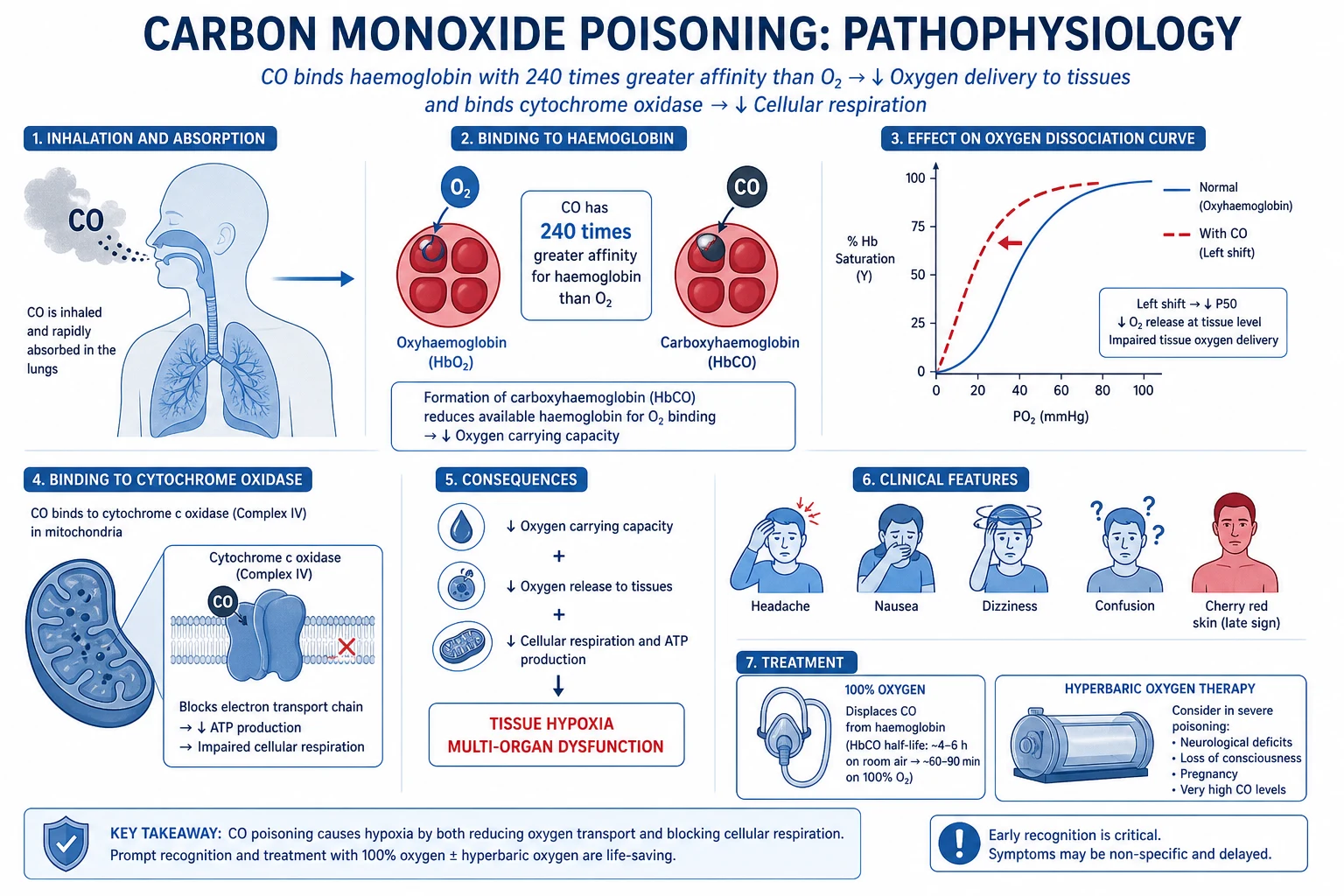
The pathophysiology — the two the determinants: (a) the WATER-THE-SOLUBILITY of the gas, (b) the CONCENTRATION + the DURATION of the exposure.[1][2][3]
The water-the-solubility — the key the concept
The water-the-solubility the determines the DEPTH of the penetration into the respiratory the tract. The water-the-soluble the gases (the HCl, the ammonia, the sulphur the dioxide, the chlorine-the-some) the dissolve in the moisture of the UPPER the airway (the nose, the pharynx, the larynx, the trachea) → the upper-the-airway the mucosal the injury → the stridor, the hoarse the voice, the drooling, the upper-the-airway the oedema. The WARNING: the irritant the symptoms the EARLY (the tearing, the burning) → the patient the flees → the less the deep the injury. The low-the-water-the-solubility the gases (the phosgene, the nitrogen the oxides, the ozone) the bypass the upper the airway (the no the early the warning) → the reach the lower the airway + the alveoli → the chemical the pneumonitis → the ARDS. The WARNING: the few the early the symptoms → the patient the stays the in the exposure → the severe the deep the injury. The intermediate the gases (the chlorine) → the BOTH the upper + the lower.[1][2]
The concentration + the duration
The dose (the concentration) × the time (the duration) = the severity. The higher the concentration + the longer the exposure → the worse. The enclosed the space (the house the fire, the basement, the silo) → the higher the concentration. The particulate the matter (the soot) the CARRIER → the adsorbs the gases → the carries the deep into the alveoli → the amplifies the injury. The soot in the sputum / the nose the marker of the significant the inhalation.[2][3]
The mechanism of the lung the injury — in the steps
- The direct the cytotoxicity — the gases the react with the mucosal the water / the proteins → the HCl, the HOCl, the free the radicals → the lipid the peroxidation of the cell the membranes → the cell the death (the type the I the pneumocytes, the Clara the cells, the ciliated the epithelium).[1][2]
- The surfactant the destruction — the injured the type the II the pneumocytes → the less the surfactant → the alveolar the collapse / the atelectasis → the V/Q the mismatch → the hypoxaemia.[2]
- The capillary the leak — the alveolar-the-capillary the membrane the damage → the protein-the-rich the exudate → the non-cardiogenic the pulmonary the oedema → the ARDS (the 24 to 72 the h).[1][3]
- The bronchospasm — the irritant the gases → the reflex the bronchoconstriction → the wheeze + the air-trapping.[1]
- The mucosal the sloughing + the cast the formation — the denuded the epithelium + the fibrin + the mucus → the bronchial the casts → the obstruction → the atelectasis + the V/Q the mismatch.[2][3]
- The systemic the absorption — the CO + the cyanide the absorbed → the tissue / the cellular the hypoxia (the see the above).[1]
The clinical — the timeline (the within 24 the h)
The clinical the presentation — the respiratory the distress the within the 24 the h of the exposure (the typical), the evolves the over the 24 to 72 the h (the chemical the pneumonitis → the ARDS). The four the compartments: (1) the upper the airway, (2) the lower the airway / the alveoli, (3) the systemic, (4) the ocular / the cutaneous.[1][2][3]
The timeline
- The IMMEDIATE (the minutes) — the upper-the-airway the irritation (the HCl, the ammonia, the chlorine): the tearing, the rhinitis, the burning the throat, the cough, the wheeze, the stridor. The systemic (the CO, the cyanide): the headache, the dizziness, the collapse, the coma.[1][2]
- The EARLY (the 2 to 24 the h) — the chemical the tracheobronchitis, the bronchospasm, the mucosal the sloughing. The CXR the often the NORMAL the initially (the delayed the radiographic the change — the common the exam the point).[2][3]
- The DELAYED (the 24 to 72 the h) — the chemical the pneumonitis → the non-cardiogenic the pulmonary the oedema → the ARDS (the hallmark of the low-the-water-the-solubility the gases — the phosgene, the nitrogen the oxides).[1][1]
- The LATE (the weeks to the months) — the bronchiectasis, the bronchiolitis the obliterans (the NOx), the obstructive / the restrictive the defect, the pulmonary the fibrosis (the severe).[1]
The clinical the signs
- The upper the airway — the stridor (the oedema), the hoarse the voice, the drooling, the soot in the mouth / the nose / the sputum, the singed the nasal the hairs, the facial / the perioral the burns.[2][3]
- The lower the airway — the wheeze (the bronchospasm), the cough (the dry → the productive the sooty), the dyspnoea, the crackles (the oedema), the cyanosis, the hypoxaemia (the refractory).[1]
- The systemic — the CO (the headache, the confusion, the coma, the cherry-the-red), the cyanide (the collapse, the coma, the seizure, the severe the acidosis), the methaemoglobinaemia (the chocolate-the-brown the blood, the cyanosis the refractory to the O2).[1]
- The ocular / the cutaneous — the corneal the burn (the ammonia, the chlorine — the irrigation), the thermal the burn (the face).[2]
The clinical the timeline — the upper vs the lower vs the systemic
| The compartment | The onset | The gases | The signs | The key the action |
|---|---|---|---|---|
| The upper the airway | The immediate (the minutes) | The HCl, the ammonia, the chlorine | The stridor, the hoarse, the drooling, the singed the hair | The EARLY the airway (the intubation before the oedema) |
| The lower the airway | The 2 to 24 the h | The chlorine, the acrolein | The wheeze, the cough, the crackles, the hypoxaemia | The bronchodilators, the O2, the observe |
| The alveoli / the ARDS | The 24 to 72 the h | The phosgene, the NOx, the acrolein | The non-cardiogenic the oedema, the refractory the hypoxaemia | The lung-the-protective the ventilation |
| The systemic (the CO) | The immediate | The CO | The headache, the confusion, the coma | The 100 per cent the O2 |
| The systemic (the cyanide) | The immediate | The cyanide | The collapse, the coma, the lactate the above 8 | The hydroxocobalamin 5 g |
| The ocular | The immediate | The ammonia, the chlorine | The corneal the burn | The copious the irrigation |
The diagnosis — the investigations
The diagnosis — the CLINICAL (the history of the exposure + the syndrome). The investigations the supportive (the confirm + the stratify the severity).[1][2][3]
The bedside + the laboratory
- The CO-the-oximetry / the arterial the COHb — the confirm the CO (the pulse the oximetry the FALSELY the normal — the common the exam the trap). The venous the COHb the acceptable. The levels: the 5 to 15 the mild (the smokers the baseline the up to 10); the 20 to 30 the moderate (the headache, the confusion); the above 30 the severe (the coma, the seizure); the above 50 the lethal.[1][3]
- The plasma the lactate — the surrogate for the cyanide (the above 8 to 10 mmol / L the sensitive — Baud 2002). The bedside, the rapid, the serial. The other the causes of the high the lactate (the shock, the hypoxia, the seizure, the CO) → the interpret the in the context.[5]
- The blood the cyanide the level — the not the rapid (the hours); the confirmatory; the do NOT the wait. The toxic the above 1 mg / L; the lethal the above 3 mg / L. The smoker the baseline the below 0.1.[4][5]
- The methaemoglobin — the multi-the-wavelength the CO-the-oximetry (the conventional the SpO2 the falsely the normal). The NOx + the nitrites the cause. The methylene the blue if the above 30 per cent (the see the Toxicology).[1]
- The ABG — the hypoxaemia, the metabolic the acidosis (the lactic — the cyanide), the respiratory the alkalosis (the early the hyperventilation) → the respiratory the acidosis (the fatigue / the ARDS).[1]
- The FBC, the U&E, the LFTs, the coagulation, the CK, the troponin — the multi-organ the assessment (the AKI, the rhabdomyolysis, the coagulopathy, the myocardial the injury).[1]
The imaging
- The CXR — the often the NORMAL the initially (the 0 to 24 the h — the radiograph the lags the clinical). The develop the bibasal the interstitial the infiltrates → the confluent the alveolar the oedema (the 24 to 72 the h) → the ARDS. The oedema the non-cardiogenic (the normal the heart the size). The pneumothorax / the pneumomediastinum if the barotrauma. The exam the pearl: 'the normal the CXR the does NOT the exclude the significant the inhalation the injury'.[2][3]
- The CT the chest — the more the sensitive (the ground-the-glass, the consolidation); the early the ARDS; the exclude the other.[3]
- The bronchoscopy — the diagnostic (the soot, the erythema, the oedema, the mucosal the sloughing, the casts) + the therapeutic (the lavage, the cast the removal). The grade the severity.[2][3]
The ECG
- The ECG — the ischaemia (the CO, the cyanide → the tissue the hypoxia), the arrhythmia (the hypoxia, the acidosis, the electrolyte), the infarction (the type the 2 the MI from the hypoxia).[1]
The investigations — the what + the why + the trap
| The test | The why | The key the finding | The trap |
|---|---|---|---|
| The CO-the-oximetry (the COHb) | The confirm the CO | The COHb the elevated | The pulse the ox the FALSELY the normal |
| The plasma the lactate | The surrogate the cyanide | The above 8 mmol / L | The other the causes (the shock) |
| The blood the cyanide | The confirm the cyanide | The above 1 mg / L | The slow (the hours) — the do NOT the wait |
| The methaemoglobin | The NOx the exposure | The above 2 per cent | The conventional the SpO2 the falsely the normal |
| The ABG | The acid-base + the gas | The lactic the acidosis | The early the respiratory the alkalosis |
| The CXR | The lung the injury | The infiltrates / the oedema | The NORMAL the initially (the lag) |
| The bronchoscopy | The direct the visualisation | The soot / the slough / the casts | The grade the severity |
The management — the comprehensive
The management — the remove the from the exposure; the 100 per cent the O2; the airway the early; the bronchodilators; the lung-the-protective the ventilation if the ARDS; the PEEP; the hydroxocobalamin for the cyanide; the NOT the steroids; the supportive. The CO / the cyanide — the see the Toxicology the topics.[1][1][3]
1. The remove from the exposure
The remove — the patient the from the source; the rescuers the PPE (the self-the-contained the breathing the apparatus — the SCBA); the decontaminate (the remove the clothing, the copious the water the irrigation the skin / the eyes — the ammonia / the chlorine). The prevent the secondary the exposure (the off-the-gassing the clothing → the ED the staff the affected — the 'the off-the-gasser').[1][2]
2. The 100 per cent the oxygen
The 100 per cent the O2 (the non-the-rebreather the mask the 15 L / the min; the endotracheal if the intubated). The benefits the ALL: (a) the CO — the reduces the t1/2 from the ~320 the min → the ~80 the min; (b) the cyanide — the improves the cellular the O2 the availability (the displaces the competitive the inhibition at the cytochrome); (c) the chemical the pneumonitis / the ARDS — the treats the hypoxaemia. The high-the-flow the nasal the cannula the alternative if the spontaneously the breathing. The do NOT the use the low-the-flow the O2 (the inadequate).[1][1]
3. The airway — the early
The airway — the EARLY the intubation if the upper-the-airway the oedema (the HCl, the ammonia, the chlorine, the facial the burns, the singed the hairs, the stridor). The oedema the WORSENS the over the first the 24 the h — the intubate the BEFORE the loss (the 'the airway the early' the mantra). The inhalational the induction (the sevoflurane) ± the awake the fibre-the-optic if the anticipated the difficult. The smaller the ETT (the oedema). The tracheostomy if the prolonged (the 2 to 3 the weeks for the severe the upper-the-airway the injury).[2][3]
4. The bronchodilators
The beta-2 the agonist (the salbutamol the nebulised — the bronchospasm; the also the helps the mucociliary the clearance). The ipratropium the added. The do NOT the use the methylxanthines (the theophylline — the no the benefit, the toxicity).[1]
5. The lung-the-protective the ventilation (if the ARDS)
The lung-the-protective the ventilation if the ARDS: the TV the 6 mL / kg the PBW, the plateau the below 30 cmH2O, the driving the pressure the below 15, the PEEP the titrated (the alveolar the recruitment — the open the lung), the permissive the hypercapnia (the pH the above 7.20). The prone the positioning if the severe (the PaO2 / FiO2 the below 150). The consider the ECMO if the refractory (the see the ARDS the topic).[1][3]
6. The hydroxocobalamin (the cyanide)
The hydroxocobalamin 5 g IV (the empiric — the bedside — for the suspected the cyanide the smoke the inhalation). The dose: the 5 g IV the over the 15 the min; the repeat the 5 g if the severe / the refractory. The mechanism: the binds the cyanide → the cyanocobalamin (the vitamin the B12) → the renally the excreted. The adverse the effects: the red-the-orange the discolouration of the skin / the urine / the mucous the membranes (the harmless, the 2 to 3 the days), the transient the hypertension, the acneiform the rash, the anaphylaxis (the rare). The do NOT the use the sodium the thiosulphate / the sodium the nitrite the KIT (the classic) the first-the-line in the SMOKE (the nitrite → the methaemoglobinaemia → the ADDS the functional the anaemia on the already-the-CO-the-poisoned the patient → the WORSE). The hydroxocobalamin the SAFE with the CO. The Borron 2007 the study → the empiric the 5 g the associated with the survival (the 67 per cent the survival in the confirmed the cyanide).[1][4]
7. The NOT the steroids
The corticosteroids the NOT the recommended (the controversial — the majority the against). The RCTs the no the benefit for the chemical the pneumonitis; the increased the infection the risk (the opportunistic — the fungal). The exception the debate: the high-the-dose the inhaled the steroids the occasionally the discussed for the prevention of the bronchiolitis the obliterans (the NOx) BUT the no the strong the evidence. The do NOT the routine. The management the supportive.[1][1]
8. The supportive
The supportive — the fluids (the cautious — the avoid the fluid the overload the worsens the pulmonary the oedema; the goal-the-directed), the vasopressors (the noradrenaline) for the shock, the renal the replacement if the AKI, the DVT the prophylaxis, the stress the ulcer the prophylaxis, the nutrition (the early the enteral), the VAP the prevention the bundle, the methylene the blue if the methaemoglobinaemia (the above 30 per cent), the antibiotics the ONLY if the proven the infection (the NOT the prophylactic).[1][3]
The hydroxocobalamin — the detail
The hydroxocobalamin — the first-the-line the antidote for the suspected the cyanide the smoke-the-inhalation the poisoning. The WHY the preferred the over the classic the kit (the sodium the nitrite + the sodium the thiosulphate): (a) the SAFE with the concomitant the CO (the no the methaemoglobin → the no the additional the functional the anaemia), (b) the rapid (the 15 the min), (c) the does NOT the impair the tissue the O2 the delivery, (d) the well the tolerated. The dose: the 5 g IV the over the 15 the min (the adult); the repeat the 5 g if the no the response / the severe. The paediatric: the 70 mg / kg. The mechanism: the binds the cyanide → the cyanocobalamin (the B12 — the renally the excreted, the non-the-toxic). The adverse the effects: the red-the-orange the skin / the urine / the mucous the membranes (the harmless — the 2 to 3 the days, the warn the patient + the family), the transient the hypertension, the acne, the anaphylaxis (the rare), the interference with the laboratory the assays (the colour the interferes with the colorimetric the chemistry — the falsely the high / the low the results; the inform the lab). The Borron 2007 the prospective the case the series (the 69 the smoke the patients) → the empiric the 5 g the associated with the survival; the 67 per cent the survival in the confirmed-the-cyanide the subset; the no the serious the adverse the events.[1][4][5]
The steroids — the controversy
The corticosteroids — the controversial, the majority the AGAINST the routine the use. The rationale the proposed: the anti-the-inflammatory (the reduce the chemical the pneumonitis). The evidence the actual: (a) the RCTs + the cohort the studies the NO the benefit for the chemical the pneumonitis / the ARDS the from the toxic the gas; (b) the increased the infection the risk (the opportunistic — the fungal, the bacterial — the Candida, the Aspergillus the reported); (c) the impaired the wound the healing (the burn the patients). The guidelines the Oh's + the Sheridan 2016: the NOT the recommended. The exception the discussion: (a) the high-the-dose the INHALED the steroids the occasionally the discussed for the prevention of the bronchiolitis the obliterans (the NOx — the silo the filler's) — the weak the evidence; (b) the systemic the steroids for the refractory the bronchospasm the not the responsive to the beta-2 — the clinical the judgement. The exam the answer: 'the NOT the routine; the no the benefit; the increased the infection — the supportive the management the mainstay'.[1][1][3]
The differential diagnosis
The differential of the acute the respiratory the distress the after the exposure.[1][1]
- The cardiac the pulmonary the oedema — the cardiogenic (the history, the big the heart, the BNP, the echo). The non-the-cardiogenic (the ARDS) — the normal the heart the size + the severe the hypoxaemia.
- The aspiration the pneumonitis — the Mendelson (the reduced the consciousness, the gastric the contents). The overlap (the smoke the inhalation + the aspiration).
- The asthma / the COPD the exacerbation — the history, the wheeze, the no the exposure.
- The pneumonia — the infective (the fever, the productive, the infiltrates, the cultures). The later the complication (the 3 to 5 the days) of the inhalation.
- The pulmonary the embolism — the DVT, the risk, the CT the pulmonary the angiography.
- The fat the embolism — the long-the-bone the fracture (the 24 to 72 the h).
- The neurogenic the pulmonary the oedema — the brain the injury. [1]
The non-the-cardiogenic vs the cardiogenic the oedema (the key the distinction)
| The feature | The chemical the pneumonitis / the ARDS | The cardiogenic |
|---|---|---|
| The history | The exposure (the gas, the smoke) | The cardiac (the ischaemia, the failure) |
| The heart the size (the CXR) | The NORMAL | The enlarged |
| The wedge the pressure | The normal (the below 18) | The high (the above 18) |
| The oedema the fluid | The protein-the-rich (the leak) | The protein-the-poor (the hydrostatic) |
| The BNP | The normal | The high |
| The echo | The normal the EF | The reduced the EF / the diastolic |
| The response to the diuretic | The minimal | The good |
The complications
The complications — the early + the late.[1][2][3]
- The ARDS — the 24 to 72 the h; the refractory the hypoxaemia; the lung-the-protective the ventilation; the mortality the 30 to 40 per cent.[1][1]
- The upper-the-airway the obstruction — the oedema; the intubation the early.[2]
- The infection (the pneumonia) — the denuded the mucosa + the impaired the clearance + the (often) the intubation → the 3 to 5 the days. The polymicrobial. The antibiotics the if the proven (the NOT the prophylactic). The VAP the bundle.[3]
- The bronchiectasis / the bronchiolitis the obliterans — the weeks to the months (the NOx). The fixed the obstruction. The no the proven the prevention.[1]
- The systemic — the CO (the delayed the neuro-the-psychiatric — the 2 to 40 the days → the recovery the over the weeks; the parkinsonism the basal the ganglia), the cyanide (the delayed the parkinsonism), the methaemoglobinaemia (the NOx).[1]
- The multi-organ — the AKI (the hypoxia, the rhabdomyolysis), the hepatic (the hypoxia), the coagulopathy / the DIC (the severe), the myocardial (the CO, the cyanide → the type the 2 the MI).[1][3]
The prevention
The prevention — the public-the-health + the occupational.[1][3]
- The carbon the monoxide the detectors — the domestic (the audible, the near the sleeping the area; the every the level). The reduce the CO the deaths (the 50 per cent the reduction in the homes the with the working the detectors). The replace the every the 5 to 7 the years.
- The proper the ventilation — the heating the appliances (the flue, the chimney — the clean, the sweep), the cooking (the extractor), the generators / the BBQs / the charcoal (the NEVER the indoors / the enclosed — the post-the-disaster the deaths).
- The industrial — the ventilation (the local the exhaust), the monitoring (the gas the detectors — the O2, the CO, the H2S, the ammonia, the chlorine), the PPE (the respirator — the SCBA for the IDLH [the immediately the dangerous to the life + the health]), the enclosed the space the protocols (the confined-the-space the entry — the permit, the gas the test, the rescue).
- The fire-the-safety — the smoke the alarms (the early the warning), the escape the plan, the sprinkler, the fire-the-retardant the materials (the reduce the toxic the combustion the products — the furniture the flammability the standards).
- The silo — the ventilation the before the entry; the gas the testing; the 'the silo the filler's the disease' the awareness.
- The household — the NEVER the mix the bleach + the acid / the ammonia (the chlorine / the chloramine the gas). [1]
The management — the step-by-step
The management of the acute toxic gas / smoke inhalation
-
THE REMOVE + THE DECONTAMINATE + THE PROTECT THE STAFF — (a) The REMOVE the patient from the source (the rescuers the SCBA — the never the enter the toxic the environment the without). (b) The DECONTAMINATE: the remove the clothing (the off-the-gassing), the copious the water the irrigation of the skin + the eyes (the ammonia / the chlorine / the HCl — the ocular the burn → the immediate, the prolonged, the Morgan the Lens). (c) The PROTECT the ED the staff (the off-the-gasser — the patient the off-the-gasses the chlorine → the staff the affected). (d) The ensure the scene the safe.[1][2]
-
THE A / B / C + THE 100 PER CENT THE O2 — (a) The AIRWAY: the EARLY the intubation if the upper-the-airway the oedema (the HCl, the ammonia, the chlorine, the facial the burns, the singed the hair, the stridor) — the oedema the WORSENS the over the first the 24 the h. The inhalational / the fibre-the-optic the approach; the smaller the ETT. (b) The BREATHING: the 100 per cent the O2 (the non-the-rebreather 15 L / the min; the ET if the intubated) — the ALL the patients (the CO, the cyanide, the hypoxaemia). (c) The CIRCULATION: the IV the access, the fluids (the cautious — the avoid the overload), the vasopressors the if the shock.[1][1][3]
-
THE DIAGNOSE + THE STRATIFY (the bedside) — (a) The history: the SOURCE (the house the fire, the industrial, the silo, the bleach + the acid), the ENCLOSED the space, the DURATION, the loss of the consciousness. (b) The CO-THE-OXIMETRY (the COHb) — the confirm the CO (the pulse the ox the falsely the normal). (c) The LACTATE — the surrogate for the cyanide (the above 8 mmol / L the sensitive — Baud 2002). (d) The methaemoglobin (the CO-the-oximetry) — the NOx. (e) The ABG. (f) The CXR (the may be the NORMAL the initially — the lag). (g) The ECG. (h) The bronchoscopy (the grade + the lavage).[2][3][5]
-
THE CYANIDE — THE HYDROXOCOBALAMIN 5 G IV (the empiric if the smoke + the coma / the lactate the above 8) — (a) The indication: the enclosed-the-space the smoke + the coma, the hypotension, the severe the acidosis, the lactate the above 8 to 10. (b) The dose: 5 g IV the over the 15 the min; the repeat the 5 g if the severe / the refractory. (c) The do NOT the wait for the cyanide the level. (d) The do NOT the use the sodium the nitrite (the methaemoglobin → the worsens the CO). (e) The warn: the red-the-orange the skin / the urine (the harmless); the inform the lab (the colour the interference).[1][4][5]
-
THE CO — THE 100 PER CENT THE O2 (the hyperbaric the controversial) — (a) The 100 per cent the O2 the until the COHb the below 5 to 10 per cent + the symptom-the-free. (b) The hyperbaric the O2 — the controversial; the consider if the COHb the above 25 to 30, the coma, the seizure, the pregnancy, the myocardial the ischaemia (the see the Toxicology #10). (c) The do NOT the delay the supportive the care the for the transfer.[1][3]
-
THE ARDS — THE LUNG-THE-PROTECTIVE THE VENTILATION (the if the 24 to 72 the h → the refractory the hypoxaemia) — (a) The TV 6 mL / kg the PBW; the plateau the below 30; the driving the pressure the below 15; the PEEP the titrated; the permissive the hypercapnia (the pH the above 7.20). (b) The prone if the PaO2 / FiO2 the below 150. (c) The ECMO if the refractory. (d) The do NOT the high-the-tidal-the-volume (the worsens).[1][3]
-
THE NOT THE STEROIDS (the controversial — the majority the against) — (a) The corticosteroids the NO the benefit for the chemical the pneumonitis (the RCTs). (b) The increased the infection the risk. (c) The do NOT the routine. (d) The exception: the inhaled the steroids for the bronchiolitis the obliterans the prevention (the weak). (e) The supportive the mainstay.[1][1]
-
THE BRONCHODILATORS + THE PULMONARY THE TOILET — (a) The salbutamol the nebulised (the bronchospasm + the mucociliary the clearance) ± the ipratropium. (b) The do NOT the methylxanthines. (c) The bronchoscopy for the cast the removal (the severe). (d) The humidification. (e) The mucolytics (the N-acetylcysteine) the no the strong the evidence.[1]
-
THE SUPPORTIVE + THE PREVENT THE COMPLICATIONS — (a) The cautious the fluids (the avoid the overload — the goal-the-directed). (b) The noradrenaline for the shock. (c) The DVT + the stress-the-ulcer the prophylaxis. (d) The VAP the bundle. (e) The early the enteral the nutrition. (f) The antibiotics the ONLY if the proven the infection (the NOT the prophylactic). (g) The methylene the blue if the methaemoglobinaemia the above 30 per cent. (h) The renal the replacement if the AKI.[1][3]
-
THE OBSERVE (the 24 to 72 the h — the delayed the pulmonary the oedema) — (a) The ANY the exposure to the low-the-water-the-solubility the gas (the phosgene, the NOx, the acrolein) → the OBSERVE the 24 to 72 the h (the delayed the oedema — the do NOT the discharge). (b) The serial the CXR, the ABG, the SpO2, the respiratory the rate. (c) The serial the lactate (the cyanide). (d) The if the symptomatic → the ICU. (e) The if the asymptomatic the 6 to 24 the h + the normal the CXR + the normal the ABG → the consider the discharge the with the strict the return the precautions (the depends the gas).[2][3]
The clinical the pearls
The additional the red flags
The landmark the trials + the guidelines
Sheridan 2016 — the Fire-Related the Inhalation the Injury (NEJM) (PMID 27518664)
Source
New England Journal of Medicine — the definitive the clinical the review
Author
Sheridan RL
The scope
The pathophysiology, the diagnosis, + the management of the inhalation the injury from the fires
The injury the compartments
The three: (1) the direct the thermal (the supraglottic — the heat the exchange the poor the below the cords), (2) the chemical (the lower the airway — the combustion the products), (3) the systemic (the CO, the cyanide)
The management
The largely the supportive — the no the consensus on the specific the drug the therapy; the airway the monitoring (the first the 72 the h); the lung-the-protective the ventilation
The key the point
The inhalation the injury the independent the risk the factor for the mortality; the lack of the clear the diagnostic the criteria + the large the trials
The steroids
The NOT the recommended — the no the proven the benefit
The clinical the bottom the line
The foundational the modern the reference — the supportive the management the mainstay; the steroids the ineffective
Borron 2007 — the hydroxocobalamin for the smoke-the-cyanide (Annals of Emergency Medicine) (PMID 17481777)
Source
Annals of Emergency Medicine — the prospective the case the series
Authors
Borron SW, Baud FJ, Barriot P, Imbert M, Bismuth C
The population
69 the patients the with the suspected the smoke-the-inhalation the cyanide the poisoning (the 1987 to 1994)
The intervention
The empiric the hydroxocobalamin (the mean the 8 the g) — the pre-the-hospital / the ED
The survival
The 67 per cent the survival in the 42 the confirmed-the-cyanide the subset (the blood the cyanide the above 1 mg / L)
The safety
The no the serious the adverse the events the attributed; the red-the-orange the skin / the urine the benign
The conclusion
The empiric the hydroxocobalamin the associated with the survival + the appeared the safe → the foundational the evidence for the bedside the empiric the use
The clinical the bottom the line
The single the most the important the paper for the empiric the hydroxocobalamin in the smoke-the-inhalation the cyanide
Baud 2002 — the lactate the surrogate for the cyanide (Critical Care Medicine) (PMID 12352039)
Source
Critical Care Medicine — the retrospective the clinical the study
Authors
Baud FJ, Borron SW, Megarbane B, et al.
The population
11 the patients the with the acute the cyanide the poisoning (the excluded the fire the victims) — the medical-toxicology the ICU
The correlation
The plasma the lactate the correlated the with the blood the cyanide (the r 0.74, the p 0.017)
The threshold
The lactate the above 8 mmol / L → the 94 per cent the sensitivity + the 70 per cent the specificity for the toxic the cyanide (the above 1 mg / L); the 85 per cent the specificity the in the no-the-catecholamine
The conclusion
The immediate + the serial the plasma the lactate the useful the bedside the marker for the cyanide the severity
The clinical the bottom the line
The empirical the basis for the 'the lactate the above 8 → the treat the cyanide' the bedside the rule
White + Martin 2010 — the chlorine the gas the inhalation (Proceedings of the American Thoracic Society) (PMID 22232204)
Source
Proceedings of the American Thoracic Society — the review
Authors
White CW, Martin JG
The scope
The human the clinical the evidence + the animal the models of the chlorine the gas the inhalation
The mechanism
The HCl + the hypochlorous the acid + the free the radicals → the lipid the peroxidation → the mucosal the injury; the upper + the lower the airway (the intermediate the solubility)
The management
The remove; the O2; the bronchodilators; the lung-the-protective the ventilation; the steroids the ineffective; the antibiotics the only if the proven
The clinical the bottom the line
The definitive the reference for the chlorine the gas — the intermediate the solubility → the both the upper + the lower; the supportive the management
The prognosis — the summary
The prognosis the depends on the (a) the concentration × the duration of the exposure, (b) the water-the-solubility (the lower the solubility → the deeper the injury → the ARDS), (c) the enclosed the space (the higher the concentration), (d) the co-the-existent the CO / the cyanide, (e) the age + the comorbidity, (f) the burns (the co-the-existent → the worse). The ARDS the mortality the 30 to 40 per cent. The mortality the higher in the enclosed-the-space the fires + the elderly + the significant the burns (the inhalation + the cutaneous the burns the synergistic). The chronic the sequelae: the bronchiectasis, the bronchiolitis the obliterans (the NOx), the obstructive / the restrictive the defect, the pulmonary the fibrosis (the severe), the delayed the neuro-the-psychiatric (the CO — the 2 to 40 the days → the recovery the over the weeks; the parkinsonism the basal the ganglia). The prompt the removal + the 100 per cent the O2 + the early the airway + the lung-the-protective the ventilation → the improved the survival. The ANY the low-the-water-the-solubility the gas the exposure → the observe the 24 to 72 the h (the delayed the oedema).[1][2][1][3]
References
- [1]White CW, Martin JG. Toxic inhalational exposures J Intensive Care Med, 2013.PMID 22232204
- [2]Haponik EF. Smoke inhalation injury New Horiz, 1993.PMID 7922421
- [3]Sheridan RL. Fire-Related Inhalation Injury N Engl J Med, 2016.PMID 27518664
- [4]Borron SW, Baud FJ, Barriot P, Imbert M, Bismuth C. Prospective study of hydroxocobalamin for acute cyanide poisoning in smoke inhalation Ann Emerg Med, 2007.PMID 17481777
- [5]Baud FJ, Borron SW, Megarbane B, et al. Value of lactic acidosis in the assessment of the severity of acute cyanide poisoning Crit Care Med, 2002.PMID 12352039