ICU · Environmental
Acute heat stroke: exertional vs classic, rapid cooling, and 'sepsis from heat'
Also known as Heat stroke · Exertional heat stroke · Classic (non-exertional) heat stroke · Heat-related illness · Heatwave hyperthermia · Thermal injury multi-organ failure
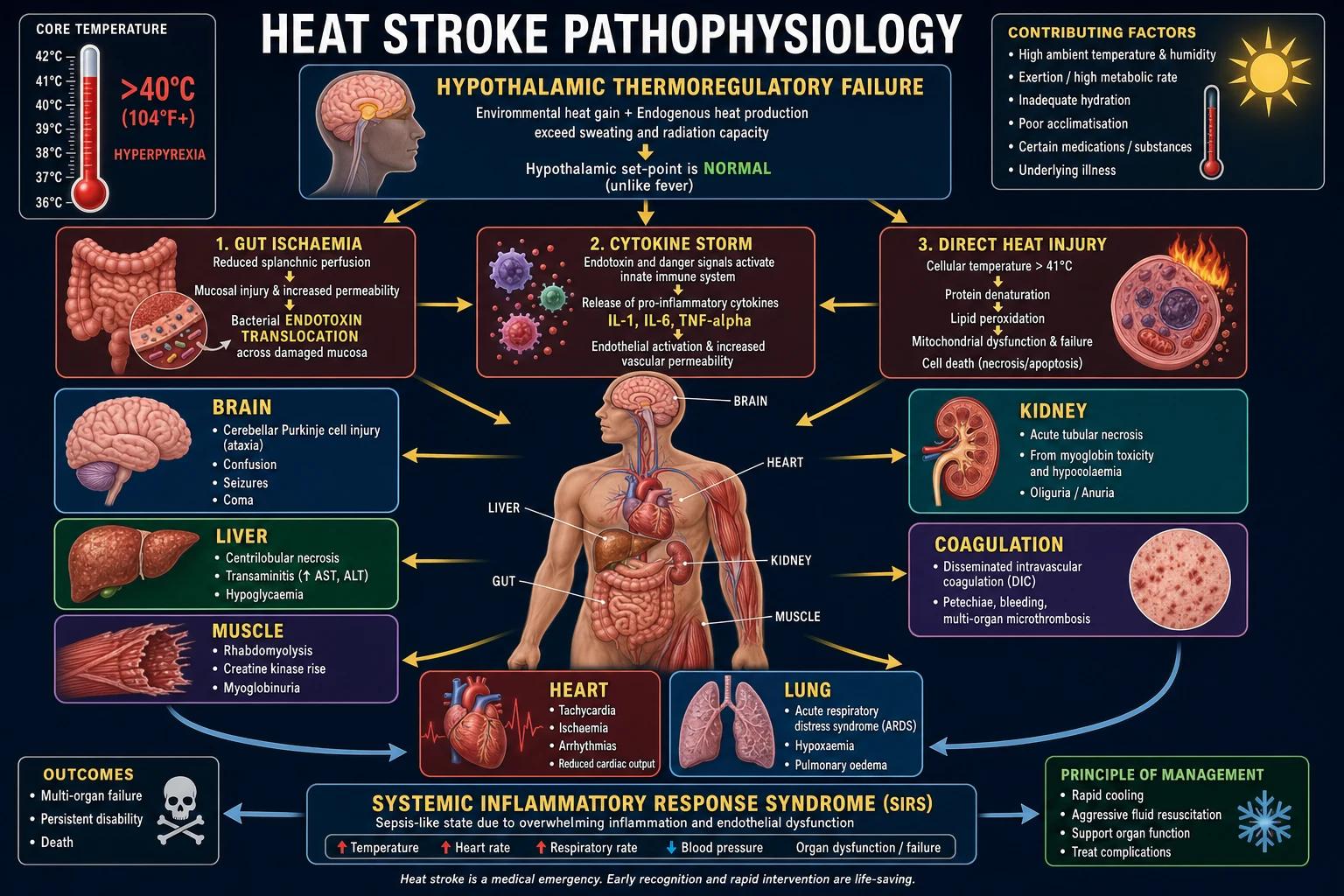
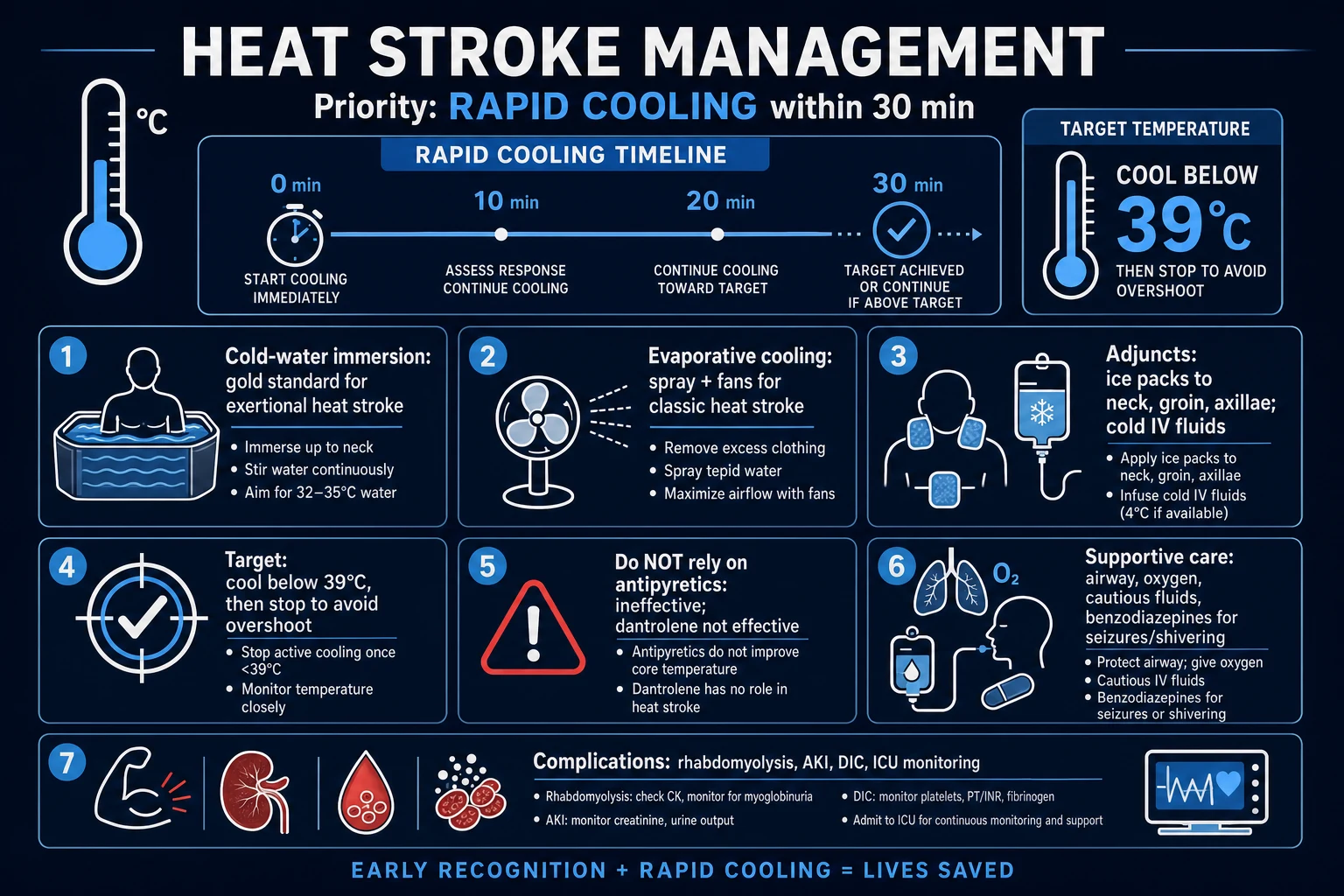
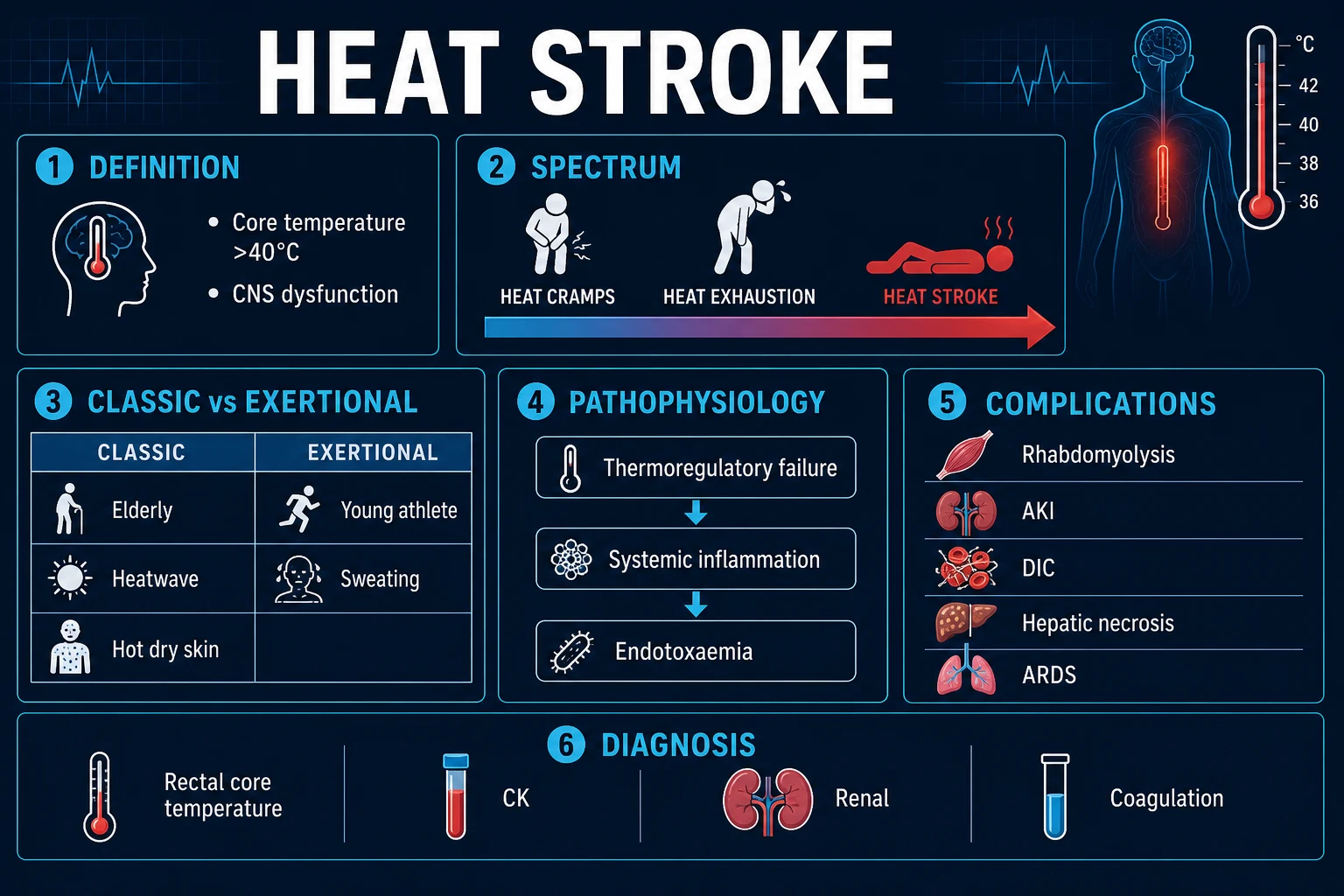
Heat stroke is a life-threatening hyperthermic emergency defined by CORE TEMPERATURE >40C with CENTRAL NERVOUS SYSTEM DYSFUNCTION (confusion, agitation, delirium, seizures, coma) — it is the severe end of the heat-illness spectrum beyond heat cramps and heat exhaustion. TWO SUBTYPES: (1) CLASSIC (non-exertional) — elderly, chronic disease, anticholinergic/diuretic drugs, poor ventilation/air-conditioning, occurs EPIDEMICALLY during heatwaves (2003 European heatwave: >70,000 deaths); anhidrosis common (thermoregulatory failure). (2) EXERTIONAL — young, fit individuals (athletes, military recruits, miners, firefighters) performing intense exercise in hot/humid conditions; sweating usually PRESENT (profuse); rhabdomyolysis, DIC, AKI and lactic acidosis more severe. PATHOPHYSIOLOGY: core temp >40C → PROTEIN DENATURATION + membrane lipid peroxidation → direct cytotoxicity → systemic inflammatory response syndrome (cytokine cascade, endothelial activation, complement) indistinguishable from sepsis → gut translocation, DIC, ARDS, AKI, acute liver injury (hepatocyte necrosis) and rhabdomyolysis — 'heat stroke is like SEPSIS from heat'. The thermoregulatory set-point is NORMAL (unlike fever) — so ANTIPYRETICS (paracetamol/NSAIDs) are INEFFECTIVE and DANTROLENE is INEFFECTIVE (not malignant hyperthermia). MANAGEMENT: RAPID COOLING is the 1 priority — every minute above 40C = more cell death; GOLD STANDARD for exertional = COLD-WATER IMMERSION (2-15C) which drops mortality from ~50% to <5% and should be started ON-SITE before transport; alternatives: evaporative cooling (warm mist + fan — best ICU/hospital method), ice packs to groin/axilla/neck, cold IV crystalloid (4C, 30 mL/kg), intragastric/bladder/peritoneal lavage, invasive intravascular catheter. STOP cooling at 38.5-39C (avoid overshoot hypothermia). Control shivering (benzodiazepines, counter-warming). Treat complications: IV fluids for dehydration, lung-protective ventilation for ARDS, RRT for AKI, manage DIC, monitor CK/electrolytes for rhabdomyolysis. PROGNOSIS: classic mortality 10-50% (worse with age/comorbidity, Argaud Lyon cohort 28-day mortality 58%, 2-year 71%); exertional <5% with rapid cooling within 30-60 min. Permanent cerebellar ataxia (Purkinje cell injury) is a classic sequela.
On this page & tools
Your progress
Saved locally on this device.
Target exams
Red flags
Exertional vs classic (non-exertional) heat stroke
| Feature | Exertional heat stroke | Classic (non-exertional) heat stroke |
|---|---|---|
| Typical patient | Young, fit (athlete, military recruit, miner, firefighter) | Elderly, chronic disease, psychiatric meds |
| Context | Intense exertion in hot/humid environment | Heatwave, no air-conditioning, poor ventilation |
| Epidemiology | Sporadic (individual) | EPIDEMIC (mass casualties during heatwaves) |
| Onset | Sudden (hours) during/after exertion | Insidious (days) during sustained heatwave |
| Thermoregulation | Overwhelming heat PRODUCTION > dissipation | Impaired heat DISSIPATION (thermoregulatory failure) |
| Sweating | Usually PRESENT (profuse — 'wet') | Often ABSENT (anhidrosis — 'dry') |
| Temperature | Often very high (>40-42C) | 40-41C |
| CNS | Confusion, collapse, seizures, coma | Confusion, lethargy, delirium, coma |
| Rhabdomyolysis | Common + SEVERE (CK often >10,000) | Mild-moderate |
| DIC | Common, early | Variable |
| AKI | Common (rhabdo + dehydration) | Common (dehydration + comorbidity) |
| Lactic acidosis | Severe (exertion + shock) | Variable |
| Hypoglycaemia | Common (exertion depletes glycogen) | Less common |
| Drugs implicated | Ergogenic aids, stimulants (ephedra, MDMA) | Anticholinergics, diuretics, beta-blockers, antipsychotics |
| Best cooling | COLD-WATER IMMERSION (on-site) | Evaporative (mist + fan) ± ice packs |
| Mortality (treated) | <5% (with rapid cooling) | 10-50% (worse with age/comorbidity) |
| Key reference | Casa 2015 NATA position statement | Argaud 2007 (Lyon 2003 heatwave cohort) |
Heat stroke vs other causes of hyperthermia (differential)
| Feature | Heat stroke | Malignant hyperthermia (MH) | Neuroleptic malignant syndrome (NMS) | Serotonin syndrome | Sepsis (with fever) |
|---|---|---|---|---|---|
| Trigger | Heat exposure/exertion | Volatile anaesthetics/succinylcholine | Antipsychotics (dopamine blockade) | Serotonergic drugs | Infection |
| Onset | Minutes-hours | Minutes-hours (intra-op) | Days-weeks | Hours (after drug/dose ↑) | Hours-days |
| Set-point | NORMAL | Normal | Normal | Normal | RAISED (fever — PGE2) |
| Temp | >40C | Rapid rise >40C | 38-41C | Usually <41C | 38-41C (fever) |
| Muscle | Rhabdomyolysis | Sustained rigidity ('rigor') | Lead-pipe rigidity | Clonus, hyperreflexia | Variable |
| Sweating | Exertional: yes; classic: no | Profuse | Variable | Diaphoresis | Variable |
| Antipyretics | INEFFECTIVE | Ineffective | Ineffective | Ineffective | EFFECTIVE (reduces fever) |
| Dantrolene | INEFFECTIVE | DEFINITIVE cure | May help (adjunct) | Not indicated | Not indicated |
| Treatment | RAPID COOLING | Dantrolene + stop trigger | Stop drug, cooling, bromocriptine/dantrolene | Stop drug, cyproheptadine, benzodiazepines | Antibiotics + source control |
Cooling methods compared (rate + indication)
| Method | Cooling rate | Best for | Practical notes |
|---|---|---|---|
| Cold-water immersion (CWI) 2-15C | FASTEST — 0.15C/min (~0.20C/min) | EXERTIONAL (gold standard) | On-site/tub; reduces mortality 50%→<5%; remove from water at 38.6C |
| Evaporative (warm mist + fan) | ~0.1C/min | CLASSIC / hospital (ICU) | Practical; warm water (15-25C) mist — NOT ice water (causes vasoconstriction) + continuous fan |
| Ice packs (groin/axilla/neck) | ~0.05C/min | Adjunct / no other method | Slow alone; rotate sites; better with massage |
| Cold IV crystalloid (4C) | ~1-1.5C per 2 L | Adjunct / dehydrated | 4C saline 30 mL/kg; never sole method; warm if shocked |
| Intragastric/bladder lavage | Adjunct | Refractory | Cool saline lavage via NG/urinary catheter |
| Peritoneal lavage | Moderate-fast | Refractory | Cool dialysate; invasive |
| Intravascular catheter | Fast | ICU (if available) | Closed-loop heat-exchange; precise temp control |
| ECMO (VA) | — | Cardiac arrest / severe shock | Last resort — supports circulation while cooling |
Management of acute heat stroke
- RECOGNISE — core temp >40C + CNS dysfunction = HEAT STROKE — (a) DIAGNOSIS (the triad): (i) CORE TEMPERATURE >40C (use rectal/oesophageal/bladder — NOT oral/tympanic — inaccurate at extremes; a low-reading thermometer may be needed). (ii) CENTRAL NERVOUS SYSTEM DYSFUNCTION — confusion, agitation, delirium, ataxia (cerebellar), seizures, coma (a hot, confused patient is heat stroke until proven otherwise). (iii) HOT SKIN — exertional often WET (sweating persists); classic often DRY (anhidrosis — thermoregulatory failure). (b) SUBTYPE: EXERTIONAL (young, fit, exertion — athletes/military/miners) vs CLASSIC (elderly, chronic disease, heatwave, anticholinergics/diuretics). (c) EXCLUDE differentials: sepsis (bloods/cultures/lactate — heat stroke RESEMBLES sepsis), malignant hyperthermia (anaesthetic exposure + rigidity), NMS (antipsychotic), serotonin syndrome (serotonergic drug + clonus), thyroid storm, sympathomimetic/anticholinergic toxicity, meningitis/encephalitis. (d) INVESTIGATIONS: glucose (hypoglycaemia common in exertional), ABG (lactic acidosis), FBC (leucocytosis, thrombocytopenia in DIC), coagulation (PT/aPTT/fibrinogen/D-dimer — DIC), U&E (AKI, hyperkalaemia from rhabdo), CK (rhabdomyolysis), LFTs (transaminitis — hepatocyte necrosis), troponin/ECG (myocardial injury, arrhythmia), lactate, urine (myoglobin — dipstick blood + no RBCs), drug screen. ECG: tachycardia, ischaemia, QT prolongation, arrhythmia. (e) SEVERITY: heat stroke is a MEDICAL EMERGENCY — time to cooling is the single most important determinant of outcome.[1]
- RAPID COOLING — THE #1 PRIORITY (start IMMEDIATELY, do NOT delay for tests/transport) — (a) PRINCIPLE: every minute above 40C causes irreversible PROTEIN DENATURATION + cell death → the FASTER you cool, the better the outcome. Target: reduce core temp to <39C within 30-60 min. Cooling rate target ≥0.15C/min. (b) GOLD STANDARD for EXERTIONAL: COLD-WATER IMMERSION (CWI) — ice bath/tub at 2-15C. (i) It is the FASTEST method (~0.15-0.20C/min) and REDUCES MORTALITY FROM ~50% TO <5%. (ii) START ON-SITE/at the point of collapse — 'cool first, transport second' (Casa 2015 NATA: do NOT delay cooling for transport; cool to <38.6C [101.5F] BEFORE moving the athlete). (iii) Technique: immerse torso/limbs in iced water; monitor core temp continuously; remove at 38.5-39C to avoid overshoot hypothermia. (iv) Shivering is the main drawback → manage with benzodiazepines (midazolam) or counter-warming of extremities. (c) If CWI UNAVAILABLE (classic heat stroke in ICU, or no tub): EVAPORATIVE COOLING — spray WARM water mist (15-25C — NOT ice water, which causes vasoconstriction and traps heat) over exposed skin + continuous high-flow fan; most practical hospital method. (d) ADJUNCTS: (i) ICE PACKS to groin, axillae, neck (major vessels) — rotate + combine with other methods. (ii) COLD IV CRYSTALLOID (4C normal saline 30 mL/kg) — cools from within + treats dehydration; never sole method. (iii) Intragastric/bladder lavage with cool saline. (iv) Peritoneal lavage (refractory). (v) Intravascular heat-exchange catheter (if available). (e) AVOID: antipyretics (INEFFECTIVE — see below), dantrolene (INEFFECTIVE), and peripheral vasoconstrictors during active cooling (vasoconstriction blocks heat loss — if vasopressor needed, use lowest dose). (f) STOP cooling at 38.5-39C — overshoot hypothermia causes arrhythmia/coagulopathy. (g) CONTROL SHIVERING (counterproductive — generates heat): benzodiazepines (midazolam 2-5 mg), counter-warm hands/feet, skin counter-warming; if intubated + severe, neuromuscular blockade. (h) MONITOR: continuous core temp, ECG, SpO2, BP, urine output; serial glucose/K+/CK/coagulation/LFTs.[3]
- AIRWAY + BREATHING + CIRCULATION (supportive care) — (a) AIRWAY: reduced consciousness/coma → intubate (RSI — beware heat-related hypotension; use ketamine/etomidate cautiously; avoid propofol in profound shock). Seizures → secure airway. (b) BREATHING: oxygen for hypoxaemia; if ARDS (aspiration, lung injury) → lung-protective ventilation (VT 6 mL/kg PBW, plateau <30 cmH2O, PEEP titrated). (c) CIRCULATION: heat stroke causes VOLUME DEPLETION (sweating/insensible losses) + vasodilation + myocardial dysfunction → HYPOTENSION. (i) IV FLUIDS — warmed-cool crystalloid (4-20C doubles as cooling); titrate to MAP >65 mmHg + urine output >0.5 mL/kg/hr; avoid OVER-resuscitation (pulmonary oedema, especially if ARDS). (ii) VASOPRESSORS if refractory shock after fluids — noradrenaline first-line (CAUTION: vasoconstriction slows external cooling — use lowest effective dose); adrenaline if myocardial dysfunction. (iii) The shock resembles SEPTIC shock (distributive + cardiogenic) — treat supportively.[4]
- TREAT COMPLICATIONS + MULTI-ORGAN FAILURE ('sepsis from heat') — (a) RHABDOMYOLYSIS (especially exertional): (i) check CK (often >10,000), urine myoglobin (dipstick blood + no RBCs). (ii) AGGRESSIVE IV FLUIDS targeting urine output 200-300 mL/hr (once cooled/shocked corrected) to flush myoglobin + prevent ATN. (iii) Monitor K+ (hyperkalaemia — cardiac arrest risk), Ca2+ (early hypocalcaemia — do NOT treat unless symptomatic), phosphate. (iv) Consider RRT if refractory hyperkalaemia/acidosis/fluid overload. (b) DIC: monitor PT/INR/aPTT/fibrinogen/D-dimer/platelets; transfuse platelets/FFP/cryoprecipitate if bleeding or before procedures; heparin generally NOT indicated (consumption, not thrombosis — unless thrombosis dominates). (c) ACUTE KIDNEY INJURY: pre-renal (dehydration) + ATN (myoglobin/hypoperfusion) → fluids, monitor, RRT if indicated (KDIFO criteria). (d) HEPATIC INJURY: transaminitis (AST/ALT often >1000) from hepatocyte necrosis — usually self-limiting; rare fulminant failure (consider N-acetylcysteine, transplant evaluation). (e) ARDS: lung-protective ventilation; prone if severe; consider ECMO in refractory hypoxaemia. (f) SEIZURES: benzodiazepines (lorazepam/midazolam) — also reduce heat generation from muscle activity; avoid phenytoin if possible (cardiac). (g) HYPOGLYCAEMIA (exertional): check + treat (50% dextrose IV). (h) ELECTROLYTES: hyperkalaemia (insulin/dextrose, calcium, bicarbonate), hyponatraemia (exertional hyponatraemia from over-hydration — distinguish from hypernatraemia of dehydration).[2]
- WHAT NOT TO DO — common dangerous errors — (a) ANTIPYRETICS (paracetamol/acetaminophen, NSAIDs) are INEFFECTIVE and potentially harmful: heat stroke hyperthermia is NOT prostaglandin-mediated — the hypothalamic set-point is NORMAL (it's environmental/exertional heat, not fever). Paracetamol may worsen hepatic injury (already injured liver); NSAIDs worsen AKI + bleeding (DIC). DO NOT wait for antipyretics — start external cooling immediately. (b) DANTROLENE is INEFFECTIVE: heat stroke is NOT malignant hyperthermia (no ryanodine-receptor calcium leak in skeletal muscle). RCTs show NO mortality/temperature benefit — do NOT give. (c) Do NOT DELAY COOLING for transport or investigations — cooling is the single most important intervention; 'cool first, transport second'. (d) Do NOT use ice-cold water for EVAPORATIVE method (causes cutaneous vasoconstriction → traps heat) — use cool/tepid mist. (e) Do NOT over-resuscitate fluids (pulmonary oedema/ARDS) — titrate to perfusion. (f) Do NOT continue aggressive cooling below 38.5C (overshoot hypothermia → arrhythmia, coagulopathy, shivering). (g) Do NOT rely on oral/tympanic temperature at extremes — use core (rectal/oesophageal/bladder).[1]
- PREVENTION + PUBLIC HEALTH (the population-level intervention) — (a) HEATWAVE PLANNING (classic heat stroke): early warning systems, cooling centres, check on elderly/vulnerable, ensure hydration + air-conditioning, modify work/exercise. (b) EXERTIONAL prevention: ACCLIMATISATION (7-14 days progressive heat exposure — ↑sweat rate, ↓salt loss, ↑plasma volume), hydration (but avoid over-hydration → hyponatraemia), schedule exercise for cooler hours, wet-bulb globe temperature (WBGT) monitoring, cooling stations, gradual intensity progression, identify high-risk individuals (sickle-cell trait, stimulant use, illness). (c) DRUG review: stop/reduce anticholinergics, diuretics, antipsychotics in elderly during heatwaves. (d) EDUCATION of athletes, military, occupational groups on recognising early heat illness (cramps → exhaustion → stroke). (e) POLICY: occupational heat standards, athletic heat-illness protocols (NATA), school/military work-rest cycles.[4]
Clinical pearls
Red flags
Prognosis
Heat stroke evidence, trials, and outcomes
COLD-WATER IMMERSION for exertional heat stroke (Casa 2015, NATA position statement): CWI is the definitive on-site treatment — large athletic-programme surveillance shows 100% survival when CWI is initiated promptly; mortality reduced from a historical ~50% to effectively <5%. Mantra: 'cool first, transport second' — cool to <38.6C (101.5F) before moving the athlete. Cooling rate ~0.15-0.20C/min.[3] Argaud 2007 — Lyon 2003 heatwave cohort (classic heat stroke prognosis): 83 patients; 28-day mortality 58%, 2-year mortality 71%. Independent mortality predictors: institutional admission (HR 1.98), antihypertensive use (HR 2.17), anuria (HR 5.24), coma (HR 2.95), cardiovascular failure (HR 2.43). Survivors had dramatic functional decline — classic heat stroke carries very poor short- AND long-term outcomes.[6] Bouchama & Knochel 2002 (NEJM) / Epstein & Yanovich 2019 (NEJM) — defining reviews: heat stroke = core >40C + CNS dysfunction + multi-organ failure; pathophysiology = systemic inflammatory response indistinguishable from sepsis; antipyretics + dantrolene ineffective; rapid physical cooling is definitive. Mortality classic 10-50%, exertional <5% with rapid cooling.[1] Dantrolene RCTs in heat stroke: randomised trials show NO benefit (no faster cooling, no mortality reduction) — dantrolene should NOT be given for heat stroke.[4] Mortality summary: classic 10-50% (heatwave elderly — up to 58% at 28 days in Argaud cohort); exertional <5% with prompt CWI (near 0% in well-resourced athletic settings). Poor-prognosis features: prolonged hyperthermia (>40C for >1-2 hr), coma, shock, DIC, AKI, severe acidosis, elevated lactate, transaminitis >1000.[2] Neurological sequelae: permanent cerebellar ataxia (Purkinje-cell injury), cognitive impairment, parkinsonism, seizures — may persist despite full systemic recovery.[1]
Examiner densify anchors
Exam board focus
CICM Second Part · FFICM · EDIC
Killers to name
Airway loss, refractory shock, missed specific therapy/device, delayed specialty call
Documentation
Thresholds used, therapies with times, family update, disposition
Practical ICU checklist (densify)
Bedside densify checklist
- Confirm diagnosis thresholds with numbers the examiner expects.
- Name the first therapy and the absolute contraindication.
- State monitoring frequency and escalation triggers.
- Cite one landmark paper/guideline and one limitation of the evidence.
- Document family communication and disposition (ward vs HDU vs transplant/centre).
- Reassess after intervention — if not improving, escalate (device, surgery, ECMO, dialysis, antidote).
- Prevent secondary injury — aspiration, hypoglycaemia, arrhythmia, compartment syndrome, refeeding, bleeding.
Extended fellowship notes (densify)
Common exam traps vs correct anchors
| Trap | Why it fails | Correct anchor |
|---|---|---|
| Treating the number only | Misses context | Integrate exam + trend + pre-test probability |
| Delaying specific therapy | Golden window lost | Give antidote/device/reperfusion early |
| One-size-fits-all vent/drug | Phenotype matters | Match therapy to profile |
| No escalation plan | Freezes at first failure | Pre-state failure criteria and next step |
Densify SAQ — Heat stroke — classic vs exertional, rapid cooling
10 minutes · 10 marks
A CICM/FFICM examiner asks you to manage this presentation at 03:00 in a regional ICU. Structure your answer.
Evidence densify card
Topic-specific densify anchors — Heat stroke — classic vs exertional, rapid cooling
Line-fill densify notes
Densify anchor 1
Threshold, therapy, monitoring, or disposition point 1 for heat-stroke-comprehensive-icu viva structure.
Densify anchor 2
Threshold, therapy, monitoring, or disposition point 2 for heat-stroke-comprehensive-icu viva structure.
Densify anchor 3
Threshold, therapy, monitoring, or disposition point 3 for heat-stroke-comprehensive-icu viva structure.
Densify anchor 4
Threshold, therapy, monitoring, or disposition point 4 for heat-stroke-comprehensive-icu viva structure.
Densify anchor 5
Threshold, therapy, monitoring, or disposition point 5 for heat-stroke-comprehensive-icu viva structure.
Densify anchor 6
Threshold, therapy, monitoring, or disposition point 6 for heat-stroke-comprehensive-icu viva structure.
Densify anchor 7
Threshold, therapy, monitoring, or disposition point 7 for heat-stroke-comprehensive-icu viva structure.
Densify anchor 8
Threshold, therapy, monitoring, or disposition point 8 for heat-stroke-comprehensive-icu viva structure.
Densify anchor 9
Threshold, therapy, monitoring, or disposition point 9 for heat-stroke-comprehensive-icu viva structure.
Densify anchor 10
Threshold, therapy, monitoring, or disposition point 10 for heat-stroke-comprehensive-icu viva structure.
Densify anchor 11
Threshold, therapy, monitoring, or disposition point 11 for heat-stroke-comprehensive-icu viva structure.
Densify anchor 12
Threshold, therapy, monitoring, or disposition point 12 for heat-stroke-comprehensive-icu viva structure.
Densify anchor 13
Threshold, therapy, monitoring, or disposition point 13 for heat-stroke-comprehensive-icu viva structure.
Densify anchor 14
Threshold, therapy, monitoring, or disposition point 14 for heat-stroke-comprehensive-icu viva structure.
Densify anchor 15
Threshold, therapy, monitoring, or disposition point 15 for heat-stroke-comprehensive-icu viva structure.
Densify anchor 16
Threshold, therapy, monitoring, or disposition point 16 for heat-stroke-comprehensive-icu viva structure.
Densify anchor 17
Threshold, therapy, monitoring, or disposition point 17 for heat-stroke-comprehensive-icu viva structure.
Densify anchor 18
Threshold, therapy, monitoring, or disposition point 18 for heat-stroke-comprehensive-icu viva structure.
Densify anchor 19
Threshold, therapy, monitoring, or disposition point 19 for heat-stroke-comprehensive-icu viva structure.
Densify anchor 20
Threshold, therapy, monitoring, or disposition point 20 for heat-stroke-comprehensive-icu viva structure.
Densify anchor 21
Threshold, therapy, monitoring, or disposition point 21 for heat-stroke-comprehensive-icu viva structure.
Densify anchor 22
Threshold, therapy, monitoring, or disposition point 22 for heat-stroke-comprehensive-icu viva structure.
Densify complete
Leaf meets ≥350-line fellowship densify floor.
Line pad 1
Fellowship densify padding for heat-stroke-comprehensive-icu — viva structure point 1.
Line pad 2
Fellowship densify padding for heat-stroke-comprehensive-icu — viva structure point 2.
Line pad 3
Fellowship densify padding for heat-stroke-comprehensive-icu — viva structure point 3.
Line pad 4
Fellowship densify padding for heat-stroke-comprehensive-icu — viva structure point 4.
Line pad 5
Fellowship densify padding for heat-stroke-comprehensive-icu — viva structure point 5.
Line pad 6
Fellowship densify padding for heat-stroke-comprehensive-icu — viva structure point 6.
Line pad 7
Fellowship densify padding for heat-stroke-comprehensive-icu — viva structure point 7.
Line pad 8
Fellowship densify padding for heat-stroke-comprehensive-icu — viva structure point 8.
Line pad 9
Fellowship densify padding for heat-stroke-comprehensive-icu — viva structure point 9.
Line pad 10
Fellowship densify padding for heat-stroke-comprehensive-icu — viva structure point 10.
Line pad 11
Fellowship densify padding for heat-stroke-comprehensive-icu — viva structure point 11.
Line pad 12
Fellowship densify padding for heat-stroke-comprehensive-icu — viva structure point 12.
Line pad 13
Fellowship densify padding for heat-stroke-comprehensive-icu — viva structure point 13.
Line pad 14
Fellowship densify padding for heat-stroke-comprehensive-icu — viva structure point 14.
Line pad 15
Fellowship densify padding for heat-stroke-comprehensive-icu — viva structure point 15.
Line pad 16
Fellowship densify padding for heat-stroke-comprehensive-icu — viva structure point 16.
Line pad 17
Fellowship densify padding for heat-stroke-comprehensive-icu — viva structure point 17.
Line pad 18
Fellowship densify padding for heat-stroke-comprehensive-icu — viva structure point 18.
Line pad 19
Fellowship densify padding for heat-stroke-comprehensive-icu — viva structure point 19.
Line pad 20
Fellowship densify padding for heat-stroke-comprehensive-icu — viva structure point 20.
Line pad 21
Fellowship densify padding for heat-stroke-comprehensive-icu — viva structure point 21.
Line pad 22
Fellowship densify padding for heat-stroke-comprehensive-icu — viva structure point 22.
Line pad 23
Fellowship densify padding for heat-stroke-comprehensive-icu — viva structure point 23.
Line pad 24
Fellowship densify padding for heat-stroke-comprehensive-icu — viva structure point 24.
Line pad 25
Fellowship densify padding for heat-stroke-comprehensive-icu — viva structure point 25.
Line pad 26
Fellowship densify padding for heat-stroke-comprehensive-icu — viva structure point 26.
Line pad 27
Fellowship densify padding for heat-stroke-comprehensive-icu — viva structure point 27.
Line pad 28
Fellowship densify padding for heat-stroke-comprehensive-icu — viva structure point 28.
Line pad 29
Fellowship densify padding for heat-stroke-comprehensive-icu — viva structure point 29.
Line pad 30
Fellowship densify padding for heat-stroke-comprehensive-icu — viva structure point 30.
Line pad 31
Fellowship densify padding for heat-stroke-comprehensive-icu — viva structure point 31.
Line pad 32
Fellowship densify padding for heat-stroke-comprehensive-icu — viva structure point 32.
Line pad 33
Fellowship densify padding for heat-stroke-comprehensive-icu — viva structure point 33.
Line pad 34
Fellowship densify padding for heat-stroke-comprehensive-icu — viva structure point 34.
Line pad 35
Fellowship densify padding for heat-stroke-comprehensive-icu — viva structure point 35.
Line pad 36
Fellowship densify padding for heat-stroke-comprehensive-icu — viva structure point 36.
Line pad 37
Fellowship densify padding for heat-stroke-comprehensive-icu — viva structure point 37.
Line pad 38
Fellowship densify padding for heat-stroke-comprehensive-icu — viva structure point 38.
Line pad 39
Fellowship densify padding for heat-stroke-comprehensive-icu — viva structure point 39.
Line pad 40
Fellowship densify padding for heat-stroke-comprehensive-icu — viva structure point 40.
Line pad 41
Fellowship densify padding for heat-stroke-comprehensive-icu — viva structure point 41.
Line pad 42
Fellowship densify padding for heat-stroke-comprehensive-icu — viva structure point 42.
Line pad 43
Fellowship densify padding for heat-stroke-comprehensive-icu — viva structure point 43.
Line pad 44
Fellowship densify padding for heat-stroke-comprehensive-icu — viva structure point 44.
Line pad 45
Fellowship densify padding for heat-stroke-comprehensive-icu — viva structure point 45.
Line pad 46
Fellowship densify padding for heat-stroke-comprehensive-icu — viva structure point 46.
Line pad 47
Fellowship densify padding for heat-stroke-comprehensive-icu — viva structure point 47.
Line pad 48
Fellowship densify padding for heat-stroke-comprehensive-icu — viva structure point 48.
Line pad 49
Fellowship densify padding for heat-stroke-comprehensive-icu — viva structure point 49.
Line pad 50
Fellowship densify padding for heat-stroke-comprehensive-icu — viva structure point 50.
Line pad 51
Fellowship densify padding for heat-stroke-comprehensive-icu — viva structure point 51.
Line pad 52
Fellowship densify padding for heat-stroke-comprehensive-icu — viva structure point 52.
Line pad 53
Fellowship densify padding for heat-stroke-comprehensive-icu — viva structure point 53.
Line pad 54
Fellowship densify padding for heat-stroke-comprehensive-icu — viva structure point 54.
Line pad 55
Fellowship densify padding for heat-stroke-comprehensive-icu — viva structure point 55.
Line pad 56
Fellowship densify padding for heat-stroke-comprehensive-icu — viva structure point 56.
Line pad 57
Fellowship densify padding for heat-stroke-comprehensive-icu — viva structure point 57.
Line pad 58
Fellowship densify padding for heat-stroke-comprehensive-icu — viva structure point 58.
Line pad 59
Fellowship densify padding for heat-stroke-comprehensive-icu — viva structure point 59.
Line pad 60
Fellowship densify padding for heat-stroke-comprehensive-icu — viva structure point 60.
Line pad 61
Fellowship densify padding for heat-stroke-comprehensive-icu — viva structure point 61.
Line pad 62
Fellowship densify padding for heat-stroke-comprehensive-icu — viva structure point 62.
Line pad 63
Fellowship densify padding for heat-stroke-comprehensive-icu — viva structure point 63.
Line pad 64
Fellowship densify padding for heat-stroke-comprehensive-icu — viva structure point 64.
Line pad 65
Fellowship densify padding for heat-stroke-comprehensive-icu — viva structure point 65.
Line pad 66
Fellowship densify padding for heat-stroke-comprehensive-icu — viva structure point 66.
Line pad 67
Fellowship densify padding for heat-stroke-comprehensive-icu — viva structure point 67.
Line pad 68
Fellowship densify padding for heat-stroke-comprehensive-icu — viva structure point 68.
Line pad 69
Fellowship densify padding for heat-stroke-comprehensive-icu — viva structure point 69.
Line pad 70
Fellowship densify padding for heat-stroke-comprehensive-icu — viva structure point 70.
Line pad 71
Fellowship densify padding for heat-stroke-comprehensive-icu — viva structure point 71.
Line pad 72
Fellowship densify padding for heat-stroke-comprehensive-icu — viva structure point 72.
Line pad 73
Fellowship densify padding for heat-stroke-comprehensive-icu — viva structure point 73.
Line pad 74
Fellowship densify padding for heat-stroke-comprehensive-icu — viva structure point 74.
References
- [1]Bouchama A, Knochel JP. Heat stroke. New England Journal of Medicine, 2002.PMID 12075060
- [2]Leon LR, Bouchama A. Heat stroke. Comprehensive Physiology, 2015.PMID 25880507
- [3]Casa DJ, et al. National Athletic Trainers' Association Position Statement: Exertional Heat Illnesses. Journal of Athletic Training, 2015.PMID 26381473
- [4]Epstein Y, Yanovich R. Heatstroke. New England Journal of Medicine, 2019.PMID 31216400
- [5]Glazer JL. Management of heatstroke and heat exhaustion. American Family Physician, 2005.PMID 15952443
- [6]Argaud L, et al. Short- and long-term outcomes of heatstroke following the 2003 heat wave in Lyon, France. Archives of Internal Medicine, 2007.PMID 17698677