ICU · Equipment, physics & clinical measurement
Humidification
Also known as Humidification · Heat and moisture exchanger · HME · Heated humidifier · Absolute humidity · Artificial nose · Mucociliary clearance · Isothermic saturation boundary · Relative humidity · Dew point · Rain-out · Ventilator circuit · High-flow nasal cannula
Humidification for the ICU First Part: the upper airway (nose and turbinates) warms, humidifies, and filters inspired gas so that by the carina, and the isothermic saturation boundary (ISB) about 5 cm below it, gas reaches 37 degrees C, 100% relative humidity, and about 44 mg of water per litre; an endotracheal or tracheostomy tube bypasses this, so dry gas impairs mucociliary clearance, causes mucus plugging, atelectasis, and ventilator-associated pneumonia. Absolute humidity (mg/L) is the measure that matters. A passive heat-and-moisture exchanger (HME, artificial nose) captures exhaled heat and water in a hygroscopic medium to about 30 mg/L (roughly 60-70% efficiency); it is contraindicated with thick or bloody secretions, large air leaks, low tidal volume under 300 mL, and high minute ventilation. An active heated humidifier warms a water bath to 37-40 degrees for full saturation (44 mg/L) and is essential for high-flow nasal cannula and long-term ventilation. CDC guidance is to change circuits only when visibly soiled or malfunctioning, not routinely.
On this page & tools
Your progress
Saved locally on this device.
8 MCQs with explanations
Target exams
Red flags
Overview & rationale
The nose and upper airway warm, humidify, and filter inspired gas so that by the carina it is close to 37 degrees Celsius and 100 per cent relative humidity (about 44 mg of water per litre). An endotracheal or tracheostomy tube bypasses this natural airway, so the delivered gas is cold and dry. Without humidification this dries secretions, impairs mucociliary clearance, causes mucosal injury and inspissated plugs with atelectasis, and increases heat loss. Humidification restores moisture and heat to inspired gas.[1]
The physiology of natural humidification
The upper airway is a heat and moisture exchanger built into the body, and understanding what it does - and what is lost when it is bypassed - is the foundation of this topic.[1]
The nose and turbinates - three jobs
Inspired room air is typically cool (around 20 degrees Celsius) and dry (about 50 per cent relative humidity, roughly 9 mg of water per litre). As it streams through the nasal cavity it meets the turbinate bones (conchae) - three shelves of highly vascular, erectile mucosa with a large surface area. The turbinates do three things: [1]
- Warm the gas. Blood in the rich venous plexus of the turbinates is at body temperature; the thin mucosal surface transfers heat to the gas by convection, warming it to near 37 degrees by the time it reaches the posterior nasopharynx. Warming matters because warm gas can hold more water vapour.
- Humidify the gas. Seromucous glands and goblet cells secrete fluid onto the mucosa; evaporation from this thin film saturates the gas, raising its water content to nearly 44 mg/L (100 per cent relative humidity at body temperature). This is the single largest contribution to humidification.
- Filter the gas. The turbulent airflow over the turbinates and the mucus blanket trap particulate matter and microbes, which are then cleared upward by the cilia. The nose is therefore the first line of airway defence. [1]
A useful reflex consequence of this anatomy is the counter-current heat exchange: on exhalation, warm saturated gas from the lungs gives heat and water back to the cooler turbinate mucosa, which partly reclaims them. This is exactly what a passive HME is designed to imitate (see below).[1]
The conditioning gradient down the airway
The warming and humidifying process continues as a gradient down the respiratory tract, not a single event. As inspired gas moves deeper: [1]
- Temperature rises progressively toward 37 degrees.
- Water content rises progressively toward 44 mg/L (full saturation at 37 degrees).
- The point at which the gas reaches full saturation at body temperature defines the isothermic saturation boundary (below). [1]
During quiet nasal breathing the ISB sits high in the trachea; with cold dry gas, mouth-breathing, high flows, or a bypassed upper airway, the ISB shifts distally, forcing the lower airway to do the work of humidification - which it cannot do without damage.[1]
The isothermic saturation boundary (ISB)
The isothermic saturation boundary is the anatomical point at which inspired gas reaches body temperature (37 degrees C) and is fully saturated with water vapour (100 per cent relative humidity, about 44 mg of water per litre).[1]
In a normal, healthy adult breathing quietly through the nose, the ISB lies just below the vocal cords, around 5 cm below the carina - that is, gas is conditioned before it reaches the subsegmental bronchi, and the entire gas-exchanging lung is exposed only to warm, fully saturated gas. Below the ISB the temperature and humidity of the gas are constant (hence isothermic - equal temperature) on both inspiration and expiration, so the deep lung neither gains nor loses heat or water over a breath cycle.[1]
Two consequences matter clinically: [1]
- Anything that bypasses or overwhelms the upper airway shifts the ISB distally. Mouth-breathing, high inspiratory flows, cold dry gas, and especially an endotracheal or tracheostomy tube all push the saturation point deeper into the bronchial tree. The distal airway mucosa, which is not designed for it, is then forced to give up its own water and heat to condition the gas.
- The aim of artificial humidification is to restore the ISB to its normal position - to deliver gas that is already at 37 degrees and 44 mg/L so that the patient's own airway does not have to do the work. A well-functioning active heated humidifier achieves this; an HME gets close (about 30 mg/L); unhumidified dry gas does not.[1]
Where the ISB sits - and what it means
| Situation | Approximate ISB position | Implication |
|---|---|---|
| Nose-breathing, quiet, room air | Upper trachea, ~5 cm below carina | Normal; deep lung sees 37 degrees, 44 mg/L |
| Mouth-breathing | Lower trachea / main bronchi | Upper airway bypassed; distal mucosa dries |
| High inspiratory flow | Shifts distally | Less residence time for conditioning |
| Cold / dry inspired gas | Shifts markedly distally | Airway must give up its own water and heat |
| Endotracheal / tracheostomy tube | Below the tube tip; effectively lost | Upper airway completely bypassed - artificial humidification required |
| Adequately humidified delivered gas (37 degrees, 44 mg/L) | Restored to the tube / carina | Patient's own airway protected |
Definitions
- Absolute humidity is the mass of water vapour per unit volume of gas (mg/L) - the measure that matters for the airway.[1]
- Relative humidity is the water content as a percentage of the maximum the gas can hold at that temperature. Warm gas holds more water, so heating the gas raises its capacity.[1]
The relationship is quantitative: the maximum amount of water a gas can hold (100 per cent relative humidity, the saturation value) rises steeply with temperature, which is why heating is inseparable from humidifying.[1]
Absolute humidity at 100% RH (saturation) vs temperature
| Gas temperature | Absolute humidity at 100% RH | Clinical context |
|---|---|---|
| 20 degrees C (room air) | ~17 mg/L | Typical delivered gas without humidification |
| 32 degrees C | ~34 mg/L | Target for many HMEs and some non-invasive set-ups |
| 34 degrees C | ~38 mg/L | Intermediate active humidifier setting |
| 37 degrees C | ~44 mg/L | Body temperature; the target for the ISB |
| 40 degrees C | ~51 mg/L | Upper limit of active humidifier setting |
The dew point and rain-out
The dew point is the temperature at which a given mass of water vapour just saturates the gas (100 per cent relative humidity). If saturated gas is then cooled any further, it can no longer hold all its water, and the surplus condenses as liquid droplets - the basis of rain-out in a heated humidifier circuit. A heated wire keeps the gas above its dew point throughout the tubing so no condensation forms; where condensation is deliberately allowed (in a water trap), the circuit must slope downward toward the trap so the water runs away from the patient rather than pooling toward the airway.[3]
Effects of bypassing the upper airway
When an endotracheal or tracheostomy tube is in place, the nose, turbinates, and upper trachea are bypassed entirely. Inspired gas arrives in the trachea cold and dry, and a predictable, damaging cascade follows - often within hours.[1][4]
The dry-gas cascade
- Mucosal drying and metaplasia. Dry gas strips water from the tracheobronchial mucosa. Within hours the ciliated epithelium loses its periciliary fluid layer; over days the mucosa can undergo squamous metaplasia and lose cilia altogether.
- Impaired mucociliary clearance. Normal ciliary beat frequency (about 10-15 Hz) depends on a low-viscosity periciliary sol layer in which the cilia can swing; drying thickens the mucus and slows or paralyses the cilia. Mucus transport, normally several millimetres per minute, falls toward zero.
- Inspissated secretions and mucus plugging. Water lost to dry gas is drawn out of secretions; they become tenacious and sticky, adhere to the tube and airway walls, and form plugs that can occlude segmental bronchi or the endotracheal tube itself.
- Atelectasis. Obstructed bronchi lead to absorption atelectasis distally, shunting blood to underventilated lung and worsening gas exchange.
- Infection and ventilator-associated pneumonia (VAP). Stagnant, inspissated secretions are an ideal culture medium; impaired clearance allows colonising bacteria to reach and persist in the lower airway. Inadequate humidification is a recognised contributor to VAP and to endotracheal tube occlusion.[1][4]
- Heat loss. The latent heat of vaporisation is carried out of the airway with each exhalation (evaporative heat loss), contributing to hypothermia in the patient who is sedated, paralysed, and receiving cool dry gas.
What the upper airway does - and what is lost when it is bypassed
| Function | Normal upper airway | With endotracheal / tracheostomy tube |
|---|---|---|
| Warming | Gas warmed to ~37 degrees by carina | Gas arrives cold; lower airway must warm it |
| Humidifying | Gas saturated to ~44 mg/L by carina | Gas arrives dry; lower airway donates its own water |
| Filtering | Turbinates and mucus trap particles and microbes | No filtering; bacteria-laden aerosol reaches the lung |
| Mucociliary clearance | Cilia beat in a normal sol layer; transport ~mm/min | Cilia slowed/paralysed; transport near zero |
| Counter-current reclaim | Heat and water reclaimed on exhalation | Reclaim lost; net heat and water loss |
The dry-gas cascade after intubation (what happens without humidification)
- Dry cool gas enters the trachea. With the upper airway bypassed, gas at ~20 degrees and ~9-17 mg/L is delivered straight to the carina.[1]
- The distal airway donates water and heat. Evaporation from the tracheobronchial mucosa humidifies the gas at the expense of the mucosa; the ISB is pushed distally.[1]
- Periciliary fluid is depleted; cilia slow and stop. Viscosity rises, ciliary beat frequency falls, and mucociliary transport collapses within hours.[4]
- Secretions inspissate. Mucus thickens and adheres to the tube and airway walls, forming plugs that obstruct segmental bronchi.[1]
- Atelectasis and shunt develop behind obstructed bronchi, worsening oxygenation and compliance.[1]
- Bacterial colonisation and VAP follow as stagnant secretions become culture medium and clearance fails - inadequate humidification is a recognised VAP risk.[1][4]
- Evaporative heat loss contributes to hypothermia, especially in the long, sedated admission.[1]
Humidifier types
Two families of humidifier are in routine ICU use, and the distinction between them is the heart of the exam answer:[1][6]
- Passive - the heat and moisture exchanger (HME, "artificial nose"), which captures the patient's own exhaled heat and water and returns them on the next breath. No power, no water; efficiency limited (about 30 mg/L, ~60-70 per cent).
- Active - the heated humidifier, which warms an external water bath to deliver fully saturated gas at body temperature (about 44 mg/L, ~100 per cent). Requires power and a water source. [1]
Both work, both have a role, and both have failure modes. The choice is governed by the patient's secretions, the tidal volume and minute ventilation, the expected duration, and whether there is a large air leak.[1][4]
Passive: heat and moisture exchanger (HME)
- An HME ("artificial nose") is a disposable filter placed between the breathing circuit and the airway. It contains a hygroscopic and hydrophobic medium that captures heat and moisture from the patient's expired gas and returns them on the next inspiration, achieving about 30 mg/L absolute humidity.[1]
- Advantages: simple, no power or water, low dead space in modern designs, no risk of overheating, and it filters exhaled microbes.[1]
- It adds a small resistance and dead space, and is contraindicated when secretions are thick, bloody, or copious (it blocks), in large air leaks (it cannot trap moisture), in severe hypothermia, and generally for high-flow systems or prolonged use where efficiency is inadequate.[1]
How an HME works
On expiration, warm saturated gas (37 degrees, 44 mg/L) passes out through the HME. The hygroscopic medium (typically calcium-impregnated paper or a sponge) absorbs water vapour and the hydrophobic element retains heat, so the medium warms and loads with water. On the next inspiration, cool dry gas passes back through the now warm, wet medium and picks up the stored heat and water. Efficiency is greatest when the full exhaled tidal volume traverses the HME - which is why a large air leak defeats it.[1]
HME efficiency and its limits
A modern HME returns about 30 mg of water per litre - roughly 60-70 per cent of the 44 mg/L target. This is usually adequate for short-term ventilation with modest secretions, but it is below full saturation, so the distal airway still does some of the work. Performance falls further when:[3][6]
- The patient's secretions are copious or bloody and load the medium.
- A large cuff or broncho-pleural air leak means exhaled gas (and its moisture) does not return through the HME.
- Tidal volumes are small (< 300 mL), so a larger fraction of each breath is "wasted" in the HME dead space, and less gas traverses the medium effectively.
- Minute ventilation is very high (the medium cannot humidify fast enough for the flow).
- The HME has been left in place too long and is saturated or blocked. [1]
HMEs are also single-use, changed every 24 hours (or sooner if soiled), because their efficiency falls as the medium loads with secretions.[1]
Active: heated humidifier
- A water bath is warmed to 37-40 degrees Celsius and the inspired gas passes over it, fully saturating it to about 44 mg/L at body temperature. A heated wire in the circuit prevents condensation ("rain-out") as the gas travels to the patient.[1]
- It provides reliable, high-efficiency humidification for long-term ventilation and is essential for high-flow nasal cannula oxygen (warmed to 37 degrees and fully humidified).[1]
- Risks: overheating (mucosal burns), condensation and water inhalation if the circuit slopes incorrectly, and water-borne contamination (use sterile water and change circuits per protocol rather than daily, to limit colonisation).[1]
How a heated humidifier works
A reservoir of sterile water is heated by a thermostatically controlled element, and the inspired gas is directed over (or bubbled through) the water so it becomes fully saturated at the set temperature. Because saturated gas cools and condenses as it travels through cooler tubing, a heated wire runs the length of the inspiratory limb to keep the gas above its dew point; a temperature probe at the patient Y-piece closes the feedback loop. Set to 37 degrees at the airway, the system delivers ~44 mg/L - matching the ISB.[3]
Risks of the heated humidifier
- Overheating - a faulty thermostat or a blocked gas flow can superheat the water bath, delivering gas hot enough to cause thermal airway injury. Alarms and a maximum set temperature (typically 40-41 degrees) protect against this.[1]
- Rain-out and water bolus - if the gas cools below its dew point anywhere in the circuit (e.g., a broken heated wire, a kinked tube, or a circuit repositioned so condensation pools toward the patient), liquid water accumulates and can be flushed into the airway. The circuit must slope downward to a water trap, never toward the patient.[3]
- Under-humidification - if the chamber runs dry the gas reaches the patient unhumidified; water level alarms and closed refill systems mitigate this.[1]
- Contamination - the warm water bath can grow bacteria (notably Legionella and Gram-negative bacilli), so only sterile (or filtered, not tap) water is used, and circuits are changed only when soiled or malfunctioning, not routinely.[4][1]
HME versus heated humidifier - the comparison
HME versus heated humidifier - the head-to-head
| Feature | HME (passive, artificial nose) | Heated humidifier (active) |
|---|---|---|
| Principle | Captures exhaled heat and water in a hygroscopic medium; returns on inspiration | External water bath warmed; gas fully saturated at body temperature |
| Absolute humidity delivered | ~30 mg/L (~60-70% of target) | ~44 mg/L (~100%, full saturation) |
| Temperature | Ambient; no heating | Set to 37-40 degrees C |
| Power / water needed | None | Electricity and sterile water |
| Dead space | Small, but present (matters at low Vt) | None (water is in the circuit, not the airway) |
| Resistance | Small added resistance | Negligible |
| Microbial filtration | Yes - filters exhaled microbes | No filtration; circuit can colonise |
| Best for | Short-term ventilation, modest secretions, transport, low infection-risk use | Long-term ventilation, thick/bloody secretions, high flow, low Vt, large air leak |
| Failure modes | Blocks with secretions/blood; ineffective with air leak or high flow | Overheating burns, rain-out water bolus, chamber runs dry, contamination |
| Cost | Low, single-use | Higher, but circuit reusable |
| Suitability for HFNC | No | Yes - mandatory |
When to use each - contraindications and the decision
The practical question is which humidifier to choose for a given patient. The default for short-term, uncomplicated ventilation is an HME; the default for everything else is a heated humidifier.[1][4]
Choose a heated humidifier (HME contraindicated) when:[1][4][6]
- Thick, bloody, or copious secretions - they block the HME, raise resistance and dead space, and risk airway occlusion.
- A large air leak (broncho-pleural fistula, large cuff leak, uncuffed tube) - the HME only works if the exhaled gas returns through it; an air leak defeats it.
- Low tidal volume (< 300 mL) - the HME's dead space becomes a significant fraction of the breath, both wasting ventilation and reducing effective humidification; lung-protective ventilation with small Vt is a reason to use a heated humidifier.
- High minute ventilation (e.g., severe acidosis, ARDS, bronchospasm) - the HME cannot humidify fast enough for the flow.
- Severe hypothermia - active warming is needed; an HME cannot add net heat.
- High-flow systems (HFNC) or non-rebreathing circuits - HMEs are not designed for these flows.[7]
- Very long-term ventilation where efficiency drift and secretion loading make the HME unreliable.
An HME is reasonable when:[1]
- Ventilation is short-to-medium term (hours to a few days).
- Secretions are thin and manageable.
- Tidal volume is adequate (typically > 300 mL) and minute ventilation is not extreme.
- There is no significant air leak.
- Simplicity, transportability, or bacterial filtration are desired. [1]
Choosing the right humidifier in the ICU
- Assess the secretions. Thin and scant - either device is fine. Thick, bloody, or copious - use a heated humidifier; an HME will block.[1]
- Check for an air leak. Any large broncho-pleural or cuff leak defeats the HME - choose a heated humidifier.[4]
- Look at the ventilator settings. Low Vt (< 300 mL, lung-protective) or high minute ventilation - heated humidifier, because the HME dead space wastes ventilation and the medium cannot keep up.[6]
- Consider duration and system. High-flow nasal cannula, non-rebreathing circuits, or long-term ventilation - heated humidifier is mandatory or strongly preferred.[7]
- Factor in temperature. Severe hypothermia needing active warming - heated humidifier adds net heat; an HME cannot.[1]
- Default to HME for uncomplicated short-term ventilation, transport, or where bacterial filtration and simplicity are wanted.[1]
- Review daily. A patient whose secretions thicken, who develops an air leak, or whose Vt is reduced should be switched from an HME to a heated humidifier.[4]
Humidification in non-invasive ventilation and high-flow nasal cannula
The principles extend to non-invasive respiratory support, with important practical differences.[7][6]
High-flow nasal cannula (HFNC)
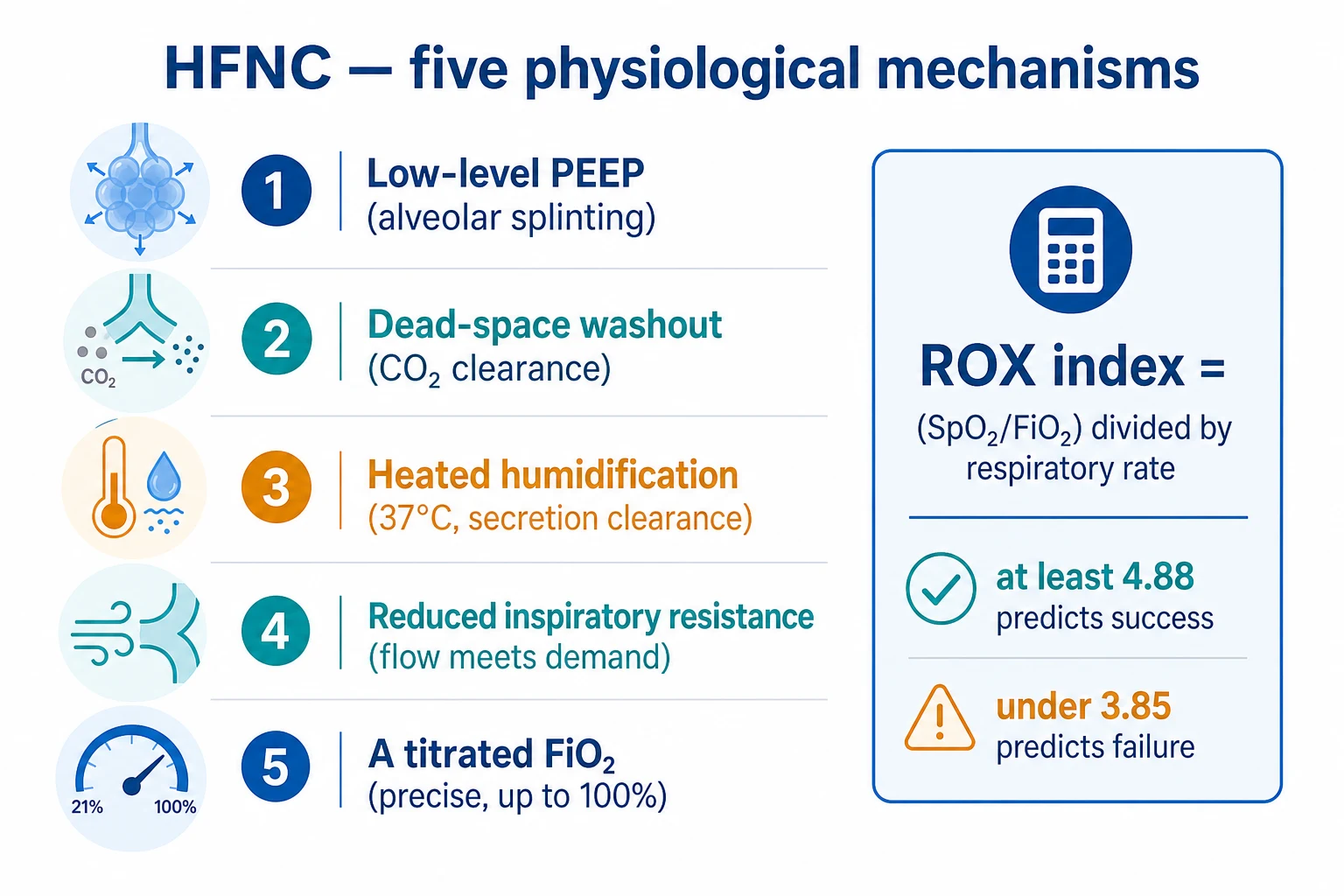
HFNC delivers up to 60 L/min of warmed, humidified gas via nasal cannula. At these flows the upper airway's humidifying capacity is overwhelmed, so active humidification is mandatory - gas must be warmed to about 37 degrees and fully humidified (44 mg/L). Delivered cold and dry it would dry the nasal and oropharyngeal mucosa, cause discomfort and airway reactivity, and negate the benefits of high flow. The humidification also improves compliance and mucociliary clearance and contributes to the dead-space washout and modest positive-pressure effects of HFNC.[1] An HME cannot be used with high flow.
Non-invasive ventilation (NIV)
NIV via mask can use either a low-flow leak port (where some humidification is lost through the leak) or a dedicated active humidifier in the circuit. Because NIV uses high flows and the mask leak dries the upper airway, an active heated humidifier is generally preferred for NIV, particularly for long sessions or thick secretions. Lellouche et al (2002) showed that adding a heated humidifier to NIV reduced the work of breathing compared with an HME, and improved tolerance.[7]
Circuit management and CDC recommendations
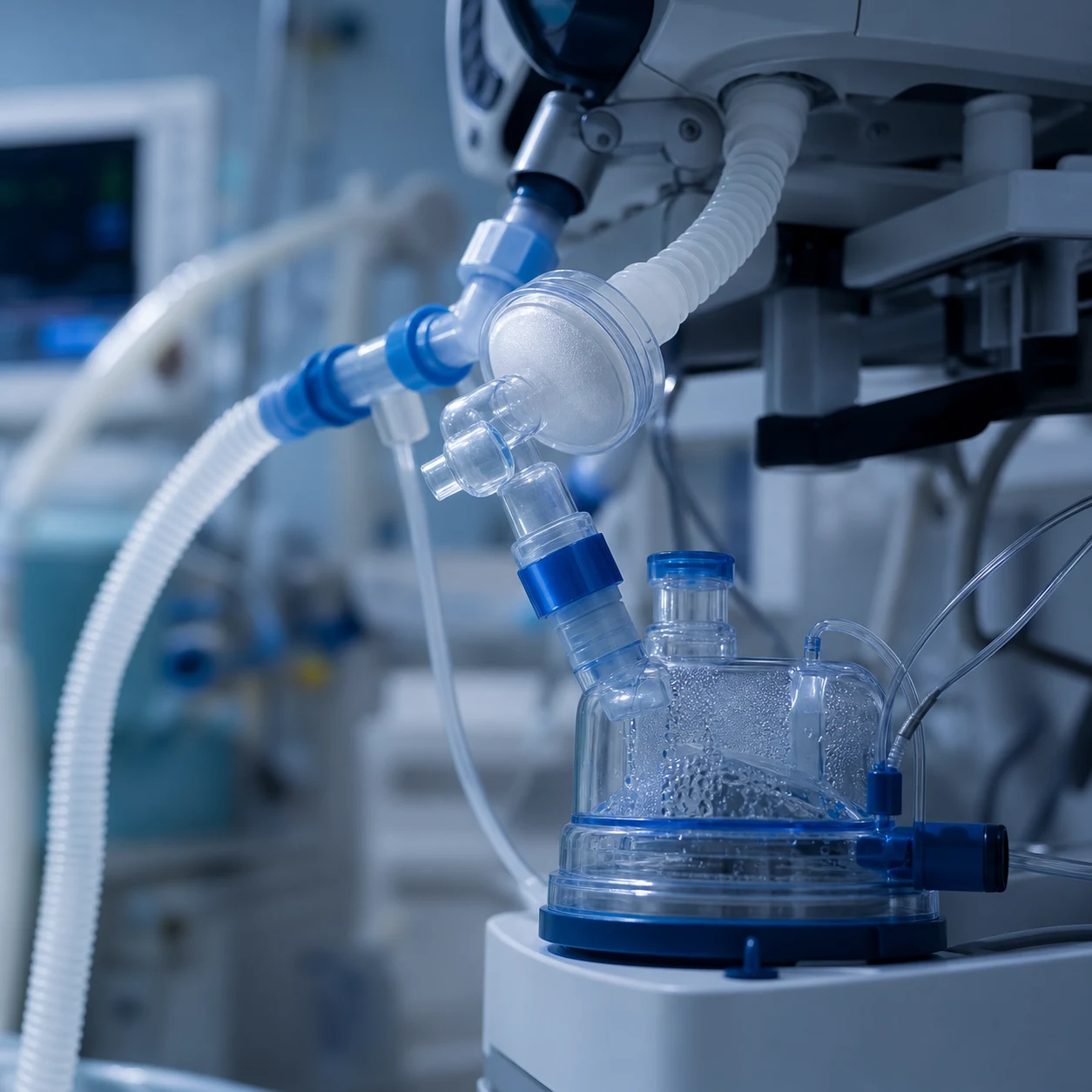
How the ventilator circuit is cared for directly affects both humidifier performance and VAP risk, and the evidence has shifted practice away from routine circuit changes.[4][1]
Routine versus "as-needed" circuit changes
Earlier practice was to change the ventilator circuit (tubing) every 24 hours, on the assumption that colonised circuits cause VAP. Randomised trials showed this was not true: more frequent circuit changes did not reduce VAP and increased cost. The current CDC/HICPAC recommendation is therefore:[4][1]
- Do not change circuits routinely or on a fixed schedule. Change the circuit only when it is visibly soiled or malfunctioning, or per the manufacturer's recommendation for the specific device.
- Condensate that forms in the circuit is contaminated and should be drained away from the patient (never letting it run back toward the airway) and discarded routinely, with hand hygiene and gloves.
- Do not routinely saline lavage before suctioning; it does not reduce VAP and may dislodge colonised biofilm.
- Aspirated subglottic secretions above the cuff are a key VAP source; subglottic secretion drainage and keeping cuff pressure adequate (20-30 cm H2O) are independent of humidifier choice but matter alongside it.[5]
Circuit care - old routine vs current CDC HICPAC practice
| Practice | Old routine practice | Current CDC / HICPAC recommendation |
|---|---|---|
| Circuit change | Every 24 hours | Only when visibly soiled or malfunctioning; no fixed schedule |
| Rationale | Colonised circuits cause VAP | Trials show scheduled changes do NOT reduce VAP and add cost |
| Condensate | Drained occasionally | Drain away from patient routinely; it is contaminated |
| HME replacement | Often 24-hourly | Per manufacturer; change when soiled or blocked |
| Heated humidifier water | Tap water acceptable | Sterile or filtered water only; refill sterile |
| Saline lavage before suction | Routine | Not recommended; no VAP benefit, may dislodge biofilm |
HME-specific circuit care
- An HME is single-use and should be replaced every 24 hours (or sooner if visibly soiled, blocked, or performance has fallen), since loading with secretions reduces efficiency and increases resistance.[1]
- Do not place an in-line suction catheter or a second filter in series that would add dead space.
- When an HME is in use, there is no need for a separate circuit filter for bacterial filtration - the HME provides it.
Heated-humidifier-specific circuit care
- Use sterile (or appropriately filtered) water only - never tap water, which risks Legionella and other water-borne pathogens.[1]
- Keep the water chamber filled; a dry chamber delivers unhumidified gas.
- Position the circuit so it slopes downward from the humidifier to a water trap; empty condensate away from the patient.[3]
- Verify the temperature setting and alarms: target ~37 degrees at the airway, with an absolute ceiling (typically 40-41 degrees) to prevent thermal injury.
Setting up and troubleshooting a heated humidifier
- Fill the chamber with sterile water before connecting to gas; never use tap water, which risks water-borne contamination.[1]
- Set the target temperature at the airway to about 37 degrees (44 mg/L); confirm the chamber and airway temperature probes read correctly.[1]
- Position the circuit sloping downward from the chamber to a water trap, so any condensation runs away from the patient.[3]
- Enable the heated wire so the gas stays above its dew point in the tubing, preventing rain-out.[3]
- Check for rain-out at each bed-space review; if present, drain the water trap, confirm the heated wire is working, and recheck circuit slope.
- Confirm the chamber does not run dry - low-water alarms should be functional; refill sterile.
- Verify the temperature ceiling alarm responds if the chamber overheats, to prevent thermal airway injury.[1]
- Do not change the circuit routinely - only when visibly soiled or malfunctioning.[1]
The one-paragraph exam answer
Exam practice — SAQs
SAQ — HME versus heated humidifier in a ventilated patient with thick secretions
10 minutes · 10 marks
A 65-year-old man is intubated and ventilated for severe community-acquired pneumonia with ARDS. He is on volume-controlled ventilation with a tidal volume of 350 mL (6 mL/kg) and PEEP 12, and has thick blood-tinged secretions and a small cuff leak. He is currently managed with a heat-and-moisture exchanger. The nurse reports that the peak inspiratory pressure has risen over the last two hours and suction is difficult. You are asked which humidifier is appropriate.
SAQ — Humidification in high-flow nasal cannula therapy
10 minutes · 10 marks
A 70-year-old woman with COPD and pneumonia is started on high-flow nasal cannula (HFNC) at 50 L/min and FiO2 0.5 for type 1 respiratory failure. The HFNC humidifier chamber low-water alarm sounds, she reports the gas feels cold and dry, and her secretions are thickening. You are reviewing the set-up at the bedside.
Red flags
Clinical pearls
Key trials and evidence
Siempos 2007 - Meta-analysis of passive humidification vs active humidification (PMID 18074484)
Source
Critical Care Medicine - meta-analysis of randomised controlled trials
Design
Pooled RCTs comparing HME (passive) with heated humidifiers (active) in mechanically ventilated patients; endpoints VAP, mortality, ICU stay, airway occlusion
Key finding
No statistically significant difference in VAP, mortality, or ICU length of stay between HME and heated humidifier; trend toward fewer airway occlusions with heated humidifier
Clinical bottom line
For uncomplicated ventilation, HME and heated humidifier are broadly equivalent on VAP and survival - the choice is driven by contraindications (thick secretions, air leak, low Vt, high flow) rather than an inherent superiority of one device
Kirton 1997 - HME vs heated-wire humidifier RCT (PMID 9377917)
Source
Chest - prospective randomised comparison in mechanically ventilated patients
Design
Patients randomised to in-line HME filter vs heated-wire humidifier; rates of early- and late-onset pneumonia and incidence of endotracheal tube occlusion recorded
Key finding
No significant difference in VAP rates between groups; endotracheal tube occlusion occurred as a recognised complication of the passive (HME) arm
Clinical bottom line
An early RCT showing equivalent VAP outcomes and highlighting tube occlusion as the practical risk of passive humidification - the basis for HME contraindications around secretions and humidifier adequacy
Lellouche 2004 - Performance of heated-wire humidifiers (PMID 15271695)
Source
American Journal of Respiratory and Critical Care Medicine - bench and clinical study
Design
Evaluated the influence of ambient and ventilator output temperatures on the delivered absolute humidity of several heated-wire humidifiers
Key finding
Heated-wire humidifier performance depended strongly on ambient temperature and the set temperature gradient; output varied between devices and could fall below the 44 mg/L target under some conditions
Clinical bottom line
Heated humidifiers are not all equal - their output depends on set-up and ambient conditions; verify the airway temperature and humidity rather than assuming saturation, and manage rain-out by matching dew point and heated-wire settings
Lellouche 2002 - Humidification device and work of breathing in NIV (PMID 12415444)
Source
Intensive Care Medicine - physiological study
Design
Compared the work of breathing during non-invasive ventilation with an HME versus an active heated humidifier in the circuit
Key finding
Adding a heated humidifier reduced the work of breathing compared with an HME during NIV, attributable to the lower resistance and dead space of the active circuit
Clinical bottom line
For NIV, especially at high flows or for long sessions, an active heated humidifier is preferred - it lowers imposed work of breathing and improves tolerance
Hess 2003 - Care of the ventilator circuit and VAP (PMID 14513820)
Source
Respiratory Care - evidence-based review
Design
Reviewed the relationship between ventilator circuit management (circuit changes, condensate handling, humidifier type) and ventilator-associated pneumonia
Key finding
Routine circuit changes do not reduce VAP; condensate is contaminated and should be drained away from the patient; both HME and heated humidifier are acceptable when used appropriately
Clinical bottom line
Foundational review supporting 'change only when soiled or malfunctioning' circuit policy and the equivalence of well-used HME and heated humidifier on VAP
Kollef 2004 - Prevention of hospital-associated and ventilator-associated pneumonia (PMID 15187525)
Source
Critical Care Medicine - narrative review
Design
Synthesised the evidence for VAP prevention, including humidification, circuit management, subglottic secretion drainage, and cuff pressure
Key finding
VAP prevention is multifactorial; adequate humidification protects mucociliary function, and subglottic secretion drainage with adequate cuff pressure are key independent measures
Clinical bottom line
Humidification is one component of a bundle - it protects the airway, but VAP prevention also requires circuit care, cuff pressure, oral hygiene, and head-up positioning
CDC / HICPAC 2004 - Guidelines for preventing healthcare-associated pneumonia
Source
MMWR Recommendations and Reports (Tablan et al, 2003/2004) - the reference infection-control guideline
Design
Expert synthesis of the evidence on humidification, circuit changes, suctioning, and water quality for mechanically ventilated patients
Key finding
No routine (scheduled) change of ventilator circuits; change only when visibly soiled or malfunctioning; use sterile water in humidifiers; do not routinely saline-lavage before suctioning
Clinical bottom line
The authoritative source for current circuit and humidifier infection-control practice - the exam answer for 'how often do you change the circuit' is 'only when soiled or malfunctioning, not routinely'
Prognosis and outcomes
Outcomes - humidification choices and their consequences
| Scenario | Outcome / consequence | Key factor |
|---|---|---|
| Adequate humidification (37 degrees, 44 mg/L) | Mucociliary clearance preserved; secretions manageable; VAP and tube-occlusion risk minimised | ISB restored to the carina |
| No humidification after intubation | Dry-gas cascade within hours; inspissated mucus, plugging, atelectasis, VAP, tube occlusion, evaporative heat loss | Upper airway bypassed; distal airway donates its own water and heat |
| HME with contraindication (thick secretions / air leak / low Vt) | Rising resistance and dead space; possible airway occlusion; under-humidification | HME blocked or defeated; switch to heated humidifier |
| HME in uncomplicated short-term ventilation | VAP and mortality broadly equivalent to heated humidifier (Siempos 2007 meta-analysis) | Adequate efficiency (~30 mg/L) for the setting |
| Heated humidifier with rain-out | Water bolus into airway if circuit repositioned; risk of contamination if condensate mishandled | Dew point management; circuit slope; heated wire |
| Heated humidifier overheating | Thermal airway injury | Thermostat failure; respect temperature ceiling and alarms |
| Tap water in heated humidifier | Risk of Legionella / Gram-negative aerosolisation into the lung | Always use sterile or filtered water |
| Routine circuit changes | No reduction in VAP; increased cost; possible bacterial dissemination from disturbing colonised circuit | CDC/HICPAC: change only when soiled or malfunctioning |
In practice, humidification is not a comfort measure but a patient-safety requirement: every intubated patient must receive adequately warmed and humidified gas, and the choice of device is governed by the patient's secretions, tidal volume, minute ventilation, air leak, and the expected duration of support. When the contraindications are respected and the circuit is managed per CDC guidance, either device is acceptable and the dry-gas cascade - and its progression to mucus plugging, atelectasis, and VAP - is reliably prevented.[1][4][1]
References
- [1]Kirton OC, DeHaven B, Morgan J, et al A prospective, randomized comparison of an in-line heat moisture exchange filter and heated wire humidifiers: rates of ventilator-associated early-onset (community-acquired) or late-onset (hospital-acquired) pneumonia and incidence of endotracheal tube occlusion Chest, 1997.PMID 9377917
- [2]Siempos II, Vardakas KZ, Kopterides P, Falagas ME Impact of passive humidification on clinical outcomes of mechanically ventilated patients: a meta-analysis of randomized controlled trials Crit Care Med, 2007.PMID 18074484
- [3]Lellouche F, Taillé S, Maggiore SM, Qader S, Lemaire F, Brochard L Influence of ambient and ventilator output temperatures on performance of heated-wire humidifiers Am J Respir Crit Care Med, 2004.PMID 15271695
- [4]Hess DR, Kallstrom TJ, Mottram CD, et al Care of the ventilator circuit and its relation to ventilator-associated pneumonia Respir Care, 2003.PMID 14513820
- [5]Kollef MH Prevention of hospital-associated pneumonia and ventilator-associated pneumonia Crit Care Med, 2004.PMID 15187525
- [6]Robinson BR, Athota KP, Branson RD Inhalational therapies for the ICU Curr Opin Crit Care, 2009.PMID 19179866
- [7]Lellouche F, Maggiore SM, Deye N, et al Effect of the humidification device on the work of breathing during noninvasive ventilation Intensive Care Med, 2002.PMID 12415444