ICU · equipment-physics
Humidification and Airway Warming — Comprehensive (HME vs Active Heated Humidifier, Physics of Humidification)
Also known as Humidification · Heat and moisture exchanger · HME · Artificial nose · Heated humidifier · Active humidification · Absolute humidity · Relative humidity · Dew point · Rainout · Mucociliary clearance · Latent heat of vaporisation · Heated wire circuit
Humidification and airway warming for the ICU First Part: WHY the intubated airway needs humidification (the upper airway normally warms, humidifies, and filters inspired gas to 37 degrees C and 100 per cent relative humidity, about 44 mg/L absolute humidity at the carina — an endotracheal or tracheostomy tube BYPASSES the upper airway so cold dry gas is delivered straight to the alveoli). The consequences of un-humidified gas are MUCOSAL DRYING and squamous metaplasia, CILIARY PARALYSIS with loss of mucociliary clearance (cilia stop beating when relative humidity falls below 75 per cent — secretions retained — atelectasis and VAP), secretion thickening into inspissated mucus plugs that occlude airways and block suction catheters, and HEAT LOSS through the latent heat of vaporisation (about 580 cal or 2.4 kJ is removed for every gram of water evaporated from the mucosa — clinically significant in the ventilated, sedated patient). The PHYSICS: ABSOLUTE HUMIDITY (mg H2O per L of gas — the measure that actually matters to the airway — target greater than 33 mg/L), RELATIVE HUMIDITY (per cent of the maximum water capacity of gas at a given temperature — warm gas holds more water, so heating raises capacity), and DEW POINT (the temperature at which gas reaches 100 per cent saturation and condensation begins — the circuit must be kept ABOVE the dew point or water condenses as RAINOUT in the tubing). Two devices. The PASSIVE heat-and-moisture exchanger (HME, artificial nose) — a disposable hygroscopic filter (paper, ceramic, or foam) placed between circuit and airway that traps EXHALED heat and moisture and returns it on the NEXT inspiration — simple, needs no power or water, adds bacterial filtration, BUT adds dead space (50-100 mL, significant in small patients and lung-protective ventilation), is less effective with thick secretions, and is contraindicated in body temperature less than 32 degrees C, in large air leaks, and in massive haemoptysis or copious secretions that block the filter; it MUST be changed every 24 hours. The ACTIVE heated humidifier — a water bath warmed to 37-41 degrees C over which inspired gas passes and becomes fully saturated to 44 mg/L, delivered through a HEATED-WIRE CIRCUIT that keeps gas above its dew point to prevent rainout — more effective for long-term ventilation greater than 96 hours, thick secretions, NIV, and hypothermia, BUT needs power, can produce rainout and water-borne contamination, and risks thermal burns if overheated. HME is preferred for SHORT-TERM ventilation under 96 hours and transport; active humidification is preferred for LONG-TERM ventilation, thick secretions, NIV, and hypothermia. NIV humidification is CRUCIAL — the high flow of dry gas from the ventilator dries nasal and oropharyngeal mucosa, causing discomfort and intolerance that leads to NIV FAILURE — always use an active heated humidifier with NIV.
On this page & tools
Your progress
Saved locally on this device.
1 MCQ with explanations
Target exams
Red flags
Overview and rationale — why the intubated airway must be humidified
The nose, nasopharynx, and large airways perform three functions on every breath: they WARM, HUMIDIFY, and FILTER inspired gas. By the time gas reaches the carina it is close to 37 degrees Celsius and 100 per cent relative humidity — about 44 mg of water per litre of gas. This condition is reached at the so-called ISOTHERMIC SATURATION BOUNDARY, normally located around the fourth to fifth generation of bronchi. Proximal to this boundary the airway ADDS heat and moisture to inspired gas and REMOVES them from expired gas (partial recovery); distal to it the gas is already fully conditioned and no net exchange occurs. [1]
An endotracheal or tracheostomy tube BYPASSES the upper airway, so cold, dry gas from the ventilator is delivered straight into the trachea. The isothermic saturation boundary is shifted DISTALLY into the bronchioles and alveoli, and the lower airway is forced to do the humidifying work the nose normally does. Delivering un-humidified gas causes a predictable cascade of harm:[1][1]
- Mucosal drying and injury. Dry gas desiccates the tracheobronchial epithelium within minutes, causing ciliary clumping, epithelial desquamation, and squamous metaplasia of the columnar epithelium.
- Ciliary paralysis and loss of mucociliary clearance. Normal cilia beat at around 1000-1500 beats per minute and transport the mucus blanket cephalad at ~1 cm/min. Ciliary beat frequency FALLS as relative humidity drops — cilia essentially STOP beating when the inspired relative humidity is below ~75 per cent. Mucociliary transport ceases, secretions are retained, and bacteria trapped in static mucus proliferate.
- Secretion thickening and mucus plugs. Water is drawn out of the mucus layer into the dry gas → the sol and gel layers become viscid and inspissated. Secretions become too thick to clear by cough or suction, form mucus plugs that occlude small airways, and cause segmental or lobar atelectasis.
- Atelectasis and VAP. Retained, contaminated secretions in poorly ventilated, plugged segments are the substrate for ventilator-associated pneumonia.
- Heat loss. Every gram of water that evaporates from the mucosa to humidify dry gas removes the LATENT HEAT OF VAPORISATION — about 580 calories (2.4 kJ) per gram of water. In an intubated patient receiving 6-10 L/min of dry gas, this evaporative heat loss is clinically significant and contributes to hypothermia, especially in the sedated, paralysed, or small patient who cannot generate compensatory heat.[1]
Humidification restores heat and moisture to inspired gas so that the gas delivered to the alveoli approximates physiological conditions, protecting mucociliary function and limiting heat loss. [1]
The physics of humidification — three definitions that are examinable
Absolute humidity (AH)
The actual mass of water vapour per unit volume of gas, expressed in mg H2O/L. This is the quantity that matters to the airway, because it is the absolute amount of water delivered, independent of temperature. At 37 degrees C and 100 per cent saturation, AH is 44 mg/L. The AARC/ISO minimum acceptable performance for any humidifier is an absolute humidity of at least 30-33 mg/L at the patient Y-piece.[1]
Relative humidity (RH)
The water content of a gas expressed as a percentage of the maximum it can hold at that temperature. Crucially, warm gas holds more water than cold gas: gas at 37 degrees C can hold 44 mg/L (so 44 mg/L = 100 per cent RH), while gas at 20 degrees C can hold only about 17 mg/L. This is why HEATING the gas raises its capacity and allows more water to be carried. A gas can be at 100 per cent RH yet still desiccate the airway if it is cold — because on warming to body temperature in the airway it becomes unsaturated and draws water from the mucosa. Hence the deliverable that matters is fully saturated gas AT body temperature. [1]
Dew point and rainout
The DEW POINT is the temperature at which a gas becomes fully saturated (100 per cent RH); any further cooling causes water to CONDENSE out as liquid. This is the mechanism of RAINOUT — condensation in the ventilator tubing. In an active heated humidifier, gas leaves the water bath warm and fully saturated; as it travels down the inspiratory limb it cools; once it drops below the dew point, water condenses in the tubing (rainout). This is prevented by a HEATED WIRE in the circuit that keeps the gas above its dew point all the way to the patient, and managed with a water trap positioned at the lowest point of the circuit.[1]
The latent heat of vaporisation — why humidification is also a thermal problem
Absolute humidity, relative humidity, and dew point — the three definitions
| Quantity | Definition | Units / example | Why it matters |
|---|---|---|---|
| Absolute humidity (AH) | Mass of water vapour per unit volume of gas | mg H2O/L (e.g., 44 mg/L at 37 degrees C, 100 per cent RH) | The actual amount of water delivered to the airway — the deliverable that protects mucociliary clearance |
| Relative humidity (RH) | Water content as a per cent of the maximum the gas can hold at that temperature | Per cent (warm gas holds more; 44 mg/L at 37 C = 100 per cent, but 44 mg/L at 20 C is supersaturated) | A cold gas at 100 per cent RH still desiccates on warming to body temp — so the gas must be hot AND saturated |
| Dew point | Temperature at which a gas reaches 100 per cent saturation; further cooling causes condensation | Degrees C (e.g., gas saturated at 37 C has dew point 37 C; cool it to 34 C and water condenses) | Determines where rainout occurs — keep the circuit above the dew point with a heated wire |
When dry gas is delivered to the alveoli, the mucosa must evaporate water to humidify it. Each gram of water evaporated removes approximately 580 calories (2.4 kJ) as latent heat of vaporisation — energy drawn from the patient. In a fully ventilated adult receiving 6-10 L/min of dry gas, this can represent a substantial heat drain, and is one reason intubated patients drift toward hypothermia. Active humidification (warming and saturating the gas externally) returns both the water AND the heat, while a passive HME returns only what the patient's own exhaled gas deposits — which is insufficient in hypothermia.[1][1]
Device 1 — the passive heat-and-moisture exchanger (HME, artificial nose)
A heat-and-moisture exchanger is a single-use device placed directly between the breathing-circuit Y-piece and the artificial airway. It contains a HYGROSCOPIC and/or HYDROPHOBIC medium — paper, ceramic, foam, or a pleated membrane impregnated with a hygroscopic salt (e.g., calcium chloride) — that captures heat and moisture from the patient's warm, saturated EXHALED gas and deposits them on the medium; on the NEXT inspiration the cool, dry inspired gas passes over the warmed, damp medium and picks the heat and water back up.[1][1]
The HME achieves an absolute humidity of roughly 25-32 mg/L (variable by design) — below the physiological 44 mg/L but above the 30 mg/L minimum. Three subtypes exist:
- Hydrophobic (low efficiency, ~20-26 mg/L) — repels water, relies on condensation on a hydrophobic membrane; also acts as a bacterial/viral filter.
- Hygroscopic (higher efficiency, ~30-33 mg/L) — impregnated with a salt that actively absorbs water vapour; better humidification but less filtration.
- Composite (hygroscopic + filter) — combines a hygroscopic salt with a bacterial/viral filter medium; the modern standard HME.[1]
Advantages: simple, no power or water supply, no condensation or rainout in the circuit, low cost, and bacterial/viral filtration of exhaled gas (protecting staff and the circuit). [1]
Disadvantages and contraindications:
- Adds dead space (50-100 mL), which is a large fraction of a small tidal volume (e.g., 100 mL on a 350 mL lung-protective Vt is nearly 30 per cent wasted ventilation) → CO2 retention and increased work of breathing. Significant in small adults, paediatric patients, and ARDS lung-protective ventilation.[1]
- Less effective with thick secretions — secretions that deposit on the medium reduce efficiency and can block it.
- Contraindicated in body temperature < 32 degrees C — the device can only return the heat/moisture the patient exhales; in severe hypothermia the exhaled gas is cold and dry and the HME cannot recover enough.
- Contraindicated in large air leaks (bronchopleural fistula, cuff leak) — the patient does not exhale back through the HME, so no moisture is trapped.
- Contraindicated in massive haemoptysis or copious, bloody secretions — these block the filter medium, raising resistance and risking airway occlusion.
- Must be changed every 24 hours (and whenever visibly soiled) to prevent blockage and bacterial colonisation.[1]
Device 2 — the active heated humidifier
An active heated humidifier passes the inspiratory gas over or through a water bath heated to 37-41 degrees C, so the gas becomes fully saturated at near-body temperature (44 mg/L at 37 C). The gas is delivered through a HEATED-WIRE CIRCUIT in which an electrical heating element runs the length of the inspiratory (and sometimes expiratory) limb, keeping the gas above its dew point so that condensation (rainout) does not form as the gas travels to the patient.[1]
The system is set to deliver 34-41 degrees C (ideally 37 degrees C) and 100 per cent RH (44 mg/L) at the Y-piece, compensating for the small drop that occurs between the chamber and the patient. A temperature probe at the Y-piece feeds back to the controller. [1]
Advantages: delivers near-physiological humidification reliably; the device of choice for long-term ventilation (> 96 h), thick or copious secretions, NIV, and hypothermia; no added dead space; does not block with secretions. [1]
Disadvantages and risks:
- Requires electrical power and a water supply (the chamber must be refilled, ideally with sterile water).
- Rainout and condensation — if the heated wire fails or the chamber is set too hot relative to circuit temperature, water condenses in the tubing; a repositioned circuit can flush a bolus of water (sometimes contaminated) into the airway. Managed by heated wire + a water trap at the circuit low point + correct chamber set-temperature.[1]
- Overheating / thermal burns — gas delivered above ~41-42 degrees C causes mucosal thermal injury. The controller's upper temperature alarm and the Y-piece temperature probe are the safeguards.
- Water-borne contamination — a heated water bath can grow Legionella, Pseudomonas, and other water organisms if the water and circuit are not managed per protocol. Use sterile water and change circuits per protocol rather than daily (frequent circuit changes do NOT reduce VAP and may increase contamination).[1]
- Does NOT filter exhaled gas (unlike an HME) — a separate expiratory filter is needed if staff/circuit protection is desired.
HME versus active heated humidifier — the head-to-head
Passive HME versus active heated humidifier
| Feature | Passive HME (artificial nose) | Active heated humidifier |
|---|---|---|
| Mechanism | Traps exhaled heat + moisture on a hygroscopic medium; returns on next inspiration | Gas passes over a heated water bath (37-41 degrees C) → fully saturated |
| Absolute humidity delivered | ~25-32 mg/L (below physiological 44) | ~44 mg/L (full saturation at 37 degrees C) |
| Relative humidity | ~70-95 per cent | ~100 per cent |
| Temperature at Y-piece | Near room/ambient + recovered heat (lower) | 34-41 degrees C (set, ideally 37) |
| Dead space added | 50-100 mL (significant in small Vt) | None |
| Power / water needed | None | Both |
| Rainout / condensation | None (closed system) | Yes — managed by heated wire + water trap |
| Bacterial/viral filtration | Yes (composite types) | No (separate filter needed) |
| Best for | Short-term ventilation < 96 h; transport | Long-term ventilation > 96 h; thick secretions; NIV; hypothermia |
| Contraindicated in | Temp < 32 C; thick/bloody/copious secretions; large air leak; very small Vt | (No absolute contraindications; manage rainout, temp, contamination) |
| Cost | Low (single use, daily) | Higher (chamber, circuit, water, power) |
| VAP effect | No difference vs heated humidifier (Lacherade 2005; Kelly 2010 Cochrane) | No difference vs HME |
| Change frequency | Every 24 h (or sooner if soiled) | Chamber/circuit per protocol (not daily) |
Which device, when — a decision framework
Selecting the humidification device
- START with an HME for SHORT-TERM invasive ventilation (< 96 h) with no contraindications. It is simple, needs no power or water, produces no rainout, filters exhaled microbes, and is cheaper. Most short-term ventilated patients are well served by an HME.[1]
- SWITCH to (or start with) an ACTIVE HEATED HUMIDIFIER when ANY of the following are present:
- Thick, tenacious, or copious secretions — an HME loads with secretions, loses efficiency, and may block. Active humidification keeps secretions thin and clearable. This is the commonest reason to choose active.[1]
- Long-term ventilation expected (> 96 h) — reliability of full saturation and no dead space favour the active device.
- Body temperature < 32 degrees C (hypothermia) — the HME cannot recover enough of the patient's own heat/moisture; active humidification also contributes to rewarming.[1]
- Large air leak (bronchopleural fistula, cuff leak) — the HME cannot trap moisture that does not return through it.
- NIV — high dry flows dry the nasal/oropharyngeal mucosa, causing discomfort and intolerance that leads to NIV failure; ALWAYS use active humidification for NIV.[1]
- Very small tidal volumes / paediatric patients — the 50-100 mL HME dead space is a large fraction of Vt and causes CO2 retention.[1]
- SET UP the active humidifier correctly:
- Chamber set to deliver 34-41 degrees C (ideally 37 C) and 100 per cent RH at the Y-piece.
- Use a HEATED-WIRE circuit to keep gas above its dew point and prevent rainout.
- Place a water trap at the lowest point of the circuit; slope tubing downward away from the patient.
- Use STERILE water in the chamber; change chamber/circuit per protocol, NOT daily (daily changes do not reduce VAP).[1]
- Set and respect the upper temperature alarm (never > 41-42 C) to prevent thermal burns.
- IF USING AN HME, respect its limits:
- Change every 24 hours and whenever visibly soiled or wet.
- Place it correctly at the Y-piece; do not add an HME on top of a circuit already using an active humidifier.
- Monitor for rising peak inspiratory pressure or CO2 — early signs the HME is loading with secretions or adding too much dead space.
- TARGET PARAMETERS at the patient Y-piece (AARC 2012 / ISO 8185): absolute humidity > 33 mg/L (minimum 30 mg/L), relative humidity > 90 per cent (ideally 100 per cent), temperature 34-41 degrees C (ideally 37 C). Never exceed 41-42 degrees C.[1]
- NEVER rely on humidification choice to prevent VAP. Both HMEs and heated humidifiers produce equivalent VAP rates (Lacherade 2005 RCT; Kelly 2010 Cochrane). VAP prevention comes from the VAP bundle (head-of-bed elevation, subglottic secretion drainage, sedation breaks, oral chlorhexidine, daily sedation interruption), not from the humidifier.[1][1]
Humidification during non-invasive ventilation (NIV)
NIV delivers high flows of gas (often 30-60 L/min) through a mask. The gas leaving the ventilator/breathing circuit is cold and dry, and the upper airway is now exposed to these high dry flows that overwhelm its natural humidifying capacity. The result is rapid drying of the nasal and oropharyngeal mucosa, with dryness, congestion, epistaxis, and mask discomfort that drive NIV intolerance and NIV failure.[1]
Always use an active heated humidifier with NIV. It preserves mucosal integrity, improves comfort and tolerance, and reduces the work the upper airway must do. An HME can be used for very short-term NIV in selected patients but adds weight and dead space to the mask circuit and is generally inferior; the AARC guideline recommends active humidification for NIV, particularly for hypercapnic patients and those on prolonged or continuous NIV.[1][1]
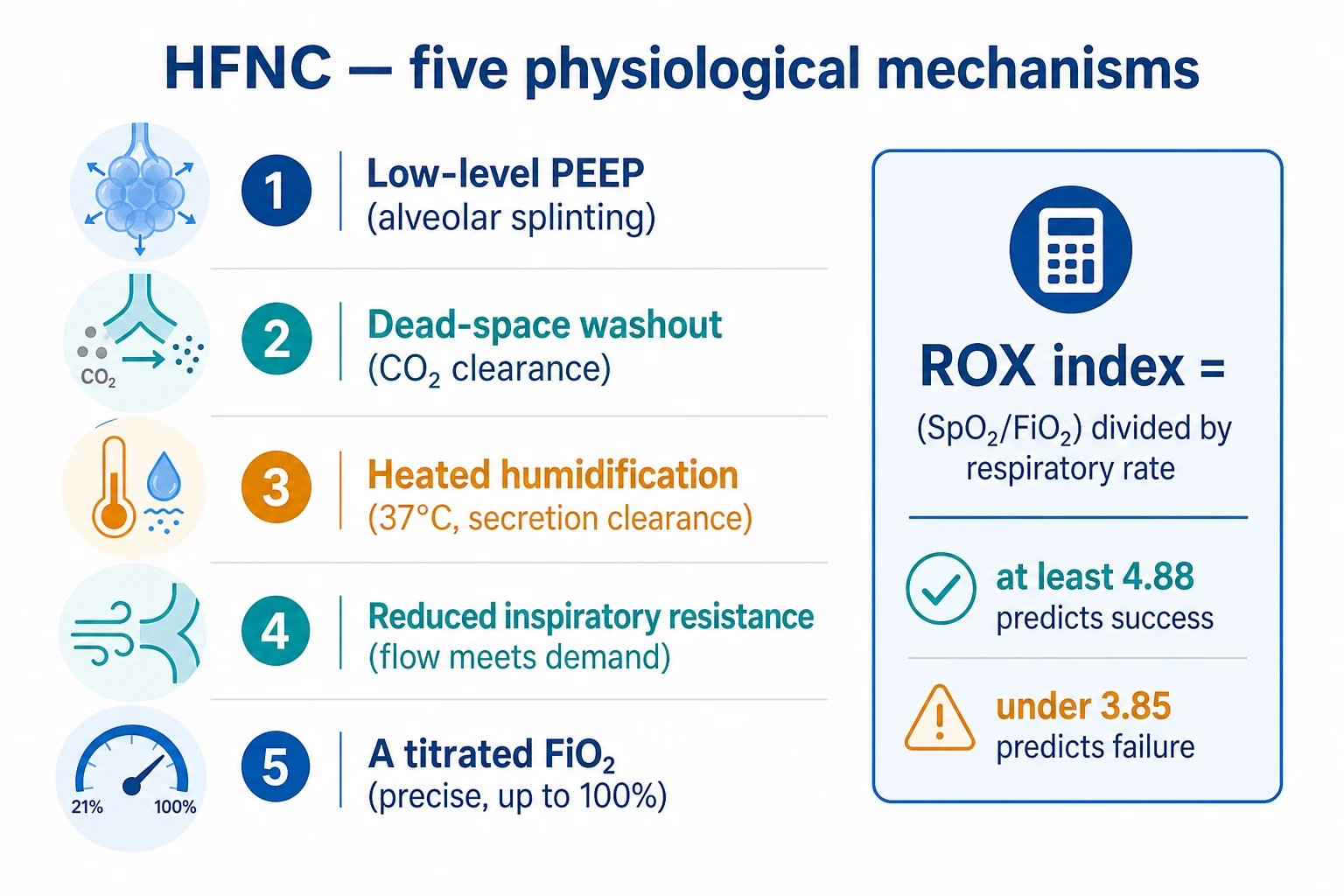
The same principle applies to high-flow nasal cannula (HFNC): the high flows mandate active humidification (warmed to ~37 degrees C and fully saturated), which is integral to HFNC's tolerability and its effects on compliance, dead-space washout, and the modest positive pressure it generates. [1]
Clinical pearls
Red flags
Prognosis
Outcomes — humidification failure and adequacy
| Scenario | Consequence | Key factor |
|---|---|---|
| Un-humidified gas for > 1-2 h | Mucosal drying, ciliary paralysis, secretion retention | Duration of dry-gas exposure |
| Inadequate humidification for days | Inspissated mucus plugs, atelectasis, increased VAP risk | Absolute humidity delivered vs requirement |
| HME blockage (missed) | Rising peak inspiratory pressure, hypoventilation, airway occlusion | Secretion load, change frequency |
| Rainout bolus to airway | Desaturation, aspiration of contaminated water | Circuit positioning, water trap |
| Overheating > 41-42 C | Mucosal thermal injury | Temperature alarm setting |
| HME vs heated humidifier (VAP) | No difference in VAP, mortality, ventilation duration | Device choice does not affect these outcomes |
Key trials and evidence
Lellouche 2009 — Humidification performance of 48 passive airway humidifiers (PMID 19201708)
Source
Chest — bench comparison of 48 HMEs vs manufacturer claims
Design
In-vitro measurement of absolute humidity for 48 HMEs
Key finding
Only ~37.5 per cent of HMEs delivered >= 30 mg/L; manufacturer data often exceeded measured performance
Clinical bottom line
HME efficiency varies widely by brand — know your device and switch to a heated humidifier if performance is marginal
Lacherade 2005 — HME vs heated humidifier and VAP (PMID 16126933)
Source
American Journal of Respiratory and Critical Care Medicine — randomised multicentre trial
Design
369 ICU patients expected to need ventilation > 48 h, randomised to heated humidifier vs HME
Key finding
No significant difference in VAP (HH 28.8 per cent vs HME 25.4 per cent, p = 0.48), mortality, or ventilation duration
Clinical bottom line
Humidification device choice does not affect VAP — base the choice on secretions, ventilation duration, and contraindications, not VAP prevention
Kelly 2010 Cochrane — Heated humidification vs HME (PMID 20393939)
Source
Cochrane Database of Systematic Reviews — systematic review of RCTs in adults and children
Key finding 1
No difference in mortality, VAP, or respiratory complications between HME and heated humidifier
Key finding 2
HME use was associated with higher minute ventilation, higher PaCO2, and lower body temperature
Clinical bottom line
Clinical outcomes equivalent; choose by secretions, dead-space sensitivity, and contraindications. HMEs cheaper but add dead space
Examiner densify anchors
SAQ — Choosing HME vs heated humidifier
8 minutes · 8 marks
A hypothermic trauma patient is ventilated with thick bloody secretions. The circuit has an HME at the Y-piece. Peak pressures are rising and the HME looks soiled. SpO2 is stable on FiO2 0.4.
Practical ICU checklist (densify)
Bedside densify checklist
- Confirm diagnosis thresholds with numbers the examiner expects.
- Name the first therapy and the absolute contraindication.
- State monitoring frequency and escalation triggers.
- Cite one landmark paper/guideline and one limitation of the evidence.
- Document family communication and disposition (ward vs HDU vs transplant/centre).
Practical ICU checklist (densify)
Bedside densify checklist
- Confirm diagnosis thresholds with numbers the examiner expects.
- Name the first therapy and the absolute contraindication.
- State monitoring frequency and escalation triggers.
- Cite one landmark paper/guideline and one limitation of the evidence.
- Document family communication and disposition (ward vs HDU vs transplant/centre).
References
- [1]Lellouche F, et al. Humidification performance of 48 passive airway humidifiers: comparison with manufacturer data. Chest, 2009.PMID 19201708
- [2]Kelly M, et al. Heated humidification versus heat and moisture exchangers for ventilated adults and children. Cochrane Database of Systematic Reviews, 2010.PMID 20393939
- [3]Restrepo RD, Walsh BK Humidification during invasive and noninvasive mechanical ventilation: 2012. Respiratory Care (AARC Clinical Practice Guideline), 2012.PMID 22546299
- [4]Branson RD Humidification of respired gases during mechanical ventilation: mechanical considerations. Respiratory Care Clinics of North America, 2006.PMID 16828693
- [5]Lacherade JC, et al. Impact of humidification systems on ventilator-associated pneumonia: a randomized multicenter trial. American Journal of Respiratory and Critical Care Medicine, 2005.PMID 16126933
- [6]Esquinas Rodriguez AM, et al. Clinical review: humidifiers during non-invasive ventilation - key topics and practical implications. Critical Care, 2012.PMID 22316078