ICU · Ethics / communication
Conflict, Mediation & Ethics Consultation in the ICU
Also known as Ethics consultation · Conflict resolution · Mediation · Goals-of-care conflict · Medical futility · Substitute decision-maker · Best interest · Capacity assessment · Withdrawal against family wishes
Conflict, mediation, and ethics consultation in the ICU: sources (prognostic disagreement, goals of care, futility, family dynamics, intra-team, resource allocation), bioethics frameworks (four principles, deontological, utilitarian, virtue ethics, care ethics), capacity and substitute decision-making (substituted judgement vs best interests), structured conflict resolution (IDENTIFY → CLARIFY → EXPLORE → NEGOTIATE → AGREE), when to call the ethics committee, medical futility disputes and unilateral withdrawal, legal aspects (capacity, guardianship, tribunal/court, advance directives), and withdrawal of life-sustaining treatment against family wishes.
On this page & tools
Your progress
Saved locally on this device.
Target exams
Overview & definition
Conflict in the ICU is common — over the goals of care, perceived futility, family disagreement, intra-team disagreement, and resource allocation. The ethics consultation provides a structured, non-binding advisory process for resolving value-laden disputes. The bioethics framework (autonomy, beneficence, non-maleficence, justice) guides reasoning, supplemented by deontological (duty-based), utilitarian (consequence-based), virtue, and care ethics traditions. The substitute decision-maker speaks for the patient who lacks capacity. Most conflict is preventable through proactive, structured communication — the family meeting conducted with SPIKES, value statements (VALUE/NURSE), and shared decision-making is the single most effective intervention.[1]
Conflict arises because the ICU is a high-stakes environment where (1) decisions are time-pressured, (2) outcomes are uncertain, (3) the patient is usually incapacitated and a surrogate must decide, (4) families are under acute psychological stress (fear, grief, guilt, mistrust), (5) clinicians hold prognostic information families do not, and (6) scarce resources force allocation decisions. Recognising conflict early — and applying a structured resolution pathway — reduces non-beneficial treatment, shortens ICU stay, lowers family PTSD/anxiety, and protects staff from moral distress and burnout.[1]

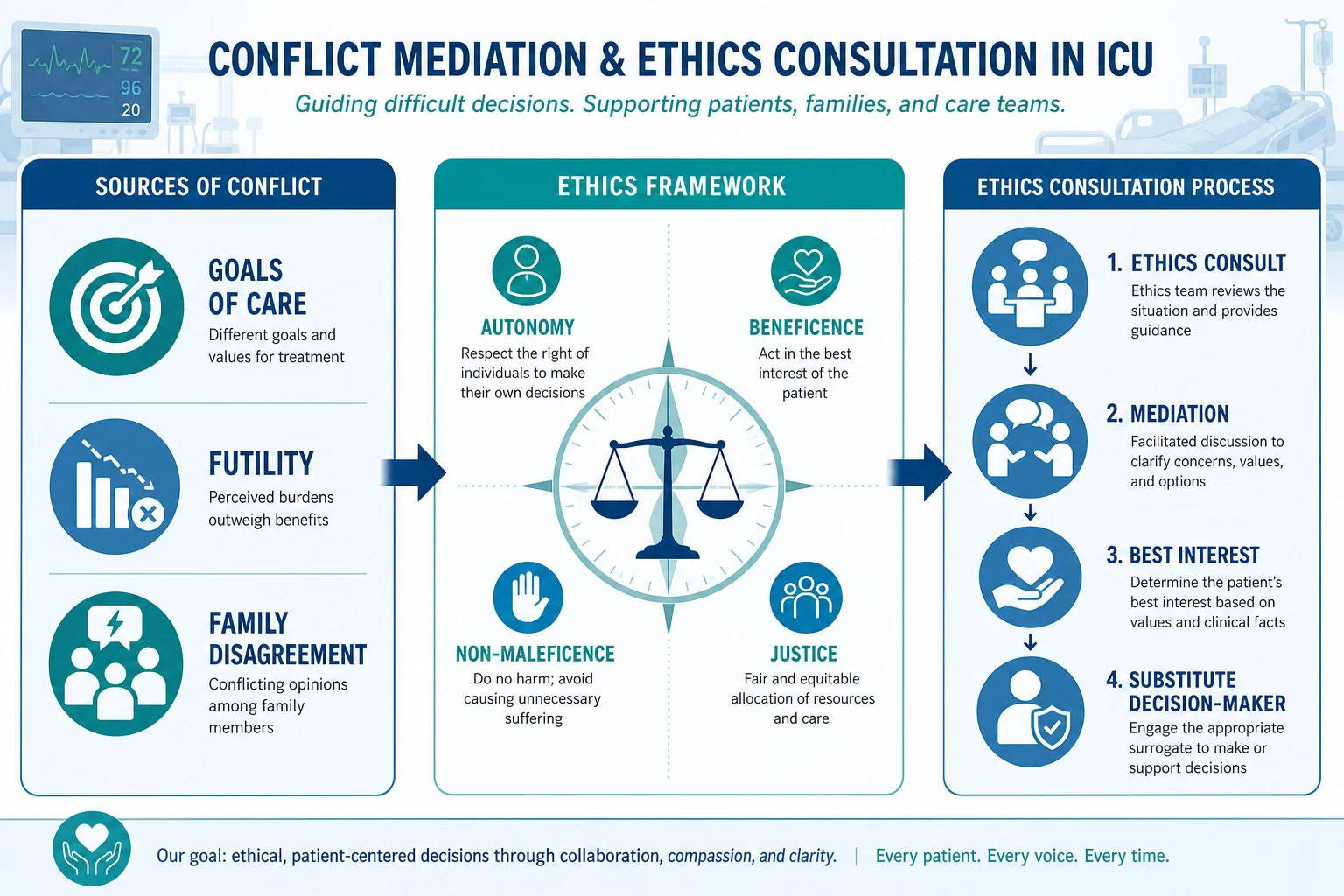
Sources of conflict in the ICU
The five domains of ICU conflict — recognise the pattern to target the fix
| Domain | What it looks like | Typical trigger | First-line response |
|---|---|---|---|
| 1. Goals of care | Team says "palliative"; family says "do everything" | Poor prognosis; treatment failure; baseline functional decline | Structured family meeting; SPIKES; shared decision-making; palliative care referral |
| 2. Prognostic disagreement | Family believes patient will recover; team believes prognosis is grave | Optimistic early messaging; prior "miracle" narratives; cultural/religious framing of prognosis | Honest prognostication with ranges; "hope for the best, prepare for the worst"; offer time-limited trial |
| 3. Family dynamics | Conflict BETWEEN family members, or SDM vs other relatives, or family vs staff | Unresolved family disputes; guilt; estranged relatives; competing "spokespersons" | Identify the lawful SDM; convene all key family; social work; one consistent senior clinician spokesperson for the team |
| 4. Perceived futility | Team believes treatment is non-beneficial; family demands continuation | CPR/ECMO/RRT in irreversible disease; vegetative state | Define futility type; second opinion; ethics consult; time-limited trial; futility policy pathway |
| 5. Resource allocation | Triage: who gets the ICU bed, the last ventilator, the transplant organ | Pandemic surge; mass casualty; organ shortage | Triage protocol (transparent, consistent, justice-based); ethics committee; regional coordination |
Conflict dyads — who is in conflict determines the intervention
| Conflict dyad | Example | Best intervention |
|---|---|---|
| Family vs team | Family demands tracheostomy/PEG in advanced dementia | Family meeting, SPIKES, palliative care, ethics consult |
| Within family | Sibling disagreement over mother's goals of care | Identify lawful SDM; family conference with social work; mediated meeting |
| SDM vs patient's known wishes | SDM wants to continue; patient previously stated "no machines" | Reaffirm substituted judgement standard; ethics consult |
| Within the team (intra-staff) | Consultant vs consultant; nursing vs medical | Goals-of-care meeting with whole team; senior clinician leadership; ethics consult if unresolved |
| Team vs institutional policy | Mandated triage vs clinician's sense of individual duty | Escalate to clinical leadership; invoke triage protocol; ethics committee |
| Clinician vs own conscience | Asked to provide care clinician believes is wrong | Conscientious objection (with duty to refer/transfer); ethics consult |
- Prognostic disagreement — the most common root of ICU conflict. Families and clinicians hold different estimates of outcome, often because early in the admission clinicians offer "hope" without bounding it. Fix: give prognostic ranges ("days to weeks," not "we'll see"), update after each milestone, and use "hope for the best, prepare for the worst." Validated scores (APACHE, SOFA) describe populations, not individuals — never quote a single mortality percentage to a family as if it predicts their loved one's outcome.[8]
- Goals-of-care conflict — curative vs palliative vs comfort direction. Usually resolvable with a structured family meeting and shared decision-making; intractable cases need palliative care and ethics input.[7]
- Family dynamics — guilt (the relative who was absent), denial, mistrust of staff, cultural/religious framing, or genuine competing interpretations of what the patient would want. Identify the LAWFUL SDM early (formal appointment > statutory hierarchy); do not let the loudest voice dominate. Use social work and a single consistent senior clinician spokesperson so the family is not given conflicting messages by rotating staff.[10]
- Resource allocation — pandemic, mass casualty, or organ shortage. Requires a transparent, consistent, justice-based triage protocol applied identically to all (NOT bedside ad-hoc decisions). Escalate to clinical leadership and ethics committee; document the triage decision and its basis.[1]
Bioethics frameworks
No single framework resolves every case — the skilled clinician holds several in mind and selects the lens that best fits the conflict. [1]
The four principles (Beauchamp & Childress) — the working framework
- Autonomy — patient self-determination; the capacitous patient may refuse any treatment, even life-saving; advance directive; SDM speaking for the incapacitous patient.[1]
- Beneficence — act in the patient's best interest; provide treatments that offer realistic benefit; relieve suffering.[1]
- Non-maleficence — "first, do no harm"; avoid burdensome, futile treatment; do not impose treatment that cannot benefit.[1]
- Justice — fair, equitable distribution of resources; do not occupy an ICU bed with non-beneficial treatment when another patient could benefit.[1]
The four principles applied to a conflict case — worked example
| Principle | Question to ask | In a "do everything" demand for a dying patient |
|---|---|---|
| Autonomy | What did the patient want? | Check advance directive; ask SDM what the patient valued; was the patient a "fight to the end" person or a "no machines" person? |
| Beneficence | Does the proposed treatment offer realistic benefit? | If CPR/vasopressors will not reverse the underlying process, they do not benefit — they prolong dying |
| Non-maleficence | Does the treatment cause harm disproportionate to benefit? | Prolonged ventilation, repeated procedures, pain, loss of dignity = harm |
| Justice | Is this a fair use of a scarce resource? | An ICU bed occupied by non-beneficial treatment denies another patient who could benefit |
| Resolution | Which principle(s) dominate here? | When the patient is incapacitous and treatment is non-beneficial, beneficence/non-maleficence/justice converge against continuing; autonomy is honoured through substituted judgement, not through a surrogate demanding non-beneficial treatment |
Beyond the four principles — competing ethical traditions
Ethical frameworks compared — different lenses for the same conflict
| Framework | Core idea | How it reasons | Application to ICU conflict | Strength / limitation |
|---|---|---|---|---|
| Principlism (four principles) | Four mid-level principles to balance | Weigh autonomy, beneficence, non-maleficence, justice case by case | The everyday working framework of ICU ethics | Pragmatic, widely taught; can become a checklist without deeper reasoning |
| Deontological (duty-based; Kant) | Certain duties are binding regardless of consequence | "Treat persons as ends, never merely as means"; duties to tell the truth, keep promises, not kill | Grounds truth-telling, informed consent, the inviolability of the patient; opposes using one patient to benefit others | Clear duties; but inflexible when duties conflict (e.g. truth vs harm) |
| Utilitarian / consequentialist | The right act maximises overall good | Choose the action with the best aggregate outcome (greatest good for greatest number) | Justifies triage, resource allocation, withdrawal of non-beneficial treatment that frees a bed | Powerful for allocation; risks sacrificing the individual ("the numbers") |
| Virtue ethics (Aristotle) | Be a good person; act as the virtuous clinician would | Focus on character — compassion, courage, honesty, practical wisdom (phronesis) | Reminds us that HOW we communicate and decide matters as much as what we decide | Rich; less action-guiding in a crisis |
| Care ethics (feminist) | Relationships and responsiveness to need | Decisions arise within relationships; attend to the particular patient and family in context | Centres the family meeting, continuity of caregiver, emotional attunement | Counters impersonal rule-application; less structured |
| Casuistry (case-based) | Reason from paradigm cases | Compare the current case to clear precedents and extend by analogy | The way clinicians actually reason at the bedside; "we've been here before" | Practical; depends on agreed paradigms |
- Deontological duties in the ICU — tell the truth (no false reassurance, no concealment of prognosis), obtain informed consent, keep promises made to the family ("I will come back and update you at 5 pm"), never abandon the patient, do not treat the patient merely as a means to others' ends (e.g. organ procurement is not a reason to withdraw). These duties hold even when breaking them would produce a "better" outcome — that is the deontological point.[1]
- Utilitarian reasoning in the ICU — most visible in triage and resource allocation. When there are more patients than ICU beds, the just allocation maximises lives saved (typically by prioritising those most likely to benefit, not those most severely ill or those first to arrive). The danger: pure utilitarianism can sacrifice an individual's interests; it must be constrained by the principles of justice (consistent process) and respect for persons.[1]
Decision-making: capacity, SDM, substituted judgement, best interests
Capacity assessment — the foundation
How to assess decision-making capacity (Appelbaum criteria)
- CAPACITY IS DECISION-SPECIFIC, NOT GLOBAL — a patient may have capacity to consent to a blood transfusion but not to withdraw dialysis. It is assessed for a SPECIFIC decision at a SPECIFIC time. Do NOT assume incapacity from age, intubation, sedation, psychiatric history, or the fact that the patient disagrees with the team. Re-assess when the patient is at their best (sedation off, post-dialysis, morning).[3]
- ELEMENT 1 — COMMUNICATE A CONSISTENT CHOICE — can the patient express a stable preference? Fluctuating or contradictory choices due to delirium indicate incapacity for that decision.
- ELEMENT 2 — UNDERSTAND THE INFORMATION — does the patient grasp the diagnosis, the options (including no treatment/comfort care), and the likely benefits and burdens of each? Test with teach-back: "Tell me in your own words what we have discussed."
- ELEMENT 3 — APPRECIATE THE SITUATION AND CONSEQUENCES — does the patient grasp this applies to THEM and that death may result? A patient who denies being ill ("the doctors are wrong, I'm fine") lacks appreciation even if they can parrot the facts.
- ELEMENT 4 — REASON ABOUT THE OPTIONS — can the patient weigh the options with a relatively consistent logic (the conclusion need not match the clinician's, but must not be driven by delusion)?
- DOCUMENT AND ESCALATE — record the four elements, the specific decision, who assessed, when. If doubt, get a second opinion (psychiatry/senior clinician). NOTE: capacity (clinical) ≠ competence (legal/court).
Capacity vs competence vs substituted judgement vs best interests vs advance directive
| Term | Definition | Who determines |
|---|---|---|
| Capacity | Clinical ability to make a specific decision (4 elements) — may fluctuate | Treating clinician(s) at the bedside |
| Competence | Legal status — determined by statute or court | Court / statute |
| Advance directive | The patient's prior written wishes (valid when capacitous) — guides SDM and team | Patient (when capacitous) |
| Substituted judgement | SDM decides "what the PATIENT would have wanted" from known values/wishes | Substitute decision-maker (SDM) |
| Best interests | When the patient's wishes are unknown — decide based on benefits vs burdens | SDM + treating team (and/or tribunal/court) |
| SDM / surrogate / proxy / enduring guardian | Person lawfully authorised to decide for an incapacitous patient | Formal appointment (patient, when capacitous) > statutory hierarchy |
The substitute decision-maker (SDM) — who decides when the patient cannot
Hierarchy of who decides when the patient lacks capacity
| Priority | Who | Basis |
|---|---|---|
| 1 | Valid advance directive refusing the proposed treatment | Legally binding (if valid and applicable) — UK MCA Advance Decision; Australian state Advance Care Directive |
| 2 | Formally appointed SDM (enduring guardian / healthcare proxy / lasting power of attorney for health) | Legal appointment by the patient when capacitous |
| 3 | Statutory hierarchy (no formal appointment) | Spouse/de facto → adult child → parent → sibling → unpaid carer (jurisdiction-specific) |
| 4 | Person responsible under guardianship legislation | Statutory definition varies by jurisdiction |
| 5 | Guardianship tribunal / court (no SDM, or SDM in dispute, or SDM acting against patient's interests) | Last resort — binding |
How the SDM should be supported to decide — framing the question correctly
- CONFIRM THE LAWFUL SDM — formal appointment (enduring guardian) > statutory hierarchy. Contact and identify them; note the relationship. If multiple relatives dispute, identify the single lawful decision-maker and convene the others as advisors.
- FRAME THE TASK AS SUBSTITUTED JUDGEMENT, NOT "WHAT DO YOU WANT" — Asking "what do you want us to do?" burdens the SDM with guilt ("am I killing my mother?"). Instead: "Help us understand what [name] would have wanted, based on the kind of person they were and the things they valued." This honours autonomy by proxy and relieves the SDM of guilt.
- ELICIT THE PATIENT'S VALUES — Open questions: "Tell me about [name]. What mattered most to them? Did they ever talk about serious illness, machines, or how they'd want to be cared for? What did they consider a life worth living?"
- IF WISHES UNKNOWN → BEST INTERESTS — Weigh the benefits (prolongation of meaningful life, relief of suffering, time with family) against the burdens (pain, invasive treatment, loss of dignity, prolongation of dying). Consider clinical, functional, social, and spiritual dimensions.
- GIVE TIME AND SUPPORT — Decisions made under acute stress are often regretted. Offer a second meeting, palliative care input, spiritual/religious support. Avoid forcing a decision in a single rushed meeting.
- DOCUMENT THE BASIS — Record who decided, on what basis (substituted judgement vs best interests), what the patient's relevant values were, and the decision. This protects the SDM and the team.
Structured approach to conflict resolution — IDENTIFY → CLARIFY → EXPLORE → NEGOTIATE → AGREE
Most ICU conflict is preventable or resolvable with a structured mediation pathway. The five-step model below is the core exam answer for "how do you resolve a conflict in ICU?" [1]
The five-step conflict resolution / mediation pathway
- IDENTIFY the conflict and the parties — Name the conflict explicitly: is it about prognosis, goals of care, perceived futility, family dynamics, or resources? Identify WHO is in conflict (family vs team; within family; SDM vs team; within team). Identify the LAWFUL SDM. Distinguish a FACTUAL dispute (we disagree about the prognosis) from a VALUE dispute (we agree on the prognosis but disagree about whether continued treatment is worthwhile) — value disputes are what ethics consultation is for. Document the conflict in the record.[1]
- CLARIFY the facts and correct misinformation — Establish the agreed clinical facts: diagnosis, trajectory, response to treatment, comorbidities, baseline function. Give an honest prognostic range. Correct misunderstandings ("the ventilator is curing the cancer," "he'll wake up any day"). Use teach-back to confirm understanding. Ensure the SDM/family have the SAME clinical picture as the team before negotiating — most conflict evaporates once facts align. Identify any advance directive or prior statement of wishes.
- EXPLORE the underlying interests, values, fears, and emotions — Move beyond positions ("we want everything done") to interests ("I'm afraid of abandoning my father," "I promised Mum I'd never give up," "I feel guilty I wasn't there"). Use open questions and NURSE statements (Name, Understand, Respect, Support, Explore). Ask what the patient would have wanted. Explore cultural, religious, financial, and family-dynamic drivers. Tolerate silence and emotion — do not rush to solutions. The exploration itself often resolves the conflict.
- NEGOTIATE options using shared decision-making — Frame the decision as a partnership, not a contest. Offer concrete options (continue full treatment; time-limited trial of X days then reassess; de-escalate specific interventions; shift to comfort-focused care). Use "what would the patient want?" as the shared anchor. Identify common ground ("we all agree we don't want him to suffer"). Be transparent about medical recommendations (you are not a neutral technician — you have a professional view, offered humbly). Allow time; avoid ultimatums. Consider a time-limited trial as a bridge when agreement cannot be reached immediately.
- AGREE and document the plan — Summarise the agreed plan in plain language; confirm the SDM understands and consents (or registers disagreement). Document: who was present, what was discussed, the basis of the decision (substituted judgement/best interests), the specific treatment plan (including any treatment limitation order), and follow-up. Communicate the plan to ALL team members (nursing, medical, allied health, night cover) — inconsistent messaging reignites conflict. Set a definite review date/meeting. If NO agreement is possible after good-faith effort, escalate to ethics consultation, second opinion, and ultimately tribunal/court.[7]
Positions vs interests — the key to breaking impasse
| Position (what they say) | Interest (what drives it) | How to address the interest |
|---|---|---|
| "Do everything" | "I can't bear to abandon him / I promised" | Reframe comfort care as continuing to care for him, not giving up; assure you will not abandon |
| "Never turn off the machine" | "Turning it off = killing him" | Clarify cause of death is the disease, not the withdrawal (WLST ≠ euthanasia); doctrine of double effect |
| "You've given up on my mother" | Mistrust; prior poor communication | Acknowledge the perception; re-explain prognosis; offer second opinion; continuity of clinician |
| "We want a miracle" | Religious/cultural framing of hope | Engage spiritual care; reframe hope (comfort, dignity, being with family) without removing it |
| "He'd want to fight" | Genuine substituted judgement OR family's own fear | Explore: "Did he ever talk about being on machines? What would 'fighting' mean to him?" |
Communication tools that resolve conflict
Communication frameworks for the conflict / goals-of-care meeting
| Tool | Use | Key elements |
|---|---|---|
| SPIKES | Delivering bad news | Setting, Perception, Invitation, Knowledge, Emotion, Strategy/Summary [4] |
| VALUE | Family-centred communication | Value statements, Acknowledge emotions, Listen, Understand the patient as a person, Elicit questions |
| NURSE | Responding to emotion | Name, Understand, Respect, Support, Explore |
| Ask-Tell-Ask | Information exchange | Ask what they know → Tell (chunked) → Ask what they understood (teach-back) |
| Serious Illness Conversation Guide (Ariadne Labs) | Structured goals-of-care | Understanding, prognosis, goals, fears/worries, trade-offs, family |
| Time-limited trial | Bridge when agreement fails | "Let's continue full treatment for 72 hours and reassess against agreed criteria" |
- Listen more than you talk — the proactive family-meeting intervention (Lautrette, NEJM 2007) that reduced family PTSD/anxiety/depression had one mechanism: families spoke for a median 14 minutes (vs 5 in control). The clinicians listened. Time-for-family-to-speak is the active ingredient.[2]
When to call the ethics committee
The ethics committee is a multidisciplinary, non-binding advisory resource. It facilitates — it does not arbitrate or impose. Call EARLY when conflict is value-laden, not late after positions have hardened. [1]
When to call the ethics committee vs when NOT to
| Call the ethics committee | Do NOT need ethics for |
|---|---|
| Value-laden conflict that has not resolved with good communication | Pure clinical-management disagreement (use a second clinical opinion) |
| Futility disputes — team believes treatment non-beneficial, family demands continuation | Straightforward consent/refusal by a capacitous patient |
| SDM disagreement — SDM's decision conflicts with patient's known wishes or best interests | A clearly valid advance directive refusing treatment (just respect it) |
| No SDM / uncontactable SDM / multi-party family dispute | Routine treatment-limitation agreed with a clear SDM |
| Conscientious objection by a clinician (with duty to refer/transfer) | Capacity assessment (clinical — though ethics can advise) |
| Resource allocation / triage decisions at institutional level | Standard WLST agreed by team and SDM |
| Disagreement within the clinical team that the usual hierarchy cannot resolve | Discharge planning logistics |
| Withdrawal against surrogate wishes (after second opinion + mediation fail) | Routine symptom control |
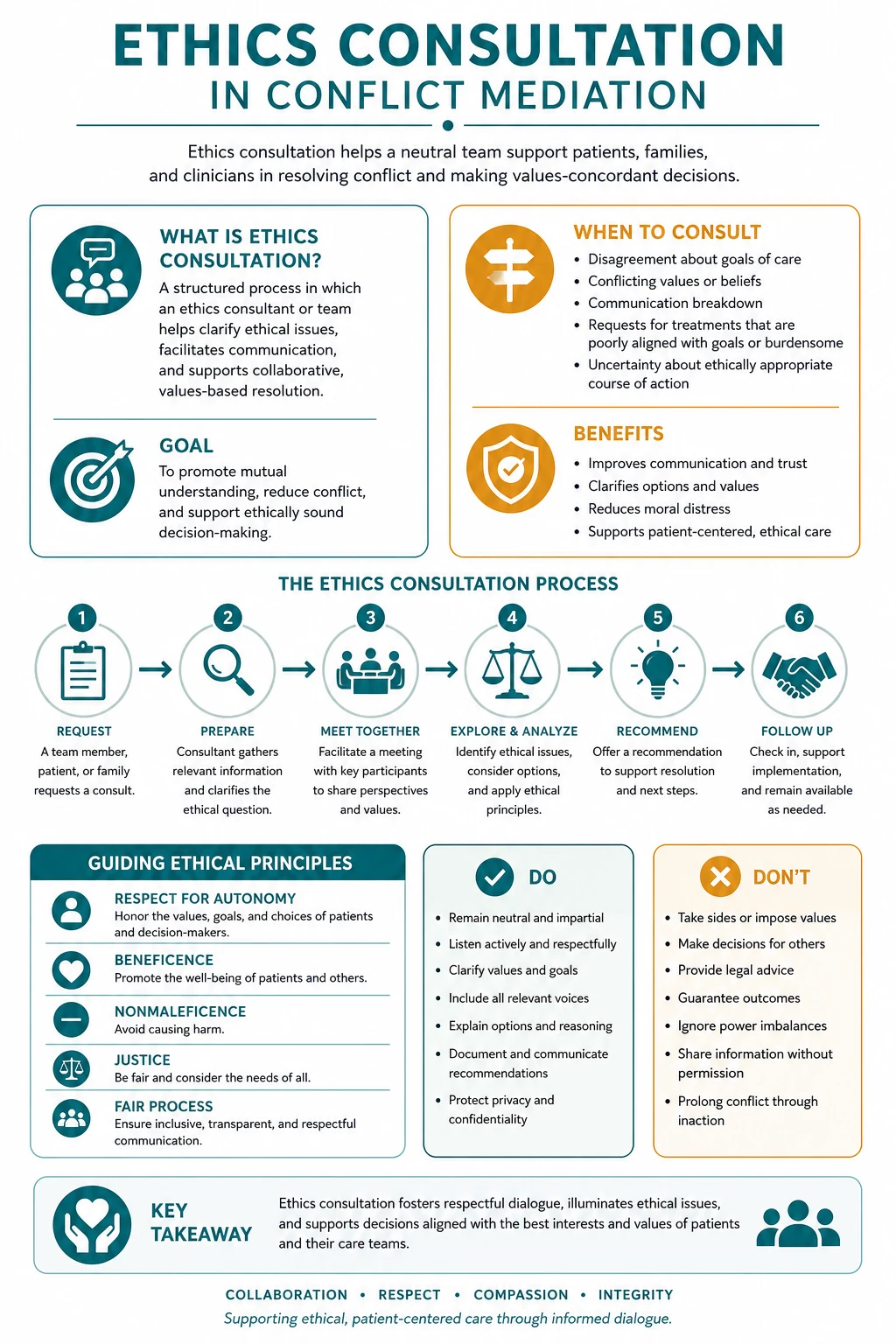
The ethics consultation process — what actually happens
- REQUEST — any team member, the patient, or the family may request an ethics consult. In most institutions no permission is required from the treating consultant to request one.
- GATHER FACTS — the ethics consultant interviews the treating team, reviews the medical record, and meets the patient (if able) and family/SDM. They establish the clinical facts, the decision in dispute, and the parties' values and concerns.
- CLARIFY THE ETHICAL QUESTION — reframe the conflict as a specific ethical question ("Is continued ventilation in the patient's best interests given prognosis X?") rather than a vague dispute.
- APPLY ETHICAL ANALYSIS — map the case against the four principles, relevant duties, and the patient's known values; identify where principles conflict.
- FACILITATE A MEETING — convene team, SDM, and family; use mediation skills to explore interests and find common ground; often the process itself resolves the conflict.
- PROVIDE A NON-BINDING RECOMMENDATION — the committee gives a written recommendation in the record. It is ADVISORY — the treating team and family retain decision authority. (This is the key difference from a tribunal/court, which is binding.)
- DOCUMENT AND FOLLOW UP — record the recommendation, the rationale, and the outcome; arrange follow-up. In the Schneiderman RCT, 87% of physicians, nurses, and surrogates found ethics consultations helpful.[1]
Futility disputes
Defining futility — physiological vs value-based
Types of futility — the distinction that drives the response
| Type | Definition | Example | Implication |
|---|---|---|---|
| Physiological futility (quantitative) | The treatment CANNOT achieve its physiological goal (e.g. CPR will not restore circulation) — often defined as <1% success | Chest compressions in a patient with progressive pulseless electrical activity despite maximal therapy | Strong basis to decline/withdraw unilaterally — the treatment simply will not work |
| Value-based / qualitative futility | The treatment MAY achieve its physiological goal but the resulting quality/state is not judged worthwhile | Tracheostomy/PEG and long-term ventilation in a patient in persistent vegetative state | Requires shared decision-making; ethics consult; cannot be imposed unilaterally as easily |
| Lack of benefit (burdens outweigh benefits) | Treatment prolongs the dying process without restoring meaningful function | Continued ICU support in end-stage multi-organ failure | Standard basis for WLST after shared decision-making |
- The historical problem with "futility" — the term was introduced by Schneiderman, Jecker & Jonsen (1990) to describe treatment that cannot achieve its goal. It quickly became controversial because unilateral declarations of futility by clinicians were seen as paternalistic and at odds with autonomy. The modern consensus (Truog 1992, ANZICS, SCCM/ATS): "futility" is best used narrowly for physiological futility; broader value-judgements should be resolved through shared decision-making, not unilateral clinician fiat.[5][6]
Resolving a futility dispute
Futility dispute pathway — team believes treatment is non-beneficial, family demands continuation
- ENSURE THE CLINICAL PICTURE IS SOLID — obtain a senior second opinion (another consultant, ideally from a different team); confirm prognosis with appropriate investigations. The team must be in agreement before approaching the family.
- HAVE THE STRUCTURED FAMILY MEETING — SPIKES, honest prognostication, shared decision-making. Clarify the type of futility (physiological vs value). Many apparent impasses dissolve with clear information and time.
- OFFER A TIME-LIMITED TRIAL — "Let's continue full treatment for 72 hours / one week with these agreed criteria, then reassess." This honours the family's need for time and lets the clinical course decide, often removing the conflict.
- CONSULT PALLIATIVE CARE AND ETHICS — early integration of palliative care reframes goals toward comfort and dignity; ethics consultation provides a neutral, structured, values-based process. (Schneiderman RCT: ethics consultation reduced non-beneficial ICU days and ventilator days without changing mortality, and 87% of stakeholders found it helpful.)[1]
- ADDRESS THE UNDERLYING INTERESTS — explore guilt, fear of abandonment, mistrust, religious/cultural framing, prior promises. The demand for "everything" is usually about something other than the medical treatment itself.
- CONSIDER UNILATERAL WITHDRAWAL PER POLICY — if, after second opinion, mediation, ethics consult, and reasonable time, the treatment is judged physiologically futile and continuation causes harm: SOME jurisdictions/institutions have a futility policy permitting unilateral withdrawal after due process (e.g. giving notice, offering transfer to another institution, a defined waiting period). This is legally and ethically fraught — use ONLY with senior leadership, legal, and ethics input. NEVER act unilaterally without exhausting the pathway and without institutional policy support.[1]
- IF UNRESOLVED → TRIBUNAL/COURT — the binding last resort. Apply to the guardianship tribunal/court for a determination. Document the entire pathway and the reasons escalation became necessary.
Family demands futile treatment vs clinician offers futile treatment — two sides
| Scenario | Ethical issue | Response |
|---|---|---|
| Family demands treatment team believes is futile | Autonomy (surrogate) vs beneficence/non-maleficence | Structured meeting → time-limited trial → palliative care → ethics → second opinion → (rarely) unilateral withdrawal per policy → tribunal |
| Clinician/team insists on withdrawal the SDM opposes | Same conflict, opposite direction | NEVER unilateral withdrawal without due process; second opinion; ethics; mediation; tribunal if needed |
| Family demands treatment that is physiologically futile (e.g. CPR that cannot work) | Non-maleficence / justice | Decline with explanation; document; offer comfort-focused alternatives; do not perform treatments that cannot work |
| Advance directive requests a treatment (e.g. "keep me alive at all costs") | Autonomy vs beneficence | An advance directive REQUESTING treatment informs but does not compel non-beneficial treatment — there is no right to demand treatment that cannot benefit |
Legal aspects: capacity, guardianship, tribunal/court
Legal instruments and pathways in ICU conflict (ANZ / UK orientation)
| Instrument / pathway | What it is | When used |
|---|---|---|
| Capacity (clinical) | Bedside assessment — decision-specific, 4 elements | Every time a patient must decide and capacity is in doubt |
| Competence (legal) | Court/statute determination | Rare in ICU; capacity usually suffices clinically |
| Advance directive / Advance Decision to Refuse Treatment (UK MCA) | Patient's binding refusal of a specified treatment, made when capacitous | When it exists and is valid/applicable — must be respected |
| Advance Care Directive (Australian states) | Legally binding statement of future health preferences | As above |
| Enduring Guardian / Lasting Power of Attorney (health) / healthcare proxy | Person legally appointed by the patient to decide when they lack capacity | The preferred SDM when appointed |
| Statutory hierarchy / "person responsible" | Default hierarchy of relatives who may decide if no formal SDM | When no formal appointment exists |
| Guardianship tribunal (e.g. VCAT, NCAT, Guardianship Division NCAT) | Independent statutory body that can appoint/replace a guardian or make binding health decisions | SDM in dispute, no SDM, SDM acting against patient's interests, unresolvable conflict |
| Court (Supreme Court / Court of Protection UK) | Highest authority; binding determinations on life-sustaining treatment | Last resort; landmark cases (e.g. UK Court of Protection "best interests" hearings; Bland, Airedale NHS Trust 1993) |
| Coroner | Investigates reportable deaths (including some peri-withdrawal deaths depending on jurisdiction) | Statutory reporting obligations — know your local rules |
Escalation pathway when conflict cannot be resolved at the bedside
- BEDSIDE — senior clinician + structured family meeting — resolve most conflicts here with SPIKES, shared decision-making, time-limited trial.
- SECOND CLINICAL OPINION — another consultant, ideally from a different unit; reassures the family that the recommendation is not one person's view.
- PALLIATIVE CARE — reframe goals toward comfort; symptom control; family support.
- ETHICS CONSULTATION — non-binding advisory; structured, neutral, values-based; reduces non-beneficial treatment.[1]
- MEDIATION — formal facilitated negotiation (some institutions have a dedicated mediation service; ethics committees often fulfil this role).
- GUARDIANSHIP TRIBUNAL — for SDM disputes, no SDM, or SDM acting against patient's interests; can appoint/replace a guardian and make a binding determination. Binding.
- COURT — the binding last resort for intractable, high-stakes disputes over life-sustaining treatment. Document the entire pathway and the reasons each step failed.
- DOCUMENT EVERYTHING — at every stage, record who was involved, what was discussed, the clinical and ethical reasoning, and the decision/basis. This is the medicolegal record and protects patient, family, SDM, and clinicians.
Capacity (clinical) vs competence (legal) — the distinction examiners test
| Feature | Capacity | Competence |
|---|---|---|
| Nature | Clinical ability to decide | Legal status to decide |
| Determined by | Treating clinician(s) at the bedside | Court or statute |
| Scope | Decision-specific and time-specific (may fluctuate) | Usually global (until restored by court) |
| Everyday use in ICU | Assessed daily at the bedside | Rarely invoked clinically |
| Key point | Capacity is the operative concept in ICU — competence is a legal term you should be able to distinguish but rarely need |
Withdrawal of life-sustaining treatment (WLST) against family wishes
This is the highest-stakes conflict: the team believes continued treatment is non-beneficial/burdensome; the family/SDM insists on continuation. It must NEVER be resolved by unilateral clinician action without due process. [1]
WLST against family wishes — the due-process pathway
- CONFIRM THE CLINICAL CASE IS SOLID — senior team consensus; second consultant opinion; appropriate investigations; document prognosis and its basis. The team must internally agree before acting.
- CONFIRM THE LAWFUL SDM AND THE BASIS FOR DECISION — is this substituted judgement (what the patient would want) or the SDM's own preference? An SDM may not override the patient's known wishes. If an advance directive exists and is valid/applicable, it governs.
- HAVE THE STRUCTURED FAMILY MEETING(S) — SPIKES; honest prognostication; shared decision-making; NURSE for emotion. Often multiple meetings over days are needed. Allow time — rushed decisions breed regret and litigation.
- ADDRESS THE UNDERLYING INTERESTS — guilt, fear of abandonment, mistrust, religious/cultural framing, prior promises. These are usually the real obstacles.
- OFFER A TIME-LIMITED TRIAL — continue full treatment for a defined period against agreed criteria, then reassess. Often resolves the conflict by letting the disease decide.
- CONSULT PALLIATIVE CARE AND ETHICS — palliative care reframes goals; ethics provides the neutral structured process. Both reduce non-beneficial treatment and family distress.[1]
- CONSIDER A FUTILITY POLICY / UNILATERAL WITHDRAWAL (IF APPLICABLE) — only if treatment is physiologically futile, all due process is exhausted, and an institutional policy permits it (with notice, offer of transfer, waiting period, legal/ethics input). This is rare and jurisdiction-dependent.
- IF UNRESOLVED → GUARDIANSHIP TRIBUNAL / COURT — apply for a binding determination. The tribunal/court applies the best-interests test and can authorise withdrawal. Document the whole pathway.
- NEVER act unilaterally without due process — unilateral withdrawal against SDM wishes without second opinion, ethics, mediation, and (where relevant) tribunal/court authority carries serious legal and ethical risk and damages trust.
- CONTINUE TO CARE FOR THE PATIENT AND FAMILY THROUGHOUT — even in conflict, the patient must not be neglected: symptom control, comfort, dignity, communication, and family access continue regardless of the dispute. The relationship is not suspended by disagreement.
Withdrawal AGAINST family wishes vs withdrawal requested BY family vs team-initiated withdrawal
| Scenario | Standard | Process |
|---|---|---|
| Family REQUESTS withdrawal consistent with prognosis | Substitute judgement / best interests | Agree if clinically appropriate; conduct structured WLST |
| Family REQUESTS continuation that team believes is futile | Autonomy (surrogate) vs beneficence/non-maleficence | Due-process pathway above; rarely unilateral withdrawal per policy |
| Team INITIATES withdrawal discussion (prognosis poor) | Beneficence/non-maleficence/justice | Shared decision-making with SDM; if SDM agrees, proceed; if not, due-process pathway |
| Capacitous patient requests withdrawal | Autonomy prevails | Respect the patient's decision; provide symptom-focused care; WLST is lawful |
| Capacitous patient refuses life-saving treatment | Autonomy prevails | Respect — even if death results (e.g. Jehovah's Witness and blood) |
Resource allocation and triage conflict
Allocation principles when resources are scarce (pandemic / mass casualty)
| Principle | Meaning | Application |
|---|---|---|
| Maximise benefit | Save the most lives / life-years | Prioritise patients most likely to survive with treatment, not those most or least sick |
| Prioritise health workers | Reciprocity / instrumental value | Frontline workers may receive priority (they save others) |
| No discrimination | Equal worth of persons | Allocation must NOT be based on age, disability, race, wealth, or social value per se |
| Consistency | Same criteria applied to all | Use a published triage protocol + triage team SEPARATE from treating clinicians |
| Transparency | Criteria public and understandable | Publish the protocol; explain decisions to families |
| Proportionality | Restrictions proportional to scarcity | Relax restrictions as supply improves |
| Accountability | Review and revise | Triage decisions auditable; appeal mechanism |
- Separate the triage decision from the bedside — the treating clinician should NOT make allocation decisions for their own patient (conflict of interest). A separate triage team applies a published protocol. This protects the patient, the clinician, and the fairness of the system.[1]
Moral distress and intra-team conflict
Conflict is not only between team and family — it occurs WITHIN the team and causes moral distress (knowing the ethically right action but being constrained from taking it). Unrecognised, it drives burnout and staff attrition. [1]
Moral distress vs moral residue vs moral injury vs burnout
| Concept | Definition | ICU example | Response |
|---|---|---|---|
| Moral distress | Distress when one knows the right action but is constrained from acting | Continuing treatment the nurse believes is futile because family insists | Debrief; ethics consult; institutional change; speak up |
| Moral residue | The lingering distress after a morally compromising situation | The feeling that "compromises what I am as a clinician" | Reflective practice; peer support |
| Moral injury | Psychological harm from perpetrating/failing to prevent acts that violate moral beliefs | COVID-era triage where clinicians felt they abandoned patients | Psychology; peer support; systemic change |
| Burnout | Emotional exhaustion, depersonalisation, reduced accomplishment | Chronic overload, EOL conflict, staffing | Structural fixes; workload; support |
- Conscientious objection — a clinician who believes a requested act is morally wrong may object, but has a duty to refer or transfer the patient to another clinician so the patient's interests are not harmed. The objection must not amount to abandonment. Ethics consultation can mediate.[1]
Cultural and religious considerations in conflict
Cultural / religious dimensions that can drive or resolve conflict
| Domain | How it manifests | Clinician response |
|---|---|---|
| Truth-telling norms | Some cultures prefer prognosis disclosed to a senior family member, not the patient ("protect" the patient) | Negotiate respectfully; ask the patient whom they want informed; do not impose Western autonomy model rigidly, but do not collude to deceive a patient who wants to know |
| Decision-making structure | Family/communal decision-making rather than individual autonomy | Identify the family spokesperson/SDM; convene key relatives; respect communal process while identifying the lawful SDM |
| Religious framing of prognosis / miracles | Hope framed as divine intervention | Engage spiritual/religious care; do not dismiss faith; reframe hope (comfort, dignity) without removing it |
| End-of-life rituals | Specific practices around dying, death, body, timing | Accommodate where possible (visiting, rituals, time with body); involve spiritual care |
| Distrust of the institution | Historical/structural mistrust (e.g. minority communities) | Acknowledge; offer second opinion; continuity of clinician; transparency |
Clinical pearls
SAQ — Family conflict: SDM vs known patient wishes (substituted judgement)
10 minutes · 10 marks
A 74-year-old man with ischaemic cardiomyopathy and severe COPD (FEV1 0.6 L, home oxygen, housebound) is intubated for aspirational pneumonia. He has recovered once from a similar admission and told his GP, his wife and his brother independently: 'If I have to be on a breathing machine again, I never want it again — let me go.' His wife (statutory SDM under your jurisdiction's hierarchy) now says she wants 'everything done.' His brother is quietly backing the patient's stated wishes. The bedside nurse tells you the patient 'fights the ventilator' and grimaces when suctioned. The team is divided.
SAQ — Mediation framework: when structured communication has failed and the team insists on unilateral withdrawal
10 minutes · 10 marks
A 67-year-old man with end-stage idiopathic pulmonary fibrosis is invasively ventilated on day 21 of an admission complicated by pneumothorax, two cardiac arrests, and stage 3 AKI on CRRT. He is now in multi-organ failure. He has no advance directive and never appointed an SDM. His son (statutory SDM by hierarchy) insists on full active treatment including re-intubation if extubated — 'He is a fighter, God will decide.' Two consultants and nursing leadership believe continued ICU is non-beneficial and want to withdraw. Three meetings have been held without resolution. The unit director calls you, on call, for advice.
Red flags
Prognosis and evidence
Conflict, ethics consultation, and family outcomes — landmark evidence
Schneiderman et al., JAMA 2003 (PMID 12952998) — multicentre RCT, 551 ICU patients with value-related treatment conflicts randomised to ethics consultation vs usual care. Ethics consultation reduced hospital days (−2.95), ICU days (−1.44), and ventilator days (−1.7) in non-survivors, with NO change in overall mortality. 87% of physicians, nurses, and surrogates found ethics consultations helpful. The key evidence that ethics consultation reduces non-beneficial treatment without harming patients and is valued by stakeholders.[1]
Lautrette et al., NEJM 2007 (PMID 17267907) — multicentre RCT in 22 French ICUs of a proactive communication strategy (structured end-of-life family conference + bereavement brochure) for families of dying patients. At 90 days, intervention families had significantly lower PTSD (IES 27 vs 39), anxiety, and depression (HADS 11 vs 17). Intervention conferences were longer and let families speak more (median 14 vs 5 minutes). The evidence that LISTENING is the active ingredient of the family meeting.[2]
Azoulay et al., AJRCCM 2005 (FAMIREA, PMID 15665326) — up to a third of family members of ICU decedents have PTSD symptoms. Predictors: poor communication, feeling excluded from decisions, contradictory information. The case for proactive, structured, family-centred communication.[10]
Appelbaum, NEJM 2007 (PMID 17978286) — the four-element framework for bedside capacity assessment (communicate a choice, understand, appreciate, reason) — the standard taught and examined worldwide. Capacity is decision-specific and may fluctuate; never assume incapacity.[3]
Baile et al., The Oncologist 2000 (SPIKES, PMID 10944091) — the six-step protocol (Setting, Perception, Invitation, Knowledge, Emotion, Strategy) for delivering bad news, now standard across critical care and oncology. Reduces family/caregiver distress.[4]
Kon et al., CCM 2016 (ACCM/ATS policy, PMID 26584151) — shared decision-making as the ethical standard for ICU treatment decisions; moves the field away from both paternalism and pure autonomy models toward a partnership.[7]
Schneiderman, Jecker & Jonsen, Ann Intern Med 1990 (PMID 2187394) — the original definition of medical futility; introduced the term to critical care. Controversial because of concerns about unilateral clinician power.[5]
Truog, Brett & Frader, NEJM 1992 (PMID 1579143) — "The problem with futility" — the influential critique arguing that unilateral futility declarations risk paternalism and that disputes should be resolved through process (second opinion, ethics, mediation) rather than clinician fiat.[6]
Curtis & Vincent, Lancet 2010 (PMID 20381225) — authoritative review of ethics and end-of-life care in the ICU; emphasises shared decision-making, communication, and the central role of the structured family meeting in preventing and resolving conflict.[8]
ANZICS Statement on Care and Decision-Making at the End of Life for the Critically Ill (2014) — the ANZ consensus framework: shared decision-making, proportionality of treatment, treatment limitation as standard practice, WLST as a legitimate ethical action, organ donation decoupled from EOL decisions. Equivalent documents: SCCM/ATS (USA), ESICM (Europe), GMC Treatment and Care towards the End of Life (UK).[1][1]
Outcomes: ethics consultation reduces non-beneficial ICU/ventilator days and is valued by stakeholders; proactive structured family meetings reduce family PTSD/anxiety/depression and increase concordance of care with patient values; conflict that is addressed early through structured communication resolves without escalation in the majority of cases. Failure to resolve conflict predictably increases non-beneficial treatment, prolongs ICU stay, worsens family psychological outcomes, and drives staff moral distress and burnout.
References
- [1]Schneiderman LJ, Gilmer T, Teetzel HD, et al. Effect of ethics consultations on nonbeneficial life-sustaining treatments in the intensive care setting: a randomized controlled trial JAMA, 2003.PMID 12952998
- [2]Lautrette A, Darmon M, Megarbane B, et al. A communication strategy and brochure for relatives of patients dying in the ICU N Engl J Med, 2007.PMID 17267907
- [3]Appelbaum PS Images in clinical medicine. Peripheral artery disease N Engl J Med, 2007.PMID 17978286
- [4]Baile WF, Buckman R, Lenzi R, et al. Eccrine poroma of the heel Int J Dermatol, 2000.PMID 10944091
- [5]Schneiderman LJ, Jecker NS, Jonsen AR Medical futility: its meaning and ethical implications Ann Intern Med, 1990.PMID 2187394
- [6]Truog RD, Brett AS, Frader J Oral milrinone in severe chronic heart failure N Engl J Med, 1992.PMID 1579143
- [7]Kon AA, Davidson JE, Morrison W, et al. Discovering the structure of nerve tissue: Part 3: From Jan Evangelista Purkyně to Ludwig Mauthner J Hist Neurosci, 2017.PMID 26584151
- [8]Curtis JR, Vincent JL Compared to whom? Subjective social status, self-rated health, and referent group sensitivity in a diverse US sample Soc Sci Med, 2010.PMID 20381225
- [9]Truog RD, Mitchell C, Daley J, et al. Notum palmitoleoyl-protein carboxylesterase regulates Fas cell surface death receptor-mediated apoptosis via the Wnt signaling pathway in colon adenocarcinoma Bioengineered, 2021.PMID 34402722
- [10]Azoulay E, Pochard F, Kentish-Barnes N, et al. Double-blind, placebo-controlled trial of pirfenidone in patients with idiopathic pulmonary fibrosis Am J Respir Crit Care Med, 2005.PMID 15665326
- [11]Abbott KH, Sago JG, Breen CM, Abernethy AP, Tulsky JA Implications of early structural-functional changes in the endothelium for vascular disease Arterioscler Thromb Vasc Biol, 2007.PMID 17138941