ICU · Ethics
Disaster/Pandemic Ethics — Resource Allocation & Triage
Also known as Disaster ethics · Pandemic triage · Resource allocation · SOFA score triage · Maximise lives saved · Fair innings · Triage committee · Crisis standards of care · Conventional contingency crisis surge · START triage · Mass casualty triage · Ventilator allocation framework · Multiprinciple allocation · Reverse triage · Duty to care · Withdrawal to reallocate
Disaster/pandemic ethics — the shift from individual focus (standard ICU) to population focus (maximise good across all) when demand exceeds supply. Mass casualty triage (START — simple triage and rapid treatment; reverse triage for burns/electrical). Surge capacity tiers: conventional → contingency → crisis, with crisis standards of care. Resource allocation principles: maximise lives saved (utilitarian), maximise life-years (fair innings), instrumental value (healthcare workers), random lottery tie-breaker. Ethical frameworks compared (utilitarian, egalitarian, prioritarian). Ventilator allocation frameworks: SOFA-based single-principle vs multiprinciple (SOFA + comorbidity + age caps + exclusions). SOFA score as the objective prognosis tool (higher = higher mortality = lower ICU priority) but imperfect and not the sole criterion. Duty to care vs duty to self (reciprocity, PPE, no abandonment). Withdrawal of life-sustaining treatment to free resources for others (ex ante consent, reallocation committee, dynamic triage). Triage committee separate from treating team. Framework: transparency, consistency, proportionality, accountability.
On this page & tools
Your progress
Saved locally on this device.
8 MCQs with explanations
Target exams
Overview & definition
Disaster/pandemic ethics — the shift from individual focus (standard ICU) to population focus (maximise good across all). Resource allocation when demand exceeds supply (ventilators, ICU beds, staff).[1]
The defining ethical fact of a disaster or pandemic is scarcity: the number of patients who could benefit from a critical resource (ventilator, ICU bed, dialysis, ECMO, even a clinician's attention) exceeds the supply. Under normal ("conventional") standards of care the clinician's duty is undivided — to act in the best interests of each individual patient. When scarcity becomes acute, that duty cannot be honoured for everyone simultaneously, and a second-order duty arises: to allocate finite resources so as to do the most good for the most people, fairly. This is the move from a deontological-equal-duty stance to a justice-constrained utilitarian stance, and it is what makes disaster ethics genuinely difficult — not because we do not know what to do for any one patient, but because we cannot do it for all of them.[1][13]
The ethical core is not "who do we let die" but "what publicly defensible, consistently applied, reviewable process will decide who receives a scarce resource when not all can." Three structural commitments make crisis allocation ethically tolerable: (1) a published protocol applied to all comers; (2) a triage team separate from the treating team so the bedside clinician's loyalty to their own patient is never corrupted; and (3) transparency, consistency, proportionality and accountability so that decisions are auditable and reversible as supply recovers. Without these, allocation collapses into ad-hoc, biased, individual judgements that are neither fair nor defensible.[1][14]

The triage principles
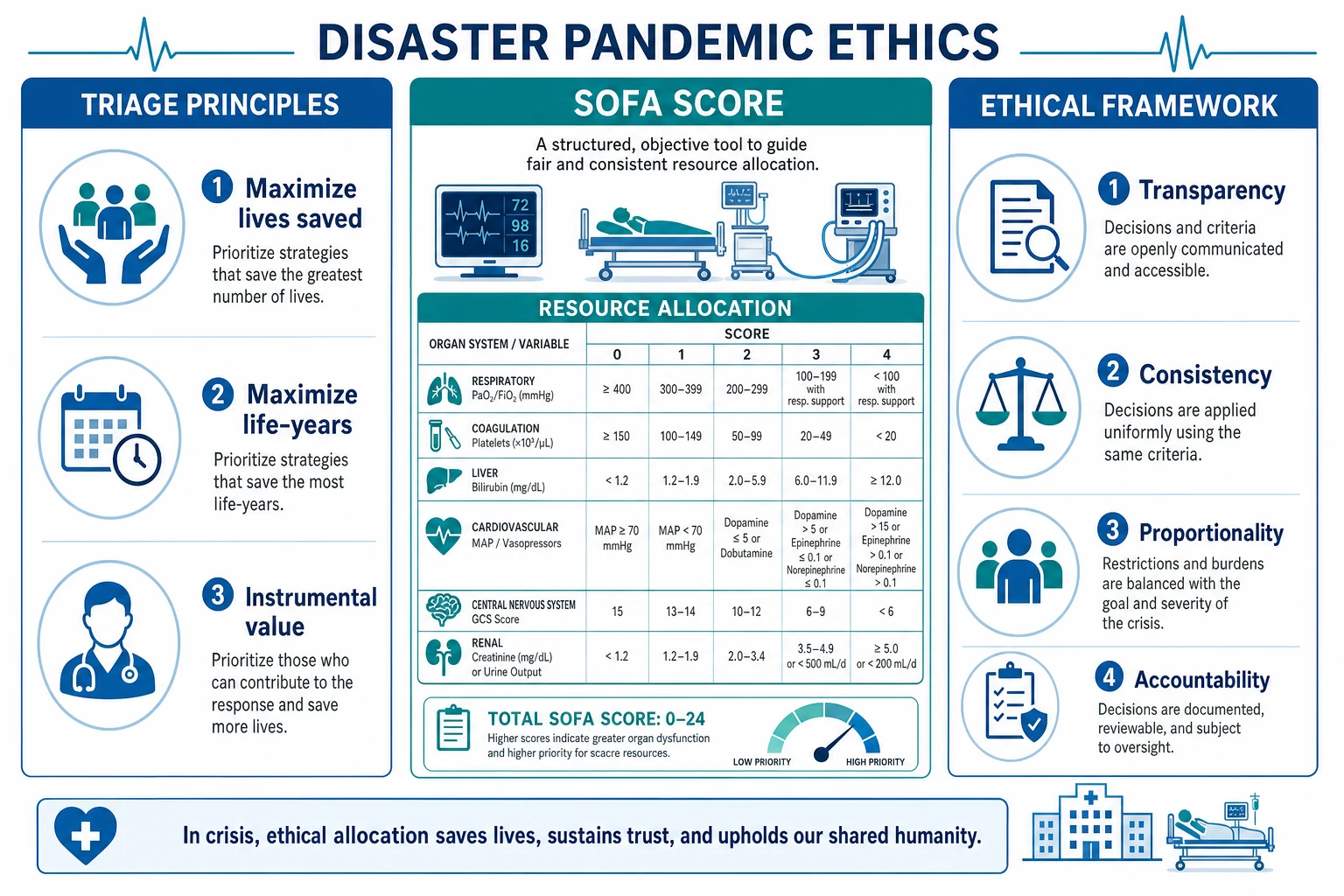
- Maximise lives saved (utilitarian — greatest good for greatest number).[1]
- Maximise life-years (fair innings — younger priority).[1]
- Instrumental value (healthcare workers — multiplier effect).[1]
- Tie-breaker — random lottery when equal.[1]
These four principles are lexically ordered in most pandemic frameworks (maximise benefit first → prioritise instrumental-value workers → equal candidates broken by lottery), but the ordering is itself a normative choice that the protocol must state explicitly and defend publicly. Emanuel and colleagues (NEJM 2020) crystallised six fundamental commitments for fair allocation: maximise benefit; prioritise health workers; avoid discrimination; consistency; transparency; and that allocation be evidence-based and responsive. The "maximise benefit" commitment is then operationalised either as save the most lives (treat those most likely to survive with treatment) or save the most life-years (prioritise those with the most years ahead) — a distinction that has real, exam-testable consequences.[1]
SOFA score (objective tool)
Higher SOFA = higher mortality = LOWER ICU priority. Limitations: does not capture frailty, comorbidity, quality of life, age directly. Should NOT be sole criterion.[1]
SOFA (Sequential Organ Failure Assessment) was adopted by most COVID-era frameworks as the objective prognostic anchor precisely because it is computed from routine data (PaO₂, platelets, bilirubin, MAP, GCS, creatinine), is reproducible, and is blind to social worth, wealth, race and religion. A SOFA-based cut-off stratifies patients into priority bands (e.g. highest priority SOFA < 6; lowest priority SOFA ≥ 11). Its great virtue is that it removes the decision from the bedside clinician's subjective judgement and makes the rule the same for every patient. Its great weakness is that it is a point-in-time snapshot that improves as patients recover and worsens as they deteriorate — which is why allocation must be dynamic (re-triaged at defined intervals, commonly 48 and 120 hours) rather than set once at admission.[3][5]
Ethical framework
- Transparency — public criteria.[1]
- Consistency — same criteria for all.[1]
- Proportionality — restrictions match severity.[1]
- Accountability — decisions reviewable.[1]
These four (often joined by duty to care, solidarity and reciprocity) form the procedural backbone of any crisis-allocation scheme. Proportionality deserves emphasis: the ethical stringency of triage must be proportional to the degree of scarcity — a unit that is 10% over capacity owes its patients far softer restrictions than a unit that is 200% over. As beds, ventilators and staff free up, the framework must de-escalate from crisis back to contingency to conventional standards, restoring the normal duty to each individual patient. A framework that imposes triage when there is no genuine scarcity, or that fails to relax it when scarcity eases, is itself an ethical failure.[11][12]
Triage committee
Separate from the treating team (removes conflict of interest). Multidisciplinary (senior clinicians, ethics, nursing).[1]
[1]Mass casualty triage — START, SALT and reverse triage
Mass casualty triage is the pre-ICU layer of disaster medicine: at the point of injury, decide in seconds who is treated, who is transported, and in what order. It is governed by a different logic from in-hospital ventilator allocation — the goal is rapid sorting (sieve) to move the most salvageable patients first, then a more detailed clinical sort (sieve→sort) to refine priorities. The dominant primary tools are START and SALT.[8][9]
START — Simple Triage and Rapid Treatment
START (Benson, Koenig & Schultz, 1996) sorts ambulatory from non-ambulatory casualties and then applies three rapid physiologic checks — respiration, perfusion (radial pulse/capillary refill), and mental status (follows commands) — to the non-ambulatory. A patient who cannot breathe after airway repositioning is deceased/expectant (black); rapid breathing, absent radial pulse or unable to follow commands mark immediate (red); the remainder are delayed (yellow); walking wounded are minor (green). The whole assessment takes under a minute per patient and needs no equipment beyond the triage officer's hands and voice.[8]
START algorithm — the four rapid checks (RPM: Respiration, Perfusion, Mental status)
- SORT THE AMBULATORY — instruct everyone who can walk to move to a designated area; these are MINOR (green) pending secondary assessment. (A handful of critically injured patients who can stagger away may be missed — re-sort them.)
- RESPIRATION — for non-ambulatory patients, assess spontaneous respiratory rate. Not breathing after head-tilt/airway opening → DECEASED/EXPECTANT (black). Respiratory rate > 30/min → IMMEDIATE (red). Rate ≤ 30 → go to next step.
- PERFUSION — radial pulse absent OR capillary refill > 2 seconds → IMMEDIATE (red). Adequate perfusion → go to next step.
- MENTAL STATUS — does not obey commands / cannot follow simple instructions → IMMEDIATE (red). Obeys commands → DELAYED (yellow).
- RE-SORT CONTINUOUSLY — START is a dynamic sieve; patients deteriorate en route and on arrival. Triage is repeated at each handover point. Expectant (black) patients are given comfort measures and reassessed if resources later allow.[8]
SALT — Sort, Assess, Life-saving interventions, Treatment/Transport
SALT (Lerner et al., 2008; endorsed as a US national guideline) is the refinement that allows limited life-saving interventions (LSI — needle thoracostomy, tourniquet, airway positioning, auto-injector antidotes) during triage and uses a global sort (walk, wave/purposeful movement, still) before the individual assessment. SALT categories are Immediate / Expectant / Delayed / Minimal / Dead, and patients are assigned by prognosis-for-intervention rather than by fixed RPM cut-offs alone. SALT is increasingly preferred because it integrates intervention with triage and handles children and chemical/radiological incidents better than START.[9]
START vs SALT — the two dominant mass-casualty primary triage tools
| Feature | START | SALT |
|---|---|---|
| Origin | Benson, Koenig & Schultz 1996 (earthquake scenarios) | Lerner et al. 2008 — proposed US national guideline |
| Initial sort | Ambulatory vs non-ambulatory | Global sort: walk / purposeful movement (wave) / still |
| Decision criteria | RPM — Respiration, Perfusion, Mental status | Global assessment of life-saving interventions needed + prognosis |
| Interventions during triage | None (airway opening only) | Allows LSIs: needle thoracostomy, tourniquet, airway positioning, antidotes |
| Categories | Minor (green) / Delayed (yellow) / Immediate (red) / Deceased (black) | Minimal / Delayed / Immediate / Expectant / Dead |
| Strength | Fast, simple, near-zero equipment, easily taught | Integrates intervention; better for children, chemical, mixed incidents |
| Limitation | Misses staggerers; no intervention during triage; less suited to children | More complex; needs trained triage officer; LSIs consume time |
| When to use | Large scene, limited officers, rapid sieve | When limited interventions during triage will save lives (blast, chemical) |
Reverse triage — for burns and electrical/lightning mass casualties
Reverse triage inverts the usual "sickest first" logic in two specific settings. In mass burn disasters (and to a degree electrical/lightning incidents), the patients with the largest and deepest burns plus inhalation injury have the lowest probability of survival and the highest resource consumption (massive fluids, long ventilation, repeated surgery). Conventional triage (treat the worst first) would consume all resources on those least likely to survive; reverse triage therefore prioritises the moderately burned who are highly salvageable, designates the extensive-full-thickness + inhalation-injury group as expectant (comfort care), and reserves critical-care capacity for the greatest number of survivors.[8]
The second meaning of reverse triage is in-hospital surge generation: rapidly discharging or downgrading the least sick current inpatients (and cancelling elective surgery) to free beds for incoming casualties. This is the principal way an ICU generates capacity in the first hours of a disaster and is distinct from patient-selection triage — it is a logistic decision applied to inpatients who stand to lose little by deferred care.[12]
Two meanings of reverse triage — do not confuse them
| Sense | What is inverted | Setting | Effect |
|---|---|---|---|
| Reverse triage of casualties (burns/electrical) | "Sickest first" → "most salvageable first"; the gravest are expectant | Mass burn / lightning / electrical disaster at the scene | Maximise survivors by not spending all fluid/surgery/ventilators on the unsalvageable |
| Reverse triage of inpatients (surge generation) | Usual admission logic → discharge the least-sick and cancel electives | Hospital generating capacity before/at onset of surge | Free ICU/ward beds for incoming casualties without harm to those deferred |
- Expectant category (black) is a treatment category, not an abandonment category. Expectant patients receive analgesia, comfort, dignity and (where possible) family contact; they are re-triaged if the resource picture improves. The decision to declare expectant is a triage-team decision proportional to scarcity, never a bedside clinician acting alone, and it must be revisable.[8]
Pandemic surge capacity — conventional → contingency → crisis
Surge capacity is not a single state but a graded continuum defined by the American College of Chest Physicians Task Force for Mass Critical Care (building on the US Institute of Medicine / National Academies framework). As demand rises relative to staff, space and supplies ("the 3 Ss"), the system moves through three tiers, each with a distinct ethical and operational standard of care.[11][12]
The three tiers of surge capacity — conventional, contingency, crisis
| Tier | Demand vs capacity | Staffing/space/supplies | Standard of care | Triage activated? |
|---|---|---|---|---|
| CONVENTIONAL | Within usual capacity | Usual spaces, usual staffing, usual supplies; space may be flexed (e.g. extra beds) | Individual patient best-interest (normal ICU duty) | No — treat everyone who meets usual criteria |
| CONTINGENCY | Demand stresses capacity but care can be adapted | Re-purposed space (PACU, wards), adaptive staffing (cross-skilling, extended scope), conservative substitute supplies | Functionally equivalent care — same outcomes via different means (e.g. lower nurse:patient ratio, deferred non-urgent work) | Generally no — adapt to preserve usual goals |
| CRISIS | Demand exceeds capacity; cannot deliver conventional or contingency care | Crisis spaces (non-ICU areas, corridors), crisis staffing (re-assigned, volunteers, students under supervision), scarce/re-used supplies | Crisis standards of care — care that falls below usual standards because it is the best achievable; explicit triage of who receives the scarce resource | Yes — activate the triage protocol and triage committee |
The thresholds between tiers are defined prospectively by trigger criteria (e.g. ICU occupancy > 100% with all flexed spaces in use; inability to staff ventilators at safe ratios; imminent exhaustion of oxygen or drug supply). Moving into crisis standards is a deliberate institutional/regional decision, documented and communicated, not a drift — and de-escalation back to contingency/conventional is a defined event triggered by recovery of capacity. Treating patients under crisis standards without declaring so, or failing to de-escalate, are both ethical failures.[11]
- Space can be surged faster than staff. The binding constraint in almost every real surge is trained critical-care staff (nurses, then respiratory therapists, then intensivists). "Empty ventilators" without staff to watch them are not capacity. Surge planning that counts only beds and machines overstates capacity by an order of magnitude.[18]
- Strain worsens outcomes independently of patient factors. ICU strain (high occupancy, high turnover, imbalanced acuity) is associated with worse risk-adjusted mortality even at sub-crisis levels — a direct empirical argument for early surge action and for de-escalation the moment capacity returns.[20]
Crisis standards of care
Crisis standards of care (CSC) are the formally declared, legally and ethically grounded rules under which care is delivered when demand so exceeds resources that conventional standards cannot be met. They are not an excuse for lower-quality care; they are a pre-planned, publicly known substitute framework that makes the inevitable deviations from usual care consistent, fair and accountable.[11]
What crisis standards of care contain — the components a clinician should be able to name
- A DECLARATION MECHANISM — explicit triggers (quantitative occupancy, staffing, supply thresholds) and a defined authority (state health department, regional command, hospital incident command) that formally moves the region into (and out of) crisis standards. Declaration matters: it confers legal/ethical standing for triage and triggers mutual aid.
- A TRIAGE PROTOCOL — a published, multi-principle allocation scheme (e.g. SOFA bands + exclusions + tie-break) applied by a triage team separate from the bedside. The protocol defines WHO is triaged, on WHAT criteria, at WHAT intervals, and the appeal pathway.
- A TRIAGE TEAM / COMMITTEE — multidisciplinary (senior intensivists, nursing, ethics, admin, ideally a lay/community member); separate from the treating team; on-call and geographically distributed. Records decisions for audit and appeal.
- STAFF, SPACE, SUPPLY AND STUFF (the 4 Ss) PLANS — surge staffing (cross-skilling, extended scope, re-deployment, volunteers), surge space (PACU, wards, off-site), and supply conservation/substitution (ventilator sharing, extended-use PPE, drug alternatives/compounding).
- LEGAL AND LIABILITY PROTECTIONS — clinicians acting in good faith under declared CSC should have defined liability protection; without it, fear of later prosecution corrupts triage decisions. Know your jurisdiction's emergency powers and Good Samaritan provisions.
- COMMUNICATION AND COMMUNITY ENGAGEMENT — the public must know the standards exist, what they mean, and how to appeal; transparency is a core ethical commitment and a precondition for trust.
- EQUITY SAFEGUARDS — explicit prohibitions on discrimination (no exclusion on the basis of age, disability, race, religion, wealth, immigration status, or social worth per se) and active monitoring for disparate impact (e.g. on minority or disabled populations).[11][16]
- MENTAL HEALTH SUPPORT FOR TRIAGE STAFF — crisis triage causes moral injury; staff need debrief, peer support, psychological referral and rotation off the triage committee to limit cumulative harm.
Ethical frameworks for triage — utilitarian, egalitarian, prioritarian
Allocation under scarcity is underdetermined by clinical facts — it requires a normative choice about what "fair" means. Three frameworks dominate the literature and the exam, and most operational protocols blend them.[1][14]
The three ethical frameworks for triage — what each maximises, and its blind spot
| Framework | Core idea | How it allocates the last ventilator | Strength | Weakness / risk |
|---|---|---|---|---|
| Utilitarian (maximise benefit) | The right allocation maximises total good — most lives or most life-years saved | Give it to the patient most likely to survive with it (and survive longest) | Most lives saved; fits the disaster imperative | Can sacrifice the individual (the sick, old, disabled) as "less efficient"; may entrench structural disadvantage |
| Egalitarian (equal moral worth) | Each person has equal claim; allocation must be blind to social worth | Random lottery among those who could benefit; or strict first-come-first-served | Maximally fair; no bias; transparent | Ignores prognosis — may give the resource to the least salvageable; first-come rewards the privileged who arrive first |
| Prioritarian (priority to the worst-off) | Those who are worst-off (youngest yet to live their life, or sickest with a chance) get priority | Priority to the youngest (fair innings) or to the most urgent salvageable case | Protects those least able to have had a "fair innings"; morally compelling | "Worst-off" is ambiguous (youngest? sickest? disabled?) and can conflict with maximise-lives; hard to operationalise |
- Real protocols blend all three. Most pandemic ventilator frameworks are primarily utilitarian (SOFA-based prognosis to maximise lives saved) with prioritarian accents (life-years / fair innings, instrumental value for healthcare workers) and an egalitarian tie-breaker (random lottery when all else is equal). The exam point is that no single framework is sufficient; a defensible protocol must state which framework dominates and why, and defend the ordering publicly.[1][4]
- First-come-first-served is NOT a fair default. It rewards whoever reaches the hospital first — which, during a pandemic, systematically favours the wealthy, the geographically close, and those with fewer caring responsibilities. Most frameworks explicitly reject FCFS as an allocation principle for that reason.[6]
- The lottery is the only egalitarian tie-breaker that survives scrutiny. When two patients are otherwise equal on the primary criteria, a random lottery (rather than a clinician's "gut feeling" or a queue) is the only method that does not introduce bias. Emanuel et al. and the Task Force for Mass Critical Care both endorse lottery as the final tie-break.[1]
Resource allocation principles — maximise lives saved vs maximise life-years
The single most-examined ethical tension in pandemic triage is maximise lives saved (treat the most salvageable) versus maximise life-years saved (give priority to the young). They sound similar and diverge sharply.[1][6]
Maximise lives saved vs maximise life-years — the central tension
| Principle | Goal | Operational rule | Favours | Disfavours | Risk |
|---|---|---|---|---|---|
| Maximise lives saved | Save the largest NUMBER of people now | Prioritise those most likely to survive THIS episode with treatment (mid-acuity, good short-term prognosis) | The moderately ill with good short-term outlook | The very sick (low survival) AND the very well (don't need the resource) | Ignores downstream life expectancy; two 85-year-olds count the same as two 25-year-olds |
| Maximise life-years saved (fair innings) | Save the most TOTAL years of life | Give priority to those with the most years ahead — younger, fewer life-limiting comorbidities | The young; those not yet had a "complete" life | The elderly; the chronically ill | Risks ageism and disability discrimination; "life-years" is hard to measure and culturally loaded |
- The "instrumental value" exception. Healthcare workers and other key responders may receive priority not because their lives are worth more, but because saving one of them saves many more — they are an investment with a multiplier. This is the only defensible "social worth" consideration; it is instrumental (consequential), not intrinsic. Most frameworks also extend a reciprocal duty: workers who took on extra risk are owed priority care as a matter of justice for the risk borne.[1]
- Life-years vs lives: the operational compromise. Emanuel et al. propose a two-stage weighting — prioritise saving the most lives, and within comparable prognoses, give priority to the young — on the explicit ground that "maximising life-years" applied bluntly would systematically exclude the old. The Task Force for Mass Critical Care similarly treats life-years as a tie-breaker rather than a primary criterion. This blended ordering is the dominant exam answer.[1][3]
Ventilator allocation frameworks — SOFA-based and multiprinciple
The ventilator is the paradigmatic scarce resource because it cannot be substituted and is staff-intensive. Two families of allocation framework evolved through SARS, H1N1 and COVID.[3][4][5]
SOFA-based single-principle frameworks
The simplest frameworks (e.g. the original 2006 Christian CMAJ protocol and several state protocols) allocate by SOFA score alone, stratified into priority bands with exclusion criteria. They are transparent, reproducible and cheap to compute, and they remove the decision from the bedside clinician's judgement. Their weakness is that a single number cannot capture short-term survival, comorbidity burden, or the trajectory of improvement.[5]
SOFA bands in a typical single-principle protocol (illustrative — protocol-specific)
| SOFA score | Short-term mortality risk | Allocation priority |
|---|---|---|
| < 6 | Low | Highest priority — most likely to benefit |
| 6–9 | Moderate | Intermediate priority |
| ≥ 11 (or > 11) | Very high | Lowest priority — least likely to benefit; consider comfort-focused care |
| Imminent death / irreversible shock / refractory hypoxaemia | Near-certain | Excluded / lowest — resource unlikely to change outcome |
Multiprinciple frameworks
Multiprinciple frameworks (Daugherty Biddison et al., the Task Force for Mass Critical Care, White & Lo) combine SOFA-based prognosis with major-comorbidity burden, short-term survival estimate, and (controversially) age caps or age-based tie-breakers. They are more clinically nuanced but more contestable, more prone to bias, and harder to apply consistently across sites. The 2019 Maryland/Johns Hopkins framework and the 2020 SCCM/CHEST implementation guide are the worked exemplars.[4][3][6]
A multiprinciple ventilator allocation algorithm (composite of SCCM/CHEST 2020 and Daugherty Biddison 2019)
- EXCLUSION SCREEN — exclude patients with conditions that make survival to discharge with the resource near-zero (e.g. irreversible shock, refractory hypoxaemia despite maximal therapy, cardiac arrest without ROSC, severe irreversible neurological devastation, end-stage disease with < 6–12 month prognosis). NOTE: categorical exclusions on age or disability alone are ethically impermissible (Auriemma et al. 2020) — exclusions must be prognosis-based, not identity-based.[16]
- CALCULATE SOFA — assign a SOFA score (or multi-organ dysfunction score) at the point of decision; convert to a priority band (e.g. band 1 SOFA < 6; band 2 6–9; band 3 ≥ 10–11).
- ADJUST FOR MAJOR COMORBIDITY / SHORT-TERM SURVIVAL — where the protocol allows, down-weight patients with severe life-limiting comorbidity or estimated short-term survival < a threshold; this must be prognosis-based, defined in the protocol, and not a proxy for age or disability.[3]
- APPLY LIFE-YEARS / FAIR-INNINGS TIE-BREAK — within a band, younger patients (or those who have had fewer life stages) may receive priority, framed as a tie-breaker rather than a primary criterion.
- APPLY INSTRUMENTAL-VALUE BOOST — healthcare workers and key responders may move up within a band on instrumental grounds (saving them saves others).
- BREAK TIES BY RANDOM LOTTERY — when all criteria are equal, allocate by random lottery; this is the only defensible method when no clinical criterion distinguishes the candidates.
- RE-TRIAGE AT FIXED INTERVALS — re-evaluate at defined time points (commonly 48 and 120 hours). Patients who fail to improve (e.g. SOFA rising, no ventilator weaning) may be down-graded or withdrawn-from in favour of a higher-priority candidate (see withdrawal-to-reallocate). This makes allocation dynamic, not a single admission decision.[3]
- RECORD AND AUDIT — every decision, the criteria used, the triage officer, and the time are documented; aggregate data are reviewed for disparate impact on protected groups.[17]
Single-principle (SOFA-only) vs multiprinciple frameworks — the trade-off
| Feature | SOFA-only (e.g. Christian 2006) | Multiprinciple (e.g. SCCM/CHEST 2020) |
|---|---|---|
| Inputs | SOFA score alone + exclusion list | SOFA + comorbidity + short-term survival + (age tie-break) + lottery |
| Transparency | High — one number, one rule | Moderate — multiple factors, more room for dispute |
| Reproducibility | High — same input, same output | Lower — comorbidity and survival estimates require judgement |
| Risk of bias | Lower for social bias; higher for missing frailty/comorbidity | Higher — comorbidity/age judgements can encode ageism/ableism |
| Acceptability to staff/public | Simple to explain; can feel crude | More nuanced; harder to explain and to defend to a family |
| Dynamic re-allocation | Yes (re-SOFA at intervals) | Yes (re-assess all criteria at intervals) |
| Best when | Speed and consistency paramount; large numbers | Resources allow deliberation; heterogeneous case mix |
- Real-world protocols vary widely. Gandhi et al. (2021) catalogued substantial variation between US metropolitan allocation protocols in their SOFA thresholds, exclusion lists, age tie-breakers and re-assessment intervals — empirically undermining the "consistency" ethical commitment and arguing for regional/national standardisation.[17]
- Categorical exclusions for disability or age are ethically impermissible. Auriemma, Halpern and colleagues (2020) make the case that protocols excluding whole categories of patients (e.g. severe intellectual disability, advanced age) violate justice and anti-discrimination norms; exclusions must be individualised and prognosis-based.[16]
Withdrawal of life-sustaining treatment to reallocate scarce resources
The most ethically fraught operation in crisis triage is withdrawing life-sustaining treatment from one patient to give it to another with a better prognosis. It is conceptually distinct from the routine WLST practised daily in ICUs (which withdraws because treatment no longer benefits the patient). Reallocation withdrawal withdraws despite ongoing benefit to the individual, because greater benefit accrues elsewhere — a conflict that is only defensible under declared crisis standards, via a triage committee, and with the consent framework reframed.[2][13]
Withdrawal-to-reallocate — the conditions that must all hold
- DECLARED CRISIS STANDARDS — the region/unit must be formally operating under crisis standards of care; reallocation withdrawal is never a conventional-care action.
- A SCARCE RESOURCE IS GENUINELY EXHAUSTED — there is a candidate patient who meets priority criteria for the resource AND no unallocated unit exists AND no contingency/conventional option remains.
- THE DECISION IS MADE BY THE TRIAGE COMMITTEE, NOT THE BEDSIDE TEAM — the treating clinician continues to advocate for their patient; the triage committee applies the protocol. This separation is what makes the decision defensible.
- THE PROTOCOL IS APPLIED PROSPECTIVELY AND CONSISTENTLY — the patient currently on the resource is judged by the SAME criteria that admitted them and by which a new candidate is being assessed; no retrospective moving of goalposts.
- THE DECISION IS FRAMED EX ANTE (behind a veil of ignorance) — the ethical defence is that a rational person, not knowing whether they would be Patient A or Patient B, would consent to a rule that allocates to the better prognosis. This is the Rawlsian move that distinguishes reallocation from arbitrary discrimination.
- DYNAMIC RE-TRIAGE TRIGGERS IT, NOT BEDSIDE DISCRETION — withdrawal-to-reallocate follows a defined re-assessment interval (e.g. 48/120 h) at which failure to improve (e.g. rising SOFA, no ventilatory improvement) down-grades priority; it is not triggered ad hoc.
- THE FAMILY IS INFORMED WITH HONESTY, COMPASSION AND TIME — explain the crisis, the protocol, the basis of the decision, and what will be provided instead (analgesia, comfort, family presence, spiritual care). Frame the cause of death as the disease, not the withdrawal. Allow time and dignity.[2]
- COMFORT AND DIGNITY ARE GUARANTEED AFTER WITHDRAWAL — analgesia, sedation, family access, spiritual care, and bereavement support are provided exactly as for any WLST; the patient is never abandoned because the resource moved elsewhere.[13]
- DECISIONS ARE DOCUMENTED AND AUDITABLE — the criteria, the committee, the time, and the alternative offered are all recorded; an appeal pathway must exist.[17]
Routine WLST vs reallocation withdrawal — the two must not be confused
| Feature | Routine WLST (daily ICU) | Reallocation withdrawal (crisis) |
|---|---|---|
| Reason | Treatment no longer benefits the patient (beneficence/non-maleficence) | Greater benefit to another patient (justice-constrained utilitarianism) |
| Standard of care | Conventional | Declared crisis standards |
| Decision-maker | Treating team + SDM (shared decision) | Triage committee (separate from bedside) + family informed |
| Consent basis | Patient/SDM agreement (substituted judgement/best interests) | Ex ante hypothetical consent (veil of ignorance) + protocol authority |
| When | Any time the standard is met | Only when a scarce resource is exhausted and a higher-priority candidate exists |
| Afterwards | Comfort-focused care | Comfort-focused care (identical) |
| Ethical risk if done wrong | Inadequate process → family/legal conflict | Bedside ad-hoc rationing → discrimination, loss of trust, legal liability |
Duty to care vs duty to self
A defining tension of any infectious-disease disaster is the clinician's duty to care (the obligation to treat, even at personal risk) versus the duty to self and family (the right/obligation to protect one's own life and those who depend on it). Both are real; neither is absolute; their balance is set by reciprocity — the institution's obligation to make the risk acceptable.[11]
Duty to care vs duty to self — the balance is set by reciprocity
| Duty | Source / grounding | Limits | Institutional counterpart (reciprocity) |
|---|---|---|---|
| Duty to care | Professional oath, social contract, virtue/solidarity; intensified by special skills (the intensivist can do what others cannot) | Bounded by acceptable risk; not infinite self-sacrifice; suspended if the clinician is the scarce resource (sick clinician should not work) | Provide PPE, staffing, training, psychological support, hazard recognition |
| Duty to self / family | Prudence, personal relationships, the clinician as a person with their own moral claims | Must not become abandonment of patients; conscientious refusal of high-risk duty must be justified and not leave patients without care | Pre-plan surge staffing; define acceptable-risk thresholds; protect those who step forward; honour those who cannot |
| Reciprocity | Justice — society asks clinicians to bear extra risk; society owes protections in return | — | Adequate PPE, vaccines/therapeutics first, mental health care, death/illness benefits for families of fallen staff |
- Adequate PPE is a precondition, not a favour. When the institution fails to provide adequate PPE, adequate staffing, or reasonable working conditions, it has defaulted on the reciprocal obligation, and the duty to care is correspondingly weakened — but the clinician's personal duty to the patient does not evaporate; the correct response is to escalate the institutional failure, not to abandon the patient.[11]
- The sick clinician is the scarce resource — stay home. A duty-to-care absolutism that sends an infected clinician back to work harms patients (nosocomial spread) and staff (more attrition). The duty to care includes the duty to rest, recover, and not become a vector.
- Moral injury is the predictable cost of crisis triage. Asking clinicians to withdraw-to-reallocate, or to deny a ventilator to a dying patient, predictably produces moral injury (psychological harm from acts that violate one's moral beliefs). Institutions must plan for it: debrief, peer support, rotation off the triage committee, and psychological referral. Treating moral injury as a personal failing rather than a predictable occupational hazard is itself an ethical failure.[12]
The triage committee — process, separation, dynamic reallocation
The triage committee is the operational heart of crisis allocation. Its defining features are separation from the treating team, multidisciplinary composition, on-call availability, and documented, auditable decisions. The separation is what resolves the conflict of interest: the bedside clinician's loyalty is to their patient; the committee's loyalty is to the fairness of the system.[1][15]
How a triage committee actually operates
- STAND-UP — activated by the crisis-standards declaration; convened by incident command; members drawn from senior intensivists (not currently treating the patients in question), senior nursing, ethics, administration, pharmacy/infectious diseases, and ideally a community/lay member.
- APPLY THE PROTOCOL — for each contested resource allocation, the committee applies the published multi-principle protocol: exclusion screen → SOFA band → comorbidity/survival adjustment → life-years tie-break → instrumental value → lottery.
- RECORD THE DECISION — patient (de-identified for the committee record), criteria applied, decision, time, committee members, and rationale; entered in a registry for audit and appeal.
- RE-TRIAGE AT INTERVALS — the committee re-assesses every patient on a scarce resource at defined intervals (e.g. 48 h, then 120 h); failure to improve down-grades priority and may trigger reallocation withdrawal.
- HANDLE APPEALS — a defined pathway exists for the treating team or family to request review of a decision; the committee reconsiders, not the bedside clinician overriding.
- MONITOR EQUITY — the committee (or an embedded equity officer) reviews aggregate decisions for disparate impact on age, disability, ethnicity, or other protected characteristics and adjusts the protocol if bias is detected.[16][17]
- STAND-DOWN — when capacity returns to contingency/conventional, the committee stands down, restores the normal duty of care, and contributes to an after-action review.
Cross-cutting practical points
- Plan before the disaster, not during it. Crisis standards, triage protocols, and committees must be pre-positioned — written, exercised, legally reviewed, and community-engaged before the surge. Deciding allocation rules under fire, with patients waiting, guarantees inconsistency, bias, and moral injury. Hick & Hanfling's title captures it: the duty to plan precedes the duty to triage.[11]
- Reverse triage (discharging the least-sick) buys time without ethical cost. The first move in any surge is not to triage casualties but to create capacity by discharging/downgrading suitable inpatients, cancelling elective surgery, and re-deploying staff. This delays or prevents the move into crisis standards and should be exhausted before triage is invoked.[12]
- Communication is a triage intervention. Families told honestly, early and with compassion that the unit is operating under crisis standards — and what that means — fare far better than families surprised by an unexplained reallocation. Frame the cause of death as the disease; offer time, presence, and bereavement follow-up. The same communication principles that govern routine WLST apply, intensified.[2]
- De-escalate the moment capacity allows. Crisis triage carries real harm (moral injury, legal risk, trust erosion). The framework must include defined triggers to return to contingency and conventional care as resources recover, restoring the normal duty to each patient. Prolonging crisis standards after the surge eases is an ethical failure equal to failing to invoke them in time.[11]
Clinical pearls
Red flags
Prognosis and evidence
Disaster/pandemic ethics and triage — landmark evidence and consensus frameworks
Emanuel EJ, Persad G, Upshur R, et al. NEJM 2020 (PMID 32202722) — the foundational ethical analysis of scarce-resource allocation during COVID-19. Articulates six commitments (maximise benefit; prioritise health workers; avoid discrimination; consistency; transparency; evidence-responsive) and operationalises "maximise benefit" as save the most lives, with life-years/fair-innings as a within-band tie-breaker. The most-cited pandemic-allocation ethics paper.[1]
Truog RD, Mitchell C, Daley GQ. NEJM 2020 (PMID 32202721) — "The Toughest Triage: Allocating Ventilators in a Pandemic." The clinician-facing companion to Emanuel, framing the move from individual duty to population duty, the separation of triage committee from bedside, and the moral weight of reallocation withdrawal. The humane, operational essay of the COVID ethics literature.[2]
Maves RC, Downar J, Dichter JR, et al. Chest 2020 (PMID 32289312) — the SCCM/CHEST Task Force for Mass Critical Care implementation guide for regional allocation of scarce critical care resources during COVID-19. The worked multiprinciple protocol (SOFA bands + exclusions + re-assessment at 48/120 h + lottery tie-break) that most US/ANZ institutions adapted.[3]
Daugherty Biddison EL, Faden R, Gwon HS, et al. Chest 2019 (PMID 30316913) — "Too Many Patients…" the Maryland/Johns Hopkins statewide framework for ventilator allocation during disasters, developed with extensive stakeholder and community engagement. The pre-COVID exemplar of a multiprinciple, democratically-informed protocol.[4]
Christian MD, Hawryluck L, Wax RS, et al. CMAJ 2006 (PMID 17116904) — the original SOFA-based critical-care triage protocol for an influenza pandemic, born of the SARS experience. The origin of the exclusion-list-plus-SOFA-bands structure copied worldwide; subsequently refined in the 2010 Intensive Care Medicine SOP series.[5]
White DB, Katz MH, Luce JM, Lo B. Ann Intern Med 2009 (PMID 19153413) — "Who should receive life support during a public health emergency?" Maps the ethical principles (maximise benefit, life-years, instrumental value, lottery) against operational rules; the conceptual bridge between ethics theory and bedside protocol.[6]
White DB, Lo B. Hastings Cent Rep 2021 (PMID 34529848) — structural inequities, fair opportunity, and ICU resource allocation. Argues that protocols must account for the fact that disadvantaged populations bear both more severe disease AND more barriers to access — pure prognosis-based allocation can entrench inequity.[7]
Benson M, Koenig KL, Schultz CH. Prehosp Disaster Med 1996 (PMID 10159733) — the original description of START (Simple Triage and Rapid Treatment), then SAVE (Secondary Assessment of Victim Endpoint) for dynamic re-triage. The foundational mass-casualty primary triage tool.[8]
Lerner EB, Schwartz RB, Coule PL, et al. Disaster Med Public Health Prep 2008 (PMID 18769263) — the evidence evaluation behind the proposed US national mass-casualty triage guideline, origin of SALT (Sort, Assess, Life-saving interventions, Treatment/Transport). The modern standard for primary triage.[9]
Robertson-Steel I. Emerg Med J 2006 (PMID 16439754) — "Evolution of triage systems." Concise historical review from Napoleonic battlefield triage (Larrey) through modern systems; useful for the viva question on the origin and meaning of triage ("to sort").[10]
Hick JL, Hanfling D, Wynia MK, Pavia AT. NAM Perspect 2020 (PMID 34532682) — "Duty to Plan: Health Care, Crisis Standards of Care, and Novel Coronavirus SARS-CoV-2." The National Academy of Medicine statement on the duty to plan, the conventional→contingency→crisis continuum, and the duty to care bounded by reciprocity. The authoritative US framing of crisis standards.[11]
Dichter JR, Devereaux AV, Sprung CL, et al. Chest 2022 (PMID 34499878) — the Task Force for Mass Critical Care report on contingency-strategy implementation during COVID-19, including reverse triage (discharging the least-sick, cancelling electives) to generate capacity before invoking crisis triage.[12]
Vincent JL, Creteur J. Eur Heart J Acute Cardiovasc Care 2020 (PMID 32347745) — "Ethical aspects of the COVID-19 crisis: how to deal with an overwhelming shortage of acute beds." A European intensivist's perspective on reallocation, age, and the limits of conventional duty under scarcity.[13]
Jöbges S, Vinay R, Luyckx VA, Biller-Andorno N. Bioethics 2020 (PMID 32975826) — international comparison and ethical analysis of national COVID-19 triage recommendations; documents wide variation and the ethical principles invoked across jurisdictions.[14]
Christian MD, Joynt GM, Hick JL, et al. Intensive Care Med 2010 (PMID 20213422) — Chapter 7 of the ESICM/SOP series: critical care triage standard operating procedures for ICU and hospital preparations for an influenza epidemic or mass disaster. The operational SOP that operationalised the 2006 protocol internationally.[15]
Auriemma CL, Molinero AM, Houtrow AJ, et al. Am J Bioeth 2020 (PMID 32420822) — "Eliminating Categorical Exclusion Criteria in Crisis Standards of Care Frameworks." The Halpern-group argument that protocols excluding whole categories (age, disability) violate justice; exclusions must be prognosis-based and individualised.[16]
Gandhi R, Piscitello GM, Parker WF, et al. AJOB Empir Bioeth 2021 (PMID 34596474) — variation in COVID-19 allocation protocols across the Chicago metropolitan area; documents that SOFA thresholds, exclusion lists, and re-assessment intervals differed substantially between neighbouring institutions, undermining "consistency."[17]
Kerlin MP, Costa DK, Davis BS, et al. Chest 2021 (PMID 33716038) — national survey of actions US hospitals took to prepare for increased ICU demand in the first COVID wave; documents the reliance on space/staff flexing and the recognition that staffing was the binding constraint.[18]
Drennan K, Hicks P, Hart G. Crit Care Resusc 2010 (PMID 21143081) — the impact of pandemic (H1N1) 2009 on Australasian critical care units; the ANZ empirical basis for surge and triage planning and for the ANZICS pandemic framework.[19]
Demoule A, Fartoukh M, Louis G, et al. PLoS One 2022 (PMID 35853020) — multicentre observational study showing ICU strain (high occupancy, high turnover) is independently associated with worse risk-adjusted COVID-19 mortality — the empirical case for early surge action and rapid de-escalation.[20]
Outcomes: ethically defensible crisis allocation depends less on the specific triage formula than on the STRUCTURE — a pre-positioned, declared framework; a triage committee separate from the bedside; transparent, consistent, proportional, accountable rules; dynamic re-triage; anti-discrimination safeguards; and de-escalation the moment capacity returns. Mortality under crisis standards is necessarily higher than under conventional care for the patients denied a resource, but frameworks that maximise lives/life-years and protect equity minimise total harm and preserve public and professional trust. The moral injury borne by triage staff is a predictable occupational cost that institutions must plan for, not a personal failing.
SaqBlocks — fellowship exam practice
SAQ — Pandemic ICU surge response: escalating from contingency to crisis standards
10 minutes · 10 marks
You are the ICU consultant on a 24-bed tertiary mixed unit. On day 14 of a severe influenza A (H3N2) surge your unit has 30 ventilated patients (6 in the recovery room, 4 in the post-anaesthesia care unit converted to ICU). Total critical-care-trained nursing fill rate is 65 percent; you have 4 ventilated patients on non-ICU wards awaiting retrieval. Two further ICU patients (a 55-year-old on ECMO for refractory ARDS, a 70-year-old with multi-organ failure) are deteriorating. Two new patients require ICU admission: a 62-year-old previously well woman with severe pneumonia and respiratory failure, and an 85-year-old community patient with septic shock and a DNACPR. The chief executive has invoked the regional pandemic plan. Outline your surge response.
SAQ — Ethical resource allocation: pandemic ventilator triage and the triage committee
10 minutes · 10 marks
Your region has formally declared crisis standards of care during a severe COVID-19 wave. The triage committee must allocate the last available ventilator. There are three candidates: (1) a 28-year-old previously well woman with COVID ARDS, intubated 36 hours, SOFA 7, P/F 110, prone; (2) a 58-year-old man with ischaemic cardiomyopathy (LVEF 25 percent) and COVID ARDS, intubated 48 hours, SOFA 9, P/F 95, on noradrenaline 0.2 mcg/kg/min; and (3) a 72-year-old retired ICU nurse with COVID ARDS, SOFA 10, P/F 88, who has been on the ventilator for 60 hours and is not improving. Outline the ethical allocation framework and your application of it.
References
- [1]Emanuel EJ, Persad G, Upshur R, et al. Fair Allocation of Scarce Medical Resources in the Time of Covid-19 N Engl J Med, 2020.PMID 32202722
- [2]Truog RD, Mitchell C, Daley GQ The Toughest Triage - Allocating Ventilators in a Pandemic N Engl J Med, 2020.PMID 32202721
- [3]Maves RC, Downar J, Dichter JR, et al. Triage of Scarce Critical Care Resources in COVID-19 An Implementation Guide for Regional Allocation: An Expert Panel Report of the Task Force for Mass Critical Care and the American College of Chest Physicians Chest, 2020.PMID 32289312
- [4]Daugherty Biddison EL, Faden R, Gwon HS, et al. Too Many Patients…A Framework to Guide Statewide Allocation of Scarce Mechanical Ventilation During Disasters Chest, 2019.PMID 30316913
- [5]Christian MD, Hawryluck L, Wax RS, et al. Development of a triage protocol for critical care during an influenza pandemic CMAJ, 2006.PMID 17116904
- [6]White DB, Katz MH, Luce JM, Lo B Who should receive life support during a public health emergency? Using ethical principles to improve allocation decisions Ann Intern Med, 2009.PMID 19153413
- [7]White DB, Lo B Structural Inequities, Fair Opportunity, and the Allocation of Scarce ICU Resources Hastings Cent Rep, 2021.PMID 34529848
- [8]Benson M, Koenig KL, Schultz CH Disaster triage: START, then SAVE--a new method of dynamic triage for victims of a catastrophic earthquake Prehosp Disaster Med, 1996.PMID 10159733
- [9]Lerner EB, Schwartz RB, Coule PL, et al. Mass casualty triage: an evaluation of the data and development of a proposed national guideline Disaster Med Public Health Prep, 2008.PMID 18769263
- [10]Robertson-Steel I Evolution of triage systems Emerg Med J, 2006.PMID 16439754
- [11]Hick JL, Hanfling D, Wynia MK, Pavia AT Duty to Plan: Health Care, Crisis Standards of Care, and Novel Coronavirus SARS-CoV-2 NAM Perspect, 2020.PMID 34532682
- [12]Dichter JR, Devereaux AV, Sprung CL, et al. Mass Critical Care Surge Response During COVID-19: Implementation of Contingency Strategies - A Preliminary Report of Findings From the Task Force for Mass Critical Care Chest, 2022.PMID 34499878
- [13]Vincent JL, Creteur J Ethical aspects of the COVID-19 crisis: How to deal with an overwhelming shortage of acute beds Eur Heart J Acute Cardiovasc Care, 2020.PMID 32347745
- [14]Jöbges S, Vinay R, Luyckx VA, Biller-Andorno N Recommendations on COVID-19 triage: international comparison and ethical analysis Bioethics, 2020.PMID 32975826
- [15]Christian MD, Joynt GM, Hick JL, et al. Chapter 7. Critical care triage. Recommendations and standard operating procedures for intensive care unit and hospital preparations for an influenza epidemic or mass disaster Intensive Care Med, 2010.PMID 20213422
- [16]Auriemma CL, Molinero AM, Houtrow AJ, et al. Eliminating Categorical Exclusion Criteria in Crisis Standards of Care Frameworks Am J Bioeth, 2020.PMID 32420822
- [17]Gandhi R, Piscitello GM, Parker WF, et al. Variation in COVID-19 Resource Allocation Protocols and Potential Implementation in the Chicago Metropolitan Area AJOB Empir Bioeth, 2021.PMID 34596474
- [18]Kerlin MP, Costa DK, Davis BS, et al. Actions Taken by US Hospitals to Prepare for Increased Demand for Intensive Care During the First Wave of COVID-19: A National Survey Chest, 2021.PMID 33716038
- [19]Drennan K, Hicks P, Hart G Impact of pandemic (H1N1) 2009 on Australasian critical care units Crit Care Resusc, 2010.PMID 21143081
- [20]Demoule A, Fartoukh M, Louis G, et al. ICU strain and outcome in COVID-19 patients-A multicenter retrospective observational study PLoS One, 2022.PMID 35853020