ICU · Ethics
Family-centred care and bereavement support in ICU
Also known as Family-centred care · ICU bereavement support · Family presence in ICU · PICS-Family · Shared decision-making in ICU · Withdrawal of life-sustaining therapy
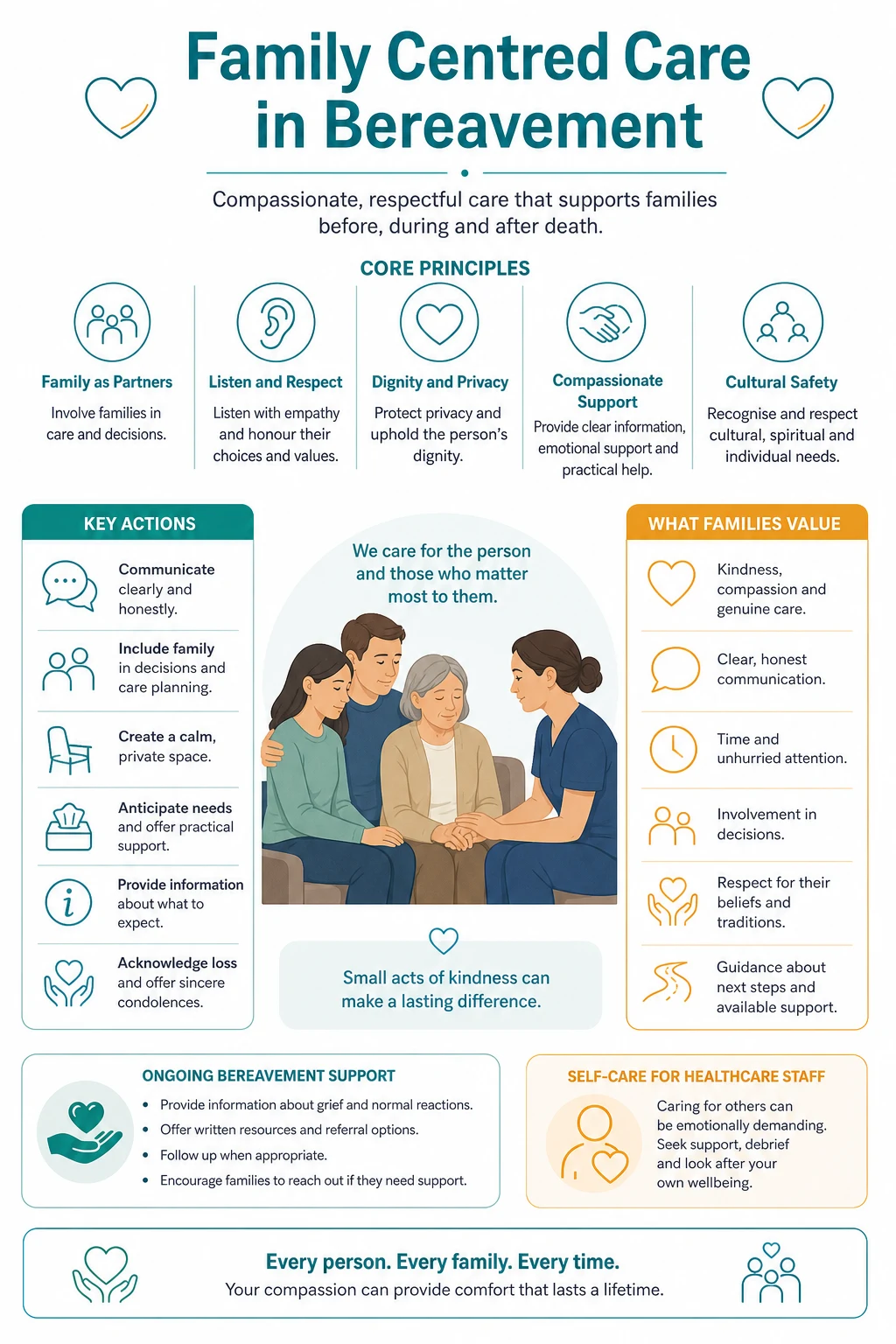
Family-centred care in ICU recognises that critical illness affects the entire family, not just the patient. Components: flexible/open visiting hours, family participation in bedside rounds, family presence during procedures and resuscitation, ICU diaries, structured proactive communication (regular family meetings, SPIKES for breaking bad news, ISBAR for handover), and shared decision-making using substituted judgement. PICS-Family: up to 50% of family members develop depression, anxiety, PTSD, or complicated grief after a loved one's ICU admission or death. Risk factors: witnessing cardiac arrest/CPR, prolonged ICU stay, unexpected outcome, poor communication, low health literacy, decisions to withdraw life-sustaining therapy (WOLST). Prevention: regular proactive family meetings, clear consistent communication, family presence, ICU diaries, and structured bereavement follow-up. Staff support addresses the 'second victim' phenomenon through debriefing, peer support, and Schwartz Rounds.
On this page & tools
Your progress
Saved locally on this device.
Target exams
Red flags

Exam practice — SAQs
SAQ — Family presence during cardiopulmonary resuscitation
10 minutes · 10 marks
A 68-year-old woman is brought to the emergency department in cardiac arrest. Return of spontaneous circulation has not been achieved after 15 minutes of advanced life support. Her husband of 40 years arrives on the resuscitation bay and asks to come in to be with his wife. The senior nurse expresses concern that his presence will distress the team and interfere with the arrest.
SAQ — Bereavement support after death in ICU
10 minutes · 10 marks
A 72-year-old man with refractory septic shock and multi-organ failure is dying in your ICU despite 72 hours of maximal therapy. After a series of structured family meetings, the treating team and family have agreed that withdrawal of life-sustaining therapy (WOLST) is appropriate. His wife of 45 years and two adult children are at the bedside. None of the family has ever witnessed a death.
Clinical pearls
Principles of family-centred care
Family-centred care in the ICU is built on the recognition that critical illness is a family event: the patient is embedded in a network of relationships whose members are simultaneously care partners, surrogate decision-makers, and patients-in-waiting (PICS-F). The SCCM/AACN guidelines define the core domains as: (1) open, flexible visitation; (2) family presence at rounds, procedures and resuscitation; (3) structured, proactive communication; (4) shared decision-making with substituted judgement; (5) environmental and spiritual support; (6) ICU diaries; and (7) staff support and debriefing.[1]
The traditional visiting hour model (restricted, brief, excluded from rounds and resuscitation) is obsolete — evidence and policy now support open ICUs. Barriers are usually staff attitudes (fear of family interference, stress, infection control) rather than patient/family harm. Implementation requires: written policy, a designated family support person (often a nurse or social worker), private space for meetings, and a structured approach to breaking bad news and conflict.[1]
Needs assessment of family members
Family needs in ICU cluster into domains assessed with the Critical Care Family Needs Inventory (CCFNI) and the Family Satisfaction (FS-ICU-24) tool. The five highest-priority needs, repeatedly confirmed across two decades of research, are:[1]
- To be assured of the patient's comfort / absence of suffering (the single most important need).
- To feel there is hope — even realistic, re-framed hope.
- To receive honest, consistent, timely information about condition, treatment and prognosis.
- To be near the patient and to be able to help / be useful.
- To find meaning — to understand
why this happenedand to feel the team cared. [1]
Unmet needs predict anxiety, depression, PTSD, dissatisfaction and complaints. A structured family meeting (see below) is the primary intervention that addresses these needs.[4]
Family presence during rounds, procedures and resuscitation
Implementing family presence during cardiopulmonary resuscitation (FPDR)
- Step 1 — Offer the option early: when a family member arrives during an arrest, a designated staff member offers the choice to be present; it is never imposed and never forbidden outright.
- Step 2 — Assign a family support person: a trained nurse, social worker or chaplain accompanies the family throughout, explaining each intervention and watching for distress.
- Step 3 — Position at the bedside: place family where they can see a
quietarea of the resuscitation (e.g. the head, holding the patient's hand), not in the path of the team. - Step 4 — Brief the team: team leader acknowledges presence; assign one team member to narrate; agree that the family will be asked to leave only if they become disruptive or obstruct care.
- Step 5 — Debrief the family immediately: after the event, the support person sits with the family, answers questions, and arranges follow-up.
- Step 6 — Debrief the team: a short team debrief addresses any distress; presence does not increase staff stress in trials.[3]
Jabre and colleagues' multicentre randomised trial in 15 French hospitals randomised resuscitations to offer or not offer family presence. Presence did not interfere with medical care, did not increase medicolegal claims, and at 90 days significantly reduced symptoms of PTSD, anxiety and depression among family witnesses.[3] Family presence during procedures (intubation, central lines) follows the same model; observational data suggest it can increase family trust and understanding of the patient's severity, with no increase in complication rates.[1]
Family presence: open-ICU vs traditional restricted model
| Domain | Traditional (restricted) | Family-centred (open) |
|---|---|---|
| Visiting hours | Fixed, short (e.g. 30 min ×4/day) | Open 24/7, individualised |
| Rounds | Family excluded | Family invited to bedside rounds |
| Procedures | Family excluded | Family offered presence |
| Resuscitation | Family excluded by default | Family offered presence with support person |
| Communication | Ad hoc, reactive | Scheduled proactive family meetings every 3-5 days |
| Evidence base | Historical convention | Recommended by SCCM/AACN/ESICM guidelines; FPDR RCT-supported |
| Family outcomes | Higher anxiety/PTSD | Lower PTSD/anxiety/depression (Jabre 2013) |
Communication frameworks
The choice of framework depends on the task: handover between clinicians (ISBAR), breaking bad news (SPIKES), conducting a family meeting (VALUE), and responding to emotion (NURSE).[1]
Communication frameworks — when to use each
| Framework | Use case | Structure |
|---|---|---|
| ISBAR | Inter-professional handover; structured escalation | Identify, Situation, Background, Assessment, Recommendation |
| SPIKES | Breaking bad news / giving serious information | Setting, Perception, Invitation, Knowledge, Empathy/emotion, Strategy/Summary |
| VALUE | Conducting a family meeting | Value statements, Acknowledge, Listen, Understand as person, Elicit questions |
| NURSE | Responding to patient/family emotion | Naming, Understanding, Respecting, Supporting, Exploring |
| Ask-Tell-Ask | Information exchange, teach-back | Ask what they know, Tell in chunks, Ask them to teach back |
| PREPARE / Serious Illness Conversation Guide | Advance care planning | Structured questions on goals, fears, trade-offs, decision-making |
SPIKES — breaking bad news
SPIKES protocol for breaking bad news in ICU
- S — Setting: private room, sit down (never stand), silence phone, ensure key family/decision-makers present, allow uninterrupted time.
- P — Perception:
Before we talk, tell me what you understand about what's happening.Establishes baseline and detects misconceptions. - I — Invitation:
How much detail would you like me to go into?Some want everything; some want a summary. Respect the preference. - K — Knowledge: give a warning shot (
I'm afraid I have difficult news), then deliver information in small chunks, in plain language, avoiding jargon. Pause frequently. - E — Emotion (empathic response): use NURSE statements — name the emotion (
This is overwhelming), validate (Anyone would feel this way), and sit with silence. Do not rush to fix. - S — Strategy / Summary: agree a plan, check understanding with teach-back, arrange follow-up (
We'll meet again tomorrow at 10), document the discussion.[1]
Running a family meeting
Proactive, structured family meetings are the single most evidence-supported intervention to improve family outcomes. The Lautrette trial showed that a proactive end-of-life conference conducted before death (not just after), guided by a brochure, reduced bereavement-related PTSD, anxiety and depression.[4] Trials of communication skills training and decision aids confirm that structure and timing matter more than the clinician's experience.[15]
Structured ICU family meeting (proactive, every 3-5 days, and before any WOLST decision)
- Before: identify all decision-makers; schedule in a private room; ask the patient (if capacitous) whom they want present; gather the multidisciplinary team (intensivist, bedside nurse, allied health, social worker).
- Introductions & setting: introduce everyone by name and role; state the purpose (
We want to review how things are going and to plan ahead); confirm permission to discuss prognosis. - Assess understanding (Ask):
Tell me what you understand about the illness so far.Correct gently. - Information provision (Tell): summarise the clinical course, current status and prognosis — in plain language, giving a realistic range not false certainty. Address what the patient would value.
- Acknowledge emotion (NURSE): pause for emotion; do not move to planning until emotion is addressed.
- Explore patient values:
If your mother could sit with us now, what would she tell us she wants? What would be unacceptable to her?(substituted judgement). - Make a recommendation: clinicians should not simply present options and step back — share a recommendation aligned with the patient's values (
Given what you've told me, I worry that continuing [treatment] would cause suffering without changing the outcome. I recommend we focus on comfort). - Agree a plan: set time-limited goals (e.g.
48-72 hours to see if the antibiotics work); agree what will trigger re-evaluation. - Document: write the discussion, decisions and plan in the medical record; ensure all team members are briefed so the message stays consistent.
- Follow up: book the next meeting; offer a bereavement brochure; provide written summary.[4]
Shared decision-making and substituted judgement
Incapacitated ICU patients cannot decide for themselves. Three classical models of clinician-family interaction have been described:[1]
Decision-making models in the ICU
| Model | Who decides | Clinician role | When appropriate |
|---|---|---|---|
| Paternalistic | Clinician | Decides and informs family | Emergency, no surrogate, clear standard of care |
| Informed choice | Family (surrogate) | Presents options, steps back | Rarely ideal; isolates family |
| Shared decision-making | Clinician + family together | Provides expertise + recommendation; family provides patient's values | Recommended default for ICU decisions |
Substituted judgement is the ethical standard: the surrogate should decide as the patient would, based on the patient's known values, prior statements, and advance directives — not as the surrogate would decide for themselves. The reality is humbling: even with prior conversations, surrogate predictions match patient preferences only ~70% of the time, and accuracy falls for preferences about specific burdensome interventions (PEG feeding, mechanical ventilation in dementia). This is the strongest argument for advance care planning before critical illness.[6]
When no advance directive and no surrogate exist (the unbefriended patient), decisions are made on the best-interests standard — what a reasonable person would want, weighing benefits, burdens and the patient's known values. These cases warrant early ethics committee involvement.[13]
For prolonged mechanical ventilation and other preference-sensitive decisions, decision aids (e.g. the Cox decision aid for surrogates) improve surrogate knowledge and reduce decisional conflict without increasing regret.[14]
End-of-life decision-making and withdrawal of life-sustaining therapy (WOLST)
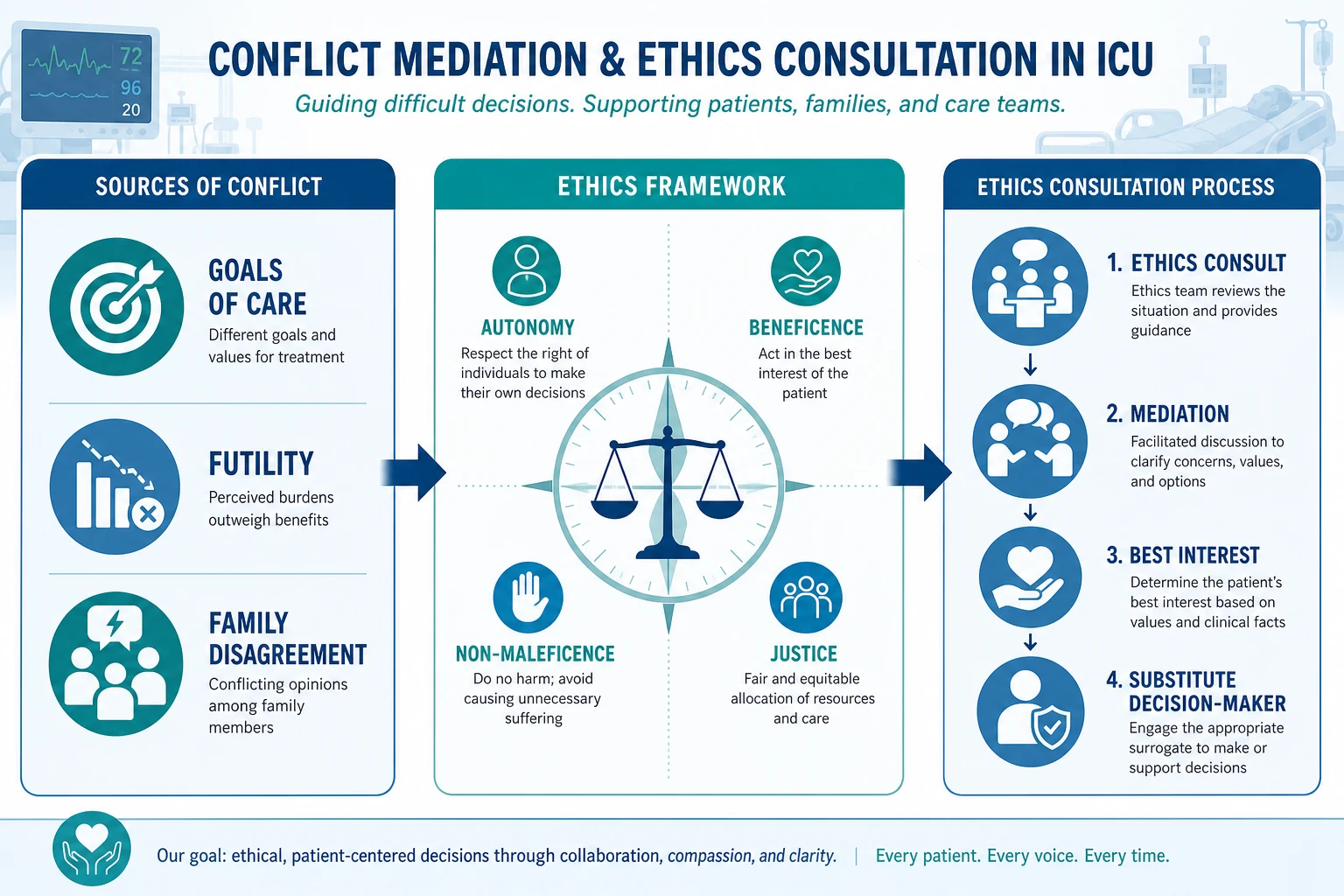
Around one in five ICU deaths in developed systems now follow an active decision to withdraw life-sustaining therapy (WOLST); the proportion is even higher in chronic critical illness and ARDS. The Truog consensus and equivalent college statements (CICM, ICS) establish the ethical framework:[5]
- Withholding and withdrawing treatment are ethically and legally equivalent. The intention — to avoid burdensome, non-beneficial treatment — is the same; only the timing differs. There is no ethical obligation to start a treatment one would not be justified in continuing.
- The decision is clinical, not just consensual. WOLST is appropriate when treatment is futile (cannot achieve its physiologic goal) or burdensome disproportionate to benefit (e.g. ongoing ventilation in irreversible brain injury). The family's role is to inform the patient's values, not to authorise or veto treatment the clinician judges non-beneficial.
Slow codesare unethical. A resuscitation attempt performed without full commitment, to placate the family, deceives them and violates the duty of honesty. If CPR is not medically appropriate, it should not be offered.[13]
Process of withdrawal
Withdrawal of life-sustaining therapy (WOLST) — practical sequence
- Plan the family conference (above): agree the goals of care have shifted to comfort; confirm the decision with the family and team; document.
- Set the time and place: preferably a private room; allow time for family to gather and be present; ensure the religious/spiritual needs are met.
- Discontinue non-beneficial treatments first: stop blood tests, monitoring, antibiotics if not for comfort, renal replacement therapy, and neuromuscular blockers (which can mask distress without treating it) — wait for them to wear off.
- Anticipate and treat symptoms: opioids (morphine infusion) and benzodiazepines (midazolam) titrated to respiratory rate, distress and comfort — NOT to shorten life (the
doctrine of double effect: intended benefit is comfort; foreseen but unintended life-shortening is acceptable). Pre-empt dyspnoea, pain and agitated delirium. - Manage the airway/extubation: decide on extubation vs terminal weaning; suction secretions (glycopyrrolate or hyoscine for death rattle).
- Family presence: invite and support the family to be at the bedside; provide chairs, tissues, privacy, time.
- Confirm death; bereavement support: offer bereavement brochure, follow-up contact at 2-4 weeks; culturally appropriate care of the body.
- Team debrief: a brief debrief acknowledges the team's role and distress.[5]
Requests for potentially inappropriate treatment
When families request treatment the treating team believes is inappropriate, the Bosslet multi-society policy provides a stepwise, procedural response — process matters more than the substantive outcome:[13]
Resolving requests for potentially inappropriate treatment (Bosslet 2015)
- Step 1 — Review facts and prognosis with the team; ensure the medical assessment is sound and complete.
- Step 2 — Negotiate and communicate: hold a structured family meeting; seek to understand the request (often a wish for time, hope, or to honour a promise); reframe around the patient's values and a realistic prognosis.
- Step 3 — Use a second opinion / external reviewer: another intensivist or palliative care physician.
- Step 4 — Ethics committee review: formal consultation to mediate and document.
- Step 5 — Offer transfer: offer to transfer to another institution willing to provide the treatment.
- Step 6 — Unilateral non-provision (last resort): if consensus that the treatment is physiologically futile and no transfer possible, the unit may unilaterally decline to provide it, with due process and full documentation; this is legally supported in most jurisdictions.
- Never: offer a slow code; withdraw unilaterally without due process; abandon the patient/family.
Organ donation discussion
Organ donation should be decoupled from the WOLST discussion to avoid any perception that donation influenced the EOL decision. Best practice:[5]
Approaching the family about organ donation
- Decouple: settle the WOLST decision and confirm death is expected before raising donation. Do not discuss donation in the same breath as the decision to withdraw.
- Use a trained donation specialist / requester: dedicated transplant coordinators achieve higher consent rates than the treating intensivist alone, partly because they remove the perceived conflict of interest.
- Timing: approach after the family has had time to absorb the prognosis, in a private setting, when all key decision-makers are present.
- Explain the process clearly: brain death vs DCD (donation after circulatory death); tests confirming death; the honour and meaning of donation; that the body is treated with respect; funeral arrangements are not delayed.
- Address specific concerns: religious objections (most major religions support or permit donation; a few have reservations — ask, never assume); cost (none to the family); impact on the body.
- Document the decision and the discussion; if consent is declined, respect it without coercion.
- Bereavement follow-up: donor families value written follow-up from the transplant team describing the outcomes; this is associated with positive bereavement adjustment.
Bereavement in the ICU
Grief is the normal response to loss; bereavement care in the ICU spans anticipatory grief (during the illness), the peri-death period, and post-death follow-up. [1]
Anticipatory grief begins with the diagnosis of a life-threatening illness and may include sadness, anger, fear, denial, and rehearsal of the loss. Far from being pathological, anticipatory grief — when supported by honest communication — is associated with better post-death bereavement adjustment. The intensivist's role is to name it, normalise it, and offer support, not to suppress it.[4]
Post-death bereavement follow-up — a phone call, letter, or clinic visit 2-4 weeks after death, sometimes again at 3-6 months — is recommended by all major ICU guidelines. It provides closure, answers questions, returns belongings, identifies families at risk of complicated grief, and offers referral. Despite recommendations, it is inconsistently delivered.[8]
Normal grief vs complicated grief vs major depressive disorder
| Feature | Normal (uncomplicated) grief | Complicated grief (PGD) | Major depressive disorder |
|---|---|---|---|
| Timescale | Waves, gradually improving over months | Persistent, intense >6-12 months | Persistent low mood ≥2 weeks |
| Dominant affect | Sadness with intact self-esteem | Yearning, longing, preoccupation with deceased | Anhedonia, worthlessness, hopelessness |
| Trigger | Reminders of deceased | Pervasive; function impaired | Any/none |
| Function | Preserved (waves) | Markedly impaired | Impaired |
| Self-harm risk | Low | Elevated | Elevated |
| Treatment | Support, time | Trauma-focused therapy (e.g. complicated grief therapy); SSRIs if co-morbid depression | Antidepressants ± psychotherapy |
Complicated grief (prolonged grief disorder, ICD-11 / DSM-5-TR) affects ~7-10% of bereaved people generally and is more common after ICU death, particularly after sudden death, death of a child, perceived poor communication, or conflict. Screen with the Inventory of Complicated Grief (ICG) or the brief bereavement questions; refer to specialist grief counselling.[8]
Post-ICU family burden: PICS-Family
Post-Intensive Care Syndrome-Family (PICS-F) describes the new, persistent or worsened psychological, physical or social dysfunction in family members of ICU survivors or of patients who died in ICU. It is the family counterpart of PICS.[2]
Cameron JI et al. NEJM 2016 — One-year outcomes in caregivers of critically ill patients (RECOVER)
- Design: prospective, multicentre cohort of 280 caregivers of ARDS survivors from 10 Canadian ICUs, followed 1 year.
- Population: caregivers were predominantly female (70%), spouse/partner (62%), median age 53; half provided ≥10 hours/week of care.
- Key results: depression in ~one-third at 1 year; care burden (hours/week) was not driven by the patient's physical function but by the patient's depression and anxiety; caregiver depression at 1 year was predicted by caregiver depression at ICU discharge and younger patient age.
- Take-home: caregiver burden is substantial, persistent and psychological — a strong argument for screening and supporting families, not just patients, through and after ICU.
- Limitation: single region (Canada), ARDS only, observational.
- Citation: [2]
Kross and colleagues' international cohort showed that family outcomes following a death in the ICU (anxiety, depression, PTSD) are driven more by the quality of communication and the feeling that the patient had a good death than by the patient's illness severity.[8]
Risk factors and prevention of PICS-F
Risk factors: female sex, spouse, lower education, younger age, pre-existing anxiety/depression, witnessing CPR or invasive procedures (if unsupported), prolonged ICU stay, death of the patient, prognostic discordance, poor communication, and low health literacy.[2]
Prevention / mitigation (mirrors family-centred care): regular proactive family meetings; consistent information from a designated spokesperson; family presence with a support person; ICU diaries; structured bereavement follow-up; written information leaflets (Azoulay showed a simple leaflet reduces family misunderstanding and anxiety);[12] and early identification/referral of at-risk families.
ICU diaries
ICU diaries are plain-language, dated, factual entries written by staff and family during the admission, describing the patient's day-to-day course, visits, and events. They are given to the patient (and/or family) at or after follow-up to reconstruct the lost period of critical illness and reduce traumatic-memory fragmentation.[9]
ICU diaries — evidence and implementation
| Aspect | Detail |
|---|---|
| Mechanism | Reconstructs amnestic period, reduces fragmentation, facilitates sense-making |
| Patient benefit | Reduced new-onset PTSD at 3 months (Jones 2010 RCT: 5% vs 13%)[9] |
| Family benefit | Reduced PTSD symptoms in relatives (Jones 2012)[10] |
| Certainty of evidence | Low to moderate (Ullman Cochrane 2015): small, heterogeneous trials; benefit plausible but not conclusive[11] |
| Implementation | Written daily; plain language; no blame/jargon; photographs optional with consent; stored securely; handed over at follow-up with a clinician present to explain |
| Cautions | Must be sensitively introduced; some patients find diaries distressing — always debrief with a clinician |
Staff support: the second victim and team welfare
Critical illness, death and adverse events affect staff. The second victim phenomenon describes the predictable psychological injury experienced by a clinician involved in an adverse event, an unexpected death, or a distressing clinical situation (e.g. a difficult WOLST, a failed resuscitation, a medical error). Scott and colleagues described a 6-stage recovery trajectory:[7]
- Chaos and accident response — shock, confusion,
what just happened?. - Intrusive reflections — rumination, self-doubt, isolation, sleep disturbance.
- Restoring personal integrity — seeking a
safecolleague to talk to. - Enduring the inquisition — fear of investigation, blame, litigation.
- Obtaining emotional first aid — from peers, mentors, EAP, or (less effectively) formal channels.
- Moving on — three outcomes: dropping out (leaving the profession), surviving (functional but diminished), or thriving (growth, advocacy). [1]
Interventions
Staff support interventions in ICU
| Intervention | What it is | Evidence |
|---|---|---|
| Hot debrief | Immediate (within ~1 h), brief, led by team; facts + are you OK?; psychological first aid, NOT therapy | Universally recommended; basic psychological first aid |
| Cold debrief | 24-72 h later, structured (Plus Delta / USCAL); systems focus, blame-free | Improves team learning; mitigates second-victim injury |
Peer support / you matter, we care | Trained peer supporters; explicit permission to be affected | Reduces isolation; key to stage 3 of recovery |
| Schwartz Rounds | Interdisciplinary, facilitated, recurring forums on the emotional/ethical aspects of care | Reduced stress, improved teamwork/compassion; no controlled outcome data |
| Single-session psychological debriefing | Structured re-exposure immediately after trauma | Not recommended — may worsen PTSD; screen and refer instead |
| Employee Assistance Programme (EAP) | Confidential counselling | Access variable; effective when used |
The overriding principle: name and normalise the impact on staff, provide blame-free structured forums, screen rather than treat en masse, and refer those who need it. A culture in which seeking support is seen as a strength — not a weakness — is the single most protective factor.[7]
Red flags
High-yield summary for the exam
- The three pillars of family-centred care: presence (open ICU, FPDR), communication (proactive structured meetings, SPIKES/VALUE/NURSE), and partnership (shared decision-making by substituted judgement).[1]
- PICS-F is the family counterpart of PICS — up to 50% of relatives affected; prevention is structural, not pharmacological.
- WOLST = withholding ethically and legally;
slow codesare unethical; due process resolves requests for inappropriate treatment (Bosslet).[13] - Know the trials: Jabre (FPDR), Lautrette (proactive family meeting + brochure), Cameron (caregiver outcomes NEJM 2016), SUPPORT (1995), Jones (ICU diaries RCT).[3][4][2][6][9]
- Decouple organ donation from WOLST; use a trained requester.
- Support the staff too: second victim trajectory, Schwartz Rounds, hot/cold debriefs; avoid single-session debriefing.
References
- [1]Davidson JE, Aslakson RA, Long AC, et al. Guidelines for Family-Centered Care in the Neonatal, Pediatric, and Adult ICU Crit Care Med, 2017.PMID 27984278
- [2]Cameron JI, Chu LM, Matte A, et al. One-Year Outcomes in Caregivers of Critically Ill Patients N Engl J Med, 2016.PMID 27168433
- [3]Jabre P, Belpomme V, Azoulay E, et al. Family presence during cardiopulmonary resuscitation N Engl J Med, 2013.PMID 23484827
- [4]Lautrette A, Darmon M, Megarbane B, et al. A communication strategy and brochure for relatives of patients dying in the ICU N Engl J Med, 2007.PMID 17267907
- [5]Truog RD, Campbell ML, Curtis JR, et al. Recommendations for end-of-life care in the intensive care unit: a consensus statement by the American College [corrected] of Critical Care Medicine Crit Care Med, 2008.PMID 18431285
- [6]The SUPPORT Principal Investigators A controlled trial to improve care for seriously ill hospitalized patients. The study to understand prognoses and preferences for outcomes and risks of treatments (SUPPORT). The SUPPORT Principal Investigators JAMA, 1995.PMID 7474243
- [7]Scott SD, Hirschinger LE, Cox KR, et al. The natural history of recovery for the healthcare provider second victim after adverse patient events Qual Saf Health Care, 2009.PMID 19812092
- [8]Kross EK, Engelberg RA, Norris WJ, et al. Burden of psychological symptoms and illness in family of critically ill patients: what is the relevance for critical care clinicians? Crit Care Med, 2008.PMID 18520648
- [9]Jones C, Backman C, Capuzzo M, et al. Intensive care diaries reduce new onset post traumatic stress disorder following critical illness: a randomised, controlled trial Crit Care, 2010.PMID 20843344
- [10]Jones C, Backman C, Griffiths RD. Intensive care diaries and relatives' symptoms of posttraumatic stress disorder after critical illness: a pilot study Am J Crit Care, 2012.PMID 22549573
- [11]Ullman AJ, Aitken LM, Rattray J, et al. Intensive care diaries to promote recovery for patients and families after critical illness: A Cochrane Systematic Review Int J Nurs Stud, 2015.PMID 25869586
- [12]Azoulay E, Pochard F, Chevret S, et al. Impact of a family information leaflet on effectiveness of information provided to family members of intensive care unit patients: a multicenter, prospective, randomized, controlled trial Am J Respir Crit Care Med, 2002.PMID 11850333
- [13]Bosslet GT, Pope TM, Rubenfeld GD, et al. An Official ATS/AACN/ACCP/ESICM/SCCM Policy Statement: Responding to Requests for Potentially Inappropriate Treatments in Intensive Care Units Am J Respir Crit Care Med, 2015.PMID 25978438
- [14]Cox CE, Lewis CL, Hanson LC, et al. Development and pilot testing of a decision aid for surrogates of patients with prolonged mechanical ventilation Crit Care Med, 2012.PMID 22635048
- [15]Scheunemann LP, McDevitt M, Carson SS, Curtis JR. How clinicians discuss critically ill patients' preferences and values with surrogates: an empirical analysis Crit Care Med, 2015.PMID 25565458