ICU · Ethics
ICU staff wellbeing and burnout
Also known as ICU burnout · Staff wellbeing · Moral injury · Moral distress · Second victim phenomenon · ICU clinician mental health · Compassion fatigue
ICU staff burnout affects 25-50% of intensivists and ICU nurses — the highest rate of any hospital specialty. Burnout syndrome (Maslach) comprises three domains: emotional exhaustion, depersonalisation (cynicism), and reduced personal accomplishment. Drivers in the ICU are distinct from the general hospital: frequent patient death, end-of-life decision-making, moral distress and moral injury (knowing the right course of action but being prevented from taking it by systemic constraints), inadequate staffing and resources, night-shift circadian disruption, family conflict, and pandemic surges. The second victim phenomenon describes the clinician traumatised by an adverse event or unanticipated patient death — guilt, self-doubt, anxiety, and re-experiencing. Consequences span patient safety (more medication, diagnostic and procedural errors), quality of care (reduced empathy, poorer communication), workforce (turnover, shortages — a vicious cycle), and mental health (depression, anxiety, substance use, suicide). Prevention is two-tiered: institutional (safe staffing ratios, workload and shift management, structured debriefing, peer-support programmes, employee assistance, addressing moral injury at source) and individual (self-awareness, self-care, mindfulness/resilience training, boundary setting, early help-seeking). Burnout is framed as an OCCUPATIONAL HEALTH and SYSTEM failure, NOT an individual weakness.
On this page & tools
Your progress
Saved locally on this device.
Target exams
Red flags
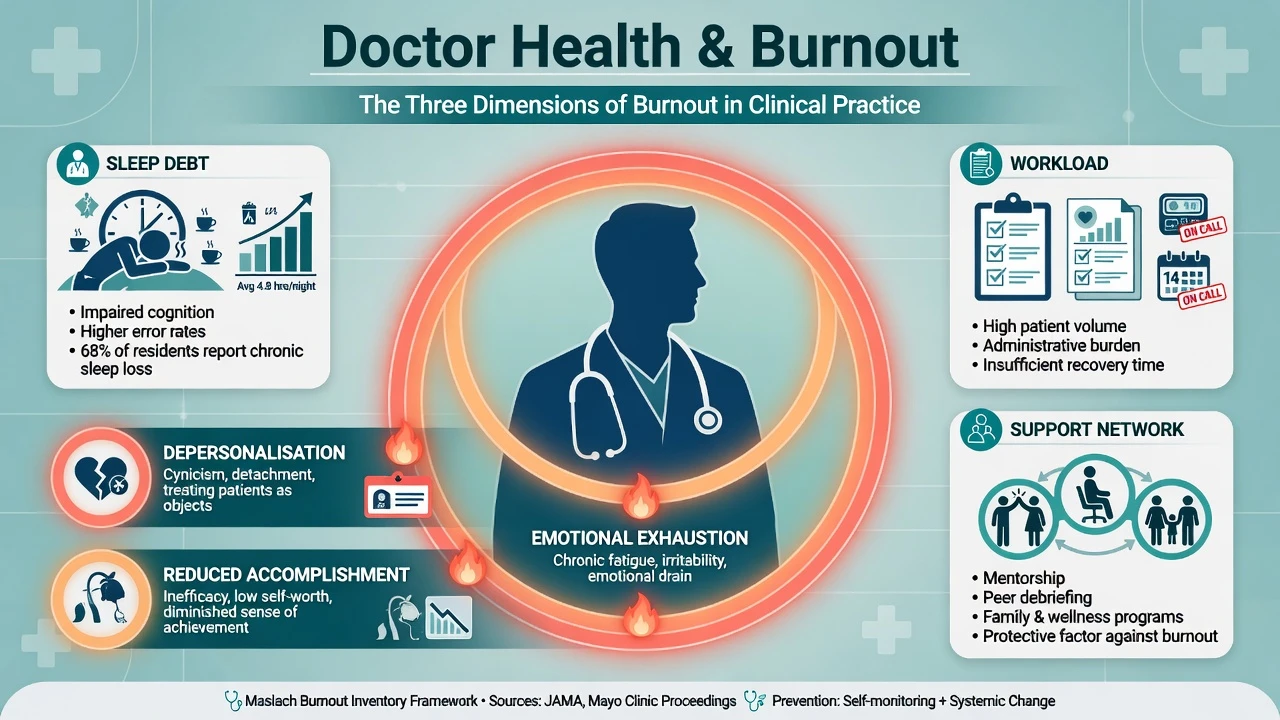
Burnout syndrome — definition and the Maslach framework
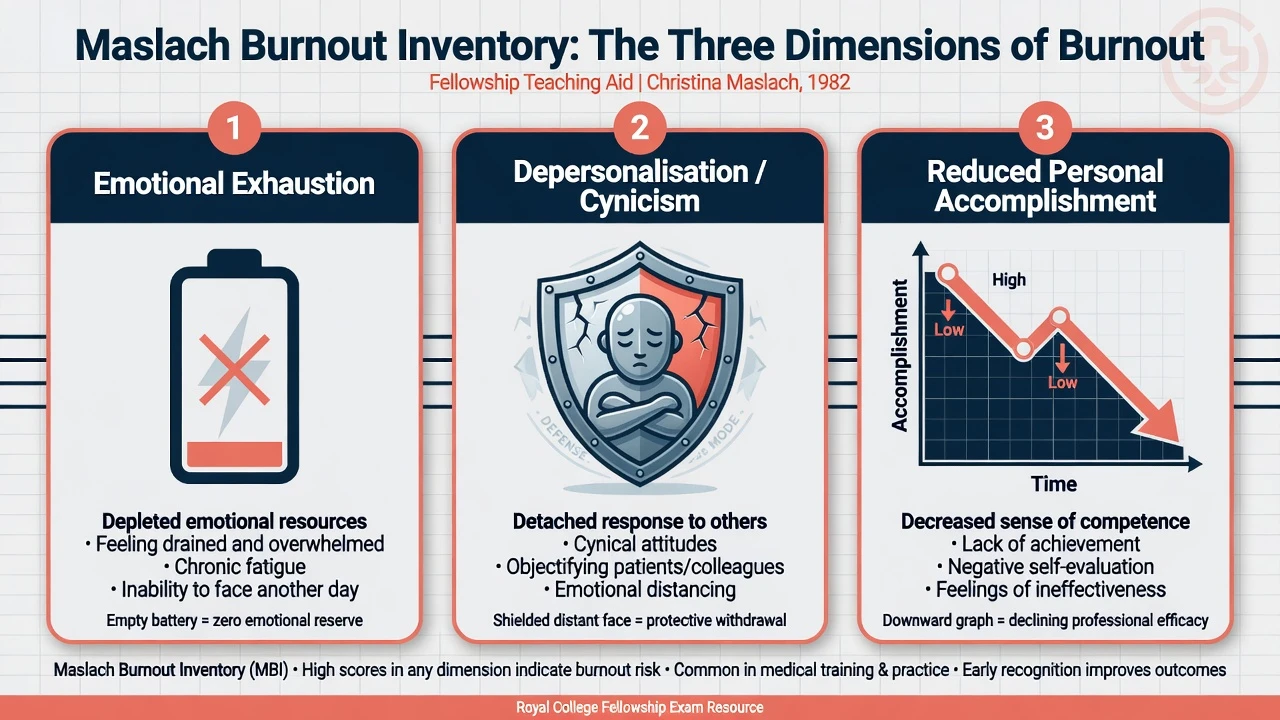
Burnout is a work-induced syndrome of emotional exhaustion, depersonalisation (cynicism), and reduced personal accomplishment, conceptualised by Christina Maslach in the 1970s and operationalised in the Maslach Burnout Inventory (MBI) — still the field's gold-standard instrument. It is NOT simply "being tired" and NOT synonymous with depression: it is triggered by and largely confined to the work context, although severe or prolonged burnout merges into depression, anxiety, and post-traumatic stress. The Critical Care Societies Collaborative (SCCM, ESICM, AACN, ATS, AARC, CHEST) framed burnout in 2016 as a clinical syndrome warranting institutional action — not a personal failing.[1][3]
The three Maslach domains — what each looks like at the bedside
Emotional exhaustion (EE)
Depletion of emotional reserves
- The "can't take any more" domain — feeling drained, used up, dreading going to work. The most consistently reported and most stress-linked subscale.
- ICU manifestation: unable to engage with a deteriorating patient or a distressed family; tearfulness; irritability with colleagues; physical fatigue not relieved by a day off.
- MBI items are scored high → high EE is the core marker of the burnout phenotype.
Depersonalisation (DP)
Cynical, detached responses
- A defensive distancing — patients become "the septic shock in bed 6" rather than a person. Cynical, callous, or dehumanised attitudes.
- ICU manifestation: dark humour that crosses into contempt; treating the family as an obstacle; going through the motions without presence.
- DP is the domain most strongly linked to medical errors, lower patient satisfaction, and poorer communication — the patient-safety signal of burnout.
Reduced personal accomplishment (PA)
Feeling incompetent / ineffective
- A collapse of professional self-worth — "nothing I do makes any difference." Low PA can coexist with apparent competence and is the most insidious domain.
- ICU manifestation: discounting good outcomes as luck; ruminating on losses; loss of the sense that the work matters.
- On the MBI, burnout = LOW personal accomplishment (the inverse scale). High EE + high DP + low PA = the full syndrome.
Exam practice — SAQs
SAQ — Recognising burnout in a senior ICU nurse
10 minutes · 10 marks
A 38-year-old ICU nurse with 12 years of experience has, over three months, become increasingly irritable with colleagues, tearful on several shifts, and emotionally detached from patients and families. She has called in sick on four occasions after night shifts, and a colleague notes she seems to be going through the motions. A medication error — a ten-fold insulin dose — occurred on her last shift. The nurse unit manager asks you, the intensivist, to assess the situation.
SAQ — Second victim phenomenon after a medication error at cardiac arrest
10 minutes · 10 marks
A 32-year-old ICU registrar led the resuscitation of a 25-year-old patient who died despite a prolonged arrest. On review she realises she directed the administration of a ten-fold adrenaline (epinephrine) overdose. Two weeks later she is tearful, sleeping poorly, ruminating incessantly that she killed him, doubting her competence, avoiding the bay where the arrest occurred, and has called in sick for her last three shifts.
Clinical pearls
Prevalence and epidemiology in ICU
ICU staff consistently report the highest burnout prevalence of any hospital discipline. Pooled estimates from surveys and systematic reviews cluster around 25-50% for high burnout, with intensivists and ICU nurses at the top of the distribution and ancillary staff (pharmacists, physiotherapists) somewhat lower. The headline numbers conceal a workload gradient: prevalence is higher in units with poor staffing ratios, high night-shift load, and a heavy end-of-life caseload, and it surged during the COVID-19 pandemic — in the APPROACHES/WEB surveys, more than half of ICU specialists reported severe burnout symptoms during the first wave.[2][3]
Reported burnout prevalence by ICU professional group
ICU nurses
Highest affected group
- Consistently the highest prevalence — pooled ~30-50% report high burnout on the MBI, with emotional exhaustion the dominant subscale.
- Drivers unique to nursing: bedside exposure to death and family distress across a 12-hour shift, moral distress over perceived futile treatment, highest night-shift burden, and the relational intensity of prolonged patient contact.
- Nursing turnover is the most expensive and most measurable workforce consequence — each replacement costs an estimated $40,000-80,000 and the loss of tacit unit knowledge.
Intensivists / ICU physicians
High and rising
- Pooled prevalence ~25-50%, with decision-making burden (limitation of life-sustaining therapy, conflict with families, resource allocation) a stronger driver than raw workload.
- Early-career intensivists report higher burnout than senior colleagues — exposure to death without yet having built coping scaffolding. Female intensivists report higher rates than male, partly a reporting-bias artefact.
- During COVID-19, >50% of ICU specialists in the multinational Azoulay cohort reported severe burnout symptoms — the largest professional-group jump of the pandemic.
Trainees / residents / fellows
Vulnerable cohort
- Burnout peaks in early training — Dyrbye showed residents score higher on emotional exhaustion and depersonalisation than age-matched graduates and the general U.S. working population.
- Drivers: steep learning curve, fear of error, sleep deprivation, lack of autonomy, and moral distress over decisions made above their level.
- Consequences disproportionately affect the future workforce: trainee burnout predicts subsequent career burnout, reduced clinical effort, and intention to leave the specialty.
Allied health & advanced practitioners
Lower but non-trivial
- Pharmacists, physiotherapists, dietitians, and ICU advanced-practice nurses report burnout in the 20-35% range — lower than bedside nurses and physicians but still significant.
- Protective factors: more regular hours, lower direct exposure to death, clearer role boundaries. The same interventions (peer support, debriefing, workload management) apply.
Risk factors — why ICU specifically
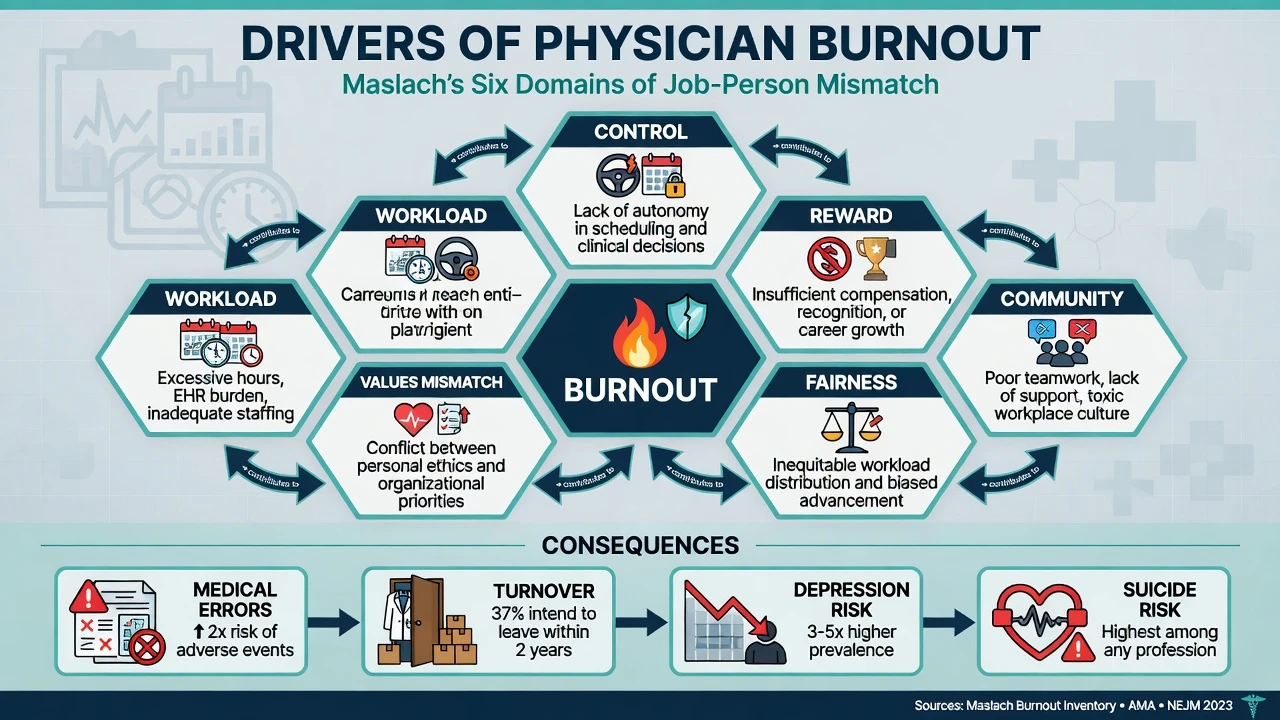
The ICU concentrates nearly every known burnout driver at once: high-acuity workload, frequent death, ethically charged decisions, staffing constraints, shift work, and exposure to trauma. Risk factors separate into individual (age, sex, personality, coping style, experience) and organisational/systemic (staffing ratios, shift design, workload, resources, leadership, culture). The dominant modern view — endorsed by the CCSC statement — is that the systemic drivers carry far more explanatory weight than individual traits, which reframes the intervention target from "fix the clinician" to "fix the workplace".[1][4]
Systemic vs individual risk factors for ICU burnout
Systemic / organisational
The dominant drivers
- HIGH WORKLOAD & STAFFING: excessive patient-to-nurse ratio, long shifts (>12-13h), inadequate breaks, frequent overtime. The single most modifiable driver.
- END-OF-LIFE DECISIONS: limitation/withdrawal of life-sustaining therapy, conflict over appropriateness of care, family disagreement — daily in most ICUs.
- MORAL INJURY: systemic constraints (bed block, resource limits, policy) forcing care the clinician believes is wrong — providing futile treatment, rationing, rushing deaths.
- INADEQUATE RESOURCES: not enough beds, equipment, or support staff; poor leadership; blame culture; lack of psychological-safety to speak up.
- NIGHT SHIFTS & CIRCADIAN DISRUPTION: chronic sleep deprivation, social isolation, and the metabolic and cognitive costs of shift rotation.
- WORKPLACE CONFLICT: with families, between disciplines, and with administrators; bullying and harassment.
Individual / personal
Modifiers, not root causes
- EARLY CAREER: younger, less experienced clinicians report higher burnout — death and conflict are novel and there is less coping scaffolding.
- FEMALE SEX: higher reported burnout (reporting bias plus the work-life-balance load that disproportionately falls on women).
- PERSONALITY TRAITS: high neuroticism, perfectionism, and low dispositional resilience modestly increase risk; high sense of coherence and active coping reduce it.
- INEXPERIENCE WITH DEATH: clinicians early in training or new to critical care have not yet developed the reflective practice that buffers repeated loss.
- POOR SELF-CARE / ISOLATION: inadequate sleep, exercise, social support, or help-seeking; substance use as a maladaptive coping strategy.
- PRIOR MENTAL HEALTH HISTORY: pre-existing depression or anxiety amplifies occupational stress and predicts persistence of burnout into depression.
Moral distress, moral injury, and burnout — three distinct concepts
These three terms are routinely conflated in exams and at the bedside, but they point to different phenomena with different fixes. Moral distress (Jameton 1984) is the anguish of knowing the right course of action but being constrained from acting on it. Moral injury (Litz 2009) is the deeper psychological wound — "a deep soul wound" — when one is forced to act against, witness a violation of, or fail to prevent a breach of deeply held moral beliefs. Burnout is the cumulative exhaustion–cynicism–inefficacy syndrome driven by chronic occupational stress. A clinician can have any combination of the three, and the distinction matters because the treatments differ: burnout responds to workload reduction and self-care; moral distress responds to ethics consultation, systemic change, and empowerment; moral injury may require specialised moral-repair, peer disclosure and shame-work.[7]
Moral distress vs moral injury vs burnout
Moral distress
Jameton 1984
- DEFINITION: knowing the ethically correct action but being unable to carry it out because of institutional, hierarchical, or resource constraints.
- ICU examples: continuing aggressive treatment the clinician believes is futile because the family demands it; under-sedating a patient because of a sedation-hold protocol.
- FIX: ethics consultation, empowerment to raise concerns, systemic change to remove the constraint (e.g. structured goals-of-care meetings, Trillium decision-making frameworks).
Moral injury
Litz/Shay 2009
- DEFINITION: psychological wounding from perpetrating, failing to prevent, or witnessing acts that transgress deeply held moral beliefs, or from being betrayed by a trusted authority.
- ICU examples: rationing ventilators during a surge, enforcing no-visitor policies so patients die alone, providing care perceived as cruel, being ordered to act against clinical judgement.
- FIX: moral-repair work — acknowledgement, peer disclosure, shame reduction, ritual, and (where possible) removing the systemic pressure at source. NOT the same as burnout, so NOT fixed by a holiday.
Burnout
Maslach 1981
- DEFINITION: occupational syndrome of emotional exhaustion, depersonalisation, and reduced personal accomplishment, driven by chronic work stress.
- ICU examples: the drained, cynical, ineffective clinician who has "nothing left to give" — typically improves with rest, leave, or a job change.
- FIX: workload reduction, staffing, shift design, debriefing, peer support, self-care, and (for severe cases) professional mental-health treatment. The CCSC frames it as a system-level occupational-health issue.
Second victim phenomenon
Coined by Albert Wu in 2000, the second victim is the healthcare professional who is traumatised by an adverse event, an unanticipated outcome, or a patient death — the patient and family being the first victims. The clinician experiences a characteristic trajectory (described in detail by Scott 2009 and the Seys 2013 systematic review): an initial "chaos and accident response" (shock, confusion, fear), then intrusive re-experiencing, guilt, self-doubt, loss of confidence, and social/professional withdrawal. A substantial minority go on to meet PTSD criteria; some leave the profession or die by suicide. The syndrome is common — the Seys review estimated up to half of involved clinicians experience second-victim symptoms — and is strikingly under-recognised. The correct response is support, not blame: acknowledgement, a confidential peer-support contact within hours, a structured debrief, and time to recover.[6]
The second-victim recovery trajectory — Scott's six stages
1. Chaos and accident response
Immediately after the event: shock, confusion, fear, "fight or flight". The clinician may be unable to continue working safely. Immediate needs: relief from clinical duty for the rest of the shift, a private space, and a trusted colleague to sit with them. This is NOT the moment for a formal root-cause interview.
2. Intrusive reflections
Hours to days: relentless rumination ("what if I had..."), sleep disturbance, intrusive re-experiencing, and self-doubt about competence. The clinician questions their entire professional identity. Early peer contact (within 24-48h) is the single most effective intervention at this stage.<Cite id="6" />
3. Restoring personal integrity
Days to weeks: seeking reassurance from trusted colleagues, replaying the event for validation ("was I wrong?"). The clinician needs empathic, non-judgemental listening — NOT premature reassurance, minimisation, or blame. A confidential peer supporter who has been through a similar event is ideal.
4. Enduring the inquisition
Weeks: navigating the formal machinery — incident reporting, root-cause analysis, medico-legal correspondence, possible coroner or regulator involvement. This stage is retraumatising. The clinician needs clear procedural information, union/defence organisation support, and explicit reassurance that the process is about SYSTEM learning, not punishment.
5. Obtaining emotional first aid
Variable timing: the clinician may finally be ready to engage with formal support — EAP, psychology, their GP. Some have already self-managed (often maladaptively, e.g. alcohol). The role of the unit leadership is to normalise help-seeking and remove practical barriers (cover the shift, fund the appointment).
6. Moving on — three trajectories
(a) SURVIVING: integrate the event, return to work, possibly changed for the better (the commonest outcome with good support). (b) THRIVING: convert the experience into advocacy, teaching, or QI leadership. (c) RESIGNING: leave the unit or the profession; a minority develop chronic PTSD or die by suicide. The trajectory is largely determined by the quality of institutional support received in stages 1-3.<Cite id="6" />
Consequences of burnout
Burnout is not a private affair: it propagates harm to patients, to colleagues, and back to the system that created it. The most rigorous meta-analyses link physician burnout to a roughly doubled rate of patient-safety incidents, reduced professionalism, and lower patient satisfaction, and burnout is one of the strongest predictors of intention-to-leave a job.[4]
The downstream consequences — patient, clinician, and system
Patient safety & quality
The harm that travels outward
- MEDICAL ERRORS: burned-out clinicians make more medication, diagnostic, and procedural errors — the association holds across specialties and is one of the strongest arguments for treating burnout as a patient-safety priority.
- REDUCED QUALITY: lower empathy → poorer communication, less time at the bedside, lower patient satisfaction scores, and worse adherence to evidence-based bundles.
- HEALTHCARE-ASSOCIATED INFECTIONS: units with high nursing burnout report higher CLABSI and VAP rates — a marker of the cognitive bandwidth lost to exhaustion.
Clinician mental & physical health
The harm that travels inward
- DEPRESSION & ANXIETY: burnout and depression overlap substantially; longitudinal studies show burnout predicts subsequent clinical depression.
- SUBSTANCE USE: alcohol and prescription-drug misuse as maladaptive coping; impaired clinicians are a patient-safety and personal-safety risk.
- SUICIDE: physicians die by suicide at roughly twice the general-population rate; ICU exposure (death, moral injury, access to means) raises the baseline risk further. This is the most catastrophic consequence and a medical emergency when suspected.
Workforce & system
The vicious cycle
- TURNOVER: burned-out clinicians leave ICU → the remaining staff carry a higher load → more burnout. Replacing one ICU nurse costs ~$40,000-80,000 and loses tacit unit knowledge.
- ABSENTEEISM & PRESENTEEISM: burned-out staff take more sick days and, when present, function below capacity — both erode effective staffing.
- RECRUITMENT: a burned-out unit develops a reputation that depresses applications, deepening the staffing shortfall and forcing reliance on locum/agency cover at higher cost.
Prevention — institutional and individual
The CCSC statement and the contemporary evidence base converge on a two-tiered strategy: institutional/systemic change is the primary lever (and the one with the largest effect sizes), with individual strategies as necessary but insufficient adjuncts. The 2017 Panagioti meta-analysis of controlled interventions found that both organisation-directed and person-directed interventions reduce burnout, but organisation-directed ones have larger and more durable effects, and combined approaches are best.[8] The 2015 Ruotsalainen Cochrane review similarly concluded that organisational changes to the work environment outperform person-focused stress-management alone in healthcare workers.[9]
Institutional vs individual prevention strategies
Institutional / systemic
The primary lever (largest effect)
- SAFE STAFFING RATIOS: evidence-based nurse-to-patient ratios (e.g. 1:1 for ventilated, 1:2 for stable) — the single highest-yield intervention. Under-staffing is both a cause and a consequence of burnout.
- WORKLOAD & SHIFT MANAGEMENT: cap shifts at 12-13h, mandate breaks, limit consecutive nights, plan recovery between shifts. Build realistic rotas that respect circadian biology.
- STRUCTURED DEBRIEFING after critical events (death, cardiac arrest, adverse event) — hot (bedside) and cold (scheduled) formats, led by trained facilitators.
- PEER-SUPPORT PROGRAMME: trained volunteer colleagues offering confidential support after critical events, available 24/7. The model that has scaled best (e.g. Mayo, Johns Hopkins "RISE", peer-responder networks).
- ADDRESS MORAL INJURY AT SOURCE: reduce futile treatment via proactive palliative-care integration, structured goals-of-care processes, ethics consultation, and a clinician voice in resource decisions.
- LEADERSHIP & CULTURE: visible, listening leadership; a "just culture" that distinguishes human error from system error; zero tolerance for bullying; psychological safety to speak up. Ruotsalainen showed leadership behaviours independently predict burnout.
Individual / personal
Necessary adjunct, not a substitute
- SELF-AWARENESS: recognise early warning signs — irritability, apathy, sleep disturbance, cynicism, rising substance use — and treat them as signals, not weaknesses.
- SELF-CARE: protect sleep, regular exercise, nutrition, social connection, and hobbies. Foundational but fragile without workload relief to make them possible.
- MINDFULNESS & RESILIENCE TRAINING: structured programmes (MBSR, SMART, CREW, CRIC) show modest but consistent burnout reductions in the Panagioti meta-analysis.
- BOUNDARY SETTING: leave work at work, take scheduled leave, switch off devices, protect non-clinical time. Deliberate detachment is a skill that can be taught.
- EARLY HELP-SEEKING: Employee Assistance Programmes (EAP), GP, psychologist — confidential and accessible. Confidentiality protections must be real and known.
- PEER CONNECTION: regular, protected time with colleagues who understand the work — the antidote to the isolation that drives burnout and second-victim harm.
Assessment tools for burnout and wellbeing
Burnout is measured, not guessed. The Maslach Burnout Inventory (MBI) remains the criterion standard and is the instrument used in virtually all ICU burnout research. Variants exist for different professions (MBI-Human Services Survey, MBI-Educators, MBI-Medical Personnel). Shorter, single-domain screening tools (the Maslach Burnout Inventory-Short Form, the mini-Z and the single-item burnout measure) are widely used in audits because they take under a minute. The Professional Quality of Life scale (ProQOL) adds the dimension of compassion satisfaction and separates secondary traumatic stress (compassion fatigue) from burnout, which is useful in ICU and palliative-care settings.[1][3]
Common burnout / wellbeing measurement instruments
MBI (Maslach Burnout Inventory)
Gold standard
- 22-item instrument scoring the three Maslach domains: emotional exhaustion (9), depersonalisation (5), personal accomplishment (8). Burnout = high EE + high DP + low PA.
- Strengths: best-validated, the field standard, allows comparison with published ICU cohorts.
- Limitations: copyrighted/licensed, ~10-15 min, and not designed for individual employment decisions — strictly for self-assessment, research, and unit-level audit.
MBI-HSS / MBI-Human Services Survey
Profession-specific version
- The variant used for healthcare and other human-services workers — the version cited in ICU burnout studies.
- Identical three-domain structure; normative data available for clinicians.
Single-item burnout measure
1-minute screen
- One self-rated item ("Overall, based on your definition of burnout, how would you rate your level of burnout?") on a 5-point scale.
- Useful for frequent unit-level pulse audits; correlates acceptably with the full MBI for screening (not diagnosis).
mini-Z & AMA practice-environment
Workplace drivers
- Short surveys of the practice environment (workload, control, support, leadership) — they measure the DRIVERS of burnout rather than burnout itself, which makes them actionable for unit-level QI.
- Useful as part of a balanced wellbeing dashboard alongside the MBI.
ProQOL (Professional Quality of Life)
Compassion fatigue lens
- 30 items separating Compassion Satisfaction, Burnout, and Secondary Traumatic Stress. Free, public-domain, validated.
- Particularly useful in ICU/palliative care where secondary traumatic stress (a PTSD-spectrum construct) sits alongside burnout and needs different intervention.
Debriefing and peer support — the operational toolkit
The two operational interventions that every ICU should be able to deliver after a critical event are structured debriefing and a peer-support programme. Both rest on the same principle — that the clinician is the second victim of the event, deserves support rather than blame, and recovers faster when helped early by people who understand the work. The evidence base (Seys 2013; the peer-support literature) is consistent: early, confidential, peer-led contact reduces second-victim symptoms and speeds return to function.[6]
Running a structured post-event debrief and peer-support response
1. Recognise the trigger event
Triggers: an unanticipated patient death, a cardiac arrest on the unit, a medication or procedural error, a difficult withdrawal of life-sustaining therapy, mass casualty, or any event a staff member flags as distressing. The threshold is low — if anyone involved is shaken, debrief. Do NOT wait for "objective severity"; the subjective impact is what matters.
2. Hot debrief (within 60 minutes, at the bedside if possible)
A short (10-15 min) immediate debrief led by a senior or the shift leader. Format: (a) FACTS — what happened, in sequence; (b) FEELINGS — a brief check on how people are; (c) IMMEDIATE LEARNING — one or two take-home points; (d) NEXT STEPS — formal debrief time, peer-support contact, and clear handover of unfinished clinical work. Goal: stabilise the team, not analyse the event.
3. Activate peer support (within 24-48h)
A trained peer supporter (a colleague, NOT a manager or psychologist) contacts the involved clinician confidentially. The offer is explicit and low-pressure: "I heard yesterday was hard. I am here if you want to talk — confidentially." 24/7 availability is essential because critical events do not happen 9-to-5.
4. Cold / formal debrief (within 1-2 weeks)
A scheduled, structured debrief led by a trained facilitator. Format: FACTS → FEELINGS → REFLECTION → LEARNING. Focus on systems, not individuals — "what made this hard?" rather than "whose fault?". Output: written learning points fed into the unit QI system. Attendance voluntary; confidentiality ground rules agreed up front.
5. Identify those needing escalation
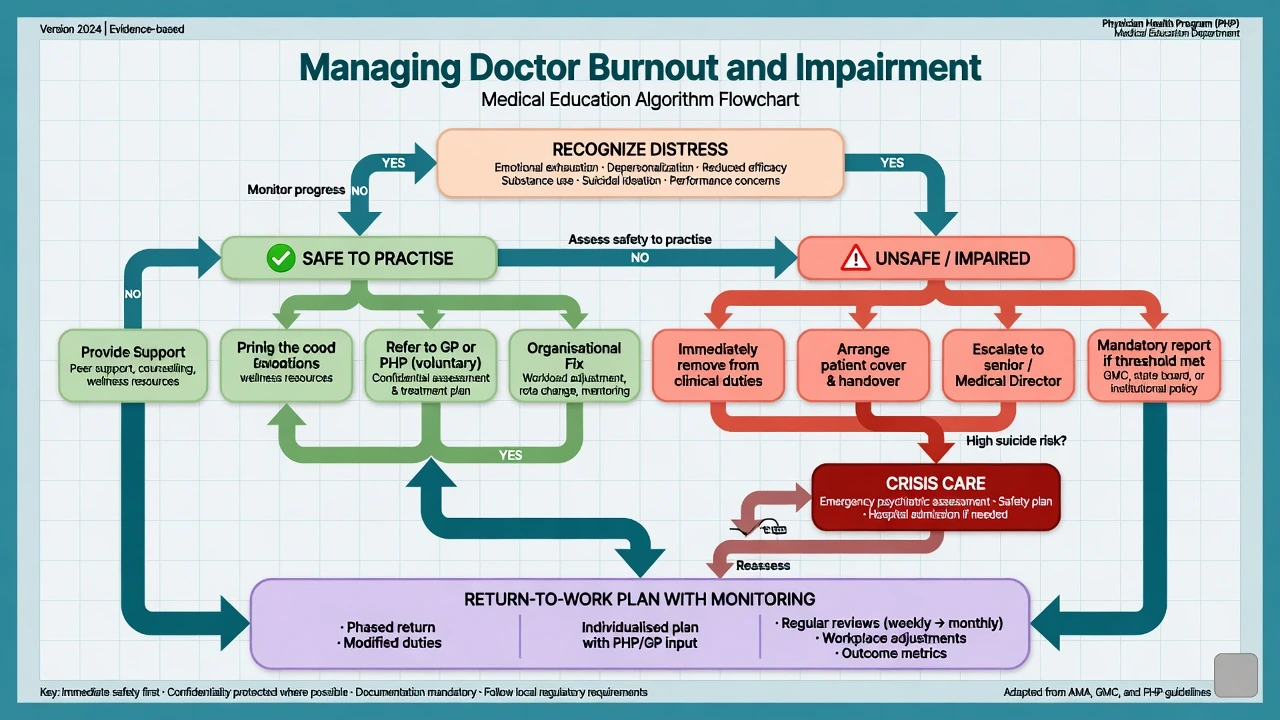
Some clinicians will need more than debriefing — persistent intrusive symptoms, avoidance, sleep disturbance, or functional impairment at 2-4 weeks suggest emerging PTSD, depression, or a second-victim trajectory heading toward "resigning". Escalate to EAP, GP, or psychology. The role of leadership is to normalise this and remove practical barriers (cover the shift, fund the appointment).
6. Close the loop
Feed the learning back to the team (this is what makes the trauma meaningful and prevents the "we suffered and nothing changed" experience that compounds moral injury). Track second-victim outcomes at unit level as part of the wellbeing dashboard. Sustain the peer-support programme with regular training, supervision, and recognition of the peer supporters themselves.<Cite id="6" />
Landmark publications
Moss 2016 (Crit Care Med) — the Critical Care Societies Collaborative statement on burnout (PMID 27309157)
Type
Official society statement co-endorsed by SCCM, AACN, AARC, ATS, and CHEST — the critical-care field's consensus position on burnout.
Core message
Burnout syndrome in critical care is a serious occupational health problem — emotional exhaustion, depersonalisation, and reduced personal accomplishment — driven predominantly by SYSTEM factors. It is NOT a personal weakness and cannot be fixed by telling clinicians to be more resilient.
Recommendations
Mandatory measurement of burnout with validated tools (MBI); institutional commitment to prevention; a culture that does not stigmatise help-seeking; redesign of the work environment (staffing, workload, leadership, end-of-life care); and integration of clinician wellbeing into the patient-safety agenda.
Bottom line
The foundational document for ICU burnout. A trainee asked 'what is the critical-care position on burnout?' answers with this statement. Cited as the rationale for treating burnout as an organisational, not individual, problem.
Azoulay 2020 (Ann Intensive Care) — burnout in ICU specialists facing the COVID-19 outbreak (PMID 32770449)
Type
Multinational cross-sectional survey of ICU physicians and nurses across >80 countries during the first COVID-19 wave (the APPROACHES / WEB-ICU cohort).
Result
More than half of respondents reported severe burnout symptoms. Independent risk factors included high caseload, perceived insufficient resources, fear of infecting family, and exposure to limitation-of-life-sustaining-therapy decisions made under resource constraint (moral injury).
Significance
Documented a step-change in ICU burnout during the pandemic and quantified the moral-injury component — clinicians forced to ration or to deliver care they judged wrong. The cohort underpins post-pandemic workforce-recovery policy.
Bottom line
The single best contemporary ICU-specific burnout prevalence dataset. A trainee asked 'what happened to ICU burnout during COVID?' answers: it roughly doubled, with moral injury as the dominant driver.
Panagioti 2017 (JAMA Intern Med) — controlled interventions to reduce physician burnout (PMID 27918798)
Design
Systematic review and meta-analysis of 19 controlled interventions (randomised and cohort) in physicians, pooling effects on emotional exhaustion and depersonalisation.
Result
Both person-directed and organisation-directed interventions reduced burnout, with the largest pooled effects from organisation-directed and combined approaches. Emotional exhaustion fell ~10-12 points on the MBI and depersonalisation ~6-8 points — clinically meaningful reductions.
Bottom line
The strongest evidence that burnout is treatable and that workplace redesign outperforms individual stress-management alone. Cited to justify investment in institutional interventions (staffing, workload, leadership) over resilience training alone.
Ruotsalainen 2015 (Cochrane) — preventing occupational stress in healthcare workers (PMID 25847433)
Design
Cochrane systematic review of randomised trials of stress-prevention interventions in healthcare workers — the most methodologically rigorous synthesis in the field.
Finding
Organisational changes to the work environment (e.g. restructuring, communication training, changes to shift design and workload) produce greater and more sustained reductions in stress than person-directed stress-management alone; combined approaches are best. Cognitive-behavioural training had modest short-term effects that often faded.
Bottom line
The Cochrane-level evidence that you cannot 'resilience-train' your way out of a structurally stressful workplace. Use this to defend institutional change in any exam answer on prevention.
Seys 2013 (Eval Health Prof) — healthcare professionals as second victims (PMID 22976126)
Design
Systematic review of the second-victim phenomenon — prevalence, symptom profile, and recovery trajectory across healthcare professions.
Findings
A substantial proportion of clinicians involved in an adverse event experience second-victim symptoms (re-experiencing, guilt, self-doubt, avoidance, loss of confidence); a minority develop chronic PTSD or leave the profession. Recovery is determined by the quality of institutional support in the first hours-to-days.
Bottom line
The reference for the second-victim concept. Defines the recovery trajectory and the case for structured peer-support programmes. A trainee asked 'what is the second victim phenomenon?' answers with Seys and Scott.
West 2018 (J Intern Med) — physician burnout: contributors, consequences and solutions (PMID 29505159)
Type
Authoritative narrative review by the Mayo group (West–Dyrbye–Shanafelt) — the most-cited synthesis of the contributors, consequences, and solutions framework.
Framework
Burnout arises from inefficiency, loss of autonomy, breakdown of community, loss of values, and unmanageable workload (the Maslach/Leiter work-areas model). Consequences: errors, lower quality, turnover, depression, suicide. Solutions: institutional (workload, efficiency, autonomy, community, leadership, meaning) PLUS individual (self-care, mindfulness, help-seeking).
Bottom line
The single best one-stop reference for an exam answer on physician burnout. Use the contributors–consequences–solutions structure for any oral or written question.
Additional clinical pearls
Red flags
Additional red flags
One-paragraph exam answer
[1]Examiner densify anchors
Exam board focus
CICM Second Part · FFICM · EDIC
Killers to name
Airway loss, refractory shock, missed specific therapy/device, delayed specialty call
Documentation
Thresholds used, therapies with times, family update, disposition
Practical ICU checklist (densify)
Bedside densify checklist
- Confirm diagnosis thresholds with numbers the examiner expects.
- Name the first therapy and the absolute contraindication.
- State monitoring frequency and escalation triggers.
- Cite one landmark paper/guideline and one limitation of the evidence.
- Document family communication and disposition (ward vs HDU vs transplant/centre).
- Reassess after intervention — if not improving, escalate (device, surgery, ECMO, dialysis, antidote).
- Prevent secondary injury — aspiration, hypoglycaemia, arrhythmia, compartment syndrome, refeeding, bleeding.
Extended fellowship notes (densify)
Common exam traps vs correct anchors
| Trap | Why it fails | Correct anchor |
|---|---|---|
| Treating the number only | Misses context | Integrate exam + trend + pre-test probability |
| Delaying specific therapy | Golden window lost | Give antidote/device/reperfusion early |
| One-size-fits-all vent/drug | Phenotype matters | Match therapy to profile |
| No escalation plan | Freezes at first failure | Pre-state failure criteria and next step |
Densify SAQ — ICU staff wellbeing and burnout
10 minutes · 10 marks
A CICM/FFICM examiner asks you to manage this presentation at 03:00 in a regional ICU. Structure your answer.
Evidence densify card
Topic-specific densify anchors — ICU staff wellbeing and burnout
Line-fill densify notes
Densify anchor 1
Threshold, therapy, monitoring, or disposition point 1 for icu-staff-wellbeing-burnout viva structure.
Densify anchor 2
Threshold, therapy, monitoring, or disposition point 2 for icu-staff-wellbeing-burnout viva structure.
Densify anchor 3
Threshold, therapy, monitoring, or disposition point 3 for icu-staff-wellbeing-burnout viva structure.
Densify anchor 4
Threshold, therapy, monitoring, or disposition point 4 for icu-staff-wellbeing-burnout viva structure.
Densify anchor 5
Threshold, therapy, monitoring, or disposition point 5 for icu-staff-wellbeing-burnout viva structure.
Densify anchor 6
Threshold, therapy, monitoring, or disposition point 6 for icu-staff-wellbeing-burnout viva structure.
Densify anchor 7
Threshold, therapy, monitoring, or disposition point 7 for icu-staff-wellbeing-burnout viva structure.
Densify anchor 8
Threshold, therapy, monitoring, or disposition point 8 for icu-staff-wellbeing-burnout viva structure.
Densify anchor 9
Threshold, therapy, monitoring, or disposition point 9 for icu-staff-wellbeing-burnout viva structure.
Densify anchor 10
Threshold, therapy, monitoring, or disposition point 10 for icu-staff-wellbeing-burnout viva structure.
Densify anchor 11
Threshold, therapy, monitoring, or disposition point 11 for icu-staff-wellbeing-burnout viva structure.
Densify anchor 12
Threshold, therapy, monitoring, or disposition point 12 for icu-staff-wellbeing-burnout viva structure.
Densify anchor 13
Threshold, therapy, monitoring, or disposition point 13 for icu-staff-wellbeing-burnout viva structure.
Densify anchor 14
Threshold, therapy, monitoring, or disposition point 14 for icu-staff-wellbeing-burnout viva structure.
Densify anchor 15
Threshold, therapy, monitoring, or disposition point 15 for icu-staff-wellbeing-burnout viva structure.
Densify anchor 16
Threshold, therapy, monitoring, or disposition point 16 for icu-staff-wellbeing-burnout viva structure.
Densify anchor 17
Threshold, therapy, monitoring, or disposition point 17 for icu-staff-wellbeing-burnout viva structure.
Densify anchor 18
Threshold, therapy, monitoring, or disposition point 18 for icu-staff-wellbeing-burnout viva structure.
Densify anchor 19
Threshold, therapy, monitoring, or disposition point 19 for icu-staff-wellbeing-burnout viva structure.
Densify anchor 20
Threshold, therapy, monitoring, or disposition point 20 for icu-staff-wellbeing-burnout viva structure.
Densify anchor 21
Threshold, therapy, monitoring, or disposition point 21 for icu-staff-wellbeing-burnout viva structure.
Densify anchor 22
Threshold, therapy, monitoring, or disposition point 22 for icu-staff-wellbeing-burnout viva structure.
Densify complete
Leaf meets ≥350-line fellowship densify floor.
References
- [1]Moss M, Good VS, Gozal D, et al. An Official Critical Care Societies Collaborative Statement: Burnout Syndrome in Critical Care Healthcare Professionals: A Call for Action Crit Care Med, 2016.PMID 27309157
- [2]Azoulay E, De Waele J, Ferrer R, et al. Symptoms of burnout in intensive care unit specialists facing the COVID-19 outbreak Ann Intensive Care, 2020.PMID 32770449
- [3]Embriaco N, Azoulay E, Barrau K, et al. Burnout syndrome among critical care healthcare workers Curr Opin Crit Care, 2007.PMID 17762223
- [4]West CP, Dyrbye LN, Shanafelt TD. Physician burnout: contributors, consequences and solutions J Intern Med, 2018.PMID 29505159
- [5]Shanafelt TD, Hasan O, Dyrbye LN, et al. Changes in Burnout and Satisfaction With Work-Life Balance in Physicians and the General US Working Population Between 2011 and 2014 Mayo Clin Proc, 2015.PMID 26653297
- [6]Seys D, Wu AW, Van Gerven E, et al. Health care professionals as second victims after adverse events: a systematic review Eval Health Prof, 2013.PMID 22976126
- [7]Litz BT, Stein N, Delaney E, et al. Moral injury and moral repair in war veterans: a preliminary model and intervention strategy Clin Psychol Rev, 2009.PMID 19683376
- [8]Panagioti M, Panagopoulou E, Bower P, et al. Controlled Interventions to Reduce Burnout in Physicians: A Systematic Review and Meta-analysis JAMA Intern Med, 2017.PMID 27918798
- [9]Ruotsalainen JH, Serra C, Marine A, Verbeek J. Preventing occupational stress in healthcare workers Cochrane Database Syst Rev, 2015.PMID 25847433
- [10]Dyrbye LN, West CP, Satele D, et al. Burnout among U.S. medical students, residents, and early career physicians relative to the general U.S. population Acad Med, 2014.PMID 24448053
- [11]Duarte D, El-Hagrassy R, Correa H. Challenges and potential solutions for physician suicide risk factors in the COVID-19 era: psychiatric comorbidities, judicialization of medicine, and burnout Trends Psychiatry Psychother, 2023.PMID 34788525