ICU · Ethics
ICU triage, resource allocation, and pandemic preparedness
Also known as ICU triage · Resource allocation · Surge capacity · Pandemic preparedness · Mass casualty · ICU admission criteria · Priority triage system · Ventilator allocation · Medical futility · Withholding and withdrawal of life-sustaining therapy · Triage committee · Rationing principles · Triage scoring (SOFA, MEES, NEMS)
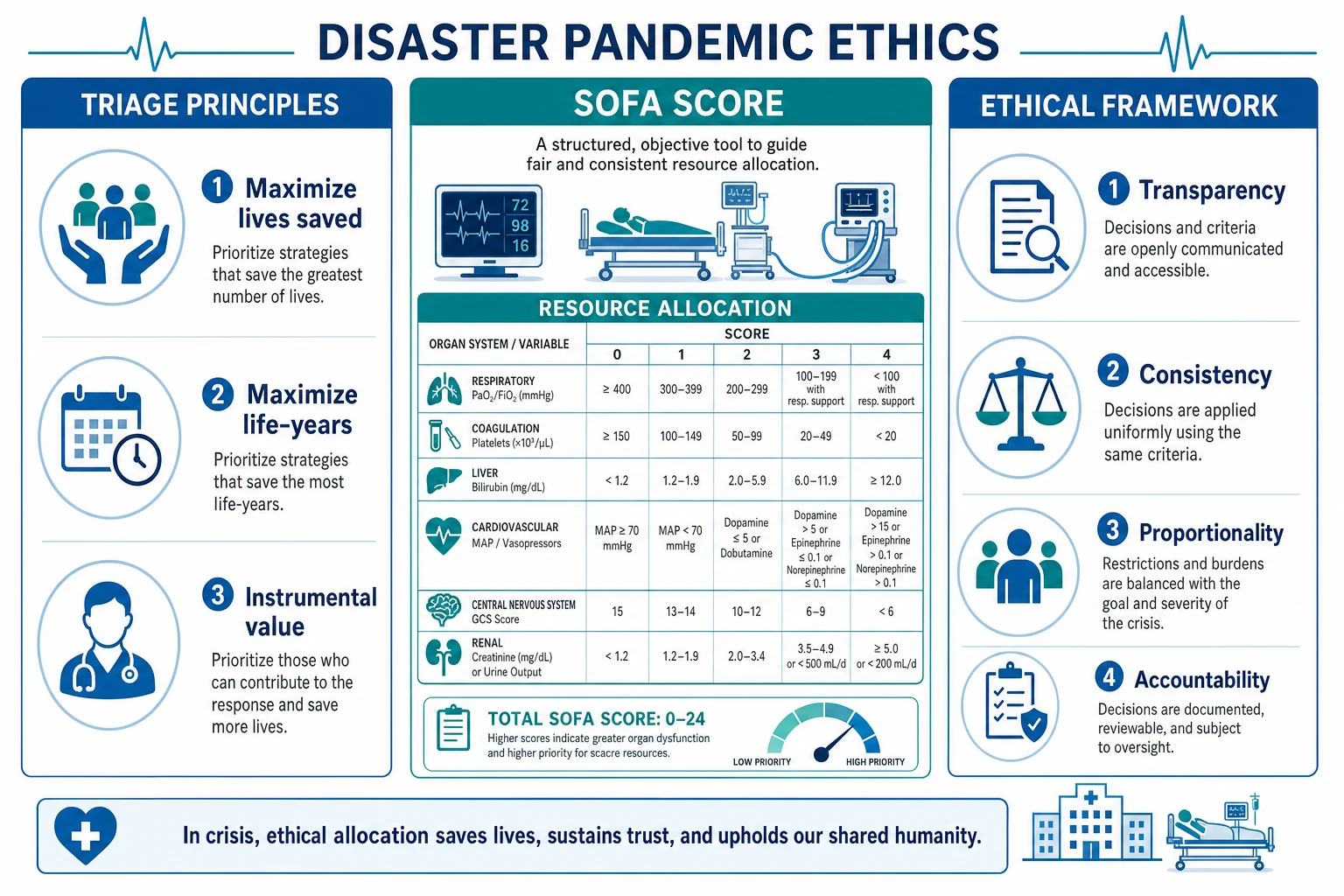
ICU triage and resource allocation govern who is admitted, who is discharged, and how scarce resources (beds, ventilators, staff, renal replacement therapy) are distributed when demand exceeds capacity (pandemic, mass casualty, seasonal surge). Core principles: (1) maximise benefit / lives saved, (2) treat people equally, (3) promote and reward instrumental value, (4) give priority to the worst off, (5) transparency, consistency and accountability. Triage hierarchy — the priority/benefit system: Priority 1 (urgent, high likelihood of benefit, e.g. reversible sepsis, trauma) — admit first; Priority 2 (urgent, moderate benefit) — admit if bed available; Priority 3 (non-urgent, low immediate risk) — defer / ward; Priority 4 (little or no expected benefit despite ICU — irreversible brain injury, terminal illness, advanced directives declining intensive care) — do not admit, provide comfort care. The benefit principle: ICU is allocated where it is most likely to do the most good (reversibility + expected survival), NOT first-come-first-served. Triage tools: SOFA score (organ failure burden — higher SOFA = lower priority), modified SOFA (mSOFA) triage categories, MEES (Mainz Emergency Evaluation Score, prehospital/ED), NEMS (Nine Equivalents of Nursing Manpower Use Score, nursing workload/capacity planning), age, comorbidity and frailty burden, reversibility. Inappropriate admissions: brain death, irreversible terminal illness, valid DNACPR/advance directives declining intensive care, patients for whom ICU cannot reverse the dying process. Discharge criteria: clinical stability (no longer needing organ support, no escalating inotropes, low SOFA, recovering primary insult), adequate step-down/HDU capacity available, and a safe handover. Rationing principles when scarce: utilitarian (maximise benefit), egalitarian (equal access / lottery), prioritarian (worst off first), first-come-first-served (REJECTED during scarcity), instrumental value (prioritise staff who can return to work). Futility: physiological (a treatment that cannot achieve its physiological goal — will not work), qualitative (quality of life/benefit too low to justify), value-based (disagreement on what counts as a benefit). Withholding vs withdrawing life-sustaining therapy are ETHICALLY EQUIVALENT. Triage committee: an independent, multidisciplinary body — NOT the treating clinician — applies a predefined protocol, reducing bias and moral burden. Surge capacity: Level 1 (conventional), 2 (contingency), 3 (crisis). The protocol MUST be predefined and applied consistently — NEVER improvised case-by-case under pressure. Communication with patients and families is essential — honest, compassionate, consistent.
On this page & tools
Your progress
Saved locally on this device.
Target exams
Red flags

Ethical foundations of triage
Triage (French trier, to sort) is the process of prioritising patients for treatment when resources cannot meet all needs. In intensive care it operates at two levels: microallocation (which individual patient gets the next ICU bed/ventilator/RRT session today) and macroallocation (how many ICU beds, staff and ventilators a society or hospital funds in the first place). Both raise the same ethical questions, but bedside clinicians face microallocation under pressure. The defining ethical feature of triage is that someone will be denied a potentially life-saving intervention that, in normal circumstances, they would receive — so the decision must be justified by a defensible, consistent, transparent principle.[5][6]
The ethical principles applied to triage and resource allocation
| Principle | Meaning | How it shapes triage |
|---|---|---|
| Utility / beneficence (maximise benefit) | Produce the greatest good for the greatest number | Prioritise patients most likely to survive WITH ICU; do not consume a bed with a treatment that cannot benefit when another patient could survive. Lives saved and life-years saved. |
| Justice / equity (treat people equally) | Like cases treated alike; no discrimination | Apply the SAME criteria to all; do not favour by wealth, fame, ethnicity, social status or personal connection. Triage by clinical factors, not social worth. |
| Prioritarianism (worst off first) | Give priority to those worst off | Favours the most severe physiological threat — but conflicts with utility when the worst off are also least likely to survive. |
| Respect for persons / autonomy | Honour prior wishes and dignity | Respect valid advance directives refusing ICU; do not coerce; communicate honestly. Autonomy is constrained in triage (a patient cannot demand a scarce bed that another needs more). |
| Non-maleficence | Avoid harm | Do not impose painful, non-beneficial treatment; provide palliative care to those not receiving ICU. |
| Reciprocity | Honour sacrifice | Healthcare workers exposed while caring for patients may be given priority for treatment (instrumental + reciprocal). |
| Transparency & accountability | Decisions are open, reviewable, appealable | Pre-published protocol; triage committee; appeal mechanism; post-event audit. |
The six fair-allocation values (Emanuel et al., NEJM 2020)
| Value | What it requires in practice |
|---|---|
| 1. Maximise benefits | The overriding aim — save the most lives and the most life-years. |
| 2. Treat people equally | If two patients derive the same benefit, allocation should not depend on irrelevant features; a lottery (random selection) is the equal-tiebreaker. |
| 3. Promote and reward instrumental value | Prioritise people who can save others — first healthcare workers (they return to care for more patients), and within that those likely to survive and return to work. |
| 4. Give priority to the worst off | Two readings — sickest first (most urgent need) and youngest first (most life-years deprived / fair-innings). |
| 5. Recognise time-based allocation | A patient needing a ventilator for a few days (recovering overdose) is prioritised over one needing it for weeks (severe ARDS), freeing the device sooner for the next patient. |
| 6. Consistency across categories | The SAME principles apply to ventilators, ICU beds, antivirals, vaccines — no special pleading. |
ICU admission criteria — the priority/benefit system
Admission to ICU is never automatic. Every request is assessed against explicit criteria because an ICU bed occupied by a patient who cannot benefit is a bed denied to a patient who can. The widely used framework (derived from the SCCM/ANA guidelines and adapted by pandemic triage protocols) classifies every referral into one of four priority bands based on two questions: (a) how urgently is intensive monitoring/organ support needed? and (b) how likely is the patient to benefit (survive to a meaningful recovery)?[1][3]
The benefit principle is the hinge of the whole system: ICU is allocated where it is expected to reverse a recoverable insult and produce survival to a quality of life the patient would value. A patient whose illness is irreversible, or whose baseline is such that ICU cannot return them to a meaningful existence, derives little or no benefit and is therefore a low priority (Priority 3) or excluded (Priority 4). [1]
The four-priority ICU admission system
| Priority | Definition | Examples | Decision |
|---|---|---|---|
| Priority 1 | Critically unwell, needs intensive monitoring/organ support that CANNOT be provided outside ICU, AND the condition is reversible with a high expected benefit | Septic shock needing vasopressors + ventilation; major trauma; severe diabetic ketoacidosis; status epilepticus; post-arrest with reversible cause; acute respiratory failure | ADMIT FIRST — bed found or created |
| Priority 2 | Needs intensive monitoring/short-term support that may step down quickly, OR a moderate likelihood of benefit; ward care cannot safely deliver what is needed | Post-operative major surgery needing overnight ventilation; mild vasopressor requirement; isolated respiratory support weaning; close monitoring after intervention | ADMIT if a bed is available; otherwise observe in HDU/ED and admit when a Priority 1 patient is discharged |
| Priority 3 | Critically unwell but with a LOW likelihood of recovery / high burden of treatment; OR unlikely to benefit sufficiently to justify ICU | End-stage chronic organ failure with acute decompensation; advanced metastatic malignancy with a reversible complication; very high SOFA / multi-organ failure with poor baseline | DEFER — manage on ward/HDU with clear ceilings of treatment; reconsider if reversibility improves |
| Priority 4 | Little or no expected benefit from ICU; admission would be non-beneficial or futile | Brain death; irreversible terminal illness (imminent death); valid directive declining intensive care; refractory cardiogenic shock with no bridge to therapy; burns with negligible survival | DO NOT ADMIT — provide ward/comfort care, palliation, and family support; consider organ donation pathway if brain-dead |
How to triage an ICU referral — the bedside process
- CONFIRM THE REQUEST AND GATHER THE DATA — Diagnosis, acute physiology (vitals, gas, lactate, organ support already in use), baseline functional status, comorbidities, frailty, advance directives / goals-of-care, reversibility of the acute insult, and what is needed (monitoring vs ventilation vs RRT vs vasoactive drugs). Do not assess on a one-line referral alone.
- ASSESS URGENCY — Is the patient deteriorating now (needs organ support within the hour), within hours, or stable enough to wait? Urgency alone does NOT guarantee admission — it is combined with benefit.
- ASSESS BENEFIT (the hinge question) — Is the acute process REVERSIBLE, and what is the expected outcome (survival to discharge, functional recovery)? Use SOFA, comorbidity and frailty as objective adjuncts. Ask: "If this patient receives ICU, what is the realistic chance of survival to a meaningful recovery?" A patient with little expected benefit is down-graded regardless of urgency.
- ASSIGN A PRIORITY BAND (1 to 4) — Combine urgency and benefit into the four-priority system above. Document the band and the reasoning.
- CHECK AGAINST EXCLUSION (Priority 4) CRITERIA — Brain death, irreversible terminal illness, valid directive declining intensive care, or physiologically futile escalation → do not admit; provide comfort/ward care and refer to palliative care and (if appropriate) the donation pathway.
- COMPARE WITH COMPETING DEMAND — If a bed is immediately available and no higher-priority patient is waiting, admit. If beds are scarce, rank ALL current referrals and inpatients by priority; the highest priority gets the next bed. Under extreme scarcity, this may require the triage committee to withdraw support from a lower-priority patient to admit a higher-priority one.
- DOCUMENT AND COMMUNICATE — Record the triage decision, the priority band, the criteria applied, who made the decision (triage officer/committee under surge), and the plan communicated to the patient/family. Provide palliative care to those not admitted.
- RE-TRIAGE PERIODICALLY — Clinical course changes priorities: a Priority 2 patient who deteriorates to multi-organ failure may become Priority 3/4; a Priority 3 patient whose sepsis responds becomes Priority 1 for weaning. Reassess at defined intervals (e.g. 48–72 h) and on any major change.
Triage tools and scoring systems
Objective scoring reduces bias and makes triage consistent. No single score decides admission — scores are adjuncts that quantify organ-failure burden, severity, workload and prognosis. Their limitations must be understood: most were developed to predict GROUP mortality for research/audit, not to triage individuals, and their discrimination for individual prognosis is modest.[8]
Triage and workload scoring tools — what they measure and how they are used
| Tool | What it measures | Score range | Triage use | Limitations |
|---|---|---|---|---|
| SOFA (Sequential Organ Failure Assessment) | Burden of organ dysfunction across 6 systems (resp PaO2/FiO2, coag platelets, liver bilirubin, cardiovascular MAP/vasopressors, CNS GCS, renal creatinine/urine) | 0–24 (each organ 0–4) | Higher SOFA = more organ failure = worse prognosis. Many COVID triage tools stratify by SOFA band (e.g. low <6 high priority; 6–9 intermediate; high >9 low/exclude). Track trajectory (rising SOFA = failing). | Designed for organ-failure description/population mortality, not individual triage; underestimates in some groups (e.g. chronic disease); does not capture frailty, reversibility or baseline. |
| mSOFA (modified SOFA) triage categories | SOFA-based operational triage bands used in pandemic protocols | Categorical (red/orange/yellow/green) | Translates SOFA + exclusion criteria into admission/discharge/reassess decisions (e.g. Maryland, Ontario, Swiss tools). | Different protocols use different cutoffs; validated outcomes data limited; can misclassify at the boundaries. |
| MEES (Mainz Emergency Evaluation Score) | Prehospital/ED severity score — combines GCS, heart rate, systolic BP, oxygen saturation, pain, etc. | 0–57 (higher = worse) | Prehospital and ED triage of incoming emergencies; predicts early mortality and ICU need; helps decide who warrants critical care at the front door. | Less commonly used inside ICU; population-derived; complements but does not replace SOFA. |
| NEMS (Nine Equivalents of Nursing Manpower Use Score) | Nursing WORKLOAD per patient (ventilation, RRT, inotropes, specific interventions summed) | ~0–50+ points | Measures staffing demand — used for CAPACITY planning (how many nurses needed) and for triage when the limiting factor is staff, not beds. | Measures workload, not prognosis; does not predict survival. |
| APACHE II / SAPS II | Severity at admission for population mortality prediction | APACHE 0–71 | Audit, research, group mortality estimation; sometimes informs prognosis for triage discussion. | Not designed for real-time triage; 24-hour data requirement; population, not individual. |
| Age + comorbidity + frailty (e.g. CFS) | Baseline reserve and reversibility | CFS 1–9 | Modifies benefit assessment — high Clinical Frailty Scale predicts poor ICU outcome and is an explicit triage modifier in many protocols. | Frailty is NOT the same as age; never use age alone. |
| Triage team judgement + reversibility | The qualitative "will this treatment work?" assessment | — | Essential overlay on all scores — a score cannot decide alone. | Subjectivity is why a predefined protocol + committee is needed. |
SOFA as a triage tool — how it is used and how it fails
| Aspect | Detail |
|---|---|
| What it does well | Provides an objective, reproducible measure of organ-failure burden; easy to compute from bedside data; trajectory (rising/falling) tracks response to treatment. |
| How it is used in triage | As a severity proxy to estimate expected benefit. A very high SOFA (>11) carries very high mortality and, in many protocols, triggers treatment limitation/exclusion. Bands stratify priority (e.g. mSOFA). |
| Why it cannot decide alone | (1) It predicts population, not individual mortality; (2) it ignores reversibility — a young patient with severe but reversible diabetic ketoacidosis may have a high SOFA yet an excellent outcome; (3) it ignores baseline frailty and comorbidity; (4) cutoffs are arbitrary and protocol-dependent; (5) early SOFA may under-represent a rapidly evolving illness. |
| Exam point | SOFA is an ADJUNCT to clinical judgement within a predefined protocol — never the sole determinant. Combine with age, comorbidity, frailty and, above all, reversibility of the acute insult. |
Inappropriate ICU admissions
Not every deteriorating patient belongs in ICU. Admitting a patient who cannot benefit occupies a scarce bed, exposes the patient to invasive, burdensome treatment and delays death without improving it, and denies the bed to a patient who could survive. Recognising inappropriate admissions is therefore both an ethical and a clinical duty.[2][10]
Appropriate vs inappropriate ICU admission
| Appropriate (admit) | Inappropriate (do not admit) |
|---|---|
| Reversible acute insult with reasonable prospect of recovery | Brain death (the patient is dead; no intensive support changes outcome — redirect to organ donation pathway) |
| Need for organ support that cannot be delivered on the ward/HDU | Irreversible terminal illness with imminent death (ICU prolongs dying, not living) |
| Post-operative monitoring after major surgery with defined plan | Valid advance directive / DNACPR declining intensive care — respect autonomy |
| Severe but treatable single-organ failure (early ARDS, septic shock, DKA) | Physiologically futile escalation — e.g. refractory cardiogenic shock with no bridge to recovery/transplant, irreversible multi-organ failure |
| Patient (or surrogate) consents to and wants intensive care | Permanent vegetative / minimally conscious state with no prospect of recovery — ICU cannot reverse the brain injury |
| Reasonable baseline functional status | End-stage irreversible disease where the patient would not survive to leave hospital regardless of ICU |
| Trial of treatment is informative ("will this get better?") | Patient/family insistence on non-beneficial treatment — demand does not create benefit; escalate to ethics, do not simply comply |
The DNACPR / advance directive interaction with ICU triage
| Scenario | Action |
|---|---|
| Valid advance directive refuses ICU / ventilation | Respect it — do not admit for the refused treatment; provide the highest level of care the patient accepted (ward, HDU, symptom control). |
| DNACPR in place but patient wants ward-level treatment | Admit to HDU/ward as appropriate; DNACPR governs resuscitation only, not all treatment. ICU may still be appropriate if reversible and consistent with goals. |
| Surrogate requests ICU the patient would have refused | Apply substituted judgement; a valid refusal prevails over a surrogate's later request; involve ethics if disputed. |
| Brain death confirmed | Patient is deceased — no ICU admission for treatment; continue ventilation ONLY if organ donation is being pursued and consented. |
| No directive, no surrogate, incapacitous, prognosis grim | Best-interests decision with senior clinician + second opinion; default to a defined trial of treatment with clear review point and ceilings. |
ICU discharge criteria
Discharging a patient at the right time is as important as admitting the right patient. Premature discharge risks readmission and death; delayed discharge (bed blocking) denies the bed to a waiting patient and is itself a triage failure. Discharge requires clinical stability, available step-down capacity, and a safe handover.[2]
Discharge readiness — when an ICU patient can step down
- ORGAN SUPPORT HAS BEEN REMOVED OR IS MINIMAL — No invasive mechanical ventilation (or established on a low, stable non-invasive/weaning setting acceptable to the receiving unit); no escalating vasopressors (off, or a stable low dose that the HDU can manage); no continuous renal replacement therapy (or a planned transition that the ward/HDU can continue); no ICP monitor/intracranial device requiring ICU nursing.
- THE PRIMARY INSULT IS RECOVERING — The reason for admission (sepsis, DKA, overdose, post-operative state) is resolving; no rapid escalation in the last 12–24 h; improving SOFA trajectory.
- AIRWAY IS SAFE AND PROTECTED — If intubated, successfully extubated with a patent airway, intact cough/swallow, no significant stridor, able to clear secretions. Tracheostomy patients may step down once stable on a secure tracheostomy the receiving unit can manage.
- MONITORING NEEDS CAN BE MET DOWNSTREAM — The patient no longer needs continuous arterial/CVC monitoring or hourly neuro-observations beyond what HDU/ward provides; abnormal but stable results with a plan.
- STEP-DOWN CAPACITY EXISTS — A HDU or ward bed with the right skill mix is available; the receiving team has accepted the patient and is briefed. Discharge should be planned, not pushed by bed pressure alone — but under genuine scarcity a clinically-stable-for-ward patient SHOULD move to free the ICU bed.
- SAFE HANDOVER AND DOCUMENTATION — Structured handover (ISBAR/SBAR), updated medications, outstanding investigations, follow-up plan (ICU follow-up clinic, rehabilitation, goals-of-care status), resuscitation/escalation decision communicated. The receiving team must be able to contact ICU for advice/readmission.
- RECOGNISE "READY BUT BLOCKED" AND THE REVERSE — If clinically ready but no bed, flag for early discharge; if a bed is free but the patient is not ready, keep them — discharge criteria override bed pressure. Anticipate and plan discharge from the day of admission.
Rationing principles — when demand exceeds supply
When there are not enough resources for all who need them, a principle must choose who is served. The choice of principle is an ETHICAL one and must be made explicitly and in advance. Under scarcity, first-come-first-served is unethical — it rewards those who happen to arrive first (geography, transport, wealth, timing) rather than need or benefit, and it has no moral basis for denying a more urgent or more salvageable patient who arrives later.[5][6][9]
Rationing models — the decision table
| Model | Principle | Strengths | Weaknesses | Use in ICU triage |
|---|---|---|---|---|
| First-come-first-served | Whoever arrives first is served first | Simple; feels "fair" in a queue; respects effort to present | UNETHICAL under scarcity — rewards geography, timing, privilege; ignores need and benefit; no moral claim | Rejected for ICU/ventilator triage. Acceptable only for non-scarce resources or near-equivalent cases. |
| Utilitarian / maximise benefit | Allocate to produce the greatest total benefit (most lives AND most life-years saved) | Maximises outcome from a finite resource; defensible when the goal is saving lives | Can sacrifice individuals for aggregate good; risks discriminating against disabled/elderly if "benefit" is narrowly defined; requires accurate prognosis | Primary principle for ICU triage — prioritise reversible, high-survival conditions. |
| Egalitarian / equal access | Everyone has equal claim; allocate by LOTTERY (random) when benefit is equivalent | Maximally impartial; removes bias; fair tiebreaker | Ignores urgency and expected benefit; can give a resource to someone who will die with it while another survives | Used as the tiebreaker between patients with equivalent expected benefit; NOT the primary principle. |
| Prioritarian / worst-off first | Give priority to the worst off — sickest (most urgent need) OR youngest (most life-years deprived, "fair innings") | Protects the vulnerable; responds to urgency; fair-innings respects life-cycle equity | Conflicts with utility when the worst off are least likely to survive; "worst off" is ambiguous (sickest vs youngest vs most deprived) | Secondary — used to break ties and to protect specific groups (children, pregnancy in some protocols). |
| Instrumental value | Prioritise those whose survival enables others to survive (healthcare workers who can return to work) | Indirectly maximises total benefit (a saved nurse saves more patients); supported by reciprocity | Risks valuing people by usefulness; must be tightly limited | Limited use — healthcare-worker priority, combined with likelihood of return to duty. |
| Reciprocity | Honour sacrifice / contribution | Recognises those who took on risk for others | Hard to define who "deserves" | Supports prioritising frontline workers exposed in a pandemic. |
When principles conflict — worked triage scenarios
| Scenario | Applied reasoning | Likely outcome |
|---|---|---|
| One ventilator; (A) 65-year-old with severe but reversible ARDS vs (B) 80-year-old with end-stage COPD and metastatic cancer | Utility: A has far higher expected benefit (reversible, better baseline); B has low benefit. | Ventilator to A. B offered ward/comfort care. |
| One bed; two patients with equivalent expected benefit and identical SOFA | Utility cannot separate them → egalitarian tiebreaker. | Random allocation (lottery) between them — NOT first-come. |
| One ICU bed; (A) 30-year-old overdosed, needs ventilation 1 day vs (B) 50-year-old with severe ARDS, needs ventilation 2–3 weeks | Time-based allocation — A frees the bed sooner for the next patient; both may survive, but A returns the resource faster. | Tilt towards A on instrumental/time grounds, with B closely monitored. |
| (A) young patient, brain-dead from trauma vs (B) older patient with reversible sepsis | Brain death = exclusion; the bed cannot help A. | Bed to B; A redirected to organ donation pathway. |
| Family demands ICU for an unconscious patient with a valid advance directive refusing ventilation | Autonomy prevails; a valid refusal is binding. | Respect directive — no ICU for ventilation; comfort care. |
Medical futility
Futility is the judgement that a proposed treatment cannot achieve its intended goal, or that the goal it achieves is not worth the burden. The concept is essential to triage because a futile treatment, by definition, offers no benefit and so cannot claim a scarce resource. Futile treatment is also ethically problematic at the bedside: continuing non-beneficial intensive care inflicts suffering, consumes resources, and violates non-maleficence. Schneiderman and colleagues' classic 1990 paper distinguished quantitative futility (a treatment that in the last 100 published cases has not worked) from qualitative futility (a treatment that may preserve life but at a quality the patient would not accept).[11][10]
Three categories of medical futility
| Type | Definition | Example | Who decides / how resolved |
|---|---|---|---|
| Physiological futility | The treatment CANNOT achieve its physiological aim — it simply will not work, physiologically | CPR in a patient with refractory asystole after prolonged arrest; chemotherapy for a tumour with no responsive disease; dialysis when there is no viable circulation | Least controversial — when a treatment is physiologically incapable of working, the clinician is not obliged to provide it, even on request. Document and explain. |
| Qualitative futility | The treatment may "work" physiologically but produces a quality of life/benefit the patient would not value (or that is below an acceptable threshold) | Permanent vegetative state after anoxic brain injury; survival with profound dependence the patient previously stated they would not want | Hardest — requires knowing the patient's values (advance directive, substituted judgement). If wishes unknown, best-interests + ethics input. |
| Value-based futility | The clinician and patient/family DISAGREE on whether the outcome is a benefit | Family views survival in any form as a blessing; team views survival with severe brain injury as non-beneficial | Requires process: explore reasons, seek second opinion, involve ethics committee, allow time, escalate to courts only as last resort. Do NOT unilaterally withdraw without due process. |
Futility vs rationing — critical distinction
| Feature | Medical futility | Rationing |
|---|---|---|
| Why treatment is withheld | The treatment cannot benefit THIS patient (no benefit achievable) | The treatment COULD benefit this patient, but the resource is needed by ANOTHER patient who would benefit more |
| Moral basis | Non-maleficence; respecting the limits of medicine; not offering what cannot help | Justice/utility; fair distribution of a finite resource |
| Operates | At the individual patient level — patient-specific prognosis | At the population level — relative need/benefit across patients |
| Example | CPR will not restart a heart in refractory asystole → physiologically futile | Two patients need one ventilator; both could benefit; one benefits more → rationed to the higher-benefit patient |
| Exam trap | "Futile" is NOT a synonym for "expensive" or "unlikely" — it means the treatment cannot achieve its goal. A treatment is NOT futile merely because the patient is old or disabled. | Rationing is about RELATIVE allocation; do not disguise rationing decisions as "futility." |
Withholding vs withdrawing life-sustaining therapy
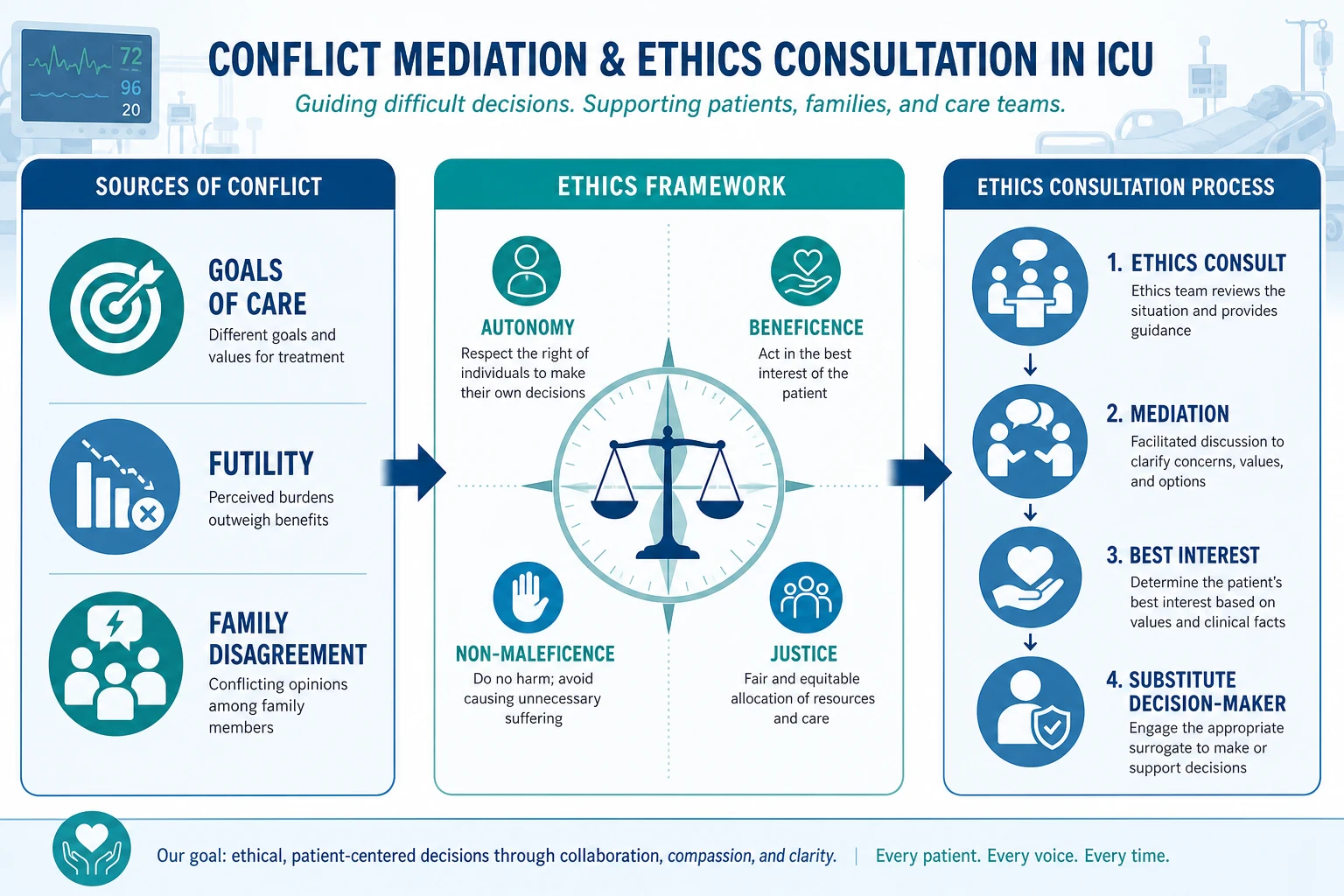
A central doctrine of intensive-care ethics, universally endorsed (SCCM, ATS, ESICM, ANZICS, GMC), is that withholding and withdrawing life-sustaining treatment are ethically and legally equivalent. There is no moral difference between not starting a treatment that cannot benefit the patient and stopping a treatment that has been shown to be non-beneficial. The relevant question is whether the treatment benefits the patient — not whether it has been started. The widespread sense that withdrawal is "worse" is a cognitive bias (omission/status-quo bias), not an ethical principle. This distinction is pivotal in triage: under scarcity it may be necessary to WITHDRAW support from a lower-priority patient to admit a higher-priority one — and because withdrawal is ethically equivalent to withholding, this is permissible under a predefined protocol.[10][7]
Withholding vs withdrawing life-sustaining therapy — ethically equivalent
| Feature | Withholding | Withdrawing |
|---|---|---|
| Definition | Not starting a treatment that would be futile/non-beneficial | Stopping a treatment already in progress that is futile/non-beneficial or, under scarcity, lower priority |
| Ethical status | Ethically and legally EQUIVALENT to withdrawing | Ethically and legally EQUIVALENT to withholding |
| Moral reasoning | The test is whether the treatment BENEFITS the patient, not whether it has been started. A treatment that cannot benefit is not obligatory to start. | Once a trial has shown a treatment is non-beneficial (or another patient benefits more), continuing it is not obligatory. |
| Common bias | Staff feel comfortable withholding | Staff (wrongly) feel withdrawal "causes" death — but death is from the underlying disease; the treatment was only postponing it |
| In triage | Not admitting a low-benefit patient = withholding | Removing a ventilator from a low-priority patient to give it to a high-priority patient = withdrawing — both permissible under protocol, decided by the triage committee |
| Practice | Same process: shared decision-making, documentation, family communication, symptom control | Same process; withdrawal allows a planned, supported, attended death |
Withdrawing to free resources — the most demanding decision in critical care
| Element | Requirement |
|---|---|
| Permissibility | Ethically permissible ONLY under a predefined triage protocol that independently grades priority — never the bedside team's ad-hoc call. |
| Who decides | The triage committee / triage officer, NOT the treating clinician — to remove conflict of interest and moral injury. |
| Trigger | A newly arriving higher-priority patient AND no other way to provide ICU AND an existing patient now meeting withdrawal criteria (e.g. prognosis downgraded by rising SOFA / failed trial of treatment). |
| Process | Review the patient against protocol criteria; if withdrawal criteria met, communicate honestly and compassionately with the patient/surrogate; conduct a structured, symptom-controlled withdrawal; provide palliative care; document thoroughly. |
| What it is NOT | It is NOT euthanasia (the cause of death is the underlying disease), NOT abandonment (comfort care continues), and NOT a unilateral act against a patient who would benefit (the patient must meet objective low-benefit criteria). |
Triage committees and the decision process
To protect both patients and clinicians, triage under scarcity is decided by an independent triage committee / triage officer, separated from the treating team. The treating clinician remains the patient's advocate; the triage committee applies the protocol. This separation reduces conflict of interest (the team is not judging its own patient against others), reduces moral injury, promotes consistency, and provides accountability.[6][9]
How a triage committee operates under surge
- STAND UP THE STRUCTURE BEFORE THE CRISIS — Constitute the triage team in the calm phase: a senior intensivist (not the treating clinician), a senior nurse, an ethicist, an administrator and (where relevant) a palliative-care or pastoral representative. Define the protocol, the priority bands, the scoring tools, the reassessment intervals and the appeal mechanism. Train and rehearse.
- TRIAGE OFFICER ASSESSES EACH PATIENT — The triage officer (a senior clinician NOT caring for the patient) collects clinical data, computes SOFA/comorbidity/frailty, and assigns a priority band per protocol. The treating team provides data but does NOT make the allocation decision.
- COMMITTEE REVIEWS COMPETING DEMAND — When resources are scarce the committee ranks all referrals and current inpatients by priority; the highest-priority patient receives the next resource. Decisions follow the protocol, not individual preference.
- COMMUNICATE THE DECISION — The decision and its basis are communicated honestly and compassionately to the patient/family by a clinician (with the protocol available). For patients not receiving ICU, offer ward/comfort care, palliative care and family support.
- PROVIDE AN APPEAL MECHANISM — Allow clinicians/families to request review of a triage decision through a defined, rapid appeal process (a second triage officer or committee). Appeals must not delay care for the higher-priority patient.
- REASSESS AT FIXED INTERVALS — Re-triage inpatients (e.g. at 48–72 h) — rising SOFA/failed trial of treatment may downgrade priority; recovery may upgrade it. Decisions are dynamic, not one-off.
- DOCUMENT AND AUDIT — Record every triage decision, criteria, priority band, communication and outcome. Audit decisions for consistency, equity (no bias by race/wealth) and adherence to protocol. After the event, review lessons and revise the protocol.
Triage committee vs treating clinician — who does what
| Role | Treating clinician | Triage committee / officer |
|---|---|---|
| Primary duty | Advocate for their individual patient | Apply the protocol fairly across all patients |
| Provides | Clinical data, prognosis estimate, treatment plan | Priority band, allocation decision, appeal handling |
| Decides admission? | No (under surge) — proposes, does not allocate | Yes — allocates per protocol |
| Decides withdrawal to free resources? | No — would be conflict of interest | Yes — per objective criteria |
| Communicates to family | Yes — with honesty and compassion, conveying the committee's decision | Provides the decision and basis; supports the clinician |
Surge capacity and pandemic preparedness
Surge capacity is the ability to expand critical-care delivery beyond normal operations. It is conventionally described in three levels — conventional, contingency and crisis — each with progressively greater departure from standard staffing, space and equipment. Staff are usually the limiting factor, not beds or ventilators.[2][4]
Surge capacity levels — conventional, contingency, crisis
| Level | Space | Staff | Supplies/equipment | Ethical/legal status |
|---|---|---|---|---|
| 1 — Conventional | Usual ICU beds | Usual ICU staff, normal ratios | Normal stocks | Standard of care; full resources |
| 2 — Contingency | Adapt spaces (PACU, step-down, post-op) for ICU-level care | Surge staff (recalled, cross-trained non-ICU nurses under ICU supervision); relaxed ratios | Conservation, substitution, adaptation of supplies | Minor, defensible departure from usual practice; care remains close to standard |
| 3 — Crisis | Convert non-clinical areas; cohorting; double-venting | Major redeployment; non-ICU staff with rapid training; much higher ratios; regional/national mutual aid | Scarce — strict rationing; reuse/reprocessing; crisis standards for ventilator/PPE allocation | Crisis standards of care — explicit, pre-declared legal/ethical framework allowing triage and rationing |
Surge capacity — the building blocks (3 Ss)
| Domain | How to build surge |
|---|---|
| Space (beds) | Identify convertible areas (PACU, HDU, theatres when not operating); pre-plan cohorted units; mutual-aid agreements with neighbouring hospitals; field hospitals as last resort |
| Staff (usually the rate-limiter) | Cross-train non-ICU nurses and doctors; recall off-duty/recently-retired staff; use tele-ICU to extend intensivist supervision; clear team-based models (1 intensivist supervising several expanded teams); protect staff with PPE and mental-health support |
| Stuff (equipment) | Stockpile ventilators, monitors, PPE, consumables (suction tubing, ABG cartridges, circuits), oxygen supply (often the unrecognised bottleneck); conservation/substitution protocols; emergency-use authorisations |
Triage models compared — the synthesis
Comparison of the major triage / allocation models
| Model | Core rule | Allocates by | When appropriate | Major criticism |
|---|---|---|---|---|
| Priority/benefit (SOFA-based) — most pandemic protocols | Rank by priority band from urgency + expected benefit (SOFA, reversibility, comorbidity) | Clinical prognosis + reversibility | Mass-critical-care surge (COVID) | Prognostic uncertainty; risk of discriminating against disabled/elderly if poorly designed |
| Utilitarian (maximise benefit) | Greatest total benefit (lives + life-years) | Expected outcome | Default under scarcity | Can sacrifice individuals for the aggregate |
| Egalitarian / lottery | Random selection among equivalent-benefit candidates | Impartial chance | Tiebreaker only | Ignores urgency/benefit if used as primary |
| Prioritarian (worst off / fair innings) | Sickest-first or youngest-first | Need / life-years | Secondary modifier | Conflicts with utility; ambiguous "worst off" |
| First-come-first-served | Arrival order | Time of presentation | Non-scarce resources only | Unethical under scarcity — rejected for ICU |
| Instrumental/reciprocal | Healthcare workers / essential staff | Usefulness + sacrifice | Limited, for front-line staff | Risks valuing people by utility |
Communication during triage
How triage is communicated shapes family experience, trust and the risk of complaint/litigation. Communication must be honest, compassionate, consistent and timely, with palliative care offered to those not receiving ICU. [1]
Communicating a triage decision to a family
- PREPARE — Confirm the decision and its basis with the triage committee/treating consultant. Arrange a private space, the right people (senior clinician, nurse, interpreter if needed), and adequate time. Turn off alarms.
- ESTABLISH UNDERSTANDING — Ask what the family already knows ("What have you been told about how [name] is doing?"). Calibrate to their level.
- GIVE A WARNING SHOT, THEN THE DECISION HONESTLY — "I'm afraid I have difficult news." Explain that demand has exceeded capacity and that decisions follow a published, fair protocol — it is not a judgement about the worth of the person. State the decision and the criteria plainly, without jargon.
- RESPOND TO EMOTION (NURSE) — Name, Understand, Respect, Support, Explore. Tolerate silence and tears. Do not justify with false reassurance.
- EMPHASISE WHAT WILL BE DONE — Reassure that the patient will NOT be abandoned: ward/comfort care, symptom control, palliative-care input, family access, spiritual support. The decision is about the LEVEL of care, not the PRESENCE of care.
- EXPLAIN THE APPEAL AND REVIEW — Tell them a decision can be reviewed if circumstances change, and how to seek review. Offer a follow-up meeting.
- DOCUMENT AND DEBRIEF — Record who was present, what was said, the decision, and the plan. Debrief with the team — triage causes significant moral distress.
Exam practice — SAQs
SAQ — Mass-casualty triage: allocating four ICU beds among seven casualties
10 minutes · 10 marks
A multi-vehicle bus crash on a rural highway delivers 14 casualties to your tertiary hospital within 90 minutes. Four ICU beds and six ventilators are vacant. The seven most serious cases are: (A) 28-year-old, GCS 6, severe closed head injury, systolic BP 110; (B) 45-year-old, GCS 4 with bilateral fixed dilated pupils; (C) 32-year-old woman 28 weeks pregnant, severe blunt chest trauma with suspected flail chest, SpO2 86 percent on 15 L, RR 34; (D) 65-year-old with severe COPD (FEV1 30 percent), multiple rib fractures and Type 1 respiratory failure; (E) 8-year-old, 35 percent TBSA partial-thickness flame burns with inhalation injury; (F) 55-year-old with crush injury and refractory haemorrhagic shock, BP 60 palpable after 2 L crystalloid and 2 units O-negative blood; (G) 70-year-old with established severe dementia (Clinical Frailty Scale 8) and traumatic asphyxia. The ED consultant asks you to lead ICU triage.
SAQ — Pandemic ventilator allocation: withdrawal to reallocate under crisis standards
10 minutes · 10 marks
During the second wave of a severe pandemic respiratory virus your ICU is at Level 3 (crisis) surge capacity. All 24 ventilators are occupied. A 35-year-old previously well nurse (Patient X) who contracted the virus while caring for patients is admitted with severe viral pneumonitis: PaO2/FiO2 90 on 15 L/min high-flow nasal oxygen, RR 38, accessory-muscle use and pre-exhaustion. She meets all criteria for intubation. The triage committee is consulted because no ventilator is available. Patient Y, currently ventilated in your ICU, is a 72-year-old with severe ARDS (P/F 70), multi-organ failure (SOFA 14), known end-stage heart failure (ejection fraction 25 percent) and is not improving after nine days of lung-protective ventilation, proning and paralysis. The triage officer asks you to advise on allocation.
Clinical pearls
Red flags
Exam pearls
Evidence and outcomes
ICU triage and resource-allocation evidence
Sprung et al. (Crit Care Med 2020, PMID 32697491) — "Adult ICU Triage During the COVID-19 Pandemic": recommendations to improve survival. Established the operational priority/benefit framework for pandemic triage; emphasised that the protocol must be predefined and applied consistently, with the goal of maximising lives saved rather than first-come allocation. Christian et al. CHEST Consensus (Chest 2014, PMID 25144591) — "Triage: care of the critically ill and injured during pandemics and disasters": the foundational consensus on surge capacity, priority categories and the role of objective scoring; defined conventional/contingency/crisis standards. Maves et al. / Task Force for Mass Critical Care (Chest 2020, PMID 32289312) — "Triage of Scarce Critical Care Resources in COVID-19: Implementation Guide": the operational US implementation guide translating principle into SOFA-based triage bands, exclusion criteria and reassessment — the most cited implementation template. Dichter et al. / Task Force for Mass Critical Care (Chest 2022, PMID 34499878) — "Mass Critical Care Surge Response During COVID-19": preliminary report of contingency strategies actually deployed; staff and oxygen identified as the dominant bottlenecks; reaffirmed crisis-standards need for pre-declaration. Emanuel et al. (N Engl J Med 2020, PMID 32202722) — "Fair Allocation of Scarce Medical Resources in the Time of Covid-19": the canonical statement of the six fair-allocation values (maximise benefit, treat people equally, instrumental value, priority to worst off, time-based allocation, consistency) — the ethical reference for triage. White & Lo (JAMA 2020, PMID 32219367) — "A Framework for Rationing Ventilators and Critical Care Beds": a multiprinciple allocation framework emphasising the independent triage team, a lottery tiebreaker, reassessment, and the separation of allocation from treating clinician. Truog et al. (N Engl J Med 2020, PMID 32202721) — "The Toughest Triage — Allocating Ventilators in a Pandemic": argued that because withholding and withdrawing are ethically equivalent, withdrawal to free a ventilator for a higher-priority patient is permissible — the key conceptual move enabling withdrawal-based triage. Vincent et al. (Intensive Care Med 1996, PMID 8844239) — the original SOFA score paper; the organ-failure measure now used as the objective severity adjunct in most triage protocols. Daugherty Biddison et al. (Chest 2019, PMID 30316913) — "Too Many Patients": a community-engaged framework for statewide ventilator allocation, developed BEFORE COVID; demonstrated that public deliberation on triage is feasible and improves legitimacy. Guidet et al. / Durban Ethics Round Table (J Crit Care 2014, PMID 25216948) — "Withholding or Withdrawing of Treatment in Elderly ICU Patients": data on the prevalence and process of treatment limitation, supporting the equivalence of withholding and withdrawal and the role of age/comorbidity in benefit assessment. Schneiderman et al. (Ann Intern Med 1990, PMID 2187394) — "Medical Futility": the foundational paper defining quantitative and qualitative futility and arguing that clinicians are not obliged to provide physiologically futile treatment even on request — the conceptual basis for futility in triage. Outcomes: triage protocols that are predefined, applied by an independent team, with reassessment and appeal, reduce bias and moral distress; poorly designed tools (over-reliance on SOFA, age alone, or single-point prognostication) misclassify patients and can unjustly exclude vulnerable groups. Post-event equity audit is essential to maintaining public trust.
References
- [1]Sprung CL, Joynt GM, Christian MD, et al. Adult ICU Triage During the Coronavirus Disease 2019 Pandemic: Who Will Live and Who Will Die? Recommendations to Improve Survival Crit Care Med, 2020.PMID 32697491
- [2]Christian MD, Sprung CL, King MA, et al. Triage: care of the critically ill and injured during pandemics and disasters: CHEST consensus statement Chest, 2014.PMID 25144591
- [3]Maves RC, Downar J, Dichter JR, et al. Triage of Scarce Critical Care Resources in COVID-19 An Implementation Guide for Regional Allocation: An Expert Panel Report of the Task Force for Mass Critical Care and the American College of Chest Physicians Chest, 2020.PMID 32289312
- [4]Dichter JR, Devereaux AV, Sprung CL, et al. Mass Critical Care Surge Response During COVID-19: Implementation of Contingency Strategies - A Preliminary Report of Findings From the Task Force for Mass Critical Care Chest, 2022.PMID 34499878
- [5]Emanuel EJ, Persad G, Upshur R, et al. Fair Allocation of Scarce Medical Resources in the Time of Covid-19 N Engl J Med, 2020.PMID 32202722
- [6]White DB, Lo B. A Framework for Rationing Ventilators and Critical Care Beds During the COVID-19 Pandemic JAMA, 2020.PMID 32219367
- [7]Truog RD, Mitchell C, Daley GQ. The Toughest Triage - Allocating Ventilators in a Pandemic N Engl J Med, 2020.PMID 32202721
- [8]Vincent JL, Moreno R, Takala J, et al. The SOFA (Sepsis-related Organ Failure Assessment) score to describe organ dysfunction/failure. On behalf of the Working Group on Sepsis-Related Problems of the European Society of Intensive Care Medicine Intensive Care Med, 1996.PMID 8844239
- [9]Daugherty Biddison EL, Faden R, Gwon HS, et al. Too Many Patients…A Framework to Guide Statewide Allocation of Scarce Mechanical Ventilation During Disasters Chest, 2019.PMID 30316913
- [10]Guidet B, Hodgson E, Feldman C, et al. The Durban World Congress Ethics Round Table Conference Report: II. Withholding or withdrawing of treatment in elderly patients admitted to the intensive care unit J Crit Care, 2014.PMID 25216948
- [11]Schneiderman LJ, Jecker NS, Jonsen AR. Medical futility: its meaning and ethical implications Ann Intern Med, 1990.PMID 2187394