ICU · Ethics
Acute severe community-acquired pneumonia: simulation training and competency assessment
Also known as Simulation in ICU · Competency assessment · Crisis resource management (CRM) · ICU training · TeamSTEPPS · Debriefing · Workplace-based assessment
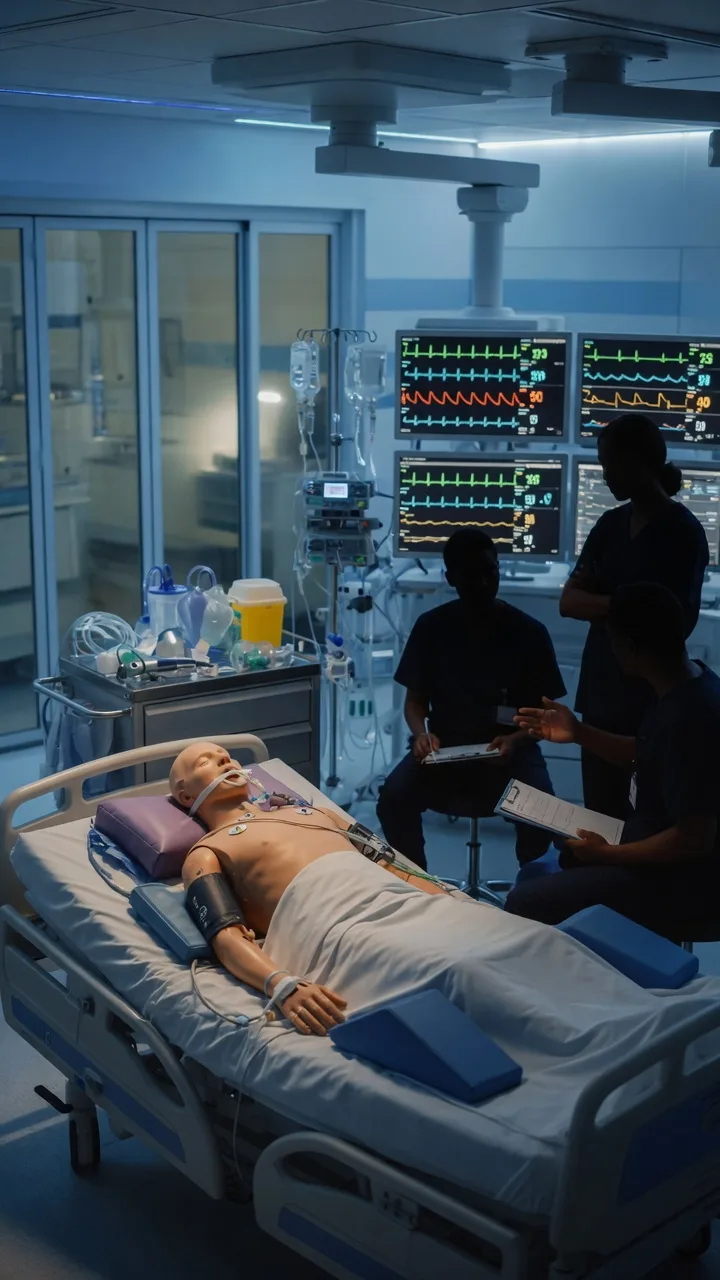
Simulation training is increasingly used in ICU education — it allows practice of high-stakes, low-frequency events without patient risk, and is now a mandated component of critical care training worldwide. Types: (1) High-fidelity (full-body manikin with realistic physiology). (2) Low-fidelity (task trainers — airway, central line, chest tube). (3) In-situ (simulation run in the actual ICU environment). (4) Screen-based / virtual and augmented reality (immersive, repeatable, no physical manikin). (5) Standardised patients (actors). Applications: technical skills (intubation, line insertion), non-technical skills (teamwork, communication, leadership), crisis resource management (CRM — emergency response), rare events (malignant hyperthermia, tension pneumothorax, cardiac tamponade), and system testing (new protocols, equipment, environment, latent safety threats). Evidence: improves knowledge (moderate), skills (strong), team performance (strong), and patient outcomes (moderate — translational outcomes) when integrated into curriculum, repeated with spaced deliberate practice, and paired with structured debriefing. The DEBRIEFING — not the scenario — is where learning occurs; debriefing models include Plus-Delta, GAS (Gather-Analyse-Summarise), and PEARLS (Promoting Excellence And Reflective Learning in Simulation). Competency assessment uses DOPS (Direct Observation of Procedural Skills), mini-CEX (mini-Clinical Evaluation Exercise), OSCE (Objective Structured Clinical Examination), and multi-source 360-degree feedback.
On this page & tools
Your progress
Saved locally on this device.
Target exams
Red flags
Exam practice — SAQs
SAQ — Designing an in-situ simulation programme after two adverse events
15 minutes · 10 marks
A tertiary 24-bed general ICU has had two serious adverse events in six months: an unanticipated difficult airway during an after-hours intubation that briefly progressed to cardiac arrest, and a 25-minute delay to first blood-product administration during a massive transfusion. Root-cause analyses identified non-technical-skill failures (no declared leader, fixation error, poor closed-loop communication) and latent system threats (the emergency blood was locked in a remote blood fridge). The ICU director asks you, as the simulation education lead, to design a simulation-based programme to address these failures.
SAQ — Competency-based sign-off for ultrasound-guided central venous catheterisation
15 minutes · 10 marks
A second-year critical care trainee has logged 18 ultrasound-guided internal jugular central venous catheter insertions without complication but has not been formally signed off as competent to perform the procedure independently. The training committee asks you to design a structured, defensible competency-assessment process covering both procedural and non-technical skills, and to explain how competency-based training differs from traditional time-based apprenticeship.
Clinical pearls
Red flags
Simulation in medical education — why it works
Simulation is a pedagogy, not a technology. The defining feature is that the learner practises in a safe environment where mistakes carry no consequence for a real patient, and where the experience is followed by a structured reflective debrief. The ICU is the natural home of simulation: the events are high-acuity and low-frequency (malignant hyperthermia, tension pneumothorax, massive transfusion, refractory status epilepticus), the procedures are invasive and unforgiving (intubation, central venous cannulation, tube thoracostomy, pericardiocentesis), and the teams are multidisciplinary and interdependent. Real patients are poor teaching material for these events precisely because they happen rarely, at unpredictable hours, when there is no time to teach.[1][8]
The BEME systematic review by Issenberg and colleagues identified the features of simulation that consistently produce effective learning: feedback (the single strongest factor), repetitive practice, curriculum integration, range of difficulty, multiple learning strategies, capture of clinical variation, controlled environment, individualised learning, defined outcomes, and simulator validity. Note that "high fidelity" of the manikin is NOT on that list as a prime driver — feedback and deliberate repetition are. This is the evidence base behind the exam truism that a cheap task trainer with a good debrief outperforms a million-dollar simulator used badly.[1]
Fidelity — low vs high, and matching the modality to the objective
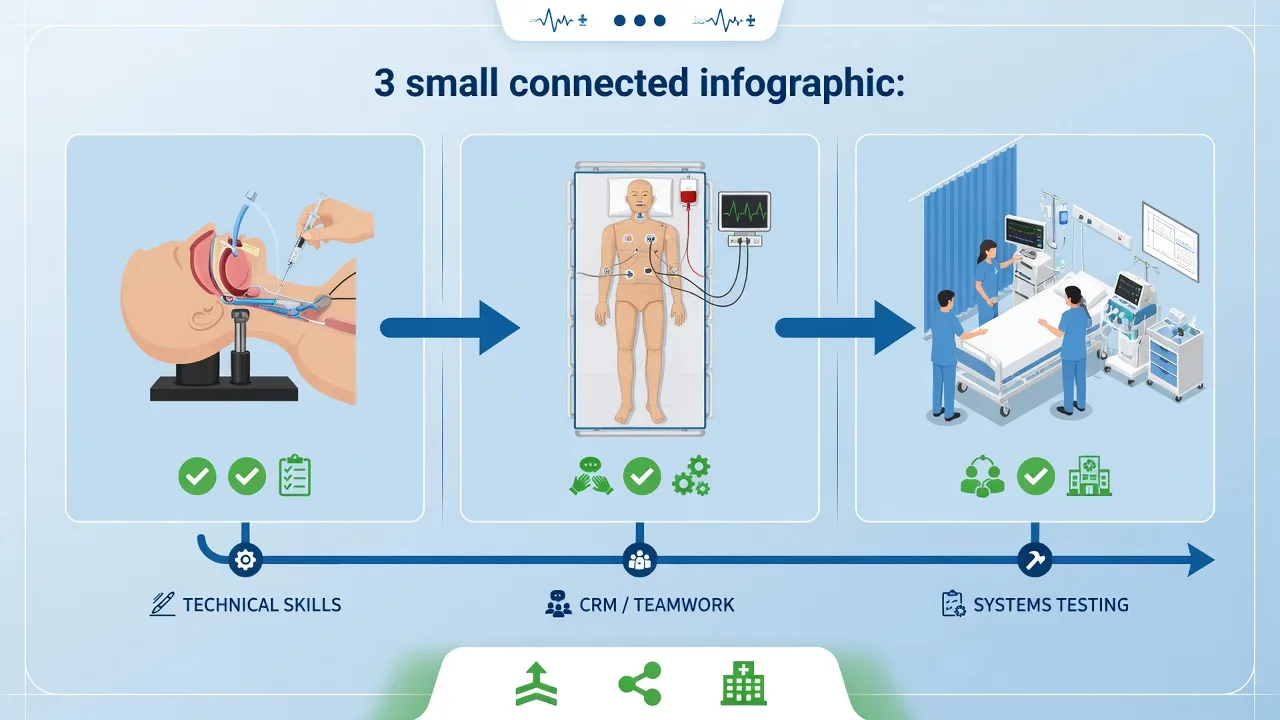
Fidelity is the degree to which the simulator replicates reality. It is not a single dial — it has three separable dimensions: physical fidelity (looks and feels like the real thing), conceptual fidelity (behaves like the real thing physiologically), and psychological fidelity (the learner engages and suspends disbelief as if it were real). A partial-task trainer (a pork-joint for chest-drain practice) has high physical fidelity for the target skill and zero fidelity elsewhere; a screen-based arrhythmia simulator has high conceptual fidelity (the ECGs and haemodynamics respond to interventions) and zero physical fidelity. The exam point is that fidelity must be matched to the learning objective, not maximised for its own sake.[1]
High-fidelity manikin
Whole-body, computer-driven
- A full-body simulator with airway, breathing, circulation and drug-response physiology, voice, palpable pulses, and physiological monitoring that mirrors a real ICU.
- Best for: team CRM scenarios, full arrest / crisis management, complex multi-problem deteriorating patient, multi-disciplinary in-situ drills where the interplay of roles is the learning target.
- Strengths: high psychological fidelity for team behaviours; allows the team to be immersed in a crisis and then debrief the non-technical skills that failed.
- Limitations: expensive, maintenance-heavy, technically fragile, and — crucially — manikin fidelity does NOT predict learning gain. Most effective when paired with a trained debriefer, not a fancier machine.
Low-fidelity / task trainer
Part-task, focused
- A partial model (intubation head, central-line gel pad, chest-wall block, pork ribs, umbilical-cord stub) that reproduces ONLY the anatomy of the target procedure.
- Best for: a single discrete technical skill — endotracheal intubation, central venous cannulation, tube thoracostomy, suturing, surgical airway, pericardiocentesis, bronchoscopy.
- Strengths: cheap, portable, repeatable, allows massed deliberate practice of one skill to mastery; no technology to break; ideal for procedural DOPS.
- Limitations: no physiology, no team dynamic — useless for CRM or communication training. Match precisely to the procedure being taught.
In-situ simulation
In the real clinical environment
- Simulation run IN the actual ICU, ED, theatre or ward, with the real team, real equipment, and real environment — usually using a portable manikin or standardised patient.
- Best for: system testing (does the emergency airway trolley actually have the right tube?), latent safety threat identification, new-protocol stress-testing, and team training in the context staff actually work in.
- Strengths: highest ecological validity; uncovers environmental and equipment failures a simulation centre cannot reveal; no travel cost; trains the whole team including after-hours staff.
- Limitations: disrupts clinical work, needs careful scheduling and a "stop-sim-if-real-emergency" rule, and a deliberate separation of the simulated patient from real patients (risk of treating the manikin by mistake).
Screen-based / VR / AR
Virtual, immersive
- Computer-based scenarios: from simple screen-based arrhythmia and ventilator-management trainers, through head-mounted virtual reality (fully immersive 3D environment), to augmented reality (digital overlays on the real world, e.g. holographic anatomy projected onto a manikin).
- Best for: pattern recognition (ECG, lung ultrasound, CT), cognitive decision-making, ventilator and pump manipulation, and high-volume independent deliberate practice that a physical manikin cannot deliver cheaply.
- Strengths: infinitely repeatable, objectively scoreable, available 24/7, no consumables, increasingly high psychological fidelity; ideal for self-directed mastery learning.
- Limitations: limited haptic (touch) feedback, isolation (no team interaction unless networked), and a steep hardware/credentialing curve for VR/AR. The technology is evolving faster than the evaluation literature.
Standardised patients
Trained actors
- Trained actors (or, in the unannounced-variant, real patients) who portray a clinical role consistently — the gold standard for communication, history-taking, examination, and breaking-bad-news training.
- Best for: communication skills, consent, goals-of-care and end-of-life conversations, conflict, and complex history-taking. Also the backbone of OSCE stations.
- Strengths: the most realistic interpersonal fidelity available; the "patient" gives structured feedback from the patient perspective that no manikin can; reusable, scriptable.
- Limitations: cannot reproduce invasive procedures, abnormal physical signs (unless a real patient), or physiological deterioration; actor fatigue and script drift over a long OSCE need management.
Fidelity in depth — physical, conceptual, psychological
The question "is this high or low fidelity?" is under-specified. The same simulator can be high-fidelity for one objective and low-fidelity for another. A ventilator-management screen trainer has high conceptual fidelity (the lung mechanics respond correctly) and low physical fidelity (there is no patient). The point of the framework below is to reason about which dimension matters for the objective you have set, and to spend resource on that dimension rather than on a "more realistic" machine that does not address it.[1]
Physical fidelity
Looks and feels real
- Degree to which the simulator visually and haptically resembles the real patient and environment — tissue feel, manikin appearance, monitor layout, bed and bay.
- Drives learning when: the objective is a psychomotor procedure (the "feel" of an intubation, the pop of a vessel, the resistance of a chest tube). Here a realistic tissue model beats a screen.
- Irrelevant when: the objective is cognitive or team-based (recognising the arrhythmia, deciding to shock, dividing team roles). A high-physical-fidelity manikin adds cost without learning gain here.
Conceptual fidelity
Behaves real
- Degree to which the simulator reproduces the underlying physiology and response to intervention — does the SpO2 rise when FiO2 increases? Does the capnography change with tube migration?
- Drives learning when: the objective is clinical reasoning, pattern recognition, or therapeutic titration (ventilator adjustment, inotrope weaning, fluid responsiveness). This is where a good physiological engine earns its place.
- Weak link: a simulator with high physical fidelity but low conceptual fidelity (a realistic-looking manikin that does not respond to adrenaline) actively misleads and undermines the debrief.
Psychological fidelity
Engages the learner
- Degree to which the learner suspends disbelief and behaves as if the event were real — engagement, stress response, and "buy-in". This is the fidelity that most predicts learning.
- Driven by: realism of the scenario and the stakes, the team acting authentically, environmental cues (real monitor, real alarms), and — above all — psychological safety that lets the learner commit fully rather than half-perform.
- The exam take-home: a low-physical-fidelity scenario with high psychological fidelity and a strong debrief beats a high-physical-fidelity scenario delivered flatly. Engagement, not engineering, is the active ingredient.
Crisis Resource Management (CRM) — the non-technical skill set
Crisis Resource Management is the set of team-level, non-technical behaviours that determine whether a clinical crisis is managed well. It was imported from aviation (crew resource management) by David Gaba and colleagues in anaesthesia in the late 1980s and 1990s, on the observation that aircraft accidents — like anaesthetic and ICU crises — were rarely caused by a failure of technical knowledge and almost always by failures of leadership, communication, situational awareness, and resource management under pressure.[2]
The relevance to ICU is direct. Reviews of critical incidents, closed malpractice claims, and anaesthesia mortality repeatedly identify non-technical failure (poor communication, fixation error, failure to escalate, absent or absent leadership) as the dominant contributor — ahead of knowledge gaps or equipment failure. CRM training therefore targets the behaviours the protocol cannot encode: who leads, who allocates, who speaks up, who steps back to think.[2][8]
CRM deconstructed — the behavioural pillars
The CRM competency map used in anaesthesia and intensive care (and assessed by tools such as ANTS — Anaesthetists Non-Technical Skills, and OTS-Lead for ICU) clusters the behaviours into a small number of pillars. The exam answer is to name them and give a concrete behaviour for each — not to recite the acronym.[2]
Leadership
One clear leader, at the head
- A single, named, identified leader who stands back from the hands-on work, declares the role aloud ("I am leading this arrest"), and orchestrates rather than performs. The leader thinks ahead and re-plans every 2 minutes.
- Failure modes: no-one declares leadership (diffusion of responsibility, parallel uncoordinated efforts); or the leader is hands-deep in a procedure and loses the big picture (fixation).
- Fix: explicit role allocation at the start; the leader steps back to the foot of the bed and does NOT perform procedures unless forced to.
Communication
Closed-loop, named, structured
- Closed-loop communication (sender names the receiver, receiver reads back, sender confirms), call-outs to announce critical events ("pulse back at 14:32"), and SBAR/ISBAR for any phone escalation or team update.
- Failure modes: vague instructions ("someone give adrenaline"), no read-back (ten-fold and sound-alike errors), and one-way communication that is never confirmed as received.
- Fix: rehearse in simulation; the leader explicitly invites voicing of concerns ("if anyone sees a problem, speak up now").
Situational awareness
See the whole picture
- Perceiving all relevant cues (patient, monitors, environment, team state), integrating them into a mental model, and projecting forward to anticipate the next deterioration. The STEP tool (Status of patient, Team members, Environment, Progress toward goal) is a structured prompt.
- Failure modes: fixation error (tunnel vision on one diagnosis — "this is just bronchospasm" — while a tension pneumothorax develops), and cognitive overload dropping peripheral cues.
- Fix: the leader does a forced "time-out" every 2 minutes to re-scan; a second pair of eyes (the reader) is assigned to watch the monitor.
Resource allocation
People, kit, and time
- Matching personnel and equipment to the task: who is airway, who is access, who is scribe, who is runner; is the difficult-airway trolley here; who is calling for blood; who is informing the family. Includes workload distribution so no-one is task-saturated.
- Failure modes: everyone crowds the head of the bed; the only person who can get the crash blood is stuck in theatre; the scribe role is unfilled so timings are lost.
- Fix: deliberate role allocation by the leader at the outset; an explicit "resource" scan (what do we have, what do we need, who is getting it).
Role clarity
Everyone knows their job
- Each team member has a single, explicit, non-overlapping role, allocated by name: "Sarah, you are airway; Tom, you are access and bloods; Priya, you scribe and time." Ambiguity is the enemy in a crisis.
- Failure modes: two people reach for the same task; the intubator is unsure whether they also run the ventilator; the nurse waits to be told.
- Fix: role allocation is the first 15 seconds of the leader’s response; roles are re-stated if team members change.
Decision-making
Decide, act, re-evaluate
- Converting situational awareness into a plan, committing to it, and re-evaluating against response — recognising when a plan is failing and switching (the opposite of fixation error). Includes rule-based (algorithm) and knowledge-based (novel-problem) decisions.
- Failure modes: decision paralysis under uncertainty; or commitment without re-evaluation (pressing on with a failing plan).
- Fix: a structured re-assessment every 2 minutes aligned with the ALS/CRM cycle; the leader states the plan aloud so the team can challenge it.
Task management
Prioritise and sequence
- Ordering tasks by priority (ABC), sequencing so that reversible threats are addressed first, and not letting a single task consume the whole team while other threats grow (e.g. fixating on central access while the airway is lost).
- Failure modes: parallel low-priority tasks; the whole team on one problem; reversible threats missed.
- Fix: the leader explicitly prioritises ("airway first, then access, then bloods") and redistributes when one task is over-resourced.
ISBAR handover taught and tested in simulation
Handover is one of the highest-yield targets for simulation precisely because it is a high-frequency, high-consequence, communication-heavy skill where the failure mode (information loss) is invisible until a patient is harmed. Simulation lets the team practise the structured tool — ISBAR (Identify, Situation, background, assessment, recommendation) — under time pressure, record the handover, and then debrief what was actually said versus what was heard. This is also one of the few simulation domains with hard clinical-outcome evidence: structured handover programmes reduce medical errors and preventable adverse events.[13]
Simulation adds three things that real handovers cannot: (1) a recording that can be replayed to the participant so they hear what they actually transmitted (often a shock — "I thought I mentioned the allergy"); (2) a standardised receiver whose information recall can be scored objectively; and (3) a safe space to fail at the "R" (Recommendation) — the element most often omitted and most strongly linked to outcome.[13]
Teaching ISBAR with simulation — the scenario-to-debrief cycle
1. Set a high-stakes handover objective
Define the learning gap: an ICU-to-ward handover of a complex patient, an ED-to-ICU referral, or a consultant escalation call. Write SMART objectives — "by the end, the participant will deliver a complete ISBAR in under 90 seconds including a specific Recommendation with a contingency." The objective drives the scenario, not the reverse.
2. Brief the tool and the basic assumption
Re-state the ISBAR structure and the elements of each letter, and set the contract: "We all assume everyone here is intelligent, capable, wants to improve, and is doing their best. This is a learning environment — mistakes are the data we learn from." Psychological safety is established before the scenario, not after.<Cite id="9" />
3. Run the scenario with a standardised receiver
The participant hands over to a trained receiver (faculty or standardised nurse) who does NOT prompt, interrupt, or fill gaps — they receive exactly what is transmitted. Record audio. The receiver later scores information recall against a pre-specified checklist (was the patient identified? the working diagnosis? the vasopressor rate? the contingency?).<Cite id="13" />
4. Surface the gap with the recording
Replay the audio. The participant hears, often for the first time, what they actually said versus what they thought they said. The most common shock is the omitted Recommendation and the missing contingency. This is the "advocacy-inquiry" moment of PEARLS — share an observation, ask for the participant’s frame.<Cite id="7" />
5. Re-run with deliberate practice
The participant repeats the handover immediately, targeting only the failed element (usually the Recommendation and contingency). Deliberate practice — focused, feedback-driven repetition of the weak component — is the active ingredient, not the scenario. The second attempt is almost always dramatically better.<Cite id="18" />
6. Debrief and transfer to practice
Close with a structured debrief (Plus-Delta or PEARLS) and an explicit transfer plan: "Tomorrow, use ISBAR on every referral. Flag your Recommendation explicitly." Schedule a follow-up in-situ to test transfer. Learning that is not transferred to the bedside is theatre.<Cite id="13" />
Debriefing — where simulation learning happens
The single most evidence-supported statement in the simulation literature is that the debrief, not the scenario, is where learning occurs. Fanning and Gaba framed it succinctly: the scenario is the experience, the debrief is the learning. Without a structured debrief, simulation is at best rehearsal and at worst a confidence-inflating exercise that entrenches poor practice. With a good debrief, even a low-fidelity scenario produces measurable skill gain.[8]
Two ideas underpin all modern debriefing. The first is psychological safety: the learner must feel safe to disclose their reasoning and their errors without fear of judgment, or the debrief collapses into performative agreement. Rudolph and colleagues formalised this as the "basic assumption" — the explicit, stated contract that everyone in the room is intelligent, capable, wants to improve, and is doing their best. The second is that the debriefer uses advocacy-inquiry: a paired statement of observation and question ("I noticed you did not request the blood gas until minute 6 — I’m concerned about that. What was your thinking?"). This surfaces the participant’s internal frame (their reasoning) rather than lecturing them on what they should have done.[9][10]
Plus-Delta
Rapid, low-resource
- A short, two-column debrief: "Plus" = what went well, "Delta" (the Greek for change) = what would you change next time. Participant-led; the faculty facilitate, not lecture.
- Best for: time-limited settings (post-arrest "hot debrief", a quick post-clinic reflection, a one-minute in-situ debrief), junior learners, and high-volume settings where time is the constraint.
- Strengths: fast (5-10 minutes), egalitarian, easy to learn, low faculty skill requirement, surfaces both wins and gaps. Builds a culture of brief reflection after every event.
- Limitation: shallow by design — does not drive into the "why" of a performance gap the way PEARLS or GAS do. Not the tool for a complex CRM failure.
GAS
Gather–Analyse–Summarise
- A three-phase structured debrief: (G) Gather the facts — what happened, from the participant’s perspective; (A) Analyse — why did it happen, what was the reasoning, what was the gap; (S) Summarise — what are the take-home lessons and the transfer plan.
- Best for: moderate-complexity scenarios where the faculty want a clear logical flow and the learners are ready for analysis. A good general-purpose model and the backbone of many simulation programmes.
- Strengths: simple, memorable, gives a clear narrative arc, ensures a summary that lands the learning. Easy to teach faculty.
- Limitation: the "Analyse" phase can become didactic if the faculty slide into telling rather than asking; pairs well with advocacy-inquiry to stay Socratic.
PEARLS
Blended, comprehensive
- Promoting Excellence And Reflective Learning in Simulation — Eppich and Cheng’s blended framework that matches the debriefing strategy to the performance gap. Two phases: Reactions (vent the emotion) then Description/Analysis/Application, using THREE moves depending on the gap.
- The three moves: (1) learner self-assessment ("how do you think that went?") when performance was good; (2) facilitated focusing — guided Socratic discussion — for moderate gaps; (3) directive feedback (teaching) when there is a clear knowledge/skill gap the learner cannot self-correct.
- Best for: complex, higher-stakes CRM and team scenarios, and for faculty who want a principled way to decide WHEN to coach vs WHEN to teach. The most widely adopted comprehensive model.
- Strengths: integrates psychological safety, advocacy-inquiry, and directive teaching into one framework; the PEARLS Healthcare Debriefing Tool gives a scripted structure for faculty. Backed by explicit rationale and growing evaluation.
PEARLS blended debriefing — the step-by-step script
The PEARLS framework is the most widely taught comprehensive debriefing model and the one most likely to be named in an exam answer. Its strength is that it tells the debriefer not only WHAT to cover but WHEN to coach and WHEN to teach. The structure below is the operational script.[7]
PEARLS debrief — the annotated script
1. Engage and set the contract (1-2 min)
Open by re-establishing psychological safety and the basic assumption: "We assume everyone here is intelligent, capable, wants to improve, and is doing their best." State the aim of the debrief (learning, not judgement), the confidentiality ground rules (what happens here stays here, what we learn leaves here), and the time boundary. This is not optional ceremony — without it the debrief produces performance, not disclosure.<Cite id="9" />
2. Reactions phase (2-3 min)
Let the participants vent the emotional residue before any analysis: "How did that feel? What was going through your mind?" Naming the affect clears working memory for reflection. Cut this phase off once the emotion is spent — do not let it become a complaint session. Silence is acceptable and often productive.<Cite id="7" />
3. Description phase — establish a shared mental model (2-3 min)
Have the participant(s) re-tell what happened from their perspective: "Walk me through your approach." This surfaces their frame (their reasoning) and aligns the team on a common account before analysis. The faculty listen for the gap between intent and execution.<Cite id="7" />
4. Analysis phase — match the move to the gap
Now analyse the performance gaps using the move that fits the gap: (a) LEARNER SELF-ASSESSMENT for good performance ("what did you do well? what would you change?"); (b) FACILITATED FOCUSING with advocacy-inquiry for moderate gaps ("I noticed X — I am concerned. What was your reasoning?"); (c) DIRECTIVE FACULTY TEACHING when there is a clear knowledge or skill deficit the learner cannot reach alone. Mixing the moves well is the art.<Cite id="7" />
5. Application / summary phase (2-3 min)
Consolidate into two or three specific, actionable take-home points owned by the learner: "Next time, I will name the leader in the first 15 seconds and state a contingency." Then a transfer plan: exactly how and when this will be applied in real practice, and how it will be measured. Learning without a transfer plan is unlikely to change behaviour.<Cite id="18" />
6. Close formally
Thank the participants, restate confidentiality, and (if relevant) flag any system threat uncovered for the quality-improvement pipeline. A formal close signals the debrief is over and the participant can disengage from the scenario emotionally.<Cite id="9" />
Plus-Delta and GAS — the lightweight alternatives
Not every debrief needs PEARLS. The post-arrest "hot debrief" in a real ICU bay, or the brief reflection after an in-situ drill, demands a model that fits in minutes. Plus-Delta and GAS fill that niche, and GAS provides the principled middle ground.[7]
Plus-Delta — the five-minute debrief
1. Plus — what went well
Each participant names one or two things that went well and should be repeated. Faculty capture these on a flipchart under "Plus". This is not flattery — it consolidates good practice and balances the (inevitably longer) Delta list so the debrief does not feel punitive.
2. Delta — what to change
Each participant names one or two things they would change next time. Faculty capture under "Delta". The participant owns the change ("I will..."), not the system ("they should...").
3. One take-home each
Each person commits to ONE specific change they will make in real practice. Writing it down or stating it aloud increases commitment and transfer.<Cite id="7" />
GAS debrief — Gather, Analyse, Summarise
1. Gather — what happened
Participants reconstruct the event factually: "Walk me through what happened." Establish the shared timeline before any judgement. The faculty facilitate, the participants narrate.
2. Analyse — why it happened
Dig into the reasoning behind the key decisions and the gaps between intent and outcome. Use advocacy-inquiry ("I noticed X — what was your thinking?") to surface frames rather than lecturing. Stay Socratic; this is where most learning happens.<Cite id="8" />
3. Summarise — the take-home
Consolidate into two or three actionable lessons and an explicit transfer plan. GAS ensures every debrief ends with a summary — the step most often skipped and most important for retention.<Cite id="8" />
Competency assessment — workplace-based and structured tools
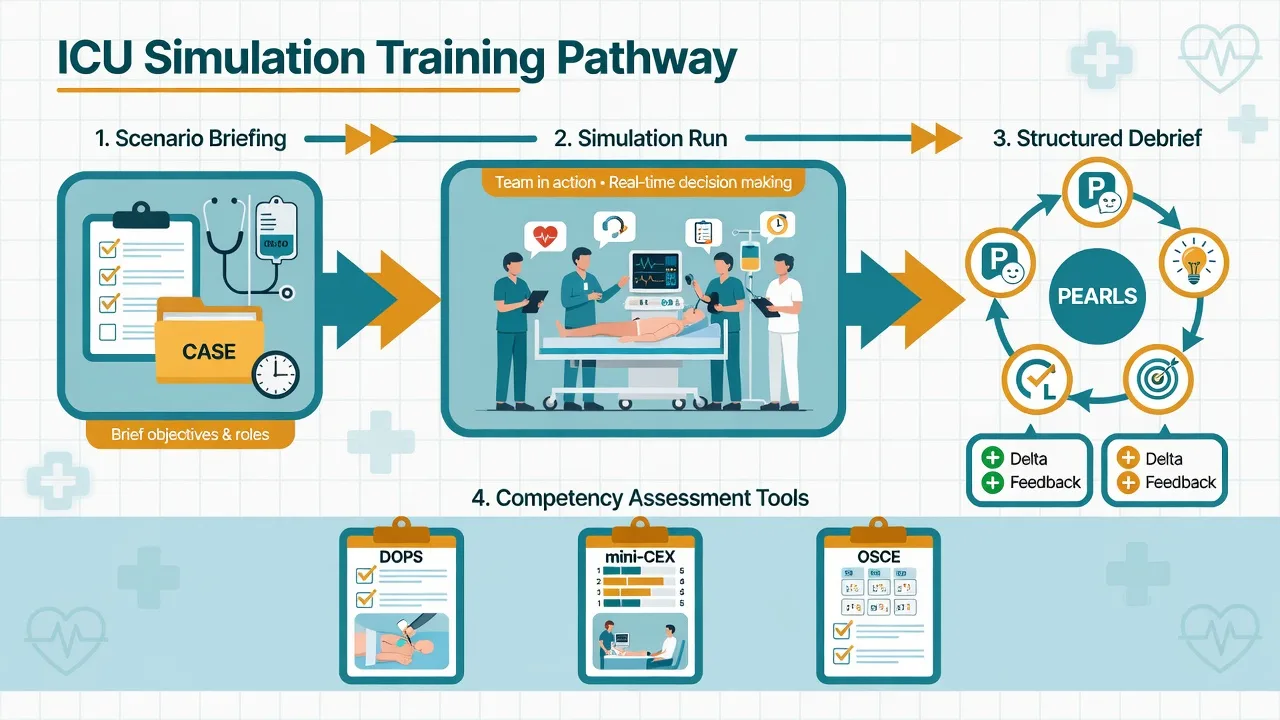
Simulation and structured assessment are separate but complementary uses of the same principles of observation and feedback. Competency assessment asks "is this clinician safe and effective to practise independently at this procedure/skill?" — a high-stakes question that demands objective, structured, validated, and documented evidence rather than a global impression. The modern framework is workplace-based assessment (WBA) — direct observation of real or simulated performance against a defined standard, repeated over time, by trained assessors, with feedback.[13]
DOPS
Direct Observation of Procedural Skills
- A trained assessor directly observes the clinician perform a REAL (or simulated) procedure — central line, intubation, chest tube, paracentesis — and scores against a structured checklist covering consent, asepsis, technical steps, patient communication, post-procedure care, and overall competence.
- Best for: invasive procedures where a single observed encounter meaningfully samples the skill. Provides immediate structured feedback. Widely mandated for procedural sign-off in critical care training.
- Evidence base: part of the UK WBA battery rolled out across specialties; reliability is improved by multiple assessments across multiple assessors and contexts — a single DOPS is a snapshot, not a verdict.
mini-CEX
mini-Clinical Evaluation Exercise
- A 15-20 minute focused observation of a REAL clinical encounter (history, examination, and one clinical decision/plan) with a standardised rating form covering history, examination, communication, clinical judgement, professionalism, and organisation.
- Best for: assessing the core "doctor" skills — clinical reasoning, communication, professionalism — that DOPS (procedures) and OSCE (artificial stations) do not sample well. Repeated across varied encounters to build a portfolio.
- Evidence base: developed and validated by the American Board of Internal Medicine (Norcini). Reliability adequate for feedback and progress decisions when 6-10 encounters across multiple assessors are aggregated; emphasises formative over summative use.
OSCE
Objective Structured Clinical Examination
- A circuit of time-limited stations, each assessing one competency against a structured mark scheme, using standardised patients, manikins, or data-interpretation tasks. Candidates rotate through identical stations so comparison is fair and standardised.
- Best for: high-stakes SUMMATIVE assessment (fellowship exit exams, certification) where fairness, standardisation, and defensibility matter. Samples communication, examination, procedures, resuscitation, and decision-making in one examination.
- Evidence base: the gold-standard format for clinical-skills assessment since the 1970s; Newble and Swanson established its psychometric characteristics (validity high; reliability depends on number of stations and examiner training). Resource-intensive to design and run.
Multi-source feedback (360°)
Team and patient ratings
- Structured ratings collected from a range of colleagues (medical peers, juniors, nurses, allied health) and patients on dimensions hard to observe in a single encounter — teamwork, communication, leadership, professionalism, reliability under pressure.
- Best for: the non-technical and professional domains that DOPS/mini-CEX/OSCE under-sample. Now a mandated component of revalidation and many fellowship programmes.
- Strength and caution: high face validity and uniquely samples the "how do they actually behave day to day" question; but low reliability per item and rater bias require aggregation across many raters and careful framing as developmental, not punitive.
Simulation-based assessment
Mastery checklists, OSCE-style sim
- Structured assessment using a high-stakes simulated scenario (e.g. a deteriorating ventilated patient, a cardiac arrest, an unanticipated difficult airway) scored against a validated checklist and/or global rating scale, sometimes to a pre-set mastery standard.
- Best for: rare, dangerous, or team-based competencies that real practice samples too infrequently to assess — malignant hyperthermia, can’t-intubate-can’t-oxygenate, CRM leadership. Increasingly used for credentialing and high-stakes sign-off.
- Evidence base: strongest when combined with mastery learning (a pass standard set in advance, repeated practice until met) — the simulation-based mastery learning literature shows translational gains to patient outcomes.
Deliberate practice and mastery learning — the engine of expertise
If debriefing is where simulation learning happens, deliberate practice is how expertise is built. Anders Ericsson’s expert-performance framework holds that expertise in complex domains is the product not of raw talent or mere repetition, but of deliberate practice: focused, effortful, repetitive practice of well-defined tasks, with immediate informative feedback, on components where the learner is weak, repeated to a defined standard. Applied to medicine, this means a trainee does not become expert at intubation by intubating 50 patients; they become expert by intubating a task trainer repeatedly with a coach, on a checklist, with feedback, until a mastery standard is met — and only then applying it to patients.[18]
Mastery learning operationalises this in medical education. The recipe: (1) a baseline diagnostic test; (2) clear learning objectives with a defined mastery standard (a minimum checklist score); (3) focused deliberate practice with feedback; (4) formative assessment with re-practice until the standard is met; (5) a final summative check. The key departure from time-based training is that progression is gated on demonstrated competence, not on time served. McGaghie and colleagues have shown, across procedural and team skills, that simulation-based mastery learning produces translational outcomes — gains that transfer from the simulator to the bedside (fewer complications, better patient outcomes, lower costs).[3][4]
Building a deliberate-practice mastery programme — the steps
1. Define the competency and the mastery standard
Write the skill as an observable behaviour with a measurable standard: "the trainee will perform ultrasound-guided internal jugular cannulation with ≥90% on the validated checklist, in <15 minutes, with zero critical errors." The mastery bar is set in advance, not norm-referenced against peers.
2. Baseline (diagnostic) assessment
Assess the trainee’s starting point against the checklist. This is diagnostic — it tells you which components to target — not a pass/fail. A trainee close to mastery needs targeted drilling; a novice needs the full curriculum.
3. Focused deliberate practice with feedback
Drill ONLY the weak components, with immediate coaching against the checklist. Repetition is effortful and feedback is specific ("your needle angle is too steep — flatten by 10 degrees"). Massed practice of one component is more efficient than whole-task repetition.<Cite id="18" />
4. Formative re-assessment and re-practice
Re-test against the mastery standard. If not met, re-practice and re-test. The trainee progresses ONLY when the standard is met — the gate is competence, not time. Most trainees reach mastery in a few focused cycles.
5. Summative mastery check and sign-off
A final assessment to the mastery standard, ideally by an independent assessor, confirms competence and triggers credentialing/sign-off. Document the result in the trainee’s portfolio for defensibility.
6. Maintenance and transfer measurement
Schedule periodic re-assessment (skills decay) and, where possible, measure translational outcomes at the bedside (complication rates, success rates). The mastery-learning literature’s strongest claim is that simulator gains translate to better patient outcomes.<Cite id="3" /><Cite id="4" />
Team training — TeamSTEPPS and beyond
Team training is simulation’s other great contribution: teaching teams, not just individuals, to perform. The premise is that most clinical error is a team-system failure, and that team behaviours (briefing, huddling, closed-loop communication, mutual support, structured handover) are teachable and measurable. The most widely adopted structured team-training system is TeamSTEPPS (Team Strategies and Tools to Enhance Performance and Patient Safety), developed by the US Department of Defense and AHRQ, built on CRM principles and organised around four competencies: Leadership, Communication, Situation Monitoring, and Mutual Support, each with concrete tools.[5][6]
The evidence for team training is now substantial. Salas and colleagues’ meta-analysis showed that team training improves team performance and, importantly, that the effect holds across domains; Hughes and colleagues extended this specifically to healthcare, reporting meaningful improvements in team performance and, where measured, in patient outcomes. Capella and colleagues demonstrated that a team-training programme (including simulation) improved the clinical care of trauma patients — one of the clearest demonstrations that team training changes real clinical outcomes, not just process measures.[5][6][14]
Leadership
Coordinate and direct
- Tools: BRIEF (plan the team, assign roles, share the mental model, state the goal before starting); HUDDLE (a short ad-hoc team sync when the situation changes or a new threat emerges); DEBRIEF (a brief reflective event after the task to improve for next time).
- Failure it fixes: no shared plan, roles unclear, the team reacting rather than anticipating. The leader names roles and states the plan aloud.
Communication
Structured exchange
- Tools: SBAR / ISBAR for escalations and handovers; CALL-OUT (announce critical information to the whole team: "pulsless VT"); CHECK-BACK (closed-loop: read-back and confirm); HANDOFF (I-PASS or SBAR structured handover at transitions).
- Failure it fixes: ambiguous instructions, information not confirmed as received, lost information at handover. Every critical message is closed-loop.
Situation monitoring
Scan and share
- Tools: STEP (Status of patient, Team members, Environment, Progress toward goal) — a structured scan the leader or any team member runs to maintain situational awareness; SHARED MENTAL MODEL — explicitly stating the plan so everyone shares the same picture.
- Failure it fixes: fixation error, lost situational awareness, the team drifting without a shared picture. STEP is the antidote to tunnel vision.
Mutual support
Speak up, back each other up
- Tools: TASK ASSISTANCE (ask for and offer help early — overload is a threat); FEEDBACK (timely, respectful, specific); TWO-CHALLENGE RULE (if a concern is voiced twice and ignored, the challenger is empowered to escalate up the chain); CUS ("I am Concerned, I am Uncomfortable, this is a Safety issue") — a scripted vocabulary for speaking up.
- Failure it fixes: hierarchy silencing the nurse or junior who sees the problem; the team watching a plan fail without intervening. The two-challenge rule and CUS give permission to interrupt.
In-situ simulation for system testing and latent safety threat identification
In-situ simulation — running the scenario in the real clinical environment with the real team and real equipment — is the single most powerful tool for testing the system rather than the individual. Where a simulation centre tests the team, in-situ simulation tests the team PLUS the environment PLUS the equipment PLUS the protocols — and it routinely uncovers failures that no root-cause analysis would have predicted because they have not yet caused harm. These are latent safety threats (LSTs): defects in the system (a missing drug, a trolley stocked wrong, a crash bell that cannot be heard from the back bay, a protocol that breaks down at 03:00) that sit dormant until a real crisis activates them.[16][17]
The evidence that in-situ simulation improves patient outcomes is accumulating. Andreatta and colleagues showed that simulation-based mock codes correlated with improved survival from paediatric cardiopulmonary arrest — a translational outcome. Gray and colleagues used in-situ simulation to reduce time to blood administration in massive transfusion, a directly practice-relevant improvement. The mechanism is system improvement: each LST found and fixed removes a failure mode before a real patient encounters it.[15][17]
Running an in-situ simulation to find latent safety threats
1. Define the threat surface and the scenario
Choose a high-risk, low-frequency event in a real location (massive transfusion in ED, unanticipated difficult airway in ICU, deteriorating post-op patient on the ward, maternal collapse in theatre). Write a scenario that exercises the system, not just the clinician — it should require equipment, drugs, protocols, and a phone escalation to work end-to-end.
2. Brief the unit and protect real care
Notify the unit in advance; schedule around clinical load; designate a "real-patient" cover so a genuine emergency is not missed; mark the simulated patient clearly (a sign, a vest) so no-one treats the manikin as real. Agree the "stop-sim" rule: the simulation stops instantly if a real patient needs the space or staff.<Cite id="17" />
3. Run with the real team, real kit, real protocols
Use the actual on-duty team (including the after-hours shift, which is the highest-risk period). Do NOT pre-stage the trolley or the drug — the point is to discover what is actually there when the crisis hits. Observe where the system fails: the missing drug, the unreachable phone, the protocol step that no-one knows.
4. Debrief for the system, not just the team
Debrief the team performance (CRM) AND run a structured latent-safety-threat harvest: list every equipment, environment, protocol, and communication failure encountered. Categorise by severity and likelihood. The LSTs are the gold — they are the defects that would have harmed a real patient.<Cite id="16" />
5. Feed the LSTs into quality improvement
Each LST becomes a QI action with an owner and a deadline: re-stock the trolley, fix the protocol, move the phone, re-label the bay. Track to closure. Without this loop, in-situ simulation is an educational exercise; with it, it is a safety engineering programme.
6. Re-test after the fixes
Repeat the scenario after the LSTs are addressed to confirm the fixes hold. The cycle — test, find, fix, re-test — is the engine of in-situ simulation as system improvement.<Cite id="17" />
Error identification without blame — the just-culture and systems lens
Simulation and in-situ drills are only useful for safety if the errors they surface are treated as system information rather than individual failings. The just-culture model (Reason’s systems approach) distinguishes human error (an inadvertent slip or lapse — manage by console, console the person, fix the system), at-risk behaviour (a shortcut taken without appreciating the risk — coach), and reckless behaviour (conscious disregard of a substantial risk — sanction). The point is that the great majority of errors in well-meaning clinicians are the first category, and the productive response is to redesign the system (the trolley, the protocol, the labelling, the cognitive aid) so that the next clinician does not make the same error.[9][10]
This is exactly what a blame-free simulation debrief models: the error is the data, the reasoning behind it is the target, and the learning is the redesign of either the individual’s mental model or the system. A debrief that scapegoats a participant destroys psychological safety and ensures the next error is hidden. A debrief that treats the error as a window into both the participant’s frame and the system’s vulnerabilities produces learning and, over time, a safer unit.[9]
Person approach
Name, blame, retrain
- Frames error as a failure of the individual — carelessness, inattention, lack of knowledge. The response is to name, blame, shame, and (at best) retrain the same individual in the same flawed system.
- Failure mode: the next clinician makes the same error because the system defect is unchanged; staff hide errors for fear of punishment; the reporting culture collapses; no systemic learning occurs.
- When it has a place: genuine recklessness or sabotage (rare). For the overwhelming majority of well-intentioned errors it is counter-productive and unsafe.
System approach
Find and fix the conditions
- Frames error as the predictable product of system conditions — workload, fatigue, ambiguous protocols, look-alike packaging, poorly designed equipment, missing cognitive aids. The response is to redesign the system so the error is harder to make.
- Simulation embodies this: the debrief asks "what in the system or the reasoning allowed this?" not "who is at fault?". The fix is a redesign (re-stock the trolley, colour-code the lines, build a checklist), not a punishment.
- Outcome: a reporting culture where staff disclose near-misses, the system learns, and the error rate falls. This is the foundation of just culture and the precondition for in-situ simulation to deliver safety value.
Building a simulation programme — from needs assessment to transfer
A simulation programme that works is designed backwards from a clinical need, not forwards from a piece of equipment. The most common failure mode is buying a manikin and then inventing scenarios for it. The sequence below — adapted from the simulation-education standards — is the design logic that ties simulation to measurable improvement.[1][8]
Designing a simulation session — needs assessment to transfer
1. Needs assessment — what is the clinical problem?
Start with the clinical gap: an audit showing high central-line infection rates, an incident report of a delayed intubation, a new protocol (prone positioning for ARDS) about to roll out, or a rare event (malignant hyperthermia) the team has not practised. The need drives everything downstream; never start with the simulator.
2. Write SMART learning objectives
State, behaviourally and measurably, what the participant will be able to do: "the team will achieve first-pass success at intubation with a structured airway plan, including a named back-up plan, within 4 minutes." Objectives should be few (2-3), specific, and observable.
3. Design the scenario to the objective
Match modality and fidelity to the objective (task trainer for a procedure, high-fidelity or in-situ for a team crisis). Write the scenario with a clear progression, embedded triggers for the learning objectives, and a scripted endpoint. Pre-test the simulator and the environment.
4. Brief and run — establish the contract first
Brief the participants: the basic assumption, the learning objectives, the ground rules (psychological safety, confidentiality), and the scenario context. Then run the scenario, with faculty observing and timing — do NOT coach during the run (it destroys the data).
5. Debrief with a structured model
Debrief with PEARLS, GAS, or Plus-Delta matched to the complexity. This is where learning occurs — budget at least as long for the debrief as for the scenario, and longer for complex team scenarios. The debrief targets the objectives, not a generic list.<Cite id="7" /><Cite id="8" />
6. Assess and feedback
Where the simulation is formative, give structured feedback against the checklist; where summative, score to a defined standard (DOPS, OSCE-style, mastery). Feed the result into the trainee’s portfolio and into the programme’s quality data.
7. Transfer to practice and re-measure
Define and measure the translational outcome: line infection rate, first-pass intubation success, time to antibiotic, mock-code survival. Learning that does not change a measurable clinical outcome is incomplete. The cycle then re-opens at the needs-assessment step.<Cite id="3" /><Cite id="4" />
Landmark trials and guidelines
Issenberg 2005 (BEME, Med Teach) — features of effective medical simulation (PMID 16147767)
McGaghie 2014 (Med Educ) — simulation-based mastery learning, translational outcomes (PMID 24606621)
McGaghie 2011 (Simul Healthc) — evaluating simulation's translational impact (PMID 21705966)
Salas 2008 (Hum Factors) — does team training improve team performance? (PMID 19292013)
Hughes 2016 (J Appl Psychol) — team training in healthcare: a meta-analysis (PMID 27599089)
Gaba 2010 (Br J Anaesth) — CRM and teamwork training in anaesthesia (PMID 20551023)
Eppich & Cheng 2015 (Simul Healthc) — the PEARLS debriefing framework (PMID 25710312)
Fanning & Gaba 2007 (Simul Healthc) — the role of debriefing (PMID 19088616)
Rudolph 2007 (Anesthesiol Clin) — debriefing with good judgment (PMID 17574196)
Rudolph 2006 (Simul Healthc) — there is no such thing as nonjudgmental debriefing (PMID 19088574)
Newble & Swanson 1988 (Med Educ) — psychometrics of the OSCE (PMID 3173161)
Norcini 2003 (Ann Intern Med) — the mini-CEX (PMID 12639081)
Wilkinson 2008 (Med Educ) — workplace-based assessment in the UK (PMID 18338989)
Capella 2010 (J Surg Educ) — team training improves trauma care (PMID 21156305)
Andreatta 2011 (Pediatr Crit Care Med) — mock codes correlate with improved arrest survival (PMID 20581734)
Weinstock 2009 (Pediatr Crit Care Med) — in-situ simulation at the point of care (PMID 19188878)
Gray 2021 (CJEM) — in-situ simulation to speed massive-transfusion blood delivery (PMID 33683613)
Ericsson 2015 (Acad Med) — medical expertise from the expert-performance approach (PMID 26375267)
Hashimoto 2015 (Surg Endosc) — deliberate practice improves surgical performance (PMID 25539697)
Additional clinical pearls
Red flags — when simulation is wasted or harmful
Exam revision summary
Core concepts
Definitions
- Simulation = practice of high-stakes, low-frequency events without patient risk; learning occurs in the DEBRIEF, not the scenario.
- Fidelity = physical (looks real) + conceptual (behaves real) + psychological (engages); match to the objective, do not maximise.
- Deliberate practice = focused, feedback-driven repetition of weak components to a defined standard; NOT mere repetition.
- Mastery learning = progression gated on demonstrated competence (a checklist standard), not on time served.
Modalities
Five types
- High-fidelity manikin — team CRM, full crisis, multidisciplinary in-situ.
- Low-fidelity / task trainer — one discrete procedure to mastery (intubation, central line).
- In-situ — system testing, latent safety threats, real team and environment.
- Screen-based / VR / AR — cognitive, pattern recognition, high-volume independent practice.
- Standardised patients — communication, history, OSCE.
CRM pillars
Non-technical skills
- Leadership (one clear leader at the head, not hands-on); Communication (closed-loop, named, SBAR/ISBAR); Situation awareness (STEP scan, anti-fixation); Resource allocation (people, kit, time); Role clarity (named, non-overlapping); Decision-making (decide, act, re-evaluate); Task management (prioritise and sequence).
- Graded assertiveness: CUS, two-challenge rule.
Debriefing models
When to use which
- Plus-Delta — rapid (5-10 min), post-event, junior learners.
- GAS — Gather/Analyse/Summarise — general-purpose, clear narrative arc.
- PEARLS — Reactions + Description + Analysis/Application, with three moves (self-assessment, facilitated focusing, directive teaching) matched to the gap.
- Underpinned by psychological safety (basic assumption) and advocacy-inquiry.
Assessment tools
WBA battery
- DOPS — procedures (checklist, observed, immediate feedback).
- mini-CEX — real clinical encounter (reasoning, communication, professionalism).
- OSCE — high-stakes summative, standardised stations (Newble/Swanson psychometrics).
- 360° / MSF — teamwork and professionalism, aggregated across raters.
- Simulation-based mastery assessment — rare/dangerous competencies to a pre-set standard.
Evidence
Numbers to quote
- Issenberg BEME: feedback + repetition > fidelity as drivers of learning.
- McGaghie: simulation-based mastery learning → translational outcomes (T1 bedside, T2 patient).
- Salas (cross-domain) + Hughes (healthcare): team training improves team performance with patient-outcome gains.
- Capella: team training improved trauma-patient care.
- Andreatta: mock-code volume correlated with paediatric arrest survival.
- Gray: in-situ simulation cut time-to-blood in massive transfusion.
System lens
Just culture
- Person approach (name/blame/retrain) vs system approach (find/fix conditions) — simulation and in-situ adopt the latter.
- Just culture triage: human error → console + fix system; at-risk → coach; reckless → sanction.
- In-situ LSTs feed a closed QI loop; without it, simulation is theatre.
References
- [1]Issenberg SB, McGaghie WC, Petrusa ER, et al. Features and uses of high-fidelity medical simulations that lead to effective learning: a BEME systematic review. Medical Teacher, 2005.PMID 16147767
- [2]Gaba DM Crisis resource management and teamwork training in anaesthesia. British Journal of Anaesthesia, 2010.PMID 20551023
- [3]McGaghie WC, Issenberg SB, Barsuk JH, Wayne DB A critical review of simulation-based mastery learning with translational outcomes. Medical Education, 2014.PMID 24606621
- [4]McGaghie WC, Draycott TJ, Dunn WF, et al. Evaluating the impact of simulation on translational patient outcomes. Simulation in Healthcare, 2011.PMID 21705966
- [5]Salas E, DiazGranados D, Klein C, et al. Does team training improve team performance? A meta-analysis. Human Factors, 2008.PMID 19292013
- [6]Hughes AM, Gregory ME, Joseph DL, et al. Saving lives: a meta-analysis of team training in healthcare. Journal of Applied Psychology, 2016.PMID 27599089
- [7]Eppich W, Cheng A Promoting Excellence and Reflective Learning in Simulation (PEARLS): development and rationale for a blended approach to health care simulation debriefing. Simulation in Healthcare, 2015.PMID 25710312
- [8]Fanning RM, Gaba DM The role of debriefing in simulation-based learning. Simulation in healthcare : journal of the Society for Simulation in Healthcare, 2007.PMID 19088616
- [9]Rudolph JW, Simon R, Rivard P, et al. Debriefing with good judgment: combining rigorous feedback with genuine inquiry. Anesthesiology Clinics, 2007.PMID 17574196
- [10]Rudolph JW, Simon R, Dufresne RL, et al. There's no such thing as "nonjudgmental" debriefing: a theory and method for debriefing with good judgment. Simulation in healthcare : journal of the Society for Simulation in Healthcare, 2006.PMID 19088574
- [11]Newble DI, Swanson DB Psychometric characteristics of the objective structured clinical examination. Medical Education, 1988.PMID 3173161
- [12]Norcini JJ, Blank LL, Duffy FD, Fortna GS The mini-CEX: a method for assessing clinical skills. Annals of Internal Medicine, 2003.PMID 12639081
- [13]Wilkinson JR, Crossley JG, Wragg A, et al. Implementing workplace-based assessment across the medical specialties in the United Kingdom. Medical Education, 2008.PMID 18338989
- [14]Capella J, Smith S, Philp A, et al. Teamwork training improves the clinical care of trauma patients. Journal of Surgical Education, 2010.PMID 21156305
- [15]Andreatta P, Saxton E, Thompson M, Annich G Simulation-based mock codes significantly correlate with improved pediatric patient outcome. Pediatric Critical Care Medicine, 2011.PMID 20581734
- [16]Weinstock PH, Kappus LJ, Garden A, et al. Simulation at the point of care: reduced-cost, in situ training via a mobile simulator. Pediatric Critical Care Medicine, 2009.PMID 19188878
- [17]Gray A, Chartier LB, Pavenski K, et al. The clock is ticking: using in situ simulation to improve time to blood administration for bleeding trauma patients. CJEM, 2021.PMID 33683613
- [18]Ericsson KA Acquisition and maintenance of medical expertise: a perspective from the expert-performance approach with deliberate practice. Academic medicine : journal of the Association of American Medical Colleges, 2015.PMID 26375267