ICU · Gastroenterology
Hepatorenal syndrome: diagnosis, management, and terlipressin
Also known as Hepatorenal syndrome · HRS · HRS-AKI · Terlipressin HRS · Type 1 HRS · Type 2 HRS
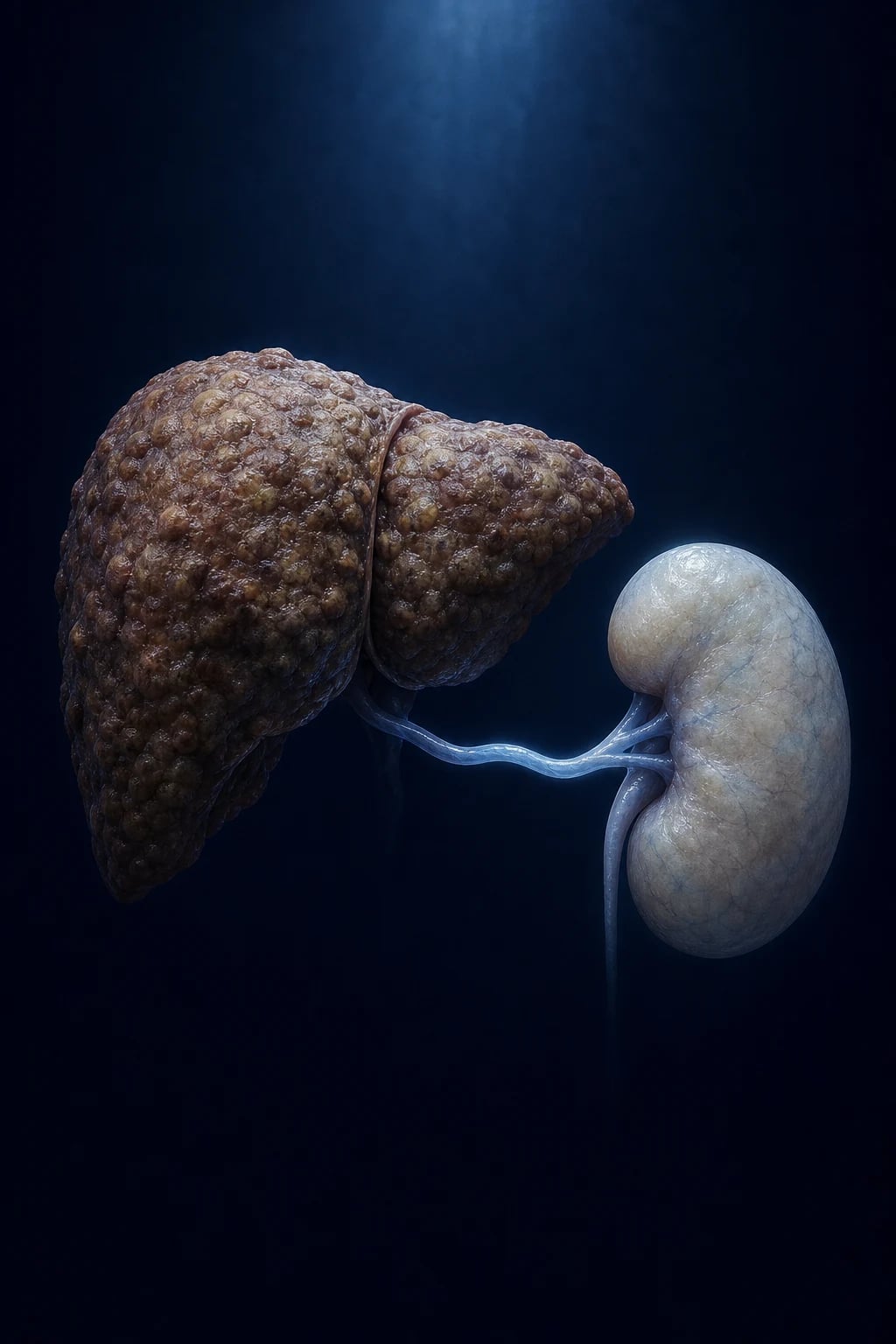
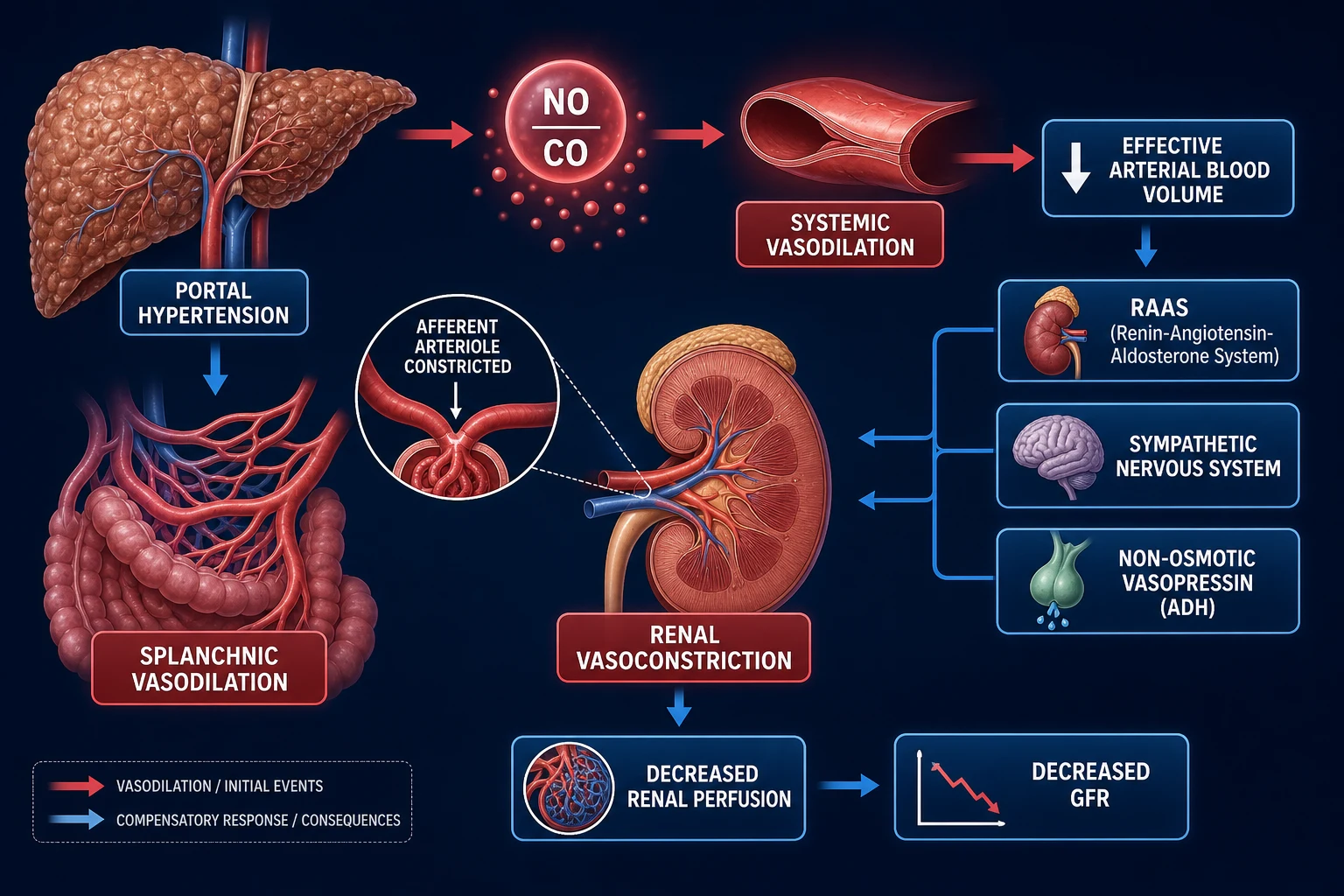
Hepatorenal syndrome (HRS): functional kidney failure in cirrhosis with ascites, WITHOUT intrinsic kidney disease. Mechanism: splanchnic vasodilation (nitric oxide) → reduced effective circulating volume → RAAS/sympathetic activation → intense renal vasoconstriction → AKI. ICA 2015 criteria (now HRS-AKI): cirrhosis + ascites + creatinine 1.5 mg/dL (133 μmol/L) + no response to albumin (1 g/kg × 48h) + no shock + no nephrotoxins + no structural kidney disease (normal urine sediment, proteinuria <500, normal renal US). Type 1 (HRS-AKI): rapid (doubling of creatinine in <2 weeks) — mortality 80% at 2 weeks untreated. Type 2 (HRS-AKD): slower, chronic. Treatment: terlipressin (CONFIRM trial — vasoconstrictor + albumin, first FDA-approved for HRS), albumin (1 g/kg bolus then 20-40 g/day), TIPS (selected), liver transplant (definitive).
On this page & tools
Your progress
Saved locally on this device.
Target exams
Red flags
HRS Type 1 (AKI) vs Type 2 (AKD)
| Feature | Type 1 (HRS-AKI) | Type 2 (HRS-AKD) |
|---|---|---|
| Onset | RAPID (doubling creatinine <2 weeks) | SLOW (weeks-months) |
| Creatinine | >2.5 mg/dL (220 μmol/L) | 1.5-2.5 mg/dL (133-220 μmol/L) |
| Clinical | Acute deterioration, often precipitant | Stable, refractory ascites |
| Mortality (untreated) | 80% at 2 WEEKS | 70% at 6 MONTHS |
| Treatment | Terlipressin + albumin → urgent transplant | TIPS, albumin, transplant (elective) |
| Natural history | Days-weeks (death from multi-organ failure) | Months (death from renal failure/ascites) |
HRS-AKI vs prerenal AKI vs ATN — diagnostic differentiation
| Feature | Prerenal AKI | HRS-AKI | ATN (intrinsic) |
|---|---|---|---|
| Mechanism | True volume depletion | Functional vasomotor (splanchnic vasodilation) | Tubular injury (ischaemic/toxic) |
| Urine Na | <20 mEq/L | <10 mEq/L (very low) | >30 mEq/L |
| FENa | <1% | <1% | >2% |
| Urine sediment | Bland | Bland (no casts) | Muddy-brown granular casts |
| Urine osm | >500 | >500 | Isotonic (~300) |
| Response to albumin | YES (creatinine falls) | NO (the defining test) | NO |
| Renal US | Normal | Normal | Normal (or in chronic CKD) |
| Proteinuria | None | <500 mg/day | Variable |
| Treatment | Volume (saline/albumin) | Terlipressin + albumin | Treat cause, RRT |
| Histology | Normal | NORMAL (functional) | Tubular necrosis |
Terlipressin vs noradrenaline vs octreotide/midodrine — vasoconstrictor comparison
| Feature | Terlipressin | Noradrenaline | Octreotide + Midodrine |
|---|---|---|---|
| Mechanism | V1 vasopressin agonist (splanchnic) | alpha-1 agonist (systemic + splanchnic) | Octreotide = somatostatin analogue; midodrine = alpha-1 agonist |
| FDA-approved for HRS | YES (2022, first agent) | No (off-label) | No (off-label, weak) |
| Route | IV bolus Q4-6h or continuous infusion | Continuous IV infusion (central line) | SC octreotide + PO midodrine |
| Dose | 1-2 mg Q4-6h or 2-12 mg/day infusion | 0.5-3 mg/h titrate to MAP | Octreotide 100-200 mcg SC TDS + midodrine 2.5-7.5 mg PO TDS |
| Efficacy (HRS reversal) | 32-50% (CONFIRM, REVERSE) | 40-50% (non-inferior to terlipressin) | LOWEST — ~15-25% |
| Setting | Ward or ICU; ICU for continuous infusion | ICU only (central line, titration) | Ward (oral/SC), last-resort |
| Main adverse effect | Ischaemia (MI, mesenteric, digital), respiratory failure (fluid overload) | Peripheral/renal ischaemia, arrhythmia | Bradycardia, hypertension, diarrhoea |
| Cost/availability | Expensive; not universally available | Cheap; every ICU | Cheap; widely available |
| Evidence | CONFIRM (n=300), REVERSE (n=178) | Alessandria 2007 pilot (n=22); multiple meta-analyses show non-inferiority | Cavallin 2015 RCT — INFERIOR to terlipressin |
Diagnosis and management of hepatorenal syndrome
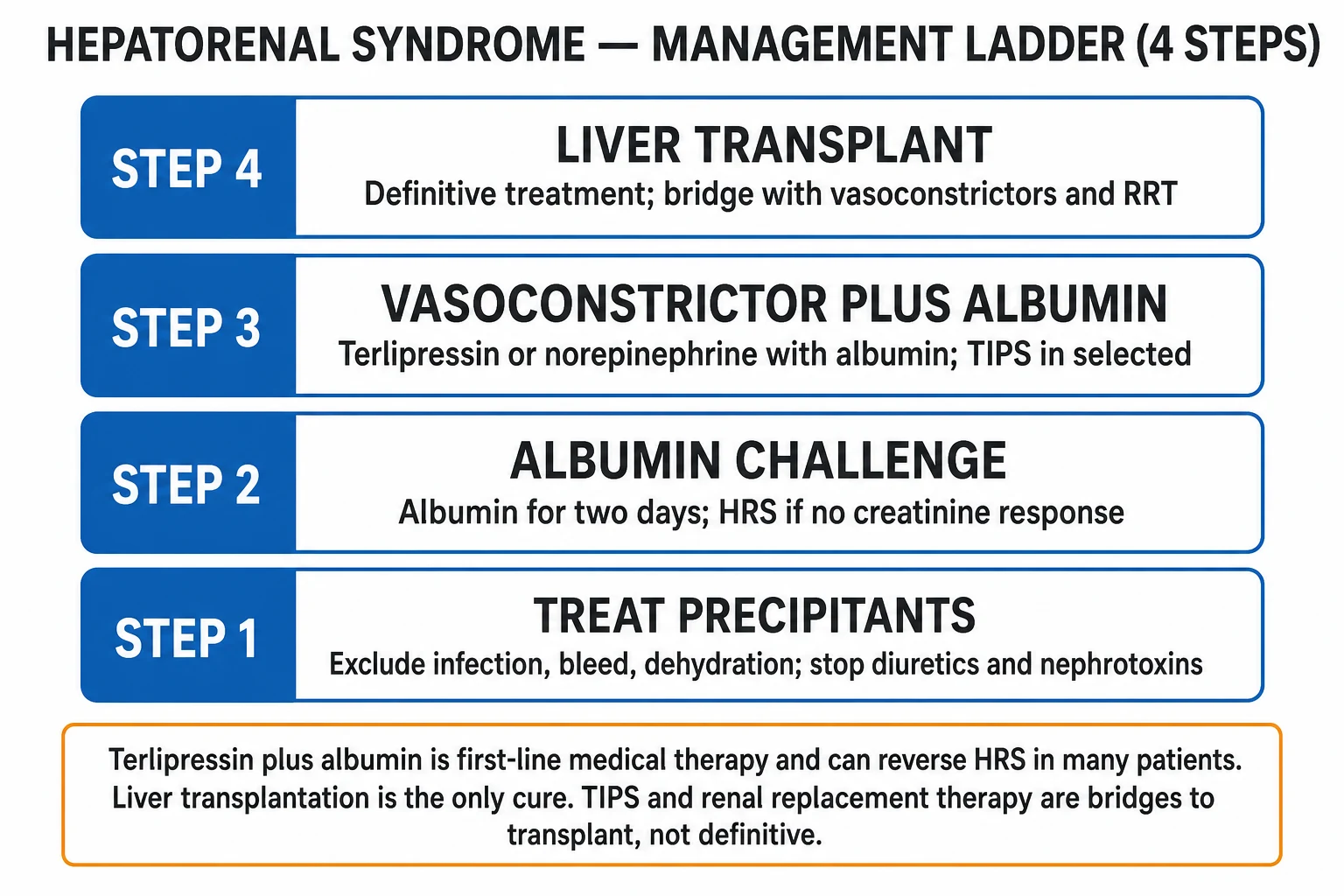
- SUSPECT HRS — cirrhotic patient with ascites develops AKI (creatinine rise ≥26.5 μmol/L in 48h or ≥1.5x baseline). VERY COMMON in decompensated cirrhosis
- EXCLUDE other causes of AKI — (a) Volume depletion (diuretics, diarrhoea, GI bleed) — give ALBUMIN 1 g/kg/day × 2 days. If creatinine improves → prerenal (NOT HRS). (b) ATN (sepsis, hypotension, nephrotoxins) — check urine sediment (granular casts → ATN), urine Na (>30 → ATN), FENa (>2% → ATN). (c) Glomerulonephritis (proteinuria >500, haematuria). (d) Obstruction (renal ultrasound)
- ICA 2015 CRITERIA for HRS-AKI (ALL must be met): (a) Cirrhosis + ascites. (b) Creatinine >1.5 mg/dL (133 μmol/L). (c) NO improvement after albumin (1 g/kg/day × 48h). (d) NO shock. (e) NO nephrotoxic drugs. (f) NO structural kidney disease (normal urine sediment, proteinuria <500, normal renal US)
- TREATMENT — TERLIPRESSIN + ALBUMIN — (a) Terlipressin: 1-2 mg IV every 4-6h (or continuous infusion 2-12 mg/day). CONFIRM trial: 32% HRS reversal vs 17% placebo. FIRST FDA-approved for HRS. (b) Albumin: 20-40 g/day (maintains intravascular volume, improves splanchnic vasoconstriction effect). (c) Duration: until creatinine <1.5 or 14 days max. (d) MONITOR: creatinine, BP, fluid status. (e) CAUTION: ischaemic side effects (MI, mesenteric, digital — 4%), fluid overload
- ALTERNATIVES — (a) Noradrenaline infusion (alternative vasoconstrictor — 0.5-3 mg/h — if terlipressin unavailable). (b) Octreotide + midodrine (LESS effective — only if no terlipressin/noradrenaline). (c) TIPS (transjugular intrahepatic portosystemic shunt — for selected, stable patients). (d) RRT (if refractory — bridge to transplant)
- LIVER TRANSPLANT — definitive — HRS is REVERSIBLE with transplant (kidney function recovers — functional, not structural). PRIORITY: MELD score (HRS raises MELD → higher priority). Post-transplant: renal recovery in 60-80% (may need temporary RRT in 20-30%)
Terlipressin dosing and titration protocol (continuous infusion preferred in ICU)
- BASELINE WORKUP — confirm HRS-AKI (ICA criteria), check ECG (terlipressin can prolong QT), review contraindications (ischaemic heart disease, peripheral vascular disease, uncontrolled arrhythmia — relative cautions, weigh benefit vs risk). Baseline creatinine, electrolytes, FBC, troponin, fluid assessment (POCUS/IVC).
- ALBUMIN FIRST — start albumin 1 g/kg/day (max 100 g/day) × 2 days as diagnostic challenge. If no improvement in creatinine AND criteria met → proceed to terlipressin.
- TERLIPRESSIN INITIATION — TWO regimens: (a) CONTINUOUS INFUSION (ICU preferred): start 2 mg/24h, titrate up by 1-2 mg/day to max 12 mg/day; lower peak-trough fluctuation, fewer ischaemic events. (b) INTERMITTENT BOLUS (ward): 1 mg IV Q4-6h (up to 2 mg Q4h if no response by day 3), max 12 mg/day.
- CONCOMITANT ALBUMIN — day 1: 1 g/kg (max 100 g); from day 2: 20-40 g/day. REDUCE albumin if fluid overload develops (JVP up, pulmonary oedema, weight gain >1 kg/day) — the leading cause of terlipressin-associated respiratory failure.
- DAILY MONITORING — serum creatinine (target: fall towards <1.5 mg/dL), MAP (target ≥65 mmHg, rise often seen as splanchnic vasoconstriction), urine output, fluid balance, daily weight. Check for ischaemic side effects: abdominal pain (mesenteric), chest pain/dyspnoea (MI/pulmonary oedema), cold/dusky fingers or toes (digital ischaemia), confusion.
- TITRATION — if creatinine FALLS ≥25% in 24h → reduce terlipressin by 50% (response). If creatinine RISES or static at day 3 → increase dose to max. If no response by day 7 → consider treatment failure, switch to noradrenaline or move to RRT.
- STOP CRITERIA — (a) SUCCESS: creatinine <1.5 mg/dL (or ↓ ≥50% from baseline) for >24h → taper over 1-2 days. (b) FAILURE: no response after 14 days, or irreversible ischaemia, or need for RRT. (c) RECURRENCE: relapse after stopping (20-50%) → re-treat; if recurrent, consider continuous infusion maintenance.
- WHEN TO STOP AND SWITCH — STOP terlipressin if: ischaemic event (new MI, mesenteric/digital ischaemia), uncontrolled fluid overload/pulmonary oedema despite albumin reduction, or persistent respiratory failure. SWITCH to noradrenaline 0.5-3 mg/h infusion (central line, ICU).
Prevention of HRS — high-risk scenarios
- SBP (spontaneous bacterial peritonitis) — give IV albumin 1.5 g/kg on day 1 and 1 g/kg on day 3 to ALL SBP patients with creatinine >1 mg/dL OR bilirubin >4 mg/dL (Sort 1999, NEJM). REDUCES HRS incidence (10% vs 33%) and 90-day mortality (22% vs 41%).
- LARGE-VOLUME PARACENTESIS (>5 L) — replace with 6-8 g albumin per litre removed to prevent post-paracentesis circulatory dysfunction (PPCD) which can trigger HRS days later.
- AVOID NEPHROTOXINS — no NSAIDs (aspirin, ibuprofen, diclofenac, naproxen, celecoxib — all). Avoid aminoglycosides (gentamicin, tobramycin — high nephrotoxicity in cirrhosis). Use ACE-inhibitors/ARBs and diuretics with caution (reduce or stop if AKI develops). Contrast only if essential.
- TREAT PRECIPITANTS PROMPTLY — early broad-spectrum antibiotics for suspected infection, endoscopic therapy for variceal bleed, corticosteroids for severe alcoholic hepatitis (Maddrey >32 with prednisolone 40 mg/day × 28 days), lactulose/rifaximin for hepatic encephalopathy.
- BETA-BLOCKERS — clinical judgement — non-selective beta-blockers (propranolol, nadolol, carvedilol) reduce portal pressure and variceal bleeding risk, BUT in advanced cirrhosis with refractory ascites or HRS they may reduce cardiac output and worsen renal perfusion. Mandorfer 2014: beta-blocker cessation in refractory ascites improved survival. STOP if SBP <90, MAP <65, or AKI develops.
- LONG-TERM ASCITES CONTROL — sodium restriction (<2 g/day), spironolactone + furosemide (ratio 100:40, titrate slowly), LVP with albumin for refractory ascites, evaluate for TIPS in suitable candidates, refer for liver transplant assessment early.
Exam practice
SAQ — HRS-AKI in decompensated cirrhosis: terlipressin and albumin
15 minutes · 10 marks
A 56-year-old man with alcohol-related cirrhosis (MELD 27) and tense ascites is admitted with a 4-day history of increasing abdominal distension and oliguria. He has grade 2 hepatic encephalopathy but is obeying commands. He has been on spironolactone 400 mg/day and furosemide 80 mg/day. Examination: BP 96/58 (MAP 67), HR 98, JVP not visible, no ankle oedema, asterixis present. Ascitic tap shows 280 neutrophils/mm³ (SBP, culture pending). Laboratory: creatinine 226 µmol/L (baseline 92 four weeks ago), sodium 128 mmol/L, bilirubin 132 µmol/L, INR 2.1, albumin 24 g/L, urine Na <10 mEq/L, FENa 0.4%, bland urine sediment, normal renal ultrasound. He has had no diuretics today and no nephrotoxins. He received albumin 1.5 g/kg on day 1 and 1 g/kg on day 3 of admission for SBP prophylaxis, plus cefotaxime.
SAQ — Differentiating HRS from acute tubular necrosis (ATN) in a cirrhotic patient
15 minutes · 10 marks
A 64-year-old woman with hepatitis C cirrhosis and ascites is referred from the ward with AKI 24 hours after an upper GI bleed (haematemesis, Hb fell from 98 to 62 g/L, transfused 4 units). On examination she is cool peripherally, BP 82/50 (MAP 60), HR 116, lactate 4.2 mmol/L, creatinine 268 µmol/L (baseline 95), urine Na 38 mEq/L, FENa 2.8%, urine shows muddy-brown granular casts, normal renal ultrasound. Variceal band ligation has been performed, terlipressin (for variceal bleed) is running, ceftriaxone given. The hepatology team has asked whether she now has HRS-AKI and whether the vasoconstrictor regimen should be escalated.
Clinical pearls
Red flags
Prognosis
CONFIRM trial (Wong 2021, NEJM) — terlipressin for HRS
RCT: 300 patients with HRS type 1. Terlipressin + albumin vs placebo + albumin.
- Primary outcome (HRS reversal — 2 consecutive creatinine ≤1.5 mg/dL, ≥2h apart, without RRT, ≥10 days):
- Terlipressin: 32% (vs placebo 17%, p=0.006 — SIGNIFICANT)
- Need for RRT at day 90: 28% vs 32% (NS — trend favouring terlipressin)
- Survival at day 90: 51% vs 45% (NS — no survival benefit)
- Respiratory failure: 11% vs 2% (p=0.01 — MORE with terlipressin — from fluid overload/albumin)
- CONCLUSION: Terlipressin improves HRS reversal (32% vs 17%) but does NOT improve survival. Caution: respiratory failure (fluid overload). First FDA-approved HRS therapy. [1]
UNTREATED HRS type 1: median survival ~2 weeks (80% mortality at 2 weeks). WITH terlipressin: may reverse HRS (32%) — buys time for transplant. WITH liver transplant: renal recovery 60-80% (HRS is reversible — functional kidney failure). Simultaneous liver-kidney transplant: if HRS prolonged (>12 weeks RRT — kidney may not recover).
REVERSE trial (Boyer 2016, Gastroenterology) — terlipressin for HRS-1
RCT: 178 patients with HRS type 1. Terlipressin + albumin vs placebo + albumin. Terlipressin 1 mg IV Q6h (titrated to 2 mg Q6h from day 4 if no response), albumin 25 g/day.
- Primary outcome (HRS reversal — 2 consecutive creatinine ≤1.5 mg/dL ≥2h apart):
- Terlipressin: 19% (vs placebo 13%, p=NS — NOT significant in ITT analysis)
- Per-protocol/verified HRS-1 subset: 23% vs 13% (p<0.05)
- RRT need: 28% vs 32% (NS)
- Survival at day 90: 51% vs 47% (NS)
- CONCLUSION: REVERSE was NEUTRAL in the primary analysis — underpowered and confounded by inclusion of non-HRS AKI (~30% misclassified). Pooled with CONFIRM, it supports terlipressin efficacy in confirmed HRS-1. Established the importance of STRICT diagnostic criteria (albumin challenge mandatory) before enrolment.[4]
Cavallin 2015 (Hepatology) — terlipressin vs octreotide/midodrine for HRS
RCT: 78 patients with HRS (type 1 and 2). Terlipressin + albumin vs octreotide + midodrine + albumin.
- Terlipressin: 1-2 mg IV Q12h; octreotide: 100-200 mcg SC TDS; midodrine: 2.5-7.5 mg PO TDS; all + albumin 20-40 g/day.
- Primary outcome (sustained HRS reversal — creatinine <1.5 mg/dL without RRT):
- Terlipressin: 50% (vs octreotide/midodrine 14%, p=0.009 — SIGNIFICANT)
- Recurrence: 25% vs 67% (terlipressin lower)
- Survival: NS between groups
- CONCLUSION: Terlipressin is SUPERIOR to the octreotide + midodrine combination. Octreotide + midodrine is a last-resort regimen ONLY when vasoconstrictor alternatives are unavailable. This trial solidified terlipressin (and noradrenaline) as the preferred agents.[8]
Sort 1999 (NEJM) — albumin in SBP prevents HRS
RCT: 126 patients with cirrhosis and SBP. IV albumin + antibiotics vs antibiotics alone. Albumin 1.5 g/kg day 1 + 1 g/kg day 3 in patients at risk (creatinine >1 mg/dL or bilirubin >4 mg/dL).
- Primary outcomes:
- HRS incidence: 10% (albumin) vs 33% (controls, p=0.007)
- 3-month mortality: 22% vs 41% (p=0.03)
- Renal impairment: 13% vs 38% (p=0.002)
- CONCLUSION: IV albumin in high-risk SBP HALVES HRS incidence and improves survival. This is the foundational evidence for the universal recommendation of albumin in SBP with renal/bilirubin criteria — a landmark in hepatology and a cornerstone of HRS PREVENTION.[7]
Alessandria 2007 (J Hepatol) — noradrenaline vs terlipressin
RCT: 22 patients with HRS-1/2. Noradrenaline infusion vs terlipressin bolus + albumin.
- Noradrenaline: 0.1-0.7 mg/h titrated to MAP; terlipressin: 1-2 mg Q12h.
- Primary outcome (HRS reversal):
- Noradrenaline: 83% (vs terlipressin 43%, p=0.05)
- Recurrence: similar
- Adverse events: fewer serious ischaemic events with noradrenaline
- CONCLUSION: PILOT study (small, unblinded) — noradrenaline appeared NON-INFERIOR (and in this small sample, possibly superior) to terlipressin, with fewer ischaemic events. Subsequent meta-analyses (Ghosh 2013, Jiang 2023, n>500) confirm non-inferiority. PRACTICE: noradrenaline is a legitimate ICU first-line alternative — cheaper, more available, smoother titration, requires central line.[9]
Wong 2020 (NDT) — AKI stage reduction predicts survival in HRS-1
Pooled analysis of CONFIRM + REVERSE (n=466). Tested whether REDUCTION in AKI stage (per KDIGO) predicts survival.
- Primary finding: For every AKI stage reduction, mortality fell ~30% (HR 0.70, p<0.01).
- HRS reversal (creatinine <1.5): 90-day survival 70% (reversal) vs 38% (no reversal, p<0.001).
- CONCLUSION: HRS reversal IS a meaningful surrogate for survival — the lack of statistically significant survival benefit in CONFIRM alone was a power issue, not a lack of biological benefit. REINFORCES the goal of treatment: achieve HRS reversal (terlipressin + albumin, escalate to max dose, switch to noradrenaline if failing).[10]
Exam pitfalls
- Trap: 'HRS kidney is structurally damaged' → FALSE. The kidney is HISTOLOGICALLY NORMAL in HRS. It is a FUNCTIONAL/vasomotor syndrome — proof: HRS kidney transplanted into a healthy recipient functions normally; HRS resolves with liver transplant.
- Trap: 'Diuretics must be stopped before HRS diagnosis' → OLD criteria. The ADQI-iICA 2024 consensus ALLOWS HRS diagnosis while on diuretics if all other criteria are met.
- Trap: 'FENa <1% rules out ATN' → FALSE. FENa is unreliable in cirrhosis (diuretics, low sodium intake, low GFR). Urinary NGAL and the response to terlipressin are better discriminators.
- Trap: 'HRS and ATN are mutually exclusive' → FALSE. In ACLF, sepsis, and ICU patients, MIXED HRS + ATN is common — treat both (terlipressin + albumin AND treat the precipitating cause).
- Trap: 'Terlipressin improves survival in HRS' → NUANCED. CONFIRM did NOT show a statistically significant 90-day survival benefit, BUT pooled data (Wong 2020) show reversal reduces mortality ~30% per stage. The trial endpoint (reversal) IS clinically meaningful.
- Trap: 'Albumin challenge for HRS = 1.5 g/kg' → FALSE. The HRS DIAGNOSTIC albumin challenge is 1 g/kg/day (max 100 g) × 2 days. The SBP PROPHYLAXIS albumin regimen is 1.5 g/kg day 1 + 1 g/kg day 3 — DIFFERENT doses for DIFFERENT purposes.
- Trap: 'Type 2 HRS = stable, treat as outpatient' → PARTLY TRUE. Type 2 (now HRS-AKD) is slower, BUT mortality at 6 months is still ~70% untreated — refer for transplant early; TIPS may help selected patients.
- Trap: 'TIPS is contraindicated in HRS because of encephalopathy' → OVERSIMPLIFIED. TIPS is CONTRAINDICATED in severe encephalopathy (and MELD >18, severe cardiopulmonary disease), but it is a valid option in selected HRS-AKD patients with refractory ascites.
- Trap: 'HRS recurs after transplant so transplant doesn't help' → FALSE. HRS resolves in 60-80% after liver transplant (functional kidney failure recovers). Recurrence after terlipressin is common (20-50%) — that's why transplant (not just terlipressin) is the definitive cure. [1]
References
- [1]Angeli P, Garcia-Tsao G, Nadim MK, et al. News in pathophysiology, definition and classification of hepatorenal syndrome: A step beyond the International Club of Ascites (ICA) consensus document J Hepatol, 2019.PMID 31302175
- [2]Wong F, Pappas SC, Curry MP, et al. Terlipressin plus Albumin for the Treatment of Type 1 Hepatorenal Syndrome N Engl J Med, 2021.PMID 33657294
- [3]Nadim MK, Kellum JA, Forni L, et al. Acute kidney injury in patients with cirrhosis: Acute Disease Quality Initiative (ADQI) and International Club of Ascites (ICA) joint multidisciplinary consensus meeting J Hepatol, 2024.PMID 38527522
- [4]Boyer TD, Sanyal AJ, Wong F, et al. Terlipressin Plus Albumin Is More Effective Than Albumin Alone in Improving Renal Function in Patients With Cirrhosis and Hepatorenal Syndrome Type 1 Gastroenterology, 2016.PMID 26896734
- [5]Biggins SW, Angeli P, Garcia-Tsao G, et al. Diagnosis, Evaluation, and Management of Ascites, Spontaneous Bacterial Peritonitis and Hepatorenal Syndrome: 2021 Practice Guidance by the American Association for the Study of Liver Diseases Hepatology, 2021.PMID 33942342
- [6]Bucsics T, Schwabl P, Mandorfer M, et al. The trigger matters - outcome of hepatorenal syndrome vs. specifically triggered acute kidney injury in cirrhotic patients with ascites Liver Int, 2016.PMID 27169985
- [7]Sort P, Navasa M, Arroyo V, et al. Effect of intravenous albumin on renal impairment and mortality in patients with cirrhosis and spontaneous bacterial peritonitis N Engl J Med, 1999.PMID 10432325
- [8]Cavallin M, Kamath PS, Merli M, et al. Terlipressin plus albumin versus midodrine and octreotide plus albumin in the treatment of hepatorenal syndrome: A randomized trial Hepatology, 2015.PMID 25644760
- [9]Alessandria C, Ottobrelli A, Debernardi-Venon W, et al. Noradrenalin vs terlipressin in patients with hepatorenal syndrome: a prospective, randomized, unblinded, pilot study J Hepatol, 2007.PMID 17560680
- [10]Wong F, Boyer TD, Sanyal AJ, et al. Reduction in acute kidney injury stage predicts survival in patients with type-1 hepatorenal syndrome Nephrol Dial Transplant, 2020.PMID 30887050
- [11]Salerno F, Navickis RJ, Wilkes MM. Albumin treatment regimen for type 1 hepatorenal syndrome: a dose-response meta-analysis BMC Gastroenterol, 2015.PMID 26606982