ICU · Gastroenterology
Acute pancreatitis: Revised Atlanta Classification and severity scoring
Also known as Pancreatitis severity · Revised Atlanta Classification · Ranson criteria · APACHE II pancreatitis · BISAP score · Severe acute pancreatitis
Acute pancreatitis severity classification (Revised Atlanta 2012): MILD (no organ failure, no complications — 80%), MODERATE (transient organ failure <48h, local complications — 15%), SEVERE (persistent organ failure 48h — 5%, mortality 30%). Severity scores: APACHE II (best overall — ≥8 suggests severe), Ranson (at admission + 48h), BISAP (5 simple criteria), Glasgow (Imrie). Complications: pancreatic necrosis (sterile vs infected), peripancreatic fluid collections, pseudocyst, walled-off necrosis. Management: aggressive IV fluids (Ringer's lactate — 250-500 mL/h), early enteral nutrition, analgesia, ERCP if gallstone obstruction, antibiotics ONLY if infected necrosis.
On this page & tools
Your progress
Saved locally on this device.
2 MCQs with explanations
Target exams
Red flags
Severity scoring systems
| Score | When | Criteria | Advantage |
|---|---|---|---|
| APACHE II | Admission + daily | General ICU severity (12 variables) | BEST overall predictor, continuous |
| Ranson | Admission + 48h | 11 criteria (5 admission + 6 at 48h) | Classic, well-studied, but SLOW (need 48h) |
| BISAP | Admission | 5 simple criteria | Rapid, simple, validated |
| Glasgow (Imrie) | Admission + 48h | 8 criteria | Alternative to Ranson |
| Revised Atlanta | 48h | Organ failure persistence | DEFINITIVE classification (clinical) |
Management of severe acute pancreatitis in ICU
- Diagnose — 2 of 3: (a) characteristic epigastric pain (radiating to back). (b) Lipase/amylase >3x ULN. (c) Characteristic imaging (CT/MRI)
- Classify severity — APACHE II at admission (≥8 suggests severe). Monitor for organ failure (MAP, creatinine, PaO2/FiO2, GCS, platelets)
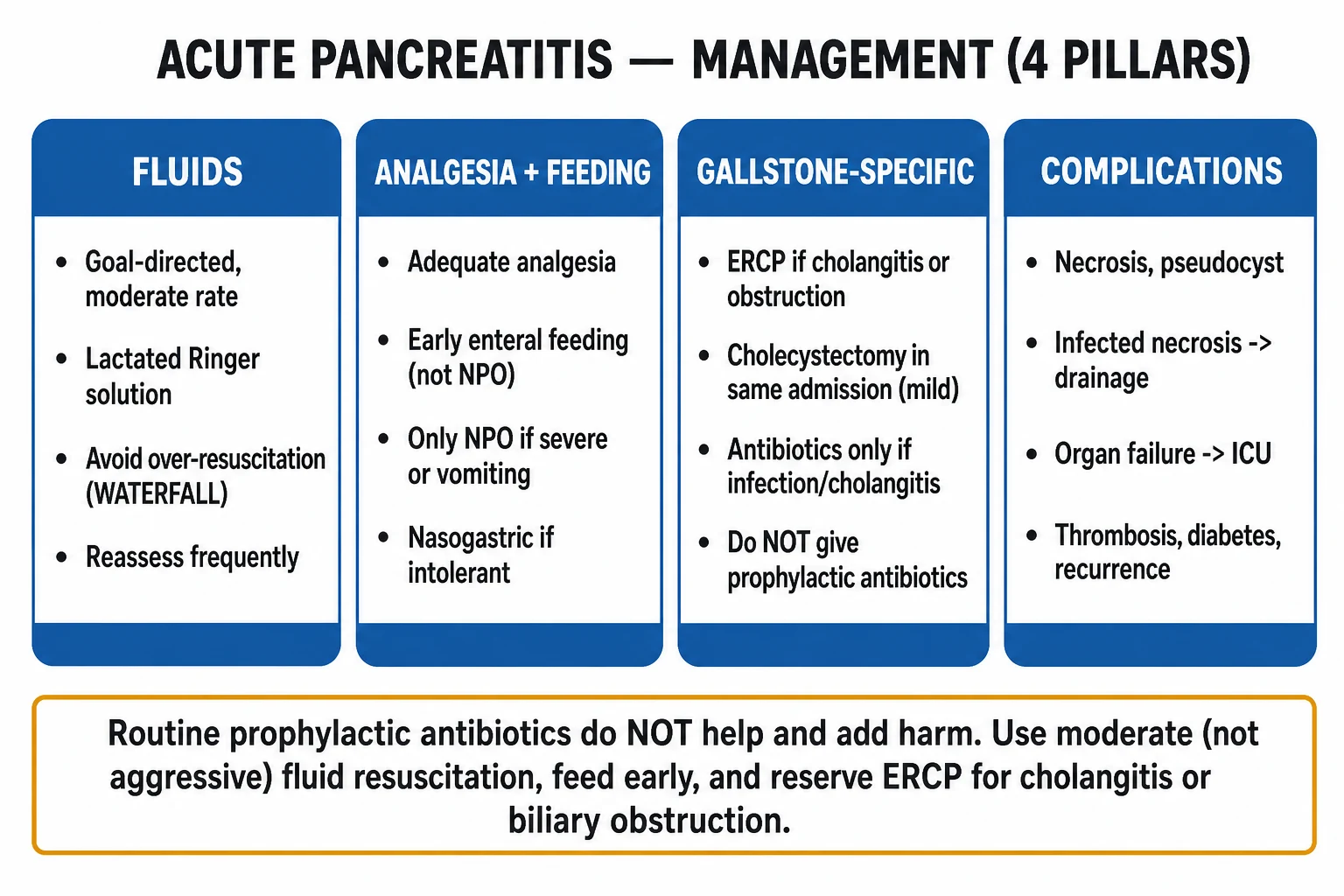
- Aggressive fluid resuscitation — Ringer's lactate 250-500 mL/h for first 12-24h (goal: BUN decreasing, MAP ≥65, urine >0.5 mL/kg/h). WATERFALL trial: aggressive vs moderately aggressive — both similar outcomes; avoid OVER-resuscitation
- Analgesia — IV opioids (fentanyl, morphine). PCA often needed. Avoid NSAIDs (renal risk)
- Nutrition — EARLY ENTERAL (within 24-48h). Nasogastric or nasojejunal (no difference). TPN only if enteral fails. Early feeding reduces infection, complications
- ERCP — within 24h if: gallstone pancreatitis + cholangitis OR gallstone + persistent biliary obstruction. NOT for gallstone pancreatitis without obstruction
- Antibiotics — NOT prophylactic (no benefit, increases fungal/resistant infections). ONLY if: infected necrosis (confirmed by FNA or clinically suspected), cholangitis, concurrent infection
- Monitor for complications — CT (if severe, at 5-7 days for necrosis assessment). Infected necrosis → step-up approach (percutaneous/endoscopic drain → minimally invasive necrosectomy)
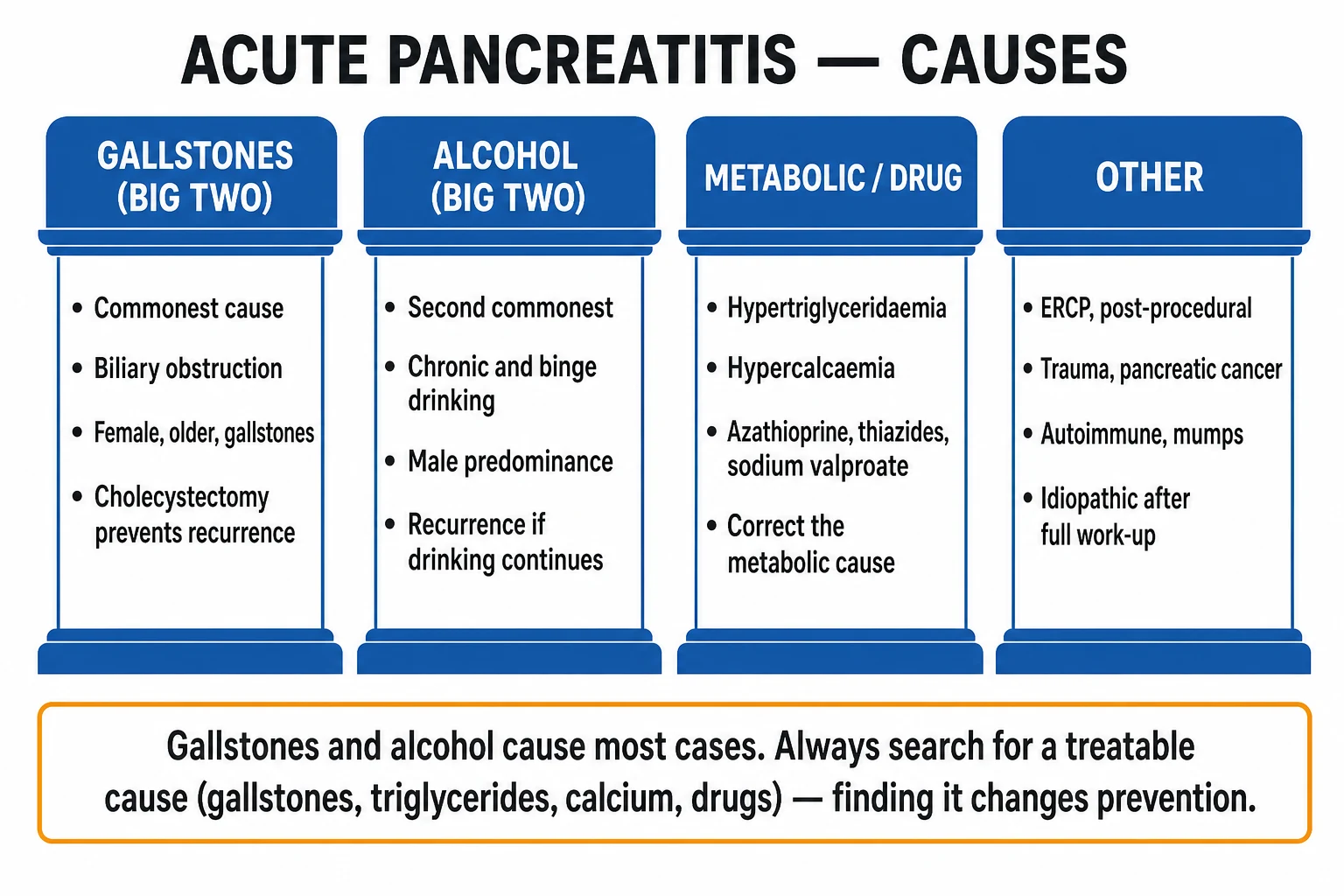
- Address cause — gallstones (cholecystectomy before discharge), alcohol (counselling), triglycerides (plasmapheresis if >1000), ERCP for microlithiasis
Clinical pearls
Red flags
Prognosis
PANTER trial (van Santvoort 2010, NEJM) — step-up vs open necrosectomy
RCT: 88 patients with infected necrotising pancreatitis. Step-up (percutaneous/endoscopic drainage first → minimally invasive necrosectomy if needed) vs primary open necrosectomy.
- Primary outcome (major complication or death): step-up 35% vs open 69% (p=0.003) — step-up BETTER
- Death: step-up 19% vs open 16% (not significant)
- New-onset diabetes: step-up 16% vs open 38% (p=0.02)
- Incisional hernia: step-up 7% vs open 25% (p=0.03)
- CONCLUSION: Step-up approach SUPERIOR to primary open necrosectomy. Now standard of care for infected necrosis. [1]
WATERFALL trial (de Madaria 2022): aggressive (20 mL/kg bolus + 3 mL/kg/h) vs moderately aggressive (1.5 mL/kg/h) fluid resuscitation. Similar outcomes, but aggressive had MORE fluid overload. Avoid over-resuscitation. Overall mortality: mild <1%, moderate 3-5%, severe 30%.
APACHE II in acute pancreatitis
[1] [1]Ranson criteria (11 criteria — admission + 48h)
[1]Ranson criteria — admission (5) and 48h (6)
| Timing | Criterion | Threshold (alcoholic) | Threshold (gallstone — modified) |
|---|---|---|---|
| Admission | Age | >55 years | >70 years |
| Admission | WBC | >16 ×10⁹/L | >18 ×10⁹/L |
| Admission | Glucose | >11 mmol/L | >11 mmol/L |
| Admission | AST | >250 IU/L | >250 IU/L |
| Admission | LDH | >350 IU/L | >400 IU/L |
| 48h | Haematocrit fall | >10% | >10% |
| 48h | Calcium | <2.0 mmol/L | <2.0 mmol/L |
| 48h | PaO2 | <8.0 kPa (60 mmHg) | — |
| 48h | Base deficit | >4 mEq/L | — |
| 48h | Fluid sequestration | >6 L | >4 L |
| 48h | BUN rise | >1.8 mmol/L | >0.7 mmol/L |
BISAP score (Bedside Index of Severity in Acute Pancreatitis)
[1]BISAP — 5 criteria with thresholds
| Letter | Criterion | Threshold |
|---|---|---|
| B | BUN | >25 mg/dL (8.9 mmol/L) — note: some versions use >35 mg/dL (12.5 mmol/L) |
| I | Impaired mental status | GCS <15 |
| S | SIRS | ≥2 of: T <36 or >38°C, HR >90, RR >20 or PaCO2 <32, WCC >12 or <4 or >10% bands |
| A | Age | >60 years |
| P | Pleural effusion | On chest X-ray or CT |
Glasgow (Imrie) criteria
[1]Glasgow-Imrie — 8 criteria
| Criterion | Threshold (severe if present) |
|---|---|
| Age | >55 years |
| WBC | >15 ×10⁹/L |
| Glucose | >10 mmol/L (no diabetes) |
| Urea | >16 mmol/L (after fluids) |
| PaO2 | <8.0 kPa (60 mmHg) |
| Calcium | <2.0 mmol/L |
| Albumin | <32 g/L |
| LDH | >600 IU/L (or AST >200 IU/L) |
CT Severity Index (Balthazar — 0–10)
[1]Balthazar grade (inflammation) — 0 to 4 points
| Grade | CT finding | Points |
|---|---|---|
| A | Normal pancreas | 0 |
| B | Pancreatic enlargement (focal or diffuse) | 1 |
| C | Intrinsic pancreatic abnormalities with peripancreatic inflammatory changes | 2 |
| D | Single, ill-defined peripancreatic fluid collection | 3 |
| E | Two or more poorly defined collections and/or gas in or adjacent to pancreas | 4 |
Necrosis component — 0 to 6 points
| Necrosis (%) | Points |
|---|---|
| None | 0 |
| <30% | 2 |
| 30–50% | 4 |
| >50% | 6 |
Revised Atlanta Classification (2012) — definitive severity
Revised Atlanta — three severity tiers
| Tier | Definition | Incidence | Mortality |
|---|---|---|---|
| MILD | No organ failure, no local or systemic complications | ~80% | <1% |
| MODERATELY SEVERE | Transient organ failure (<48h) AND/OR local complications (necrosis, fluid collections, pseudocyst, walled-off necrosis) OR exacerbation of comorbidity | ~15% | 3–5% |
| SEVERE | Persistent organ failure (>48h) — single or multiple. Respiratory (PaO2/FiO2 ≤300), cardiovascular (SBP <90 after fluids), renal (Cr >170 µmol/L) | ~5% | ~30% |
Determining organ failure — Marshall score thresholds (≥2 = failure)
| System | Parameter | Score 0 | Score 1 | Score 2 (failure) | Score 3 | Score 4 |
|---|---|---|---|---|---|---|
| Respiratory | PaO2/FiO2 (mmHg) | >400 | 301–400 | 201–300 (≤300) | 101–200 | ≤101 |
| Renal | Creatinine (µmol/L) | ≤134 | 134–169 | 171–239 | 240–311 | ≥312 |
| Cardiovascular | SBP (mmHg, with vasopressors) | ≥90 | <90, fluid-responsive | <90, not fluid-responsive | <90, pH<7.3 | <90, pH<7.2 |
| Neurological | GCS | 15 | 13–14 | 10–12 | 7–9 | ≤6 |
| Haematological | Platelets (×10⁹/L) | >120 | 81–120 | 51–80 | 21–50 | ≤20 |
How to assign Revised Atlanta severity at the bedside
- At admission (0h): Document baseline organ function (MAP, creatinine, PaO2/FiO2, GCS, platelets). Calculate Marshall score.
- Through first 48h: Serially reassess. If any system reaches Marshall ≥2 then resolves within 48h → transient organ failure (MODERATE if no other severe features).
- At 48–72h: Definitive severity assignment. Persistent Marshall ≥2 in any system >48h = SEVERE.
- Local complications: CT at 5–7 days if clinical concern. Necrosis, peripancreatic collections, pseudocyst, walled-off necrosis each downgrade management even without organ failure.
- Exacerbation of pre-existing comorbidity (COPD, CHF, cirrhosis) without new organ failure = MODERATE severity.
HAPS — Harmless Acute Pancreatitis Score (rule-out)
[1]HAPS — 3 criteria (1 point each)
| Criterion | Positive if |
|---|---|
| Peritonism / rebound tenderness on abdominal examination | Present |
| Haematocrit | Male >43%, Female >39% (haemoconcentration → third-space loss) |
| Creatinine | >170 µmol/L (2.0 mg/dL) |
Comparison of severity scoring systems — strengths, weaknesses, when to use
Pancreatitis scoring systems — head-to-head comparison
| Score | Variables | Time to score | Threshold (severe) | Strengths | Weaknesses | Best use |
|---|---|---|---|---|---|---|
| APACHE II | 12 physiological + age + chronic health | Admission (24h); daily | ≥8 | Best early predictor; continuous; validated across diagnoses; reassessable | Not pancreatitis-specific; needs ABG + full labs; complex | ICU admission decision; daily reassessment; trial stratification |
| Ranson | 5 admission + 6 at 48h (11 total) | 48h | ≥3 | Classic; well-studied; widely cited | SLOW (48h); alcoholic-pancreatitis derived; no longer recommended as sole tool | Historical/trial definitions; examination |
| BISAP | 5 (BUN, GCS, SIRS, age, pleural effusion) | 24h | ≥3 | Rapid; simple; few inputs; validated; ED-friendly | Slightly less discrimination than APACHE II; binary only | ED triage; resource-limited settings; first 24h risk stratification |
| Glasgow-Imrie | 8 criteria | 48h | ≥3 | UK-standard; uses PaO2; includes albumin | SLOW (48h); like Ranson, delays triage | UK/FFICM practice; 48h reassessment |
| CTSI (Balthazar) | Inflammation grade + necrosis % | Day 5–7 (CT) | ≥7 | Anatomical detail; quantifies necrosis; predicts local complications | Requires contrast CT; needs delayed imaging; no early role | Necrosis assessment; planning drainage; outcome at day 5–7 |
| Modified CTSI (Mortele) | Simplified necrosis + extrapancreatic | Day 5–7 | ≥6 | Better correlation with organ failure than original; simpler | Same CT limitations as CTSI | Modern alternative to original CTSI |
| Revised Atlanta (2012) | Organ failure persistence + local/systemic complications + comorbidity | 72h | Persistent OF >48h | DEFINITIVE clinical severity; standardised; trial endpoint | Needs serial Marshall/SOFA; severity only final at 72h | Definitive severity classification; clinical trials; ICU care intensity |
| HAPS | 3 (peritonism, Hct, creatinine) | Admission | ≥1 (admit) | Very simple; high NPV; rule-out | Low sensitivity; outpatient use only in selected patients | ED rule-out of severe course; triage |
| Marshall / SOFA | Organ-system scores (5 systems) | Daily | Any ≥2 | Captures dynamic organ failure; central to Revised Atlanta | General ICU scores, not pancreatitis-specific | Quantifying organ failure within Revised Atlanta |
When to use each score — a practical guide
| Clinical question | Best score(s) |
|---|---|
| Should this patient go to ICU at admission? | APACHE II ≥8, or BISAP ≥3, or any organ failure |
| Can this patient be safely discharged from ED? | HAPS = 0 + clinical wellbeing + reliable follow-up |
| What is the early (24h) severity? | APACHE II or BISAP |
| What is the 48h severity? | Ranson or Glasgow-Imrie |
| How much necrosis is there? | CTSI / Modified CTSI (CT at day 5–7) |
| What is the definitive severity for trial/reporting? | Revised Atlanta Classification (determined at 72h) |
| How do I quantify organ failure over time? | Marshall score (preferred in Revised Atlanta) or SOFA |
Clinical pearls (additional high-yield points)
Red flags (additional)
Prognosis and outcome data by score
Outcome prediction by scoring system — summary of key data
Mortality stratified by APACHE II (general ICU / pancreatitis cohorts):
- APACHE II 0–9: mortality ~5–10%
- APACHE II 10–19: mortality ~20–30%
- APACHE II ≥20: mortality >50% [1]
Mortality stratified by BISAP (Wu 2008, n=18 000+):
- BISAP 0: 0.2%; 1: 0.6%; 2: 1.8%; 3: 5.3%; 4: 12.7%; 5: 18–22%. [1]
Mortality stratified by Ranson:
- 0–2: ~1%; 3–4: ~15%; 5–6: ~40%; ≥7: ~100%. [1]
Mortality stratified by CTSI:
- 0–3: 3%; 4–6: 6%; 7–10: 17%. [1]
Mortality stratified by Revised Atlanta:
- Mild: <1%; Moderate: 3–5%; Severe: ~30%. [1]
Bottom line: APACHE II, BISAP, and Revised Atlanta are the three scores with the strongest current evidence base. Ranson, Glasgow, and CTSI remain useful for specific contexts (history, UK practice, anatomical necrosis assessment respectively).
Key evidence underpinning pancreatitis severity scoring
- Lankisch PG et al. (2009, HAPS derivation) — Germvast dataset: 3-criterion HAPS identified ~40% of admissions as low-risk; NPV ~98% for severe pancreatitis and ~97% for necrosis. Population: ~270 patients, German cohort.
- Wu BU et al. (2008, BISAP derivation) — Nationwide Inpatient Sample (~18 000 admissions). BISAP 5 criteria; AUROC 0.82 for mortality, comparable to APACHE II.
- Banks PA et al. (2013, Gut) — Revised Atlanta Classification. International consensus; severity anchored to organ failure persistence (Marshall score) and local/systemic complications.
- Balthazar EJ et al. (1990, Radiology) — original CTSI. Combined inflammation grade (A–E) and necrosis %; validated against morbidity and mortality.
- Mortele KJ et al. (2004, Radiology) — Modified CTSI. Simplified necrosis scoring + extrapancreatic complications; superior correlation with organ failure.
- Knaus WA et al. (1985, Crit Care Med) — APACHE II original. 12 physiological variables + age + chronic health; widely adopted for ICU severity including pancreatitis.
- Ranson JH et al. (1974, Surg Gynecol Obstet) — original 11 criteria. Alcoholic pancreatitis derivation; modified by McMahon/McKay for gallstone pancreatitis.
- Blamey SL et al. (1984, Scand J Gastroenterol) — Imrie/Glasgow 8-factor criteria. UK-developed alternative to Ranson; uses PaO2 and albumin.
- de Madaria E et al. (2022, Gastroenterology) — WATERFALL trial. Aggressive vs moderately aggressive fluid resuscitation; similar outcomes but more fluid overload with aggressive.
- van Santvoort HC et al. (2010, NEJM) — PANTER trial. Step-up approach vs primary open necrosectomy; step-up superior.
Scoring limitations and pitfalls
[1]A practical bedside algorithm for using scores together
- At 0h (ED): Calculate HAPS (rule-out) + BISAP (early severity). If HAPS 0 and well → consider discharge with follow-up. If BISAP ≥3 or organ failure → ICU.
- At 0–24h (admission): Calculate APACHE II for ICU triage and daily reassessment. Trend BUN, Hct, CRP, SIRS.
- At 48h: Calculate Ranson or Glasgow-Imrie. Check CRP (>150 → suspect necrosis). Reassess SIRS persistence.
- At 72h: Assign Revised Atlanta severity (organ failure persistence). Plan contrast CT at day 5–7 if moderate/severe or persistent symptoms.
- At day 5–7: CTSI / Modified CTSI for necrosis quantification; identify infected necrosis (gas, FNA). Plan step-up drainage if infected.
- Daily: Trend Marshall/SOFA for organ failure trajectory; reassess APACHE II. Adjust ICU level of care.
SAQ practice
SAQ — Severe acute pancreatitis: classification and ICU severity scoring
10 minutes · 10 marks
A 58-year-old man presents to the ED with 24 hours of severe epigastric pain radiating to the back, vomiting, and a serum lipase of 2 400 U/L (normal < 60). On examination he is tachycardic (HR 122), hypotensive (BP 92/58 after 2 L crystalloid), hypoxic (SpO₂ 91% on 4 L nasal), and has a rigid abdomen. CT confirms acute pancreatitis with peripancreatic stranding and no definite necrosis. Past history: alcohol use disorder, BMI 34, ex-smoker.
SAQ — RANSON and APACHE II scoring in gallstone pancreatitis
10 minutes · 10 marks
A 67-year-old woman is admitted with biliary pancreatitis (CBD stone on ultrasound, ALP 380, bilirubin 85 µmol/L). On admission her WBC is 19 ×10⁹/L, glucose 14 mmol/L, AST 310 IU/L, LDH 420 IU/L, age 72, Hct 46%. At 48h: Hct has fallen by 12%, Ca²⁺ 1.85 mmol/L, PaO₂ 7.5 kPa on room air, base deficit 5 mEq/L, fluid sequestration 5.5 L, BUN rise 1.0 mmol/L. She is on 3 L/min nasal prong O₂, MAP 78 on 250 mL/h Hartmann\'s, urine output 0.6 mL/kg/h.
References
- [1]Banks PA, et al. Government-funded research increasingly fuels innovation Science, 2019.PMID 31221848
- [2]Boxhoorn A, et al. Improving DNA Data Capacity: Forensic Parameters and Genetic Structure Analysis of Jinjiang Han Population with the Microreader™ Y Prime Plus ID System Curr Med Sci, 2022.PMID 35403953
- [3]Crockett SD, et al. Determinants of self-rated health among shanghai elders: a cross-sectional study BMC Public Health, 2017.PMID 29029627
- [4]Wu BU, et al. Can sand nourishment material affect dune vegetation through nutrient addition? Sci Total Environ, 2020.PMID 32278174
- [5]Tenner S, et al. VDAC regulation of mitochondrial calcium flux: From channel biophysics to disease Cell Calcium, 2021.PMID 33529977
- [6]van Santvoort HC, et al. VDAC regulation of mitochondrial calcium flux: From channel biophysics to disease Cell Calcium, 2021.PMID 33529977