ICU · GI/Nutrition
Nutrition in the ICU
Also known as Critical illness nutrition · Enteral nutrition (EN) · Parenteral nutrition (PN) · Early enteral nutrition · Refeeding syndrome · ESPEN guidelines
Nutrition is a critical component of ICU care. Early enteral nutrition (EN within 24-48h) is preferred over parenteral (PN) — it maintains gut mucosal integrity, lowers infection, is cheaper and safer. NUTRIC score stratifies nutrition risk (high NUTRIC = patient who benefits most from aggressive nutrition). Energy target 25-30 kcal/kg/day (indirect calorimetry preferred; ESPEN suggests 25 kcal/kg/day in acute phase); permissive underfeeding (40-70% of target) is acceptable early. Protein 1.2-2.0 g/kg/day (higher in burns, trauma, RRT). Refeeding syndrome: check phosphate/Mg/K before feed, give thiamine, start at 10-15 kcal/kg/day in high-risk and ramp slowly. Immune-modulating formulas (glutamine, arginine, omega-3) — REDOX showed glutamine may HARM; routine use not recommended. Key trials: CALORIES (EN vs PN neutral), NUTRIREA-2 (EN not superior to PN in shock, more gut complications), Casaer EAT (late PN day 8 better than early PN), PermiT (permissive underfeeding non-inferior), EDEN (trophic vs full feeding neutral in ARDS).
On this page & tools
Your progress
Saved locally on this device.
Target exams
Red flags
Nutritional assessment in critical illness
Not every critically ill patient benefits equally from aggressive nutrition. Assessment answers two questions: (1) who is malnourished or at nutrition risk? and (2) who will benefit most from meeting protein-calorie targets? Traditional markers are unreliable in ICU: albumin and pre-albumin are negative acute-phase reactants (fall with any inflammation regardless of nutrition), BMI is masked by oedema, and weight is distorted by fluid resuscitation. The validated tool for ICU is the NUTRIC score (NUTrition Risk in the Critically ill), developed by Heyland in >5900 ICU patients.[3]
NUTRIC components — the six 'A's of nutrition risk
NUTRIC / mNUTRIC
Validated ICU-specific tool
- Developed and validated in ICU patients (Heyland 2011)
- Predicts which patient BENEFITS from adequate nutrition (not just who is malnourished)
- Drives the permissive-underfeeding decision: low score = underfeed safely
- Modified version (mNUTRIC, 0-9) is the one used clinically (no IL-6 needed)
Albumin / pre-albumin
NOT reliable in ICU
- Negative acute-phase reactants — fall with ANY inflammation, not just malnutrition
- Albumin half-life ~20 days (too slow); pre-albumin ~2 days (better but still confounded)
- Do NOT use to judge nutrition status or guide feeding in the acute phase
- May trend over weeks in recovery to track response
SGA / BMI / weight
Useful baseline, limited in ICU
- Subjective Global Assessment (SGA) — good baseline screen on admission (history + exam)
- BMI: masked by oedema; obesity paradox means obese still need high protein
- Unintentional weight loss >10% in 6 months = malnutrition (history from family)
- Admission weight rarely reflects dry weight after resuscitation
Enteral vs parenteral nutrition
Enteral nutrition (EN)
Preferred first-line
- Maintains gut mucosal integrity (prevents bacterial translocation)
- Lower infection rates (less line sepsis, pneumonia)
- Cheaper and safer than PN
- Start within 24-48h of ICU admission
- Route: NG (first), post-pyloric (NJ) if high gastric residuals or pancreatitis
- Contraindications: bowel obstruction, severe shock, mesenteric ischaemia
Parenteral nutrition (PN)
Only when EN insufficient/contraindicated
- Used if EN contraindicated (obstruction, ischaemia) or insufficient after 7 days
- Higher infection risk (catheter-related bloodstream infection)
- Higher cost, more complex preparation
- PermiT trial: late PN (day 8) non-inferior to early PN for mortality
- If PN needed: add glutamine (immunonutrition), avoid overfeeding (hyperglycaemia, hepatic dysfunction)
Nutrition targets
[1]Energy and protein targets — deep dive
Targets are best set by indirect calorimetry (measuring resting energy expenditure from VO2/VCO2). When unavailable — the usual case — predictive equations are used, with weight-based estimates preferred for simplicity. Guidelines differ slightly on the exact number, but all converge on a narrow band of 25-30 kcal/kg/day for the acute and recovery phases.[1]
Guideline
Energy
- ESPEN 2019: 25 kcal/kg/day acute phase, rising to 25-30 kcal/kg/day in recovery
- SCCM/ASPEN 2016: 25-30 kcal/kg/day
- Canadian CPG: 20-25 kcal/kg/day in early phase
- Common exam answer: **25-30 kcal/kg/day** (use actual body weight if non-obese)
Guideline
Protein
- ESPEN 2019: **1.3 g/kg/day** (general ICU)
- SCCM/ASPEN 2016: **1.2-2.0 g/kg/day** (body weight)
- Burns / multitrauma: **1.5-2.0 g/kg/day**
- Continuous RRT / CRRT: **1.5-1.7 g/kg/day** (amino acids lost in effluent)
- Common exam answer: **1.2-2.0 g/kg/day**; do NOT protein-restrict (even early)
Obese (BMI >30)
Special dosing
- Use **ideal (or adjusted) body weight**, NOT actual weight, for calories
- Permissive underfeeding / hypocaloric high-protein strategy: 11-14 kcal/kg actual/day
- Protein 2.0-2.5 g/kg ideal body weight/day (higher than non-obese)
- Promotes fat catabolism, spares lean mass, improves glycaemia
Refeeding syndrome
Refeeding syndrome — risk stratification and management
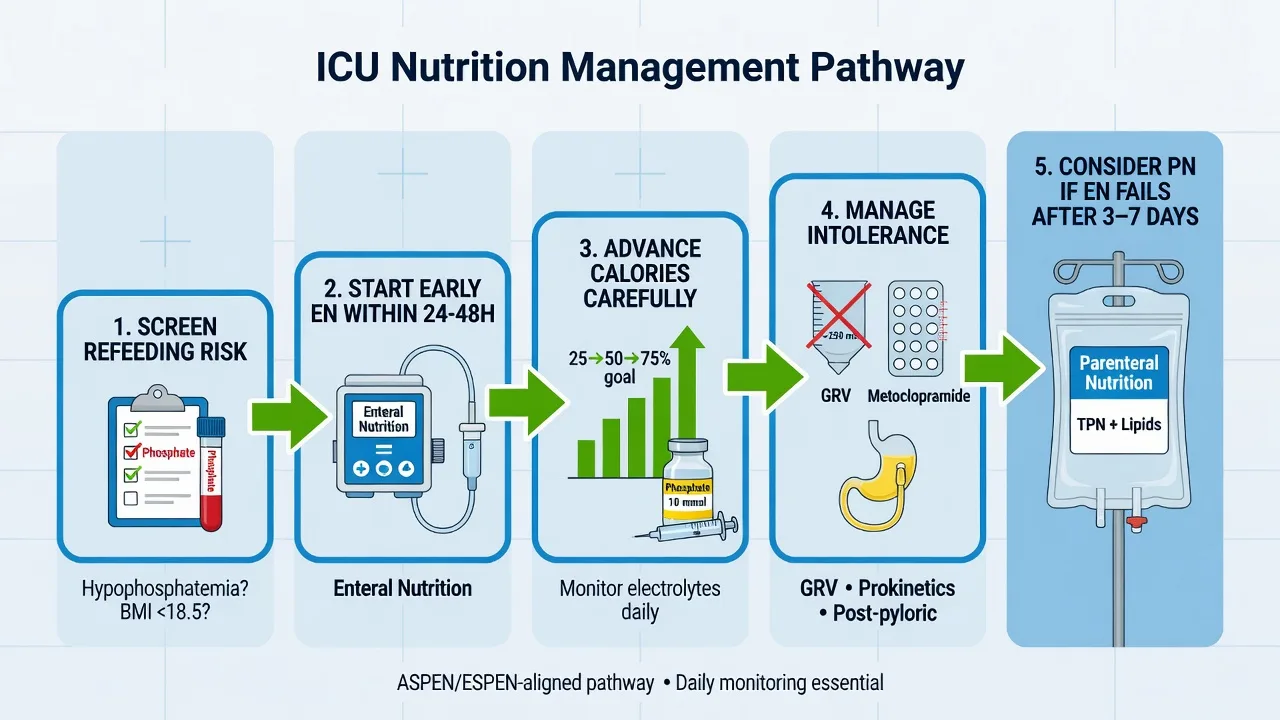
The existing RedFlag above gives the pathophysiology and clinical features. The actionable part is stratifying risk before you feed and choosing the starting rate accordingly. The NICE (UK, CG32) framework stratifies into four bands.[2]
Very high risk
Start 5-10 kcal/kg/day
- BMI <14, or
- Little/no intake for >15 days, or
- Pre-existing low phosphate/K/Mg, or
- Any of: alcoholism, chemotherapy, insulin or diuretic use
- MARSIPAN/anorexia: start at 5-10 kcal/kg, ramp over 10+ days, cardiac monitor
High risk
Start 10-15 kcal/kg/day
- BMI <16, or
- Unintentional weight loss >15% in 3-6 months, or
- Little/no intake >10 days, or
- History of alcohol/drug misuse
- Ramp calories over 5-7 days to full target
Moderate risk
Start 15-20 kcal/kg/day
- BMI 16-18.5, or
- Weight loss >10% in 3-6 months, or
- Little/no intake >5 days
- Reach target over 4-6 days
Low risk
Start at ~25-50% target
- Normal BMI, good recent intake
- Standard ICU advance: 25% → 50% → full over 3-5 days
- Still check baseline phosphate/K/Mg (ICU patients are atypical)
Refeeding syndrome prevention bundle (apply to ALL ICU patients before feed)
- Screen and stratify — compute NICE band on admission. The single best predictor is days of minimal intake combined with BMI.
- Check baseline biochemistry — phosphate, potassium, magnesium, calcium, glucose. Correct any deficit BEFORE starting feed.
- Give thiamine BEFORE the first feed — 200-300 mg IV/PO daily for 5-7 days. Thiamine is the cofactor for pyruvate dehydrogenase; the carbohydrate load demands it, and a starved patient has none → Wernicke if omitted. Also give a multivitamin/B-complex.
- Start at the risk-appropriate rate — protein from day 1 (1.2-2.0 g/kg/day, do NOT protein-restrict), but limit CALORIES (carbohydrate is the trigger) to 5-15 kcal/kg/day in high risk.
- Ramp slowly — increase calories by ~25% per day only if electrolytes stable; reach full target by day 4-7 (or day 10+ for very high risk).
- Monitor daily for 5-7 days — phosphate, K, Mg, glucose, fluid balance, weight; daily ECG if high risk (QT from hypokalaemia/hypomagnesaemia).
- Replace aggressively if levels fall — IV phosphate 15-30 mmol, IV potassium, IV MgSO4 1-2 g; re-check after each dose. Do not let phosphate fall below 0.65 mmol/L.
When to start and how to advance
Starting and advancing enteral nutrition
Assess readiness (within 24-48h)
Start EN if: haemodynamically stable (or stable on low-dose vasopressors), no bowel obstruction, no mesenteric ischaemia, no severe shock. Even without bowel sounds, EN can be started (bowel sounds are a poor indicator of gut function in ICU).
Assess refeeding risk
HIGH risk: >5 days minimal intake, BMI <16, alcoholism, anorexia. Check phosphate, Mg, K, and correct before starting. Give thiamine 100 mg IV. Start at 10-15 kcal/kg/day (NOT full target). MODERATE risk: 2-5 days minimal intake, BMI 16-18.5. Start at 25% target.
Choose route
Nasogastric (NG) tube first — easiest, cheapest. If high gastric residuals or intolerance: try prokinetics (metoclopramide 10 mg IV Q8H, erythromycin 200 mg IV BD). If still intolerant: post-pyloric (NJ) tube. If prolonged ICU stay expected (>2-3 weeks): consider PEG (percutaneous endoscopic gastrostomy).
Start and advance
Start at 25% of target rate. Increase by 25% each day if tolerating (no vomiting, no significant distension, gastric residual <500 mL). Reach target by day 3-7. Monitor: daily weight, fluid balance, glucose, electrolytes (phosphate, Mg, K), liver function.
Monitor tolerance
Gastric residual volume: check every 4-6h initially. GRV >500 mL: assess for intolerance (abdominal distension, discomfort). Do NOT automatically stop feed for GRV <500 mL (guidelines: only hold feed if GRV >500 mL with signs of intolerance). Give prokinetics. Consider NJ tube.
Evidence on timing and route — the key trials
The "early EN, late PN" paradigm rests on a sequence of landmark trials. Knowing the trial, its population and its one-line result is a high-yield exam area. [1]
Casaer EAT (2011, NEJM) — the trial that changed PN timing
Design: Multicentre RCT, 4640 critically ill adults. Early PN (within 48h, to top up insufficient EN) vs late PN (day 8 if EN still insufficient). Result: Late PN was BETTER — fewer infections, less ICU-acquired weakness, shorter ventilation, lower inflammation, less liver dysfunction, and no difference in mortality. Recovery was also faster and cheaper. Take-home: Routine supplemental PN in the first week is harmful; wait until day 7-8 before adding PN if EN is insufficient.[4]
PEPaNIC (2016, NEJM) — the paediatric mirror
Design: 1440 critically ill children. Early PN (within 24h) vs late PN (day 8). Result: Early PN increased infections and a composite of new infections; no mortality benefit. The harm signal was robust and mirrored EAT in adults. Take-home: Withholding PN for one week in children whose EN is insufficient is safe and reduces infection.[11]
CALORIES (2014, NEJM) — route in the first 5 days
Design: 2400 critically ill adults with unplanned ICU admission. EN vs PN within 36h, at the SAME caloric dose, for 5 days. Result: No difference in 30-day mortality (the primary outcome) or in infection, organ failure or length of stay. EN caused more gastrointestinal complications; PN caused more hyperglycaemia. Take-home: When you cannot feed enterally, early PN for a few days is not the catastrophe older dogma suggested — but EN is still first-line because it is cheaper and safer long-term.[6]
NUTRIREA-2 (2018, Lancet) — EN vs PN in shock on vasopressors
Design: 2410 intubated, ventilated adults with shock (on vasopressors). EN vs PN within 24h. Result: EN did NOT reduce mortality or infections and caused more digestive complications: vomiting, bowel ischaemia (2-fold), colonic pseudo-obstruction. Cumulative calorie delivery was also lower with EN (underfed). Take-home: In frank shock on rising vasopressors, do NOT force EN at the expense of gut perfusion — a few days of PN (or trophic EN) is reasonable until the shock resolves. Trophic/hypocaloric EN is still reasonable, but full-volume EN in shock carries a real mesenteric-ischaemia risk.[7]
EDEN (2012, JAMA, ARDSNet) — trophic vs full EN in acute lung injury
Design: 1000 patients with acute lung injury. Trophic EN (10-20 mL/h, ~25% target) for 6 days vs full target feeding from day 1. Result: No difference in ventilator-free days, infection or 60-day mortality. Trophic feeding caused fewer GI side-effects (less vomiting, less constipation). Take-home: In early ARDS, trophic/permissive underfeeding is safe — do not feel compelled to reach full calories early. Combined with PermiT, this supports early underfeeding.[8]
PermiT (2015, NEJM) — permissive underfeeding
Design: 894 critically ill adults. Permissive underfeeding (40-70% of target) vs standard (70-100%) for up to 14 days. Result: Non-inferior for 90-day mortality; fewer insulin requirements and less hyperglycaemia in the underfed group. Take-home: Early underfeeding is acceptable and probably safer than chasing calories — provided protein is met.[5]
TARGET (2019, NEJM) — does more energy help?
Design: 3966 critically ill adults. Energy-dense (1.5 kcal/mL) vs routine (1.0 kcal/mL) enteral formula for up to 28 days (so ~50% more energy delivered). Result: No difference in 90-day survival; the energy-dense group received more calories but did not benefit. Take-home: Delivering MORE calories than the standard target does not improve outcome — reinforces that we routinely overfeed, and the calorie target is a ceiling, not a goal.[10]
REDOX (2013, NEJM) — glutamine and antioxidants can HARM
Design: 1223 mechanically ventilated patients with multi-organ failure. High-dose glutamine + antioxidants vs placebo. Result: No benefit, and a signal of increased mortality at 28 days and 6 months in the glutamine group (particularly in shock and renal/hepatic failure). Antioxidants alone had no mortality effect. Take-home: Do NOT routinely supplement high-dose glutamine in the general ICU, especially in shock or multi-organ failure. Glutamine benefit (if any) is confined to burns and major elective surgery.[9]
Synthesis of the trial evidence
What to tell the examiner
- EN is first-line, started within 24-48h, but EARLY FULL calories are not required
- Routine supplemental PN in week 1 is harmful (EAT, PEPaNIC) — wait until day 7-8
- Route (EN vs PN) at matched calories is neutral (CALORIES) — EN wins on safety/cost
- In shock, full-volume EN risks bowel ischaemia (NUTRIREA-2) — trophic EN or short PN
- Permissive/trophic underfeeding is safe early (EDEN, PermiT) — meet PROTEIN, not calories
- More calories than target do not help (TARGET); glutamine may harm (REDOX)
Specific situations
Sepsis/septic shock
Cautious start
- Do NOT start EN in fulminant shock (unstable on high-dose vasopressors)
- Once stabilising (stable on low-dose vasopressors): start trophic EN (10-20 mL/h)
- Advance slowly as haemodynamics tolerate
- Avoid PN in first 7 days (no benefit, more infections)
Acute pancreatitis
EN preferred over NPO
- Old practice: NPO ("rest the pancreas"). WRONG.
- Current: start EN within 48h (jejunal preferred, but NG is acceptable)
- EN reduces infection, complications, mortality vs PN or NPO
- NPO only if severe ileus or cannot tolerate EN
Burns
High metabolic demand
- Metabolic rate 1.5-2x normal
- Start EN early (within 6h ideally)
- High calorie and protein target (1.5-2 g/kg/day protein)
- Glutamine supplementation may benefit (immunonutrition)
Special populations
Obesity (BMI >30)
Hypocaloric high-protein
- Use IDEAL body weight for calories: 11-14 kcal/kg actual/day (permissive underfeeding)
- Protein 2.0-2.5 g/kg ideal body weight/day — HIGHER than non-obese (sarcopenic obesity)
- Promotes fat oxidation, spares muscle, improves insulin sensitivity and glycaemia
- Obesity paradox: obese ICU patients may have LOWER mortality — but still feed carefully
ARDS / acute lung injury
Trophic early, enteral
- Trophic/permissive underfeeding safe early (EDEN trial) — meet protein, not calories
- Avoid overfeeding → excess VCO2 worsens hypercapnia and impedes lung-protective ventilation
- Omega-3 fatty acid / fish-oil enriched formulas: meta-analyses mixed, NOT routine
- Prone positioning does not preclude EN, but watch for regurgitation/aspiration
AKI / RRT (CRRT, SLED)
High protein, no restriction
- Do NOT protein-restrict to "protect the kidney" — outdated and harmful
- Protein 1.5-1.7 g/kg/day (amino acids lost in CRRT effluent, 10-15 g/day)
- Energy 25-30 kcal/kg/day; avoid overfeeding (azotaemia, fluid)
- Electrolyte-enriched, low-K/low-P formula if needed; watch phosphate (refeeding + RRT)
- Citrate anticoagulation for CRRT may contribute calories (~0.8 kcal/mmol citrate)
Liver failure / encephalopathy
EN, avoid protein restriction
- DO NOT restrict protein (old "low-protein for encephalopathy" myth is WRONG)
- Energy 30-35 kcal/kg/day, protein 1.2-1.5 g/kg/day; BCAA may help chronic encephalopathy
- Avoid constipation (lactulose/rifaximin) — gut is source of ammonia
- Watch for refeeding (malnourished cirrhotics); salt restriction conflicts with nutrition
Traumatic brain injury / stroke
Early, full target
- Hypermetabolic + catabolic (doubles REE) — meet full target early (do NOT underfeed)
- Start EN within 48-72h; if intolerance, NJ or PEG
- Gastric feeding often poorly tolerated (impaired gastric emptying from raised ICP) — prokinetics/NJ
- Avoid hyperglycaemia (worsens secondary brain injury) — target glucose 6-10 mmol/L
Burns
Highest metabolic demand
- REE 1.5-2x normal, sustained for weeks — calories 30-35 kcal/kg, protein 1.5-2.0 g/kg/day
- Start EN within 6h (prevents ileus); glutamine may benefit (unlike REDOX, burns are the exception)
- Watch phosphate/magnesium/potassium closely (massive refeeding risk as feeding escalates)
- Carbohydrate load limited by glucose oxidation ceiling (~5 mg/kg/min); use fat for remainder
Immune-modulating (pharmaconutrition) formulas
Immune-modulating formulas add substrates intended to modulate the inflammatory response — glutamine, arginine, omega-3 fatty acids and antioxidants. The evidence is population-specific: helpful in some, harmful in others. [1]
Glutamine
Conditional amino acid
- Most abundant amino acid; fuel for enterocytes and immune cells; becomes essential in stress
- REDOX (2013): high-dose IV glutamine in multi-organ failure → signal of HARM (do NOT use)
- MAY benefit: burns, major elective surgery, trauma (inconsistent evidence)
- ESPEN: do NOT routinely supplement; consider in burns and trauma
Arginine
Semi-essential, NO precursor
- Precursor of nitric oxide; supports T-cell function
- Immune-enhancing diets (arginine + omega-3 + nucleotides): benefit in elective surgery
- CONCERN in sepsis (iNOS upregulation → excess NO → hypotension) — most avoid in active sepsis
Omega-3 fatty acids (fish oil)
Anti-inflammatory
- Reduce pro-inflammatory prostaglandins/leukotrienes; improve gas exchange in ARDS (some studies)
- EDEN-omega and meta-analyses: mixed; routine use NOT recommended
- MAY be considered in selected ARDS patients (e.g. olive-oil based low-O6 formulas)
Antioxidants (selenium, vitamins C/E)
Trace elements
- Free-radical scavenging; selenium levels fall in critical illness
- REDOX: antioxidants alone had no mortality effect (but no harm)
- Selenium monotherapy meta-analyses: small mortality signal; often supplemented empirically
Monitoring tolerance and avoiding complications
[1]Gastric residual volume (GRV)
Poorly predictive
- GRV correlates poorly with aspiration, pneumonia or feed absorption
- Do NOT automatically stop feed for GRV <500 mL
- >500 mL → assess for intolerance (distension, vomiting); give prokinetic; consider NJ
- Checking GRV every shift is optional in many units once feeding established
Feed intolerance
Escalate the route
- Step 1: confirm tube position (pH <5 or X-ray); head of bed 30-45° to reduce aspiration
- Step 2: add prokinetic — metoclopramide 10 mg IV Q8H ± erythromycin 200 mg IV BD
- Step 3: post-pyloric (NJ) feeding if persistent
- Step 4: PEG if need anticipated >2-3 weeks
Diarrhoea
Common, multifactorial
- Causes: medications (sorbitol, elixirs, antibiotics → C. difficile), hypoalbuminaemia (mucosal oedema), feed hyperosmolarity, infection
- Do NOT reflexively stop feed — address cause, slow rate temporarily, consider soluble-fibre formula
- Send C. difficile toxin if nosocomial; check Mg+ for overflow
Aspiration / VAP risk
Prevention bundle
- Head of bed 30-45°, subglottic suction ETT, oral chlorhexidine, minimise sedation
- Post-pyloric feeding if high aspiration risk (impaired swallow, prolonged ventilation)
- Single-use closed feeding systems; hang time <24h
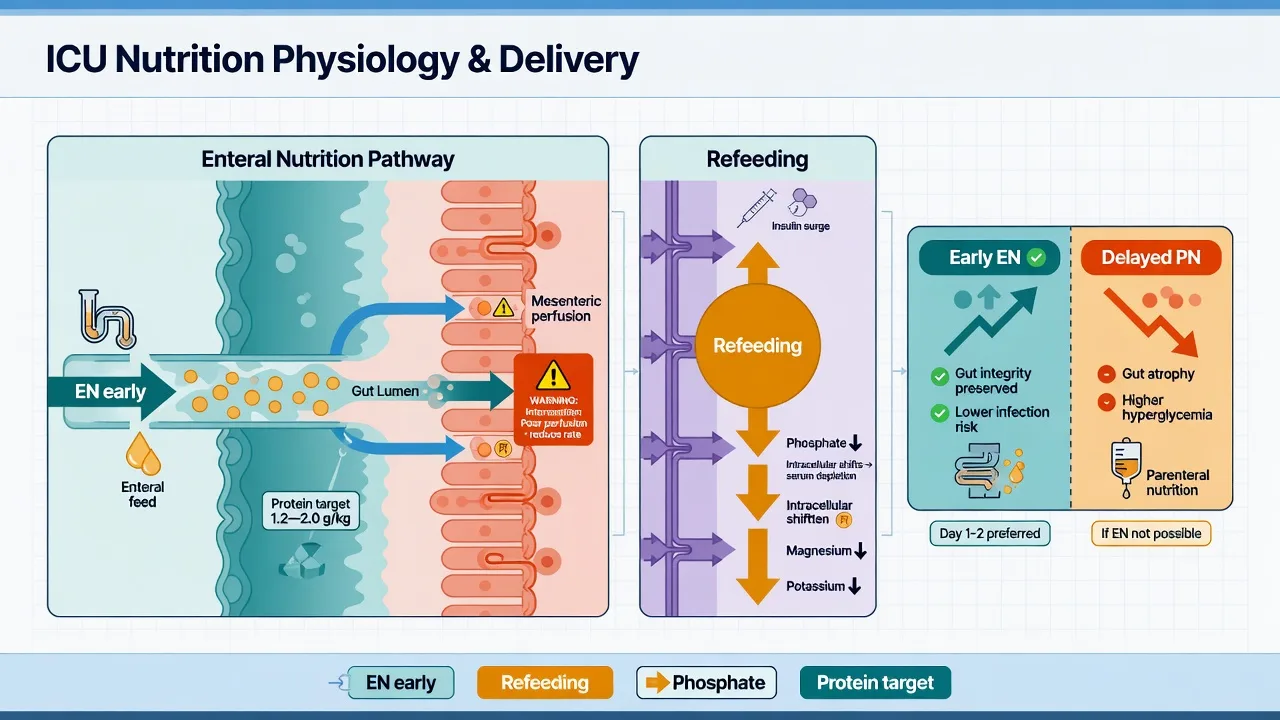
Why enteral nutrition preserves gut integrity
EN is preferred not merely because it is cheaper, but because it is physiologically active in maintaining the gastrointestinal barrier. Use this physiology when justifying EN in a viva. [1]
Short-answer questions
SAQ — Early enteral versus parenteral nutrition in a ventilated patient with septic shock
10 minutes · 10 marks
A 72-year-old man (weight 80 kg) is admitted to ICU with community-acquired pneumonia and septic shock. He is intubated and ventilated on noradrenaline 0.25 mcg/kg/min (MAP 68 after 30 mL/kg crystalloid), lactate 3.2 mmol/L, creatinine 160 micromol/L. He has had minimal oral intake for 2 days. BMI 26. The registrar asks whether to start total parenteral nutrition now to 'meet his caloric target immediately'.
SAQ — Refeeding syndrome in a malnourished alcoholic admitted to ICU
10 minutes · 10 marks
A 49-year-old man with chronic alcohol dependence is admitted with aspiration pneumonia and sepsis. He has eaten almost nothing for 10 days and drinks 1-2 bottles of wine daily. BMI 15.8, weight 48 kg. He is intubated and ventilated on noradrenaline 0.15 mcg/kg/min. Baseline biochemistry: phosphate 0.55 mmol/L, magnesium 0.45 mmol/L, potassium 3.0 mmol/L, glucose 4.2 mmol/L, albumin 22 g/L. The team plans to start full-strength enteral feed at 50 mL/h.
Clinical pearls
Red flags
Evidence and prognosis
ICU nutrition — the evidence landscape at a glance
Mortality benefit of nutrition: No single trial shows that hitting a calorie target reduces mortality in the general ICU. The signal is for protein adequacy (especially in high-NUTRIC patients) and for avoiding harm (overfeeding, early PN, glutamine). [1]
Route: EN vs PN at matched early calories is neutral for mortality (CALORIES); EN preferred for safety, cost and gut-barrier preservation. EN is not superior in frank shock (NUTRIREA-2, more gut complications). [1]
Timing: Early EN (24-48h) is standard. Early/supplemental PN (within the first week) is harmful (EAT, PEPaNIC) — wait until day 7-8 if EN insufficient. [1]
Dose: Permissive/trophic underfeeding is non-inferior (EDEN, PermiT); delivering more than target does not help (TARGET). Meet PROTEIN (1.2-2.0 g/kg/day), tolerate calorie underfeeding early. [1]
Pharmaconutrition: Glutamine may harm in shock/MOF (REDOX); arginine/omega-3 routine use not recommended. The clearest place for immune-modulating nutrition is major burns. [1]
Refeeding syndrome: Preventable killer; incidence 10-30% of ICU starts. Mortality up to 30% if unrecognised; near-zero if prevented (slow start, thiamine, electrolyte monitoring).[2]
START-EN — when it is safe to begin enteral nutrition
References
- [1]Singer P, Blaser AR, Berger MM, et al. ESPEN guideline on clinical nutrition in the intensive care unit Clin Nutr, 2019.PMID 30348463
- [2]Friedli N, Stanga Z, Sobotka L, et al. Revisiting the refeeding syndrome: Results of a systematic review Nutrition, 2017.PMID 28087222
- [3]Heyland DK, Dhaliwal R, Jiang X, et al. Identifying critically ill patients who benefit the most from nutrition therapy: the development and initial validation of a novel risk assessment tool Crit Care, 2011.PMID 22085763
- [4]Casaer MP, Mesotten D, Hermans G, et al. Early versus late parenteral nutrition in critically ill adults N Engl J Med, 2011.PMID 21714640
- [5]Arabi YM, Aldawood AS, Haddad SH, et al. Permissive Underfeeding or Standard Enteral Feeding in Critically Ill Adults N Engl J Med, 2015.PMID 25992505
- [6]Harvey SE, Parrott F, Harrison DA, et al. Trial of the route of early nutritional support in critically ill adults N Engl J Med, 2014.PMID 25271389
- [7]Reignier J, Boisrame-Helms J, Brisard L, et al. Enteral versus parenteral early nutrition in ventilated adults with shock: a randomised, controlled, multicentre, open-label, parallel-group study (NUTRIREA-2) Lancet, 2018.PMID 29128300
- [8]National Heart, Lung, and Blood Institute ARDS Clinical Trials Network, Rice TW, Wheeler AP, et al. Initial trophic vs full enteral feeding in patients with acute lung injury: the EDEN randomized trial JAMA, 2012.PMID 22307571
- [9]Heyland D, Muscedere J, Wischmeyer PE, et al. A randomized trial of glutamine and antioxidants in critically ill patients N Engl J Med, 2013.PMID 23594003
- [10]Peake SL, Chapman MJ, Davies AR, et al. (TARGET investigators). Energy-Dense versus Routine Enteral Nutrition in the Critically Ill N Engl J Med, 2019.PMID 30699311
- [11]Fivez T, Kerklaan D, Mesotten D, et al. Early versus Late Parenteral Nutrition in Critically Ill Children N Engl J Med, 2016.PMID 26975590