ICU · GI & nutrition / metabolic
Refeeding Syndrome — Hypophosphataemia, Thiamine & the Low-and-Slow Refeed
Also known as Refeeding syndrome · Hypophosphataemia of refeeding · Refeeding hypophosphataemia · NICE refeeding · Thiamine deficiency · Wernicke · Malnutrition refeeding
The refeeding syndrome is the potentially fatal metabolic disturbance that occurs when the food is reintroduced too rapidly after a period of the starvation or the malnutrition. The pathophysiology: the starved state has the low insulin, the catabolism, the depleted intracellular electrolytes (the phosphate, the potassium, the magnesium) and the thiamine. On the refeeding, the insulin surge shifts the glucose, the water, and the electrolytes intracellularly, causing the precipitous falls in the serum phosphate (the hallmark), the potassium, and the magnesium, the thiamine depletion (the Wernicke), and the fluid retention (the oedema, the heart failure). The at-risk: the little or no intake over 5 days, the BMI under 16, the weight loss over 15 per cent, the alcohol misuse, the anorexia, the low baseline phosphate or potassium or magnesium. The management (NICE): the start low and slow (the 10 kcal per kg per day for the high-risk, increase over 4 to 7 days), the thiamine BEFORE the refeeding (the 200 to 300 mg), the supplement the phosphate, the potassium, the magnesium, the monitor daily. The arrhythmias are the main death cause.
On this page & tools
Your progress
Saved locally on this device.
8 MCQs with explanations
Target exams
Overview & definition
The refeeding syndrome is the potentially fatal metabolic disturbance that occurs when the food is reintroduced too rapidly after a period of the starvation or the malnutrition. The hallmark is the precipitous hypophosphataemia (with the hypokalaemia and the hypomagnesaemia) within the 5 days of the refeeding, from the insulin-driven intracellular shift of the electrolytes. The arrhythmias are the main cause of the death. The condition is preventable — the identify the at-risk patient, the refeed low and slow, the supplement the thiamine and the electrolytes.[1]
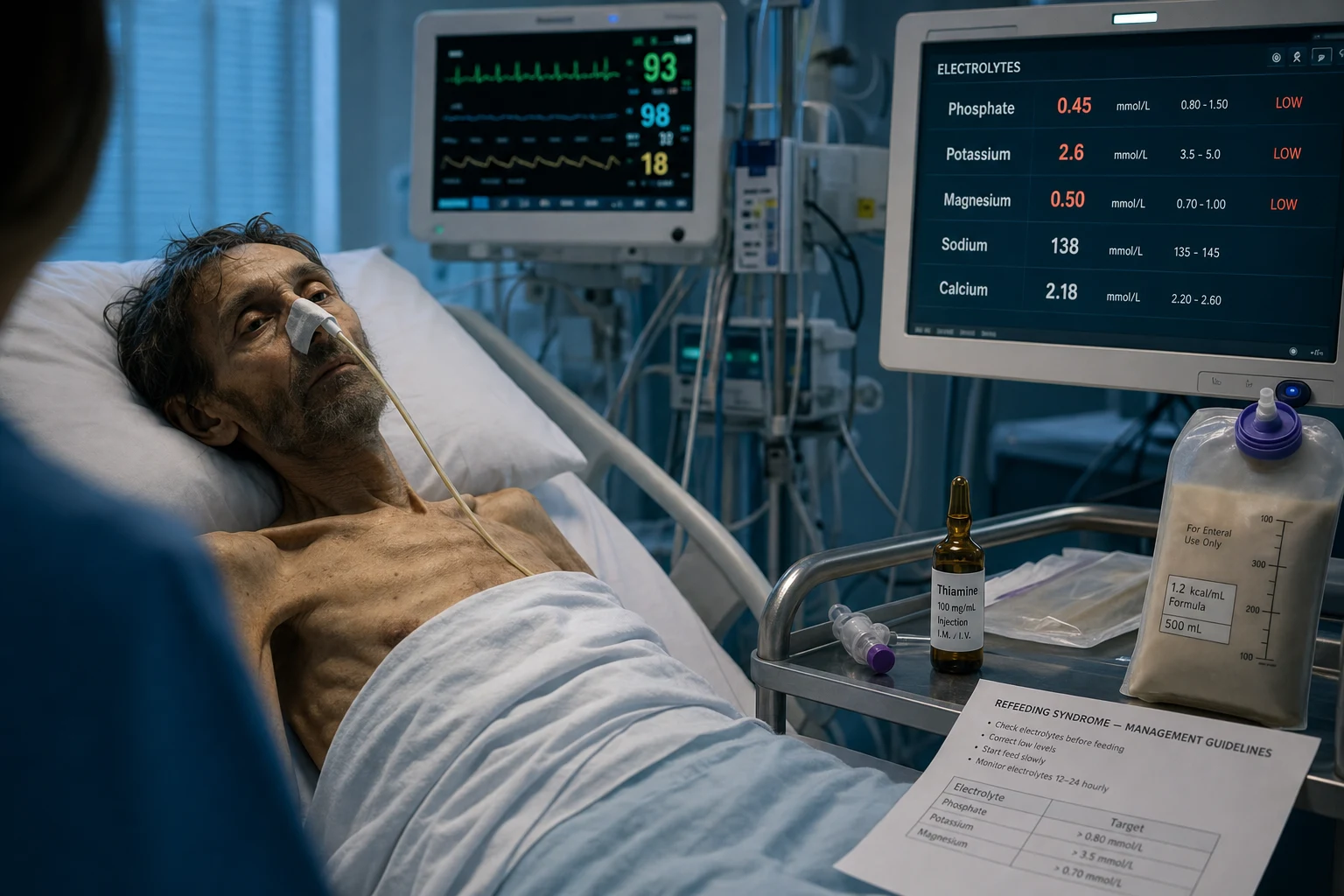
Refeeding syndrome was first described in 1940s prisoners of war and famine-relief populations, who developed oedema, heart failure and death within days of resumed feeding. The same biology recurs wherever starvation is followed by rapid refeeding — anorexia nervosa, chronic alcoholism, post-bariatric surgery, oncology cachexia, the frail elderly, prolonged ICU starvation, and post-operative nil-by-mouth states. Reported ICU incidence is 10–30% of nutrition starts in at-risk cohorts, and unrecognised refeeding carries mortality up to 30%; with prevention the mortality is near-zero.[1][7]
The pathophysiology
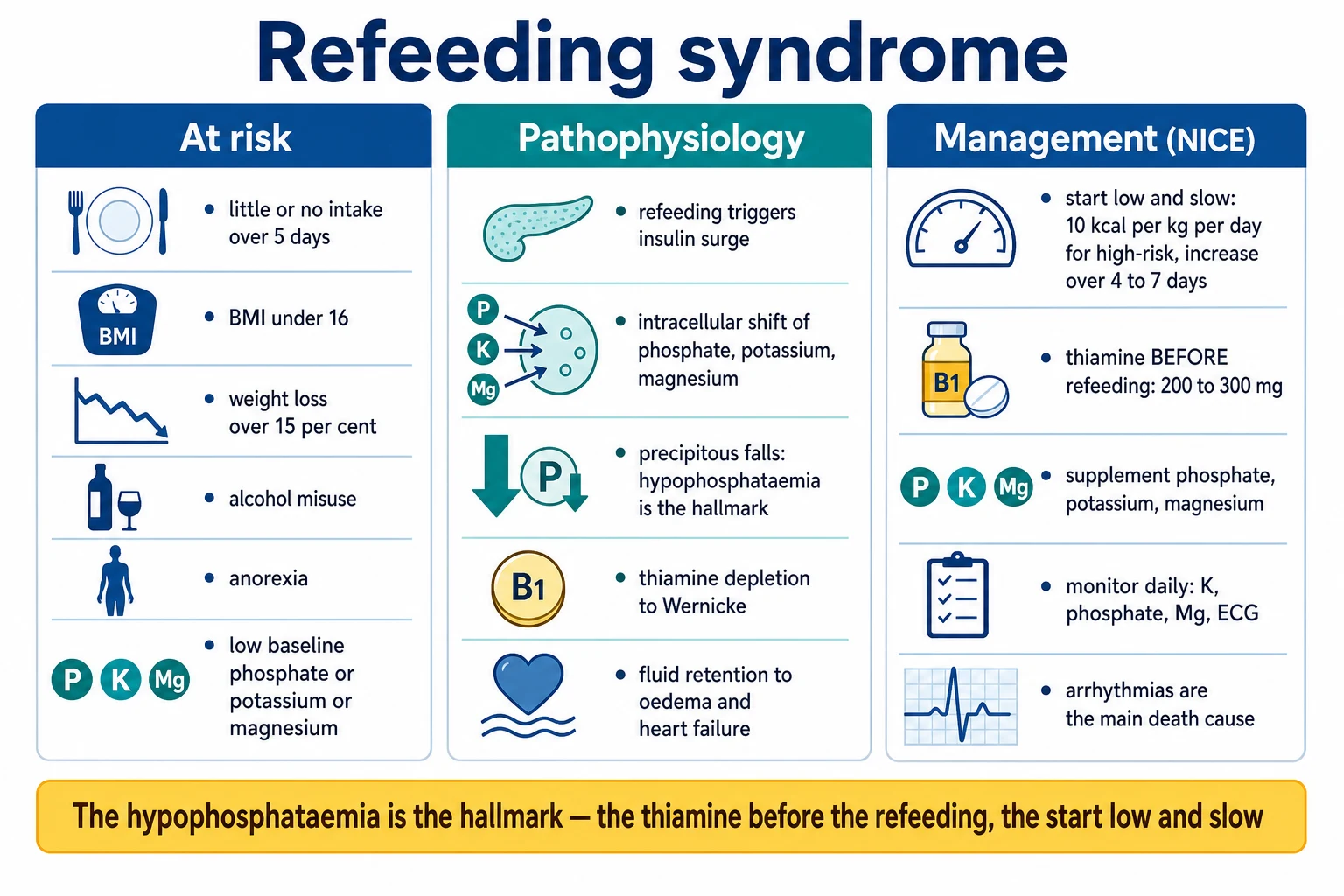
- The starved state — the low insulin, the catabolism, the depleted intracellular electrolytes (the phosphate, the potassium, the magnesium) and the thiamine. The serum levels may be normal (the depletion is intracellular).[1]
- The refeeding → the insulin surge → the intracellular shift of the glucose, the water, and the electrolytes → the precipitous falls in the serum phosphate (the hallmark), the potassium, and the magnesium.[1]
- The thiamine depletion (the thiamine is the cofactor for the pyruvate dehydrogenase — the glucose metabolism) → the Wernicke encephalopathy (the ataxia, the nystagmus, the ophthalmoplegia, the confusion). The refeeding with the glucose precipitates the Wernicke in the depleted patient.[1]
- The fluid retention (the insulin drives the sodium and the water retention) → the oedema, the heart failure.[1]
The molecular cascade — insulin is the trigger
The entire syndrome is driven by a single event: the carbohydrate load → a brisk insulin release from a starved, insulin-restricted β-cell axis. Insulin is an anabolic hormone; the starved patient has been running on counter-regulatory hormones (glucagon, cortisol, catecholamines) for days. The sudden switch to an anabolic state produces four parallel derangements, all of which matter for the exam.[2][5]
The four-pathway pathophysiology of refeeding syndrome
Insulin-driven intracellular shift of electrolytes
Insulin stimulates the Na⁺/K⁺-ATPase pump and GLUT4 glucose uptake in muscle and liver. Phosphate, potassium and magnesium are dragged intracellularly as glucose and ATP are synthesised. Serum phosphate can fall by >0.5 mmol/L within 12–72 h. Serum levels may be normal at baseline because total-body depletion is masked.
ATP depletion and 2,3-DPG fall
Phosphate is the building block of ATP and 2,3-diphosphoglycerate. The refeeding spike in metabolic demand consumes phosphate faster than it can be mobilised → ATP depletion in heart, diaphragm and skeletal muscle → contractile failure. 2,3-DPG fall shifts the Hb–O2 curve leftwards → tissue hypoxia at the cellular level.
Thiamine exhaustion (pyruvate dehydrogenase)
Thiamine is an essential cofactor for pyruvate dehydrogenase (pyruvate → acetyl-CoA). The carbohydrate load demands it; the starved/alcoholic patient has none stored → pyruvate is shunted to lactate → metabolic acidosis, and the brainstem is starved of usable substrate → Wernicke encephalopathy (confusion, ataxia, nystagmus, ophthalmoplegia).
Fluid, sodium and glucose overload
Insulin drives renal sodium and water retention (antinatriuresis) and a fall in serum osmolality → compartmental fluid shifts → peripheral oedema, rarely acute heart failure in the atrophic heart. Simultaneous hyperglycaemia from the calorie load causes osmotic diuresis, dehydration and worsened electrolyte losses.
The at-risk patient
- The little or no intake for over 5 days.[1]
- The BMI under 16 (the severe malnutrition).[1]
- The unintentional weight loss over 15 per cent in the 3 to 6 months.[1]
- The history of the alcohol or the drug misuse (the thiamine depletion, the malnutrition).[1]
- The anorexia (the eating disorder), the oncology, the post-operative, the elderly.[1]
- The low baseline phosphate, potassium, or magnesium before the feeding.[1]
The risk factors above are the headline list; the operational tool is the NICE stratification (below), which assigns each patient a risk band that determines the starting calorie rate, the monitoring intensity, and the duration of the slow-start. Critically, the ICU population is systematically under-recognised as at-risk — the average intubated patient has been nil-by-mouth for days before admission, frequently has electrolyte losses from diuretics, vomiting or RRT, and is then started on full-rate enteral feed. Every ICU admission should be screened.[1][8]
NICE criteria for high-risk patients (CG32, 2006; reaffirmed 2017)
The UK National Institute for Health and Care Excellence (NICE) Clinical Guideline CG32 — Nutrition support in adults stratifies refeeding risk into bands that map directly to the starting calorie dose. This is the framework examiners expect. The 2018 Friedli consensus algorithm refines it for the inpatient.[5]
Extremely high risk
Start 5 kcal/kg/day
- BMI <14, OR
- Negligible intake for >15 days, OR
- Pre-existing low phosphate / potassium / magnesium before any feed, OR
- Anorexia nervosa with BMI <14 (MARSIPAN) — high risk of fatal arrhythmia
- Start 5 kcal/kg/day, ramp over 10–14 days, mandate continuous cardiac monitoring
High risk
Start 10 kcal/kg/day
- BMI <16, OR
- Unintentional weight loss >15% in 3–6 months, OR
- Negligible intake for >10 days, OR
- History of alcohol misuse or drug misuse, OR
- Concurrent insulin, diuretics, chemotherapy, antacid or PPI use (electrolyte loss)
- Start 10 kcal/kg/day, ramp to full target over 5–7 days (longer if very depleted)
Moderate risk
Start 15–20 kcal/kg/day
- BMI 16–18.5, OR
- Unintentional weight loss >10% in 3–6 months, OR
- Negligible intake for 5–10 days, OR
- Elderly, oncology, post-operative with reduced intake
- Start ~15–20 kcal/kg/day, reach target over 4–6 days
Low risk
Start ~25 kcal/kg/day
- BMI 18.5–20 with little or no weight loss
- Recent intake adequate (<5 days minimal)
- Still check baseline phosphate / K / Mg in ICU (atypical risk)
- Begin at ~50–75% of target, reach full target by day 3–5
The NICE high-risk criteria — 'BMI, DAYS, WEIGHT, ALCOHOL, ELECTROLYTES'
The clinical features (within 5 days of the refeeding)
- The hypophosphataemia (the hallmark) — the weakness, the respiratory failure (the diaphragm weakness), the rhabdomyolysis, the cardiac dysfunction, the leucocyte dysfunction.[1]
- The hypokalaemia and the hypomagnesaemia — the arrhythmias.[1]
- The thiamine deficiency — the Wernicke (the ataxia, the nystagmus, the ophthalmoplegia, the confusion).[1]
- The fluid retention — the peripheral oedema, the heart failure.[1]
- The arrhythmias — the main cause of the death (the ventricular arrhythmias from the electrolyte derangements).[1]
Clinical features — organ by organ
The features develop within 12–72 hours (up to 5 days) of starting feed and reflect which electrolyte has fallen fastest and which organ is most ATP-starved. The exam answer is hypophosphataemia → respiratory/cardiac failure; the practical answer is that the syndrome is a multi-organ ATP-depletion emergency. [1]
Respiratory
Hypophosphataemia dominates
- Acute respiratory failure from diaphragm and accessory-muscle weakness (ATP depletion)
- Ventilator weaning failure in the ICU patient who was nearly ready to extubate
- Reduced vital capacity (CVF) and negative inspiratory force — bed-side clue
- Failed cough → secretion retention → nosocomial pneumonia
Cardiac
The killer
- Ventricular arrhythmia (VT/VF) — the leading cause of death
- QT prolongation from hypokalaemia + hypomagnesaemia + hypocalcaemia
- Acute heart failure: myocardial ATP depletion + atrophic left ventricle + volume load
- Reduced contractility, low-output state; rarely cardiogenic shock
- ECG: T-wave flattening, U waves, ST depression, prolonged QT — monitor continuously
Neurological
Thiamine → Wernicke
- Wernicke encephalopathy (classic triad: ataxia, nystagmus/ophthalmoplegia, confusion) — often incomplete
- Acute confusional state indistinguishable from ICU delirium (so easily missed)
- Peripheral paraesthesia and weakness from hypophosphataemia/hypomagnesaemia
- Rare: seizures from severe hypomagnesaemia/hypocalcaemia
Haematological / immune
Cellular dysfunction
- Leucocyte dysfunction (impaired phagocytosis and chemotaxis) → nosocomial infection
- Haemolytic anaemia (erythrocyte ATP depletion → membrane fragility) when phosphate <0.3 mmol/L
- Thrombocytopenia and platelet dysfunction — bleeding risk
Metabolic / fluid
- Fluid retention and peripheral oedema (insulin-driven antinatriuresis)
- Hyperglycaemia and hyperinsulinaemia (calorie load exceeds the oxidative ceiling)
- Lactic acidosis from pyruvate shunting (thiamine-deficient pyruvate dehydrogenase)
- Hypocalcaemia (often accompanies hypomagnesaemia — refractory to calcium until Mg corrected)
The management (NICE)
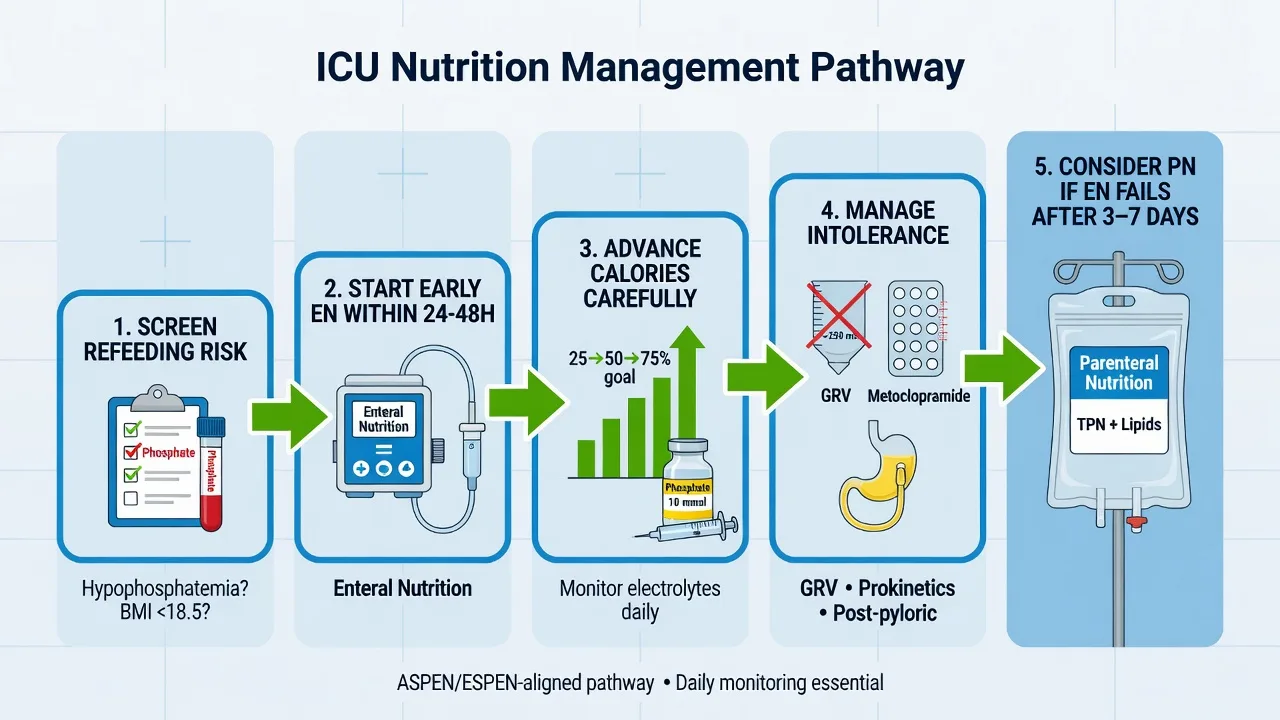
1. Identify the at-risk patient and stratify the risk
Stratify into the high-risk (the severe malnutrition, the BMI under 16, the little intake over 10 days, the low baseline electrolytes) and the moderate-risk. The management intensity scales with the risk.[1]
2. The start low and slow
- The 10 kcal per kg per day for the high-risk patient; increase gradually to the full target over 4 to 7 days.[1]
- The 20 kcal per kg per day for the moderate-risk; the faster increase.[1]
- The caloric restriction for the first week — the lower and the slower than the normal feeding.[1]
3. The thiamine BEFORE and during the refeeding
- The thiamine 200 to 300 mg daily (oral or IV), started BEFORE the first feed and continued for the first week. Prevents the Wernicke.[1]
4. The supplement and monitor the electrolytes
- The phosphate, the potassium, the magnesium — check the baseline, supplement prophylactically, and the monitor daily (or more often) for the first week.[1]
- The replace aggressively as the levels fall (the intracellular shift is rapid).[1]
- The ECG monitoring for the arrhythmias; the fluid-balance and the weight for the fluid retention.[1]
The management — caloric strategy in detail
The single most important intervention is caloric restriction at the start. The carbohydrate load is the trigger; restricting it blunts the insulin surge and the consequent electrolyte shift. Provide full protein from day 1 (1.2–2.0 g/kg/day — protein restriction does NOT prevent refeeding and worsens catabolism) but hold back calories.[5]
Extremely high risk (BMI <14, >15 days NBM, anorexia)
5 kcal/kg/day
- Start at 5 kcal/kg/day for the first 24–48 h
- Increase by ~5 kcal/kg/day every 2–3 days if electrolytes stable
- Reach full target only by day 10–14
- MARSIPAN anorexia: cardiac monitoring throughout; refeeding is the most dangerous period
- Continue thiamine 200–300 mg, multivitamin, and phosphate/K/Mg prophylaxis
High risk (BMI <16, >10 days NBM, alcohol)
10 kcal/kg/day
- Start at 10 kcal/kg/day for the first 24–48 h
- Increase by ~5 kcal/kg/day as tolerated, reaching full target over 5–7 days
- Limit carbohydrate (the trigger); prioritise fat calories where possible
- Meet full protein target from day 1 (do NOT protein-restrict)
- Daily phosphate/K/Mg and ECG for the first week
Moderate risk (BMI 16–18.5, 5–10 days NBM)
15–20 kcal/kg/day
- Start at ~15–20 kcal/kg/day
- Reach full target over 4–6 days
- Check baseline PO4/K/Mg; repeat at 24–48 h
- Give thiamine 200–300 mg before the first feed regardless
Low risk (BMI >18.5, <5 days NBM)
25 kcal/kg/day
- Begin at ~50–75% of target, reach full target by day 3–5
- Check baseline electrolytes; repeat only if abnormal
- In ICU patients, treat ALL as at least moderate risk (prolonged starvation unrecognised)
Thiamine and micronutrient replacement
Micronutrient and electrolyte prophylaxis — give BEFORE the first feed
Thiamine (mandatory)
200–300 mg IV (or PO if tolerated) DAILY, started before the first feed and continued for 7–10 days (longer in alcohol misuse). High-dose IV thiamine (e.g. 500 mg TDS) is reserved for suspected/proven Wernicke. Cofactor for pyruvate dehydrogenase — without it the glucose load precipitates Wernicke. NEVER give glucose (including the refeeding) without prior thiamine in the at-risk patient.
Phosphate
If baseline normal and high-risk: oral prophylaxis (1–2 tablets of phosphate-sandoz equivalents, ~500–1000 mg elemental, TDS). If falling/low: IV sodium/potassium phosphate 15–30 mmol over 6 h, re-check; severe (<0.3) 30–60 mmol over 6–12 h. Avoid in hypercalcaemia; monitor Ca (phosphate replacement can precipitate hypocalcaemia).
Potassium
Aim K >4.0 mmol/L throughout refeeding. If normal baseline: prophylactic oral KCl 20–40 mmol/day. If falling: IV KCl 10–20 mmol/h via central line (max 20 mmol/h), re-check. The intracellular shift is fast — a K of 4.0 can fall to 2.5 within 24 h on full feed.
Magnesium
Aim Mg >0.75 mmol/L (most replace to >0.9). Prophylaxis: oral Mg glycerophosphate. If low: IV MgSO4 1–2 g (4–8 mmol) over 1–2 h, re-check; severe arrhythmia 2 g over 10 min then infusion. Hypocalcaemia will not correct until Mg is replete.
Multivitamin / trace elements
Daily multivitamin and B-complex for 7–10 days. Replace folate if deficient. Trace elements (selenium, zinc, copper) are relevant in prolonged refeeding but not day 1. Vitamin D and calcium if osteomalacia or chronic malnutrition.
The prevention bundle — apply to every at-risk patient before the first feed
Refeeding syndrome prevention bundle (NICE + 2018 Friedli algorithm)
1. Screen and stratify on admission
Assign a NICE band (extremely high / high / moderate / low) using BMI, days of negligible intake, weight loss, alcohol/drug misuse, and electrolyte-depleting drugs. In ICU, default to assuming at least moderate risk.
2. Check baseline biochemistry BEFORE feeding
Phosphate, potassium, magnesium, calcium, glucose, sodium, urea/creatinine, LFTs, albumin. Correct any deficit before the first feed. A normal baseline does NOT exclude the syndrome — the drop is the diagnosis.
3. Give thiamine BEFORE the first feed
Thiamine 200–300 mg IV/PO daily for 7–10 days, plus a multivitamin/B-complex. Mandatory in all at-risk patients. Alcohol misuse: consider high-dose IV thiamine (Pabrinex).
4. Start at the risk-appropriate caloric rate
5 kcal/kg/day (extremely high), 10 kcal/kg/day (high), 15–20 (moderate). Meet full protein from day 1 (1.2–2.0 g/kg/day — do NOT protein-restrict). Favour fat over carbohydrate calories.
5. Ramp slowly
Increase calories by ~5 kcal/kg/day (or ~25–33% per day) only if electrolytes are stable. Reach full target over 5–7 days (high risk), 10–14 days (extremely high risk). If phosphate falls >0.3 mmol/L or below 0.5, halve the caloric rate.
6. Monitor closely for 5–10 days
Daily (or twice-daily in extreme risk) phosphate, K, Mg, glucose, calcium. Daily ECG if high risk (QT). Hourly fluid balance and daily weight (aim for fluid balance not > +1 L/day). Continuous cardiac monitoring in extremely high risk.
7. Replace aggressively if levels fall
IV phosphate 15–30 mmol, IV KCl, IV MgSO4 1–2 g; re-check after each dose. Do not let phosphate fall below 0.65 mmol/L. If severe hypophosphataemia (<0.3) with organ dysfunction, stop feed, give IV phosphate, ICU monitoring.
Special populations at the sharp end
Anorexia nervosa (MARSIPAN/MARSIPAN-MARSIPAN)
Highest arrhythmia risk
- Highest single-condition refeeding mortality; sudden death from ventricular arrhythmia
- MARSIPAN guideline: start 5 kcal/kg/day (some now advocate 10–20 cautiously), thiamine, phosphate/K/Mg, daily ECG, continuous cardiac monitoring
- Watch for refeeding oedema and rare acute cardiac decompensation in the atrophic LV
- Beware "under-feeding syndrome" if prolonged restriction — newer evidence supports cautious higher start
Chronic alcohol misuse
Thiamine is the priority
- Severely thiamine-depleted — give high-dose IV thiamine (Pabrinex) before ANY glucose
- Combined risk of Wernicke on refeeding + alcoholic ketoacidosis + withdrawal
- Hypomagnesaemia from poor intake + renal wasting — Mg is essential for thiamine activation
- Treat withdrawal concurrently with benzodiazepine protocol; do not delay nutrition
Post-bariatric surgery
Months to years later
- Late presentation: profound micronutrient and thiamine deficiency presenting with vomiting
- Atrophic gut — small stomach pouch, possible stenosis, dumping syndrome
- Thiamine deficiency and Wernicke can occur WITHOUT refeeding in persistent vomiting
- Refeed cautiously, supplemental parenteral vitamins; tetracycline/B12/iron/folate repletion
The frail elderly
Insidious, easily missed
- Reduced intake for weeks ("tea and toast"), sarcopenia, polypharmacy (diuretics, PPIs)
- Present with falls, confusion, "failure to thrive" — the electrolyte drop is unexpected
- Lower starting dose; watch salt and fluid overload (heart failure common)
- Refeeding hypophosphataemia independently predicts mortality in this group
Oncology / cachexia
Catabolic + malnourished
- Tumour-driven catabolism + treatment-related nausea/vomiting → severe depletion
- Concurrent chemotherapy: electrolyte-losing (cisplatin → Mg, K)
- Refeed slowly; co-manage nausea, mucositis; consider appetite stimulants
Prolonged ICU / post-operative NBM
The unrecognised at-risk
- Days of nil-by-mouth before and during ICU admission; ileus, vomiting, RRT losses
- Default to moderate–high risk; check phosphate/Mg/K on every ICU admission
- Traumatic brain injury and burns are hypercatabolic — high protein, but still refeed cautiously on calories
Evidence — the key trials and the slow-start controversy
The classic NICE slow-start (10 kcal/kg/day in high-risk) rests on pathophysiological reasoning and case series, not large RCTs. The Doig trial (2015) tested whether caloric restriction helps once refeeding hypophosphataemia has already developed.[3]
Doig 2015 (Lancet Respir Med) — caloric restriction once refeeding is established
Design: Multicentre, single-blind RCT, 339 critically ill adults who developed refeeding hypophosphataemia (phosphate fall on feed). Randomised to caloric restriction (40% of target for up to 7 days, then re-advance) vs continued standard caloric intake (full target). Result: Caloric restriction produced a faster resolution of hypophosphataemia but did not improve 60-day mortality, ICU or hospital stay, or organ-failure-free days, and was associated with more infections in the restricted group. Take-home: The trial is the best RCT evidence but is criticised (entry required established refeeding, not prevention; underpowered; 40% target may still be too high). It does NOT support abandoning the slow-start in the prevention phase for the genuinely high-risk patient. Prevent first; if refeeding develops, caloric restriction is reasonable but monitor and re-advance promptly.[3]
Olthof 2018 (Clinical Nutrition) — caloric intake and outcomes in ICU refeeding
Design: Retrospective cohort of ICU patients with refeeding syndrome (defined by hypophosphataemia). Compared outcomes across caloric intake strata. Result: Higher caloric intake in the first week was not associated with worse outcomes; in some analyses patients with refeeding who received more calories did no worse. Hypophosphataemia itself, however, was associated with adverse outcomes. Take-home: Reinforces that the harm tracks with the electrolyte derangement and the underlying depletion, not the calories per se. Replace electrolytes aggressively and re-advance when stable; do not withhold nutrition indefinitely out of fear.[4]
Friedli 2017 (Nutrition) — the systematic review of refeeding
Design: Systematic review of the refeeding syndrome literature, definition, incidence and outcomes. Result: Confirmed the heterogeneity of definitions and the wide incidence range (1–60% depending on population and threshold). Mortality attributable to refeeding is real but hard to quantify because of confounding by underlying disease. The review supports the NICE high-risk criteria and the slow-start with thiamine and electrolyte replacement as the evidence-supported prevention. Take-home: The evidence base is observational and consensus-driven; the NICE framework remains the standard, and the burden of preventable harm justifies its application.[1]
Monitoring schedule and escalation triggers
[1]Why thiamine is non-negotiable
Exam practice
SAQ — Anorexia and the low-and-slow refeed (MARSIPAN)
10 minutes · 10 marks
A 24-year-old woman with anorexia nervosa (BMI 13.2, weight loss 22% over 4 months) is admitted to ICU with collapse and hypothermia after 14 days of negligible intake. She is haemodynamically stable. The team wishes to start enteral nutrition.
SAQ — Established refeeding syndrome with arrhythmia
10 minutes · 10 marks
A 62-year-old chronic alcoholic admitted with pancreatitis has been nil-by-mouth for 8 days. Twelve hours after starting full-rate enteral feed his phosphate falls from 0.88 to 0.28 mmol/L, he develops new QT prolongation with runs of torsades-de-pointes, and his respiratory rate rises with weak cough.
Clinical pearls
[1]Red flags
Prognosis and the bottom line
Refeeding syndrome — the evidence landscape at a glance
Definition/epidemiology: Friedli 2017 systematic review — heterogeneous definitions, incidence 1–60%, NICE criteria remain the practical standard.[1]
Prevention/management consensus: NICE CG32 (2006, 2017) and the Friedli 2018/2020 algorithms — risk-stratify, start low and slow, thiamine before feed, supplement and monitor PO4/K/Mg.[5][6]
The slow-start RCT: Doig 2015 — caloric restriction once refeeding is established resolves phosphate faster but does not improve mortality and may increase infection; does not overturn prevention-phase slow-start in the genuinely high-risk.[3]
Outcomes association: Yu 2020 (Medicine) — refeeding syndrome is associated with increased mortality in malnourished medical inpatients.[7]
Bottom line: the syndrome is preventable. Identify the at-risk patient, refeed low and slow, give thiamine before the first feed, supplement and monitor phosphate/potassium/magnesium daily, and watch the ECG. The hypophosphataemia is the hallmark; the arrhythmia is the killer.
THIAMINE-POKM — the refeeding prevention bundle
References
- [1]Friedli N, Stanga Z, Sobotka L, et al. Revisiting the refeeding syndrome: Results of a systematic review Nutrition, 2017.PMID 28087222
- [2]Mehanna HM, Moledina J, Travis J. Refeeding syndrome: what it is, and how to prevent and treat it BMJ, 2008.PMID 18583681
- [3]Doig GS, Simpson F, Heighes PT, et al. Restricted versus continued standard caloric intake during the management of refeeding syndrome in critically ill adults: a randomised, parallel-group, multicentre, single-blind controlled trial Lancet Respir Med, 2015.PMID 26597128
- [4]Olthof E, Huisman-de Waal G, Onland J, et al. Impact of caloric intake in critically ill patients with, and without, refeeding syndrome: A retrospective study Clin Nutr, 2018.PMID 28866139
- [5]Friedli N, Theodoropoulos JJ, Heuberger PR, et al. Management and prevention of refeeding syndrome in medical inpatients: An evidence-based and consensus-supported algorithm Nutrition, 2018.PMID 29429529
- [6]Friedli N, Stanga Z, Culkin A, et al. Refeeding syndrome: update and clinical advice for prevention, diagnosis and treatment Curr Opin Gastroenterol, 2020.PMID 31895231
- [7]Yu R, Chen PR, Wu MJ, et al. Refeeding syndrome is associated with increased mortality in malnourished medical inpatients: Secondary analysis of a randomized trial Medicine (Baltimore), 2020.PMID 31895785
- [8]Álvarez-Hernández J, Planas Vila M, León-Sanz M, et al. Refeeding syndrome in the frail elderly population: prevention, diagnosis and management Clin Exp Gastroenterol, 2018.PMID 30022846
- [9]Pereira Gomes T, Lopes M, Cordeiro R, et al. Refeeding Syndrome: A Critical Reality in Patients with Chronic Disease Nutrients, 2022.PMID 35889815