ICU · GI/Nutrition
Stress-related mucosal disease (stress ulcer prophylaxis)
Also known as Stress ulcer prophylaxis (SUP) · Stress-related mucosal disease (SRMD) · Curling ulcer (burns) · Cushing ulcer (TBI) · SUP-ICU trial · PEPTIC trial · REVISE trial
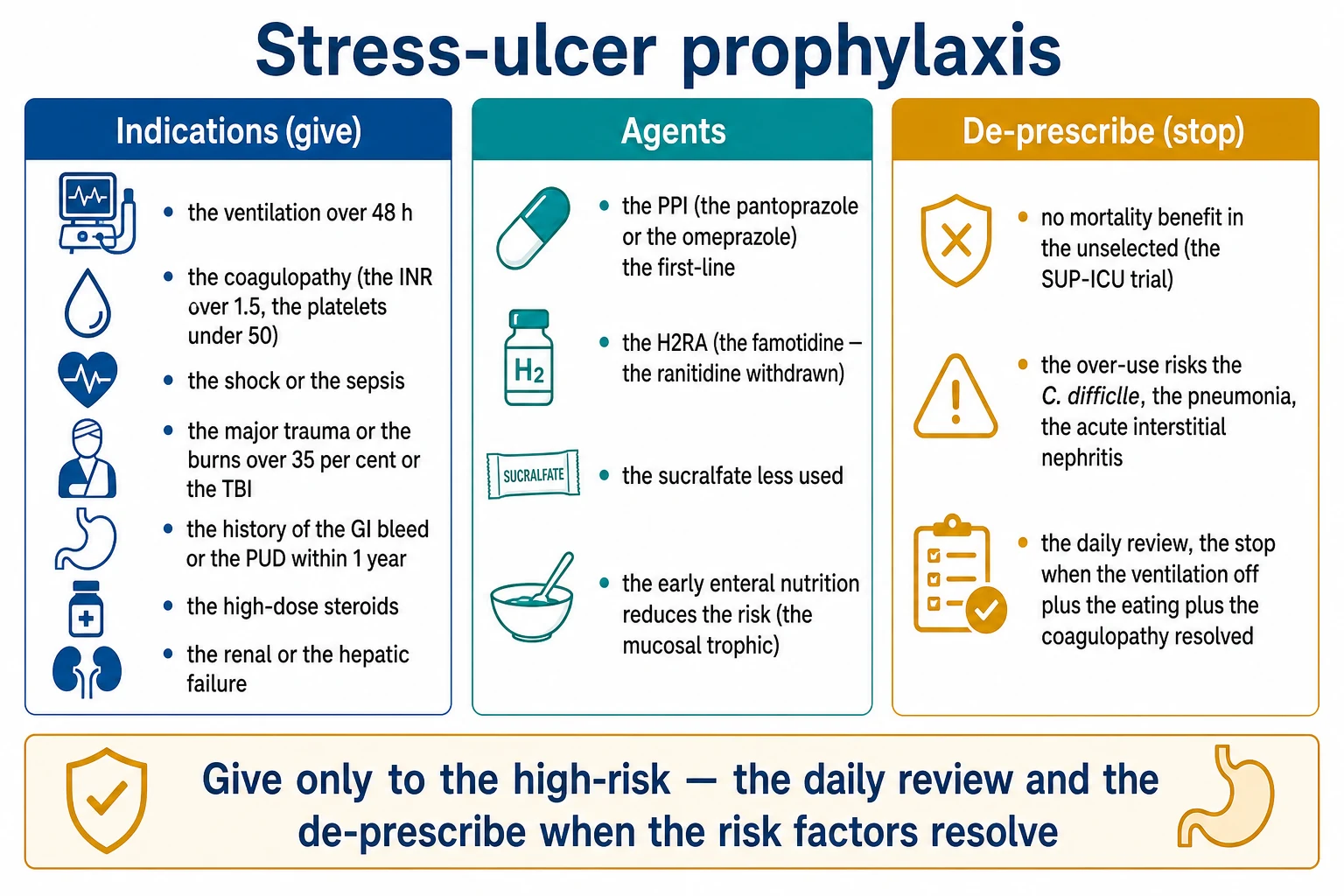
Stress-related mucosal disease (SRMD) is the rapid, ischaemia-driven breakdown of the gastric mucosal barrier in critical illness: splanchnic hypoperfusion → mucosal ischaemia → acid back-diffusion → superficial erosion (fundus/body). Subclinical erosions appear on endoscopy in 75-100% of ventilated patients within 24-72h, but clinically significant bleeding is rare (0.1-4%). Two independent risk factors dominate (Cook 1994, NEJM): mechanical ventilation 48h (1) and coagulopathy (INR 1.5 or platelets <50) — together they account for most clinically significant bleeding. Other: shock, sepsis, major burns 35% TBSA (Curling ulcer), severe TBI (Cushing ulcer), high-dose steroids. Prophylaxis is PPI first-line (pantoprazole 40 mg IV/PO daily — least CYP2C19 inhibition, clopidogrel-safe). Ranitidine globally WITHDRAWN (NDMA contamination) — use famotidine. Sucralfate is a mucosal protectant with lower C. diff risk but less effective. SUP-ICU trial (Krag 2018, NEJM): pantoprazole vs placebo reduced clinically significant bleeding (2.5% vs 4.2%, NNT 59) but did NOT reduce 90-day mortality and showed NO significant increase in pneumonia or C. difficile. PEPTIC (Young 2020, JAMA): PPI vs H2 blocker — no mortality difference. REVISE (Cook 2024, NEJM): confirms bleeding reduction without excess infection. Start SUP if risk factors present; STOP when tolerating enteral feeds + extubated + coagulopathy resolved. Enteral nutrition itself is protective. C. difficile risk is dose- and duration-dependent (~1.5x with PPI). Do NOT give SUP to ALL ICU patients — only those with indications. Review indication DAILY.
On this page & tools
Your progress
Saved locally on this device.
Target exams
Red flags
Overview
[1]Pathophysiology — why critically ill patients ulcerate
Stress-related mucosal disease (SRMD) is the rapid, ischaemia-driven breakdown of the gastric (and proximal duodenal) mucosal barrier that follows critical illness. Within 24-72 hours of an ICU insult, endoscopy reveals superficial erosions in 75-100% of mechanically ventilated patients — yet only a minority (0.1-4%) progress to clinically significant bleeding. Understanding the cascade matters because every risk factor and every prophylactic agent acts at a specific point in it. [1]
The mucosal defence system — what fails
The gastric mucosa defends itself against a luminal pH of 1-2 through four interlocking mechanisms that all fail in critical illness: [1]
- The mucus-bicarbonate barrier. Surface foveolar mucus cells secrete a viscoelastic mucus gel (~0.2-0.6 mm thick) overlying an unstirred layer of secreted bicarbonate. This holds the surface epithelial pH near 7 despite a luminal pH of 1-2 — a gradient of ~6 pH units across a fraction of a millimetre. In shock, mucosal blood flow falls and bicarbonate secretion stops — the gradient collapses.
- Mucosal blood flow (the acid "sink"). Abundant submucosal capillary flow washes away any H+ that back-diffuses, and delivers bicarbonate. This is the first thing to fail in splanchnic hypoperfusion.
- Rapid epithelial turnover (2-4 days). Continuous restitution and renewal replaces damaged cells. Mucosal ischaemia and catabolic critical illness slow this.
- Endogenous prostaglandins (PGE2, PGI2) stimulate mucus, bicarbonate, and maintain mucosal blood flow. NSAIDs and steroids disrupt this layer. [1]
The SRMD cascade — splanchnic hypoperfusion is the trigger
Pathophysiological cascade: splanchnic hypoperfusion → mucosal ischaemia → acid back-diffusion → ulceration
Splanchnic hypoperfusion
Critical illness (shock, sepsis, mechanical ventilation with high intrathoracic pressure, major trauma) triggers sympathetic-driven splanchnic vasoconstriction. The gut is the first organ to shed blood flow in shock ("the canary of the abdomen") — mesenteric oxygen delivery falls disproportionately to systemic flow.
Mucosal ischaemia
Reduced mucosal blood flow starves the surface epithelium of oxygen and bicarbonate. ATP depletion impairs the Na+/K+ ATPase → intracellular acidosis → mitochondrial dysfunction. NO-mediated vasodilatation is lost; the protective mucus-bicarbonate gradient collapses.
Acid back-diffusion
With the barrier compromised, luminal H+ diffuses back INTO the epithelial cell (it should be moving into the lumen). Intracellular pH plummets. The mucus gel that should be impermeable to H+ becomes leaky. This is the pivotal step — and the reason acid suppression (PPI/H2 blocker) works: remove the luminal H+ and back-diffusion injury stops.
Epithelial cell death and erosion
Intracellular acidosis activates lysosomal enzymes, generates reactive oxygen species on reperfusion, and triggers apoptosis/necrosis of surface cells. Shallow erosions form — they do NOT initially breach the muscularis mucosae (hence "superficial"). Lesions are multiple and cluster in the acid-secreting fundus and body.
Ulceration and bleeding
If the insult continues, erosions deepen into the submucosa where arterioles lie. Erosion into a submucosal vessel = clinically significant bleeding. Concurrent coagulopathy or thrombocytopenia converts a trivial ooze into a life-threatening haemorrhage — which is why coagulopathy multiplies bleeding risk 4-15x.
Why the fundus and body? — the acid-secreting mucosa bears the brunt
SRMD lesions cluster in the gastric fundus and body — the parietal-cell mass that secretes acid. Two reasons: (1) this mucosa is bathed in the highest concentration of back-diffusing H+; (2) the energy demand of the proton pump makes these cells exquisitely sensitive to ischaemia. The antrum (mucus-secreting, non-acidic) and the duodenum are relatively spared — the opposite distribution to chronic peptic ulcer disease (duodenum/antrum). [1]
SRMD versus peptic ulcer disease — a recurring exam comparison
Stress-related mucosal disease (SRMD) vs peptic ulcer disease (PUD)
| Feature | SRMD (stress ulceration) | PUD (peptic ulcer) |
|---|---|---|
| Setting | Acute critical illness (ICU, shock, burns, TBI) | Chronic outpatient disease |
| Onset | Within 24-72h of insult | Over weeks-months-years |
| Number | Multiple (often dozens) | Single, or few |
| Depth | Superficial erosion (rarely through muscularis mucosae) | Deep (through muscularis mucosae into submucosa/muscularis propria) |
| Site | Gastric fundus and body (acid-secreting mucosa) | Duodenal bulb or gastric antrum |
| Pathogenesis | Splanchnic hypoperfusion → ischaemia → acid back-diffusion | Helicobacter pylori (~90% duodenal), NSAIDs, hypersecretory states (Zollinger-Ellison) |
| Pain | Usually painless until bleeding | Epigastric pain, classically relieved (duodenal) or worsened (gastric) by food |
| Perforation | Rare (lesions are superficial) — EXCEPT Cushing ulcer | Recognised complication (deep ulcer) |
| Bleeding | Clinically significant in 0.1-4% of ICU patients | Common presentation |
| Role of acid | Normal/low acid — barrier FAILURE is the problem | Acid-driven injury to an exposed site |
| Resolution | Resolves as the patient recovers from critical illness | Chronic / relapsing without eradication |
Named syndromes — Curling and Cushing
- Curling ulcer — acute gastric/duodenal ulceration after severe burns (>30% TBSA). Mechanism: hypovolaemia → splanchnic vasoconstriction + reduced plasma volume → mucosal ischaemia, compounded by gastric acid hypersecretion from systemic stress. Classically associated with duodenal ulcers that may perforate.
- Cushing ulcer — gastric/duodenal/oeseophageal ulceration after severe traumatic brain injury, intracranial haemorrhage, or raised intracranial pressure. Unique mechanism: direct vagal nucleus stimulation from raised ICP → unchecked gastric acid hypersecretion (unlike other stress ulcers, where acid is normal/low). Cushing ulcers are deeper, carry a higher risk of perforation, and may need prophylaxis even when standard risk factors are absent. [1]
Risk factors
The landmark Cook et al. study (NEJM 1994, >2200 ICU patients) established that clinically significant GI bleeding is not random — it clusters in patients with specific, identifiable risk factors. Two dominate and are the backbone of every guideline since.[5][7]
MAJOR risk factors
Clear indications
- Mechanical ventilation >48h (#1 risk factor)
- Coagulopathy (platelets <50, INR >1.5, PTT >2x normal)
- Shock (any cause — septic, cardiogenic, hypovolaemic)
- These two (ventilation + coagulopathy) account for most clinically significant bleeding
Other risk factors
Consider prophylaxis
- Major burns (>35% TBSA) — Curling ulcer
- Severe TBI — Cushing ulcer (hyperglycaemic, direct vagal stimulation)
- Major trauma (ISS >16)
- Sepsis (especially with multi-organ failure)
- High-dose steroids (>250 mg hydrocortisone equivalent/day) + NSAIDs
- ICU stay >7 days with any of above
Each risk factor in detail — the mechanism and the relative risk
Risk factors — mechanism, magnitude and guideline status (SCCM/ASHP 2024)
| Risk factor | Mechanism | Relative risk of bleeding | Guideline status |
|---|---|---|---|
| Mechanical ventilation >48h | #1 — splanchnic hypoperfusion from high intrathoracic pressure + reduced mucosal blood flow + bile/acid reflux + depressed mucosal defence | ~3-4x | Strong — ventilated >48h should receive SUP |
| Coagulopathy (INR >1.5 OR platelets <50 OR PTT >2x normal) | Minor erosions that would otherwise be trivial progress to significant bleeding because haemostasis is impaired | ~4-15x | Strong |
| Shock (septic, haemorrhagic, cardiogenic) | Splanchnic vasoconstriction → mucosal ischaemia (the trigger of the whole cascade) | ~3-5x | Strong |
| Severe burns >35% TBSA | Hypovolaemia + splanchnic vasoconstriction + acid hypersecretion (Curling ulcer) | ~5-10x | Strong |
| Severe TBI / raised ICP (Cushing ulcer) | Vagal stimulation from raised ICP → gastric acid HYPERsecretion (unique — acid-driven, not ischaemia-driven). Can perforate | ~3-5x | Conditional |
| Sepsis / multi-organ failure | Splanchnic hypoperfusion + systemic inflammation + coagulopathy | ~3-5x | Conditional |
| High-dose steroids (>250 mg/day hydrocortisone equivalent) | Impair mucosal defence (reduce mucus + bicarbonate + prostaglandins) and impair healing. NOTE: steroids ALONE are NOT a sufficient indication | ~2x (controversial) | Conditional — not sufficient alone |
| Major surgery (prolonged, complex; cardiac, transplant) | Splanchnic hypoperfusion + inflammatory response | ~2-3x | Conditional |
| Renal failure (uraemia) | Uraemic platelet dysfunction + mucosal ischaemia | ~2x | Not an independent indication in current SCCM guideline |
The exam-critical point: SUP is NOT for every ICU patient. Patients admitted for observation, a minor overdose, or a stable post-operative course have low baseline bleeding risk and derive NO benefit — only the harms of acid suppression (C. difficile, pneumonia, drug interactions, cost). The SCCM/ASHP 2024 guideline and the network meta-analysis both conclude that withholding SUP in low-risk patients is the correct default.[4][8]
Pharmacological options
PPI (proton pump inhibitor)
Preferred
- Pantoprazole 40 mg IV daily (or omeprazole 40 mg)
- Superior acid suppression (pH >4 for longer than H2 blockers)
- Oral route if tolerating enteral nutrition
- Side effects: increased C. difficile risk (controversial), hypomagnesaemia, B12 deficiency (long-term)
- Overuse in ICU: many patients receive PPI without clear indication
H2 receptor antagonist
Alternative
- Famotidine 20 mg IV BD (ranitidine withdrawn — NDMA contamination)
- Less potent acid suppression than PPI
- Side effects: thrombocytopenia, confusion (elderly), tachyphylaxis (reduced efficacy over time)
- PEPTIC trial: no significant difference in mortality vs PPI
Sucralfate
Mucosal protectant
- Forms protective coating over ulcer bed
- Minimal acid suppression (less C. diff risk)
- Binds to other drugs (reduces absorption — separate by 2h)
- Less effective than PPI/H2 blocker for prevention
- Rarely used in modern ICU
PPI pharmacology in depth — the first-line agent
PPIs are pro-drugs (weak bases, pKa ~4) that are inactive at systemic pH. They accumulate in the highly acidic secretory canaliculus of the activated parietal cell, where they are protonated, trapped, and rearranged into a reactive sulfenamide. The sulfenamide forms a covalent disulfide bond with cysteine residues (Cys-813, Cys-892) on the alpha-subunit of the H+/K+-ATPase (the "proton pump") — irreversibly inactivating that pump molecule. Inhibition persists for the lifespan of the enzyme (~24h), which is why: [1]
- The duration of action (>24h) far exceeds the plasma half-life (~1-1.5h).
- Full steady-state acid suppression takes 3-5 days (only pumps active at the moment of dosing are inhibited; newly synthesized pumps must accumulate).
- The drugs are bioequivalent IV and PO at steady state — both ultimately depend on recruiting actively secreting pumps. [1]
PPI agent-by-agent profile — onset, CYP2C19 inhibition, clopidogrel safety
| Agent | IV onset | PO full effect | Duration | CYP2C19 inhibition | Clopidogrel-safe? | SUP dose |
|---|---|---|---|---|---|---|
| Pantoprazole | ~1h | 3-5 days | >24h | Minimal (partly renally cleared) | YES — preferred | 40 mg IV/PO daily |
| Esomeprazole | ~1h | 3-5 days | >24h | Moderate | Acceptable (not first-line) | 20-40 mg IV/PO daily |
| Omeprazole | — | 3-5 days | >24h | Strong | NO — avoid | 20-40 mg PO daily |
| Rabeprazole | — | 3-5 days | >24h | Minimal | Yes | 20 mg PO daily |
| Lansoprazole | — | 3-5 days | >24h | Moderate | Acceptable | 30 mg PO daily |
Drug interactions — the CYP2C19 axis
PPIs are metabolised by hepatic CYP2C19 to varying degrees (omeprazole strongest inhibitor; pantoprazole weakest). The cardinal interaction is with clopidogrel: clopidogrel is a prodrug needing CYP2C19 (and CYP3A4) to form the active thiol metabolite. Omeprazole reduces active metabolite exposure by ~40% and was associated with increased major adverse cardiac events in observational data. Recommendation: do NOT combine omeprazole and clopidogrel — use pantoprazole. Always check antiplatelet therapy before choosing a PPI in a cardiac patient.[4]
Why ranitidine disappeared — NDMA contamination
Ranitidine (the dominant H2 blocker for decades) was globally withdrawn/recalled in 2019-2020 after testing showed its molecule contains a dimethylamine moiety that, under storage conditions (especially heat), degrades to form N-nitrosodimethylamine (NDMA) — a probable human carcinogen — at levels far exceeding the FDA's acceptable daily intake (0.096 mcg). This was a drug-specific chemistry problem, not a class effect: famotidine (the structural replacement) does not form NDMA and remains available. The recall upended decades of H2-blocker-based SUP practice and accelerated the shift toward PPIs.[12]
Sucralfate — the niche option
Sucralfate is a complex aluminium hydroxide-sucrose sulfate that, in an acidic environment, forms a viscous, adherent paste that binds electrostatically to positively charged ulcer bases and eroded mucosa, forming a physical barrier. It also stimulates local prostaglandin E2, mucus, and bicarbonate production. Its key advantages — no acid suppression and therefore no gastric bacterial overgrowth and lower C. difficile/pneumonia risk — are exactly the weaknesses of acid-suppressing drugs. Its key disadvantages: QID dosing, less effective than PPI/H2 blocker for bleeding prevention (Cook 1998 showed ranitidine superior), and adsorption of co-administered drugs (fluoroquinolones, phenytoin, warfarin, digoxin, levothyroxine — separate by ≥2h). In current practice it is reserved for patients in whom acid suppression is undesirable (e.g., recurrent C. difficile).[6]
Key trials and evidence
SUP-ICU trial — the definitive modern trial
SUP-ICU trial — pantoprazole vs placebo (Krag et al., NEJM 2018; PMID 30354950)
Study design
Multinational, randomised, double-blind, placebo-controlled trial — 3,298 adult ICU patients across 9 countries
Population
Critically ill adults with at least one risk factor for stress ulcer bleeding (anticipated ICU stay >48h, plus coagulopathy, shock, sepsis, etc.)
Intervention
Pantoprazole 40 mg IV daily vs placebo, while in ICU
Primary outcome
90-day mortality: 31.1% (pantoprazole) vs 31.2% (placebo) — NO significant difference
Secondary outcome
Clinically significant GI bleeding: 2.5% (pantoprazole) vs 4.2% (placebo) — significant reduction (NNT ~59)
Safety
No significant difference in C. difficile infection, pneumonia, myocardial ischaemia, or infectious adverse events between groups
Key message
PPI reduces GI bleeding but does NOT reduce mortality — bleeding is too rare (and the absolute reduction too small) to move the mortality needle. The trial ALSO refuted the feared excess of infections/pneumonia/CDI with PPIs in the short ICU course
Clinical bottom line
Give SUP to patients WITH an indication — it prevents a rare but serious complication without reducing overall mortality. Do NOT extrapolate to low-risk patients
On the 'enterococcal pneumonia' question: The SUP-ICU primary analysis found no significant difference in pneumonia or C. difficile between pantoprazole and placebo. The broader mechanistic concern — that raising gastric pH with any acid suppressant promotes gastric overgrowth of potential pathogens (including Enterococcus species and enteric Gram-negatives), which may then micro-aspirate and cause ventilator-associated pneumonia — remains a real class-level consideration and the rationale for minimising SUP duration. But the SUP-ICU trial did not demonstrate a significant pneumonia excess with pantoprazole, and no specific 'enterococcal pneumonia' substudy was published from that trial. The take-home: the biological plausibility of pH-mediated gastric colonisation and VAP justifies judicious, time-limited SUP — it does not justify withholding PPIs from appropriately selected patients.[1][4]
PEPTIC trial — PPI vs H2 blocker head-to-head
PEPTIC trial — PPI vs H2 blocker (Young et al., JAMA 2020; PMID 31950977)
Study design
Multinational, cluster-crossover, pragmatic, registry-embedded randomised trial — 26,982 patients across 50 ICUs (Australia/NZ, Ireland, Canada)
Population
Adult ICU patients receiving invasive mechanical ventilation
Intervention
PPI (pantoprazole) vs H2 receptor antagonist (famotidine/ranitidine) for stress ulcer prophylaxis
Primary outcome
In-hospital mortality: 18.8% (PPI) vs 18.5% (H2 blocker) — NO significant difference
Key finding
No significant difference in clinically important GI bleeding, pneumonia, or C. difficile between PPI and H2 blocker
Clinical bottom line
PPI and H2 blocker are broadly equivalent on hard outcomes; PPI is generally preferred for superior acid suppression and (now) ranitidine's withdrawal. The largest SUP trial ever run — confirms there is no mortality advantage of one class over the other
REVISE trial — the updated confirmation
REVISE trial — pantoprazole vs placebo in ventilated patients (Cook et al., NEJM 2024; PMID 38875111)
Study design
Randomised, placebo-controlled trial — patients receiving invasive mechanical ventilation
Intervention
Pantoprazole vs placebo for stress ulcer prophylaxis during invasive ventilation
Primary outcome
Clinically significant GI bleeding — pantoprazole reduced it vs placebo (confirms SUP-ICU)
Safety
No increase in mortality or infections (pneumonia, C. difficile) with pantoprazole
Clinical bottom line
Modern confirmation that PPI prophylaxis is effective at reducing bleeding and is safe in the short ICU course — the benefits outweigh the risks when used in patients WITH an indication
Cook 1998 — sucralfate vs ranitidine (the foundational VAP-vs-acid-suppression debate)
Cook et al., NEJM 1998 — sucralfate vs ranitidine in ventilated patients (PMID 9504939)
Study design
Multicentre randomised double-blind trial — 1,200 mechanically ventilated patients (Canadian Critical Care Trials Group)
Population
Adults expected to require mechanical ventilation for >48h
Intervention
Sucralfate 1 g NG QID (no acid suppression) vs ranitidine 150 mg NG BD (H2 blocker)
Primary outcome
Clinically significant GI bleeding: 3.8% (sucralfate) vs 1.6% (ranitidine) — ranitidine reduced bleeding (p=0.02)
Key finding
A pre-specified analysis suggested MORE pneumonia with ranitidine, seeding decades of debate about whether raising gastric pH causes ventilator-associated pneumonia
Legacy
The foundational trial that (a) established the VAP-vs-acid-suppression debate and (b) made H2 blockers and sucralfate the comparators for every subsequent SUP trial, including SUP-ICU, PEPTIC and REVISE
What the network meta-analysis adds
The Alhazzani 2018 network meta-analysis (underpinning the guideline) ranked PPIs highest for reducing clinically significant GI bleeding versus placebo and versus H2 blockers, with no convincing increase in mortality, pneumonia or C. difficile at the meta-analytic level — though individual studies flag a dose- and duration-dependent CDI signal.[8]
Enteral nutrition as prophylaxis
[1]Enteral feeding is the single most effective physiological (non-pharmacological) SUP — and it is free of the harms of acid suppression. Patients on full enteral feeds have markedly lower clinically significant bleeding than those who are starved or on trophic feeds. This is the second reason (after resuscitation) to start enteral nutrition early (within 24-48h). It does NOT mean a fed, extubated, stable patient needs a PPI — it means that when an SUP indication exists (e.g., still ventilated, still coagulopathic), enteral nutrition augments pharmacological prophylaxis and often allows the PPI to be de-escalated sooner once full feeds are established and the primary indication resolves. [1]
Can enteral nutrition REPLACE pharmacological SUP? Not yet. Despite strong observational signals, no RCT has shown that full enteral feeding alone is non-inferior to a PPI in the highest-risk groups (coagulopathy + ventilation). Current practice: continue the PPI while the indication persists, prioritise enteral feeding, and stop the PPI once the indication resolves — feed then becomes the ongoing natural prophylaxis.[4]
Refeeding considerations
Stress ulcer prophylaxis and the (re)introduction of nutrition are tightly linked in the recovering ICU patient, and several interactions matter: [1]
- Refeeding hypophosphataemia/hypokalaemia/hypomagnesaemia are not caused by SUP, but long-term PPI use independently causes hypomagnesaemia (via reduced intestinal absorption). A patient developing hypomagnesaemia on prolonged ICU PPI should have the PPI reviewed as a contributing factor.
- Vitamin B12 and iron absorption are acid-dependent. Months of PPI can lower B12; this is a long-term rather than acute ICU concern but becomes relevant when SUP leaks onto the ward.
- When feeds are reintroduced, gastric residual volumes and feed tolerance should be assessed, but the presence of a PPI does not impede feeding. Switch from IV to oral pantoprazole as soon as the enteral route is reliable (IV and PO are bioequivalent at steady state).
- Refeeding acidifies the stomach less (feed buffers pH) and supports mucosal integrity — so as feeds are established, the indication for SUP often falls away (patient is also usually being extubated and stabilising). Reassess and stop. [1]
When to start — and when to STOP — stress ulcer prophylaxis
When to start
Start SUP when a patient has an indication (per SCCM/ASHP 2024): mechanical ventilation anticipated to exceed 48h, coagulopathy (INR >1.5 / platelets <50), shock, severe burns >35% TBSA, or another strong risk factor. Default agent: pantoprazole 40 mg IV daily (switch to PO when enteral route reliable). Do NOT start SUP on every ICU admission — the default for a low-risk patient is no SUP.[4]
When to STOP — daily review and de-escalation
Overtreatment is the dominant real-world error: the PPI started on day 1 for a valid indication (ventilated + coagulopathic) is still running on day 14 in a patient who has been extubated, eating, and stable for a week. Each unnecessary day compounds the dose- and duration-dependent risks of C. difficile infection, pneumonia, drug interactions, and (if it persists onto the ward) the chronic harms of long-term PPI use. Daily review is mandatory. [1]
The daily four-question check — on every ward round, for every patient on SUP, ask: [1]
- Airway/ventilation — Still intubated / anticipated reintubation within 48h? If extubated and unlikely to be reintubated → indication weakening.
- Coagulopathy — INR still >1.5 or platelets still <50? If corrected → indication weakening.
- Haemodynamics — Still in shock / on escalating vasopressors? If stable → indication weakening.
- Nutrition — Tolerating enteral feeds? Feed itself is protective. [1]
When all four are favourable, STOP the PPI. Do not taper — PPIs need no wean for short ICU courses (rebound hypersecretion is a phenomenon of chronic use >8 weeks; for short ICU courses it is negligible). Document the stop on the ICU discharge summary explicitly — never let "continue PPI" propagate by default. [1]
SUP de-escalation and IV-to-PO transition
Daily indication review
Each ward round: confirm (1) still ventilated >48h or imminently so, (2) ongoing coagulopathy, (3) ongoing shock, (4) other valid indication. If NONE remains → STOP the PPI today.
Route optimisation
If enteral absorption is reliable (tolerating NG/PO medications, no ileus, no active UGIB) → switch IV pantoprazole 40 mg to PO pantoprazole 40 mg once daily. IV and PO are bioequivalent at steady state — this is purely a route/cost change, not a dose change.
Reassess at ICU discharge
Before transfer to the ward: is there ANY remaining indication? Most ICU patients do NOT need ongoing SUP. Stop, and explicitly write "SUP stopped — indication resolved" on the discharge summary.
Ward review within 48h
On the ward, re-evaluate within 48h. If the patient is eating normally and stable, ensure no PPI is newly (re)started. Break the chain that turns a 3-day ICU PPI into a 3-year outpatient prescription.
Avoid rebound confusion
For short ICU courses (<2 weeks), abrupt cessation is safe — rebound acid hypersecretion is negligible. Do NOT taper. (Tapering is reserved for chronic outpatient PPI use >8 weeks.)
C. difficile risk — and how to minimise it
PPIs raise gastric pH; the loss of gastric acid kills fewer ingested C. difficile spores, allowing them to germinate in the colon. The risk is dose-dependent and duration-dependent and has been demonstrated across both ICU and general populations.[9][10]
- Magnitude: roughly 1.5-2x increased risk of hospital-acquired / ICU-acquired C. difficile infection (CDI) with PPI exposure, per Barletta et al. (Mayo Clin Proc 2013; Crit Care 2014).
- Importantly: the SUP-ICU trial did not show a statistically significant excess of CDI with short-course pantoprazole — the signal is most relevant to prolonged and unnecessary PPI use.
- Mitigation:
- Only give SUP to patients WITH an indication.
- Review and stop SUP daily when the indication resolves.
- In a patient with recurrent or refractory CDI, consider sucralfate (no acid suppression → no gastric overgrowth) instead of a PPI, or stop SUP entirely if the bleeding-risk/benefit allows.
- Do not let the ICU PPI survive the ICU stay onto the ward as a default. [1]
The same pH-mediated overgrowth logic underpins the ventilator-associated pneumonia concern: a higher gastric pH permits colonisation by enteric Gram-negatives and enterococci, which may micro-aspirate around the endotracheal cuff. SUP-ICU did not confirm a significant pneumonia excess, but the biological plausibility is another reason to use the lowest effective dose for the shortest necessary time.[1][4]
When prophylaxis fails — management of active stress ulcer bleeding
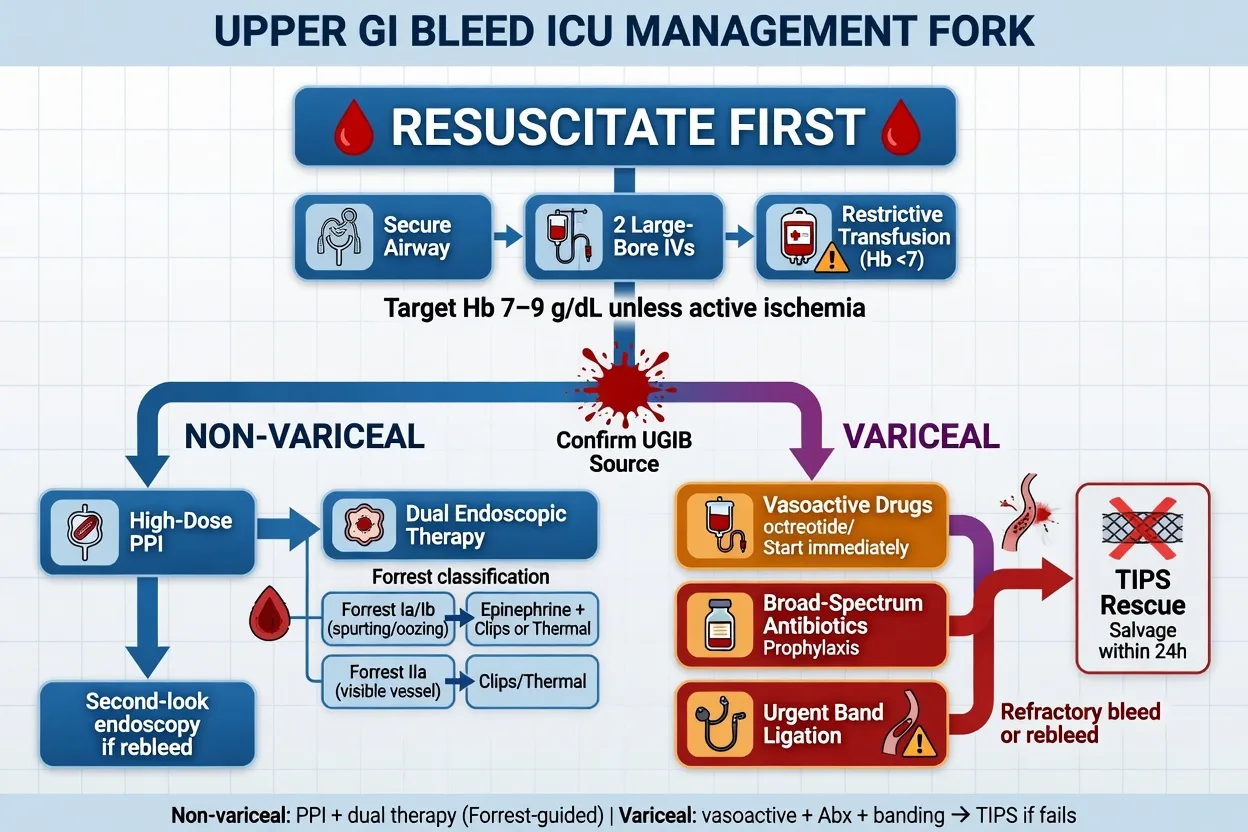
Clinically significant stress ulcer bleeding (overt GI bleeding with haemodynamic compromise, a drop in Hb ≥20 g/L, or requiring transfusion/intervention) is rare (0.1-4%) but serious. Management mirrors any acute upper GI bleed, with two differences: (1) vasoactive drugs (terlipressin/octreotide) are not indicated (no portal hypertension); (2) high-dose IV PPI infusion is central. [1]
Management of clinically significant stress ulcer bleeding
Resuscitate (ABC)
Airway (consider intubation if ongoing haematemesis / reduced GCS — aspiration risk). Two large-bore cannulae. Crystalloid then blood. RESTRICTIVE transfusion: Hb threshold 70 g/L (80 g/L if ischaemic heart disease). Crossmatch 4 units. Send FBC, coagulation, U&E, LFTs, lactate.
High-dose IV PPI — immediately
Pantoprazole 80 mg IV bolus then 8 mg/h infusion for 72h (regimen validated in non-variceal UGIB trials). For a patient already on a PPI for SUP, ESCALATE — do not simply continue 40 mg/day. Onset within ~1h.
Correct coagulopathy and thrombocytopenia
Stress ulcer bleeding is amplified by deranged haemostasis. Target INR <1.5, platelets >50. Give FFP, platelets, vitamin K/PCC as indicated; hold/reverse anticoagulants.
Upper GI endoscopy within 24h
After resuscitation and PPI loading. Identify source; apply haemostasis — adrenaline injection + mechanical (clips) or thermal coagulation for visible vessels/active bleed. Most stress ulcer bleeding stops with single endoscopic therapy.
Refractory bleeding — escalate
If endoscopic haemostasis fails or recurs: (1) repeat endoscopy, (2) interventional radiology — mesenteric angiography with embolisation, (3) surgery (under-running/wedge resection) as last resort — high mortality in the critically ill.
Supportive care
Maintain Hb >70, correct ionised calcium (citrate from transfusion → hypocalcaemia), keep the patient warm and coagulopathy-free (avoid the lethal triad — hypothermia, acidosis, coagulopathy). Re-evaluate SUP strategy — the patient now clearly meets an indication.
Definitions — what counts as "clinically significant": the SUP-ICU / PEPTIC / REVISE definition is overt GI bleeding (haematemesis, melaena, coffee-ground aspirate or blood via NG, or blood per rectum) PLUS one of: (a) drop in Hb ≥20 g/L within 24h, (b) haemodynamic compromise related to the bleed, or (c) need for ≥2 units of blood transfusion. "Coffee-ground" aspirate or guaiac-positive stool alone do NOT meet the bar — they are clinically insignificant. This matters because it is the endpoint the major trials used and the threshold for escalation.[1]
Exam practice
SAQ — Indications, agent choice and the PEPTIC/REVISE evidence
10 minutes · 10 marks
A 72-year-old man is admitted to ICU with severe community-acquired pneumonia and septic shock. He is intubated and ventilated (ICU Day 3) on noradrenaline 0.25 mcg/kg/min. Bloods: platelets 32 × 10⁹/L, INR 2.0, lactate 4.2 mmol/L. He is receiving enteral nutrition via NG at 60 mL/h. The registrar asks whether to start stress ulcer prophylaxis.
SAQ — Overt upper GI bleeding despite prophylaxis
10 minutes · 10 marks
A 55-year-old man, ICU Day 5, intubated for severe burns (40% TBSA — Curling ulcer risk), receiving pantoprazole 40 mg IV daily, develops melaena and a haemoglobin fall from 98 to 62 g/L with new haemodynamic instability (BP 88/50, HR 118).
SAQ — Interpreting the SUP-ICU trial at the bedside
10 minutes · 10 marks
A 68-year-old woman is admitted to ICU with aspiration pneumonia and septic shock requiring intubation and noradrenaline. Her ICU consultant asks you to justify starting pantoprazole 40 mg IV daily using the SUP-ICU trial, and to explain why a drug that does not reduce mortality is still worth giving.
SAQ — Choosing between a PPI and an H2-receptor antagonist
10 minutes · 10 marks
A 60-year-old man is intubated for ARDS. He is on dual antiplatelet therapy (aspirin + clopidogrel) following a recent drug-eluting stent. The registrar asks whether to use pantoprazole or famotidine for stress ulcer prophylaxis, and whether ranitidine could be used instead.
Clinical
pearls [1]
Red flags
[1]Key facts and memory aids
[1] [1]References
- [1]Krag M, Marker S, Perner A, Wetterslev J, Wise MP, et al. Pantoprazole in Patients at Risk for Gastrointestinal Bleeding in the ICU N Engl J Med, 2018.PMID 30354950
- [2]Young PJ, Bagshaw SM, Forbes AB, et al. (PEPTIC Investigators; ANZICS CTG) Effect of Stress Ulcer Prophylaxis With Proton Pump Inhibitors vs Histamine-2 Receptor Blockers on In-Hospital Mortality Among ICU Patients Receiving Invasive Mechanical Ventilation: The PEPTIC Randomized Clinical Trial JAMA, 2020.PMID 31950977
- [3]Cook D, Deane A, Lauzier F, Zytaruk N, et al. Stress Ulcer Prophylaxis during Invasive Mechanical Ventilation N Engl J Med, 2024.PMID 38875111
- [4]MacLaren R, Dionne JC, Granholm A, Alhazzani W, et al. Society of Critical Care Medicine and American Society of Health-System Pharmacists Guideline for the Prevention of Stress-Related Gastrointestinal Bleeding in Critically Ill Adults Crit Care Med, 2024.PMID 39007578
- [5]Cook DJ, Fuller HD, Guyatt GH, et al. (Canadian Critical Care Trials Group) Risk factors for gastrointestinal bleeding in critically ill patients. Canadian Critical Care Trials Group N Engl J Med, 1994.PMID 8284001
- [6]Cook D, Guyatt G, Marshall J, et al. (Canadian Critical Care Trials Group) A comparison of sucralfate and ranitidine for the prevention of upper gastrointestinal bleeding in patients requiring mechanical ventilation. Canadian Critical Care Trials Group N Engl J Med, 1998.PMID 9504939
- [7]Cook D, Heyland D, Griffith L, et al. (Canadian Critical Care Trials Group) Risk factors for clinically important upper gastrointestinal bleeding in patients requiring mechanical ventilation. Canadian Critical Care Trials Group Crit Care Med, 1999.PMID 10628631
- [8]Alhazzani W, Alshamsi F, Belley-Cote E, et al. Efficacy and safety of stress ulcer prophylaxis in critically ill patients: a network meta-analysis of randomized trials Intensive Care Med, 2018.PMID 29199388
- [9]Barletta JF, Sclar DA Proton pump inhibitors increase the risk for hospital-acquired Clostridium difficile infection in critically ill patients Crit Care, 2014.PMID 25540023
- [10]Barletta JF, El-Ibiary SY Proton Pump Inhibitors and the Risk for Hospital-Acquired Clostridium difficile Infection Mayo Clin Proc, 2013.PMID 24012413
- [11]Toews I, George AT, Peter JV Interventions for preventing upper gastrointestinal bleeding in people admitted to intensive care units Cochrane Database Syst Rev, 2018.PMID 29862492
- [12]Eads AV Pharmacists are key in interpreting clinical implications of N-nitrosodimethylamine contamination in medications J Am Pharm Assoc (2003), 2020.PMID 32741598