ICU ·
Toxic megacolon and acute severe colitis
Also known as Toxic megacolon · Acute severe ulcerative colitis (ASUC) · Fulminant colitis · C. difficile colitis · Pseudomembranous colitis · Toxic dilation of the colon · Truelove-Witts severe UC · Subtotal colectomy · Infliximab rescue · Cyclosporine rescue · CONSTRUCT trial
Toxic megacolon is a life-threatening complication of inflammatory colitis characterised by acute, non-obstructive, total or segmental colonic dilation (transverse colon diameter greater than or equal to 6 cm; caecum greater than 9 cm) accompanied by systemic toxicity. In the ICU the leading cause is Clostridioides difficile (pseudomembranous) colitis, followed by a severe flare of ulcerative colitis (the number-one cause overall), Crohn colitis, ischaemic colitis, and infectious colitis (CMV, Salmonella, Shigella, Campylobacter, E. coli O157:H7). Presentation: severe bloody diarrhoea, abdominal pain and distension, fever, tachycardia, and sepsis or peritonism. Diagnosis is radiographic (AXR or CT showing colonic dilation with loss of haustra, thumbprinting, mucosal oedema) plus the Jalan clinical criteria (at least three of fever over 38, HR over 120, WCC over 10.5, anaemia; plus at least one of dehydration, altered mental state, electrolyte disturbance, hypotension). Management: bowel rest with nasogastric and rectal tube decompression, aggressive IV fluid and electrolyte correction (K+, Mg2+), broad-spectrum antibiotics covering Gram-negatives and anaerobes plus intraluminal vancomycin if C. diff, IV hydrocortisone 100 mg Q6H for IBD flare (assess at day 3), AVOID opioids, anticholinergics and anti-diarrhoeals that worsen the ileus, DVT prophylaxis, and EARLY surgical referral. Steroid-refractory ASUC at day 3-5 receives rescue therapy with infliximab 5 mg/kg OR cyclosporine 2 mg/kg/day. Surgery (subtotal colectomy with end ileostomy) is mandated for perforation, peritonitis, uncontrolled bleeding, or refractory disease within 48-72 hours.
On this page & tools
Your progress
Saved locally on this device.
Target exams
Red flags

Overview & definition
Toxic megacolon is an acute, life-threatening complication of inflammatory colitis defined by non-obstructive, total or segmental colonic dilation (transverse colon diameter greater than or equal to 6 cm, or caecum greater than 9 cm on plain abdominal X-ray or CT) accompanied by systemic toxicity. The dilation reflects transmural inflammation that paralyses the colonic smooth muscle, allowing the gas-distended, inflamed colon to dilate; the inflamed, paper-thin wall then tears or perforates, converting a medical problem into a surgical emergency.[1]
The condition sits at the severe end of a continuum: mucosal colitis → transmural inflammation → colonic atony and dilation → bacterial translocation and sepsis → ischaemia, perforation, and peritonitis. Mortality rises sharply once perforation occurs (from roughly 5-15% to 30-50%), so the entire ICU strategy is built around early recognition, aggressive medical stabilisation, objective day-3 reassessment, and a low threshold for surgical rescue before perforation.[1][2]
Closely related, and managed with the same pathway, is acute severe ulcerative colitis (ASUC) — defined by the Truelove-Witts criteria — which may or may not yet have radiographic megacolon but carries the same risk of progression and the same steroid-first, surgery-ready algorithm. In the ICU the two are managed together.[2]
[1]Pathophysiology
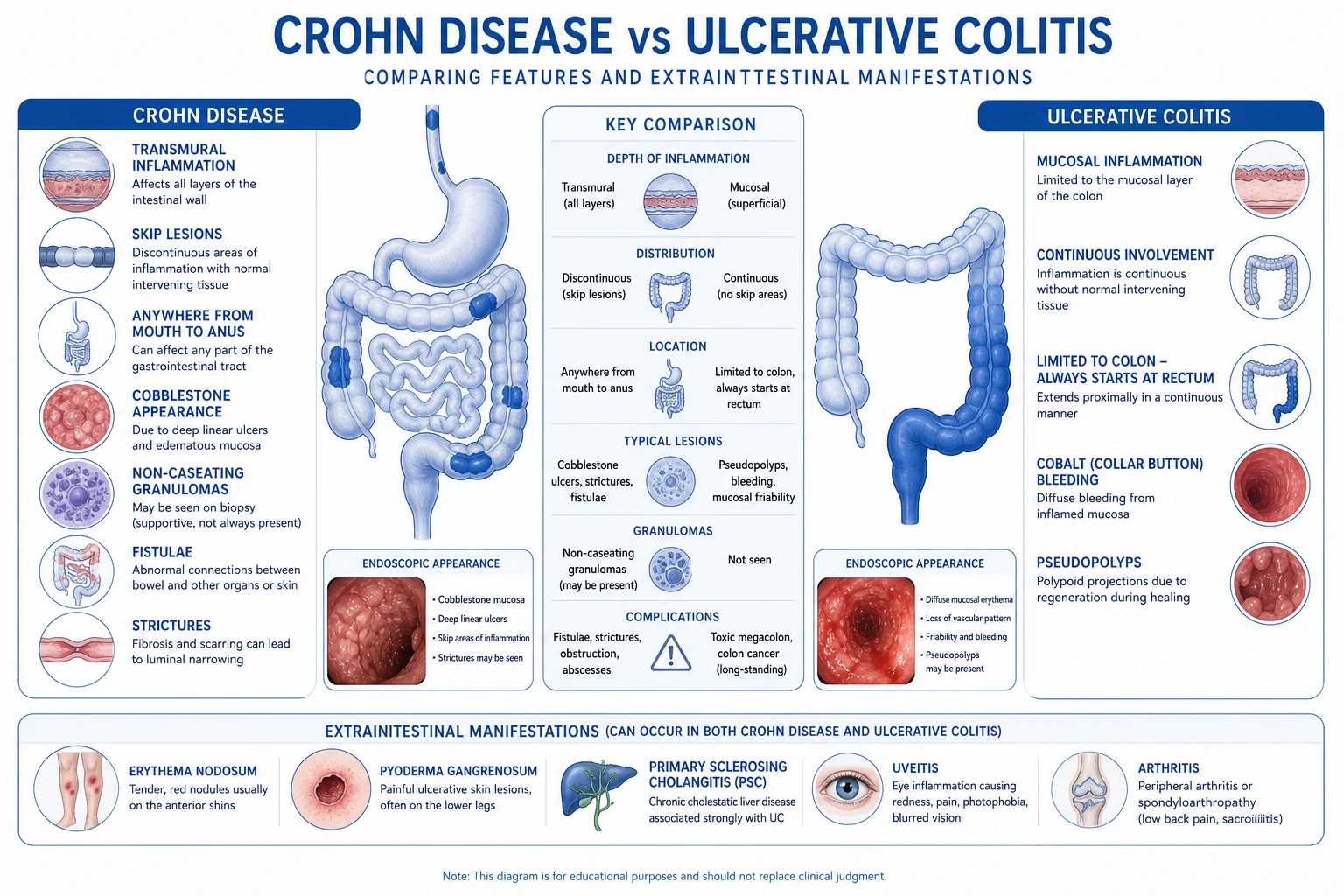
Understanding the mechanism explains every management decision: [1]
- Transmural extension of inflammation. In severe colitis the inflammatory process breaches the mucosa and extends into the muscularis propria and subserosa. The inflamed muscle becomes atonic and the neural plexus is damaged, so peristalsis fails and the gas-filled colon dilates passively.[1]
- The thin-walled, distended colon is the danger. Dilation stretches and thins the wall → relative ischaemia → necrosis and perforation. Perforation may be insidious (sealed, walled-off) or catastrophic (free air, faecal peritonitis, septic shock). Mortality after perforation is 30-50% versus 5-15% without.[1]
- Bacterial translocation and sepsis. The damaged mucosal barrier allows enteric organisms and toxin to translocate → bacteraemia, systemic inflammatory response, and multi-organ dysfunction. This is why broad-spectrum antibiotics are part of the bundle even when no single pathogen is yet identified.[8]
- Precipitants that worsen atony. Anything that further suppresses colonic motility tips a borderline colon into megacolon: opioids, anticholinergics, anti-diarrhoeals (loperamide, diphenoxylate), hypokalaemia, hypomagnesaemia, and invasive procedures during an active flare (colonoscopy, barium enema). Early tapering of steroids in IBD is another classic precipitant.[1]
The practical corollary: every one of these precipitants must be actively sought and reversed — replete potassium and magnesium, stop the opioids, avoid the anti-motility agent, and do not scope an unstable patient. [1]
Causes
The aetiology matters because it changes the management: IBD needs steroids and rescue therapy, C. difficile needs intraluminal vancomycin and infection control, CMV needs ganciclovir, and ischaemia may need resection.[1][8]
IBD
#1 cause overall
- Ulcerative colitis — the classic cause; often first presentation or a severe flare of known disease
- Crohn colitis — less common than UC but well recognised
- Risk increased by early steroid taper, severe first attack, and concomitant CMV superinfection
- Needs IV steroids + rescue therapy; surgery is subtotal colectomy
C. difficile
#1 cause in ICU
- Pseudomembranous colitis — the leading ICU cause; antibiotic-associated (clindamycin, fluoroquinolones, cephalosporins)
- Hypervirulent NAP1 / ribotype 027 strain — higher toxin, higher megacolon risk
- Fulminant disease: shock, ileus, megacolon, perforation
- Treatment: STOP offending antibiotic, ADD oral vancomycin 500 mg Q6H + IV metronidazole; soap-and-water hand hygiene (alcohol gel does NOT kill spores)
Other infectious
Always exclude
- CMV colitis — immunocompromised and IBD patients on steroids; biopsy for inclusion bodies, treat with ganciclovir
- Salmonella, Shigella, Campylobacter, E. coli O157:H7
- Entamoeba histolytica (travel history)
- Send stool culture, C. diff GDH + toxin (two-step), CMV PCR, and blood cultures on admission
Ischaemic
Elderly, vasculopathic
- Acute mesenteric ischaemia or ischaemic colitis can progress to megacolon
- Suspect in the elderly, vasculopathic, low-flow state, or post-cardiac-arrest patient
- CT angiogram to define vascular anatomy; often needs surgical resection rather than steroids
Diagnosis
Diagnosis rests on three pillars: radiographic evidence of dilation, the Jalan clinical criteria for systemic toxicity, and exclusion of mechanical obstruction (by definition toxic megacolon is non-obstructive).[1]
Radiographic features
Imaging approach in suspected toxic megacolon
Plain abdominal X-ray (AXR) — first test, repeat daily
Look for: colonic dilation (transverse colon >6 cm; caecum >9 cm), LOSS OF THE NORMAL HAUSTRAL PATTERN, THUMBPRINTING (mucosal oedema and submucosal haemorrhage), mural gas (pneumatosis), and FREE INTRAPERITONEAL GAS (perforation). The AXR is cheap, bedside, repeatable, and the cornerstone of daily monitoring.
CT abdomen/pelvis — for the unstable or diagnostic uncertainty
CT better defines wall thickening, pericolonic fat stranding, ascites, mesenteric vascular anatomy (to exclude ischaemia/obstruction), abscess, and contained vs free perforation. CT also excludes mechanical obstruction — a prerequisite for the diagnosis.
Erect CXR or lateral decubitus film
To detect free subdiaphragmatic gas (perforation) in the patient who cannot stand for an erect AXR. Even a small amount of free gas mandates urgent surgical review.
Limited flexible sigmoidoscopy (UNPREPPED, minimal insufflation)
NOT full colonoscopy — perforation risk. A limited, unprepped, low-insufflation sigmoidoscopy assesses severity (severe UC = spontaneous bleeding, deep ulcers), takes biopsies for CMV inclusion bodies, and identifies pseudomembranes (C. diff). Avoid if unstable or peritonitic.
Jalan criteria for toxic megacolon (the diagnostic standard)
[1]Laboratory workup
- FBC, CRP, U&E, LFTs, albumin, Mg, phosphate — anaemia, leucocytosis, and hypoalbuminaemia quantify severity; hypokalaemia and hypomagnesaemia both worsen atony and must be corrected.
- Stool: culture, C. difficile GDH + toxin A/B EIA (two-step), CMV PCR, ova/cysts/parasites.
- Blood cultures × 2 — before antibiotics if possible.
- Cross-match — at least 4 units; major haemorrhage is a recognised complication.
- Coagulation, group and save, VTE risk assessment.
- Lactate — a rising lactate signals ischaemia, perforation, or septic shock. [1]
Truelove-Witts criteria for acute severe UC (ASUC)
The companion diagnostic standard — identifies the severe colitis patient at risk of progressing to megacolon:[2]
[2]Travis day-3 objective criteria — the predictor of colectomy
The single most useful early decision tool. On day 3 of IV steroids, assess:[3]
[3]Differential diagnosis
The critical distinction is mechanical obstruction (excluded by definition in toxic megacolon) and Ogilvie syndrome (acute pseudo-obstruction, which is dilation WITHOUT toxicity and WITHOUT mucosal inflammation).[1]
Toxic megacolon
Inflammatory + toxic
- Non-obstructive dilation + systemic toxicity + mucosal inflammation
- Thumbprinting, loss of haustra, bloody diarrhoea
- Steroids (IBD), antibiotics + vancomycin (C. diff), surgery if refractory
- NEOSTIGMINE CONTRAINDICATED — inflamed colon perforates
Ogilvie (pseudo-obstruction)
Atonic, non-toxic
- Massive colonic dilation WITHOUT toxicity and WITHOUT mucosal inflammation
- Bedridden, elderly, post-op, electrolyte-disordered, opioid-exposed patient
- Conservative: correct electrolytes, stop opioids, NG + rectal tube, position changes
- Neostigmine IS the treatment (after excluding mechanical obstruction); colonoscopic decompression if refractory
Mechanical obstruction
Must be excluded
- Volvulus, tumour, stricture, hernia — dilation is proximal to a point of obstruction
- No mucosal inflammation; absent or reduced flatus/stool
- CT with contrast defines the level and cause
- Different management: decompression or resection of the obstructing lesion
Management
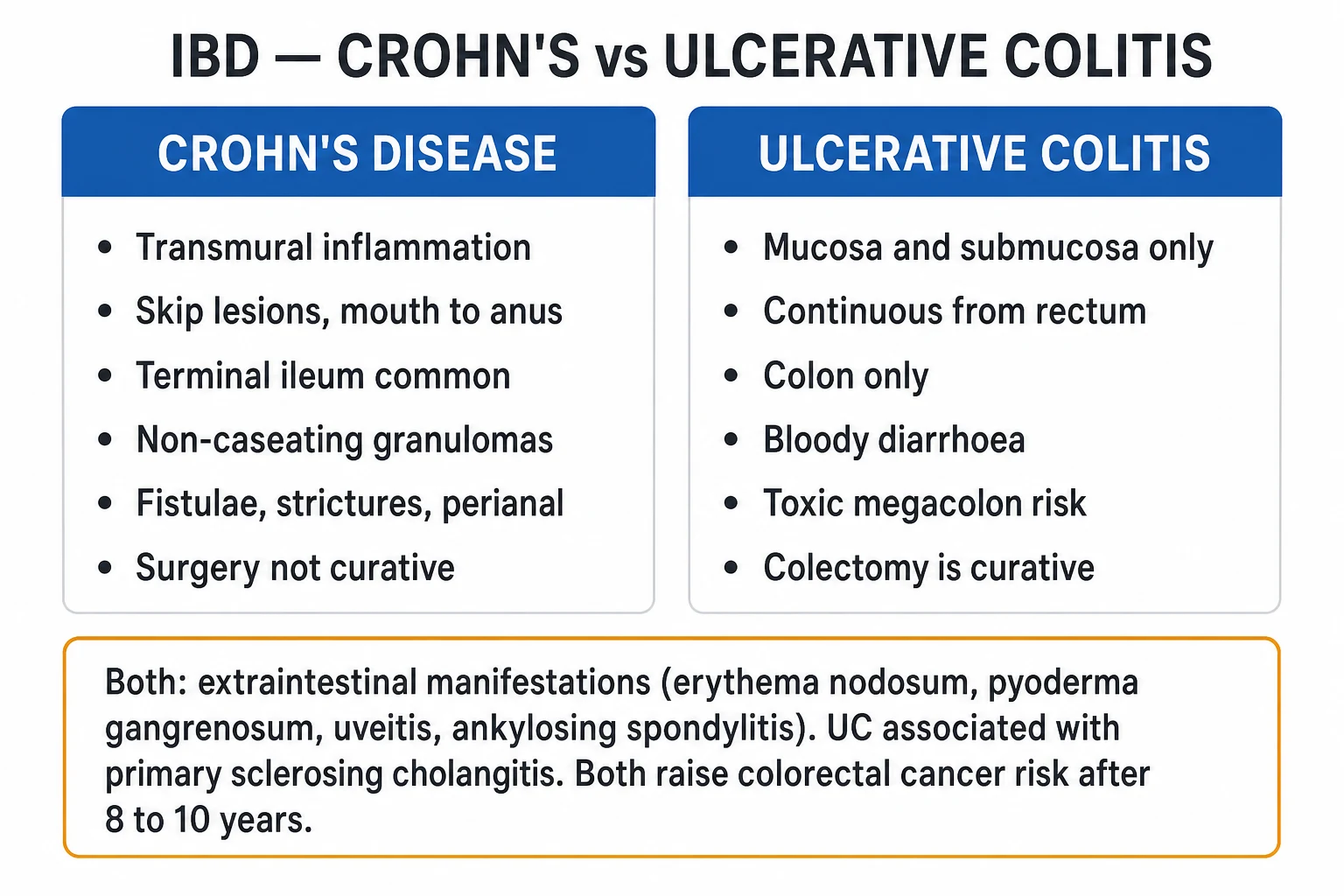
Management is a time-critical bundle run in parallel, not a sequence. The aims are: (1) resuscitate and reverse precipitants, (2) treat the underlying cause, (3) suppress the IBD inflammation, (4) monitor for perforation, and (5) be surgically ready.[1][2]
Toxic megacolon management bundle
1. Resuscitate + admit to HDU/ICU + NBM
Airway/breathing/circulation first. Large-bore IV access, supplemental O2, cardiac monitoring. Make the patient nil by mouth (bowel rest). Pass a NASOGASTRIC TUBE (decompresses upper GI, reduces swallowed air reaching the colon) and a RECTAL TUBE (decompresses the dilated colon directly). Catheterise and monitor urine output.
2. IV fluids + electrolyte correction (K+ and Mg2+)
Aggressive resuscitation — large losses from diarrhoea plus third-spacing into the inflamed gut. CORRECT HYPOKALAEMIA AND HYPOMAGNESAEMIA aggressively: both worsen colonic atony and precipitate/worsen megacolon. Replace albumin if low. Transfuse packed cells if Hb <70 g/L. Aim for a balanced crystalloid; monitor lactate and urine output.
3. STOP precipitating drugs
CEASE opioids, anticholinergics, anti-diarrhoeals (loperamide, diphenoxylate, codeine) — all worsen colonic atony. Review ALL medications for anticholinergic burden. In IBD do not abruptly stop steroids (precipitant itself) but switch to IV.
4. Broad-spectrum antibiotics (plus intraluminal vancomycin if C. diff)
Cover Gram-negatives AND anaerobes: piperacillin-tazobactam 4.5 g IV TDS OR ceftriaxone 2 g IV OD plus metronidazole 500 mg IV TDS. If C. difficile is suspected or confirmed (fulminant): ADD oral/NG VANCOMYCIN 500 mg Q6H (the higher 500 mg dose, not 125 mg, for fulminant disease) and consider rectal vancomycin enema if ileus. Fidaxomicin is an alternative. Continue IV metronidazole. Send stool for GDH + toxin and blood cultures.
5. IV corticosteroids — first-line for IBD-related megacolon
HYDROCORTISONE 100 mg IV Q6H (or methylprednisolone 40-60 mg IV daily). DO NOT use higher doses — no added benefit and more infection risk. THIS IS NOT a treatment for C. difficile megacolon. Reassess objectively on DAY 3 (Travis criteria). Continue steroids while awaiting response. Add a PPI for stress ulcer prophylaxis if NBM and ventilated.
6. VTE prophylaxis (do not forget)
Severe IBD carries a HIGH venous thromboembolism risk (active inflammation + immobility + dehydration). Give ENOXAPARIN 40 mg SC daily (or equivalent LMWH) UNLESS there is active life-threatening bleeding. Even frank rectal bleeding is not an absolute contraindication — discuss but default to prophylaxis.
7. Surgical consultation — EARLY, on day 1
Involve COLORECTAL SURGERY on the day of admission, not when perforation occurs. The surgeon needs to know the patient from day 1 to plan and counsel. Set the trigger criteria for surgery in advance: perforation, peritonitis, uncontrolled haemorrhage, failed rescue therapy, or worsening megacolon despite maximal medical therapy. The procedure is SUBTOTAL COLECTOMY with END ILEOSTOMY (Hartmann pouch) — never primary anastomosis in the acute, inflamed setting.
8. Daily monitoring bundle
DAILY AXR (monitor colonic diameter — risk rises above 10 cm); daily bloods (FBC, CRP, albumin, K+, Mg2+); daily abdominal examination (new peritonism = perforation until proven otherwise); accurate stool chart (frequency and blood); and regular observations. Reassess formally on day 3 using objective criteria (Travis).
9. Rescue therapy or surgery at day 3-5 if steroid-refractory
If no objective response to IV steroids by day 3 (or worsening), choose: (a) INFLIXIMAB 5 mg/kg IV infusion (anti-TNF; accessible, well tolerated), OR (b) CYCLOSPORINE 2 mg/kg/day IV continuous infusion (calcineurin inhibitor; monitor levels, renal function, BP, Mg2+). The two are EQUIVALENT in efficacy — pick by familiarity, monitoring capacity, and cost. DO NOT combine both. If rescue therapy fails or the patient deteriorates → SUBTOTAL COLECTOMY.
10. Nutrition and supportive care
Enteral nutrition is preferred if tolerated and may continue in many patients (does not worsen outcome). Reserve TPN for prolonged NBM or intolerance. Maintain glycaemic control, pressure-area care, and early mobilisation once stable. Plan the transition to maintenance therapy (azathioprine/6-MP, or anti-TNF continuation) after recovery.
Rescue therapy for steroid-refractory ASUC — the deep dive
Roughly 30-40% of ASUC patients do not respond to IV steroids by day 3-5 and need rescue medical therapy to avoid colectomy. Two agents are equivalent and interchangeable.[4][5][6][7]
Cyclosporine
Calcineurin inhibitor
- Dose: 2 mg/kg/day IV as a continuous infusion (lower than historical 4 mg/kg, equally effective, less toxic)
- Monitor: trough levels 150-300 ng/mL, renal function, BP, Mg2+ (hypomagnesaemia common), lipids
- Rapid onset (days), ~80% short-term response; bridge to oral ciclosporin or azathioprine
- Avoid in renal impairment, uncontrolled hypertension, pregnancy (teratogenic considerations)
Infliximab
Anti-TNF monoclonal
- Dose: 5 mg/kg IV infusion at weeks 0, 2, 6 (single dose often sufficient in acute setting)
- Monitor for infusion reaction; screen TB and hepatitis B first if not already done
- ~70% short-term response; convenient outpatient continuation as maintenance
- Preferred where ciclosporin monitoring (levels) is not feasible; lower logistic burden
Choice
Either is acceptable
- CYSIF and CONSTRUCT trials: NO significant difference in colectomy or QoL between the two
- Pick by centre familiarity, monitoring capacity, contraindications, and COST (cyclosporine cheaper)
- DO NOT combine (additive immunosuppression, infection, no added benefit)
- If rescue therapy fails or the patient deteriorates → SUBTOTAL COLECTOMY without delay
The pivotal trials
Lichtiger (NEJM 1994)
NEJM 1994
20 pts with severe UC refractory to IV steroids — cyclosporine 4 mg/kg/day vs placebo
Key finding
9/11 (82%) cyclosporine responders vs 0/9 placebo; placebo cross-overs responded, establishing cyclosporine as effective rescue
Practice change
Established IV cyclosporine as rescue therapy for steroid-refractory ASUC
CSC (Gastroenterology 2005)
Gastroenterology 2005
45 pts with severe-moderate UC not responding to 4-7 days steroids — infliximab 4-5 mg/kg vs placebo
Key finding
Colectomy 7/24 (29%) infliximab vs 14/21 (67%) placebo at 90 days
Practice change
Established infliximab as an alternative rescue therapy to cyclosporine
CYSIF (Lancet 2012)
Lancet 2012
115 pts with steroid-refractory severe UC — cyclosporine 2 mg/kg/day vs infliximab 5 mg/kg, open-label RCT
Key finding
No significant difference in treatment failure at day 98 (60% vs 54%); comparable colectomy and adverse events
Practice change
Either cyclosporine or infliximab acceptable; choose by familiarity and monitoring capacity
CONSTRUCT (HTA 2016)
Health Technol Assess 2016
UK pragmatic RCT — 270 pts steroid-resistant UC: cyclosporine vs infliximab, with economic evaluation
Key finding
No significant difference in QoL, symptoms, colectomy or death at 12 months; cyclosporine markedly cheaper
Practice change
Confirms equivalence; supports cyclosporine on cost grounds where monitoring is available
Travis (Gut 1996)
Gut 1996
Cohort of 49 consecutive severe UC admissions — derived objective day-3 predictors of colectomy
Key finding
Day-3 CRP >45 mg/L PLUS >8 stools/day = 85% colectomy on that admission
Practice change
Introduced objective day-3 reassessment to trigger rescue therapy or surgery early
IDSA/SHEA C. difficile 2017
Clin Infect Dis 2018
Multisociety guideline update for C. difficile infection, including the fulminant/megacolon presentation
Key finding
Fulminant C. diff: oral vancomycin 500 mg Q6H + IV metronidazole +/- rectal vancomycin enema + urgent surgical review
Practice change
Standardised the 500 mg (not 125 mg) vancomycin dose and dual therapy for fulminant disease
Surgical management
Surgery is definitive and potentially life-saving — the entire medical bundle exists to either avoid it or buy time until it can be done safely. The default operation is subtotal (total abdominal) colectomy with end ileostomy and a Hartmann pouch (rectal stump closed and left in situ).[1][2]
Surgical decision-making in toxic megacolon
Absolute indications for surgery (do not delay)
PERFORATION (free gas or confirmed), PERITONITIS (generalised), UNCONTROLLED COLORECTAL HAEMORRHAGE, and FRANK DETERIORATION with septic shock despite maximal medical therapy. These are not negotiable — operate.
Relative indications (judgement + multidisciplinary)
Worsening megacolon (diameter rising, especially >10 cm) despite 48-72 h of maximal medical therapy; failure of rescue therapy; failure to respond by day 5-7; or a patient who is deteriorating biochemically (rising CRP, lactate, WCC) even if clinically borderline.
Operation: subtotal colectomy + end ileostomy
Remove the entire colon (and typically the rectum is left as a Hartmann pouch). End ileostomy is matured at the skin. AVOID primary anastomosis in the acutely inflamed, malnourished, immunosuppressed patient — leak risk is prohibitive. A blow-hole (loop) ileostomy or chimney ileostomy is a damage-control option in the most unstable.
Postoperative course and second-stage planning
The rectal stump may "flare" — monitor the stump, drain it if dehiscence. After recovery, plan STAGED RECONSTRUCTION (ileoanal pouch or ileorectal anastomosis) once inflammation and nutrition are optimised, typically months later.
Monitoring and complications
[1]Toxic megacolon outcomes and thresholds
Recognised complications
- Colonic perforation — the dominant fatal complication; may be silent in the immunosuppressed/steroid-treated patient (maintain a high index of suspicion, rely on AXR free gas + lactate + repeat exam).
- Major haemorrhage — from deep ulceration; transfuse, consider urgent colectomy if uncontrolled.
- Septic shock and multi-organ failure — from bacterial translocation or perforation; manage per sepsis bundle.
- Acute kidney injury — from hypovolaemia, third-spacing, and sepsis; correct electrolytes aggressively.
- Venous thromboembolism — high risk; give prophylactic LMWH.
- CMV superinfection — consider and biopsy in the steroid-refractory IBD patient; treat with ganciclovir. [1]
Special scenarios
Prognosis
Outcomes hinge on three things: the underlying cause, the speed of escalation, and whether perforation occurs. Steroid-responsive ASUC has a good prognosis; perforated megacolon has a 30-50% mortality. The colectomy rate on the index admission is roughly 25-30%. Long term, patients who avoid colectomy need maintenance immunomodulator or biologic therapy to prevent relapse; patients who undergo subtotal colectomy may be considered for staged pouch reconstruction once recovered.[1][2][3]
Short-answer questions
SAQ — acute severe ulcerative colitis flare, steroid-refractory
10 minutes · 10 marks
A 28-year-old woman with known ulcerative colitis is admitted with 10 bloody stools per day, abdominal pain, and postural dizziness. On day 3 of IV hydrocortisone her CRP is 52 mg/L and she is still passing 9 bloody stools daily; she has become tachycardic (HR 118) and hypotensive (BP 96/58).
SAQ — toxic megacolon complicating C. difficile colitis
10 minutes · 10 marks
A 72-year-old man who recently finished a course of clindamycin presents with profuse bloody diarrhoea, abdominal distension, and confusion. He is febrile (38.9 C), tachycardic (128), hypotensive (92/55) with WCC 18. AXR shows a transverse colon diameter of 8 cm with loss of haustral markings.
Clinical pearls
Red flags
One-paragraph exam answer
Toxic megacolon is acute, non-obstructive colonic dilation (transverse colon ≥6 cm, caecum >9 cm) with systemic toxicity, defined by the Jalan criteria. C. difficile is the #1 ICU cause; UC the #1 cause overall; other causes include Crohn, CMV, ischaemic, and infectious colitis. Diagnosis is radiographic (AXR/CT — dilation, loss of haustra, thumbprinting, free gas if perforated) plus clinical (fever, tachycardia, leucocytosis, anaemia, AMS, hypotension). Management is a parallel bundle: NBM with NG and rectal tubes, IV fluids with aggressive K+/Mg2+ correction, STOP opioids/anticholinergics/anti-diarrhoeals, broad-spectrum antibiotics (plus intraluminal vancomycin 500 mg Q6H if C. diff), IV hydrocortisone 100 mg Q6H for IBD, VTE prophylaxis, and EARLY colorectal surgical referral. Daily AXR tracks the colonic diameter. Day-3 objective reassessment (Travis: CRP >45 + >8 stools → 85% colectomy) triggers rescue therapy with infliximab 5 mg/kg OR cyclosporine 2 mg/kg/day (equivalent; CYSIF, CONSTRUCT), or surgery (subtotal colectomy + end ileostomy) for perforation, peritonitis, uncontrolled bleeding, or refractory disease. Mortality is 5-15% unperforated, 30-50% if perforated — the whole strategy is to operate before the colon ruptures.[1][2][3][8]
References
- [1]Autenrieth DM, Baumgart DC Toxic megacolon Inflamm Bowel Dis, 2012.PMID 22009735
- [2]Seah D, De Cruz P Review article: the practical management of acute severe ulcerative colitis Aliment Pharmacol Ther, 2016.PMID 26725569
- [3]Travis SPL, Farrant JM, Ricketts C, et al Predicting outcome in severe ulcerative colitis Gut, 1996.PMID 8984031
- [4]Lichtiger S, Present DH, Kornbluth A, et al Cyclosporine in severe ulcerative colitis refractory to steroid therapy N Engl J Med, 1994.PMID 8196726
- [5]Jarnerot G, Hertervig E, Friis-Liby I, et al Infliximab as rescue therapy in severe to moderately severe ulcerative colitis: a randomized, placebo-controlled study Gastroenterology, 2005.PMID 15940615
- [6]Laharie D, Bourreille A, Branche J, et al Ciclosporin versus infliximab in patients with severe ulcerative colitis refractory to intravenous steroids: a parallel, open-label randomised controlled trial Lancet, 2012.PMID 23063316
- [7]Williams JG, Alam MF, Alrubaiy L, et al Comparison Of iNfliximab and ciclosporin in STeroid Resistant Ulcerative Colitis: pragmatic randomised Trial and economic evaluation (CONSTRUCT) Health Technol Assess, 2016.PMID 27329657
- [8]McDonald LC, Gerding DN, Johnson S, et al Clinical Practice Guidelines for Clostridium difficile Infection in Adults and Children: 2017 Update by the Infectious Diseases Society of America (IDSA) and Society for Healthcare Epidemiology of America (SHEA) Clin Infect Dis, 2018.PMID 29462280
- [9]Shibolet O, Regushevskaya E, Brezis M, Soares-Weiser K Cyclosporine A for induction of remission in severe ulcerative colitis Cochrane Database Syst Rev, 2005.PMID 15674937