ICU · Haematology / coagulation
Anticoagulants & Antiplatelets — Heparin, DOACs, Warfarin & Reversal
Also known as Heparin · Unfractionated heparin · UFH · LMWH · Enoxaparin · Fondaparinux · DOAC · Dabigatran · Rivaroxaban · Apixaban · Edoxaban · Warfarin · Protamine · Idarucizumab · Andexanet alfa · PCC · Four-factor PCC · Antiplatelet · Aspirin · Clopidogrel · Ticagrelor · Prasugrel · Heparin-induced thrombocytopenia · HIT · 4Ts score · Argatroban · Bivalirudin · HAS-BLED · Vitamin K · Phytomenadione
The anticoagulants and the antiplatelets in the ICU: the heparins (the UFH — the antithrombin-mediated IIa or Xa, the APTT monitoring, the protamine reversal 1 mg per 100 U; the LMWH — the anti-Xa, the enoxaparin 1 mg per kg BD, the partial protamine reversal about 60 per cent, the avoid the CrCl under 30; the fondaparinux — the not reversible); the DOACs (the dabigatran — the direct IIa — the idarucizumab 5 g; the apixaban, the rivaroxaban, the edoxaban — the direct Xa — the andexanet alfa or the PCC); the warfarin (the vitamin-K antagonist, the INR — the reversal the vitamin K 10 mg IV plus the PCC 25 to 50 IU/kg, the FFP the slower); the antiplatelets (the aspirin — the COX-1, the irreversible 7 to 10 days — the platelet transfusion; the clopidogrel, the prasugrel, the ticagrelor — the P2Y12 — the platelet transfusion); the heparin-induced thrombocytopenia (the 4Ts the score, the argatroban or the bivalirudin); the bleeding risk (the HAS-BLED). The reversal in the major bleed or the emergency surgery — the stop the agent, the specific the reversal (the protamine, the idarucizumab, the andexanet, the PCC plus the vitamin K, the platelets), the supportive.
On this page & tools
Your progress
Saved locally on this device.
8 MCQs with explanations
Target exams
Overview & definition
The anticoagulants (the heparins, the DOACs, the warfarin) and the antiplatelets (the aspirin, the P2Y12 inhibitors) are the commonest the drugs the implicated in the ICU bleeding AND the critical the thrombosis prevention. The reversal — the specific the agent per the class — is the high-yield the ICU knowledge. The know the agent, the monitor, and the specific the reversal for the each.[1]
The anticoagulant the classes differ by the the mechanism (the antithrombin-potentiation for the heparins; the direct the IIa or the Xa for the DOACs; the vitamin-K-epoxide-reductase for the warfarin), the the route of the clearance (the hepatic the reticuloendothelial for the UFH; the renal for the LMWH, the fondaparinux, the dabigatran — about 80 per cent renal), the the half-life (the 60 to 90 min for the UFH; the 4 to 5 h for the enoxaparin; the 7 to 11 h for the apixaban; the 5 to 13 h for the rivaroxaban; the 12 to 17 h for the dabigatran; the 36 to 42 h for the warfarin), and the the monitor (the APTT or the anti-Xa for the UFH; the INR for the warfarin; the nothing the routine for the DOACs). The two the bedside the questions — the which the agent AND the when the last the dose — the drive the reversal.[1][11]
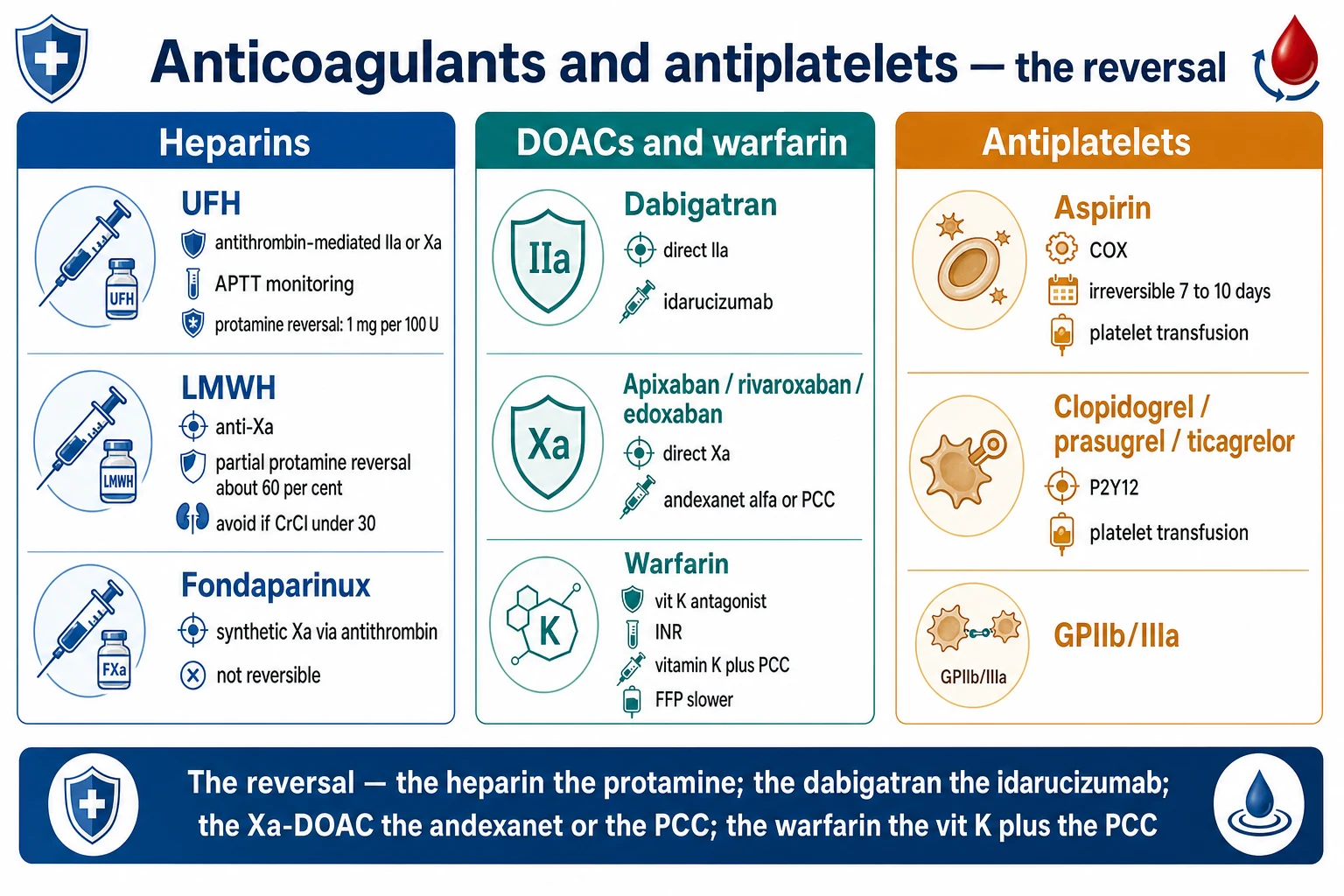
The heparins
The UFH (unfractionated heparin)
- The mechanism — the potentiates the antithrombin → the inactivates the thrombin (IIa) and the Xa.[1]
- The monitoring — the APTT (the target the 1.5 to 2.5 times the normal), or the anti-Xa in the heparin resistance.[1]
- The reversal — the protamine sulfate (the 1 mg per 100 units of the heparin; the within the 4 hours of the last the dose). The fully reversible. The caution — the hypotension, the anaphylaxis, the heparin-rebound.[1]
- The for — the VTE tx or prophylaxis, the ACS, the mechanical the valves, the ECMO, the renal the failure (the safer the than the LMWH). The short the half-life (the 60 to 90 min).[1]
The LMWH (enoxaparin, dalteparin)
- The mechanism — the anti-Xa the more the than the anti-IIa (the 4 to 1). The more the predictable, the SC, the longer the half-life.[1]
- The monitoring — the anti-Xa (the renal, the pregnancy, the obese, the elderly).[1]
- The reversal — the protamine the partial reversal (the 1 mg per 1 mg of the enoxaparin within the 8 hours; the about the 60 per cent). The not the fully reversible.[1]
- The caution — the avoid in the severe the renal failure (the CrCl the under 30) — the accumulation; the UFH the preferred.[1]
The fondaparinux
- The synthetic Xa inhibitor (the via the antithrombin). The NOT the reversible (the protamine the ineffective). The renal the excretion. The for the VTE prophylaxis, the HIT.[1]
The heparins — the head-to-head the dosing and the reversal
| The agent | The mechanism | The dose (the therapeutic) | The monitor | The clearance | The half-life | The reversal |
|---|---|---|---|---|---|---|
| The UFH | The antithrombin the potentiation (the IIa + the Xa) | The 80 units per kg the bolus then the 18 units per kg per h the infusion (the APTT-titrated) | The APTT (the 1.5 to 2.5×); the anti-Xa in the resistance (the 0.3 to 0.7 IU per mL) | The reticuloendothelial (the hepatic, the partial the renal) | The 60 to 90 min | The protamine 1 mg per 100 U (the last the 4 h); the fully the reversible |
| The enoxaparin (the LMWH) | The anti-Xa > the anti-IIa (the 4:1) | The 1 mg per kg SC the BD (the therapeutic); the 1.5 mg per kg the OD; the 40 mg the OD for the prophylaxis; the CrCl the under 30 → the 1 mg per kg the OD | The anti-Xa (the 0.5 to 1.0 IU per mL the BD-trough) in the renal, the obese, the pregnancy | The renal (the unchanged) | The 4 to 5 h | The protamine the partial (the 60 per cent) — the 1 mg per 1 mg within the 8 h |
| The dalteparin (the LMWH) | The anti-Xa > the anti-IIa | The 200 IU per kg the OD (the therapeutic); the 5000 IU the OD for the prophylaxis | The anti-Xa in the renal, the obese, the pregnancy | The renal | The 3 to 5 h | The protamine the partial (the 60 per cent) |
| The fondaparinux | The synthetic the Xa (the via the antithrombin) | The 7.5 mg SC the OD (the 5 mg under the 50 kg; the 10 mg over the 100 kg); the 2.5 mg for the prophylaxis | The anti-Xa (the calibrated) | The renal (the unchanged) | The 17 to 21 h | The NOT the reversible (the protamine the ineffective; the rFVIIa the case the reports) |
The heparin-induced thrombocytopenia (HIT)
The HIT — the the immune, the pro-thrombotic the adverse the effect of the heparin (the UFH > the LMWH; the fondaparinux the rarely). The the IgG the antibody the against the the platelet-the-factor-4 (PF4) the heparin the complex → the Fc-the-mediated the platelet the activation → the thrombocytopenia (the 5 to 14 the days; the fall the 50 per cent or the platelets the 50 to 80) AND the thrombosis (the venous the DVT/PE, the arterial the limb, the stroke, the MI; the 30 to 50 per cent the thrombosis; the 20 to 30 per cent the mortality). The the suspect the HIT in the the falling the platelets the 5 to 14 days the after the heparin (the sooner the if the prior the heparin the exposure the within the 30 days), the the platelet the fall the 50 per cent, the the thrombosis or the the skin the necrosis at the LMWH-the injection the sites, the the timing the rule-out-the-other the causes. The the 4Ts the score — the risk-the-stratify the BEFORE the laboratory.[8]
The 4Ts score — the clinical the probability of the HIT (the Warkentin; the Lo 2006)
| The 4T | The 2 points | The 1 point | The 0 points |
|---|---|---|---|
| The Thrombocytopenia | The fall the 50 per cent AND the nadir the 20 or the above | The fall the 30 to 50 per cent OR the nadir the 10 to 19 | The fall the under 30 per cent OR the nadir the under 10 |
| The Timing (of the platelet the fall) | The clear the onset the 5 to 10 days (or the 1 day the if the prior the heparin the within the 30 days) | The consistent the but the not the clear (the onset the after the day 10; the day 1 the but the prior the heparin the not the certain) | The under the day 4 the (the no the prior the exposure) OR the no the fall |
| The Thrombosis (or the other the sequelae) | The proven the new the thrombosis; the skin the necrosis; the acute the systemic the reaction the after the IV the heparin | The progressive, the recurrent, the silent, or the non-necrotising the skin the lesions | The none |
| The oTher (the cause of the thrombocytopenia) | The none the apparent | The possible | The definite |
The the score — the 0 to 3 the LOW (the 0 to 5 per cent); the 4 to 5 the INTERMEDIATE (the 10 to 20 per cent); the 6 to 8 the HIGH (the 40 to 80 per cent). The intermediate the OR the high → the the STOP the ALL the heparin (the UFH, the LMWH, the heparin-the flushes, the heparin-the coated the lines) AND the the start the alternative the non-heparin the anticoagulant (the argatroban OR the bivalirudin — the direct the thrombin the inhibitors; the danaparoid OR the fondaparinux — the anti-Xa). The send the the PF4-the ELISA (the screen) AND the the serotonin-the-release the assay (SRA) (the confirmatory). The the DO NOT the give the platelet the transfusion (the fuels the thrombosis) the unless the life-the-threatening the bleeding. The the DO NOT the bridge to the warfarin the until the platelets the recovered (the over the 150) — the warfarin the early the causes the skin the necrosis AND the venous the limb the gangrene (the protein-C the depletion the first).[8]
The argatroban (the direct thrombin inhibitor for the HIT)
- The mechanism — the small the molecule, the direct the thrombin the inhibitor (the IIa). The reversible.
- The dose — the 0.5 to 2 micrograms per kg per min the IV the infusion (the lower the 0.5 in the hepatic the failure; the titrate to the APTT the 1.5 to 3× the baseline, the maximum the 100 seconds).
- The clearance — the hepatic → the safe in the renal the failure (the PREFERRED the HIT-the anticoagulant the in the renal the failure).
- The monitoring — the APTT (the 1.5 to 3× the baseline; the check the 2 h the after the each the change). The the INR the ALSO the prolonged (the argatroban the raises the INR) — the challenging the warfarin the transition. The the transitional the overlap the 5 days the minimum, the INR the over the 4 (the on the both), the stop the argatroban, the recheck the INR the 4 to 6 h the after (the INR the drift).[7]
- The the Lewis 2003 — the argatroban the reduced the composite the endpoint (the death, the amputation, the new the thrombosis) the 34 per cent the vs the historical the control in the HIT.[7]
The bivalirudin (the direct thrombin inhibitor for the HIT)
- The mechanism — the direct the thrombin the inhibitor (the bivalent, the hirudin-the analogue).
- The dose — the 0.15 to 0.2 mg per kg per h the IV (the cardiac the catheterisation: the 0.75 mg per kg the bolus then the 1.75 mg per kg per h).
- The clearance — the enzymatic (the 80 per cent) AND the renal (the 20 per cent) — the dose-the-reduce the moderate the renal; the caution the severe.
- The monitoring — the APTT (the 1.5 to 2.5× the baseline).
- The for — the percutaneous the coronary the intervention (PCI) in the HIT; the alternative to the argatroban the in the hepatic the failure. [1]
The DOACs
The the direct the oral the anticoagulants (DOACs) — the the dabigatran (the direct the IIa) AND the the apixaban, the rivaroxaban, the edoxaban (the direct the Xa). The the predictable, the the fixed-the-dose, the the no the routine the monitoring, the the no the dietary the restriction, the the fewer the drug the interactions than the warfarin. The the reversal — the specific the per the agent. The the clearance — the dabigatran the 80 per cent the renal; the apixaban the 25 per cent the renal; the rivaroxaban the 33 per cent the renal (the one-the-third the renal, the two-the-thirds the hepatic); the edoxaban the 50 per cent the renal.[2]
The DOACs — the dose, the clearance, the reversal
| The DOAC | The target | The standard the dose | The renal the clearance | The half-life | The dialysable | The reversal |
|---|---|---|---|---|---|---|
| The dabigatran (the direct IIa) | The thrombin (IIa) | The 150 mg BD (the 110 mg BD the CrCl the 30 to 50; the 75 mg BD the CrCl the 15 to 30) | The ~80 per cent | The 12 to 17 h (the longer the renal) | The YES (the 50 to 60 per cent the removed) | The idarucizumab the 5 g IV (the Praxbind) |
| The apixaban (the direct Xa) | The Xa | The 5 mg BD (the 2.5 mg BD: the 2 of the age > 80, the weight the under 60, the creatinine the over 133) | The ~25 to 27 per cent | The 12 h | The NO (the protein-the-bound) | The andexanet alfa OR the 4F-PCC 50 IU per kg |
| The rivaroxaban (the direct Xa) | The Xa | The 20 mg OD (the 15 mg OD the CrCl the 15 to 50) | The ~33 per cent (the one-the-third the renal) | The 5 to 13 h (the 9 the elderly) | The NO (the protein-the-bound) | The andexanet alfa OR the 4F-PCC 50 IU per kg |
| The edoxaban (the direct Xa) | The Xa | The 60 mg OD (the 30 mg the CrCl the 15 to 50, the 60 kg or the under) | The ~50 per cent | The 10 to 14 h | The NO (the protein-the-bound) | The andexanet alfa OR the 4F-PCC 50 IU per kg |
The dabigatran (the direct thrombin inhibitor)
- The reversal — the idarucizumab (the Praxbind; the specific the monoclonal the antibody, the 5 g IV — the two 2.5 g the vials). The fully the reverses (the within the minutes).[5]
- The monitoring — the NOT the routine; the for the emergency → the thrombin time (the normal the excludes; the prolonged the confirms), the ecarin the clotting time, the anti-IIa.[5]
- The dialysis the removes the about the 50 to 60 per cent (the dialysable).[5]
- The the RE-LY (the Connolly 2009) — the dabigatran 150 mg BD the superior the to the warfarin for the stroke the prevention in the AF (the lower the intracerebral the haemorrhage); the dabigatran 110 mg BD the non-the-inferior (the lower the bleed).[2]
The apixaban, the rivaroxaban, the edoxaban (the direct Xa inhibitors)
- The reversal — the andexanet alfa (the Andexxa; the decoy the Xa protein the binds the drug) OR the PCC (the prothrombin complex concentrate, the 25 to 50 units per kg) if the andexanet the unavailable.[6]
- The monitoring — the NOT the routine; the for the emergency → the anti-Xa (the calibrated).[6]
- The NOT the dialysable (the protein-bound).[6]
- The the ARISTOTLE (the Granger 2011) — the apixaban 5 mg BD the superior the to the warfarin (the lower the stroke, the lower the bleeding, the lower the mortality).[4]
- The the ROCKET-AF (the Patel 2011) — the rivaroxaban 20 mg OD the non-the-inferior the to the warfarin; the less the intracerebral the haemorrhage; the more the GI the bleeding.[3]
The warfarin (the vitamin-K antagonist)
- The mechanism — the inhibits the vitamin-K the epoxide the reductase → the depletes the reduced the vitamin K → the impairs the gamma-the-carboxylation of the factors the II, the VII, the IX, the X AND the proteins C and S. The slow the onset (the days; the factor the II the half-life the 60 to 100 h). The the protein-C the depletion the first (the 8 h) → the transient the pro-thrombotic the state the days 1 to 3 (the skin the necrosis; the bridge the heparin the for the high-the-thrombotic).[1]
- The monitoring — the INR (the target the 2 to 3 for the most; the 2.5 to 3.5 for the mechanical the mitral the valve, the older the aortic the valves, the recurrent the VTE the on the warfarin).[1]
- The reversal (the by the INR and the bleeding):[1]
- The no the bleed, the INR the under 5 → the hold, the monitor.[1]
- The no the bleed, the INR the 5 to 9 → the hold plus the low-dose the oral the vitamin K (the 1 to 2.5 mg).[1]
- The no the bleed, the INR the over 9 → the hold plus the higher the vitamin K (the 5 to 10 mg the oral; the IV the if the rapid the needed).[1]
- The major the bleed → the 4F-PCC (the 25 to 50 units per kg — the rapid, the minutes) PLUS the IV the vitamin K (the 5 to 10 mg the slow — the takes the 6 to 12 h; the sustains). The FFP the slower (the volume the load, the thaw the time; the 15 mL per kg).[1]
- The the INCH (the Steiner 2016) — the PCC the superior the to the FFP for the warfarin-the-related the intracerebral the haemorrhage (the INR the normalisation the 67 per cent the PCC vs the 9 per cent the FFP).[1]
The warfarin reversal — the agent and the speed
| The agent | The onset | The duration | The dose | The role |
|---|---|---|---|---|
| The 4F-PCC (the Beriplex, the Octaplex) | The minutes | The hours (the factor VII the shortest the ~6 h) | The 25 IU per kg (INR 2 to 4), the 35 (INR 4 to 6), the 50 (INR > 6); the max the 50 IU per kg, the 5000 IU | The immediate the factor the replacement |
| The vitamin K (the phytomenadione) | The 6 to 12 h | The days to the weeks | The 10 mg the IV the slow (the 20 to 30 min the diluted) for the major the bleed; the 5 to 10 mg the oral for the asymptomatic the high-INR | The sustained the hepatic the synthesis (the prevents the rebound) |
| The FFP | The 30 to 60 min (the after the thaw) | The hours | The 15 mL per kg (the ~4 the units, the 1 L) | The fallback (the if the PCC the unavailable) |
The antiplatelets
- The aspirin — the the COX-1 the inhibitor → the irreversible the acetylation → the blocks the thromboxane the A2 (the TXA2) → the platelet the inhibition the 7 to 10 days (the life the of the platelet). The NO the specific the reversal; the platelet the transfusion for the bleeding or the emergency the surgery. The desmopressin (the DDAVP) the adjunct (the 0.3 micrograms per kg) for the mild the antiplatelet-the-related the bleeding.[1]
- The clopidogrel (the pro-the-drug; the CYP2C19; the irreversible), the prasugrel (the irreversible; the more the potent), the ticagrelor (the reversible; the direct; the cyclopentyl-the-triazolo-the-pyrimidine) — the P2Y12 the ADP-the-receptor the inhibitors → the block the ADP-the-mediated the platelet the activation. The clopidogrel or the prasugrel the irreversible; the ticagrelor the reversible (the binds the reversibly; the 3 to 5 days the off the time). The platelet the transfusion for the bleeding. The timing the matters — the transfuse the platelets the AFTER the drug the cleared (the clopidogrel the active the metabolite the persists the hours; the transfuse the 6 to 12 h the after the last the dose).[1]
- The GPIIb/IIIa inhibitors (the abciximab, the eptifibatide, the tirofiban) — the block the fibrinogen-the-cross-link the receptor → the platelet the transfusion for the bleeding.[1]
The antiplatelets — the mechanism, the recovery, the reversal
| The agent | The target | The reversibility | The off the time | The reversal |
|---|---|---|---|---|
| The aspirin | The COX-1 (the TXA2) | The irreversible (the acetylation) | The 7 to 10 days (the new the platelets) | The platelet the transfusion; the DDAVP the adjunct |
| The clopidogrel | The P2Y12 (the ADP) | The irreversible (the pro-the-drug; the CYP2C19) | The 5 to 7 days | The platelet the transfusion (the 6 to 12 h the after the last the dose) |
| The prasugrel | The P2Y12 | The irreversible (the more the potent) | The 5 to 7 days | The platelet the transfusion |
| The ticagrelor | The P2Y12 | The reversible (the direct) | The 3 to 5 days | The platelet the transfusion; the shorter the off the time |
| The abciximab / eptifibatide / tirofiban | The GPIIb/IIIa | The abciximab the long (the 24 to 48 h); the others the short (the 4 h) | The 4 to 48 h | The platelet the transfusion |
The bleeding risk — the HAS-BLED
The the HAS-BLED (the Pisters 2010, the Euro the Heart the Survey) — the predicts the one-year the major-the-bleeding the risk in the AF the patient the on the oral the anticoagulant. The the one the point the each (the maximum the 9):[9]
The HAS-BLED score — the 1-year the major-bleed the risk
| The letter | The criterion |
|---|---|
| H | The Hypertension (the systolic the over 160 mmHg) |
| A | The Abnormal the renal AND/OR the liver the function (the 1 the point the each; the maximum the 2) |
| S | The Stroke the history |
| B | The Bleeding the history or the predisposition (the anaemia) |
| L | The Labile the INR (the TTR the under 60 per cent) — the for the warfarin |
| E | The Elderly (the age the over 65) |
| D | The Drugs (the antiplatelet OR the NSAID) OR the alcohol the excess (the 1 the point the each; the maximum the 2) |
The the score — the 0 to 1 the LOW (the ~1 per cent); the 2 the MODERATE (the ~2 to 5 per cent); the 3 or the above the HIGH (the ~10 per cent the major the bleed; the ~12 per cent the at the 5). The the high the score the NOT the a the contraindication to the anticoagulant — the high-the-HAS-BLED the patient the also the high-the-CHA2DS2-the-VASc (the high the thrombotic); the the address the modifiable the factors (the BP, the INR the control, the alcohol, the concomitant the aspirin/NSAID). The the HAS-BLED the for the AF; the the ATRIA, the the ORT, the the HEMORR2HAGES the alternative the scores; the the OBRI the for the older.[9]
The bleeding-risk vs the thrombotic-risk — the balancing the decision
| The thrombotic the score | The bleed the risk the score | The decision |
|---|---|---|
| The CHA2DS2-the-VASc (the AF: the CCF, the HTN, the age the 65 to 74 = 1 / the over 75 = 2, the DM, the stroke/TIA, the vascular, the female) | The HAS-BLED | The high-the-thrombotic AND the high-the-bleed → the anticoagulant the STILL the indicated; the address the modifiable; the DOAC the preferred (the lower the intracerebral) |
| The 0 the (the male) OR the 1 the (the female) | The low | The no the anticoagulant (the aspirin the no the longer the recommended) |
| The 2 or the above | The any | The oral the anticoagulant (the DOAC the preferred the over the warfarin) |
The reversal in the major bleed — the protocol
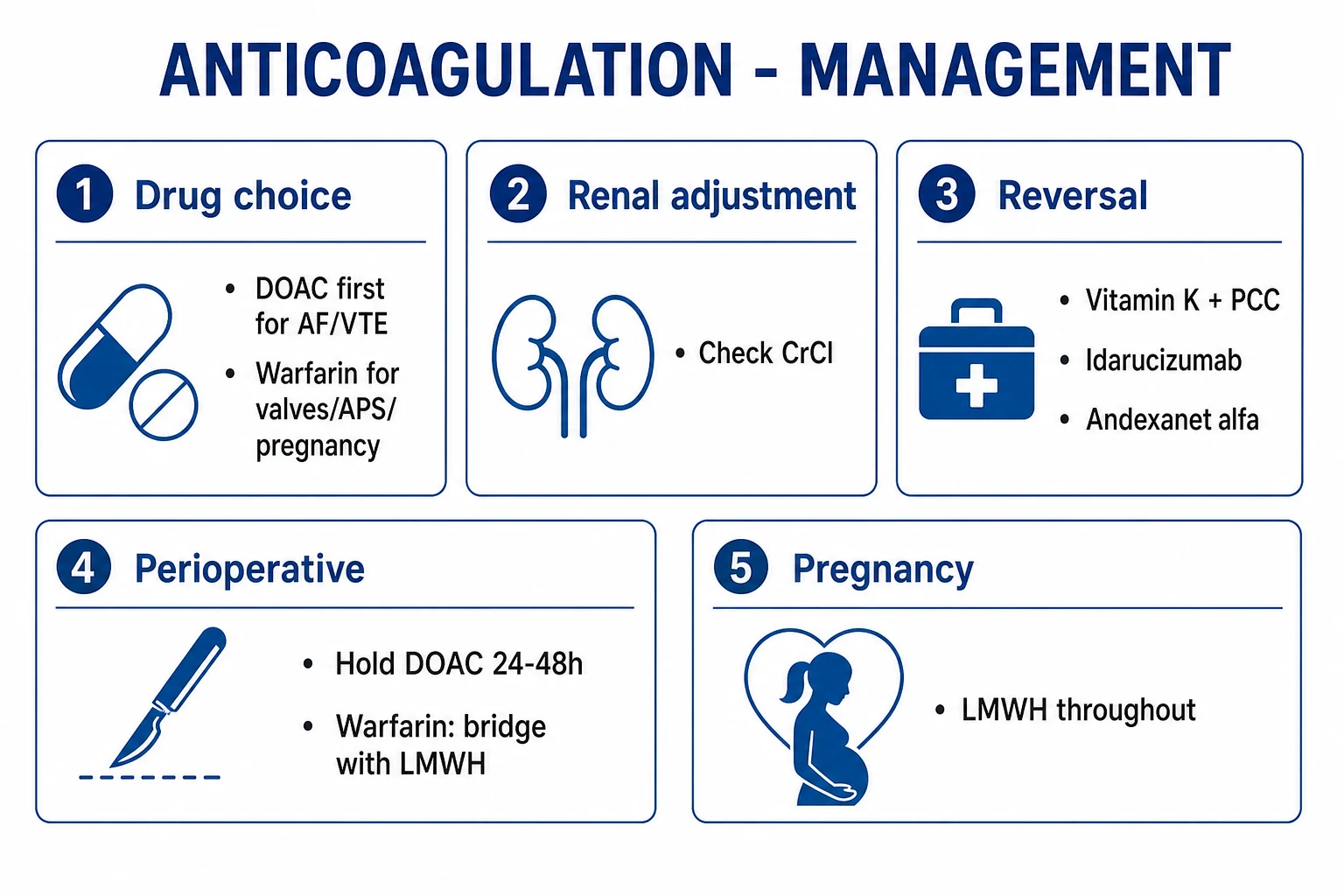
The the first the 30 minutes of the anticoagulant-the-related the major the bleed (the intracerebral, the retroperitoneal, the tamponade, the compartment, the massive the GI the shock). The the stop the agent, the the specific the reversal, the the supportive.[11]
The acute the anticoagulant-the-major-bleed the reversal — the first the 30 minutes
- The RECOGNISE AND the CLASSIFY the AGENT — the drug, the dose, the last the administration the time, the indication:
- The warfarin? The DOAC (the which — the dabigatran vs the rivaroxaban/the apixaban/the edoxaban)? The UFH or the LMWH or the fondaparinux?
- The severity — the life-the-threatening or the critical-the-organ (the ICH, the tamponade, the compartment, the shock)? The IF the YES the DO NOT the wait the levels.[11]
- The STOP the ALL the anticoagulant AND the the send the bloods — the FBC, the coag (the PT/INR, the APTT, the fibrinogen), the group-and-the-save, the crossmatch, the VBG the lactate, the renal, the LFT, the troponin. The draw the the BEFORE the reversal the sample (the drug the level, the anti-Xa, the TT the if the available) — the send the if the agent the uncertain.[11]
- The DELIVER the SPECIFIC the REVERSAL the WITHOUT the DELAY (the by the class):
- The warfarin — the 4F-PCC 25 to 50 IU per kg AND the vitamin K 10 mg the IV the slow.
- The dabigatran — the idarucizumab 5 g IV (the two 2.5 g the vials); the haemodialysis the adjunct the if the idarucizumab the unavailable.
- The apixaban/the rivaroxaban/the edoxaban — the andexanet alfa (the low- or the high-the-dose the regimen) OR the 4F-PCC 50 IU per kg the if the andexanet the unavailable.
- The UFH — the protamine 1 mg per 100 U (the last the 4 h; the max the 50 mg per the dose).
- The LMWH (the enoxaparin) — the protamine 1 mg per 1 mg the within the 8 h (the partial — the 60 per cent).
- The antiplatelets (the aspirin, the clopidogrel) — the platelet the transfusion (the 1 the adult the dose) for the ICH or the emergency the surgery; the DDAVP 0.3 micrograms per kg the adjunct.[11]
- The SUPPORTIVE the resuscitation — the airway, the breathing, the circulation; the two the large-bore the cannulae; the goal the MAP the 65 mmHg; the permissive the hypotension (the systolic the 80 to 90) the until the controlled; the tranexamic the acid 1 g the IV (the if the trauma); the activate the massive-the-transfusion the protocol the if the shock.[11]
- The SOURCE the CONTROL — the CT (the ICH → the neurosurgery; the aortic → the vascular; the GI → the endoscopy); the surgical the opinion the early.[11]
- The MONITOR AND the PLAN the RE-ANTICOAGULATION — the recheck the INR/the anti-Xa/the TT the at the 30 min, the 6, the 12, the 24 h. The document the thrombotic the indication (the AF, the mechanical the valve, the recent the VTE). The plan the re-anticoagulation the timing (the ICH the typically the day 7 to 14; the mechanical the valve the earlier the with the heparin the bridging; the GI the bleed the day 7).[10]
The reversal agent — the dose, the onset, the cap
| The agent | The dose | The onset | The cap / the caution |
|---|---|---|---|
| The protamine (the UFH) | The 1 mg per 100 U of the UFH (the last the 4 h) | The minutes | The max the 50 mg per the dose; the max the 5 mg per the min; the fish-the-allergy, the NPH-the-insulin the caution |
| The protamine (the LMWH) | The 1 mg per 1 mg of the enoxaparin (the within the 8 h) | The minutes | The partial (the 60 per cent); the re-dose the 0.5 mg per mg the 2 to 3 h the later the if the bleeding |
| The idarucizumab (the dabigatran) | The 5 g IV (the two 2.5 g the vials) | The minutes | The additional the 2.5 g the if the recurrence; the thrombotic the risk the afterwards |
| The andexanet alfa (the Xa-DOAC) | The low-the-dose (the 400 mg the bolus + the 480 mg the infusion the 120 min) OR the high-the-dose (the 800 + the 960) the by the drug/the dose/the timing | The minutes | The ~10 per cent the thrombosis; the incompatible the with the heparin |
| The 4F-PCC (the Xa-DOAC the fallback; the warfarin) | The 25 to 50 IU per kg (the Xa-DOAC: the 50; the warfarin: the INR-the-based) | The minutes | The thrombosis; the heparin-the-containing the unless the brand the heparin-the-free |
| The vitamin K (the warfarin) | The 10 mg the IV the slow (the 20 to 30 min the diluted) | The 6 to 12 h | The anaphylactoid (the rare); the slow-the-infuse; the sustained (the prevents the rebound) |
| The FFP (the fallback) | The 15 mL per kg (the ~4 the units) | The 30 to 60 min (the after the thaw) | The TRALI, the TACO, the volume the load; the inferior (the INCH) |
| The platelets (the antiplatelets) | The 1 the adult the dose (the 1 the pool or the 1 the apheresis the unit) | The minutes | The transfuse the AFTER the drug the cleared (the clopidogrel the 6 to 12 h); the no the HIT the platelet the transfusion |
Exam practice — SAQs
SAQ — Major intracerebral haemorrhage on warfarin and on dabigatran
10 minutes · 10 marks
A 76-year-old woman on warfarin for atrial fibrillation (INR target 2 to 3) is brought to the ED with a 90-minute history of right-sided weakness and slurred speech. GCS 11. CT brain shows a 35 mL left basal ganglia intracerebral haemorrhage with NO midline shift. INR 7.2, platelets 210, fibrinogen normal. Her neighbour, on the same ward, is a 68-year-old man on dabigatran 150 mg BD for AF who also presents with a spontaneous ICH of similar size.
SAQ — Heparin-induced thrombocytopenia on day 9 of ICU admission
10 minutes · 10 marks
A 58-year-old man on ICU for 9 days after aortic valve replacement was on UFH then enoxaparin for VTE prophylaxis. On day 7 his platelets fell from 220 to 88 (a 60 per cent drop). Today (day 9) his platelets are 62 and he has developed a swollen, painful right leg with a palpable calf cord. He was started on UFH again yesterday for a line flush.
SAQ — Antiplatelet reversal in spontaneous intracerebral haemorrhage on dual antiplatelet therapy
10 minutes · 10 marks
A 71-year-old man is brought to the ED with acute left-sided weakness and dysphasia. Six weeks ago he had a drug-eluting stent to the LAD and now takes aspirin 100 mg daily and ticagrelor 90 mg twice daily. GCS 12 (E3 V4 M5). CT brain shows a 25 mL right thalamic intracerebral haemorrhage with no intraventricular extension. BP 178/96. Platelets 245, INR 1.0, fibrinogen normal.
SAQ — Andexanet alfa reversal of apixaban in intracerebral haemorrhage
10 minutes · 10 marks
A 68-year-old woman on apixaban 5 mg twice daily for non-valvular atrial fibrillation (CHA2DS2-VASc 4; weight 78 kg, creatinine 80 micromol/L; last apixaban dose 3 hours ago) is brought in with a sudden severe headache and a declining GCS. CT brain shows a 40 mL left parietal intracerebral haemorrhage with intraventricular extension. BP 168/92. The hospital stocks andexanet alfa.
Red flags
The landmark the trials
Steiner 2016 — INCH: the PCC vs the FFP for the warfarin-the-related the intracerebral the haemorrhage (PMID 27302126)
Source
Lancet Neurology — the randomised, the multicentre, the open-label the trial
Patients
The 50 the patients the vitamin-K-the-antagonist-the-related the intracerebral the haemorrhage (the VKA-the-ICH)
Design
The 4F-PCC 30 IU per kg PLUS the vitamin K vs the FFP 20 mL per kg PLUS the vitamin K
Primary the outcome
The INR the normalisation (the ≤ 1.2 the at the 3 h) — the 67 per cent the PCC vs the 9 per cent the FFP
Safety
The stopped the early for the safety — the FFP the haematoma-the-expansion the deaths
Clinical the bottom the line
The 4F-PCC (the NOT the FFP) the standard the of the care for the warfarin-the-related the life-the-threatening the bleed
Connolly 2009 — RE-LY: the dabigatran vs the warfarin in the AF (PMID 19717844)
Source
New England Journal of Medicine — the randomised, the open-label, the non-inferiority, the 18,113 the patients
Design
The dabigatran 150 mg BD OR the 110 mg BD vs the warfarin (the INR the 2 to 3)
Result
The 150 mg the SUPERIOR (the lower the stroke, the lower the intracerebral the haemorrhage, the similar the major the bleed); the 110 mg the non-inferior (the lower the bleed)
Reversal
The dabigatran — the NO the antidote the at the time (the idarucizumab the later, the 2015)
Clinical the bottom the line
The dabigatran 150 mg BD the superior the to the warfarin for the stroke the prevention in the AF
Patel 2011 — ROCKET-AF: the rivaroxaban vs the warfarin in the non-valvular AF (PMID 21830957)
Source
New England Journal of Medicine — the randomised, the double-blind, the 14,264 the patients
Design
The rivaroxaban 20 mg OD (the 15 mg OD the CrCl the 30 to 50) vs the warfarin (the INR the 2 to 3)
Result
The non-inferior (the NOT the superior); the less the intracerebral the haemorrhage AND the critical-the-organ the bleed; the more the GI the bleeding AND the transfusion-the-bleed
Clinical the bottom the line
The rivaroxaban the once-the-daily the alternative the to the warfarin; the GI-the-bleeding the caution
Granger 2011 — ARISTOTLE: the apixaban vs the warfarin in the AF (PMID 21870978)
Source
New England Journal of Medicine — the randomised, the double-blind, the 18,201 the patients
Design
The apixaban 5 mg BD (the 2.5 mg BD the 2 of: the age the over 80, the weight the under 60 kg, the creatinine the over 133) vs the warfarin
Result
The SUPERIOR — the lower the stroke, the lower the major the bleeding, the lower the intracerebral the haemorrhage, the lower the all-the-cause the mortality
Clinical the bottom the line
The apixaban the preferred the DOAC for the AF (the superiority the across the stroke, the bleed, the mortality)
Pollack 2017 — RE-VERSE AD: the idarucizumab for the dabigatran the reversal (PMID 28693366)
Source
New England Journal of Medicine — the prospective, the open-label, the single-the-group, the 503 the patients
Patients
The dabigatran-the-associated the serious the bleed OR the requiring the urgent the surgery
Design
The idarucizumab 5 g IV (the two 2.5 g the vials)
Result
The near-the-complete the dabigatran-the-concentration the reversal (the 88 to 98 per cent the at the 4 h); the haemostasis the good; the thrombotic the events the 4.8 per cent the at the 30 days; the mortality the 13.5 per cent the at the 90 days
Clinical the bottom the line
The definitive the reversal for the dabigatran — the 5 g IV, the near-the-instant; the life-the-threatening the bleed OR the emergency the surgery
Connolly 2019 — ANNEXA-4: the andexanet alfa for the Xa-the-inhibitor the bleeding (PMID 30730782)
Source
New England Journal of Medicine — the prospective, the open-label, the single-the-group, the 352 the patients
Patients
The acute the major the bleed the within the 18 h of the apixaban or the rivaroxaban
Design
The andexanet alfa the bolus PLUS the 120-min the infusion (the low- OR the high-the-dose the by the drug/the dose/the timing)
Result
The 82 per cent the excellent/the-good the haemostasis; the 92 per cent the anti-the-fXa-the-activity the reduction; the ~10 per cent the thrombotic the events the at the 30 days
Clinical the bottom the line
The evidence the base for the andexanet the in the life-the-threatening the apixaban/the rivaroxaban the bleed; the reserve the for the critical the bleeds (the thrombotic the cost)
Lewis 2003 — the argatroban in the HIT (PMID 12912723)
Source
Archives of Internal Medicine — the prospective, the historical-the-controlled, the 189 the patients
Patients
The HIT (the confirmed OR the suspected); the comparison the to the historical the controls
Design
The argatroban the IV (the APTT the 1.5 to 3× the baseline)
Result
The lower the composite the of the death, the amputation, the new the thrombosis (the 34 per cent the vs the 43 per cent); the more the bleeding (the minor); the no the reversal the needed
Clinical the bottom the line
The argatroban the effective the for the HIT; the hepatic-the-clearance (the safe the in the renal the failure); the INR-the-prolongation the challenges the warfarin the transition
Lo 2006 — the 4Ts score for the HIT the diagnosis (PMID 16634744)
Source
Journal of Thrombosis and Haemostasis — the prospective, the two-the-cohort, the validation
Patients
The 406 the patients the across the two the clinical the settings
Design
The 4Ts the clinical-the-probability the score (the thrombocytopenia, the timing, the thrombosis, the other the cause) — the compared the to the SRA-the-confirmed the HIT
Result
The low the 4Ts (the 0 to 3) — the 0 to 5 per cent the HIT; the intermediate (the 4 to 5) — the 10 to 20 per cent; the high (the 6 to 8) — the 40 to 80 per cent
Clinical the bottom the line
The low the 4Ts the reliably the rules-the-out the HIT — the laboratory the testing the for the intermediate OR the high
Pisters 2010 — HAS-BLED: the bleeding-the-risk the score for the AF (PMID 20299623)
Source
Chest — the Euro the Heart the Survey, the 3,978 the patients the with the AF
Design
The HAS-BLED the score (the hypertension, the abnormal the renal/the liver, the stroke, the bleeding, the labile the INR, the elderly, the drugs/the alcohol)
Result
The score the 0 to 1 the ~1 per cent; the 2 the ~2 to 5 per cent; the ≥ 3 the ~10 per cent the major the bleed the at the 1 year
Clinical the bottom the line
The HAS-BLED the simple, the validated; the high the NOT the a the contraindication — the address the modifiable the factors
Kuramatsu 2018 — the mechanical-the-valve AND the intracerebral the bleed (PMID 29529259)
Source
European Heart Journal — the retrospective the multicentre, the 206 the mechanical-the-valve the patients
Patients
The mechanical the heart valve AND the intracerebral the haemorrhage the on the oral the anticoagulant
Result
The earlier the re-anticoagulation (the day 5 to 7, the heparin-the-bridged) the lower the thrombotic the complications (the valve the thrombosis, the ischaemic the stroke) AND the acceptable the re-bleed
Clinical the bottom the line
The mechanical-the-valve the patient — the do NOT the delay the re-anticoagulation the past the 2 weeks; the day 5 to 7 the with the bridging
Pitfalls
Clinical pearls
Prognosis
The anticoagulant-the-related the major the bleed the mortality the 10 to 20 per cent (the intracerebral the 40 per cent; the warfarin-the-related the higher). The timely the specific the reversal the reduces the haematoma-the-expansion AND the mortality. The re-anticoagulation the balance — the premature → the re-bleed; the delayed → the thrombosis (the mechanical-the-valve the highest the risk). The DOACs the overall the lower the fatal-the-bleeding AND the intracerebral the haemorrhage the vs the warfarin. The HIT the mortality the 20 to 30 per cent (the thrombosis the 30 to 50 per cent); the early the recognition AND the argatroban/the bivalirudin the reduce. The HAS-BLED the high the modifiable-the-factors the addressed → the lower the re-bleed. [1]
References
- [1]Steiner T, Poli S, Griebe M, et al. Fresh frozen plasma versus prothrombin complex concentrate in patients with intracranial haemorrhage related to vitamin K antagonists (INCH): a randomised trial Lancet Neurol, 2016.PMID 27302126
- [2]Connolly SJ, Ezekowitz MD, Yusuf S, et al. Dabigatran versus warfarin in patients with atrial fibrillation N Engl J Med, 2009.PMID 19717844
- [3]Patel MR, Mahaffey KW, Garg J, et al. Rivaroxaban versus warfarin in nonvalvular atrial fibrillation N Engl J Med, 2011.PMID 21830957
- [4]Granger CB, Alexander JH, McMurray JJ, et al. Apixaban versus warfarin in patients with atrial fibrillation N Engl J Med, 2011.PMID 21870978
- [5]Pollack CV Jr, Reilly PA, van Ryn J, et al. Idarucizumab for Dabigatran Reversal - Full Cohort Analysis N Engl J Med, 2017.PMID 28693366
- [6]Connolly SJ, Crowther M, Eikelboom JW, et al. Full Study Report of Andexanet Alfa for Bleeding Associated with Factor Xa Inhibitors N Engl J Med, 2019.PMID 30730782
- [7]Lewis BE, Wallis DE, Leya F, et al. Argatroban anticoagulation in patients with heparin-induced thrombocytopenia Arch Intern Med, 2003.PMID 12912723
- [8]Lo GK, Juhl D, Warkentin TE, et al. Evaluation of pretest clinical score (4 T's) for the diagnosis of heparin-induced thrombocytopenia in two clinical settings J Thromb Haemost, 2006.PMID 16634744
- [9]Pisters R, Lane DA, Nieuwlaat R, et al. A novel user-friendly score (HAS-BLED) to assess 1-year risk of major bleeding in patients with atrial fibrillation: the Euro Heart Survey Chest, 2010.PMID 20299623
- [10]Kuramatsu JB, Sembill JA, Gerner ST, et al. Management of therapeutic anticoagulation in patients with intracerebral haemorrhage and mechanical heart valves Eur Heart J, 2018.PMID 29529259
- [11]Tomaselli GF, Mahaffey KW, Cuker A, et al. 2020 ACC Expert Consensus Decision Pathway on Management of Bleeding in Patients on Oral Anticoagulants: A Report of the American College of Cardiology Solution Set Oversight Committee J Am Coll Cardiol, 2020.PMID 32680646