ICU · haematology-coagulation
Acute Severe Anticoagulation Reversal — Warfarin, DOACs & Heparin in the ICU
Also known as Anticoagulation reversal · Warfarin reversal · DOAC reversal · Dabigatran reversal · Idarucizumab · Andexanet alfa · Prothrombin complex concentrate · PCC · Protamine · Major bleeding on anticoagulants
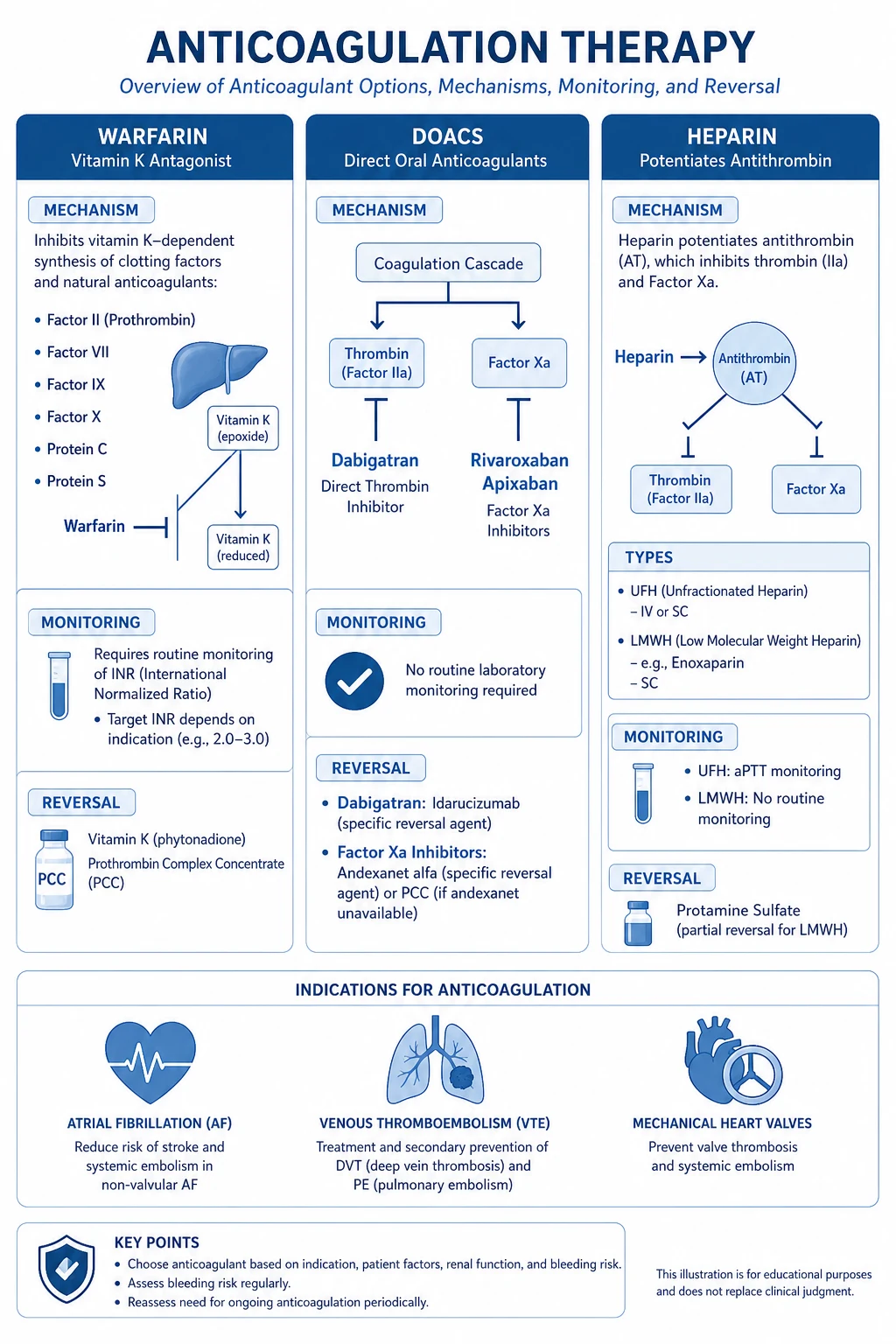
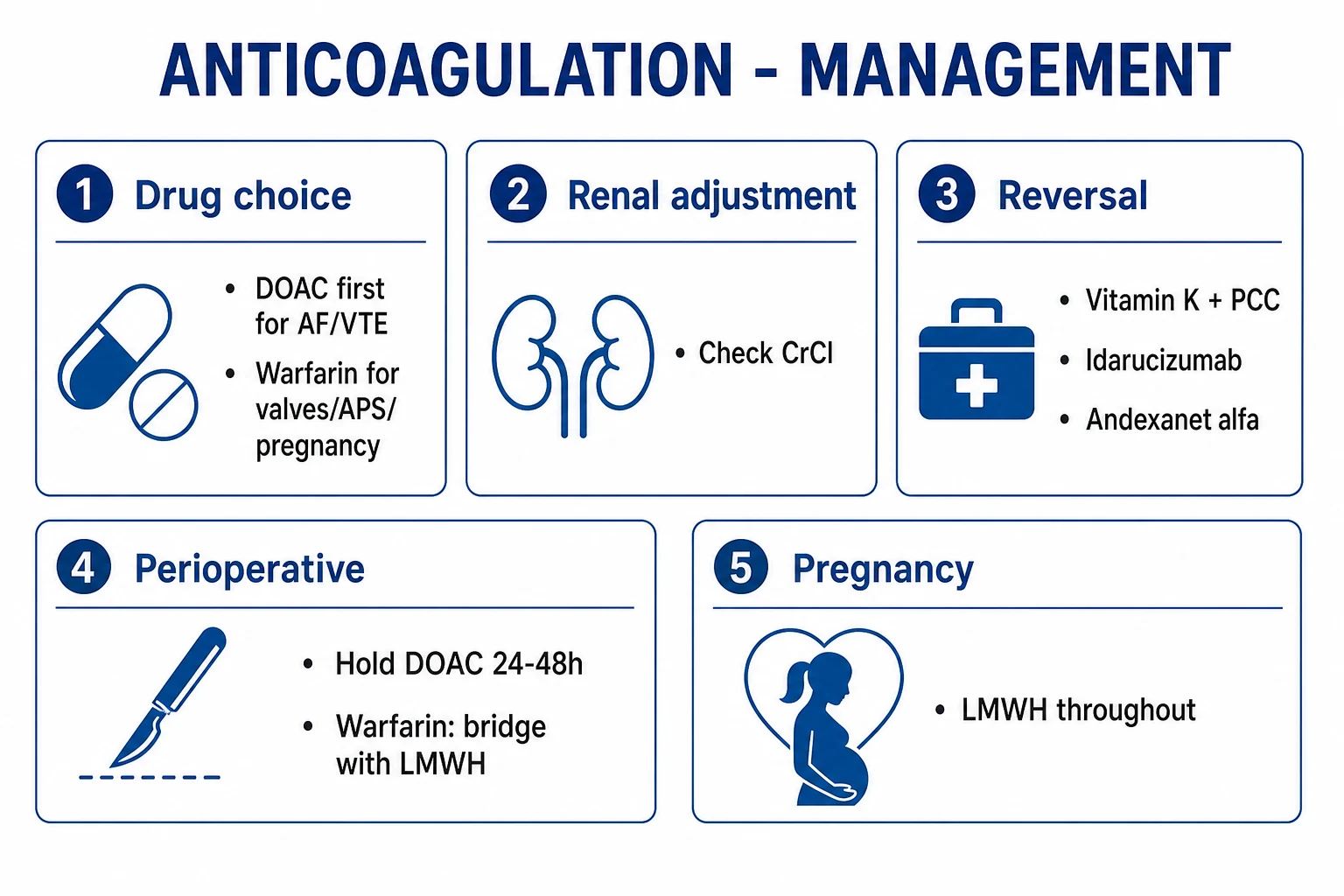
Acute severe anticoagulation reversal covers the three drug classes the intensivist must reverse in life-threatening bleeding or before emergency surgery — WARFARIN (vitamin K antagonists), the DIRECT ORAL ANTICOAGULANTS (dabigatran a direct thrombin inhibitor; rivaroxaban, apixaban and edoxaban direct factor Xa inhibitors), and the HEPARINS (unfractionated heparin and the low-molecular-weight heparins). WARFARIN reversal: vitamin K 10 mg IV (slow infusion — anaphylactoid risk) for every patient PLUS prothrombin complex concentrate (4F-PCC, Beriplex/Octaplex 25-50 IU/kg, INR-based dosing) for life-threatening bleeding — PCC preferred over fresh frozen plasma (faster, smaller volume, more effective; INCH trial). FFP 15 mL/kg only if PCC unavailable. DOAC reversal: dabigatran → idarucizumab 5 g IV (Praxbind — monoclonal antibody fragment, specific reversal, RE-VERSE AD). Rivaroxaban/apixaban → andexanet alfa (Andexxa — recombinant modified factor Xa decoy, ANNEXA-4) OR PCC 50 IU/kg if andexanet unavailable. Heparin reversal: protamine 1 mg per 100 units heparin (maximum 50 mg, give slowly — histamine release). LMWH reversal: protamine — PARTIAL reversal only (1 mg per 1 mg enoxaparin). Timing is critical — for intracerebral haemorrhage every minute of an INR above 1.5 worsens outcome, so reverse immediately and do not await confirmatory levels. Reverse ONLY for life-threatening or critical-organ bleeding or urgent surgery — NOT for minor bleeding or routine procedures. Monitor with INR (warfarin), anti-Xa (heparin, LMWH, rivaroxaban, apixaban), and thrombin time or diluted thrombin time (dabigatran).
On this page & tools
Your progress
Saved locally on this device.
Target exams
Red flags
Overview & definition
Anticoagulation reversal sits at the centre of critical-care haemostasis because the population on anticoagulants — older patients with atrial fibrillation, mechanical heart valves, recent venous thromboembolism or post-cardiac-surgery states — is exactly the population at risk of major bleeding and intracerebral haemorrhage. The intensivist's job is narrow and time-critical: (1) recognise the agent, (2) quantify the anticoagulant effect where it changes management, (3) deliver the correct reversal agent at the correct dose without delay, and (4) plan safe re-anticoagulation. The single most common and dangerous error is undertreatment — waiting for laboratory confirmation in a patient with a clear history of warfarin and an expanding intracerebral haematoma, or reaching for FFP when PCC is available.[5][6]
When to reverse — and when NOT to
The decision to reverse is governed by the severity and location of the bleed, not by the INR or drug level alone. Reversal agents all carry a thrombotic cost (PCC and andexanet most obviously), so they must be reserved for bleeds where the anticoagulant effect is materially contributing to an immediately life-threatening or disabling process.[6]
Indication to reverse — by bleed severity (ACC 2020 decision pathway)
| Bleed category | Examples | Reverse? | Agents |
|---|---|---|---|
| Life-threatening / critical organ | Intracerebral haemorrhage, intraspinal, intraocular/retrobulbar, pericardial tamponade, compartment syndrome, massive haemoptysis/haematemesis with shock | YES — immediately, do not await levels | Full-dose specific reversal (PCC + vitamin K; idarucizumab; andexanet or PCC; protamine) |
| Major, non-critical organ | Overt GI bleed haemodynamically significant, retroperitoneal, non-compartment limb, uncontrolled epistaxis/persistent haematuria with drop in haemoglobin | YES if on warfarin/heparin; for DOAC, case-by-case — measure level if ingestion over 4 h ago | Warfarin: PCC + vitamin K. DOAC: idarucizumab/andexanet if drug still active (or PCC). UFH: protamine |
| Minor / non-significant | Minor epistaxis controlled, microscopic haematuria, bruising, minor laceration, asymptomatic elevated INR | NO — hold the drug, local measures ± (for warfarin) oral vitamin K | Do NOT give PCC, andexanet or idarucizumab |
| Urgent/emergency surgery/procedure | Emergency neurosurgery, cardiac surgery, procedure with uncontrollable bleeding risk within hours | YES — reverse to operative haemostasis | Full reversal as above, then re-anticoagulate post-op when safe |
| Elective procedure / routine | Routine dental, cataract, colonoscopy, joint injection | NO — hold the anticoagulant pre-procedure | Bridging only if high thrombotic risk; no reversal agents |
WARFARIN reversal — the two-component rule
Warfarin inhibits vitamin K epoxide reductase, depleting the reduced vitamin K needed for gamma-carboxylation of the vitamin-K-dependent factors (II, VII, IX, X) and proteins C and S. Effective reversal therefore requires BOTH immediate factor replacement AND restoration of hepatic synthesis. Giving only one component is the classic error.[1]
- 4F-PCC (immediate component) — Beriplex/Kcentra or Octaplex. Contains factors II, VII, IX and X (plus proteins C and S). Reverses the INR within minutes. Dosed by INR (Beriplex scheme): INR 2 to under 4 → 25 IU/kg; INR 4 to 6 → 35 IU/kg; INR over 6 → 50 IU/kg (round to nearest vial; the INCH trial used 30 IU/kg). Maximum single dose 50 IU/kg / 5000 IU. Also reverses the super-warfarin rodenticides at higher doses.
- Vitamin K (phytomenadione, sustained component) — 10 mg IV by slow infusion (diluted, over 20-30 min). Onset 6-12 h, peak 24 h. Given to EVERY patient needing warfarin reversal: PCC alone has a short factor VII half-life (~6 h) so the INR rebounds at 12-24 h without vitamin K. IV route is preferred for rapid effect; the anaphylactoid risk (rare) mandates a slow infusion. Oral vitamin K (1-5 mg) is reserved for non-urgent supratherapeutic INR without major bleeding.
- FFP (the fallback) — 15 mL/kg (typically 4 units / ~1 L). Used only when PCC is unavailable. Slower (requires thawing and large-volume transfusion), less effective, and carries TRALI/TACO and volume-overload risk. The INCH trial was stopped early because FFP performed so poorly.[1]
Warfarin reversal agents — head to head
| Agent | What it does | Onset / duration | Dose | Pros | Cons |
|---|---|---|---|---|---|
| 4F-PCC (Beriplex/Octaplex) | Replaces factors II, VII, IX, X | Minutes; factors last hours (VII shortest ~6 h) | 25-50 IU/kg by INR (max 50 IU/kg) | Fast, low volume (~20 mL/kg vs FFP), highly effective, no thawing | Thrombosis risk (~2-7 per cent); heparin-containing unless heparin-free brand; cost; supply |
| Vitamin K (phytomenadione) | Restores hepatic factor synthesis | 6-12 h onset, peak 24 h, lasts days-weeks | 10 mg IV slow infusion | Sustained reversal; prevents INR rebound; mandatory adjunct | TOO SLOW alone for life-threatening bleeding; IV anaphylactoid risk; re-warfarinising resistance if dose too high |
| Fresh frozen plasma (FFP) | Replaces all factors (non-concentrated) | 30-60 min (after thaw); large volume | 15 mL/kg (~4 units) | Universally available; replaces all factors | Slow, large volume, TRALI/TACO, transfusion burden, inferior efficacy (INCH) |
DOAC reversal — match the agent to the antidote
The direct oral anticoagulants split into two mechanistic families, and each has its own reversal logic. Dabigatran is a direct thrombin (factor IIa) inhibitor; the rivaroxaban/apixaban/edoxaban group are direct factor Xa inhibitors. Specific antidotes exist for dabigatran (idarucizumab) and the Xa inhibitors (andexanet); where the specific agent is unavailable, 4F-PCC is the non-specific backup for the Xa inhibitors.[2][4]
- Dabigatran → idarucizumab (Praxbind). A humanised monoclonal antibody fragment that binds dabigatran with roughly 350 times the affinity of thrombin — a specific, stoichiometric scavenger. Dose 5 g IV (two 2.5 g vials given consecutively, or as a bolus over 5-10 min; a slower infusion over 15 min is an alternative). Immediate reversal of the anticoagulant effect; RE-VERSE AD showed 88-98 per cent normalisation of the diluted thrombin time within minutes, sustained for 24 h in most patients. A repeat 2.5 g can be given if bleeding recurs or anticoagulant activity returns. Because dabigatran has low plasma protein binding (~35 per cent) it is also removable by haemodialysis.[3]
- Rivaroxaban/apixaban (and edoxaban) → andexanet alfa (Andexxa/Ondexxya). A recombinant, catalytically inactive (modified) factor Xa that acts as a decoy — it binds and sequesters the Xa-inhibitor drugs, freeing endogenous factor Xa to restore thrombin generation. Dose is weight- and drug/dose/timing-based: low dose = 400 mg IV bolus at 30 mg/min then 4 mg/min infusion for 120 min; high dose = 800 mg bolus then 8 mg/min for 120 min (high dose for apixaban over 5 mg or rivaroxaban over 10 mg if under 8 h, or unknown). ANNEXA-4 reported excellent or good haemostasis in 82 per cent and a roughly 92 per cent reduction in anti-Xa activity. Two cautions: (a) andexanet is physically incompatible with heparin — it binds heparin-antithrombin, so do not run heparin in the same line for at least 4 h afterwards; (b) thrombotic events in around 10 per cent at 30 days.[2][4]
- Xa-inhibitor bleeding when andexanet is unavailable → 4F-PCC 50 IU/kg. Non-specific but restores thrombin generation; supported by observational data and ACC guidance. Activated PCC (FEIBA) is an alternative but carries higher thrombosis risk.[4][6]
- General DOAC measures — activated charcoal 50 g if ingestion within the previous 2-4 h (reduces absorption). Dabigatran only is dialysable. Standard PT and aPTT are unreliable for quantifying DOAC effect — use the specific assays below.
DOAC reversal — the specific antidotes
| DOAC | Mechanism | Specific reversal | Dose | Backup if unavailable | Dialysable? |
|---|---|---|---|---|---|
| Dabigatran | Direct thrombin (IIa) inhibitor | Idarucizumab (Praxbind) | 5 g IV (2 x 2.5 g) | Haemodialysis; activated charcoal if early | YES (~35 per cent protein bound) |
| Rivaroxaban | Direct factor Xa inhibitor | Andexanet alfa (Andexxa) | Low or high dose by regimen | 4F-PCC 50 IU/kg | No (high protein binding) |
| Apixaban | Direct factor Xa inhibitor | Andexanet alfa (Andexxa) | Low or high dose by regimen | 4F-PCC 50 IU/kg | No |
| Edoxaban | Direct factor Xa inhibitor | Andexanet (off-label) | Low or high dose | 4F-PCC 50 IU/kg | No |
Heparin and LMWH reversal — protamine and its limits
- Unfractionated heparin (UFH) → protamine sulfate. Protamine is a strongly basic polypeptide (derived from salmon sperm) that binds the acidic heparin molecule in a 1:1 stoichiometric complex, neutralising it. Dose 1 mg protamine per 100 units of heparin to be reversed, based on the heparin received in the preceding 2-4 h (heparin half-life is about 60-90 min). Maximum 50 mg per dose and a maximum infusion rate of 5 mg/min — rapid protamine causes histamine release (hypotension, flushing, bradycardia) and, rarely, true anaphylaxis (higher risk with fish allergy or prior exposure to NPH/protamine-insulin). Reversal occurs within 5 minutes; check aPTT or anti-Xa at 5-15 min and again at 2-8 h.[6]
- Low-molecular-weight heparin (enoxaparin, dalteparin) → protamine gives PARTIAL reversal only (~60-75 per cent) because the shorter LMWH chains have lower affinity for protamine and the longer half-life leaves residual effect. Dose 1 mg protamine per 1 mg enoxaparin if within 8 h of the last dose; a second dose of 0.5 mg per mg may be given if bleeding persists (within 8-12 h). Beyond 12 h protamine adds little. Anti-Xa monitoring guides additional dosing.
- Fondaparinux → protamine is INEFFECTIVE. For life-threatening bleeding use recombinant activated factor VII (rFVIIa) 90 micrograms/kg. Dialysis is ineffective.
- Danaparoid → no specific reversal; consider rFVIIa or plasma exchange.
Heparin-family reversal
| Agent | Reversal agent | Dose | Effectiveness | Caution |
|---|---|---|---|---|
| UFH | Protamine sulfate | 1 mg per 100 units heparin (based on prior 2-4 h) | Complete (near 100 per cent) | Max 50 mg/dose, max 5 mg/min (histamine, anaphylaxis); fish/NPH-insulin allergy |
| LMWH (enoxaparin) | Protamine sulfate | 1 mg per 1 mg enoxaparin within 8 h; +0.5 mg per mg if still bleeding | PARTIAL (~60-75 per cent) | Incomplete neutralisation; less effect beyond 12 h |
| Fondaparinux | Protamine INEFFECTIVE | rFVIIa 90 micrograms/kg | Protamine ~0 per cent; rFVIIa partial | Dialysis ineffective; high thrombosis risk with rFVIIa |
The reversal protocol — first 30 minutes
Acute severe anticoagulation reversal — the first 30 minutes in ICU
-
RECOGNISE AND CLASSIFY THE AGENT — obtain the drug, dose, last administration time and indication:
- Warfarin? DOAC (which one — dabigatran vs rivaroxaban/apixaban/edoxaban)? UFH or LMWH or fondaparinux?
- Severity: is this life-threatening or critical-organ bleeding (ICH, tamponade, compartment, shock) or emergency surgery? If YES, do not wait for levels. [1]
-
STOP THE ANTICOAGULANT AND TAKE BLOODS — hold the agent, draw:
- INR, aPTT, fibrinogen, platelets, blood group and screen, cross-match
- Specific assays if DOAC: thrombin time / diluted thrombin time (dabigatran); anti-Xa calibrated to the drug (rivaroxaban/apixaban)
- Anti-Xa for UFH/LMWH if on heparin [1]
-
WARFARIN life-threatening bleed → 4F-PCC 25-50 IU/kg (INR-based) AND vitamin K 10 mg IV slow infusion — together. Use FFP 15 mL/kg only if PCC unavailable. Recheck INR at 30 min. [1]
-
DABIGATRAN life-threatening bleed → idarucizumab 5 g IV (2 x 2.5 g). If unavailable, consider haemodialysis; activated charcoal if ingestion within 2-4 h. [1]
-
RIVAROXABAN/APIXABAN (or edoxaban) life-threatening bleed → andexanet alfa (low-dose or high-dose regimen by drug/dose/timing) if available, otherwise 4F-PCC 50 IU/kg. Do NOT co-infuse heparin for 4 h after andexanet. [1]
-
UFH bleed or post-bypass → protamine 1 mg per 100 units heparin (preceding 2-4 h), max 50 mg, max 5 mg/min. LMWH → protamine 1 mg per 1 mg enoxaparin (partial). Fondaparinux → rFVIIa. [1]
-
GENERAL HAEMOSTATIC SUPPORT — treat the bleed itself: source control (neurosurgery for ICH, endoscopy/IR for GI, surgery for compartment), transfuse to haematocrit and platelet targets, correct coagulopathy and acidosis, maintain normothermia and normocalcaemia, avoid hypotension. [1]
-
MONITOR AND PLAN RE-ANTICOAGULATION — recheck INR/anti-Xa/TT at 30 min, 6, 12, 24 h. Document the thrombotic indication (AF, mechanical valve, recent VTE). Plan re-anticoagulation timing (ICH typically day 7-14) with the primary team.
Monitoring — the right assay for the right drug
Using the wrong assay is a common error — a normal aPTT does NOT exclude a clinically significant DOAC level. Match the assay to the agent.[6]
Monitoring each anticoagulant during and after reversal
| Agent | Primary assay | Target after reversal | Pitfall |
|---|---|---|---|
| Warfarin | INR | Under or equal to 1.4 for ICH / procedures; check at 30 min post-PCC, then 6/12/24 h | INR can be artefactually raised by PCC if factor assays differ; recheck for rebound |
| Dabigatran | Thrombin time (TT) / diluted thrombin time (dTT); ECT; plasma level | Normal TT/dTT | TT is very sensitive (normal excludes dabigatran; prolonged confirms but does not quantify). Use dTT for quantification |
| Rivaroxaban / apixaban | Anti-Xa (drug-calibrated) | Low/undetectable anti-Xa | PT and aPTT are unreliable — do NOT use them to exclude a significant level |
| UFH | aPTT and/or anti-Xa | aPTT in reference range; anti-Xa under 0.1 IU/mL | aPTT affected by factor deficiency, DIC; anti-Xa more reliable in ICU |
| LMWH (enoxaparin) | Anti-Xa (4 h post-dose) | Anti-Xa under 0.5 IU/mL (treatment range 0.5-1.0) | Renal impairment prolongs LMWH effect; protamine reversal is partial |
Specific reversal agents vs non-specific — the thrombotic trade-off
Every reversal agent restores haemostasis at the price of thrombotic risk. Specific antidotes (idarucizumab, andexanet) bind the drug directly and tend to be cleaner; non-specific procoagulants (PCC, aPCC, rFVIIa) add clotting factors and carry higher thrombotic risk. The thrombotic signal is real: andexanet had thrombotic events in about 10 per cent at 30 days in ANNEXA-4, and PCC in 2-7 per cent. This is precisely why reversal is reserved for life-threatening or critical-organ bleeding — the anticoagulant was prescribed for a thrombotic indication (atrial fibrillation, mechanical valve, recent VTE), and removing its protection has consequences.[2][5][6]
Specific vs non-specific reversal agents
| Agent | Class | Specificity | Speed | Thrombotic risk | Best for |
|---|---|---|---|---|---|
| Idarucizumab | Monoclonal antibody fragment | Specific to dabigatran | Immediate | Low (~5 per cent) | Dabigatran life-threatening bleed |
| Andexanet alfa | Recombinant modified factor Xa (decoy) | Specific to Xa inhibitors | Immediate | Moderate (~10 per cent at 30 d) | Rivaroxaban/apixaban life-threatening bleed |
| 4F-PCC | Concentrated factors II/VII/IX/X | Non-specific (warfarin); non-specific procoagulant for DOAC-Xa | Minutes | Moderate (2-7 per cent) | Warfarin (with vitamin K); Xa-inhibitor backup |
| FFP | All factors, non-concentrated | Non-specific | 30-60 min | Lower | Warfarin only if PCC unavailable |
| Protamine | Basic peptide binding heparin | Specific to UFH; partial for LMWH | Minutes | Low-moderate | UFH, LMWH |
| rFVIIa | Activated factor VII | Non-specific procoagulant | Minutes | High | Fondaparinux; refractory bleeding |
Red flags
SaqBlocks — fellowship exam practice
SAQ — Dabigatran-associated intracerebral haemorrhage reversed with idarucizumab (RE-VERSE AD)
10 minutes · 10 marks
A 78-year-old man (weight 80 kg) on dabigatran 150 mg twice daily for non-valvular atrial fibrillation (CHA2DS2-VASc 5) is brought to the emergency department 3 hours after a witnessed seizure with progressive right-sided weakness and a decreasing conscious state. CT brain shows a 35 mL right basal-ganglia intracerebral haemorrhage with intraventricular extension; his last dabigatran dose was 4 hours ago. GCS 9 (E2V3M4), BP 178/96, HR 92 (controlled rate atrial fibrillation). Bloods: Hb 138 g/L, platelets 210, INR 2.4, aPTT 54 seconds, creatinine 120 micromol/L (baseline 95). A diluted thrombin time is markedly prolonged with an estimated dabigatran plasma level of 280 ng/mL. The neurosurgical team wishes to place an external ventricular drain within the hour. You are asked to reverse the dabigatran.
SAQ — Warfarin-associated intracerebral haemorrhage reversed with 4F-PCC and vitamin K (INCH)
10 minutes · 10 marks
A 74-year-old woman (weight 65 kg) on warfarin 5 mg daily for a mechanical mitral valve replacement (target INR 2.5 to 3.5) is admitted after a witnessed seizure followed by a decreasing conscious state. She is intubated for airway protection. CT brain shows a 40 mL left lobar intracerebral haemorrhage. Admission INR is 7.2 (supratherapeutic). BP 168/92 on a propofol infusion, HR 88 sinus rhythm. Platelets 180, fibrinogen 4.2 g/L, creatinine 90 micromol/L. She has no known coagulopathy other than the warfarin. The intensivist and neurosurgeon agree on immediate reversal with the goal of an INR at or below 1.4 and then external ventricular drain placement. You are asked to outline the reversal.
Clinical pearls
Prognosis
Outcomes after anticoagulant-associated major bleeding and reversal
| Factor | Effect on outcome | Detail |
|---|---|---|
| Intracerebral haemorrhage on warfarin | Mortality ~40-55 per cent at 30 days | Worse than non-anticoagulated ICH; driven by haematoma expansion while INR is high |
| Speed of INR reversal | Faster reversal → smaller haematoma, better outcome | Every minute of INR over 1.5 worsens haematoma growth; PCC achieves this far faster than FFP (INCH) |
| PCC vs FFP (INCH) | PCC superior for INR normalisation (67 per cent vs 9 per cent) | Haematoma-expansion deaths occurred in the FFP arm, not the PCC arm |
| DOAC vs warfarin ICH | DOAC-associated ICH tends to be smaller and lower mortality | Direct comparison favours DOACs for intracranial bleeding risk |
| Idarucizumab (RE-VERSE AD) | ~81 per cent normal haemostasis; thrombosis ~5 per cent at 90 days | Effective and rapid; mortality still driven by bleed severity and comorbidity |
| Andexanet (ANNEXA-4) | 82 per cent excellent/good haemostasis; thrombosis ~10 per cent at 30 days | Effective but the thrombotic signal shapes conservative use |
| Timing of re-anticoagulation | Premature restart → re-bleed; delayed start → thromboembolism | Mechanical valves most unforgiving of delay; ICH restart typically day 7-14 |
| Underlying thrombotic indication | High-risk (mechanical valve, recent VTE) → must plan early re-anticoagulation | The reversal decision is never just about the bleed |
Key trials and evidence
Steiner 2016 — INCH trial: PCC vs FFP for warfarin intracerebral haemorrhage (PMID 27302126)
Source
Lancet Neurology — randomised, multicentre, open-label trial
Patients
50 patients with vitamin-K-antagonist-related intracerebral haemorrhage (VKA-ICH)
Design
4-factor PCC 30 IU/kg plus vitamin K vs FFP 20 mL/kg plus vitamin K
Primary endpoint
Proportion achieving INR under or equal to 1.2 within 3 h of treatment
Key result
PCC 67 per cent vs FFP 9 per cent reached INR under or equal to 1.2 at 3 h (adjusted OR 30.6; p=0.0003)
Safety
Trial stopped early for safety — 5 of 23 FFP patients died from haematoma expansion vs ZERO PCC patients
Key finding
PCC is faster, lower-volume and markedly more effective than FFP for urgent warfarin reversal in ICH
Clinical bottom line
4F-PCC (not FFP) is the standard of care for warfarin-related life-threatening bleeding; the trial underpins every modern guideline
Connolly 2019 — ANNEXA-4: andexanet alfa for factor Xa inhibitor bleeding (PMID 30730782)
Source
New England Journal of Medicine — prospective, open-label, single-group study
Patients
352 patients with acute major bleeding within 18 h of a factor Xa inhibitor (apixaban or rivaroxaban)
Design
Andexanet alfa bolus plus 120-min infusion (low- or high-dose regimen by drug/dose/timing)
Key result
Anti-factor Xa activity reduced by ~92 per cent; excellent or good haemostasis in 82 per cent at 12 h
Safety
Thrombotic events in ~10 per cent of patients at 30 days
Key finding
Andexanet rapidly reverses the anti-Xa effect and achieves effective haemostasis in most patients with Xa-inhibitor major bleeding
Clinical bottom line
The evidence base for andexanet in life-threatening apixaban/rivaroxaban bleeding — reserve for critical bleeds because of the thrombotic cost
Pollack 2017 — RE-VERSE AD: idarucizumab for dabigatran reversal (PMID 28693366)
Source
New England Journal of Medicine — prospective, open-label, single-group study
Patients
503 patients with dabigatran-associated serious bleeding or requiring urgent surgery/procedure
Design
Idarucizumab 5 g IV (two 2.5 g vials)
Key result
Maximum percentage reversal of diluted thrombin time was 88-98 per cent within minutes; normal haemostasis in ~81 per cent
Safety
Thrombotic events in ~5 per cent at 90 days; mortality ~13-19 per cent, driven by bleed severity and comorbidity
Key finding
Idarucizumab gives specific, rapid and sustained reversal of the dabigatran anticoagulant effect
Clinical bottom line
The definitive reversal for dabigatran — 5 g IV, near-instant, used for life-threatening bleeding or emergency surgery
References
- [1]Steiner T, Poli S, Griebe M, et al. Fresh frozen plasma versus prothrombin complex concentrate in patients with intracranial haemorrhage related to vitamin K antagonists (INCH): a randomised trial Lancet Neurol, 2016.PMID 27302126
- [2]Connolly SJ, Crowther M, Eikelboom JW, et al. Full Study Report of Andexanet Alfa for Bleeding Associated with Factor Xa Inhibitors N Engl J Med, 2019.PMID 30730782
- [3]Pollack CV Jr, Reilly PA, van Ryn J, et al. Idarucizumab for Dabigatran Reversal - Full Cohort Analysis N Engl J Med, 2017.PMID 28693366
- [4]Barra ME, Das AS, Hayes BD, et al. (Goldstein JN, senior author) Evaluation of andexanet alfa and four-factor prothrombin complex concentrate (4F-PCC) for reversal of rivaroxaban- and apixaban-associated intracranial hemorrhages J Thromb Haemost, 2020.PMID 32291874
- [5]Kuramatsu JB, Sembill JA, Gerner ST, et al. Management of therapeutic anticoagulation in patients with intracerebral haemorrhage and mechanical heart valves Eur Heart J, 2018.PMID 29529259
- [6]Tomaselli GF, Mahaffey KW, Cuker A, et al. 2020 ACC Expert Consensus Decision Pathway on Management of Bleeding in Patients on Oral Anticoagulants: A Report of the American College of Cardiology Solution Set Oversight Committee J Am Coll Cardiol, 2020.PMID 32680646