ICU · Haematology / coagulation
Thrombocytopenia in the ICU — HIT, TTP/HUS, ITP & Septic
Also known as Thrombocytopenia · Heparin-induced thrombocytopenia · HIT · 4T score · Thrombotic thrombocytopenic purpura · TTP · Haemolytic uraemic syndrome · HUS · ADAMTS13 · Immune thrombocytopenia · ITP · Argatroban · Bivalirudin · Plasmapheresis · Caplacizumab
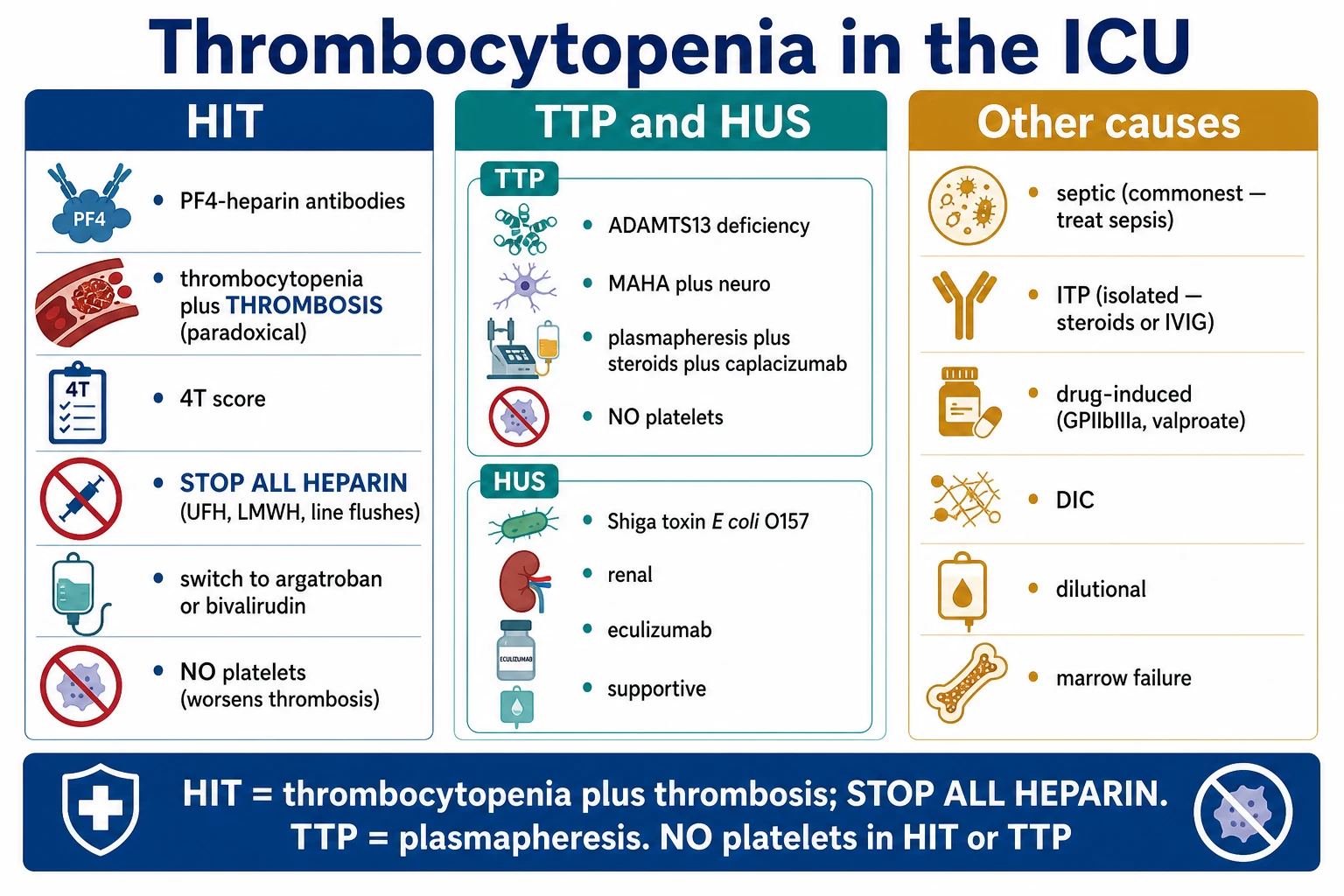
The ICU thrombocytopenia differential: the HIT (heparin-induced — the PF4-heparin antibodies; thrombocytopenia AND thrombosis; 4T score; STOP ALL HEPARIN; switch to argatroban or bivalirudin; NO platelets), the TTP (ADAMTS13 deficiency; MAHA plus neuro; plasmapheresis plus steroids plus caplacizumab; NO platelets), the HUS (Shiga toxin E coli; renal; eculizumab), the ITP (isolated; steroids or IVIG), the septic (the commonest — treat sepsis), the drug-induced, the DIC, the dilutional, the marrow failure. The key: HIT and TTP have thrombocytopenia with THROMBOSIS (paradoxical) — and NO platelets in either (worsens the microvascular thrombosis). The TTP and HUS have the MAHA (schistocytes, raised LDH, low haptoglobin). The 4T score for the HIT; the ADAMTS13 for the TTP; the plasmapheresis is the definitive for the TTP.
On this page & tools
Your progress
Saved locally on this device.
8 MCQs with explanations
Target exams
Overview & definition
The thrombocytopenia (platelets under 150 × 10⁹ per L, or the under 50 the significant) is common in the ICU (30 to 50 per cent). The two CRITICAL diagnoses to NOT miss: the HIT (heparin-induced — thrombocytopenia AND thrombosis) and the TTP (ADAMTS13 deficiency — MAHA plus organ failure). Both have the paradoxical thrombocytopenia with the THROMBOSIS, and the platelet transfusion is the CONTRA-INDICATED in both. The commonest ICU cause is the septic.[1]
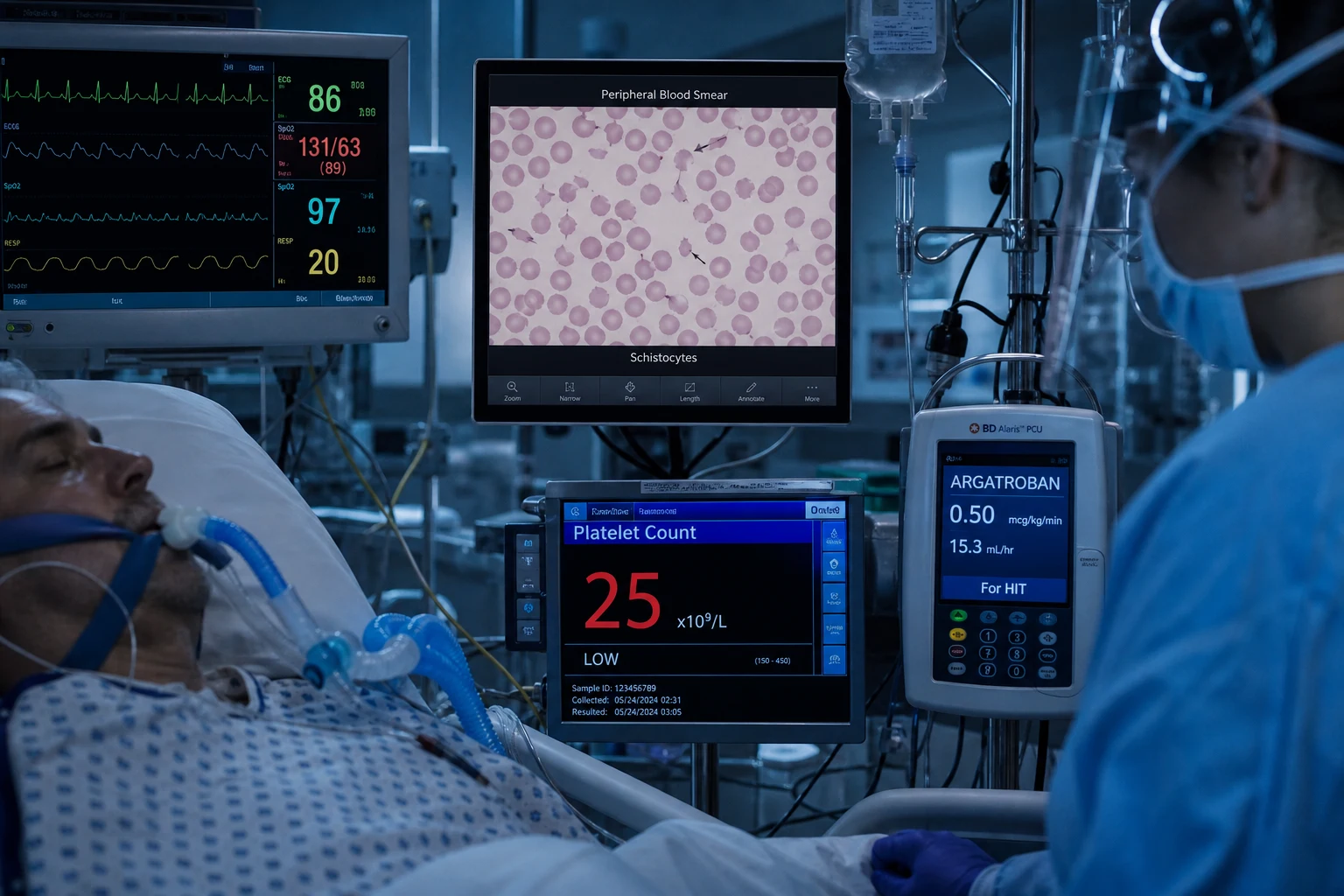
The differential
HIT (heparin-induced thrombocytopenia)
- The PF4-heparin antibodies → the platelet activation → thrombocytopenia AND THROMBOSIS (the paradoxical — the DVT, the PE, the arterial, the skin necrosis, the limb ischaemia).[1]
- The timing — 5 to 14 days post-heparin (or sooner if the prior the exposure — the rapid-onset HIT).[1]
- The 4T score — Thrombocytopenia (the degree), Timing (the 5 to 14 days), Thrombosis (the new), oTher cause (excluded). The high the score → the HIT likely.[1]
- The management — STOP ALL HEPARIN (UFH, LMWH, line flushes, heparin-coated catheters). Switch to the argatroban or the bivalirudin (the direct thrombin inhibitors — the argatroban the hepatic, the bivalirudin the renal). The fondaparinux if the renal OK. The warfarin AFTER the platelet recovery (NOT while the thrombocytopenic — the warfarin the skin necrosis).[1]
- The NO platelet transfusion (the worsens the thrombosis).[1]
TTP (thrombotic thrombocytopenic purpura)
- The ADAMTS13 deficiency (the inherited or the autoimmune) → the ultra-large vWF multimers → the platelet aggregation (the microvascular thrombosis).[1]
- The pentad (the rare all-five) — thrombocytopenia, MAHA (the schistocytes, the raised LDH, the low haptoglobin), neurological, renal, fever.[1]
- The diagnosis — the ADAMTS13 the activity (under 10 per cent). The blood film (the schistocytes).[1]
- The management — PLASMAPHERESIS (the definitive — the removes the antibody, the replaces the ADAMTS13), the steroids (the autoimmune), the caplacizumab (the anti-vWF — the blocks the platelet aggregation). The NO platelets (the worsens the microvascular thrombosis).[1]
HUS (haemolytic uraemic syndrome)
- The Shiga toxin (the E. coli O157 — the bloody diarrhoea) → the complement activation → the renal the microvascular thrombosis.[1]
- The triad — the MAHA, the thrombocytopenia, the AKI (the renal-predominant — distinguishes from the TTP).[1]
- The management — the supportive (the RRT for the AKI), the eculizumab (the anti-C5 — the severe/atypical). The NO platelets.[1]
ITP (immune thrombocytopenia)
- The isolated thrombocytopenia (the no other cause excluded). The anti-platelet antibodies.[18]
- The management — the steroids (the prednisolone), the IVIG (the rapid), the TPO-receptor agonists (the eltrombopag, the romiplostim), the splenectomy (the refractory). The platelet transfusion for the life-threatening bleeding.[19]
The septic thrombocytopenia (the commonest)
- The commonest ICU cause — from the sepsis (the marrow suppression, the consumption, the splenomegaly, the endothelial the damage). The marker of the severity.[1]
- Treat the sepsis (the antibiotics, the source control). The platelet transfusion for the under 10 to 20 (the prophylactic) or the under 50 with the bleeding.[1]
The other causes
- The drug-induced (the GPIIb/IIIa, the valproate, the antibiotics, the PPIs, the chemotherapy). The stop the drug.[1]
- The DIC (the coagulopathy — the PT/APTT, the fibrinogen, the D-dimer).[1]
- The dilutional (the massive transfusion).[1]
- The marrow failure (the leukaemia, the aplastic, the chemotherapy).[1]
Exam practice — SAQs
SAQ — Thrombotic thrombocytopenic purpura presenting as MAHA with neurological signs
10 minutes · 10 marks
A 35-year-old woman presents with 5 days of fatigue, confusion, and petechiae. On examination: T 37.8 degrees C, HR 110, BP 145/85, GCS 14 (fluctuating), no focal deficit but intermittent word-finding difficulty. Labs: Hb 65 g/L, platelets 12 x 10⁹/L, INR 1.1 (normal), aPTT 32 s (normal), fibrinogen 4.2 g/L (normal), LDH 2400, haptoglobin undetectable, creatinine 165 micromol/L. Blood film shows MANY schistocytes (over 5 per cent). ADAMTS13 pending.
SAQ — Heparin-induced thrombocytopenia with venous limb gangrene
10 minutes · 10 marks
A 70-year-old man post-hip replacement received LMWH prophylaxis for 8 days. Platelets fell from 280 to 95 (a 66 per cent drop) on day 8. On day 10 he developed severe right leg pain, swelling, and dark purple discoloration of the toes. Doppler confirms extensive iliofemoral DVT. The team started UFH for the DVT.
Red flags
Causes — the comprehensive ICU differential
Thrombocytopenia in ICU is the falling or low platelet count in a critically ill patient — the four mechanisms are decreased production (marrow failure), increased destruction (immune or consumption), sequestration (spleen), and dilution/loss (massive transfusion). The mnemonic "D-I-S-C" — Destruction (HIT, TTP/HUS, ITP, DIC, sepsis, drugs), Inadequate production (marrow), Sequestration (hypersplenism), Consumption/dilution (DIC, massive transfusion). The commonest single ICU cause is sepsis (around 40–50 per cent of all ICU thrombocytopenia), followed by drug-induced and then the critical-not-to-miss cluster (HIT, TTP/HUS, DIC).[1]
The 9 causes — mechanism, key clue, and what to do
| Cause | Mechanism | Distinguishing clue | First action |
|---|---|---|---|
| Sepsis (commonest ICU cause) | Marrow suppression + endothelial consumption + haemophagocytosis + splenomegaly; cytokine-driven (IL-1, TNF, IFN-γ) | Septic source; platelet count is severity marker; falls over hours-days | Treat sepsis (antibiotics <1 h, source control); transfuse at standard thresholds |
| DIC | Massive thrombin generation → consumption of platelets + factors + microthrombi | PT/APTT prolonged, fibrinogen low, D-dimer high, schistocytes on film | Treat trigger + cryoprecipitate/FFP/platelets (see DIC topic) |
| Drug-induced (non-HIT) | Direct marrow toxicity (chemo) or immune destruction (GPIIb/IIIa inhibitors, vancomycin, sulfonamides, valproate, PPIs, quinine) | Temporal link to a new drug (5–14 days for immune); recovery 1–2 weeks after cessation | Stop the offending drug; rechallenge is contraindicated (immune) |
| HIT (the immune, Type 2) | IgG anti-PF4/heparin → platelet activation/aggregation → thrombocytopenia AND thrombosis | 5–14 days post-heparin (or <24 h if prior exposure); thrombosis despite "anticoagulation"; 4T score | STOP ALL HEPARIN → argatroban/bivalirudin; NO platelets |
| Massive transfusion / dilutional | Loss + under-resuscitation of platelets; 1 unit platelets ≈ 30–40 × 10⁹/L rise; citrate also lowers ionised Ca²⁺ | Trauma/GI bleed; received >1 blood volume; PT/APTT also prolonged | Balanced resuscitation (1:1:1); recheck platelets and ROTEM/TEG |
| ITP | Auto-antibodies to platelet glycoproteins (IIb/IIIa, Ib/IX) → splenic destruction | Isolated thrombocytopenia, otherwise well; no splenomegaly; smears show large platelets | Steroids (prednisolone 1 mg/kg) ± IVIG if bleeding/urgent procedure |
| TTP | Auto-antibodies to ADAMTS13 (activity <10%) → ultra-large vWF multimers → platelet microthrombi | MAHA (schistocytes, LDH↑, haptoglobin↓) + neuro + renal + fever; ADAMTS13 <10% | PLASMAPHERESIS within hours + steroids + caplacizumab; NO platelets |
| HUS | Shiga toxin (E. coli O157:H7) → complement-mediated glomerular microthrombi | Triad MAHA + thrombocytopenia + AKI; bloody diarrhoea precedes; paediatric predominance | Supportive + RRT; eculizumab for severe/atypical; NO platelets |
| Splenic sequestration | Platelet pooling in enlarged spleen (cirrhosis, portal hypertension, myelofibrosis, Gaucher, malaria) | Splenomegaly + low platelets; PT/APTT/fibrinogen normal; no schistocytes | Treat underlying cause; transfuse only if bleeding |
| Post-transfusion purpura (PTP) | Antibodies (anti-HPA-1a) against transfused platelets that cross-react with autologous platelets | Sudden severe thrombocytopenia 5–10 days after transfusion; previously pregnant/transfused patient | IVIG (first-line); plasma exchange if refractory; avoid platelet transfusion |
| Marrow failure / infiltration | Leukaemia, aplastic anaemia, myelodysplasia, chemotherapy, radiation, vitamin B12/folate deficiency | Pancytopenia (all three lines low); low reticulocytes; dry tap on marrow | Treat underlying; transfuse supportively; haematology referral |
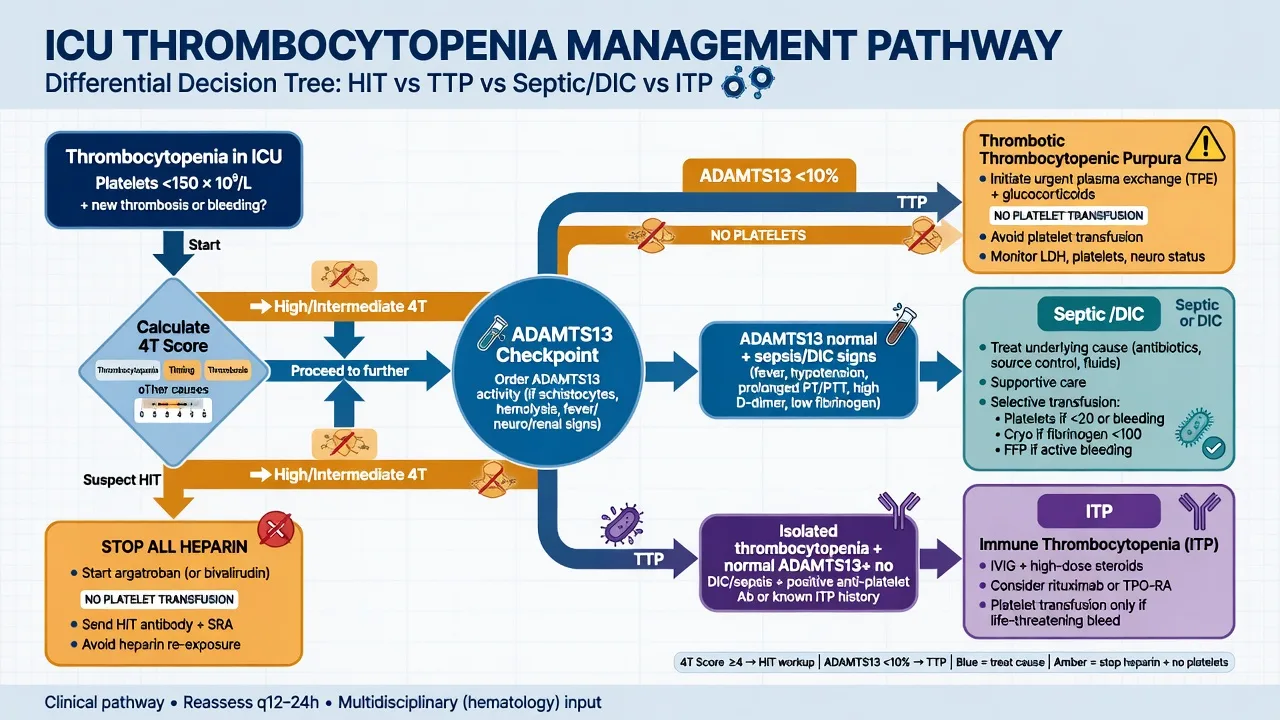
HIT — the deep dive (heparin-induced thrombocytopenia)
Pathophysiology — the PF4 story
The PF4 (platelet factor 4) is released from platelet α-granules. Heparin binds PF4 → conformational change → the IgG anti-PF4/heparin antibody forms → the Fc region binds the platelet FcγIIa receptor → massive platelet activation and aggregation → thrombocytopenia AND a pro-thrombotic state (the paradox). The activated platelets release more PF4 → amplification. The antibody also activates monocytes and endothelium → tissue factor expression → further thrombin generation. The net result is a 30 per cent risk of new thrombosis (DVT, PE, arterial, skin necrosis, limb gangrene, cerebral sinus thrombosis, myocardial infarction, mesenteric) and a 20–30 per cent mortality if untreated.[1][2]
HIT Type 1 (non-immune) vs HIT Type 2 (immune) — the classification
| Feature | HIT Type 1 (non-immune, mild) | HIT Type 2 (immune, severe) |
|---|---|---|
| Mechanism | Direct heparin effect on platelets (non-antibody) | IgG anti-PF4/heparin antibody → platelet activation |
| Onset | Days 1–4 (early) | Days 5–14 (typical); <24 h if previous exposure (rapid-onset); delayed onset up to 3 weeks after stopping heparin |
| Platelet nadir | Mild — usually >100 × 10⁹/L | Moderate-severe — usually 40–80 × 10⁹/L (rarely <20); falls >50% from baseline |
| Antibodies | Absent | Present (anti-PF4/heparin IgG) |
| Thrombosis | NOT a feature | YES — the defining feature (DVT, PE, arterial, skin necrosis, limb ischaemia, cerebral sinus) |
| Recovery | Resolves despite continuing heparin | Recovers 4–14 days after stopping ALL heparin |
| Clinical importance | None — a benign observation, no action needed | Critical — STOP ALL HEPARIN, start non-heparin anticoagulant |
| Frequency | 10–30% of heparin-exposed patients | 1–5% with UFH; 0.1–1% with LMWH; higher post-cardiac surgery |
The 4T score — pre-test probability
The 4T score for HIT pre-test probability (Warkentin)
| T | Feature | 0 points | 1 point | 2 points |
|---|---|---|---|---|
| Thrombocytopenia | Platelet count fall and nadir | Fall <30% OR nadir >100 | Fall 30–50% OR nadir 50–100 | Fall >50% OR nadir 20–100 |
| Timing | Platelet fall onset after heparin | <1 day (no prior exposure) | Consistent with days 5–10, but not clear; or onset after day 10; or fall <1 day (prior exposure >30 days ago) | Clear onset days 5–10 OR fall <1 day with prior exposure <30 days ago |
| Thrombosis | New thrombosis or skin necrosis | None | Progressive/recurrent thrombosis; non-necrotising rash; suspected thrombosis | Proven new thrombosis; skin necrosis; acute systemic reaction after IV heparin bolus |
| oTher cause | Other cause for thrombocytopenia | Definite other cause present | Probable other cause | None identified |
Interpretation: 0–3 = low probability (<5% chance HIT — DO NOT test, do NOT stop heparin); 4–5 = intermediate (5–50% — test, consider stopping heparin if clinical concern high); 6–8 = high probability (50–95% — STOP ALL HEPARIN, test, switch to non-heparin anticoagulant).[3][4]
Confirmatory laboratory testing
HIT confirmatory assays — the two-tier approach
| Assay | What it measures | Sensitivity | Specificity | Turnaround | Role |
|---|---|---|---|---|---|
| PF4 ELISA (immunoassay) | Anti-PF4/heparin antibodies (IgG/A/M or IgG-specific) | High (~0.95–1.0) | Moderate (~0.70–0.85) — detects clinically insignificant antibodies | Hours (batched) | Screen — fast, sensitive; a negative result rules OUT; a positive result must be confirmed functionally |
| Serotonin release assay (SRA) | Platelet serotonin release in response to patient serum + heparin (low and high dose) — functional | High (~0.90–0.97) | Very high (~0.95) | Days (specialist lab) | Confirm — the gold standard; high-dose heparin inhibits (the diagnostic pattern) |
| Heparin-induced platelet activation (HIPA) | Platelet aggregation with patient serum + heparin | High | Very high | Days | Alternative functional assay (European centres) |
| Particle gel immunoassay (PaGIA) | Rapid anti-PF4 detection | Moderate (~0.85) | Moderate | Minutes | Point-of-care screen — useful for rapid rule-out if negative |
Interpretation: A positive ELISA + positive SRA = definite HIT. A positive ELISA + negative SRA = non-pathogenic antibody (NOT HIT — often seen post-cardiac surgery or in dialysis patients). DO NOT wait for the SRA to start treatment if the 4T score is intermediate-high; the SRA takes days and untreated HIT causes thrombosis.[3][4]
The HIT management pathway — from suspicion to long-term anticoagulation
- Calculate the 4T score on EVERY ICU patient with a falling platelet count who has had any heparin (UFH, LMWH, line flushes, heparin-coated catheters, heparin-bonded circuits). A score <4 → do NOT stop heparin; consider alternative explanations. A score ≥4 → proceed.
- STOP ALL HEPARIN — switch IV lines, replace heparin locks/bungs with saline, remove heparin-coated central lines, check the dialysis circuit and flush solutions, check the TPN for heparin. This includes LMWH (enoxaparin, dalteparin) and low-dose heparin flushes — there is no "safe" dose of heparin in HIT.
- Start a non-heparin anticoagulant immediately — do NOT leave the patient unprotected; HIT is a prothrombotic state and the highest thrombosis risk is in the first days. The options:
- Argatroban (direct thrombin inhibitor, hepatic clearance) — start 0.5–2 µg/kg/min (reduce in hepatic failure, heart failure, critically ill); target aPTT 1.5–3× baseline (max 100 s). Useful in renal failure.
- Bivalirudin (direct thrombin inhibitor, partial enzymatic clearance) — 0.15–0.2 mg/kg/h; preferred for percutaneous procedures (PCI) and cardiac surgery.
- Danaparoid (anti-Xa, partial renal clearance) — alternative where available (Australia/UK).
- Fondaparinux (anti-Xa, renal clearance) — useful if renal function preserved; out-patient transition.
- Send confirmatory testing — PF4 ELISA + SRA (or HIPA). Document the clinical probability.
- DO NOT give platelets — even for invasive procedures (with rare exceptions e.g. life-threatening bleeding, discussed with haematology). Platelet transfusion fuels the microvascular thrombosis.
- DO NOT start warfarin until platelet count has recovered to ≥150 × 10⁹/L — premature warfarin causes protein C depletion → skin necrosis and venous limb gangrene. Start warfarin at low dose (5 mg) with overlap for ≥5 days and until platelets stable. Argatroban/bivalirudin cause a false-elevated INR — adjust bridging.
- Screen for occult thrombosis — lower-limb Doppler US, consider CT-pulmonary angiography; up to 50% of HIT patients have subclinical thrombosis at diagnosis.
- Document and flag the allergy — lifelong heparin avoidance (UFH AND LMWH); reconsider need for surgery, dialysis circuit anticoagulation, VAD.
- Transition to oral anticoagulation (warfarin or DOAC — DOACs increasingly supported for HIT) for 3–6 months (longer if thrombosis was extensive or persistent antibody).
Non-heparin anticoagulants in HIT — when to choose which
| Agent | Mechanism | Clearance | Dose | Monitoring | Best for | Pitfall |
|---|---|---|---|---|---|---|
| Argatroban | Direct thrombin inhibitor | Hepatic | 0.5–2 µg/kg/min infusion | aPTT 1.5–3× baseline | Renal failure; ICU multi-organ failure | Falsely elevates INR (affects warfarin bridging); hypotension |
| Bivalirudin | Direct thrombin inhibitor | Enzymatic (80%) + renal (20%) | 0.15–0.2 mg/kg/h; bolus for PCI | aPTT or ACT | PCI; cardiac surgery (off-pump); short procedures | Dose-reduce in renal failure |
| Danaparoid | Anti-Xa (heparinoid) | Renal (major) | Bolus + infusion OR SC | Anti-Xa level | Patients needing long-term SC anticoagulation | Cross-reactivity ~10% (check SRA); not available in USA |
| Fondaparinux | Anti-Xa (pentasaccharide) | Renal (100%) | 5–10 mg SC daily (renal-adjusted) | Anti-Xa (or unmonitored) | Outpatient transition; prophylaxis | Contraindicated if CrCl <30; slow onset |
| DOACs (apixaban, rivaroxaban) | Direct anti-Xa or IIa | Mixed (renal + hepatic) | Standard oral doses | Unmonitored | Outpatient; selected stable inpatients | Limited ICU data; not for acute severe HIT |
TTP and HUS — the deep dive
TTP (thrombotic thrombocytopenic purpura) — pathophysiology
ADAMTS13 is a metalloprotease that cleaves ultra-large von Willebrand factor (UL-vWF) multimers secreted by endothelium. In TTP, an auto-antibody (acquired, >95%) or inherited deficiency (Upshaw-Schulman syndrome, <5%) of ADAMTS13 → uncleaved UL-vWF multimers accumulate → spontaneous platelet adhesion/aggregation → platelet-rich microthrombi in the arterioles and capillaries (especially brain, heart, kidney, gut). The classic pentad (all five present in <20%): thrombocytopenia, MAHA, neurological, renal, fever. The trial (much commoner): thrombocytopenia + MAHA + (neurological or renal). Untreated mortality >90%; with plasmapheresis <15%.[9][10]
HUS (haemolytic uraemic syndrome) — pathophysiology
Typical HUS (D+ HUS, 90%): Shiga toxin (STEC, classically E. coli O157:H7 from undercooked beef or unpasteurised milk; also E. coli O104:H4 outbreak 2011) binds the renal glomerular endothelial GB3 receptor → endothelial injury → microthrombi → AKI. The triad: MAHA + thrombocytopenia + AKI, preceded by bloody diarrhoea 5–10 days prior. Atypical HUS (aHUS, 10%): dysregulation of the alternative complement pathway (mutations in complement factor H, I, or membrane cofactor protein / CD46; or anti-factor H antibodies) → uncontrolled complement activation on the glomerular endothelium. aHUS recurs, has high mortality/ESRF, and responds to eculizumab (anti-C5).[15]
TTP vs HUS vs DIC vs severe sepsis (the MAHA / low-platelet differentials)
| Feature | TTP | HUS (typical) | HUS (atypical) | DIC | Severe sepsis (no DIC) |
|---|---|---|---|---|---|
| Hallmark | ADAMTS13 <10% | Shiga toxin + bloody diarrhoea | Complement mutation; family history | Consumption coagulopathy | Cytokine marrow suppression |
| MAHA (schistocytes) | Yes (severe) | Yes | Yes | Yes (mild-moderate) | Mild or absent |
| PT/APTT | Normal | Normal | Normal | Prolonged | Normal or mild ↑ |
| Fibrinogen | Normal | Normal | Normal | Low | Normal or ↑ (acute phase) |
| D-dimer | Normal/mild ↑ | Normal/mild ↑ | Normal/mild ↑ | Markedly ↑ | Mild ↑ |
| Complement C3 | Normal | Low-normal | Low (often) | Normal | Low |
| Renal dominant | Variable | Yes (AKI) | Yes | Variable | Variable |
| Neuro dominant | Yes | Less prominent | Less | Variable | Encephalopathy |
| Definitive treatment | Plasma exchange + steroids + caplacizumab | Supportive ± eculizumab (rare) | Eculizumab | Treat trigger + products | Antibiotics + source control |
| NO platelets? | YES — contraindicated | YES | YES | Give if bleeding | Give per threshold |
Suspected TTP — the time-critical pathway (treat before the ADAMTS13 result)
- CLINICAL DIAGNOSIS — thrombocytopenia + MAHA (schistocytes on film, LDH↑↑, haptoglobin↓, indirect bilirubin↑) + organ ischaemia (neuro/renal/gut/cardiac). DO NOT wait for ADAMTS13.
- Send bloods BEFORE first exchange — ADAMTS13 activity + inhibitor, full blood film, LDH, haptoglobin, reticulocytes, bilirubin, Coombs test (to exclude autoimmune haemolysis), renal function, coagulation, troponin, pregnancy test (in women), HIV/hepatitis (for plasma exchange safety).
- Start plasma exchange IMMEDIATELY — 1.5 plasma volumes daily, replacement with cryo-poor plasma (or solvent-detergent plasma) until platelet >150 for 2 days, then taper. Each day's delay increases mortality.
- Start corticosteroids — methylprednisolone 1 g daily for 3 days, then oral prednisolone 1 mg/kg (treats the autoimmune mechanism).
- Consider caplacizumab (anti-vWF nanobody) — 10 mg IV bolus then 10 mg SC daily until ADAMTS13 returns. Speeds platelet recovery; HERMES showed reduced 30-day death and refractory TTP. MUST be used WITH plasma exchange (does not remove antibody or replace ADAMTS13).[11][12]
- NO PLATELET TRANSFUSION unless truly life-threatening bleeding — sudden deaths reported from microvascular thrombosis exacerbation.
- Caplacizumab increases bleeding risk — co-administer with care; have plasma/cryoprecipitate available.
- Refractory disease (platelets not rising after 4–5 days) — add rituximab, increase exchange volume to 2 plasma volumes, consider N-acetylcysteine, vincristine, or splenectomy.
- ADAMTS13 result — if >10%, reconsider diagnosis (HUS, DIC, malignant hypertension, scleroderma renal crisis). If <10%, confirm TTP and continue therapy.
Drug-induced thrombocytopenia (non-HIT)
Common drug causes of immune thrombocytopenia in ICU
| Drug | Mechanism | Onset | Recovery | Notes |
|---|---|---|---|---|
| GPIIb/IIIa inhibitors (abciximab, eptifibatide, tirofiban) | Drug-dependent antibodies | Within hours of exposure (1–24 h) | Days | Common after PCI; acute severe thrombocytopenia; stop drug |
| Vancomycin | Drug-dependent antibody | 5–14 days | 1–2 weeks | Common ICU culprit; verify with vancomycin-dependent antibody test |
| Sulfonamides (incl. co-trimoxazole) | Hapten-mediated | 7–10 days | 1–2 weeks | Common in ICU; also causes neutropenia |
| Quinine / quinidine | Hapten | 5–10 days | Days–weeks | Classic exam answer; also causes HUS-like syndrome |
| Anticonvulsants (valproate, phenytoin, carbamazepine) | Marrow toxicity + immune | Weeks | Weeks | Valproate also causes marrow suppression |
| PPIs (omeprazole, pantoprazole) | Immune | Weeks | Days–weeks | Increasingly recognised ICU cause |
| Linezolid | Marrow toxicity | >2 weeks | 1–2 weeks after cessation | Also causes anaemia, lactic acidosis, serotonin syndrome |
| Chemotherapy | Marrow toxicity | 7–14 days post-cycle | 2–3 weeks | Predictable nadir; supportive transfusion |
| Heparin | HIT (see above) | 5–14 days | 4–14 days after cessation | Special case — switch to non-heparin |
Diagnosis: temporal relationship (onset 5–14 days after starting drug, or within hours for re-exposure to GPIIb/IIIa); exclude other causes; recovery 1–2 weeks after cessation. Drug-dependent antibody testing available for some (quinine, vancomycin, sulfonamides). Management: STOP the offending drug; transfuse only if bleeding or for procedures; rechallenge is contraindicated for immune causes. [1]
Post-transfusion purpura (PTP)
A rare but classic exam entity. 5–10 days after a transfusion (usually platelets or RBCs), a previously sensitised patient (multiparous women or previously transfused) develops severe thrombocytopenia (<10 × 10⁹/L) — antibodies (classically anti-HPA-1a) form against the transfused platelets and cross-react with the patient's OWN platelets. Petechiae and mucosal bleeding are common. Distinguish from transfusion reaction (no haemolysis, no fever). Management: IVIG (first-line; 0.4–1 g/kg/day × 2–5 days); plasma exchange if refractory; avoid further platelet transfusion (worsens); future transfusions must be HPA-matched or washed/leucodepleted. Spontaneous recovery in 2–4 weeks even untreated, but bleeding risk is high until recovery. [1]
Septic thrombocytopenia — the deep dive
The single commonest cause of ICU thrombocytopenia (40–50%). Mechanisms are multiple and overlapping: marrow suppression (cytokine-driven, IL-1/TNF/IFN-γ inhibit megakaryopoiesis); endothelial consumption (sepsis-induced endothelial activation consumes platelets at the vessel wall); haemophagocytosis (secondary HLH in severe sepsis — macrophages ingest platelets in marrow); splenic sequestration (sepsis-induced splenomegaly); DIC (in 25–50% of severe sepsis — see separate DIC topic); and drug-induced (antibiotics, antifungals). The platelet count is a severity marker — a count <100 × 10⁹/L or a fall >30% doubles ICU mortality. Management: treat the sepsis (antibiotics within 1 h, source control); exclude HIT (4T score — septic patients often on prophylactic heparin); transfuse at standard thresholds (prophylactic <10–20, bleeding <50). The count usually recovers within 3–7 days of effective source control; persistent thrombocytopenia suggests ongoing sepsis, secondary HLH, or a missed diagnosis (HIT, drug).[1]
DIC workup — what to send
When thrombocytopenia accompanies coagulopathy or organ failure, send the DIC panel and apply the ISTH overt-DIC score (see separate DIC topic). The key tests: [1]
The DIC workup — what each test tells you
| Test | DIC finding | Mechanism | Pitfall |
|---|---|---|---|
| Platelet count | Low and falling | Consumption in microthrombi | Single value misleading — the TREND matters |
| PT (INR) | Prolonged | Factor VII (shortest half-life) consumed first | Also prolonged in liver disease, vitamin K deficiency, warfarin |
| aPTT | Prolonged | Factors XII, XI, IX, VIII consumed | May be normal early or shortened (acute phase factor VIII↑) |
| Fibrinogen | Low (acute) — may be normal/high early (acute phase reactant) | Consumption; the LAST to fall — by then DIC is severe | Normal fibrinogen does NOT exclude DIC (it is an acute-phase reactant; a falling trend is diagnostic) |
| D-dimer | Markedly elevated | Cross-linked fibrin breakdown | Non-specific — also raised in thrombosis, post-op, sepsis, malignancy, pregnancy |
| Peripheral smear | Schistocytes (fragmented RBCs) | Microangiopathic haemolysis (MAHA) from microthrombi shearing RBCs | Schistocytes also seen in TTP/HUS, mechanical valves, severe hypertension |
| Thrombin time | Prolonged | Low fibrinogen + FDP interference | — |
| LDH, haptoglobin | LDH↑↑, haptoglobin↓ | Intravascular haemolysis | Confirms MAHA |
Schistocytes on the blood film are the red flag for MAHA — if you see them, think TTP, HUS, DIC, malignant hypertension, or mechanical haemolysis (cardiac valve). The combination of schistocytes + normal PT/APTT + low platelets = TTP/HUS until proven otherwise → call haematology and prepare for plasma exchange. The combination of schistocytes + prolonged PT/APTT + low fibrinogen + high D-dimer = DIC → treat the trigger + product support. [1]
Transfusion thresholds — when to give platelets
The thresholds differ for prophylaxis, active bleeding, and procedures. In HIT, TTP, HUS, PTP — DO NOT transfuse platelets regardless of count (unless life-threatening bleeding, with haematology advice). [1]
Platelet transfusion thresholds in the NON-HIT, NON-TTP patient
| Clinical context | Threshold | Target | Rationale |
|---|---|---|---|
| Stable, non-bleeding (prophylaxis) | <10 × 10⁹/L (<20 if febrile, septic, or haematology patient) | >10 (or >20) | Prevents spontaneous intracranial haemorrhage — the PLADO trial showed low-dose prophylaxis is as effective as high-dose |
| Active bleeding / DIC / intracranial / retroperitoneal | <50 × 10⁹/L | >50 | Active bleeding requires higher counts; >100 for CNS/surgery |
| Major surgery / neurosurgery / cardiac / ophthalmic / percutaneous liver biopsy | <50 × 10⁹/L (pre-op); <100 for CNS/cardiac | >50 (pre-op); >100 (CNS) | Intra-operative and post-op bleeding risk |
| Bedside procedures (central line, bronchoscopy, paracentesis, thoracentesis, joint injection) | <20 × 10⁹/L (pre-procedure); <50 for lumbar puncture, epidural, GI biopsy | >20 (or >50) | Bedside procedures have lower bleeding risk than surgery |
| Massive transfusion / trauma / major bleeding | Maintain >50 × 10⁹/L (some centres >75–100 if TBI) | >50 | Use 1:1:1 ratio; ROTEM/TEG-guided |
| Antiplatelet therapy + ICH | Maintain >100 in first 24 h (after platelet transfusion, per PATCH) | >100 (first 24 h) | PATCH trial showed worse outcome with platelets in antiplatelet-associated ICH — controversial; many units still transfuse |
Platelet transfusion for the bleeding ICU patient — the practical protocol
- Confirm the thrombocytopenia is not HIT/TTP/HUS/PTP — if any of these, DO NOT transfuse platelets without haematology advice (transfusion worsens the microvascular thrombosis).
- Send group & save + crossmatch if not already done; check for HLA/HPA antibodies if previously transfused or multiparous (refractory to standard platelets — give HLA-matched).
- Give 1 adult therapeutic dose (≈200–300 × 10⁹ platelets, 1 unit per 10 kg, or 1 apheresis unit). Each unit should raise count by 20–40 × 10⁹/L in a non-refractory adult.
- Recheck platelet count at 10–60 minutes post-transfusion (the 10-minute post-transfusion count is the most sensitive test for refractoriness).
- Calculate corrected count increment (CCI): CCI = (post − pre) × body surface area / number of platelets transfused (×10¹¹). CCI <7.5 at 1 h (or <4.5 at 24 h) = refractory → investigate immune (HLA/HPA antibodies) or non-immune (sepsis, DIC, splenomegaly, fever, amphotericin) causes.
- Repeat as needed to maintain target threshold; document the indication, the pre- and post-counts.
Splenic sequestration — a frequently missed cause
In cirrhosis with portal hypertension (the commonest ICU context), up to 90 per cent of platelets can be pooled in an enlarged spleen. The platelet count typically sits at 50–150 × 10⁹/L and rarely falls below 30 unless there is concurrent consumption. Clues: splenomegaly on examination or imaging; normal PT/APTT, fibrinogen, and D-dimer (rules out DIC); no schistocytes (rules out MAHA); other cytopenias may coexist (leucopenia, anaemia). Distinguish from DIC — DIC has abnormal coagulation; isolated splenic sequestration has normal coagulation. Management: treat the underlying cause; transfuse only if bleeding or for procedures; platelet recovery post-transfusion is blunted (the transfused platelets also pool). After splenectomy or TIPS, count often recovers. Remember the post-splenectomy patient has a permanently high platelet count — a sudden fall suggests sepsis, DIC, or relapse. [1]
SAQ — The thrombocytopenia differential in the septic ICU patient
10 minutes · 10 marks
A 62-year-old man is in ICU on day 5 of a Streptococcus pneumoniae pneumonia with septic shock (noradrenaline 0.25 mcg/kg/min, lactate 3.8). He receives enoxaparin 40 mg SC daily for VTE prophylaxis and has a heparin-bonded central line. His platelet count has fallen from 280 on admission to 45 today, with epistaxis and oozing around his arterial line. PT 18 s (INR 1.7), aPTT 44 s, fibrinogen 1.3 g/L, D-dimer markedly elevated. The blood film shows occasional schistocytes; LDH is mildly raised, haptoglobin low. ADAMTS13 sent and pending.
SAQ — Heparin-induced thrombocytopenia: recognition and management
10 minutes · 10 marks
A 58-year-old woman is on ICU day 7 after an emergency laparotomy for a perforated diverticulum. She received unfractionated heparin flushes through her central line and enoxaparin 40 mg SC daily for prophylaxis. Her platelet count has fallen from 320 on admission to 60 today. This morning her right leg is swollen, painful and dusky; Doppler ultrasound confirms an acute iliofemoral DVT. PT 14 s, aPTT 38 s, fibrinogen 4.2 g/L, D-dimer mildly elevated. Creatinine 95 micromol/L. You suspect heparin-induced thrombocytopenia.
Clinical pearls — the 14 high-yield points
Trial cards — the evidence base
Rock 1991 — Plasma exchange vs plasma infusion in TTP (Canadian Apheresis Study Group) (PMID 2062330)
Source
New England Journal of Medicine — multicentre RCT, 102 patients with TTP
Intervention
Plasma exchange (1.5 plasma volumes) vs plasma infusion (30 mL/kg/day)
Result
Plasma exchange REDUCED mortality at 6 months (22% vs 37%, p=0.035) — established plasma exchange as the standard of care for TTP
Why it matters
The landmark trial that defined TTP treatment; every modern TTP guideline descends from this paper
Modern note
Modern mortality with plasma exchange is <15% (was >90% pre-exchange); caplacizumab further reduces it
Scully 2019 — HERMES — Caplacizumab for acquired TTP (PMID 30625070)
Source
New England Journal of Medicine — phase 3 RCT, 145 patients with acquired TTP
Intervention
Caplacizumab (anti-vWF nanobody) 10 mg IV bolus then 10 mg SC daily + plasma exchange + steroids vs placebo + plasma exchange + steroids
Primary outcome
Median time to platelet normalisation REDUCED (2.69 vs 3.94 days, p<0.001)
Key results
Reduced refractory TTP (3% vs 18%); reduced TTP-related death (1% vs 6%); reduced recurrence during treatment
Caveat
Increased bleeding (caplacizumab is an anti-thrombotic); must be used WITH plasma exchange (does not remove antibody or replace ADAMTS13)
Peyvandi 2016 — TITAN — Caplacizumab for acquired TTP (PMID 26863353)
Source
New England Journal of Medicine — phase 2/3 RCT, 75 patients with acquired TTP
Intervention
Caplacizumab 10 mg IV bolus then 10 mg SC daily for 30 days (after 3 days of plasma exchange) vs placebo
Primary outcome
Reduced time to response (3.3 vs 4.3 days, p=0.005); fewer exacerbations (8% vs 36%, p=0.003)
Caveat
Increased bleeding tendency; one fatal cerebral bleed; led to HERMES confirmation
Cuker 2016 — 'Does my patient have HIT?' — the 4T score systematic review (PMID 26847066)
Source
Blood — systematic review of 13 studies, 3356 patients tested for HIT
What it did
Calculated the negative and positive predictive value of the 4T score at low, intermediate, and high cut-offs
NPV (low score)
0.998 — a low 4T score (<4) rules OUT HIT; do NOT test or treat
PPV (high score)
0.40–0.82 — a high score does NOT confirm HIT; confirmatory functional testing needed
Take-home
The 4T score is a rule-OUT tool — high scores still require ELISA + SRA confirmation
Lewis 2002 (ARG-911/915) — Argatroban in HIT (PMID 12811012)
Source
Pathophysiology of Haemostasis and Thrombosis — multicentre prospective cohort (the ARG-911/915 registry) + acute coronary syndrome substudy
Intervention
Argatroban (direct thrombin inhibitor) in patients with HIT or HIT with thrombosis
Result
Reduced composite endpoint (new thrombosis, amputation, death) vs historical heparin-treated controls; platelet recovery in 4–14 days
Why it matters
Established argatroban (hepatic clearance) as the first-line non-heparin anticoagulant in HIT, especially in renal failure
Slichter 2010 — PLADO — Prophylactic platelet dose in haematology (PMID 20164484)
Source
New England Journal of Medicine — multicentre RCT, 1271 haematology patients receiving prophylactic platelets
Intervention
Low-dose (1.1 × 10¹¹/m²) vs medium-dose (2.2 × 10¹¹/m²) vs high-dose (4.4 × 10¹¹/m²) prophylactic platelets at <10
Result
NO difference in bleeding (the primary outcome) between doses — low-dose as effective as high-dose
Take-home
Use the LOWEST effective dose for prophylaxis (1 adult dose, not 2) — saves a scarce resource without sacrificing efficacy
Stanworth 2013 — TOPPS — No-prophylaxis platelet strategy (PMID 23656642)
Source
New England Journal of Medicine — multicentre RCT, 600 haematology patients (acute myeloid leukaemia, stem-cell transplant)
Intervention
No-prophylaxis (transfuse only for bleeding or count <10) vs prophylaxis (transfuse at <10)
Result
Non-inferior for major bleeding; prophylaxis did not reduce bleeding in autologous stem-cell transplant patients
Take-home
A no-prophylaxis strategy is reasonable in selected haematology patients — <10 is the universal threshold for transfusion
ASH 2018 — Cuker — HIT management guidelines (PMID 30482768)
Source
Blood Advances — American Society of Hematology clinical practice guideline
Scope
Diagnosis and management of HIT in adults
Diagnosis
Use the 4T score for pre-test probability; low score — do NOT test or treat; intermediate-high — test (PF4 ELISA) and treat
Management
STOP ALL HEPARIN; start argatroban, bivalirudin, danaparoid, fondaparinux, or DOAC; avoid warfarin until platelet recovery; avoid platelet transfusion
Take-home
The North American standard; aligns with the Cuker 4T systematic review and the Warkentin teaching
Zheng 2020 — ISTH TTP diagnosis and treatment guidelines (PMID 32914582, 32914526)
Source
Journal of Thrombosis and Haemostasis — International Society on Thrombosis and Haemostasis
Scope
Diagnosis and treatment of immune-mediated TTP (iTTP)
Diagnosis
ADAMTS13 activity <10% with inhibitor; clinical picture of MAHA + thrombocytopenia + organ ischaemia
Treatment
Plasma exchange + corticosteroids + caplacizumab; avoid platelet transfusion; consider rituximab for relapse prevention
Long-term
ADAMTS13 monitoring; pre-emptive rituximab if ADAMTS13 <10% in remission (prevents relapse)
Pavord 2021 — VITT case series (PMID 34379914)
Source
New England Journal of Medicine — UK Expert Haematology Panel case series, 23 patients
Background
Thrombosis + thrombocytopenia 5–30 days after ChAdOx1 (Oxford-AstraZeneca) adenoviral-vector COVID vaccine; antibodies to PF4 (pathophysiologically HIT-like)
Presentation
Cerebral venous sinus thrombosis, splanchnic vein thrombosis, arterial thrombosis at unusual sites; platelets 10–50; low fibrinogen common
Management
STOP ALL HEPARIN; give IVIG FIRST (neutralises anti-PF4); non-heparin anticoagulant; avoid platelets
Why it matters
Defined the VITT syndrome — a HIT-mimic that needs IVIG first; informs every future adenoviral-vector vaccine safety assessment
Comparison tables — exam-ready
HIT Type 1 vs HIT Type 2 — the must-know distinction
| Feature | HIT Type 1 | HIT Type 2 |
|---|---|---|
| Mechanism | Non-immune (direct heparin effect) | Immune (IgG anti-PF4/heparin) |
| Onset | Days 1–4 | Days 5–14 (or <24 h if prior exposure, or delayed up to 3 weeks) |
| Platelet nadir | Mild (>100) | Moderate (40–80); fall >50% from baseline |
| Thrombosis | No | Yes — the defining feature |
| Antibodies | Absent | Present |
| Action | Observe — benign | STOP ALL HEPARIN → argatroban/bivalirudin |
| Frequency | 10–30% | 1–5% (UFH); 0.1–1% (LMWH) |
HIT vs TTP vs HUS vs DIC — the four 'paradoxical thrombosis' syndromes
| Feature | HIT | TTP | HUS | DIC |
|---|---|---|---|---|
| Mechanism | Anti-PF4/heparin IgG | ADAMTS13 <10% (autoimmune) | Shiga toxin / complement dysregulation | Massive thrombin generation |
| Onset | 5–14 days post-heparin | Days (acute) | Days (post-diarrhoea 5–10 days) | Hours-days |
| MAHA / schistocytes | No | Yes (severe) | Yes | Yes (mild-moderate) |
| PT/APTT | Normal | Normal | Normal | Prolonged |
| Fibrinogen | Normal | Normal | Normal | Low |
| D-dimer | Normal | Normal/mild ↑ | Normal/mild ↑ | Markedly ↑ |
| Confirmatory test | PF4 ELISA + SRA | ADAMTS13 <10% + inhibitor | Shiga toxin / complement workup | ISTH overt-DIC score ≥5 |
| Definitive therapy | STOP ALL HEPARIN + argatroban/bivalirudin | Plasma exchange + steroids + caplacizumab | Supportive ± eculizumab | Treat trigger + products |
| Platelet transfusion | NO | NO | NO | YES (if bleeding) |
Septic thrombocytopenia vs HIT — distinguishing in the ICU
| Feature | Septic thrombocytopenia | HIT |
|---|---|---|
| Frequency | 40–50% of ICU thrombocytopenia | 1–5% of heparin-exposed patients |
| Platelet fall | Gradual, over days | Acute (days 5–14 post-heparin); fall >50% |
| Nadir | Variable; recovery with sepsis treatment | 40–80; recovers 4–14 days after stopping heparin |
| Coagulopathy | May have (concurrent DIC) | Normal PT/APTT, fibrinogen, D-dimer |
| Thrombosis | Not characteristic (unless DIC) | YES — the defining feature |
| 4T score | Low (definite other cause) | Intermediate-high |
| Anti-PF4 antibody | Negative | Positive |
| Management | Treat sepsis; transfuse at standard threshold | STOP ALL HEPARIN; non-heparin anticoagulant; NO platelets |
The MAHA differentials — what the blood film shows
| Diagnosis | Schistocytes | PT/APTT | Fibrinogen | D-dimer | ADAMTS13 | Other clue |
|---|---|---|---|---|---|---|
| TTP | Severe | Normal | Normal | Normal/mild ↑ | <10% | Neuro + renal + fever (pentad) |
| HUS | Severe | Normal | Normal | Normal/mild ↑ | Normal | Bloody diarrhoea; AKI-dominant |
| aHUS | Severe | Normal | Normal | Normal/mild ↑ | Normal | Complement mutation; family history |
| DIC | Mild-moderate | Prolonged | Low | Markedly ↑ | Normal | Known trigger (sepsis, trauma, APL, obstetric) |
| Malignant hypertension | Variable | Normal/mild ↑ | Normal | Normal/mild ↑ | Normal | BP >180/120; retinopathy; renal failure |
| Mechanical (cardiac valve) | Mild | Normal | Normal | Normal | Normal | Prosthetic valve; occurs immediately post-op |
| Scleroderma renal crisis | Variable | Normal | Normal | Normal/mild ↑ | Normal | Scleroderma; hypertension; ACE inhibitor is treatment |
The 90-second viva answer
The 90-second viva: 'Discuss the causes and management of thrombocytopenia in the ICU'
- Define & epidemiology — "Thrombocytopenia (platelets <150 × 10⁹/L, <50 significant) is present in 30–50% of ICU patients. The D-I-S-C mnemonic: Destruction (sepsis, HIT, TTP/HUS, DIC, drugs), Inadequate production (marrow), Sequestration (spleen), Consumption/dilution (massive transfusion)."
- The two not-to-miss — "HIT and TTP — both have thrombocytopenia WITH paradoxical thrombosis, and in BOTH platelet transfusion is CONTRAINDICATED."
- HIT — "Anti-PF4/heparin IgG → platelet activation → thrombocytopenia AND thrombosis (DVT, PE, arterial, skin necrosis, limb ischaemia). 4T score (Thrombocytopenia, Timing 5–14 days, Thrombosis, no oTher cause); confirm with PF4 ELISA + serotonin release assay. STOP ALL HEPARIN → argatroban (hepatic) or bivalirudin (procedures); warfarin only AFTER platelet recovery; NO platelets; lifelong heparin avoidance."
- TTP — "ADAMTS13 <10% (autoimmune) → UL-vWF multimers → platelet microthrombi. MAHA (schistocytes, LDH↑↑, haptoglobin↓) + neuro/renal/fever. CLINICAL diagnosis — start PLASMA EXCHANGE before the ADAMTS13 result; add steroids and caplacizumab (anti-vWF, HERMES trial). NO platelets."
- HUS — "Shiga toxin (E. coli O157) → complement → renal microthrombi. Triad: MAHA + thrombocytopenia + AKI, preceded by bloody diarrhoea. Supportive + RRT; eculizumab for atypical (complement-mediated) — vaccinate against meningococcus first."
- Septic (commonest) — "Marrow suppression + consumption + splenomegaly. Treat the sepsis; the count is a severity marker. Transfuse at <10 (prophylaxis) or <50 (bleeding). ALWAYS do the 4T score — septic patients on heparin prophylaxis can have concurrent HIT."
- Transfusion thresholds — "<10 prophylactic, <20 if febrile/septic, <50 active bleeding or surgery, <100 CNS/neurosurgery. PLADO (half-dose as effective) and TOPPS (no-prophylaxis non-inferior) inform the thresholds."
- Other causes — "ITP (isolated, steroids/IVIG), drug-induced (vancomycin, sulfonamides, GPIIb/IIIa — stop the drug), dilutional (massive transfusion), splenic sequestration (normal coagulation), post-transfusion purpura (IVIG), marrow failure (pancytopenia), VITT (HIT-mimic post adenoviral vaccine — IVIG first)."
Common exam pitfalls
Common exam pitfalls in ICU thrombocytopenia
| Pitfall | The error | The correct answer |
|---|---|---|
| "Give platelets for the bleeding" in HIT/TTP | Transfusion worsens the microvascular thrombosis | NO platelets in HIT, TTP, HUS, PTP — use plasma exchange / anticoagulation / treat trigger |
| "Continue heparin, the count is from sepsis" in a 4T-score-high patient | Misses HIT — high morbidity | STOP ALL HEPARIN; calculate 4T score; confirm with ELISA + SRA |
| "Start warfarin to bridge off heparin" in active HIT | Warfarin → protein C depletion → venous limb gangrene | Only start warfarin when platelets ≥150; overlap ≥5 days; low dose (5 mg) |
| "Wait for the ADAMTS13 result before treating TTP" | Each day's delay increases mortality | CLINICAL diagnosis — start plasma exchange WITHIN HOURS; send ADAMTS13 BEFORE first exchange |
| "The fibrinogen is normal, so it is not DIC" | Fibrinogen is an acute-phase reactant — may be normal early | Send ISTH overt-DIC score (platelets + PT + fibrinogen + D-dimer); a falling trend is diagnostic |
| "It is HIT — give platelets for the procedure" | Platelets worsen HIT thrombosis | Coordinate with haematology; defer procedure if possible; alternative anticoagulation |
| "VITT = treat with heparin like other thrombosis" | Heparin may worsen VITT (pathophysiologically HIT-like) | STOP ALL HEPARIN; IVIG FIRST; then non-heparin anticoagulant |
| "All low platelets in cirrhosis are from DIC" | Splenic sequestration is commonest in cirrhosis | Check coagulation — normal PT/APTT/fibrinogen/D-dimer = sequestration (transfuse only if bleeding) |
| "Prophylactic platelets for the chemotherapy patient at <20" | PLADO/TOPPS showed <10 is the threshold | <10 for prophylaxis; <20 only if febrile/haematology; dose low (1 unit) |
| "Caplacizumab replaces plasma exchange in TTP" | Caplacizumab only blocks vWF-platelet binding | Use WITH plasma exchange (removes antibody, replaces ADAMTS13) and steroids |
Prognosis and follow-up
Outcomes by cause
| Cause | Untreated mortality | Treated mortality | Key determinant |
|---|---|---|---|
| TTP | >90% | <15% (with plasma exchange + caplacizumab) | Time to first plasma exchange |
| HIT | 20–30% (thrombosis/limb loss) | <5% (with non-heparin anticoagulant) | Time to stopping heparin; occult thrombosis at presentation |
| HUS (typical) | Variable | <5% (supportive) | Severity of AKI; neurological involvement |
| aHUS | High (recurrent) | Improved with eculizumab | Time to eculizumab; complement genotype |
| Septic thrombocytopenia | Sepsis mortality | Depends on source control | Platelet count is severity marker (lower = worse) |
| DIC | High (depends on trigger) | Depends on trigger resolution | ISTH DIC score trend; trigger-specific therapy |
| ITP | Low (rare fatal bleed) | <1% | Major bleeding risk (count, age, comorbidity) |
References
- [1]Warkentin TE, Chong BH, Greinacher A Heparin-induced thrombocytopenia: IgG-mediated platelet activation, platelet microparticle generation, and altered procoagulant/anticoagulant balance in the pathogenesis of thrombosis and venous limb gangrene complicating heparin-induced thrombocytopenia Transfus Med Rev, 1996.PMID 8899954
- [2]Warkentin TE Think of HIT Hematology Am Soc Hematol Educ Program, 2006.PMID 17124091
- [3]Cuker A, Arepally G, Crowther MA, Rice L, Datko F, Hook K, Propert KJ, Kuter DJ, Ortel TL, Juhl R, Sauer R, Thakrar T, Lai J, Wrecover E, Bates DW, Lakshmanan S, Al-Samkari H, Cai T, Zwicker JI, Rueda JC, Delev D, Poudel S, Skene E, Gleason S, Connors JM Does my patient have HIT? There should be an app for that Blood, 2016.PMID 26847066
- [4]Cuker A, Arepally GM, Chong BH, Cines DB, Greinacher A, Gruel Y, Linkins LA, Rodner SB, Warkentin TE, Wex A, Yan Zhao N, Calis KA, Liebman HA, Raskob GE American Society of Hematology 2018 guidelines for management of venous thromboembolism: heparin-induced thrombocytopenia Blood Adv, 2018.PMID 30482768
- [5]Lewis BE, Wallis DE, Berkowitz SD, Matthai WH, Fareed J, Walenga JM, Bartholomew J, Sham R, Lagger SL, Gorja JD, Kelton JG; ARG-915 Study Investigators Argatroban in HIT type II and acute coronary syndrome Pathophysiol Haemost Thromb, 2002.PMID 12811012
- [6]Nutescu EA, Wittkowsky AK, Dobesh PP, Fink J, Haines ST, While R, Spinler SA, Scanlon P, Kordella C, Zacharski L Direct thrombin inhibitors for anticoagulation Ann Pharmacother, 2004.PMID 14742803
- [7]Smythe MA, Blackmer L, Kuriakose P, Chintamani G, Lofgren RP, Starr DA, Cuker A, Sheth NK, Warkentin TE Venous limb gangrene and fatal hemorrhage: adverse consequences of HIT overdiagnosis in a patient with antiphospholipid syndrome Am J Hematol, 2011.PMID 21264902
- [8]Linkins LA, Warkentin TE The approach to heparin-induced thrombocytopenia Semin Respir Crit Care Med, 2008.PMID 18302088
- [9]Rock GA, Shumak KH, Buskard NA, Blanchette VS, Kelton JG, Nair RC, Spasoff RA Comparison of plasma exchange with plasma infusion in the treatment of thrombotic thrombocytopenic purpura. Canadian Apheresis Study Group N Engl J Med, 1991.PMID 2062330
- [10]Tsai HM Advances in the pathogenesis, diagnosis, and treatment of thrombotic thrombocytopenic purpura J Am Soc Nephrol, 2003.PMID 12660343
- [11]Scully M, Cataland SR, Peyvandi F, Coppo P, Knobl PN, Kremer Hovinga JA, Metjian A, de la Rubia J, Pavenski K, Callewaert F, Biswas D, De Winter H, Zeldin RK; HERMES Study Investigators and the Berlin Cambridge TTP Investigators Caplacizumab Treatment for Acquired Thrombotic Thrombocytopenic Purpura N Engl J Med, 2019.PMID 30625070
- [12]Peyvandi F, Scully M, Kremer Hovinga JA, Cataland SR, Knobl P, Wu H, Artoni A, Westwood JP, Mansouri Taleghani M, Jilma B, Callewaert F, Ulrichts H, Duby C, Tersago D; TITAN Investigators Caplacizumab for Acquired Thrombotic Thrombocytopenic Purpura N Engl J Med, 2016.PMID 26863353
- [13]Zheng XL, Sadler JE, Blinder MA, Chen J, Cataland SR, Cserti-Gazdewich CM, Fox LC, Gernsheimer T, Kessler CM, Kiss JE, Malouf DS, Matsumoto M, Nguyen TC, Raife TJ, Razon R, Soff GA, Tanhehco YC, Terrell DR, Thomas IA, Vasquez R, Vesely SK, Winkler AM, Yan K, Zhang WY, Zheng PQ ISTH guidelines for the diagnosis of thrombotic thrombocytopenic purpura J Thromb Haemost, 2020.PMID 32914582
- [14]Zheng XL, Vesely SK, Cataland SR, Copelovitch L, Cserti-Gazdewich CM, Fox LC, Gernsheimer T, Kessler CM, Kiss JE, Matsumoto M, Nguyen TC, Raife TJ, Razon R, Soff GA, Tanhehco YC, Terrell DR, Thomas IA, Winkler AM, Yan K, Zhang WY, Zheng PQ, McCrae KR ISTH guidelines for treatment of thrombotic thrombocytopenic purpura J Thromb Haemost, 2020.PMID 32914526
- [15]Walsh PR, Johnson S Eculizumab in the treatment of Shiga toxin haemolytic uraemic syndrome Pediatr Nephrol, 2019.PMID 30058046
- [16]Slichter SJ, Kaufman RM, Assmann SF, Hill-Jackson C, Strauss RG, Dumont LJ, Apolseth TO, Macauley MB, Bolgiano D, McCullough J; STRIDE and PLADO Investigators Dose of prophylactic platelet transfusions and prevention of hemorrhage N Engl J Med, 2010.PMID 20164484
- [17]Stanworth SJ, Estcourt LJ, Powter G, Kahan BC, Dyer C, Chiche L, Jones G, Raj K, Westerman DA, Brown C, Altuntas F, Vogel T, Murphy MF, Carrum I, Connolly JM, Davis L, Lejeune M, Leytozh K, Powell SE, Smith N, Szer J, Todd M, Wells AW, Williamson LM; TOPPS Investigators A no-prophylaxis platelet-transfusion strategy for hematologic cancers N Engl J Med, 2013.PMID 23656642
- [18]Provan D, Stasi R, Newland AC, Blanchette VS, Bolton-Maggs P, Bussel JB, Chong BH, Cines DB, Gernsheimer T, Godeau B, Grainger J, Greer I, Hunt BJ, Imbach PA, Lyons G, McMillan R, Rodeghiero F, Sanz MA, Tarantino M, Watson S, Young J, Kuter DJ International consensus report on the investigation and management of primary immune thrombocytopenia Blood, 2010.PMID 19846889
- [19]Neunert C, Terrell DR, Arnold DM, Buchanan G, Cines DB, Cooper N, Cuker A, Despotovic JM, George JN, Grace RF, Kühne T, Kuter DJ, Lim W, McCrae KR, Paz P, Santoso S, Savoia A, Tarantino MD, Blazej J, Zdravic S, Vesely SK, Bussel JB American Society of Hematology 2019 guidelines for immune thrombocytopenia Blood Adv, 2019.PMID 31794604
- [20]Pavord S, Scully M, Hunt BJ, Lester W; on behalf of the Expert Haematology Panel Clinical Features of Vaccine-Induced Immune Thrombocytopenia and Thrombosis N Engl J Med, 2021.PMID 34379914