ICU · Haematology / coagulation
VTE Prophylaxis & Treatment — LMWH, IPC, Thrombolysis & the ICU Default
Also known as Venous thromboembolism · VTE · DVT prophylaxis · PE treatment · LMWH · Enoxaparin · Intermittent pneumatic compression · IPC · Thrombolysis · Alteplase · IVC filter · Embolectomy
ALL ICU patients are at HIGH risk for VTE (immobility, critical illness, central lines, inflammation) and require prophylaxis. Pharmacological (LMWH enoxaparin 40 mg daily = standard; UFH for renal failure; fondaparinux for HIT) and mechanical (IPC for the bleeding-contraindicated). Contraindications: active bleeding, coagulopathy (platelets under 50), recent neurosurgery, epidural catheter. Treatment of established VTE: LMWH therapeutic (enoxaparin 1 mg per kg BD), UFH infusion for massive PE or renal failure, thrombolysis for massive PE (alteplase 50 to 100 mg), embolectomy for the thrombolysis-contraindicated, IVC filter for the anticoagulation-contraindicated. Early mobilization reduces the risk.
On this page & tools
Your progress
Saved locally on this device.
8 MCQs with explanations
Target exams
Red flags
Overview & definition
ALL ICU patients are at the HIGH risk for the VTE (the DVT and the PE) — from the immobility, the critical illness, the central lines, the inflammation, the surgery. The VTE prophylaxis is the DEFAULT for the every ICU patient (the unless the contraindicated). The two methods: the pharmacological (LMWH, UFH, fondaparinux) and the mechanical (IPC). The treatment of the established VTE: the therapeutic anticoagulation, the thrombolysis for the massive PE, the embolectomy, the IVC filter.[1]
Pathophysiology — Virchow triad in the ICU
Venous thromboembolism (VTE) — the continuum of deep vein thrombosis (DVT) and pulmonary embolism (PE) — arises from Rudolf Virchow's triad (1856): venous stasis, hypercoagulability, and endothelial injury. The ICU patient is the human embodiment of all three simultaneously, which is why the baseline VTE risk in critical illness is among the highest in medicine (10 to 30 per cent DVT incidence without prophylaxis, and still 5 to 10 per cent even with prophylaxis).[1]
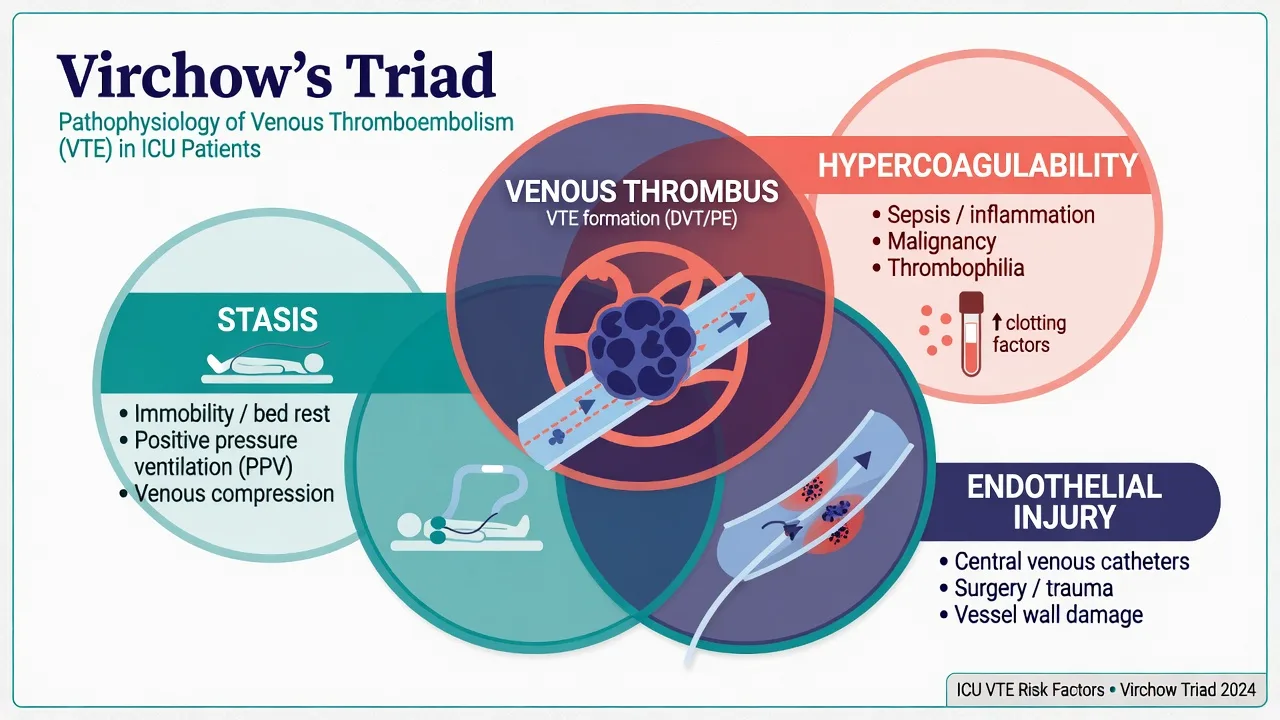
Virchow triad — the mechanism and the ICU correlate
| Triad component | Normal defence | How the ICU defeats it | Result |
|---|---|---|---|
| Venous stasis | Calf-muscle pump, venous valves, ambulation | Immobility (bed-rest, sedation, paralysis); raised intrathoracic pressure from positive-pressure ventilation; venous obstruction (central venous catheter, pelvic mass) | Slow venous return lets fibrin and platelet microaggregates settle and propagate |
| Hypercoagulability | Balanced coagulation; hepatic clearance of activated factors; antithrombin, protein C and protein S | Sepsis (cytokine-driven tissue factor expression); malignancy (tumour procoagulants); pregnancy (high fibrinogen, low anticoagulant reserve); postoperative state; inherited thrombophilia (factor V Leiden, prothrombin G20210A); oestrogens | Thrombin generation exceeds the natural anticoagulant capacity |
| Endothelial injury | Intact glycocalyx and endothelium are antithrombotic (heparan sulphate, thrombomodulin, nitric oxide, prostacyclin) | Central venous catheters; surgical and trauma tissue damage; cytokine-mediated endothelial activation; reperfusion injury; burns | Exposed subendothelium plus loss of the antithrombotic surface drives platelet adhesion and coagulation cascade activation |
The thrombus most often originates in the valve sinuses of the deep calf veins (where stasis is maximal and local oxygen tension lowest), then propagates proximally into the popliteal, femoral and iliac veins. Proximal (above-knee) DVT carries an approximately 50 per cent risk of PE if untreated — this is the lesion that matters clinically and the one prophylaxis is designed to prevent. About half of isolated calf DVTs resolve spontaneously; the rest propagate proximally, which is why the calf being 'far' from the lung is no reassurance.[1]
Why the ICU patient is the highest-risk patient in the hospital
The ICU-specific VTE risk factors (every row is a reason to prophylax)
| Category | ICU-specific risk factor | Approximate relative risk |
|---|---|---|
| Stasis | Mechanical ventilation, chemical paralysis, prolonged bed-rest | 2 to 4× |
| Hypercoagulability | Sepsis or septic shock, systemic inflammation (high CRP, IL-6) | 2 to 3× |
| Endothelial injury | Central venous catheter (femoral highest, then internal jugular, then subclavian) | 2 to 5× (catheter-related DVT) |
| Critical-illness coagulopathy | Acquired antithrombin deficiency, activated protein C depletion | Additive |
| Renal replacement therapy | Heparin-free circuits, vascular-access thrombosis | 2 to 3× |
| Transfusion | Pro-thrombotic effect of red cells and platelets; dilutional effect of massive transfusion | 1.5 to 2× |
| Vasopressors | Splanchnic and peripheral vasoconstriction increases stasis | Additive |
The take-home: in the ICU you do not need a risk calculator to decide whether to give prophylaxis — the decision is made for you. The only questions are which agent, what dose, and when to start.[22]
Prophylaxis
Pharmacological (the mainstay)
- The LMWH (the enoxaparin 40 mg SC daily, or the dalteparin 5000 U daily) — the standard. The reduce to the 20 mg or the UFH if the CrCl the under 30.[1]
- The UFH (the 5000 U SC TDS or BDS) — the alternative (the shorter the half-life, the safer in the renal failure, the easy the reverse).[1]
- The fondaparinux (the 2.5 mg daily) — for the HIT.[1]
- The DOACs — NOT the routine for the ICU prophylaxis (the oral route the unreliable; the drug interactions).[1]
Mechanical
- The IPC (the intermittent pneumatic compression) — for the patients with the contra-indication to the pharmacological (the active bleeding, the coagulopathy).[1]
- The graduated compression stockings (the TEDS) — the adjunct.[1]
- The combine the mechanical + the pharmacological for the highest-risk.[1]
Early mobilization
- The best prophylaxis. The reduce the immobility (the daily the sedation the breaks, the mobilise).[1]
Risk stratification — when you DO need a calculator (the ward patient)
The ICU patient gets prophylaxis by default. On the general ward and in ambulatory oncology, a risk score decides. The three the examiners want:[22]
Risk stratification scores for VTE prophylaxis
| Score | Population | High-risk threshold | Components |
|---|---|---|---|
| Padua Prediction Score | Medical inpatients | ≥4 = high risk (prophylax) | Active cancer, previous VTE, reduced mobility, known thrombophilia, recent trauma or surgery (within 1 month), age ≥70, acute infection, respiratory failure, BMI ≥35, hormone treatment |
| Caprini Score | Surgical patients | ≥5 = high risk (consider extended prophylaxis) | Age, BMI, type and length of surgery, VTE history, malignancy, etc. — additive points |
| Khorana Score | Ambulatory chemotherapy patients | ≥2 = high risk (consider apixaban or rivaroxaban primary prophylaxis) | Cancer site (very high: stomach, pancreas; high: lung, lymphoma, gynaecological, bladder, testicular), platelets ≥350, Hb <10, leucocytes ≥11, BMI ≥35 |
The Khorana score (and its modifications — Vienna, PROTECHT, CONKO) underpins primary pharmacological VTE prophylaxis in ambulatory cancer patients (the AVERT and CASSINI trials showed apixaban and rivaroxaban reduce VTE in high-Khorana patients, at the cost of more bleeding).[17][23]
The prophylaxis evidence — ENDORSE and the medical-prophylaxis trials
The ENDORSE study (Cohen 2008) was a multinational cross-sectional audit of over 68,000 hospitalised patients across 32 countries. It showed approximately 50 per cent of medical patients and 64 per cent of surgical patients were at HIGH VTE risk by American College of Chest Physicians criteria — yet only about half of those high-risk patients received appropriate prophylaxis. ENDORSE defined the scale of the problem; the trials below defined the solution.[1]
The landmark medical and ICU prophylaxis RCTs
| Trial | Population | Intervention vs comparator | Key result | Lesson |
|---|---|---|---|---|
| MEDENOX (Samama 1999, NEJM) | Acutely ill medical inpatients | Enoxaparin 40 mg SC daily vs 20 mg vs placebo, 6 to 14 days | 40 mg reduced VTE from 14.9% to 5.5% (RRR 63%); 20 mg no better than placebo | Established enoxaparin 40 mg daily as the medical-prophylaxis standard |
| Dalteparin prophylaxis (Kucher 2005, Arch Intern Med) | Medically ill patients | Fixed low-dose dalteparin 5000 U daily vs placebo | Reduced VTE | LMWH class effect; dalteparin is an acceptable alternative |
| PROTECT (Cook 2011, NEJM) | Critically ill ICU patients | Dalteparin 5000 U daily (UFH if renal failure) vs UFH 5000 U TDS | No difference in proximal DVT (primary); LESS heparin-induced thrombocytopenia with dalteparin | LMWH and UFH are equivalent in ICU prophylaxis; LMWH favoured for lower HIT risk |
| CLOTS-1 (Dennis 2009, Lancet) | Immobile stroke patients | Thigh-length graduated compression stockings vs no stockings | NO benefit (DVT 10.5% vs 10.0%); more skin harm | GCS do NOT work after stroke — abandoned |
| CLOTS-3 (Dennis 2013, Lancet) | Immobile stroke patients | Intermittent pneumatic compression vs no IPC | Reduced proximal DVT (8.5% vs 12.1%) and improved survival | IPC WORKS where stockings fail — the mechanical agent of choice |
The key ICU message from PROTECT: in the critically ill, LMWH (dalteparin 5000 U) and UFH (5000 U TDS) are equivalent for proximal-DVT prevention, and dalteparin causes less HIT — so LMWH is the default, with UFH reserved for renal failure or active bleeding. Mechanical IPC is added when pharmacology is held, and is the only mechanical device proven to work (stockings are obsolete after CLOTS-1).[4][18][19]
Extended-duration DOAC prophylaxis — the trials that did NOT deliver
Several trials tested whether oral factor-Xa inhibitors could extend prophylaxis beyond the hospital stay in medical patients. All were negative for net clinical benefit, because the reduction in VTE was offset by major bleeding:[22]
Extended-duration DOAC prophylaxis trials in medical patients (know them — examiners ask why DOACs are NOT routine ICU prophylaxis)
| Trial | Population | Intervention | Result | Why it failed |
|---|---|---|---|---|
| MAGELLAN (Cohen 2013, NEJM) | Acutely ill medical inpatients | Rivaroxaban 10 mg daily for 35 days vs enoxaparin for 10 days | Non-inferior at day 10 but MORE symptomatic VTE-and-death-related events and MORE major bleeding with extended rivaroxaban | Bleeding outweighed benefit |
| ADOPT (Goldhaber 2011, NEJM) | Medically ill patients | Apixaban 2.5 mg BD for 30 days vs enoxaparin for 6 to 14 days | NO difference in the composite of VTE and death; more major bleeding | Negative |
| MARINER (Spyropoulos 2018, NEJM) | Medically ill patients (IMPROVE risk-stratified) | Rivaroxaban 10 mg daily for 45 days post-discharge vs placebo | Missed primary (symptomatic VTE) significance; reduced fatal PE in a pre-specified subgroup | Missed endpoint; bleeding concern |
The bottom line: DOACs are NOT routine for ICU VTE prophylaxis — the enteral route is unreliable in the critically ill (gastric stasis, ileus, variable nasogastric absorption), and the extended-duration trials show bleeding outweighs benefit. DOACs belong to the TREATMENT of established VTE, not its prevention in the ICU.[9][10][11]
Contraindications to the pharmacological prophylaxis
- The active bleeding (the GI bleed, the intracranial haemorrhage).[1]
- The coagulopathy (the platelets under 50, the INR over 1.5 on the warfarin, the fibrinogen under 1.0).[1]
- The recent neurosurgery or spinal surgery (the under 24 h).[1]
- The epidural or spinal catheter — the hold the LMWH 2 to 4 h the before the removal; the hold the 12 h the after.[1]
- The HIT — the use the fondaparinux.[1]
Absolute and relative contraindications — the working list
Contraindications to pharmacological VTE prophylaxis — and what to do instead
| Contraindication | Detail | What to do instead |
|---|---|---|
| Active bleeding | GI bleed, intracranial haemorrhage, ongoing surgical bleeding | Mechanical IPC; restart LMWH once bleeding controlled (usually within 24 to 72 h) |
| Severe thrombocytopenia | Platelets <50 ×10^9/L (the threshold most guidelines use) | Mechanical IPC; correct the cause; restart LMWH when platelets >50 |
| Coagulopathy | INR >1.5 on warfarin or liver disease; fibrinogen <1.0 g/L | Mechanical IPC; reverse coagulopathy, then start LMWH |
| Recent neurosurgery or intracranial bleed | Within 24 h (48 to 72 h for major craniotomy) | Mechanical IPC; re-bleed risk is highest in first 24 h — reassess daily |
| Recent major surgery | Large incisional surfaces in first 12 to 24 h | Mechanical IPC; usually safe to start LMWH at 24 h once haemostasis is secure |
| Epidural or spinal catheter in situ | Spinal haematoma risk (see neuraxial timing below) | Mechanical IPC; time LMWH around catheter manipulation per ASRA guidance |
| Heparin-induced thrombocytopenia (HIT) | All heparins (UFH, LMWH) contraindicated | Fondaparinux 2.5 mg SC daily (prophylaxis) or argatroban/bivalirudin (therapeutic) |
| Severe renal failure | Not an absolute contraindication — LMWH accumulates | UFH 5000 U TDS, or dose-reduced LMWH with anti-Xa monitoring |
| Hypersensitivity | Rare; pork-derived heparins | Fondaparinux (synthetic) |
Neuraxial anaesthesia and LMWH — the spinal haematoma trap
The combination of neuraxial anaesthesia (epidural or spinal) with LMWH is the single most feared prophylaxis complication — spinal or epidural haematoma causes permanent paraplegia. The ASRA (American Society of Regional Anesthesia) guidance, now widely adopted in ANZ, is the exam answer:[22]
Neuraxial timing with anticoagulants (ASRA-based — the exam numbers)
- Therapeutic LMWH (e.g. enoxaparin 1 mg/kg BD) — wait 24 h after the last dose before needle placement or catheter removal; wait 4 h after a clean procedure before the next dose
- Prophylactic LMWH (e.g. enoxaparin 40 mg daily) — wait 12 h after the last dose before needle placement or catheter removal; wait 4 h after catheter removal before the next dose
- Twice-daily prophylactic LMWH — higher haematoma risk; first dose more than 24 h after the procedure, only after catheter removal
- UFH SC — wait 4 to 6 h after the last prophylactic dose, or 2 to 4 h after catheter removal
- UFH infusion — stop 4 to 6 h before needle placement; resume 1 h after
- DOACs (apixaban, rivaroxaban) — wait 48 h after the last dose; do not give for 24 h after catheter removal (longer if traumatic tap)
- Warfarin — stop, confirm INR ≤1.5 before needle placement or catheter removal
- Fondaparinux — avoid single-shot spinal; use only with an indwelling catheter held per protocol
Spinal haematoma: suspect in ANY patient with an epidural or spinal catheter who develops severe back pain, motor or sensory deficit, or bowel/bladder dysfunction. Order an urgent MRI and contact neurosurgery for decompression — delay beyond 8 hours dramatically worsens neurological outcome. [1]
Heparin-induced thrombocytopenia (HIT) — the paradoxical thrombosis
HIT is an immune (IgG anti-PF4-heparin) adverse drug effect that paradoxically causes thrombocytopenia AND thrombosis. It occurs 5 to 14 days after heparin exposure (or sooner with prior exposure within 100 days). The 4Ts score estimates pre-test probability; the confirmatory test is the anti-PF4 ELISA or the serotonin-release assay.[22]
The ICU trap is the falling platelet count in a heparin-exposed septic patient. Do NOT assume sepsis or dilution — calculate the 4Ts and send the anti-PF4. If HIT is suspected (4Ts ≥4, or high clinical suspicion), STOP ALL heparin (UFH and LMWH, including flushes and line locks) and switch to a non-heparin anticoagulant (argatroban or bivalirudin infusion for the critically ill; fondaparinux or danaparoid subcutaneously once the patient stabilises). Never re-challenge — the antibody persists for about 100 days. Prophylactic-dose heparin should never be resumed in confirmed HIT; the patient needs lifelong avoidance of heparin and is anticoagulated with a DOAC or warfarin once recovered. [1]
The 4Ts score for HIT pre-test probability
| Parameter | 0 points | 1 point | 2 points |
|---|---|---|---|
| Thrombocytopenia | <30% fall or nadir <10 | 30 to 50% fall or nadir 10 to 19 | ≥50% fall or nadir 10 to 50 |
| Timing of onset | <1 day (immediate, no prior heparin) | Consistent with day 5 to 10 but unclear; or ≤1 day with recent heparin | Clear onset day 5 to 14; or ≤1 day with heparin within 30 days |
| Thrombosis or other sequelae | None | Progressive or recurrent thrombosis; non-necrotising rash | New thrombosis; skin necrosis; acute systemic reaction |
| oTher cause for thrombocytopenia | Definite | Possible | None identified |
A 4Ts score of 0 to 3 excludes HIT (high negative predictive value) — no further testing needed; 4 to 8 requires an anti-PF4 assay; 8 is high-probability. [1]
The treatment of the established VTE
The anticoagulation (the mainstay)
- The LMWH therapeutic (the enoxaparin 1 mg per kg BD or 1.5 mg per kg daily) — the first-line for the acute.[1]
- The UFH infusion (the APTT-guided) — for the massive PE, the renal failure, the high-bleeding-risk (the shorter half-life, the reversible).[1]
- The DOACs (the apixaban, the rivaroxaban) — the oral; the post-acute transition.[1]
- The warfarin — the transition (the overlap with the LMWH or the UFH for the 5 days; the INR 2 to 3 for the 24 h).[1]
The thrombolysis (for the massive PE)
- The alteplase 50 to 100 mg IV over 2 h (or the 0.6 mg per kg over 15 min) — for the massive PE (the hypotension, the shock, the cardiac arrest).[1]
- The submassive PE (the RV strain on the echo, the troponin rise) — the controversial (the lower the threshold if the deteriorating).[1]
The embolectomy
- The surgical or the catheter — for the thrombolysis-contraindicated or the failed.[1]
The IVC filter
- For the anticoagulation-contra-indicated (the temporary — remove when the safe).[1]
The acute-phase options — parenteral vs oral
Anticoagulant options for acute VTE treatment
| Agent | Mechanism | Dose | Onset | Antidote or reversal | Role in acute VTE |
|---|---|---|---|---|---|
| LMWH (enoxaparin) | Antithrombin to factor Xa inhibition | 1 mg/kg SC BD (or 1.5 mg/kg OD) | 3 to 5 h (peak) | Protamine partial (~60%) | First-line parenteral for haemodynamically stable PE or DVT |
| UFH infusion | Antithrombin to thrombin and Xa | 80 U/kg bolus then 18 U/kg/h, APTT-guided | Immediate (minutes) | Protamine (complete) | Massive PE, renal failure, high bleeding risk, when rapid titration or reversal is needed |
| Fondaparinux | Selective factor Xa (via antithrombin) | Weight-based 5 to 10 mg SC daily | 2 h | None (rFVIIa in overdose) | HIT; renal clearance (avoid if CrCl <30) |
| Rivaroxaban | Direct factor Xa | 15 mg BD for 21 days, then 20 mg OD | 2 to 4 h | Andexanet alfa | First-line oral; NO parenteral lead-in (EINSTEIN) |
| Apixaban | Direct factor Xa | 10 mg BD for 7 days, then 5 mg BD | 3 to 4 h | Andexanet alfa | First-line oral; NO parenteral lead-in (AMPLIFY) |
| Warfarin | Vitamin K epoxide reductase inhibition | Variable (target INR 2 to 3) | Days (slow) | Vitamin K plus PCC or FFP | Long-term; requires parenteral overlap |
| Dabigatran | Direct thrombin | 150 mg BD after 5 to 10 d parenteral lead-in | 1 to 2 h | Idarucizumab | Oral; REQUIRES parenteral lead-in (unlike the Xa DOACs) |
The DOACs — the modern first-line oral therapy
The factor-Xa DOACs (rivaroxaban, apixaban, edoxaban) have replaced warfarin for most patients with VTE because they are non-inferior for recurrence, with less major and fatal bleeding and no monitoring. Crucially, rivaroxaban and apixaban can be started immediately with NO parenteral lead-in, which is why they dominate outpatient VTE care. The direct-thrombin-inhibitor dabigatran (and edoxaban) DO require 5 to 10 days of parenteral anticoagulation first.[22]
The DOAC treatment trials — know the regimens
| Trial | Population | Intervention | Key result | Clinical bottom line |
|---|---|---|---|---|
| EINSTEIN-DVT (2010, NEJM) | Acute symptomatic DVT | Rivaroxaban 15 mg BD for 3 weeks then 20 mg OD vs enoxaparin/warfarin | Non-inferior for recurrence; less major bleeding | Rivaroxaban, no lead-in — first-line |
| EINSTEIN-PE (Buller 2012, NEJM) | Acute symptomatic PE | Same rivaroxaban regimen vs enoxaparin/warfarin | Non-inferior for recurrence; trend to less bleeding | Rivaroxaban confirmed for PE |
| AMPLIFY (Agnelli 2013, NEJM) | Acute VTE | Apixaban 10 mg BD for 7 d then 5 mg BD vs enoxaparin/warfarin | Non-inferior; significantly less major bleeding | Apixaban, no lead-in — first-line |
| AMPLIFY-EXTENSION (Agnelli 2013, NEJM) | Extended therapy | Apixaban 2.5 or 5 mg BD vs placebo for 12 months | Both doses reduced recurrence; no excess bleeding | Low-dose apixaban for long-term |
Warfarin — when it is still needed (and the overlap rule)
Warfarin remains first-line for: pregnancy (DOACs are teratogenic), severe or triple-positive antiphospholipid syndrome (DOACs inferior in this subgroup), and where DOACs are unavailable or unaffordable. The overlap rule: start warfarin alongside LMWH or UFH, and CONTINUE the overlap for a minimum of 5 days AND until the INR is at least 2.0 for 24 h. The reason: warfarin initially depletes protein C (an anticoagulant), creating a transient pro-thrombotic state (rarely, warfarin skin necrosis) — the parenteral drug covers this window.[22]
Duration of anticoagulation — provoked vs unprovoked vs cancer
The duration question is one of the highest-yield viva topics:[22]
Duration of anticoagulation after a first VTE (CHEST 2016 guidance)
| VTE type | Duration | Rationale |
|---|---|---|
| Provoked by a transient or reversible risk factor (surgery, trauma, oestrogen, immobilisation) | 3 months (then stop) | The provoking factor is gone; the off-treatment recurrence risk is low; indefinite therapy adds bleeding without net benefit |
| Unprovoked (no identifiable trigger) | At least 3 months, then reassess; usually indefinite if bleeding risk acceptable | The off-treatment recurrence rate is ~10% per year and never returns to baseline |
| Second unprovoked VTE | Indefinite (lifelong) | Very high recurrence; the benefit of indefinite therapy is clear |
| Cancer-associated thrombosis | Indefinite while cancer is active | Active malignancy is a persistent provoking factor |
| Distal (calf) DVT | 6 weeks to 3 months if isolated and asymptomatic | Lower embolic risk than proximal DVT |
| VTE with a persistent provoking factor (e.g. ongoing immobility) | Until the factor resolves | The risk continues while the factor is present |
Deciding duration — the 90-second logic
- Was the VTE provoked? A reversible or transient trigger (surgery, trauma, oestrogen, immobilisation) = provoked.
- If provoked — 3 months, then stop. Do not extend.
- If unprovoked — at least 3 months, then reassess. Weigh the annual recurrence risk (~10%) against the bleeding risk. Most young, fit patients stay on indefinite therapy; frail high-bleeding-risk patients may stop.
- If a second unprovoked VTE — indefinite. No debate.
- If cancer-associated — indefinite while cancer is active, with LMWH or a DOAC (see below).
- Distinguish proximal from distal DVT — isolated distal calf DVT may be treated for 6 weeks to 3 months; proximal DVT always gets full-duration therapy.
Cancer-associated thrombosis (CAT) — LMWH vs DOAC
Cancer multiplies VTE risk 4- to 7-fold, and VTE is the second leading cause of death in cancer patients. For a decade, LMWH (dalteparin 200 U/kg for 1 month, then 150 U/kg for 5 months) was the standard — the CLOT trial (Lee 2003) showed LMWH superior to warfarin in cancer-associated VTE.[23]
The DOAC era has now challenged LMWH monotherapy. Three pivotal non-inferiority RCTs underpin the current guidance: [1]
Cancer-associated thrombosis — the DOAC trials
| Trial | DOAC | Comparator | Key result | Caveat |
|---|---|---|---|---|
| SELECT-D (Young 2018, JCO) | Rivaroxaban | Dalteparin | Less recurrent VTE (4% vs 11%); more clinically relevant non-major bleeding; a signal to more GI bleeding (especially GI malignancy) | Rivaroxaban reasonable in non-GI cancer; caution in GI or GU malignancy |
| Hokusai VTE-Cancer (Raskob 2018, NEJM) | Edoxaban | Dalteparin | Non-inferior; more major bleeding (mostly GI) | Edoxaban is an alternative to LMWH |
| Caravaggio (Agnelli 2020, NEJM) | Apixaban | Dalteparin | Non-inferior for recurrence; NO significant excess major bleeding | Apixaban the best-tolerated DOAC in CAT |
The current ASCO/ISTH/ASH consensus: LMWH, rivaroxaban, apixaban, and edoxaban are all acceptable first-line for cancer-associated VTE. Apixaban and rivaroxaban (no lead-in) are increasingly preferred for convenience. The exception is active GI or GU malignancy (bleeding risk high) where LMWH is safer. LMWH is also preferred in pregnancy, severe renal failure, and where enteral absorption is unreliable.[14][15][16][23]
IVC filters — the temporary rescue device
An IVC (inferior vena cava) filter is a metal cage deployed (usually percutaneously, via the internal jugular or femoral vein) below the renal veins to trap emboli arising from lower-limb DVT. The single indication: acute proximal DVT or PE with an absolute contraindication to anticoagulation (active bleeding, recent intracranial haemorrhage, planned urgent major surgery). Filters are a BRIDGE, not a definitive treatment — they do not prevent DVT extension (in fact they increase lower-limb DVT risk) and they do not treat the clot that is already there.[20][21]
The IVC filter evidence — PREPIC and PREPIC2
| Trial | Design | Result | Lesson |
|---|---|---|---|
| PREPIC (Decousus 1998, NEJM) | Permanent filters vs no filter, proximal DVT, 8-year follow-up | Reduced PE (especially fatal); but DOUBLED the rate of DVT and thrombotic occlusion of the IVC | Permanent filters prevent PE but cause long-term DVT — use only when anticoagulation is permanently impossible |
| PREPIC2 (Mismetti 2015, JAMA) | Retrievable filters plus anticoagulation vs anticoagulation alone, recurrent PE | NO reduction in recurrent PE at 6 months | Even retrievable filters add nothing once anticoagulation can be given — do NOT use as an extra layer |
The rules: (1) place a filter ONLY when anticoagulation is impossible; (2) use a RETRIEVABLE filter; (3) start anticoagulation as soon as bleeding risk allows; (4) REMOVE the filter as soon as feasible (ideally within weeks) — long-dwelling filters become endothelialised and un-retrievable, and themselves thrombose the IVC. A filter is never a substitute for anticoagulation.[20][21]
Thrombolysis for PE — the haemodynamically-driven decision
The decision to thrombolyse a PE is driven entirely by the haemodynamic status, because the benefit (rapid clot lysis) must outweigh the bleeding risk (about 10% major bleeding, 1 to 3% intracranial).[22]
PE severity and the thrombolysis decision
| PE category | Definition | Thrombolysis? |
|---|---|---|
| Massive (high-risk) | Hypotension (SBP <90) or shock or cardiac arrest | YES — alteplase 50 mg IV over 2 h (or 100 mg); or embolectomy if thrombolysis is contraindicated |
| Submassive (intermediate-risk) | Normotensive but RV strain (echo or RV:LV ratio), troponin or BNP rise | Controversial — anticoagulation plus monitor; thrombolyse only if deteriorating. PEITHO (below) informs this |
| Low-risk | Normotensive, no RV strain | NO thrombolysis — anticoagulation only |
The submassive PE thrombolysis trials
| Trial | Population | Intervention | Result | Lesson |
|---|---|---|---|---|
| Konstantinides 2002 (NEJM) | Submassive PE (RV dysfunction, normotensive) | Alteplase plus heparin vs heparin alone | Less treatment escalation (rescue thrombolysis); no mortality difference; trend to more bleeding | Early signal of benefit in the deteriorating submassive PE |
| PEITHO (Meyer 2014, NEJM) | Normotensive PE with RV strain and troponin positive | Tenecteplase vs placebo | Reduced death or haemodynamic collapse (2.6% vs 5.6%); but MORE major bleeding (11.5% vs 2.4%) and MORE intracranial haemorrhage (2.4% vs 0.2%) | Thrombolysis in submassive PE reduces decompensation at the cost of serious bleeding — reserve for the deteriorating patient |
The consensus: thrombolyse the MASSIVE PE (hypotension or shock); in the SUBMASSIVE PE, anticoagulate and monitor closely (serial echo, lactate, troponin), and reserve thrombolysis for the patient who is deteriorating (rising lactate, worsening RV function, falling blood pressure).[12][13]
Massive PE — the resuscitation sequence
- Recognise — hypotension, hypoxia, tachycardia, raised JVP, right-heart strain on echo (D-shaped septum, RV dilation); high clinical suspicion in the right context (immobility, recent surgery, malignancy, pregnancy)
- Resuscitate — high-flow oxygen, cautious IV fluids (250 mL boluses; the RV is preload-dependent but volume-intolerant), noradrenaline for hypotension (alpha-constriction plus beta-inotropy), consider dobutamine or inotropes if RV failure
- Confirm rapidly — CT pulmonary angiogram if the patient can tolerate transfer; bedside echo (RV strain) if not. Do NOT delay thrombolysis for imaging in cardiac arrest or extreme instability with a convincing story
- Thrombolyse — alteplase 50 mg IV over 2 h (massive PE dose; 100 mg for cardiac arrest). No APTT monitoring required during infusion and for 24 h afterwards
- Anticoagulate — UFH infusion (not LMWH) after the lytic, for reversibility: hold during the infusion, restart without a bolus once bleeding is controlled
- If thrombolysis is contraindicated or has failed — surgical embolectomy or catheter-directed thrombolysis or embolectomy
- Search for and treat the cause — DVT, malignancy, thrombophilia, pregnancy
Special scenarios — the ICU curveballs
VTE treatment in special populations
| Population | First-line anticoagulant | Notes |
|---|---|---|
| Pregnancy | LMWH (enoxaparin 1 mg/kg BD) throughout; switch to UFH infusion near delivery; warfarin postpartum (safe in breastfeeding) | DOACs are CONTRAINDICATED (teratogenic); warfarin crosses the placenta (fetal warfarin syndrome) |
| Renal failure (CrCl <30) | UFH infusion (hepatic clearance); or dose-reduced LMWH with anti-Xa monitoring | DOACs are largely renal (avoid rivaroxaban; apixaban can be used cautiously); fondaparinux is contraindicated |
| Morbid obesity (>120 kg or BMI >40) | LMWH at weight-based dose (no capping); UFH infusion; apixaban or rivaroxaban (no dose adjustment) | Anti-Xa monitoring for LMWH; avoid low fixed-dose prophylaxis regimens |
| HIT (confirmed) | Argatroban or bivalirudin infusion (parenteral); warfarin only once platelets recover, overlapped with the non-heparin agent | NO heparin (UFH or LMWH) ever again |
| Severe liver disease | LMWH preferred (UFH is less reliable due to low antithrombin); warfarin difficult (baseline high INR) | DOACs relatively contraindicated; monitor anti-Xa |
| Extremes of body weight | Weight-based LMWH; UFH infusion | Avoid fixed-dose prophylaxis in very low weight (bleeding) or very high weight (under-dosing) |
SAQ — Massive pulmonary embolism with thrombolysis
10 minutes · 10 marks
A 68-year-old man (weight 80 kg) is admitted to ICU ten days after a total hip replacement. He presents with sudden-onset dyspnoea, pleuritic chest pain, and a syncopal episode. On examination: HR 128, BP 78/46 (MAP 57), RR 32, SpO2 88 per cent on 15 L via non-rebreather, JVP raised at 8 cm, right parasternal heave. Bedside echocardiography shows a dilated right ventricle (RV:LV ratio 1.4) with septal bowing into the left ventricle (D-shaped septum) and a McConnell sign. Troponin 0.14 ng/mL, lactate 4.2 mmol/L, creatinine 95 micromol/L, platelets 210, INR 1.1. CT pulmonary angiogram confirms a saddle embolus at the bifurcation with filling defects in both main pulmonary arteries. There is no contraindication to thrombolysis.
SAQ — Anticoagulation reversal for warfarin-associated intracerebral haemorrhage
10 minutes · 10 marks
A 74-year-old woman on warfarin 5 mg daily for non-valvular atrial fibrillation (CHA2DS2-VASc 4) and a provoked proximal DVT six weeks ago presents with a sudden severe headache and progressive drowsiness. GCS 10 (E2V3M5), BP 184/96, HR 88 (irregular). CT brain shows a 40 mL right thalamic intracerebral haemorrhage with intraventricular extension and early hydrocephalus. INR 6.5 (target 2 to 3), platelets 220, creatinine 90 micromol/L, glucose 7.2. She took her warfarin this morning. You are asked to reverse her anticoagulation urgently.
Red flags
Clinical pearls
[1]Key trials and evidence
The evidence base for VTE prophylaxis and treatment rests on a small number of landmark RCTs. Prophylaxis in the medical and critically ill patient is anchored by MEDENOX (enoxaparin 40 mg, Samama 1999), the dalteparin prophylaxis study (Kucher 2005), and PROTECT (dalteparin vs UFH in the ICU, Cook 2011).[2][3][4] Treatment of established VTE with oral factor-Xa inhibitors is built on the EINSTEIN-DVT and EINSTEIN-PE programmes (rivaroxaban, 2010 and 2012) and the AMPLIFY programme including its extension (apixaban, 2013).[5][6][7][8] The cards below summarise the trials whose findings appear repeatedly in fellowship vivas.
ENDORSE — Cohen 2008 — VTE risk and prophylaxis in hospitalised patients (PMID 18242412)
Source
Lancet — multinational cross-sectional study, 68,183 patients across 358 hospitals in 32 countries
What it did
Audited the prevalence of VTE risk and the use of appropriate prophylaxis in acutely ill hospitalised medical and surgical patients
Key finding
About 50% of medical and 64% of surgical patients were at high VTE risk by ACCP criteria; only about half of high-risk patients received appropriate prophylaxis
Clinical bottom line
Defined the global scale of the VTE-prophylaxis gap — half of high-risk inpatients are still under-prophylaxed
MEDENOX — Samama 1999 — Enoxaparin prophylaxis in medical patients (PMID 10477777)
Source
New England Journal of Medicine — double-blind RCT, 1102 acutely ill medical patients
Intervention
Enoxaparin 40 mg SC daily or 20 mg vs placebo for 6 to 14 days
Result
40 mg reduced VTE from 14.9% to 5.5% (63% relative risk reduction); 20 mg was no better than placebo
Clinical bottom line
Established enoxaparin 40 mg SC daily as the medical-prophylaxis standard — the dose still used worldwide
PROTECT — Cook 2011 — Dalteparin vs UFH thromboprophylaxis in the critically ill (PMID 21417952)
Source
New England Journal of Medicine — multicentre RCT, 3764 critically ill patients
Intervention
Dalteparin 5000 U daily (UFH if renal failure) vs UFH 5000 U TDS
Primary endpoint
Proximal leg DVT by day 21 — NO significant difference (dalteparin 5.1% vs UFH 5.8%)
Safety
Less heparin-induced thrombocytopenia with dalteparin; a secondary analysis suggested more PE with dalteparin
Clinical bottom line
In the ICU, LMWH and UFH are equivalent for proximal-DVT prevention; LMWH is favoured for its lower HIT rate
EINSTEIN-PE — Buller 2012 — Oral rivaroxaban for symptomatic PE (PMID 22449293)
Source
New England Journal of Medicine — open-label non-inferiority RCT, 4833 patients with acute symptomatic PE
Intervention
Rivaroxaban 15 mg BD for 3 weeks then 20 mg OD vs standard enoxaparin/warfarin
Primary endpoint
Symptomatic recurrent VTE — rivaroxaban non-inferior (2.1% vs 1.8%)
Bleeding
Less major or clinically relevant non-major bleeding; less serious bleeding
Clinical bottom line
Rivaroxaban is non-inferior and at least as safe as standard therapy for PE — the foundation of oral-only VTE treatment
AMPLIFY — Agnelli 2013 — Oral apixaban for acute VTE (PMID 23808982)
Source
New England Journal of Medicine — double-blind RCT, 5395 patients with acute VTE
Intervention
Apixaban 10 mg BD for 7 days then 5 mg BD vs conventional enoxaparin/warfarin
Primary endpoint
Recurrent VTE or VTE-related death — apixaban non-inferior (2.3% vs 2.7%)
Bleeding
Significantly less major bleeding (0.6% vs 1.8%)
Clinical bottom line
Apixaban is non-inferior with significantly less major bleeding — a preferred first-line oral agent with no parenteral lead-in
PEITHO — Meyer 2014 — Fibrinolysis for intermediate-risk PE (PMID 24716681)
Source
New England Journal of Medicine — double-blind RCT, 1006 normotensive PE patients with RV strain and positive troponin
Intervention
Tenecteplase (weight-based single bolus) vs placebo, both with anticoagulation
Primary endpoint
Death or haemodynamic decompensation at 7 days — reduced (2.6% vs 5.6%)
Safety
More major bleeding (11.5% vs 2.4%) and more intracranial haemorrhage (2.4% vs 0.2%)
Clinical bottom line
Thrombolysis in submassive PE reduces decompensation at the cost of serious bleeding — reserve for the deteriorating patient
SELECT-D — Young 2018 — Rivaroxaban vs dalteparin in cancer-associated thrombosis (PMID 29746227)
Source
Journal of Clinical Oncology — open-label randomised trial, 406 cancer patients with acute VTE
Intervention
Rivaroxaban (standard regimen) vs dalteparin (200 U/kg for 1 month then 150 U/kg)
Key finding
Less recurrent VTE with rivaroxaban (4% vs 11% at 6 months); more clinically relevant non-major bleeding; a signal to more GI bleeding
Clinical bottom line
Rivaroxaban is a reasonable first-line for non-GI cancer-associated thrombosis; use LMWH for GI or GU malignancy
Caravaggio — Agnelli 2020 — Apixaban for cancer-associated VTE (PMID 32223112)
Source
New England Journal of Medicine — randomised trial, 1155 cancer patients with acute VTE
Intervention
Apixaban 10 mg BD for 7 days then 5 mg BD vs subcutaneous dalteparin, for 6 months
Primary endpoint
Recurrent VTE — apixaban non-inferior (5.6% vs 7.9%)
Safety
No significant difference in major bleeding (3.8% vs 4.0%)
Clinical bottom line
Apixaban is non-inferior to LMWH for cancer-associated thrombosis without excess major bleeding — the best-tolerated DOAC in CAT
Hokusai VTE-Cancer — Raskob 2018 — Edoxaban for cancer-associated VTE (PMID 29972743)
Source
New England Journal of Medicine — open-label non-inferiority RCT, 1050 cancer patients with VTE
Intervention
Edoxaban (after 5-day LMWH lead-in) vs dalteparin for 6 to 12 months
Primary endpoint
Recurrent VTE or major bleeding — non-inferior (combined outcome 12.8% vs 13.5%); more major bleeding (mostly GI)
Clinical bottom line
Edoxaban is a non-inferior alternative to LMWH for cancer-associated thrombosis; caution in GI malignancy
CLOTS-3 — Dennis 2013 — IPC to reduce DVT after stroke (PMID 23727163)
Source
Lancet — multicentre RCT, 2876 immobile stroke patients
Intervention
Intermittent pneumatic compression vs no IPC
Primary endpoint
Proximal DVT — reduced with IPC (8.5% vs 12.1%)
Secondary
Improved survival at 6 months (deaths 10.8% vs 13.1%)
Clinical bottom line
IPC reduces proximal DVT and improves survival in immobile stroke patients — the mechanical agent of choice when pharmacology is held
PREPIC2 — Mismetti 2015 — Retrievable IVC filter plus anticoagulation (PMID 25919526)
Source
JAMA — randomised trial, 399 patients with proximal DVT and high PE risk
Intervention
Retrievable IVC filter plus anticoagulation vs anticoagulation alone
Primary endpoint
Symptomatic recurrent PE at 6 months — NO difference (3.0% vs 1.5%)
Clinical bottom line
Adding a retrievable filter to anticoagulation does not reduce recurrent PE — filters are for the anticoagulation-contraindicated only
MARINER — Spyropoulos 2018 — Post-discharge rivaroxaban prophylaxis (PMID 30145946)
Source
New England Journal of Medicine — randomised trial, 12,024 medically ill patients at high VTE risk
Intervention
Rivaroxaban 10 mg daily for 45 days post-discharge vs placebo
Primary endpoint
Symptomatic VTE or VTE-related death — missed significance (0.83% vs 1.10%)
Secondary
Reduced fatal PE (0.16% vs 0.40%); no excess major bleeding
Clinical bottom line
Extended post-discharge DOAC prophylaxis missed its primary endpoint — reinforces that DOACs are not routine prophylaxis
Exam technique — how to answer a VTE question
The 90-second viva answer for 'Discuss VTE prophylaxis and treatment in the ICU patient'
- Frame the risk — "All ICU patients are at high VTE risk by default — Virchow's triad in full: immobility (ventilation, sedation), hypercoagulability (sepsis, inflammation, malignancy), and endothelial injury (central lines)."
- State the default — "Pharmacological prophylaxis is the standard of care — enoxaparin 40 mg SC daily. UFH 5000 U TDS if CrCl under 30. Fondaparinux 2.5 mg if HIT. Mechanical IPC when pharmacology is contraindicated."
- Give the evidence — "PROTECT showed LMWH and UFH are equivalent in the ICU; CLOTS-3 validated IPC; CLOTS-1 retired stockings; ENDORSE showed half of at-risk patients are still under-prophylaxed."
- List contraindications — "Active bleeding, platelets under 50, recent neurosurgery or intracranial bleed, epidural catheter (ASRA timing), confirmed HIT."
- Treatment of established VTE — "Therapeutic LMWH (enoxaparin 1 mg/kg BD) or a factor-Xa DOAC (rivaroxaban or apixaban, no lead-in). UFH infusion for massive PE or renal failure."
- Escalation — "Massive PE: thrombolysis alteplase 50 mg over 2 h, or embolectomy if thrombolysis is contraindicated. IVC filter only if anticoagulation is impossible — retrievable, temporary."
- Duration — "Provoked 3 months; unprovoked at least 3 months then usually indefinite; cancer or recurrent unprovoked indefinite. Cancer-associated: apixaban, rivaroxaban, or LMWH."
- Pitfalls — "Renal failure (use UFH), obesity (weight-based, no capping), pregnancy (LMWH, no DOACs or warfarin), neuraxial (12-h hold), HIT (stop all heparin)."
Common exam pitfalls in VTE
| Pitfall | The error | The correct answer |
|---|---|---|
| "Use a DOAC for ICU prophylaxis" | Enteral route unreliable; bleeding outweighs benefit (MAGELLAN, ADOPT, MARINER) | LMWH (enoxaparin 40 mg); reserve DOACs for treatment of established VTE |
| "Stockings for the immobile patient" | CLOTS-1 showed no benefit and more skin harm | IPC (CLOTS-3); stockings are obsolete after stroke |
| "IVC filter as an extra layer of protection" | PREPIC2 showed no benefit with anticoagulation; long-term DVT risk | Filter ONLY when anticoagulation is impossible; retrievable; remove ASAP |
| "Three months for every DVT" | Under-treats unprovoked and cancer VTE | Provoked 3 months; unprovoked usually indefinite; cancer indefinite |
| "Thrombolyse the submassive PE" | PEITHO showed more intracranial bleeding | Anticoagulate and monitor; thrombolyse only if deteriorating |
| "Cap the LMWH at 40 mg in obesity" | Under-dosing and risk of failure | Weight-based LMWH; check anti-Xa; DOACs need no obesity adjustment |
| "Warfarin alone for acute VTE" | Slow onset; early protein C depletion is pro-thrombotic | 5-day parenteral overlap AND INR at least 2.0 for 24 h |
| "Re-challenge heparin in recovered HIT" | Antibody persists for about 100 days | Lifelong heparin avoidance; DOAC or warfarin |
Summary — the non-negotiables
[1]References
- [1]Cohen AT, Tapson VF, Bergmann JF, et al. (ENDORSE study) Venous thromboembolism risk and prophylaxis in the acute hospital care setting (ENDORSE study): a multinational cross-sectional study Lancet, 2008.PMID 18242412
- [2]Samama MM, Cohen AT, Darmon JY, et al. (MEDENOX) A comparison of enoxaparin with placebo for the prevention of venous thromboembolism in acutely ill medical patients. Prophylaxis in Medical Patients with Enoxaparin Study Group N Engl J Med, 1999.PMID 10477777
- [3]Kucher N, Leizorovicz A, Vaitkus PT, et al. Efficacy and safety of fixed low-dose dalteparin in preventing venous thromboembolism among obese or elderly hospitalized patients: a subgroup analysis of the PREVENT trial Arch Intern Med, 2005.PMID 15710801
- [4]Cook D, Meade M, Guyatt G, et al. (PROTECT) Dalteparin versus unfractionated heparin in critically ill patients N Engl J Med, 2011.PMID 21417952
- [5]EINSTEIN Investigators, Bauersachs R, Berkowitz SD, et al. Oral rivaroxaban for symptomatic venous thromboembolism N Engl J Med, 2010.PMID 21128814
- [6]EINSTEIN-PE Investigators, Buller HR, Prins MH, et al. Oral rivaroxaban for the treatment of symptomatic pulmonary embolism N Engl J Med, 2012.PMID 22449293
- [7]Agnelli G, Buller HR, Cohen A, et al. (AMPLIFY) Oral apixaban for the treatment of acute venous thromboembolism N Engl J Med, 2013.PMID 23808982
- [8]Agnelli G, Buller HR, Cohen A, et al. (AMPLIFY-EXTENSION) Apixaban for extended treatment of venous thromboembolism N Engl J Med, 2013.PMID 23216615
- [9]Cohen AT, Spiro TE, Buller HR, et al. (MAGELLAN) Rivaroxaban for thromboprophylaxis in acutely ill medical patients N Engl J Med, 2013.PMID 23388003
- [10]Goldhaber SZ, Leizorovicz A, Kakkar AK, et al. (ADOPT) Apixaban versus enoxaparin for thromboprophylaxis in medically ill patients N Engl J Med, 2011.PMID 22077144
- [11]Spyropoulos AC, Ageno W, Albers GW, et al. (MARINER) Rivaroxaban for Thromboprophylaxis after Hospitalization for Medical Illness N Engl J Med, 2018.PMID 30145946
- [12]Meyer G, Vicaut E, Danays T, et al. (PEITHO) Fibrinolysis for patients with intermediate-risk pulmonary embolism N Engl J Med, 2014.PMID 24716681
- [13]Konstantinides S, Geibel A, Heusel G, et al. Heparin plus alteplase compared with heparin alone in patients with submassive pulmonary embolism N Engl J Med, 2002.PMID 12374874
- [14]Young AM, Marshall A, Thirlwall J, et al. (SELECT-D) Comparison of an Oral Factor Xa Inhibitor With Low Molecular Weight Heparin in Patients With Cancer With Venous Thromboembolism: Results of a Randomized Trial (SELECT-D) J Clin Oncol, 2018.PMID 29746227
- [15]Agnelli G, Becattini C, Meyer G, et al. (Caravaggio) Apixaban for the Treatment of Venous Thromboembolism Associated with Cancer N Engl J Med, 2020.PMID 32223112
- [16]Raskob GE, van Es N, Verhamme P, et al. (Hokusai VTE-Cancer) Edoxaban for Cancer-Associated Venous Thromboembolism N Engl J Med, 2018.PMID 29972743
- [17]Khorana AA, Kuderer NM, Culakova E, et al. Development and validation of a predictive model for chemotherapy-associated thrombosis Blood, 2008.PMID 18216292
- [18]CLOTS Trials Collaboration, Dennis M, et al. (CLOTS trial 1) Effectiveness of thigh-length graduated compression stockings to reduce the risk of deep vein thrombosis after stroke (CLOTS trial 1): a multicentre, randomised controlled trial Lancet, 2009.PMID 19477503
- [19]CLOTS Trials Collaboration, Dennis M, et al. (CLOTS 3) Effectiveness of intermittent pneumatic compression in reduction of risk of deep vein thrombosis in patients who have had a stroke (CLOTS 3): a multicentre randomised controlled trial Lancet, 2013.PMID 23727163
- [20]Decousus H, Leizorovicz A, Parent F, et al. (PREPIC) A clinical trial of vena caval filters in the prevention of pulmonary embolism in patients with proximal deep-vein thrombosis. Prévention du Risque d'Embolie Pulmonaire par Interruption Cave Study Group N Engl J Med, 1998.PMID 9459643
- [21]Mismetti P, Laporte S, Pellerin O, et al. (PREPIC2) Effect of a retrievable inferior vena cava filter plus anticoagulation vs anticoagulation alone on risk of recurrent pulmonary embolism: a randomized clinical trial JAMA, 2015.PMID 25919526
- [22]Kearon C, Akl EA, Ornelas J, et al. Antithrombotic Therapy for VTE Disease: CHEST Guideline and Expert Panel Report Chest, 2016.PMID 26867832
- [23]Lyman GH, Khorana AA, Falanga A, et al. (ASCO) American Society of Clinical Oncology guideline: recommendations for venous thromboembolism prophylaxis and treatment in patients with cancer J Clin Oncol, 2007.PMID 17968019