ICU · icu-acquired-infection
ICU-Acquired Infection Prevention Bundle — Comprehensive
Also known as ICU infection prevention · VAP bundle · CRBSI bundle · CAUTI prevention · C. difficile prevention · WHO 5 moments hand hygiene · Nosocomial infection prevention · Healthcare-associated infection
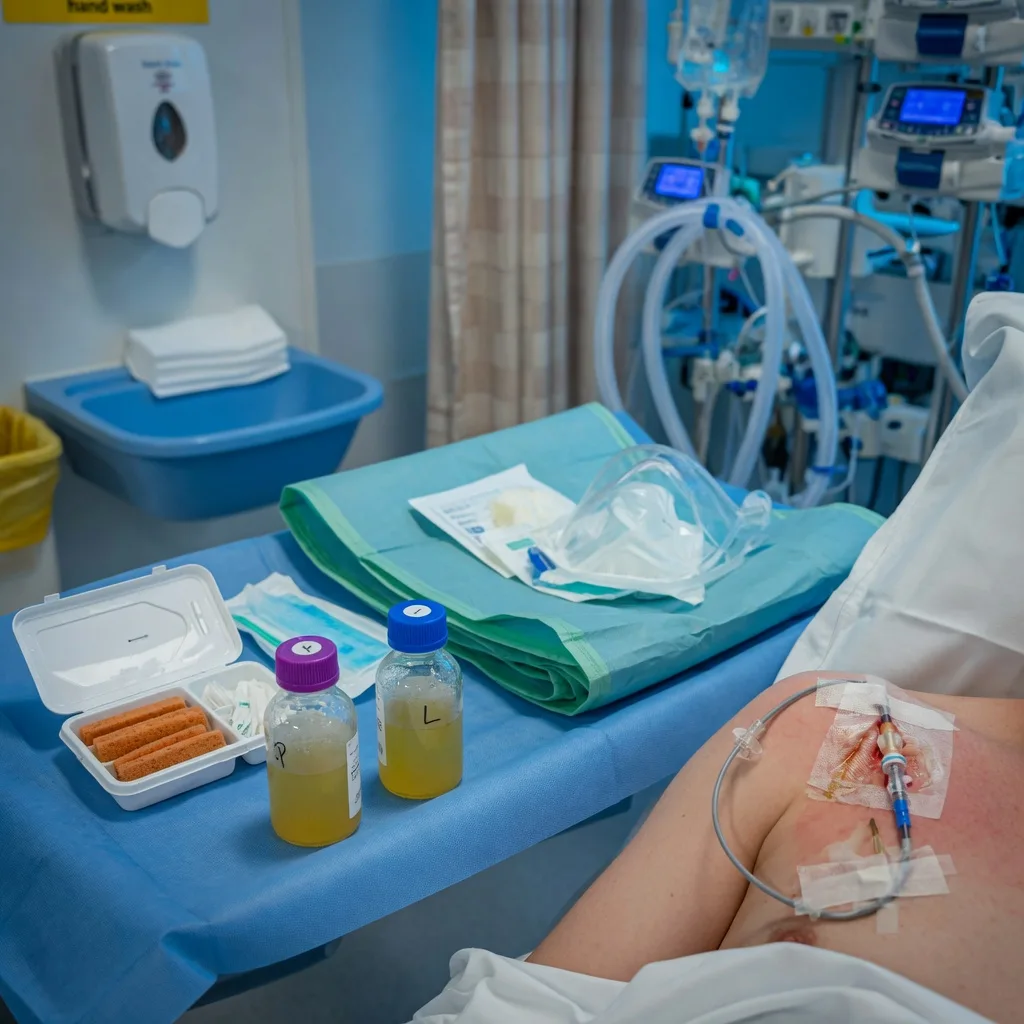
ICU-acquired infection prevention — the comprehensive evidence-based bundle approach to preventing the 5 major nosocomial infections in ICU: VAP (ventilator-associated pneumonia), CRBSI (catheter-related bloodstream infection), CAUTI (catheter-associated urinary tract infection), C. difficile infection, and SSI (surgical site infection). Each infection has a validated prevention bundle: VAP bundle (head of bed 30-45° + daily sedation interruption + oral care with chlorhexidine + peptic ulcer prophylaxis + DVT prophylaxis), CRBSI bundle (maximal sterile barrier precautions + chlorhexidine skin antisepsis + avoid femoral site + daily review of line necessity + chlorhexidine-impregnated dressings), CAUTI bundle (avoid unnecessary catheterisation + sterile insertion technique + remove as soon as possible + closed drainage system + daily review of necessity), C. difficile prevention (antimicrobial stewardship + hand hygiene with SOAP AND WATER [not alcohol gel — spores resistant] + contact precautions + environmental cleaning with bleach). Universal measures: WHO 5 Moments of Hand Hygiene, aseptic technique for all procedures, antimicrobial stewardship, environmental cleaning, surveillance and feedback. Prevention is ALWAYS better than treatment — each ICU-acquired infection increases mortality, length of stay, cost, and antimicrobial resistance.
On this page & tools
Your progress
Saved locally on this device.
Target exams
Red flags
Overview
The five infection prevention bundles
ICU infection prevention bundles — the comprehensive summary
| Infection | Bundle components | Evidence of benefit | Key teaching point |
|---|---|---|---|
| VAP | Head of bed 30-45° + daily sedation interruption (SAT) + oral care with chlorhexidine 0.12% q4-6h + peptic ulcer prophylaxis + DVT prophylaxis | Reduces VAP by 40-70% | Head of bed elevation is the SINGLE MOST EFFECTIVE VAP prevention measure — gravity prevents aspiration of oropharyngeal secretions |
| CRBSI | Maximal sterile barrier precautions + chlorhexidine 2% skin prep + AVOID femoral site + daily line necessity review + chlorhexidine-impregnated dressing | Reduces CRBSI by 50-80% | Full barrier precautions (like an OR) for ALL central line insertions — even emergencies — reduces CRBSI by 6x (Pronovost Keystone trial) |
| CAUTI | Avoid unnecessary catheterisation + sterile insertion + closed drainage + daily necessity review + remove ASAP | Reduces CAUTI by 30-50% | The best urinary catheter is the ABSENT one — review daily: 'Does this patient still need a catheter today?' |
| C. difficile | Antimicrobial stewardship + SOAP AND WATER hand hygiene + contact precautions + bleach cleaning + proton pump inhibitor review | Reduces CDI by 20-40% | Alcohol gel does NOT kill C. difficile SPORES — MUST wash with soap and water |
| SSI (for surgical ICU patients) | Perioperative antibiotics within 60 min of incision + normothermia + glycaemic control + supplemental oxygen | Reduces SSI by 30-50% | Give cefazolin within 60 min before incision — re-dose if surgery >4h or blood loss >1500 mL |
Clinical pearls
Red flags
Prognosis
Impact of ICU-acquired infections
| Infection | Additional mortality | Additional ICU days | Additional cost | Prevention bundle efficacy |
|---|---|---|---|---|
| VAP | 5-13% | 4-6 days | $20,000-40,000 | 40-70% reduction |
| CRBSI | 10-25% | 5-7 days | $30,000-45,000 | 50-80% reduction |
| CAUTI | 2-5% | 1-2 days | $1,000-5,000 | 30-50% reduction |
| C. difficile | 5-15% | 3-5 days | $10,000-20,000 | 20-40% reduction |
| SSI | 2-5% | 3-5 days | $15,000-25,000 | 30-50% reduction |
Key trials and evidence
Pronovost Keystone Initiative — CRBSI prevention (historical)
Source
New England Journal of Medicine — statewide quality improvement in 103 Michigan ICUs
Intervention
Central line bundle: full barrier precautions + chlorhexidine prep + avoid femoral + daily review
Outcome
CRBSI reduced by 66% (from 2.7 to 0.9 per 1000 catheter days) — sustained over 18 months
Key finding
A simple checklist-based bundle dramatically reduced a lethal complication — the most dramatic ICU quality improvement ever published
Clinical bottom line
The central line bundle is MANDATORY for ALL central line insertations — it reduces CRBSI by 66%
VAP diagnosis — clinical vs microbiological [1]
VAP diagnosis — clinical (CPIS) vs microbiological (BAL/PSB)
| Criterion | Clinical (CPIS) | Microbiological (BAL) |
|---|---|---|
| Temperature | >38C or <36C | — |
| Leucocytes | >12,000 or <4,000 | — |
| Secretions | Purulent | — |
| PaO2/FiO2 | <300 | — |
| CXR | New/progressive infiltrate | New/progressive |
| Culture | — | BAL: >=10^4 CFU/mL (quantitative) |
| CPIS score | >=6 = likely VAP (0-12) | — |
VAP empiric antibiotic selection
VAP empiric antibiotics — by risk profile
| Profile | Likely organisms | Empiric regimen | Duration |
|---|---|---|---|
| Early-onset (<5 days, no MDR risk) | Strep pneumoniae, H. influenzae, MSSA | Ceftriaxone 2g IV daily | 7 days |
| Late-onset (>5 days or MDR risk) | Pseudomonas, Acinetobacter, ESBL | Pip-tazobactam 4.5g q6h + amikacin 15mg/kg daily | 7-8 days |
| Known MRSA colonisation | Add MRSA coverage | + Vancomycin 1g q12h (TDM 15-20) | 7-8 days |
CRBSI insertion checklist
Central line insertion — the evidence-based bundle
- REVIEW INDICATION: Is a central line truly needed? Could peripheral access suffice?
- MAXIMAL STERILE BARRIERS: Operator: cap, mask, sterile gown, sterile gloves. Patient: FULL BODY sterile drape (not just small drape). This reduces CRBSI by 6x
- CHLORHEXIDINE 2% SKIN PREP: Concentric circles from site outward. Allow to DRY (>30 seconds). Chlorhexidine > povidone-iodine
- SITE SELECTION: Subclavian (lowest CRBSI) > IJV (ultrasound-guided) > femoral (3-8x higher CRBSI — avoid unless emergency)
- ULTRASOUND GUIDANCE: Real-time US for ALL insertions — reduces mechanical complications by 70%
- CHLORHEXIDINE-IMPREGNATED DRESSING: Biopatch at insertion site for lines >5 days — reduces CRBSI by 40%
- DAILY REVIEW: Ask EVERY DAY: Does this patient still need this line? Remove when no longer indicated
C. difficile treatment protocol

C. difficile treatment by severity
| Severity | First-line | Alternative | Recurrence prevention |
|---|---|---|---|
| Non-severe (WCC <15, Cr <1.5x) | Fidaxomicin 200mg BD x 10 days (PREFERRED — lower recurrence) OR vancomycin 125mg QID x 10 days | Metronidazole 500mg TID x 10 days | — |
| Severe (WCC >=15, Cr >=1.5x, albumin <30) | Vancomycin 125mg QID x 10-14 days + IV metronidazole 500mg TID | — | — |
| Fulminant (hypotension, megacolon) | Vancomycin 500mg PO/NG QID + IV metronidazole 500mg TID + rectal vancomycin (if ileus) | Surgery (colectomy) if perforation | — |
| First recurrence | Fidaxomicin 200mg BD x 10 days OR vancomycin taper | — | Bezlotoxumab 10mg/kg IV (reduces recurrence by 40%) |
| Second+ recurrence | Faecal microbiota transplant (FMT) — 90% cure rate | — | — |
Additional clinical pearls
Additional trials
Chastre 2003 — PNEUMA trial: 8 vs 15 days VAP antibiotics
Study
Randomised — 401 patients with confirmed VAP
Intervention
8 days vs 15 days appropriate antibiotics
Outcome
28-day mortality: 18.8% (8d) vs 17.6% (15d) — NO difference
Clinical bottom line
7-8 days sufficient for most VAP — shorter reduces resistance
MODIFY II — Bezlotoxumab for C. difficile recurrence prevention
Study
Randomised, placebo-controlled — 1,206 patients
Intervention
Bezlotoxumab 10mg/kg IV single dose + standard antibiotic therapy
Outcome
12-week recurrence: 17% (bezlo) vs 28% (placebo) — 40% reduction
Clinical bottom line
Give bezlotoxumab for high-risk CDI patients (age >=65, severe, immunocompromised)
Detailed CRBSI management — diagnosis and treatment
CRBSI diagnosis — culture methods
| Method | Technique | Advantage | Disadvantage |
|---|---|---|---|
| Paired blood cultures (differential time to positivity) | Draw simultaneously from the central line AND a peripheral vein. If line culture turns positive >2 hours BEFORE peripheral → the line is the source | Simple, no line removal needed for diagnosis, widely available | Requires 2 separate blood culture bottles drawn simultaneously. Less sensitive than semi-quantitative culture |
| Semi-quantitative (Maki) roll-plate | Remove the catheter → roll the tip across an agar plate → count colonies. >15 CFU = significant colonisation. Requires catheter REMOVAL | Identifies the organism + sensitivities | Requires line removal (which may not be necessary if the line is not the source) |
| Paired quantitative blood cultures | Draw from the line (3:1 or 5:1 dilution) AND peripheral. If line culture has 3-5x MORE colonies than peripheral → line is the source | Most sensitive and specific | More expensive, less widely available, requires quantitative culture technique |
CRBSI management — by organism and line type
| Scenario | Line management | Antibiotic duration | Notes |
|---|---|---|---|
| Coagulase-negative Staph (CNS) CRBSI | REMOVE line (do NOT exchange over wire — new line will be contaminated from the same tract). Insert NEW line at DIFFERENT site | 5-7 days (if line removed AND patient improves within 72h). If metastatic infection (endocarditis, septic thrombophlebitis) → 4-6 weeks | Most common CRBSI organism (30-40%). Often from SKIN FLORA contamination at insertion. If patient stable and line DIFFICULT to replace → can try antibiotic lock therapy (instil vancomycin 5mg/mL into the lumen for 12h/day x 14 days) |
| S. aureus CRBSI | ALWAYS remove line. Screen for metastatic infection (echo for endocarditis, MRI for osteomyelitis/epidural abscess) | 14 days minimum (if no metastatic infection AND echo negative AND repeat blood cultures negative at 72h). 4-6 weeks if endocarditis/osteomyelitis | HIGH mortality (20-30%). 15-30% develop metastatic infection. ALWAYS do echo (TTE first, TOE if TTE negative AND high suspicion) |
| Gram-negative CRBSI | REMOVE line | 7-14 days (depends on organism and source) | More likely from CONTAMINATED INFUSION or haematogenous seeding (not from skin flora) |
| Candida CRBSI | ALWAYS remove line | 14 days after FIRST negative blood culture AND after line removal | Check for metastatic infection (fundoscopy for chorioretinitis, echo for endocarditis). Source: TPN, broad-spectrum antibiotics, haematological malignancy |
| Prosthetic valve / pacemaker CRBSI | ALWAYS remove line. URGENT cardiac surgery opinion (may need valve/pacemaker removal) | 6+ weeks | Complex — requires multi-disciplinary (cardiology, cardiac surgery, ID) |
VAP antibiotic duration — the evidence summary
VAP antibiotic duration — evidence for short courses
| Trial | Year | Comparison | Key finding | Clinical bottom line |
|---|---|---|---|---|
| Chastre (PNEUMA) | 2003 | 8 vs 15 days (appropriate antibiotics) | 28-day mortality: 18.8% vs 17.6% (NO difference). Recurrence: slightly higher in 8-day group for Pseudomonas (but NOT statistically significant) | 7-8 days is SUFFICIENT for most VAP |
| Singh (pneumonia score) | 2000 | CPIS-guided stop vs standard 10-21 days | CPIS ≤6 at day 3 → stop antibiotics → fewer antibiotic days WITHOUT worse outcomes | CPIS can GUIDE duration — but CPIS is NOT reliable for VAP DIAGNOSIS |
| Luyt (VAPRA) | 2014 | 7 vs 15 days (France) | No difference in 28-day mortality. Shorter duration: fewer antibiotic days, less MDR emergence | 7 days preferred for VAP (including VAP due to Pseudomonas) |
CAUTI — detailed prevention and management
CAUTI prevention — the full bundle
| Component | Evidence | Implementation |
|---|---|---|
| AVOID unnecessary catheterisation | #1 prevention measure — 25% of urinary catheters have NO clear indication. The best catheter is the ABSENT one | Daily review: 'Does this patient need a urinary catheter TODAY?' Remove if: ambulatory, no need for strict I&O, no urinary retention, no sacral/perineal wound management need |
| Sterile insertion | Reduces bacterial introduction during insertion | Use sterile gloves, sterile drape, sterile lubricant, sterile catheter. Cleanse meatus with antiseptic before insertion. Use CLOSED system (do NOT break the circuit) |
| Closed drainage system | Prevents bacterial ascent from drainage bag to bladder | NEVER separate the catheter from the drainage tube. Empty bag via the drainage PORT (not by disconnecting tubing). Keep bag BELOW bladder level (gravity prevents reflux) but OFF the floor |
| Daily meatal care | Routine WASHING with soap and water (NOT antiseptic — antiseptic does NOT reduce CAUTI and may cause irritation) | Wash perineum daily with soap and water. Do NOT apply antiseptic ointment to meatus (ineffective). Do NOT perform bladder instillation with antiseptic (ineffective + irritant) |
| Silver-alloy or antibiotic-impregnated catheters | Reduce CAUTI in short-term catheterisation (<2 weeks). Cochrane: 12% reduction in CAUTI | Consider for patients expected to need catheter >1 week. Cost vs benefit — more expensive but reduce CAUTI episodes |
| Scheduled voiding trials (catheter clamping) | NOT recommended — does NOT predict voiding success and may cause retention | Remove catheter and assess spontaneous voiding. If unable to void → reinsert. Use bladder scanner to assess post-void residual |
Universal infection prevention — the infrastructure
Universal ICU infection prevention — the system approach
- HAND HYGIENE AUDIT: WHO 5 Moments audited MONTHLY. Target compliance >80%. Feedback to staff. Alcohol-based hand rub at EVERY bedspace (visible + accessible)
- ANTIBIOTIC STEWARDSHIP ROUND: Daily microbiology review of ALL ICU patients on antibiotics. Questions: (a) Is this antibiotic still needed? (b) Can it be de-escalated (narrower spectrum based on cultures)? (c) Can it be stopped (duration)? (d) Is it the RIGHT dose (PK/PD optimisation)?
- SURVEILLANCE AND FEEDBACK: Track ICU-acquired infection rates monthly: VAP rate per 1000 ventilator days, CRBSI rate per 1000 line days, CAUTI rate per 1000 catheter days. DISPLAY rates in ICU (visual feedback). Benchmark against national/international rates. Target ZERO preventable infections
- STAFF EDUCATION: Quarterly infection control training for ALL ICU staff. Competency assessment for aseptic technique (central line insertion, urinary catheter insertion, sterile dressing changes). New staff orientation includes infection control assessment
- ENVIRONMENTAL CLEANING: ICU cleaned DAILY with hospital-grade disinfectant. HIGH-TOUCH surfaces (bed rails, monitors, IV pumps, keyboards) cleaned at least twice daily. Terminal cleaning after patient discharge/discharge (curtain change, mattress disinfection). UV-C light decontamination for enhanced terminal cleaning (reduces residual bacterial load by 95%)
- ISOLATION PROTOCOLS: Contact precautions for MRSA, VRE, CRE, C. difficile. Airborne precautions for TB, measles, varicella. Droplet precautions for influenza, RSV, pertussis. Correct PPE for each isolation type. Signage on door. Dedicated equipment (stethoscope, BP cuff) for isolation rooms
Additional clinical pearls for exam-exhaustive depth
Antibiotic stewardship — the final frontier
Antibiotic stewardship interventions in ICU
| Intervention | Impact | Evidence |
|---|---|---|
| PCT-guided stopping | Reduces antibiotic duration by 2-7 days | PRORATA: NNT=7 for one fewer antibiotic day. Cochrane: safe across multiple settings |
| Daily stewardship round | Reduces inappropriate prescriptions by 30% | Requires: intensivist + pharmacist + microbiologist. Review: indication, spectrum, dose, duration |
| Rapid diagnostics (PCR, MALDI-TOF) | Reduces time to appropriate therapy by 24-48h | Faster organism identification → faster de-escalation |
| Pharmacokinetic optimisation | Reduces underdosing (75% of ICU patients under-dosed) | Extended/continuous infusion beta-lactams (BLING II), TDM-guided vancomycin |
| De-escalation protocol | Reduces broad-spectrum antibiotic days by 30% | Switch from piperacillin-tazobactam to ceftriaxone once cultures identify sensitive organism |
| Automatic stop orders | Reduces antibiotic duration by 1-2 days | Default 7-day stop with microbiology review at day 5-7 |
Exam practice — SAQ
SAQ — ICU device-infection prevention bundles
10 minutes · 10 marks
Your unit’s CLABSI rate has doubled over 6 months. Leadership asks for an evidence-based response for CICM infection-control viva.
Examiner densification notes
[1] [1]References
- [1]Labeau SO, et al. [Natural killer cells: adaptation and memory in innate immunity] Med Sci (Paris), 2013.PMID 23621934