MedVellum
MCQsExamsAtlas
DashboardPricing
MBBS / Core medicine✳Dermatology✳ICU Fellowship (CICM)✳Anaesthesia✳Emergency Medicine✳Psychiatry Fellowship✳Paediatrics Fellowship✳Physician Medicine✳MCQs✳SAQs✳Vivas✳OSCE✳Evidence-first✳MBBS / Core medicine✳Dermatology✳ICU Fellowship (CICM)✳Anaesthesia✳Emergency Medicine✳Psychiatry Fellowship✳Paediatrics Fellowship✳Physician Medicine✳MCQs✳SAQs✳Vivas✳OSCE✳Evidence-first✳

MedVellum.

The folio

Exam-exhaustive medical education across every specialty — evidence-graded topics, engraved plates, and practice in every written and oral format. Educational content only — not medical advice.

llms.txt · psychiatry LLM catalog · sitemap

Atlas

  • Specialty atlas
  • MBBS / Core medicine
  • Dermatology
  • ICU Fellowship (CICM)
  • Anaesthesia
  • Emergency Medicine
  • Psychiatry Fellowship
  • Paediatrics Fellowship
  • Physician Medicine

Study & account

  • MCQ practice
  • Practice alias
  • Exam tools
  • Dashboard
  • Pricing
  • Sign in

© 2026 MedVellum. For education only — not a substitute for clinical judgement.

Folio edition · Set in Instrument Serif & Archivo

ICU TopicsAntimicrobial Stewardship

ICU · Antimicrobial Stewardship

Acute severe community-acquired pneumonia: infection control in ICU

Also known as Infection control in ICU · Nosocomial infection prevention · ICU hygiene · Isolation precautions

Infection control in ICU prevents transmission of pathogens between patients, staff, and the environment. Core components: (1) Hand hygiene (WHO 5 Moments — single most effective measure). (2) Standard precautions (for ALL patients — gloves, gown, eye protection when exposure risk). (3) Transmission-based precautions: contact (MRSA, VRE, C. diff, MDR), droplet (influenza, RSV, pertussis), airborne (TB, measles, chickenpox). (4) Environmental cleaning (high-touch surfaces, terminal cleaning). (5) Equipment cleaning/disinfection (dedicated equipment for isolated patients). (6) Surveillance (MDR screening cultures, infection rates). (7) Staff education and audit. (8) Antimicrobial stewardship. ICU infection rate is a quality metric — lower is better.

low15 referencesUpdated 2 July 2026
On this page & tools

Your progress

Saved locally on this device.

Target exams

CICMFFICMEDIC

Red flags

Hand hygiene compliance <70% = significant infection risk — audit, feedback, educationC. diff: contact precautions + soap and water (NOT alcohol gel — spores survive alcohol)TB: airborne isolation — NEGATIVE PRESSURE room, N95/P2 respirator

Your progress

Saved locally on this device.

Target exams

CICMFFICMEDIC

Red flags

Hand hygiene compliance <70% = significant infection risk — audit, feedback, educationC. diff: contact precautions + soap and water (NOT alcohol gel — spores survive alcohol)TB: airborne isolation — NEGATIVE PRESSURE room, N95/P2 respirator
ICU ward scene showing a staff member performing hand hygiene at the bedside with a WHO Five Moments poster, a patient in contact isolation with gown and gloves, and a chlorhexidine wipe-down of equipment, clinical-blue lighting
FigureInfection control in the ICU — hand hygiene (WHO Five Moments) is the single most effective, lowest-cost measure. Contact precautions, isolation of MDR colonised patients, chlorhexidine bathing and active surveillance cultures break cross-transmission.

In one line

ICU infection control: (1) Hand hygiene (WHO 5 Moments — most effective). (2) Standard precautions (all patients). (3) Transmission-based: contact (MRSA, VRE, C. diff), droplet (influenza), airborne (TB). (4) Environmental/equipment cleaning. (5) Surveillance. (6) Stewardship. C. diff: soap and water (NOT alcohol gel). TB: negative pressure + N95.

[2]

SAQ — outbreak investigation in the ICU

SAQ — ICU outbreak: carbapenem-resistant Klebsiella (CRE) in the ICU

10 minutes · 10 marks

Over a 5-day period, three patients in your 12-bed ICU grow carbapenem-resistant Klebsiella pneumoniae (KPC-producing) from sputum and urine cultures. Two are on the ventilator and one is on a renal replacement circuit. The unit has had hand hygiene compliance of 64% on the last audit. You are asked to lead the outbreak response.

[2]

SAQ — A bundle approach to preventing device-related infections in ICU

10 minutes · 10 marks

Your ICU has reported catheter-related bloodstream infection (CRBSI) and ventilator-associated pneumonia (VAP) rates that are above the national benchmark. The medical director asks you to design a quality-improvement programme to reduce these device-associated infections.

[14]

SAQ — MDR organism isolation and hand hygiene compliance

SAQ — Newly admitted patient with suspected multidrug-resistant (MDR) organism colonisation

10 minutes · 10 marks

A 68-year-old man is transferred from a tertiary hospital overseas to your ICU for ongoing management of ventilated respiratory failure. The referral letter flags prior isolation of carbapenem-resistant Acinetobacter baumannii (CRAB) from sputum and vancomycin-resistant Enterococcus (VRE) from rectal screening. Your ICU is at 90% occupancy with no vacant single rooms for the next 6 hours. Outline your isolation and infection-control management.

[1]

SAQ — Designing a hand hygiene quality-improvement programme for the ICU

10 minutes · 10 marks

Your 16-bed ICU's most recent independent audit shows hand hygiene compliance of 58% (target ≥80%, aspirational ≥90%). The lowest-performing moment is Moment 1 (before touching a patient) at 41%. The infection prevention committee asks you to lead a multimodal improvement programme. Outline your approach and the supporting evidence.

[1]

Clinical pearls

High-yight infection control points for the CICM/FFICM exam

  1. Hand hygiene: WHO 5 Moments — most effective infection control measure. Target >90% compliance.[1] }
  2. Alcohol-based hand rub: preferred for routine hand hygiene (faster, better skin tolerance). BUT: NOT effective against C. diff spores — use soap and water.[1] }
  3. C. diff: CONTACT precautions + SOAP AND WATER (alcohol gel does NOT kill spores). Sporicidal disinfectant (chlorine-based) for cleaning.[2] }
  4. TB: AIRBORNE precautions — negative pressure room, N95/P2 respirator for staff. Door closed at all times.[2] }
  5. Contact precautions: gown + gloves for ALL contact. Single room or cohort. Dedicated equipment.[2] }
  6. Droplet precautions: surgical mask within 1 metre. Single room preferred. Door may remain open.[2] }
  7. MDR organisms: contact precautions for MRSA, VRE, ESBL, CRE, MDR Pseudomonas, Acinetobacter.[2] }
  8. Environmental cleaning: high-touch surfaces (bed rails, call button, IV poles, monitors) cleaned daily. Terminal cleaning after discharge.[2] }
  9. Equipment: dedicated equipment for isolated patients (stethoscope, BP cuff, thermometer, glucometer). Do NOT share.[2] }
  10. Visitors: educate on hand hygiene. Gown + gloves if providing direct care. Exclude if symptomatic (respiratory infection, diarrhoea).[2] }
  11. Staff: ill staff should NOT come to work (especially respiratory infection, diarrhoea, skin infection). Vaccination (influenza, hepatitis B, MMR, varicella, TB screening).[2] }
  12. Antibiotic stewardship: minimise antibiotic use → reduces C. diff, MDR selection, antibiotic-associated diarrhoea.[2] }
  13. Audit and feedback: regular audit of hand hygiene compliance, isolation compliance, environmental cleaning. Feedback to staff → improves performance.[1] }
  14. Infection control nurse/committee: dedicated staff for surveillance, education, outbreak investigation, policy development.[2] }

Red flags

Critical infection control points

  • Hand hygiene <70% compliance = significant infection risk.[1] }
  • C. diff: soap and water (NOT alcohol gel — spores survive alcohol).[2] }
  • TB: negative pressure + N95/P2 respirator.[2] }
  • Contact isolation for ALL MDR organisms — gown + gloves, single room/cohorting.[2] }
  • Dedicated equipment for isolated patients — do NOT share.[2] }

ICU-acquired (nosocomial) infections — overview

Why ICU infection control matters

ICU patients carry roughly 5–10× the risk of a healthcare-associated infection (HAI) of ward patients because of: (1) severe illness and immune compromise; (2) multiple invasive devices (endotracheal tube, central venous catheter, urinary catheter, arterial line, surgical drains); (3) broad-spectrum antibiotic exposure that selects resistant organisms; (4) prolonged length of stay; and (5) frequent staff contact and cross-transmission. The five major device-/procedure-associated infections are CRBSI/CLABSI, VAP, CAUTI, SSI and C. difficile infection (CDI). Each is reported as a rate per 1000 device-days, is largely preventable, and is a benchmark of ICU quality. Infection control is therefore a SYSTEM — standard and transmission-based precautions, device bundles, antimicrobial stewardship, environmental hygiene and surveillance — that together target near-zero preventable infections.[1][14]

[14]

The chain of infection — what each control measure breaks

[2]

Hand hygiene — the single most effective measure
WHO Five Moments of hand hygiene educational diagram at the ICU bedside
FigureWHO Five Moments — the highest-yield, lowest-cost infection-control intervention in the ICU.

WHO 5 Moments of Hand Hygiene — the exam answer

  1. Moment 1 — BEFORE touching a patient. Protects the patient from flora carried on your hands (e.g., after touching the bed rail you then take a pulse).[1]
  2. Moment 2 — BEFORE a clean/aseptic procedure. Protects the patient from their own flora and yours entering a sterile site (before line insertion, before wound care, before drawing blood).[1]
  3. Moment 3 — AFTER body-fluid exposure risk. Protects you and the unit from the patient's flora and blood-borne pathogens (after suctioning, after removing a soiled dressing, after handling a urine bag).[1]
  4. Moment 4 — AFTER touching a patient. Protects you and the environment from the patient's flora.[1]
  5. Moment 5 — AFTER touching patient SURROUNDINGS. Surfaces around an infected patient are as contaminated as the patient (bed rails, monitors, IV pumps). The environment is a reservoir — clean your hands after touching it even if you did not touch the patient.[1]
[1]

Hand hygiene compliance and improvement

  1. Target compliance ≥80% (WHO); achievable >90% with a multimodal strategy. Unaided compliance is typically 20–40%, so audit and feedback are essential. Pittet's landmark Geneva study raised compliance from 48% to 66% and halved the HAI rate.[3][4]
  2. WHO multimodal improvement strategy (5 components): (1) system change (ABHR at every point of care); (2) training and education; (3) monitoring and feedback; (4) reminders in the workplace (posters); (5) institutional safety climate (leadership and culture). This is the evidence-based bundle that actually moves compliance.[1]
  3. Barriers to compliance: understaffing, high workload and time pressure, skin irritation, sink inaccessibility, and glove misuse ("I'm wearing gloves so I don't need to clean my hands" — false: gloves are not a substitute; perform hand hygiene on removal).[4]

Catheter-related bloodstream infection (CRBSI / CLABSI)
Infographic of CLABSI and VAP prevention bundles with full-barrier insertion, chlorhexidine, daily line review and head-of-bed elevation
FigureDevice-infection prevention bundles — insertion asepsis, maintenance, and daily necessity review cut CLABSI and VAP rates.

CRBSI vs CLABSI — definitions

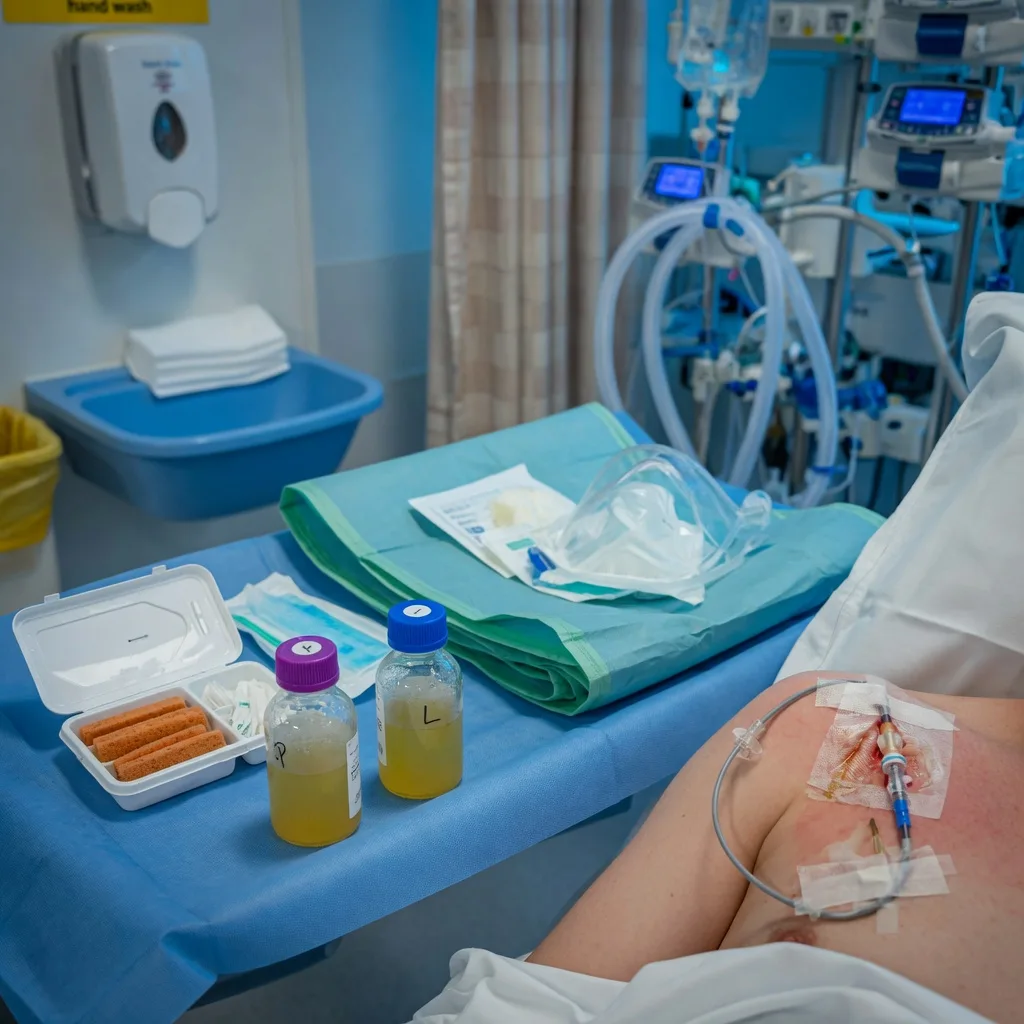
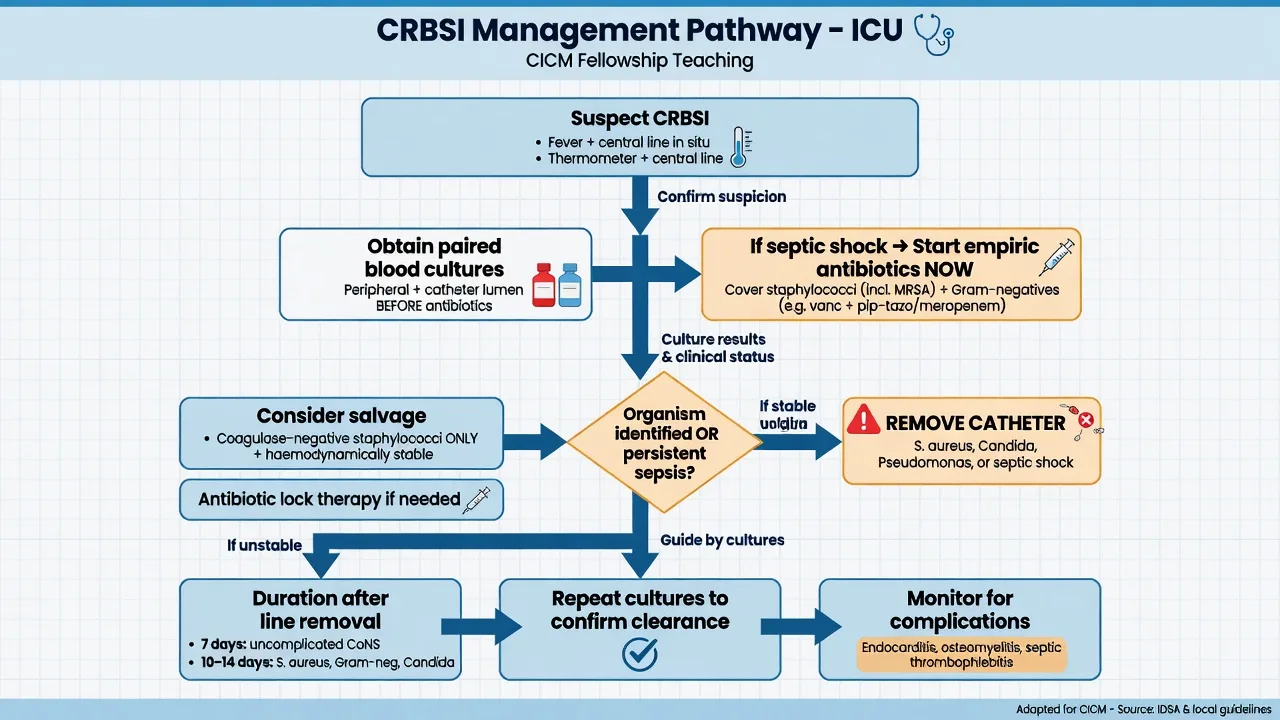
CLABSI (central line–associated bloodstream infection) = a laboratory-confirmed bloodstream infection in a patient who had a central line in place for more than 2 calendar days, where the line was in place on the day of or the day before onset, and the infection is not related to another site — a surveillance definition that overestimates true catheter infection. CRBSI (catheter-related bloodstream infection) = the catheter is PROVEN to be the source by paired cultures, differential time to positivity, or semi-quantitative tip culture (a clinical definition that is more specific). CLABSI is used for surveillance benchmarking; CRBSI for clinical management.

[5]
[6]
[6]

Ventilator-associated pneumonia (VAP) — the prevention bundle

Catheter-associated urinary tract infection (CAUTI)

[8]

Surgical site infection (SSI)

C. difficile infection (CDI) — prevention

Multidrug-resistant (MDR) organisms
Educational compare of contact droplet and airborne precautions with example ICU pathogens and PPE engineering controls
FigureTransmission-based precautions — match contact, droplet or airborne controls to the pathogen and the route.
[2] [10]
[2]

MDR organism pearls

  1. MRSA decolonisation options: TARGETED (screen, then mupirocin 2% nasal BD ×5 days plus chlorhexidine body washes) or UNIVERSAL (chlorhexidine bathing of all ICU patients with or without nasal mupirocin). Huang NEJM 2013 cluster-randomised trial: universal decolonisation reduced MRSA clinical isolates by 37% and MRSA bacteraemia by 44%, with no benefit from targeted screening alone.[10]
  2. Chlorhexidine (CHG) daily bathing reduces colonisation with MRSA and VRE and, in some studies, reduces CLABSI and ICU-acquired bacteraemia. Climo 2009 multicentre trial: CHG bathing reduced MRSA acquisition by 32% and VRE acquisition by 50%.[12]
  3. CRE screening: Carbapenem-resistant Enterobacterales are a global public-health threat — screen on admission patients with healthcare exposure in endemic regions, prior CRE colonisation, or transfer from a high-risk facility; use pre-emptive contact precautions while awaiting results.[2]
  4. Cohorting and dedicated staff: during MDR outbreaks, cohort colonised or infected patients and, ideally, dedicate nursing staff to a cohort to prevent cross-transmission between cohorts.[2]
  5. Donning and doffing order matters. DON (put on): gown → mask/respirator → goggles or face shield → gloves. DOFF (take off): gloves → gown → face/eye protection → mask or respirator LAST (to avoid self-contamination). Perform hand hygiene immediately after all PPE is removed.[2]

Antimicrobial stewardship in the ICU

The four Ds of antimicrobial stewardship

Right Drug, right Dose, right Duration, and De-escalation — applied daily to every ICU antibiotic prescription, ideally on a multidisciplinary (intensivist + pharmacist + microbiologist) stewardship round. The Surviving Sepsis Campaign 2021 recommends rapid identification of source and pathogen, early appropriate therapy, and prompt de-escalation or stopping when infection is excluded or controlled.[11]

[11] [14]

Environmental cleaning and disinfection

Environmental cleaning pearls

  1. The environment is a reservoir. MRSA, VRE, Acinetobacter, C. difficile and norovirus survive on dry surfaces for days to months. A patient admitted to a room previously occupied by an MDR-positive patient has a significantly higher risk of acquiring that organism — so terminal cleaning quality directly affects acquisition.[13]
  2. Spaulding classification of equipment: CRITICAL (enters sterile tissue or vasculature — e.g., surgical instruments) → sterilisation; SEMI-CRITICAL (contacts mucous membranes or non-intact skin — e.g., endoscopes, laryngoscope blades) → high-level disinfection; NON-CRITICAL (contacts intact skin — e.g., stethoscopes, BP cuffs) → low-level disinfection.[2]

Surveillance cultures and active screening

[2] [14]

Surveillance and quality-metric pearls

  1. Device-associated infections are reported as RATES per 1000 device-days (CLABSI per 1000 line-days, VAP per 1000 ventilator-days, CAUTI per 1000 catheter-days) — this adjusts for device utilisation and allows fair comparison between units and over time.[14]
  2. Achievable benchmark targets give concrete goals: CLABSI <1.0, CAUTI <3.0 and VAP <4.0 per 1000 device-days; many high-performing ICUs approach zero CLABSI.[14]
  3. Feedback drives improvement. Monthly display of unit infection rates, hand-hygiene compliance and bundle adherence — fed back to frontline staff — is itself an intervention (the Pronovost Keystone CRBSI reduction came from bundle PLUS measurement PLUS feedback).[5][14]

Key trials and evidence

Pronovost 2006 — Michigan Keystone (CRBSI bundle)

[5]

Huang 2013 — REDUCE MRSA (universal decolonisation)

[10]

Climo 2009 — CHG bathing to reduce MRSA and VRE acquisition

[12]

Harbarth 2008 — universal MRSA admission screening

[15]

Pittet 2000 — Geneva hand-hygiene programme

[3]

Additional red flags

C. difficile — the alcohol-gel trap

Alcohol-based hand rub does NOT kill C. difficile spores. For any patient with suspected or confirmed CDI: use soap and water for hand hygiene (mechanical removal of spores), contact precautions, and sporicidal (chlorine-based) environmental cleaning. This is one of the most frequently tested infection-control facts.[9]

Airborne precautions need a negative-pressure room

Pulmonary or laryngeal TB, measles, varicella, and disseminated herpes zoster require a negative-pressure room with the door closed and an N95/P2 respirator for staff — NOT a surgical mask. A surgical mask is for DROPLET precautions; it does not protect against airborne particles.[2]

Gloves are not a substitute for hand hygiene

Gloves become contaminated during use, and organisms transfer when gloves are removed. Perform hand hygiene (WHO Moment 3 or 4) every time you remove gloves, and never wear the same pair between patients.[1]

A guidewire line exchange does not prevent CRBSI

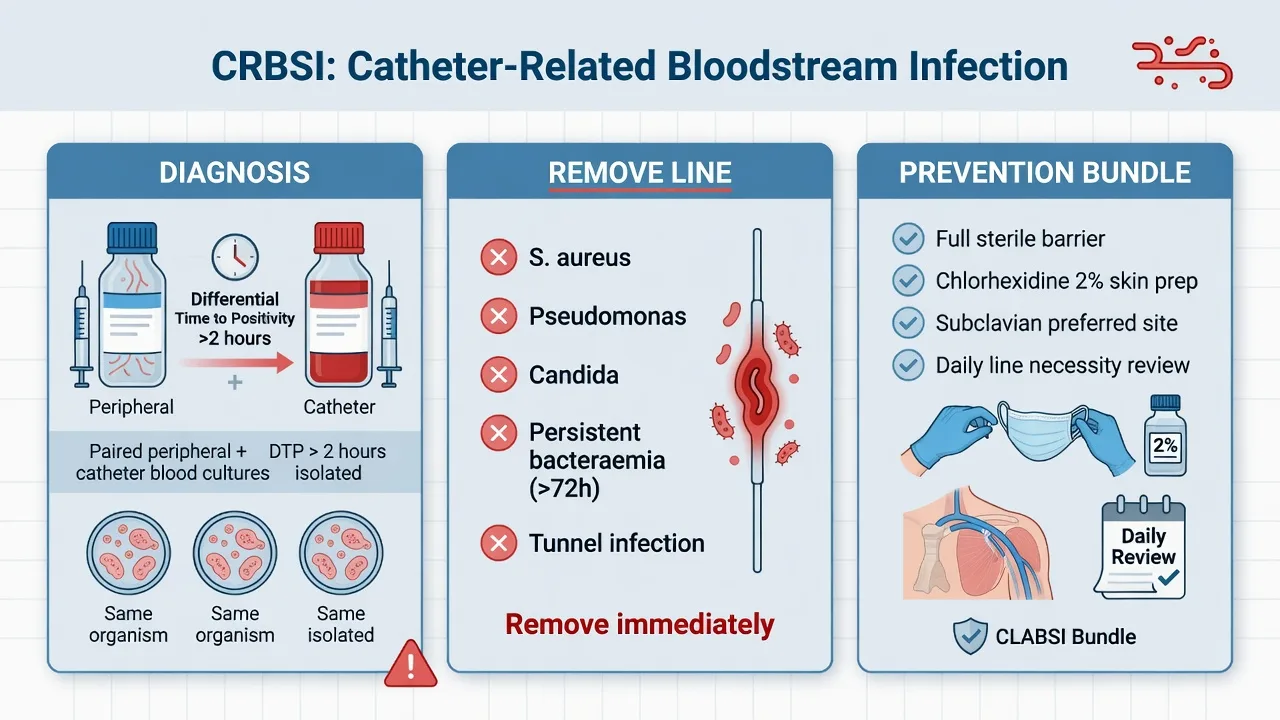
Routine scheduled replacement of central lines over a guidewire seeds the new catheter from the contaminated tract of the old one. Do NOT routinely exchange lines; remove the line when no longer needed and, if infection is suspected, insert a new one at a different site.[6]

Prognosis and quality metrics

[14]

Final exam-ready pearls

  1. The two questions that prevent most device infections: "Does this patient still need this device today?" and "Was the bundle used when it was inserted?" Daily device review plus bundle-driven insertion prevents the majority of CRBSI, VAP and CAUTI.[5][7][8]
  2. Standard precautions apply to EVERY patient, EVERY time — assume every patient's blood, body fluids, secretions and non-intact skin are potentially infectious. Transmission-based precautions are ADDED on top, never instead of, standard precautions.[2]
  3. Outbreak recognition: a cluster of the same organism (same species and sensitivities) in a unit over days–weeks, or a single case of a high-consequence pathogen (e.g., CRE, measles, TB), should trigger outbreak investigation — case-finding, cohorting, environmental cultures, and reinforcement of hand hygiene and cleaning.[13][14]
  4. Staff vaccination and health: staff immunisation (influenza, hepatitis B, MMR, varicella, COVID-19, TB screening) and exclusion of staff with transmissible illness are part of infection control — the staff member is both a vector and a susceptible host.[2]
  5. The WHO core components of an IPC programme (leadership, guidelines, education, surveillance, multimodal strategies, monitoring/audit, workload/staffing, built environment) are the framework an ICU's infection-control programme is judged against — exam questions on "how to improve an ICU's infection rate" map onto these.[14]

References

  1. [1]Pittet D, Allegranzi B, Boyce J, et al. The World Health Organization Guidelines on Hand Hygiene in Health Care and their consensus recommendations. Infection Control and Hospital Epidemiology, 2009.PMID 19508124
  2. [2]Siegel JD, Rhinehart E, Jackson M, Chiarello L, HICPAC. 2007 Guideline for Isolation Precautions: Preventing Transmission of Infectious Agents in Health Care Settings. American Journal of Infection Control, 2007.PMID 18068815
  3. [3]Pittet D, Hugonnet S, Harbarth S, et al. Effectiveness of a hospital-wide programme to improve compliance with hand hygiene. Lancet, 2000.PMID 11073019
  4. [4]Lotfinejad N, Peters A, Tartari E, et al. Hand hygiene in health care: 20 years of ongoing advances and perspectives. Lancet Infectious Diseases, 2021.PMID 34331890
  5. [5]Pronovost P, Needham D, Berenholtz S, et al. An intervention to decrease catheter-related bloodstream infections in the ICU. New England Journal of Medicine, 2006.PMID 17192537
  6. [6]O'Grady NP, Alexander M, Burns LA, et al. Guidelines for the prevention of intravascular catheter-related infections. Clinical Infectious Diseases, 2011.PMID 21460264
  7. [7]Klompas M, Branson R, Eichenwald EC, et al. Strategies to prevent ventilator-associated pneumonia in acute care hospitals: 2014 update. Infection control and hospital epidemiology, 2014.PMID 25376073
  8. [8]Lo E, Nicolle LE, Coffin SE, et al. Strategies to prevent catheter-associated urinary tract infections in acute care hospitals: 2014 update. Infection Control and Hospital Epidemiology, 2014.PMID 25376068
  9. [9]Dubberke ER, Carling P, Carrico R, et al. Strategies to prevent Clostridium difficile infections in acute care hospitals: 2014 update. Infection Control and Hospital Epidemiology, 2014.PMID 25376069
  10. [10]Huang SS, Septimus E, Kleinman K, et al. Targeted versus universal decolonization to prevent ICU infection. New England Journal of Medicine, 2013.PMID 23718152
  11. [11]Evans L, Rhodes A, Alhazzani W, et al. Surviving Sepsis Campaign: International Guidelines for Management of Sepsis and Septic Shock 2021. Critical Care Medicine, 2021.PMID 34605781
  12. [12]Climo MW, Sepkowitz KA, Zuccotti G, et al. The effect of daily bathing with chlorhexidine on the acquisition of methicillin-resistant Staphylococcus aureus and vancomycin-resistant enterococci. Critical Care Medicine, 2009.PMID 19384220
  13. [13]Dancer SJ. Mopping up hospital infection. Journal of Hospital Infection, 1999.PMID 10549308
  14. [14]Storr J, Twyman A, Zingg W, et al. Core components for effective infection prevention and control programmes: new WHO evidence-based recommendations. Antimicrobial Resistance and Infection Control, 2017.PMID 28078082
  15. [15]Harbarth S, Fankhauser C, Schrenzel J, et al. Universal screening for methicillin-resistant Staphylococcus aureus at hospital admission and nosocomial infection in surgical patients. JAMA, 2008.PMID 18334690