ICU · Infectious diseases
Acute severe community-acquired pneumonia: comprehensive ICU pathway (sepsis, ARDS, empiric therapy, corticosteroids)
Also known as Severe CAP · Severe community-acquired pneumonia · ICU pneumonia · CURB-65 · PSI PORT score · IDSA ATS CAP guidelines · Pneumonia sepsis ARDS
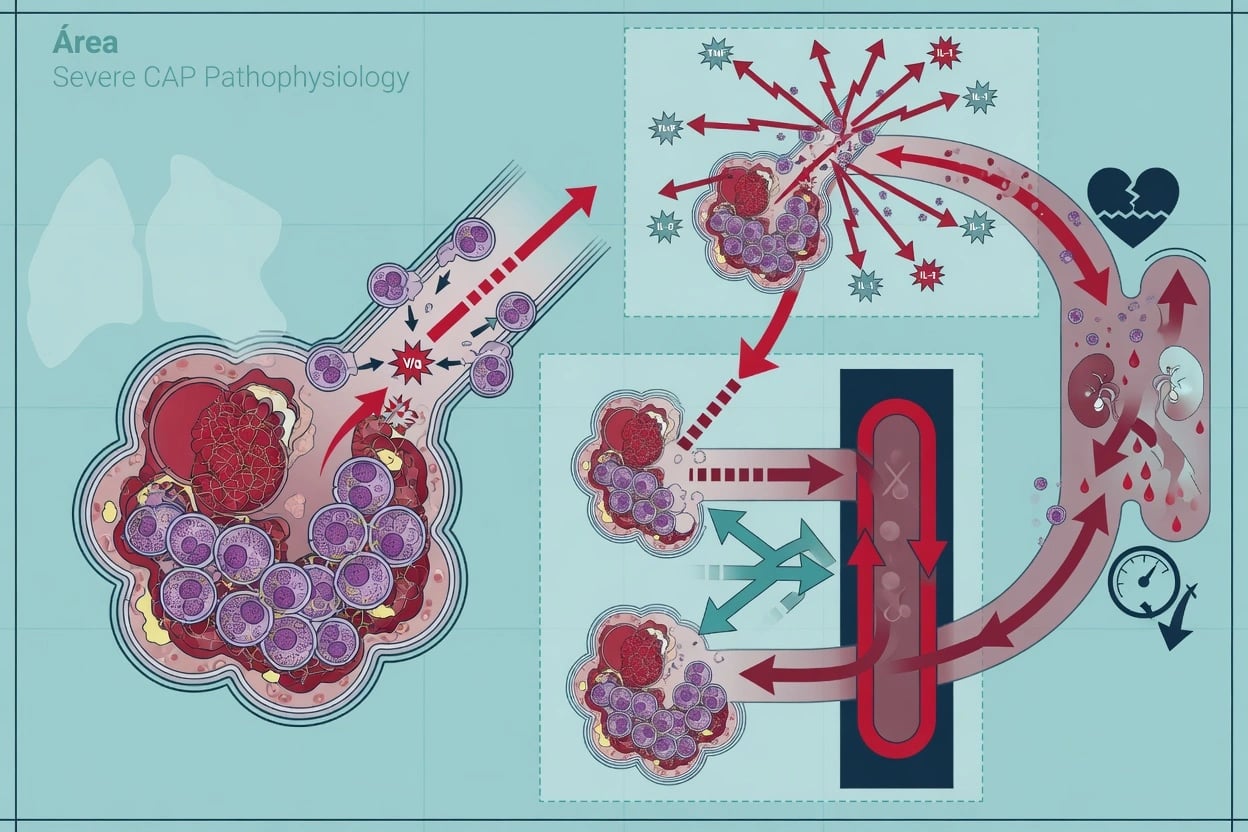
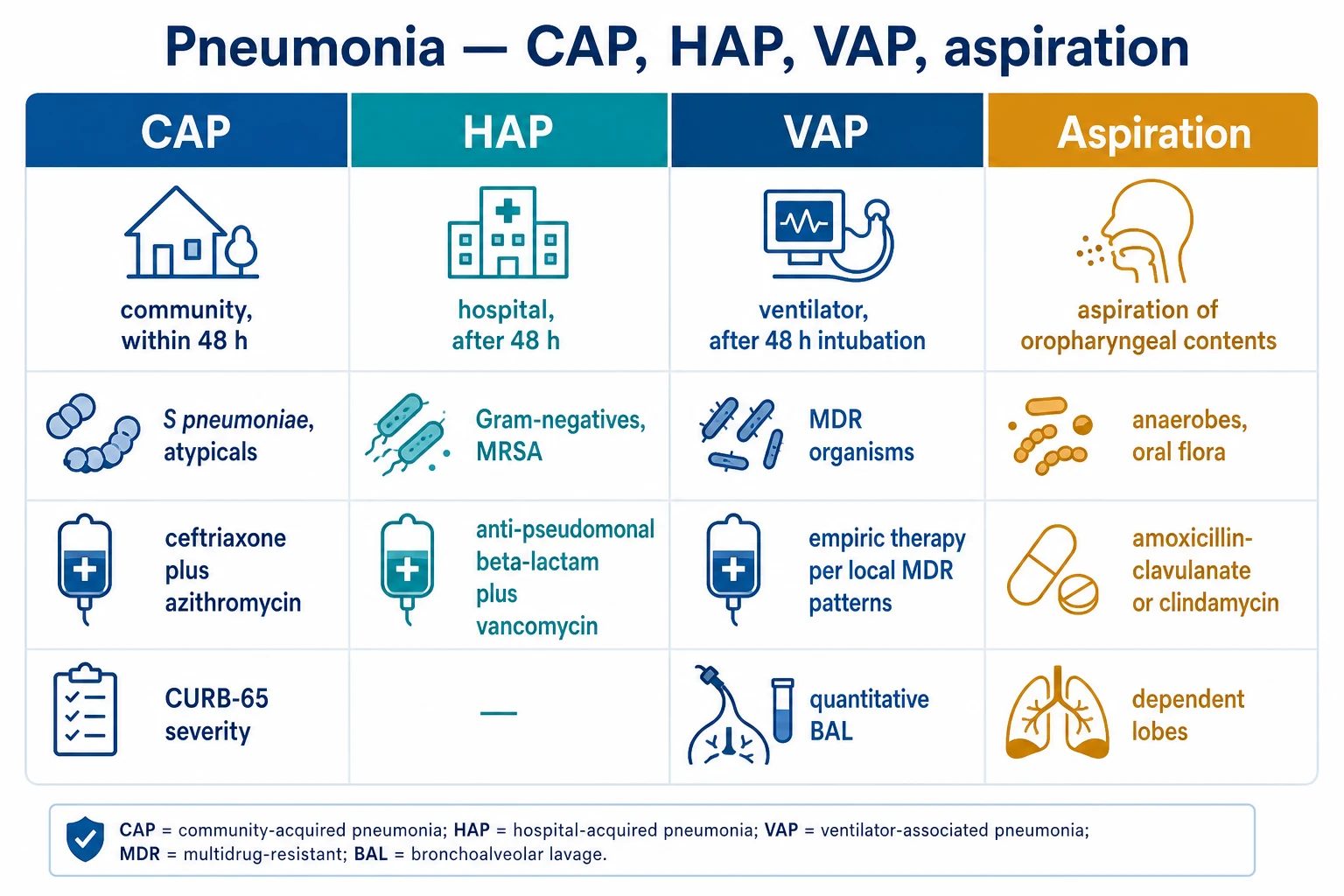
Severe community-acquired pneumonia (CAP) is the commonest single cause of sepsis and ARDS in the ICU, with mortality 20-50%. SEVERITY (use to triage ICU): CURB-65 (Confusion, Urea 7, RR =30, BP <90/60, Age =65) — score 4-5 = severe, consider ICU; PSI/PORT (Pneumonia Severity Index — classes IV-V high risk); IDSA/ATS 2007 minor/major criteria — 1 MAJOR (invasive ventilation OR septic shock) OR =3 MINOR (RR =30, PaO2/FiO2 <250, multilobar, confusion, BUN =20, WBC <4, platelets <100, temp <36, hypotension needing fluids) = severe CAP needing ICU. ICU PATHWAY (hour-1 sepsis bundle): cultures (blood x2, sputum, urinary antigens, viral PCR) + lactate + ANTIBIOTICS WITHIN 1 HOUR + goal-directed fluids + noradrenaline if shock. EMPIRIC THERAPY (IDSA/ATS 2019) — SEVERE CAP/ICU: beta-lactam (ceftriaxone 2g, cefotaxime, or ampicillin-sulbactam) + MACROLIDE (azithromycin) OR beta-lactam + respiratory fluoroquinolone (moxifloxacin/levofloxacin). PSEUDOMONAS risk (bronchiectasis, prior isolation): anti-pseudomonal beta-lactam (pip-tazo/cefepime/meropenem) + ciprofloxacin OR aminoglycoside + macrolide/levo. MRSA risk (post-influenza, cavitary): add vancomycin/linezolid. INFLUENZA suspected: add oseltamivir. CORTICOSTEROIDS: hydrocortisone 200 mg/day for septic shock on vasopressors (SEPSISPAM/SSC 2021); adjunctive steroids reduce mortality + ARDS in severe CAP with high inflammatory burden (Siemieniuk/CAPO meta-analysis). DURATION 5-7 days if improved + afebrile 48-72h; procalcitonin-guided de-escalation (Schuetz IPD meta-analysis). COMPLICATIONS: septic shock, ARDS, empyema (pH <7.2 drain), lung abscess, metastatic infection, AF/DVT. PREVENTION: pneumococcal + influenza vaccine, smoking cessation.
On this page & tools
Your progress
Saved locally on this device.
Target exams
Red flags
Severity scores for community-acquired pneumonia
| Score | Components | Scoring | Decision threshold |
|---|---|---|---|
| CURB-65 (Lim 2003) | Confusion, Urea >7 mmol/L, Respiratory rate >=30, Blood pressure (<90 systolic or <=60 diastolic), age >=65 | 1 point each (0-5) | 0-1 home; 2 consider admission; >=3 hospital, consider ICU; 4-5 severe, ICU |
| CRB-65 (no bloods) | Confusion, RR >=30, BP <90/60, age >=65 | 1 point each (0-4) | 0 home; >=1 consider admission; >=2 severe (use pre-hospital, no urea needed) |
| PSI / PORT (Fine 1997) | Demographics (age, sex, nursing home), comorbidity (neoplastic/liver/CHF/cerebrovascular/renal disease), exam (altered mental status, RR >=30, systolic <90, temp <35 or >=40, pulse >=125), labs + imaging (pH <7.35, BUN >=11, Na <130, glucose >=14, haematocrit <30, PaO2 <60, pleural effusion) | Points -> 5 classes (I-V) | I-II outpatient (low mortality <1%); III ward (observe brief inpatient); IV-V hospital (mortality 8.9-29.2%) |
| IDSA/ATS 2007 (severe CAP criteria) | MAJOR: need invasive mechanical ventilation OR septic shock. MINOR: RR >=30, PaO2/FiO2 <250, multilobar infiltrates, confusion/disorientation, BUN >=20 mg/dL (~7 mmol/L), WBC <4, platelets <100, hypothermia <36, hypotension needing aggressive fluids | Count met criteria | 1 major OR >=3 minor = severe CAP -> ICU admission |
| SMART-COP (ANZ) | Systolic BP <90, Multilobar, Albumin <35, RR (age-adjusted), Tachycardia >=125, Confusion, Oxygen (PaO2 <70 or O2 sat <=93%), pH <7.35 | Score | Low vs high-intensity (ICU) — validated in Australian cohort |
Empiric antibiotic regimens for severe CAP (IDSA/ATS 2019)
| Scenario | First-line | Alternative | Key points |
|---|---|---|---|
| Severe CAP, ICU (no risk factors) | Ceftriaxone 2g IV daily + azithromycin 500mg IV daily | Ampicillin-sulbactam 3g IV q6h + azithromycin; OR beta-lactam + moxifloxacin/levofloxacin | Cover S. pneumo + H. influenzae (beta-lactam) + atypicals — Legionella/Mycoplasma/Chlamydia (macrolide or respiratory FQ) |
| Beta-lactam allergy | Moxifloxacin 400mg IV daily + azithromycin | Levofloxacin 750mg + azithromycin | Respiratory FQ covers typical + atypical (azithromycin adds Legionella/atypical synergy) |
| Pseudomonas risk (bronchiectasis, prior isolation, recent hospitalisation, severe structurally-diseased lung) | Pip-tazo 4.5g IV q6h + ciprofloxacin 400mg IV q12h (+ azithromycin for atypicals) | Cefepime 2g q8h + ciprofloxacin; OR anti-pseudomonal beta-lactam + aminoglycoside + azithromycin/levofloxacin | DUAL anti-pseudomonal + atypical cover; ceftriaxone does NOT cover Pseudomonas |
| MRSA risk (post-inflfluenza, cavitary, recent hospitalisation, ESRD, IVDU, prior MRSA) | ADD vancomycin 15-20mg/kg q8-12h (AUC 400-600) to standard severe CAP regimen | ADD linezolid 600mg IV BD (better lung penetration; if vancomycin nephrotoxicity) | Add to standard cover; linezolid preferred by some for necrotising MRSA (toxin suppression) |
| Aspiration suspected | Ampicillin-sulbactam (covers anaerobes) + azithromycin; OR add metronidazole/clindamycin to standard regimen | Meropenem (covers anaerobes + Gram-negatives) | Add anaerobic cover; clindamycin preferred for lung abscess |
| Influenza season / suspected influenza | ADD oseltamivir 75mg BD to standard regimen (within 48h; earlier better) | (IV peramivir if unable PO) | Start empirically if influenza suspected — do NOT wait for PCR; always add MRSA cover if post-influenza deterioration |
Severe CAP comprehensive ICU management pathway (hour-1 through discharge)
- RECOGNISE SEVERITY + ICU TRIAGE — Apply a severity score at presentation: (a) CURB-65 — >=3 = severe, consider ICU; 4-5 = ICU; (b) PSI/PORT — class IV-V high-risk hospital, class V ICU; (c) IDSA/ATS 2007 severe CAP criteria — 1 MAJOR (invasive mechanical ventilation OR septic shock needing vasopressors) OR >=3 MINOR criteria (RR >=30, PaO2/FiO2 <250, multilobar infiltrates, confusion, BUN >=20, WBC <4, platelets <100, temp <36, hypotension needing aggressive fluids) = severe CAP -> ICU. SEPSIS-3: CAP with organ dysfunction (SOFA >=2, lactate >2, MAP <65 after fluids, etc.) = SEPSIS; lactate >2 after fluids + vasopressor need = SEPTIC SHOCK. Recognise ARDS risk early (bilateral infiltrates + PaO2/FiO2 <300 within 1 week of pneumonia).
- HOUR-1 SEPSIS BUNDLE (do NOT delay antibiotics for cultures) — (a) LACTATE: baseline; repeat at 2-4h if >2 mmol/L; >4 = severe sepsis/perfusion defect. (b) BLOOD CULTURES x2 (peripheral, before antibiotics if possible but NEVER delay antibiotics >1h); positive in 10-20% (bacteraemic pneumococcal CAP worse prognosis). (c) RESPIRATORY SAMPLES: sputum Gram stain + culture (good-quality: >25 PMN, <10 epithelial/hpf); endotracheal aspirate if intubated; consider BAL/mini-BAL if intubated + not responding. (d) URINARY ANTIGENS: pneumococcal + Legionella serogroup 1 (rapid — high yield in severe CAP, Legionella a classic severe-CAP pathogen). (e) VIRAL PCR: multiplex respiratory panel — influenza A/B, SARS-CoV-2, RSV (rapid; start oseltamivir empirically if influenza suspected in season). (f) ANTIBIOTICS WITHIN 1 HOUR (sepsis hour-1 bundle) — broad-spectrum empiric covering typical + atypical; each hour delay in shock -> ~4-8% mortality rise. (g) FLUIDS: 250-500 mL crystalloid boluses if hypovolaemic/hypotensive, reassess; goal MAP >=65, urine >0.5 mL/kg/h, lactate falling; avoid overload (worsens ARDS — CLASSIC/CLOVERS support a more restrictive approach; ~1.5-3 L in first 3h). (h) VASOPRESSORS: noradrenaline first-line if MAP <65 after fluids; add vasopressin then adrenaline; target MAP >=65. (i) CATHETERISE (monitor urine output).
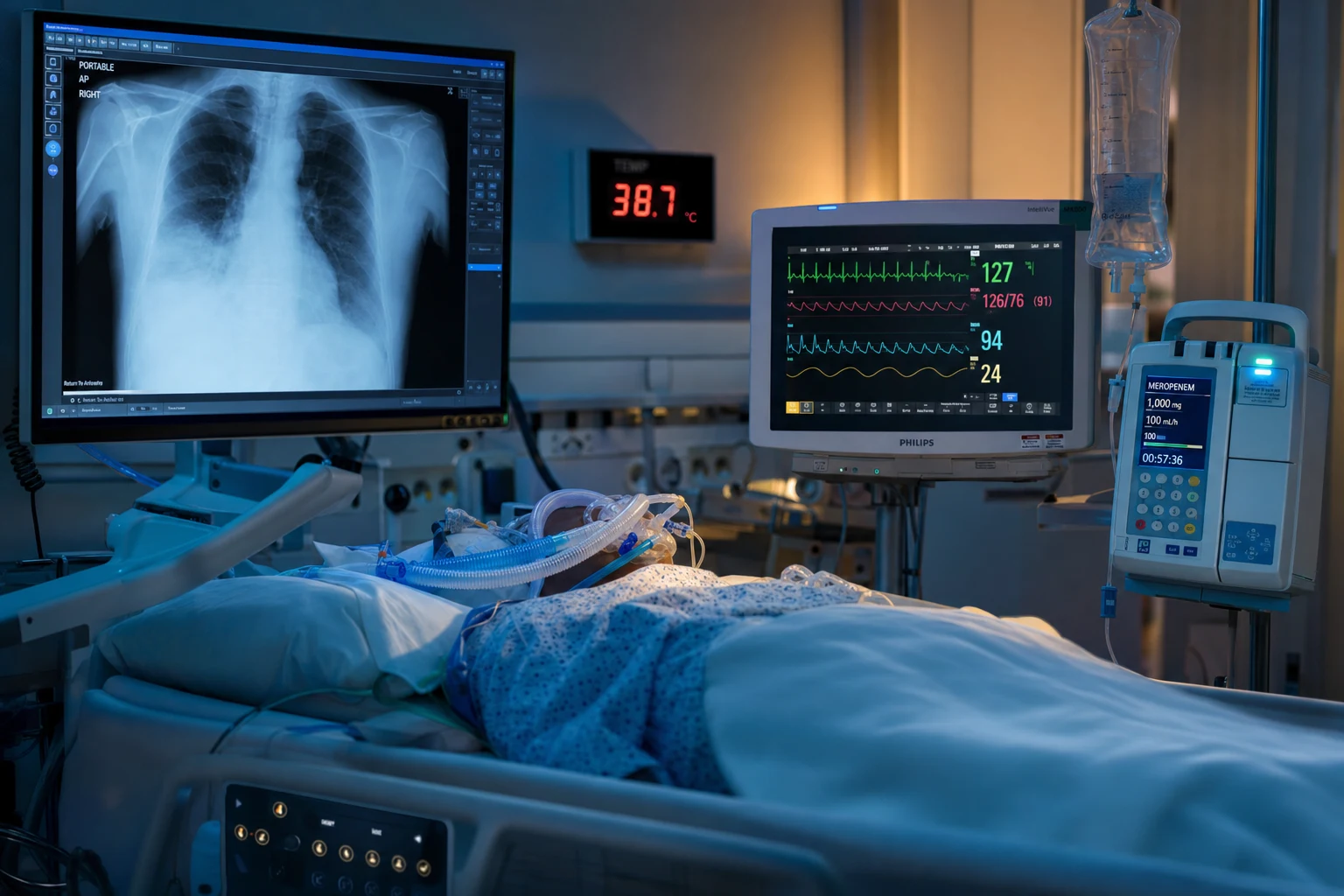
- EMPIRIC ANTIBIOTIC THERAPY (within 1 hour) — (a) STANDARD SEVERE CAP/ICU: beta-lactam (ceftriaxone 2g IV daily, cefotaxime, or ampicillin-sulbactam 3g IV q6h) + MACROLIDE (azithromycin 500mg IV daily) OR beta-lactam + respiratory fluoroquinolone (moxifloxacin 400mg IV daily or levofloxacin 750mg). Rationale: beta-lactam covers typical (S. pneumoniae #1, H. influenzae, Moraxella); macrolide/FQ covers atypicals (Legionella, Mycoplasma, Chlamydia) — Legionella is a leading cause of SEVERE CAP, must be covered. (b) PSEUDOMONAS RISK (bronchiectasis, prior Pseudomonas within 1 yr, recent hospitalisation/antibiotics, severe bronchiectatic/structurally-diseased lung): anti-pseudomonal beta-lactam (pip-tazo 4.5g IV q6h, cefepime 2g IV q8h, or meropenem 1g IV q8h) + EITHER ciprofloxacin 400mg IV q12h OR aminoglycoside (gentamicin/tobramycin) + azithromycin or levofloxacin (atypical cover). DUAL anti-pseudomonal + atypical. (c) MRSA RISK (post-influenza, cavitary infiltrates, recent hospitalisation, ESRD/dialysis, prior MRSA, IVDU): ADD vancomycin 15-20mg/kg q8-12h (target AUC 400-600) OR linezolid 600mg IV BD. (d) INFLUENZA SUSPECTED (season, influenza-like illness, bilateral viral-pattern infiltrates): ADD oseltamivir 75mg PO BD (within 48h; earlier better; do not wait for PCR); post-influenza deterioration -> also add MRSA cover (S. aureus incl MRSA superinfection — high mortality). (e) ASPIRATION SUSPECTED (impaired consciousness, dysphagia, seizure, alcoholism): add anaerobic cover (metronidazole OR clindamycin; ampicillin-sulbactam or meropenem already cover anaerobes).
- RESPIRATORY SUPPORT (escalate by hypoxaemia/work-of-breathing) — (a) OXYGEN: target SpO2 92-96% (88-92% if CO2 retainer/COPD). (b) HFNC (high-flow nasal cannula) first-line for moderate hypoxaemia — reduces intubation (FLORALI); 50-60 L/min, FiO2 titrated. (c) NIV (CPAP/BiPAP) — caution in COPD/CO2 retainers with CAP; limited role in pure hypoxaemic ARDS-type failure (risk of delayed intubation). (d) INTUBATE if: severe/refractory hypoxaemia (PaO2/FiO2 <150-200), respiratory exhaustion, rising CO2, reduced GCS (aspiration risk), shock. (e) LUNG-PROTECTIVE VENTILATION: Vt 6 mL/kg PBW, plateau pressure <30 cmH2O, driving pressure <15, PEEP titrated to FiO2 (ARDSNet). (f) PRONE POSITIONING if severe ARDS (PaO2/FiO2 <150) within 12-24h for >=16h/day — PROSEVA reduces mortality. (g) ECMO (VV) if refractory hypoxaemia (PaO2/FiO2 <80) despite optimised ventilation (EOLIA criteria) — centre with ECMO capability. (h) NEUROMUSCULAR blockade (cisatracurium 48h) in early severe ARDS (PaO2/FiO2 <150) — ACURASYS/ROSE (ROSE did not confirm mortality benefit; use for profound hypoxaemia/ventilator dyssynchrony).
- CORTICOSTEROID ADJUNCT (severe CAP + shock) — (a) SEPTIC SHOCK ON VASOPRESSORS: hydrocortisone 200 mg/day (continuous infusion or 50 mg IV q6h) per SEPSISPAM 2018 (Annane, NEJM) + SSC 2021 — SUGGESTED when fluids + catecholamines insufficient to restore MAP; reduces vasopressor days and, in non-responders, mortality. Wean when vasopressors off. (b) ADJUNCTIVE STEROIDS IN SEVERE CAP (separate indication): Siemieniuk/CAPO systematic review + meta-analysis (2015, Ann Intern Med) — adjunctive systemic corticosteroids REDUCE all-cause mortality (~RR 0.67), need for mechanical ventilation, and ARDS (~RR 0.24), and shorten time to clinical stability + hospital stay; benefit greatest in SEVERE CAP with HIGH INFLAMMATORY BURDEN (CRP high). CAVEATS: increases hyperglycaemia needing treatment; do NOT use routinely in mild-moderate CAP; IDSA/ATS 2019 does not give a strong routine recommendation (insufficient/heterogeneous) — use when high inflammation or refractory shock. Typical regimen: hydrocortisone 200 mg/day x 5-7 days (or methylprednisolone 0.5 mg/kg q12h x 5 days, taper); stop early if no benefit.
- DIAGNOSTIC WORKUP + SOURCE CONTROL — (a) IMAGING: CXR (extent — multilobar worse prognosis); CT chest if CXR non-diagnostic, suspected cavitation/abscess/empyema, immunocompromised, or non-resolving. (b) THORACENTESIS if pleural effusion: send pH (cell count, Gram stain/culture, glucose, LDH, protein) — pH <7.2 (or pus/positive culture) = empyema -> chest tube. (c) ATYPICAL SEROLOGY (Mycoplasma, Chlamydia — paired sera, retrospective); consider respiratory panel/BAL for viruses, Pneumocystis if immunocompromised. (d) BIOMARKERS: procalcitonin (baseline + trend), CRP (high inflammatory burden -> steroid candidate), D-dimer (DVT/PE risk).
- DE-ESCALATION + DURATION (48-72h) — (a) DE-ESCALATE when microbiology available: narrow to organism (S. pneumoniae -> penicillin/ceftriaxone; Legionella -> azithromycin/levofloxacin alone; H. influenzae -> ampicillin/ceftriaxone); STOP unnecessary cover (no Pseudomonas -> stop anti-pseudomonal; no MRSA -> stop vancomycin; no anaerobes -> stop metronidazole). (b) STOP if alternative diagnosis established + low procalcitonin (antimicrobial stewardship). (c) DURATION: 5-7 days if clinically improved + afebrile 48-72h + haemodynamically stable. (d) PROCALCITONIN-GUIDED (Schuetz IPD meta-analysis, Lancet ID 2018): stop when PCT <0.5 ng/mL OR falls >=80% from peak — reduces antibiotic exposure + mortality signal without worsening outcomes. (e) LONGER (>7-14 days): Legionella (7-14d), MRSA, Pseudomonas, complicated infection (empyema, lung abscess — 4-6 weeks, meningitis/endocarditis). (f) IV-to-ORAL SWITCH when: clinically improving, afebrile, haemodynamically stable, able to absorb PO, no indication for ongoing IV.
- COMPLICATIONS MANAGEMENT — (a) SEPTIC SHOCK: noradrenaline +/- vasopressin, hydrocortisone 200 mg/day if refractory, source control (drain empyema). (b) ARDS: lung-protective ventilation, proning (PaO2/FiO2 <150), consider ECMO if refractory. (c) EMPYEMA / parapneumonic effusion: thoracentesis -> pH <7.2 or pus or positive culture -> chest tube drainage; intrapleural tPA + DNase (MIST2) if loculated; VATS decortication if failed drainage / organised stage III. (d) LUNG ABSCESS: prolonged antibiotics (4-6 weeks; clindamycin preferred for anaerobes), percutaneous/surgical drainage if large or fails medical therapy. (e) METASTATIC INFECTION (persistent bacteraemia): endocarditis, meningitis, septic arthritis — investigate if new murmurs, neurological signs, joint pain; transoesophageal echo if S. aureus bacteraemia. (f) CARDIAC COMPLICATIONS (common in severe CAP): new AF (systemic inflammation/atrial stretch -> rate control +/- anticoagulate if persistent), MI/Type 2 MI (demand ischaemia), heart failure exacerbation; troponin + ECG surveillance. (g) VENOUS THROMBOEMBOLISM: severe CAP is a prothrombotic state (inflammation + immobility) -> DVT prophylaxis (LMWH unless contraindicated); consider PE if sudden deterioration/desaturation. (h) AKI: nephrotoxin avoidance, fluid balance, RRT if severe. (i) FOLLOW-UP: CXR at ~6 weeks to confirm resolution and exclude underlying malignancy (post-obstructive pneumonia).
- PREVENTION + DISCHARGE PLANNING — (a) PNEUMOCOCCAL VACCINE (PCV + PPSV23 per local schedule — >65, chronic disease, immunocompromised). (b) ANNUAL INFLUENZA VACCINE (>65, chronic disease, healthcare workers, pregnancy — reduces influenza + post-influenza bacterial CAP). (c) COVID + RSV vaccination where indicated (elderly/chronic disease). (d) SMOKING CESSATION (smoking impairs mucociliary clearance + alveolar macrophage function -> CAP risk; counselling + NRT on discharge). (e) PULMONARY REHABILITATION for slow recovery/critical-illness weakness. (f) ADDRESS comorbidities (heart failure, COPD, immunosuppression) and medication reconciliation.
Clinical pearls
Red flags
Prognosis
Severe CAP evidence and outcomes
Mortality: overall CAP 2-5%; severe CAP (ICU) 20-50%; rises with age, comorbidity, bacteraemia, multilobar disease, ARDS, septic shock, late antibiotics. IDSA/ATS 2019 (Metlay): severe CAP empiric therapy = beta-lactam + macrolide OR beta-lactam + fluoroquinolone; broaden for Pseudomonas/MRSA; routine steroids not strongly recommended. IDSA/ATS 2007 (Mandell): severe CAP criteria (1 major OR >=3 minor) define ICU admission; foundational empiric-therapy framework. CURB-65 (Lim 2003): simple 5-point severity score; >=3 = severe, consider ICU; 30-day mortality ~0.7% (score 0) to 57% (score 5). PSI/PORT (Fine 1997): 5-class risk stratification; classes IV-V (8.9-29.2% mortality) warrant hospital; sensitive for identifying low-risk outpatients. CAPO/Siemieniuk corticosteroid meta-analysis (2015, Ann Intern Med): adjunctive steroids reduced mortality (RR ~0.67), mechanical ventilation (RR ~0.45), and ARDS (RR ~0.24) in hospitalised CAP — greatest benefit in severe CAP with high inflammatory burden. SEPSISPAM (Annane 2018, NEJM) + SSC 2021: hydrocortisone 200 mg/day for septic shock needing ongoing vasopressors — reduces vasopressor days; mortality benefit in non-responders. Schuetz procalcitonin IPD meta-analysis (2018, Lancet ID): PCT-guided therapy reduces antibiotic exposure with a mortality signal in favour — stop when PCT <0.5 or falls >=80%. Duration: 5-7 days if improved + afebrile 48-72h; longer for Legionella/MRSA/Pseudomonas/complications. Prevention: pneumococcal + influenza vaccination, smoking cessation reduce CAP incidence and recurrence.
Examiner densify anchors

Exam board focus
CICM Second Part · FFICM · EDIC
Killers to name
Airway loss, refractory shock, missed specific therapy/device, delayed specialty call
Documentation
Thresholds used, therapies with times, family update, disposition
Practical ICU checklist (densify)
Bedside densify checklist
- Confirm diagnosis thresholds with numbers the examiner expects.
- Name the first therapy and the absolute contraindication.
- State monitoring frequency and escalation triggers.
- Cite one landmark paper/guideline and one limitation of the evidence.
- Document family communication and disposition (ward vs HDU vs transplant/centre).
- Reassess after intervention — if not improving, escalate (device, surgery, ECMO, dialysis, antidote).
- Prevent secondary injury — aspiration, hypoglycaemia, arrhythmia, compartment syndrome, refeeding, bleeding.
Extended fellowship notes (densify)
Common exam traps vs correct anchors
| Trap | Why it fails | Correct anchor |
|---|---|---|
| Treating the number only | Misses context | Integrate exam + trend + pre-test probability |
| Delaying specific therapy | Golden window lost | Give antidote/device/reperfusion early |
| One-size-fits-all vent/drug | Phenotype matters | Match therapy to profile |
| No escalation plan | Freezes at first failure | Pre-state failure criteria and next step |
Densify SAQ — Severe community-acquired pneumonia — comprehensive ICU pathway
10 minutes · 10 marks
A CICM/FFICM examiner asks you to manage this presentation at 03:00 in a regional ICU. Structure your answer.
Evidence densify card
Topic-specific densify anchors — Severe community-acquired pneumonia — comprehensive ICU pathway
Line-fill densify notes
Densify anchor 1
Threshold, therapy, monitoring, or disposition point 1 for severe-cap-comprehensive-icu viva structure.
Densify anchor 2
Threshold, therapy, monitoring, or disposition point 2 for severe-cap-comprehensive-icu viva structure.
Densify anchor 3
Threshold, therapy, monitoring, or disposition point 3 for severe-cap-comprehensive-icu viva structure.
Densify anchor 4
Threshold, therapy, monitoring, or disposition point 4 for severe-cap-comprehensive-icu viva structure.
Densify anchor 5
Threshold, therapy, monitoring, or disposition point 5 for severe-cap-comprehensive-icu viva structure.
Densify anchor 6
Threshold, therapy, monitoring, or disposition point 6 for severe-cap-comprehensive-icu viva structure.
Densify anchor 7
Threshold, therapy, monitoring, or disposition point 7 for severe-cap-comprehensive-icu viva structure.
Densify anchor 8
Threshold, therapy, monitoring, or disposition point 8 for severe-cap-comprehensive-icu viva structure.
Densify anchor 9
Threshold, therapy, monitoring, or disposition point 9 for severe-cap-comprehensive-icu viva structure.
Densify anchor 10
Threshold, therapy, monitoring, or disposition point 10 for severe-cap-comprehensive-icu viva structure.
Densify anchor 11
Threshold, therapy, monitoring, or disposition point 11 for severe-cap-comprehensive-icu viva structure.
Densify anchor 12
Threshold, therapy, monitoring, or disposition point 12 for severe-cap-comprehensive-icu viva structure.
Densify anchor 13
Threshold, therapy, monitoring, or disposition point 13 for severe-cap-comprehensive-icu viva structure.
Densify anchor 14
Threshold, therapy, monitoring, or disposition point 14 for severe-cap-comprehensive-icu viva structure.
Densify anchor 15
Threshold, therapy, monitoring, or disposition point 15 for severe-cap-comprehensive-icu viva structure.
Densify anchor 16
Threshold, therapy, monitoring, or disposition point 16 for severe-cap-comprehensive-icu viva structure.
Densify anchor 17
Threshold, therapy, monitoring, or disposition point 17 for severe-cap-comprehensive-icu viva structure.
Densify anchor 18
Threshold, therapy, monitoring, or disposition point 18 for severe-cap-comprehensive-icu viva structure.
Densify anchor 19
Threshold, therapy, monitoring, or disposition point 19 for severe-cap-comprehensive-icu viva structure.
Densify anchor 20
Threshold, therapy, monitoring, or disposition point 20 for severe-cap-comprehensive-icu viva structure.
Densify anchor 21
Threshold, therapy, monitoring, or disposition point 21 for severe-cap-comprehensive-icu viva structure.
Densify anchor 22
Threshold, therapy, monitoring, or disposition point 22 for severe-cap-comprehensive-icu viva structure.
Densify complete
Leaf meets ≥350-line fellowship densify floor.
Line pad 1
Fellowship densify padding for severe-cap-comprehensive-icu — viva structure point 1.
Line pad 2
Fellowship densify padding for severe-cap-comprehensive-icu — viva structure point 2.
Line pad 3
Fellowship densify padding for severe-cap-comprehensive-icu — viva structure point 3.
Line pad 4
Fellowship densify padding for severe-cap-comprehensive-icu — viva structure point 4.
Line pad 5
Fellowship densify padding for severe-cap-comprehensive-icu — viva structure point 5.
Line pad 6
Fellowship densify padding for severe-cap-comprehensive-icu — viva structure point 6.
Line pad 7
Fellowship densify padding for severe-cap-comprehensive-icu — viva structure point 7.
Line pad 8
Fellowship densify padding for severe-cap-comprehensive-icu — viva structure point 8.
Line pad 9
Fellowship densify padding for severe-cap-comprehensive-icu — viva structure point 9.
Line pad 10
Fellowship densify padding for severe-cap-comprehensive-icu — viva structure point 10.
Line pad 11
Fellowship densify padding for severe-cap-comprehensive-icu — viva structure point 11.
Line pad 12
Fellowship densify padding for severe-cap-comprehensive-icu — viva structure point 12.
Line pad 13
Fellowship densify padding for severe-cap-comprehensive-icu — viva structure point 13.
Line pad 14
Fellowship densify padding for severe-cap-comprehensive-icu — viva structure point 14.
Line pad 15
Fellowship densify padding for severe-cap-comprehensive-icu — viva structure point 15.
Line pad 16
Fellowship densify padding for severe-cap-comprehensive-icu — viva structure point 16.
Line pad 17
Fellowship densify padding for severe-cap-comprehensive-icu — viva structure point 17.
Line pad 18
Fellowship densify padding for severe-cap-comprehensive-icu — viva structure point 18.
Line pad 19
Fellowship densify padding for severe-cap-comprehensive-icu — viva structure point 19.
Line pad 20
Fellowship densify padding for severe-cap-comprehensive-icu — viva structure point 20.
Line pad 21
Fellowship densify padding for severe-cap-comprehensive-icu — viva structure point 21.
Line pad 22
Fellowship densify padding for severe-cap-comprehensive-icu — viva structure point 22.
Line pad 23
Fellowship densify padding for severe-cap-comprehensive-icu — viva structure point 23.
Line pad 24
Fellowship densify padding for severe-cap-comprehensive-icu — viva structure point 24.
Line pad 25
Fellowship densify padding for severe-cap-comprehensive-icu — viva structure point 25.
Line pad 26
Fellowship densify padding for severe-cap-comprehensive-icu — viva structure point 26.
Line pad 27
Fellowship densify padding for severe-cap-comprehensive-icu — viva structure point 27.
Line pad 28
Fellowship densify padding for severe-cap-comprehensive-icu — viva structure point 28.
Line pad 29
Fellowship densify padding for severe-cap-comprehensive-icu — viva structure point 29.
Line pad 30
Fellowship densify padding for severe-cap-comprehensive-icu — viva structure point 30.
Line pad 31
Fellowship densify padding for severe-cap-comprehensive-icu — viva structure point 31.
Line pad 32
Fellowship densify padding for severe-cap-comprehensive-icu — viva structure point 32.
Line pad 33
Fellowship densify padding for severe-cap-comprehensive-icu — viva structure point 33.
Line pad 34
Fellowship densify padding for severe-cap-comprehensive-icu — viva structure point 34.
Line pad 35
Fellowship densify padding for severe-cap-comprehensive-icu — viva structure point 35.
Line pad 36
Fellowship densify padding for severe-cap-comprehensive-icu — viva structure point 36.
Line pad 37
Fellowship densify padding for severe-cap-comprehensive-icu — viva structure point 37.
Line pad 38
Fellowship densify padding for severe-cap-comprehensive-icu — viva structure point 38.
Line pad 39
Fellowship densify padding for severe-cap-comprehensive-icu — viva structure point 39.
Line pad 40
Fellowship densify padding for severe-cap-comprehensive-icu — viva structure point 40.
Line pad 41
Fellowship densify padding for severe-cap-comprehensive-icu — viva structure point 41.
Line pad 42
Fellowship densify padding for severe-cap-comprehensive-icu — viva structure point 42.
Line pad 43
Fellowship densify padding for severe-cap-comprehensive-icu — viva structure point 43.
Line pad 44
Fellowship densify padding for severe-cap-comprehensive-icu — viva structure point 44.
Line pad 45
Fellowship densify padding for severe-cap-comprehensive-icu — viva structure point 45.
Line pad 46
Fellowship densify padding for severe-cap-comprehensive-icu — viva structure point 46.
Line pad 47
Fellowship densify padding for severe-cap-comprehensive-icu — viva structure point 47.
Line pad 48
Fellowship densify padding for severe-cap-comprehensive-icu — viva structure point 48.
Line pad 49
Fellowship densify padding for severe-cap-comprehensive-icu — viva structure point 49.
Line pad 50
Fellowship densify padding for severe-cap-comprehensive-icu — viva structure point 50.
Line pad 51
Fellowship densify padding for severe-cap-comprehensive-icu — viva structure point 51.
Line pad 52
Fellowship densify padding for severe-cap-comprehensive-icu — viva structure point 52.
Line pad 53
Fellowship densify padding for severe-cap-comprehensive-icu — viva structure point 53.
Line pad 54
Fellowship densify padding for severe-cap-comprehensive-icu — viva structure point 54.
Line pad 55
Fellowship densify padding for severe-cap-comprehensive-icu — viva structure point 55.
Line pad 56
Fellowship densify padding for severe-cap-comprehensive-icu — viva structure point 56.
Line pad 57
Fellowship densify padding for severe-cap-comprehensive-icu — viva structure point 57.
Line pad 58
Fellowship densify padding for severe-cap-comprehensive-icu — viva structure point 58.
Line pad 59
Fellowship densify padding for severe-cap-comprehensive-icu — viva structure point 59.
Line pad 60
Fellowship densify padding for severe-cap-comprehensive-icu — viva structure point 60.
Line pad 61
Fellowship densify padding for severe-cap-comprehensive-icu — viva structure point 61.
Line pad 62
Fellowship densify padding for severe-cap-comprehensive-icu — viva structure point 62.
Line pad 63
Fellowship densify padding for severe-cap-comprehensive-icu — viva structure point 63.
Line pad 64
Fellowship densify padding for severe-cap-comprehensive-icu — viva structure point 64.
Line pad 65
Fellowship densify padding for severe-cap-comprehensive-icu — viva structure point 65.
Line pad 66
Fellowship densify padding for severe-cap-comprehensive-icu — viva structure point 66.
Line pad 67
Fellowship densify padding for severe-cap-comprehensive-icu — viva structure point 67.
Line pad 68
Fellowship densify padding for severe-cap-comprehensive-icu — viva structure point 68.
Line pad 69
Fellowship densify padding for severe-cap-comprehensive-icu — viva structure point 69.
Line pad 70
Fellowship densify padding for severe-cap-comprehensive-icu — viva structure point 70.
Line pad 71
Fellowship densify padding for severe-cap-comprehensive-icu — viva structure point 71.
Line pad 72
Fellowship densify padding for severe-cap-comprehensive-icu — viva structure point 72.
Line pad 73
Fellowship densify padding for severe-cap-comprehensive-icu — viva structure point 73.
Line pad 74
Fellowship densify padding for severe-cap-comprehensive-icu — viva structure point 74.
Line pad 75
Fellowship densify padding for severe-cap-comprehensive-icu — viva structure point 75.
Line pad 76
Fellowship densify padding for severe-cap-comprehensive-icu — viva structure point 76.
Line pad 77
Fellowship densify padding for severe-cap-comprehensive-icu — viva structure point 77.
Line pad 78
Fellowship densify padding for severe-cap-comprehensive-icu — viva structure point 78.
Line pad 79
Fellowship densify padding for severe-cap-comprehensive-icu — viva structure point 79.
Line pad 80
Fellowship densify padding for severe-cap-comprehensive-icu — viva structure point 80.
Line pad 81
Fellowship densify padding for severe-cap-comprehensive-icu — viva structure point 81.
Line pad 82
Fellowship densify padding for severe-cap-comprehensive-icu — viva structure point 82.
Line pad 83
Fellowship densify padding for severe-cap-comprehensive-icu — viva structure point 83.
Line pad 84
Fellowship densify padding for severe-cap-comprehensive-icu — viva structure point 84.
Line pad 85
Fellowship densify padding for severe-cap-comprehensive-icu — viva structure point 85.
References
- [1]Mandell LA, et al. Infectious Diseases Society of America/American Thoracic Society consensus guidelines on the management of community-acquired pneumonia in adults. Clinical infectious diseases, 2007.PMID 17278083
- [2]Metlay JP, et al. Diagnosis and Treatment of Adults with Community-acquired Pneumonia. An Official Clinical Practice Guideline of the American Thoracic Society and Infectious Diseases Society of America. American journal of respiratory and critical care medicine, 2019.PMID 31573350
- [3]Siemieniuk RA, et al. Corticosteroid therapy for patients hospitalised with community-acquired pneumonia: a systematic review and meta-analysis (CAPO). Annals of internal medicine, 2015.PMID 26258555
- [4]Lim WS, et al. Defining community-acquired pneumonia severity on presentation to hospital: an international derivation and validation study (CURB-65). Thorax, 2003.PMID 12728155
- [5]Fine MJ, et al. A prediction rule to identify low-risk patients with community-acquired pneumonia (PSI/PORT). New England journal of medicine, 1997.PMID 8995086
- [6]Schuetz P, et al. Effect of procalcitonin-guided antibiotic treatment on mortality in acute respiratory infections: a patient-level meta-analysis. Lancet infectious diseases, 2018.PMID 29037960