ICU · Infectious Diseases
Acute severe community-acquired pneumonia: respiratory virus panel
Also known as Viral pneumonia · Respiratory virus PCR · Influenza, RSV, COVID-19 · Viral-bacterial co-infection · Multiplex respiratory virus panel · FilmArray / BioFire respiratory panel · Syndromic respiratory PCR
Respiratory viruses are increasingly recognised as a cause — or co-pathogen — in severe community-acquired pneumonia (15-30% of cases). The common ICU viruses are influenza A/B, RSV, SARS-CoV-2 (COVID-19), adenovirus, rhinovirus, parainfluenza, human metapneumovirus (hMPV), coronavirus, enterovirus and bocavirus. Diagnosis rests on the multiplex respiratory virus PCR panel performed on a nasopharyngeal swab / BAL, which detects many viruses simultaneously and returns a result within ~1 hour (syndromic testing). Clinical utility spans aetiological diagnosis, infection-control / isolation decisions, antiviral therapy selection (oseltamivir for influenza, remdesivir for COVID-19, ribavirin for RSV in the immunocompromised) and antibiotic stewardship (a confident viral diagnosis may permit earlier antibiotic de-escalation). Critical limitations: detecting viral nucleic acid does NOT prove the virus is causing the pneumonia — asymptomatic shedding, prolonged shedding post-infection and bacterial co-infection (25-50%) are all common, so antibiotics must always be covered empirically until bacterial infection is excluded. Procalcitonin is a useful bacterial biomarker adjunct (low in pure viral disease). The immunocompromised require more aggressive and broader viral testing (CMV, HSV).
On this page & tools
Your progress
Saved locally on this device.
Target exams
Red flags

Why the respiratory virus panel matters in the ICU
Common respiratory viruses in ICU
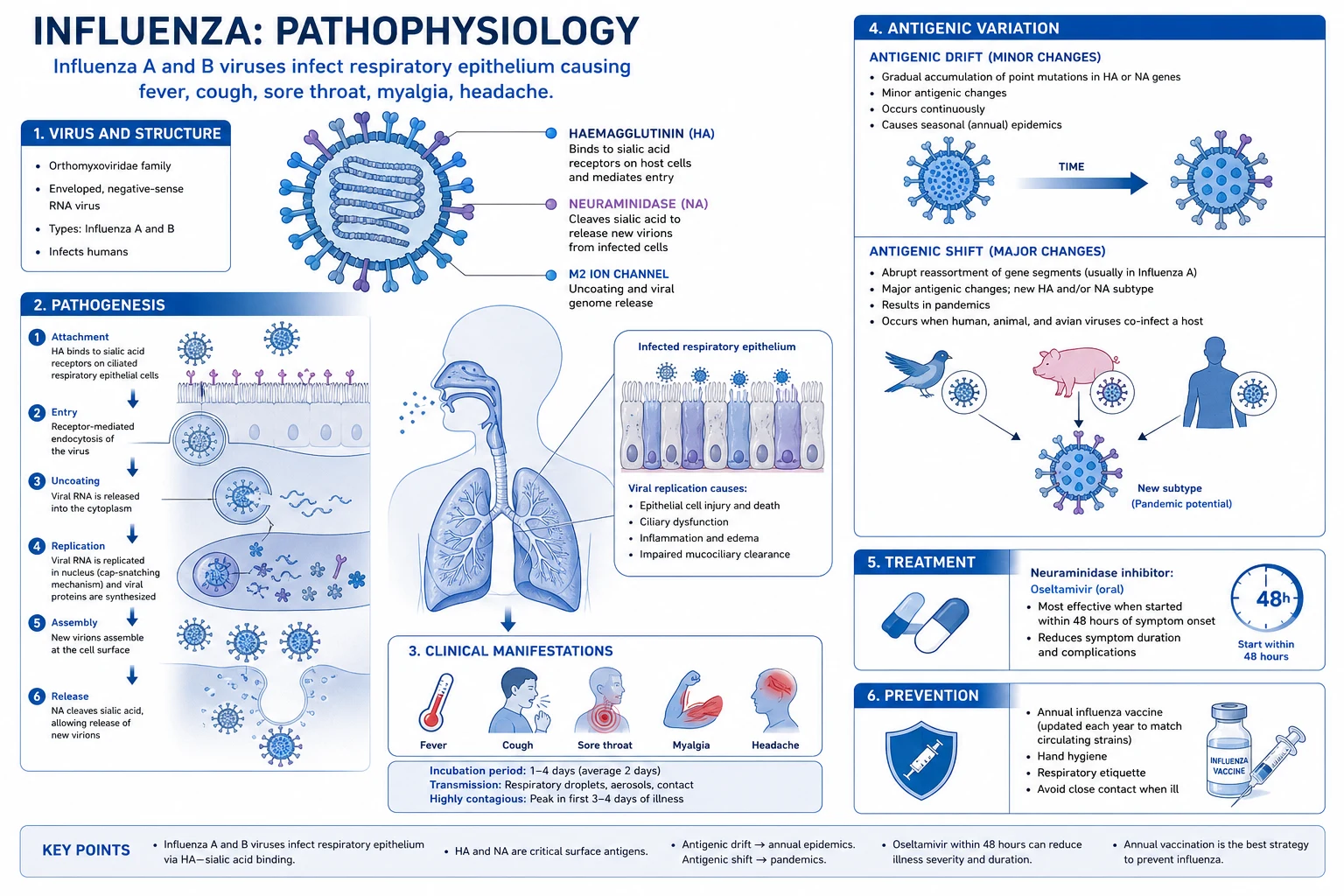
Influenza A/B
#1 viral cause
- Seasonal (winter). Antigenic drift (annual) and shift (pandemic).
- Antiviral: oseltamivir 75 mg PO BD x 5 days (start immediately, even if >48h in severe cases)
- Bacterial co-infection: S. aureus (#1, often post-influenza), S. pneumoniae, H. influenzae
- Vaccination: annual (best prevention)
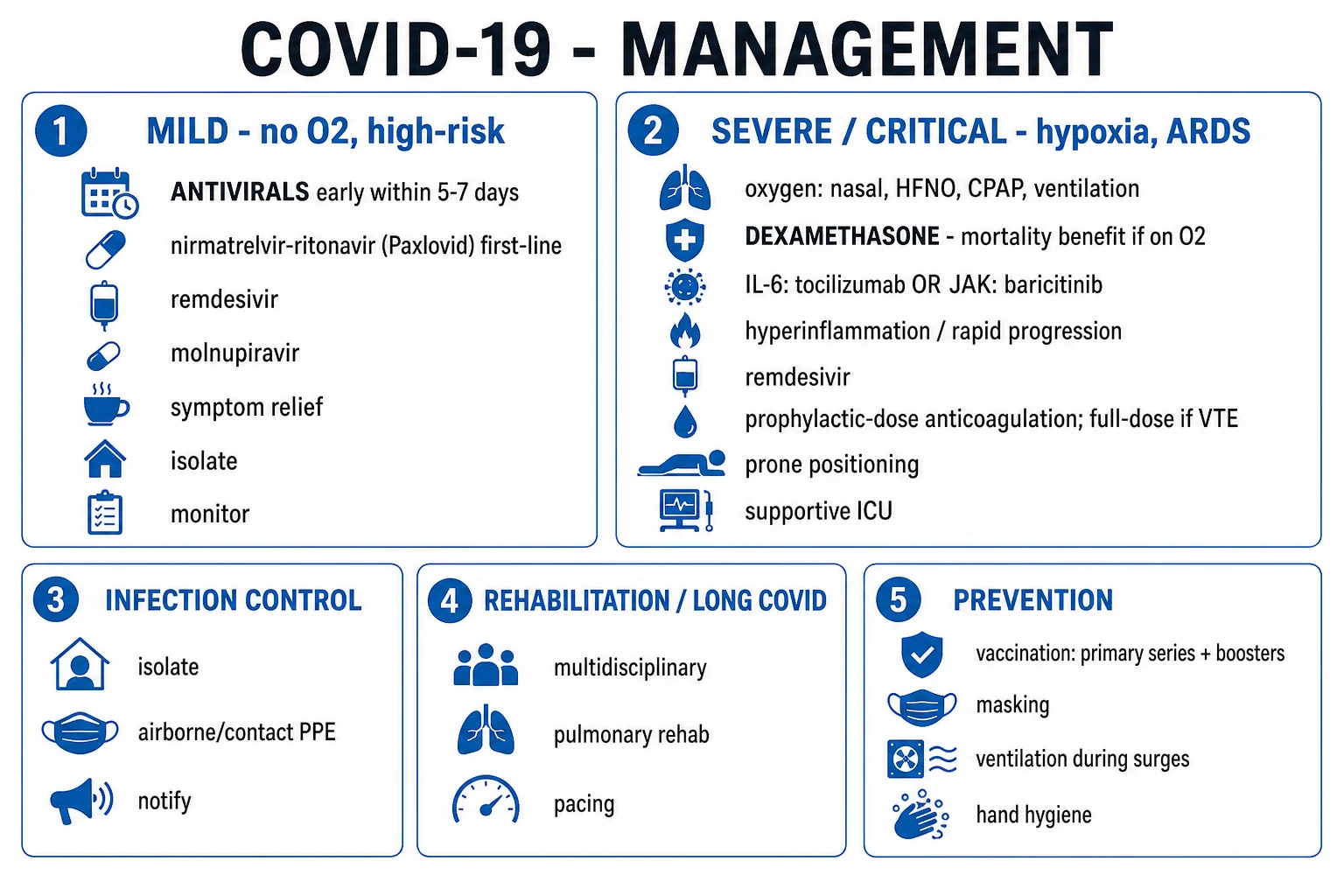
SARS-CoV-2 (COVID-19)
Pandemic/ongoing
- Antiviral: remdesivir 200 mg day 1 then 100 mg daily x 5-10 days (early disease). Limited benefit in late/ventilated patients.
- Anti-inflammatory: dexamethasone 6 mg daily x 10 days (RECOVERY trial — reduces mortality in oxygen/ventilated patients)
- Immunomodulator: tocilizumab (IL-6 receptor antagonist) for rapid respiratory deterioration + elevated CRP
- Anticoagulation: prophylactic-dose LMWH (unless contraindicated) — COVID-associated coagulopathy
RSV
Infants and elderly
- Severe in: infants, elderly, heart/lung disease, immunocompromised
- Antiviral: ribavirin (aerosolised) — reserved for the immunocompromised; supportive care mainstay in immunocompetent adults
- Palivizumab / nirsevimab (monoclonal antibodies) — prophylaxis for high-risk infants (not treatment)
- Bronchodilators, supportive ventilation
Adenovirus
Immunocompromised / military recruits
- Can cause severe necrotising pneumonia, especially in transplant recipients and neonates
- Treatment: cidofovir (limited evidence) + IV immunoglobulin in severe disease
- May shed for weeks after infection (interpret PCR with caution)
Human metapneumovirus (hMPV)
Similar to RSV
- Clinically indistinguishable from RSV — bronchiolitis in children, pneumonia in elderly/immunocompromised
- No specific antiviral — supportive care is the mainstay
- Recognised only since 2001; identified by PCR, not by older antigen methods
Parainfluenza 1-4
Croup / pneumonia
- Parainfluenza 1/2 — croup in children; type 3 — bronchiolitis and pneumonia
- Pneumonia in the immunocompromised (esp. haematopoietic stem cell transplant) can be severe
- Supportive care; DAS181 (sialidase) has limited evidence in immunocompromised pneumonia
Rhinovirus / enterovirus
Common cold pathogens
- Usually mild (common cold) but a leading cause of CAP exacerbation in COPD/asthma
- Can cause severe pneumonia in the immunocompromised
- Frequently detected as asymptomatic carriage — interpret a positive result cautiously
Coronavirus (non-SARS) + bocavirus
Panel additions
- Seasonal coronaviruses (229E, OC43, NL63, HKU1) cause mild URI but can precipitate CAP in frail patients
- Human bocavirus — frequent co-detection in children; true pathogenicity in adults debated
- Supportive care; no specific antiviral
CMV (immunocompromised only)
Transplant / advanced HIV
- Not on standard CAP panels — send CMV PCR on BAL in the immunocompromised with interstitial infiltrates
- Ganciclovir 5 mg/kg IV BD x 14-21 days (valganciclovir for step-down)
- Often coexists with pneumonitis in stem-cell transplant recipients
The multiplex respiratory virus panel — what it is and how it is used
How the syndromic respiratory PCR panel is used in the ICU
1. Specimen — nasopharyngeal swab (or BAL)
A flocked nasopharyngeal swab in viral transport medium is the standard specimen for upper-respiratory viruses. In intubated patients, **endotracheal aspirate or BAL** gives higher yield for lower-respiratory viruses (influenza, RSV, SARS-CoV-2, hMPV) and allows bacterial culture to be sent on the same sample. A BAL specimen is essential when suspecting **CMV/HSV pneumonitis** in the immunocompromised. Swab technique matters: an inadequate nasopharyngeal swab is the commonest cause of a false-negative.
2. Multiplex nucleic-acid amplification (PCR)
The sample is loaded onto a **syndromic multiplex panel** (e.g. BioFire FilmArray RP, Luminex xTAG/NxTAG, Genmark eSensor, Cepheid Xpert Xpress Flu/RSV). These platforms amplify and detect **influenza A/B (+ subtyping), RSV A/B, SARS-CoV-2, parainfluenza 1-4, adenovirus, rhinovirus/enterovirus, human metapneumovirus, coronaviruses (incl. endemic strains), human bocavirus, and sometimes Mycoplasma, Chlamydia and Bordetella**. Turnaround is ~1 hour on FilmArray; batched platforms a few hours.<Cite id="9" /><Cite id="10" />
3. Result interpretation in context
A positive result must be read against the pre-test probability and the limitations below. **One or more viruses detected** is common; the panel cannot distinguish colonisation/asymptomatic shedding from causative infection. **Cycle threshold (Ct)** is sometimes reported — a low Ct (high viral load) is more compatible with true infection, but thresholds vary by assay and Ct should not be over-interpreted in isolation.
4. Action — therapy, isolation, stewardship
Use the result to (a) **start or continue targeted antiviral therapy** (oseltamivir for influenza, remdesivir for COVID-19, ribavirin for RSV in the immunocompromised); (b) **set infection-control precautions** — droplet + contact for influenza/RSV, airborne/negative-pressure for aerosol-generating procedures; (c) **de-escalate antibiotics** if bacterial cultures/procalcitonin are reassuring AND the patient is improving; and (d) **cohort** patients with the same virus to preserve single rooms.
Clinical utility of a confirmed viral diagnosis
Antiviral therapy decisions driven by the panel
Influenza A/B positive → oseltamivir
Oseltamivir 75 mg PO BD x 5 days (dose-adjusted if eGFR <30). Start immediately on suspicion in flu season; do not wait for the PCR. Meta-analysis of randomised trials shows symptom reduction and, in severe/hospitalised influenza, a mortality signal in favour of early treatment. Benefits persist even when started >48h in critically ill patients. Alternatives: zanamivir (inhaled, avoid in ventilated/obstructed airway), baloxavir (single dose; limited ICU data).<Cite id="8" />
SARS-CoV-2 positive → severity-stratified COVID therapy
Remdesivir 200 mg day 1 then 100 mg daily x 5-10 days benefits EARLY disease (first ~10 days, before the hyper-inflammatory phase). **Dexamethasone 6 mg daily x up to 10 days** reduces mortality in patients requiring oxygen or ventilation (RECOVERY). **Tocilizumab** (IL-6 receptor antagonist) for rapid respiratory deterioration with systemic inflammation/CRP elevation (REMAP-CAP). Add prophylactic-dose LMWH for COVID-associated coagulopathy.<Cite id="4" /><Cite id="5" /><Cite id="6" />
RSV positive + immunocompromised → consider ribavirin
Aerosolised ribavirin is reserved for RSV in transplant recipients / severely immunocompromised adults or infants with high-risk disease; in immunocompetent adults, supportive care is the mainstay. Healthcare-worker exposure to aerosolised ribavirin is a teratogenicity concern — administer in a scavenged circuit.
CMV positive (BAL) in immunocompromised → ganciclovir
Ganciclovir 5 mg/kg IV BD x 14-21 days, then valganciclovir for maintenance/step-down. Concurrent CMV DNAemia quantitation guides duration. Often combined with reduction of immunosuppression.
Adenovirus / hMPV / parainfluenza / rhinovirus → mainly supportive
No proven specific antiviral for most. Cidofovir has been used for severe adenovirus disease in transplant recipients. Treatment is supportive lung-protective ventilation, lung-protective fluid strategy, and treatment of bacterial co-infection.
Antiviral and immunomodulatory evidence (COVID-19 and influenza)
Dexamethasone reduces mortality in COVID-19 patients requiring oxygen or ventilation — RECOVERY
Multicentre, randomised, open-label, platform trial
Population: Hospitalised COVID-19 patients (n > 6000 in the dexamethasone arm)
Key finding
Mortality reduction confined to patients receiving respiratory support: ~one-third fewer deaths in invasively ventilated patients and ~one-fifth fewer in patients receiving oxygen alone. No benefit (possible harm) in patients not requiring oxygen.
Remdesivir shortens recovery in early COVID-19 — ACTT-1
Double-blind, randomised, placebo-controlled trial
Population: Hospitalised adults with COVID-19 pneumonia (n = 1062)
Key finding
Median time to recovery shortened from 15 to 10 days. Benefit greatest in patients requiring low-flow oxygen; no mortality benefit in those already mechanically ventilated (late, hyper-inflammatory disease).
Tocilizumab improves survival in critically ill COVID-19 — REMAP-CAP
Randomised, embedded, multifactorial, adaptive platform trial
Population: Critically ill adults with COVID-19 receiving respiratory or cardiovascular organ support
Key finding
Reduced 90-day mortality and more organ-support-free days. Benefit seen in patients with systemic hyper-inflammation (elevated CRP).
Oseltamivir reduces symptom duration in adults with influenza — meta-analysis of RCTs
Meta-analysis of individual patient data from randomised controlled trials
Population: Adults with confirmed influenza treated within 48 hours of symptom onset
Key finding
Significant reduction in symptom duration; in the subgroup of patients with confirmed influenza and higher risk, reduced lower-respiratory-tract complications and hospitalisation.
Impact on antibiotic stewardship
[7]Using the viral result for safe antibiotic de-escalation
1. Confirm the bacterial workup is negative
Blood cultures, sputum/ETT aspirate culture, urinary pneumococcal and Legionella antigen, and (if relevant) atypical serology all negative or non-contributory. A positive bacterial culture mandates continuing targeted antibiotics regardless of the viral result.
2. Confirm the viral result fits the clinical picture
A single positive virus with a compatible illness (interstitial infiltrates, viral prodrome, low procalcitonin) and high viral load supports a viral aetiology. Be cautious with rhinovirus/enterovirus/bocavirus, which are frequently carried asymptomatically.
3. Confirm the patient is clinically improving
Falling oxygen requirement, resolving fever, improving inflammatory markers, and haemodynamic stability. Do not de-escalate in a deteriorating patient even if the PCT is low — re-evaluate for bacterial superinfection (especially post-influenza S. aureus).
4. Stop antibiotics and continue antivirals as indicated
Discontinue antibiotics with a documented stewardship reason; complete the antiviral course (e.g. 5 days oseltamivir, 5-10 days remdesivir). Reassess daily for clinical relapse or secondary infection.
Critical limitations — a positive PCR is not a diagnosis
[1] [9]Procalcitonin — the bacterial biomarker adjunct
The immunocompromised host — broaden the viral net
[1] [2]SAQ — Severe viral CAP and the respiratory virus panel
SAQ — Severe influenza pneumonia with bacterial co-infection
10 minutes · 10 marks
A 61-year-old man is admitted to ICU in mid-winter with a 3-day history of influenzal prodrome (fever, myalgia, coryza) then rapidly progressive dyspnoea. He is in septic shock (BP 84/50, lactate 3.8), SpO2 88% on 15 L, RR 34, and has bilateral interstitial infiltrates progressing to multilobar consolidation over 12 hours. Nasopharyngeal swab multiplex PCR is positive for influenza A (H1N1). Procalcitonin 2.4 ng/mL. Sputum Gram stain shows gram-positive cocci in clusters.
SAQ — Severe COVID-19 pneumonia in the ICU
10 minutes · 10 marks
A 58-year-old unvaccinated man with type 2 diabetes and BMI 34 presents with 8 days of COVID-19 symptoms and 3 days of worsening dyspnoea. He requires 10 L/min via HFNC to maintain SpO2 92%, RR 30, CRP 145, D-dimer 1800 ng/mL, ferritin 1200. Chest CT shows bilateral ground-glass predominant infiltrates (greater than 50% involvement). He is not in shock.
Clinical pearls
Red flags
References
- [1]Niederman MS, Torres A. Severe community-acquired pneumonia Eur Respir Rev, 2022.PMID 36517046
- [2]Jain S, Self WH, Wunderink RG, et al. Community-Acquired Pneumonia Requiring Hospitalization among U.S. Adults N Engl J Med, 2015.PMID 26172429
- [3]Metlay JP, Waterer GW, Long AC, et al. Diagnosis and Treatment of Adults with Community-acquired Pneumonia. An Official Clinical Practice Guideline of the American Thoracic Society and Infectious Diseases Society of America Am J Respir Crit Care Med, 2019.PMID 31573350
- [4]Beigel JH, Tomashek KM, Dodd LE, et al. Remdesivir for the Treatment of Covid-19 - Final Report N Engl J Med, 2020.PMID 32445440
- [5]RECOVERY Collaborative Group. Dexamethasone in Hospitalized Patients with Covid-19 N Engl J Med, 2021.PMID 32678530
- [6]REMAP-CAP Investigators, Gordon AC, Mouncey PR, et al. Interleukin-6 Receptor Antagonists in Critically Ill Patients with Covid-19 N Engl J Med, 2021.PMID 33631065
- [7]Schuetz P, Wirz Y, Werner S, et al. Effect of procalcitonin-guided antibiotic treatment on mortality in acute respiratory infections: a patient level meta-analysis Lancet Infect Dis, 2018.PMID 29037960
- [8]Dobson J, Whitley RJ, Pocock S, Monto AS. Oseltamivir treatment for influenza in adults: a meta-analysis of randomised controlled trials Lancet, 2015.PMID 25640810
- [9]Mahony JB. Molecular diagnosis of respiratory virus infections Crit Rev Clin Lab Sci, 2011.PMID 22185616
- [10]Popowitch EB, O'Neill SS, Miller MB. Comparison of the Biofire FilmArray RP, Genmark eSensor RVP, Luminex xTAG RVPv1, and Luminex xTAG RVP fast multiplex assays for detection of respiratory viruses J Clin Microbiol, 2013.PMID 23486707