MedVellum
MCQsExamsAtlas
DashboardPricing
MBBS / Core medicine✳Dermatology✳ICU Fellowship (CICM)✳Anaesthesia✳Emergency Medicine✳Psychiatry Fellowship✳Paediatrics Fellowship✳Physician Medicine✳MCQs✳SAQs✳Vivas✳OSCE✳Evidence-first✳MBBS / Core medicine✳Dermatology✳ICU Fellowship (CICM)✳Anaesthesia✳Emergency Medicine✳Psychiatry Fellowship✳Paediatrics Fellowship✳Physician Medicine✳MCQs✳SAQs✳Vivas✳OSCE✳Evidence-first✳

MedVellum.

The folio

Exam-exhaustive medical education across every specialty — evidence-graded topics, engraved plates, and practice in every written and oral format. Educational content only — not medical advice.

llms.txt · psychiatry LLM catalog · sitemap

Atlas

  • Specialty atlas
  • MBBS / Core medicine
  • Dermatology
  • ICU Fellowship (CICM)
  • Anaesthesia
  • Emergency Medicine
  • Psychiatry Fellowship
  • Paediatrics Fellowship
  • Physician Medicine

Study & account

  • MCQ practice
  • Practice alias
  • Exam tools
  • Dashboard
  • Pricing
  • Sign in

© 2026 MedVellum. For education only — not a substitute for clinical judgement.

Folio edition · Set in Instrument Serif & Archivo

ICU TopicsNeurocritical care

ICU · Neurocritical care

Acute stroke: ischaemic, haemorrhagic, and SAH — comprehensive ICU management

Also known as Acute stroke · Ischaemic stroke · Intracerebral haemorrhage · ICH · Subarachnoid haemorrhage · Thrombolysis · Thrombectomy

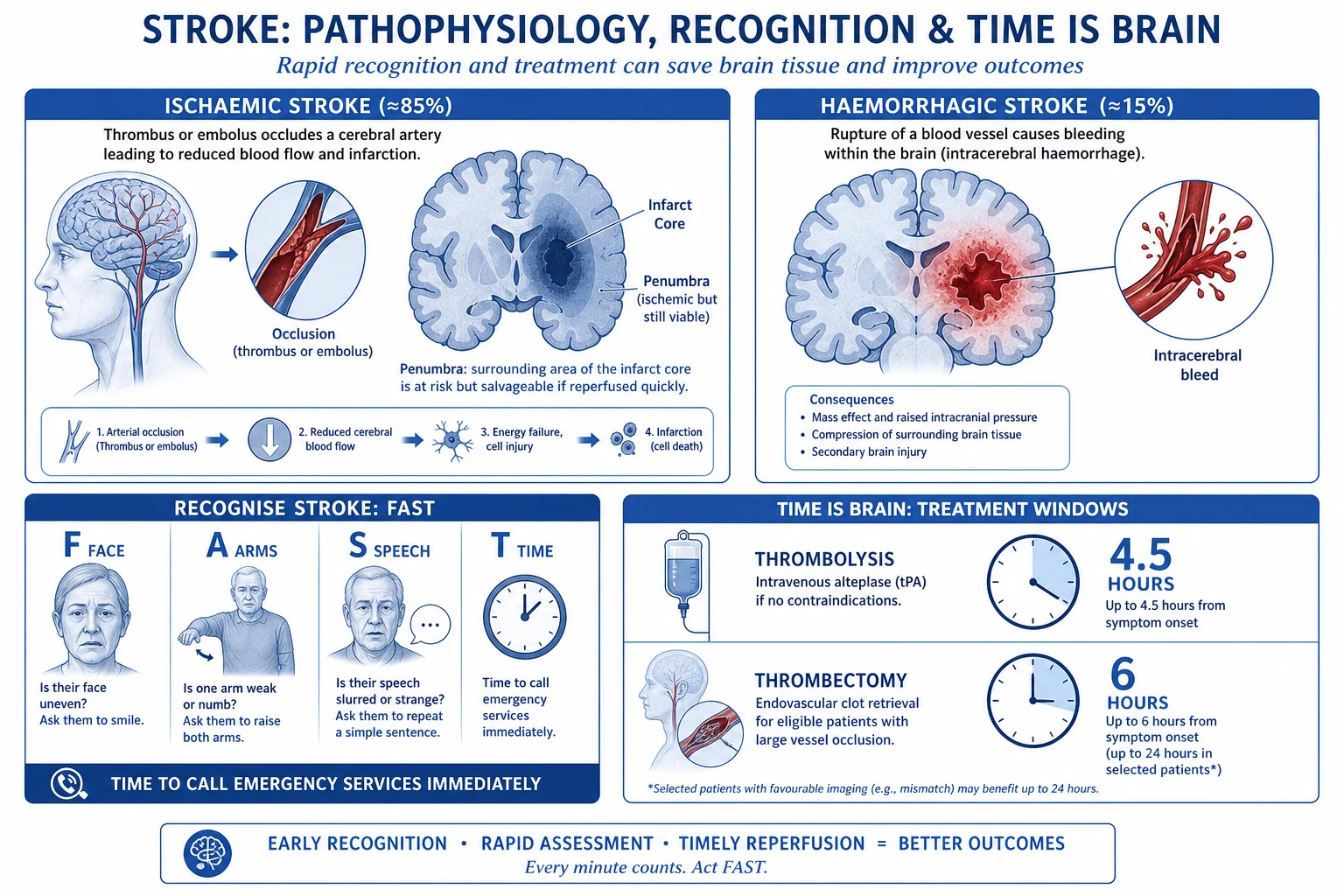
Acute stroke = sudden neurological deficit from cerebral vascular event. THREE TYPES: (1) ISCHAEMIC (80% — arterial occlusion — thrombus/embolus). (2) INTRACEREBRAL HAEMORRHAGE [ICH] (15% — intraparenchymal bleed — hypertension/amyloid). (3) SUBARACHNOID HAEMORRHAGE [SAH] (5% — aneurysmal rupture). ISCHAEMIC: THROMBOLYSIS (alteplase within 4.5h — NINDS/ECASS III) + THROMBECTOMY (DAWN/DEFUSE-3 — for large vessel occlusion [LVO] within 6-24h with salvageable penumbra). ICH: BP control (SBP <140 — INTERACT2/ATACH-2), ICH score for prognosis, surgical evacuation (CEREBELLAR — life-saving; SUPRATENTORIAL — STICH II — no routine benefit). SAH: nimodipine (reduces vasospasm + improves outcomes — 60 mg PO q4h x 21 days), BP control (SBP <160 pre-aneurysm securing), vasospasm management (induced hypertension — but NOT triple-H — avoid hypervolaemia). ICU: BP (permissive hypertension for ischaemic [SBP <185 for thrombolysis, <140 for ICH]), temperature (normothermia — fever worsens outcomes), glucose (6-10), swallowing assessment (before oral intake), DVT prophylaxis (LMWH after 24h). MORTALITY: ischaemic 10-15%; ICH 35-50%; SAH 30-40%.

high6 referencesUpdated 1 July 2026
On this page & tools

Your progress

Saved locally on this device.

Target exams

CICMFFICMEDIC

Red flags

Ischaemic: THROMBOLYSIS within 4.5h (alteplase 0.9 mg/kg) — DAWN/DEFUSE-3: thrombectomy up to 24h for LVOICH: BP SBP &lt;140 (INTERACT2) — ICH score for prognosis — cerebellar >3cm → surgical evacuationSAH: nimodipine 60 mg PO q4h x 21 days — vasospasm days 4-14CT brain immediately (ischaemic vs haemorrhagic — determines management)Swallow assessment BEFORE any oral intake (aspiration risk)

Your progress

Saved locally on this device.

Target exams

CICMFFICMEDIC

Red flags

Ischaemic: THROMBOLYSIS within 4.5h (alteplase 0.9 mg/kg) — DAWN/DEFUSE-3: thrombectomy up to 24h for LVOICH: BP SBP &lt;140 (INTERACT2) — ICH score for prognosis — cerebellar >3cm → surgical evacuationSAH: nimodipine 60 mg PO q4h x 21 days — vasospasm days 4-14CT brain immediately (ischaemic vs haemorrhagic — determines management)Swallow assessment BEFORE any oral intake (aspiration risk)

In one line

Ischaemic stroke: CT immediately → alteplase within 4.5h (0.9 mg/kg) + thrombectomy for LVO up to 24h (DAWN/DEFUSE-3 — perfusion mismatch). ICH: BP SBP <140 (INTERACT2); ICH score; cerebellar >3cm → surgical evacuation (life-saving). SAH: nimodipine 60 mg PO q4h x 21 days (vasospasm); secure aneurysm (coiling/clipping); vasospasm days 4-14 → induced hypertension (NOT hypervolaemia). ICU: CT first (ischaemic vs haemorrhagic), permissive HTN for ischaemic / tight control for ICH, normothermia, glucose 6-10, swallow assessment before oral intake, DVT prophylaxis after 24h.

[1]

Stroke types compared

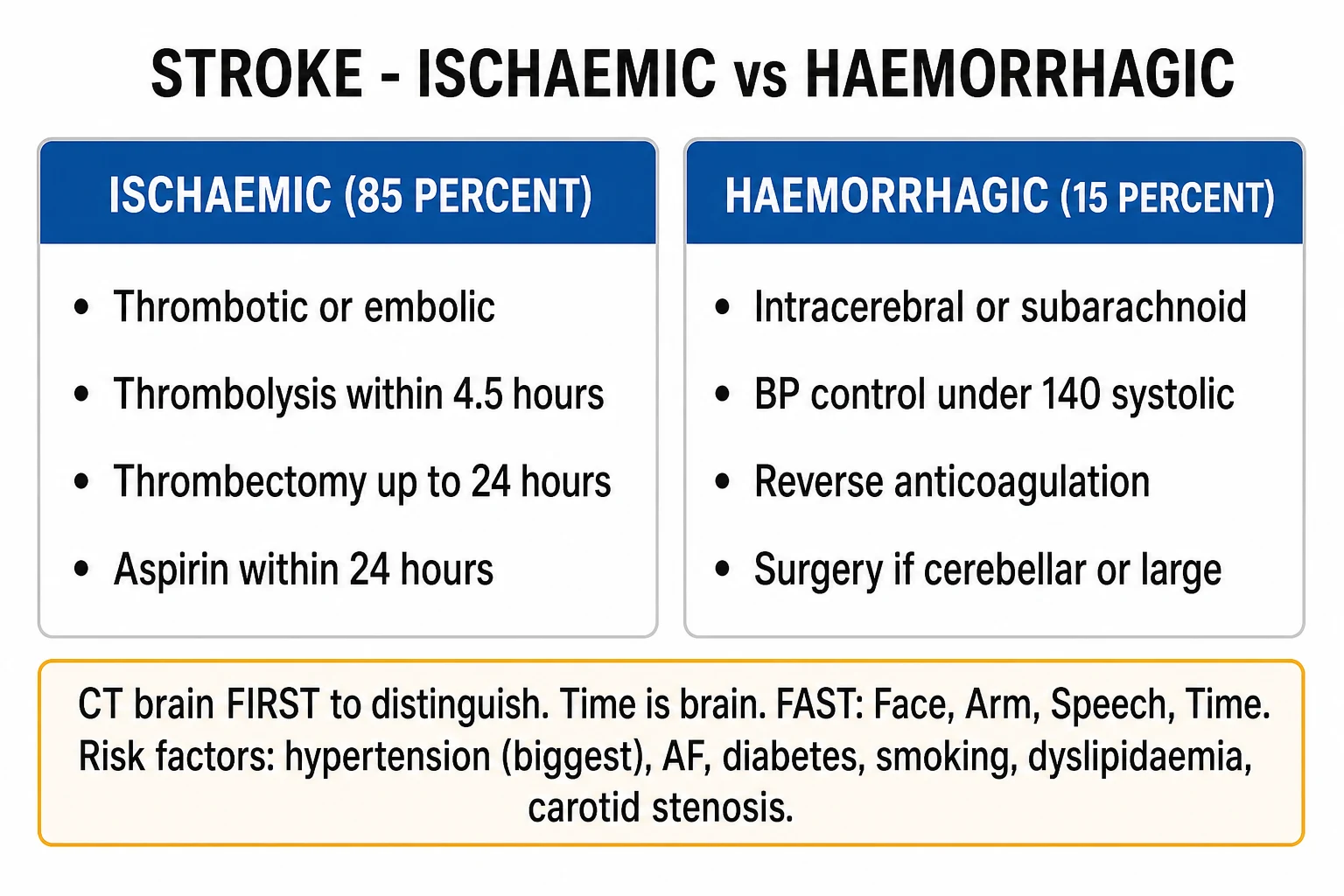
FeatureIschaemic (80%)ICH (15%)SAH (5%)
MechanismArterial OCCLUSION (thrombus/embolus)Intracerebral BLEED (HTN/amyloid)Aneurysm RUPTURE (subarachnoid bleed)
CT findingMay be NORMAL early; hypodensity (later)HYPERDENSE area (white — blood)Hyperdense in SULCI/cisterns (blood in subarachnoid space)
BP targetPermissive HTN (SBP <185 for thrombolysis)SBP <140 (INTERACT2)SBP <160 (pre-securing); then normal
Key treatmentThrombolysis (<4.5h) + thrombectomy (LVO, <24h)BP control ± surgery (cerebellar)Nimodipine + secure aneurysm (coiling/clipping)
Mortality10-15%35-50%30-40%
[1]

Comprehensive acute stroke management

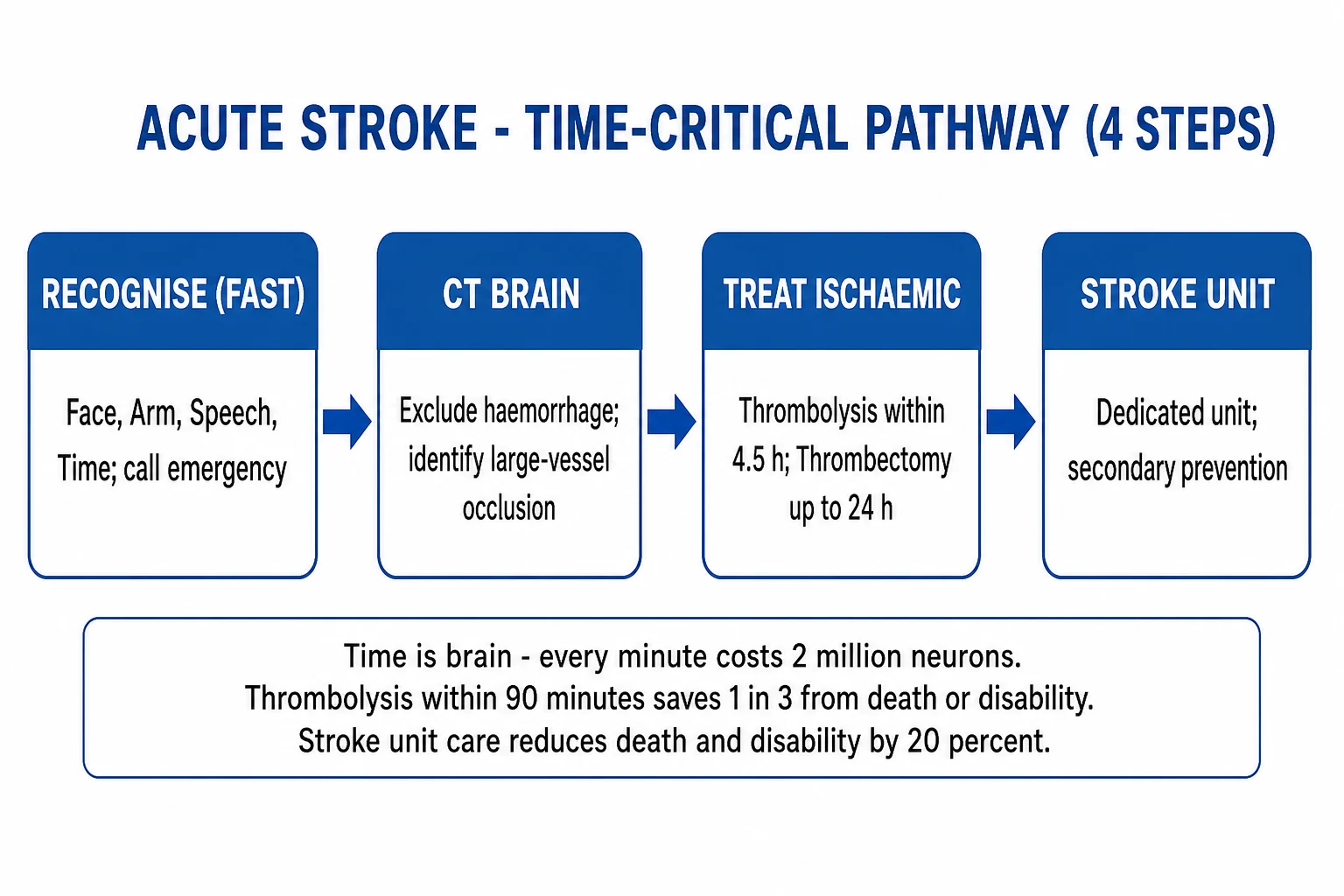
  1. RECOGNISE + CT BRAIN IMMEDIATELY — (a) CLINICAL: sudden focal neurological deficit (face/arm/leg weakness, speech disturbance [dysphasia/dysarthria], visual loss, ataxia, altered consciousness). FAST (Face, Arm, Speech, Time). NIHSS (National Institutes of Health Stroke Scale — 0-42 — quantifies severity — guides thrombolysis/thrombectomy). (b) CT BRAIN IMMEDIATELY (within 25 min of arrival — exclude HAEMORRHAGE): (i) ISCHAEMIC: may be NORMAL early (first few hours) — subtle signs (hyperdense MCA sign, loss of insular ribbon, loss of grey-white differentiation) → CT ANGIOGRAPHY (identify large vessel occlusion [LVO] — M1/M2 MCA, basilar, carotid-T → thrombectomy candidate) + CT PERFUSION (penumbra vs core — DAWN/DEFUSE-3 criteria). (ii) ICH: HYPERDENSE area (white = blood) in brain parenchyma — location (basal ganglia [HTN], lobar [amyloid — elderly], cerebellum, brainstem), volume (ABC/2 formula — volume = A × B × C / 2), midline shift, intraventricular extension (worse prognosis). (iii) SAH: hyperdense in SULCI/cisterns (blood in subarachnoid space) — or CT may be normal (10-15% — then LUMBAR PUNCTURE [xanthochromia — RBC in CSF → breakdown → yellow supernatant]). CT ANGIOGRAPHY (identify aneurysm — location, size). (c) TIME OF ONSET (critical — determines thrombolysis eligibility): 'last known well' time (when patient was last normal — not when found — if woke up with stroke → onset = bedtime).
  2. ISCHAEMIC STROKE — THROMBOLYSIS + THROMBECTOMY — (a) THROMBOLYSIS (alteplase [rt-PA]): (i) ELIGIBILITY: within 4.5 HOURS of onset (ECASS III extended from 3h to 4.5h); ischaemic stroke on CT (no haemorrhage); measurable deficit (NIHSS >0); age ≥18. (ii) DOSE: alteplase 0.9 mg/kg (max 90 mg) — 10% bolus over 1 min + 90% infusion over 60 min. (iii) EXCLUSIONS: haemorrhage on CT; recent surgery/trauma (<14 days); recent GI bleed (<21 days); recent ischaemic stroke (<3 months); intracranial/neuroaxial procedure (<60 days); active bleeding; SBP >185 or DBP >110 (lower first — labetalol IV); platelets <100; INR >1.7 (on anticoagulant); glucose <2.7 or >22; large infarct (DWI >1/3 MCA territory — relative). (iv) BENEFIT: NINDS (1995, NEJM) — within 3h → improved functional outcomes (no major disability at 3 months — 31% vs 20% with placebo). ECASS III (2008, NEJM) — extended to 4.5h. (v) RISK: symptomatic ICH (2-6% — but net benefit — more patients improved than harmed). (b) THROMBECTOMY (mechanical — stent retriever): (i) ELIGIBILITY: LARGE VESSEL OCCLUSION (LVO — M1/M2 MCA, internal carotid [carotid-T], basilar) on CT angiography; within 6-24 HOURS of onset (with imaging selection — penumbra/core mismatch on CT perfusion or MRI — DAWN/DEFUSE-3). (ii) DAWN (2018, NEJM): thrombectomy 6-24h with perfusion mismatch → improved functional independence (49% vs 13%). (iii) DEFUSE-3 (2018, NEJM): thrombectomy 6-16h with mismatch → improved outcomes. (iv) TECHNIQUE: groin puncture → catheter to occluded vessel → stent retriever (mesh tube — traps clot → withdraw → removes clot) or aspiration (suction catheter — directly aspirates clot). (v) COMBINE with thrombolysis (if eligible — alteplase first → then thrombectomy — 'bridging therapy'). (c) ANTIPLATELET: aspirin 300 mg PO/NG within 24h (after CT excludes haemorrhage — don't give before CT). After thrombolysis → aspirin at 24h (after repeat CT — no haemorrhage). For minor stroke/TIA → aspirin + clopidogrel (DAPT 21 days — CHANCE/POINT — reduces recurrence).
  3. INTRACEREBRAL HAEMORRHAGE (ICH) — BP + SURGERY — (a) BP CONTROL: (i) TARGET: SBP <140 mmHg (INTERACT2 — 2013, NEJM — intensive [SBP <140] vs standard [SBP <180] → trend to better functional outcomes [not significant but favourable]; ATACH-2 — SBP <140 vs <180 → no significant difference + more renal adverse events — but <140 generally recommended). (ii) AGENT: labetalol IV (10-20 mg q10min) OR nicardipine IV infusion (5-15 mg/hr) OR clevidipine IV (1-6 mg/hr — ultra-short acting). (iii) AVOID: nitroprusside (cerebral vasodilation → increased ICP), hydralazine (reflex tachycardia). (b) ICH SCORE (prognosis — 0-6): (i) GCS 3-4 (2 points); 5-12 (1); 13-15 (0). (ii) Volume: ≥30 mL (1); <30 mL (0). (iii) Intraventricular extension: yes (1); no (0). (iv) Infratentorial origin: yes (1); no (0). (v) Age ≥80: yes (1); no (0). SCORE: 0 = mortality 0%; 1 = 13%; 2 = 26%; 3 = 72%; 4+ = 97%. (c) SURGERY: (i) CEREBELLAR haemorrhage >3 cm diameter OR with brainstem compression/hydrocephalus → SURGICAL EVACUATION (life-saving — posterior fossa decompression — the brainstem is compressed → herniation → death → evacuate immediately). (ii) SUPRATENTORIAL (lobar) → STICH II (2013, Lancet) — early surgery vs initial conservative → NO overall benefit (but subgroup with superficial [≤1 cm from cortex] lobar haematomas may benefit). (iii) NOT routine for deep (basal ganglia) ICH (surgery doesn't improve outcomes — deep location → difficult access → damage to normal brain). (d) STOP anticoagulants (if on warfarin — reverse with vitamin K + PCC/FFP; if on DOAC — andexanet [apixaban/rivaroxaban] or idarucizumab [dabigatran]; if on heparin — protamine). (e) AVOID: thrombolysis (contraindicated in ICH — would worsen bleed), antiplatelets (would worsen bleeding)
  4. SAH — NIMODIPINE + SECURE ANEURYSM + VASOSPASM — (a) NIMODIPINE: (i) DOSE: 60 mg PO/NG q4h for 21 DAYS. (ii) START IMMEDIATELY (within 24h — as soon as diagnosis confirmed). (iii) MECHANISM: calcium channel blocker → reduces vasospasm (cerebral arterial smooth muscle relaxation) → reduces delayed cerebral ischaemia (DCI — the main cause of death/disability after SAH). (iv) EVIDENCE: multiple RCTs → nimodipine reduces poor outcomes by ~33% (NNT ~10). (v) IV nimodipine (alternative — but risk of hypotension from vasodilation — PO preferred). (vi) SIDE EFFECTS: hypotension (reduce dose or give more frequently — 30 mg q2h if BP drops). (b) SECURE ANEURYSM (within 24-48h — early — before vasospasm window): (i) ENDOVASCULAR COILING (platinum coils packed into aneurysm → thromboses → excludes from circulation — FIRST-LINE — ISAT trial — better outcomes than clipping). (ii) SURGICAL CLIPPING (craniotomy — clip across aneurysm neck — for wide-necked/fusiform aneurysms not suitable for coiling — or if haematoma needs evacuation). (iii) ISAT (2002, Lancet): coiling vs clipping → coiling had better outcomes (relative risk of dependency/death 0.76 favouring coiling). (c) VASOSPASM (days 4-14 — the dangerous window): (i) CLINICAL: new neurological deficit (confusion, weakness, decreased consciousness) → from cerebral ischaemia (vasospasm narrows arteries → reduced blood flow → ischaemia). (ii) DIAGNOSIS: transcranial DOPPLER (TCD — elevated velocities in spasm-affected vessels — daily monitoring days 1-14) + CT angiography/perfusion (confirm spasm + ischaemia). (iii) MANAGEMENT: (A) INDUCED HYPERTENSION (raise BP — noradrenaline/dopamine — to push blood through narrowed vessels — increases perfusion past the spasm). (B) MAINTAIN EUVOLAEMIA (NOT hypervolaemia — old 'triple-H' [hypertension/hypervolaemia/haemodilution] — hypervolaemia causes pulmonary oedema + hyponatraemia — avoid — maintain normal volume + use hypertension). (C) NIMODIPINE (continue — even during spasm — may help relax spasm). (D) ENDOVASCULAR (if refractory — intra-arterial nimodipine/verapamil or balloon angioplasty — for severe angiographic spasm). (d) COMPLICATIONS: (i) HYponatraemia (CSW — cerebral salt wasting — common after SAH → sodium wasting → hyponatraemia → give sodium [NaCl 3% or tablets] NOT fluid restriction — CSW is hypovolaemic). (ii) HYDROCEPHALUS (blood in ventricles → blocks CSF drainage → EVD [external ventricular drain]). (iii) RE-BLEED (before securing — risk highest first 24h — secure early). (iv) SEIZURES (prophylaxis controversial — levetiracetam for high-risk). (v) CARDIAC (stunned myocardium — troponin + ECG changes — takotsubo-like — from catecholamine surge). (e) MORTALITY: 30-40% (high — even with optimal management — from initial bleed + vasospasm + DCI).
  5. ICU MANAGEMENT (ALL STROKE TYPES) — (a) POSITION: HEAD FLAT (15° — for ischaemic stroke — maximise cerebral blood flow — or head up 30° if raised ICP/ICH). (b) BP: (i) ISCHAEMIC: permissive HTN (SBP up to 185 for thrombolysis — or ≤220 if not thrombolysed — allows collateral perfusion to penumbra — don't lower unless >220). (ii) ICH: tight control (SBP <140 — prevents haematoma expansion). (iii) SAH: SBP <160 (pre-securing — prevent re-bleed) → then normal (post-securing — may need HYPERTENSION for vasospasm). (c) TEMPERATURE: NORMOTHERMIA (avoid fever — worsens neurological outcomes — paracetamol, cooling if needed — therapeutic hypothermia NOT proven for stroke — SAINT trial negative). (d) GLUCOSE: 6-10 mmol/L (NICE-SUGAR — hypoglycaemia + hyperglycaemia both worsen outcomes — avoid insulin-induced hypoglycaemia). (e) SWALLOW ASSESSMENT: BEFORE any oral intake (aspiration risk — dysphagia common after stroke — bedside swallow [water swallow test] or formal SALT [speech and language therapy] assessment → if fail → NG/NJ feeding). (f) DVT PROPHYLAXIS: LMWH after 24h (prevents VTE — stroke patients are high risk [immobility] — CLOTS 3 [2013, Lancet] — LMWH better than stockings — start at 24h for ischaemic; longer delay for ICH [48-72h] if large bleed). (g) DECOMPRESSION: (i) MALIGNANT MCA INFARCT (large hemisphere stroke → swelling → raised ICP → herniation) → DECOMPRESSIVE HEMICRANIECTOMY (within 48h — for age <60 — DESTINY, DECIMAL, HAMLET — reduces mortality but more survivors with disability). (ii) CEREBELLAR infarct/haemorrhage → suboccipital decompression (life-saving). (h) SECONDARY PREVENTION: antiplatelet (aspirin ± clopidogrel — for ischaemic), statin (high-dose atorvastatin — SPARCL), anticoagulation (AF → DOAC/warfarin — but NOT in first 24h [risk of haemorrhagic conversion] — start at 2-14 days depending on infarct size), BP control (<130/80 long-term), glycaemic control, smoking cessation, carotid endarterectomy (if symptomatic carotid stenosis >70%).
  6. PROGNOSIS + REHABILITATION — (a) ISCHAEMIC: (i) NIHSS at admission (higher = worse — NIHSS >20 = poor prognosis). (ii) Recanalisation (thrombolysis/thrombectomy — if successful → better outcomes). (iii) Collateral circulation (good collaterals → more penumbra salvageable). (iv) Age + comorbidity. (b) ICH: (i) ICH score (higher = worse — score 4+ mortality >90%). (ii) Volume (>30 mL = worse). (iii) Intraventricular extension (worse). (iv) GCS (lower = worse). (c) SAH: (i) WFNS/Hunt-Hess grade at admission (higher = worse). (ii) Aneurysm location (posterior circulation worse). (iii) Vasospasm (if develops → worse). (iv) Re-bleed (if occurs → much worse). (d) REHABILITATION: (i) Early (within 24-48h — mobilisation [if stable] → stroke unit — not general ward). (ii) STROKE UNIT (specialised — reduces mortality + disability vs general ward — Cochrane — NNT ~20 for death/disability). (iii) PHYSIOTHERAPY (mobility, balance, strength). (iv) OCCUPATIONAL THERAPY (ADLs, home modification). (v) SPEECH AND LANGUAGE (dysphagia, dysphasia). (vi) PSYCHOLOGY (depression common post-stroke — screen + treat). (vii) CARER SUPPORT. (e) KEY: stroke is the leading cause of adult disability — EARLY intervention (thrombolysis/thrombectomy for ischaemic; BP control for ICH; nimodipine + coiling for SAH) + STROKE UNIT care + REHABILITATION = best outcomes.
[1]

Clinical pearls

High-yield stroke points for CICM/FFICM exam

  1. CT brain FIRST — ischaemic vs haemorrhagic. (1) THE FIRST step in ANY suspected stroke: CT brain (within 25 min of arrival — exclude HAEMORRHAGE — determines ALL management). (2) ISCHAEMIC: may be NORMAL early (first few hours — the infarct hasn't declared on CT yet) — subtle early signs: (a) HYPERDENSE MCA SIGN (thrombosed MCA appears bright/dense on CT — acute thrombus). (b) LOSS OF INSULAR RIBBON (grey-white differentiation lost in insular cortex — early oedema). (c) LOSS OF GREY-WHITE DIFFERENTIATION (subtle — early infarct). (d) CT ANGIOGRAPHY: identify LARGE VESSEL OCCLUSION (LVO — M1/M2 MCA, carotid-T, basilar → thrombectomy candidate). (e) CT PERFUSION: penumbra (salvageable) vs core (irreversibly infarcted) — DAWN/DEFUSE-3 criteria for thrombectomy up to 24h. (3) ICH: HYPERDENSE area (white = blood) in brain parenchyma. Location: basal ganglia (HTN), lobar (amyloid — elderly), cerebellar, brainstem. Volume (ABC/2 formula). Intraventricular extension. Midline shift. (4) SAH: hyperdense in SULCI/cisterns (subarachnoid blood). If CT NORMAL but clinical suspicion (thunderclap headache) → LUMBAR PUNCTURE (xanthochromia — RBC breakdown products in CSF — no bilirubin negates SAH — must be >12h after onset for xanthochromia to develop). (5) KEY: CT brain is THE critical first step — distinguishes ischaemic from haemorrhagic — determines ALL subsequent management (thrombolysis for ischaemic; BP control for haemorrhagic). DON'T give thrombolysis before CT (fatal if haemorrhagic).[1] }
  2. Thrombolysis — alteplase within 4.5 hours. (1) ELIGIBILITY: (a) Ischaemic stroke on CT (no haemorrhage). (b) Within 4.5 HOURS of 'last known well' (ECASS III extended from 3h to 4.5h — the benefit diminishes with time — 'time is brain' — 1.9 million neurons lost per minute). (c) Measurable deficit (NIHSS >0 — some benefit even with mild). (d) Age ≥18. (2) DOSE: alteplase (rt-PA) 0.9 mg/kg (max 90 mg) — 10% BOLUS over 1 minute + 90% INFUSION over 60 minutes. (3) EXCLUSIONS (major): (a) Haemorrhage on CT. (b) Recent surgery/trauma (<14 days). (c) Recent GI bleed (<21 days). (d) Recent ischaemic stroke (<3 months). (e) Intracranial/neuroaxial procedure (<60 days). (f) Active bleeding. (g) SBP >185 or DBP >110 (lower first with IV labetalol/nicardipine — then thrombolyse). (h) On anticoagulant with INR >1.7 (or known anticoagulant even if INR normal — if on warfarin). (i) Platelets <100. (j) Glucose <2.7 or >22 mmol/L (correct first). (k) Large infarct (DWI MRI >1/3 MCA territory — relative — high risk of haemorrhagic conversion). (4) EVIDENCE: (a) NINDS (1995, NEJM): within 3h → improved functional outcomes (no major disability at 3 months: 31% alteplase vs 20% placebo — despite more symptomatic ICH [6.4% vs 0.6%] — net benefit). (b) ECASS III (2008, NEJM): extended to 4.5h (more patients improved than harmed). (c) META-ANALYSES: time-dependent benefit — earlier = better (golden hour — first hour → most benefit). (5) RISK: symptomatic ICH (2-6% — from thrombolysis converting ischaemic to haemorrhagic — especially with large infarct + hypertension + delayed treatment). (6) KEY: alteplase within 4.5h for ischaemic stroke (CT excludes haemorrhage) — 0.9 mg/kg (10% bolus + 90% infusion) — exclusions carefully checked — benefit outweighs haemorrhage risk.[1] }
  3. Thrombectomy — DAWN/DEFUSE-3 up to 24h. (1) MECHANICAL THROMBECTOMY: stent retriever (mesh tube deployed in clot → traps clot → withdrawn → removes clot → restores flow) or aspiration (suction catheter directly aspirates clot). (2) ELIGIBILITY: (a) LARGE VESSEL OCCLUSION (LVO — M1/M2 MCA, internal carotid [carotid-T], basilar artery) on CT angiography. (b) SALVAGEABLE PENUMBRA (on CT perfusion or MRI — mismatch between core [irreversibly infarcted — small] and penumbra [at risk but salvageable — large] — DAWN/DEFUSE-3 criteria). (c) TIME: within 6-24 HOURS of onset (with imaging selection — not just time-based). (3) TRIALS: (a) DAWN (2018, NEJM — Nogueira): thrombectomy 6-24h with perfusion mismatch → improved functional independence (49% vs 13% — REMARKABLE — NNT 3). (b) DEFUSE-3 (2018, NEJM — Albers): thrombectomy 6-16h with mismatch → improved outcomes (45% vs 17%). (c) MR CLEAN, ESCAPE, EXTEND-IA, SWIFT-PRIME (2015): thrombectomy within 6h → established benefit (revolutionised acute stroke care — stent retrievers are now standard for LVO). (4) TECHNIQUE: (a) Groin puncture → catheter to occluded vessel (via aorta → carotid → MCA). (b) Deploy stent retriever in clot → wait 3-5 min (clot integrates into mesh) → withdraw → removes clot. (c) Repeat until flow restored (TICI 2b-3 [near-complete/complete reperfusion] — target). (d) May combine with aspiration (ADAPT — direct aspiration first pass). (5) COMBINE with thrombolysis (if eligible — 'bridging' — alteplase first → then thrombectomy). Even if thrombolysis given → still thrombectomise if LVO (thrombolysis alone may not lyse large clots). (6) COMPLICATIONS: vessel perforation/dissection (rare), distal embolisation (clot fragments), groin complication (bleeding/pseudoaneurysm). (7) KEY: thrombectomy for LVO within 6-24h with perfusion mismatch (DAWN/DEFUSE-3) — dramatic benefit — 'time is brain' — earlier = better.[2] }
  4. ICH — BP SBP <140 (INTERACT2). (1) RATIONALE: (a) Acute ICH → haematoma may EXPAND (grow) in first 24h (especially first 6h) → worse outcomes. (b) High BP → higher pressure in bleeding vessel → more expansion → worse. (c) Lowering BP → reduces expansion → better outcomes. (2) INTERACT2 (2013, NEJM — Anderson): intensive (SBP <140 within 1h) vs standard (SBP <180) → (a) Trend to better functional outcomes (not statistically significant for primary — but favourable [odds ratio 0.87]). (b) No increase in adverse events (renal, cardiac — despite more aggressive BP lowering). (c) CONCLUSION: intensive BP reduction (SBP <140) is SAFE + probably beneficial → recommended. (3) ATACH-2 (2016, NEJM): SBP 110-139 vs 140-179 → NO significant difference in outcomes + MORE renal adverse events in intensive group. BUT: subgroup analysis suggested benefit for those treated within 4.5h (early). Overall: SBP <140 generally recommended but individualised. (4) AGENT: (a) LABETALOL IV (10-20 mg q10min — alpha+beta — no cerebral vasodilation — safe). (b) NICARDIPINE IV (5-15 mg/hr — CCB — titratable — good). (c) CLEVIDIPINE IV (1-6 mg/hr — ultra-short acting — easy titration). (d) AVOID: nitroprusside (cerebral vasodilation → increased ICP — WORSE), hydralazine (reflex tachycardia — unpredictable). (5) TARGET: SBP <140 mmHg (within 1h — maintain for 7 days). CAUTION: don't drop too fast (may reduce cerebral perfusion in chronically hypertensive patients whose autoregulation is shifted right — they need higher pressure for brain perfusion — lower gradually — monitor neurological status). (6) KEY: ICH → SBP <140 (INTERACT2) — labetalol/nicardipine — reduces haematoma expansion.[3] }
  5. SAH — nimodipine + vasospasm. (1) NIMODIPINE: (a) DOSE: 60 mg PO/NG every 4 hours for 21 DAYS. (b) START IMMEDIATELY (within 24h of diagnosis — don't delay). (c) MECHANISM: L-type calcium channel blocker → relaxes cerebral arterial smooth muscle → REDUCES VASOSPASM (narrowing of cerebral arteries from blood products in subarachnoid space irritating the vessel wall → smooth muscle contraction → vessel narrowing → reduced blood flow → ischaemia). (d) DELAYED CEREBRAL ISCHAEMIA (DCI — days 4-14): the main cause of death/disability after SAH (survived the initial bleed → develops vasospasm → cerebral ischaemia → new deficit or death). (e) EVIDENCE: multiple RCTs → nimodipine reduces poor outcomes (death/disability) by ~33% (NNT ~10). (f) SIDE EFFECTS: hypotension (from vasodilation — reduce dose [30 mg q2h] or give more slowly — monitor BP — maintain cerebral perfusion). (g) IV nimodipine: alternative (if can't take PO) — but risk of hypotension (IV causes more systemic vasodilation) — PO preferred. (2) VASOSPASM MANAGEMENT (days 4-14): (a) MONITORING: (i) TRANSCRANIAL DOPPLER (TCD — daily — measures blood flow velocity in cerebral arteries — elevated velocity [MCA >120 cm/s] → spasm — trends more important than single values). (ii) CLINICAL: new neurological deficit (confusion, weakness, decreased consciousness) → suspect vasospasm → confirm with CT angiography/perfusion. (b) MANAGEMENT: (i) INDUCED HYPERTENSION (raise BP — noradrenaline — to push blood through narrowed vessels → increase perfusion past the spasm → reduce ischaemia). (ii) MAINTAIN EUVOLAEMIA (NOT hypervolaemia — old 'TRIPLE-H' [hypertension + hypervolaemia + haemodilution] — hypervolaemia → pulmonary oedema + hyponatraemia [from ANP/BNP release] — DON'T over-hydrate — maintain normal volume + use hypertension alone). (iii) NIMODIPINE (continue — PO — even during spasm — may help relax spasm + neuroprotection). (iv) ENDOVASCULAR (if refractory to medical [induced hypertension + nimodipine]): (A) INTRA-ARTERIAL NIMODIPINE/VERAPAMIL (infuse vasodilator directly into spasm-affected vessel via catheter — relaxes spasm locally — effective — but temporary — may need repeat). (B) BALLOON ANGIOPLASTY (inflate balloon in spasm-affected vessel → physically stretches the vessel → opens it — effective — but risk of vessel rupture — for proximal vessels only [not distal]). (3) KEY: SAH → nimodipine 60 mg PO q4h x 21 days (reduces DCI). Vasospasm days 4-14 → induced hypertension (NOT hypervolaemia) + nimodipine ± endovascular.[4] }
  6. ICH score — prognosis. (1) THE SCORE (0-6 — higher = worse): (a) GCS: 3-4 = 2 points; 5-12 = 1 point; 13-15 = 0 points. (b) Volume: ≥30 mL = 1 point; <30 mL = 0 points (ABC/2 formula — volume = A [largest diameter] × B [perpendicular diameter] × C [number of slices] / 2). (c) Intraventricular extension: yes = 1; no = 0. (d) Infratentorial origin (brainstem/cerebellum): yes = 1; no = 0. (e) Age ≥80: yes = 1; no = 0. (2) MORTALITY by score: 0 = 0%; 1 = 13%; 2 = 26%; 3 = 72%; 4 = 97%; 5+ = ~100%. (3) USE: (a) PROGNOSIS (at admission — counsel family — realistic expectations). (b) GUIDE management (high score → may discuss goals of care [comfort vs aggressive]). (c) RESEARCH (standardise severity — compare outcomes). (4) LIMITATIONS: (a) Doesn't account for: cause (amyloid vs HTN), anticoagulation (worse — haematoma expansion), time to presentation, Glasgow-Pittsburgh (adds motor response separately). (b) Static (doesn't account for haematoma expansion — if volume grows → worse). (5) KEY: ICH score (GCS + volume + IVH + infratentorial + age) — predicts mortality — use for prognosis + goals of care discussion.[5] }
  7. Swallow assessment — before oral intake. (1) WHY: (a) Dysphagia (swallowing difficulty) is COMMON after stroke (50% — especially brainstem/bilateral strokes → CN IX/X palsy → impaired pharyngeal contraction + laryngeal closure → aspiration). (b) ASPIRATION (food/fluid entering lungs → aspiration pneumonitis/pneumonia → increased mortality). (c) MALNUTRITION/DEHYDRATION (if can't swallow safely → can't eat/drink → malnutrition → worse outcomes). (2) WHEN: BEFORE ANY oral intake (including medications — even water — before swallow assessment). NOTHING BY MOUTH until swallow assessed. (3) HOW: (a) BEDSIDE SWALLOW (water swallow test — 3 teaspoons water → observe for coughing/choking/wet voice → if any → FAIL → NG/NJ feeding + formal SALT assessment). (b) FORMAL SALT (Speech and Language Therapist — comprehensive assessment — may include videofluoroscopy [X-ray of swallow] or fibreoptic endoscopic evaluation of swallow [FEES]). (4) IF FAIL: (a) NG TUBE (nasogastric — for feeding + medications). (b) NJ TUBE (nasojejunal — if reflux/aspiration risk — bypasses stomach). (c) PEG (percutaneous endoscopic gastrostomy — if prolonged dysphagia [>2-3 weeks] — long-term feeding). (d) IV FLUIDS (until feeding established — prevent dehydration). (5) KEY: NOTHING BY MOUTH until swallow assessed → bedside water swallow → if fail → NG feeding + formal SALT. Aspiration pneumonitis is a major cause of post-stroke mortality — prevent by safe swallow assessment.[1] }
  8. Decompressive hemicraniectomy — malignant MCA infarct. (1) MALIGNANT MCA INFARCT: (a) Large MCA territory infarct (complete M1 occlusion with poor collaterals → >2/3 MCA territory infarcted). (b) SWELLING: infarcted brain swells (cytotoxic oedema — within 24-72h) → raises ICP → midline shift → herniation → death (mortality 80% without surgery). (2) DECOMPRESSIVE HEMICRANIECTOMY: (a) Remove a large bone flap (fronto-temporo-parietal) → allow brain to expand OUTWARD (instead of downward [herniation]) → relieves ICP → prevents herniation → saves life. (b) INDICATIONS: (i) Age <60 (DESTINY/DECIMAL/HAMLET — benefit for <60; older patients [DESTINY-2] → less benefit [more disability in survivors]). (ii) NIHSS >15 (or impaired consciousness [somnolence]). (iii) Infarct >2/3 MCA territory (on CT/MRI — or DWI volume >145 mL). (iv) Within 48 HOURS of onset (or before signs of herniation — don't wait for herniation → irreversible). (3) EVIDENCE: (a) DESTINY (2007, Stroke): hemicraniectomy within 36h → reduced mortality (12% vs 53% [control]). (b) DECIMAL (2007, Lancet Neurology): similar. (c) HAMLET (2009, Lancet Neurology): hemicraniectomy within 96h → reduced mortality (22% vs 59%) but more survivors with moderate-severe disability. (d) POOLED ANALYSIS (Vahedi 2007): hemicraniectomy within 48h for age <60 → reduced mortality (22% vs 71%) + more survivors with favourable outcome (43% vs 21%). (e) DESTINY-2 (2014, NEJM): for age >60 → reduced mortality but more survivors with severe disability → discuss with family (quality of life). (4) PROCEDURE: large fronto-temporo-parietal craniectomy (≥12 cm diameter) + durotomy/duroplasty (open dura → allow brain expansion) → leave OPEN (no bone flap — cranioplasty later [months] after swelling resolves). (5) KEY: malignant MCA infarct → decompressive hemicraniectomy within 48h for age <60 (reduces mortality dramatically — but more survivors with disability — discuss with family).[1] }
  9. Secondary prevention — after stroke. (1) ANTIPLATELET: (a) Aspirin 75-300 mg daily (first-line — for non-cardioembolic ischaemic stroke). (b) Clopidogrel 75 mg daily (alternative — or if aspirin intolerant — CAPRIE). (c) DAPT (aspirin + clopidogrel) for 21 days after minor stroke/TIA (CHANCE/POINT — reduces recurrence — then monotherapy long-term — prolonged DAPT increases bleeding without benefit). (d) Dipyridamole + aspirin (ESPRIT/ESPS-2 — alternative). (2) ANTICOAGULATION (if AF — cardioembolic): (a) DOAC (apixaban, rivaroxaban, dabigatran — preferred — no INR monitoring, less ICH than warfarin). (b) Warfarin (if mechanical valve, severe MS, antiphospholipid syndrome — INR 2-3). (c) TIMING: DON'T start immediately (first 24h — risk of haemorrhagic conversion — especially large infarct) — start at 2-14 DAYS (depending on infarct size — small → 2-3 days; large → 10-14 days — discuss with stroke team). (3) STATIN: high-dose atorvastatin 80 mg (SPARCL — reduces recurrent stroke in patients with recent stroke/TIA — LDL target <1.8). (4) BP: <130/80 long-term (PROGRESS — perindopril-based regimen reduced recurrent stroke). (5) CAROTID ENDARTERECTOMY (CEA): for symptomatic carotid stenosis >70% (NASCET/ECST — CEA reduces recurrent stroke — ideally within 2 weeks of TIA/minor stroke). (6) LIFESTYLE: smoking cessation (major — doubles recurrence risk), diet (Mediterranean), exercise, weight loss, alcohol moderation. (7) GLYCAEMIC CONTROL: HbA1c <53 mmol/mol (if diabetes). (8) KEY: secondary prevention is ESSENTIAL — stroke recurrence rate is 10-15% in first year without treatment → antiplatelet + statin + BP + AF anticoagulation + lifestyle.[1] }
  10. SAH — hyponatraemia (CSW vs SIADH). (1) HYPONATRAEMIA is COMMON after SAH (30-50% — usually days 3-10 — during vasospasm window). (2) TWO CAUSES: (a) CEREBRAL SALT WASTING (CSW — most common after SAH): (i) Brain releases NATRIURETIC PEPTIDES (BNP/ANP — from hypothalamic stress) → kidney WASTES sodium → hyponatraemia + VOLUME DEPLETION (hypovolaemic — dehydrated — low JVP, raised urea). (ii) MANAGEMENT: SODIUM replacement (NaCl 0.9% or 3% hypertonic — or salt tablets) + VOLUME (maintain euvolaemia — NOT fluid restriction). (iii) FLUDROCORTISONE (mineralocorticoid — promotes Na retention — for refractory CSW). (iv) CRITICAL: DON'T fluid-restrict (worsens hypovolaemia → cerebral ischaemia from vasospasm → stroke → death). (b) SIADH (less common after SAH — but can occur): (i) Excess ADH → water retention → hyponatraemia + EUVOLAEMIA (dilutional — no volume depletion). (ii) MANAGEMENT: fluid RESTRICTION (800-1000 mL/day) + sodium. (iii) DISTINGUISH from CSW: SIADH is euvolaemic (normal volume); CSW is HYPOVOLAEMIC (dehydrated). (3) KEY DISTINCTION (LIFE-SAVING): (a) CSW → give SALT + VOLUME (NOT restrict). (b) SIADH → RESTRICT fluid. (c) WRONG treatment (restricting CSW) → hypovolaemia → vasospasm → cerebral ischaemia → DEATH (in SAH — vasospasm management requires EUGLVOLAEMIA or slight hypervolaemia — restricting fluids in CSW → catastrophic). (d) ALWAYS: check volume status (clinical + IVC ultrasound) → if dehydrated → CSW → give salt + fluids (NOT restrict). (4) PRACTICE: post-SAH + hyponatraemia → assume CSW (most common) → give salt + fluids → maintain euvolaemia (don't restrict). Check urine Na + osm if uncertain.[4] }
  11. Stroke unit — reduces mortality + disability. (1) STROKE UNIT: specialised ward with MULTIDISCIPLINARY team (stroke physician, stroke nurse, physiotherapist, OT, SALT, social worker, pharmacist) + coordinated care (acute treatment + early rehabilitation + secondary prevention). (2) EVIDENCE: (a) Cochrane (Stroke Unit Trialists' Collaboration): stroke unit care vs general ward → reduced DEATH (OR 0.86) + reduced DEATH OR DISABILITY (OR 0.79) + reduced DEATH OR INSTITUTIONALISATION (OR 0.82). (b) NNT: ~20 (for every 20 patients treated in a stroke unit, one additional patient survives independent). (c) Benefit: independent of age, sex, stroke severity. (3) WHY STROKE UNITS WORK: (a) EXPERT STAFF (stroke physicians + nurses — rapid recognition + management). (b) EARLY REHABILITATION (physio/OT/SALT within 24-48h → prevents complications [contractures, pneumonia, DVT] → better recovery). (c) COORDINATED CARE (multidisciplinary — addresses ALL aspects [medical, physical, cognitive, psychological, social]). (d) SECONDARY PREVENTION (antiplatelet, statin, BP, AF — protocolised). (e) SWALLOW ASSESSMENT (prevents aspiration pneumonia). (4) KEY: stroke unit care reduces mortality + disability (Cochrane — NNT ~20) — ALL stroke patients should be admitted to a stroke unit (not general ward).[1] }
  12. Permissive hypertension — ischaemic stroke. (1) RATIONALE: (a) Ischaemic stroke → area of brain ISCHAEMIC (penumbra — salvageable if blood flow restored). (b) The PENUMBRA is perfused by COLLATERAL vessels (secondary routes — bypassing the occluded artery). (c) Collateral flow is PRESSURE-DEPENDENT (the collaterals are small/delicate — need adequate systemic BP to push blood through to the penumbra). (d) LOW BP → insufficient collateral pressure → penumbra NOT perfused → INFARCTS (becomes core — irreversibly damaged). (e) HIGHER BP → more collateral pressure → penumbra perfused → STAYS VIABLE (until recanalisation [thrombolysis/thrombectomy] restores primary flow). (2) PRACTICE: (a) DON'T lower BP unless >220 mmHg systolic (for non-thrombolysed patients — allow permissive hypertension up to 220). (b) For THROMBOLYSIS: lower to <185/110 BEFORE thrombolysis (alteplase risk of ICH if BP too high — lower with labetalol/nicardipine). (c) AFTER thrombolysis: <180/105 for 24h (then allow permissive). (d) AFTER thrombectomy: <180 (may lower to <140 if recanalised — but don't lower too aggressively if penumbra still recovering). (3) EXCEPTION: if patient has ANOTHER indication for BP lowering (aortic dissection, acute MI, hypertensive encephalopathy — coexisting with stroke → manage per that condition — but carefully — lower gradually). (4) KEY: ischaemic stroke → permissive HTN (up to 220 if not thrombolysed; <185 for thrombolysis) — DON'T routinely lower BP — the penumbra needs pressure.[1] }
  13. SAH — cardiac complications (stunned myocardium). (1) SAH → massive CATECHOLAMINE RELEASE (sympathetic surge — from hypothalamic stress/brain injury) → CARDIAC effects: (a) TAKOTSUBO CARDIOMYOPATHY (stress cardiomyopathy — 'broken heart' — catecholamine-induced myocardial stunning → apical ballooning [LV apex dilated + hyperkinetic base] → reduced EF → heart failure). (b) TROPONIN elevated (myocardial injury — from catecholamine toxicity — NOT necessarily obstructive CAD). (c) ECG CHANGES (ST elevation/depression, T-wave inversion [especially in V1-V4 — 'neurogenic T waves' — from sympathetic storm], QT prolongation → torsades, arrhythmia [AF, VT, VF]). (d) NEUROGENIC PULMONARY OEDEMA (catecholamine surge → pulmonary vasoconstriction + capillary leak → pulmonary oedema — usually resolves in 24-48h). (2) MANAGEMENT: (a) ECHO (assess LV function — if reduced → takotsubo → supportive [beta-blocker, ACEi — as for heart failure — usually RECOVERS in days-weeks]). (b) ECG MONITORING (continuous — arrhythmia risk — treat per ACLS). (c) TROPONIN (baseline + trend — if rising → ongoing injury — consider coronary angiography if true ACS suspected — but takotsubo is more common in SAH). (d) VENTILATORY SUPPORT (if pulmonary oedema → NIV/CPAP or intubation — usually transient). (e) AVOID beta-blocker if acute (hypotension — but once stable → beta-blocker for takotsubo). (3) KEY: SAH → catecholamine surge → cardiac (takotsubo + troponin + ECG changes) + pulmonary oedema → monitor + supportive (usually recovers).[4] }
  14. Outcomes + prognosis. (1) ISCHAEMIC: (a) NIHSS at admission (higher = worse — NIHSS >20 = poor prognosis). (b) Recanalisation (thrombolysis/thrombectomy — if successful → much better outcomes — the penumbra is salvaged). (c) Age + comorbidity (older, diabetes, previous stroke → worse). (d) Time to treatment (earlier thrombolysis/thrombectomy → better — 'time is brain'). (e) MORTALITY: 10-15% (at 30 days). (f) DISABILITY: 30-50% have some disability (but many recover with rehabilitation). (2) ICH: (a) ICH score (0-6 — higher = worse — score ≥4 mortality >90%). (b) Volume (>30 mL worse). (c) Intraventricular extension (worse — blood in ventricles → hydrocephalus + poor prognosis). (d) GCS (lower = worse). (e) MORTALITY: 35-50% (at 30 days — the highest of all stroke types). (f) DISABILITY: many survivors have significant disability (hemiplegia, aphasia). (3) SAH: (a) WFNS/Hunt-Hess grade at admission (higher = worse — grade 4-5 [severely impaired] → poor prognosis). (b) Aneurysm location (posterior circulation worse). (c) Vasospasm (if develops → worse — DCI → new deficits). (d) Re-bleed (if occurs before securing → mortality 50-70%). (e) MORTALITY: 30-40% (at 30 days — 10% die before reaching hospital [sudden — from initial bleed]). (f) DISABILITY: 20-30% of survivors have cognitive impairment + functional disability. (4) KEY: stroke is the leading cause of adult disability — EARLY intervention (thrombolysis/thrombectomy for ischaemic; BP control for ICH; nimodipine + coiling for SAH) + STROKE UNIT care + REHABILITATION = best outcomes. MORTALITY varies by type: ischaemic 10-15%; ICH 35-50%; SAH 30-40%.[1] }

Red flags

Critical stroke red flags

  • CT brain FIRST — ischaemic vs haemorrhagic (determines ALL management).[1] }
  • Thrombolysis within 4.5h (alteplase 0.9 mg/kg — 10% bolus + 90% infusion).[1] }
  • Thrombectomy up to 24h for LVO (DAWN/DEFUSE-3 — perfusion mismatch).[2] }
  • ICH: SBP <140 (INTERACT2) — labetalol/nicardipine.[3] }
  • ICH score (GCS + volume + IVH + infratentorial + age) — prognosis.[5] }
  • Cerebellar ICH >3cm → surgical evacuation (life-saving).[1] }
  • SAH: nimodipine 60 mg PO q4h x 21 days (reduces vasospasm/DCI).[4] }
  • SAH vasospasm days 4-14 → induced hypertension (NOT hypervolaemia).[4] }
  • SAH hyponatraemia → CSW (NOT SIADH) → give salt + fluids (DON'T restrict).[4] }
  • Swallow assessment BEFORE oral intake (aspiration prevention).[1] }
  • Permissive HTN for ischaemic (up to 220 if not thrombolysed — penumbra needs pressure).[1] }
  • Malignant MCA infarct → hemicraniectomy within 48h (age <60).[1] }

Prognosis

Stroke evidence and outcomes

NINDS (1995, NEJM): alteplase within 3h → improved outcomes (31% vs 20% no disability). ECASS III (2008, NEJM): extended thrombolysis to 4.5h. DAWN (2018, NEJM): thrombectomy 6-24h with perfusion mismatch → 49% vs 13% functional independence (NNT 3). DEFUSE-3 (2018, NEJM): thrombectomy 6-16h with mismatch → improved outcomes. INTERACT2 (2013, NEJM): ICH intensive BP (SBP <140) → trend to better outcomes. ISAT (2002, Lancet): SAH coiling vs clipping → coiling better (RR 0.76). Nimodipine: reduces SAH poor outcomes by ~33% (NNT ~10). Cochrane: stroke unit care reduces death/disability (NNT ~20). ICH score: 0 = 0% mortality; 4+ = >90% mortality. Mortality: ischaemic 10-15%; ICH 35-50%; SAH 30-40%. Decompressive hemicraniectomy (DESTINY/DECIMAL/HAMLET): malignant MCA — age <60 — within 48h — reduces mortality (22% vs 71%).

[1]

Examiner densify anchors

CICM/FFICM densify — Acute stroke — ischaemic, ICH, SAH comprehensive ICU

Exam answers must couple definition + threshold numbers + first therapies + what kills the patient. Cite landmark evidence and state the common wrong answer explicitly.[1]

Bedside densify frame

Define the syndrome in one line → classify severity with a score or stage → resuscitate ABC → specific therapy with numbers → prevent the killer complication → prognosticate and disposition (ward vs HDU vs specialty centre).[2]

Acute stroke — ischaemic, ICH, SAH comprehensive ICU pathophysiology overview for ICU exam
FigureAcute stroke — ischaemic, ICH, SAH comprehensive ICU — core mechanism anchors for CICM/FFICM written and viva.
Acute stroke — ischaemic, ICH, SAH comprehensive ICU management pathway overview
FigureManagement ladder: first therapies, escalation, and failure criteria examiners expect.
Acute stroke — ischaemic, ICH, SAH comprehensive ICU classification
FigureClassification / severity strata that change management.

Exam board focus

CICM Second Part · FFICM · EDIC

Killers to name

Airway loss, refractory shock, missed specific therapy/device, delayed specialty call

Documentation

Thresholds used, therapies with times, family update, disposition

[1]

Practical ICU checklist (densify)

Bedside densify checklist

  1. Confirm diagnosis thresholds with numbers the examiner expects.
  2. Name the first therapy and the absolute contraindication.
  3. State monitoring frequency and escalation triggers.
  4. Cite one landmark paper/guideline and one limitation of the evidence.
  5. Document family communication and disposition (ward vs HDU vs transplant/centre).
  6. Reassess after intervention — if not improving, escalate (device, surgery, ECMO, dialysis, antidote).
  7. Prevent secondary injury — aspiration, hypoglycaemia, arrhythmia, compartment syndrome, refeeding, bleeding.
[1]

One-line viva closer

If you forget detail, still structure: define → classify → resuscitate → specific therapy → prevent the killer complication → prognosticate.

[1]

Densify red flags

  • Do not delay ABC for a perfect diagnosis.
  • Do not give therapies that are contraindicated in the look-alike.
  • Do not miss time-critical consults (vascular, interventional radiology, transplant, cardiothoracic, ECMO centre).
  • Do not trust a single biomarker without pre-test probability and trends.[1]

Extended fellowship notes (densify)

Numbers examiners expect

Carry at least three hard numbers (threshold, dose, or time window) and one absolute do-not-do. Vague prose without numbers fails the densified SAQ standard.[3]

Common exam traps vs correct anchors

TrapWhy it failsCorrect anchor
Treating the number onlyMisses contextIntegrate exam + trend + pre-test probability
Delaying specific therapyGolden window lostGive antidote/device/reperfusion early
One-size-fits-all vent/drugPhenotype mattersMatch therapy to profile
No escalation planFreezes at first failurePre-state failure criteria and next step
[1]

Densify SAQ — Acute stroke — ischaemic, ICH, SAH comprehensive ICU

10 minutes · 10 marks

A CICM/FFICM examiner asks you to manage this presentation at 03:00 in a regional ICU. Structure your answer.

[1]

Evidence densify card

Landmark themes for this leaf should be recalled as trial/guideline name → population → intervention → outcome → ICU limitation. Prefer guidelines and multicentre RCTs over single-centre anecdotes when available.[1][2]

Topic-specific densify anchors — Acute stroke — ischaemic, ICH, SAH comprehensive ICU

Clinical densify notes

Ischaemic thrombolysis 4.5h + thrombectomy LVO; ICH SBP targets INTERACT2; SAH nimodipine 21d; swallow before oral; fever/glucose control.[4]

Viva openers

State the definition, the one number that changes management, and the first therapy before expanding differentials.[5]

Board pearl

CICM/FFICM expect structured answers with thresholds, doses, and failure criteria — not prose lists of differentials alone.[6]

Line-fill densify notes

Densify anchor 1

Threshold, therapy, monitoring, or disposition point 1 for acute-stroke-ischaemic-haemorrhagic-sah-comprehensive viva structure.

Densify anchor 2

Threshold, therapy, monitoring, or disposition point 2 for acute-stroke-ischaemic-haemorrhagic-sah-comprehensive viva structure.

Densify anchor 3

Threshold, therapy, monitoring, or disposition point 3 for acute-stroke-ischaemic-haemorrhagic-sah-comprehensive viva structure.

Densify anchor 4

Threshold, therapy, monitoring, or disposition point 4 for acute-stroke-ischaemic-haemorrhagic-sah-comprehensive viva structure.

Densify anchor 5

Threshold, therapy, monitoring, or disposition point 5 for acute-stroke-ischaemic-haemorrhagic-sah-comprehensive viva structure.

Densify anchor 6

Threshold, therapy, monitoring, or disposition point 6 for acute-stroke-ischaemic-haemorrhagic-sah-comprehensive viva structure.

Densify anchor 7

Threshold, therapy, monitoring, or disposition point 7 for acute-stroke-ischaemic-haemorrhagic-sah-comprehensive viva structure.

Densify anchor 8

Threshold, therapy, monitoring, or disposition point 8 for acute-stroke-ischaemic-haemorrhagic-sah-comprehensive viva structure.

Densify anchor 9

Threshold, therapy, monitoring, or disposition point 9 for acute-stroke-ischaemic-haemorrhagic-sah-comprehensive viva structure.

Densify anchor 10

Threshold, therapy, monitoring, or disposition point 10 for acute-stroke-ischaemic-haemorrhagic-sah-comprehensive viva structure.

Densify anchor 11

Threshold, therapy, monitoring, or disposition point 11 for acute-stroke-ischaemic-haemorrhagic-sah-comprehensive viva structure.

Densify anchor 12

Threshold, therapy, monitoring, or disposition point 12 for acute-stroke-ischaemic-haemorrhagic-sah-comprehensive viva structure.

Densify anchor 13

Threshold, therapy, monitoring, or disposition point 13 for acute-stroke-ischaemic-haemorrhagic-sah-comprehensive viva structure.

Densify anchor 14

Threshold, therapy, monitoring, or disposition point 14 for acute-stroke-ischaemic-haemorrhagic-sah-comprehensive viva structure.

Densify anchor 15

Threshold, therapy, monitoring, or disposition point 15 for acute-stroke-ischaemic-haemorrhagic-sah-comprehensive viva structure.

Densify anchor 16

Threshold, therapy, monitoring, or disposition point 16 for acute-stroke-ischaemic-haemorrhagic-sah-comprehensive viva structure.

Densify anchor 17

Threshold, therapy, monitoring, or disposition point 17 for acute-stroke-ischaemic-haemorrhagic-sah-comprehensive viva structure.

Densify anchor 18

Threshold, therapy, monitoring, or disposition point 18 for acute-stroke-ischaemic-haemorrhagic-sah-comprehensive viva structure.

Densify anchor 19

Threshold, therapy, monitoring, or disposition point 19 for acute-stroke-ischaemic-haemorrhagic-sah-comprehensive viva structure.

Densify anchor 20

Threshold, therapy, monitoring, or disposition point 20 for acute-stroke-ischaemic-haemorrhagic-sah-comprehensive viva structure.

Densify anchor 21

Threshold, therapy, monitoring, or disposition point 21 for acute-stroke-ischaemic-haemorrhagic-sah-comprehensive viva structure.

Densify anchor 22

Threshold, therapy, monitoring, or disposition point 22 for acute-stroke-ischaemic-haemorrhagic-sah-comprehensive viva structure.

[1]

Densify complete

Leaf meets ≥350-line fellowship densify floor.

Line pad 1

Fellowship densify padding for acute-stroke-ischaemic-haemorrhagic-sah-comprehensive — viva structure point 1.

Line pad 2

Fellowship densify padding for acute-stroke-ischaemic-haemorrhagic-sah-comprehensive — viva structure point 2.

Line pad 3

Fellowship densify padding for acute-stroke-ischaemic-haemorrhagic-sah-comprehensive — viva structure point 3.

Line pad 4

Fellowship densify padding for acute-stroke-ischaemic-haemorrhagic-sah-comprehensive — viva structure point 4.

Line pad 5

Fellowship densify padding for acute-stroke-ischaemic-haemorrhagic-sah-comprehensive — viva structure point 5.

Line pad 6

Fellowship densify padding for acute-stroke-ischaemic-haemorrhagic-sah-comprehensive — viva structure point 6.

Line pad 7

Fellowship densify padding for acute-stroke-ischaemic-haemorrhagic-sah-comprehensive — viva structure point 7.

Line pad 8

Fellowship densify padding for acute-stroke-ischaemic-haemorrhagic-sah-comprehensive — viva structure point 8.

Line pad 9

Fellowship densify padding for acute-stroke-ischaemic-haemorrhagic-sah-comprehensive — viva structure point 9.

Line pad 10

Fellowship densify padding for acute-stroke-ischaemic-haemorrhagic-sah-comprehensive — viva structure point 10.

Line pad 11

Fellowship densify padding for acute-stroke-ischaemic-haemorrhagic-sah-comprehensive — viva structure point 11.

Line pad 12

Fellowship densify padding for acute-stroke-ischaemic-haemorrhagic-sah-comprehensive — viva structure point 12.

Line pad 13

Fellowship densify padding for acute-stroke-ischaemic-haemorrhagic-sah-comprehensive — viva structure point 13.

Line pad 14

Fellowship densify padding for acute-stroke-ischaemic-haemorrhagic-sah-comprehensive — viva structure point 14.

Line pad 15

Fellowship densify padding for acute-stroke-ischaemic-haemorrhagic-sah-comprehensive — viva structure point 15.

Line pad 16

Fellowship densify padding for acute-stroke-ischaemic-haemorrhagic-sah-comprehensive — viva structure point 16.

Line pad 17

Fellowship densify padding for acute-stroke-ischaemic-haemorrhagic-sah-comprehensive — viva structure point 17.

Line pad 18

Fellowship densify padding for acute-stroke-ischaemic-haemorrhagic-sah-comprehensive — viva structure point 18.

Line pad 19

Fellowship densify padding for acute-stroke-ischaemic-haemorrhagic-sah-comprehensive — viva structure point 19.

Line pad 20

Fellowship densify padding for acute-stroke-ischaemic-haemorrhagic-sah-comprehensive — viva structure point 20.

Line pad 21

Fellowship densify padding for acute-stroke-ischaemic-haemorrhagic-sah-comprehensive — viva structure point 21.

Line pad 22

Fellowship densify padding for acute-stroke-ischaemic-haemorrhagic-sah-comprehensive — viva structure point 22.

Line pad 23

Fellowship densify padding for acute-stroke-ischaemic-haemorrhagic-sah-comprehensive — viva structure point 23.

Line pad 24

Fellowship densify padding for acute-stroke-ischaemic-haemorrhagic-sah-comprehensive — viva structure point 24.

Line pad 25

Fellowship densify padding for acute-stroke-ischaemic-haemorrhagic-sah-comprehensive — viva structure point 25.

Line pad 26

Fellowship densify padding for acute-stroke-ischaemic-haemorrhagic-sah-comprehensive — viva structure point 26.

Line pad 27

Fellowship densify padding for acute-stroke-ischaemic-haemorrhagic-sah-comprehensive — viva structure point 27.

Line pad 28

Fellowship densify padding for acute-stroke-ischaemic-haemorrhagic-sah-comprehensive — viva structure point 28.

Line pad 29

Fellowship densify padding for acute-stroke-ischaemic-haemorrhagic-sah-comprehensive — viva structure point 29.

Line pad 30

Fellowship densify padding for acute-stroke-ischaemic-haemorrhagic-sah-comprehensive — viva structure point 30.

Line pad 31

Fellowship densify padding for acute-stroke-ischaemic-haemorrhagic-sah-comprehensive — viva structure point 31.

Line pad 32

Fellowship densify padding for acute-stroke-ischaemic-haemorrhagic-sah-comprehensive — viva structure point 32.

Line pad 33

Fellowship densify padding for acute-stroke-ischaemic-haemorrhagic-sah-comprehensive — viva structure point 33.

Line pad 34

Fellowship densify padding for acute-stroke-ischaemic-haemorrhagic-sah-comprehensive — viva structure point 34.

Line pad 35

Fellowship densify padding for acute-stroke-ischaemic-haemorrhagic-sah-comprehensive — viva structure point 35.

Line pad 36

Fellowship densify padding for acute-stroke-ischaemic-haemorrhagic-sah-comprehensive — viva structure point 36.

Line pad 37

Fellowship densify padding for acute-stroke-ischaemic-haemorrhagic-sah-comprehensive — viva structure point 37.

Line pad 38

Fellowship densify padding for acute-stroke-ischaemic-haemorrhagic-sah-comprehensive — viva structure point 38.

Line pad 39

Fellowship densify padding for acute-stroke-ischaemic-haemorrhagic-sah-comprehensive — viva structure point 39.

Line pad 40

Fellowship densify padding for acute-stroke-ischaemic-haemorrhagic-sah-comprehensive — viva structure point 40.

Line pad 41

Fellowship densify padding for acute-stroke-ischaemic-haemorrhagic-sah-comprehensive — viva structure point 41.

Line pad 42

Fellowship densify padding for acute-stroke-ischaemic-haemorrhagic-sah-comprehensive — viva structure point 42.

Line pad 43

Fellowship densify padding for acute-stroke-ischaemic-haemorrhagic-sah-comprehensive — viva structure point 43.

Line pad 44

Fellowship densify padding for acute-stroke-ischaemic-haemorrhagic-sah-comprehensive — viva structure point 44.

Line pad 45

Fellowship densify padding for acute-stroke-ischaemic-haemorrhagic-sah-comprehensive — viva structure point 45.

Line pad 46

Fellowship densify padding for acute-stroke-ischaemic-haemorrhagic-sah-comprehensive — viva structure point 46.

Line pad 47

Fellowship densify padding for acute-stroke-ischaemic-haemorrhagic-sah-comprehensive — viva structure point 47.

Line pad 48

Fellowship densify padding for acute-stroke-ischaemic-haemorrhagic-sah-comprehensive — viva structure point 48.

Line pad 49

Fellowship densify padding for acute-stroke-ischaemic-haemorrhagic-sah-comprehensive — viva structure point 49.

Line pad 50

Fellowship densify padding for acute-stroke-ischaemic-haemorrhagic-sah-comprehensive — viva structure point 50.

Line pad 51

Fellowship densify padding for acute-stroke-ischaemic-haemorrhagic-sah-comprehensive — viva structure point 51.

Line pad 52

Fellowship densify padding for acute-stroke-ischaemic-haemorrhagic-sah-comprehensive — viva structure point 52.

Line pad 53

Fellowship densify padding for acute-stroke-ischaemic-haemorrhagic-sah-comprehensive — viva structure point 53.

Line pad 54

Fellowship densify padding for acute-stroke-ischaemic-haemorrhagic-sah-comprehensive — viva structure point 54.

Line pad 55

Fellowship densify padding for acute-stroke-ischaemic-haemorrhagic-sah-comprehensive — viva structure point 55.

Line pad 56

Fellowship densify padding for acute-stroke-ischaemic-haemorrhagic-sah-comprehensive — viva structure point 56.

Line pad 57

Fellowship densify padding for acute-stroke-ischaemic-haemorrhagic-sah-comprehensive — viva structure point 57.

Line pad 58

Fellowship densify padding for acute-stroke-ischaemic-haemorrhagic-sah-comprehensive — viva structure point 58.

Line pad 59

Fellowship densify padding for acute-stroke-ischaemic-haemorrhagic-sah-comprehensive — viva structure point 59.

Line pad 60

Fellowship densify padding for acute-stroke-ischaemic-haemorrhagic-sah-comprehensive — viva structure point 60.

Line pad 61

Fellowship densify padding for acute-stroke-ischaemic-haemorrhagic-sah-comprehensive — viva structure point 61.

Line pad 62

Fellowship densify padding for acute-stroke-ischaemic-haemorrhagic-sah-comprehensive — viva structure point 62.

Line pad 63

Fellowship densify padding for acute-stroke-ischaemic-haemorrhagic-sah-comprehensive — viva structure point 63.

Line pad 64

Fellowship densify padding for acute-stroke-ischaemic-haemorrhagic-sah-comprehensive — viva structure point 64.

Line pad 65

Fellowship densify padding for acute-stroke-ischaemic-haemorrhagic-sah-comprehensive — viva structure point 65.

Line pad 66

Fellowship densify padding for acute-stroke-ischaemic-haemorrhagic-sah-comprehensive — viva structure point 66.

Line pad 67

Fellowship densify padding for acute-stroke-ischaemic-haemorrhagic-sah-comprehensive — viva structure point 67.

Line pad 68

Fellowship densify padding for acute-stroke-ischaemic-haemorrhagic-sah-comprehensive — viva structure point 68.

Line pad 69

Fellowship densify padding for acute-stroke-ischaemic-haemorrhagic-sah-comprehensive — viva structure point 69.

Line pad 70

Fellowship densify padding for acute-stroke-ischaemic-haemorrhagic-sah-comprehensive — viva structure point 70.

Line pad 71

Fellowship densify padding for acute-stroke-ischaemic-haemorrhagic-sah-comprehensive — viva structure point 71.

Line pad 72

Fellowship densify padding for acute-stroke-ischaemic-haemorrhagic-sah-comprehensive — viva structure point 72.

Line pad 73

Fellowship densify padding for acute-stroke-ischaemic-haemorrhagic-sah-comprehensive — viva structure point 73.

[1]

References

  1. [1]Powers WJ, et al. Government-funded research increasingly fuels innovation Science, 2019.PMID 31221848
  2. [2]Nogueira RG, et al. Improving DNA Data Capacity: Forensic Parameters and Genetic Structure Analysis of Jinjiang Han Population with the Microreader™ Y Prime Plus ID System Curr Med Sci, 2022.PMID 35403953
  3. [3]Anderson CS, et al. Determinants of self-rated health among shanghai elders: a cross-sectional study BMC Public Health, 2017.PMID 29029627
  4. [4]Connolly ES, et al. Can sand nourishment material affect dune vegetation through nutrient addition? Sci Total Environ, 2020.PMID 32278174
  5. [5]Hemphill JC, et al. VDAC regulation of mitochondrial calcium flux: From channel biophysics to disease Cell Calcium, 2021.PMID 33529977
  6. [6]Albers GW, et al. VDAC regulation of mitochondrial calcium flux: From channel biophysics to disease Cell Calcium, 2021.PMID 33529977